Implications
Shoulder ulcers are a heritable trait. The estimated genetic parameters of shoulder ulcers and the association to mean piglet weight and sow body condition can be used in the design of breeding programs to reduce the presence of shoulder ulcers.
Introduction
Shoulder ulcers in sows are a welfare problem (Broom, Reference Broom1988; Herskin et al., Reference Herskin, Bonde, Jørgensen and Jensen2010). The incidence rate of shoulder ulcers among sows in pig production varies between 10% and 34% in studies based on farm data as well as on information from slaughter houses (Baustad and Fredriksen, Reference Baustad and Fredriksen2006; Zurbrigg, Reference Zurbrigg2006; Knauer et al., Reference Knauer, Stalder, Karriker, Baas, Johnson, Serenius, Layman and McKean2007; Bonde, Reference Bonde2008; Ivarsson et al., Reference Ivarsson, Mattson, Lundeheim and Holmgren2009; KilBride et al., Reference KilBride, Gillman and Green2009). Shoulder ulcers appear when the tissue is under pressure between a surface and the tuber of the scapular spine for a longer time, or repeatedly without enough time in between for the tissue to recover from the resulting ischemia (Jensen, Reference Jensen2009). These ulcers are believed to cause varying levels of pain in the different stages, and they are also an entrance for pathogens causing infections (Herskin et al., Reference Herskin, Bonde, Jørgensen and Jensen2010). Costs for shoulder ulcers are generated by treatments, reduced carcass value due to total or partial condemnation and replacement of culled sows with gilts (Gunnar Johannsson, personal communication, 2010; Swedish Animal Health Service, Sweden). Sows should be kept for at least three parities in order to be economically profitable (Stalder et al., Reference Stalder, Lacy, Cross and Conatser2003).
As reviewed by Bonde et al. (Reference Bonde, Herskin, Jørgensen and Hjelholt Jensen2007), the etiology for shoulder ulcers is multifactorial. Many environmental factors influence the prevalence and severity of shoulder ulcers, such as flooring (Bonde et al., Reference Bonde, Rousing, Badsberg and Sørensen2004; Ivarsson et al., Reference Ivarsson, Mattson, Lundeheim and Holmgren2009) and feeding routines (Sørensen, Reference Sørensen2009). Pen size and design, indoor/outdoor temperature and humidity (e.g. drip coolers) may also increase the risk of developing shoulder ulcers (Bonde et al., Reference Bonde, Herskin, Jørgensen and Hjelholt Jensen2007). Other factors are more sow related. Individual variation in body conformation such as differences in the shoulder blade anatomy might play a role (Agerley et al., Reference Agerley, Høgedal and Pedersen2007). Shoulder ulcers in previous lactations increase the risk of new ulcers (Kaiser et al., Reference Kaiser, Mose and Alban2006). Older sows are usually larger compared with younger animals, and the reduced space due to the larger size of the older sow may hinder her from posture changes (McGlone et al., Reference McGlone, Vines, Rudine and Dubois2004). Greater weight leads to more pressure on critical areas, for example, the shoulders (Le et al., Reference Le, Madsen and Barth1984). Older sows have also been exposed to environmental risk factors for a longer time than sows in early parities (Kaiser et al., Reference Kaiser, Bach-Mose and Alban2007). On the other hand, when sows are group fed, older sows usually maintain a better body condition due to a higher rank in the group (Brouns and Edwards, Reference Brouns and Edwards1994; Kranendonk et al., Reference Kranendonk, Van der Mheen, Fillerup and Hopster2007; Hoy et al., Reference Hoy, Bauer, borberg, Chonsch and Weirich2009). Health status and stress response are other factors that could influence the presence of shoulder ulcers (Bonde et al., Reference Bonde, Herskin, Jørgensen and Hjelholt Jensen2007). Poor sow body condition in the time period around farrowing and lactation increases the risk of developing shoulder ulcers (Davies et al., Reference Davies, Morgan Morrow, Rountree and Miller1997; Bonde et al., Reference Bonde, Rousing, Badsberg and Sørensen2004; Zurbrigg, Reference Zurbrigg2006; Knauer et al., Reference Knauer, Stalder, Karriker, Baas, Johnson, Serenius, Layman and McKean2007; Ivarsson et al., Reference Ivarsson, Mattson, Lundeheim and Holmgren2009). Over the last decades, there has been a systematic selection for leanness (de Vries and Kanis, Reference de Vries and Kanis1994; Edwards, Reference Edwards1998), that is, against the ability to build up body reserves.
The objective of this paper was to estimate the heritability for shoulder ulcers and the genetic correlations between shoulder ulcers, mean piglet weight at 3 weeks and sow body condition at weaning.
Material and methods
Data and editing of data
Animal Care and Use approval was not needed because the data used in this study were obtained from an existing database. Data were extracted from the Norwegian litter recording scheme, provided by the Norwegian pig breeding company, Norsvin, and recorded between January 2008 and April 2010. All recordings were made by the farmer or herdsman who was instructed by breeding technicians on how to score shoulder ulcers and sow body condition. Shoulder ulcers and sow body condition were recorded at weaning. Shoulder ulcers were scored on a scale from 0 to 4 (Animalia, 2010). The description of the scores that the farmers use is as follows: 0 = no ulcers, 1 = ulcers in the epidermal layer of the skin and sometimes with crust formation, 2 = ulcers in the epidermal/dermal layer of the skin with crust formation and scar tissue, 3 = ulcers in the subcutical layer of the skin and with crust formation and 4 = deep ulcers into the muscles, sometimes with visible shoulder bone. Histological examinations were not performed. Sow body condition was scored on a scale from very thin (1) to very fat (9; Norsvin, 2010). Individual piglets were weighed between 17 and 25 days of age, an interval recommended by the breeding company. Weights recorded outside this interval were regarded as missing values in the analyses. Moreover, weight records outside the interval of the uncorrected mean ± 3 s.d. (rounded upward, i.e. 2 to 13 kg) were regarded as missing values. The mean piglet weight was calculated from the individual weights of the piglets in the litter. Lactation length was limited to an interval between 17 and 49 days. Litters with a lactation length outside the interval were excluded from the data set. Herds with fewer than 30 litters during the time of data collection were excluded from the data set as well as one herd with no recorded shoulder ulcer scores of 1 to 4.
The sows were loose housed in individual farrowing pens during the entire lactation period. The sows were given dry feed, wet feed or wet feed with dry feed as a complement. When using wet feed, the feed pellets were mixed with water or whey. In general, sows were fed restrictively in the beginning of the lactation period. The recommendation is to give the sow 17.6 MJ net energy/day on the day of farrowing. The amount of feed given is increased by +8.8 MJ/day according to appetite. In the third week of lactation, the recommendation says that sows (if healthy) should be fed so that they can consume feed ad libitum. This is approximately between 70 and 106 MJ net energy/day. The sow feed contains approximately 10 MJ/kg dry matter. The number of feedings per day varies from 2 to 4 (Solveig Kongsrud, personal communication, 2010; Norsvin, Norway).
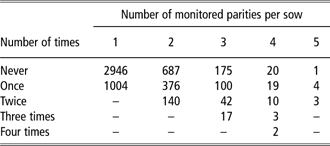
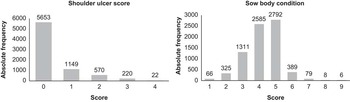
After editing, the data set contained information on 5549 Norwegian Landrace sows and their 7614 purebred litters. In 74.2% of the lactations, the sows developed no shoulder ulcer (score 0). During 15.1% of all lactations, sows were given a score of 1, during 7.5% a score of 2, during 2.9% a score of 3 and during 0.3% a score of 4 for shoulder ulcers. Descriptive statistics for the traits included in the genetic analysis are presented in Table 1. Owing to few observations for the higher scores of shoulder ulcers, the trait was categorized into two classes. Animals without shoulder ulcers were given score 1 and animals with shoulder ulcers were given score 2. Of the 1599 sows with several parities in the data set, 13.6% had shoulder ulcers more than once. The incidence of shoulder ulcers in consecutive parities are presented in Table 2.
Descriptive statistics for the sow traits in the genetic analysis made on 5549 Norwegian Landrace sows (7614 lactations) in 45 herds recorded between January 2008 and April 2010

11 = no shoulder ulcers at weaning and 2 = shoulder ulcers at weaning.
2Sow body condition was scored on a scale from 1 to 9 (from 1 = very thin to 9 = very fat) at weaning.
3Mean piglet weight was calculated from the individual weights of the piglets in the litter at 3 weeks.
Number of times shoulder ulcersFootnote 1 were observed in consecutive parities for 5549 Norwegian Landrace sows in 45 herds recorded between January 2008 and April 2010

1 Description of the scoring of shoulder ulcers at weaning: 0 = no ulcers, 1 = ulcers in the epidermal layer of the skin and sometimes with crust formation, 2 = ulcers in the epidermal/dermal layer of the skin with crust formation and scar tissue, 3 = ulcers in the subcutical layer of the skin and with crust formation and 4 = deep ulcers into the muscles, sometimes with visible shoulder bone.
All together, 45 Norwegian herds were represented in the data set. Out of these herds, 36 were nucleus herds (n = 5073 observations), 6 were multiplier herds (n = 356) and 3 were commercial herds (n = 120). The parity of the sows ranged from 1 to 8 and was in the analyses classified into three categories (1 for 1st parity sows, 2 for 2nd parity sows and 3 for sows in 3rd parity or older) as the number of sows in parities above 3 was low. The number of observations in the different parities and the frequency of sows grouped in 1st, 2nd or 3rd parity is presented in Table 3.
Distribution of observationsFootnote 1 between parities

1 Data from 5549 Norwegian Landrace sows (7614 lactations) in 45 herds recorded between January 2008 and April 2010.
2 Includes all observations from 3rd to 8th parity.
Average lactation length, 35 days (s.d. = 5.9), corresponded well to the lactation length of an average herd in Norway (Norsvin, 2010). The number of piglets born alive was on average 12.5 (s.d. = 3.24) and the number of piglets weaned was on average 10.5 (s.d. = 2.34). In nucleus herds, approximately 10% of the piglets are cross fostered according to the breeding organization (Norsvin, 2010). As the recordings of nursing sows to which piglets were entrusted were incomplete, cross fostering was ignored in the analyses. The pedigree was traced five generations back when possible and the final pedigree file included 9783 animals. In the studied herds, there was a 100% use of artificial insemination (AI) and the herds were genetically connected through the use of the same AI boars.
Both phenotypic and genetic analyses of the traits in focus for this study were performed. Sow body condition and mean piglet weight were analyzed as linear traits. Shoulder ulcers was analyzed as a binary trait in the phenotypic analysis and as a threshold trait (Gianola, Reference Gianola1982) in the genetic analysis. Distributions for the traits shoulder ulcers and sow body condition are presented in Figure 1.
Shoulder ulcers1 and sow body condition2 distributions in Norwegian Landrace sows3. (1Description of the scoring of shoulder ulcers at weaning: 0 = no ulcers, 1 = ulcers in the epidermal layer of the skin and sometimes with crust formation, 2 = ulcers in the epidermal/dermal layer of the skin with crust formation and scar tissue, 3 = ulcers in the subcutical layer of the skin and with crust formation and 4 = deep ulcers into the muscles, sometimes with visible shoulder bone. 2Sow body condition was scored on a scale from 1 to 9 (from 1 = very thin to 9 = very fat) at weaning. 3Data from 5549 Norwegian Landrace sows (7614 lactations) in 45 herds registered between January 2008 and April 2010.)

Phenotypic analyses
Phenotypic single-trait analyses were performed with the SAS software, version 9.1 (SAS Institute Inc., Cary, NC, USA). The significance of the effects of season and parity on shoulder ulcers were obtained with PROC GLIMMIX, using a binary distribution with a logit link function. The correlations between repeated observations within a sow were handled by specifying the compound symmetry covariance structure with sow as the subject. PROC GLIMMIX was assumed to have converged when the absolute change in parameter estimates between successive iterations was less than 1e−6. The following model was used for shoulder ulcers:

where Yijklm = shoulder ulcers, μ = general mean, hi = fixed effect of the ith herd, sj = fixed effect of the jth season, pk = fixed effect of the kth parity, b 1×1ijklm = regression on number of piglets weaned and b 2×2ijklm = regression on lactation length.
Least square (LS) means for the effect of season and parity on sow body condition and mean piglet weight were obtained with PROC MIXED. For mean piglet weight, the following model was used: Yijklm = μ + hi + sj + pk + b 1 × 1ijklm + b 2 × 2ijklm + aijkl + eijklm, where Yijklm = mean piglet weight, b 1 × 1ijklm = regression on number of piglets at weighing, b 2 × 2ijklm = regression on age (days) of the piglets at weighing, aijkl = random animal effect and eijklm = random residual effect. In the model used for sow body condition, b 1 × 1ijklm = regression on number of piglets weaned and b 2 × 2ijklm = regression on lactation length. The season used in the phenotypic analyses was the season of farrowing for all traits, and the season component in the phenotypic analyses corresponds to the year divided into quarters; January to March, April to June, July to September and October to December.
Genetic analysis
The genetic analysis was performed using the Gibbs sampling method with the program THRGIBBS1F90 developed by Tsuruta and Misztal (Reference Tsuruta and Misztal2006). The post-Gibbs analysis was performed using the program POSTGIBBSF90 (Misztal et al., Reference Misztal, Tsuruta, Strabel, Auvray, Druet and Lee2002). The total number of iterations was set to 500 000. The burn-in period was set to 50 000 iterations after graphical inspection of the plots of the sampled values v. iterations as proposed by Kass et al. (Reference Kass, Carlin, Gelman and Neal1998). Every 50th sample was saved and a total of 9000 samples were included in the post-Gibbs analysis. Incidence of shoulder ulcers, mean piglet weight and sow body condition were analyzed by multitrait animal models. The following model was used for shoulder ulcers:

where Yijklm = shoulder ulcers or sow body condition, μ = general mean, hi = fixed effect of the ith herd, ysj = fixed effect of the jth year×month combination, pk = fixed effect of the kth parity, b 1 × 1ijklm = regression on number of piglets weaned, b 2 × 2ijklm = regression on lactation length, peijkl = random permanent environmental effect and aijkl = random animal genetic effect.
For mean piglet weight, the following model was used: Yijklm = μ + hi + ysj + pk + b 1 × 1ijklm + b 2 × 2ijklm + peijkl + aijkl + eijklm, were Yijklm = mean piglet weight, b 1 × 1ijklm = regression on number of piglets at weighing, b 2 × 2ijklm = regression on age (days) of the piglets at weighing and eijklm = random residual effect. In the model used for sow body condition, b 1 × 1ijklm = regression on number of piglets weaned and b 2 × 2ijklm = regression on lactation length. The month used in the year×month combination was the month of farrowing for all traits. Owing to few observations in some months, the observations were sometimes grouped. The phenotypic variance was calculated from each of the saved samples as σ p2 = σ a2 + σ pe2 + σ e2. The heritability was calculated as σ a2/σ p2 and the repeatability as (σ a2 + σ pe2)/σ p2.
Results
Phenotypic analysis
The effect of herd on shoulder ulcers was significant (P < 0.0001). In one of the herds, only 2% of the sows were affected compared with >50% of the sows in the herds with the highest frequencies of shoulder ulcers. There was a significant effect of farrowing season on shoulder ulcers (P = 0.0004). From July to September, 29% of the sows had shoulder ulcers, compared with an average of 24% for the other quarters. Lactation length had a significant effect on shoulder ulcers (P < 0.0001). Sows with longer lactation length had a greater risk of developing shoulder ulcers. There was also a significant effect of number of piglets weaned on shoulder ulcers (P < 0.0001); sows with large litters were more affected. First-parity sows had less shoulder ulcers, lower body condition and lower mean piglet weight than older sows (Table 4).
Frequency of sowsFootnote 1 without shoulder ulcers at weaning, sow body condition and mean piglet weight least square meansFootnote 2 by parityFootnote 3

1 Data from 5549 Norwegian Landrace sows (7614 lactations) in 45 herds registered between January 2008 and April 2010.
2 Values with different superscripts within row differ significantly (P < 0.05).
3 3rd parity includes parity 3 to 8.
4 Sow body condition was scored on a scale from 1 to 9 (from 1 = very thin to 9 = very fat) at weaning.
5 Mean piglet weight was calculated from the individual weights of the piglets in the litter at 3 weeks.
Genetic analysis
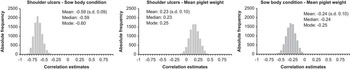
Variance component estimates and effective sample sizes are presented in Table 5. The effective sample size for the estimated variance components varied from 80 to 4428. The repeatabilities were 0.36, 0.25 and 0.28 for shoulder ulcers, sow body condition and mean piglet weight, respectively. Heritability and correlation estimate distributions are presented in Figures 2 and 3, respectively. The differences between mean, mode and median values of each estimate were all very small. The environmental correlation between shoulder ulcers and sow body condition was −0.37 (s.d. = 0.03). The environmental correlation between shoulder ulcers and mean piglet weight was −0.04 (s.d. = 0.03) and between sow body condition and mean piglet weight 0.10 (s.d. = 0.02).
Shoulder ulcers, sow body condition and mean piglet weight variance component estimatesFootnote 1 from Norwegian Landrace sowsFootnote 2

1 Estimated variance components with posterior s.d. as subscript and effective sample size for the traits shoulder ulcer, body condition at weaning and mean piglet weight.
2 Data from 5549 Norwegian Landrace sows (7614 lactations) in 45 herds recorded between January 2008 and April 2010.
3 σ a2 = additive genetic variance, σ pe2 = permanent environmental variance and σ e2 = residual variance.
4 Categorized as no shoulder ulcers (1) or shoulder ulcers (2) at weaning.
5 Sow body condition was scored on a scale from 1 to 9 (from 1 = very thin to 9 = very fat) at weaning.
6 Mean piglet weight was calculated from the individual weights of the piglets in the litter at 3 weeks.
Marginal posterior distribution of heritability estimates for shoulder ulcers1, sow body condition2 and mean piglet weight3 from Norwegian Landrace sows4. (11 = no shoulder ulcers at weaning, 2 = shoulder ulcers at weaning. 2Sow body condition was scored on a scale from 1 to 9 (from 1 = very thin to 9 = very fat) at weaning. 3Mean piglet weight was calculated from the individual weights of the piglets in the litter at 3 weeks. 4Data from 5549 Norwegian Landrace sows (7614 lactations) in 45 herds recorded between January 2008 and April 2010.)

Marginal posterior distribution of genetic correlation estimates for shoulder ulcers1, sow body condition2 and mean piglet weight3 from Norwegian Landrace sows4. (11 = no shoulder ulcers at weaning, 2 = shoulder ulcers at weaning. 2Sow body condition was scored on a scale from 1 to 9 (from 1 = very thin to 9 = very fat) at weaning. 3Mean piglet weight was calculated from the individual weights of the piglets in the litter at 3 weeks. 4Data from 5549 Norwegian Landrace sows (7614 lactations) in 45 herds recorded between January 2008 and April 2010.)

Discussion
Considerable work has been performed to describe the effect of environmental and biological factors on shoulder ulcers (Davies et al., Reference Davies, Morgan Morrow, Rountree and Miller1997; Bonde et al., Reference Bonde, Rousing, Badsberg and Sørensen2004; Cleveland-Nielsen et al., Reference Cleveland-Nielsen, Bækbo and Ersbøll2004; Rolandsdotter et al., Reference Rolandsdotter, Westin and Algers2009). To our knowledge, only few attempts have been made to estimate genetic parameters of shoulder ulcers (Bradley, Reference Bradley2005). Thus the following discussion, if not stated otherwise, includes comparisons with results from phenotypic studies.
The phenotypic analysis in the present study showed that the frequency of shoulder ulcers was 5 percentage points greater during July to September than during the rest of the year. This could be due to several reasons, such as increased lying bouts and lower feed intake due to increased temperature in the stable (Bonde et al., Reference Bonde, Herskin, Jørgensen and Hjelholt Jensen2007). The data set for this study consisted of purebred Norwegian Landrace sows. In a Canadian study, Landrace and Duroc sows were more likely to develop shoulder ulcers than Yorkshire sows (Zurbrigg, Reference Zurbrigg2006). When comparing the three breeds, Zurbrigg (Reference Zurbrigg2006) found that the risk of developing shoulder ulcers was 3.0 times greater for Landrace sows and 4.6 times greater for Duroc sows, as compared with Yorkshire sows. Breed combination in crossbred sows may also have an effect on the presence of shoulder ulcers (Bonde et al., Reference Bonde, Herskin, Jørgensen and Hjelholt Jensen2007). Anatomical, physiological (e.g. stress response, immune response), as well as behavioral differences, may explain some of the variation in shoulder ulcers between breeds. Further studies of breed effects on shoulder ulcers could be of value for the pig production industry in the choice of breed combinations.
Ivarsson et al. (Reference Ivarsson, Mattson, Lundeheim and Holmgren2009) reported that the development of shoulder ulcers increased from the 4th to the 5th lactation week. Furthermore in the present study, there was a significant effect of lactation length on the incidence of shoulder ulcers. As there is a parent–offspring conflict linked to lactation length (Bøe, Reference Bøe1991), it would be interesting to study more specifically when the shoulder ulcers appear and the effect of lactation length.
The heritability for shoulder ulcers was estimated at 0.25 on the underlying scale. This can be considered as a high value as the measure of the trait shoulder ulcers was relatively rough. In this study, we did not use all the available information from the recordings, as we used an affected/not affected approach in the analysis. The goal in pig production should be ‘no sows with shoulder ulcers in the herds’, which could justify this simplification. The heritability of body condition was estimated at 0.14 in this study. Grandinson et al. (Reference Grandinson, Rydhmer, Strandberg and Solanes2005) estimated heritability of backfat loss (ultrasonic measurement) and weight loss during lactation at 0.10 and 0.20, respectively, using data from an experimental herd. Borg et al. (Reference Borg, Notter and Kott2009) estimated heritabilities for body condition in ewes and these results were similar to the present findings. In their study, heritability for body condition during lactation was estimated at 0.13 and after weaning the lambs at 0.15. The heritability estimate for mean piglet weight in this study (0.23) was comparable with previously published reports (Högberg and Rydhmer, Reference Högberg and Rydhmer2000) and previous estimates from the Norwegian Landrace population (Canario et al., Reference Canario, Lundgren, Haandlykken and Rydhmer2010; Lundgren et al., Reference Lundgren, Canario, Grandinson, Lundeheim, Zumbach, Vangen and Rydhmer2010).
In this study, the genetic correlation between mean piglet weight and body condition was negative (−0.24). This is lower than the correlation reported by Grandinson et al. (Reference Grandinson, Rydhmer, Strandberg and Solanes2005), who estimated the genetic correlation between loss in body weight during lactation and piglet growth to −0.85 using data from a research herd. Milk production is costly for the sow and a large, heavy litter can result in poor sow body condition as a consequence of the sow utilizing body tissue reserves (Valros et al., Reference Valros, Rundgren, Spinka, Saloniemi, Rydhmer, Hulten, Uvnäs-Moberg, Tomanek, Krejci and Algers2003; Grandinson et al., Reference Grandinson, Rydhmer, Strandberg and Solanes2005). The genetic correlation between shoulder ulcers and sow body condition was also negative (−0.59). Sows with poor body condition have an increased risk of developing shoulder ulcers. This fact is well documented on a phenotypic level in the literature (Davies et al., Reference Davies, Morgan Morrow, Rountree and Miller1997; Bonde et al., Reference Bonde, Rousing, Badsberg and Sørensen2004; Zurbrigg, Reference Zurbrigg2006; Knauer et al., Reference Knauer, Stalder, Karriker, Baas, Johnson, Serenius, Layman and McKean2007; Ivarsson et al., Reference Ivarsson, Mattson, Lundeheim and Holmgren2009). The genetic correlation between shoulder ulcers and mean piglet weight was low but positive and thus unfavorable (0.23). The genetic ability to raise heavy piglets increases the risk of shoulder ulcers. This is in agreement with the phenotypic study by Zurbrigg (Reference Zurbrigg2006), which showed that increased litter weaning weight increases the risk of developing shoulder ulcers. In general, high-producing sows are definitely more at risk of developing shoulder sores than sows with a lower production.
In the present findings, 1st parity sows had lower body condition score at weaning compared with older sows. First-parity sows are not able to consume a sufficient quantity of food in order to fully compensate for the high-energy requirements during lactation (Eissen et al., Reference Eissen, Kanis and Kemp2000). The body resources available for production and reproduction are limited, and there is a trade-off between different processes in an animal such as maintenance, own growth, reproduction or growth of offspring (Beilharz et al., Reference Beilharz, Luxford and Wilkinson1993). Thus, there is a conflict concerning nutrient allocation between the needs of a sow's current litter and the sow's own needs. Indeed, besides resources for milk production, the young sow is still growing (Whittemore, Reference Whittemore1996). In the present findings, there was a significant effect of litter size at weaning on shoulder ulcers. Litter size was lower in 1st parity sows than in later parities (10.6 piglets v. 11.1 piglets at weaning, results not shown). However, the incidence of shoulder ulcers from 1st parity sows was significantly lower when compared with older sows, even when the correction for litter size was applied to the model. This could be related to the fact that older sows raise heavier piglets, or maybe to aging in itself or longer exposure to unfavorable environmental effects.
Shoulder ulcers are more common in sows with leg disorders (Bonde et al., Reference Bonde, Rousing, Badsberg and Sørensen2004; Knauer et al., Reference Knauer, Stalder, Karriker, Baas, Johnson, Serenius, Layman and McKean2007), and postpartum dysgalactia syndrome is known to increase the risk of developing shoulder ulcers (Ivarsson et al., Reference Ivarsson, Mattson, Lundeheim and Holmgren2009). Selection for robust pigs may thus decrease the risk of shoulder ulcers. Both inferior health and stress may increase the time sows spend lying down (Bonde et al., Reference Bonde, Herskin, Jørgensen and Hjelholt Jensen2007) and increased time lying down increases the risk of developing shoulder ulcers (Rolandsdotter et al., Reference Rolandsdotter, Westin and Algers2009).
In all Scandinavian countries, shoulder ulcers is a large part of the sow welfare discussion and action plans against shoulder ulcers are developed (Ministry of Food, Agriculture and Fisheries, Denmark; Animalia, Norway; Swedish Animal Health Service, Sweden). However, the conditions differ when it comes to the legal ramifications. In Denmark, fines and jail terms are imposed for marketing sows with shoulder ulcers (Dyrevaernsloven, retsinformation.dk; Ministry of Food, Agriculture and Fisheries, Denmark). In total, 619 cases have been reported to the police during 2004 to 2009 (Mousing et al., Reference Mousing, Noergaard, kirkeskov Jensen, Havbroe Andersen, Lindahl, Damm, Fraas Johnsen, Hjelholt Jensen, Gulisano, Auken, Rosenberg Khawaja, Caspersen, Feldstedt and Groen Pedersen2008). Focus has been on estimating genetic parameters for shoulder ulcers in this study, but in a longer perspective the aim is to decrease the frequency of shoulder ulcers by selection. An economic weight has to be calculated before shoulder ulcers can be included in a genetic evaluation. Economic costs of treatments, extra work, extra replacement of sows and loss of carcass value can be calculated. The costs of low pig welfare and possible losses due to consumers’ mistrust in pork production are more difficult to predict (Olesen et al., Reference Olesen, Groen and Gjerde2000). More weight on traits important for sow welfare included in the genetic evaluation will slow down the progress in production traits (Gourdine et al., Reference Gourdine, de Greef and Rydhmer2010), and this cost should also be taken into account. One way forward is to define an economic weight by the desired-gains approach as suggested by Kanis et al. (Reference Kanis, de Greef, Hiemstra and van Arendonk2005). In the first step, this desired gain could be no further deterioration of shoulder health.
Conclusions
Shoulder ulcers in lactating sows are heritable and sows producing heavier piglets have a higher risk of developing shoulder ulcers when compared with other sows. Owing to the genetic correlations between shoulder ulcers and mean piglet weight as well as sow body condition, it is important to take into account shoulder ulcers in breeding programs in order to improve sow welfare and to avoid associated economic losses.
Acknowledgements
This study was financed by the Swedish Farmers’ Foundation for Agricultural Research (SLF). Data were provided by The Norwegian Pig Breeders Association (Norsvin). We thank Freddy Fikse for valuable advice. Last but not least, the authors would like to thank the farmers for their contribution through the work with the recordings.