INTRODUCTION
Fruit–frugivore interactions mediate seed dispersal in the majority of plant species in tropical wet forests. For example, of the woody species in a Costa Rican wet forest, more than 90% are dispersed by animals (Chazdon et al. Reference CHAZDON2003). Birds are an important guild of seed-dispersing vertebrates in these forests where often a third of all bird species depend wholly or in part on fruit (Blake et al. Reference BLAKE, STILES, LOISELLE and Gentry1990). Few studies have examined how fruit–frugivore interactions are affected by changes in land-use by people. Yet research examining such questions is urgently needed, especially in tropical countries where 350 million ha were deforested between 1950 and 2000 (ITTO 2002).
We examined how fruit–frugivore interactions differ between young-secondary forest and old-growth forest. Young-secondary forests differ from old-growth forests in light levels (Chazdon & Fetcher Reference CHAZDON and FETCHER1984), soil nutrients (Fernandes & Sanford Reference FERNANDES and SANFORD1995), bird species composition (Blake & Loiselle Reference BLAKE and LOISELLE2001, Blake et al. Reference BLAKE, STILES, LOISELLE and Gentry1990), and the abundance of both frugivorous birds (Blake & Loiselle Reference BLAKE and LOISELLE1991, Reference BLAKE and LOISELLE2001; Levey Reference LEVEY1988a) and fruiting plants (Blake & Loiselle Reference BLAKE and LOISELLE1991, Levey Reference LEVEY1988a, Loiselle & Blake Reference LOISELLE and BLAKE1990). Each or a combination of these factors could influence fruit–frugivore interactions via availability and allocation of resources to fruits by plants, densities and behaviours of frugivorous birds, or both. We examined two factors by which forest age may influence fruit–frugivore interactions: (1) fruit sugar concentration and (2) fruit removal rates.
Sugar concentrations in fruits may be expected to be higher in plants growing in young-secondary forest than in plants growing in old-growth forest for two reasons. First, young-secondary forest plants may invest more in fruit nutrients because of evolutionary adaptations to higher competition for dispersers. Despite frugivorous birds being more abundant in young-secondary forest than in old-growth forest, fruits are also more abundant. Consequently many fruits go uneaten and seeds fall to the ground below the parent plant (Blake & Loiselle Reference BLAKE and LOISELLE1991, Levey Reference LEVEY1988a, Loiselle & Blake Reference LOISELLE and BLAKE1990). This excess of uneaten fruit suggests a lower ratio of frugivores to fruit in young-secondary forests, so competition among plants for dispersers should be higher. Because frugivorous birds choose fruits with higher sugar concentrations (Levey Reference LEVEY1987b), young-secondary forest species may thus invest more resources in fruit sugars than old-growth forest species where competition for dispersers is thought to be less intense. Second, plastic physiological responses of plants to increased light levels should also result in increased sugar concentrations (Watson et al. Reference WATSON, WRIGHT, MCBURNEY, TAYLOR and LINFORTH2002). Understorey plants tend to be light-limited (Montgomery & Chazdon Reference MONTGOMERY and CHAZDON2001), and more light reaches the forest floor in young-secondary forests than in old-growth forests (Chazdon & Fetcher Reference CHAZDON and FETCHER1984), so plants growing in young-secondary forests may have more energy to allocate to fruit sugars than plants growing in old-growth forest. Thus, higher sugar concentrations in fruits produced in young-secondary forest relative to old-growth forest may indicate either an adaptive response to increased competition for dispersers predicting species-level differences among plants growing in different environments; or it may indicate a direct response to light availability predicting individual-level variation within the same plant species growing in both environments.
Fruit removal rates may also be affected by forest age because young-secondary forests are home to a characteristic suite of both bird and plant species that rarely grow in old-growth forests and vice versa (Blake & Loiselle Reference BLAKE and LOISELLE2001, Blake et al. Reference BLAKE, STILES, LOISELLE and Gentry1990). Three alternative hypotheses (which differ in the ratio of frugivorous birds to fruits and the degree to which local adaptation has shaped fruiting traits) predict differing patterns of fruit removal between forests of different ages which can be compared to the null hypothesis of no effect of forest age on fruit removal. If the higher abundance of frugivorous birds in young-secondary forests (Blake & Loiselle Reference BLAKE and LOISELLE1991, Reference BLAKE and LOISELLE2001; Levey Reference LEVEY1988a) results in a higher ratio of frugivores to fruit in young-secondary forest than in old-growth forest, then by experimentally manipulating fruiting branch locations we would expect higher fruit removal rates in young-secondary forest regardless of where the plant had grown. If, however, the lower availability of fruit in old-growth forest (Blake & Loiselle Reference BLAKE and LOISELLE1991, Levey Reference LEVEY1988a, Loiselle & Blake Reference LOISELLE and BLAKE1990) results in a higher ratio of frugivores to fruit in old-growth forest than in young-secondary forest, then we would expect higher fruit removal rates in old-growth forest regardless of where the plant had grown. Finally, if fruit traits have been shaped by the local selective environment (including disperser community), then we would expect higher fruit removal rates in the forest in which the plant commonly grows. This is a plausible alternative given that bird species differ in their visual capabilities (Ödeen & Håstad Reference ÖDEEN and HÅSTAD2003), plant signals are affected by light environment (Schaefer et al. Reference SCHAEFER, SCHAEFER and LEVEY2004), and both bird community composition and light levels are affected by forest age.
We examined how fruit sugar concentration and removal are affected by forest age in a lowland tropical rain forest in Costa Rica. We determined if sugar concentrations were higher in fruits of young-secondary forest plants than in fruits of old-growth forest plants by comparing both (1) fruits from species characteristic of each forest and (2) fruits from a species that commonly grows in both forests. To examine how fruit removal rate is affected by forest age we manipulated the location of fruiting branches and monitored subsequent removal rates.
METHODS
We conducted experiments during June–July 2007 at La Selva Biological Station in north-eastern Costa Rica (10°25′ N, 84°01′ W, elevation 30–120 m asl). Much of the forest in the region was cleared for cattle grazing over the past century (Butterfield Reference BUTTERFIELD, McDade, Bawa, Hespenheide and Hartshorn1994). Pasturelands around La Selva Biological Station nearly doubled from 1973 to 1983, and many of the cleared pastures have been abandoned to succession, creating new areas of young-secondary forest (Butterfield Reference BUTTERFIELD, McDade, Bawa, Hespenheide and Hartshorn1994). La Selva Biological Station contains forests of various ages including 834 ha of old-growth forest. We made comparisons between plants growing in 409 ha of young-secondary forest (i.e. ≤ 24 y old) and plants growing in old-growth forest understorey located ≥ 100 m from edges or boundaries with younger forest. A detailed description of the forests at La Selva can be found in Hartshorn (Reference HARTSHORN and Janzen1983) and Pringle et al. (Reference PRINGLE, CHACON, GRAYUM, GREENE, HARTSHORN, SCHATZ, STILES, GOMEZ and RODRIGUEZ1984).
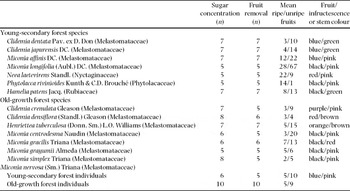
We chose plant species if they were bearing fruit at the time of the study, dispersed by small understorey frugivorous birds, fruiting within 3 m of the ground, and common enough to enable us to locate several fruiting individuals. We considered a plant to be bird-dispersed if it bore ripe fleshy fruits ≤ 1.5 cm in diameter that produced a visible liquid when squeezed gently between the fingers, and had been found in faecal samples of frugivorous birds in the region (Blake & Loiselle Reference BLAKE and LOISELLE1992, Boyle Reference BOYLE2006). We classified each plant species as either adapted to high-light environments and found growing in young-secondary forests, or adapted to low-light environments and found growing in old-growth-forest understorey. This species-level classification of light and forest age association was based on the locations we encountered plants (over 5-y experience at the site by W. A. Boyle) as well as independent classification by a local botanical expert (over 20-y experience at the site). Of the 15 species, seven were classified as young-secondary forest species and seven as old-growth forest species (Table 1). We also chose one plant species, Miconia nervosa (Sm.) Triana, which commonly grows in both forests. For each species we measured sugar concentrations and estimated fruit removal rates based on 5–10 (mean ± SE = 6.6 ± 0.3) individual plants (Table 1).
Plant species grouped by forest age classification. For each species we present the number of individuals from which we obtained sugar concentration data and the number of individuals involved in fruit removal experiments. The mean number of ripe and unripe fruits per mounted branch, and both fruit and infructescence or stem colour data (depending on infructescence type) provide additional data on factors that many influence fruit removal rates.

To determine the effect of forest age on fruit sugar concentration, we calculated mean sugar concentrations for each individual by measuring the sugars in the juice of 1–5 (mean ± SE = 4.1 ± 0.1) ripe fruits using a hand-held refractometer (RHBN-32ATC, 0–32% Brix range). We determined ripeness of fruits by colour (Table 1). When possible we collected each fruit from a different fruiting branch. We examined interspecific variation in fruit sugar concentrations (square root-transformed) as a function of forest age using a two-factor nested ANOVA (forest age classification with the 14 plant species nested within forest age classification). To examine intraspecific investment in fruits as a function of forest age, we compared mean sugar concentrations (square root-transformed) in Miconia nervosa fruits from young-secondary forest and old-growth forest individuals using a t-test.
To determine the effects of forest age on fruit removal, we compared proportions of fruit removed from paired fruiting branches from the same individual simultaneously mounted in young-secondary and old-growth forest. We chose the same plants on which we measured sugar concentration when those plants bore at least two separate branches with ripe fruit. We controlled for differences in fruit crop size by removing fruits from the larger fruiting branch, equalizing quantities of both ripe and unripe fruits on the two branches (see Table 1 for mean number of fruits on branches). The paired experimental design allowed us to control for many confounding variables (such as plant location, age, health, and individual investment in fruit) which could influence fruit removal by birds.
We mounted fruiting branches 1–2 m above the ground on 1–5-cm diameter horizontal branches of understorey plants of species not bearing fruit during our study. We chose mounting locations near markers located at 50-m intervals along trails, as these markers were inconspicuous and located randomly with respect to vegetation and landscape features. We mounted branches ≥ 2 m into forest from cleared areas along trails. We used each marker only once during the study to avoid recognition of experimental branches by resident birds which could locally increase removal rates. We mounted one fruiting branch in young-secondary forest by the marker nearest to, but ≥ 100 m from the parent plant and the other in old-growth forest understorey by the nearest available marker relative to the first fruiting branch (and always ≥ 100 m from old-growth forest edges). We avoided mounting branches in treefall gaps because such gaps in old-growth forest resemble secondary forest in fruit abundance, bird abundance and light availability (Blake & Hoppes Reference BLAKE and HOPPES1986, Levey Reference LEVEY1988a, Reference LEVEYb; Wunderle et al. Reference WUNDERLE, WILLIG and PINTO-HENRIQUES2005). To preserve visual cues that birds may use in plant species recognition, we ensured that each fruiting branch was subtended by 1–6 of its own leaves. To prevent desiccation and maintain freshness of fruiting branches, we wrapped wet cotton and plastic wrap over the cut end of the stem. We then camouflaged the cut end by wrapping a leaf around the base of the fruiting branch and secured the fruiting branches with green wire ties.
We quantified fruit removal by counting the number of ripe and unripe fruits on each fruiting branch at 24 h and 48 h after mounting. We removed pairs of fruiting branches after 24 h if either all ripe fruits had been removed, or the branch had wilted on one or both of the branches in a pair (12 individuals). Occasionally we were unable to check branches after 24 h due to difficulties accessing plants during bad weather. Thus, for seven pairs of branches, we only have data on the proportion of fruit removed after 48 h. However, pairs of fruiting branches from the same individual were always mounted for the same duration, and we calculated the average proportion of fruit removed per 24-h period. These methods permitted analysis of all pairs together, regardless of whether they were mounted for 24 h or for 48 h. We assumed that all fruits that disappeared between checks had been consumed by birds. Thus, the number of fruits removed from each fruiting branch equalled the initial sum of ripe and unripe fruits minus the final sum of ripe and unripe fruits. These calculations allowed us to account for removal of fruits that ripened during the experiment.
We compared removal rates by calculating the difference in the proportion of fruits removed from the branch mounted in young-secondary forest and the branch mounted in old-growth forest. We calculated the proportion of fruits removed for each of the paired fruiting branches by dividing the number of fruits removed by the number of ripe fruits that had been available for removal during the experiment (i.e. the number of fruits removed plus the number of ripe fruits still available when the branch was removed). For all branches that had been mounted for 48 h we divided the proportion of fruit removed by 2. We then calculated the difference between the two proportions by subtracting the proportion of fruits removed from the branch mounted in old-growth forest from the proportion of fruits removed from the branch mounted in young-secondary forest. Values of 0 indicated that equal proportions of fruit were removed from both branches; values > 0 indicated that a greater proportion of fruits was removed from the branch mounted in young-secondary forest; and values < 0 indicated that a greater proportion of fruits was removed from the branch mounted in old-growth forest. We examined interspecific difference in proportions of fruit removed as a function of forest age using a two-factor nested ANOVA (forest age classification, and the 14 plant species nested within forest age). We examined intraspecific difference in proportions of fruit removed as a function of forest age for individuals of Miconia nervosa from young-secondary forest and old-growth forest using a t-test.
Our analytical methods assume similar rates of fruit removal over the first and second 24-h periods that most of the branches were mounted. To verify this assumption, we conducted two further sets of analyses. First, we took the two subsets of our data for which either 24-h (n = 90) or 48-h (n = 85) data were available and repeated all analyses on the restricted datasets. Results based on both restricted datasets were qualitatively identical to the results obtained using the full dataset. Therefore we report only the results of the full dataset below. Second, we compared the proportion of fruit removed during the first and the second 24-h periods out of the total number of fruits removed in 48 h for the 78 individuals (including 12 Miconia nervosa) for which we have data from both days. We compared these proportions using t-tests, separately analysing branches mounted in young-secondary and branches mounted in old-growth forest.
RESULTS
We collected sugar concentration data from 106 plants of 15 species. Of those, we collected fruit removal data from 97 individuals; nine plants did not produce sufficient fruit to include in the fruit-removal experiment. The 15 species belonged to four plant families. All seven of the young-secondary-forest species, five of the old-growth forest species, as well as Miconia nervosa belong to Melastomataceae. Sample sizes were comparable for young-secondary forest and old-growth forest environments with 49 individuals from young-secondary forest, and 57 individuals from old-growth forest. We detected no consistent differences in external fruit characteristics between young-secondary forest and old-growth forest species (Table 1).
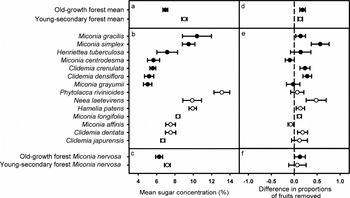
Sugar concentration means were on average 2.1 percentage points higher for fruits of species growing in young-secondary forest (least squares mean ± SE; 9.0% ± 0.3%) than for fruits of plants growing in old-growth forest (6.9% ± 0.3%; F13, 76 = 9.1, P < 0.001; Figure 1a). Mean sugar concentrations varied roughly two-fold among different plant species, ranging from a low of 5.0% ± 0.5% in fruits of Miconia grayumii to a high of 13.1% ± 0.8% in fruits of Phytolacca rivinioides (Figure 1b). Among individual Miconia nervosa, fruit sugar concentrations in young-secondary forest individuals did not differ significantly from those of old-growth forest individuals (7.2% ± 0.4% vs. 6.3% ± 0.3%; t = 1.6, df = 14, P = 0.126; Figure 1c). However, trends in these data reflect results of interspecific comparisons, and a power analysis revealed that by adding only 10 more individuals, observed differences in mean sugar concentrations in young-secondary and old-growth forest individuals of Miconia nervosa would be significant at P < 0.05.
Sugar concentrations (least squares mean ± SE) of fruits growing in young-secondary and old-growth forest (a–c), and mean difference in the proportions of fruit removed (± SE) from paired fruiting branches taken from the same individual plant mounted in either young-secondary forest or old-growth forest (d–f). Positive values indicate that proportionately more fruits were removed from the branch mounted in young-secondary forest, negative values indicate that proportionately more fruits were removed from the branch mounted in old-growth forest, and the dashed line indicates equal proportions of fruit removed in forests of both ages. For both sugar concentration and fruit removal we plot overall means for all young-secondary forest species and all old-growth forest species (a, d), separate species means calculated using data for all individuals within a species (b, e), and mean values for young-secondary forest individuals and old-growth forest individuals of Miconia nervosa (c, f). Open circles represent plants growing in young-secondary forest and filled black circles represent plants growing in old-growth forest.

The overall mean difference in proportions of fruits removed from both young-secondary forest species (0.13 ± 0.05) and old-growth forest species (0.18 ± 0.06) was > 0 indicating that removal rates were generally higher in young-secondary forest than in old-growth forest regardless of where plants grew (Figure 1d). Indeed, all but three species of Miconia (including two old-growth forest species) reflected the overall pattern with higher fruit removal rates in young-secondary forest than in old-growth forest (Figure 1e). The difference in proportions of fruits removed did not vary overall between young-secondary forest and old-growth forest species (F13, 68 = 1.6, P = 0.111), nor between Miconia nervosa young-secondary forest (0.07 ± 0.19) and old-growth forest (0.12 ± 0.12) individuals (t = −0.3 df = 13, P = 0.795; Figure 1f). Despite the similarity in results obtained from both full and restricted datasets, the proportion of fruits removed did increase between the first and the second 24-h periods for branches mounted in young secondary forest (0.27 ± 0.04 vs. 0.47 ± 0.05; t = −2.7, df = 77, P < 0.001) but did not differ for branches mounted in old-growth forest (0.24 ± 0.04 vs. 0.34 ± 0.05; t = −1.5, df = 77, P = 0.129).
DISCUSSION
Results of this study indicate that plant species adapted to high-light young-secondary forests have higher fruit sugar concentrations than plant species adapted to growth in the low-light understorey of old-growth forest. Furthermore, regardless of where fruits were grown, fruit removal rates were higher in young-secondary forest for more than 75% of the species we studied implying that successional forests may present better overall conditions for seed dispersal than old-growth forest if fruit removal rates reflect seed dispersal probability. Higher sugar concentrations in fruits of young-secondary forest species relative to old-growth forest species (and not among individuals of Miconia nervosa) suggest that variation in fruit sugars may be due to competition for dispersers in fruit-rich environments leading to increased investment of resources for attracting seed-dispersing birds. However, ruling out the role of plastic physiological responses in contributing to this variation may be premature given the trends observed in the intraspecific data. The results of our fruit-removal experiment are consistent with the hypothesis that young-secondary forests have higher ratios of frugivores to fruits than old-growth forest, and consequently plants experience increased fruit-removal rates independent of fruit nutrient investment. Likewise, our results are inconsistent with the hypotheses that fruits are best adapted to removal in the environment in which they grow and that low food availability in old-growth forest understorey relative to young-secondary forest results in a more severe food limitation for avian seed dispersers in old-growth forest. Although we found differences in removal rate over time in young-secondary forest but not old-growth forest, these results were not of a magnitude to affect our conclusions generally. However, these differences do suggest that the behaviour of frugivores foraging in forests of different ages may differ and the nature of those differences merits further exploration.
In combination, the results of the two components of our study provide conflicting evidence regarding the role of competition for dispersal agents in shaping fruiting traits of plants. On one hand the sugar concentration results suggest that young-secondary forest species invest more in fruit sugars due to adaptive responses to competition for dispersers in young-secondary forest. Yet if competition for dispersers is more intense in young-secondary forests, one would not expect fruit removal rates to be higher in those environments. Indeed, one would predict either no difference among forests of different ages, or lower fruit removal rates in young-secondary forest. One possible interpretation of these results is to reconsider the physiological explanation for higher fruit sugar concentrations in young-secondary forest plants. Our failure to demonstrate an intraspecific difference in sugar concentrations (as would be expected under this hypothesis) may be due to micro-habitat associations of Miconia nervosa individuals. If Miconia nervosa only grows in relatively high-light situations in old-growth forest, the effect of forest age may not be evident in our relatively small intraspecific dataset, whereas in the larger dataset, we may have the power to find a forest age effect despite random variation in micro-habitat.
Other plant and bird traits we did not consider could influence removal rates as plants exploit a varied suite of signals to attract dispersers. For example, many birds are able to detect UV reflectance of fruits (Altshuler Reference ALTSHULER2001). Possibly measuring the reflectance spectra of young-secondary and old-growth forest species fruits would reveal consistent differences in brightness and contrast in the UV range. Additionally, birds may be able to remember the spatial location of different food types (Sanford & Clayton Reference SANFORD and CLAYTON2008), and so the identity of plants in the neighbouring community may influence fruit choice by birds. The higher rate of fruit removal in young-secondary forest of most species may be the result of facilitation due to neighbouring highly attractive fruiting plants (Carlo Reference CARLO2005).
A potential pitfall in interpreting the results of comparative studies such as ours is that variation in fruiting traits among species may not reflect adaptation to an environment, but rather shared phylogenetic history (Jordano Reference JORDANO1995). Unfortunately, a species-level phylogeny for all of the species used in this study is currently unavailable. However, accounting for phylogeny would be unlikely to alter the conclusions of our study because 80% of the species we studied belong to the same plant family, and 11 of the 15 species belong to genera represented by both young-secondary forest and old-growth forest. Thus, it is more likely that higher fruit sugar concentrations in young-secondary forest species represent adaptation to current ecological conditions rather than representing conserved traits that evolved in response to historical ecological conditions.
Higher sugar concentrations and fruit removal rates in young-secondary forests may influence seed-dispersal dynamics of old-growth forest edges bordered by young-secondary forests. Admittedly, fruit removal rates may not translate directly into seed-dispersal success due to differences in seed-dispersal quality by the frugivores in forests of different ages. For example, seed dispersal success depends in part on the manner in which the bird consumes fruit (Levey Reference LEVEY1987a), as well as the location that seeds are deposited (Loiselle & Blake Reference LOISELLE and BLAKE1999). However, seeds cannot be dispersed if they are not first removed from the plant, so our measure of fruit-removal success serves as a proxy for the number of seeds potentially dispersed. One possible scenario is that plants in old-growth forests bordered by young-secondary forest will experience decreased dispersal rates if frugivorous birds venture away from old-growth forest sites to forage preferentially in young-secondary forests (although Restrepo et al. Reference RESTREPO, GOMEZ and HEREDIA1999 failed to find evidence of such processes). If sweeter young-secondary forest fruits draw old-growth forest birds into disturbed areas where they disperse old-growth forest seeds, such movements will facilitate succession by increasing the rate at which young-secondary forest reverts to old-growth forest plant species composition. Such facilitation can only occur, however, where fragmentation and deforestation is not so severe as to inhibit the movements of frugivorous birds (Chazdon Reference CHAZDON, CAREAGA, WEBB and VARGAS2003, Martínez-Garza & Howe Reference MARTÍNEZ-GARZA and HOWE2003).
The degree to which frugivorous seed-dispersing birds shape plant fruiting traits is a matter of debate (Elzinga et al. Reference ELZINGA, ATLAN, BIERE, GIGORD, WEIS and BERNASCONI2007, Poulin et al. Reference POULIN, WRIGHT, LEFEBVRE and CALDERON1999, Stiles & Rosselli Reference STILES and ROSSELLI1993). While seed dispersal clearly ‘matters’ (Howe & Miriti Reference HOWE and MIRITI2000), selective pressures imposed by birds are often believed to be swamped by stronger selection imposed by pathogens that kill seeds and seedlings (Houle Reference HOULE1995) and by the inherent unpredictability of dispersal efficacy (Wheelwright & Orians Reference WHEELWRIGHT and ORIANS1982). This study contributes to the debate by providing more evidence for both the potential for avian selection on plant traits (differences in removal rates) as well as evidence of adaptation that may reflect past selection by birds (differences in sugar concentrations among species). From an applied perspective, these results are encouraging because they suggest that mutualistic interactions between fleshy-fruited plants and seed-dispersing birds may not be adversely affected by changes in forest age at the landscape level. Although both bird and plant community composition will undoubtedly be affected by conversion of old-growth forest to younger successional stages, in areas where patches of old-growth forest persist, the presence of young-secondary forest may increase the likelihood of the persistence of old-growth forest bird species by providing high-quality food resources.
ACKNOWLEDGEMENTS
This work was funded by the National Science Foundation Research Experience for Undergraduates (NSF-REU) and benefited from logistical assistance provided by the Organization for Tropical Studies (OTS). We thank O. Vargas for helping with plant identification and forest age classifications, C. Figuerola-Hernández for help in the field, and S. Letcher, J. Griffin and E. Powell for constructive criticism on earlier drafts of this manuscript.