It is difficult to overestimate the role candidate selection plays in determining the number of women in elected office. While an increasing amount of research has been dedicated to the impact political parties have on women's electoral representation (Caul Reference Caul1999; Davidson-Schmich Reference Davidson-Schmich2010; Kittilson Reference Kittilson2006; Krook Reference Krook2009, Reference Krook2010; Matland and Studlar Reference Matland and Studlar1996; Murray, Krook, and Opello, Reference Murray, Krook and Opello2012), the relationship between gender and candidate selection remains a relatively understudied area. Ashe and Stewart (Reference Ashe and Stewart2012) and Nieven (Reference Nieven1998), however, provide empirical evidence that the majority of the variance in women's underrepresentation can be explained with demand-side factors.
This research aims to take forward our knowledge of how the demand side influences women's underrepresentation by investigating at the individual level how party gatekeepers rank female candidates in electoral lists in different types of party list proportional representation systems (PR-list systems). The list placement of candidates is an important stage in the overall electoral competition. In first-past-the-post (FPTP) systems, a candidate's likelihood to be elected depends on the constituency in which she runs (Ryan, Haslam, and Kulich Reference Ryan, Haslam and Kulich2010). Similarly, in PR-list systems, a candidate's likelihood to be elected depends largely on her electoral list placement. Past research concentrating on FPTP systems provide evidence that women are often overrepresented among hopeless candidates (i.e., candidates competing for marginal seats) (see for example, Deber Reference Deber1982; Gertzog and Simard Reference Gertzog and Simard1981; Ryan, Haslam, and Kulich Reference Ryan, Haslam and Kulich2010). However, little comparative attention has been paid to women's likelihood of viable candidacy in different types of PR-list systems.
This paper sets out to investigate what determines how political parties—the gateway to political office—place women in the electoral lists in PR-list systems with and without preference voting option (ordered vs. closed-list PR-list systems). Most importantly, I concentrate on how varying combinations of parties' internal candidate selection procedures and certain electoral rules affect party gatekeepers' choices. Past research suggests that “with different electoral systems we could, and probably would, see different kinds of candidates' (Hazan and Voerman Reference Hazan and Voerman2006, 148). In other words, party gatekeepers, presented with varying electoral rules, compose the party lists differently.
I study this question in the context of the 2009 European Parliamentary (EP) elections. The EP elections provide an excellent testing ground for this research as 20 out of the 27 member states employ either a closed or ordered-list PR-list voting system. Also, these are the only PR-list elections for which there is a comprehensive cross-national candidate survey data set available—the 2009 European Election Study (EES) Candidate Survey. The results of the analysis suggest that viable candidate selection differs across institutional and contextual settings: women are placed lower in the electoral lists in ordered-list systems compared to closed-list systems. The results also show that party gatekeepers respond to the overall levels of gender equality in the society, with women enjoying more viable list rankings in more gender-equal societies, but only if the candidate selection within the party is centralized.
PARTY-DETERMINED VIABLE CANDIDACY IN PR-LIST SYSTEMS
While candidate selection is referred to as “the secret garden of politics” (Gallagher and Marsh Reference Gallagher and Marsh1988), it is one of the most important stages in the electoral process. Candidate selection not only determines the choices given to voters—which influences how the vote choice is perceived and made—but it also determines the composition of the parties in the legislature (Crotty Reference Crotty and Crotty1968; Hazan and Voerman Reference Hazan and Voerman2006).
Past research identifies four groups of variables affecting aspirants' chances in the candidate selection process: (1) individual characteristics summarizing the traits the selectors are looking for in a candidate; (2) party rules concerning who and at what level can elect/appoint candidates; (3) institutional settings conditioning the selectors' choices; and (4) wider contextual settings and selectors' perception of voter preferences (Gallagher and Marsh Reference Gallagher and Marsh1988; Hazan and Voerman Reference Hazan and Voerman2006; Katz Reference Katz1980; Norris Reference Norris1997). This article proceeds by covering the main expectations with regard to how these traditional predictors of candidate selection affect women's likelihood of viable candidacy. While the classic works on candidate selection examine the likelihood of aspirants to become a candidate, in this research I study what distinguishes a viable candidate from all other candidates. Therefore, the initial pool of cases from which viable candidates are “selected” is not all aspirants, but all candidates.
Individual Characteristics that the Selectors are Looking for
While most political parties do not have a set of formal requirements prospective candidates need to meet, party gatekeepers value candidates with traits such as incumbency, political experience, and party loyalty (Gallagher and Marsh Reference Gallagher and Marsh1988; Shugart, Valdini, and Suominen Reference Shugart, Valdini and Suominen2005). Gallagher and Marsh (Reference Gallagher and Marsh1988) also emphasise the demographic characteristics of potential candidates but note that parties often use the lower, electorally hopeless places on the list for producing a balanced ticket. Therefore, while being a woman may increase an aspirant's chance of being selected as a candidate, it may decrease her chances of being granted a viable candidacy. Past research concentrating on the U.S. House elections and British general elections provides evidence that women are overrepresented among hopeless candidates (see for example, Deber Reference Deber1982; Gertzog and Simard Reference Gertzog and Simard1981; Ryan, Haslam, and Kulich Reference Ryan, Haslam and Kulich2010).
In terms of other individual characteristics, past research considers incumbency and political experience as key traits that increase an aspirant's chances of being selected as a candidate (Gallagher and Marsh Reference Gallagher and Marsh1998; Norris Reference Norris1997; Shugart, Valdini, and Suominen Reference Shugart, Valdini and Suominen2005; Valdini Reference Valdini2012). The level of the individual candidate's political aspirations could affect her viability, too. It is likely that candidates who express high levels of political ambition may fight for their electoral-list position more and in turn be granted with a more viable list position than candidates who show little or no apparent motivation to become an MEP.
Based on the elaborations above, I hypothesise the following:
H1: At the individual level, female candidates are likely to be underrepresented among viable candidates in PR-list systems.
H2: At the individual level, candidates with no or limited political experience are likely to be underrepresented among viable candidates in PR-list systems.
H3: At the individual level, candidates who show little or no apparent motivation to become an MEP are likely to be underrepresented among viable candidates in PR-list systems.
Parties' Candidate Selection Rules
Different parties apply varying candidate selection rules, which are likely to affect the outcome of candidate selection, too. Rahat and Hazan (Reference Rahat and Hazan2001) distinguish four dimensions of candidate selection: (1) candidacy (who can run); (2) the inclusiveness of the selectorate (who can vote/choose); (3) decentralization (whether candidates are selected at local, regional, or national level); and (4) voting vs. appointment (whether all candidates are selected by a voting procedure). Since there is little variation across the EU countries in terms of the first and the fourth dimension, I will concentrate on the inclusiveness and decentralization variables only.
Current research offers a somewhat unclear picture of the relationship between centralization of candidate selection and women's representation. On one hand, the literature on political parties expects decentralized parties to be more open to new ideas (Kitschelt Reference Kitschelt1994). As women candidates remain relatively “novel” in most countries, one could take Kitschelt's (Reference Kitschelt1994) argument further and claim that a more decentralized party could thus select more women in the party lists.
Matland and Studlar (Reference Matland and Studlar1996), however, offer a counterargument: party gatekeepers in a more centralized party can be held more directly accountable as local party leaders cannot point fingers at one another and thus cannot escape the responsibility for their failure to promote women. In the case of centralized candidate selection, different interest groups within the party, such as women's factions, are also likely to be more organized and thus stronger in pursuing support for specific candidates. More recent literature further supports this counterargument (Caul Reference Caul1999; Kittilson Reference Kittilson2006). Kittilson (Reference Kittilson2006, 34) suggests, for example, that “in a centralised party, the leadership has the ability to make and enforce the new rules” and thereby advance the position of women in the party list.
Hence, a number of politics and gender scholars (Caul Reference Caul1999; Matland and Studlar Reference Matland and Studlar1996; Kittilson Reference Kittilson2006) agree that a more centrally organized party is more likely to respond to women's demands for a more equitable representation. Derived from that, one could assume that more centralized candidate selection procedures, too, would increase women's chances for viable candidacy because it is likely that there is a rather strong correlation between overall party centralization and the centralization of candidate selection. Past research, however, shows that decentralized candidate nomination slightly increases the levels of women's political representation (Kittilson Reference Kittilson2006). However, that finding holds in an analysis, which also shows that centralized party organization is a strong positive predictor of women's representation. Kittilson (Reference Kittilson2006, 127) explains these rather counterintuitive findings with a claim that “in a centralised party, national authorities have the power to persuade local constituencies to implement standard policies to promote women.” Kittilson (Reference Kittilson2006) thus argues that centralized party organization is an important precondition for women to enjoy higher levels of representation in parties where candidates are nominated locally. As the level of candidate nomination is one of the weaker indicators and overall party centralization is one of the stronger indicators in Kittilson's (Reference Kittilson2006) analysis, decentralized candidate selection on its own is unlikely to increase women's chances for viable candidacy.
Greater inclusiveness of the selectorate is likely to affect women's candidacy, too. The literature on preference voting argues that one of the reasons why fewer women are elected in preference voting systems compared to closed-list voting systems is due to the fact that party elites may “understand” better than the wider masses the necessity of women's representation (Matland Reference Matland, Karam and Ballington2005). Hence, women should be placed in more viable list positions in parties with less inclusive selectorates. Moreover, Hazan and Rahat (Reference Hazan and Rahat2006) claim that more inclusive selectorates are less successful in balancing the composition of candidate lists because candidates from the dominant group can win most of the safe positions on the list.
Another party level variable that is likely to affect women's chances for viable candidacy is party ideology. The main assumption is that left-wing parties are more likely to support women's candidacies because they promote more egalitarian ideologies than right-wing parties (Duverger Reference Duverger1955). Most gender and politics scholars find empirical evidence of the positive relationship between the strength of left-wing ideology and women's descriptive representation (Caul Reference Caul1999; Norris and Franklin Reference Norris and Franklin1997; Reynolds Reference Reynolds1999).
Based on the elaborations above, I hypothesise the following:
H4: Parties that select candidates centrally (on a national level) and are thus organized more centrally, nominate more women as viable candidates in their electoral lists
H5: Parties with a more exclusive selectorate nominate more women as viable candidates in their electoral lists.
H6: Parties representing left-wing ideology nominate more women as viable candidates in their electoral lists.
The Structure of Opportunities: Institutional Setting
As noted above, parties are not entirely independent in their decision of “selecting” (viable) candidates. The electoral rules condition and constrain the parties' menu of choices concerning candidate selection (Hazan and Voerman Reference Hazan and Voerman2006). The central institutional variable of interest in this research is the specific voting system used in PR-list electoral systems.
This paper examines the effect of PR-list electoral systems on women's viable candidacy based on ballot (the extent of party control over who is elected) and district magnitude (the number of seats per electoral district). Past literature distinguishes three types of ballot structure: (1) parties present a ballot that cannot be altered by voters; (2) parties present a ballot that can be altered by voters; and (3) parties have no control over the ballot (Carey and Shugart Reference Carey and Shugart1995; Renwick and Pilet Reference Renwick and Pilet2011). As this paper concentrates on how party gatekeepers influence individual candidates' viability, I examine only those PR-list systems that fall in the former two categories—closed-list and ordered-list systems—in which party gatekeepers have some actual power to influence an individual candidate's electoral chances.Footnote 1 We could assume that women's likelihood for viable candidacy varies in different voting systems because party gatekeepers are likely to balance their ticket differently in these two different types of systems. It is likely that female candidates are faced with different chances for viable candidacy in a situation in which only parties determine an individual candidate's viability (closed lists), or where parties determine individual candidate's viability but voters can disturb it with preference votes (ordered lists).Footnote 2
Closed party lists put the responsibility on the political party to balance the representation of different demographics, interests, and groups among candidates. In such a system, different factions in the party (e.g., women's faction) are likely to put pressure on party gatekeepers not only to include enough women in electoral lists, but to ensure women have viable list positions. As list position determines everything in closed-lists systems, it also means that these different factions within parties can hold party gatekeepers responsible for their dismal commitment to fielding female candidates.
In ordered list systems, on the other hand, parties affect an individual candidate's electoral chances with the initial list placement, but they cannot be held solely responsible for impeding women's representation, as voters have the opportunity to change the list order with preference votes. This means that party gatekeepers may have less incentive to include more women in viable list positions because the chain of responsibility is weaker. Moreover, in systems where preference voting is available, party gatekeepers may suggest that women could “make up” their potentially weaker list ranking with preference votes. Past research suggests that any personal characteristic that marks a candidate as distinct from the others in her party and that allows constituents to identify with a candidate can be seen as a potential advantage in gaining preference votes (Carey and Shugart Reference Carey and Shugart1995; Katz Reference Katz1980; Shugart, Valdini, and Suominen Reference Shugart, Valdini and Suominen2005). In other words, the potential advantage of being a woman in gaining preference votes could be used by party gatekeepers as an excuse to rank women lower in the list than men.
Besides electoral rules, parties' menu of choices in terms of candidate selection is also conditioned by whether the party has adopted or the state has imposed candidate gender quotas. While candidate gender quotas operate primarily at the moment of candidate selection, Krook and Norris (Reference Krook and Norris2014) argue that elites may still believe that women are not viable candidates. Hence, in some cases, the quota rules increase the share of women among candidates but not among viable candidates. Previous literature also suggests that quota effectiveness depends on how the candidates interact with other elements of the political environment (Jones Reference Jones2009; Krook Reference Krook2009; Krook and Norris Reference Krook and Norris2014). Jones (Reference Jones2009) and Tripp and Kang (Reference Tripp and Kang2008) find, for example, that quotas with placement mandates are the most effective, while general legislative quotas appear to be the least efficient measure to increase women's descriptive representation. While both Jones' (Reference Jones2009) and Tripp and Kang's (Reference Tripp and Kang2008) studies use women's descriptive representation as a dependent variable, I expect candidate quotas to influence viable female candidacy the same way. I therefore hypothesise the following:
H7: At the political system level, women have less likelihood of being placed on a viable list position in an ordered-list preferential than in a closed-list nonpreferential voting system.
H8: Candidate gender quotas have a positive effect on women candidates' chances to be granted with viable candidacy only if the quota rule includes a placement mandate measure.
The Structure of Opportunities: Contextual Setting
Besides institutional rules, the overall gender norms and equality in the society are likely to affect party gatekeepers' decisions when ranking candidates in the electoral lists. In a country where overall levels of gender equality are high, there are not only more potentially viable female candidates, but also the expectations within the party and in the society that women's positions in the party list are likely to differ from a member state where gender inequality is prevalent and more accepted. Overall gender equality is reported to be both a strong positive predictor of women's candidacy (Valdini Reference Valdini2012) and descriptive representation (Jones Reference Jones2009; Matland Reference Matland, Karam and Ballington2005; Schwindt-Bayer and Mishler Reference Schwindt-Bayer and Mishler2005; Tripp and Kang Reference Tripp and Kang2008). Besides direct effect, I expect overall gender equality to condition the effect of other institutional and party-level variables, too. Valdini (Reference Valdini2012) argues, for example, that the selectorate has a strong incentive to be attentive to the prevalence of traditional or liberal gender norms in the society and thus balance the ticket accordingly. Therefore, I expect the following to be true:
H9: Women have a higher likelihood of being positioned in the electoral lists as viable candidates in more gender-equal societies.
EUROPEAN PARLIAMENT ELECTIONS
This research investigates the hypothesis stated above in the context of the 2009 European Parliament (EP) elections. The literature on EP elections frequently classifies them as second-order elections that are less important than national elections, as there is no government formation (Hix and Marsh Reference Hix and Marsh2011; Reif and Schmitt Reference Reif and Schmitt1980). Yet, often the same candidates and parties compete in both first- and second-order elections (Franklin Reference Franklin and Richardson2006; Reif and Schmitt Reference Reif and Schmitt1980). However, past research shows that women have better access to second-order elected offices than to national legislative seats (Darcy, Welch, and Clark Reference Darcy, Welch and Clark1994; Ford and Dolan Reference Ford, Dolan and Whitaker1999; Kantola Reference Kantola2009; Matland and Studlar Reference Matland and Studlar1998).
The fact that the EP elections are second-order elections could pose a potential problem for the research. The results from the EP elections could prove “too positive” in the sense that we may overestimate women's chances for viable candidacy. Due to this reason, I acknowledge the fact that the results of the following analysis have some limitations. While second-order elections matter less than first-order elections, it would also be unreasonable not to exploit the neat data the European Election Study offers to learn more about women's electoral representation. Also, like other second-order offices, the European Parliament may serve as a point of departure to many women on their pursuit for national elected office. Past literature shows that more than half of the members of the European Parliament (MEPs) have held no previous elected positions, not even local government offices, and nearly one-fifth of the MEPs continue to national parliaments (ScarrowReference Scarrow1997). Therefore, studying women's chances at the EP elections should give us some information about these same women's chances in future national elections, too.
Indeed, the European Parliamentary elections are “a fascinating research site” because it “presents the opportunity to craft powerful research designs incorporating an unusual, indeed probably unique degree of controlled comparison: between members [candidates] of the same political institution chosen under a range of different electoral arrangements” (Farrell and Scully Reference Farrell and Scully2010, 36). I consider the European elections the most suitable testing ground for the main hypotheses of the paper primarily because all member states have to employ proportional electoral systems while they are free to choose the level of openness of the ballot structure. Besides controlling for proportional electoral system, I also control for the type of institution representatives are elected to and the time of the election.
DATA, METHOD, AND MEASUREMENT
This article relies on the 2009 European Election Study (EES) Candidate Survey and general institutional and contextual data. The 2009 EES Candidate Study offers a unique data set to examine candidates at the European elections. In total, more than 6500 candidates were contacted, ranging from 29 candidates in Cyprus to 881 in the United Kingdom (Giebler et al. Reference Giebler, Haus and Wessels2010). The mean response rate for all countries combined is 22% (Giebler and Wessels Reference Giebler and Wessels2010).Footnote 3 There is a significant variation in response rate by party and country (Giebler and Wessels Reference Giebler and Wessels2010). In order to address the dissimilarities in response rates, survey weights are used in the analysis. This paper utilizes a combined weight for party affiliation and the number of MEPs per country. Fortunately, there seems to be no systematic patterns of nonresponse in terms of gender, chance to get elected, or in regard to actual electoral success (Giebler, Haus, and Wessels Reference Giebler, Haus and Wessels2010). Hence, there is no significant response bias regarding the central variables of interest.
Since this paper focuses on women candidates' viability in ordered- and closed-list voting systems only, I utilize responses to the EES Candidate Survey from the 20 EU member states that employ the aforementioned ballot structure.Footnote 4 The final sample consists of 1020 respondents, 34% of whom are women.
Dependent Variable and Method
The dependent variable is candidate's party-determined viability. I use a measure developed by Giebler and Wessels (Reference Giebler and Wessels2010). The categorization of the overall viability variable is based on the candidate's list position in relation to the potential number of seats won by her party (Hix, Marsh, and Vivyan. Reference Hix, Marsh and Vivyan2009). I use this variable instead of original list ranking because it takes into account a party's overall viability. Since different parties expect to win varying numbers of elected seats, list ranking alone does not fully explain individual candidate's viability. In order to incorporate uncertainty in the measure, the standard deviation of discrepancy between the predictions and the seats that were actually won was calculated for each country. As a result, candidates with a list position below the predicted seats minus one standard deviation were classified as “safe” candidates. Candidates with a list position above the predicted seats plus one standard deviation were classified as “unpromising” candidates, and all other candidates were classified as “doubtful” (Giebler and Wessels Reference Giebler and Wessels2010). Of the respondents, 5.7% are coded as “safe,” 12.7% as “doubtful,” and 81.6% as “unpromising” candidates.
The party-determined candidate viability measure is by its nature an ordinal variable because a natural ordering exists for these categories (“unpromising” is worse than “doubtful”; “doubtful” is worse than “safe”). As the data used for the analysis do not meet parallel regression assumption, I employ multinominal logistic regression models (MNLM). MNLM is considered as a reasonable alternative to ordered logistic regression models when the parallel regression assumption is not met (Long Reference Long1997; Long and Freese Reference Long and Freese2006).
Operationalization of Independent Variables
This paper utilizes the 2009 EES Candidate Survey responses for measuring all individual-level variables. Survey respondents were asked whether they are or have ever been a member of the following bodies: local representative body, regional representative body, national representative body, member of the EP, member of local government, member of regional government, and/or member of national government. The political experience index used in this study is measured as the proportion of memberships in relation to the total number of items (for more information, see Giebler, Haus, and Wessels Reference Giebler, Haus and Wessels2010). The respondents were also asked which of the aforementioned bodies they “would like to be ten years from now.” Each candidate was asked to choose as many options as appropriate. Political ambition is measured based on this survey question. Ambitions for positions in the EP are coded as 1; all others are coded as 0.
I use the 2009 EES Candidate Survey question “On which level were you nominated as an official candidate for the EP election?” as an indicator of the centralization of candidate selection procedures. The values of the variable used increase from decentralized to centralized candidate selection: local level (1), regional level (2), and national level (3). More than half of the respondents (57%) are nominated at the national level. I also rely on candidates' survey responses to measure the inclusiveness of the selectorate. I use the original categories of the 2009 EES Candidate Survey, ranging from exclusive to inclusive candidate selectorate: the executive board of your party (1), appointed party members (2), elected party members (delegates) (3), all party members (4), and voters (5). Most often candidates are officially nominated by the executive board of their party (43%) or by elected party members (delegates) (22%). The final party level variable, whether the candidate's party represents left-wing/liberal/ecological ideology or not, is measured as a dichotomous variable. If the candidate's national party has affiliation with the Social Democrats; Liberals and Liberal Democrats; Greens and Regionalists; or Communists, Democratic Socialists, and the far-left European Parliamentary party groups, the variable is coded as 1, otherwise as 0.
For the analysis, I use a dichotomous variable to distinguish between ordered-list and closed-list voting systems, where closed-list voting system is the baseline category. Member states are classified similarly to Farrell and Scully (Reference Farrell and Scully2005) with the exception of Poland, which according to its electoral law is an open-list, not a closed-list, system.Footnote 5 Austria, Belgium, Bulgaria, Cyprus, Czech Republic, Latvia, Lithuania, the Netherlands, Slovakia, Slovenia, and Sweden are coded as ordered-list voting systems. Estonia, France, Germany, Greece, Hungary, Portugal, Romania, Spain, and the United Kingdom (excluding the Northern Ireland constituency) are coded as closed-list voting systems. District magnitude is coded as the number of MEP seats the constituency in which the candidate runs has.
For measuring overall gender equality in society, I calculated a gender equality index (GEI) based on a modified EU Gender Equality Index (Platenga et al. Reference Platenga, Remery, Figueiredo and Smith2009). The Gender Equality Index used in this research includes four major areas of life where equality between men and women varies across Europe: equal share of employment; equal share of money; equal share of (decision-making) power; and equal share of time. The exact measurement of the gender equality index is explained in Appendix A.
Regarding candidate gender quotas, I distinguish between cases in which (1) no quota rule is applied, (2) simple quotas without placement mandate rule are applied; and (3) quotas with placement mandate rule are applied. The Quota Project's database is used for the categorization. The quota measures are dichotomous variables, where value 0 indicates no such quota rule and value 1 indicates this specific quota rule.
RESULTS AND DISCUSSION
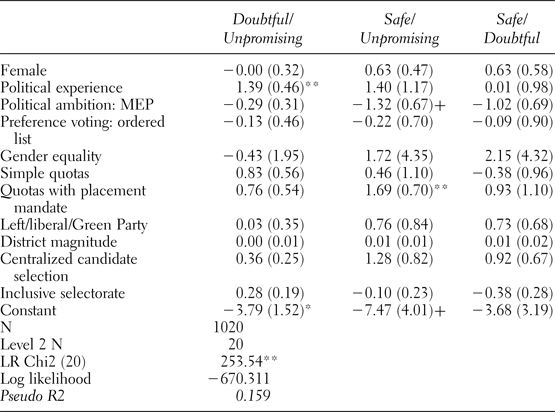
Table 1 summarizes the results of the overall model, which includes all candidates. The results show that women are not less (or more) likely than men to be viable candidates; the results also hold if a binary model with candidate sex as the only explanatory variable is estimated.
Explaining candidates' likelihood of party determined viable candidacy, multinominal logistic regression estimates

Source: 2009 EES candidate survey data
Note: **p < 0.01; *p < 0.05; + p < 0.10 (two-tailed tests); robust standard errors (clustered by country) in parentheses.
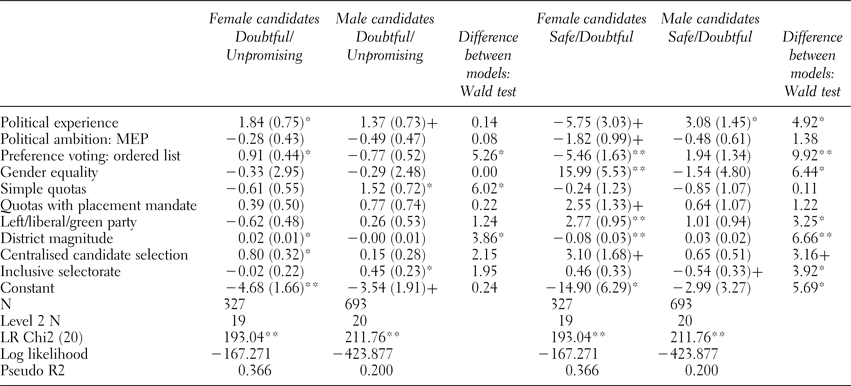
However, in order to understand whether and how electoral rules affect women candidates' chances for party-determined viable candidacy, I run separate models for male and female candidates and compare the differences of the coefficients with Wald tests.Footnote 6 This approach is applied instead of running a model with gender interaction terms because I expect different variances for the two groups.
Table 2 explains both female and male candidates' likelihood of being placed by party gatekeepers as viable candidates. To recall, candidate viability is measured with a three-category variable, where “safe” indicates a highly viable list position, “doubtful” indicates a semiviable list position, and “unpromising” indicates a list position from which it is highly unlikely to get elected. The left-hand section of Table 2 summarizes how the independent variables influence the likelihood of being positioned in the party lists as a doubtful candidate as opposed to an unpromising candidate. A negative coefficient indicates that the independent variable decreases the candidate's chances of being a doubtful candidate as opposed to unpromising and vice versa. The right-hand section of Table 2 shows how the independent variables affect the likelihood of being positioned in the party lists as a safe candidate, as opposed to a doubtful one.
Explaining female and male candidates' likelihood of party-determined viable candidacy, multinominal logistic regression estimates
Source: 2009 EES candidate survey data
Note: **p < 0.01; *p < 0.05; +p < 0.10 (two-tailed tests); robust standard errors (clustered by country) in parentheses.
Most importantly, the results in Table 2 demonstrate that female candidates' likelihood of being placed in the party lists as viable candidates is considerably more dependent on the institutional and contextual setting in which they run than male candidates' likelihood of viability. For men, the single most important (and consistently statistically significant) variable explaining their chances for being ranked high on parties' electoral lists is their personal political experience. For women, political experience fails to reach traditional levels of significance.Footnote 7 Berch (Reference Berch2004) shows similar results: female incumbents face more challenges in being reelected than male incumbents do in U.S. House elections.
Most notably, Table 2 shows the strong effect of overall gender equality in society on women candidates' chances to be granted with a highly viable list position. The effect of preferential voting systems is somewhat less straight forward. Preferential voting system appears to increase women's chances of not being an unpromising but a somewhat viable doubtful candidate. However, the positive effect of the preferential voting system ends with semiviable doubtful candidacy, as women have a much higher likelihood of being granted a highly viable safe candidacy in nonpreferential closed-list voting systems. I assume that it is the safe candidacy that matters the most in the electoral competition. Therefore, the fact that in closed-list systems women are ranked relatively higher in the electoral lists than they are in ordered-list systems suggests that women also have greater chances for election in closed-list systems.
Alternatively, one could argue that in an ordered-list system, a moderately viable list position (doubtful candidacy) is enough, as in this system candidates' likelihood of getting elected does not depend only on their list position, but also on how many preference votes they gain. Hence, it is still possible to get elected, even if the party places the candidate in the semiviable doubtful position rather than on a highly viable safe position. However, this means that in order for women to have the same likelihood as men for getting elected, female candidates in doubtful list positions need to collect many more preference votes than the male candidates in safe list positions. Research on preferential voting does not show that women are consistently more (or less) likely to gain preference votes than men (Matland Reference Matland, Karam and Ballington2005; Sanbonmatsu Reference Sanbonmatsu2002; Smith and Fox Reference Smith and Fox2001). Therefore, less viable party-determined electoral list placement is likely to negatively influence these women's overall electoral chances and thus explain why past literature finds that women in preferential voting systems have lower levels of descriptive representation than women in nonpreferential voting systems (Caul Reference Caul1999; Hogan Reference Hogan2001; Norris Reference Norris, LeDuc, Niemi and Norris1996; Norris and Franklin Reference Norris and Franklin1997; Paxton and Kunovich Reference Paxton and Kunovich2003; Reynolds Reference Reynolds1999; Schwindt-Bayer and Mishler Reference Schwindt-Bayer and Mishler2005).
Besides the electoral arrangements, women candidates' chances for viable candidacy are also influenced by the rules in the party office and party ideology. Unlike male candidates, female candidates' likelihood of viable candidacy is affected by the level of candidate selection. In line with the expectations, women candidates are more likely to be hopeless candidates and less likely to be highly viable safe candidates if they are selected at the local/regional level as opposed to the national level. However, whether candidates are officially nominated by a small group of party executive members or by a more inclusive selection body does not statistically significantly affect women candidates' chances for being placed in winnable list positions. Caul (Reference Caul1999) and Norris (Reference Norris, Katz and Crotty2006) argue that the move to more inclusive selectorates in Western Europe occurred at the same time as an increase in the use of various correction mechanisms to assure the representation of women. Therefore, the empirical findings of this article seem to suggest that parties may indeed restrict the choices of their more inclusive selectorates with these “correction mechanisms” in order to facilitate the election of women. Finally, the results also show that left-wing parties continue to support viable female candidacy more than right-wing parties.
In line with the expectation, only quotas with placement mandates increase women's likelihood of being granted with viable candidacy, while quota rules without a placement mandate regulation remain ineffective in increasing women candidates' chances for viable candidacy. However, it is important to note that quotas with placement mandate rules affect women's chances for highly viable candidacy only and not for doubtful candidacy. This may be influenced by the specific quota rules applied. For example, in Belgium only two top candidates of the party list cannot be of the same gender, while there is no alternation required throughout the list.
While the analysis suggests that both individual and contextual level variables affect women candidates' likelihood for viable candidacy differently than men's, it is difficult to explain why this is the case. The fact that men are, in general, politically more experienced than women could partly explain why political experience explains men's chances for viable candidacy but not women's. Also, the same fact that women are in general underrepresented in politics is likely to explain why context matters more for women's individual chances of being placed in a viable list position than it does for men's. Female candidates could be seen as the “political underdogs” who need a more favorable context to guarantee a viable list position. Male candidates, due to the fact that they are the more common political actors, are less sensitive to the context in which they run.
The results discussed above illustrate how certain characteristics of the electoral system and the overall context can have a positive or negative impact on women's likelihood of being positioned by party gatekeepers as viable candidates. However, the central variables of interest, the voting system, the centralization of candidate selection, and the overall gender equality in the society do not always go hand in hand. To estimate the full impact of the voting system, overall gender equality, and candidate nomination procedures within parties, I report predicted probabilities of party-determined viable candidacy for women across a range of situations.Footnote 8
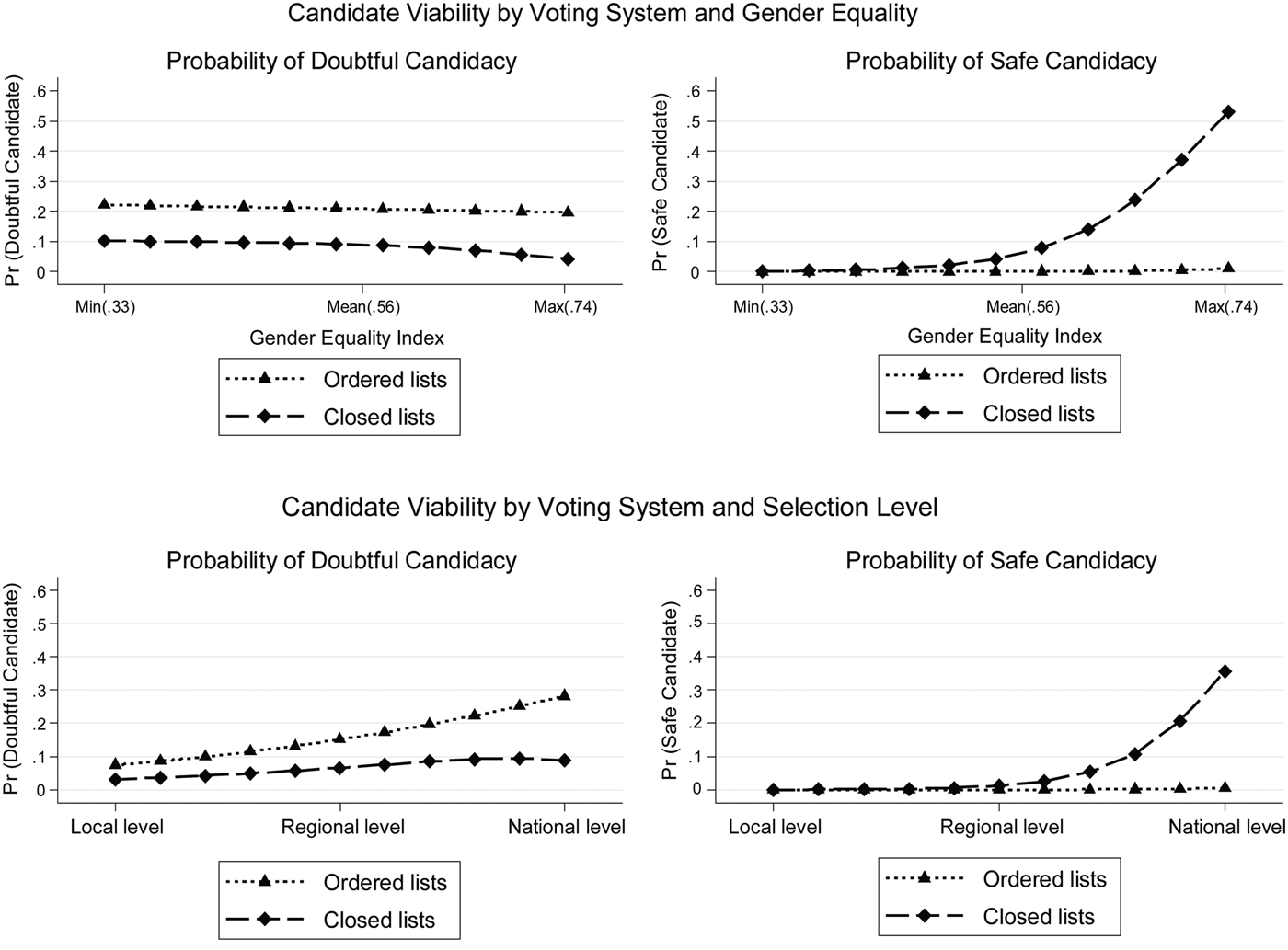
Figure 1 depicts the difference of the effect of overall gender equality and candidate selection procedures within parties across ordered-list and closed-list voting systems. The top section of Figure 1 shows the strong positive effect overall gender equality has on women candidates' chances to be granted with a highly viable (safe) candidacy in closed-list systems. However, the overall levels of gender equality barely affect women's probability of viable candidacy in preferential ordered-list systems. These results indicate that closed-list voting rules may not increase women's chances for party-determined viable candidacy in countries where women are relatively unequal to men. However, in a society with above-average levels of gender equality, women appear to be considerably more likely to be viable candidates when a nonpreferential voting system is employed.
Predicted probabilities of party-determined candidate viability for women by voting system, gender equality, and candidate selection level. Predicted probabilities obtained from female candidate model estimates in Table 2. All other covariates are set at estimation sample mean.
Continuing with the electoral system effects, the bottom section of Figure 1 depicts that women have close to zero probability of being positioned by party gatekeepers as a doubtful or safe candidate in both ordered- and closed-list systems if the candidate selection is carried out at the local level. However, there are differences in women's probabilities for party-determined viable candidacy across voting systems once the decision of candidate selection is made either at the regional or national level. Most notably, more centralized candidate selection procedures increase women's probability of viable candidacy in both ordered- and closed-list systems. However, while in preferential ordered-list systems more centralized candidate selection increases women's chances of doubtful candidacy, in closed-list preferential voting systems it increases women's chances of safe candidacy. Therefore, the combination of centralized candidate selection with closed-list ballot structure appears the most likely context in which women can expect to be granted a highly viable candidacy.
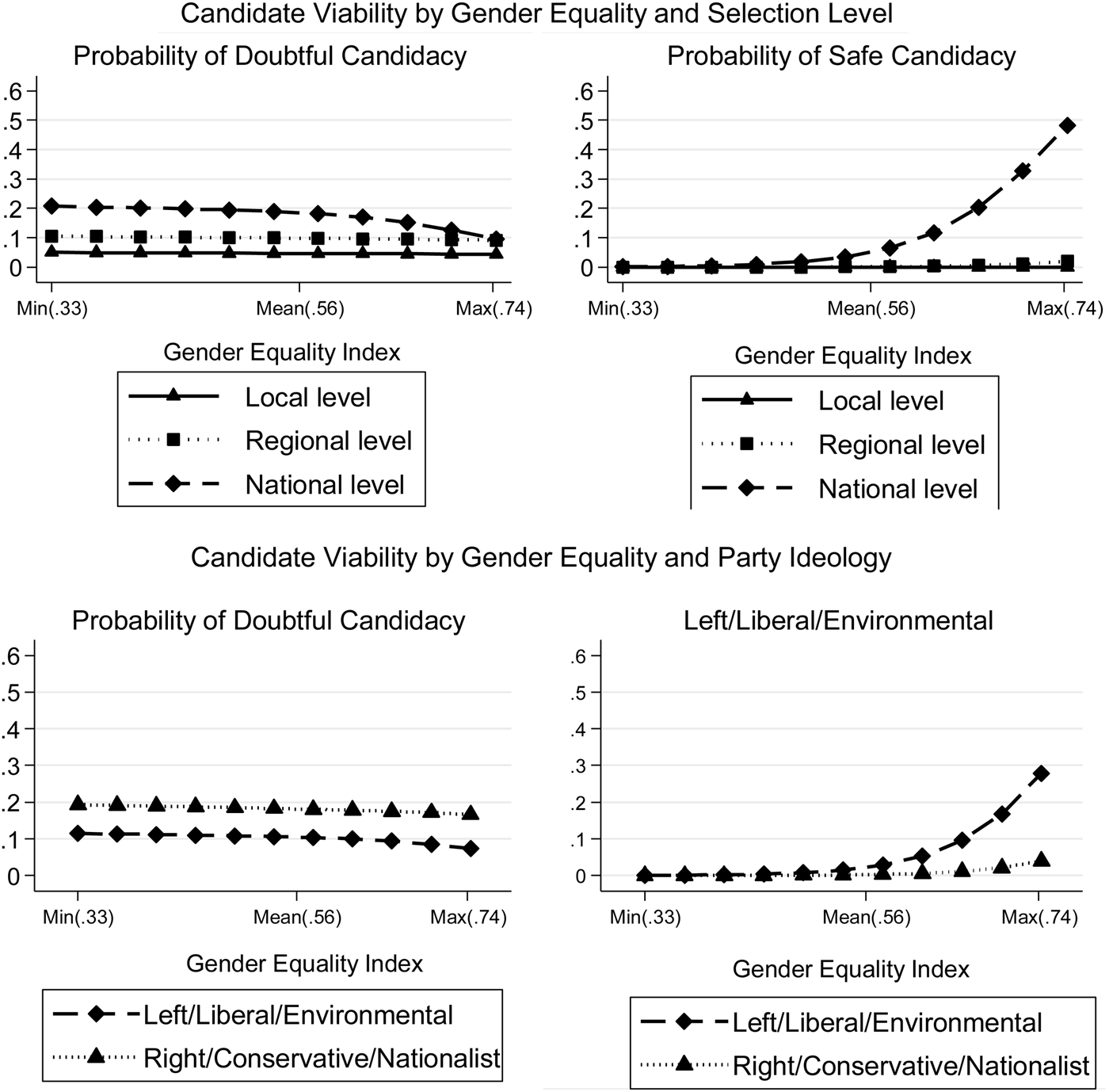
Figure 2 depicts party gatekeepers' response to overall gender equality dependent on candidate selection procedures and party ideology. The top section of Figure 2 illustrates that different candidate selection procedures within political parties also condition the effect of overall gender equality on women candidates' party-determined viability. While overall gender equality does not influence women candidates' likelihood of being granted with a highly viable (safe) candidacy in cases where candidates are nominated in local party offices, gender equality has a strong effect on women's party-determined viability in cases where candidates are nominated at the national level. The effect of gender equality on viable candidacy also varies by party ideology. The bottom section of Figure 2 shows that women in both right- and left-wing parties enjoy a higher probability of highly viable safe candidacy only in relatively gender-equal societies. These findings are interesting because they indicate a mechanism of how overall levels of gender equality influence women's likelihood of being placed in winnable seats.
Predicted probabilities of party-determined candidate viability for women by gender equality, candidate selection level, and party ideology. Predicted probabilities obtained from female candidate model estimates in Table 2. All other covariates are set at estimation sample mean.
One of the arguments of how overall levels of gender equality affect women's electoral chances is that in more gender-equal societies there is a greater supply of prospective female candidates. The fact that both left- and right-wing parties place women in highly viable safe-list positions in highly gender-equal societies only could indicate that in more gender-equal societies there is a greater supply of potentially highly viable candidates. However, the supply-side argument does not explain the results depicted in the top section of Figure 2, which point to party gatekeepers. There are stark differences in the likelihood of women from moderately or highly gender-equal societies to be placed at highly viable (safe) seats dependent on the centralization of candidate nomination. I consider it unlikely that in relatively gender-equal societies, the supply of suitable female candidates for viable list positions varies substantively dependent on whether or not the party selects its candidates at the local or at the national level. Rather it appears that party gatekeepers seem to respond more to the overall context of gender equality, thus to the perceived demand, if candidate selection is more centralized.
Valdini (Reference Valdini2012) argues that the selectorate has a strong incentive to be attentive to the prevalence of gender equality in the society and thus balance the ticket accordingly. These results show a more nuanced finding: whether or not party gatekeepers are attentive to the overall gender ideology in the society depends on the level at which party gatekeepers select candidates.
FINAL COMMENTS
The data from the 2009 European Parliament elections show that while women have no less likelihood of party-determined viable candidacy than men, the institutional setting and overall context in which they run affects female candidates' chances for viability more than male candidates' chances. Context matters for female candidates. This is both bad news and good news. Certain contextual predictors, such as overall gender equality in the society, are not easily changed. However, institutional rules, such as the type of voting systems used and the level at which candidate selection takes place in political parties, are not only theoretically changeable, but history shows that these features of electoral systems and party rules are indeed occasionally changed. Therefore, a change in electoral rules toward closed-list voting (as opposed to ordered-list voting) and toward more centralized party selection procedures are likely to increase women's chances of party-determined viable candidacy, which is likely in turn to increase their chances of being elected.
The findings of this study thus show the general trend toward more “open” electoral systems (Renwick and Pilet Reference Renwick and Pilet2011) and more decentralized and inclusive candidate selection procedures (Hazan and Rahat Reference Hazan and Rahat2006) in a different light. While this change in electoral and internal party rules is usually presented as a move toward a more democratic institutional setting, this study shows that these current changes may have a negative effect on women's descriptive representation.
The results of the analysis also suggest that party gatekeepers respond to the overall levels of gender equality and place women in more viable list positions in more gender-equal societies. Moreover, the effect is the strongest in closed-list voting systems and within parties where candidate selection is centralized. I assume that this is the case because in a more centralized party organization it is likely to be easier for the women's factions in the party (or other interest groups) to hold the party gatekeepers responsible for their illicit decisions when fielding women candidates.
The study offers interesting findings with regard to candidate gender quotas. While I expected candidate gender quotas without a placement mandate rule to remain ineffective, quotas with placement mandate also have a limited effect. In countries and parties where placement mandate rule is used, women have a higher likelihood of highly viable candidacy but not of moderately viable candidacy. I assume that this is due to the fact that some parties, such as the Moderate Party in Sweden, and countries, such as Belgium and Slovenia, apply the placement mandate rule in the top part of the list only.
In conclusion, this research provides important information with regard to party-determined viable candidacy. These findings are likely to help us explain certain mechanisms of the election of women in general, too. For example, the fact that party gatekeepers place women on moderately viable, rather than highly viable, list positions in preferential ordered-list systems and on highly viable list positions in closed-list systems may explain why we witness fewer women in the legislatures in preferential than in nonpreferential PR-list electoral systems. Future studies could put this claim to test and examine if and how the differences in women candidates' party-determined viability across varying institutional and contextual contexts affect women's chances of being elected.
APPENDIX A
Measurement of Overall Gender Equality
I use the following eight indicators to measure the different dimensions of gender equality:
• Equal share of employment: (1) gender gap in employment; (2) gender gap in unemployment.
• Equal share of money: (3) gender pay gap; (4) gender gap in risk of poverty after social transfer.
• Equal share of power: (5) gender gap in national parliament (lower chamber); (6) gender gap in ISCO 1 level occupations.
• Equal share of time: (7) gender gap in hours spent educating children and caring for them among people in full-time employment; (8) gender gap in hours spent cooking and doing house chores among people in full-time employment.
Since the indicators are measured on different scales, the actual values of the indicators are standardized using the min-max methodology in order to calculate the composite index.
The formula:
 $$\hbox{Standardized value} = \displaystyle{{\vert \hbox{actual value x1} - \hbox{min value x1}\vert} \over {\hbox{max value x1} - \hbox{min value x1}}}$$
where the actual value is a national score on the indicator (i.e., gender gap of 5% in unemployment); where a situation of absolute equality (no gender gap) refers to the maximum value and has assigned the value 0; and where the minimum value is set at a level that is a little below the actual minimum value within the sample of EU countries. Since gender equality is understood as the absence of gender gaps, both positive and negative gaps are treated the same way, which means that the absolute value of the gender gap is used. As a result, the standardized values of each indicator vary between 0 and 1, where 0 corresponds to a situation of the worst inequality in the EU, and 1 corresponds to a situation of absolute equality. Appendix B summarizes the scores of overall gender equality across EU member states.
APPENDIX B
Overall ranking of 27 EU member states on gender equality index (2007–2009)