Introduction
With the growing population of older adults, there has been an increased requirement for family and friends to act as informal caregivers (Cranswick and Dosman, Reference Cranswick and Dosman2008). It is estimated that 2.7 million Canadians (Cranswick and Dosman, Reference Cranswick and Dosman2008) and 65.7 million Americans (National Alliance for Caregiving, 2009) act as informal caregivers of ill or disabled older adults. Informal caregiving refers to a range of activities and experiences involved in providing care and support to individuals who are unable to care for themselves (Pearlin et al., Reference Pearlin, Mullan, Semple and Skaff1990). It is now well recognized that providing care for a spouse or loved one can pose significant challenges to a caregiver's physical, psychological, social, and financial well-being (Schoenmakers et al., Reference Schoenmakers, Buntinx and Delepeleire2010). These multidimensional challenges, collectively referred to as caregiver burden, are especially pronounced when the care recipient suffers from dementia or Alzheimer's disease (AD). Indeed, caregiving for a person with dementia has been associated with physical health problems (Vitaliano, Reference Vitaliano, Zhang and Scanlan2003), reduced health-related quality of life (Serrano-Aguilar et al., Reference Serrano-Aguilar, Bastida-Lopez and Yanes-Lopez2006), and increased risk of mortality (Schulz and Beach, Reference Schulz and Beach1999). Caregivers of individuals with dementia also report higher levels of caregiver burden as compared to caregivers of frail older adults (Kim and Schulz, Reference Kim and Schulz2008), and nearly one-quarter report clinically significant anxiety (Mahoney et al., Reference Mahoney, Regan, Katona and Livingston2005). A recent review of the caregiving literature also shows that the prevalence of depression is significantly higher among caregivers of patients with dementia than in caregivers of patients with chronic or psychiatric illnesses (Schoenmakers et al., Reference Schoenmakers, Buntinx and Delepeleire2010).
It is further estimated that 20–25% of caregivers are aged over 65 years (Alecxih et al., Reference Alecxih, Zeruld and Olearczyk2001; Cranswick and Dosman, Reference Cranswick and Dosman2008), indicating that a substantial proportion of caregivers are older adults themselves. This suggests that caregiver challenges could be further exacerbated by the difficulties associated with aging, therefore placing older adult caregivers at increased risk for problems, such as physical and mental health issues and reduced quality of life.
Dementia anxiety
Despite the increased focus on caregiver burden, and acknowledgment of increased burden for those caring for individuals with dementia, little research has examined caregivers' anxiety or concern about eventually developing dementia themselves (i.e. dementia anxiety). In the research that has been conducted, however, it has been found that 52.2% of caregivers reported that they were very concerned about developing AD during the course of their life (Roberts and Connell, Reference Roberts and Connell2000). Although that study did not specifically examine older adult caregivers (i.e. mean age of the sample was 53.5 years), the findings provide preliminary evidence of dementia anxiety among caregivers of individuals with dementia. In contrast to these findings, rates of dementia anxiety appear much lower in non-caregiver older adults, with only 16% found to worry about dementia in that sample (Yeo et al., Reference Yeo, Horan, Jones and Pendleton2007).
Research examining variables that may predict dementia anxiety among caregivers and non-caregivers is minimal and the findings are often mixed. For example, caregivers and non-caregivers who are married have reported more concern about dementia than those who are single (Roberts and Connell, Reference Roberts and Connell2000; Cutler and Hodgson, Reference Cutler and Hodgson2001). Some studies have indicated that dementia anxiety is higher among women than men (Roberts and Connell, Reference Roberts and Connell2000; Cutler and Hodgson, Reference Cutler and Hodgson2001), while others have failed to find a relationship between sex and dementia anxiety (Yeo et al., Reference Yeo, Horan, Jones and Pendleton2007). Higher levels of education were associated with increased dementia anxiety among those with a parental history of dementia or AD (Cutler and Hodgson, Reference Cutler and Hodgson2001). However, for those with no parental history, the opposite relationship was observed, in that lower education level was related to elevated dementia anxiety. In contrast, additional studies have found no association between education and dementia anxiety (Werner, Reference Werner2002; Yeo et al., Reference Yeo, Horan, Jones and Pendleton2007). Findings have also been mixed with respect to the influence of age on dementia anxiety. Among their sample of middle-aged caregivers, Roberts and Connell (Reference Roberts and Connell2000) demonstrated that younger age was associated with higher levels of dementia anxiety. However, among older adult non-caregivers, Yeo and colleagues (2007) failed to find an association between age and dementia anxiety.
One possible explanation for the lack of consensus in the above findings is the means by which dementia anxiety is measured or assessed. For example, all previous studies used only a single item to measure dementia anxiety, wherein participants responded by either providing an answer on a Likert scale (Roberts and Connell, Reference Roberts and Connell2000; Cutler and Hodgson, Reference Cutler and Hodgson2001; Werner, Reference Werner2002) or indicating yes/no (Yeo et al., Reference Yeo, Horan, Jones and Pendleton2007). While this is a convenient way to measure dementia anxiety, the reliability and validity of single item scales is questionable. The low reliability arises because single items are associated with substantial random error, which makes it difficult to achieve consistent and reproducible results (Fayers and Machin, Reference Fayers and Machin2007). Validity is low because, similar to other psychological variables, dementia anxiety is a complex construct that cannot be sufficiently assessed through a single categorical item (Fayers and Machin, Reference Fayers and Machin2007). Given the previous narrow assessments of dementia anxiety and their limitations, a more in-depth examination is therefore warranted in order to further understand dementia anxiety and its relation to caregiver variables. There is also a strong possibility that additional care recipient variables, which have not yet been studied, may be related to the development of dementia anxiety among caregivers. For instance, the health status of the care recipient (i.e. with or without a dementia diagnosis) could be an important factor, such that caregivers for individuals without dementia may not experience heightened dementia anxiety, and this would presumably be due to less exposure to the disease. Depression and caregiver burden may also impact dementia anxiety, and, in fact, may be more important than background variables in predicting dementia anxiety. Given the high rates of comorbidity between depression and anxiety (Cairney et al., Reference Cairney, Corna, Veldhuizen, Herrmann and Streiner2008) and the importance of caregiver burden as a predictor of anxiety in general (Grunfeld et al., Reference Grunfeld2004), there is a strong possibility that both of these factors may be associated with dementia anxiety among caregivers.
Current study
The purpose of the current study was to examine dementia anxiety among older adult caregivers, while also providing a reliable and valid assessment of this construct using the Dementia Anxiety Scale (Verhaeghen et al., Reference Verhaeghen, Geraerts and Marcoen2000). Specifically, we investigated the association between dementia anxiety and variables related to the care recipient and caregiver. Depression and caregiver burden were also examined as predictors of dementia anxiety.
Given the nature of caring for an individual with dementia (i.e. frequent exposure to the disease), it was predicted that caregivers of individuals with dementia would experience higher dementia anxiety than caregivers of those who do not have dementia. Based upon previous literature, it was also hypothesized that caring for a spouse would predict elevated dementia anxiety scores. We also examined sex, education, and age as predictors, but due to the mixed findings of previous studies, no specific hypotheses were formulated. Other variables that have yet to be established as associated with dementia anxiety in the literature were also considered as potential predictors of dementia anxiety. Specifically, it was hypothesized that caregiver variables such as living in the same house as the care recipient, having a higher number of health conditions, elevated depression, and caregiver burden would predict elevated dementia anxiety. It was hypothesized that higher disability levels in the care recipient would significantly predict dementia anxiety in the caregiver. Finally, based on previous research demonstrating that caregiver burden is higher for those who have been caregiving for a shorter period of time (Jones et al., Reference Jones, Hadjistavropoulos, Janzen and Hadjistavropoulos2011), we also predicted that shorter periods of caregiving would predict greater dementia anxiety.
Methods
Participants and procedure
After receiving ethics approval from the Research Ethics Board of our institution, 123 older adult caregivers were recruited from across Canada to participate in the study by contacting caregiver organizations (e.g. Alzheimer Society of Canada), caregiver support programs, care homes, seniors’ centers and day programs, and through poster and newspaper advertisements. Eligible participants were aged 60 years and older and were providing care to an individual who was physically frail or disabled, and/or had received a formal diagnosis of AD or dementia. Prospective participants were mailed questionnaire packages that took approximately 45–60 minutes to complete. When questionnaire packages were returned to the researchers, a $10.00 CAD honorarium was provided to each caregiver for their participation.
Measures
Participants answered questions about demographics including age, sex, ethnicity, province and city of residence, educational level, relationship status, and self-reported health conditions. Relationship status was coded as single, dating, common law/cohabiting, married, separated, divorced, or widowed. Self-reported health conditions were measured by asking participants to check off which conditions they had experienced from a list of common health problems, with items such as heart, respiratory, and digestive problems. Additional background questions gathered caregiving information, including length of time spent in the caregiver role (in months), living arrangement of care recipient and caregiver, whether the care recipient was spouse to the caregiver, and whether the care recipient previously received a formal diagnosis of AD or dementia.
The Townsend Disability Scale (TDS; Bond and Carstairs, Reference Bond and Carstairs1982) was administered to assess the care recipient's physical disability. Nine items were rated by the caregiver on a 3-point scale, with total scores ranging from 0 to 18. Consistent with previous research (McGee et al., Reference McGee, Johnson and Kay1998), scores ≥7 were used to identify care recipients with appreciable incapacity. Higher scores on the TDS have been correlated with increased disability and age (McGee et al., Reference McGee, Johnson and Kay1998), while reduced disability is predictive of lower depression in healthy older adults (Fieo, Reference Fieo2007), supporting the construct validity of the measure. In this study, the internal consistency of the scale was α = 0.87.
The Dementia Anxiety Scale (DAS; Verhaeghen et al., Reference Verhaeghen, Geraerts and Marcoen2000) was created as an abridged subscale to the Metamemory in Adulthood Scale (MIA; Dixon and Hultsch, Reference Dixon and Hultsch1983). The DAS consists of five items that measure anxiety or worry about developing dementia. Participants rated their responses on a 5-point Likert scale ranging from 1 (agree strongly) to 5 (disagree strongly). The DAS was scored by totaling the items. This scale has demonstrated good internal consistency (α = 0.83) and acceptable construct validity as is evidenced by high correlations between the DAS and a measure of the perception of memory abilities as generally stable or subject to long-term decline (Verhaeghen et al., Reference Verhaeghen, Geraerts and Marcoen2000). The Cronbach's α coefficient for the DAS in the present study was α = 0.94.
The Caregiver Burden Inventory (CBI; Novak and Guest, Reference Novak and Guest1989) contains 24 items that can be summed to create a total caregiver burden score. Items are rated on a scale ranging from 0 (never) to 4 (nearly always), and ask about (1) time-dependence, or the belief that caregiving limits the time of the caregiver; (2) developmental burden, or the belief that the caregiver is missing out on life or that their life has altered from their expected life course as compared to peers; (3) physical burden, or the effect of caregiving on the caregiver's physical health and fatigue; (4) social burden, or feelings that caregiving conflicts with their other relationships or jobs; and (5) emotional burden, or the caregiver's negative feelings towards the care recipient and the ensuing guilt. Cronbach's α for the total score was excellent (α = 0.91).
The Geriatric Depression Scale (GDS; Yesavage et al., Reference Yesavage1982) was used to assess depressive symptoms of caregivers. The GDS consists of 30 dichotomous (yes/no) items wherein participants indicate how they felt over the past week. This tool was designed to distinguish depressive symptoms from cognitive decline or somatic concerns. Scores of 11 or higher have been used as a possible indicator of depression (Lyness et al., Reference Lyness, Noel, Cox, King, Conwell and Caine1997). Strong correlations between the GDS and other commonly used measures of depression provide support for its construct validity (Yesavage et al., Reference Yesavage1982). Cronbach's α for the GDS in the present sample was α = 0.91.
Results
Preliminary analyses
The data were screened for missing data and outliers. Mean substitution was used to replace missing data points for cases where participants responded to at least 90% of items on any given scale or subscale. In such cases, the missing data points were replaced with the participant's average score for that scale or subscale. Mean substitution was used to replace missing data on the CBI (12 cases) and the GDS (13 cases). To screen for outlying scores, descriptive statistics were evaluated to discern the standardized value (i.e. z-score) for each scale's total and subscale scores. If the z-score of a data point equaled ±3.29 (p < 0.001, 2-tailed), the score was changed to one unit larger than the next most extreme non-outlying score in the distribution (Tabachnick and Fidell, Reference Tabachnick and Fidell2001). In total, four outlying scores on length of time spent caregiving were changed using this method.
Sample characteristics
Respondents younger than 60 years of age (n = 6) or who were caring for an individual without significant disability (i.e. TDS score less than 7) and did not have a diagnosis of AD or dementia (n = 1) were excluded from analyses. The final sample comprised 116 older adult caregivers.
The average age of the respondents was 73.3 years (SD = 6.8) and ranged from 60 to 90 years. The majority were female (n = 84; 72.4%), Caucasian (n = 107; 92.2%), resided in western Canada (n = 105; 90.5%), and reported either being married or in a common-law living arrangement (n = 92; 79.3%). Over 80% of the respondents reported completing either a high school diploma or had pursued higher education (n = 95; 81.9%).
Close to two-thirds of the respondents reported being spouse caregivers (n = 75; 64.7%), while the other respondents indicated caring for a parent, step-parent, parent-in-law, friend, another family member, or one of their children (n = 41; 35.3%). Fewer than 10% of the caregivers reported providing care for more than one individual (n = 9; 7.76%). Over half of the respondents reported living in the same household as the care recipient (n = 65; 56%). The remaining respondents did not live with the care recipient or temporarily resided in the same household as needed (n = 51; 44%). Length of time spent providing care ranged from 2 months to 56 years, with a mean of 79.6 months or 6.6 years (SD = 100.5). Two-thirds of the care recipients had received a formal diagnosis of dementia or AD (n = 77; 66.4%), while the other care recipients were characterized as physically frail or disabled (n = 39; 33.6%).
Data analyses
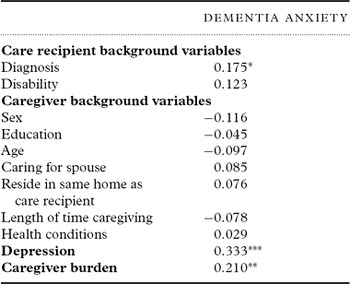
Correlations were used to examine relationships among dementia anxiety and care recipient background variables, caregiver background variables, depression, and caregiver burden (see Table 1). Interestingly, the only care recipient variable that approached significance in its correlation with dementia anxiety was diagnosis of dementia in the care recipient (r = 0.175, p = 0.065). No other care recipient background variables were associated with dementia anxiety. In contrast, both caregiver burden and caregiver depression were positively associated with dementia anxiety.
Pearson correlations between dementia anxiety and care recipient background variables, caregiver background variables, depression, and caregiver burden

*p-value approaching significance at 0.065; **p < 0.05; ***p < 0.01.
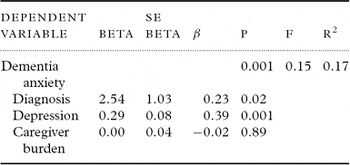
To explore the relative predictive ability of the variables significantly associated with dementia anxiety, we next conducted a linear regression analysis with dementia anxiety as the dependent variable and caregiver depression, caregiver burden, and care recipient diagnosis of dementia or AD as the independent variables. As indicated in Table 2, the overall regression model was significant, F (3, 106) = 7.15, p < 0.001 (R 2 = 0.17). Caregiver depression scores (β = 0.39) and the diagnosis of AD or dementia in the care recipient (β = 0.23) were both significant predictors of dementia anxiety, while caregiver burden failed to reach statistical significance (β = −0.02).
Predictors of dementia anxiety

Diagnosis = diagnosis of dementia or AD in the care recipient.
Discussion
Dementia anxiety is an important construct to understand because it has the potential to impact the well-being of both caregivers and care recipients. Heightened anxiety about developing dementia may place additional strain on caregivers, influencing both the amount and quality of care provided. Moreover, dementia anxiety is especially worthwhile to investigate among the older adult caregiver population not only because of its potential to exacerbate the stress of caregiving, but also because of the changes and difficulties often associated with aging including the increased likelihood of developing dementia in later life.
Based on the results, dementia anxiety appears to be a variable that is particularly difficult to predict among older adult caregivers. In contrast to previous research conducted with middle-aged adults (Roberts and Connell, Reference Roberts and Connell2000; Cutler and Hodgson, Reference Cutler and Hodgson2001), but consistent with research pertaining to older adults (Yeo et al. Reference Yeo, Horan, Jones and Pendleton2007), we found that dementia anxiety was not associated with being female, caring for a spouse, or with age. On the other hand, one of the few variables that did predict dementia anxiety was caring for an individual who had a diagnosis of dementia or AD. This finding is not surprising as one might suspect that continual exposure to the symptoms and consequences of dementia (which is often the case for dementia caregivers) could potentially heighten caregivers’ anxiety towards developing the disease themselves. This finding is also consistent with findings among middle-aged adults (Roberts and Connell, Reference Roberts and Connell2000). The results are important, however, as some past research has suggested that caring for individuals with dementia does not necessarily result in increased emotional distress compared to caring for someone who does not have dementia (e.g. Crespo et al., Reference Crespo, Lopez and Zarit2005). The present results seem to suggest that increased risk for dementia anxiety among those caring for individuals with dementia or AD is one way in which caring for someone with dementia may be more challenging psychologically than caring for individuals afflicted with other health problems. As a further extension of previous research, we observed that caregiver burden and depression were associated with increased levels of dementia anxiety, with depression acting as a unique predictor when controlling for other variables.
In terms of clinical implications, our research suggests that prevention strategies should be created and tailored specifically to older adults providing care for individuals diagnosed with dementia. The results would suggest that psychosocial treatment for older caregivers may not only need to address depression in this population, but should also potentially consider dementia anxiety. While interventions aimed at treating dementia anxiety specifically have not yet been developed or tested, research suggests that brief group cognitive-behavioral therapy (CBT) for anxiety may offer assistance to caregivers of individuals with dementia. Akkerman and Ostwald (Reference Akkerman and Ostwald2004) randomly assigned 38 anxious family caregivers (mean age 58 years) to a nine-week group CBT intervention or to a waitlist control group. The intervention included didactic skills training and utilized a multidimensional model to explain the physical, cognitive, and behavioral components associated with caregiver anxiety. Caregivers were provided with handouts and asked to practice skills related to each component. The results indicated that caregivers assigned to CBT showed less anxiety on self-report and clinician-administered questionnaires than caregivers assigned to the waitlist, both at post-treatment and six weeks’ follow-up. It appears that an intervention such as this could be adapted to specifically address dementia anxiety in older adult caregivers.
This study has several limitations that should be noted. First, the sample of older adult caregivers was a convenience sample and was therefore not completely representative of the general population. Second, the sample largely consisted of Caucasian individuals and those who were caring for a spouse or partner. Given the ethnic diversity of Canadians (Statistics Canada, 2006) and given that a significant proportion of individuals aged 45 years and older provide care for a parent (Cranswick and Dosman, Reference Cranswick and Dosman2008), research should seek to include these individuals in future studies. Finally, it must be kept in mind that the data reported here are correlational. Longitudinal data are therefore needed before causal links between caregiving, depression, and dementia anxiety can be inferred. For example, is it that individuals with higher dementia anxiety are more likely to be depressed, or alternatively, do elevated levels of depression lead to the development of dementia anxiety or are both variables the result of caregiving?
Based on the current findings, it is evident that there is still much to be learned about dementia anxiety. While we found significant predictors, in total these only accounted for approximately 17% of the variance in dementia anxiety among older adults. Thus, it is apparent that further research is needed to identify additional variables related to dementia anxiety. One such variable that was not included in the present study but should be examined in future research is the extent to which having a family history of AD combined with caring for someone with AD influences dementia anxiety. Future research could also investigate the relationships between dementia anxiety and health anxiety. Boston and Merrick (Reference Boston and Merrick2010) have generally found low levels of health anxiety in older adults, but the relative prevalence of dementia anxiety and health anxiety generally should also be examined. Might dementia anxiety be more prevalent than health anxiety?
One of the primary purposes of the current study was to provide a more comprehensive assessment of dementia anxiety. Although the use of the DAS provided such an assessment, it would be useful to measure other aspects of dementia anxiety in future research. For example, how frequently do caregivers worry about dementia, what is the content of worries, and what are the behavioral consequences of having dementia anxiety (e.g. use of health care services, relationship to avoidance and functional impairment)? Such questions warrant study in future investigations.
Conclusion
The current study adds to the literature on dementia anxiety, specifically suggesting that caring for individuals with AD, caregiver depression, and caregiver burden are positively associated with dementia anxiety among older caregivers. Given the stresses linked to both caregiving and aging, further research is needed to better understand the development, occurrence, and appropriate interventions for dementia anxiety among caregivers in general and older adult caregivers in particular.
Conflict of interest
None.
Description of authors' roles
N.M.A. conducted the literature review and assisted with the study conceptualization. She assisted with data analysis and prepared the first draft of the paper. H.D.H. identified the need to study dementia anxiety among older adults, conceptualized the study, designed the research, supervised data collection and analysis, conducted statistical analyses, and assisted with preparation of all aspects of the paper. N.E.P. assisted with data collection, data analysis and writing of the results section. S.L.J. assisted with initial literature review, design of the study, data collection and writing of the paper.