INTRODUCTION
Maritime activities have intensified all over the world with the rise of international trade between countries. Thousands of organisms have been unintentionally transported from place to place, fouled on ship hulls or in ballast tanks (Carlton & Geller, Reference Carlton and Geller1993; Pierce et al., Reference Pierce, Carlton, Carlton and Geller1997; Silva et al., Reference Silva, Fernandes, Larsen and Souza2002). Around the world, aquaculture has also allowed the introduction of several organisms (Naylor et al., Reference Naylor, Williams and Strong2001) and oil platforms have acted as another way of introducing species to new environments (Ferreira et al., Reference Ferreira, Gonçalves, Coutinho, Silva and Souza2004).
The distribution of species out of their natural ranges has promoted the homogenization of marine biota (Lodge, Reference Lodge1993; Silva et al., Reference Silva, Fernandes, Larsen and Souza2002). Organisms belonging to the most varied taxonomic groups have been introduced to environments where they had not been detected before (Berman & Carlton, Reference Berman and Carlton1991; Chapman & Carlton, Reference Chapman and Carlton1991; Carlton & Geller, Reference Carlton and Geller1993; Tavares & Mendonça, Reference Tavares and Mendonça1996; Pierce et al., Reference Pierce, Carlton, Carlton and Geller1997; Reise et al., Reference Reise, Gollasch and Wolff1999) and a few authors consider molluscs among the most transported organisms, either intentionally or not (Carlton & Geller, Reference Carlton and Geller1993; Carlton, Reference Carlton1999; Naylor et al., Reference Naylor, Williams and Strong2001). Molluscs provide excellent examples for examining changes in marine ecosystems mainly by the combination of a large fossil, archaeological and historical record and their potential for drastically affecting native communities (Crooks, Reference Crooks1998).
Ecological studies about bioinvasions may be essential for the understanding of the main driving forces of community dynamics locally (Lodge, Reference Lodge1993). At the same time, biological invasions have been considered one of the main factors responsible for ecological changes operating at a global scale (Ruiz & Hewitt, Reference Ruiz, Hewitt, Leppakoski, Olenin and Gollasch2002). Invasive species are regarded as a threat to local (thus global) biodiversity as their high population density may cause the disappearance of native species.
Studies carried out on some of the rocky shores in Rio de Janeiro State and its surrounding areas until the 1990s did not record the presence of any isognomonid bivalves (Ihering, Reference Ihering1897; Oliveira, Reference Oliveira1947; Lavrado, Reference Lavrado1992; Migoto et al., Reference Migoto, Tiago and Magalhães1993). In the middle of that decade, dense populations of Isognomon bicolor (C.B. Adams, 1845) were observed occupying a wide range of the intertidal zone of rocky shores in Arraial do Cabo where the bivalves Perna perna (Linnaeus, 1758), Brachidontes solisianus (Orbigny, 1846) and Crassostrea rizophorae (Guilding, 1828), as well as the cirriped Tetraclita stalactifera (Lamarck, 1818) (Ferreira et al., Reference Ferreira, Junqueira, Villac, Lopes, Rilov and Crooks2008), were usually found.
Currently I. bicolor is found in the West Atlantic, from Florida, United States of America, up to Santa Catarina State, Brazil (Domaneschi & Martins, Reference Domaneschi and Martins2002). There are two probable vectors of unintentional introduction of I. bicolor to the Brazilian coast. The most likely one is oil platforms that are brought to Brazilian waters from different regions and, indeed, the mass occurrence of this species has been observed fouling such structures (personal observation). But one cannot discard ballast water as a vector due to the large number of foreign and national ships which frequently arrive along the Brazilian coast.
In Rio de Janeiro State, I. bicolor has settled along the coast being necessary to evaluate its current population status. Hence, the objective of the present work is to compare the population structure of I. bicolor in three different coastal areas of Rio de Janeiro State and to assess the degree of temporal variation of the population structure of this species in those areas.
Study area
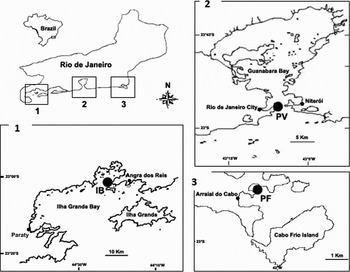
Rio de Janeiro State has an 850 km-long coastline (south-east Brazil, between 21°15′ and 23°30′S and 41° and 44°45′W) which presents very distinctive areas (Figure 1). An important oceanographic feature is found in the region of Cabo Frio (RJ): the change in the coast direction and the proximity of the 100 m isobaths creates a topography which promotes the upwelling of deep and cold waters of the South Atlantic Central Water (SACW) (Valentin, Reference Valentin, Seeliger and Kjerfve2001). Upwelling is determined by meteorological and hydrological factors (Valentin & Kempf, Reference Valentin and Kempf1977) and, depending on the strength of the wind and the ocean currents, this phenomenon can reach as far south as Guanabara Bay and surroundings. The southernmost area, including Ilha Grande Bay, is less influenced by this phenomenon and is marked by high rainfall and warm waters originated from the warmer and nutrient-impoverished waters of the Brazil Current.
Location of the three study areas on the coast of Rio de Janeiro State. IB, Ilha do Brandão; PV, Praia Vermelha; PF, Ponta da Fortaleza.

The present work was performed in rocky shores of three ecologically different areas (Figure 1):
(1) Ilha do Brandão (23°01′35.15″S and 44°24′05.81″W)—located in Ilha Grande Bay, municipality of Angra dos Reis, this area can be considered oligotrophic as most environments in this region are (Silva et al., Reference Silva, Junqueira, Silva, Zalmon, Lavrado, Neves and Magoon1989). Areas close to the study sites have been characterized for presenting salinities varying from 32 to 35, temperature between 24 and 27°C and maximum values of 1.77 µg.l−1 for chlorophyll-a and of 1.13 µM for nitrate (Mayer-Pinto & Junqueira, Reference Mayer-Pinto and Junqueira2003).
(2) Praia Vermelha (22°57′23.75″S and 43°09′50.45″W)—located in Guanabara Bay, in the municipality of Rio de Janeiro, this area is in a region prone to organic pollution, although most often characterized by a moderate eutrophication of the water column (Mayr & Paranhos, Reference Mayr and Paranhos2000). Santos et al. (Reference Santos, Villac, Tenenbaum and Paranhos2007) found mean values of 14.37 µg.l−1 chlorophyll-a and of 2.35 µM nitrate in an adjacent area. Salinity on the water surface varies from 33 to 34 (Kjerfve et al., Reference Kjerfve, Ribeiro, Dias, Filippo and Quaresma1997) and the mean water temperature is around 23.5°C (Junqueira et al., Reference Junqueira, Falcão, Mayer-Pinto, Viana and Silva2000).
(3) Ponta da Fortaleza (22°58′11.62″S and 42°00′45.87″W)—located in the Enseada do Forno, in the municipality of Arraial do Cabo, this area presents no records of sewage disposal. Nonetheless, it receives waters rich in chlorophyll-a and nitrate from Cabo Frio upwelling, and values around 3.5 µg.l−1 and 2.2 µM, respectively, have been recorded in periods of the highest upwelling intensity (Rocha, Reference Rocha2002). The mean water salinity varies from 35 to 36 and temperature varies from 21 to 25°C (Lavrado, Reference Lavrado1992).
MATERIALS AND METHODS
Samplings were conducted from June to September 2002 (winter) and from January to March 2003 (summer), during spring tides. In each area, in each sampling period, a horizontal transect was established in the zone of I. bicolor in the intertidal rocky shore and 5 100-cm2 quadrats were randomly positioned for the sampling of all organisms. These samples were stored in labelled plastic bags and frozen as rapidly as possible.
The population structure of I. bicolor in each area was assessed taking into account the population density and the size–frequency distribution. All individuals were counted at the laboratory. We considered dead individuals those which lacked the ‘soft parts’ or those which presented drills in the shells. The mean density of I. bicolor was obtained for each area. Approximately 160 live individuals of I. bicolor from each area, per season, were randomly chosen and measured with a caliper with a 0.05 mm precision. Individuals smaller than 2 mm were measured under a stereoscopic microscope. Length of the hinge (h) and of the nacreous layer (nl) of the left shell of each individual were taken since they are measures of internal characters, therefore being less prone to modifications (Figure 2). Even so, the dead individuals could not be measured because generally the nacreous layer of the shell loses coloration and the hinge deteriorates. A correlation analysis was conducted between these two measures for verifying the relation of the size between different parts of the shell of I. bicolor.
Measure of the length of hinge (h) and nacreous layer (nl) of the left valve of an Isognomon bicolor adult.

The size–frequencies were grouped in 2 mm-interval classes per season and per area. The individuals presenting the hinge and the nacreous layer of the shell in classes from 2 to 4 were considered recruits.
Two-way analyses of variance (ANOVA) were performed in order to compare the density of I. bicolor as well as the mean size of the hinge and of the nacreous layer of I. bicolor among areas and seasons. The homogeneity of the variances was tested through Cochran's test (Zar, Reference Zar1996) and data were log-transformed when necessary. Tukey's test was used a posteriori to assess the differences between pairs of means (Zar, Reference Zar1996).
RESULTS
Density and mortality of Isognomon bicolor
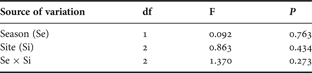
In the three study areas, the mean number of the individuals of I. bicolor was extremely high in both seasons, presenting values higher than 1000 live individuals per 100 cm2 at Ilha do Brandão (Figure 3). There was no significant difference (P > 0.05) in the mean number of the individuals of I. bicolor between areas or seasons (Table 1).
Mean density (+standard deviation) of live and dead individuals of Isognomon bicolor in Praia Vermelha (PV), Ponta da Fortaleza (PF) and Ilha do Brandão (IB), during winter (W) and summer (S).

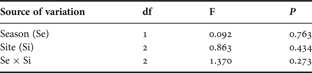
Results of the two-way ANOVA on densities of Isognomon bicolor between areas (Praia Vermelha, Ponta da Fortaleza and Ilha do Brandão) and seasons (winter and summer).
*, significant values, if P < 0.05.
On the rocky shores of Praia Vermelha and Ponta da Fortaleza, densities of live individuals were around 10 times higher than those of the dead individuals. In contrast, more than 500 dead individuals of I. bicolor per 100 cm2 were found at Ilha do Brandão in the two studied seasons (Figure 3).
Size–frequency distribution of Isognomon bicolor
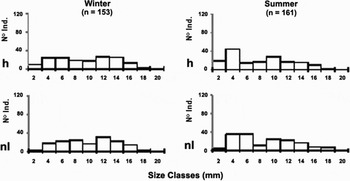
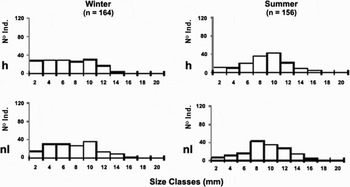
Sample analyses indicate the occurrence of differences in predominant size-classes of I. bicolor between the study areas (Figures 4, 5 & 6). The individuals sampled at Praia Vermelha (more eutrophic) are those which presented the highest mean and maximum sizes in the length of the hinge and of the nacreous layer of the shell, whereas those at Ilha do Brandão (more oligotrophic) presented the smallest sizes (Table 2).
Size–frequency distribution of the hinge (h) and of the nacreous layer (nl) of Isognomon bicolor shells, at Praia Vermelha, during winter and summer. N = number of individuals.

Size–frequency distribution of the hinge (h) and of the nacreous layer of Isognomon bicolor shells, at Ponta da Fortaleza, during winter and summer. N = number of individuals.

Size–frequency distribution of the hinge (h) and of the nacreous layer of Isognomon bicolor shell, at Ilha do Brandão, during winter and summer. N = number of individuals.

Mean size and size-range of the hinge and of the nacreous layer of Isognomon bicolor shells at Praia Vermelha (PV), at Ponta da Fortaleza (PF) and at Ilha do Brandão (IB), during winter (W) and summer (S). N = number of individuals.

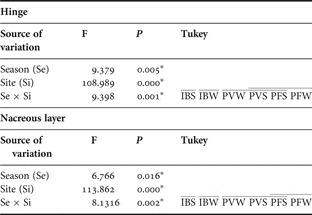
In regard to the mean size of the hinge and to the nacreous layer of the shell, there was a significant interaction (P < 0.05) between the study areas and the seasons (Table 3). Ilha do Brandão was significantly different from the others and presented variation between the periods of the year (P < 0.05) both in relation to the hinge and in terms of the nacreous layer. There was also a significant difference (P < 0.05) between Ponta da Fortaleza and Praia Vermelha, mainly in winter. However, the two areas did not present significant temporal variations (Table 3).
Results of two-way ANOVA of the mean length of the hinge and of the nacreous layer of Isognomon bicolo r shells between sites (Si) and seasons (Se). IBS, Ilha do Brandão, in summer; IBW, Ilha do Brandão, in winter; PVW, Praia Vermelha, in winter; PVS, Praia Vermelha, in summer; PFW, Ponta da Fortaleza, in winter; PFS, Ponta da Fortaleza, in summer.

*, significant values, if P < 0.05.
There was a high and significant correlation (r = 0.996, P < 0.0001) between the nacreous layer and the hinge of I. bicolor shells.
DISCUSSION
The mean densities of Isognomon bicolor found in the present work (more than 800 individuals per 100 cm2, in all areas) are among the highest ever recorded for this invasive species on the Brazilian coast. We noticed a considerable increase in the mean density of I. bicolor at Ponta da Fortaleza in relation to previous studies. In our study, a mean of 806 individuals per 100 cm2 was found, whereas, between 2000 and 2001, Fernandes et al. (Reference Fernandes, Rapagnã, Bueno, Silva and Souza2004) recorded a mean of 445 individuals and Rocha (Reference Rocha2002) values close to 200 individuals per 100 cm2. More recently, with samplings conducted in 2005, López (Reference López2008) found mean values higher than 1000 individuals per 100 cm2 in the same area. These high densities and the short time period estimated for the introduction of I. bicolor in Brazil (about 15 years) are very alarming, due to the ecological and economic impacts that this invasive species can cause.
In all the studied areas, dead individuals of I. bicolor were found. The mean number of dead individuals at Ilha do Brandão was higher than the one found in the other two study areas. This can be attributed to the presence of vermetid gastropods in that area. These individuals form a well-developed complex reef structure in the intertidal zone and create an environment where different groups of organisms live, including the invasive bivalve I. bicolor. The high mortality of I. bicolor in this area can occur because the individuals are caught in this reef structure, being found more easily than in other areas where the broken shells loose from the rocky shore. Hence, a reasonable explanation for the low mortality of I. bicolor observed in the other areas is that the dead individuals are washed away by waves, not remaining there to be counted as such. The high mortality of I. bicolor in this area can also occur because this reef apparently is an environment with too much organic matter on it and a low internal water circulation and probably with predation and competition from other species.
In the three areas, many individuals of I. bicolor presented drills in the shell, which is a sign of predation. López & Coutinho (Reference López and Coutinho2003) investigated a change of food habit in the gastropod Stramonita haemastoma (Linnaeus, 1758) after the introduction of I. bicolor in Arraial do Cabo and concluded that the latter became important in the diet of the former. Before the introduction of I. bicolor, according to Lavrado (Reference Lavrado1992), the bivalve P. perna was the species which was preferentially eaten by S. haemastoma in the area.
Even in the first record of I. bicolor, at Ponta da Fortaleza in 1996 (Junqueira, personal observation), this species was already conspicuous, suggesting that it had been already introduced in this area a few years before this observation. Recent studies about the process of colonization of I. bicolor in rocky shores from different localities (Rocha, Reference Rocha2002; Fernandes et al., Reference Fernandes, Rapagnã, Bueno, Silva and Souza2004; Ferreira-Silva, Reference Ferreira-Silva2004) showed that I. bicolor is not a pioneer species during ecological succession and that in a naked surface it only comes after approximately one year in the succession process. On the other hand, in a monitoring study of the communities of the intertidal zone at the rocky shore of Ilha do Brandão, Moysés et al. (Reference Moysés, Junqueira, Lavrado and Silva2007), observed that I. bicolor are able to settle in the substratum in the first stages of colonization, only occupying small depressions or holes in the rock since it normally has a very aggregated distribution. The late arrival is generally expected for marine bivalves which normally need conditions which facilitate their establishment on the rocky shore. Moreover, organisms that succeed in their settlement generally serve as substratum for new recruiting conspecific individuals (Greene et al., Reference Greene, Schoener and Corets1983). These facts suggest that there was a delay in the detection of I. bicolor in the rocky shores where it had been introduced and that its density increased very fast after the colonization of the first individuals.
The measures obtained from the hinge and the nacreous layer of the shells are distinct from those obtained by most of the studies on the population structure of I. bicolor (Domaneschi & Martins, Reference Domaneschi and Martins2002; Rocha, Reference Rocha2002) and proved to be very effective in determining size of that species. As our results indicated a high significant strong correlation between both size parameters, we suggest the use of shell hinge as proxy of size because the animal does not necessarily need to be opened, allowing its measurement in vivo.
In respect to the size–frequency distribution of I. bicolor, a spatial variation on a regional basis can be observed. At Praia Vermelha, larger individuals were recorded, probably in response to the moderate eutrophication level of this area. This relationship is corroborated by studies performed with P. perna which indicated a higher rate of growth of the individuals in sites with water enriched by organic matter (Suplicy et al., Reference Suplicy, Schimitt, Moltschaniwskyj and Ferreira2003; Marenzi & Branco, Reference Marenzi and Branco2005; Resgalla & Brasil, Reference Resgalla and Brasil2007). At Ponta da Fortaleza, a higher frequency of individuals with intermediate size-classes but no modal distribution was found. López (Reference López2008) observed in this same area, a tendency of unimodal distribution in summer and bimodal distribution in winter and in autumn, being the presence of recruits recorded in all periods of the year. Rocha (Reference Rocha2002), also in Arraial do Cabo, observed a high number of adults but only a few recruits in the population of I. bicolor throughout the year. According to this author, this type of population structure is not commonly recorded in bivalves and a high and continuous recruitment was expected, an essential characteristic of the invasion ability of these organisms. To this author, therefore, I. bicolor keeps its dominance not by the intensity of the recruitment but by the stability of the bank, longevity of adults, and a low, although regular, recruitment associated with low mortality and morphological plasticity.
Ilha do Brandão significantly differs from Praia Vermelha and Ponta da Fortaleza in respect to size–frequency distribution of I. bicolor, and it is noteworthy that most of the smaller individuals are found in the former site, both in winter and in summer. The highest frequency of small individuals at Ilha do Brandão may be a consequence of the presence of vermetids mentioned before. In the same way that these reefs make possible the settlement of larvae and the recruitment of individuals of many species (Hughes, Reference Hughes, Larwood and Rosen1979) they also seem to prevent the growth of individuals of I. bicolor with a physical barrier. In any way, even being small in size, sexually mature individuals may exist in the population of Ilha do Brandão which are capable of generating larvae for the plankton, thus supporting the population. Harper & Morton (Reference Harper, Morton, Morton and Dudgeon1994), in a study on the biology of Isognomon legumen (Gmellin, 1791) in China, identified individuals of 6 mm of length that were already mature, a finding which reinforces this hypothesis. Another explanation would be that adult and mature populations of the adjacent areas support the population of Ilha do Brandão, formed by small and immature individuals, through the contribution from plankton. However, issues about the sexual maturity of I. bicolor individuals present at Ilha do Brandão still need further investigation.
In summary, Isognomon bicolor is an invasive species which possesses well settled populations in the rocky shores of Rio de Janeiro State with local variations in its size structure, but occurring in high densities in the studied sites, which probably may be causing significant changes in the structure of the native communities.
ACKNOWLEDGEMENTS
We would like to thank the Benthos Laboratory team (UFRJ) for their assistance in the field work; Tereza Marques de Oliveira Lima for the English version and Petrobras for the MSc scholarship granted to the first author. We also wish to acknowledge Dr Osmar Domaneschi (in memoriam) for his contributions to this paper and to Brazilian malacology.