Introduction
‘Are you tired of war talk? Weary of the pros and cons of propaganda? Then pay a visit to the Nationality Rooms at the University of Pittsburgh’. Thus begins the editorial in The Pittsburgh Press on 17 September 1939.Footnote 1 The piece continues by declaring that in these rooms, ‘there is no breath of political credo and hatred, but instead Art, which recognises no boundary-lines, portrays in concrete form the finer instincts of fine people’.Footnote 2 The author's enthusiasm was misplaced. The University of Pittsburgh's Cathedral of Learning housed a number of classrooms – Czechoslovak, Hungarian and Romanian ones for certain – that were designed, assembled and decorated with propaganda and politics in mind. This propaganda was different from the propaganda of world wars. In the University of Pittsburgh's Nationality Rooms it was cleverly disguised as a cultural artefact in accordance with the practice and understanding of contemporary cultural diplomacy.Footnote 3
American anxiety about propaganda and its effects began as soon as the First World War came to an end. Many became aware that British war propaganda influenced US public opinion and some went so far as to claim that it manipulated it.Footnote 4 Yet the word ‘propaganda’ earned a negative connotation far beyond the United States, attaining in the words of one British Foreign Office official, a ‘particularly bad odour’, one that prompted his colleagues to eschew the use of the word altogether in favour of the word ‘publicity’.Footnote 5 Whatever negative association the word ‘propaganda’ implied, political leaders and diplomats learned during the First World War that they could not ignore its usefulness for influencing public opinion. The need to ‘project’ the nation, to ‘self-advertise’ national achievements, to carry out a ‘public relations campaign’ avant la lettre, or – to use present-day terminology – to ‘brand’ the state, certainly remained constant. From Japan to Great Britain, under the aegis of ‘cultural diplomacy’, various governmental entities, and institutions closely related to governments, opened their doors with the goal of promoting their respective nations’ cultural, scientific and historical achievements.Footnote 6
This article tells a story from a region of dense European settlement in the west of Pennsylvania, an area that saw considerable diplomatic activity during World War I, culminating in agreements of March 1918 signed in the regional metropolis, Pittsburgh, that led to the foundation of the state of Czechoslovakia. The area continued as a hotbed of cultural diplomacy in the 1920s and 1930s, one of several in the US as foreign states attempted to sway American public opinion. In 1920 the wartime British Bureau of Information, with various locations across the country, was rechristened to the more neutral sounding British Library of Information.Footnote 7 France, Germany, Hungary and Italy opened official and semi-official cultural centres as well as ‘information libraries’ in the United States between 1925 and 1939.Footnote 8 Among other ‘information centres’ were the Japanese Kokusai Bunka Shinkokai, the China Institute and the American Russian Institute for Cultural Relations with the Soviet Union, Inc.Footnote 9
Cultural production transcends national borders and reveals interactions between states often ignored by historians of diplomacy. It tells more about the creators of cultural diplomacy than their intended targets, and depicts competing self-perceptions of European nations projected beyond the continent. Although they were a worldwide phenomenon, it is safe to say that such efforts were most pronounced among the states of Europe, and especially the states of east-central Europe. For them, creating new identities was among the foremost tasks as their relationships of dependency with the West developed. Czechoslovak, Hungarian and Romanian governments had to construct images that, in the absence of military, political and economic might, would serve as tools of diplomacy abroad. The Hungarian government hoped to revise the results of Paris Peace Conference – in particular the Treaty of Trianon – while the governments of Czechoslovakia and Romania sought to confirm them.Footnote 10
The practice of inter-war east-central European cultural diplomacy can thus be seen as inter-state competition. As Andrea Orzoff points out, this competition centred on debates about Europeanness, and each state cited historical achievements in defending Western civilisation as well as adherence to supposed Western cultural norms as ‘proof of its moral worthiness’.Footnote 11 According to Holly Case these states had ‘stories of always having belonged to, protected, and defended, preserved, and represented European culture and values’.Footnote 12
In the post-Versailles geo-political climate the states of east-central Europe looked to the West for assurance, knowing that while the game might be played in the east, the referees and the rules came from the West. Leaders like Hungary's István Bethlen and Czechoslovakia's Edvard Beneš viewed cultural diplomacy as a zero-sum game. Artists, architects and filmmakers became warriors, and their paintings, buildings, movies and other cultural products became weaponry. One unexplored site of this competition was the University of Pittsburgh's Cathedral of Learning's Nationality Rooms, where, throughout the 1920s and 1930s, Czechoslovak, Hungarian and Romanian committees struggled to portray their newly-minted national images.
While constructing a national image or identity is often presented as an abstract notion, at the Nationality Rooms of the Cathedral of Learning, it was put into practice, creating identities for export. This article poses a number of questions in connection with this project. Why did these countries involve themselves in a apparently insignificant project at the University of Pittsburgh? What were the specific manifestations of their efforts? By answering these questions, this article intends to shed light on the complex relationship between cultural production, national identity-construction and foreign policy. Moreover, it aims to bring to life the fears and anxieties, as well as the hopes and expectations, of these countries as they competed for Western recognition, support and acceptance.
This article explores the history of this struggle in order to illuminate the historiographical territory of east-central European cultural diplomacy.Footnote 13 Inter-war intellectuals and politicians addressed this issue in numerous studies, yet they saw it within single-nation frameworks, and usually from a nationalist point of view. Scholars of the region after the Second World War continued to investigate the inter-war years relying on the national – not necessarily nationalist – perspective. Western scholars who have investigated propaganda and cultural diplomacy have tended to ignore east-central Europe, preferring to focus on post Second World War American-Soviet cultural diplomacy.Footnote 14 This study shows that cultural diplomacy in the period between the two world wars was indeed looked upon as a viable and essential addition to traditional diplomacy, and that some of its principal practitioners were the ‘small countries’ of east-central Europe. It employs a comparative approach to illustrate the competitive nature of east-central European cultural diplomacy.
From Local to Transatlantic Project
The Cathedral of Learning's Nationality Room project did not start out as a cultural diplomatic project. The idea for a new ‘tower of education’ was the brainchild of Chancellor John G. Bowman. The planning and fundraising began in 1921, and five years later groundbreaking ceremonies were held for the forty-two story building. The Nationality Rooms programme was launched the same year under the direction of Ruth Crawford Mitchell, lecturer in sociology and recognised expert on immigrant culture.Footnote 15 Chancellor Bowman had turned to Mitchell after deciding to involve local émigré communities in the tower project.Footnote 16 She suggested that ‘in connection with the development of rooms for the various departments, groups of people may be interested in furnishing [them] characteristic of their own countries’.Footnote 17
Fifteen émigré groups, including Czechs and Slovaks, Hungarians and Romanians responded to Mitchell's call and established committees to raise money and oversee the construction of their given nationality rooms in order to commemorate the heritage of the ‘old countries’.Footnote 18 However, soon diplomats caught wind of the project, and the various committees promptly received moral and in some cases financial support from European governments. Shortly afterwards, the local émigré committees began relinquishing control – to a greater or lesser extent – over the designs of these rooms to committees established in Prague, Budapest and Bucharest, and state-sponsored artists began to work on the architectural designs in conformity with official government policy.Footnote 19 Although the University of Pittsburgh established a policy according to which the nationality rooms were to contain nothing of a political nature, the rooms became construction sites for national identity formation and soon became politically useful.Footnote 20
Czechoslovak Room – Humanistic Spirit
Some have argued that Czechoslovakia was a child of propaganda.Footnote 21 Inter-war Hungarian politicians certainly believed this.Footnote 22 ‘Strangely enough’, admitted Slovak politician and diplomat Stefan Osuský ‘we Czechoslovaks have unwittingly done as much to spread this erroneous idea as have our political adversaries’.Footnote 23 For Tomáš Garrigue Masaryk and Edvard Beneš concerns with propaganda and the press remained central to their inter-war vision, having been already well-established during the Great War.Footnote 24 For example, Masaryk's personal relationship with British historian and publicist R. W. Seton-Watson dated back to June of 1915 when the former was offered a public lecturer position in Slavonic history at London University's King's College.Footnote 25 During the war the two worked closely together at The New Europe, the weekly review that, according to its mission statement, was to work towards ‘the emancipation of the subject races of central and south-eastern Europe from German and Magyar control’.Footnote 26 In 1922 Seton-Watson was named the first holder of the Masaryk Chair at King's College, and six years later Masaryk pledged six million Czechoslovak crowns (c. £35,000–42,000) towards the construction of a Slavonic Institute that remained the institutional centre of pro-Czechoslovak intellectuals throughout the inter-war years.Footnote 27 This was but one case in which Masaryk and his circle actively cultivated relationships with the Western elite, hoping to convince the Western powers that their country was a keystone of European peace in contrast to Hungary, which fed the ‘germs of distrust and uncertainty throughout Central Europe’.Footnote 28
Within the Czechoslovak Foreign Ministry the Third Section took responsibility for both domestic and foreign propaganda.Footnote 29 The central message to be propagated was the ‘Czechoslovak modern national myth’, according to which Czechoslovakia had been rescued from the repression of Habsburg German-speakers, and become an island of democratic values, rationalism and fair-mindedness in the much-troubled region of east-central Europe.Footnote 30 Through the state-owned publishing house Orbis, the Third Section published academic journals and weeklies such as L'Europe Centrale, Die Prager Presse and the Central European Observer.Footnote 31 The Third Section was also responsible for entertaining influential foreigners, overseeing radio and film production and newspaper publishing, and for supporting – both morally and financially – foreign journalists, correspondents and academics. By the 1930s it had twenty-six French newspapers, press agencies and radio agencies on its payroll.Footnote 32
A small classroom in Pittsburgh's Cathedral of Learning became a battleground where disputes were actualised about the legitimacy of the Czechoslovak national character, along with fears of revisionist Hungarian propaganda. A memorandum of 7 February 1927 from the local organising committee called for the creation of a room that ‘concentrates attention entirely on the cultural interest [and heritage] of the three branches of the Slavic peoples now represented in the Czechoslovak Republic, namely the Czechs, Slovaks, and the Carpatho-Russians’.Footnote 33 The original committee stated that ‘since Pittsburgh has a far larger population of both Slovaks and Carpatho-Russians than it has Czechs, it follows quite logically that the chief emphasis should be given to the arts and decoration of Slovaks’.Footnote 34 The Slavic League, which represented the majority of Slovaks in America, propagated the idea of Slovak autonomy and was ‘unwilling to ask the rank and file of Slovaks throughout the state for contributions to a project, which is labelled Czechoslovak’. Instead, they demanded a ‘Slovak Room’.Footnote 35 The unenviable task of mediating between the various factions fell to Ruth Crawford Mitchell. She was keenly aware of the tensions, and even acknowledged the fact that, as she put it, ‘in many Czechoslovak projects in the United States very little attention had been paid to the Slovak element’.Footnote 36 However, she made it clear that the institution was ‘not at all interested in the political difficulties of Czechoslovakia or any part of the Old World’.Footnote 37 ‘Therefore’, the memo continues, ‘the University must continue to deal with Czechoslovak committees’.Footnote 38
Under the direction of Dr Alice G. Masaryk – daughter of President Masaryk – a committee in Prague took charge of the project.Footnote 39 Despite the relatively small ‘target audience’ – the Nationality Rooms were to seat no more than 15 to 25 students each – the Prague committee was peopled by highly influential and well-connected public figures. The list included not only Alice Masaryk, but also Mrs. Edvard Beneš, Mrs. Josef Havránek (wife of the director of the Škoda Works), Dr William [Vilém] Pospišil (President of the Czechoslovak National Bank) and Přemysl Šamal (Chancellor of President Masaryk's chancery).Footnote 40 The Committee took charge of the architectural planning, and identified two finalists for interior design of the room: Dušan Jurkovič of Bratislava, a well-known advocate of Slovak art, and Bohumil Sláma, a young architect from Prague. Jurkovič's plan paid homage to Slovak peasant art and was welcomed by the Pittsburgh committee. However, the Prague committee determined that ‘tulips, arts, and apples are not only Slovak and that the basic character of this design was shared by all Central European nations’.Footnote 41 Mitchell appealed to Alice Masaryk, arguing that Jurkovič was ‘psychologically the ideal choice’ because of his Slovak origin, yet she was overruled, and the Prague committee turned to Sláma, whose training was more along the lines of the historical design they favoured.Footnote 42
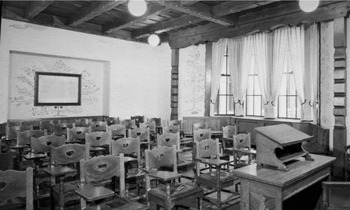
The final design combined elements of a Slovak farmhouse and Prague's Charles University, highlighting the development of the Czechoslovak humanistic spirit throughout history (see Figure 1).
Czechoslovak Nationality Room
© 1978 University of Pittsburgh. Photograph by Herbert K. Barnett. Used with permission.

In this construction the quintessential Czechoslovak characteristic was humanism (humanita) as embodied by ‘President-Liberator’ Tomáš G. Masaryk. Humanism became the lynchpin that connected Czechoslovakia with its Bohemian past, a quality to be publicised worldwide. Masaryk was commemorated in the room and linked humanita to the writing and actions of eight exceptional personalities in Czech and Slovak history from the ninth to the nineteenth century, including Cyril and Methodius (creators of the Glagolitic alphabet and Christian missionaries to the Slavs); ‘Good King’ Wenceslaus (founder of the Czech political nation); Jan Hus (‘the Czech's noblest and greatest champion in the struggle for religious freedom’); Jan Amos Komenský (‘pioneer of the modern educational methods ‘); Ján Kollár (Slovak poet) and Ľudovít Štúr (‘founder of the Slovak literary language’); and Bishop Stefan Moyzes (‘a pioneer of popular education among Slovaks’).Footnote 43
The choices typified the representation of the Czechoslovak European character. For example, Komenský enjoyed almost cult-like status within the Czechoslovak national discourse – in 1937 the Czechoslovak government went so far as to pay (symbolic) rent for his mausoleum outside Amsterdam, and the ceremony surrounding the event counted as a major event in Dutch-Czechoslovak cultural relations.Footnote 44 Jan Masaryk, son of President Masaryk, stated on 7 March 1939 during the dedication of the Czechoslovak Room in Pittsburgh that Czechoslovaks had ‘always carried [their] weight in European history – in cultural, ethical, and moral enterprises . . . [while others] have monuments to war heroes’.Footnote 45 On the birthday of T.G. Masaryk, just months after the Munich Agreement and a week before the German troops marched into Prague, the room was finally opened to the public. In keeping with the logic of cultural diplomacy the classroom was not simply a classroom, but a ‘shrine dedicated to carry Czechoslovak culture to the world’, and a memorial to the idea that ‘a nation which can create cannot and will not die’.Footnote 46 Czechoslovakia's cultural propaganda – past and present – in the United States did not go unnoticed in Hungarian government circles.
Hungarian Room – Artistic Spirit
The Treaty of Trianon fundamentally transformed the way that the Hungarian leadership viewed the significance of culture and cultural projects.Footnote 47 Before the treaty it might have perceived the lack of Western recognition of Hungarian cultural and historic accomplishments as a vexing problem, but after 1920 it believed such ignorance had grave consequences. The committee responsible for supplying documentation to the Hungarian representatives at the Paris Peace Conference was reorganised and transferred to the jurisdiction of the newly established Foreign Ministry.Footnote 48 Rechristened as the ‘Political Information Bureau’, it assumed the role of collecting and assessing foreign propaganda related to Hungary and the region.Footnote 49 There was much work to do. After the First World War, Hungary was portrayed as culpable for launching hostilities in 1914, and Hungarians were concerned that the Great Powers might perceive their newly independent country as anachronistic, belligerent and a liability to European peace.Footnote 50
‘Not sword, but culture can sustain and make the Hungarian homeland great once again’, announced Kunó Klebelsberg in his inaugural speech as Hungarian Minister of Culture and Education in 1922. Aware of the country's lack of military might, human and material resources, technology and international status, members of the political elite argued that the country's situation could be improved only through a non-traditional diplomatic campaign: the deployment of Hungarian culture.Footnote 51 In Klebelsberg's view the negative image of the country was to blame for the severity of the Treaty of Trianon and the country's international isolation. The Ministry of Culture and the newly established diplomatic corps of the Foreign Ministry aspired to deploy the country's cultural capital as their primary instrument in influencing Western public opinion.Footnote 52 However, they also believed that their campaign to win over the hearts and minds of the West suffered from a late start, as neighbouring countries had already made considerable advances in the West.Footnote 53 Intellectuals and politicians argued for a reorganisation of Hungary's propaganda and pointed, with jealous admiration, to the achievements of Czechoslovakia's cultural and political propaganda.Footnote 54 To the Hungarians, the Czechoslovak example demonstrated the significance of access to Western diplomats and the Western public and many began to believe that culture as a tool of diplomacy did indeed ‘work’. The architects of the campaign assumed Western roots would rehabilitate Hungary, and the cultural diplomatic campaign abroad was therefore less political and less confrontational than domestic revisionist propaganda.Footnote 55 The Ministry of Culture and the Foreign Ministry oversaw the foreign representation of Hungarian historical, cultural and scientific achievements in newspapers, magazines, tourist brochures, radio programmes and movies. However, most relevant to this story is the role of academic institutions in this campaign. The Hungarian Parliament passed a law in 1927 that allocated 1.2 million Hungarian pengő (c. £60.000) for the establishment of institutions that would serve as outposts of Hungarian culture, and soon branches of Collegium Hungaricum opened their doors in Vienna, Berlin and Rome.Footnote 56 In the years that followed the Hungarian cultural offensive reached out through lectureships and academic departments to France, Great Britain, Poland, Bulgaria, Estonia, Finland, the Netherlands, Portugal, Sweden, Switzerland, Turkey, Japan and the United States.Footnote 57
At first glance the University of Pittsburgh may not have seemed the most logical place to commemorate Hungarian culture. Despite the sizable Hungarian population in the city and surrounding areas, Pittsburgh carried no particular historical significance for the Hungarian leadership. However, Pittsburgh was important to the Czechoslovaks, and this, in turn, rendered this Pennsylvanian city important to the Hungarians. In 1929 Lajos Alexy, Hungarian consul-general in Cleveland, alerted the Foreign Ministry to the growing cultural activities of the area's Romanians, Yugoslavs and, especially, Slovaks and Czechs. He also pointed out that at the University of Pittsburgh, Slavic studies featured prominently. Moreover, he argued, with the Nationality Rooms project and the expanding interest they signalled that the university would become the ‘Mecca for students interested in European culture’.Footnote 58 In another letter the same year Alexy pointed out that both the Czechoslovak and Yugoslav governments had already contributed financially to the construction of their own rooms.Footnote 59 This provided the impetus for the Hungarian government to engage in the Nationality Room project.
The Pittsburgh Hungarian Committee, under the leadership of a Pittsburgh resident, Dr Samuel Gömöry, was officially established in October 1928, but their original gift of $2,000 had been presented to the University of Pittsburgh the previous year.Footnote 60 Almost immediately after its establishment the local Pittsburgh committee contacted, through the Hungarian legation in Cleveland, the Hungarian Foreign Ministry and the Ministry of Culture.Footnote 61 As a result, a government-sponsored committee, under the direction of the Royal Hungarian State Secretary of Culture and Education, Dr Gyula Kornis, was set up in Budapest in order to ‘vitalise the campaign’.Footnote 62 The Budapest committee assured the Pittsburgh Hungarians of their government's moral, and, on a more limited scale, financial support.Footnote 63 Accordingly, a carefully selected working group in Budapest took over the planning and invited applications for the architectural plans and designs of the room.Footnote 64 The eventual winner was Dénes Györgyi, the semi-official state architect of all Hungarian government projects abroad. He had contributed to the design of the Hungarian Pavilion in the 1911 Turin World's Fair, and had also designed the Hungarian pavilions at the World's Fairs in Barcelona (1929), Brussels (1935) and Paris (1937).Footnote 65 Györgyi was also considered an ideal choice because he represented a compromise between contemporary Hungary's two cultural trends, blending the geometrically simplistic architectural designs characteristic of the urbánus or modern style with ornamentation of the népies or folk manner. He further promoted co-operation and compromise between the various factions of Hungarian elites, for he believed that depictions of cultural achievements were among the most important tasks for Hungarian intellectuals. In his view, Hungary had to study its rivals, their way of thinking and their plans, in order to identify a unique, essential quality or image that would best represent the achievements of Hungary abroad.Footnote 66
Hungarians, like their neighbours, sought to prove their Europeanness by describing their role in defending Western civilisation (as ‘the Shield of Christendom’), their contributions to science and culture, and their overall usefulness in furthering the development of humanity. However, in this case the message of the Pittsburgh Nationality Room was more complicated. Through his design, Györgyi argued for the modern functionality of Hungarian folk art, which he perceived as the unique characteristic and distinctive property of the Hungarian artistic spirit. This artistic spirit was to become the main message of the room which, in an indication of the highly competitive nature of the climate, was enlarged after the Hungarian Committee learned that the Czechoslovak and Romanian committees had both selected larger rooms.Footnote 67
Györgyi's correspondence with the Pittsburgh committee provides clear evidence that his plan for the interior design was the result of close collaboration between the architect and the Hungarian Cultural Ministry. Even a celebrated architect such as Györgyi had to make sure that his design portrayed an image deemed advantageous by government circles. In a 1931 letter to Gömöry he indicated that he saw the government inclusion in the final design as rather appropriate and beneficial. As he put it, he viewed Klebelsberg and his colleges at the Ministry of Culture as the ‘most competent custodians’ of the country's culture.Footnote 68
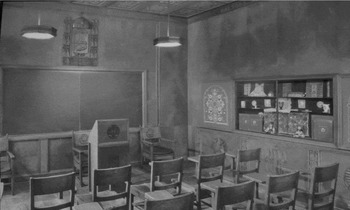
In 1931 the building of the actual Cathedral of Learning had progressed far enough to allow construction of the Hungarian Room to start, and craftsmen from both sides of the Atlantic began work. Györgyi's contrasting style – simple, yet in places distinctively ornamental – and his belief that traditional folklore and progress were not mutually exclusive, are clearly in evidence in the room (see Figure 2).
Hungarian Nationality Room
© 1978 University of Pittsburgh. Photograph by Herbert K. Barnett. Used with permission.

The plain, unassuming tobacco-brown walls contrast with the highly ornamental ceiling of seventy wooden panels painted paprika-red and decorated with brightly coloured Hungarian folk-motifs, including doves, flowers and hearts.Footnote 69 ‘Carved door and brilliant ceiling, plain walls and floor laid in polished squares the same size as the ceiling cassettes carry out the contrast which is the peculiar character of Hungarian decorative art’, observed Ruth Crawford Mitchell.Footnote 70 Further detail included a great tulip-chest-cabinet (tulipános láda) with Hungarian porcelain, a coat of arms from the oldest Hungarian university, a carved frieze with the first two stanzas of the Hungarian National Anthem, and a gold watch and a hand-written letter by Lajos Kossuth, the most esteemed and famous figure in modern Hungarian history. The Hungarian Room, which was to serve as evidence of the ‘strength and superiority of Hungarian culture’, opened its doors on 29 September 1939.Footnote 71
Romanian Room – Orthodox Spirit
The Romanians took careful note of the Hungarians’ efforts, yet at the moment the Hungarian Room was opening its doors the Romanian Foreign Ministry was undergoing significant reorganisation. On 3 October 1939 Romania established its own Ministry of Propaganda, and soon the Foreign Ministry in Bucharest instructed the Romanian embassy staff in Washington D.C. to carry out a campaign to counter Hungarian propaganda in the United States.Footnote 72 In October 1940, Ion Antonescu even proclaimed ‘propaganda to be “a new army” upon which “the future of the state depended”.’Footnote 73 However, the Romanian leadership's concern with propaganda and its influence on public opinion predated their interest in the University of Pittsburgh's Nationality Rooms. After the First World War, Romania's newly acquired frontiers became the target of three different revisionist campaigns.Footnote 74 It is no exaggeration to say that, if the leitmotif of Hungary's diplomatic efforts was to revise the Versailles system, then Romania's was to maintain it. On this issue all the warring factions of Romanian political life –with the exception of the Communists – agreed.Footnote 75 Under the direction of Nicolae Titulescu (until 1936) the country's foreign policy, described by one British Foreign Office figure as ‘very much a one-man show’, sought to promote the idea that Romania's territorial integrity was the key to future peace and stability not only in the region, but in Europe as a whole.Footnote 76 The Romanian political and cultural elite acknowledged the subtle power of cultural diplomacy alongside that of traditional diplomatic channels.
In the effort to influence public opinion, Titulescu deployed all the weapons at his disposal. This was a wide-ranging arsenal, which he successfully used during the Paris Peace Conference and continued to use thereafter, and included the exploitation of his personal relationships not only with Western political and public figures but also with journalists (both at home and abroad) whom he ‘subsidised’ from a ‘secret fund of the Foreign Ministry’.Footnote 77 Utilising cultural production, Titulescu and his colleagues sought to create a Romanian identity that would enable them to gain sympathy and good will abroad. While the United States was certainly not their primary target, the Romanian Nationality Room in Pittsburgh attracted the attention of governmental circles.
In other ways the Romanian Room in Pittsburgh owed its existence to serendipity. A young Romanian PhD student, Christine Galitzi, was travelling through Pittsburgh in the summer of 1927 when she learned about the proposal for the Nationality Rooms. Joining forces with two other Romanian students at the University, she formed a committee of Romanian students and approached the Romanian government via the Romanian Legation in Washington. The chief problem they faced was the low number of Romanian immigrants to Pittsburgh, numbered only in the hundreds.Footnote 78 Therefore, through the medium of ‘The Union of Romanian Beneficial and Cultural Societies of America’, they proposed a nationwide fundraising campaign. How far competition between Hungary and Romania contributed to the Romanian government's decision to get involved must remain a matter for speculation. However, we do know that in the summer of 1929 another returning student, Ionel Ionescu, was received by Queen Mary of Romania and Prime Minister Juliu Maniu.Footnote 79 It is also certain that in 1930 the committee, with the active patronage of the Romanian Legation, raised the considerable sum of $7,000 in eight months.Footnote 80
In early 1930 Juliu B. Drăguşanu, Vice President of the Pittsburgh committee, travelled to Washington to discuss setting up a counterpart to the committee in Bucharest and to ask the Romanian Legation to commission a design for the Romanian Room.Footnote 81 Charles Davila, Romania's Ambassador to the United States, assured Drăguşanu that the Romanian government would offer its co-operation. He further pointed out that although early drafts by New York Romanian architect Alexander Seceni were deemed ‘cheerful and attractive’, they were not representative of ‘specifically and purely Romanian art’.Footnote 82 He proposed instead the drawings of famed Bucharest architect George Matei Cantacuzino – descendant of one of the oldest Wallachian noble families – which in his view represented a ‘more classical Romanian art inspired by the Byzantine style’.Footnote 83 However, an unforeseen event hampered the development of the Romanian Room. In 1931 an American cashier embezzled the funds that had been raised, and there was no progress in the development of the Romanian Room for some five years. In August of 1936, through the medium of the newly established American Institute of Romania, new committees were organised in both in Pittsburgh and Bucharest.Footnote 84 The new committee in Bucharest was chaired by Mihail Oromulu, and its members included Prince George Nicholas Mavrocadato and Nicolae Iorga, Romania's most eminent historian of the early twentieth century, who was also former Prime Minister and Minister of the Interior, and Rector of the University of Bucharest.
In many ways Romanians, like their Hungarian and Czechoslovak counterparts, viewed the image of Europeanness as crucial to attracting the Western powers’ attention. However, as Katherine Verdery points out, there was a heated debate about the meaning and representation of the specificul naţional (‘national essence’) of Romania.Footnote 85 The country's intellectual elite was bitterly divided. The ‘Westernisers’ advocated the continuation of Romania's development based on the Western European model of progress and modernisation.Footnote 86 ‘Opposed to the “European” orientation were the “traditionalists”,’ comprising ‘those intellectuals who sought models for Romanian development in its autochthonous past, real or imagined’.Footnote 87 For many ‘traditionalists’, Orthodox Christianity and tradition were the ‘two primary, inseparable ingredients of the Romanian national character’.Footnote 88 Even though the traditionalist camp was far from united, they all agreed on the unique and predominantly rural character of Romania and viewed its historical past – from antiquity to the present – and its perceived role as the shield of Christianity as undeniable proof of the country's role in the development of Western civilisation.
Leading traditionalist Nicolae Iorga viewed south-eastern Europe in general, and Romania specifically, as ‘the spiritual and institutional continuation of Byzantium’, and argued that Byzantine ideals, church and civilisation had been preserved and protected by the various princes of Wallachia and Moldavia, such as Constantin Brâncoveanu and Nicholas Mavrocordat.Footnote 89 To Iorga, the synthesis of Byzantine high culture and traditional Romanian culture and the claimed continuity of its ancient past made Bucharest ‘the true intellectual capital of South-Eastern Europe’. It was an idea he promulgated in a number of publications and during his American lecture tour.Footnote 90 In his view Orthodoxy was the bedrock of Romanian identity and represented much more than religion.Footnote 91
The responsibility for designing a room that portrayed the nexus of Romanian art, Orthodoxy and Byzantine culture – as Iorga defined it – was assigned to a hand-picked team consisting of Nicolae Ghica-Budeşti, George Matei Cantacuzino and George Bals. The selection of these three artists is telling. Ghica-Budeşti was the leading Romanian architect of the time. Together with Cantacuzino and Bals, he had been involved in a Romanian government project to conduct a comprehensive survey of the country's principal churches and monasteries.Footnote 92 Cantacuzino described the motivation behind their work as follows: ‘We try to find ourselves everywhere. Each of us searches the past for our likes, to praise and justify our tastes and aspirations . . . To dream about the past is also a way to prepare for the future.’Footnote 93
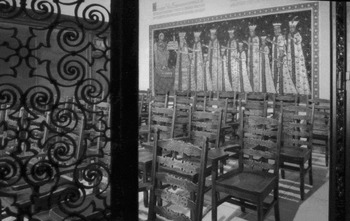
These architects’ search for a useable past to represent the identity of modern Romania took them to the seventeenth-century Romanian-Byzantine style monastery of Horezu in Wallachia, whose designs inspired the Christian Orthodox motifs of the Romanian Nationality Room (see Figure 3). Wallachian Prince Constantin Brâncoveanu personified Romania's sacrifices as the shield of Christianity, and gave evidence of its worthiness as a European nation. Many in Romania thought the ‘Brâncovenesc style’ the only truly Romanian one. According to legend, the Prince and his family were executed by the Ottomans for refusing to recant their Christian faith. As the inscription in the room's mosaic states: ‘Prince Constantin Brâncoveanu and his family laid down their lives so that faith in God and nation may live forever in Romanian hearts.’ The four icons depicting the Virgin and Child, Christ, the Dormition of the Virgin, and Saint Mark were installed to further illustrate Romania's Christian character.
Romanian Nationality Room
© 1978 University of Pittsburgh. Photograph by Herbert K. Barnett. Used with permission.

With the onset of war, movement of ideas, people and material slowed, delaying construction. In Romania itself radical political changes were taking place as the right-wing authoritarian General Ion Antonescu rose to prominence. Yet, just as in Hungary, cultural diplomacy continued to enjoy government support. Most revealing of this support is the fact that the Brâncoveanu mosaic, the four icons, the beautiful pink marble flooring, and the wrought-ironwork was shipped from the Romanian Pavilion of the 1939 New York World's Fair. The transaction required a special decree of the Romanian Parliament, which made the University of Pittsburgh one of the custodians of the exhibit.Footnote 94 Vicissitudes of war could hamper but not stop progress on this project, and the Romanian Room opened its doors on 16 May 1943, although by that point both Romania and Hungary had been at war with the United States for sixteen months.
Conclusion
After the First World War, the negative connotations of traditional propaganda forced politicians to consider more subtle ways of influencing foreign opinion. The Czechoslovak, Hungarian and Romanian political elites engaged in fierce competition for reassurance and support from the countries of the West – even after the outbreak of the Second World War.Footnote 95 Each sought recognition as a credible European nation, and as such had to demonstrate contributions to the betterment of European and Western civilisation. Each government believed that in order to have a successful foreign policy that assured sovereignty over national territory, it needed firm Western support, and therefore each mobilised artists, filmmakers, musicians and even, as in the case in Pittsburgh, architects to redraw their nation's image abroad. Assessing the effects of these efforts is difficult, yet they certainly point to a distinctive intertwining of culture, diplomacy and foreign policy during the inter-war years.
Those efforts included the construction of Nationality Rooms at the University of Pittsburgh, where humanistic and Christian imageries – arguably not unique features of any one country – were designed to convey political messages. Pittsburgh would appear to be an unlikely target of cultural diplomacy. Indeed, it would be unfair to claim that the Czechoslovak, Hungarian and Romanian leaders saw the United States as their primary target for propaganda. In fact most of their energy (and money) was used to convince the likes of Great Britain and France – and to lesser degree Germany and Italy – of the just nature of their cause. However, the case of the nationality rooms shows that for the countries of east-central Europe no project was too small or too insignificant. When Ruth Crawford Mitchell visited the region, state dignitaries, including the Queen of Romania, welcomed her. She noted, with considerable pride, the local media coverage of her visit and the Pittsburgh project. Indeed, despite significant economic, political and even personnel changes, commitment to the project did not wane on either side of the ocean. The rooms provide an illustrated account of inter-war east-central Europe's ferocious and many-pronged struggle for legitimacy and influence.
What became of the Nationality Rooms project? Today, the Czechoslovak, Hungarian and Romanian classrooms are but three of the twenty-six nationality rooms in the Cathedral of Learning. The Hungarian Room was remodelled in the 1950s and was fitted with beautiful stained-glass windows depicting illustrious Hungarians. The Czechoslovak Room outlived the state of Czechoslovakia and still portrays a country once seen as the most democratic state in east-central Europe. The Romanian Room remains one of the most spiritual rooms at the Cathedral of Learning. By an ironic twist of history these rooms do what they were originally intended to do by Ruth Crawford Mitchell: they exemplify the various nations’ cultural and historical heritage for the numerous students who take their exams there and for the tens of thousands of visitors every year. For the historian, however, the University of Pittsburgh's Nationality Room project exemplifies the perceived utility of cultural diplomacy during the inter-war years, so great as to engage central Europe's top historians, architects and artists, as well as quite a few diplomats and statesmen, and occasionally commanding the attention of the most powerful leaders of that time.