Introduction
In 2010, the Social Security Disability Insurance (DI) programme of the United States provided monetary and medical benefits to 8.2 million beneficiaries. Participation in the programme has increased significantly over the last two decades. With this increase has come a renewed interest in understanding how economic factors influence application decisions.
Starting with Halpern and Hausman (Reference Halpern and Hausman1986), application decisions have been conceptualised as a choice between applying for the programme and working. Subsequent studies such as Kreider (Reference Kreider1998, Reference Kreider1999) and Lahiri et al. (Reference Lahiri, Song and Wixon2008) have increased the degree of complexity of the decision process by including lifetime income flows, uncertainty and Medicare value, but have maintained the assumption that workers essentially make a decision between applying for DI versus working. However, applications for DI are strongly countercyclical (Lando et al., Reference Lando, Coate and Kraus1979; Rupp and Stapleton, Reference Rupp and Stapleton1995), suggesting that workers move onto DI only after losing their job. More recently, Autor and Duggan (Reference Autor and Duggan2003) argue that reforms since the 1980s have increased the number of such applications occurring after job loss. They construct state-level instruments of the supply and demand for DI benefits and find that DI applications following labour demand shifts more than doubled since the mid-1980s. Perhaps the clearest evidence that job loss directly influences DI applications, at least for Norway, comes from Bratsberg et al. (Reference Bratsberg, Fevang and Red2010). They use administrative records to identify job displacements and find higher rates of DI applications after such an event. Despite this growing evidence that workers who have lost their job are more prone to apply for DI than those who have not, little is known about whether and how economic circumstances around the time of a job separation contribute to this decision.Footnote 1
Looking at the time between job separation and application for disability insurance is also of great interest for current efforts to modernise disability insurance programmes. The US and many other countries with a developed welfare state face increasing pressure to modernise their expanding programmes (Milligan and Wise, Reference Milligan, Wise and Wise2012). Reforms need to balance conflicting objectives: preserving the insurance function on the one hand, while restoring fiscal sustainability on the other. Previous attempts in the US and elsewhere have focused on tightening eligibility of beneficiaries (see for instance Baker and Milligan (Reference Baker, Milligan and Wise2012) for Canada, Bingley et al. (Reference Bingley, Gupta, Pedersen and Wise2012) for Denmark, Behaghel et al. (Reference Behaghel, Blanchet, Debrand, Roger and Wise2012) for France, García-Gómez et al. (Reference García-Gómez, Jiménez-Martín, Vall Castelló and Wise2012) for Spain, Jönsson et al. (Reference Jönsson, Palme, Svensson and Wise2012) for Sweden and Banks et al. (Reference Banks, Blundell, Bozio, Emmerson and Wise2012) for the United Kingdom). While such reforms reduced the number of beneficiaries, they typically had little success in increasing employment among (former) beneficiaries, presumably because they have been out of work for too long (Autor, Reference Autor2011).
As a response to such challenges, new reform efforts have focused on providing work accommodation for employees with work limitations. Work accommodations can include a variety of measures such as improving access to office space, special equipment at the workplace (e.g., hearing devices or large-type computer terminals), modified work schedules or human assistance at work. The idea is to make it easier for such workers to stay in their job, which in turn prevents them from applying for disability insurance benefits. Empirical support for such a pre-emptive measure comes from Burkhauser et al. (Reference Burkhauser, Butler and Gumus2004), who find that workers receiving employer accommodations in the US are less likely to apply for DI. In the Netherlands, social insurance reforms in 2002 included a provision encouraging firms to provide work accommodation for people with disabilities (Burkhauser and Daly, Reference Burkhauser and Daly2011). The idea of using pre-emptive policy options suggests that increasing re-employment among individuals who are out of work and who might end up applying for disability insurance could also lower the number of applications. However, such policies can only influence the behaviour of applicants if they do not claim disability benefits right after job loss but consider other options as well.
This paper addresses whether such policies could be effective by examining employment transitions of applicants before they claim DI benefits. Three main findings emerge. First, most applicants for DI stop working before they apply for DI benefits. These employment transitions account for most of the observed income decline prior to application. Second, the majority of workers report either the onset of a work limitation or an illness or injury shortly before they are out of work. And, third, even though most non-employment episodes begin with a health shock, applicants typically do not move quickly onto DI. Furthermore, classifying these non-employment spells by beginning events reveals that spell duration, search effort, UI participation and DI application processing time differ substantially by these categories.
These results suggest that economic conditions at the beginning and during spells of non-employment could be important in explaining why workers apply for DI. The decision-making process of an individual on the verge of applying for DI might be better characterised as one of job search versus application for DI, where job opportunities, transfer income and search intensity may all influence the decision to apply for DI. As a consequence, policies aimed at increasing re-employment of individuals who recently stopped working could be effective in stabilising the number of applications for DI.
Besides contributing to the literature and the current policy debate related to disability insurance, some of the findings also relate to survey design issues. Most notably, employment changes at the time a work limitation is first reported appear to be very sensitive to the exact wording of the work limitation question. Because this study uses a broad definition of work limitation, employment rates do not decrease sharply with the onset of such a work limitation. Other studies that use a more restrictive definition of a work limitation find a stronger employment decline. These findings highlight the need for researchers to pay close attention to the exact wording of such questions and how it may affect their findings.
The next section provides a short overview of the DI programme in the United States. It is followed by a description of the data used for this study. After that, the role of employment transitions and non-employment episodes for DI applications is discussed. The last section provides some concluding remarks.
Institutional background
DI was enacted in 1956 to insure workers as well as their spouses and dependents against loss of earnings due to disabilities by providing monetary transfers and access to Medicare. In 1974, SSI for the Disabled and Blind was added as a second programme aimed at disabled adults. For both programmes, disability is defined as:
the inability to engage in any substantial gainful activity by reason of any medically determinable physical or mental impairment which can be expected to result in death or which has lasted, or can be expected to last, for a continuous period of at least 12 months.Footnote 2
For both programmes, initial applications are determined by a sequential five-stage procedure, which assesses the applicant's health impairment severity and work capacity.Footnote 3 While initial applications are processed relatively quickly, only a minority of applicants are accepted.Footnote 4 The appeal process itself has several stages, namely reconsideration, administrative law judge (where most appeals are decided), appeals board and federal court. Applicants who appeal an initial denial have a high chance to be awarded benefits, but the appeals process can extend over several months and often exceeds a year or more (Benitez-Silva et al., Reference Benitez-Silva, Buchinsky, Chan and Sheidvasser1999).
While both insurance programmes have the same medical eligibility criteria, their non-medical eligibility rules are somewhat different. Eligibility for DI requires a recent and relatively steady work history.Footnote 5 Eligibility for SSI does not stipulate this work history, but people must have income and assets below certain thresholds. Individuals can apply for both programmes if they meet their respective non-medical requirements. About one quarter of applicants apply for both programmes.
Applicants also cannot engage in substantial gainful activity, as measured by an earnings threshold. The threshold was $200 per month for the non-blind in 1975 and has been raised sporadically to $700 by 2000. Since then, it has been adjusted for inflation and is $1,010 per month in 2012. Given such low earnings ceilings, most applicants need to be out of work in order to pass the earnings test. This study uses the Survey of Income and Program Participation (SIPP) matched to administrative files in order to shed light on the time of non-employment preceding applications. The following section begins the empirical analysis with an overview of the data.
Data
The SIPP is a nationally representative sample of individuals fifteen years of age and older of the civilian non-institutionalised population.Footnote 6 The main objective of the SIPP is to provide accurate and comprehensive information about income and programme participation of individuals and households in the United States. Respondents are interviewed once every four months, called a wave, for two to four years. When sampling a new population, the Census Bureau randomly assigns respondents to four rotation groups. Starting with the first of such rotation groups, each subsequent group is interviewed one month after the previous one. When interviewed, respondents are asked to provide information about the preceding four months, called reference months. For this study, SIPP panels covering the years 1990–2007 are analysed.Footnote 7
While the SIPP provides information on employment, demographic characteristics and participation in transfer programmes, it does not contain application dates and outcome decisions for DI. To overcome this limitation, SIPP records are matched to administrative records on DI applications and their respective award decisions using Social Security Numbers (SSN). Applications are identified through so-called 831 files. When a person applies for DI, an 831 file is opened. It subsequently tracks the application and initial determination including the reconsideration stage, but does not record subsequent appeals.
Initially, denied applicants can appeal the decision, and the majority of appeals are successful. In order to improve on the accuracy of application outcomes, 831 files are therefore augmented by the Master Beneficiary Records (MBR). These records contain complete application information including appeals for the latest disability application of an applicant. Earlier applications, however, are erased from the MBR records. For such applications, the application outcome can still be recovered with the help of the Payment History Update System (PHUS), which records who receives DI benefits. MBR and PHUS records are matched to 831 files using application and benefit begin dates, respectively.Footnote 8
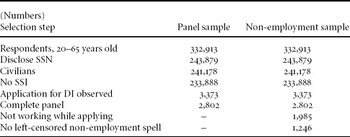
Sample selection proceeds in several stages. From the sample of men and women between the age of twenty and sixty-five, those who do not report their Social Security Number have to be disregarded since they cannot be linked to Social Security's administrative records. Next, only civilians who apply for DI while being surveyed for the SIPP are considered. SSI applicants are kept in the sample only if they also apply for DI. Individuals not interviewed in one or more waves are disregarded as well. After these steps, 2,802 applicants for disability insurance remain in the sample. The first column of Table 1 shows these selection steps and corresponding population numbers.
Sample selection

Note: The table shows unweighted population numbers for selection steps.
Source: SIPP panels 1990–2004 matched to administrative records. See text for details.
Individuals in this sample may or may not be working while applying for DI. In order to specifically analyse non-employment episodes ending with an application for DI, a subsample of such spells is created. This subsample excludes applicants who work when applying for DI or who have an unknown spell begin (i.e., those for whom a non-employment spell is left-censored). Non-employment spells that end with re-employment are also eliminated. The second column of Table 1 shows population numbers for these selection steps. The final sample size for this subsample is 1,246 individuals.
The role of employment transitions for DI applications
The scope of employment transitions
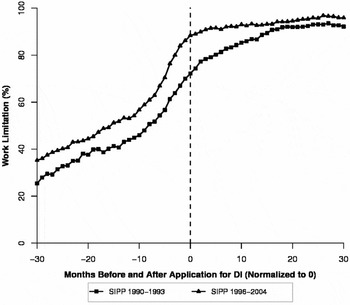
The analysis begins with work limitation trends using the panel of 2,802 applicants. For these trends, it is important to realise that the work limitation question is not included in all waves for SIPP surveys 1990–93. As a result, some of the individuals in these surveys can only report the onset of a work limitation many months later. Therefore, the fraction of people reporting a work limitation in these surveys is likely to be lower as compared to later SIPP surveys. To address this concern, work limitation trends are reported separately for two panel groups, namely SIPP 1990–93 and SIPP 1996–2004.
Figure 1 presents the percentage of applicants who report a work limitation thirty months prior and thirty months after the month they apply for DI. For both panel groups, the fraction of applicants reporting a work limitation slowly increases thirty to ten months before the application month and then accelerates during the last ten months. However, the increase is less pronounced for the earlier surveys. At the time of application, 70 per cent of applicants in the SIPP 1990–93 group, but 90 per cent of applicants in the SIPP 1996–2004 group report a work limitation. The 20 per cent difference is apparently the result of delayed reporting in earlier surveys. Still, about 10 per cent of all individuals in the later surveys do not report a work limitation when applying for DI. This is a surprisingly high number, because applicants need to be physically or mentally impaired to be eligible for benefits. However, the fraction of applicants with no reported work limitation is similar to the one reported by Livermore et al. (Reference Livermore, Stapleton and Claypool2010) for DI applicants one to twelve months after DI entry. Apparently, a small fraction of applicants for DI claim benefits without having a qualifying work limitation at the time of application.
Onset of work limitation, by months relative to first application for DI and SIPP groups
Note: Standard errors are in paranthesis. Means (columns 1 and 2) or percentages (columns 3 to 5) are in square brackets. Stars indicate signficance as follows:
*** p<0.01 ** p<0.05 * p<0.1
Source: SIPP panels 1990–2004 matched to administrative records.

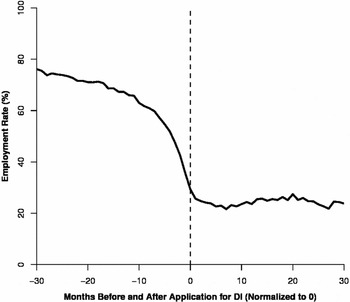
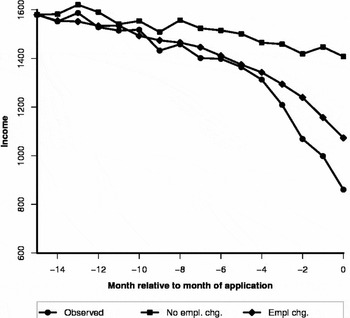
Turning to the employment rate of applicants, Figure 2 shows the average employment rate thirty months before and after application. The employment rate starts just below 80 per cent, decreases to around 60 per cent ten months before application and then declines strongly to 30 per cent during the application month. Therefore, two-thirds of the observed employment decline in the thirty months before the month of application occur relatively shortly before application, i.e. in the preceding ten months. Loss of employment can also explain most of the observed income decline prior to application. Figure 3 shows the average monthly income of applicants during the fifteen months prior to the application month, and also the result of a decomposition of monthly income changes into changes due to job loss versus other income changes.Footnote 9 As one can see, changes in income due to changes in employment tracks the overall income decline very closely until the last four months prior to the application month.
Employment rate, by months relative to month of first application for DI
Source: SIPP panels 1990–2004 matched to administrative records.

Decomposition of personal income into income change due to change in employment (‘Empl chg.’) and other income change (‘No empl. chg.’) by months relative to month of first application for DI
Source: SIPP panels 1990–2004 matched to administrative records.

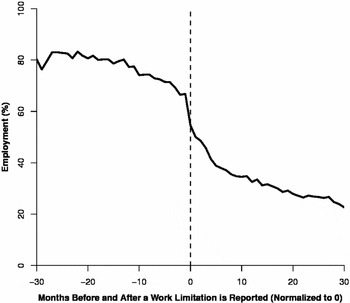
These figures highlight that the fraction of individuals reporting a work limitation increases strongly and employment rates drop sharply during the last ten months prior to the month of application. To see more directly how employment is related to the onset of a work limitation, Figure 4 presents monthly employment rate of applicants, but this time centred around the first month during which a work limitation is reported. The employment rate drops when the work limitation begins, and further declines in the ensuing months. However, the employment decline at the onset of a work limitation as observed here is much less pronounced than the employment decline from 60 per cent to 15 per cent reported by Benitez-Silva et al. (Reference Benitez-Silva, Buchinsky, Chan, Cheidwasser and Rust2004) who use the Health and Retirement Study (HRS). The respective wording of the work limitation question may explain this discrepancy. In the SIPP, a respondent is classified as being health impaired if he or she answers yes to the following question: ‘Does . . . have a physical, mental or other health condition that limits the kind or amount of work . . . can do?’ By contrast, Benitez-Silva et al. (Reference Benitez-Silva, Buchinsky, Chan, Cheidwasser and Rust2004) use a stricter definition: ‘Do you have any impairment or health problem that limits the amount of paid work you can do? If so, does this limitation keep you from working altogether?’ It is not surprising that individuals apply quickly for DI after the onset of such a severe work limitation.Footnote 10
Employment rate, by months relative to onset of work limitation
Source: SIPP panels 1990–2004 matched to administrative records.

Together, these trends show that most applicants start reporting a work limitation and stop working before applying for DI. Less clear is whether all job losses occur as individuals report the onset of a work limitation, whether they apply for DI benefits quickly after job loss or whether other economic factors are related to non-employment spell and application characteristics. The next section addresses these questions by examining spells of non-employment.
Analysis of non-employment episodes
In what follows, the sub-sample of applicants with fully observed non-employment episodes ending in applications for DI are analysed. For all tables, fields with fewer than ten observations are masked with XXX to avoid disclosure risk.
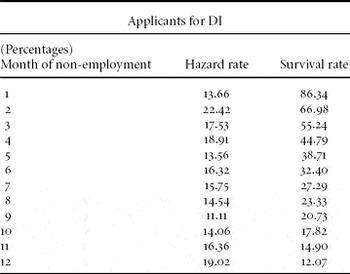
Table 2 reports the hazard rate and the fraction of non-employed workers who have not yet applied for DI for the first twelve months of non-employment. The rate is higher during the first four months as compared to later months and peaks in the second month at 22.4 per cent, but it remains above 10 per cent for all of the twelve months. Clearly, applicants do not immediately apply for DI as soon as they stop working. More than 30 per cent of them do not apply before being without a job for six months or more.
Hazard and survival rate for non-employment spells ending in DI applications

Source: SIPP panels 1990–2004 matched to administrative records.
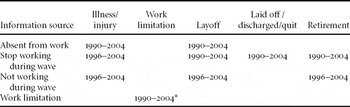
Having established that applicants do not immediately claim benefits after they stop working, the next step is to take a closer look at events surrounding these employment transitions. To this end, a hierarchical classification scheme for beginning events is developed. Several variables are used to identify beginning events, as summarised by Table 3.
Classification of beginning events

Notes: Information sources indicate questions used to identify beginning events. Cell numbers represent SIPP surveys.
Absent from work: Respondents who report being absent from work are asked about the reason for not being at work.
Stop working during wave: Respondents who report stop working during a wave are asked about the reason for not working anymore.
Not working during wave: Respondents who report not working during a wave are asked about the reason for not working during that time.
Work Limitation: Respondents are asked the following question: ‘Does . . . have a physical, mental or other health condition that limits the kind or amount of work . . . can do? ’
* SIPP 1990–1993: Wave 1 and selected topical modules only. SIPP 1996 and later: all waves.
The first of these groups contains applicants whose spell begins with an illness or injury. Two sets of questions in the SIPP provide this information. First, an individual who is absent from work may report an illness or injury as the reason for not being at work.Footnote 11 Second, for SIPP surveys 1996–2004, workers who stop working during a wave or who do not work during the entire wave may report an injury or illness as the reason why they do not work.
The second group of applicants are those who report a work limitation shortly before they stop working. Two definitions are used – one, broad; the other, narrow. For the broad definition, a work limitation must be reported at least once during the first month of non-employment or during the eight months before the non-employment spell begins, but not earlier than that. The time window for the narrow definition is four months. Multiples of 4 are used because most changes in reported health and employment occur between waves and not within them, which is a manifestation of the seam bias.Footnote 12 Months with no information about a work limitation are treated as months without work limitation. Such missing values occur for the 1990–93 SIPP surveys because they only include questions about health in selected modules. Finally, spells with eight (four) or fewer prior months are assumed to begin with a work limitation if the respondent reports having a work limitation for all of the months preceding the job loss.
If a spell cannot be categorised by these health limitation categories, then six more groups are distinguished: layoff, laid off, discharged, quit, retirement and unknown or other events. Layoffs are temporary interruptions of work, while being laid off refers to a permanent termination of employment due to business conditions, economic conditions or other reasons that are not the employee's fault. Workers might also get discharged, or they may quit or retire from work. These groups are identified through various questions. First, an individual who stops working during a wave can chose one of these events as a reason. Second, a layoff can be identified through the employment status question. Third, for the SIPP 1996–2004, layoffs or retirement are also included as possible reasons why a person does not work during the entire wave.
Finally, some non-employment spells do not fit into any of the above categories. A few of them begin with a different event, such as taking care of children, or lack information about the beginning events since the respondent is a contingent worker who is not asked why they stop working. However, the main reason why these spells do not have a known beginning event has to do with SIPP's survey design. Before the SIPP 1996, only respondents who stop working during a wave are asked why they stop working. Unfortunately, individuals tend to report the occurrence of an employment change between waves: they work all months during one wave but do not work at the first month of the next wave.
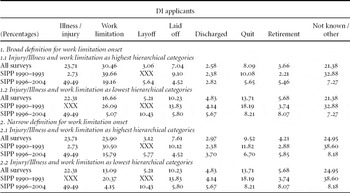
Table 4 presents frequencies of beginning events. For the broad definition of work limitation onset (first row of category 1.1 in the table), 24 per cent of all non-employment spells begin with an illness or injury, and another 30 per cent of all spells begin with a work limitation. When the narrow definition of work limitation onset is used, 24 per cent of all spells begin in this way (first row of category 2.1). Fewer than 30 per cent of all non-employment spells are classified under the next five categories, and 21 to 25 per cent of all spells cannot be classified or are other events.
Beginning events: frequency

Notes: All cell numbers represent percentages. Person-level population weights are used. Fields with fewer than ten observations are masked with XXX to avoid disclosure risk. The first row in each part shows percentages for SIPP surveys. The second and third row in each part shows percentages for SIPP 1990 to 1993 and SIPP 1996 and 2004, respectively. See text for details concerning the broad and narrow definition for work limitation onset and for the hierarchical classification scheme.
Source: SIPP panels 1990–2004 matched to administrative records.
While health shocks are the primary beginning event, the fraction of illnesses or injuries is underrepresented for SIPP surveys 1990–93 due to non-existing survey questions that identify these categories. To assess the severity of this information limitation, beginning events are also reported by pre- and post-SIPP 1996 (shown in the second and third row for each category). Almost half of all spells in SIPP surveys 1996–2004 start with an illness or injury, but less than 3 per cent of all spells can be classified in this way in SIPP surveys 1990–93. For the latter surveys, 30 to 40 per cent of all beginning events start with a work limitation as compared to less than 20 per cent post 1996. Likewise, not known or other events drop from more than 30 per cent to less than 10 per cent.Footnote 13
Given the low number of job separations due to layoff, being laid off, quit, discharged and retirement, it is of interest to find an upper bound for these other reasons. To do so, beginning events are re-classified by treating illness, injury and work limitation as the lowest categories, i.e. a spell only begins with such an event if the individual does not also indicate other beginning events (layoff, laid off, discharged, quit, retirement). The results are shown in Table 4 as categories 1.2 and 2.2 for the broad and narrow definition of onset of a work limitation, respectively. Focusing on results from SIPP surveys 1996–2004, at most 40 per cent of all non-employment spells start with a beginning event other than a health shock. The different types of health shocks together still account for the majority of beginning events.
The analysis so far has established that the majority of applicants report an illness, injury or work limitation at or around the time they stop working, but that most applicants do not immediately apply after job separation. Still unclear is, however, whether spell duration and other characteristics differ by the type of job separation.
To address this question, several changes are made. Two infrequently occurring beginning events (layoffs and discharges) are combined with workers who are laid off into a new category called job loss. Illness or injury and work limitation are again the highest categories. The analysis also focuses on the narrow definition for work limitation because it is closer to the job separation event. Finally, given the issues with SIPP panels 1990–93, the following analysis focuses on SIPP panels 1996–2004, with a corresponding sample size of 705 individuals.
In order to assess whether the beginning categories are associated with various characteristics, regressions of the following form are estimated:
 \begin{eqnarray}
y_i &=& \beta _{\rm 0} + \beta _1 ill_i + \beta _2 worklim_i + \beta _2 quit_i + \beta _4 ret_i \nonumber \\
&&+\, \beta _5 unkown_i + X_i '\gamma + \varepsilon _i
\end{eqnarray}
The regression also includes a number of control variables Xi. These are: age, a dummy for being male, a dummy for being white, two dummies for education (high-school graduate, attended some college) with no high-school degree as reference category, a dummy for being married, a dummy for having worked in the public sector, two dummy variables for industry of prior work (construction/manufacturing, services) with the agricultural sector as the reference category, a dummy for having worked full-time and year fixed-effects. These variables control for differences in observable characteristics that might be associated with different beginning categories.
Two different models are used to estimate equation (1). Spell length and waiting time are count variables, for which a negative binomial model is suitable. The negative binomial model is a generalisation of the Poisson model that does not require mean and variance of the dependent variable to be equal. A logit model is used for the other dependent variables (application outcome, searching and UI participation) because they are binary outcomes. Coefficients measure semi-elasticities of counts and semi-elasticities of odds ratios for negative binomial models and logit models, respectively. These semi-elasiticities have a straight-forward interpretation: the coefficient for one beginning category dummy times 100 shows the average percentage change in outcome that is associated with an individual being in that category as opposed to the job loss category, holding all other variables constant.
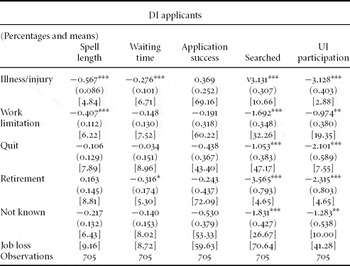
Table 5 presents results for the beginning categories. For each beginning category (row), the first line shows the coefficient estimate, the second line the standard errors in round brackets and the third line the unweighted mean in square brackets. Because job loss is the reference category, only averages are displayed for it.
Regression results for spell characteristics on beginning events

Note: Data source: SIPP panels 1996–2004 matched to administrative records. Spell length and waiting time are expressed in months. Having searched during the spell, and UI participation refer to the whole spell. Beginning events refer to the narrow definition of beginning events (see text for details). All regressions include the following additional variables: age, sex, race (dummy for being white), high-school graduate, attended some college, being married, prior work in public sector, industry of prior work (agricuture (base category), construction/manufacturing, services), full-time work before employment separation, and year fixed-effects. For spell length and waiting time as outcome, negative binomial models are estimated. For the other three outcomes, logit models are estimated. Estimates show semi-elasticities of counts for negative binomial models and semi-elasticities of odds ratios for logit models.
The first row shows results for illness or injury as beginning category. The estimates for spell length and waiting time are negative and significant, indicating that individuals who report an illness or injury as beginning category as opposed to a job loss as a beginning category are more likely to apply quickly for DI benefits and to have a short application determination process. The magnitude of these coefficients is large: the spell duration for these individuals is less than half the spell duration of observationally identical job losers and their waiting time is more than 25 per cent lower. Still, because job losers are on average non-employed for more than nine months, individuals with an illness or injury remain out of work for several months before applying for DI benefits. The coefficient for application success is positive but not significant. Finally, individuals with an injury or illness are also significantly less likely to report looking for a job and to receive UI benefits.
The coefficient for spell length for individuals in the work limitation category is also negative but a bit smaller in magnitude than the corresponding coefficient for the illness/injury category. The coefficient for the waiting time and application success is negative and not statistically significant, indicating that this group of workers has a similar application process and outcome as job losers when observable characteristics are taken into account. The coefficients for searching and receiving UI benefits are negative and statistically significant; however, they are much smaller in magnitude than corresponding coefficients for individuals with an illness or injury (differences in coefficients are statistically significant). Apparently, this group of workers is more likely to consider other options than applying for DI as compared to the illness and injury category.
The next four rows show that with the exception of searching and UI participation, individuals who quit, retire or who have an unknown or other beginning event are not observably different from individuals who report a job loss. They tend to be less likely to search and to receive UI benefits as compared to observably identical job loses, but this reflects the very high rates of job search and UI participation for the reference group.
These regression results show that there is important heterogeneity in terms of spell and application characteristics with respect to beginning events. Individuals with an illness or injury apply the quickest (but still remain non-employed for some months), have a short waiting time and also have the highest application success probability (although not statistically significant). They also do not bother much about getting UI benefits and looking for a new job. Individuals with a work limitation are somewhat similar, but they are non-employed for a longer time and much more likely to draw UI benefits and to engage in job search. For searching and UI participation, they are often more similar to respondents who experienced job loss than individuals who quit, retire or who have an unknown beginning event.
The analysis was repeated using SIPP 1990–93 to investigate whether spell characteristics differ for these panels because of less accurate classification of illness/injury versus work limitation (the exact results are available upon request). For these panels, the work limitation coefficients for the outcomes spell length, searching and UI participation are all more strongly negative than corresponding coefficients in Table 5; moreover, the work limitation coefficient for the outcome application success is positive and highly significant. These results are consistent with the idea that some of the individuals in the work limitation category for the SIPP 1990–93 have an unidentified illness or injury as beginning event.
Conclusions and policy implications
This article examines transitions from employment to DI application. Most applicants do work a year before applying for DI, but do not work at the time of application. Therefore, applicants tend to experience a transition from working to not working before claiming benefits. Focusing on these non-employment spells reveals that most applicants experience an illness, injury or the onset of a work limitation shortly before or at the time of job loss. However, most applicants apply only after being out of work for several months, and some of them engage in job search and claim UI benefits before claiming DI.
Returning to the policy questions raised in the introduction, these results indicate that the months without work may play an important role for the decision to apply for disability insurance, at least for applicants with no acute illness or injury. While individuals with such acute illnesses or injuries apply relatively quickly, they only constitute about half of all applicants. For the other half, applying for DI does not necessarily appear to be their first choice; rather, they seem to consider other options, implying a more complex decision process.
One implication of these findings is that policies aimed at improving re-employment prospects of individuals with acute illness or injuries could be effective in reducing the number of applications. There are a number of policies that can target this population: short-term cash or other benefits, supporting job search effort and training for new job requirements. Future research will have to address what the specific needs of this population are and what kind of services can help getting them back to work.
Another implication is that policies that promote work accommodations, as are already in place in the Netherlands, could also be a successful early intervention strategy in the US. The high proportion of future applicants with work limitation who work before they become out of work and apply for DI benefits indicates that such policies could prevent job losses and subsequent applications for DI. Together, these policies aim at preventing potential applicants from applying for DI benefits by either making the workplace more suitable for them, or by improving re-employment prospects if they are out of work. If such preventive measures can reduce the number of cases where people apply for disability insurance benefits because of lack or other alternatives, then they can also help the disability insurance programme to better serve its core function, namely being a social safety net for people who cannot work.
Acknowledgment
This work has been supported by a fellowship from the Social Security Administration through the Center for Retirement Research at Boston College. Jeffrey Smith, John Laitner, John Bound, Brian McCall, Jessica Wyse and two anonymous referees provided helpful comments and suggestions.