Introduction
Following the adoption of the early soybean production system, rice reproduction and ripening throughout Mississippi often coincides near soybean maturation and harvest, creating potential for off-target herbicide movement from desiccants applied to soybean. Traditionally, the use of herbicides as a harvest aid was intended to desiccate weeds, improve crop quality, and increase harvest efficiency (Griffin et al. Reference Griffin, Boudreaux and Miller2010). In recent years the use of desiccants in the early soybean production system adopted in the midsouthern United States has become of great importance for crop harvestability (Griffin et al. Reference Griffin, Boudreaux and Miller2010). Soybean plants left in the field past physiological maturity may expose the seed to adverse weather conditions, reducing both yield and quality. Yield losses due to delayed harvest have been estimated to occur at a rate of 0.2% d–1 (Boudreaux and Griffin Reference Boudreaux and Griffin2008; Philbrook and Oplinger Reference Philbrook and Oplinger1989). In 2018, approximately 70% of soybean hectarage in Mississippi received a desiccant application (T. Irby, personal communication). Specifically, MSU Extension Service recommends paraquat, glyphosate, saflufenacil, and sodium chlorate applied alone or in combination to expedite and/or increase soybean harvest efficiency.
As a soybean desiccant, Mississippi recommends the use of glyphosate (842 to 3,932 g ae ha–1) after all pods have lost green color, with a minimum of 7 d between herbicide application and harvest (Anonymous Reference Bond2018). Glyphosate is a nonselective, foliar-applied, systemic herbicide that inhibits the enolpyruvyl shikimate-3-phosphate synthase pathway (Shaner Reference Shaner2014, p 240). In glyphosate-resistant soybean production systems, glyphosate applied as a desiccant has been shown to increase harvest efficiency while reducing weed seed production and viability (Clay and Griffin Reference Clay and Griffin2000; Isaacs et al. Reference Isaacs, Murdock, Toler and Wallace1989; Whigham and Stoller Reference Whigham and Stoller1979). The use of paraquat as a soybean desiccant in Mississippi is recommended at a use rate of 140 to 280 g ai ha–1, when soybeans are fully developed with at least half of leaves dropped and remaining leaves turning yellow, and a harvest interval of 15 d must be observed after herbicide application (Anonymous Reference Bond2018). Paraquat is a nonselective, foliar-applied herbicide that inhibits the flow of electrons in photosystem I in susceptible plants (Shaner Reference Shaner2014, p 337). As measured by days to complete desiccation, paraquat was observed to be the most effective soybean harvest aid when compared to glyphosate and ametryn (Whigham and Stoller Reference Whigham and Stoller1979). Sodium chlorate is recommended as a soybean desiccant in Mississippi at a rate of 6,741 g ai ha–1 applied to soybeans ready to harvest at least 7 d before harvest (Anonymous Reference Bond2018). When applied alone or in combination with paraquat, sodium chlorate has been shown to expedite desiccation, improve harvest efficiency, and decrease weed seed production and germination (Griffin et al. Reference Griffin, Boudreaux and Miller2010). The use of saflufenacil as a soybean desiccant is recommended in Mississippi at a rate of 24 to 49 g ai ha–1 when soybeans have reached physiological maturity, with a minimum of 3 d before soybean harvest (Anonymous Reference Bond2018). Saflufenacil is a broad-spectrum, nonselective herbicide that inhibits the enzyme protoporphyrinogen oxidase (Shaner Reference Shaner2014, p 409). Applied as a harvest aid in dry beans, saflufenacil was observed to increase desiccation progress without showing any impact on yield or seed quality (McNaughton et al. Reference McNaughton, Blackshaw, Waddell, Gulden, Sikkema and Gillard2015).
The use of desiccants for crop and weed desiccation has expedited and increased harvest efficiency throughout the midsouthern United States; however, the risk of off-target herbicide movement during these applications can be great. Off-target herbicide movements during application has been suggested to contain from 1/10th to 1/100th of the applied rate depending upon distance and environmental factors (Al-Khatib and Peterson Reference Al-Khatib and Peterson1999; Wolf et al. Reference Wolf, Grover, Wallace, Shewchuk and Maybank1993). Off-target herbicide movement of sublethal rates has been documented to negatively impact numerous crops including corn (Zea mays L.), cotton (Gossypium hirsutum L.), grain sorghum [Sorghum bicolor (L.) Moench], soybean, and wheat (Triticum aestivum L.) (Al-Khatib et al. Reference Al-Khatib, Claassen, Stahlman, Geier, Regehr, Duncan and Heer2003; Anderson et al. Reference Anderson, Clay, Wrage and Matthees2004; Ellis and Griffin Reference Ellis and Griffin2002; Ellis et al. Reference Ellis, Griffin, Linscombe and Webster2003; Lawrence et al. Reference Lawrence, Bond, Edwards, Peeples, Hydrick, Reynolds and Phillips2016; Marple et al. Reference Marple, Al-Khatib and Peterson2008; Roider et al. Reference Roider, Griffin, Harrison and Jones2007). Sensitivity of rice to off-target herbicide movement has been documented throughout the literature; however, the severity of injury may vary with herbicide rate, formulation, and rice growth stage (Bond et al. Reference Bond, Griffin, Ellis, Linscombe and Williams2006; Ellis et al. Reference Ellis, Griffin, Linscombe and Webster2003; Hensley et al. Reference Hensley, Webster, Blouin, Harrell and Bond2012; Namenek et al. Reference Namenek, Smith and Branson2001; Webster et al. Reference Webster, Hensley, Blouin, Harrell and Bond2016).
In Mississippi, rice accounts for only 3% of the total row crop hectarage and is commonly grown near a variety of other crops, including corn, soybean, and cotton (USDA-NASS 2018). The close proximity to these crops creates great potential for off-target herbicide movement onto rice fields throughout the growing season. With the adoption of the early soybean production system and increasing soybean desiccant usage, potential for rice exposure to sublethal concentrations of soybean desiccants extends throughout the entirety of the growing season. Therefore, the primary objective of this research was to evaluate rough rice grain yield, yield component, and milling quality response to sublethal concentrations of common desiccants applied late in the season.
Materials and Methods
Six independent, concurrent studies were conducted from 2016 to 2018 to determine the response of rice to sublethal concentrations of soybean desiccants applied during reproductive and ripening growth stages. Each year studies included paraquat (Paraquat study), glyphosate (Glyphosate study), saflufenacil (Saflufenacil study), sodium chlorate (Sodium Chlorate study), paraquat + saflufenacil (Paraquat + Saflufenacil study), and paraquat + sodium chlorate (Paraquat + Sodium Chlorate study). Research was established in Stoneville, MS, at the Mississippi State University Delta Research and Extension Center. Global positioning system coordinates, soil series, soil description, previous crop, soil pH, and soil organic matter (OM) for each study are described in Table 1.
Geographic location, soil classification, and agronomic information for field studies evaluating rice response to sublethal concentrations of desiccants managed at the Delta Research and Extension Center in 2016–2018.

a Abbreviation: OM, organic matter content.
At each site-year, the rice cultivar ‘CL163’ (HorizonAg, Memphis, TN) was drill-seeded at 83 kg ha–1 using a small-plot grain drill (Great Plains 1520; Great Plains Mfg, Inc., Salina, KS) into conventionally tilled plots. Plots measured 1.5 by 4.5 m, containing eight rows of rice spaced 20 cm apart, 4.5 m in length, and separated by a perpendicular alley 1.5 m wide. Treated plots were bordered on either side by identically sized buffer plots to minimize treatment contamination across the field.
Each year a management plan consisting of glyphosate (Roundup PowerMax 4.5 L, 1,120 g ae ha–1; Monsanto Company, St. Louis, MO) and/or paraquat (Gramoxone 2.0 SL, 560 g ai ha–1; Syngenta Crop Protection, Greensboro, NC) was applied at each site to control emerged vegetation prior to rice planting. Clomazone (Command 3 ME, 498 g ai ha–1; FMC Corp., Philadelphia, PA) plus saflufenacil (Sharpen 2.85 SC, 4.5 g ai ha–1; BASF Crop Protection, Research Triangle Park, NC) were applied preemergence each site-year for residual weed control. Propanil (Stam M4, 1,121 g ai ha–1; RiceCo, Memphis, TN) and quinclorac (Facet 1.50 SL, 375 g ai ha–1; BASF Crop Protection, Research Triangle Park, NC) plus halosulfuron (Permit 75 DF, 12 g ai ha–1; Gowan Company, Yuma, AZ) were applied preflood. Across all studies N fertilizer was applied at a uniform rate of 80 kg N ha–1 in the form of urea (46-0-0) prior to flood establishment. When rice reached the two-tiller stage a 6- to 10-cm deep permanent flood was established across all plots. Selected dates for important agronomic management events at each site-year are described in Table 2. Rice management closely followed the Mississippi State University Extension Service recommendations for stand establishment, pest management, and irrigation management (Buehring Reference Buehring2008).
Selected dates of agronomic management events for research trials managed at the Delta Research and Extension Center during 2016–2018 for research trials evaluating rice response to sublethal concentrations of desiccants.

The experimental design for all studies was a randomized complete block with four replications. All desiccant treatments were applied at 1/10 of the recommended desiccant use rate in Mississippi (Al-Khatib and Peterson, Reference Al-Khatib and Peterson1999; Anonymous Reference Bond2018; Wolf et al. Reference Wolf, Grover, Wallace, Shewchuk and Maybank1993), using a CO2-pressurized backpack sprayer equipped with flat-fan nozzles (AM11002 nozzle; Greenleaf Technologies, Covington, LA) set to deliver 140 L ha–1 at 206 kPa using water as a carrier. Simulated off-target movement tested with constant carrier volume utilizes reduced herbicide rates to simulate low-concentration exposure (Davis et al. Reference Davis, Scott, Norsworthy and Gbur2011; Ellis et al. Reference Ellis, Griffin and Jones2002). All desiccant treatments included methylated seed oil at 1% vol/vol. Within each study, treatments were applied at five rice growth stages beginning at 50% heading (when 50% of panicles had emerged from the leaf sheath), denoted as 0 d after heading (DAH), with subsequent applications at 1-wk intervals (0, 7, 14, 21, and 28 DAH) up to harvest. A nontreated control was included for comparison. Studies consisted of paraquat at 28 g ha–1, sodium chlorate (Defol 5; Drexel Chemical Company, Memphis, TN) at 280 g ha–1, saflufenacil at 5 g ha–1, glyphosate at 126 g ha–1, paraquat + sodium chlorate at 28 and 280 g ha–1, respectively, and paraquat + saflufenacil at 28 and 5 g ha–1, respectively.
In all studies, visible estimates of rice injury were recorded 3, 7, 14, 21, and 28 d after application (DAA) on a scale of 0 to 100%, with 0 indicating no visible effect of herbicides and 100% indicating complete plant death. At maturity, whole aboveground portions of rice plants were collected from a random 1-m section from rows 2 or 7 in each plot to determine rice dry weight, yield components (panicle number m2 and 1,000-grain weight), and harvest index. Plots were then mechanically harvested with a small-plot combine (Wintersteiger Delta; Wintersteiger, Inc., Salt Lake City, UT) to obtain rough rice yield. Rough rice grain yields were recorded and adjusted to 12% moisture for uniform statistical yield analysis. Hand-harvested samples were allowed to dry in the greenhouse for 2 wk at 32 to 49 (± 5) C, then weighed to determine rice dry weight, and weights were converted to g m–2. The total number of panicles in each hand-harvested sample were counted to determine panicle number m–2. Hand-harvested samples were then threshed using a plot thresher to determine total seed number m–2, total seed weight m–2, seeds per panicle, and 1,000-grain weight. Harvest index in each plot was calculated by dividing the grain weight by the total plant dry weight. Total milled (consisting of whole and broken kernels) and head rice (consisting of whole kernels) yields were then determined from cleaned 120-g subsamples of rough rice utilizing the procedure outlined by Adair et al. (Reference Adair, Bollich, Bowman, Jordon, Johnson, Webb and Atkins1972). For all parameters, percentage of nontreated control data were calculated by dividing the data from the treated plot by that in the nontreated control plot in the same replication and multiplying by 100.
Rough rice grain yield, yield components, total and head-milled rice in all independent studies were regressed against days after 50% heading (DAH), allowing for both linear and quadratic terms with coefficients depending on DAH, and nonsignificant model terms were removed sequentially until a satisfactory model was obtained (Golden et al. Reference Golden, Slaton, Norman, Gbur, Brye and Delong2006). For each relationship, maximum relative yield was defined as 5% less than the predicted maximum (100%) (Slaton et al. Reference Slaton, Golden, Delong and Mozaffari2010). As a result of unbalanced rating evaluations, injury data were subjected to ANOVA using the PROC MIXED procedure in SAS v. 9.3 (SAS Institute Inc., Cary, NC) with experimental replication (nested within site-year) as a random-effect parameter (Blouin et al. Reference Blouin, Webster and Bond2011). Least square means were calculated, and mean separation (P ≤ 0.05) was produced using PDMIX800 in SAS, which is a macro for converting mean separation output to letter groupings (Saxton Reference Saxton1998).
Results and Discussion
Paraquat Study
Paraquat applied at different timings after heading caused significant differences in rice injury (Table 3). At 3 DAA, rice injury was >13% from rice receiving paraquat at 7, 14, and 21 DAH (P = 0.0001). The least injury 3 DAA was exhibited by rice receiving paraquat application 28 DAH (10%). Paraquat applied to rice at 7 and 28 DAH produced injury similar to 0 DAH at 3 DAA. By 7 DAA, the 7- and 14-DAH treatments produced the greatest injury (P = 0.0001), 17% and 18%, respectively. At 7 DAA, treatments applied 28 DAH produced the least injury at 10%. Regardless of paraquat application timing, rice injury 14 DAA was similar (P = 0.3616) (11% to 13%). At the 21-DAA evaluation, paraquat applied 7 DAH caused the least injury, 8% (P = 0.0019). The greatest injury 21 DAA, was 12% following a paraquat application 14 DAH. At the 28-DAA evaluation, paraquat applied 7 DAH produced the greatest injury 8%, whereas applications made 0 DAH produced less injury, 5% (P = 0.0001).
Rice injury 3, 7, 14, 21, and 28 d after application (DAA) as influenced by application time following exposure to paraquat at 28 g ha–1 (Paraquat study), saflufenacil at 5 g ha–1 (Saflufenacil study), sodium chlorate at 280 g ha–1 (Sodium Chlorate study), paraquat + saflufenacil (Paraquat + Saflufenacil study), and paraquat + sodium chlorate (Paraquat + Sodium Chlorate study) for research established during 2016–2018 at the Delta Research and Extension Center.

a Means within a column, within a study, followed by the same letter are not significantly different at P ≤ 0.05.
b Abbreviation: DAH, days after 50% heading.
Across all evaluations, rice injury ranged from 5% to 18% (Table 3). Less injury at later evaluations may be due to the natural desiccation of the rice plant, which caused injury symptoms to become less apparent. Similarly, paraquat applied 28 DAH produced injury less than paraquat at some of the other application timings, possibly as a result of the desiccation observed prior to this later application timing.
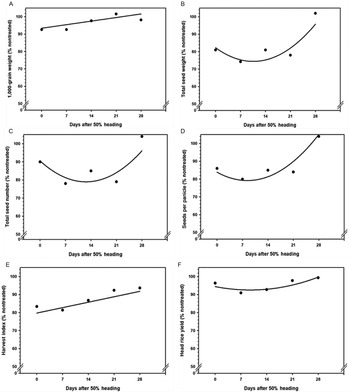
Quadratic trends were detected for rough rice grain yield, total seed weight, total seed number, seeds per panicle, and head rice yield following paraquat applications at 28 g ha–1 (Table 4; Figures 1 and 2). Linear trends were detected for 1,000-grain weight and harvest index (Table 4 and Figure 2).
Regression coefficients following exposure to paraquat at 28 g ha–1 (Paraquat study), glyphosate at 126 g ha–1 (Glyphosate study), saflufenacil at 5 g ha–1 (Saflufenacil study), sodium chlorate at 280 g ha–1 (Sodium Chlorate study), paraquat + saflufenacil (Paraquat + Saflufenacil study), and paraquat + sodium chlorate (Paraquat + Sodium Chlorate study) for rough rice grain yield, yield components, and milling components for research established during 2016–2018 at the Delta Research and Extension Center.

a Data presented as % nontreated.
b Abbreviation: SE, standard error term.
§ Coefficient is not significantly different than zero.
Rough rice grain yield following paraquat applied at 28 g ha–1 at various times after heading in the Paraquat study for research established during 2016–2018 at the Delta Research and Extension Center.

Rice 1,000-grain weight (A), seed weight (B), seed number (C), seeds per panicle (D), harvest index (E), and head rice yield (F) following paraquat applied at 28 g ha–1 at various times after heading in the Paraquat study for research established during 2016–2018 at the Delta Research and Extension Center.

Rough rice grain yield following paraquat application was reduced by >12% from 0 to 21 DAH (P = 0.001; R = 0.7140) (Figure 1). Paraquat applied 28 DAH produced relative grain yields >95% of the untreated. Following a paraquat application at 0 DAH, rough rice grain yield was reduced by 16%. The greatest yield reduction following paraquat occurred 7 DAH (21%), with similar yield reductions (17%) following paraquat applied 14 DAH.
A linear trend was observed for 1,000-grain weight (P = 0.0148; R = 0.4227) (Figure 2A). Paraquat application 0 DAH produced weight reductions of 8% compared with the nontreated. Reductions in 1,000-grain weight decreased by 0.29% d–1 for a paraquat application following 0 DAH. Paraquat application 14 DAH or later produced 1,000-grain weight >95% of the nontreated.
Total seed weight was reduced 0 to 21 DAH (P = 0.0470; R = 0.4176) (Figure 2B). The greatest seed weight reduction (26%) was observed following paraquat 7 DAH. At 21 DAH, total seed weight reductions were 22%, whereas a paraquat application 28 DAH produced total seed weight >95% of the nontreated.
Total seed number was reduced >10% from paraquat 0 to 21 DAH (P = 0.0500; R = 0.4233). The greatest reduction in total seed number (20%) was from paraquat 7 DAH. Similarly, seeds per panicle was reduced >10% following paraquat 0 to 21 DAH (P = 0.0486; R = 0.4725). Paraquat applied 7 DAH produced the greatest reduction in seeds per panicle, 20% (Figure 2D). Rice following paraquat application 28 DAH exhibited seeds per panicle >95% of the nontreated.
A linear trend was detected for harvest index following paraquat treatments (P = 0.0482; R = 0.4174). The greatest reductions in harvest index was following paraquat 0 DAH, 17% (Figure 2E). Reductions in harvest index decreased 0.43% d–1 for paraquat following 0 DAH (Table 4). Harvest index reduction remained 6% with paraquat applied 28 DAH.
A quadratic trend was detected with paraquat applications for head rice yield (P = 0.0012; R = 0.5604). Head rice yield reduction was 9% and 7% due to a paraquat application 7 or 14 DAH, respectively (Figure 2F).
Following paraquat at 28 g ha–1, rice injury ranged from 5% to 18%. Similar studies reported a sublethal paraquat exposure to rice at vegetative or reproductive stages resulted in rice injury ranging from 40% to 91%, dependent upon application growth stage (Lawrence et al. Reference Lawrence, Bond, Golden, Edwards, Peeples and McCoy2018; Calhoun et al. Reference Calhoun, Barber, Norsworthy, Doherty, Hill, Norman and Moldenhaour2016). Although estimates of visible injury in the current research were not as severe as those suggested by some, injury observed due to paraquat was substantial. Rough rice grain yield reductions of >12% were observed 0 to 21 DAH following paraquat. Similar reductions were observed with 1,000-grain weight, total seed weight, total seed number, and seeds per panicle. Similarly, Lawrence et al. (Reference Lawrence, Bond, Golden, Edwards, Peeples and McCoy2018) reported a 28% reduction in rough rice yield following a paraquat application to rice in the two- to three-leaf growth stage, with reductions in seeds per panicle and 1,000-grain weight. Calhoun et al. (Reference Calhoun, Barber, Norsworthy, Doherty, Hill, Norman and Moldenhaour2016) also reported yield reductions of 45% to 96% with rice exposure to paraquat during reproductive stages. Paraquat exposure to other grass crops such as corn, demonstrated similar yield reductions of 0.5% d–1 during vegetative growth (Sperry et al. Reference Sperry, Lawrence, Bond and Reynolds2019). Harvest index was also reduced >6% following paraquat, 0 to 28 DAH. Head rice yield was reduced 7 to 14 DAH because of paraquat exposure. These observations suggest that rice exhibits severe sensitivity to paraquat 0 DAH through 21 DAH.
Glyphosate Study
At all application timings and evaluations, no visible rice injury was observed with glyphosate at 126 g ha–1 (data not presented). Glyphosate is a readily translocated systemic herbicide, and what symptoms appear are normally on new emerging vegetation (Shaner Reference Shaner2014, p 240). At later growth stages, there is little to no new emerging vegetation, rendering glyphosate injury symptoms undetectable.
A quadratic trend was detected for rough rice grain yield following glyphosate from 0 DAH to 28 DAH (Table 4 and Figure 3). Linear trends were detected for total seed weight, total seed number, seeds per panicle, and harvest index (Table 4 and Figure 4).
Rough rice grain yield following glyphosate applied at 126 g ha–1 at various times after heading in the Glyphosate study for research established during 2016–2018 at the Delta Research and Extension Center.

Rough rice seed weight (A), seed number (B), seeds per panicle (C), and harvest index (D), following glyphosate applied at 126 g ha–1 at various times after heading in the Glyphosate study for research established during 2016–2018 at the Delta Research and Extension Center.

Rough rice grain yield following glyphosate application was reduced >6% from 0 DAH to 28 DAH (P = 0.0065; R = 0.5132) (Figure 3). The greatest yield reduction was 19% following glyphosate 0 DAH. Glyphosate applications after 0 DAH resulted in rough rice grain yield decreases <10%. However, yield reductions >5% were observed from glyphosate at all application timings. At 28 DAH, rough rice grain yield was reduced 6% with glyphosate (Figure 3).
Total seed weight followed a linear trend, with the greatest reductions (23%) from glyphosate applied 0 DAH (P = 0.0024; R = 0.4427) (Figure 4). Reductions in total seed weight decreased by 0.95% d–1 for a glyphosate application after 0 DAH. Rice following applications 21 DAH or later produced total seed weight >95%.
Similarly, total seed number reduction (26%) due to glyphosate was greatest 0 DAH (P = 0.0001; R = 0.5360) (Figure 4). Total seed number increased 1.1% d–1 for a glyphosate application following 0 DAH. Rice following glyphosate applications 21 to 28 DAH produced total seed number >95%.
The greatest reduction in seeds per panicle (27%) followed glyphosate applied 0 DAH (P = 0.0002; R = 0.5662) (Figure 4). Reductions in seeds per panicle decreased by 0.99% d–1 following a glyphosate application after 0 DAH. Glyphosate applied 21 DAH or later resulted in seeds per panicle >95% of the nontreated.
Harvest index observations followed a linear trend (P = 0.0025; R = 0.4489). Harvest index was least (78%) following glyphosate 0 DAH (Figure 4). Reductions in harvest index decreased by 0.82% d–1 for glyphosate following 0 DAH.
No rice injury was observed from glyphosate at any application timing. Hensley et al. (Reference Hensley, Webster, Blouin, Harrell and Bond2013) reported no visible injury due to glyphosate applications were observed at reproductive rice growth stages. Congruently, corn exhibited no injury when exposed to glyphosate at rates <100 g ha–1 (Brown et al. Reference Brown, Robinson, Young, Loux and Johnson2009). Rough rice grain yield reductions >6% were observed following glyphosate applications 0 to 28 DAH. Yield reduction was 19% following glyphosate 0 DAH. The greatest yield and yield component reductions were from glyphosate 0 DAH. Similarly, rough rice yield reductions from glyphosate at the boot growth stage were observed to be >50% (Hensley et al. Reference Hensley, Webster, Blouin, Harrell and Bond2013). Glyphosate exposure to wheat at reproductive growth stages caused similar yield reductions, 54% (Roider et al. Reference Roider, Griffin, Harrison and Jones2007). However, Hensley et al. (Reference Hensley, Webster, Blouin, Harrell and Bond2013) reported no effects on yield with glyphosate exposure at rice maturity. This report contrasts the 6% rough rice grain yield reductions observed with an application 28 DAH in the current research. Although rice yield reductions in the current research were not as severe as reported at vegetative stages in rice or reproductive stages in wheat (Hensley et al. Reference Hensley, Webster, Blouin, Harrell and Bond2013; Roider et al. Reference Roider, Griffin, Harrison and Jones2007), rough rice grain yield loss occurred following exposure 0 DAH to 28 DAH. These data suggest that rice sensitivity to glyphosate exposure encompasses the entire growing season up to 1 wk before harvest.
Saflufenacil Study
Significant differences in rice injury were observed with saflufenacil applied at different timings after rice heading (Table 3). Although injury was observed for all application timings and evaluation intervals, rice injury was <5%. Therefore, injury following saflufenacil 0 to 28 DAH carries no agronomical significance.
A quadratic trend was detected for rough rice grain yield following saflufenacil applications from 0 DAH to 28 DAH (P = 0.0091; R = 0.6778) (Table 4 and Figure 5). Although a trend was observed due to saflufenacil applications, relative yield was >95% for all application timings (Figure 5). No other trends were detected for all yield parameters following saflufenacil application from 0 to 28 DAH (data not shown).
Rough rice grain yield following saflufenacil applied at 5 g ha–1 at various times after heading in the Saflufenacil study for research established during 2016–2018 at the Delta Research and Extension Center.

Although rice injury from saflufenacil was observed, all estimates of visible injury were <5%. Congruent observations were reported by Montgomery et al. (Reference Montgomery, Bond, Golden, Gore, Edwards, Eubank and Walker2014), where saflufenacil applications at two- to three-leaf stage produced estimates of visible injury <13%. In the current research, a quadratic yield trend was observed following a saflufenacil application 0 to 28 DAH. However, relative yield was >95% for all application timings, and no trends were observed for all other parameters. Similarly, Montgomery et al. (Reference Montgomery, Bond, Golden, Gore, Edwards, Eubank and Walker2014) reported no effect on rice yield or milling quality following saflufenacil application. These observations suggest that rice sensitivity to saflufenacil from 0 to 28 DAH is minimal.
Sodium Chlorate Study
Rice injury was significantly different following sodium chlorate applied at 280 g ha–1 at different timings after rice heading (Table 3). Although injury was observed for all application timings and evaluation intervals, rice injury was <5%. Therefore, injury following sodium chlorate 0 to 28 DAH carries no agronomical significance.
A linear trend was detected for rough rice grain yield following sodium chlorate application from 0 DAH to 28 DAH (P = 0.0204; R = 0.5972) (Table 4 and Figure 6). Although a trend was observed from sodium chlorate applications, relative yield was >95% for all application timings (Figure 6). No other trends were observed for all yield parameters following sodium chlorate application 0 to 28 DAH (data not shown). Calhoun et al. (Reference Calhoun, Barber, Norsworthy, Doherty, Hill, Norman and Moldenhaour2016) reported similar findings suggesting sodium chlorate applications to rice resulted in minimal crop injury and had no effect on rough rice yield. These observations suggest that rice sensitivity to sodium chlorate from 0 to 28 DAH is minimal.
Rough rice grain yield following sodium chlorate applied at 280 g ha–1 at various times after heading in the Sodium Chlorate study for research established during 2016–2018 at the Delta Research and Extension Center.

Paraquat + Saflufenacil Study
When paraquat + saflufenacil were applied as a mixture at different timings after rice heading, significant differences in rice injury were observed (Table 3). At the 3-DAA evaluation the least injury was from paraquat + saflufenacil 28 DAH (P = 0.0001). Applications 7, 14, or 21 DAH produced similar injury, >13%. At 7 DAA, the greatest injury was in plots receiving an application 14 DAH (18%) (P = 0.0001). The least injury was from paraquat + saflufenacil 28 DAH (7%). At the 14-DAA evaluation, paraquat + saflufenacil 0, 7, or 14 DAH caused injury similar to one another and greater than plots receiving an application 21 DAH (P = 0.0018). All applications of paraquat + saflufenacil caused injury <10% at 21 DAA (Table 3). Rice injury from paraquat + saflufenacil 0 DAH was greater than 14, 21, and 28 DAH, while similar to 7 DAH (P = 0.0236). At 28 DAA, paraquat + saflufenacil 0 or 7 DAH caused injury similar to one another (P = 0.0750) (8% to 9%).
Rough rice grain yield following paraquat + saflufenacil 0 DAH was reduced 19% (P = 0.0001; R = 0.6756). Reductions in yield decreased by 0.75% d–1 for an application following 0 DAH (Figure 7). An application 21 DAH or later produced rough rice grain yield >95% of the nontreated.
Rough rice grain yield following applications of a mixture of paraquat + saflufenacil at 28 and 5 g ha–1, respectively, at various times after heading in the Paraquat + Saflufenacil study for research established during 2016–2018 at the Delta Research and Extension Center.

Rice 1,000-grain weight was reduced >5% when an application was made 0 to 14 DAH (P = 0.0001; R = 0.6139). Reductions in 1,000-grain weight decreased by 0.43% d–1 for an application of paraquat + saflufenacil following 0 DAH (Figure 8).
Rice 1,000-grain weight (A), seed weight (B), and head rice yield (C) following applications of a mixture of paraquat + saflufenacil at 28 and 5 g ha–1, respectively, at various times after heading in the Paraquat + Saflufenacil study for research established during 2016–2018 at the Delta Research and Extension Center.

Total seed weight was reduced >8% following paraquat + saflufenacil 0 to 21 DAH (P = 0.0154; R = 0.4832). The greatest reduction in total seed weight (22%) was observed from paraquat + saflufenacil 0 DAH. Reduction in total seed weight decreased 0.61% d–1 for an application following 0 DAH.
Head rice yield exhibited a quadratic trend from paraquat + saflufenacil applications (P = 0.0029; R = 0.4988) (Table 4). Reductions in head rice yield were >7% 0 to 14 DAH. The greatest reduction in head rice yield (14%) was from paraquat + saflufenacil 14 DAH. Applications made 21 DAH or later resulted in >95% relative head rice yield.
In the current research following a paraquat + saflufenacil application, rice injury ranged from 6% to 18%. Lawrence et al. (Reference Lawrence, Bond, Golden, Edwards, Peeples and McCoy2018) and Calhoun et al., (Reference Calhoun, Barber, Norsworthy, Doherty, Hill, Norman and Moldenhaour2016) reported rice injury and recovery with sublethal paraquat applications to rice. Rough rice grain yield reductions were observed to be greatest with an application 0 DAH (19%). Applications made after 0 DAH exhibited lesser reductions, and rice receiving application 21 DAH or later produced relative grain yield >95% of the nontreated. Yield component trends resembled reductions in rough rice grain yield due to a paraquat + saflufenacil application. Congruent observations were reported by Lawrence et al. (Reference Lawrence, Bond, Golden, Edwards, Peeples and McCoy2018), where reductions in rough rice grain yield due to paraquat applications were similar to harvest parameters. In the current research, head rice yield was influenced by paraquat + saflufenacil applications where reductions were >7%, 0 to 14 DAH. These observations suggest that rice may exhibit severe sensitivity to a paraquat + saflufenacil exposure event 0 to 21 DAH.
Paraquat + Sodium Chlorate Study
Paraquat + sodium chlorate applied as a mixture at different timings after rice heading caused significant differences in rice injury (Table 3). At the 3-DAA evaluation, plots receiving an application 28 DAH exhibited the lowest estimates of visual injury, 8% (P = 0.0007) (Table 3). Paraquat + sodium chlorate applied 0 to 21 DAH produced injury >11% and similar to one another. At 7 DAA, an application 14 DAH produced the greatest injury symptomology (18%) (P = 0.0001). At the 7-DAA evaluation, rice receiving paraquat + sodium chlorate 28 DAH exhibited the least injury. At the 14-DAA rating interval, an application made 0 to 14 DAH produced injury similar to one another and greater than 21 DAH (P = 0.0103). At 21 DAA, injury from paraquat + sodium chlorate applications was <10%, and application timings were similar to one another (P = 0.0593). By 28 DAA, applications 0 or 7 DAH produced injury similar to one another (P = 0.4964) (8%). Although these are independent studies and not comparable statistically, similar to the paraquat timing study in general, as DAA rating interval increased, estimates of visible injury decreased; this result may be caused by the natural desiccation of the rice plant causing herbicide injury to become less distinct. Similarly, an application made 28 DAH produced visible injury estimates <9%, possibly due to the desiccation observed prior to this later application timing.
A quadratic trend was detected for rough rice grain yield following paraquat + sodium chlorate (P = 0.0033; R = 0.6703) (Table 4 and Figure 9). An application of paraquat + sodium chlorate reduced rough rice grain yield >6%, 0 to 21 DAH (Figure 9). The greatest reduction in rough rice grain yield (24%) was observed following applications 0 DAH. Paraquat + sodium chlorate applications 28 DAH produced relative yield >95%.
Rough rice grain yield following applications of a mixture of paraquat + sodium chlorate at 28 and 280 g ha–1, respectively, at various times after heading in the Paraquat + Sodium Chlorate study for research established during 2016–2018 at the Delta Research and Extension Center.

A linear trend was observed for 1,000-grain weight (P = 0.0091; R = 0.4839) (Table 4 and Figure 10). Rice 1,000-grain weight following paraquat + sodium chlorate 0 to 14 DAH was <95% of the nontreated. Applications 0 DAH reduced 1,000-grain weight by 13%. Reductions in 1,000-grain weight decreased by 0.23% d–1 for applications made following 0 DAH.
Rice 1,000-grain weight following applications of a mixture of paraquat + sodium chlorate at 28 and 280 g ha–1, respectively, at various times after heading in the Paraquat + Sodium Chlorate timing study for research established during 2016–2018 at the Delta Research and Extension Center.

Following paraquat + sodium chlorate application, rice injury ranged from 8% to 18% at all application timings and evaluations. Lawrence et al. (Reference Lawrence, Bond, Golden, Edwards, Peeples and McCoy2018) reported injury with sublethal concentrations of paraquat alone and in mixture with residual herbicides to rice at the two- to three-leaf growth stage. Calhoun et al. (Reference Calhoun, Barber, Norsworthy, Doherty, Hill, Norman and Moldenhaour2016) suggested that rice injury to paraquat at reproductive stages ranged from 14% to 91%. Rough rice grain yield was reduced from paraquat + sodium chlorate 0 to 21 DAH. Greatest yield reductions were observed 0 DAH (24%). Similarly, 1,000-grain weight was reduced >5% for applications made 0 to 14 DAH, with the greatest reduction following an application made 0 DAH. Lawrence et al. (Reference Lawrence, Bond, Golden, Edwards, Peeples and McCoy2018) reported that reductions in rough rice grain yield following paraquat applications also resulted in reduction of yield components. Observations from the current research suggest that rice may exhibit severe sensitivity to a paraquat + sodium chlorate exposure event 0 to 21 DAH.
In the current research, rough rice grain yields were reduced by exposure to sublethal concentrations of desiccants 0 to 28 DAH. Rice injury was determined to not be an accurate predictor of rough rice grain yield loss, as injury did not exceed 20% with any desiccant, and no injury was observed from glyphosate applications. Paraquat applications reduced rough rice grain yield by inhibiting the capabilities of the rice plant to complete proper reproduction at a critical time. This is evident in the reductions of total seed weight, total number of seed, and seeds per panicle. Proper grain-fill during ripening was also inhibited by paraquat applications, as indicated by the reductions of 1,000-grain weight and head rice yield. In contrast, glyphosate had little to no effect on grain-fill during ripening in the current research, as evidenced by head rice yield and 1,000-grain weight being unaffected. Reductions observed in total seed weight, total seed number, and seeds per panicle following glyphosate exposure suggest that glyphosate inhibited proper reproduction without affecting grain-fill during ripening. This contrast in response observed may be due to the differences in translocation of paraquat and glyphosate in plants. The absence of rice response following late-season applications of saflufenacil or sodium chlorate suggests that these desiccants have no effect on rough rice grain yield, yield components, or milling quality during reproductive growth stages. When desiccants saflufenacil and sodium chlorate were applied in mixture with paraquat, little or no additional response over paraquat alone was observed. These data indicate that late-season exposure to sublethal concentrations of desiccants from 0 DAH to 28 DAH has an impact on rough rice grain yield, yield components, and head rice yield. In general, rice sensitivity to desiccants was observed to be greatest from exposure 0 DAH to 14 DAH. It should be noted that in on-farm off-target movement events, exposure levels may vary; caution must therefore be exercised in accurately estimating crop response to unknown exposure levels. In Mississippi, desiccant applications can occur over a varied range of dates encompassing a large window of rice reproduction and ripening. Rough rice grain yield reductions coupled with milling quality reductions and driven by the proximity of rice to corn, cotton, soybean, and sorghum in Mississippi creates the need to exercise caution when applying desiccants to these adjacent crops.
Acknowledgments
This publication is a contribution of the Mississippi Agricultural and Forestry Experiment Station. Material is based on work supported by the Mississippi Rice Promotion Board. The authors would like to thank the Mississippi Rice Promotion Board for funding this research. We thank personnel at the Mississippi State University Delta Research and Extension Center for their assistance. No conflicts of interest have been declared.