In his classic text, Dennis Mueller (1989, 1)
defines public choice analysis as “the economic study of nonmarket decision
making, or simply the application of economics to political science…. The
basic behavioral postulate of public choice, as for economics, is that man
is an egoistic, rational, utility maximizer.” By its very nature, this
interdisciplinary field of study was, at its start in the late 1950s and
early 1960s, outside the mainstream of both economics and politics. Many
economists were, at the time, wary of applying economic models where there
were not formal markets and price mechanisms to govern relationships, while
political scientists were skeptical of rationality assumptions and formal
modeling techniques inherent in economic study. Today, however, economists
seem quite comfortable with applying economic models to almost any worldly
phenomena, and many introductory economics textbooks include a chapter
specifically on public choice issues.
Public choice inroads into the mainstream of political science have been
slower. Critics of the public choice paradigm are vocal, attacking its
assumptions, its conclusions, and its impact, but are unable to fully
account for its influence. Orchard and Stretton (1997), for example, argue that public choice analysis has been
ideologically driven and dominated by the libertarian perspective.1
On the other hand, Grofman (1995) defends against this charge: “While it
is certainly true that almost all of the most famous exponents of
rational choice modeling are ideologically conservative, there is
nothing inherent in the nature of rational choice modeling that
makes it a tool of either the left or the right” (241).
They contend that its “assumption of exclusively rational, egoistic,
materially acquisitive behaviour is now acknowledged to be unhelpful and to
generate inaccurate predictions and false or inadequate explanations of
political performance” (423) and that “research has also discredited the
main branches of public choice micro-theory” (424). Yet, “despite these
troubles, the movement flourishes” (424), perhaps because of the
“deregulating, privatizing, tax-hating temper of the times” (425). Cohn
(
1999) notes that critics refer to rational
choice as a “cult.”
2 Another prominent
critique of rational choice is presented by Green and Shapiro (1994). A special double issue of Critical
Review (volume 9, 1995) was devoted to this topic, with most of the
contributors detailing the shortcomings of the Green and Shapiro
analysis, followed by a lengthy response from the
authors.
At this juncture, it appears fruitful to consider the overall status of
public choice analysis in the social sciences. In this note, we seek to
discover if public choice scholars truly differ in their methodological
beliefs and conclusions from other economists and political scientists. Have
their assumptions and conclusions been rejected or accepted? As a first
grasp at tackling this issue, we circulated a survey containing 33
statements3
We thank John Dinan, Keith
Dougherty, Don Frey, P. J. Hill, and Andrew Morriss for commenting
on the original wording of our survey.
regarding various
public choice model assumptions or predictions regarding the interplay of
politics and economics. The survey was sent to 200 randomly selected members
of the American Economic Association (AEA) and 207 randomly selected members
of the American Political Science Association (APSA), as well as to almost
everyone on the Public Choice Society (PCS) mailing list, which includes 201
economists and 125 political scientists.
4 Among AEA members, we sampled only those with a Ph.D., teaching
in economics departments in the U.S. Among APSA members we sampled
only those with a Ph.D., teaching in departments of political
science, politics, or government in the U.S. There is no formal
Public Choice association. Rather, anyone who registers for the
Public Choice Society conference is included on the mailing list. We
thank Carol Roberts for supplying us with the most recent mailing
list in 2000. Among PCS members, we define economists as anyone
teaching in an economics department, and political scientists as
anyone teaching in a politics department, regardless of their degree
specialization. Anyone whose mailing address did not list an
economics or politics/political science/government department was
not included in the survey.
Our response rate was highest
from members of the AEA, where 36.3% returned completed surveys, very
similar to the Alston, Kearl, and Vaughan (
1992)
survey response rate of 34.4% among economists. The response rate for APSA
members was only slightly lower at 33.2%, while the response rate for public
choice scholars was modestly lower at 29.6%.
For each statement, respondents were asked how strongly they agreed with the
given proposition, on a scale from 1 (strongly disagree) to 5 (strongly
agree). Their beliefs may be based on either theoretical grounds or on their
reading of the degree of empirical support. We focus here on the 23
propositions that public choice scholars themselves agreed with, where we
define “agreement” very broadly to include any case where an absolute
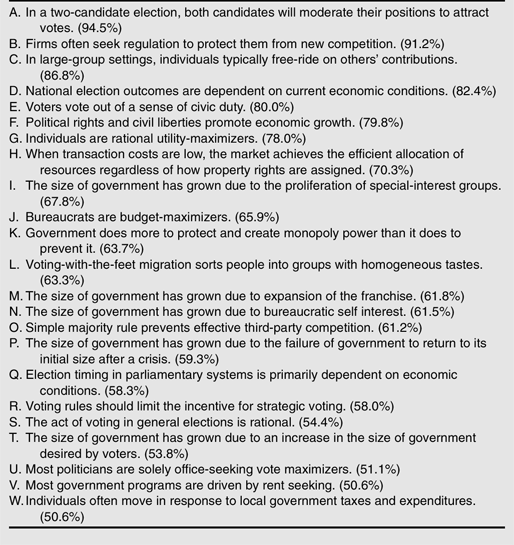
majority “agreed” with the proposition by answering with a 4 or 5. Table 1 lists the propositions that meet our
criteria for agreement among public choice scholars. Readers who wish to
define group agreement using a stricter rule (such as a supermajority) may
want to focus on a narrower subset of the presented questions.
We seek to explore if these economic and political propositions, which have
been accepted within the public choice community, have also been accepted
across the disciplines by general economists and political scientists, or if
the rational/public choice approach remains unique to these particular
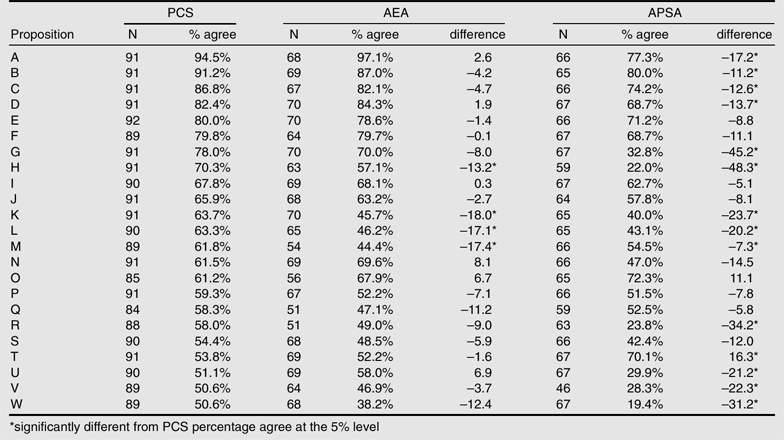
scholars. Table 2 lists the number of respondents
in each group that answered the question, the percentage from each group
agreeing with the given proposition, and the difference compared to the
responses of PCS members.
Economists generally accept the propositions that public choice scholars
accept. Among the economists, support for these 23 propositions is generally
a bit lower than among PCS members, but in only six cases does support
differ by more than 10 percentage points, and only four propositions (H, K,
L, and M) generate statistically significant (lower) differences in the
level of agreement. Only two of the propositions that are accepted by a
majority of PCS members are accepted by less than 45% of AEA members. The
key to this fairly widespread agreement among economists and public choice
practitioners may be proposition G: “individuals are rational
utility-maximizers.” Mueller identified a similarly worded statement as the
“basic behavioral postulate of public choice, as for economics”
(1989, 1: emphasis added) and the survey bears out his contention: 78% of
Public Choice Society members and 70% of economists agree or strongly agree
with this statement.5
Most of the rest of both
PCS members and AEA members are neutral on this proposition, rather
than disagreeing with it.
Based on
Table
2, we conclude that on most public choice issues the other
economists generally accept public choice scholars' conclusions.
Although disagreements between public choice scholars and economists are
fairly modest, Table 2 shows that the views of
public choice scholars and political scientists often differ substantially.
Almost half of the propositions that generate majority agreement among PCS
members do not yield majority agreement among our sample of APSA members.
Fourteen of the 23 propositions receive significantly lower degrees of
support among APSA members. For 17 of the 23 propositions, APSA support is
more than ten percentage points lower than PCS support; support is more than
20 percentage points lower in eight cases, and more than 40 percentage
points lower in two cases. Again, the most telling difference is probably
proposition G. While 78% of public choicers agree that “individuals are
rational utility-maximizers,” only 33% of political scientists agree with
this axiom. In fact, a plurality (43%) of political scientists disagree or
strongly disagree with this idea (while 24% are neutral on the issue), which
is fundamental to rational choice modeling.
Among the other propositions that are accepted by public choice scholars for
which APSA members' support is noticeably weaker (more than twenty
percentage points lower) are these: when transaction costs are low, the
market achieves the efficient allocation of resources regardless of how
property rights are assigned (popularly known as the Coase Theorem)
(proposition H);6
A reviewer has suggested
that the lack of support for the Coase Theorem implication by APSA
members has more to do with a lack of familiarity of the theorem by
typical political scientists rather than outright rejection. This
interpretation may hold true for some of the other propositions as
well. We note that regardless of familiarity with the theorem
itself, apparently most APSA members in our sample do not support
the statement.
that government does more to protect and
create monopoly power than it does to prevent it (proposition K); that
voting-with-the-feet migration sorts people into groups with homogeneous
tastes (proposition L); that voting rules should limit the incentive for
strategic voting (proposition R); that most politicians are solely
office-seeking vote maximizers (proposition U); that most government
programs are driven by rent seeking (proposition V); and that individuals
often move in response to local government taxes and expenditures
(proposition W). Disagreement across the two groups occurs over a wide
variety of public choice topics.
To answer the titular question–public choice scholars are not much different
than the typical economist, but they are considerably different than general
political scientists. This finding suggests that critics of public choice
analysis, such as Orchard and Stretton, are too hasty in concluding that the
assumptions and conclusions of public choice analysis have been discredited.
Indeed, they are widely accepted by mainstream economists. This also
suggests that the movement will continue to flourish among economists
because of common reliance on the basic operating assumption of rational
utility maximization–the very reason that it will probably continue to have
less success among political scientists.