




No CrossRef data available.
Article contents
- Abstract
- Role Conceptions
- The Council of Ministers' Working Groups
- Explaining Role Conceptions of State Representatives
- Methodological Issues and Data Set
- Measuring the Dependent Variable, Role Conceptions
- Recruitment and Professional Experiences
- Role Conceptions and Multiple Embeddedness
- Conclusion
- References
Multiple Embeddedness and Socialization in Europe: The Case of Council Officials
Published online by Cambridge University Press: 18 October 2005
Article contents
- Abstract
- Role Conceptions
- The Council of Ministers' Working Groups
- Explaining Role Conceptions of State Representatives
- Methodological Issues and Data Set
- Measuring the Dependent Variable, Role Conceptions
- Recruitment and Professional Experiences
- Role Conceptions and Multiple Embeddedness
- Conclusion
- References
Abstract
Neofunctional, supranationalist, and constructivist scholars studying European integration hypothesize that social interactions cutting across national borders lead individual actors to shift their allegiance toward the European level. This strong socialization hypothesis presumes that, as a result of prolonged exposure and interactions, individuals adopt role conceptions that promote a sense of “we-ness” and that fit into a view of the European Union (EU) as an autonomous level primarily designed for finding policy solutions in the interest of a common, European, good. In contrast, this article offers an institutional understanding of role enactment that argues that socialization—that is, the adoption of role conceptions—is considerably shaped by actors' embeddedness in multiple European and domestic contexts. Based on quantitative interview data, I demonstrate that, in contrast to the strong socialization hypothesis, extensive exposure to the European level does not necessarily lead to supranational role playing. On the contrary, domestic factors, rather than European-level conditions, positively affect the adoption of supranational role conceptions.Thanks to Ambassador Frans Van Daele and Ambassador Philippe de Shoutheete de Tervarent, who allowed interviews on aspects of this article. I also express my gratitude toward the ISPO-team of the University of Leuven, Belgium, for their help in doing the fieldwork, and to Jan De Bock and Vincent Mertens de Wilmars for the crucial information they provided. Data collection was made possible by a grant from the Fund for Scientific Research–Flanders (Belgium) and was supervised by Guido Dierickx (University of Antwerp, Belgium). Special thanks go to the participants in the various IDNET-workshops and the ARENA research seminar (April 2002), to IO editors Thomas Risse and Lisa Martin, two anonymous reviewers, and Karen Anderson, Morten Egeberg, Jeff Checkel, Alexandra Gheciu, Jeffrey Lewis, Marianne van der Steeg, Mark Rhinard, Jarle Trondal, and Maarten Vink for their extensive and constructive comments.
Information
- Type
- Research Article
- Information
- Copyright
- © 2005 The IO Foundation and Cambridge University Press
Socialization is an important theme in much research about European integration. Since Haas' seminal study, crucial questions have been to what extent, under which conditions, and through which processes political elites and the broader public within the member states shift their allegiance toward the European Union (EU).1
This connection between European integration and change among domestic actors and institutions is also characteristic of contemporary “Europeanization” studies, and the socialization theme has recently regained attention within the ranks of empirically oriented constructivists.2For an overview of the Europeanization literature, see Cowles, Caporaso, and Risse 2001; Vink 2003; and Mair 2004. For reviews of the constructivist socialization literature, see Checkel 1999; and Johnston 2001.
Because regional integration in Europe can be considered as a process that transforms the organization of the European political space, it is no surprise that early and contemporary scholars consider “socialization” a key feature of regional integration. This article focuses on one specific set of domestic actors, national bureaucrats representing their country in the working groups of the Council of the European Union (Council working groups or CWGs hereafter) and investigates the extent to which their experiences with the EU's institutions, and more specifically the Council, shape their role conceptions. Role conceptions are norms held by state representatives on what constitutes appropriate behavior in the CWGs. Do bureaucrats who are regularly and intensively involved in policymaking arenas that transcend national borders adopt supranational norms of appropriate behavior as a result of these experiences (compared to those that are only occasionally involved)? Are bureaucrats who are closely connected to their domestic environment more inclined to view their occasional participation in the CWGs as an act of exchanging and balancing member-state interests instead of finding solutions in the interest of a common, European, good? Which other arenas function as socialization sites if European arenas, such as the CWGs, are not consequential for actor socialization?
As Zürn points out, these questions are not trivial: they relate to the political legitimacy of the EU's multilevel institutional framework.3
See Zürn, this volume.
See, for instance, Keohane 1969, 862; and Haas 1992, 24, 32.
This example suggests that in studying international socialization at least two sets of factors need to be distinguished: factors connected with the international socialization site, on the one hand, and factors related to potential socialization that takes place outside the international site, on the other hand. Phrased differently, role enactment is considerably shaped by actors' embeddedness in multiple international, European, and domestic contexts. This article qualifies, specifies, and tests the strong socialization hypothesis, which states that social interactions cutting across national borders stimulate individuals to shift their allegiances and basic orientations toward the European level. This hypothesis assumes that the EU is a site that has a substantial socializing impact. It presumes that, as a result of prolonged and intensive exposure to EU affairs, individuals adopt role conceptions that promote a sense of “we-ness,” and that fit into a view of the EU as an autonomous level primarily designed for finding policy solutions in the interest of a common, European, good.
The next section further defines and explicates the dependent variable, role conceptions. In the second section, I take a brief look at the Council of the European Union, and I argue that the formal and informal rules that apply in the CWGs may lead to actor behavior governed by notions of appropriateness. Building on this argument, the third section presents several scope conditions as independent variables shaping the adoption of role conceptions. After listing the hypotheses that are tested, I present the research design and the data set. Based on quantitative interview data, I demonstrate that extensive exposure to the European level does not necessarily lead to supranational role playing. By controlling for socialization that potentially takes place before an actor enters the European socialization site, I conclude that especially domestic scope conditions, not European conditions, positively affect the adoption of supranational role conceptions.
Role Conceptions
The standard sociological definition of “role” is “the behavior expected of an actor in a specific social position.”5
See Homans 1961, 11; and Searing 1991, 1239, 1245.
First, “role” refers to a more or less systematic pattern of relations between actors and specific positions. For instance, civil servants from the EU's member-state ministries deliberate in small bureaucratic EU committees (that is, their position) and prepare decisions to be taken by the Council of Ministers. Role playing includes the act whereby these officials define themselves and other actors (that is, the politicians, the other member-state officials, and so on) in relation to the specific position in which they are situated (that is, the bureaucratic committee). Role playing is the act wherein information is transmitted about how, in such positions, interests are defined, which resources are useful, and how disputes should be resolved. Thus actors form their social context by playing roles; that is, they transmit information on how things should be done. Although roles are properties of individual actors, they also provide information about how groups, networks, or larger social aggregates function. In sum, a study of role playing should focus on the individual without losing sight of the broader context in which this individual is embedded.
Second, roles are norms that include expectations about what constitutes appropriate behavior given the actors' position. The way actors conceive their role—their “role conception”—is not actual behavior that directly leads to specific policy outcomes. Role playing contrasts with what March and Olsen have labeled the “logic of consequences,” which implies political events understood as a consequence of strategic choices in which a logical connection is made between individual interests, preferences, and outcomes.6
When making choices, actors will consider which course of action will be most effective and efficient in reaching the desired outcome. However, choices, March and Olsen argue, are characterized by ambiguities, uncertainties, limited computational abilities, and restricted access to information. Moreover, choices are not only made with future consequences (and how these affect specific interests) in mind, but they are also informed by normative concerns about how choices should be made. National bureaucrats will ask “what is the proper role I am expected to play in Council working groups?” To put it differently, political events may be evaluated and understood according to a “logic of appropriateness;” that is, instead of considering potential political outcomes, actors also care about the informal norms and rules that structure the policy process. Therefore, it is difficult to establish the impact of appropriate behavior on specific policy outcomes in a straightforward manner.7 Indeed, rule and role conceptions are formed, designed, and used as cues in situations wherein goals, potential outcomes, and formal rules of interaction are imprecise, more fluid, and less well-known.“Role” is not only a theoretical concept invented by sociologists. It is used extensively by scholars evaluating different actors within the EU multilevel system. This use is apparent in statements such as, “The duality of the Presidency [of the Council of Ministers] as being both supranational and national is exemplified by the different roles played by the member-state officials or ministers, on the one hand, and the Presidency representatives, on the other.”8
Christiansen 2002, 35.
First, when state representatives adopt a supranational role, they view Europe as an autonomous level primarily designed for finding policy solutions in the interest of a common, European, good. This role implies a desire to promote the project of European common policymaking, and includes a disposition to view oneself as an autonomous actor responsible for crafting an EU-wide policy consensus. One of the major events in recent European history, the emergence of the Economic and Monetary Union (EMU), is often explained as the outcome of such appropriate behavior. The delegation of monetary policies to “institutionalized transnational actors” via the creation of the Delors Committee of central bankers provided Europe with a forum in which transnational elites were able to disconnect from domestic politics and to internalize the belief that monetary unification was a sensible next step in the process of European integration.9
Cameron 1995, 74.
Second, when assuming the role of intergovernmental state representative, officials conceive European policymaking as an act of exchanging and balancing member-state interests: officials define themselves as national representatives, and they confine their task to defending national positions. The same event, the EMU, is understood by other scholars as the outcome of deliberate intergovernmental behavior. Moravcsik, for instance, argues that national preferences were largely a result of domestic processes, and these preferences diverged from the beginning of the negotiation process.10
Moravcsik 1999, 379–471.
European socialization concerns the extent to which European scope conditions, such as extensive experiences with the CWGs, stimulate state representatives to adopt a specific role. Socialization could imply a change from one role to another; that is, instead of playing an intergovernmental role, actors adopt a supranational role. However, socialization does not necessarily concern the adoption of supranational views at the expense of intergovernmental views or the mere shift from one category to another; it might also imply a reconceptualization of existing intergovernmental dispositions or the playing of multiple roles that are not considered to be in conflict. For instance, officials continue to define themselves as national representatives while at the same time they increasingly consider national perspectives as overlapping and compatible with a common European perspective. In this situation, actors systematically play both roles. They adopt layers of multiple roles in the sense that an intergovernmental role is supplemented with a supranational role. When supranational roles correlate positively with intergovernmental roles, as in this situation, actors do not experience so-called role conflicts.11
Rather, such conflicts emerge when representing and defending national perspectives is considered incompatible with promoting a common European interest. Actors with an outspoken supranational view reject intergovernmental roles, and vice versa; they view both roles as incompatible and not reconcilable. Such a negative relation between roles suggests that Council negotiations are characterized by a dominant cleavage between those adopting supranational roles and those adopting intergovernmental roles. Thus a situation exists in which cooperative norms and practices are less deeply internalized by individuals and their immediate surrounding.The Council of Ministers' Working Groups
Decision making in the EU's Council of Ministers is organized into three stages. First, the CWGs composed of member-state representatives specialize in obtaining information about particular policies and try to negotiate a first compromise. Second, high-profile committees such as the Committee of Permanent Representatives (COREPER) or, for the Common Agricultural Policy, the Special Committee on Agriculture (SCA), further refine the legislative proposals made by the European Commission and prepare the meeting of the ministers. Finally, the ministers representing the member states decide by taking a vote, but often consensus reached in the earlier stages is rubber-stamped by unanimity. This structure portrays Council decision making as divided into a bureaucratic level (the CWGs, on the one hand, and COREPER or SCA on the other hand) and a political level (the ministers). Little exact information exists on the amount and the nature of issues that are resolved at the bureaucratic level, but experienced observers estimate that about 70 percent to 80 percent of all issues are settled there.12
It may sound somewhat surprising to consider supranational role playing as a mechanism at work in the EU's Council of Ministers and its working groups. Is not the European Commission expected to be the mainstay of supranational policymaking, while the Council is expected to act as a countervailing, intergovernmental body?13
Wessels 1991, 138.
Although the Council is conceived as an intergovernmental body, there are few formal rules that shape Council officials' role conceptions.14
Article 203, Treaty of the European Union.
See Council decision 2004/338/EC.
See Hooghe, this volume.
Rationalist analyses of the Council strongly emphasize the importance of formal rules, that is, voting rules and legislative procedures, as the strategic context shaping the optimizing behavior of state agents.17
See, for instance, Garrett and Tsebelis 1996; Crombez 1996; and Steunenberg 2000.
See Mattila and Lane 2001, 37–38; and also Elgström, Bjurulf, Johansson, and Sannerstedt 2001, 114–15.
Mattila and Lane 2001, 45–48.
In sum, one should not attach too much explanatory power to formal rules. Indeed, some formal rules with respect to the Council (for instance, the entrepreneurial role Commission officials play in it) may promote a spirit of supranational cooperation in addition to intergovernmental bargaining. But formal rules may differ considerably from an organization's actual operations. Often, formal rules are inadequate, weakly specified, or not consistent with all relations, attitudes, and behavior that exist in an organization.20
Searing 1991, 1241–43.
Lindberg 1998 [1963], 105.
Lewis 2003, 106–7.
This focus on informal rules of appropriateness is typical for the more qualitative literature on Council decision making. Several authors stress that officials involved in EU policymaking are exposed to a spirit of cooperation.23
In addition, some scholars claim that territorial role identifications lose importance and are replaced or supplemented by functional, expertise-based role perceptions. State representatives are more than diplomats in the traditional sense. Most of them are technical experts within a specialized field of competence.24Westlake 1995, 318–20.
Explaining Role Conceptions of State Representatives
Major disagreement exists on the role of state representatives. I begin by briefly reviewing a set of arguments drawn from neofunctional and supranationalist approaches, which view European experiences as conducive to the adoption of supranational roles. In contrast to this, I present intergovernmentalism as an approach that is quite skeptical vis-à-vis the strong socialization hypothesis (and socialization as such). Next, and more importantly, I advance my institutionalist perspective, which is informed in key ways by political psychology and organization theory. Finally, I identify a set of scope conditions that form the basis of several hypotheses related to the adoption of supranational roles.
Strong Socialization versus No Socialization
Socialization is a crucial component in all neofunctional definitions of regional integration; all include the notion that interactions cutting across national borders gradually socialize actors, supranational and domestic elites, into adopting pro-European norms and practices.25
See Haas 1958, 16; and Lindberg 1963, 4–7.
Kerr 1973, 47.
See Peck 1979; Scheinman and Feld 1972; Smith 1973; and Wolf 1973.
For an overview, see Pollack 1998.
Martin and Simmons 1998, 95–96.
Nonetheless, the strong socialization hypothesis is still important for three “schools” on European politics. As Checkel discusses constructivism and the Habermasian approaches in his introductory essay, I confine myself to a brief summary of contemporary “supranationalism,” which draws, to a large extent, upon its neofunctionalist predecessors. In contrast to constructivist, Habermasian, and early neofunctionalist approaches, which expect identity change (Checkel's Type II socialization),30
Checkel, this volume.
Ibid., 305.
See Kerremans 1996, 232; and Christiansen 2002, 50–51.
In contrast to neofunctionalists and supranationalists, intergovernmentalists do not consider the EU to be an important socialization site. Although Hoffman, an intergovernmentalist, had no explicit theory on socialization, he was outspoken with respect to the remaining stickiness of national institutions. For instance, he argued that cross-border interactions sustain territorial allegiances and that several institutional features of the EU reinforce this.34
Diversity, in contrast to convergence emphasized by neofunctionalists, constrains a shift of allegiances. In this perspective, the Council, which should be viewed as the body par excellence through which national politics interacts with the European level, imposes a nationality label on domestic officials participating in it. State representatives are delegated negotiators; they represent national views and their roles are predominantly intergovernmental. Recent versions of intergovernmentalism are even more silent about the potential European socialization of state representatives.35 Domestic politics is considered a key arena for aggregating domestic preferences, while little or no endogenous preference formation or political spillover takes place at the European level. Role playing by state representatives is not shaped by European experiences, but should be seen as an outcome of domestic processes and fitting into the national government's position on particular issues. Norms and ideas represented by state agents are considered to be epiphenomena of underlying issue-specific preferences, not as rules of appropriateness shaping the institutional context in which state representatives interact. Therefore, intergovernmentalism has been more successful in explaining “the delegation and pooling of specific and precise powers,” but “it leaves unexplained patterns of support for more general institutional commitments.”36See Moravcsik 1999, 488; and also Pollack 2003, 256–59.
The Conditional Emergence of Supranational Role Playing
EU studies remain inconclusive with respect to the socialization of state representatives. Some argue that state representatives are resocialized, while others argue that a loyalty transfer does not take place. The institutionalist perspective I propose in this section includes the notions that roles are affected by institutional affiliations and that they are endogenously shaped, but also that endogeneity may be related to embeddedness in multiple international, European, and domestic contexts. To some extent, European experiences may affect role enactment, but controls for the potential effect of other institutional affiliations are needed.
Let me elaborate on this point by referring to the ambiguous nature of political representation. Representation, the activity of state representatives in the Council, means the paradox of “making present in some sense of something which is nevertheless not present literally or in fact.”37
Pitkin 1972, 8–9 (emphasis in original).
See Pitkin 1972, chap. 7; and Beyers and Trondal 2004.
State representatives may be perceived by themselves, but also by their superiors, as representatives of the EU in their member state. Their role may be one of explaining, even “selling,” compromises to a domestic audience. Because of their inside knowledge about EU policymaking, they may play a huge part in the design of their instructions. See also Zürn and Checkel, this volume.
Thus “multiple embeddedness” means actors identifying with different rules and expectations related to the multiple contexts in which they are embedded. Although representatives may have similar preferences on specific issues and experience the same European socialization stimuli, they do not necessarily act in the same way; some consider their representational role as defender of the national interests, while others see themselves as being responsible for the governing of Europe. Much depends on presocialization and the primary institutional affiliation of officials. Committee work is one of the many duties of state representatives whose domestic ministry or agency remains an important point of reference.41
Or as Bulmer notes, “their interaction with the domestic level is important. Institutional traditions and their cultural dimension are more embedded at that level than at the EU-level.”42Bulmer 1994, 373.
Harmsen 1999, 85–87.
Searing 1969, 490–95, and 1986, 363–72.
Hypotheses to Be Tested
The strong socialization hypothesis states that contact with the EU will lead to the emergence of supranational roles. Yet “contact” is a slippery concept.45
See Checkel, this volume.
H1–H3: Strong European socialization implies that the more frequently the interactions occur (H1), the more intense these interactions are (H2); and the longer the duration (H3), the more state representatives internalize supranational roles.
In addition to involvement in CWGs, I explore the effect of QMV. While formal voting is not allowed at this level of the Council, knowledge about voting weights and member-state positions allows state representatives to estimate the extent to which a majority has been reached. If QMV is the informal rule, the centrality of supranational actors such as the presidency and the Commission should increase. The latter may adapt its initial proposal in order to reach the required majority; the former can threaten to call a vote, and by doing this, may intensify the interaction process. Research has shown that QMV triggers state representatives to build more extensive communication networks in order to find compromises.46
See Beyers and Dierickx 1998, 308; and Trondal 2001, 11.
H4: According to a supranational socialization logic, state representatives that are active in CWGs where QMV applies for the issues on the agenda are more likely to adopt supranational roles.
However, there are two reasons to question this hypothesis. First, for intergovernmentalists, formal rules such as QMV do not shape roles; the views stated by state representatives are to be seen as expressions of national governments' preferences on specific issues. Second, supranationalists argue that the decreasing number of issues for which unanimity applies excludes the exit option of the veto—vetoing that is generally seen as noncooperative and intergovernmental behavior. However, Johnston also shows that in situations where unanimity applies, actors may be cautious about defection and noncooperation.47
Johnston 2001, 502–6.
In recruiting representatives, member-state governments are likely to juggle several criteria. On the one hand, officials with extensive European or international professional experiences are likely candidates because they already know the codes of conduct in European/international policymaking settings and, therefore, adapt more easily. Although a correlation between this experience and supranational role playing could be seen as evidence to support the strong socialization hypothesis, it is not direct evidence of socialization through involvement in the EU. Rather, it means that those representatives who are already supportive are likely to be recruited.48
Another factor leading to the recruitment of representatives with strong European/international experiences may be self-selection; the eagerness of those with European/international experiences to become part of the Council infrastructure is great because they are already favorable to the norms and values. Such individuals spend more effort soliciting EU-related tasks and, therefore, are more likely to become selected. See also Hooghe, this volume.
H5: The likelihood of European socialization depends on domestic politics. In recruiting their representatives, member-state governments look for candidates with extensive European or international experiences. Such experiences have a positive impact on supranational role playing.
H6: The likelihood of European socialization depends on domestic politics. In recruiting their representatives, member-state governments look for candidates with an extensive domestic socialization record, and this stimulates intergovernmental role playing.
With respect to domestic socialization, I add two further specifications. First, some representatives are only occasionally exposed to the CWGs. These so-called part-timers are often bureaucrats from sectoral ministries in the member states. They combine their task as state representatives with other, mainly domestic, tasks, and CWGs are secondary institutional affiliations. In contrast, bureaucrats attached to the Permanent Representations and professional diplomats are more exposed to the peculiarities of European policymaking than the part-timers. This leads to my seventh hypothesis:
H7: The strong European socialization hypothesis implies that full-timers should develop more supranational roles than part-timers, since the European arena is more a point of reference for them.
Second, as already suggested, the position officials are supposed to represent may be less well-conceived because of weak domestic coordination structures, unclear instructions, or information shortages. If this is the case, representatives are less tied by specific outcomes, and this allows them to use the CWGs not for defending preestablished national guidelines, but for searching for European solutions to problems for which they have no “national” answer.49
Those who perceive deficiencies and shortcomings in their political administrative setting develop supranational roles more easily. They experience less inconsistency between, on the one hand, their role as a state representative—which is ambiguous because the “national interest” is ill-defined—and, on the other hand, someone who actively promotes a European interest. A similar expectation is put forward by Marks and Hooghe, who write that “those who already rely on effective national networks have an interest in intergovernmentalism. Officials from weak national networks have an interest in supporting supranationalism.”50Hooghe and Marks 2001, 158.
H8: The likelihood of European socialization is conditioned by how state representatives are tied to their domestic environments. State representatives that are less tied by detailed instructions and perceive deficiencies in their domestic coordination system develop supranational roles more easily.
Finally, I consider two conditions measured at the level of the member state. First, consistent with the strong socialization hypothesis, older member states' representatives should be more supranational. This factor has a similar effect as duration, or length of attendance, in the sense that length of membership implies more experiences. However, length of membership is collinear to some specific nation-state, or non–European-level, factors. The founding member states—the Benelux countries, France, Germany, and Italy—started European integration during an era characterized by a permissive consensus; their political elites laid the basis for the current institutional infrastructure; and they had more time to learn the peculiarities of European policymaking. If duration plays a role, then countries that are part of the first enlargement, or “first wave” (the United Kingdom, Ireland, and Denmark) should adopt supranational roles more easily than second-wave countries (Spain, Portugal, and Greece). However, countries belonging to the first wave were, at the moment of their entrance, reluctant about supranationalism, and it is therefore plausible to assume that these governments did not appoint their most supranationalist bureaucrats as state representatives. Although these representatives had more time to become socialized than those entering the EU at a later stage, they started off as more intergovernmental.51
See Hooghe, fig. 2, this volume.
H9: The strong European socialization hypothesis implies that the longer a state has been an EU member, the more likely that officials who represent this state adopt supranational roles.
Second, state representatives receive a substantial part of their training and political education within national political systems. It is there that they learn the values and orientations of the national political and administrative elite to which they belong. From this perspective, European factors only slightly affect the adoption of supranational roles, and the roles adopted by domestic officials are basically a reflection of values shared by the respective national elites to which they belong.52
See Hooghe 1999; and Hooghe, this volume.
H10: The ideas represented by state representatives are formed at the domestic level. Domestic bureaucrats represent norms and values in accordance with national elite orientations and, consequently, the more the domestic elite favor supranationalism (intergovernmentalism), the more state representatives adopt supranational (intergovernmental) roles.
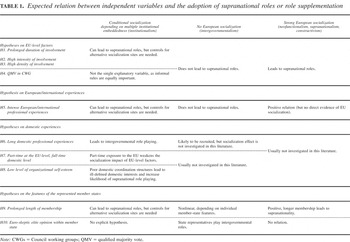
Table 1 situates these ten hypotheses within the three theoretical perspectives on socialization—strong socialization, no socialization, and conditional socialization—that were presented in the previous section. It also summarizes disagreement and inconclusiveness with respect to the socialization of state representatives.
Expected relation between independent variables and the adoption of supranational roles or role supplementation

Methodological Issues and Data Set
The evidence for testing the hypotheses comes from a quantitative quasi-experimental design that includes explicit controls for scope conditions at both the European and the domestic level. Data is drawn from a survey among state representatives, who were, to a varying degree, involved in the CWGs. It was decided that, given the large number of working groups (approximately 170 at the time of the fieldwork), it would not be valid to rely on a small number of respondents to establish the facts. However, at the time the research project started (1993), detailed and systematic information regarding state representatives and their involvement in the CWGs was not available. Therefore, I started with a list of 170 working groups (provided by the Belgian Permanent Representation) and collected information regarding the officials who were active in these 170 groups. On the basis of twenty-eight in-depth, qualitative interviews, most CWGs were coded according to density of meetings (ranging from “never” to “several times a week”), policy area (based on the items discussed), type (cross-cutting policy fields, technical regulation in an existing policy field, and so on), composition (traveling part-timers or Brussels-based full-timers), and the applicable voting procedure for the issues on its agenda (QMV or unanimity).
In sampling state representatives, two sources of variation were considered as crucial: first, variation with respect to the member state represented by the official; and second, variation according to the level of involvement in the CWGs— that is, part-timers and full-timers (see Hypothesis 7). Part-timers are officials from sectoral ministries who only occasionally take part in CWGs and combine this with other, mainly domestic, tasks. Full-timers are involved in CWGs on a more regular basis and include diplomats at the Foreign Office or the Permanent Representation (PR) and officials of sectoral ministries attached to the PR.53
On the composition of the PR, see Hayes-Renshaw and Wallace 1997.
The choice of Belgium was driven mainly by practical considerations; the location of the Belgian government institutions in Brussels facilitated the fieldwork. One could argue that this biases the research outcomes in the sense that it is easier for Belgian part-timers to develop contacts with the European institutions and to adopt supranational norms. Unfortunately, as the data set does not include part-timers from other member states, I cannot substantiate this claim from a comparative perspective. However, there are two reasons why this bias is not necessarily large or problematic. First, research on Belgium's relation with the EU shows the irrelevance of proximity when it comes to the Europeanization of the Belgian system. It appears that the networks of Belgian bureaucrats remain largely separate from EU policy networks. On this aspect, see Dierickx and Beyers 1999; Bursens 2002; see also fns. 60 and 61. Second, within a sample including Belgian full-timers and Belgian part-timers, proximity remains constant and will not cause biased research outcomes within this sample.
From the set of 170 CWGs, thirteen groups were selected. Only groups that were situated in different first-pillar policy domains and were staffed, as much as possible by representatives from the PRs in Brussels, were included.55
The first pillar of the Treaty on the European Union consists of policy domains that belong to the three original treaties: European Community for Coal and Steel (ECCS), European Atomic Energy Community (Euratom), and the European Economic Community (EEC).
A final comment concerns some limitations of the data.56
See also Hooghe, this volume.
Measuring the Dependent Variable, Role Conceptions
One of the first questions to be answered is whether state representatives have adopted systematic conceptions of their role and to what extent their roles correspond to two more or less distinguishable conceptions, namely a supranational and an intergovernmental role. During the interviews, the interviewees were given nine statements designed to measure how they believed they should act, that is, their role, or how they conceived the policy process (the situation in which they were placed), specifying their view on a scale ranging from 1 (disagree) to 6 (agree). The higher the score, the more convinced the interviewees were that they should act according to the role conception outlined in a particular statement.
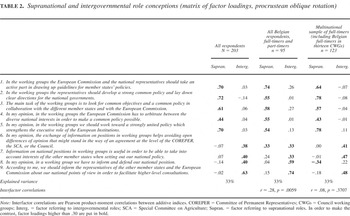
The first column of Table 2 shows all nine items. These nine observed variables do not measure nine separate roles. By factor analyzing the nine items, I explore the extent to which these observations can be explained by a set of hypothetical factors that correspond to the two role conceptions I outlined in the first section. The major aim of factor analysis is to represent a set of observed variables, which are answers to different questions, by a smaller set of factors. In order to interpret the outcome, I inspected the matrix with factor loadings; factor loadings are to be considered as correlations between latent factors and observed variables. The higher the factor loadings, the more an observed variable is associated with an underlying latent factor or the more an unobserved latent concept explains variation in the set of observed and measured variables.57
See Kim and Mueller 1978; and Tacq 1997.
Supranational and intergovernmental role conceptions (matrix of factor loadings, procrustean oblique rotation)

The factor loadings in Table 2 show that state representatives distinguish two roles. Columns (2) and (3) (“All respondents”) present the matrix of factor loadings, that is, correlations between the latent factor and the observed variables, for all respondents. In order to check the similarity of the outcome, I show in the other columns two additional analyses, one for all Belgian respondents and another for the multinational sample (including Belgian full-timers). The first five items clearly correspond to a supranational role conception (that is, they strongly correlate with one common factor): officials should “draw up guidelines for the member states,” “play an active part,” “develop a common policy,” “collaborate and look for common objectives,” and “strengthen the role of European institutions.” The next four items fit more into an intergovernmental role conception. Key phrases are “taking into account interests of other member states,” “defend national positions,” and “exchange and balance national viewpoints.” Two other features are typical for these intergovernmental items. First, “the national position” is a key ingredient of someone's evaluation of the process in the CWGs and, second, bureaucrats do not view themselves as autonomous consensus-builders. On the contrary, they exchange information to facilitate decision making at the higher levels.
The pattern of correlations between observed variables and the two underlying factors suggests that state representatives have consistently adopted two more or less distinct roles, a supranational role and an intergovernmental role. What about the possibility that actors, to some extent, combine roles? Or, do officials separate one role from the other and thus keep each role distinct? To reiterate briefly, different patterns in the data would indicate different ways of combining role conceptions. First, a positive correlation would suggest that actors combine both roles in the sense that evoking an intergovernmental role is combined with a supranational role, a situation in which role conflict is unlikely. Second, in the case of a negative correlation, outspoken supranational roles would imply a rejection of intergovernmental roles. This outcome would suggest the existence of role conflict. Finally, the absence of a substantial correlation means that, on average, both the positive combination of roles and role conflict are not taking place, but it does not rule out blurring role conceptions or role conflict under some specific scope conditions. For example, compared to less experienced state representatives, more experienced state representatives find it easier to combine both roles; they do not necessarily see a difference between defending a national and a European interest (see below).
The evidence shows that some state representatives tend to combine different role conceptions. A closer inspection of the factor pattern in Table 2 suggests that both conceptions are quite, but not perfectly distinguishable. The positive interfactor correlation for Belgian respondents (full-timers and part-timers) shows that on average, Belgian officials tend to combine intergovernmental roles with supranational roles (r = .28, p = .0059); that is, in the Belgian case it is difficult to assume that both role conceptions are completely distinct from each other. Some positive and rather substantial cross-loadings—that is, factor loadings or correlations of one variable with two factors—also point in this direction. The outcome is less straightforward when I consider the multinational sample of full-timers. The interfactor correlation is low and insignificant (r = .08, p = .3707), but some cross-loadings suggest role conflict instead of a positive role combination. For instance, it is noteworthy that an “intergovernmental” statement referring to the defense “of our national position” points to conflict with a supranational role conception (negative loading of −.34). Thus there are some indications of role conflict among full-timers, but the overall pattern remains too weak and unsystematic to make firm conclusions.
Recruitment and Professional Experiences
Role playing may be affected by scope conditions at multiple levels of governance, namely the European and the domestic level. As suggested earlier, member-state governments juggle several criteria. They may prefer to appoint those with extensive European/international professional experience, or prefer officials with profound insight into domestic sensitivities and an extensive domestic socialization record (Hypotheses 5 and 6). The importance of socialization experiences at both the domestic and European levels is apparent from my quantitative data as well as from the various in-depth interviews that I carried out. It also appears that many EU diplomats combine a strong ‘European’ curriculum with extensive domestic experiences.
First, although diplomats are supposed to rotate every four years to another post, the traditional four-year rule does not apply to the Belgian EU Permanent Representative.58
Often, EU Permanent Representatives serve much longer periods at the PR than one would expect of an average professional diplomat. Second, diplomats at the highest position in the PR had previous, sometimes extensive, experiences with the EU and its member states. Third, these “European” experiences correspond with extensive experience and involvement in various domestic political networks. Being part of the PR is not just an ordinary thing, and the prestige of the job has political consequences. Domestic party political considerations are unambiguously and openly taken into account when making appointments.59Dierickx and Beyers 1999, 200–3.
Do these observations from the in-depth interviews correspond with the available quantitative evidence? What about the European embeddedness of officials, their current involvement in policymaking processes at the European level in general, and their participation in CWGs in particular?
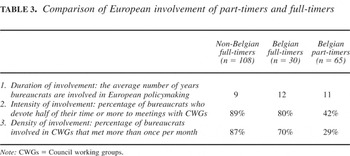
Above I suggested that the distinction between part-timers and full-timers relates to their embeddedness in CWGs (Hypothesis 7). However, what is the nature of this embeddedness? As Table 3 shows, the distinction between part-timers and full-timers is not significantly related to the duration—in years—of involvement in various CWGs, but it corresponds with the intensity of contact and the density of CWG gatherings in which officials were involved. Within the group of Belgian respondents, the duration of involvement is slightly higher for the full-timers (twelve years) than for the part-timers (eleven years), and the non-Belgian respondents had, on average, spent nine years in CWGs. Yet the differences are small and statistically irrelevant (F = 1.69, df = 2, p = .1872). It is more the intensity of involvement and the density of CWG meetings that differentiates part-timers from full-timers. Among the full-timers, 80 percent of the Belgian officials and 89 percent of the non-Belgian officials devoted more than half of their time to meetings with CWGs. Only 42 percent of the Belgian part-timers spent more than half of their time in meetings with CWGs.60
Time devoted to CWGs, intensity of involvement, is measured by an ordinal five-point scale ranging from one (less than 25 percent) to five (100 percent). Note that the data concern a period during which Belgium held the Presidency of the Council (1993) and that the time devoted in CWG meetings might be somewhat overestimated. Nevertheless, the observed difference between Belgian and non-Belgian full-timers is relatively small and statistically insignificant (χ2 = 5.958, df = 4, p = .202), while the difference between Belgian full-timers, non-Belgian full-timers and Belgian part-timers is strongly significant (χ2 = 61.332, df = 8, p = .001).
Each CWG was coded on the basis of twenty-eight in-depth expert-interviews. The density of meetings for each CWG ranges on an ordinal six-point scale from zero (CWG did not meet) to 5 (CWG met several times a week). The observed difference between Belgian full-timers and non-Belgian full-timers might be attributable to the fact that the group of Belgian full-timers included more diplomats and Foreign Office staff. Notably, the difference between Belgian and non-Belgian full-timers is relatively small (χ2 = 7.386, df = 4, p = .117) compared to the difference between Belgian full-timers, non-Belgian full-timers and Belgian part-timers (χ2 = 78.748, df = 10, p = .001). By adding Belgian part-timers, the heterogeneity of the evidence substantially and significantly increases (dχ2 = 71.362, ddf = 6, p = .000).
Comparison of European involvement of part-timers and full-timers

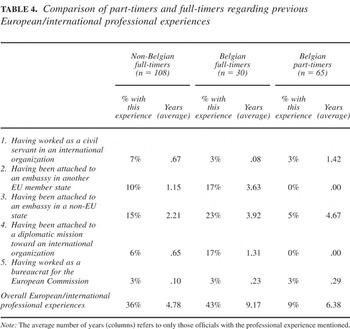
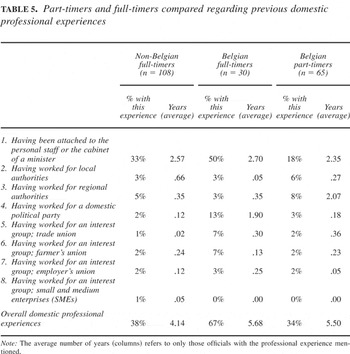
Tables 4 and 5 show results concerning previous professional experiences. In general, the extensiveness of European/international and domestic professional experiences correlates substantially with the distinction between part-timers and full-timers. As qualitative evidence has already illustrated, full-timers follow a professional trajectory that has a pronounced European/international character; they spend more of their professional career in other member states, an indication of extensive “European” socialization opportunities. The Belgian full-timers in particular are characterized by extensive European/international and domestic professional experiences.62
We have to be somewhat careful in distinguishing “international” from “European” professional experiences. For instance, if a respondent had been attached to an embassy in a non-EU state, this might imply a post in another European state before it entered the EU.
Comparison of part-timers and full-timers regarding previous European/international professional experiences

Part-timers and full-timers compared regarding previous domestic professional experiences

It is clear that Belgian full-timers have strong domestic experiences and that Belgian part-timers have, compared to the Belgian full-timers, weak historical ties with their domestic environment. In the Belgian case, the full-timers' recruitment correlates strongly with both an extensive domestic socialization record and extensive European/international experiences. In the next section, I explore the extent to which these experiences affect the adoption of supranational role conceptions.
Role Conceptions and Multiple Embeddedness
As the factor analysis shows (see Table 2), state representatives adopt a consistent conception of their role and distinguish between two possible roles, a supranational role and an intergovernmental role. Within the Belgian sample, state representatives tend to see a supranational role as complementary to an intergovernmental role; that is, on average, Belgian bureaucrats do not experience role conflict. Although there are some minor indications of role conflict among full-timers, both roles were quite separable within this sample. The previous section showed that representatives are embedded in multiple contexts and that many of them, especially Belgian full-timers, have strong domestic ties in addition to their European responsibilities.
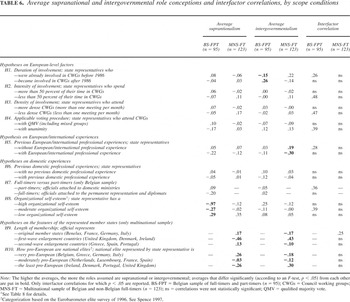
But to what extent are these variable socialization experiences associated with the adoption of supranational roles and a rejection of intergovernmental roles? I constructed two factor scales by making an additive index of the observed variables belonging to the factors supranational and intergovernmental role conceptions, respectively. These scales are standardized and used in the analyses summarized in the tables and figures below. The first column of Table 6 introduces categorical distinctions related to the various socialization experiences that were identified as potential scope conditions explaining role playing (Hypotheses 1–10). The next four columns show the average scores for supranational and intergovernmental role playing—first for the Belgian sample of full-timers and part-timers (BS-FTP), and then for the multinational sample of full-timers (MNS-FT). The higher the mean, the more supranational or intergovernmental state representatives are.
Average supranational and intergovernmental role conceptions and interfactor correlations, by scope conditions

I demonstrated above that on average, multinational full-timers do not combine both roles (see interfactor correlations in Table 2). However, this does not rule out blurring role conceptions under some specific circumstances. For instance, especially extensively involved officials may be able to combine both roles. In general, if European socialization takes place, then the combination of role conceptions—substantiated by a significant correlation between the two factor scales—and the adoption of supranational roles should occur among the extensively involved state representatives. The last two columns of Table 6 show interfactor correlations within different categories; these correlations indicate whether and to what extent roles are combined under specific scope conditions.
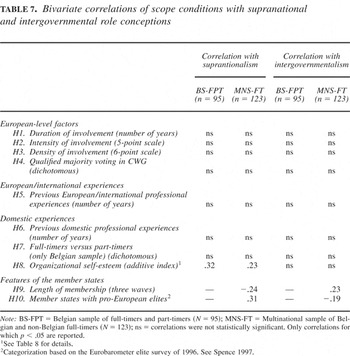
One of the limitations of the results shown in Table 6 is the use of categorical distinctions that may be criticized for their crudeness. Therefore, I show in Table 7 the Pearson product-moment correlations of the two role conceptions with the original noncategorized independent variables. For instance, instead of making a rough dichotomous distinction about whether or not previous European professional experiences occurred, I look at the number of years these experiences lasted.
Bivariate correlations of scope conditions with supranational and intergovernmental role conceptions

The discussion of the results starts with the interfactor correlations in Table 6 (see the last two columns). Given the absence of negative correlations, it can be concluded that role conflict is not the usual pattern within different subgroups. Moreover, the predominance of role combination (that is, defining oneself as playing both intergovernmental and supranational roles), in contrast to role conflict, is further confirmed. Especially among representatives of the larger member states (not in the table) and within CWGs where unanimity applies for the issues on the agenda, both role conceptions are combined.63
When isolating the four member states with the biggest voting power (Italy, France, Germany, and the United Kingdom), a significant correlation is observed (r = .43, p = .0026) between the adoption of an intergovernmental and a supranational role.
See Lewis 1998; and Lewis, this volume.
Does intensive, dense, and prolonged participation in CWGs lead to supranational and less intergovernmental role conceptions (Hypotheses 1–3, 7)? To some extent, European/international experiences seem to mitigate intergovernmental role conceptions. Among Belgian respondents, those officials that became involved in the CWGs before 1986 have a less intergovernmental role conception (F = 4.00, df = 1, p = .0484). In the group of full-timers, having previous European/international professional experiences decreases intergovernmentalism (F = 7.25, df = 1, p = .0081). However, the latter observation is not direct confirmation of EU socialization (see Hypothesis 5). Moreover, in general, these are rather weak and unsystematic associations. Neither the bivariate correlations in Table 7, nor the categorical distinctions in Table 6, provide strong and systematic confirmation of the strong European socialization hypothesis. The only evidence suggesting European socialization concerns duration of involvement. Belgian officials that were involved in CWGs before 1986 are slightly more disposed to combine intergovernmental roles with supranational role conceptions (r = .26, p = .0438). The strong socialization hypothesis that especially extensive and intense experiences with CWGs lead to a combination of roles receives no strong support. On the contrary, in the Belgian sample there is considerable evidence for role combination among part-timers (r = .36, p = .0033), among those without previous transnational experiences (r = .28, p = .0127), among those involved in less dense CWGs (r = .47, p = .0003) and among those who spent less than 50 percent of their time in CWGs (r = .48, p = .0010). These observations suggest the opposite of the strong socialization hypothesis, namely that weak and casual, not strong, European ties lead actors to adopt supranational roles in combination with intergovernmental roles.
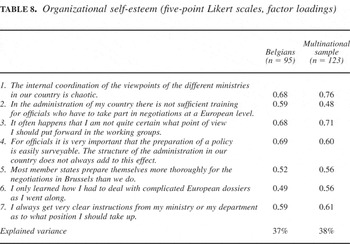
The data also indicate that ties with the domestic arena affect role playing. Hypothesis 8 (see Table 1) suggests that the less frequently and extensively representatives are instructed by domestic institutions with respect to desired outcomes, the more supranational role playing may emerge. To measure the nature of ties with the domestic politico-administrative system, seven Likert items were combined in a scale labeled “organizational self-esteem” (see Table 8). In general, low organizational self-esteem is positively associated with the adoption of supranational role conceptions. In the Belgian case in particular, the perceived weaknesses of domestic networks contribute to supranationalism (see results in Tables 6 and 7).
Organizational self-esteem (five-point Likert scales, factor loadings)

I illustrate this finding in a more succinct manner. The distinction between part-timers and full-timers corresponds to embeddedness in CWGs and may be used as a proxy for involvement. In general, average organizational self-esteem is somewhat higher among Belgian full-timers than among Belgian part-timers; that is, full-timers feel that they get more detailed instructions and guidelines, but this difference is statistically insignificant (F = 1.61, df = 1, p = .2076). A covariance analysis with one interaction term (involvement × organizational self-esteem) reveals that in particular, a low domestic organizational self-esteem stimulates supranational roles (F = 5.29, df = 2, p = .0067). Figure 1 displays the average supranational role conception according to self-esteem and involvement. Again, it is not an extensive or intensive involvement in the CWGs that makes the most substantial difference. Rather, the evidence suggests that the less frequent and intensive the involvement in Europe (as is so for part-timers), the more a low organizational self-esteem (that is, a perception of weak instructions, poor domestic coordination and policy preparation) leads to the adoption of supranational role conceptions.

Average supranational role conception among Belgian officials, by organizational self-esteem and domestic experience (Hypothesis 8)
Much of my qualitative data also points in this direction. From the in-depth interviews, I learned that, among Belgian officials, complaints about the complexity of the domestic political system prevailed.65
See also Bursens 2002.
Tests of hypothesis nine, which refers to length of member-state EU membership, systematically confirm the importance of domestic socialization. First, as expected, older member-state representatives develop more supranational roles (r = −.24, p = .0074) and fewer intergovernmental roles (r = .23, p = .0094) than the newer member states (see Table 6). However, the distinctions in Table 6 nuance this general conclusion considerably. The covariation is curvilinear instead of linear.66
F-test for supranational roles and intergovernmental roles are, respectively, F = 4.67, df = 2, p = .0112, and F = 4.09, df = 2, p = .0192.
Finally, there is considerable support for Hypothesis 10, namely that adopted roles reflect the overall elite attitude within a member state. In general, if an official represents a member state with a pro-European societal elite, the official tends to act according to a supranational role conception (F = 6.36, df = 2, p = .0130) and rejects intergovernmental roles (F = 4,98, df = 2, p = .0276). In contrast, if a CWG-official represents a member-state where the overall elite attitude is more Euro-skeptic, I observe the opposite. In this respect, domestic Council officials are quite “representative.”
Conclusion
The Council of Ministers and its working groups are a fertile laboratory for studying actor behavior that is governed by role playing and rules of appropriateness. Few formal rules prescribe how state representatives at the lower levels of the Council are expected to behave, and the notion of representation implies that state representatives may face several dilemmas regarding the interests they are supposed to represent. In this case, representatives operate under the condition of bounded rationality; that is, their computational abilities are limited and their access to information is restricted. They adopt role conceptions—norms, rules, expectations, and prescriptions of appropriate behavior—enabling them to prioritize and respond to particular policy problems and interests (and to de-emphasize others).
This perspective fits Checkel's category of Type I socialization studies, focusing on scope conditions and with a view of actors as boundedly rational. My findings also demonstrate that state representatives adopt supranational role conceptions as norms of appropriate behavior. This observation, which contrasts with pure intergovernmental role playing or what Lewis labeled the “hard bargaining” image of the Council, confirms that joint problem solving is an important feature of the processes in the CWGs.67
Although the possibility of normative suasion as a socialization mechanism has not been fully explored here, the evidence suggests that many processes in the Council are not only motivated by member-state interests. State representatives also puzzle over joint and deliberative problem solving, seek information, and try to learn about problems in other member states. Such role-driven behavior is reasonable because it enables state representatives to act under circumstances that are often ambiguous.However, in contrast to the strong socialization hypothesis, one cannot conclude that it is especially those interactions cutting across national borders that lead to the adoption of supranational roles among state representatives. Nor are state representatives operating in a context that is largely disconnected from domestic values and norms. Recruitment and selection are significantly shaped by domestic networks, and state representatives' role perceptions are considerably consistent with the overall elite attitude in the member state they represent. Scope conditions that refer to European experiences—such as intensity, duration, and density of contact—showed no systematic relationship with the dependent variable. On the contrary, in the Belgian subsample, in which there is more variation regarding the level of involvement, I observed that weak and casual, not strong or regular, European ties correlate positively with supranational roles. Supranational role playing among state representatives that are only occasionally involved in the Council can be seen as a counterindication of strong EU socialization.
One possible explanation for this finding relates to specific organizational features of the domestic polity. My research strongly endorses the notion that a profound understanding of international socialization depends to a large extent on an in-depth exploration of how domestic politics is organized.68
Checkel 2004, 237–38.
See also Hooghe, this volume.
More generally, my findings suggest that the variable ways in which domestic institutions are organized significantly affect the potential of system transformation at the EU level.70
See Egeberg 2004; and Beyers and Trondal 2004.
See Lewis, this volume; and Hooghe, this volume.
References
REFERENCES
Beyers, Jan, and
Guido Dierickx.
1998.
The Working Groups of the Council of the European Union:
Supranational or Intergovernmental Negotiations?
Journal of Common Market Studies
36 (3):289–317.Google Scholar
Beyers, Jan, and
Jarle Trondal.
2004.
How Nation-States ‘Hit’ Europe. Ambiguity and
Representation in the European Union.
West European Politics
27 (5):919–42.CrossRefGoogle Scholar
Bulmer, Simon J.
1994.
The Governance of the European Union: A New Institutionalist
Approach.
Journal of Public Policy
13 (4):351–80.CrossRefGoogle Scholar
Bursens, Peter.
2002.
Why Denmark and Belgium Have Different Implementation Records: On
Transposition Laggards and Leaders in the EU.
Scandinavian Political Studies
25 (2):173–95.CrossRefGoogle Scholar
Cameron, David R.
1995.
Transnational Relations and the Development of European and
Monetary Union. In
Bringing Transnational Relations Back In: Non-State Actors, Domestic
Structures and International Institutions, edited by
Thomas Risse-Kappen,
37–78.
Cambridge:
Cambridge University Press.
Checkel, Jeffrey.
1999.
Social Construction and Integration.
Journal of European Public Policy
6 (4):545–60.CrossRefGoogle Scholar
Checkel, Jeffrey.
2004.
Social Constructivism in Global and European Politics: A Review
Essay.
Review of International Studies
30 (2):229–44.CrossRefGoogle Scholar
Christiansen, Thomas.
2002.
The Role of Supranational Actors in EU Treaty Reform.
Journal of European Public Policy
9 (1):33–53.CrossRefGoogle Scholar
Cowles, Maria Green,
James Caporaso, and
Thomas Risse.
2001.
Transforming Europe: Europeanization and Domestic Change.
Ithaca, N.Y.:
Cornell University Press.
Crombez, Christophe.
1996.
Legislative Procedures in the European Community.
British Journal of Political Science
26 (2):199–228.CrossRefGoogle Scholar
Dierickx, Guido, and
Jan Beyers.
1999.
Belgian Civil Servants in the European Union. A Tale of Two
Cultures?
West European Politics
22 (3):198–222.CrossRefGoogle Scholar
Egeberg, Morten.
1999.
Transcending Intergovernmentalism? Identity and Role Perceptions of
National Officials in EU Decision-Making.
Journal of European Public Policy
6 (3):456–74.CrossRefGoogle Scholar
Egeberg, Morten.
2004.
An Organizational Approach to European Integration: Outline of a
Complementary Perspective.
European Journal of Political Research
43 (2):199–219.CrossRefGoogle Scholar
Elgström, Ole,
Bo Bjurulf,
Jonas Johansson, and
Anders Sannerstedt.
2001.
Coalitions in European Union Negotiations.
Scandinavian Political Studies
24 (2):111–28.CrossRefGoogle Scholar
Garrett, Geoffrey, and
George Tsebelis.
1996.
An Institutional Critique of Intergovernmentalism.
International Organization
50 (2):269–99.CrossRefGoogle Scholar
Goetz, Klaus.
2000.
European Integration and National Executives: A Cause in Search of
an Effect?
West European Politics
23 (4):210–31.Google Scholar
Haas, Ernst B.
1958.
The Uniting of Europe: Political, Social, and Economical Forces
1950–1957.
Stanford, Calif.:
Stanford University Press.
Haas, Peter M.
1992.
Introduction: Epistemic Communities and International Policy
Coordination.
International Organization
46 (1):1–35.CrossRefGoogle Scholar
Harmsen, Robert.
1999.
The Europeanization of National Administrations: A Comparative Study
of France and the Netherlands.
Governance: An International Journal of Policy and
Administration
12 (1):81–113.CrossRefGoogle Scholar
Hayes-Renshaw, Fiona, and
Helen Wallace.
1997.
The Council of Ministers.
London:
MacMillan.
Hoffmann, Stanley.
1966.
Ostinate or Obsolete? The Fate of the Nation State and the Case of
Western Europe.
Daedalus
95:862–915.Google Scholar
Hoffmann, Stanley.
1982.
Reflections on the Nation-State in Western Europe Today.
Journal of Common Market Studies
21 (1–2):21–38.Google Scholar
Homans, G. C.
1961.
Social Behavior: Its Elementary Forms.
New York:
Harcourt, Brace & World.
Hooghe, Liesbet.
1999.
Supranational Activists or Intergovernmental Agents?: Explaining the
Orientations of Senior Commission Officials Toward European
Integration.
Comparative Political Studies
32 (4):435–63.CrossRefGoogle Scholar
Hooghe, Liesbet, and
Gary Marks.
2001.
Multi-Level Governance and European Integration.
Lanham, Md.:
Rowman & Littlefield.
Johnston, Alastair Iain.
2001.
Treating International Institutions as Social Environments.
International Studies Quarterly
45 (4):487–515.CrossRefGoogle Scholar
Keohane, Robert O.
1969.
Institutionalization in the United Nations General Assembly.
International Organization
23 (4):859–96.CrossRefGoogle Scholar
Kerr, Henry H.
1973.
Changing Attitudes Through International Participation: European
Parliamentarians and Integration.
International Organization
27 (1):45–83.CrossRefGoogle Scholar
Kerremans, Bart.
1996.
Do Institutions Make a Difference? Non-Institutionalism,
Neo-Institutionalism, and the Logic of Common Decision-Making in the
European Union.
Governance
9 (2):217–40.CrossRefGoogle Scholar
Kerremans, Bart, and
Jan Beyers.
2001.
The Belgian Permanent Representation to the European Union: Mail
Box, Messenger, or Representative? In
The National Co-ordination of EU Policy, edited by
Hussein Kassim,
Anand Menond,
B. Guy Peters, and
Vincent Wright,
1991–210.
Oxford:
Oxford University Press.
Kim, Jae-On and
Charles W. Mueller.
1978.
Factor Analysis: Statistical Methods and Practical Issues.
London:
Sage.
Lewis, Jeffrey.
1998.
Is the ‘Hard Bargaining’ Image of the Council
Misleading? The Committee of Permanent Representatives and the Local
Elections Directive.
Journal of Common Market Studies
36 (4):479–504.CrossRefGoogle Scholar
Lewis, Jeffrey.
2003.
Institutional Environments and Everyday EU Decision Making:
Rationalist or Constructivist?
Comparative Political Studies
36 (1/2):97–124.Google Scholar
Lindberg, Leon N.
1963.
The Political Dynamics of European Economic Integration.
London:
Oxford University Press.
Lindberg, Leon N.
1998 [1963].
Political Integration: Definitions and Hypotheses. In
The European Union: Readings on the Theory and Practice of European
Integration, edited by
Brent Nelsen and
Alexander Stubb,
145–56.
London:
Macmillan.
Mair, Peter.
2004.
The Europeanization Dimension.
Journal of European Public Policy
11 (2):337–48.Google Scholar
March, James G., and
Johan P. Olsen.
1989.
Rediscovering Institutions: The Organizational Basis of
Politics.
New York:
Free Press.
March, James G., and
Johan P. Olsen.
Forthcoming.
The Logic of Appropriateness. In
Handbook of Public Policy, edited by
Robert Goodin,
Michael Moran, and
Martin Rein.
Oxford:
Oxford University Press.
Martin, Lisa, and
Beth A. Simmons.
1998.
Theories and Empirical Studies of International Institutions.
International Organization
52 (4):729–57.CrossRefGoogle Scholar
Mattila, Mikko, and
Jan-Erik Lane.
2001.
Why Unanimity in the Council? A Roll Call Analysis of Council
Voting.
European Union Politics
2 (1):31–52.CrossRefGoogle Scholar
Mayntz, Renate.
1999.
Organizations, Agents and Representatives. In
Organizing Political Institutions: Essays for Johan P. Olsen,
edited by
Morten Egeberg and
Per Laegreid,
81–91.
Oslo, Norway:
Scandinavian University Press.
Moravcsik, Andrew.
1993.
Preferences and Power in the European Community: A Liberal
Intergovernmentalist Approach.
Journal of Common Market Studies
31 (4):473–524.CrossRefGoogle Scholar
Moravcsik, Andrew.
1999.
The Choice for Europe: Social Purpose and State Power From Messina
to Maastricht.
London:
UCL Press.
Peck, Richard.
1979.
Socialization of Permanent Representatives in the United Nations:
Some Evidence.
International Organization
33 (3):365–90.CrossRefGoogle Scholar
Pitkin, Hanna F.
1972.
The Concept of Representation.
Berkeley:
University of California Press.
Pollack, Mark A.
1998.
Constructivism, Social Psychology and Elite Attitude Change: Lessons
from an Exhausted Research Program.
Paper Presented at the 11th International Conference of
Europeanists, February, Baltimore.
Pollack, Mark A.
2003.
The Engines of European Integration: Delegation, Agency, and Agenda
Setting in the EU.
Oxford:
Oxford University Press.
Scheinman, Lawrence, and
Werner Feld.
1972.
The European Economic Community and National Civil Servants of the
Member States.
International Organization
26 (1):121–35.CrossRefGoogle Scholar
Searing, Donald D.
1969.
The Comparative Study of Elite Socialization.
Comparative Political Studies
1 (4):471–500.CrossRefGoogle Scholar
Searing, Donald D.
1986.
A Theory of Political Socialization: Institutional Support and
Deradicalization in Britain.
British Journal of Political Science
16 (3):341–76.CrossRefGoogle Scholar
Searing, Donald D.
1991.
Roles, Rules, and Rationality in the New Institutionalism.
American Political Science Review
85 (4):1239–60.CrossRefGoogle Scholar
Smith, Keith A.
1973.
The European Economic Community and National Civil Servants of the
Member States—A Comment.
International Organization
27 (4):563–68.CrossRefGoogle Scholar
Spence, Jacqueline M.
1997.
The European Union ‘A View from the Top’: Top Decision
Makers and the European Union. Prepared for EOS Gallup Europe's
European Omnibus Survey.
Brussels:
EOS Gallup Europe.
Available at
〈http://europa.eu.int/comm/public_opinion/archives/top/top_en.htm〉.
Accessed 21 June 2005.
Steunenberg, Bernard.
2000.
Seeing What You Want to See: the Limits of Current Modelling on the
European Union.
European Union Politics
1 (3):368–73.Google Scholar
Stone Sweet, Alec, and
Wayne Sandholtz.
1997.
European Integration and Supranational Governance.
Journal of European Public Policy
4 (3):297–317.CrossRefGoogle Scholar
Stryker, Sheldon.
1980.
Symbolic Interactionism: A Social Structural Perspective.
Reading, Mass.:
Benjamin-Cummings.
Tacq, Jacques.
1997.
Multivariate Analysis Techniques in Social Science Research: From
Problem to Analysis.
London:
Sage.
Trondal, Jarle.
2001.
Is There Any Social Constructivist-Institutionalist Divide?
Unpacking Social Mechanisms Affecting Representational Roles among EU
Decision-Makers.
Journal of European Public Policy
8 (1):1–23.CrossRefGoogle Scholar
Vink, Maarten.
2003.
What Is Europeanisation? And Other Questions on a New Research
Agenda.
European Political Science
3 (1):63–74.CrossRefGoogle Scholar
Wessels, Wolfgang.
1991.
The EC Council: The Community's Decisionmaking Center.
In
The New European Community: Decisionmaking and Institutional
Change, edited by
Stanley Hoffmann and
Robert O. Keohane,
133–54.
Boulder, Colo.:
Westview.
Westlake, Martin.
1995.
The Council of the European Union.
London:
Catermill.
Wolf, Peter.
1973.
International Organization and Attitude Change: A Re-Examination of
the Functionalist Approach.
International Organization
27 (3):347–71.CrossRefGoogle Scholar
Expected relation between independent variables and the adoption of supranational roles or role supplementation
Supranational and intergovernmental role conceptions (matrix of factor loadings, procrustean oblique rotation)
Comparison of European involvement of part-timers and full-timers
Comparison of part-timers and full-timers regarding previous European/international professional experiences
Part-timers and full-timers compared regarding previous domestic professional experiences
Average supranational and intergovernmental role conceptions and interfactor correlations, by scope conditions
Bivariate correlations of scope conditions with supranational and intergovernmental role conceptions
Organizational self-esteem (five-point Likert scales, factor loadings)
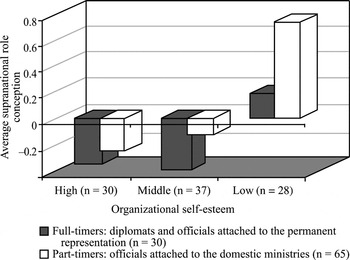
Average supranational role conception among Belgian officials, by organizational self-esteem and domestic experience (Hypothesis 8)
 You have
Access
- 136
- Cited by