Some ten years ago Bill Rubinstein, while accepting the virtual ‘collapse’ of upper-middle-class authority in provincial civil societies following 1918, also acknowledged that this phenomenon was still ‘largely unexplored and a matter of guesswork’.Footnote 1 Attention has also turned to the date this alleged downturn occurred, and its nature; was it universal, or spasmodic, generational or occupation specific? Did it occur only in politics, or across the broader range of civil activity?Footnote 2 Should we ‘count’ only those public persons – to use Lee's well-worn idiom – of independent social standing and wealth, or fetishize the absence of the major industrialist as the necessary hero of provincial governance, when such elite rule was neither ‘natural’ nor ‘superior’?Footnote 3 Or ought we to accept that civil society before 1914 was already socially inclusive, yet still dynamic?Footnote 4
Indeed, the act of juxtaposing a deficient twentieth-century ‘present’ with a more engaged past involves a misreading, built on empirical, methodological and theoretical deficiencies in data and categorization.Footnote 5 If, as Morris notes, we currently lack ‘guidance on how to write the urban history’ of the post-1920 era, nonetheless he is surely right to hypothesize that ‘the notion that this was a period of decline from the “golden age” of the late 19th century, simply will not do’.Footnote 6 Yet to temper an earlier binarism that ‘counted’ only the wealthy, and wealthy manufacturers particularly, we need to develop alternative, gradated and interlocking signifiers of an individual's objective/subjective status that cross the occupational divides. This article, therefore, has two key aims. First, it redresses the paucity in historical data for twentieth-century provincial civil society by surveying some 2,900 individuals in one English city – Nottingham – between the years 1900 and 1950.Footnote 7 It also questions the validity of ‘capturing’ an individual's hierarchical status by relying on ‘headline’ indicators such as occupation and wealth. Instead, it advocates the use of a synthesis of status markers as more accurate indicators of the stratas of social hierarchy. By so doing, it will be possible to gain a more comprehensive measurement of the postulated decline of social and economic elite participation in the management of political, charitable and voluntary activity after 1914. Such syntheses will also allow us to capture isolation of other broader participation trends within the middle, lower middle and working classes and facilitate the construction of aggregate status indices to measure overall trends across status groups.
A dearth of hard data
The data set covers those members of the public who were involved in local politics, who were magistrates or poor law guardians, or who helped manage or represent one of 34 voluntary associations serving Nottingham and the surrounding county (Appendix 1). It was set up to study the status range of middle-class participation in order to test for disengagement. To this end, it also samples independently the city's business leadership, and its propensity to volunteer. The sample draws on a range of voluntary organizations from the smallest to the largest city-based charities and associations, but it excludes working-class bodies like trade unions, friendly societies and the co-operative movement. Partial exception is made for those increasingly important organizations specifically linked to supporting local hospitals financially, which had a stronger working-class constituency. Three-quarters of those covered by the data set lived within the city boundary. With an inter-war middle-class constituent by occupation of some 22.5 per cent, Nottingham was roughly comparable with other northern or midland industrial cities. Its occupational distribution also approximately mirrored that of England.Footnote 8
Nottingham in the 1920s was prosperous. And with subsequent levels of unemployment peaking at 16.9 per cent (some 5 points below the UK average), and recovery underway, by 1936 the city's employment exchange manager still thought it ‘fairly prosperous’.Footnote 9 But such figures masked major inequalities in economic activity. Whereas employment in tobacco, clothing and pharmaceuticals expanded rapidly in the 1930s, the city's older staples like mining and cotton ‘collapsed’. Before the war ‘at the mid-day break’, one contemporary recalled, the city's lace warehouses were ‘discharging their crowds of employees in solid thousands’; 20 years later the lace market was ‘semi-deserted’. If then there was nothing exceptional or remarkable about the city's social structure, its economic fortunes were bipolar, ring fenced by industries that ‘failed to recover and others which developed apace’.Footnote 10
The clear majority of those sampled were middle class, with only 10 per cent being working class, and 1.5 per cent upper class. Yet the middle class is amorphous; its boundaries encompass singular disparities in wealth, income, status, lifestyle and self-view.Footnote 11 Some 29 per cent were upper middle class, 43 per cent middle middle class and 17 per cent lower middle class: roughly comparable with other samples mapping civil society that are similarly skewed towards wealth and privilege.Footnote 12 This disparity was most noticeable in terms of upper-middle-class visibility; this despite the upper middle classes constituting only some 0.75–1.0 per cent of the population of England and Wales.Footnote 13 Such a disproportionate presence confirms that the attractions and benefits of voluntary service were still essential to the formation of urban upper-middle-class identity after 1900, just as they had been in the previous century.Footnote 14
Yet the orthodox position on class posits the progressive replacement of an urban upper- and middle-middle-class leadership throughout the twentieth century, driven by an antipathetic desire to be separated from the working classes, or ‘under siege’, as ‘lower-middle-class worthies and the representatives of organised labour’ battled for the ‘scraps of what once was a vibrant urban culture’.Footnote 15 Such concerns were not new. Hennock identifies a ‘qualitative’ decline in city council memberships after 1900, but notes also a lack of entrepreneurial engagement in earlier decades. Indeed, contemporaneous constructs of what constituted an ‘ideal’ civic leadership had already changed to incorporate the large numbers of professionals then being recruited to civic office.Footnote 16 As Trainor notes, if our definition of elites is broadened to ‘encompass social substance’, those respected moderately affluent men and women who held ‘influential leadership within the towns’, then the argument for ‘decline is not strong’.Footnote 17 Indeed, at the median the socio-economic status of council members might even have risen.Footnote 18
Even less empirical evidence exists to confirm the withdrawal of socio-economic elites from leadership roles in voluntary organizations. Perhaps the slow ingress of local state authority reduced the incentive to volunteer, as the decline in organized religion after 1900 did.Footnote 19 Certainly, some traditional charities faltered, but others flourished, responding to new social circumstances and expectations. Yet charitable benevolence by the wealthy or moderately wealthy was still ‘expected’, even as middle-class identity began to assume a national persona which had the potential to devalue local participation.Footnote 20 Perhaps volunteering demanded less ‘raw’ commitment, making it less ‘crisis-prone’ than local government or poor law administration, with its public scrutiny, electioneering and bellicose nature.Footnote 21
Who's for volunteering?
What, then, was the market for volunteering? Trainor, looking at the late nineteenth century, found that large numbers of affluent men sought voluntary positions, and that posts were ‘plentiful enough to satisfy the ambition of many local citizens, but were never so numerous as to confer no distinction on their holders’.Footnote 22 Yet it would be wrong to assume that an equilibrium existed between the propensity to ‘volunteer’ and the needs of these organizations. Both the nineteenth and twentieth centuries witnessed perennial shortages of visitors and collectors, but shortfalls were apparent, too, in the layers of voluntary management above this. Braithwaite noted in the late 1930s that ‘there seemed to be little competition for election’. Instead, most associations were run by enthusiastic ‘small cliques of public-spirited volunteers’.Footnote 23 A decade later, Mass-Observation found that three-quarters of the membership of philanthropic associations were subscribers only. Active members tended to be middle-aged, male and middle class, of higher status than the general membership, and higher still than the population at large. But the variants within these parameters were considerable, reflecting the range of roles undertaken and the diversity of scale and prestige of the organizations concerned.Footnote 24
Yet fixing the relationship between individual status and the propensity to volunteer remains problematic. Collecting data on individual wealth for large samples is time consuming, and anyway many professional ‘top people’ were not wealthy, but still considered to be upper middle class.Footnote 25 Nor, frequently, is elite status best assessed by primary occupation: consider those holding multiple directorships, or who have a significant commercial ranking as an adjunct to their professional practice as lawyers or accountants.Footnote 26 An absence of data on individual earnings prohibits the most obvious linking of status to consumption patterns. One further option, as I have argued elsewhere, would be to consider property tax, where rateable value (RV) related directly to the price of the property. Expenditure on housing was highly income elastic across income ranges.Footnote 27 A family's house was also an inward and outward symbol of its social and financial standing; moving house – ‘up’ or ‘down’ – the surest indicator of changing aspiration or financial circumstance, and for most the single most important expression of the family's position in society.Footnote 28 Not surprisingly, property valuation correlates strongly to an individual's social class (r = 0.79 for Nottingham). Moreover, rateable valuations enable us to rank one house (and thus one family) against another within a city's social hierarchy. Thus, the valuation becomes an ordinal numeric index rather than a monetary enumerator.Footnote 29
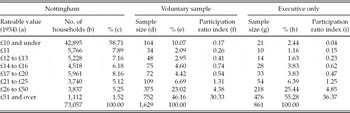
Using standardized rates data fixed on 1934 valuations,Footnote 30Table 1 records the social/financial profile of those living in Nottingham who were involved in local voluntary associations between 1900 and 1950 (Appendix 1: full sample), as members of the
Voluntary participation by rateable value: Nottingham 1900–50 (1934 constant prices)

Sample size: 1,629.
Notes: col. (b) based on city housing structure by rateable value year ending March 1934.
col. (d) is based on the overall voluntary sample, counting those whose primarily residence was in Nottingham, based on the highest value property occupied by them when in office.
cols. (f and i), participation ratio index is (e/c) and (h/c) respectively.
Principal sources: Nottingham Archives Office (NAO) CA.TR/1/3/1–25, Nottingham City Council valuation list 1934; NAO epitome of accounts CA.TR/5/4 year ending 31/3/1934, voluntary association annual reports, minutes; Nottinghamshire trade directories 1900–50.
executive, house or ladies’ committees, as a treasurer or honorary secretary, as an area organizer, as a president or vice-president.Footnote 31 The correlation between high rateable value (and social status) and volunteering is clearly visible. Where RVmax denotes the property with the highest rateable value occupied over time by each individual, the median value for all volunteers was £48 pa (or in the range of the top 1.5 per cent of city houses by value). The social profile rises if the sample is restricted to executive committee members (RVmax median £56 pa), or non-executive offices like president or vice-president (RVmax median £69). Only when conformably within the lower-middle class banding (where RVmax > £20 pa) do we see ‘volunteering’ proportions rise above overall household distribution norms for Nottingham (Table 1 columns f and i: percentage of volunteers over percentage of city households in each rateable banding).
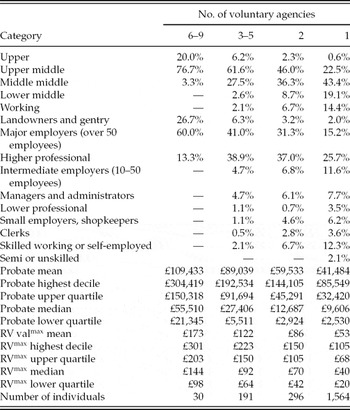
Yet volunteering carried with it a high opportunity cost. All but the most honorific posts required a significant investment in time and frequently cash; indeed, some executive posts constituted an alternative, unpaid job. ‘Excessive calls on time’, it is suggested, remained the strongest disincentive to volunteering among higher socio-economic elites, and particularly, Garrard argues, amongst manufactures.Footnote 32Figure 1 plots status against single or multiple memberships of local voluntary associations. Only in the middle reaches and above of the middle classes – those living in the limited number of properties with a rateable value of over £50 pa – do we see multiple membership exceed single as a percentage of the group. The contrast between the high percentage returns at this upper end, compared to their very small numbers within the population, is stark. Of the 2,088 individuals identified, 524 held office in more than one voluntary association. Of these, only 7 were associated with 10 or more bodies, 30 with between 6 and 9, 191 with 3 to 5, and a further 296 with 2 bodies (Table 2). It is worth noting that few working or lower-middle people were involved in more than one voluntary agency across the sample, although obviously this takes no account of their potential participation in other areas of self-provision (e.g. friendly societies, the co-operative movement).
Participation analysis of volunteering patterns by class, occupation, wealth and housing status, 1900–50 (1934 constant prices)

Sample size: 2,081.
Source: As Figure 1, plus National Probate Registers.
Single and multiple membership patterns of local voluntary associations (Nottingham and Nottinghamshire) Sample size: 2,088. Sources: As Table 1, and, in addition, the Valuation and Rate Books of the urban and district councils for Nottinghamshire.

Beveridge feared that domestic staff shortages and the diminution of the ‘leisured class’, coupled with the decline of the ‘family firm’ would mean that elites would have had less control over their time, and would be significantly less inclined to volunteer. Others have speculated on the rootlessness of a new suburbanized ‘managerial’ urban middle class from the late nineteenth century, and the diminution of traditional charitable activity as a vital component of middle-class identity, so that, as in local politics, the linkages with civil society were broken.Footnote 33 Certainly amongst the very wealthy in Nottingham and Nottinghamshire this was not the case. Such elites continued to volunteer, and were significantly more likely to engage in multiple service. For example, Sir Charles Seely, a millionaire colliery owner (probate £1,052,071: 1916), who lived at Sherwood Lodge (RV £101) on the outskirts of the city, became the public face perhaps most ‘closely associated with Nottingham's charitable works’ in the early twentieth century. He was involved in various capacities with 13 associations in the sample (as president, vice-president, patron or trustee), as an executive member of the Social Guild and, ‘first and foremost among his benefactions’, as chair of the city's General Hospital (to which he gave some £100,000).Footnote 34 Seely's level of involvement in multiple organizations was mirrored by that of other leading local industrialist elites across the period. It was reflected, too, in a continuing aristocratic presence. Earl Manvers (probate £1,046,316: 1926) and the duke of Portland (probate £201,516: 1943) both had large estates outside Nottingham, and were connected with 10 and 11 city-based charities respectively.
Of those operating below this level of activity, being members of between 6 and 9 organizations (Table 2), all barring one were either upper middle or upper class. They occupied properties with a mean rateable value of £172 pa (that is a substantial mansion), and left on average some £109,433 on death (at 1934 constant prices, or some £5.8m at today's rate). Some 60 per cent were major employers (or married to a major employer). Within the 3 to 5 range, only 9 individuals were working or lower middle class, but two-thirds belonged to the upper or upper middle classes, producing a housing/wealth mean profile of RVmax £122: probate £89,039 (where £40,000–45,000 on death at 1934 rates would indicate upper-middle-class membership).Footnote 35 Noticeable across the series is the strong presence in the upper quartile and higher percentile range of the very wealthy. Only at the highest level of multiple volunteering do we see an absence of the comfortable middle class, reflected in the smaller numbers of the higher professions.
If the costs were high, but the correlation between volunteering and industrial success, for example, seemingly strong, what was the effect upon other work commitments, particularly for those involved in the management of the more demanding, larger associations? Were such people merely figureheads? The General Hospital was the most socially prestigious and wealthiest charity in the county (income £12,000 pa in 1900, £210,000 pa 1947).Footnote 36 All those who chaired its management committee were upper middle class. Five of the six were major industrialists, several of whom were very wealthy and involved with multiple charities. All, too, were heavily involved in the hospital's day-to-day running. The already noted Sir Charles Seely directed the hospital until shortly before his death in 1915. Autocratic by nature, he ‘gave lavishly of his great wealth’, which allowed him to dictate policy, particularly in terms of development, where he brooked little opposition from the medical staff. As one surgeon recalled, his ‘chairmanship was such that he practically did what he liked at the hospital’.Footnote 37 His successor, Frederick Acton, a city solicitor (RV £80; probate £55,398: 1933), who left £10,000 to the hospital, was described on his death as the ‘greatest hospital enthusiast Nottingham has ever known’, a man of ‘zeal and untiring efforts in promoting the welfare and progress’ of the institution.Footnote 38 He was replaced in 1927 by the tobacco magnate William Player (RV £205; probate £1,606,739: 1959). The Player tobacco empire had a share capital of some £200,000 and by 1900 employed some 1,000 workers. Yet it was not simply the money he donated (purportedly some £150,000) which made Player a noteworthy benefactor. With a reputation for conscientiousness and attention to detail, he saw it as his job, amongst others things, to check on the condition of the hospital chapel's paintwork, to ensure that surgical waste was being correctly disposed, to help redesign the porters’ uniforms, to meet with local fundraisers and to help recruit local manufactures and the gentry to stand for office.Footnote 39 His successor, Sir Louis Pearson (RV £138; probate £459,954: 1943), who ran a major engineering company, when asked how much time managing the hospital took, thought some ‘two or three afternoons a week, at least’.Footnote 40 His nephew, Lt Col Noel Gervis Pearson (RV £150; probate £393,367: 1958) who took over in 1942, continued to run the family engineering company, but apparently it was the hospital which he ‘made the chief interest (one might say ‘hobby’) of his life’ and which he visited ‘every day’.Footnote 41
Such commitments were made possible by the infrastructural support available within these large companies so that management could be devolved. Where this was not the case, the costs on body and soul could be high, even when running smaller charities. Albert Mather served as the honorary secretary of Ellerslie House, a 14-bed home for paralysed ex-servicemen established in 1918. Writing to the Ministry of Pensions he recorded that:
We have a heavy struggle to finance the above Home and to make our expenses tie with our income. We would not get anywhere near this if we had to pay administrative expenses. All such work in connection with the Home is voluntary and as Honorary Secretary this continual struggle . . . is wearing one somewhat.Footnote 42
Yet, despite such calls on his time, Mather, who worked in the troubled lace industry, continued to volunteer throughout the inter-war period. This selflessness at a time of economic hardship was not in itself unusual. Lace and cotton manufacturers like William Brownsword and Stanley Bourne maintained their existing voluntary activity through the recession, even taking on additional executive responsibilities, as did Frederick Dobson, another major city employer in the lace and bleaching trades.
It is thus tempting to project a strong relationship between charitable involvement and business leadership, where the latter was valued for its connections, status and entrepreneurship, while those in business valued voluntary service as a way of acquiring a public identity as ‘extraordinary’ local patrons.Footnote 43 But an ability to fill places does not necessarily equate to a broader engagement. The cross tabulation of the directorships of Nottingham's 220 leading joint stock companies (c. 1902) reveals that only 24 per cent were involved in some capacity with one or more of the 34 city-based voluntary associations in the sample. The median age when each first participated in associational activity was 50. The high age profile reflected the value placed by associations on experience and a networked presence, and on the lifecycle of the individuals concerned, where the early years were more heavily geared to career development. But how representative is the sample, and what, if any, was the level of voluntary involvement beyond it? Bibliographic detail was tracked for 100 of the directors involved in this voluntary work. Some one third listed other charitable activities outside and beyond the 34 core associations, but primarily these were minor organizations, or the linkage was financial rather than participatory. This confirms the sample's robustness as an indicator of the degree of overall business volunteering.
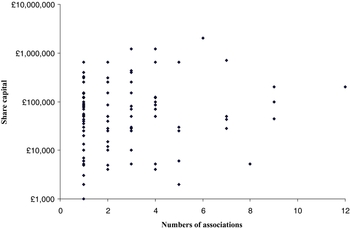
Yet, unlike the earlier noted linkages between individual wealth, income and multiple service (Table 2), company size (measured by share capital) proved a poor predictor (r2 = 0.031) of a director's propensity for multiple volunteering (Figure 2). This is not to suggest that directors of major city-based enterprises were disproportionately less likely to serve. The median company share valuation of those directors who volunteered was £51,925. Some 35 per cent of company directors above this line were volunteers; for those below, the ratio fell significantly to 20 per cent. Manufacturing companies of this size had a significant local presence: for example, J.B. Lewis, hosiery manufacturers (share value £50,000) employed some 600 workers in 1900. Its managing director, Herbert Lancashire, was actively involved in seven charities. Blackburn and Son, hosiery engineers (share value £50,000), employed several hundred workers in its one acre works. Lt Col William Blackburn, who ran the company, was heavily engaged in the running of Ellerslie House. As its executive recorded on his death: he was ‘always untiring in his efforts. Every Saturday morning he visited the Home, and he never came empty handed.’Footnote 44 His fellow directors, however, took little or no part in charitable or associational work. Clearly joint stock valuations offer only one insight. Sir Albert Atkey founded his own motor company in 1897 (share value £2,000), but ‘his civic life and political ambition developed alongside his business interests’. Thus he became progressively a city councillor, alderman, magistrate and later member of parliament for Nottingham, actively involved with the Chamber of Commerce, the General Hospital, Children's Hospital Cot Fund, the Mechanics’ Institute and Poor Boys’ and Girls’ Camp Society.Footnote 45
Director participation in voluntary associations by company value (1902) Sample size: 125. Note: If directors were involved in multiple local companies, the highest valued company is used. Sources: Allen's Nottingham Red Book (1902/3) and as Table 1.

Counting civil society
Not everyone has accepted the case for decline in the world of formal local politics. Morris, Newton and Sharpe argue for a middle-class continuity in council membership in Birmingham and Croydon from the 1930s to 1970s based on the persistent presence of those belonging to census classes I and II (broadly middle-class occupations).Footnote 46 The data for Nottingham reveals a similar, disproportionate and continuing middle-class dominance. Nottingham was not exceptional in being Conservative controlled (1908–45). Nationally, by 1939 Labour had captured only about a third of seats in county boroughs, although in Nottingham, as elsewhere, it was on the cusp of becoming the largest party (as it almost had in 1929).Footnote 47 In the inter-war period, classes I and II accounted for about one eighth of the total employed male population in the city. Yet, despite rising Labour representation, 80 per cent of councillors and aldermen in the 1930s and 1940s belonged to one of these two groupings. For the city's Conservative party, representation became more, not less, socially exclusive, so that after World War I all its councillors and aldermen belonged to classes I and II. For the Labour group, the figure consistently hovered at around 55 per cent. Only for the Liberals did it fall significantly.
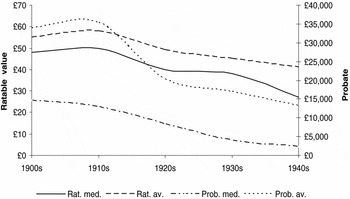
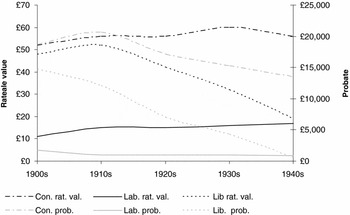
At the same time, such figures lack specific meaning because of the large social variance within each census class. If we consider particularly class II (employers and managers), for the Conservative party in the 1900s the probate range (at 1934 values) runs from baker John Houston (£1,991) to the lace machine manufacturer Frank Hobson (£181,639). The spread increased still further when Sir Harold Bowden, the managing director of Raleigh bicycles, became a councillor in 1912 (£311,790). Even within class I (the professions) the variance was high, from the large numbers who left very little, to wealthy upper-middle-class solicitors like Stanley Bright (£57,421) and Sir Bernard Wright (£63,094). Plotting members’ probate and property valuations (as proxies for wealth and income) offers one gradated understanding of fluctuations in social composition through time. From 1918, each indicator falls noticeably (Figure 3) as Labour numbers increased. By the 1940s, median probate and rateable value for all council members combined had dropped by 85 per cent and 45 per cent respectively. Yet median rateable value levels in both the Conservative and Labour parties actually rose, albeit from very different bases (Figure 4). We can thus place the median Conservative (RVmax £56) and Labour (RVmax £17) member in the top 1.5 per cent and 20 per cent of the city population by income respectively (Table 1).
Council membership by probate and rateable average and median value (1934 prices), 1900–50 Sample size: 681. Sources: Nottingham Guardian, 1900–50; Nottingham City and County Rate and Valuation Books; Nottinghamshire Trade Directories; National Probate Registers.

Council party membership by median probate and rateable value (1934 prices), 1900–50 Sample size: 681. Sources: As Figure 3.

Trend indicators using probate, while suggesting a fall in status through time, have to be treated with greater caution. Conservative party figures are probably distorted by the impact of tax avoidance (as the top rates of death duties rose rapidly after 1918, to 40–50 per cent in the inter-war years, and to 80 per cent after 1945). Most Labour members, by contrast, continued to possess no wealth at all for tax purposes (and they are consequently excluded from the calculations). The collapse in Liberal status is very apparent across all indicators. If we manually manipulate this personal income and wealth data with occupation and company records to produce a class profile for each party (Figure 5), we find key elements of both continuity and change. Perhaps most striking is the strong and continuing upper-middle-class presence amongst Conservatives: accounting for some 40.5 per cent (± 4.9 per cent) of the group membership across the decades (including or excluding aldermen). Continuity transcends the borders of World Wars I and II which are so frequently offered as negative boundary markers for subsequent disengagements.Footnote 48 Typical within the Tory ranks would be the lace manufacturer, Edwin Mellor, a councillor from 1898, and alderman from 1916 until he died in 1927, whereupon he left £11,978. Mellor lived in a comfortably sized detached Victorian villa (RV 64 pa). Or take surgeon Dr Wilfred Blandy, a councillor in the 1930s and 1940s. Blandy left a modest £13,075 in 1947, but similarly lived in a large Victorian villa (RV 72 pa). Some 30 per cent of councillors were also magistrates, and 25 per cent of those standing before 1930 were poor law guardians. Upper-middle-class membership here fell consistently, from 73 to 40 per cent for all magistrates, 1900–50, and from 13.5 to 4.5 per cent for poor law guardians, 1900–30 (Figure 6). Clearly, as Trainor found for the nineteenth century, an organizational status hierarchy operated descending from the magistracy, but we also see a disengagement by social elites from areas of ‘coercion’ like poor law relief and criminal justice.Footnote 49 Most commonly their replacements, however, were not drawn from the ‘shopocracy’ but from the middle-ranking middle class.
Council party membership by class, 1900–50 Sample size: 681. Sources: As Figure 3.

Membership by class for city magistrates and poor law guardians, 1900–50 Sample size: 358. Sources: As Figure 3.

Executive membership trends in voluntary associations were more static. Taking as a base the nine charities (Appendix 1) for which a complete run of data for 1900–50 is available, upper-middle-class membership always exceeded two-fifths, rising to around one half during the inter-war period. Where it fell slightly – as other priorities took hold during both wars – it was the middle middle classes that replaced them. Working- and lower-middle-class membership combined never exceeded 15 per cent after the 1900s. Nonetheless, contra trends were evident. Participation by the city's larger manufacturers fell – from over 35 per cent up until the 1930s, to below 25 per cent two decades later; by contrast, higher profession membership rose across this period by a corresponding 10 percentage points to reach 38 per cent by the 1940s. This changing occupational structure is reflected through the financial indicators available (Figure 7). The average probate return for executive members falls sharply after 1918, as it was affected by the disproportionately lower participation rates of the wealthy in the upper quartile range. At the upper decile mark the amount left on death fell by 60 per cent across the inter-war and post-war period. Yet participatory status measured through property consumption, in offering a more neutral measure, remained constant through time. The average professionals might be less wealthy than their manufacturing counterparts, but nevertheless spent liberally on the family and business ‘home’.Footnote 50
Probate and rateable value by decade for executive membership of indicative voluntary associations, 1900–50 (1934 constant prices) Sample size: 586. Sources: As Figure 3.

There are also other important variations between associations. Female representation almost doubled across the 50 years, from 11 to 21 per cent. The constitution of the Women's Hospital had always stipulated equal gender representation. By contrast, the General Hospital only lifted its moratorium against women being elected to the Monthly Board of Management in 1923, whilst the Children's Hospital executive excluded women, arguing that it already had a ‘very efficient’ but separate Ladies’ Committee for fundraising and house duties.Footnote 51 Certain charities, as a consequence of historical function and associational habitus, more readily recruited from the upper social elites. This was particularly true of hospital charities. Other types of middle-class associations – for example the Bromley House Subscription Library and the Nottingham District Cripples’ Guild – were by contrast always solidly middle class, having significantly fewer wealthy patrons. Yet, even within the hospital sector, a hierarchy existed, so that the Children's Hospital ranked above the city's Ear, Nose and Throat or Eye Hospitals, which were smaller, less significant establishments. The General Hospital, the city's most prestigious charity, paradoxically was also the most socially mixed, so that before 1914, some 5 per cent of its executive was working or lower middle class. These were primarily delegates of the Nottingham and District Health (Saturday) Fund, a mutual association established to collect weekly subscriptions to cover hospital costs. During the inter-war period, lower-class representation on the General's executive was almost to triple. Yet, still a majority on the board were upper middle class.
It is perhaps not surprising that at the turn of the century over half the executive of the Saturday Fund was lower middle class and a further 30 per cent working class, nominated through a system of work-based representation. Yet, by the 1930s, as the Fund grew, this combined figure had fallen to 60 per cent. Once the Fund became a fully operational contributory insurance scheme in 1938, upper-middle- and middle-middle-class representation increased markedly, recruited from business but also from the professions (particularly accountants and solicitors) as the numbers on the executive expanded. By the 1940s, lower-class representation had fallen to just over 50 per cent. Such change is captured by the doubling of the mean maximum rateable value of property occupied by executive members ( RVmax) across the decades (Figure 8). This is more striking in context than the rapid rise across the inter-war years in RVmax within the Children's Hospital Executive. Having only 6 or so members, as opposed, for example, to the 35 who served on the General Hospital executive, it could boast among its ranks some of the city's leading industrialists, wealthy professionals and county landowners operating as a small, cohesive group which successfully raised significant funds to finance the building and running of a major new extension during the 1920s: men like John Player (RV £180; probate £2,501,622: 1950); local landowner Thomas Edge (RV £170; probate £233,970: 1931); and colliery owner Major Phillip Barber (RV £230; probate £503,041: 1961).
Mean rateable vales by decade for executive membership of indicative voluntary associations, 1900–50 (1934 constant prices) Sample size: 586. Sources: As Figure 3.

Not all trends were ‘positive’. Before 1914, the Mechanics’ Institute executive was rich with a professional and manufacturing membership. But during the course of the twentieth century, as the Institutes were increasingly perceived as being peripheral – culturally and educationally – so the aggregate status of the executive also fell. Whilst a higher professional presence remained, involvement was more common among the lower professions like teachers, lesser manufacturers and dealers, occupying houses with rateable values in the range of £20–30 pa.Footnote 52 For those associations or committees formed after and as a consequence of World War I, the trends could also be mixed. The city's War Pensions Committee was socially diverse, as representative of Nottingham's broader community. Half of its membership was lower middle or working class, although several members also belonged to prominent city and county families: as representatives of the local authorities, disabled servicemen, widows and orphans, local employers, voluntary associations or the Ministry of Pensions. Moreover, its membership remained fairly static through time. The executive of Ellerslie House, by contrast, was anything but socially balanced. Its premises were a gift of the duke and duchess of Portland, the latter being heavily involved in its day-to-day running. Its committee drew on men and women from the district's leading families, from the gentry and industry, three-quarters of whom would be labelled upper or upper middle class, with a RVmax of £157 pa, and a male probate average of £57,000 (1934 prices). Such a social profile attached to a newly established charity belies any suggestion that traditional elites were no longer exercising their function of social leadership after 1918. Not was it simply a war-specific enthusiasm, for the profile remained intact as the home increasingly catered for industrial injuries.
Including those associations which lack a complete run of data but where sufficient plots exist to establish a clear trend through time (Appendix 1), linear regression analysis shows that for 5 of the 18 charities, the executive members’ status quotient (cross tabulated roughly by rateable value, occupational status and class) rose, for 8 it fell and for 5 little change occurred (sample size: 925 individuals). The magnitude of change varied significantly. Before 1914, 80 per cent of the executive of the Convalescent Homes Society was upper middle class and there was no working- or lower-middle-class presence, whereas by the 1920s a third fell into the latter categories, and upper-middle-class membership was similarly down by about one third. The change was due primarily to an increasing workplace presence, particularly from the mining unions, whose members were among the chief beneficiaries and contributors to the fund. Indicatively, RVmax fell from £100 to £58 across the 50-year period. The picture for the Adult Deaf and Dumb Society was completely the reverse: it was increasingly professionalized. The numbers on the executive expanded significantly across the half century, but whereas before 1914 some 35 per cent were lower middle class, by the 1940s that figure had fallen to 15 per cent. The largest inward movement came from the ranks of the medical profession or their wives, but also from accountants and solicitors or their spouses, who in total accounted for over half the membership. Notable also was the presence of the city and county's political and educational hierarchies, all offering particular specialist services and/or connections. Correspondingly, RVmax rose from £36 to £52 pa.
The highest ranked organization in terms of membership status was the Coppice Lunatic Hospital, which cared for upper- and middle-class patients of limited means (RVmax 1900–40: £140 pa). The lowest was the Children's Hospital Cot Fund (RVmax 1900–40: £15 pa). The Coppice was managed by a small committee of some 10 or so members, predominantly very wealthy, recruited from the ranks of the local gentry, the banking community and major industrialists. There was also a tradition of family service, where posts were handed down. Not surprisingly, there were few changes across time in terms of executive status. Bromley House Subscription Library might be offered as a typical middle-ranging institution, status static despite undergoing radical changes in its management structure, since in 1926 it became nominally a limited liability company with a triennially elected board of directors. In fact, by the 1940s, it became even more middle class, with fewer wealthy members elected onto the executive, but also showed a marked lack of lower-class participation as other publicly funded provision expanded. The city's Cot Fund, an umbrella organization for local Sick and Annual Societies, raised money though a network of work and public house collections for the Children's Hospital. As the Hospital executive readily acknowledged, the Fund had been its ‘chief support . . . for many years’. Yet it remained largely self-managed by a working- and lower-middle-class executive: indeed, after 1918 it became increasingly working class in its composition at a time when working-class contributions to hospitals increased in importance.Footnote 53
Yet for 40 per cent of associations the regression lines for the individual status indicators of class, RVmax and occupation had conflicting negative and positive slopes. Such discrepancies can be resolved by constructing one amalgam indicator for class, rateable value, occupation and probate using principle components analysis, from which each individual in the data set can subsequently be scored (Appendix 2). Plotting the median values (Figure 9) for the core sample based on the aggregated scores of the individuals for Pc1 and Pc2 reveals the disparity through time between the status of executive members where probate is included and excluded, captured in the negative slope of Pc1Vol and Pc2Vol as the mean value of probate – for the reasons already noted – fell (Figure 7). Where probate is excluded, as for Pc2Vol-P, collective status neither rises nor falls. The regression line for the major indicator Pc1Vol-P (which accounts for 81.5 per cent of the variation within the data set) is similarly flat across time. The greatest fall occurs in the years surrounding World War I, only for scores to rise noticeably during the inter-war period. At the upper decile mark, this downturn was less manifest, and the subsequent upturn more vigorous, as greater numbers of higher-status individuals volunteered during the inter-war period (Figure 10). Even at the low point of the 1910s, median entries were located around the higher professions (law, medicine). Thus, the exemplar median executive member in 1900 would be, say, Dr Robert Hogarth (Pc1Vol-P score = + 0.38).Footnote 54 Public school educated, he became president of the British Medical Association, and built up one of the largest medical practices in the Midlands. He occupied a large villa in Nottingham's Park area (RV £101) and left £97,069 when he died in 1953. Hogarth, by dint of what he would achieve, would be deemed upper middle class (that is at the top end of his profession) and later in life, his Z1Vol-P score would rise to +0.76 (and included as such in the aggregated calculations for the 1930s). But in the 1900s, he was still a general practitioner, just about to launch his surgical career, and living in smaller, albeit not insubstantial, premises (RV £65 pa).
Median principle components scores by decade for executive membership of indicative voluntary associations, 1900–50 (including and excluding probate) Sample size: 586. Sources: As Figure 3.

Median and upper decile principle components scores (Pc1Vol-P) by decade for indicative voluntary associations, 1900–50 Sample size: 586. Sources: As Figure 3.

Plotting Pc1Vol-P (Figure 10) for the individual core associations reveals, not unsurprisingly, different status trends through time. The aggregate slope for all associations is broadly neutral (-0.03). Median scores, however, for the Cripples’ Guild rose noticeably – offering a slope + 0.22 – as during the 1920s and 1930s, the charity recruited the brewer Sir Thomas Shipstone, the director of Boots the Chemists, Henry Gillespie and a director of J.B. Lewis, Henry Rose. By contrast, the median entry score for the city's Eye Hospital fell sharply (slope – 0.30). Its typical member in 1900 would be accountant Job Derbyshire, a multiple-company director who left £293,312 in 1954, and was comfortably upper middle class. By the 1940s, his counterpart was bank manager Ernest Wilson, who left £3,505 in 1946 and who lived in a Victorian semi-detached villa (RV £48). Such median ‘decline’ was primarily the product of increased Saturday Fund representation and the proportional impact this had on a relatively small board membership, for although most Saturday Fund representatives here were middle rather than working class, they were still less wealthy and had lower incomes than the previous typical middle-class member of the board. Of the nine associations, the Pc1Vol-P regression line for only three was positive (the Children's Hospital, Cripples’ Guild and Saturday Fund) and six negative, reflecting the trend to democratization particularly within the health charities as those working-class contributors who increasingly raised the revenue finances took places on the executive. Yet at the upper decile mark this pattern was reversed so that only in three cases (The Dispensary, Bromley House and the Mechanics’ Institute) was the trend line negative. Clearly, the wealthy continued to involve themselves heavily in the management of the city's voluntary institutions, so that despite the economic uncertainties of the period, in 60 per cent of cases at the upper decile mark scores were higher in the 1920s, 1930s or 1940s than in the 1900s or 1910s.
We can assess the status of city councillors along similar lines. The stability of the Conservative group through time (Figure 11) is readily apparent at the median, upper quartile and upper decile points. Typically, by decade, the middle-ranking Conservative councillor was respectively a civil engineer, a senior solicitor, a successful auto-engineer, a stockbroker and a retail chemist with multiple outlets. On average, they left some £23,000 on death (1934 value), and lived in properties valued at around £60 pa RV (that is a medium-sized detached Victorian villa or similar). They were all thus comfortably middle class. If the status scores of new Conservative councillors entering the chamber in the 1920s fell by some 20 per cent as Labour's star began to rise, by the 1930s, they were once again increasing significantly. Median scores for Conservative members were consistently and significantly higher than the aggregate across the voluntary associations studied, and at the upper decile mark ranked comparatively with those socially exclusive voluntary associations in Nottingham. Ranged within its membership in the 1920s and 1930s were such leading industrialists as the brewer John Farr, who left £385,942 in 1951 and lived in properties valued around £200 pa RV, the land agent and property developer, Sir Albert Ball (RV £22; £119,894: 1945), and Sir Cecil Armitage (RV £142; probate £109,470: 1962), the managing director of an extensive catering business, who led the Conservative group prior to the outbreak of World War II. Clearly this was no urban ‘shopocracy’, nor, like its voluntary counterpart, was it representative of a volunteer civil society in crisis or retreat – at least when measured by the status of people who volunteered.
Median, upper quartile and upper decile principle components scores (Pc1Pol) for Nottingham City Council, 1900–50 (excluding probate) Sample size: 681. Source: As Figure 3.

The myth of decline
Society is frequently drawn to speculate more on change than on continuity, more so when a past ‘golden age’ can be conjured up against supposed subsequent ills. Thus, in rejecting their nineteenth-century heritage, and instead avowing a gentrified ‘easy life’, or its suburbanized equivalent, across the country supposedly urban elites and the surrounding gentry merged in degrees of semi-detachment, spatially and emotionally separated from the city, and increasingly enmeshed in a homogenized national culture that deprecated the local ‘civic’.Footnote 55 Yet, the data from Nottingham suggests such constructs of disengagement to be seriously misplaced. The orthodox position places the chronological disconnect at around 1914; but, instead, we see a social reconnection, so that during the inter-war years, the status of executive members across a broad range of voluntary associations once again rose into the 1940s. The dip around the Great War is less apparent still amongst the highest-status groups, and subsequent ‘recovery’ stronger. Where upper-middle-class absence was more noticeable – for example among poor law guardians or magistrates – there was no particular ingress of working- or lower-middle-class replacements, but instead a swelling of the ranks of the solid middle-class volunteer.
In the political world, Nottingham continued to be governed not just by the middle classes, but by a council with a very noticeable upper-middle-class core (amounting to some 40 per cent across time). Remembering that across the inter-war years the Conservatives or their proxies held a clear majority of seats in English county boroughs, the results from Nottingham should not be read as unusual. Here, using a range of indicators, the aggregated status quotient for Conservative members remained remarkably constant. Such consistency was observable, too, across multiple layers of the city's civil society, and not differentiated noticeably by size or date of formation of association. Nor was there evidence of spatial disengagement. Of those who chaired the General Hospital executive, none resided in the city's heartland. Two lived in Victorian suburbia and the remainder on the city's edge or in its rural hinterland. Indeed, overall there was a not unexpected highly positive correlation between higher status and multiple involvement (Table 2), and consequentially also with spatial diaspora. Nottingham, with its greater economic diversity, was in some senses untypical (but then all cities are). That those among its commercial and industrial leadership from sectors which both ‘failed to recover and others which developed apace’ continued to fulfil their traditionally assigned roles is significant as a market against those who make ‘national’ but speculative claims for disengagement. Indeed, it needs to be remembered that involvement was never the norm amongst the city's upper-middle-class elite, nor should this be read as being the case elsewhere. Only a quarter of manufacturers were volunteering at the turn of the century, which represented no significant change to nineteenth-century patterns.Footnote 56
Yet, if the overall status of volunteers remained roughly constant, by ‘occupational hierarchy’ it fell off, as manufacturing membership slipped to be replaced by greater numbers of higher professionals – part of a broadening of civic society nationally and one already apparent in the late nineteenth century. This was representative of an increasing professional influence in British society, which ran contrary to trends in manufacturing, where all industries faced stiffer competition and economic uncertainty.Footnote 57 Nor was this the product of rapidly rising numbers; the percentage of higher professionals as a proportion of the employed population grew from just 1 to 2 per cent throughout the period.Footnote 58 Yet, importantly, and setting to one side changing differential participation rates by occupation through time, measured by property consumption, the social standing of executive members in Nottingham remained largely constant across the 50 years. Where falling median scores were recorded, as with the Convalescent Homes’ membership, the city's Dispensary and the General, Children's, Eye and Women's Hospitals, this was a direct product of greater workplace representation on executive boards, which included men like Robert Osbourne, a foreman at John Player, who represented the Hospital Saturday Fund on the General Hospital's Monthly Board, or the teacher William Cotterill, present because local schools annually raised considerable monies for the Children's Hospital. Clearly, a greater communal balance existed on medical executive boards by the World War II, but, excepting the Eye Hospital, there remained also a strong and socially disproportionate upper-middle-class presence on each.
The evidence for disengagement offered by this first large-scale quantitative study of provincial elites clearly runs contrary to orthodox interpretations. Only in formal politics, measured across the parties, do we register a fall in status scores, and indeed even here measured within each party, ‘declinism’ is only registered amongst the Liberal group (which in itself was a product of a broader malaise). Instead, what we see generally is a remarkable consistency through time. This is stronger still if we reject constructs that see major industrialists as necessary lynchpins, although many in commerce did continue to see such activity as being important. We need anyway to move from occupation specific data towards a more balanced consumption-based model of measurement better suited to the twentieth century if we want to understand the patterns of provincial elite involvement after 1900.
Appendix 1
Core sample: Bromley House Subscription Library, Children's Hospital, Cripples’ Guild, The Dispensary, Eye Hospital, General Hospital, Mechanics’ Institute, Hospital Saturday Fund, Women's Hospital.
Extended core sample: as above, plus Coppice Lunatic Hospital, The City Mission, Deaf and Dumb Society, Hospital for Diseases of the Throat, Ear and Nose, Girls’ Evening Homes and Clubs, Southwell House Rescue Home, Nottingham and Notts Convalescent Homes and the Children's Hospital Cot Fund.
Full sample: as above, plus Samaritan Hospital for Women, Midland Orphanage and Industrial Training Institute for Girls, Nottingham Day Nursery and Orphanage, Association for the Prevention of Consumption, The Social Guild, Nottingham Society of Artists, Poor Girls’ and Poor Boys’ Camp Society, Girls’ Evening Homes and Clubs, Charity Organization Society, Discharged Prisoners’ Aid Society, Sunday School Union, Nottingham and Notts Nursing Association, Chamber of Commerce, British Red Cross Society (Notts branch), Girl Guides, Society for the Prevention of Cruelty to Children.
Appendix 2
Applying principle components analysis to the core sample of nine associations for the period 1900–50 produces the following weighted combination:
 \begin{eqnarray*}
{\rm Pc}_{\,\,{\rm Vol}}^1 = 0.523{\rm X}_{{\rm RV}} + 0.325{\rm X}_{{\rm Prob}} + 0.558{\rm X}_{{\rm Occ}} + 0.557{\rm X}_{{\rm Cl}}
\end{eqnarray*}
 \begin{eqnarray*}
{\rm Pc}_{\,\,{\rm Vol}}^2 = 0.199{\rm X}_{{\rm RV}} + 0.852{\rm X}_{{\rm Prob}} - 0.329{\rm X}_{{\rm Occ}} - 0.355{\rm X}_{{\rm Cl}}\end{eqnarray*}
 \begin{eqnarray*}
{\rm Pc}_{\,\,{\rm Vol}}^3 = 0.828{\rm X}_{{\rm RV}} - 0.409{\rm X}_{{\rm Prob}} - 0.306{\rm X}_{{\rm Occ}} - 0.232{\rm X}_{{\rm Cl}}\end{eqnarray*}
 \begin{eqnarray*}
{\rm Pc}_{\,\,{\rm Vol} \hbox{-} {\rm P}}^1 = 0.543{\rm X}_{{\rm RV}} + 0.589{\rm X}_{{\rm Occ}} + 0.599{\rm X}_{{\rm Cl}}\end{eqnarray*}
 \begin{eqnarray*}
{\rm Pc}_{{\rm Vol} \hbox{-} {\rm P}}^2 = 0.835{\rm X}_{{\rm RV}} - 0.457{\rm X}_{{\rm Occ}} - 0.307{\rm X}_{{\rm Cl}}\end{eqnarray*}