INTRODUCTION
Hemopoietic stem cell transplant (HSCT) is a complex procedure involving a prolonged period of isolation, which may last from 4 weeks to several months. The physical consequences of treatment can include fatigue, fever, nausea, vomiting, diarrhea, and painful mouth sores. The isolation combined with pain often induces distress, anxiety, and depression, which should be recognized, monitored, and treated (Illescas-Rico et al., Reference Illescas-Rico, Amaya-Ayala and Jimènez-López2002; Holland & Alici, Reference Holland and Alici2010; Isaak, Reference Isaak2010).
Art therapy has been perceived as helpful by cancer patients generally, at different times in the course of the illness: during hospitalization (Luzzatto et al., Reference Luzzatto, Sereno and Capps2003), during radiotherapy, and during chemotherapy treatment (Hiltebrand, Reference Hiltebrand and Malchiodi1999; Malchiodi, Reference Malchiodi2003; Oster et al., Reference Oster, Svensk and Magnusson2006; Forzoni et al., Reference Forzoni, Perez and Martignetti2010); and after treatment (Luzzatto & Gabriel, Reference Luzzatto and Gabriel2000).
The only published study so far on the use of art therapy with patients in isolation for bone marrow transplant was conducted at Memorial Sloan-Kettering Cancer Center (MSKCC), New York. The analysis of the imagery made by the patients during isolation suggested that art therapy may fulfill a variety of needs for this population: from providing pleasure and relaxation, to facilitating self-reflection, to allowing the expression of spiritual issues (Gabriel et al., Reference Gabriel, Bromberg and Vandenbovenkamp2001).
A program of supportive care offering individual art therapy for patients undergoing an allogeneic HSCT, was started in 2006 at S. Martino Hospital, Genova, Italy.
AIMS AND OBJECTIVES
The general aim of this project, conducted at San Martino Hospital in Genova, Italy, was to understand the potential role of art therapy within the Interdisciplinary Team for the Quality of Life in Hospital. The study had two specific objectives: (1) to identify the specific factors of the art therapy experience perceived as helpful by these patients in isolation; and (2) to establish appropriate criteria for referral to art therapy among this population. In this article we will also describe some art therapy techniques that seemed to be effective in responding to these patients' needs.
METHOD
Between 2006 and 2010, a dedicated art therapist (AA) visited the Transplant Unit twice a week, for 4 hours each time. Eighty adult patients (~20 per year) were referred to art therapy by the hematologist (TL). The art therapist wrote regular reports for the Interdisciplinary Team and had regular meetings with the art therapy supervisor (PL). The art therapist brought with her into the room a kit of art materials, containing: white paper (size A4), a black pencil, a watercolor set, a set of colored felt pens (which included gold and silver colors), stickers, photographs illustrating a variety of emotions (from the Getty Collection, Zannier, Reference Zannier1999), and black and white drawings to be colored (mandala and body outline). All art materials had been sterilized.
The art therapy sessions were conducted with some basic principles of art therapy practice in mind: (1) image making, empathic silence, and verbal interaction may be used at the beginning of each session to make contact with the patient's state of mind and to establish a therapeutic alliance; (2) in cases in which a patient has anxious or depressive feelings, the art therapist may suggest and facilitate the externalization of these feelings into a symbolic visual image, within a safe relationship devoid of intrusions and interpretations; and (3) the art therapist will help the patients to get in touch with their positive memories and resources, using a variety of art therapy interventions (Rubin, Reference Rubin1984).
The evaluation of the program was based on a self-assessment questionnaire that the patient would fill before being discharged. The questionnaire was anonymous, and it was given to the patient by a nurse. The questionnaire was divided into two sections: (1) in the first section, patients were simply asked whether the art therapy experience had been “helpful”, or “not helpful”; and (2) the second section encouraged spontaneous comments from the patients about the art therapy experience, and what had been helpful (or unhelpful). The patients' answers were analyzed using a qualitative method, based on word repetition and the identification of key concepts and themes (Taylor & Bogdan, Reference Taylor and Bogdan1984).
RESULTS
Out of 80 patients who had been referred by the hematologist, 74 patients (40 males and 34 females, between 17 and 62 years old) were seen weekly throughout the period of isolation. Six patients became physically too ill to participate in the art therapy. Most patients were seen 6 times (for the other patients, there was a minimum of 4, and a maximum of 24 sessions). The art therapist planned to visit each patient once a week for about 1 hour, but in practice, some sessions lasted 15 minutes and others up to 90 minutes.
All 74 patients filled out the questionnaire before leaving the Unit, and left it with the nurse in charge. In response to the first question (“Has the art therapy experience been helpful to you?”) all 74 patients who had art therapy sessions indicated that art therapy had been “helpful.”
The second question was “In which way was the art therapy experience helpful/or unhelpful?” Through the thematic analysis of the patients' replies, five recurring concepts emerged: (1) “feeling more peaceful,” (2) “being helped to relax,” (3) “feeling free to express myself”; (4) “being able to share my state of mind, and feeling understood”; and (5) “being helped to connect with my family.” These were grouped into three types of “helping factors”:
1. The relaxation and tranquility factor: Being able to calm down, from a state of anxiety and distress, through the use of art therapy techniques (n = 57, 77.02%);
2. The self-expression and sharing factor: Feeling free to express and share difficult feelings, which they had not communicated verbally (n = 56, 75.67%);
3. The family connection factor: Being able to establish meaningful connections with their loved ones - mainly their children at home – through artwork and images made during the art therapy sessions (n = 27, 36.48%).
There was a large overlap among these sets: about 50% of the patients mentioned both 1 and 2 (they had been helped to feel calm and relaxed, and also were helped to express and share hidden thoughts and feelings). Most of the patients who mentioned 3 mentioned also 1 or 2. The same patient may have had different needs at different times during isolation. Sometimes a patient wanted only to calm down; another patient might have calmed down only after having revealed some inner concerns. Other patients focused their comments on the value of the symbolic communication, without mentioning any relaxation needs. This will become clear through the case illustrations.
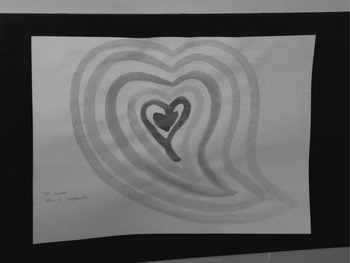
The Relaxation and Tranquility Factor (Fig. 1)
Case Illustration A1 (Fig 1: My heart is expanding)
B.C. was a 34-year-old woman with a diagnosis of acute myeloid leukemia. Reason for referral: B was introduced to the art therapist before the transplant. Because she had had several traumatic events in her life, she was emotionally fragile even before the illness, and she was quite anxious in view of the transplant. B had seven sessions. This is from the fifth session.
The nurse tells me B had a nightmare during the previous night, and that B feels very panicky. I ask B whether she can tell me something about her nightmare. B talks about it and cries a lot, then says she is afraid of dying (her father died of the same illness). While listening to her, I remember the drawing she made on the first session, and I take it out from the folder: it is a body outline, which she had filled in with colors, and entitled “my soul.” I ask her whether she can find in her previous drawing an element that might help her now. B looks at the colorful heart she had drawn before, and feels moved and surprised. I invite B to slowly draw the heart-shape on a new sheet of paper. I guide her verbally, helping her to harmonize her movement with the brush and her breathing, and I suggest she can focus on the image of the heart as a centering symbol. B entitles the drawing “My heart is expanding.” At the end of the session she says she feels “different, less scared, and more balanced.”
In this session, the negative state of panic and fear caused by a nightmare was recognized by B as fear of dying: because of the emotional fragility of this patient, it seemed appropriate to get in touch with a positive part of her, which she had illustrated in a previous art therapy session: the image of a colorful heart, inside her body outline. The image of the heart was then enlarged on another paper, and the brush movement and the breathing were added as a centering exercise, strengthening in this way the symbolic value of the heart image, and leaving her feeling “less scared and more balanced.”
The relaxation and tranquility factor. “The expanding heart.” This patient, a 34-year-old woman, diagnosed with acute myeloid leukemia, after 40 days of isolation was very anxious. The art therapist took out the painting she had done at the first session (top). The patient was surprised to see the colorful heart, and followed the art therapist's suggestion to paint it again on another sheet of paper (bottom). Using the art therapy technique of harmonizing the brush movement with the breathing, and focusing on the image as a centering symbol, at the end of the session she said “I feel different … less scared and more balanced.”

Case Illustration A2
C.C. was a 20-year-old man with a diagnosis of acute lymphoblastic leukemia. Referral: C had never accepted his illness and felt very angry. C had six sessions. This is the from the third session.
I meet C's mother in the corridor, and she tells me C was so anxious today that he wanted to get out from his room and leave the hospital, and she had to call the nurse. When I go in, C is rolling himself on the bed and repeats to me that “he can't cope any more and wants to get out.” I succeed in establishing eye contact with C, and I suggest C could engage in a “mandala-coloring.” C does select a mandala shape. I keep talking to him: I invite him to focus on his breathing, then to take a coloring pen, and to transfer the tension that is shaking his body into the mandala shape in front of him. His breathing is more regular, and when the coloring is completed, he talks about his need to go back to normal life: “I have been locked up in this room …” I invite him to write this sentence on paper, so that it is not only in his mind, but “out there.” While we look at the mandala, C recovers a memory: “visiting my grandparents, who welcome me and hug me.” C makes this second image, and adds a title “Home … sweet home.” I suggest he should hold on to this drawing as a form of support during his period of isolation, C says he feels better, he feels “light”, he does not need to leave … he now wishes to rest on his bed.
C was in a state of great physical and mental distress. Establishing eye contact with the art therapist, the mandala-coloring, and the attention to the breathing helped to integrate body and mind. In this way C calmed down and started to verbalize his wish to leave the hospital and go home. He was able to move to a positive memory of visiting his grandparents. Making the image of this memory helped him to recognize his need for an affective relationship and to use it as a positive inner resource. He completed the treatment until the appropriate time of discharge.
Case Illustration A3
R C. was a 47-year-old woman with a diagnosis of acute myeloid leukemia. Referral: R came from far away and had no visitors. She seemed to be very diffident and uncommunicative. R had 15 sessions. This is from the second session.
During this session R says she feels “very anxious and very sad,” and “she does not know why.” I invite her to find a color that may represent her mood. Very slowly R paints a black shape, then says: “It is like a black spot that grows inside me.” Together we look at the drawing, and I suggest she might find a different shape, that may function as a containment of these dark feelings. R takes the red color and makes at first a series of little red dots around the black spot, then she paints a thick red circle all around it. She says “I know … this is my sadness …” She breathes deeply: “… it is because I feel my children don't understand …” R sits up straight on her bed now, she looks more focused on the present, and she writes the title “Let the sadness go.” I ask R whether she wants to choose another color, to experience a more pleasant feeling. R selects blue and pink watercolors, and paints long wavy lines with the brush, on another sheet of paper. She smiles, and says: “It feels like if I am caressing myself now.” She looks surprised, and she adds: “It was good to recognize why I was sad … and just by using colors!”
R was feeling anxious and sad and confused. She was helped to concentrate, and the art therapy technique of giving a form to her inner mood was effective. R was able to visualize her negativity into a “black spot,” and later to contain it symbolically within a red circle. The visualization of her feelings helped her to make sense of them: she realized her frustration was caused by not receiving enough attention from her children. The increased self-awareness made her free to give to herself the comfort she was not getting from outside.
The Self-Expression and Sharing Factor (Fig. 2)
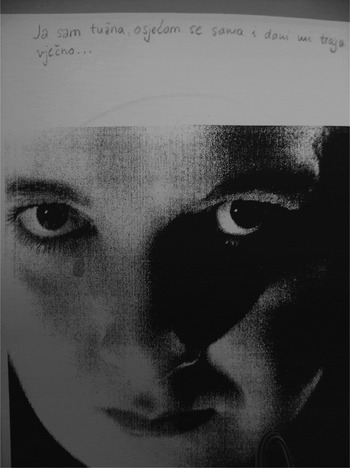
Case illustration B1 (Fig. 2: “The Blue Tear”)
L.N. was a 23-year-old woman with a diagnosis of acute lymphatic leukemia. Referral: L came from another country and did not speak Italian well. She seemed frightened and closed into herself. According to the nursing staff, she hid some internal pain under a smiling face. L had nine sessions. This is from the sixth session.
It has taken a number of weeks before L starts to trust me. During this session L is obviously still blocked, she does not know what to do. Through her non-verbal bodily communication I understand she feels burdened by something heavy, and at the same time she communicates — again non-verbally — that she does not want to talk about it.
The expression and sharing factor. “The Blue Tear.” This patient, a 23-year-old woman, diagnosed with acute lymphatic leukemia, after 42 days of isolation appeared to be distressed and uncommunicative. Through the art therapy technique of the “external evocative image,” she selected this picture, painted a blue tear on the woman's face, and burst into tears. Finally she shared her “secret”: she was distressed because “she finds herself unable to pray, which was her main resource.” In the following sessions she will work on alternative ways of praying, such as making a shrine, and listening to holy songs, and will cope well with the treatment.

This time I decide to use my set of black and white postcards, where there are many human faces showing different expressions. I ask her to select a face that may show an emotion similar to what she is feeling. L engages easily into this activity, and starts to look at the cards, one by one, in complete silence, for a long time … Finally she chooses the picture of a woman's face: she takes a blue pastel, and draws a tear coming down her face. Then she writes a sentence on the postcard, in her own language, that I do not understand. She says “I feel very lonely …” She bursts into tears, and she cries for a long time, very freely, as if this is really what she wanted to do for a long time. I suggest maybe there is something else she wants to say … L looks at me, but without speaking. At this point she selects a second photo: it is an image of a young woman with the two hands crossed in front of her face. L decides to share with me something that for her is very private, and it sounds like a confession: she is troubled by the fact that she finds herself incapable of praying, she is tired and in pain, and she cannot concentrate on her prayers: for her this is very serious, because her faith has always been her main resource.
L feels obviously relieved for having shared with me her feelings and her preoccupations. She has stopped crying, she looks again at the picture of the young woman, she asks for the pastels and colors the woman's hands in pink and she puts some red on her lips. Then she asks me to keep these two pictures in a protected place, as she does not want anybody else to see them, or to damage them.
The use of external images where patients may project their own feelings, within the protected framework of a symbolic image, is a very powerful tool in art therapy, and it may facilitate or reactivate a therapeutic process. It was particularly appropriate in the case of this patient, because of her being a foreigner, because of her feeling stuck, and because of her feeling guilty about being stuck. The therapeutic process continued to flow freely in the following sessions. She dealt with her spiritual need by creating a new ritual: she made a small shrine with paper and religious imagery, and she started to listen to holy songs that she found on her cellular phone, as a kind of prayer.
Case illustration B2
S.T. was a 19-year-old woman with a diagnosis of severe aplastic anemia. Referral: S was referred because she was very afraid and panicky about the possibility of physical pain. S had four sessions. This is from the second session.
Today S is in bed, curled up in, in a fetal position, and she says that she has awful pain in the stomach area, with nausea: this makes it difficult for her to talk, and it does not allow her to eat, therefore she also feels very weak and frightened that the pain will prolong her time in isolation. She says nobody can really understand how she feels, and therefore she feels even more lonely and isolated.
I suggest the patient should not try to talk, but she could find some metaphors, to describe the pain that she cannot describe in words. S says that the best metaphor is for her the “lightning.” As she feels too weak to paint this image, I offer to do it for her, following her instructions. She tells me to paint red lightning for the worst pain; then she wants to continue and she tells me to paint orange wavy lines for medium pain; at this point she tells me to paint also yellow short lines for light pain.
S is now more relaxed and she wants to continue our session. I ask her whether she can imagine anything that may sooth the worst pain that she has represented with the red lightning: she says it should be “water,” so she can imagine the lightning going into the sea. I paint the image for her, and while we look at it together she says she can experience the relief of the fire being extinguished into the water.
Physical pain can be easily transformed into emotional pain, when the difficulty in communicating the experience makes the patient feel even more isolated. In this case, the art therapist used two types of symbolic work: first helping the patient to express the pain using colors and shapes; then helping the patient to find another symbolic image that could be soothing. At the end of the session, S felt relieved because she had given a form to something so formless and invasive as the pain experience, and she had also been able to imagine a natural element that could gently absorb the lightning. This mental process was used as a positive resource for the patient also later on during isolation.
Case Illustration B3
N.A. was a 22-year-old woman with a diagnosis of myelodysplastic syndrome. Referral: N showed signs of depression because of the interruption of all her life projects, caused by the illness. She did not want to interact with the staff, or even with her relatives (two brothers). N had 16 sessions. This is from the eighth session.
At the beginning of the session N seems to be very silent and passive. She does not want to talk, but, as in the previous sessions, slowly she becomes interested in the art materials I have with me. I tell her that I brought to her a new type of felt-pens, and I encourage her to try them.
N draws very slowly three little faces, with eyes and lips. I ask her whether anyone of those little faces is talking to her. According to N, the black little face is saying: “I want to scream, and I don't know how to do it! …” I add that we may create a safe space where the black face can scream freely, I take another piece of paper, and I draw a large green square, with a blank space inside. At this point N takes the pen with much more energy, and draws inside the green square a number of jagged lines and squiggles. Finally she looks at me, and adds the word UFFA! (It's enough!). At the end of the session N is surprised she has been able to express and share her state of mind, which she now describes as a mixture of depression, anger, boredom, frustration and despair…She says she would like continue next time the same type of work we started to-day.
The art material may facilitate a safe communication when a patient does not want to talk. In this case, the new art material caught the patient's attention, and N created a simple drawing (three little faces). The art therapy process moved into two steps: first the patient projected her feeling into one of the little faces, saying that it “wanted to scream”; then the patient followed the art therapist's suggestion to externalize the very “act of screaming” into a contained space, on another piece of paper. This process was appropriate to what the patient needed to do, and in fact, N continued to communicate using a metaphoric language with the art therapist until she was discharged.
The Family Connection Factor
Case Illustration C1
M.M. was a 34-year-old woman, married with three young children (between 2 and 5 years old), with a diagnosis of acute myeloid leukemia. Referral: M was referred because her children were not allowed to see her, and she was depressed and anxious about them. M had 30 sessions. This is from the third session.
M tells me she is very frustrated because she can only use the telephone, and her children are too young to use it. I suggest she may try to communicate with drawings. As M seems to respond to this idea, I ask M which maternal role she most misses. M says she misses playing with them, and reading stories when they go to sleep. We plan a “communicative bridge” between her and the children: each week we will create a game or story that her husband will take home. The children will know that it is something mum has started, and they have to complete it, or to play with it. Then the children will be able to talk over the phone with her about the game they have received. During this session M decides to create three little cars, one for each child, and she makes the drawing of a highway: she says the children will have fun in racing with them on the highway. The modalityremained the same during the whole period of isolation. Week after week, M created a number of games: a drawing to be filled in; a story to be completed; little objects to play with, etc. The children started to send their own drawings back to mum, and M stuck them on the wall all around her room. Her depressive and anxious moods decreased. She kept saying: “I am happy because I feel I am doing something for them … I can imagine them playing … and it is a bit like being there with them!”
The concrete aspect of art therapy allows the image to become a communicative tool in a very special way. The images made in the art therapy setting were both a link, a gift, and a positive message for the whole family.
Case Illustration C2
F.R. was a 37-year-old woman with a diagnosis of acute myeloid leukemia. Referral: F had been ill for a long time, and had become quite distressed having left her 3-year-old child at home again. F had four sessions. This is from the third session.
F wants to show me the drawings she has made during the week: she tells me she draws in the morning, in order to overcome the fears she experiences during her nightmares. She dreams of abandoned children, and of dead landscapes … She says she needs to share with me her fears (of dying and leaving her child alone). I see that she also needs to re-establish contact with her child, therefore I ask her to remember what kind of modality she used when her child was scared for some reasons, and she wanted to reassure him … F concentrated, then her face lit up, when she remembered a song she used to sing in order to comfort him and make him feel safe. The song is about of a number of animals (“two crocodiles, one monkey, two snakes, a cat, a mouse, an elephant… and no one is missing…”). I help F to illustrate the song, using animal-stickers on the paper, and enriching the picture with a colorful background. F says she feels very close to her son now, and writes a sentence for him on the center of the picture: “From mum, with much love…”
This time the patient needed to connect with “the child in her mind,” even more than with the external child. The creative connection established through art therapy helped her to feel at peace with her situation, less guilty, and less anxious. In the following session she said she had had no nightmares during the previous week.
DISCUSSION
In a transplant unit, the medical staff often find it difficult to deal with the patients' distress, especially when patients have a long medical history and a previous transplant, or when they are vulnerable to anxious and depressed states of mind; or when patients lack family support. As these patients suffer from a multifactorial type of distress, in which physical pain and psychological worries are powerfully combined, it seems appropriate to use a multimodal therapeutic approach (Robbins, Reference Robbins1994). The Transplant Unit at San Martino Hospital in Genova made a step in the direction of interdisciplinary care, including art therapy in their program. HSCT patients found art therapy helpful as part of the supportive care during their admission.
The replies written by the patients on the self-assessment questionnaires emphasize recurrently a kind of “mood transformation”: patients mention being surprised that it was possible, during an art therapy session, to move from an anxious and panicky state to a state of relaxation and tranquility; and that they were able to reveal and share thoughts and feelings they were keeping secret. The art therapist always functioned as a “double container,” directing some of their thoughts and feelings toward the space of the artwork as a “secondary containment”. The triangular setting of art therapy (patient–image–art therapist at the three corners) makes this possible.
Which art therapy techniques have been most effective? Some simple techniques seemed to be particularly appropriate to help patients reach a peaceful and relaxed state: (1) the suggestion to paint freely inside a structured space (such as a mandala-shape) often succeeded to channel the anxious state and to contain it; (2) sometimes it was effective to engage the patient on multiple body–mind levels: for example, connecting the rhythmic use of watercolor brush with deep breathing, plus facilitating the visual focusing on pleasing colors; and (3) some patients engaged into a “virtual painting,” imagining that they were painting a beautiful landscape that the art therapist made on their behalf on a card, later leaving the card in the room for them.
Other patients were too silent and uncommunicative, and they looked depressed. Silence had become like a defensive armor, protecting a secret that the patient did not want to reveal. Also here the art therapist functioned on a number of levels: (1) for some patients it was important to reach a safe symbolic expression, that would not be too revealing, maybe using abstract colors and shapes; (2) working with a set of evocative images has been a particularly effective tool to increase patients' awareness of their own emotions; and (3) for other patients, making images of positive memories was particularly helpful: these images often allowed a connection with a positive part of the patient's self, and functioned as repairing tools.
The emotional impact of isolation may be especially difficult for those patients who have young children at home, and do not know for how long they will be separated. In these cases, it was important first to identify together with the patient some way of relating with the child, which was special to that parent (a game, or telling stories, or other ways of being together). As a second step, the art therapist helped the patient to keep alive the parent–child relationship, creating images, artwork, and stories that could reach the child. This process of relating with relatives at home was activated also in the case of partners, elderly parents, and grandchildren, and especially during anniversaries and special holidays such as Christmas.
One may think that patients in isolation are too weak to use art materials, or that they do not want to deal with emotional issues: this study shows that the art therapy modality allows patients to relax, or to deal with their emotions, according to their needs.
CONCLUSIONS
In conclusion, these results strongly suggest that when patients find themselves physically and psychologically isolated and in pain, an interdisciplinary approach that would include expressive-creative therapies, such as art therapy, might be appropriate and effective.
ACKNOWLEDGMENTS
We are grateful to the Antonio Lanza Association for funding this project. We thank the physiotherapists Manuela Albarello and Simona Marsili for their cooperation and integrative approach. We gratefully acknowledge the constant support of the nursing staff, and especially of the professional nurse Roberto Sobrino for his generous involvement. We express our thanks to all the patients who participated to the art therapy sessions during the time of isolation and expressed their views about the art therapy experience.