1 Introduction
It is generally agreed that first-person singular verbs of cognition like I think, I believe or I guess may be used with an interpersonal meaning; rather than describing a concrete mental process, they often modify the proposition expressed in an accompanying clause (see e.g. Urmson Reference Urmson1952; Hooper Reference Hooper and Kimball1975; Thompson & Mulac Reference Thompson, Mulac, Traugott and Heine1991; Diessel & Tomasello Reference Diessel and Tomasello2001; Thompson Reference Thompson2002; Kärkkäinen Reference Kärkkäinen2003; Van Bogaert Reference Van Bogaert2006; Boye & Harder Reference Boye and Harder2007; Kearns Reference Kearns2007; Brinton Reference Brinton2008). In the corpus examples below, the complement-taking mental predicates (CTMPs) I think, I suppose and I believe convey the speaker's epistemic/evidential stance (see e.g. Brinton Reference Brinton1996; Boye & Harder Reference Boye and Harder2007) and they can be said to have an interpersonal rather than a propositional interpretation. As regards the structural manifestations of CTMPs, they may introduce a complement clause, using either that (1) or the zero complementizer (2). This complement clause may also be replaced by a proform (so, not or zero proform), as in (3).Footnote 2 In addition, CTMPs may be used parenthetically, i.e. in medial (4) or final position (5).
(1) I think that the new settlement erm should be as close to York erm city as can be achieved (BNC: HVK 69)
(2) Er I think there may have been a mid mistake made today and I hope that this is investigated fully. (BNC: FXT 455)
(3) A: You're alright for time, aren't you?
B: Oh I suppose so. (BNC: KBJ 1678)
(4) Most of the tenant farmers i in this county I believe are dairy farmers and in fact they have their life savings tied up in their stock. (BNC: JNB 480)
(5) It'll come out in the wash I guess! (BNC: KCB 2606)
When a CTMP is used as a parenthetical, the clause it is inserted in or attached to is sometimes referred to as the ‘host clause’ (see Ifantidou Reference Ifantidou2001; Kaltenböck Reference Kaltenböck2005, Reference Kaltenböck2007a, Reference Kaltenböck, Dehé and Kavalova2007b; Dehé & Kavalova Reference Dehé, Kavalova, Dehé and Kavalova2007; Schneider Reference Schneider2007). In this article, the terms CTMP and host clause will be used without regard to the syntactic assembly of the construction. In other words, even in those cases where a CTMP strictly speaking does not take a complement, because it signals interpersonal meaning, the label CTMP will still be used. In view of the structural many-sidedness of the type of expression examined in this article, the choice of appropriate terminology is not a straightforward one. A term like ‘parenthetical’, which appositely denotes medial and final uses, as in (4) and (5), is unsuitable to refer to clause-initial manifestations and conversely, a term like ‘matrix clause’ or ‘primary clause’ may be acceptable for clause-initial uses, while being unfit for the description of parenthetical manifestations.Footnote 3 Therefore, the terms employed here are to be regarded as mere labels that serve to identify the two components in the structures at hand, irrespective of their syntactic ordering or status. ‘Complement-taking mental predicate’ will be used to refer to a sequence like I think as in (1)–(5).Footnote 4 It can be regarded as a specification of ‘complement-taking predicate’ (CTP) as used by Thompson (Reference Thompson2002) and Boye & Harder (Reference Boye and Harder2007). Following Boye & Harder (Reference Boye and Harder2007: 572), this article will employ ‘the same set of terms in cases where the central predicate strictly speaking does not take a complement . . ., because the constructions have undergone a process of grammaticalization’.
The aim of the current study is to account for the variability of CTMPs at two levels. The first pertains to the internal structure of the CTMP, specifically its TAM (tense, aspect, modality) properties. In the literature, it is often stated that in order for a CTMP to be used interpersonally, it needs to occur in a very specific grammatical form: the first person singular of the simple present (see e.g. Urmson Reference Urmson1952; Aijmer Reference Aijmer1972; Hooper Reference Hooper and Kimball1975; Fischer Reference Fischer, Smit, Hüttner, Kaltenböck and Lutzky2007), which will be called the ‘prototypical’ form. Nevertheless, it will become apparent in this article that deviations from the prototypical form in terms of TAM specifications need not preclude an interpersonal reading. In fact, as Wierzbicka (Reference Wierzbicka2006: 206) remarks, there exists a range of variant forms that may also provide an interpersonal perspective to a host clause, e.g. I would think, I thought, I should have thought (see also Van Bogaert to appear). Previous accounts of CTMPs in terms of grammaticalization have not handled this formal variability particularly well. Far from being incommensurable with grammaticalization theory, the current article argues for a usage-based, constructional approach to CTMPs, by proposing a constructional taxonomy that integrates both prototypical and variant forms.
The second type of variability dealt with in this article concerns the existence in Present-Day English of a whole class of cognitive verbs used as interpersonal CTMPs. Rather than singling out the most frequently occurring CTMP(s) – especially I think – as has been customary in many previous studies (e.g. Aijmer Reference Aijmer, Swan and Westwik1997; Simon-Vandenbergen Reference Simon-Vandenbergen2000; Mindt Reference Mindt, Mengel, Schmidt and Steppat2003; Kärkkäinen Reference Kärkkäinen2003), a set of nine CTMPs will be examined and related to each other in a constructional taxonomy: i think, i suppose, i believe, i guess, i expect, i understand, i reckon, i imagine and i realize.Footnote 5
After a discussion of the data and methodology used in this study, it will be demonstrated that, while CTMPs meet many of the established grammaticalization criteria, TAM variation has not been satisfactorily accounted for in previous works on CTMPs employing traditional grammaticalization insights. By means of corpus data, the TAM variation of CTMPs will be illustrated and quantitatively analysed, after which a constructional model will be presented as an alternative combining insights from grammaticalization theory with Construction Grammar and usage-based, emergent perspectives on grammar in general.
2 Methodology
2.1 Corpus data
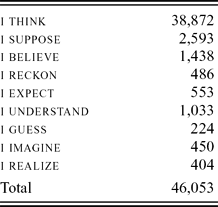
The current study focuses on CTMPs as they are used in contemporary spoken British English. The data on which it relies were extracted from the British National Corpus (BNC).Footnote 6 In view of CTMPs’ greater frequency in spoken English, especially conversations, compared to written texts (Biber et al. Reference Biber, Johansson, Leech, Conrad and Finegan1999: 197, 668–9; Kaltenböck Reference Kaltenböck2005), the data have been restricted to the spoken component of the BNC, comprising around 10 million words. Specifically, for each of the nine above-mentioned CTMP types, this subcorpus was searched for all instances of the first-person singular pronoun I followed by any form of the respective cognitive verb, allowing for a two-word span between I and the verb so as to also include auxiliaries and the negator not, as in I would (not) have thought. The frequencies resulting from these queries are given in table 1.Footnote 7
Occurrences of first-person cognitive verbs in the spoken part of the BNC
After putting the search results in random order, the first 180 tokens of each verb that could be identified as CTMPs with an interpersonal reading were picked out.Footnote 8 In what follows, the criteria employed to identify these interpersonal CTMPs will be discussed.
2.2 Criteria for identifying interpersonal CTMPs
First, in order to qualify as a CTMP, a first-person singular cognitive verb needs to meet a number of formal criteria; it needs to occur in any one of the syntactic structures exemplified by (1)–(5), i.e. as a matrix clause followed by the complementizer that, by zero that or by a proform, or as a parenthetical.Footnote 9 This means that all other complementation patterns that the cognitive verbs may enter into, e.g. accusativus cum infinitivo constructions, as in (6), were excluded from the data. CTMPs containing interpolating adverbials, as in I now believe, were also filtered out since ‘additional lexical items in the main clause make a parenthetical [i.e. interpersonal JVB] interpretation of the weak assertive predicate impossible’ (Hooper Reference Hooper and Kimball1975: 107).
(6) Well I certainly I believe that to be the case. (BNC: J9T 419)
Although some of the above-mentioned formal criteria help to distinguish interpersonal from propositional CTMPs (e.g. pronominalization and syntactic position), additional criteria are required to differentiate these two uses. The distinction crucially rests on the question of what is the (main) assertion expressed by the sentence at hand (see Diessel & Tomasello Reference Diessel and Tomasello2001).Footnote 10 As Hooper (Reference Hooper and Kimball1975: 101) explains, ‘the semantic content of a weak assertive predicate in its parenthetical sense is reduced to the extent that it makes no assertion in itself but, rather, only describes the speaker's attitude towards the truth of the asserted proposition, which lies in the complement’.Footnote 11 The CTMP's lack of assertive force has a number of consequences that can be used as criteria to identify interpersonal CTMPs. To begin with, several authors have observed that an interpersonal CTMP can be omitted without changing the main message conveyed by the sentence (e.g. Urmson Reference Urmson1952; Diessel & Tomasello Reference Diessel and Tomasello2001; Kearns Reference Kearns2007). To this general observation concerning the absence of propositional content in interpersonal CTMPs Hooper (Reference Hooper and Kimball1975: 101) adds that these CTMPs are ‘transparent with regard to several syntactic/semantic operations’. Firstly, interpersonal CTMPs are transparent to tag questions. As (7) shows, the tag ‘picks up’ the subject and operator of the host clause rather than being anchored to the CTMP. This ‘tag test’ is also discussed by Robin Lakoff (Reference Lakoff1969) and by Halliday (Reference Halliday1994 [1985]).
(7) The only thing is, I think it's quite a way for you to travel isn't it? (BNC: KST 5125)
Secondly, Hooper (Reference Hooper and Kimball1975) points out that interpersonal CTMPs are transparent to negation, a property that was first described by Fillmore (Reference Fillmore1963) and has been referred to as ‘negative raising’ (Lindholm Reference Lindholm1969), ‘negative transportation’ (Robin Lakoff Reference Lakoff1969), ‘not-transportation’ (George Lakoff Reference Lakoff1970 [1965]), ‘transferred negation’ (Quirk et al. Reference Quirk, Greenbaum, Leech and Svartvik1985; Bublitz Reference Bublitz1992) and ‘negative transfer’ (Halliday Reference Halliday1994 [1985]). Negative raising accounts for the semantic equivalence of (8a) to (8b). Cases of negative raising were also included in the data sample.
- (8)
(a) I don't think our votes are going to be crucial. (BNC: KPM 834)
(b) I think our votes are not going to be crucial.
Thirdly, Hooper (Reference Hooper and Kimball1975) shows interpersonal CTMPs to be transparent with regard to factive sentence adverbials. Hence, unfortunately in (9) modifies the proposition contained in the host clause rather than having scope over I think. In like manner, an interpersonal CTMP is transparent to the protasis of a conditional construction. This phenomenon is referred to as ‘protasis lifting’ (Kimball Reference Kimball1972) and is exemplified by (10).
(9) Unfortunately I think the time has come to pack your things up. (BNC: KPX 22)
(10) If it stays fine I think I'll put another load of washing in here. (BNC: KB8 5000)
The CTMPs’ transparency to the above-mentioned syntactic/semantic operations can be explained by the fact that when they provide an epistemic/evidential modification to the host clause, they belong to the interpersonal layer of the structure of the clause. In many functional linguistic theories, a distinction is made between the grammatical organization of the propositional content of a clause and structures pertaining to the speaker's attitudes towards that proposition (see Butler & Taverniers Reference Butler and Taverniers2008 for a discussion of layering in structural-functional grammars). In this regard, Halliday's (Reference Halliday1994 [1985]) Systemic Functional Grammar differentiates between the ideational and the interpersonal components of clausal structure. It is in the interpersonal ‘layer’ of the clause that epistemic modality can be situated. For this reason, CTMPs that provide the speaker's assessment of the truth value of the host clause can be called interpersonal.
As previously argued by Vandelanotte (Reference Vandelanotte2004, Reference Vandelanotte2006), interpersonal CTMPs are informed by what Verstraete (Reference Verstraete2001) calls ‘modal performativity’; by means of an interpersonal CTMP, the speaker creates a position of commitment in the here-and-now of the speech act situation to a given proposition (see also Nuyts Reference Nuyts1993; Diessel & Tomasello Reference Diessel and Tomasello2001). However, Verstraete (Reference Verstraete2001) explains that once a modal expression has been performatively realized, it can be taken up in subsequent discourse and reported on as an event belonging to the state of affairs. Verstraete (Reference Verstraete2001: 1520) calls this the ‘propositionalized resumption’ of a performatively used modal. Such propositionalized resumptions of CTMPs have been excluded from the data used for this study as they are part of the propositional (or in Hallidayan terms, ‘ideational’) component of the clause. A common environment in which they occur is the protasis of a conditional construction. In that case the function of the protasis, which consists in suspending speaker commitment, is at odds with the performativity of the CTMP, which inherently involves speaker commitment. The only way this functional clash can be resolved is by means of a propositional interpretation of the CTMP. In (11), for example, I think is used to describe the speaker's recurrent belief that they have left a door unlocked rather than to express such a belief. If a CTMP occurs in a complement clause conveying reported speech, it also loses its modal performativity and becomes part of the proposition, as in (12).
(11) . . . if I think that I leave either the front door unlocked, my house unlocked or the garage door open I go and actually check that in the middle of the night. (BNC: HUL 572)
(12) I know that there are many women who have a very rough time at home, but you're asking me if I think men have changed, and I think in that way, domestically, I think they have, but I don't think their attitude has changed in the workplace. (BNC: KRL 5321)
Another useful way to identify interpersonal CTMPs is substitution by means of a modal adverb like probably. The functional resemblance between CTMPs and modal adverbs was first observed by Urmson (Reference Urmson1952), who likens I believe to probably (see also Diessel & Tomasello Reference Diessel and Tomasello2001: 104). He remarks, however, that these adverbial equivalents lack the subjectivity peculiar to ‘parenthetical verbs’. By the same token, according to Halliday (Reference Halliday1994 [1985]: 354ff.), I think and probably have the same modal value, viz. ‘median modality’, but they differ in that I think is subjective while probably is objective. Although most interpersonal CTMPs express a median modal value, it is possible for some CTMPs, notably I think (13) and I believe (14), to realize a stronger sense of commitment on the part of the speaker than could adequately be paraphrased by probably. In this connection, Aijmer (Reference Aijmer, Swan and Westwik1997) talks of the ‘deliberative’ use of I think, which heightens the speaker's commitment. This deliberative function was shown to apply to I believe too (Van Bogaert Reference Van Bogaert2006). Seeing that such instances also realize a position of modal commitment to a given proposition in the here-and-now, they qualify as performative, interpersonal CTMPs. As (15) illustrates, the deliberative use can be bolstered by the use of emphatic do.
(13) Now, I'm a pensioner, and I think it's a scandal what we get for a pension after all the years that you, you fight for you, you put away for your old age, and before you know it you've nothing! (BNC: FX5 492)
(14) and therefore I believe the executive committee as the trustees and custodians on our behalf, in this matter, should take the responsibility, and I would have preferred the trustees rather than the Council to have been stated at that point. (BNC: JNJ 97)
(15) Now, as a matter fact I do think that there are contexts in which species selection does make sense. (BNC: KRH 3941)
3 CTMPs and grammaticalization theory
3.1 Grammaticalization criteria
Various previous studies of CTMPs, especially of I think, suggest that these expressions have been subject to a process of grammaticalization, which can be defined as ‘the change whereby lexical items and constructions come in certain linguistic contexts to serve grammatical functions, and once grammaticalized, continue to develop new grammatical functions’ (Hopper & Traugott Reference Hopper and Traugott2003: 18). From a synchronic point of view, grammaticalization can be understood as a ‘discourse pragmatic phenomenon, to be studied from the point of view of fluid patterns of language use’ (Hopper & Traugott Reference Hopper and Traugott2003: 2). The perspective adopted in this article is that of ‘synchronic grammaticalization’ (Lehmann Reference Lehmann1985; Brems Reference Brems2007). On the basis of Present-Day English data, it aims to discern different degrees or ‘layers’ (Hopper Reference Hopper, Traugott and Heine1991; Brems Reference Brems2007; Brems et al. Reference Brems, Davidse and De Smet2008) of grammaticalization, thus inquiring into the ‘synchronic gradience’ (Traugott & Trousdale Reference Traugott, Trousdale, Traugott and Trousdale2010) obtaining between a set of forms.Footnote 12 Probing the intersection between synchronic gradience and grammaticalization, Traugott & Trousdale (Reference Traugott, Trousdale, Traugott and Trousdale2010) clarify that synchronic gradience is often the result of grammaticalization, adding that lexicalization may also be at the basis of such gradience, but this process is not considered germane to the description of CTMPs for reasons explicated in Van Bogaert (to appear) & Trousdale (Reference Traugott, Trousdale, Traugott and Trousdale2010: 40) consider synchronic gradience as ‘an ideal testing ground for hypotheses about the expressions that are most likely to undergo grammaticalization, and perhaps more critically, the way in which grammatical constructions emerge’. Indeed, in emergent grammar, synchronic gradience is often regarded as an effect of diachronic gradualness (Traugott & Trousdale Reference Traugott, Trousdale, Traugott and Trousdale2010: 21) and in this article, the CTMPs will be positioned vis-à-vis one another in an emerging constructional network (see section 4).
CTMPs have been shown to meet many of the established grammaticalization criteria, as will become apparent from the ensuing discussion (see also Fischer Reference Fischer, Smit, Hüttner, Kaltenböck and Lutzky2007; Van Bogaert to appear). One of the reasons why CTMPs have been so attractive to the grammaticalization framework is their semantic ambiguity. Hooper (Reference Hooper and Kimball1975) points out that any clause containing a CTMP is ambiguous between a propositional and an interpersonal reading, adding that there is usually a preferred reading.Footnote 13 In grammaticalization theory, the existence of these two readings (and possible gradations in between) is considered to embody the well-known shift from ideational to interpersonal (Traugott Reference Traugott, Lehmann and Malkiel1982, Reference Traugott2005). The loss of a concrete meaning describing a mental operation and the emergence of an attitudinal, epistemic/evidential one has been interpreted in terms of ‘(semantic) bleaching’ (Traugott Reference Traugott, Lehmann and Malkiel1982, Reference Traugott1988; Sweetser Reference Sweetser1988) or ‘desemanticization’ (Heine, Claudi & Hünnemeyer Reference Heine, Claudi and Hünnemeyer1991). As Urmson (Reference Urmson1952: 482) explains, interpersonal CTMPs ‘are not psychological descriptions’, but rather serve to ‘orient the hearer aright towards the statements with which they are associated’ (Reference Urmson1952: 491).
The interpersonal, attitudinal meanings that compensate for a loss of concrete meaning can be construed in terms of ‘pragmatic strengthening’ (Traugott Reference Traugott1988; Traugott & König Reference Traugott and Heine1991) or ‘subjectification’, a semantic change whereby ‘meanings tend to be increasingly based in the speaker's subjective belief state/attitude towards the proposition’ (Traugott 1989: 35; see also Traugott Reference Traugott1988: 410). The accumulation of pragmatic uses by CTMPs (see Kärkkäinen Reference Kärkkäinen2003; Van Bogaert Reference Van Bogaert2006) explains the adoption of the term ‘pragmatic marker’ (e.g. Brinton Reference Brinton1996; Palander-Collin Reference Palander-Collin1999).
The interpersonal reading of a sentence containing a CTMP has been said to presuppose a semantic and syntactic reanalysis. It has been claimed that a construal in which the CTMP acts as the matrix clause and the host clause as the subordinate clause is untenable seeing that it is the propositional content of the host clause that is at the forefront while the CTMP merely modifies that proposition. As Verhagen (Reference Verhagen, Sanders, Schilperoord and Spooren2001: 349) puts it, ‘[i]n a sense, we have turned the traditional notion of “dependent clause” upside down, by showing that it is the matrix clause that is actually conceptually dependent on a subordinate one’. The structural reanalysis concomitant to this reinterpretation of the clause's semantic assembly is described by Thompson & Mulac (Reference Thompson, Mulac, Traugott and Heine1991: 323) as ‘the type of grammaticalization in which a governing or head element is reanalysed as a governed or dependent element’. The reanalysis of the CTMP as ancillary information, which pivots on the non-realization of the complementizer that, promotes its capacity for syntactic mobility, i.e. its tendency to occur in parenthetical positions, which has been interpreted in terms of a category shift from verbal to adverbial (Thompson & Mulac Reference Thompson, Mulac, Traugott and Heine1991; Palander-Collin Reference Palander-Collin1999).Footnote 14 Thompson & Mulac (Reference Thompson, Mulac, Traugott and Heine1991: 313) use the following examples to illustrate their grammaticalization cline:
- (16)
(a) I think that we're definitely moving towards being more technological.
(b) I think Ø exercise is really beneficial, to anybody.
(c) It's just your point of view you know what you like to do in your spare time I think.
Two remarks are in order here. Firstly, Thompson & Mulac's ‘matrix clause hypothesis’ (Brinton Reference Brinton2008), which entails that CTMPs followed by zero that (16b) are more grammaticalized than those taking explicit that (16a), and that parenthetical CTMPs (16c) represent an even more advanced level of grammaticalization, is based on frequency of occurrence in Present-Day English. Although Palander-Colin's (1999) study confirms the diachronic validity of this model as far as I think is concerned, Thompson & Mulac's matrix clause hypothesis has been criticized. Brinton (Reference Brinton1996, Reference Brinton2008) shows that both matrix clause and parenthetical uses are attested in Middle English. On the basis of Brinton's (Reference Brinton1996) historical findings, only a small number of parenthetical CTMPs can be said to historically derive from matrix clauses. Brinton (Reference Brinton1996, Reference Brinton2008) demonstrates that in fact the source constructions of parenthetical CTMPs are numerous and diverse. Some of the verbs in her data are exclusively found in parenthetical positions, which seems to point to a parenthetical source construction for some present-day parentheticals. In her model for the development of parenthetical I think, given below, the source construction is a paratactic construction with an anaphoric element. It can be seen that the matrix clause use of the CTMP is not treated as the starting point of the development, but rather as one of its outcomes. Brinton posits an intermediary stage where I think occurs in a relative clause introduced by as (Stage III). Fischer (Reference Fischer, Smit, Hüttner, Kaltenböck and Lutzky2007), however, objects that as I think or as I gesse must not be analysed as a relative clause, but as a paratactic, independent clause in which as is an adverbial derived from an anaphoric demonstrative pronoun.
Stage I: They are poisonous. That I think.
Stage II: They are poisonous, {that I think, I think that/it, as/so I think}. = ‘which I think’
Stage III: They are poisonous, I think or
They are poisonous, as I think. = ‘as far as I think, probably’
Stage IV: I think, they are poisonous. They are, I think, poisonous. (Brinton Reference Brinton1996: 252)
Secondly, as Kearns (Reference Kearns2007) and Boye & Harder (Reference Boye and Harder2007) have argued, a functional reanalysis into a routinized, subsidiary comment does not require a structural reanalysis. Boye & Harder (Reference Boye and Harder2007: 571) argue that a ‘complement-taking predicate’ (CTP) needs to be described both as a ‘usage-level’ phenomenon, i.e. as an ‘actual communicative event’, and as a ‘structure-level’ phenomenon, i.e. as an ‘instantiation of the structural patterns of a linguistic code’. At the structural level, a CTP is either lexical or grammatical. Lexical CTPs can be regarded as true matrix clauses and have predicative force, while grammatical CTPs function like epistemic adverbials and lack the predicative force of their lexical counterparts (Boye & Harder Reference Boye and Harder2007: 581). A cross-cutting dimension can be added at the usage-level; depending on its discourse centrality, a CTP can have primary or secondary usage status, i.e. it can be discursively foregrounded, in which case it expresses the main point of the utterance, or backgrounded, in which case it provides ancillary information (Boye & Harder Reference Boye and Harder2007: 584). Combining these two levels of analysis, Boye & Harder (Reference Boye and Harder2007: 590) arrive at the following three types of CTPs, which they propose as three stages in a diachronic model for the development of grammatical CTPs:
(17) A: lexical and primary CTP
↓ usage reanalysis
B: lexical but secondary CTP
↓ structure reanalysis, grammaticalization of CTP
C: grammatical and secondary CTP
Boye & Harder's secondary lexical CTPs constitute a hybrid category; from a structural point of view, they should be considered as matrix clauses, while they are backgrounded in the discourse due to ‘momentary discourse pressures’ (Boye & Harder Reference Boye and Harder2007: 585). This type of CTMP has been included in the data used for this study. It can be seen that secondary lexical CTPs imply a functional reanalysis, at the usage level, while only secondary grammatical CTPs have also undergone structural reanalysis. Similarly, Diessel & Tomasello (Reference Diessel and Tomasello2001) distinguish between assertive CTV-clauses (complement-taking verb clauses), which contain the main assertion of the utterance, performative CTV-clauses, which manage speaker–addressee interaction while the complement clause expresses the main proposition without being conceptually embedded in the CTV-clause, and finally formulaic CTV-clauses, which need to be regarded as clausal operators in a monoclausal construction. In conclusion, in this paper it is maintained that while interpersonal CTMPs may be functionally reanalysed as ‘adverbial-like’ elements, they remain subject-verb sequences from a structural point of view; due to the principle of ‘grammatical persistence’ (Torres Cacoullos & Walker Reference Torres Cacoullos and Walker2009), the cognitive verbs do not lose their verbal properties (Van Bogaert to appear).
Lehmann's (Reference Lehmann1985) concept of attrition, i.e. the loss of a sign's integrity, not only has a semantic side, corresponding to the notion of bleaching, but also a phonological one. In this connection, Kärkkäinen (Reference Kärkkäinen2003: 121) points out that the pronunciation of I think is sometimes reduced to [ayin?]. Givón (Reference Givón1993: 38, cited in Kärkkäinen Reference Kärkkäinen2003) observes that in rapid speech the subject pronoun of ‘epistemic quantifiers’ may be dropped. Along similar lines, Traugott (Reference Traugott, Stein and Wright1995b: 38) envisages the possibility of its complete erosion, similar to the reduction of if you please to please. Kärkkäinen (Reference Kärkkäinen and Englebretson2007) provides an example of such subject deletion with I guess from the Santa Barbara Corpus of Spoken American English:
(18) Guess I'll put it o = n. it's not on, <SBCSAE 0001 Actual Blacksmithing 00:12:46>
Since it is impossible to search a corpus specifically for first-person uses of think where the subject is not pronounced, and seeing that the omission or retention of I in the transcription is to a large extent due to the transcriber's decisions, the feature of subject deletion could not be systematically investigated. Nevertheless, one may hit upon instances of subject deletion ‘by accident’ while analysing regular data:
(19) Erm on October ninety four I'll be, guess there won't be any old prices in the [unclear]. (BNC: FLS 328)
In some dictionaries, notably the Oxford English Dictionary, it is mentioned that I guess may be shortened to guess. In the same vein, Heller & Howe (Reference Heller and Howe2008) observe that ‘raising parentheticals’ like (it) turns out and (it) seems, which resemble CTMPs in that they convey epistemic/evidential meanings and can be used parenthetically, may be subject to ‘it-deletion’.
Hopper (Reference Hopper, Traugott and Heine1991) complements Lehmann's (Reference Lehmann1985) parameters and processes (e.g. attrition, fixation, coalescence, obligatorification) by proposing five principles of grammaticalization. The first of these, layering, states that within a given functional domain, newly emerged layers do not supersede already existing structures serving the same functional purposes. I think has indeed not taken over from epistemic modal auxiliaries, but rather occupies its own niche in the functional domain of epistemic modality. Hopper's (Reference Hopper, Traugott and Heine1991) principle of divergence explains why the lexical verbs think, guess, understand etc. have not disappeared and continue to be used in their full, literal meanings as well. According to the principle of specialization, grammaticalization narrows down the variety of formal choices within a functional domain. The preponderance of I think as compared to other CTMPs points to specialization (see frequencies in table 4). Fourthly, Hopper points out that a grammaticalized form does not entirely rid itself of its original lexical meaning. By virtue of the principle of persistence, or ‘retention’ (Bybee & Pagliuca Reference Bybee, Pagliuca, Ramat, Carruba and Bernini1987; Bybee, Perkins & Pagliuca Reference Bybee, Perkins and Pagliuca1994), its grammatical distribution may be constrained by the vestiges of its lexical history. This principle was adduced as an important explanation for the differences in usage between I guess, I suppose and I believe in Van Bogaert (Reference Van Bogaert2006) and for the fact that I think constitutes a stronger assertion of belief than I guess in Thompson & Mulac (Reference Thompson, Mulac, Traugott and Heine1991: 325). In spite of meeting the above-mentioned grammaticalization criteria, TAM variation jeopardizes the applicability of the grammaticalization framework to CTMPs, as will be explained in the following section.
3.2 Lack of internal fixation
As Wierzbicka (Reference Wierzbicka2006: 206) points out, the class of ‘epistemic verbal phrases’ in Present-Day English is subject to further expansion into such forms as I should think, I should've thought, I don't suppose or I would guess. Variant forms like I would think or I should imagine, however, pose a challenge to any account of CTMPs in terms of grammaticalization. Their existence violates what can be referred to as a type of fixation (Lehmann Reference Lehmann1985), albeit not the syntactic fixation of the CTMP's position with respect to the host clause, but its internal, morphological fixation into a single, unalterable form. Hopper (Reference Hopper, Traugott and Heine1991: 30) describes this as ‘a freezing or loss of morphological trappings’. It has been observed by several authors (e.g. Urmson Reference Urmson1952; Aijmer Reference Aijmer1972; Hooper Reference Hooper and Kimball1975; Fischer Reference Fischer, Smit, Hüttner, Kaltenböck and Lutzky2007) that a CTMP's most distinctive grammatical property, viz. its ability to convey an interpersonal meaning, depends on its occurrence in a specific grammatical form, viz. the prototypical first-person singular declarative simple present use. In spite of the connection between this prototypical form and a CTMP's interpersonal status, it will be demonstrated on the basis of corpus data that it is possible for a CTMP to deviate from this strict pattern without being barred from an interpersonal reading.
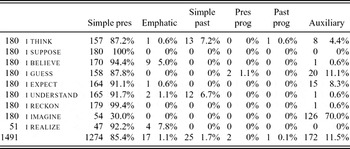
Each of the nine 180-token CTMP samples described in section 2 was quantitatively examined for TAM variation. The results of this analysis can be seen in table 2.
TAM variation in the BNC samples

The only CTMP that is consistently used in the prototypical form is i suppose. The most common variant pattern is that involving a modal auxiliary, mostly would, as in the examples below. i think sometimes combines this modal with the perfect aspect, as illustrated in (23). The CTMPs in the examples below can easily be omitted since they do not convey the main proposition of the utterance. They can also be substituted by a prototypical CTMP, although this slightly changes the pragmatic effect of the CTMP. Note, also, that in (20) and (22) the CTMPs’ interpersonal meaning nicely accords with probably in the host clause. The epistemic modality conveyed by would seems to be particularly compatible with the epistemic/evidential function of CTMPs. Compared to such a prototypical CTMP, variants with would sound more tentative. (24), which was not part of the data set used for this study but occurred in the spoken part of the BNC nonetheless, shows that I would think is transparent to negation, which is an additional argument for treating it as an interpersonal CTMP. Thus, the variant uses given below qualify as interpersonal CTMPs.
(20) Now they're sort of things that you've probably seen yourself quite frequently I would think. (BNC: FM0 721)
(21) erm Quite a lot of help required in areas of the remit of this committee I would guess, things like home, security and safety, heating down here, quite a lot of people want help with heating. (BNC: KS1 903)
(22) This'd probably be used for a construction of some sort I would imagine. (BNC: KGU 354)
(23) So, it's a busy area now and erm from a fire point of view the fire risk is, is quite, quite high now, I would've thought, not necessarily dangerously high, but certainly it's increased, gradually increased. (BNC: K69 26)
(24) A: I wondered if they still did it at the pictures, ’cos it's years since I went to the pictures.
B: I have no, no, no, I don't, I I wouldn't think I wouldn't think it's been played in a cinema for years.
The second most common modal auxiliary is should, illustrated in (25)–(28), which has a similar effect to would in toning down commitment and making the utterance sound more tentative.
(25) Pretty fair stack of them I should think, wasn't there? (BNC: KDT 253)
(26) A: What'll they do with baseball bat?
B: Well I should imagine they're playing baseball. (BNC: KDE 2732)
(27) Well they don't like stepping across icy grass I should have thought. (BNC: KBB 1691)
(28) ‘So I should have imagined,’ said Gildas, gently withdrawing his hand, ‘it's hardly news.’ (BNC: AMP 2768)
Although the data sample used for this study did not contain any examples of should in combination with the perfect aspect, I should have thought can be found when the entire spoken portion of the BNC is searched, as (27) shows, and the written component of the corpus contains a few instances of I should have imagined in fictional dialogue (28). In example (25), the variant CTMP is shown to be transparent to the tag question, which proves its interpersonal status.
Two CTMPs, i think and i understand, have the potential to occur in the past tense without denoting a past act of cogitation. Scheibman (Reference Scheibman2002: 67–8) points out that I thought and I was thinking do not typically indicate past time reference and Fischer (Reference Fischer, Smit, Hüttner, Kaltenböck and Lutzky2007: 108) makes the same observation with regard to the parenthetical use of Dutch dacht ik (lit. ‘thought I’) (see also Nuyts Reference Nuyts1993). Kärkkäinen (Reference Kärkkäinen, Slembrouck, Van Herreweghe and Taverniers2009) treats I thought as an epistemic phrase that is used for displaying stance and according to Rühlemann (Reference Rühlemann2007, cited in Kärkkäinen Reference Kärkkäinen, Slembrouck, Van Herreweghe and Taverniers2009), it can be used as a discourse marker. The ability to be used in the past tense, not with past time reference, but as performative expressions tied to the here-and-now of the speech act situation, is a property that i think and i understand share with epistemic modal auxiliaries. It is a well-known fact that past tense uses of epistemic modals, such as might and could, do not have past time reference, but rather add tentativeness (e.g. Kiefer Reference Kiefer, Verschueren, Östman, Blommaert and Bulcaen1998; Krug Reference Krug2000). Verstraete (Reference Verstraete2001) attributes the imperviousness of epistemic modal auxiliaries to past time marking by means of tense to their modal performativity. This grammatical property, which also informs interpersonal CTMPs (see section 2.2), explains why i think and i understand are partially unsusceptible to past time marking by means of tense.Footnote 15 (29) is an example of I understood being cautiously used as a hearsay evidential. 12 of the 180 uses of i understand are used in this way.
(29) A: I mean he does the invoices now doesn't he?
B: Well I understood so. (BNC: FUL 728)
i think is used in the simple past 13 times (see example 30), amounting to 7 per cent of the data of this CTMP type, and once in the past progressive (see example (31)). I thought, as in (30), gives the interlocutor the impression that the speaker is prepared to change his/her mind by virtue of the ostensible distance that the past tense creates between the speaker's point of view and the here-and-now of the speech act situation. Stubbs (Reference Stubbs1986) explains that this kind of past tense use creates a sense of ‘remoteness’. The use of the past tense for politeness reasons is not an uncommon pragmatic phenomenon; Traugott (Reference Traugott1995a: 5) gives the example What was your name? to illustrate the pragmatic use of the past tense for politeness.
(30) A: It's a record com
B: It is is it?
A: A record company.
B: Ah! I wondered
A: Yeah. Quite a big company actually.
B: Yes but I thought A and M are only a small one. (BNC: KDP 1326
Example (31) combines the distancing effect of the past tense with the progressive aspect. By drawing attention to the on-going process of making up one's mind, the speaker in (31), who is advising his/her interlocutor on what to do with his/her money, further softens the imposition that this suggestion may entail by signalling that the amount of money to be put aside is negotiable. This reserve on the part of the speaker is also reflected in the use of the approximator about, the pragmatic marker you know, the vacillation between fifteen and twenty pounds and some hesitation markers (er and the repetition of to).
(31) Yeah I was thinking about, you know, fifteen, twenty pounds a month might be er a reasonable investment to, to put aside for the children. (BNC: JJP 975)
Although the random 180-token sample on which the figures in table 2 are based did not yield any present progressive uses of i think, this pattern can be found in the spoken part of the BNC. In example (32), the speaker is telling the other people present at a business meeting what he believes needs to be done with certain applications and trust letters. However, he minimizes the risk of imposing on the others, not only by prefacing his recommendation with a CTMP, but also by using the progressive aspect. This grammatical feature conveys non-finality and draws attention to the ongoing process of making up one's mind, and as such it helps reassure the addressee(s) that the speaker is not pontificating.
(32) Yes decisions, no, no, no for the actual post of all that stuff I appreciate that, but the actual raising of money and something Yeah, well, no I'm thinking that these, these applications have to be in both of them by the end of September and I don't Yes see why the, the second string of the trust letters shouldn't be going out straight away after Aha Straight away, yes (BNC: KB8 6761)
Five CTMPs make use of emphatic do: i think, i believe, i expect, i understand and i realize. This pattern is used to underscore one's commitment to a point of view rather than to weaken it, as (33) shows.
(33) But I do believe that we ought to be doing more in terms of making sure they do come out erm you know i, we know it's only a a training exercise even though you leave one or two in there, but I think we ought. (BNC: FLS 1006)
Aijmer (Reference Aijmer, Swan and Westwik1997) characterizes the use of I do think in order to heighten illocutionary force as ‘deliberative’ and this notion was extrapolated to I do believe in Van Bogaert (Reference Van Bogaert2006).
The above discussion of TAM variation in CTMPs has shown that in spite of the assumed connection between the prototypical form and an interpersonal reading, it is possible for a CTMP to deviate from this strict pattern without being barred from an interpersonal interpretation.
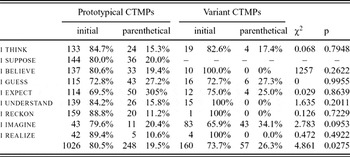
The syntactic mobility of a CTMP is often mentioned as an indication of its grammaticalization into an epistemic/evidential formula. Thompson & Mulac (Reference Thompson, Mulac, Traugott and Heine1991) consider parenthetical CTMPs as more grammaticalized than clause-initial ones. As several of the examples above show, variant CTMPs may also be used parenthetically. Table 3 systematically compares the positional preferences of prototypical and variant CTMPs.
Positional distribution of prototypical and variant CTMPs in the BNC samples

Three CTMPs, viz. i think, i guess and i imagine, have higher rates of parenthetical use when used as variant CTMPs. In the other CTMPs, an inverse tendency can be observed; variant i believe, i understand, i reckon and i realize, for example, never appear parenthetically. However, as the chi square test results in the two rightmost columns of table 3 show, for none of the individual CTMPs can the difference between prototypical and variant CTMPs in terms of syntactic position be called statistically significant. However, when the aggregate of all CTMPs is considered, the proportion of parenthetical use in the variant category is greater than that in the prototypical category and a statistical significance can be observed in the distribution of these values. In conclusion, if we take syntactic mobility to be a yardstick to measure a CTMP's level of grammaticalization, the above quantitative analysis does not suggest that variant CTMPs are less syntactically mobile and hence, on the basis of the feature of syntactic mobility, variant forms cannot be said to be less grammaticalized than prototypical CTMPs.
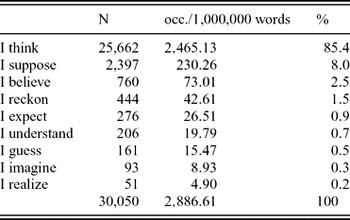
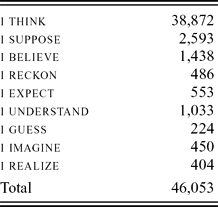
According to Thompson & Mulac's (Reference Thompson, Mulac, Traugott and Heine1991) hypothesis, frequency of occurrence is a crucial factor in the grammaticalization of CTMPs into epistemic/evidential formulas (see also Thompson Reference Thompson2002). The connection between frequency and the emergence and routinization of grammatical and discursive patterns has been established in various other studies (e.g. Haiman Reference Haiman and Pagliuca1994; Bybee & Thompson Reference Bybee and Thompson1997; articles in Bybee & Hopper Reference Bybee and Hopper2001; Scheibman Reference Scheibman2002; Bybee Reference Bybee, Joseph and Janda2003, Reference Bybee2006; Kärkkäinen Reference Kärkkäinen2003). Therefore, we expect to find the greatest tendency towards internal fixation as routinized, grammaticalized formulas in the most frequently used CTMPs. Table 4 gives an overview of the frequency with which CTMPs are used in the spoken part of the BNC in their prototypical form. The data, listed in order of frequency, were obtained as follows. For each CTMP, the spoken part of the BNC was searched for a given subject–verb sequence, e.g. I believe. For I believe, this specific query yielded 857 hits. However, these comprise both CTMP uses and non-CTMP uses like I believe in fairies (BNC F7R 300). Seeing that the manual filtering of all of the search results (more than 30,600 tokens) would have been rather a laborious undertaking, 300 random occurrences of each subject–verb sequence were manually checked. Those queries producing fewer than 300 tokens were of course checked in their entirety. The CTMP/non-CTMP ratio was then multiplied by the total number of occurrences of a given subject–verb sequence. In the case of I believe, 266 out of 300 tokens were found to be interpersonal CTMPs, which corresponds to 88.67 per cent. If we take the same proportion of the total number of I believe tokens, we arrive at the 760 interpersonal CTMP uses of I believe listed in table 4. The table gives absolute and normalized frequencies (occurrences per million words) as well as the percentage that each CTMP accounts for, relative to the total number of CTMPs.
Frequency of prototypical CTMPs in the spoken part of the BNC

The frequency with which I think is used is unequalled by any other CTMP. The second most frequent CTMP, I suppose, is used 10.7 times less than I think. The figures reveal the exceptional status of I think and show that I expect, I understand, I guess, I imagine and I realize each account for less than 1 per cent of all CTMP use.
The quantitative data on TAM variation in table 2 and those on frequency of occurrence in table 4 reveal that the traditionally posited correlation between frequency of occurrence and fixation into an unalterable form does not straightforwardly obtain. i think unequivocally poses a challenge to the hypothesis that the more a CTMP is used, the more it prefers the prototypical form. I think occurs with a frequency that is almost eleven times that of its runner-up I suppose, and yet the proportion of variant forms of i think is second only to i imagine, whose variant pattern with would or should rather idiosyncratically is to be granted canonical status in this CTMP's paradigm from a quantitative perspective. Thus, the data for the most frequent CTMP blatantly contradict the claim that high frequency entails internal fixation, suggesting instead that high frequency of occurrence correlates not with a preference for a fixed form, but with formal variability.Footnote 16
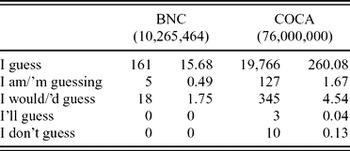
In order to explore this counter-hypothesis, viz. that frequency stands in inverse proportion to internal fixation, a small case study was conducted, comparing the TAM variation of i guess in American and in British English. While I guess is sparsely used in British English, as the BNC data in table 4 show, the CTMP is much more common in American English. In the American English conversations that Thompson & Mulac (Reference Thompson, Mulac, Traugott and Heine1991) examined, for instance, I guess is the second most frequently used CTMP, preceded only by I think. Considering the higher frequency of I guess in American English, the counter-hypothesis predicts a greater use of variant forms in this variety than in British English. Table 5 indicates the absolute and normalized frequencies (occurrences per million words) in the spoken parts of the BNC and of the Corpus of Contemporary American English (COCA).Footnote 17
Frequencies of I guess and formal variants in spoken parts of BNC and COCA

The normalized frequency of prototypical I guess in the American data is almost sixteen times higher than in the British data. Correspondingly, the level of variant use is also higher in American English, although the differences are less substantial.Footnote 18 In conclusion, the comparison between the British and American data for i guess tends to confirm the counter-hypothesis that frequency of occurrence is correlated with formal variability.19
In what follows, a constructional model will be presented that aims to account for this correlation and to thereby overcome the deadlock facing traditional grammaticalization approaches to CTMPs. A constructional taxonomy will be proposed in order to clarify the relationships between the various CTMP types (i think, i suppose, i believe, etc.), as well as between prototypical and variant CTMPs (e.g. I think vs. I'd think). These taxonomic relationships will be defined in terms of schematicity and analogy.
4 The emergence of a constructional network
In this section, I want to argue that a constructional approach provides an apposite description of the grammar of CTMPs in that it accounts for the existence of variant forms and of a whole class of CTMP types. Far from being irreconcilable with grammaticalization theory, such a constructional account can be considered as a reassessment or an extension of existing usage-based approaches involving grammaticalization. Recently, various scholars, in particular Trousdale (Reference Trousdale, Trousdale and Gisborne2008a, Reference Trousdale2008b, Reference Trousdale, Minkova and Fitzmaurice2008c, Reference Trousdale2009) and Traugott (Reference Traugott2007, Reference Traugott, Bergs and Diewald2008a, Reference Traugott, Eckhardt, Jäger and Veenstra2008b), have focused on the role of constructions in grammaticalization, marrying the theory with insights from Construction Grammar (Goldberg Reference Goldberg1995, Reference Goldberg2006; Croft Reference Croft2001; Östman & Fried Reference Östman and Fried2005; Schönefeld Reference Schönefeld2006).Footnote 20 This new perspective in grammaticalization theory has been referred to as constructional grammaticalization (see Trousdale Reference Trousdale2008b).Footnote 21
The conceptualization of grammar that constructional grammaticalization subscribes to is usage-based and emergent; it is observant of the dynamic relationship between grammar and discourse, rejecting an a priori conception of grammar and positing, instead, that linguistic structure comes into being in language use (Hopper Reference Hopper1987, Reference Hopper and Tannen1988). Not only do speakers make use of grammatical structures to achieve their communicative goals, but equally, grammatical structures are shaped by their use in everyday interaction. As Bybee & Hopper (Reference Bybee and Hopper2001: 12) put it, ‘the result of innumerable communicative acts is to change language and to create and recreate grammar’.
As a general definition of the notion ‘construction’, Trousdale (Reference Trousdale, Trousdale and Gisborne2008a: 42) suggests Croft's (Reference Croft, Östman and Fried2005) ‘conventional symbolic unit’. Croft (Reference Croft, Östman and Fried2005: 274) uses this phrase in the sense that Langacker (Reference Langacker1987: 57–63) intended, explaining that ‘[r]oughly, a construction is an entrenched routine (“unit”), that is generally used in the speech community (“conventional”), and involves a pairing of form and meaning (“symbolic”)’. Trousdale (Reference Trousdale, Trousdale and Gisborne2008a: 54–6) cites three key features informing the (synchronic) nature and (diachronic) development of a construction. Firstly, grammatical constructions are characterized by a certain degree of generality; over time, they tend to become more schematic.Footnote 22 Therefore, as regards the grammaticalization of CTMPs, it is not the concrete string of a first-person singular pronoun followed by a simple present verb, e.g. I think, that is grammaticalizing, but rather, at a higher level of abstraction, the schema according to which I think is formed is becoming increasingly entrenched and grammaticalized.Footnote 23 In this connection, Traugott (Reference Traugott2007, Reference Traugott, Bergs and Diewald2008a, Reference Traugott, Eckhardt, Jäger and Veenstra2008b) proposes a model differentiating between various constructional levels. These levels may be taken to represent diachronic stages or synchronic degrees/layers in the grammaticalization of a construction. At the lowest level, we do not find a proper, i.e. schematic, construction, but an instantiation of such a construction in actual language use, viz. a ‘construct’, or what would be a ‘usage event’ in Langacker's (Reference Langacker1987, Reference Langacker2000: 2) Cognitive Grammar. The 25,662 occurrences of I think in the spoken part of the BNC all count as constructs instantiating the type, or the ‘micro-construction’, i think. A set of micro-constructions may be grouped together as a ‘meso-construction’ and at the highest level of schematicity, we find a ‘macro-construction’ (see also Bybee's (Reference Bybee2006) exemplar representation of constructions). Both Traugott (Reference Traugott2007, Reference Traugott, Bergs and Diewald2008a, Reference Traugott, Eckhardt, Jäger and Veenstra2008b) and Trousdale (Reference Trousdale, Trousdale and Gisborne2008a, Reference Trousdale, Minkova and Fitzmaurice2008b, Reference Trousdale2008c) make a case for positioning constructions in a network, instead of studying them in isolation. Regarding CTMPs as members of a constructional network, informed by their relationships to other members of the taxonomy, rather than considering individual forms in isolation, is the most fruitful contribution that a constructional approach can offer to existing accounts of CTMPs. Determining a construction's place in a wider taxonomy and its relationship with constructions of a similar, higher, or lower degree of schematicity is essential in making sense of a contemporary grammatical phenomenon and of the past and potential developments of the construction at hand.
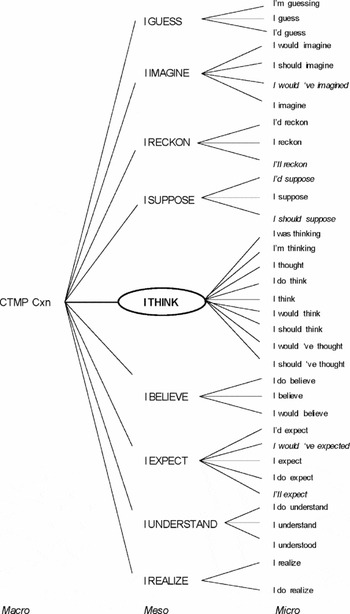
As a second tendency in the development of constructions, Trousdale (Reference Trousdale, Trousdale and Gisborne2008a) mentions an increase in productivity. An entrenched construction is apt to sanction new instances that are less schematic. This tendency in the emergence and development of constructions goes a long way towards accounting for the lack of internal fixation of CTMPs (see section 3.2). A highly frequent CTMP like I think allows for variant forms like I thought and I would think because the schematic construction i think has become deeply entrenched, so much so that the schema has become productive; it opens up to deviations from the prototypical form. What are initially ‘novel structures’ (Langacker Reference Langacker2000: 100) become entrenched constructions in their own right; the variant forms come to assume their own positions in the constructional taxonomy and contribute to the expansion and the entrenchment of the higher-order construction. Croft & Cruse (Reference Croft and Cruse2004: 309) maintain that a high level of instantiations of a construction, whether more or less schematic, further entrenches the superordinate category: ‘entrenchment (productivity) of a construction is proportional to the number of instances of the construction at any level of schematicity’. As such, all instances of I should think and I'd guess serve to entrench not only the respective meso-constructions i think and i guess, but also the more schematic category of I + CV (cognitive verb), indicated at the macro-constructional level as ‘CTMP-Cxn’ (CTMP-Construction) in figure 1.
Taxonomy of the CTMP-Construction

The notion of productivity as a concomitant of advanced schematicity and entrenchment lends support to what was referred to in section 3.2 as the counter-hypothesis to the direct correlation between frequency and internal fixation. It would appear that the more frequently a CTMP schema is instantiated, the more likely it is to sanction variant forms.
The third property of constructions is not exclusive to grammaticalization, but can also be witnessed in lexicalization. Demotivation, or what Trousdale (Reference Trousdale, Trousdale and Gisborne2008a, Reference Trousdale2008b) refers to as a loss of compositionality, often plays an important part in both processes. It entails that the meaning of a complex whole can no longer be arrived at by simply combining the meanings of its components. In this connection, Taverniers (to appear) points out that in a CTMP like I think, the pronoun I has lost most of its referentiality or ‘potency’ (Langacker Reference Langacker1991: 270; Reference Langacker2000: 271–315). In the same vein, Traugott (Reference Traugott, Stein and Wright1995b: 39) argues that ‘in the case of I think, where the subject is first person, the subject is losing referential (objective) properties, and becoming simply the starting-point of a perspective’, and Scheibman (Reference Scheibman, Bybee and Hopper2001) claims that the specificity of the pronominal referent in expressions like you know, I mean and I think has faded. The meaning of the CTMP as a whole too has become more divorced from the meanings of its component parts; on an interpersonal reading, a CTMP no longer serves to denote a process of cogitation, but rather, the CTMP in its entirety scopes and modalizes a host clause (see Vandelanotte Reference Vandelanotte2004, to appear; Taverniers to appear).
The three tendencies in constructional grammaticalization (increasing schematicity, increasing productivity and loss of compositionality) are characterized as diachronic processes, but, as in the present paper, they can equally be interpreted synchronically as the relationships that obtain between the members of the constructional taxonomy visualized in figure 1.
5 Analogization
5.1 An expanding constructional network
It can be seen in figure 1 that i think occupies a central and prominent position in the taxonomy. This is because i think plays an exceptional role in shaping the constructional network of CTMPs: it is the pacemaker leading the other CTMPs towards higher levels of entrenchment and formulaicity. The frequency with which the meso-construction i think or the micro-construction I think occurs is unequalled by any other CTMP. The number of occurrences of I think in the BNC is almost eleven times that of I suppose and 500 times that of I realize. Seeing that frequency is the most influential factor in a linguistic pattern's entrenchment (Bybee Reference Bybee, Joseph and Janda2003; Goldberg Reference Goldberg1995, Reference Goldberg2006), we can take i think to be the most entrenched and conventionalized CTMP of the entire constructional network. Due to the high token frequency of I think, the construction is extremely salient in speakers’ minds (see Ariel Reference Ariel2008 on ‘salience’). The highly salient i think construction pulls along the other CTMPs on its grammaticalization path aided by the mechanism of ‘analogization’ (Traugott & Trousdale Reference Traugott, Trousdale, Traugott and Trousdale2010). In answer to the question what the intersection between synchronic gradience and grammaticalization tells us about the centrality of reanalysis and analogy/extension to grammaticalization, Traugott & Trousdale (Reference Traugott, Trousdale, Traugott and Trousdale2010: 31) propose that ‘the gradience that is attested synchronically arises as the result of successive small-step changes resulting from the operation of the well-known mechanisms of reanalysis and analogy’. They refer to Givón to point out that analogy lies at the basis of much linguistic change:
Almost all creative-elaborative diachronic change in language, be it phonological, morpho-syntactic, semantic or discourse-pragmatic, is in principle analogical. That is, it involves the language user's recognition – conscious or subliminal – of similarities between two structural or functional contexts. (Givon Reference Givón, Traugott and Heine1991: 258, cited in Traugott & Trousdale Reference Traugott, Trousdale, Traugott and Trousdale2010: 36; emphasis in original)
Traugott & Trousdale (Reference Traugott, Trousdale, Traugott and Trousdale2010: 38) go on to make a distinction between ‘analogy’ as a precondition or motivation for change and ‘analogization’ as the actual mechanism, i.e. the change proper. As regards the relationship between analogization and reanalysis, Traugott & Trousdale (Reference Traugott, Trousdale, Traugott and Trousdale2010: 38) clarify that ‘all analogization is reanalysis, but not all reanalysis is analogization’.
The analogy between I think and other CTMPs, i.e. the structural and semantic resemblance, serves as a motivation for the expansion of the constructional network. As Barlow & Kemmer (Reference Barlow, Kemmer, Barlow and Kemmer2000: ix) say, ‘units of language . . . are not fixed but dynamic, subject to creative extension and reshaping with use’. The significance of analogization to the development of a constructional network becomes quite clear when we consider the emergence of variant forms as entrenched constructions in their own right. As a concomitant of its frequency of occurrence and its salience, i think is highly schematic. At the rather abstract meso-level, i think can to a large extent be considered schematic for TAM specifications. The i think schema licenses the largest range of variant forms. In this sense, the construction is productive; it brings forth less schematic constructions which also become conventionalized and find their own niche in the taxonomy. Some of these variant CTMPs are indeed well-entrenched routines in their own right. I should think, for instance, has a higher token frequency than some prototypical CTMPs, e.g. I expect or I reckon. The paradigm of variant forms of i think, e.g. I would think and I should think, in turn exerts pressure on the other CTMPs. By virtue of analogization, i think imposes its variant patterns on other CTMPs like i guess or i imagine, which have sanctioned the use of e.g. I would guess and I would imagine.
The extent to which analogized variant forms can be considered conventionalized may vary. Again, the token frequency of a variant form is a reliable indication of its degree of entrenchment and routinization. Some, like I would imagine and I should imagine, occur with considerable frequency and are stored and retrieved as conventional units. Others, notably I would suppose, which occurs only once in the spoken part of the BNC, depend rather strongly on the activation of the schema onto which they were modelled, in this case I would think, or more specifically the abstraction of I would think, viz. the schema i would cv. I would suppose is not a ‘salient discourse pattern’ (Ariel Reference Ariel2008); it does not exceed the status of a ‘novel structure’ (Langacker Reference Langacker2000: 100) created ad hoc by analogy to an existing, entrenched construction. When a speaker uses I would suppose, s/he directly draws on the familiar pattern of I would think/i would cv to produce this variant form and by the same token, a hearer decodes this construct by virtue of its analogy to the existing template. Such a construct does not surpass the level of grammaticalization that Boye & Harder (Reference Boye and Harder2007) designate as secondary lexical. By virtue of ‘momentary discourse pressures’ (Boye & Harder Reference Boye and Harder2007: 585) and analogy with a more schematic pattern, they are given ancillary status in the discourse, adding the speaker's attitudinal comment, without being properly entrenched as routines. I would imagine, by contrast, is so well-entrenched in its own right that speakers no longer need to appeal to the analogical relationship it has with I would think/i would cv, but rather, they can routinely produce this variant CTMP because it is stored and retrievable as a conventional unit.
To summarize, through analogization, new constructs instantiating the CTMP-Construction emerge. When these become salient discourse patterns, they may crystallize into new micro-constructions and each of their instantiations serves to further entrench the CTMP-Construction as a whole. Whereas an analogical construct requires the cognitive activation of a higher-order schema, speakers do not need to call to mind the analogy relationship with a ‘source construction’ in order to instantiate an entrenched variant construction. We can say that such conventional variant micro-constructions have become more autonomous from the source construction that engendered them (see Bybee Reference Bybee, Joseph and Janda2003; Reference Bybee2006 on autonomy). Following this rationale, only those variant forms that can be regarded as salient discourse patterns that have attained the status of conventionalized, entrenched units can be considered as micro-constructions. These have been plotted in figure 1 in roman typeface. The patterns in italics do not qualify as micro-constructions, but are sporadically occurring variant constructs that are produced by actively appealing to the analogy with a more schematic pattern.
6 Conclusion
The present article has attempted to account for TAM variation and the existence of a class of CTMP types by integrating variant forms (e.g. I would think, I'm guessing, I should imagine) and different CTMP types (e.g. i suppose, i expect, i understand) into a constructional taxonomy. Although CTMPs meet many of the recognized grammaticalization criteria, the existence of variant forms is in conflict with the traditional assumption in grammaticalization theory that frequency of occurrence correlates with internal fixation. In view of corpus data contradicting this belief, the counter-hypothesis was formulated that frequency of occurrence results in paradigmatic richness, i.e. in the emergence of variant forms. Lack of internal fixation can be satisfactorily accounted for by adopting a constructional approach that not only considers individual sequences such as I guess or I should think but also the schematic construction of which these forms are instantiations. Thus, the different CTMP types and variants were integrated into a constructional network structured according to various levels of schematicity. The most frequently used CTMPs have reached a high level of entrenchment and schematicity. As a concomitant, the schema according to which these CTMPs are formed becomes more productive. Hence, frequently used, entrenched CTMPs sanction instantiations that deviate from the prototypical schema. On account of its extremely high frequency, i think serves as a template onto which the other members of the taxonomy are modelled. Its paradigm of variant forms exerts pressure on the other CTMPs by virtue of analogization. The extent to which analogized forms can be considered to be entrenched varies. Provided that such forms are used with sufficient frequency, they acquire the status of entrenched micro-constructions that are produced and decoded effortlessly as conventional units. Others, by contrast, do not exceed the status of constructs relying on the conscious activation of the schema according to which they were formed.
It can be concluded that the incorporation of insights from Construction Grammar into other usage-based, emergent paradigms such as grammaticalization theory offers a satisfying account of CTMPs, since such a constructional approach accommodates the grammatical peculiarities that disqualify CTMPs as classic cases of grammaticalization.