


This article develops a theory of party strategy in which parties compete by emphasizing policy issues. A vast literature has examined the role and use of political issues in electoral competition, both their life cycle and evolution (e.g., Carmines and Stimson Reference Carmines and Stimson1989) and the strategic priming of favorable issues (e.g., Iyengar and Kinder Reference Iyengar and Kinder1987). However, links to the currently most structured theory of party competition—Downsian theory—remain weak. This is partly understandable, because Downsian theory has framed the inherent multidimensionality of the issue space more as a problem than as a resource for competition: The unidimensionality assumption underlying the median voter theorem (Downs Reference Downs1957) avoids issues of disequilibria and decision cycles caused by multidimensionality (Arrow Reference Arrow1951). Subsequent literature has attempted to extend the median voter theorem to multiple dimensions, mostly proving that doing so requires quite demanding conditions: A multidimensional view of the issue space is not easily tractable by the theory (see Ansolabehere and Snyder Reference Ansolabehere and Snyder2000; Davis and Hinich Reference Davis, Hinich and Bernd1966; McKelvey Reference McKelvey1986; Plott Reference Plott1967). Yet multidimensionality cannot be evaded in political practice. In fact, the idea underlying our model is that political parties—especially those in a minority position—have good reasons to deemphasize the main conflict dimension of a given party system and to shift their focus onto other, more specific policy issues.
According to Downsian theory, a party in a minority position would engage in positional maneuvering: It would move toward the median voter in an effort to gain votes and gradually overcome its minority status. However, this strategy is not always feasible. Frequent changes in ideology may not be credible (and often may not even be perceived by voters: see Adams, Ezrow, and Somer-Topcu Reference Adams, Ezrow and Somer-Topcu2011), and parties pursue conflicting goals that prevent effective ideological maneuvering (Müller and Strøm Reference Müller and Strøm1999), so that positional strategies are often hard to apply (Grofman Reference Grofman2004). Still, parties do not accept perpetual defeat; thus, we expect them to deemphasize the main dimension of conflict and to stress other, more specific issues where they enjoy a potential majority position.
This reasoning is indebted to the concept of heresthetics introduced by William Riker (Reference Riker1986). In Riker's theory, the potential disequilibria induced by multidimensionality—though detrimental for efficient decision making—serve as powerful resources that political actors can use to escape an unfavorable equilibrium: “For a person who expects to lose on some decision, the fundamental heresthetical device is to divide the majority with a new alternative, one the person prefers to the alternative previously expected to win” (Reference Riker1986, 1). At the same time, such heresthetical strategies might have unwanted consequences. Downplaying the main dimension of competition may attract new voters, but it might also jeopardize the party's traditional identity. The history of electoral socialism in Western Europe is a prominent case in point (cf. Przeworski and Sprague Reference Przeworski and Sprague1986). Overall, then, these arguments suggest that “[t]he effort in all political struggle is to exploit cracks in the opposition while attempting to consolidate one's own side,” as Schattschneider expressed more than 50 years ago (Reference Przeworski and Sprague1960, 67).
Moving from theory to modeling, the question we address is how to determine the specific choice of issues that a party will emphasize in a campaign to make effective use of heresthetics. Our focus is on the tension between two distributions of preferences on each issue. The first is the distribution within the party: Parties will emphasize issues that define their supporters and are not internally divisive. The second is the distribution in the electorate at large: Parties will emphasize issues on which their position is shared by many potential voters. This tension also underlies the well-known duality of vote-seeking and policy-seeking incentives, well explored in the literature from the early formulation in Wittman (Reference Wittman1973), to the analysis of party strategy evolution in Kitschelt (Reference Kitschelt1989), and then to the agent-based model in Laver and Sergenti (Reference Laver and Sergenti2011).
We theorize a solution to this tension by borrowing concepts from the main rival of the positional model, the valence model. Its two cornerstones—the existence of shared goals and their linkage to specific parties or leaders—can be generalized to positional issues. Policies enjoying largely majoritarian support—but still retaining some degree of partisanship—would partly assume the characteristics of valence issues. We consequently derive a unified view of political issues that subsumes both position and valence by conceptualizing them as extremes of the same continuum.
Following this operation, we show how, on any positional issue, each policyFootnote 1 —characterized in terms of support and partisanship—presents to each party a specific combination of risks and opportunities in electoral competition. We identify four types of policies, one of which—bridge policies—is most attractive for party strategy because it allows parties to reach out to new voters without the risk of losing existing support.
We finally introduce the concept of issue yield as a summary of the combination of risks and opportunities. Issue yield can be defined as the degree to which an issue allows a party to overcome the conflict between protection and expansion of electoral support. It thus unites incentives rooted in public opinion and partisan politics. By channeling issue emphasis, issue yield determines which interests can be meaningfully represented by a political system. Representation then combines aspects of valence and position, or selective emphasis and direct confrontation.
The article is structured as follows. First we review the main conceptual approaches to political issues and then present our unified model of party strategy. A first empirical test is provided using comprehensive mass survey data from the European Election Study 2009, covering 12 issues for 150 parties from 27 European countries. We measure our dependent variable, issue emphasis, using party manifesto codings from the Euromanifestos Project 2009. We refine the analysis by developing an issue yield index, our main independent variable. The effect of issue yield on issue emphasis is first demonstrated in a single country case, followed by tests of specific hypotheses employing the full dataset in a multilevel crossed-effects framework. After discussing the findings, we extend the basic model to reflect strategic incentives specific to intense multiparty competition. Finally we offer overall conclusions.
VIEWS OF POLITICAL ISSUES
A discussion of views on policy issues inevitably starts from the Downsian spatial framework, which focuses on disagreement over policy alternatives. The spatial representation is a metaphor for the presence of different voter preferences on an issue. Only if there is a voter distribution on an issue dimension does positional maneuvering as theorized by Downs (Reference Downs1957) make sense.
The natural counterpart of the spatial model is the valence framework proposed by Donald Stokes (Reference Stokes1963). According to Stokes, certain policies are characterized by general agreement, because they are “positively or negatively valued by the electorate [as a whole]” (373).Footnote 2 Such valence issues imply a different mechanism for party competition: Parties do not compete by repositioning, but rather by claiming credibility in the achievement of a shared policy goal. Later research has mostly applied this framework to issues such as economic performance or national security,Footnote 3 which can hardly be analyzed in positional terms.Footnote 4
Finally, saliency theory (Budge and Farlie Reference Budge and Farlie1983; Petrocik Reference Petrocik1996; Robertson Reference Robertson1976) can be seen as a third view of political issues, providing an original synthesis of position and valence. It highlights how parties selectively emphasize issues: Rather than taking position on all of them, parties only focus on those issues where they are perceived as particularly credible. Parties also attempt to convert positional into valence issues by hiding implied policy tradeoffs. Leftist parties traditionally emphasize welfare state expansion (but not tax increases); conservative parties often stress lower taxes (but not welfare cuts). Selective emphasis on only one side of a policy tradeoff allows parties to frame issues in valence terms (shared goals for the whole community) that are inherently positional (i.e., with clearly defined policy alternatives). Saliency theory can be thus seen as bridging position and valence politics; however, it still implicitly recognizes their qualitative distinction, which is surpassed only by splitting one positional issue into two (e.g., by decoupling taxation and welfare). A general synthesis that subsumes both positional and valence issues has yet to be developed. This is the task to which we now turn.
A UNIFIED CONCEPTUALIZATION OF ISSUES
We start from a suggestion by Donald Stokes, which has received little attention in the literature: “The question whether a given problem poses a position- or valence-issue is a matter to be settled empirically and not on a priori logical grounds” (Reference Stokes1963, 373). In other words, any issue that is divisive in one context (a positional issue) could be uncontroversial in another (a valence issue).Footnote 5
We thus suggest that a criterion for classifying issues—that is, placing both valence and positional issues on the same continuum—is the level of support enjoyed by a particular policy in a specific country at a specific time. Using this criterion reconceptualizes the difference in quality between valence and position as a difference in quantity.
Let us consider how this criterion represents “pure” position and valence issues. Imagine polling citizens of a country using Likert scales regarding their agreement with specific policies. On an ideal-typical positional issue such as “Income and wealth should be redistributed toward ordinary people” we could find about 50% of respondents on the agreement side. In contrast, a statement such as “The government's economic policy should pursue development rather than recession” should enjoy almost 100% support, indicating an ideal-typical valence issue.Footnote 6
Thus, if issues can be classified as positional or valence based on the distribution of policy preferences, we can assess the empirical nature of each issue, rather than having to assume it theoretically. Potentially divisive (thus positional) issues may in fact represent shared goals of a particular political community. As an example, a country with an egalitarian political culture could show—for the “income redistribution” policy stated earlier—a 95% level of support, indicating a valence issue, in which competition will be about which is the most credible party for enforcing such a policy.
As evident from Table 1, this approach can provide insightful and occasionally surprising results. Even a statistically conservative measure—the average of 27 national levels of support for specific policy statements (from all EU member states, European Election Study 2009)—shows that although some statements clearly appear as divisive, others are closer to the ideal-typical valence pole. In addition, in many countries (not shown), several policy statements reach and exceed 90% of support. For example, the income redistribution statement has 75% support in France and Italy, 92% in Slovenia, but only 49% in Denmark, where it is clearly divisive. In general, policy support on the national level shows large cross-country and cross-issue variation.
Average EU-27 Percentages of Respondents Supporting Specific Policy Statements (Country Means)

Data source: EES 2009. N (countries) = 27; N (respondents) = 27,069.
These empirical patterns demonstrate that Stokes’ suggestion is not only theoretically stimulating but also empirically sound: Even potentially divisive issues may become—in some contexts—largely shared goals. The next section examines how such issues have interesting properties that make them appealing for party strategy.
BRIDGE POLICIES, POLICY SUPPORT, AND PARTISANSHIP
As an issue gets closer to the valence pole in terms of support, we expect the dynamics of positional competition to gradually give way to those of valence competition. Parties should increasingly avoid different positions on the issue and instead claim superior credibility on the policy supported by most voters. However, such hybrid issues retain important positional characteristics. Especially in terms of credibility, they may still show a clear partisan character. Referring to the examples in Table 1, a leftist party may generally be considered more credible on women's rights, whereas a rightist party could claim higher credibility on the “harsher sentences” policy.
The ambiguity between a shared goal and a partisan concern makes hybrid policies appealing for party strategy. They can act as “bridges” between a party and voters of other parties, which is why we label them “bridge policies.” Bridge policies allow parties to reach new voters by focusing on widely shared goals, but—still being associated to the party's identity—they minimize the risk of alienating the existing party base. In other words, bridge policies allow parties to reconcile the tension between the two key preference distributions within the party and in the electorate at large. This is the general intuition that underlies our model of party strategy.
A more rigorous formulation of our model requires first a clarification of our assumptions. In general, we assume the following:
-
1. Party strategy is essentially driven by vote maximization.
-
2. Party preference at the voter level can be described by a Downsian proximity model, both for the main conflict dimension and for each policy issue taken separately.
-
3. Issue importance may vary and is sensitive to priming effects, so that (at least some of the) voters may change their criteria of party choice in reaction to electoral campaigns.
-
4. A change of ideological or policy position is difficult and costly for parties, much more so than a change in issue emphasis.
If these assumptions are met, parties will mostly maneuver on issue emphasis: They will seek to make favorable issues as salient as possible in voters’ minds, so that proximity to the party on these issues becomes the main judgment criterion for a significant share of voters. According to our model, issues with a favorable voter distribution are those in which one of the two possible policiesFootnote 7 (1) is positively associated with the party (in both a substantive and a statistical sense) and (2) enjoys a general level of support that is higher than the party's standing level of support.
The second characteristic expresses the bridging capacity of the policy (i.e., the opportunity offered to the party for gaining new voters by priming the issue). The first characteristic reflects the goal of claiming policy credibility: We assume that a positive association between a policy and a party (supporters of the policy also support the party) is in large part an indicator of the party's credibility on the policy. In addition, such an association is a measure of the risk the party would run in emphasizing the issue. If a policy is widely supported within the party, risk is minimal; if the association is less strong (many party supporters do not support the policy), there is a higher risk of losing voters when making the issue salient.
We suggest that policies can be classified regarding bridging capacity and party-policy association by using three simple measures, which can be calculated from virtually all existing individual-level survey datasets that contain questions about policy issues and party choice:
-
i = proportion of the electorate supporting a policy
-
p = proportion of the electorate supporting a party
-
f = proportion of the electorate supporting both policy and party
For the bridging capacity of a policy, we simply propose the indicator of overall level of support denoted by i. Regarding the party-policy association, we introduce a more complex measure based on a cross-tabulation of support for party and policy.
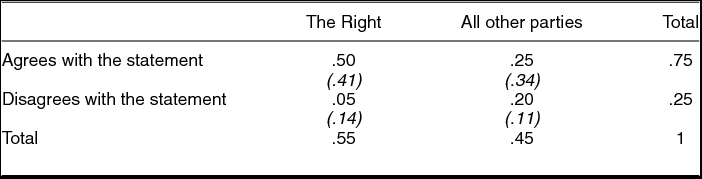
The example in Table 2 shows a party system in which the policy proposal, “immigrants should be required to adapt to the customs of our country,” has 75% support (i = 0.75).Footnote 8 The association of this policy with “The Right” (a party supported by 55% of voters, so that p = 0.55) is clear when comparing observed and expected relative frequencies (the latter are in parentheses). If there were no association between the parties and the policy, we should observe 41% of respondents supporting “The Right” and the policy (with 14% supporting “The Right” but not the policy). Instead, we observe 50% in the top-left cell (f = 0.50), which is nine percentage points higher: Thus, the policy is oversupported within “The Right.” Over- or undersupport can be expressed in terms of generic differential support:
-
d = differential support for a policy within a party (partisanship of the issue)
Party and Policy Support for an “Immigrants Should Be Required to Adapt to the Customs of Our Country” Policy in a Hypothetical Party System

Note: Cells report observed relative frequencies, with expected relative frequencies in parentheses.
This is simply the difference between the observed relative frequency in the top-left cell (f) and the expected relative frequency: d = f − ip. In this case, d = 0.09.
The table also provides information about the opposite policy on the same issue— disagreement with the “immigrants should adapt” statement—which is obviously undersupported within “The Right” (the observed frequency is .05 compared to an expected frequency of .14, so that d = −0.09).
Examining one party at a time, d and i can be computed for all policy pairs associated to each issue statement included in a voter survey. Using them as coordinates, policies can thus be plotted in a party-specific diagram that we call the support-partisanship (SP) diagram.Footnote 9
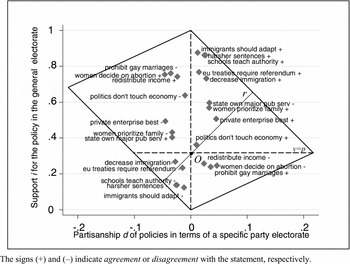
An example of an SP diagram is presented in Figure 1: It is based on actual data for the Spanish Partido Popular using 12 policy statements included in the 2009 EES. For each statement,Footnote 10 we present two simplified policies of agreement or disagreement, each of which may be emphasized in a campaign. Each policy is represented by a dot whose coordinates are defined by its levels of partisanship d (x-axis) and support i (y-axis). Whereas partisanship is obviously party dependent (leading to a separate diagram for each party), overall policy support is party independent.
Support-partisanship diagram for 12 policy statements: Partido Popular (Spain). Data source: EES 2009.

Figure 1 also contains a diamond expressing logical constraints: Given the share of respondents who support a party, policy dots cannot lie outside the inner region delimited by the diamond, whose borders can be identified through the method of bounds.Footnote 11 It is also worth noting that, given the equations of the four borders (see the Supplemental Appendix), the y-coordinate of the right corner of the diamond corresponds to p (the size of the party), whereas the y-coordinate of the left corner corresponds to 1 − p.Footnote 12
Such a representation is particularly instructive when partitioning the diamond into four quadrants defined by the vertical axis (x = 0) and a horizontal line drawn at y = p. The vertical line distinguishes between policies that are under- or oversupported within the party electorate (and therefore positively or negatively associated with it). The horizontal line distinguishes policies in terms of the size of their support base. Above the line, policy support is higher than party support; below the line it is lower.
Combining these two criteria yields a typology of policies in terms of risks and opportunities for a party, with each type corresponding to a quadrant of the diagram:
I (top right): “bridge policies.” These enjoy larger support than from the existing party base and are also positively associated with the party (they are oversupported within the party). Because they offer the opportunity to gain votes without losing many present supporters, they may serve as “bridges” between the party and potential new voters. They are particularly appealing for election campaigns and should receive the most emphasis.
II (top left): “venture policies.” These have an overall support that is larger than the existing party base, but are negatively associated with the party (they are undersupported within the party). Such policies still provide an opportunity to gain votes, but with a high risk of losing a significant share of the party base. Parties that emphasize such issues go on a “venture” with uncertain prospects. Average emphasis should thus be lower than for bridge policies.Footnote 13
III (bottom left): “dead-end policies.” These have less support than the party and are negatively associated with the party base. Emphasizing such policies would only damage the reputation of a party without providing particular benefits. To avoid the “dead end” of such policies, parties should barely emphasize them in their election campaigns.
IV (bottom right): “pamper policies.” Finally, these policies enjoy less support than the party, but are positively associated with it. An emphasis on such policies would not win over new voters (and would perhaps alienate some present supporters), but could reaffirm the party's identity. Such policies may serve to “pamper” the party faithful. Average emphasis should thus be lower than for bridge policies, but higher than for dead-end policies.
To see the real-world implications of this typology, consider again the Spanish Partido Popular (PP; Figure 1). The issues in the middle of the “bridge” quadrant (expected to receive the greatest emphasis) coincide with some of the main policies traditionally associated with the PP: traditional gender roles (“women prioritize family +”), but primarily economic liberalism (“private enterprise best +” and “state own major public services –”). Such policies spurred the electoral success of PP leader Aznar (in office 1996–2004) and were essentially kept intact even by his socialist successor Zapatero (who chose to emphasize discontinuity on civil rights issues, rather than on the economy). Conservative attitudes on abortion and gay marriage (the latter legalized by Zapatero in 2005) lie in the “pamper” quadrant for the PP: These attitudes might please PP loyals, but they are minoritarian in Spanish society, with levels of support even lower than the PP support share. Paradoxically, a vote-maximizing strategy for the PP might be to make a U-turn on such policies (embracing liberal positions on civil rights) toward the majority of Spanish voters. However, this move would clearly exemplify a “venture” policy (top-left quadrant) that would attract new voters while jeopardizing its existing electorate.
DATA, MEASUREMENT, AND METHODS
Testing our general hypothesis of differences in policy emphasis between the four policy types required two parallel data sources: (1) mass survey data to measure the distribution of policy support and party preference and (2) party data to measure policy emphasis. Because our theory of party competition is highly general, we required evidence to support it under a range of diverse conditions. Our aim therefore was to test the model for as many countries, issues, parties, and voters as possible.
An appealing comparative dataset was collected by the PIREDEU project (http://www.piredeu.eu) during the 2009 European Parliament (EP) elections. Although the EP is the supranational legislature of the European Union (EU), its elections are organized on a national basis and contested by the regular national parties. Using this dataset allowed us to study electoral competition in all EU member states (27 in 2009) using data for 150 parties and more than 27,000 voters.
PIREDEU's voter component is the European Election Study 2009 (EES), consisting of 27 identical representative national surveys. These data served to construct our independent variables. The partisan dimension was measured by vote intention in national elections.Footnote 14 The support dimension was measured by responses to a battery of 12 Likert items, each corresponding to one of the policy statements summarized in Figure 1.Footnote 15 These items were asked consistently in all EU member states, making the EES a superior choice to other large-scale comparative surveys. The same advantage applies to our party dataset, the Euromanifestos Project 2009, which we used to construct our dependent variable. This dataset contains codings of national party manifestos for the EP elections. From these texts, “quasi-sentences” are extracted and allocated to a large number of political issues. Our indicator of emphasis was the standard measure widely used and verified in empirical research: the percentage of quasi-sentences of the overall manifesto. This fits our purpose, because party manifestos are strategic documents that provide “direct evidence of the declared salience of issues for political parties in electoral competition” (Marks et al. Reference Marks, Hooghe, Steenbergen and Bakker2007, 27).Footnote 16
Strictly speaking, we used temporally successive information (support/partisanship measured in the voter survey) to estimate a temporally antecedent variable (issue emphasis in the manifestos, published before the elections). However, our aim was not to predict changes of party strategy in reaction to changing voter constellations, but to validate a model of the latent risk/opportunity structure that informs party strategy. This approach is supported by the choice of Euromanifestos for the measurement of issue emphasis. Elections to the European Parliament have long been considered “second-order” contests with low public awareness and limited campaign efforts (Reif and Schmitt Reference Reif and Schmitt1980). Using these election data ensured that the potential confounding effect—that of manifesto content on public opinion—was circumstantial at most.
The EES data also have other advantages: They provide excellent “windows into the national political processes” (Van der Brug, Franklin, and Tóka Reference Van der Brug, Franklin and Tóka2008, 589). Although the supranational function of EP elections may be thought to bias the relationship between voting behavior and party strategy, their “second-order” nature implies that any such noise is very limited. Domestic politics, and not matters of European integration, has dominated the public agenda in EP elections.Footnote 17 Overall, then, the EES offers all advantages of a standardized election survey and permits analysis of electoral politics in diverse contexts at the same time. To exploit the wealth of these data thoroughly, we applied a multilevel modeling strategy (see the later discussion).
Turning to operationalization, a valence issue may be either characterized by wide agreement or by wide disagreement (as discussed for Table 2). Because valence (or any degree of quasi-valence) may refer to either of the two, we measured emphasis separately for the two sides of each issue. The coding of the manifesto items accommodated this approach, recording a positive and a negative category separately for each issue.Footnote 18 We analyzed the two sides as alternative policies on the same issue.
We then matched the policy items derived from the manifesto data to the Likert scales from the voter survey. To avoid selection bias we included all EES issues, even when conceptual matching was problematic (tests on restricted policy sets showed less error and stronger effects). Our choices are documented in the Supplemental Appendix.
A First Empirical Test
Before delving into more systematic modeling, let us demonstrate how our data support the policy typology described earlier. Mean policy emphasis in the four quadrants of the SP diagram is in the expected order: It is highest for bridge policies (.96), followed by venture policies (.54), pamper policies (.12), and finally dead-end policies (.08).Footnote 19
These findings are reassuring. Our basic theoretical intuition allows us to categorize policies according to their strategic value in party competition. The only partial exception is the relatively low value of emphasis for pamper policies, which we expected to be closer to that of venture policies. However, this result is caused by the nature of our simple typology: By focusing on differences between the quadrants, it ignores potentially large variation within each quadrant. In the SP diagram, most pamper policies are located closer to the dead-end quadrant than to the bridge quadrant, whereas the opposite is the case for venture policies. Given this distribution, the typology is fully supported by the data. More generally, however, this preliminary analysis calls for a more accurate quantification of the SP diagram that reflects the whole variance of the data. This is the subject of the next section.
A Summary Measure of Risks and Opportunities: Issue Yield
Earlier we presented issue yield as a summary of the combination of risks and opportunities offered by a policy to a party. We now turn to the development of an appropriate operational definition for this concept. Based on our theoretical considerations and preliminary findings, the first requirement for a numeric index is that it reaches its maximum for typical bridge policies in the top-right quadrant, and its minimum for typical dead-end policies in the bottom-left quadrant. However, no party would ever fully identify with a proposed “bridge policy,” in the sense that its new electorate would coincide exactly with the electorate supporting the policy. Parties do not lose their existing identity just because they propose a new policy, nor do they aim to do so. Instead, policies send signals to the electorate: For example, a large conservative governing party may advertise its favorable position toward a “harsher sentences” policy to signal a tough stance on crime. This does not mean that this position will become the only goal of the party, nor does it imply a massive securitarian turn on other issues. In other words, we suggest that policies are used to advertise a future direction of the party in terms of the new electorate(s) it wants to attract.
These considerations can be expressed using a vector framework. In Figure 1, the signal transmitted by a policy emphasis can be described by a vector (with its direction and magnitude) that connects the origin O to the location of the policy. O represents a “neutral” policy emphasis: A policy located at O is neutral in terms of partisanship (equally supported within and outside the party base) and in terms of overall support (equal in size to the party's support base). In relation to this neutral point, an emphasis on, for example, the “private enterprise best +” policy of Figure 1 (a typical bridge policy) goes in the direction of both satisfying the party base and reaching new voters, whereas an emphasis on the “women prioritize family –” policy (a venture policy) goes in the risky direction of reaching new voters but dissatisfying the party base. Similar considerations apply to issues in the other quadrants.
For operational purposes, the direction of a policy emphasis has to be assessed in relation to a reference line. The choice we deem obvious for this line is the bisector of the top-right quadrant (denoted by r in Figure 1), because it best expresses the characteristics of a bridge policy. Policies on this reference line most effectively combine attention to the party base with an attempt to reach a new electorate.
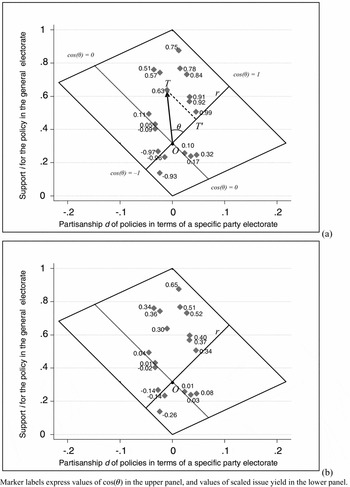
Once the reference line is identified, mathematical expressions for the direction and magnitude of each policy emphasis vector can be derived using simple trigonometry. In Figure 2a, which shows a selection of the policy points of Figure 1, the direction of a policy emphasis is identified by the angle θ between the reference line r and the vector
 $\overrightarrow {OT}$
describing the signal of an emphasis on policy T. In conceptual terms, this angle describes different types of policies. Although, by definition, θ = 0° identifies a typical bridge policy, values of θ of 90°, 180°, and 270° correspond to typical venture, dead-end, and pamper policies, respectively. In operational terms, the most intuitive way to translate this angle into a meaningful index is its cosine, which ranges from +1 for an optimal issue (lying on the reference line in the top-right bridge policies quadrant) to -1 for the “worst” possible issue (also on the reference line, but in the bottom-left dead-end policies quadrant). Values of cos(θ), our measure of direction, are reported as labels for each policy in Figure 2a.
Construction of the issue yield index, exemplified on the support-partisanship diagram for the Partido Popular (Spain). Data source: EES 2009.

The magnitude of the vector expresses the strength of a signal, in terms of what electorate the party wants to attract. Given that the unit of both axes is vote shares, vector magnitude expresses how different the neutral and destination electorates are. The vertical axis expresses how different they are in terms of size, whereas the horizontal axis expresses how different they are in terms of partisanship. In operational terms, the magnitude of the vector is simply the length of the OT segment, which is calculated, using the Pythagorean theorem, based on the coordinates of O and T.
Direction (expressed by cos(θ)) and magnitude (the length of the vector) contain all the information describing a policy emphasis. However, these quantities alone cannot fully express our hypotheses. For policies in the “bridge” quadrant, we expect a positive relationship between magnitude and policy emphasis: The larger the magnitude (a policy sending a stronger signal in the optimal direction), the more the party should emphasize the policy. But for negative values of direction, we expect the opposite effect: A policy sending a stronger signal in the “wrong” direction should be deemphasized. In other words, we expect an interaction of direction and magnitude, as captured by their product.
The conceptual interpretation of this multiplication is straightforward. Multiplying the magnitude of vector
 $\overrightarrow {OT}$
by the cosine of its angle with the reference line (cos(θ)) simply expresses the (signed) magnitude of the projection of the vector on the reference line, which corresponds to vector
 $\overrightarrow {OT^{\,\prime} }$
. In line with our expectations, the interaction of direction and magnitude expresses that parties will emphasize policies that deviate from the optimal line only as long as they imply some progress in the optimal direction. Our measure of issue yield is therefore defined as the value of this interaction. Thus in general,
 \begin{equation}
{\rm general\ issue\ yield} = \left( {{\rm vector\ length}} \right) \cdot \cos \left( \theta \right)\end{equation}
In a coordinate system originating at O (so that x = f − ip and y = i − p), equation (1) simply yields (proof in the Supplemental Appendix):
 \begin{equation}
{\rm general\ issue\ yield} = \frac{{\sqrt 2 }}{2}\left( {x + y} \right)\end{equation}
This simple preliminary formulation expresses how basic issue yield is proportional to the sum of differential support for the issue within the party, and to overall support for the issue beyond the party's size. The equal weighting of the two coordinates reflects that gaining a new voter has the same a priori importance as keeping an existing one. Importantly, however, we then reparameterize equation (2) in terms of i, p, and f as proposed earlier (x = f − ip and y = i − p) and normalize x and y in terms of their theoretical maximum values (which are party dependent) so as to allow interparty comparisons. Finally we scale the vector projection to a maximum of 1 and obtain (proof in the Supplemental Appendix):
 \begin{equation}
{\rm scaled\ issue\ yield} = \frac{{f - ip}}{{p(1 - p)}} + \frac{{i - p}}{{1 - p}}\end{equation}
This measure of issue yield (whose values are reported in Figure 2b for the example party) expresses a combination of risks and opportunities specific to each party. The normalization of the coordinates reflects that the weight of support increases with party size, whereas the weight of partisanship decreases simultaneously. A large party will dare to emphasize even issues with modest partisanship, because it can afford the risk of losing part of its standing electorate. In contrast, a small party will be more sensitive toward this risk, which may well threaten its electoral future. Relatedly, a small party will discount its chances of actually gaining a larger percentage of the electorate, which is more realistic for a larger party. The normalization translates such different sensitivities into differences of scale.
Issue Yield in a Two-party System
Before proceeding with comprehensive models using all our data, we present a prototype test of our theory. Arguably the most straightforward representation of a situation such as the one shown in Table 2 comes from a two-party system. Although pure two-party systems are rare,Footnote 20 our data do comprise a system that comes close to the ideal type: the Spanish case already used. In 2009, the year our data were collected, the two major Spanish parties, the Partido Socialista Obrero Español(PSOE) and the PP, together commanded 92.3% of the seats in the Congreso de los Diputados (more than Tories and Labour in the British House of Commons). Spain's effective number of parliamentary parties (Laakso and Taagepera Reference Laakso and Taagepera1979) was a mere 2.34. We therefore begin with a simple test that pits the PSOE against the PP.Footnote 21
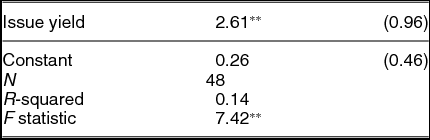
Table 3 shows the results obtained from regressing our dependent variable, policy emphasis, on our issue yield measure. The coefficient of issue yield is positive and highly significant, corroborating our earlier illustration of PP's policies. Substantively, compared to a neutral policy with zero yield, an optimal policy with a yield of 1 receives 2.61 more percentage points of manifesto space. Given that, in Spain, issue yield has an empirical range of 1.38 (1.65 in the entire EES dataset), this effect may seem small; however, to appreciate its importance, one also needs to consider the distribution of the dependent variable, which is rather compact. Mean policy emphasis is 0.72 with a standard deviation of 1.67. A maximum predicted difference of 3.60 (2.61 × 1.38) between low-yield and high-yield policies is therefore quite substantial.Footnote 22
Policy Emphasis Predicted from Issue Yield for the Two Major Spanish Parties

Notes: OLS coefficients with standard errors in parentheses.
** significant at .01; * significant at .05
The value of this simple test lies in its clarity and the low number of modeling assumptions required. However, our theory is neither restricted to two-party systems nor to large parties nor to a single country. Establishing generality is then the task of our comparative analysis of 27 EU countries, the focus of the next section.
A Multilevel Model of Policy Emphasis Based on Issue Yield
Our basic hypothesis, implicit in the previous section, is that policy emphasis can be predicted by the configuration of risks and opportunities summarized by the issue yield index:
-
H1 Issue yield has a positive and significant effect on issue emphasis.
Expectations for the size of the effect are less obvious than for its direction. This is because we propose a new predictor, never tested in previous research. In general terms, we expect the coefficient to be smaller than in our rather stylized case study of Spain (Table 3), but still very substantial, say well above 1.
More decisive evidence in favor of the model would be that issue yield outperforms the various components from which it was constructed. From a technical point of view, these are vector direction and magnitude, the two “constitutive terms” of the yield index.Footnote 23 In a more theoretical sense, issue yield should outperform two prominent common-sense explanations of party strategy: that opportunistic politicians take any stance if there is a majority for it or that politicians are ideologues who only cater to their parties’ interests. These “pure” explanations are contained in the ultimate elements of issue yield: policy support (i), party support (p), and the intersection of the two (f). Ideally, issue yield will subsume these variables and improve on their joint effect. This would mean that issue yield effectively summarizes all the information from i, p, and f that is relevant for predicting party strategy:
-
H2 Issue yield outperforms the added effects of its components: vector direction and magnitude, as well as i, p, and f.
We now test these hypotheses. To utilize the potential of our large dataset, care must be taken in estimating the model parameters. It would be heroic to assume that the effect of issue yield is the same across countries, parties, and issues: There may be variance in the ideological flexibility of different party families, in the meanings of issues across contexts, and in the incentives presented to actors in different party systems. Such heterogeneity could seriously bias the estimates and inflate significance tests. Hierarchical modeling allows us to address the statistical problems involved and to explore substantive variation in the role of issue yield.
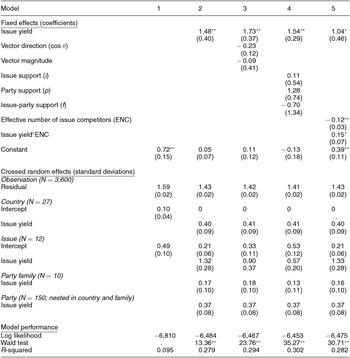
We estimated multilevel models with observations nested within countries, issues, party families, and parties. The term “observation” here refers to a policy emphasis by a specific party in a certain country. The structure of the higher levels is somewhat complex: Parties are nested within countries and party families, but they are crossed with issues—each party contains data for all issues, and each issue contains data for all parties. In a similar way, the other two levels (country and party family) are crossed with issues and with each other. Our model reflected this particular combination of nested and crossed random effects to allow the effect of issue yield to vary in theoretically meaningful ways. We carried out all calculations using Stata's -xtmixed-.
What share of the multilevel variance in issue emphasis should a good model explain? To approach this question, consider that manifesto space as a measure of issue emphasis—although extensively validated in past research—is an abstract concept involving much “random” variation not amenable to theoretical interpretation. Recent analyses of similarly specified dependent variables attest to this variation (Rovny Reference Rovny2012; Wagner Reference Wagner2012a). These models included several predictors (including party-level variables such as issue position and systemic salience) for estimating party emphasis on more general dimensions that aggregate several issues: The variance explained hovered between 0.51 and 0.64. In comparison, we ran our analysis on individual issues, and it relied essentially on a single predictor, which was constructed exclusively from survey data. Expectations of model fit ought to reflect these conditions.Footnote 24
RESULTS
Table 4 presents five nested models. Model 1 includes only random intercepts for country and issue, allowing us to evaluate model fit due to the sheer crossed-level structure. Without any explicit covariate, the model explains 9.5% of the variance in issue emphasis.Footnote 25
Mixed Effects Models of Policy Emphasis, Based on Issue Yield and Its Components

Notes: Standard errors in parentheses.
Significances for fixed effects: ** .01 * .05
Model 3 and 4 also contain random slopes of the respective control variables on the issue level (cf. note 24).
Model 2 adds issue yield (including random slopes at the issue and party family levels). Issue yield has a strong and statistically significant positive effect, which supports H1: Parties place stronger emphasis on policies that present a more favorable configuration of electoral risks and opportunities. Compared to Model 1, the variance explained is nearly tripled (27.9%). Moreover, variation in random intercepts at the issue level is more than halved, and random country intercepts are even so weak that they degenerate to 0. This suggests that issue yield provides a general explanation for what appeared in Model 1 as idiosyncratic country and issue differences.
Model 3 adds vector magnitude and direction as covariates.Footnote 26 Notably, the coefficient of issue yield is unaffected (even somewhat strengthened) by this manipulation, and the coefficients of magnitude and direction are both weak and insignificant. This confirms that the yield index captures the risk-opportunity constellation relevant for party strategy, and it does not require auxiliary variables to calibrate its effect (H2).
A complementary conclusion can be drawn when interpreting issue yield explicitly as the product of direction and magnitude. Issue yield then represents a typical multiplicative interaction. The coefficient of the product term indicates how the effects of the two constitutive terms covary. We expected the strongest effect on policy emphasis to occur when both direction and magnitude take on high values, so we expected the positive coefficient of the interaction term found in Model 3.
In the presence of an interaction term, the coefficients of the two constitutive terms—direction and magnitude—indicate the effect of the respective variable for the case that the other constitutive term (and therefore also the interaction) is zero. It is common practice to include all constitutive terms of an interaction in regression models, as in Model 3. However, the issue yield interaction is a special case that suggests excluding the constitutive terms, as in Model 2. In fact, the literature on interaction effects names three conditions for stand-alone interactions: natural zero points of the constitutive terms, theoretical reasons for expecting these terms to have effects close to zero when the interaction term is added, and empirical verification of this expectation (Brambor, Clark, and Golder Reference Brambor, Clark and Golder2006, 68f.; Kam and Franzese Reference Kam and Franzese2007, 99f.).
Consider how these conditions are fulfilled in the case of issue yield. The weak and insignificant effect of direction in Model 3 means that direction does not matter when magnitude is close to 0. This is the case for neutral policies, which should not elicit party action. The effect of magnitude, however, requires more interpretation. It indicates that the mechanics of the model are somewhat different for venture and pamper policies than for bridge and dead-end policies. Remember that vector direction (cos(θ)) is +1 for the bisector of the top-right (bridge) quadrant of the SP diagram and -1 for the bottom-left (dead-end) quadrant. Thus, direction is 0 for the bisectors of the two off-diagonal quadrants. The weak and insignificant effect of magnitude thus means that magnitude does not matter for typical venture and pamper policies. Emphasizing such policies appears to be a categorical decision. Pamper policies seek sizable minorities by catering to the party faithful, whereas venture policies aim to transform the party by relocating its support base. The categorical nature of these risky choices is readily interpreted when remembering that they contrast gains on one criterion (support or partisanship) with losses on the other. This means that more or less of such a policy signal is not automatically “better” or “worse,” as is the case for bridge and dead-end policies.
Model 4 completes the test of H2 by introducing the original components of issue yield (i, p, and f). The contribution of these variables is very limited, and none of the effects reaches statistical significance. Issue yield still shows a strong and significant effect and therefore passes this second robustness test.
Models 3 and 4 confront issue yield directly with its constitutive terms and components. Alternatively, we can evaluate the performance of the various measures in separate models. In plain OLS regressions, which guarantee comparability, issue yield explains 7.68% of the variance (AIC = 13,623), followed by direction/magnitude with 6.66% (AIC = 13,664) and i/p/f with 6.61% (AIC = 13,668). Given that these models use the same input information, the winning margin of issue yield is quite substantial; it is solely due to the specific aggregation of the input information into the issue yield index. This lends additional support to our expectation in H2.
Consider next how the supersession of i and f by issue yield is interpreted in substantive terms.Footnote 27 Supersession of i shows that—issue yield being constant—parties do not privilege policies with overwhelming support (high i) over more controversial policies (lower i). It is only through the index of issue yield that policy support enters the calculus of policy emphasis. Supersession of f is particularly relevant, because f—a measure of joint party-issue support—can be considered an indicator of issue ownership. Issue ownership thus matters for policy emphasis only through the index of issue yield. Note, however, that f may not be the best measure of party-policy association, because it is strongly dependent on party size. We therefore performed an additional test based on differential support d (see the earlier discussion), which is not affected by party size: A model analogous to Model 2, but with issue yield replaced by differential support d, has an R-squared of 0.138, explaining half the variance compared to issue yield. Party-policy association thus appears to affect the calculus of policy emphasis in a way that is better described by the issue yield model.Footnote 28
Before proceeding to Model 5, let us consider the random effects specification in more detail. Although we can only offer exploratory interpretations at this stage, the empirical patterns shed further light on the operation of issue yield across party families, issues, and countries.
In the bivariate Model 2, the effect of issue yield varies across issues with a standard deviation of 0.21. Cross-level interactions (not shown) indicate weaker effects for currently sensitive areas such as immigration and same-sex marriage, whereas traditional issues like redistribution and law and order show the strongest effects. This suggests that issue yield matters most when not compromised by interfering factors such as delicate alignments with extremist views.
The estimated standard deviation of the issue yield effect between party families is 0.17. Substantively, it seems that “niche parties” (Ezrow Reference Ezrow2010; Meguid Reference Meguid2008) have particularly strong effects. There is no complete consensus about the empirical definition of niche parties, but green parties and nationalist parties are covered by all major studies (cf. Wagner Reference Wagner2012b). These are also the two families with the strongest effects of issue yield, suggesting that policy is indeed the deciding factor in carving out the “niche.”
Country variation (SD = 0.40) revealed generally lower effects of issue yield in the new democracies of Central and Eastern Europe. This finding does not come as a surprise because the foundations of the spatial model—issue representation and voter-party linkages—had to be established almost from scratch after the fall of communism. Notwithstanding such differences, however, issue yield has a positive effect in all countries in the dataset.
Multiparty Competition
To achieve our goal of a general model of party strategy, we made various simplifying assumptions along the way. One concerned the complications posed by multiparty competition. The elements of the yield index were derived from a cross-tabulation that pit the party in question against “all other parties” (Table 2). We thus “collapsed” multiparty systems into artificial two-party systems. Of course, doing so concealed the differences among “all other parties,” with obvious implications for strategizing. In particular, for any given party, some competitors will be ideologically closer than others. They pose a greater risk to the party because its voters may defect to them more readily, but they also offer greater opportunities because the party may more easily poach new voters from them.
To some degree our model takes this degree of ideological closeness implicitly into account. Assuming that potential, ideologically close voters do not differ greatly from the party's present supporters, issues that are popular among the potential voters are assigned high yield. The “bridging capacity” of a policy is thus overproportionally affected by voters who are easily won over. To the degree that their ideological bases overlap, competing parties will fight over the same issues.
But multiparty competition is even more complicated. Ideological differences between parties may be reflected not only in proximity relations but also in distinct identities. If a party traditionally “owns” an issue, it will be hard for others to intrude into its territory. If a competitor mimics the policy position, voters are likely to give the “benefit of the doubt” (Feld and Grofman Reference Feld and Grofman1991; also see Adams Reference Adams1998) to the traditional “owner.” Similarly, a party with a large nonpolicy valence advantage deters competing strategies in its proximity (Schofield and Sened Reference Schofield and Sened2006).
These considerations suggest that strong issue ownership by a competitor will discourage yield-based strategies. A high-yield policy will not attract a party's attention if it is owned by another party (so that the prospects of actually gaining votes are low). Campaign resources are better spent on a policy with somewhat lower yield but less resistance due to ownership.
We tested this expectation through a simple operationalization of issue ownership, based on the distribution of policy supporters across different parties and, in particular, among each party's competitors. If the distribution is biased toward one competitor (i.e., if most voters who support a policy also support this competitor), there is reason to assume that it owns the policy. If support is distributed more equally, competition is open and no party owns the policy. We expect the effect of yield on policy emphasis to be lower in the former case than in the latter case.
-
H3 The effect of issue yield on issue emphasis is stronger where issue ownership is less clear among the party's competitors.
A measure of the distribution of policy support can be constructed in analogy to Laakso and Taagepera's (Reference Laakso and Taagepera1979) effective number of parties (ENP) measure, which counts parties as a function of their vote shares (with large parties weighing more than small ones).Footnote 29 We adapted this measure in two ways. First, we did not use overall vote shares, but rather shares of the support base of each policy. Second, we were interested not in the global number of parties in a system, but in the number of competitors each party faces. Our measure should therefore not be affected by the share of policy support that is “owned” by the respective party itself. Accordingly, we corrected the ENP for each party's contribution. The resulting construct is our measure of the effective number of (issue) competitors (ENC), calculated for each party and each policy.Footnote 30
To test our hypothesis we interacted the ENC with issue yield. We expected a significant positive coefficient for the interaction term, indicating that issue yield matters more for higher ENC (open competition) and less for lower ENC (“ownership” by a competitor).
Model 5 in Table 4 confirms this expectation. For the case in which a party has a single competitor (i.e., when ENC = 1, the likely “owner”), the marginal effect of issue yield is 1.19 (1.04 + 0.15). This is clearly lower than the global effect of 1.49 in Model 2. In contrast, for the observed maximum ENC of about 7, the marginal effect of issue yield is a strong 2.09 (1.04 +7 × 0.15). When there is open policy competition, party strategy is highly structured by issue yield. By analogy, this also indicates that parties spend their resources on policies for which their opponents are vulnerable, whereas they hesitate to attack dominant players.Footnote 31 The crossed-effects specification of issue and country ensures that these results are not mere artifacts of party-system differences but reflect real strategic incentives in party competition.
CONCLUSIONS
We began by suggesting that policy emphasis is a fundamental resource for party competition, especially given the constraints of positional strategies. We then showed how the two main rival frameworks for the analysis of issue competition, the positional model and the valence model, can be encompassed in a single overarching conceptualization. This new framework allows us to predict, from basic information about voter distributions, the policies that parties will stress in their campaigns. Our empirical results demonstrate that the measure of issue yield subsumes several important variables characterizing the party-policy relationship; it also explains variation across party families, countries, and issues and even applies to intense multiparty competition.
In more general terms, issue yield advances the reconciliation and integration of different theoretical frameworks. First, the adoption of level of support as a policy classification criterion (leading to the SP diagram) extends the applicability of the valence framework beyond its conventionally identified policy domains, provided that a policy enjoys strong support. At the same time, the adoption of this dimension reconciles the positional and valence models by reframing them as extremes on the same continuum. Policy issues can then be classified as closer to one model than the other, based on empirical measurement rather than theoretical considerations.
At the same time, we suggest important implications for problems of democratic representation that are inherent in positional and valence competition. Supporting William Riker's intuition, our model shows that multidimensionality is not necessarily a curse for democracy. Rather than subjecting democracy to disequilibria and decision cycles, it allows parties to systematically employ heresthetic strategies, turning specific policy issues into advantageous resources for competition. Such advantageous policies allow parties to gain support for their entire platform (which often includes many less popular policies), thus reducing the complexity of issue competition and escaping the inconsistencies of Downsian models in multidimensional space.
As regards the valence model, our conceptualization highlights a feature that was already clear to Stokes (Reference Stokes and Kavanagh1992): the inherent riskiness of strategies entirely based on valence issues. As evident from the SP diagram, pure valence issues (lying at the diamond's top corner) lack any specific party association. Any valence advantage is inherently instable, because the perception of competence of a given party is inevitably based on evaluations that can change quickly (Stokes Reference Stokes and Kavanagh1992). It is thus understandable why parties might prefer high-yield policies: While enjoying high levels of support, they still have a clear (and stabilizing) partisan character.
Our findings also address the issue ownership model, although our data do not lend themselves to a conclusive test. Our model confirms the importance of issue ownership and clarifies its conditions of applicability. It does matter whether a party is associated with a policy; however, it appears that this is primarily the case for policies whose widespread support provides an opportunity for widening the party base. Issue yield thus subsumes ownership theory to some extent. Future research could flesh out the formal relationship between the two approaches.
More work is also needed to explore the interactions of issue yield. We have modeled how dynamics change under intense multiparty competition, but other factors such as issue saliency and preference intensity may also intervene. Another promising direction is to explore the parallels of issue yield to the concept of “wedge politics” primarily used in the United States: In a two-party system, maximizing the support dimension of one party's platform generally suggests emphasizing issues that divide the other party, but integrating the competitor's voters also compromises the partisanship dimension of other issues. Issue yield offers a strategic solution to this tradeoff.
Time series or panel data may help resolve the question of reverse causation, which potentially affects our results. If voters who prefer a party for some reason tend to adopt its policy positions (be it due to persuasion or mere rationalization), it might seem that electoral strategies are structured by issue yield, whereas in reality issue yield is structured by electoral strategies. Even in our cross-sectional analysis, however, issue yield is not naïve with regard to the direction of causality. If the reverse hypothesis were true, there would be no need for parties to take intraparty opinion into account. They could simply concentrate on majority strategies, and intraparty opinion would follow. This is clearly not what we observed. Instead, we demonstrated that mass opinion and intraparty opinion interactively constrain party strategy. This interaction, as expressed by the issue yield index, captures the logic of policy emphasis in party competition.
SUPPLEMENTARY MATERIAL
To view supplementary material for this article, please visit http://dx.doi.org/10.1017/S0003055414000379







Comments
No Comments have been published for this article.