Introduction
A dysregulated hypothalamic–pituitary–adrenal (HPA) axis is often hypothesized as a key mechanism by which early stress exerts deleterious effects on physical and mental health (Koss & Gunnar, Reference Koss and Gunnar2018; McEwen & Stellar, Reference McEwen and Stellar1993). The HPA axis is one of the core biological stress system responsible for mobilizing energy in stressful contexts in order to cope with stressors and return to baseline levels afterwards (Koss & Gunnar, Reference Koss and Gunnar2018). Its action involves several neuromodulators and hormones, including the glucocorticoid stress hormone cortisol, of which the circadian rhythm is typically characterized by increased levels in the morning with a peak occurring 30–40 min after awakening (the cortisol awakening response or CAR) followed by a gradual decline throughout the day until a minimum is reached, around midnight (Koss & Gunnar, Reference Koss and Gunnar2018). Substantial inter-individual disparities have, however, been noted regarding this circadian pattern of secretion (Smyth et al., Reference Smyth, Ockenfels, Gorin, Catley, Porter, Kirschbaum, Hellhammer and Stone1997). Understanding the relative influence of genetic and environmental factors on individual differences in diurnal cortisol secretion may help to unravel its association and underlying mechanisms with a variety of stress-related psychopathologies (e.g., depression, anxiety and externalizing behaviors; Koss & Gunnar, Reference Koss and Gunnar2018).
Exposure to stress early in life when the brain is ongoing key maturational changes has been proposed to induce long-lasting alterations in HPA axis secretion and regulation processes, as signaled by atypical patterns of diurnal cortisol secretion (Lupien et al., Reference Lupien, McEwen, Gunnar and Heim2009; McEwen & Stellar, Reference McEwen and Stellar1993). Aside from traumatic experiences (e.g., child maltreatment), living in socioeconomically deprived families is conceived as a form of stressful experience that aggregates with many stressful life events (Koss & Gunnar, Reference Koss and Gunnar2018; Tarullo et al., Reference Tarullo, Tuladhar, Kao, Drury and Meyer2020; Young et al., Reference Young, Farrell, Carlson, Englund, Miller, Gunnar, Roisman and Simpson2019; Zalewski et al., Reference Zalewski, Lengua, Thompson and Kiff2016). Previous studies have relied on a variety of indicators to measure socioeconomic status (SES), varying from composites of wealth and prestige (e.g., parents’ education level and income) to wealth only (e.g., parents’ income) or prestige only indicators (e.g., parents’ education level and occupation). Nevertheless, converging evidence suggests that children whose families are lower on the SES hierarchy are more likely to experience greater and more intense levels of psychosocial and physical stress and to show a greater vulnerability to these stressors than their more advantaged counterparts (Dohrenwend, Reference Dohrenwend1974; Evans & English, Reference Evans and English2002). Low-SES households have thus been proposed to reflect a social environment typically encumbered with stressful life events that may induce dysregulations in stress-related neuroendocrine responses (McEwen & Seeman, Reference McEwen and Seeman1999). To date, however, scientific evidence linking socioeconomic strains in childhood or adolescence and diurnal cortisol secretion has been inconsistent, with studies reporting higher (Chen et al., Reference Chen, Cohen and Miller2010; Clearfield et al., Reference Clearfield, Carter-Rodriguez, Merali and Shober2014; Essex et al., Reference Essex, Klein, Cho and Kalin2002; Lupien et al., Reference Lupien, King, Meaney and Mcewen2001), lower levels of cortisol (Chen & Paterson, Reference Chen and Paterson2006; Desantis et al., Reference Desantis, Kuzawa and Adam2015; Zalewski et al., Reference Zalewski, Lengua, Thompson and Kiff2016), as well as nonsignificant findings (Cutuli et al., Reference Cutuli, Wiik, Herbers, Gunnar and Masten2010; McLachlan et al., Reference McLachlan, Rasmussen, Oberlander, Loock, Pei, Andrew, Reynolds and Weinberg2016; West et al., Reference West, Sweeting, Young and Kelly2010; Young et al., Reference Young, Farrell, Carlson, Englund, Miller, Gunnar, Roisman and Simpson2019). One reasons for such inconsistencies might be because previous studies have overlooked potential nonlinear patterns of association between these variables. Findings from a handful of studies suggest that the associations between gradients of socioeconomic strains and cortisol secretion may be nonlinear (Ouellet-Morin et al., Reference Ouellet-Morin, Cantave, Paquin, Geoffroy, Brendgen, Vitaro, Tremblay, Boivin, Lupien and Côté2020; Zalewski et al., Reference Zalewski, Lengua, Thompson and Kiff2016). For instance, Zalewski et al., (Reference Zalewski, Lengua, Thompson and Kiff2016) found that children from both higher and lower income families consistently exhibited a low trajectory of morning cortisol, whereas those who grew up in families with an average income had a more moderate pattern of secretion. This suggests that both lower and higher SES backgrounds might feature factors that increase the risk for a dysregulated cortisol secretion among these children, even though these experiences might diverge (Zalewski et al., Reference Zalewski, Lengua, Thompson and Kiff2016). Alternatively, lower morning cortisol levels may suggest allostatic load among low-SES children, while indicating lower physiologic responsiveness among youth from wealthier families (Zalewski et al., Reference Zalewski, Lengua, Thompson and Kiff2016). Mixed findings may additionally arise because of variations in age range between samples, in how diurnal cortisol was measured, as well as in the nature (i.e., wealth and prestige SES indicators or wealth only or prestige only indicators) and the range of the socioeconomic contexts targeted in these studies, from the most disadvantaged to the wealthiest ones (Bernard et al., Reference Bernard, Frost, Bennett and Lindhiem2017; Bunea et al., Reference Bunea, Szentágotai-Tătar and Miu2017; Fogelman & Canli, Reference Fogelman and Canli2018). Finally, most investigations have failed to acknowledge and adequately control for the confounding effect of the participants’ genetic background when testing the presence and magnitude of these associations.
Substantiated evidence suggests that genetic and environmental factors both contribute to individual differences in cortisol secretion measured in basal and stressful contexts. Findings from an early meta-analysis of twin studies showed that basal cortisol levels are strongly influenced by genetic factors, with heritable factors accounting for 62% of variations in twin cortisol concentrations (Bartels et al., Reference Bartels, Van den Berg, Sluyter, Boomsma and de Geus2003). Given that the heritability of cortisol secretion likely fluctuates across the day, potentially reflecting distinct functions of cortisol as the day goes by, subsequent studies opted to describe the genetic and environmental contributions to cortisol secretion according to distinct indicators across the diurnal cycle. In general, moderate genetic influences are evidenced in cortisol levels in the early morning, whereas stronger environmental influences emerge in the afternoon and evening (Gustafsson et al., Reference Gustafsson, Gustafsson, Anckarsäter, Lichtenstein, Ljung, Nelson and Larsson2011; Ouellet-Morin et al., Reference Ouellet-Morin, Brendgen, Girard, Lupien, Dionne, Vitaro and Boivin2016; Schreiber et al., Reference Schreiber, Shirtcliff, Hulle, Lemery-Chalfant, Klein, Kalin, Essex and Goldsmith2006; Van Hulle et al., Reference Van Hulle, Shirtcliff, Lemery-Chalfant and Goldsmith2012). The CAR is, however, reported to be influenced by both dominant and additive genetic effects and has been found to be under stronger genetic influences than cortisol secreted at awakening and the diurnal slope (Ouellet-Morin et al., Reference Ouellet-Morin, Brendgen, Girard, Lupien, Dionne, Vitaro and Boivin2016). Furthermore, Ouellet-Morin et al., (Reference Ouellet-Morin, Brendgen, Girard, Lupien, Dionne, Vitaro and Boivin2016) documented specific and common sources of genetic variance across different indicators of diurnal cortisol secretion. Specifically, although the contribution of genetic factors to the CAR was largely uncorrelated with awakening cortisol levels and diurnal change levels, there was still evidence of a smaller genetic contribution to the CAR that was shared between these indicators. Evidence of an overlapping nonshared environmental influence was also documented for all three cortisol indicators, which was not the case for shared environmental influences (Ouellet-Morin et al., Reference Ouellet-Morin, Brendgen, Girard, Lupien, Dionne, Vitaro and Boivin2016). These findings concord with prior evidence suggesting that the CAR is a distinct entity within the diurnal cycle and is under different regulatory processes than cortisol indicators capturing pre-and-post awakening cortisol secretion (Clow et al., Reference Clow, Thorn, Evans and Hucklebridge2004; Clow et al., Reference Clow, Hucklebridge, Stalder, Evans and Thorn2010). Put together, studies investigating the SES–cortisol phenotypic association suggest that family SES during childhood and adolescence might play an environmentally mediated role in diurnal cortisol secretion, whereas genetically informed studies underscore the need to also consider participants’ genetic background.
It is well established that genetic and environmental sources of influence do not combine additively but interact together to explain individual differences in diurnal cortisol secretion. For instance, interactions taking place at the DNA level interact with chemicals in the cellular environment (e.g., transcription factors). The presence of gene–environment interactions (GxE) can be investigated in a twin research designs by examining to what extent the relative contributions of genetic and environmental factors vary according to environmental circumstances in which the twins evolve (e.g., family SES). At least two forms of gene–environment interactions could be expected. On the one hand, in line with the Diathesis-stress effect of GxE, the genetic factors related to diurnal cortisol secretion may become expressed to a greater extent in stressful environments rather than in more favorable ones (Shanahan & Hofer, Reference Shanahan and Hofer2005). Evidence in favor of this hypothesis is found in a study where the heritability of morning cortisol was shown to be under strong genetic influence (estimated heritability: 69%) among 6-month-old twins exposed to high family adversity, which encompassed several SES indicators. Morning cortisol levels were otherwise entirely accounted for by unique environments at the lower levels of family adversity (Ouellet-Morin et al., Reference Ouellet-Morin, Dionne, Pérusse, Lupien, Arseneault, Barr, Tremblay and Boivin2009). On the other hand, in line with a suppression effect of GxE, inherited factors may be reduced—or entirely silenced—by environments thought to exert profound organizational effects on brain structures and connections involved in the regulation of the HPA axis activity, especially if these structures are still immature (Lupien et al., Reference Lupien, McEwen, Gunnar and Heim2009; Shanahan & Hofer, Reference Shanahan and Hofer2005). Such a suppression pattern of GxE has been documented for cortisol responses to a novel social situation. Specifically, whereas genetic factors explained 40% of the variance at lower levels of family adversity (e.g., low family income, low maternal education and single parenthood), variations in cortisol reactivity were fully accounted for by shared and unique environmental effects in children exposed to higher levels of adversity (Ouellet-Morin et al., Reference Ouellet-Morin, Boivin, Dionne, Lupien, Arsenault, Barr, Pérusse and Tremblay2008). Collectively, these findings offer provisional evidence that the relative contributions of heritable and environmental factors to individual differences in cortisol secretion may vary as a function of the family environment.
Our understanding of the heritability of diurnal cortisol secretion, including GxE, is, however, limited by the fact that these hypotheses have mostly been tested among young children. It is currently unknown whether these initial GxE findings can be replicated in adolescence for three reasons. First, past studies have noted important changes in basal cortisol levels during the first two decades of life, with lower concentrations observed from toddlerhood to mid-childhood, followed by a transition to higher levels in adolescence (Gunnar et al., Reference Gunnar, Wewerka, Frenn, Long and Griggs2009; Shirtcliff et al., Reference Shirtcliff, Allison, Armstrong, Slattery, Kalin and Essex2012). These processes may be genetically programed, as well as triggered by environmental cues. Second, adolescence is increasingly portrayed as a sensitive period during which embedded patterns of HPA axis activity resulting from earlier stressors can be recalibrated to more closely align with contemporary sources of influences, detrimental and positive ones (Koss & Gunnar, Reference Koss and Gunnar2018). Third, a higher prevalence of emotional and behavioral disorders is noted in adolescence, for which the onset and recurrence are exacerbated by past and concomitant exposure to stress (Kuhlman et al., Reference Kuhlman, Chiang, Horn and Bower2017; Lupien et al., Reference Lupien, McEwen, Gunnar and Heim2009). A closer look at the genetic and environmental contributions to diurnal cortisol secretion in adolescence according to family SES is therefore warranted.
Another aspect that needs to be formally tested, among the same individuals, is whether the developmental timing of exposure to lower family SES (childhood versus adolescence) differentially affects adolescents’ diurnal cortisol secretion and its genetic and environmental contributions. Such an investigation requires the use of repeatedly measured income and education levels to test whether the timing of SES ought to be taken into consideration.
Aiming to address these gaps in knowledge, the present study tested whether childhood (0–5 years old) and adolescence (age 14) family SES are linearly or nonlinearly associated with three complementary indicators of diurnal cortisol secretion: cortisol at awakening, CAR, and the diurnal pattern of secretion, all measured at 14 years of age. Second, we examined whether the relative contribution of genetic and environmental factors to individual differences in these three indicators of diurnal cortisol secretion varies according to family SES, while controlling for the association between SES and cortisol. To best capture the socioeconomic context in which the twins are living, we opted to operationalize SES according to parents’ education and income level.
Methodology
Participants
Participants were part of the Quebec Newborn Twin Study, a sample of twins recruited between 1995 and 1998 in the greater Montreal area. A total of 989 families with twins were contacted after the twins’ birth, of which 662 agreed to participate (68%). Twins were first seen when they were 5 months of age and then prospectively assessed for a variety of children and family characteristics. The families were comparable to another sample of single births in the province of Québec. At the time of their children’s birth, 95% of parents lived together, 44% of the twins were the firstborn children, 66% of mothers and 60% of fathers were between 25 and 34 years old and 17% of mothers and 14% of fathers had not finished high school. Also, 28% of mothers and 27% of fathers held a university degree, 83% of the parents were employed, 10% of the families received social welfare or unemployment insurance and 30% of families had an actual income of <$30,000. During the twins’ preschool years and adolescence, between 16% and 28% of families reported income levels below the low-income cut-offs (LICOs), defined by Statistics Canada (2016) as an income-to-need threshold below which a family will have to spend a larger proportion of its income on necessities in comparison to the average Canadian family (For more information, see Supplementary Table 2). Most families were Whites (86%), 6% were Blacks, 6% were Asians and .3% were Native North Americans. Zygosity was assessed by using 8–10 highly polymorphous genetic markers. Twins were diagnosed as monozygotic when concordant for all genetic markers. When genetic material was insufficient or unavailable due to parental refusal (43% of cases), zygosity was determined based on physical resemblance questionnaires at 18 months and again at age 9 (Spitz et al., Reference Spitz, Carlier, Vacher-Lavenu and Reed1996). The comparison of both methods in a subsample of 237 same-sex pairs revealed a 94% correspondence rate (Forget-Dubois et al., Reference Forget-Dubois, Pérusse, Turecki, Girard, Billette, Rouleau, Boivin, Malo and Tremblay2003). The present study focuses on valid cortisol data collected at 14 years of age [Mean(SD) = 14.0(.3)] and the SES indicators collected from 5 months to 14 years among 592 twin pairs [280 monozygotic (MZ), 204 same-sex dizygotic (DZ) and 108 mixed-sex DZ twin pairs] from whom most (74%) had collected saliva at each of the four collection days (for more information, see Ouellet-Morin et al., Reference Ouellet-Morin, Brendgen, Girard, Lupien, Dionne, Vitaro and Boivin2016).
Procedures
Letters detailing the objectives of the study were sent to the families, followed by a home visit. After informed consent from the parents and assent from the participants were obtained, the research assistants explained the saliva collection protocol, which consisted in sampling saliva at four-time points during the day (at awakening, 30 min later, late in the afternoon and bedtime) on four collection days (Tuesdays and Thursdays on two consecutive weeks) and the fulfillment of an interview-based questionnaire by the twins and their parents. The research assistants made sure that the participants and (their parents) were familiar with the material before leaving. The families were visited a second time to gather the saliva tubes. All instruments and study procedures were approved by the Ethics Committee of the Ste-Justine Hospital Research Center.
Measures
Childhood and adolescence family SES were derived from questions enquiring information about the parents’ highest educational level and family income during the twins’ preschool years (several assessments between 5 months and 5 years of age) and once more at 14 years of age. An index capturing parents’ highest educational level during the twins’ childhood and adolescence, respectively, was computed for mothers and fathers. A score of 0 was attributed to those who had a high school diploma or less and a score of 1 was attributed to those with a postsecondary diploma. Family income was reported in categories when twins were 5 and 18 months, and again at 2.5, 4 and 14 years, and ranged from 0 to
 $ \ge $
$80,000. The categorical response options were averaged to create an averaged family income during childhood [Mean (SD) = 4.46 (1.92), corresponding to $40,000 to $49,999 on average] and adolescence [Mean (SD) = 3.06 (1.49), corresponding to $60,000 to $80,000 on average]. Due to the negatively skewed distribution of family income, the distribution was then partitioned into five groups to lessen the distribution asymmetry and avoid cells with few participants, as this would generate biased estimates in the subsequent analysis. Information about the highest parental educational level and family income were included in a confirmatory factor analysis (CFA) to derive robust and cohesive indicators of latent childhood (0–5 years old) and adolescence (age 14) SES, respectively. Good model fit and parsimony indices are generally suggested by a nonsignificant chi-square statistic χ2, a comparative fit index (CFI)
 $ \ge $
.9, a root mean square error of approximation (RMSEA) < .08 and a weighted root mean square residual (WRMR)
 $\; \le \;$
1. Adequate model fit was found in childhood [χ2(2) = .000, p = .001; RMSEA = .00; CFI = 1.000; TLI = 1.000; WRMR = .004] and adolescence [χ2(1) = .000, p = .001; RMSEA = .000; CFI = 1.000; TLI = 1.000; WRMR = .005]. The childhood and adolescence standardized SES estimated factors [childhood SES: Mean (SD) = −.05 (.53); adolescence SES: Mean (SD) = −.03 (.71); see Supplementary Figures 1 & 2 for more information] were saved to be included in the genetic modeling described below.
Cortisol
Participants were provided saliva tubes, instructions for collection and diaries to report the exact times the twins collected the samples (supervised by their parents). Saliva samples were first placed in the participants’ refrigerator during data collection days. They were then stored in freezers at −20o C in the laboratory until cortisol determination completed using a high sensitivity enzyme immune assay kit (Salimetrics® State College, PA, Catalog No. 1-3102). Frozen samples were brought to room temperature to be centrifuged at 15,000
 $ \times $
g (3000 rpm) for 15 min and were analyzed on 96-well plates. The range of detection for this assay was between .007–3 µg/dl (.19–82.76 nmol/L) and the intra- and interassay coefficients of variation were 4.8% and 8.2%, respectively. Of the possible 9,472 saliva samples from 592 participants, 2037 (21.05%) were missing due to participants lapses, insufficient saliva collection or technical problems (on average, 25.2% were missing at awakening, 17.7% at +30 min, 8.7% at the end of the afternoon and 25.95% in the evening). Systematic missing data analysis indicated that cortisol data was not missing completely at random [
 $\chi $
2(7) = 22.20, p = .002]. DZ twins and those reporting more severe depressive symptoms at age 13 years were less likely to have participated in saliva collection (awakening cortisol [
 $\chi $
2(2) = 45.65, p = .001], CAR [
 $\chi $
2(2) = 36.42, p = .001], diurnal slope [
 $\chi $
2(2) = 46.69, p = .001]). We identified 75 cortisol samples (1%) with a value greater than 3 times the SD above, which were then winsorized. Participants were considered “compliant” if their awakening and +30 min samples were separated from at least 20 min and less than 40 min, the awakening collection was completed within the first 15 min following awakening and not distinct between the twins (
 $ \le $
8 min). A total of 8.61% of the samples were discarded due to noncompliance to the collection protocol. The final sample included 569 participants. Cortisol values were converted from µg/dl to nmol/L (i.e., multiplied by 27,588) and natural log-transformed prior to data analyses.
Creating aggregated indicators of cortisol secretion across several days is recommended when examining individual characteristics or experiences in relation to cortisol levels (Adam & Gunnar, Reference Adam and Gunnar2001). To this end, three distinct indicators were derived: the CAR, the awakening and the diurnal change levels. As has been done previously (Adam et al., Reference Adam, Hawkley, Kudielka and Cacioppo2006; Badrick et al., Reference Badrick, Kirschbaum and Kumari2007), the CAR was derived separately from the diurnal slope calculations because of previous reports suggesting that the CAR is regulated by different neurobiological and genetic mechanisms than cortisol secreted later in the day (Clow et al., Reference Clow, Hucklebridge, Stalder, Evans and Thorn2010; Ouellet-Morin et al., Reference Ouellet-Morin, Brendgen, Girard, Lupien, Dionne, Vitaro and Boivin2016). First, the CAR was calculated for each day of saliva collection by subtracting the awakening level from the one collected 30 min later. Second, growth curve analyses using mixed modeling for longitudinal data were carried in order to capture the cortisol diurnal rhythm at each collection day by estimating the mean level of cortisol at awakening (intercept) and the change that took place afterward (slope). To this end, an unspecified curve model was chosen to allow for slightly varying assessment times between individuals and obtain an optimal estimate of change without imposing any particular shape of change across individuals (Duncan et al., Reference Duncan, Duncan, Alpert, Hops, Stoolmiller and Muthen1997). Of note, the diurnal slopes were modeled according to time-since awakening. The model contained both fixed and random estimates, corresponding to the parameters’ mean and variance between individuals. The fixed unstandardized beta estimate (means) of each collection day varied from 20.81 to 21.09 for the intercept and from −.89 to −.93 for the slope. The random unstandardized beta estimates (variance) of each collection day varied from 11.60 to 17.85 for the intercept and from .05 to .08 for the slope (see Ouellet-Morin et al., Reference Ouellet-Morin, Brendgen, Girard, Lupien, Dionne, Vitaro and Boivin2016 for additional information). Models were fitted in Mplus Version 6.11 using maximum likelihood estimation and the COMPLEX option adjusting standard error estimates to correct for the non-independence of observations. Growth curve models confirmed the expected progressive decrease of cortisol levels from awakening to evening (Brendgen et al., Reference Brendgen, Ouellet-Morin, Lupien, Vitaro, Dionne and Boivin2017). Third, we tested whether the estimates of the intercepts (awakening cortisol levels), slopes (diurnal change levels) and CAR were affected by a wide range of individual characteristics that have previously been identified to potentially affect diurnal cortisol secretion (e.g., sexual maturity, menstruation for girls, sex, medication use and health-related characteristics such as cold, fever, allergies). Only a few (i.e., sex, awakening time, hours of sleep, sleeping problems, exercises and alcohol or drug consumption) were uniquely associated with at least one indicator and were thus statistically accounted for in the subsequent analyses. Fourth, the four intercept estimates (one for each collection day) were included in a CFA to derive an indicator free from day-specific variation. Similar CFAs were conducted for the slope and CAR estimates. The CFAs confirmed that the respective estimates derived from each collection day could be grouped into three global factors: CAR [χ2 (2) = 1.95, p = .38; RMSEA = .00; CFI = 1.00; SRMR = .03], intercept [χ2 (1) = .002, p = .96; RMSEA = .00; CFI = 1.00; SRMR = .00] and slope [χ2 (1) = .007, p = .93; RMSEA = .00; CFI = 1.00; SRMR = .00].
Statistical analyses
Univariate genetic modeling
Genetic modeling using twin design allows to examine the relative magnitude of latent genetic and environmental contributions to any given phenotype (Neale & Cardon, Reference Neale and Cardon1992). By comparing the degree of similitude (i.e., intra-pair correlations) between MZ twin pairs who share approximately 100% of their genetic background and between DZ twins who share, on average, 50% of their genetic makeup, sources of variance in a phenotype can be partitioned in terms of additive genetic effects (A), non-additive or dominance genetic effects (D) as well as shared (C) and non-shared environmental effects (E) (Neale & Cardon, Reference Neale and Cardon1992). Additive effects refer to the independent effects of genes, whereas non-additive influences denote the effects due to the interaction between alleles of the same locus (dominance) or located at different loci (epistasis). Second, environmental influences include shared environmental effects that make siblings alike (C) and nonshared environmental effects that make siblings dissimilar (E). Additive genetic effects are denoted by a MZ intra-pair correlation that is up to twice the DZ intra-pair correlation. Higher MZ intra-pair correlation may suggest dominance genetic effects. A crude estimate of the relative contribution of shared environmental factors can be evaluated by subtracting the MZ intra-pair correlation from twice the DZ intra-pair correlation. Non-shared environmental effects are expected when the MZ intra-pair correlation is less than 1. Any measurement error is captured in the E variance component.
Structural equation modeling using a maximum-likelihood fit function allows a more precise estimation of the relative contribution of genetic and environmental parameters with their respective confidence intervals (CI), which enables the test of the statistical significance of these estimates (Neale & Cardon, Reference Neale and Cardon1992). To this end, a two-group model is fitted to the data where (1) the latent genetic correlations between the twin pairs are constrained to 1.0 for MZ twins and to .50 (to estimate latent additive genetic effects) or to .25 (to estimate dominance genetic effects) for DZ twins; (2) correlations of latent shared environmental influences between the twins of the same pair are fixed to 1 for MZ and DZ twins; and (3) the nonshared environmental intra-pair correlation are fixed to zero for MZ and DZ twins. The estimated coefficients a, d, c, e provide information about the relative contribution of the latent factors A, D, C, E to the total variance of each phenotype P, with the variance of P = a2 + d2 + c2 + e2. Given that the estimation of c and d both rely on the same information (i.e., difference between the MZ and DZ within-pair correlations), it is not possible to estimate these parameters in the same model in a typical twin reared together study design (Neale & Cardon, Reference Neale and Cardon1992). Therefore, we tested separate ACE and ADE models for each of the three cortisol indicators. Mixed-sex twin pairs were excluded from these analyses because their pattern of intra-pair correlations differed from that found for same-sex twin pairs (See Supplementary Table 3 in the Supplement). Using nested χ2-difference tests, the full ACE (or ADE) model was compared to more restrictive models, which allowed to determine the best fitting and more parsimonious models in addition to the significance and estimated values of the a, d, c and e parameters, as well as the significance of the nested χ2-difference tests. Non-significant χ2-statistic, lower AIC and BIC and RMSEA < .08 indicate good models fit and parsimony.
Univariate models testing the genetic and environmental interaction (GxE)
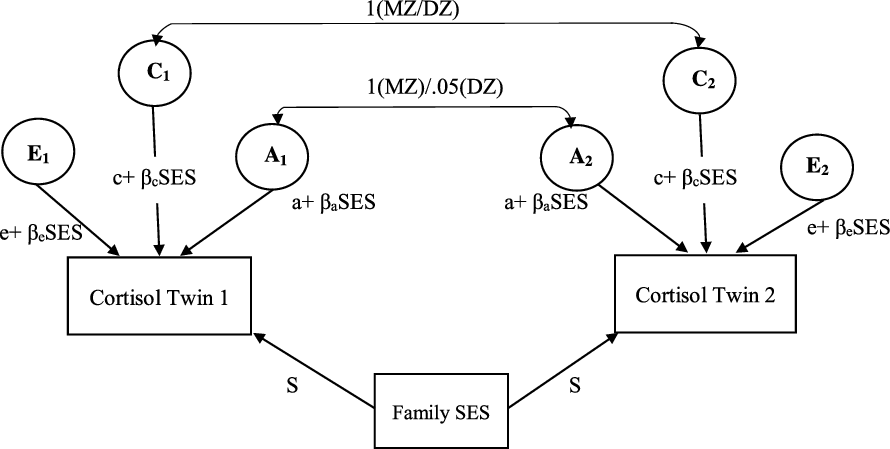
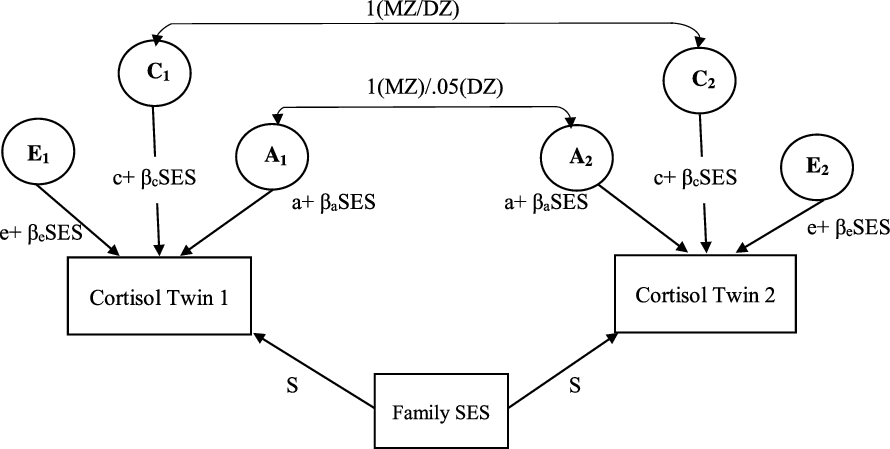
To examine whether SES interacted with the genetic and environmental factors estimated for each of the cortisol indicator, taken separately, we expanded the univariate model to allow for each of the latent factor (A, C or D and E) to interact with SES (measured variable). As illustrated in Figure 1, the coefficients a, c (or d) and e represent the main effects of the latent factors A, C (or D), E, respectively, whereas the coefficients βaSES, βc(or d)SES and βeSES allow for the estimation of the interactions between SES and A, C (or D), E latent factors. The s coefficient represents the main effect of SES on a given cortisol indicator. Of note, model parameters from the best fitting univariate models were used as the starting point of the univariate GxE analyses. All of the genetic analyses were conducted in Mplus Version 8.1.6.
Univariate moderation model.
Results
Prospective and concurrent associations between the main study variables
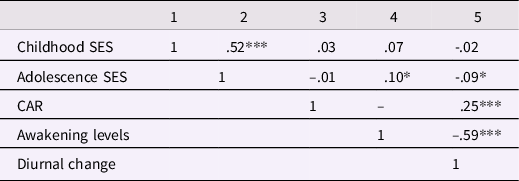
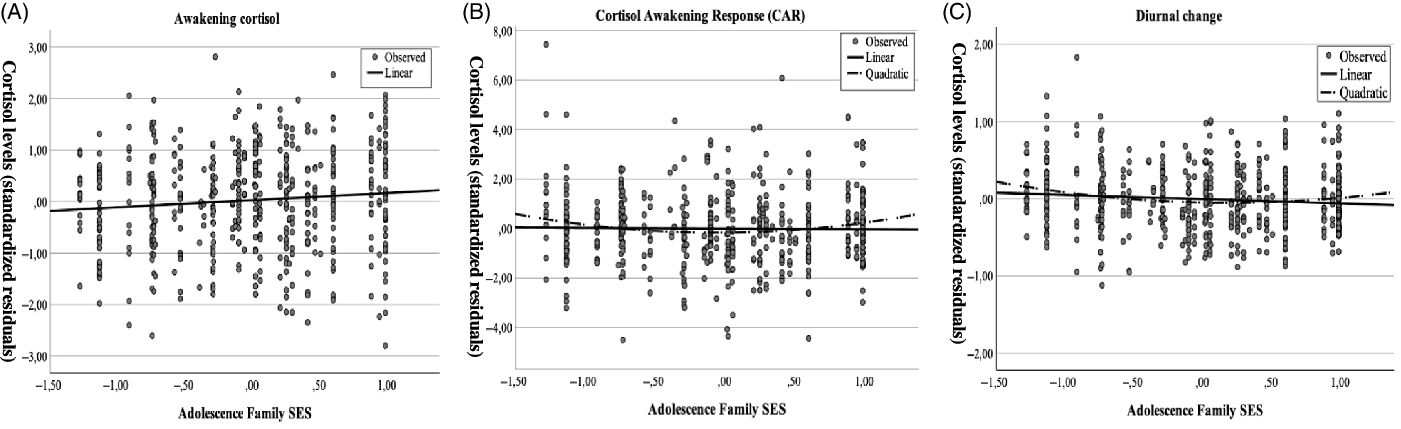
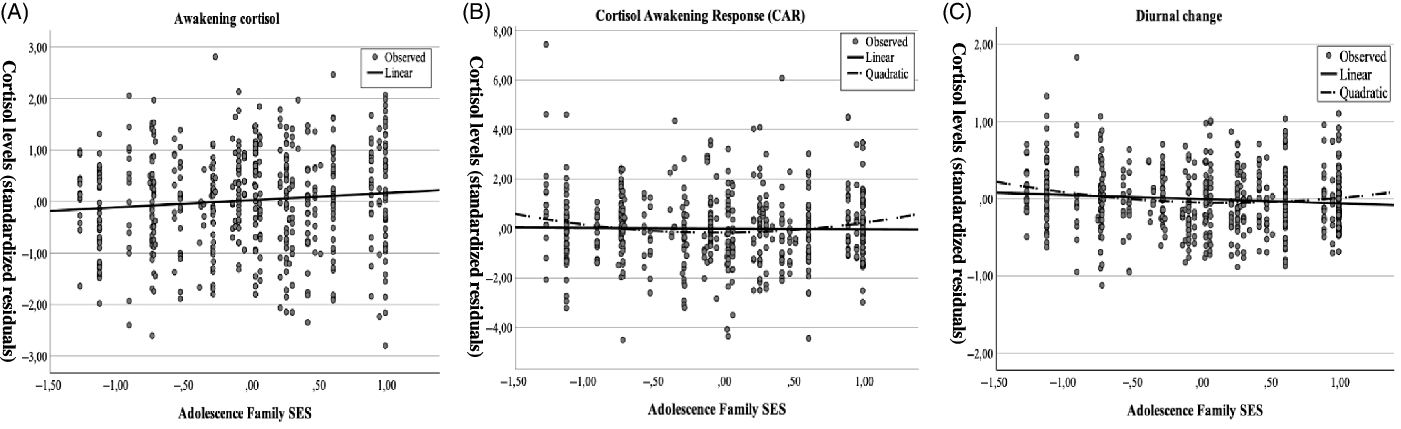
As shown in Table 1, a moderate-to-strong correlation was noted between SES levels derived from information collected during childhood and adolescence, suggesting stability of this indicator over time, but also that changes occurred during this period. Furthermore, analyses revealed that childhood SES was not significantly associated with adolescents’ CAR, awakening cortisol or diurnal change levels. However, a significant correlation emerged between adolescence family SES and awakening cortisol levels, indicating that adolescents living in wealthier families had higher awakening cortisol levels (See Figure 2, Panel A). While no linear associations were detected between adolescence family SES and the CAR, nonlinear associations were observed with the CAR [R 2 = .01, F = 3.09, p = .05] and diurnal change levels [R 2 = .02, F = 5.50, p = .004]. As illustrated in Figure 2 (Panel B & C), adolescents growing up in lower or higher SES families both exhibited a higher CAR and a flatter diurnal slope in comparison to adolescents from families with average levels of SES (depicted by a standardized score of zero). The nonlinear associations linking adolescence family SES to the CAR [R 2 = .02, F = 3.34, p = .02] and diurnal change levels [R 2 = .02, F = 3.36, p = .02] were observed over and above the effects of childhood SES. As for the awakening cortisol levels, the previously detected linear association was significant at a trend level [R 2 = .01, F = 2.85, p = .06] once the putative effect of childhood SES was controlled.
Phenotypic (linear) correlations between childhood and adolescence SES and the cortisol outcomes
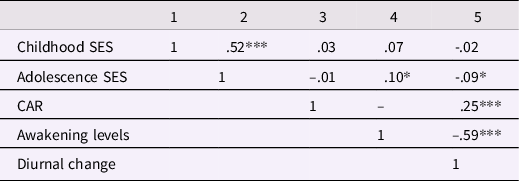
Notes. CAR = Cortisol awakening response; *** = p ≤ .000; ** = p ≤ .01; * = p ≤ .05.
Linear and nonlinear associations between adolescence family SES and awakening cortisol (A), CAR (B), and diurnal change (C).
Do the genetic and environmental contributions to awakening cortisol levels vary according to childhood or adolescence SES?
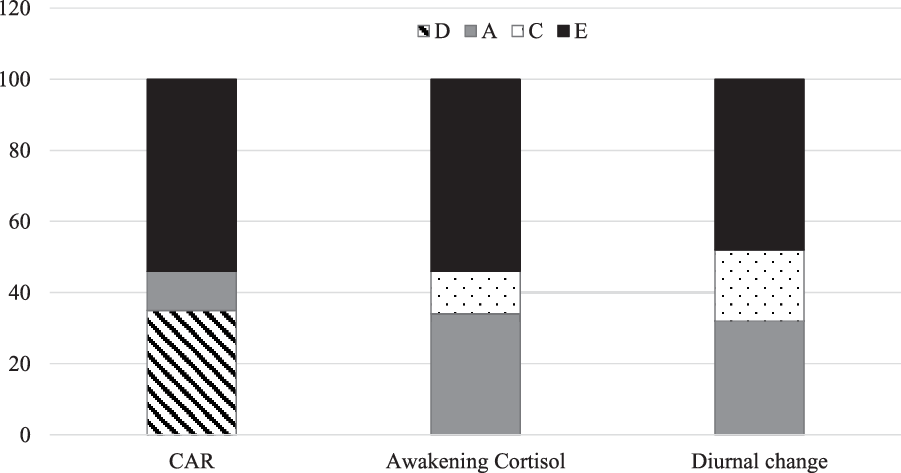
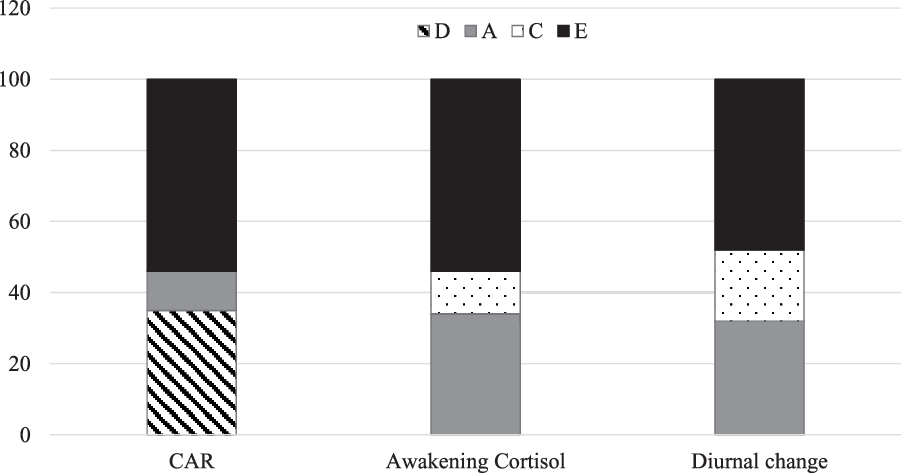
Based on the AIC, the BIC and the χ2-difference test, the nested univariate analyses suggested that individual differences in awakening cortisol levels were best characterized by an AE model (See Supplementary Table 1). The ACE model was nonetheless selected because the RMSEA was comparable in the ACE and AE models and the latent factor C explained a non-negligible portion of the variance of this phenotype (12%). The remaining part of the variance was accounted for by additive genetic (34%) and unshared environmental factors (54%; See Figure 3). This suggests that—beyond the moderate influence of genetic factors—environmental factors that either enhanced or reduced the twins’ similarity in cortisol secretion at awakening were involved, albeit to a different degree.
Proportion (%) of variance explained by the dominance genetic, additive genetic, shared environmental and nonshared environmental factors for the CAR, awakening cortisol levels and cortisol diurnal change.
Note. D = dominance genetic factors; A = additive genetic factors; C = shared environment factors; and E = unshared environmental factors.
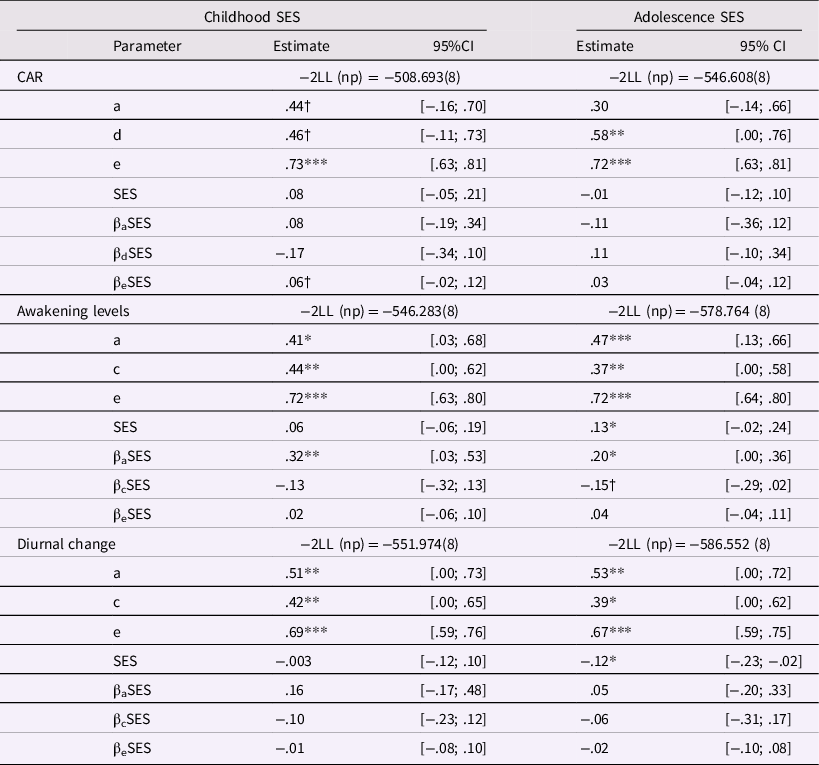
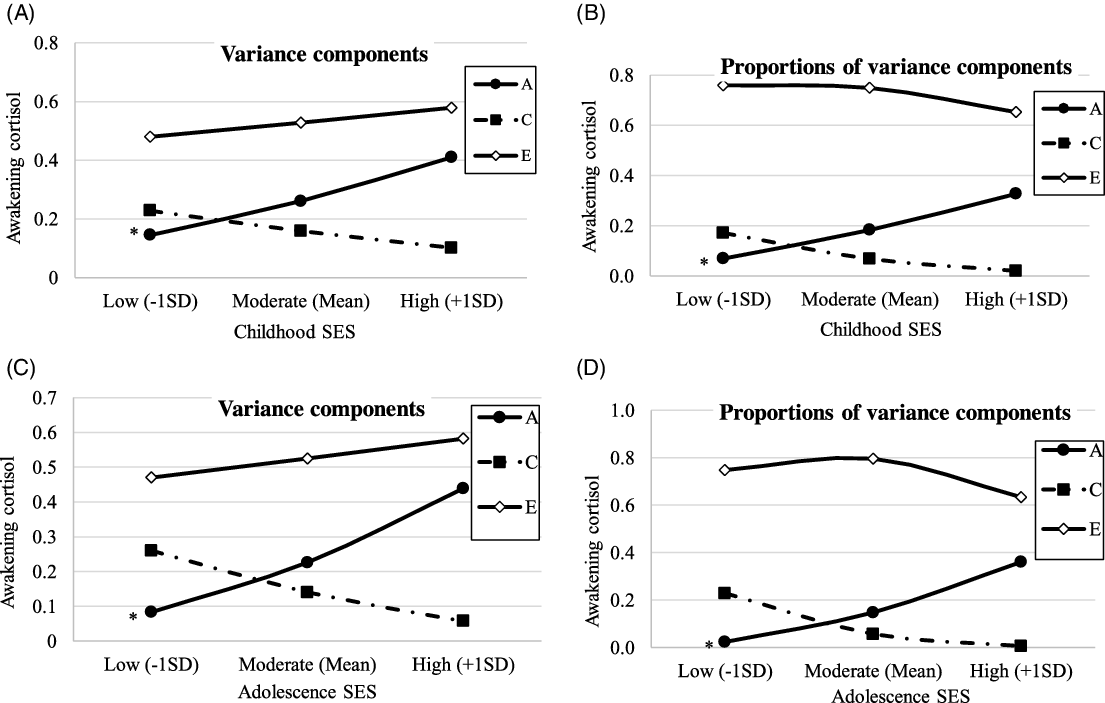
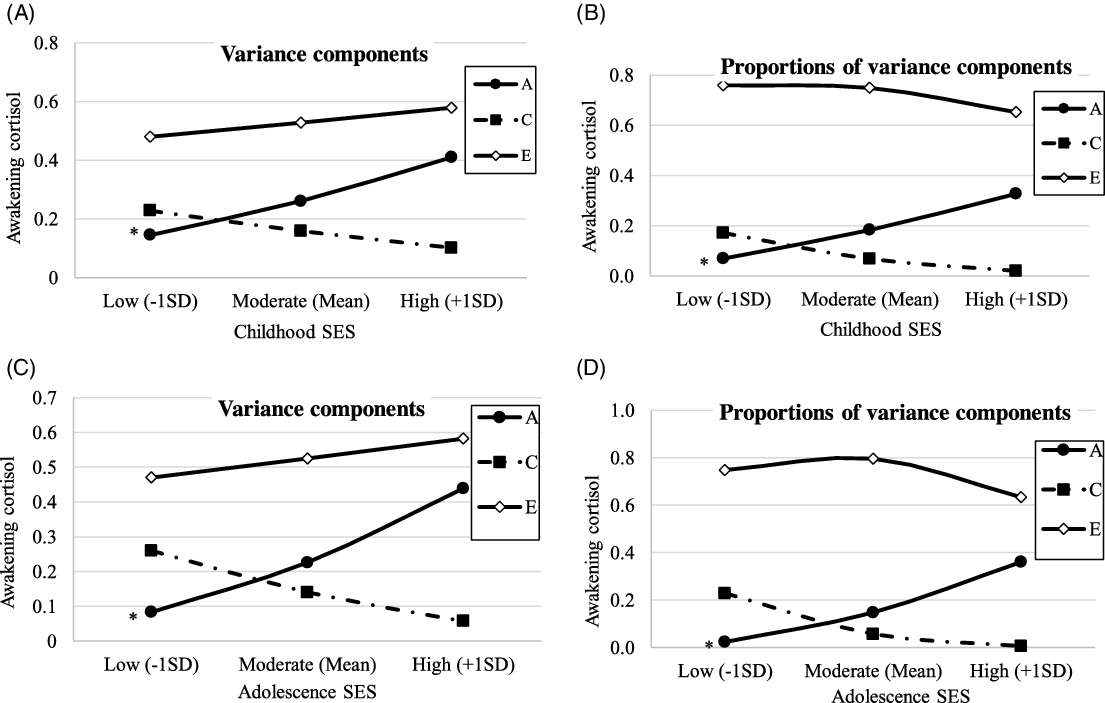
As presented in Table 2, a significant interaction emerged indicating that the magnitude of additive genetic influences on awakening cortisol levels varied across the childhood SES continuum. More specifically, Figure 4 (Panel A) shows that the contribution of the additive genetic factor to adolescents’ awakening cortisol levels increased along the distribution of childhood family SES, whereby lower genetic estimates were noted for children growing up in the most disadvantaged families, whereas heritability of this phenotype was greater in higher SES backgrounds. Figure 4 (Panel B) also illustrates that awakening cortisol levels were best explained by environmental factors [shared (17%) and unshared (76%)] than genetic factors (7%) among children from lower SES families. In comparison, among youth raised in wealthier families during their childhood years, the relative influences of shared and unshared environmental factors in awakening cortisol secretion appeared slightly less strong [shared (2%) and unshared factors (65%)], whereas the genetic estimated factors were nearly five times higher in magnitude (33%). The interaction between the latent additive genetic factors and adolescence SES was also found to be significant (see Table 2) and depicted a similar pattern of findings as the one evidenced for childhood SES (See Figure 4(c) and 4(d)), but no longer reached statistical significance once childhood SES was controlled for.
Results of the univariate models including the interactions
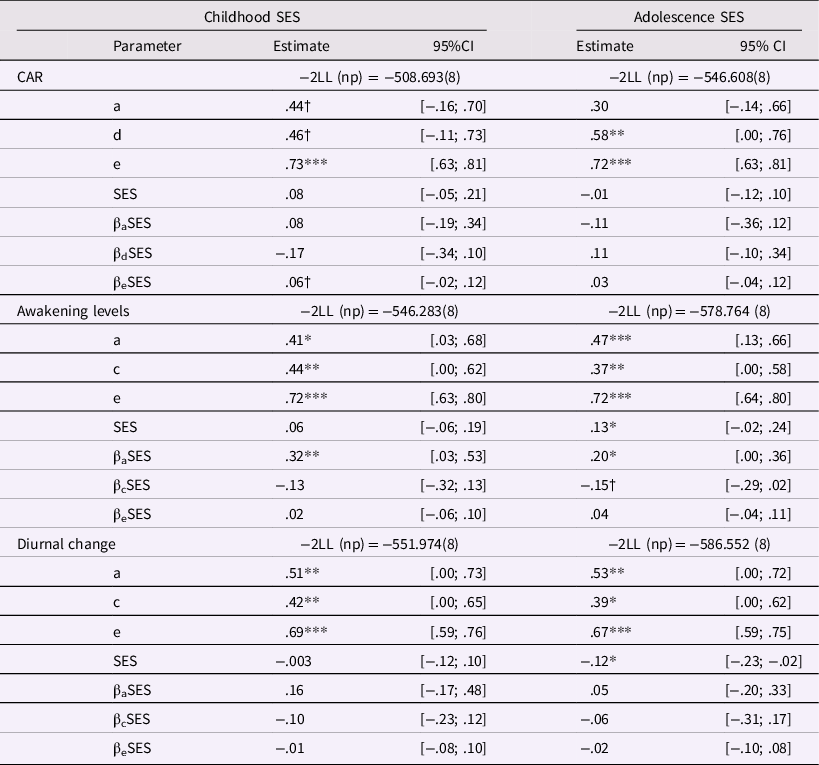
Note. The β coefficients represent the interactions between each genetic and environmental latent factor and SES. LL = log-Likelihood; np = number of parameters. *** = p ≤ .000; ** = p ≤ .01; * = p ≤ .05; † = p ≤ .10.
Genetic, shared and nonshared raw and proportional variance components of awakening cortisol as a function of childhood (A and B) and adolescence SES (C and D).
Do the genetic and environmental contributions to the CAR vary according to childhood or adolescence SES?
The univariate genetic analyses revealed that the variation in the CAR was best explained by a DE model, as indexed by a nonsignificant χ2-difference test, as well as lower AIC, BIC and RMSEA indices (See Supplementary Table 1). The ADE model was nonetheless selected given its comparable RMSEA value with the DE model and because the additive genetic factors accounted for a non-negligible 11% of variation of the CAR (See Figure 3). Altogether, 46% of the CAR variance was explained by (additive and dominance) genetic factors, with the remaining 54% due to unshared environmental factors. Examination of the CIs of the interaction terms (presented in Table 2) indicated that the relative influence of genetic and environmental factors on individual differences in the CAR of 14-year-old adolescents was not moderated by the family socioeconomic context experienced early in life or concurrently.
Do the genetic and environmental contributions to cortisol diurnal change levels vary as a function of childhood or adolescence SES?
The univariate genetic analyses indicated that individual differences in cortisol secretion change across the day was best described by an ACE model (See Supplementary Table 1). Additive genetic factors accounted for 32% of the variance of this phenotype, another 20% was explained by shared environmental factors, and the remaining variance (48%) was related to unshared environmental factors. As reported in Table 2, none of the interactions between the latent factors A, C and E and childhood (or adolescence) SES reached statistical significance, implying that the genetic and environmental influences on diurnal cortisol levels in adolescence is independent of (i.e., not moderated by) the youths’ family SES in childhood or adolescence. Of note, nonlinear interactions were tested between childhood and adolescence SES and each cortisol indicator. None were found to be significant (available upon request).
Discussion
Anchored in a developmental perspective, this study provided a unique opportunity to test whether the genetic and environmental contributions to three indicators of diurnal cortisol secretion assessed at age 14 varied according to family SES and whether these findings were contingent on the timing of these socio-family experiences. As done previously (Chen et al., Reference Chen, Martin and Matthews2007; Young et al., Reference Young, Farrell, Carlson, Englund, Miller, Gunnar, Roisman and Simpson2019), family SES was measured during the first 5 years of life and again at age 14, reflecting both continuity and changes occurring between these developmental periods and accounting for the high covariance estimated from infancy to early childhood. Our data revealed that the phenotypic associations between childhood SES and all three indicators of adolescence diurnal cortisol secretion were not significant. In contrast, there were significant associations between the SES factor assessed contemporaneously (in adolescence) and the salivary cortisol measures, either according to a linear or nonlinear function. These associations were observed, for the most part, even when controlling for childhood SES. Moreover, the findings provided evidence of an interaction (GxE) between genetic effects on cortisol measured at awakening and childhood (and also to a lesser extent adolescence) family SES. In contrast, the genetic and environmental contributions of the CAR and cortisol changes across the day did not vary by SES.
Prospective and concurrent associations between SES and diurnal cortisol indicators
At the phenotypic level, the results indicated that adolescents living in wealthier families concurrently had higher awakening cortisol levels. In contrast, a nonlinear pattern of correlation emerged for the CAR and diurnal change levels, revealing that youth raised in either higher or lower SES households both exhibited a higher CAR and a flatter diurnal slope in comparison to those who grew up in more average SES families according to this study sample. These findings did not, however, extend to childhood SES. This suggests that adolescence diurnal cortisol secretion is influenced more by the current family socioeconomic environment than by the family SES documented in twins’ early childhood. Although the magnitude of these phenotypic associations was small, our results concord with those from other studies that indicators of diurnal cortisol levels measured in adolescence may vary according to the family concurrent living contexts and that nonlinear patterns of associations may exist (Ouellet-Morin et al., Reference Ouellet-Morin, Cantave, Paquin, Geoffroy, Brendgen, Vitaro, Tremblay, Boivin, Lupien and Côté2020; Zalewski et al., Reference Zalewski, Lengua, Thompson and Kiff2016). Thus, Zalewski et al. (Reference Zalewski, Lengua, Thompson and Kiff2016) reported a flatter diurnal slope among adolescents from richer and poorer families when compared to those growing up in average-income families, similarly to what was found in the present study sample. Building on this evidence, we speculate that youths growing up in families subjected to more socioeconomic constraints—as well as those growing up in the most affluent families—may be exposed to several experiences that may collectively relate to a higher CAR and a flatter diurnal slope, even though the nature of these experiences may differ. This hypothesis is consistent with other reported phenotypic associations between diurnal cortisol and SES in a handful of cross-sectional and prospective studies (Chen et al., Reference Chen, Cohen and Miller2010; Clearfield et al., Reference Clearfield, Carter-Rodriguez, Merali and Shober2014; Essex et al., Reference Essex, Klein, Cho and Kalin2002; Gustafsson et al., Reference Gustafsson, Gustafsson and Nelson2006; Lupien et al., Reference Lupien, King, Meaney and Mcewen2001; Lupien et al., Reference Lupien, King, Meaney and McEwen2000). However, according to the present set of findings, it is not possible to discern whether a higher CAR or a flatter diurnal slope signal increases vulnerability to socioemotional, academic and behavioral difficulties in the long run or, inversely, may be indicative of positive adaptation to the social environment. To better understand the role played by diurnal cortisol secretion in the adolescence gradients of socioeconomic inequity, future studies ought to systematically test nonlinear patterns of associations and examine whether these indicators of cortisol diurnal secretion predict unique risks and strengths in youth from a variety of backgrounds and across a wide range of domains of functioning.
Genetic and environmental contributions to adolescence diurnal cortisol indicators
As reported before for this cohort (Brendgen et al., Reference Brendgen, Ouellet-Morin, Lupien, Vitaro, Dionne and Boivin2017; Ouellet-Morin et al., Reference Ouellet-Morin, Brendgen, Girard, Lupien, Dionne, Vitaro and Boivin2016), awakening cortisol levels, the CAR and diurnal change levels were found to be moderately influenced by genetic factors. This result is consistent with earlier findings in behavioral genetic studies conducted among children and adolescents (Bartels et al., Reference Bartels, Van den Berg, Sluyter, Boomsma and de Geus2003; Gustafsson et al., Reference Gustafsson, Gustafsson, Anckarsäter, Lichtenstein, Ljung, Nelson and Larsson2011; Van Hulle et al., Reference Van Hulle, Shirtcliff, Lemery-Chalfant and Goldsmith2012; Wüst et al., Reference Wüst, Federenko, Hellhammer and Kirschbaum2000), as well as with prior evidence from genome-wide association studies (GWAS) and candidate gene studies (Chen et al., Reference Chen, Joormann, Hallmayer and Gotlib2009; Utge et al., Reference Utge, Räikkönen, Kajantie, Lipsanen, Andersson, Strandberg, Reynolds, Eriksson and Lahti2018; Velders et al., Reference Velders, Kuningas, Kumari, Dekker, Uitterlinden, Kirschbaum, Hek, Hofman, Verhulst, Kivimaki, Van Duijn, Walker and Tiemeier2011; Wüst et al., Reference Wüst, Federenko, Rossum, Koper, Kumsta, Entringer and Hellhammer2004). The findings are, however, partly inconsistent with previous studies indicating that afternoon and evening cortisol secretion were uniquely explained by shared and nonshared environmental factors (Schreiber et al., Reference Schreiber, Shirtcliff, Hulle, Lemery-Chalfant, Klein, Kalin, Essex and Goldsmith2006; Wüst et al., Reference Wüst, Federenko, Hellhammer and Kirschbaum2000), whereas diurnal change from morning to evening was shown to be under both genetic and environmental influences. These divergent findings may be partly due to the examination of cortisol change during the day from morning to evening in the present study, instead of cortisol changes that occurred from afternoon to evening. Additionally, distinct findings may arise because we considered stable indicators of diurnal cortisol derived from saliva sampled over four collection days. Notwithstanding these putative explanations for divergent findings, we found a moderate contribution of genetic factors to cortisol diurnal change from morning to evening, as was also reported in another study that estimated a stable indicator of diurnal cortisol change from morning to afternoon (i.e., genetic factors [32%]; Van Hulle et al., Reference Van Hulle, Shirtcliff, Lemery-Chalfant and Goldsmith2012). Collectively, our findings indicated that adolescence diurnal cortisol secretion is largely influenced by twins’ unique environmental experiences and to a lesser part by their shared experiences. These cortisol indexes might thus be particularly useful for investigating the influences of past and concurrent experiences—whether good or bad—on adolescents’ patterns of cortisol secretion, especially in youth from lower SES families. The latter findings emphasize the need for environmentally-rooted prevention strategies to recalibrate cortisol secretion among these adolescents, as individual differences are mainly attributable to environmental forces. Taken together, the CAR seems to be the most heritable indicator of diurnal cortisol secretion and the genetic influences on the CAR do not overlap, for the most part, with those of awakening cortisol and the diurnal change (Ouellet-Morin et al., Reference Ouellet-Morin, Brendgen, Girard, Lupien, Dionne, Vitaro and Boivin2016). The possibility that the genetic and environmental contributions to cortisol secretion vary across the day makes a compelling case for systematically investigating the associations between childhood stress, cortisol, and stress-related psychopathologies according to multiple, yet distinct and complementary, indicators of diurnal cortisol secretion.
Gene–environment interactions between SES and diurnal cortisol indicators
We found that the contribution of genetic factors to awakening cortisol varied according to early and—to some extent—adolescence SES, such that lower genetic influences were observed among children from more deprived families in comparison to those from wealthier backgrounds. Incidentally, this means that individual variation in awakening cortisol secretion among youth from lower SES families seems to be mainly due to shared and nonshared environmental factors. It is noteworthy that this pattern of GxE was observed within the range of SES captured in the present sample, which was mainly composed of families from moderate-to-wealthy backgrounds—with approximately a quarter of families reporting an income of less than CAN$30K (≈US$24K). This indicates that lower heritability of awakening cortisol may not arise only in the context of extreme poverty. Our findings are thus consistent with the idea that adverse environments, such as growing up in more socioeconomically deprived families, may exert a profound organizational influence on the developing brain that supersedes the effects of genetic factors, especially in cerebral structures implicated in the regulation of the HPA axis activity (Lupien et al., Reference Lupien, McEwen, Gunnar and Heim2009; Shonkoff, Reference Shonkoff2010). The observation of smaller genetic influences on awakening cortisol among youth from lower SES households concord with evidence from singleton studies emphasizing the relevance of low-SES conditions, especially during childhood and adolescence, to diurnal cortisol secretion (Chen et al., Reference Chen, Cohen and Miller2010; Chen & Paterson, Reference Chen and Paterson2006; Lupien et al., Reference Lupien, King, Meaney and Mcewen2001; Zalewski et al., Reference Zalewski, Lengua, Thompson and Kiff2016). Our results additionally contend that GxE processes cannot be overlooked when ascertaining the cortisol–adversity association, as genetic liability may not be uniformly distributed across the environment continuum.
One noteworthy implication of the present findings is that interventions aiming to normalize HPA axis diurnal activity may differ in effectiveness according to SES levels and genetic background. Children from middle to higher SES households may benefit to some extent from interventions contributing to recalibrate awakening cortisol secretion. However, these interventions may be more fruitful for children from lower SES backgrounds, because environmental forces explain individual differences in secretion to a greater extent in this context. This is consistent with findings from a previous study that the effect of a social skills intervention on the recalibration of children’s diurnal cortisol secretion varies according to family income, with greater effects observed among children from low-income families (Larose et al., Reference Larose, Ouellet-Morin, Vitaro, Geoffroy, Ahun, Tremblay and Côté2019). Additional experimental research is needed to test whether this putative enhanced impact of interventions on awakening cortisol level of adolescents from lower SES backgrounds predicts lower risk for emotional and behavioral problems later on.
Although the concurrent measure of SES was phenotypically associated with the CAR and with diurnal cortisol change, the relative role of genetic influences on these two cortisol indexes appeared to be unaffected by current or past family SES backgrounds. It is possible that genetic (and environmental) influences on these cortisol indicators are differentially affected by other adverse experiences, such as peer victimization (Brendgen et al., Reference Brendgen, Ouellet-Morin, Lupien, Vitaro, Dionne and Boivin2017) or maltreatment rather than by sociodemographic aspects of the familial context, such as family SES. Alternatively, gene–environment interplay with respect to the CAR and with diurnal cortisol change may be more readily detectable when including more severely deprived families than those participating in the present study. Future genetically informed studies investigating a wider range of adverse socioeconomic and psychosocial contexts could test these alternative hypotheses.
Limitations and future directions
Our findings should be interpreted in light of some limitations. First, due to our sample size, we were unable to examine whether the contribution of genetic and environmental factors to variations in diurnal cortisol was different for boys and girls. As sex and gender differences have been reported in regard to cortisol secretion (Doom et al., Reference Doom, Cicchetti, Rogosch and Dackis2013) and hormonal coupling (Phan et al., Reference Phan, Hulle, Shirtcliff, Schmidt and Goldsmith2020), future work with larger samples is needed to examine this hypothesis. Second, the phenotypic associations between family SES and each indicator of diurnal cortisol were tested without exerting adequate control over shared genetic influences. Hence, it is not possible to decipher whether these reported associations emerge from environmental- and/or genetically-mediated processes. In a twin design, only environmental measures that vary within a twin pair allow for such a level of control, which is not the case for family SES. Third, because the participants of this population-based study were mostly Whites and came from middle-to-higher socioeconomic backgrounds, our findings may not generalize to adolescents from other ethnic and socioeconomic backgrounds, in addition to clinical populations. Finally, the influence of noncompliance to the collection protocol was examined through written records provided by the participants instead of the use of electronic devices. Nevertheless, mean sampling times reported by the participants mostly complied with the protocol, to which we exerted additional statistical control to minimize potential bias due to noncompliance in our analyses.
Conclusion
Using a genetically informed and longitudinal study design, this study provided a unique insight into the specific patterns of gene–environment interplay noted to distinct indicators of adolescence diurnal cortisol secretion in the context of childhood and adolescence family SES. Our findings suggested that the contribution of genetic and environmental factors to cortisol secreted at awakening was contingent on family SES, while it was not the case for the CAR and diurnal changes. This suggests that genetically informed studies are needed to refine our understanding of the hypothesized association between early-life experiences and the HPA axis. This undoubtedly constitutes the building blocks by which we would bring a new light into the mechanisms by which early adversity is expected to increase risks for physical and mental health.
Supplementary material
For supplementary material accompanying this paper visit https://doi.org/10.1017/S0954579421001048
Funding statement
Funding for this study was provided by the Social Sciences and Humanities Research Council of Canada and the Canadian Institutes of Health Research (grant number: MOP 97882). Mara Brendgen is supported by the Fonds de Recherche du Québec-Santé (FRQS), Sonia J Lupien is a Canada Research Chair in Human Stress, Michel Boivin is a Canada Research Chair in Child Development, and Isabelle Ouellet-Morin is a Canada Research Chair in the Developmental Origins of Vulnerability and Resilience.
Acknowledgments
We thank Alain Girard for his help in the analyses and Marie-Elyse Bertrand for coordinating the data collection and Hélène Paradis for data management and preparation. We also thank the twins and their families as well as their classmates for participating in this study.
Conflicts of interest
None.