INTRODUCTION
Individual political identities are increasing related to and defined by religion. There is even some evidence that religious identities are influenced by politics (Chapp and Goren Reference Chapp and Goren2014; Margolis Reference Margolis2015). One manifestation of this intermingling of religious and political identities is the emergence of a “Christian nationalism” in America. Christian nationalists are a subset of Americans who typically hold strong fundamentalist or evangelical beliefs, but more importantly, subscribe to a particularly strong sense of religious, and more specifically Christian religious, purpose to the American national identity. This approach to national identity creates an exceptionally high bar of exclusion from the American national identity based on faith or the unwillingness to adhere to the assumptions of Christian nationalism. Previous scholarship has identified a relationship between Christian nationalist identifiers and attitudes toward a prominent out-group in the United States, immigrants (McDaniel, Nooruddin, and Shortle Reference McDaniel, Nooruddin and Shortle2011). In this article, we examine the relationship between Christian nationalism and attitudes toward minority rights of another potential out-group in the United States: Muslims.
This article argues that restrictive opinion toward domestic Muslims and their religion is shaped by a conflation of religious and national identities that extend beyond the typical evangelical explanation of public outgroup attitudes. This conflation results in attitudes that are both prejudicial and also intolerant (e.g., specifically, desirous of blocking access of minorities to civil rights of religious worship). To provide a stringent test of our expectations, we analyze prejudice against Muslims and intolerance of Muslims’ right to worship by drawing on a survey sample from the American heartland, Oklahoma, where the most explicitly anti-Muslim policy in the United States was adopted by popular initiative in 2010. We test our expectations against the three B's of religion in political behavior: religious beliefs, religious belonging, and religious behavior. Our findings suggest that religious nationalism plays a larger role in the construction of anti-Muslim opinion than alternative explanations. Our findings allow for an indexing of Christian nationalism effects, which has been an underdeveloped area of inquiry in previous examinations of religion's influence on public opinion. Our research further confirms the insights put forth by extant literature that examines the influence of conflated social identities on political and religious behaviors (Jacobs and Theiss-Morse Reference Jacobs and Theiss-Morse2013; Patrikios 2009; Reference Patrikios2013).
LITERATURE
The politics of the 21st century infused international dimensions into domestic United States politics. The emergence of a national security environment was not confined to Washington politics or to matters of defense policy. Local debates about security emerged. State and local politicians took on a variety of security issues, and policy debates focused on identifying and curtailing potential domestic threats, especially those arising from out-groups. This led to debates and policy proposals that brought heightened scrutiny of American Muslims. These debates were often accompanied by Christian rhetoric couched in religious nationalist assumptions. When we inquire about attitudes toward American Muslims, the Muslim religion, and policy affecting Muslims, we should inquire as to whether restrictive attitudes among individuals toward this domestic religious minority are related to general evangelical Christian identification, or to more specific religious beliefs or identities that manifest as Christian nationalism.
The growth of prejudice toward Muslims (or those perceived to be Muslims, such as Sikhs) is well documented by opinion research (see Pew Research Center 2010; Gallup 2011). Research examining anti-Muslim sentiment in America since 2001shows new attitudes is emerging toward a relatively “new” group of ethnic and religious outsiders in America (Khan and Ecklund Reference Khan and Ecklund2012; Panagolpoulous Reference Panagolpoulos2006). The explanations for anti-Muslim sentiment and opinion are many. Current research has identified four: racialization; securitization; psychological threat; and ethical cultural conflict.
Racialization
Muslim-Americans come from diverse ethnicities.Footnote 1 There is growing use of descriptive stereotypes and misperceptions made by Anglo-Americans of all Muslims as a homogeneous group and leading to racialized perceptions of Muslims as “brown” and “Arab” (see Abu-Ras and Suarez Reference Abu-Ras and Suarez2009; McCarus Reference McCarus1994; Nyang Reference Nyang1999; Pew Research Center 2010). This practice is consistent with previous racialization of other groups by Anglo whites, such as Latinos and Asians (Gotanda 2011; see also Iqbal Reference Iqbal2010).Footnote 2
Securitization
Modern technology and globalization contribute to the intensification of culture wars (Akhtar Reference Akhtar2011). Since the September 11, 2001 attacks, American-Muslims are viewed as a “national political problem” capable of being both an internal and external security threat, not unlike the Japanese during World War II. Subsequent policy changes identify Muslims as a security “problem,” thereby changing the relationship between the citizen and the state for Muslim Americans.
Psychological Threat
Distinct biases are formed against Muslims across several situational contexts. A perception of cultural and physical threat and “otherness” being applied to them (Khan and Ecklund Reference Khan and Ecklund2012). Perceptions of Muslim intolerance and Islam as a violent threat are often key components of a psychological fear of group members (Iqbal Reference Iqbal2010). This perception is distinct for the securitization threat because it is personalized and originates with the respondent, not the state.
Ethical Culture
Another theory is that Islam is a cultural and ethical system that threatens the economic and social order of neo-liberal West (see Evans 2011). Pushback against Islam, especially by market conservatives, is due to the “counter-hegemonic” threat to the neo-liberalism. The tenets of Islam offer an “alternative ethical path” that is based on sufficiency to support one's self, rather than potentially unlimited wealth accumulation by elites, and also subordination of the individual to the group. This ethical order places Islam at odds with many Christians and also market-oriented political conservatives in the United States.
RELIGIOUS TRADITION VERSUS RELIGIOUS NATIONALISM
Scholars are only starting to fully examine what role American religion plays in the formation of these attitudes of prejudice and intolerance toward this important religious out-group. One explanation that has been posited is that evangelicals are driving this trend toward anti-Muslim prejudice and intolerance, which is consistent with the overall tendency of religion and politics research to explain behavior as the function of evangelical denominational affiliation, which falls under the “belonging” category in “three B's” typology of religiosity; behavior and belief mark the other types of religiosity shaping political behavior (Smidt, Kellstdt, and Guth Reference Smidt, Kellstedt, Guth, Guth, Kellstedt and Smidt2009; See Kellstedt and Greene Reference Kellstedt, Greene, Leege and Kellstedt1993). One way to conceptualize religious tradition is as a salient social identity. The most sophisticated treatment of anti-Muslim attitudes, Kalkan, Layman, and Uslaner (Reference Kalkan, Layman and Uslaner2009) uses social identity theory to posit that attitudes are most pronounced among those who perceive Muslims as furthest from their view of normal or “mainstream.” Layman, and Uslaner (2009, 855) contend that Muslims are unique in the United States, in that they are viewed as both a cultural (behavioral) out-group and as a racial out-group. Ultimately, this line of research implies that it is the symbolic difference perceived between Evangelicals’ perception of “divinely anointed” in-group members (e.g., fellow Christians — if not specifically Evangelicals) versus the “theologically condemned” out-group members (e.g., Muslims) that leads to anti-Muslim sentiment on the part of evangelicals (Clarke and Powell Reference Clarke, Powell and Savulescu2013, 20). This explanation is consistent with extant work drawing on psychological theories of in-group/out-group religious effects on opinion (Hewstone, Ruin, and Willis Reference Hewstone, Rubin and Willis2002). This same evangelical explanation has proven useful for explaining the roots of other non-religious conservative attitudes as well as foreign policy stances, and also domestic political ideology and policy preferences (Ellison and Musick Reference Ellison and Musick1993; Judis Reference Judis2005; McCartney Reference McCartney2004). However, the evangelical explanation, for all its popularity, cannot explain the continued trend of individuals from non-evangelical backgrounds to also express anti-Muslim attitudes (see Guth Reference Guth2012). There are many non-evangelical Americans for whom religion plays an important role in their lives, and for whom we would expect religion to therefore play an important role in their political opinions. Prejudice and intolerance for Muslims therefore cannot solely be explained by religious tradition. Here is where, we argue, Christian nationalism becomes a potentially useful explanation.
How an individual defines nationhood provides valuable information about which groups an individual believes deserve protection of citizen rights, making American identity an important factor when investigating the possible determinants of intolerance. The term tolerance is largely understood as willingness to extend liberties to undesirable or “least liked” groups in society (Stouffer Reference Stouffer1955; Sullivan, Piereson, and Marcus Reference Sullivan, Piereson and Marcus1982). By adopting a narrow definition of American identity, individuals forego any consideration about protecting citizen rights, since Muslims lie outside of their symbolic construction of national identity and therefore the benefits that national identity membership confers. Using this logic, we argue that the development of intolerant and prejudicial anti-Muslim views arise when individuals hold a restrictive view of national identity that requires Americans to adhere to beliefs about America's religious purpose. Evangelicals primarily, but not exclusively, subscribe to this religiously conflated version of national identity that makes anti-Muslim attitudes likely. We argue that both prejudice and intolerance for Muslims can therefore be explained through Christian nationalism, which symbolically constructs a conflated view of American identity and religious identity that omits Muslims from consideration as true citizens deserving of protection.
CONFLATED IDENTITIES & CHRISTIAN NATIONALISM
We are not the first to argue that a conflation of identities could affect behavior, especially when religious and political identities are being investigated (Patrikios 2009; Reference Patrikios2013). Scholars have started to examine the role of conflated identities to explain prejudice and intolerance, largely because of the limitations of religious tradition based explanations. For example, Guth (Reference Guth2006) and Mayer (Reference Mayer2004) argue that it is this fusion of faith and patriotism among evangelicals that drives their passionate support for Israel and “aggressive posture toward Islamic extremism” (see Kalkan, Layman, and Uslaner Reference Kalkan, Layman and Uslaner2009, 850). Instead of relying solely on evangelical belonging, these researchers use a mixture of religious and national identifiers to inform their analyses. Going beyond this scholarship, there has been research demonstrating out-group attitudes are based on the specific concept of Christian nationalism (Lieven Reference Lieven2012; McDaniel, Nooruddin, and Shortle Reference McDaniel, Nooruddin and Shortle2011). According to these studies, evangelical belonging plays a secondary role in shaping out-group attitudes, while the belief that America is a divinely inspired nation lends a superior explanation of prejudicial attitudes in America. Some of the Christian nationalism studies illustrate the concept as a cause of restrictive policy stances (e.g., Lieven Reference Lieven2012), while others attempt to specify the mechanism behind Christian nationalism as the result of psychological processes (McDaniel, Nooruddin, and Shortle Reference McDaniel, Nooruddin and Shortle2011). In a similar vein to Christian nationalism research, Jacobs and Theiss-Morse (Reference Jacobs and Theiss-Morse2013), using both survey and an experimental implicit association test, find Americans generally associate being Christian with being a “true American.” Theiss-Morse (Reference Theiss-Morse2009) finds that strong identifiers are more likely to set exclusive boundaries on a group, often to the point of over-exclusion — better to exclude an “in-group” member by being too exclusive than to let in an “out-group” member. This research overall reveals that identities based on national identity and religious identity are often conflated in the minds of many Americans, with the result typically being prejudice and intolerance.
For those Americans, the framing of the debate about the national identity as “Christian or not” or, alternatively, “just how Christian” makes the national identity a first-principles component of modern politics. The historic dominion of Protestant Christianity in defining and using the public space of the United States leads to conflicts in a modern, pluralist America, where Protestants, based on an early understanding of the values that define the nation, seek to defend the nation from alien encroachment (Carroll Reference Carroll2012). Controlling and defining the public space creates boundaries to secure the national identity (See Theiss-Morse Reference Theiss-Morse2009). In the American case, this brings about conflict, as the presumed preferred position of Protestants is challenged. Americans seek to incorporate the national space into their religious world; it should not be surprising for them to infuse the national identity with their religious identity, and to then use that basis of national identity to deny access to the national space by members of an out-group. It should likewise be unsurprising to find that these types of identity mechanisms are especially likely to shape attitudes in more Evangelical regions of America.
Given the likely tendency of Evangelical publics to conflate their national and religious identities already, focusing the analysis on an Evangelical epicenter provides a most stringent test of religious nationalism's influence on anti-Muslim attitudes. This is because we should not be able to explain much of the variance in attitudes if the Evangelical explanation holds in an Evangelical epicenter; all attitudes would trend in the prejudicial and intolerant direction as the result of evangelical belonging. And yet, if religious nationalism can explain these attitudes in an ardent Evangelical epicenter, like Oklahoma, this result would provide a clear indication of respondents conflating their religious with national identities to form anti-Muslim attitudes — above and beyond the presumed powerful influence of Evangelical belonging in an evangelical epicenter. For this reason, our analysis focused on a prominent evangelical epicenter in America, Oklahoma, to provide a conservative test to our expectations of religious nationalism's influence, particularly in its ability to outperform evangelical belonging.
DATA AND METHODS
The Evangelical Epicenter
Evangelical epicenters are predominantly white, rural, and suburban counties with large evangelical Christian populations. These places have Republican voting tendencies, and residents are often conservative on a variety of social and other issues. The term was coined by Chinni and Gimpel (Reference Chinni and Gimpel2010) in Our Patchwork Nation. Footnote 3 Of the 3,141 counties in the United States, 473 (15.1%) are classified as Evangelical Epicenters, and over 85% of these counties are located in the census South, with the remainder are largely concentrated in Missouri. Multiple measures of evangelical concentration hone in on the same places. Data from the 2010 Glenmary religious census show the Deep SouthFootnote 4 with a population that is nearly 32% evangelical. The Rim SouthFootnote 5 and the Border SouthFootnote 6 are each just over 24% evangelical. The remaining 34 states are just over 10% evangelical by population. In five states in these regions, over a quarter of the population resided in an Evangelical epicenter: Arkansas (37.8%); Alabama (32.5%); Tennessee (32.2%); Oklahoma (28.4%); and Kentucky (27.6%). The top five states for overall evangelical religious population are Alabama (42.0%), Oklahoma (40.8%), Mississippi (39.4%), Arkansas (39.0%), and Tennessee (37.6%). Of the 100 most evangelical counties in the United States, 41 are located in these five states. Oklahoma therefore stands out as the prototypical evangelical epicenter state (second in percent evangelical population; fourth in terms of the share of population residing in Evangelical Epicenters; and second in terms of the percentage of counties identified as Evangelical Epicenters). Over two-thirds of all religious adherents in the state are evangelical Christians, and polling data from the state routinely finds half of respondents say they attend church at least weekly or more.
Evangelical epicenters provide a good venue for testing the relationship between Christian nationalism, evangelical identity, and restrictive opinion and policy preferences directed at Muslims. Carroll (Reference Carroll2012) observes that the South defined its region and religious space in more specifically Protestant terms, making the South the least-diverse region of the country in terms of religion. In more recent times, this definition of space extended to anti-modernism and also seeing international Islam as a ‘target of mistrust’ (see also Manis Reference Manis, Wilson and Silk2005, 184–189).
In addition to being one of the most epic Evangelical epicenters, Oklahoma is an ideal place to test the relationship between Christian nationalism and anti-Muslim sentiment. Oklahoma is the first state to directly limit Islam in policy, via constitutional amendment in 2010 (SQ 755, the “Sharia Law” amendment).Footnote 7 This change, adopted by an overwhelming vote, amended the state constitution to prohibit the application of certain forms of international law by the state courts, and also specifically Sharia Law.Footnote 8 Media speculation fixed on Sharia as another cultural wedge issue designed to drive voter turnout, much as affirmative action, gay marriage, and abortion had been in the past.Footnote 9 Voters approved the amendment by a 70–30 margin, and majorities in every county in the state approved the measure.
Survey research conducted the month before the vote on SQ 755 indicated an environment that was suspicious of Muslims: 56% of likely voters surveyed had an unfavorable opinion of Muslims, compared to just 25% favorable; over 60% thought Muslims worshiped “a different God” than Christians; and 58% thought Islam “promotes violence.” Of those surveyed, 57% supported SQ 755 while 25% opposed it. Support for SQ 755 was 20 points higher among those who viewed Muslims unfavorably, and 30 points higher among respondents who thought Islam promoted violence.Footnote 10
In order to explore the structure of Christian national identity and its relationship to attitudes and opinions toward Muslims, we draw on data from a statewide public opinion survey conducted in February 2011. Sooner Poll, an established Oklahoma polling firm providing opinion content to news media outlets in the state for roughly a decade, fielded the survey. The instrument was designed in cooperation with one of the authors of this article. The survey was fielded over land-line and cell telephones to a random sample of high propensity voters, stratified to match the age, sex, party registration, and geography of the likely electorate.Footnote 11 Due to the categorical nature of the dependent variables, we employed ordered probit analyses with robust standard errors to test our expectations. To ensure the results were not idiosyncratic to Oklahoma, the analysis was also replicated using a national representative sample, from a 2010 Knowledge Networks survey.
Variables
Together, the analyses’ dependent variables were crafted to represent two dimensions of anti-Muslim opinion: (1) targeted prejudice against Muslims; and, (2) intolerance — understood as a general desire to suppress the civil rights of outgroups (Gibson Reference Gibson1992; Reference Gibson2008; Stouffer Reference Stouffer1955). Examining these concepts together allowed for a more balanced examination of Christian nationalism's influence on the diverse forms of anti-Muslim sentiment that persist in America (See Pew Research Center 2010). The prejudice item was based on the question, “In general, would you say your opinion on the Muslim religion is: 1 = strongly favorable, 2 = somewhat favorable, 3 = neither favorable nor unfavorable, 4 = somewhat favorable, or 5 = strongly unfavorable.” The largest proportion of the sample held prejudicial views of the Muslim religion, with 34% of respondents sharing a “very unfavorable” opinion and 18% a “somewhat unfavorable” opinion. By contrast, 25% claimed “neither favorable nor unfavorable,” 15% responded with “somewhat favorable” opinions, and 8% cited a “very favorable” opinion. The second dependent variable, intolerance of Muslim worship, was based on the question, “Which comes closer to your view: ‘Muslims should have the same rights as other groups to build houses of worship in local communities,’ OR, ‘Local communities should be able to prohibit construction of houses of worship if they do not want them.’” Respondents were inclined towards protecting religious freedom in this case, with 58% preferring not to limit Muslims’ rights to build houses of worship, versus 29% preferring rights of worship to be limited in this regard. Responses therefore differed across anti-Muslim measures, with more respondents claiming prejudicial views than expressing support for limiting American Muslims’ right to worship. On average, though, respondents demonstrated large levels of anti-Muslim attitudes.
Independent Variables
Christian nationalism represented the main variable expected to explain both prejudice against and intolerance for American-Muslims. It measured the level to which individuals conflated their religious and national identities, by using an index of Christian nationalism beliefs to gauge this conflation; a factor analysis of the six questions from the Christian nationalism battery revealed two dimensions (Cronbach's alpha = 0.75).Footnote 12 One dimension, the Christian nationalism dimension, was made up of four questions: “America holds a special place in God's plan;” “God has chosen this nation to lead the world;” “the United States was founded as a Christian nation;” and “it is important to preserve the nation's religious heritage.” The other dimension emerged from the remaining two questions, “The United States was established to be religiously diverse,” and “United States success is not a reflection of divine will.” In order to generate a single, simplified measure of Christian nationalism, we constructed an index of the four items that loaded together onto the first dimension of the factor analysis, by summing and averaging agreement with the four ideals.
Our analysis then took into account the three B's of religiosity: religious beliefs, religious behaviors, and religious belonging. The “belief” variable of Biblical literalism, the “behavior” variable of church attendance, and the “belonging” variable of evangelical identification, acted as the specific alternative explanatory variables in the analysis. The belief item used a question about whether respondents believed the Bible was the actual word of God. From this item, a dichotomized biblical literalism variable was crafted, alongside a dichotomized non-believer variable. This allowed us to examine the most ardent believers, as well as the less religiously inclined respondents. The behavior item was based on how many times a respondent attended church on a weekly basis, with the highest level at least twice a week. The affiliation item was determined by whether or not the respondent self-identified as an evangelical Christian. In terms of control items, we included the standard demographic variables of race (dichotomous variable for whether respondent identified as White), income (9 point scale), sex (whether R identified as female), and partisan identification (0 Democrat; 1 Independent; 2 Republican). We expected most of these control variables, other than income, to result in increased levels of anti-Muslim prejudice and intolerance. These expectations were based on a scholarly evidence and conventional wisdom, including social identity and group reference theory literatures’ insights into prejudice development (Tajfel Reference Tajfel, Turner, Austin and Worchel1979), traditionally higher levels of intolerance on the part of women, and literature citing an increased tendency for Republicans to hold negative views of Muslims (Layman, Kalkan, and Greer Reference Layman, Kalkan and Green2014).
The primary expectation was for Christian nationalism to positively and significantly relate to anti-Muslim attitudes, outperforming alternative, and control variables. In keeping with previous research, we estimated that evangelical identification would also relate positively to anti-Muslim attitudes; however, the effect should then diminish when submitted to statistical tests against the primary independent variable of Christian nationalism. We anticipated that religious variables as a group would outperform the control variables. On the descriptive end, there was less hypothesizing about what the “Christian Nationalist” group would include, since our understanding of the concept allows for adherents from a wide swath of affiliations and behaviors. The exception to this rule was that more evangelicals were assumed would agree with Christian nationalist ideals than non-evangelicals (i.e., McDaniel, Nooruddin, and Shortle Reference McDaniel, Nooruddin and Shortle2011).
THE SHAPE OF CHRISTIAN NATIONALISM IN THE EPICENTER
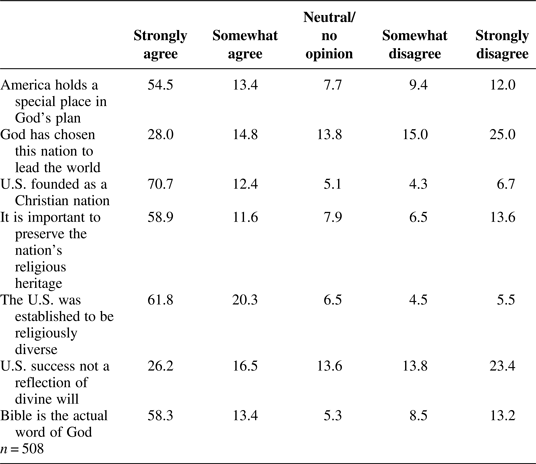
Before controlling for other factors, we expected at the most general level for our sample to express high levels of support for Christian nationalist ideals. This initial expectation of Christian nationalism's widespread prevalence in Oklahoma was born out in the data — of the five statements used to tap into Christian nationalism, four enjoyed majority agreement from respondents (see Table 1). Among the pro-Christian-nationalist statements, the highest agreement was with the statements “The United States was founded as a Christian nation” (83.1% agreed, 70.7% strongly), followed by “America holds a special place in God's plan” (67.9% agreed, 54.5% strongly). “God has chosen this nation to lead the world” did not receive majority support (42.8% agreed, 28% strongly), and the reverse phrased statement “The United States success is not a reflection of divine will” similarly divided (42.7% agreed, 37.2% disagreed). The two remaining measures, of religious pluralism and of the importance of preserving religious heritage, enjoyed intense and broad majority support. The baseline percentages suggest that respondents widely adhered to Christian nationalist ideals, confirming our initial thoughts on the matter.
Statements used as measures of Christian nationalist sentiment

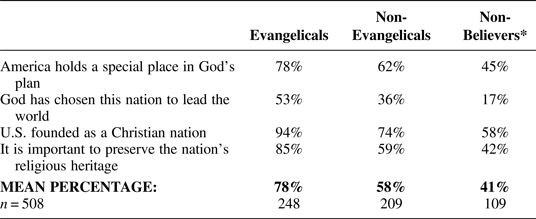
We next investigated the possibility that this adherence to Christian nationalism was due to widespread support on the part of evangelicals in the state, due to the large percentage of Oklahomans who affiliate with the Evangelical Protestant tradition (i.e., a majority of 53% according to Pew Research Center 2010). Table 2 compares the percentages of support for Christian nationalist ideals across three groups: evangelicals, non-evangelicals, and non-believers — defined as those who strongly disagreed or somewhat disagreed that the Bible represented the word of God. The percentages illustrate that while Evangelicals expressed higher levels of Christian nationalism on average, with percentages of support around 78% for any given measure of Christian nationalism, a majority of non-Evangelicals also adhered to Christian nationalist ideals. On average, roughly 60% of non-Evangelicals agreed with Christian nationalist ideals that were presented to them. Furthermore, non-believers demonstrated shockingly high levels of support for Christian nationalist ideals: for example, a majority claimed that the United States was founded as a Christian nation (58%). As expected, Christian nationalism was more popular for Evangelicals than most other religious identifiers, but was still well received by most respondents, regardless of their religious — or nonreligious — backgrounds.
Percent in agreement with Christian nationalism, by religious group

The Evangelicals and Non-Evangelicals categories were based on respondent self-identification as either Evangelical or not. *The Non-Believers category was based on the group of respondents who either disagreed or strongly disagreed that the Bible is the literal word of God. The figures exhibited in the table represent the percentage of each religious group, who are indicated at the top of each column the table, in agreement with the Christian nationalist statements that are listed in the first column of the table, from top to bottom. Comparing these figures to the full sample, 70% of respondents in the full sample agreed that “America holds a special place in God's plan,” 44% agreed that “God has chosen to lead the world,” 84% agreed that “the U.S. was founded as a Christian nation,” and 72% agreed that “It is important to preserve the nation's religious heritage.”
Note: Sooner Poll (2011) Oklahoma state survey, Knowledge Networks (2010) national survey *p < 0.1; **p < 0.05;***p < 0.01.
The fact that non-believers adhered to some of the Christian nationalist statements at all offers an interesting result. According to this finding, being a non-believer in the Bible did not preclude a respondent from believing her nation has a purpose that is predestined by God — and, in fact, represented an attitude held by just under half of all non-believers in our sample (45% of nonbelievers felt America “held a special place is God's plan”). Our measures of “non-believer identification” were, however, limited to one item about Biblical interpretations; we assume the finding would not be replicated if the question had been able to more directly assess respondents’ atheism, agnosticism, and religious “none” identification. The finding could, alternatively, reveal that Christian nationalism enjoys support from the most obvious to the most unexpected of places.
ANALYSIS: WHO IS ANTI-MUSLIM?
What, then, are the significant indicators of Muslim dislike, all else being equal? Does the conflation of religious and national identities matter? Or is it simply the evangelicals or avid churchgoers who are driving this trend? In Tables 3 and 4, we examined these questions by estimating robust ordered probit models of anti-Muslim prejudice and anti-Muslim intolerance, which tested for Christian nationalist effects using a scale created from the four major Christian nationalist markers identified in our factor analysis. We tested the main Christian nationalist effect against the alternative explanations of biblical literalist beliefs, non-beliefs, frequency of church attendance, and self-professed evangelical identity, while controlling for four demographic controls (Anglo white, income, party identification, and sex).
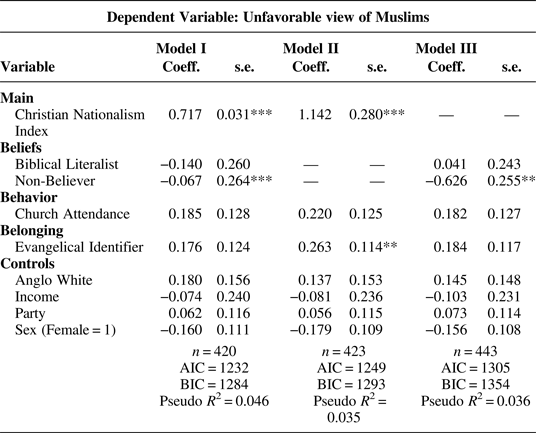
Beliefs, behaviors, and unfavorable views of Muslims

Note: Sooner Poll (2011) Oklahoma survey, *p < 0.1;**p < 0.05;***p < 0.01.
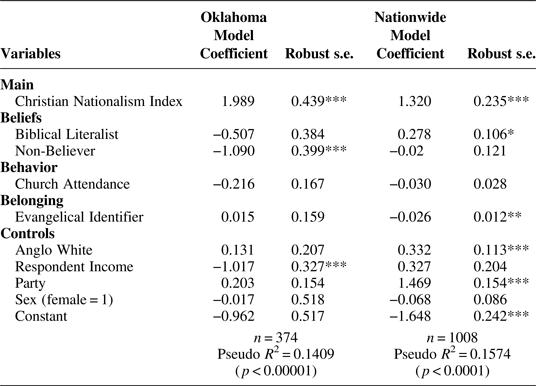
Comparing Oklahoma to nationwide willingness to limit Muslim religious rights

Note: Sooner Poll (2011) Oklahoma state survey, Knowledge Networks (2010) nationwide survey *p < 0.1;**p < 0.05;***p < 0.01.
The results confirm the main expectation of this study, which is that Christian nationalism, beyond other religious and/or demographic background alternatives, is the main determinant of anti-Muslim attitudes for this Oklahoma sample. In Table 3, this finding is first presented across three separately estimated models of anti-Muslim prejudice. Christian nationalism strongly relates to anti-Muslim prejudice, with highly significant coefficients of 0.717 and 1.142 in Models I and II (p < 0.001). The Christian nationalism variable outperformed all other variables across all model specifications. This suggests that Christian nationalism is the primary determinant of prejudice against Muslims. Models I and II additionally demonstrated significantly higher amounts of explanatory power than the Model III, which omitted Christian nationalism from the model estimation. This was illustrated by a large difference in Akaike Information Criterion (AIC) between models. There are smaller AICs of 1232 and 1249 when Christian nationalism is included in Models I and II, meaning stronger models, compared to the larger AIC of 1302 for the more weakly performing Model III, which omitted Christian nationalism. This demonstrates strong evidence that the correct model includes Christian nationalism. The strong independent effect of Christian nationalism and the greater explanatory power of the Christian nationalism-specified models provide strong statistical evidence of Christian nationalism's influence on anti-Muslim prejudice. All of these results point to the consistent finding of Christian nationalism's ability to explain prejudicial attitudes toward Muslims on the part of Oklahomans. These findings further reveal that in terms of religious influences on prejudice, believing America has a divine purpose explains prejudice, whereas individual religious beliefs, behaviors, or belonging, e.g., evangelical affiliation are inadequate to the task.
In terms of the alternative variables in Table 3, there is some evidence to suggest non-believer status influenced prejudice, as the non-believer variable yielded a negative and significant coefficient (−0.067, p < 0.001). This finding suggests that expressing disagreement that the Bible is the word of God related negatively and significantly to anti-Muslim prejudice.Footnote 13 Non-believers were therefore less prejudicial. While an interesting finding, the effect is still dwarfed by the Christian nationalism's stronger effect. Both variables related significantly to prejudice; however, comparing model specifications to one another indicates the superiority of Christian nationalism-based models over all others.
The small but significant non-believer effect was somewhat unexpected. This could be the result of a confounding factor in the social context of the region, which involves elevated levels of biblical literalism as part of the socio-political fabric in Oklahoma. Alternatively, the finding could have some relevance to religious nones in America, where perhaps religious non-belief is playing an increased role in political behavior. As speculating more on this finding is outside the scope of this study, we simply view the finding as evidence that religious beliefs matter in the formation of anti-Muslim prejudice in America, although to a lesser degree than Christian nationalism.
Based on the prejudice findings overall, we can conclude that prejudice against Muslims is largely the result of Christian nationalism. However, there are some limitations to this analysis which merit additional investigation. For instance, the prejudice study leaves unanswered whether Christian nationalism also translates to support for suppressing Muslims’ right to worship (e.g., intolerance). Additionally, it is unclear whether the Oklahoma analysis is truly comparable to the American public, with the large levels of conservatism and biblical literalism within the state.
To address these possible limitations of the prejudice analysis, our study turned to an analysis of political intolerance to determine if the same findings held when the anti-Muslim sentiment changed from general prejudice to more specific preferences to limit Muslim rights of worship. To uncover whether the Christian nationalism findings were unique to Oklahoma, we additionally tested the same model using a nationally representative Knowledge Networks survey. The national survey included nearly identical questions to the Oklahoma survey, although, the national survey's intolerance dependent variable used a question about disapproval of a mosque being built at the former World Trade Center. While not an identical measure to the Oklahoma item, which asked about general approval of a town's ability to limit the building of Muslim houses of worship, both questions adequately captured respondents’ approval of limiting Muslim Americans’ right to worship. The main finding from the nationwide comparison confirmed our expectations; Christian nationalism positively related to intolerant attitudes more than any other variable in the model, regardless of the population examined. The national sample, however, yielded at least one interesting secondary effect that was absent in the Oklahoma analysis. Specifically, religious non-believer status lost its significance for the national sample, marking a difference from the Oklahoma sample. This finding could be explained by the higher overall levels of biblical non-belief in the national sample, which indicates nonbeliever status across the nation might mean something different — likely, something less influential — than nonbeliever status in a biblical literalism stronghold such as Oklahoma. In this telling, non-believing Oklahomans necessarily must overcome a greater sense of social undesirability to offer such responses, with the result being a more impactful form of non-belief accruing from the Oklahoma sample, and less influential nonbelief effects for the national sample. Alternatively, the difference between the two samples could more simply be an artifact of the year's difference between each survey sample's data collection: the Oklahoma sample was collected in 2011, while the national sample was collected in 2010. Perhaps religious nonbelief is gaining prominence in its political-attitude-making influence, and the increased significance of the 2011 data accounts for this change. We cannot say which interpretation of the different findings for religious non-belief is correct, and to investigate it further is outside the scope of this paper. However, each possible explanation points to a potential confounding factor that ultimately explains the divergent results. Still, this difference failed to match the much greater influence of the primary Christian nationalism effect, revealing that both the national and statewide samples continued to form their intolerant attitudes as a result of conflating their religious and national identities, above all else.
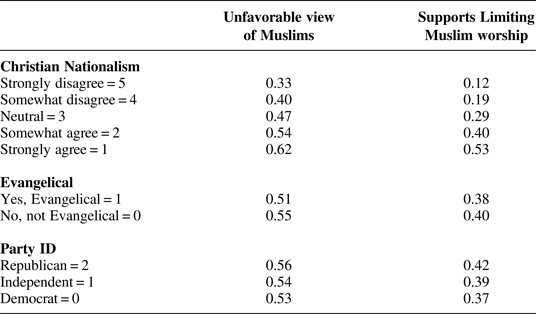
Finally, to add a more substantive understanding of what these statistically significant relationships mean, we call attention to the predicted probabilities in Table 5. These two columns represent the probability that an average respondent from the Oklahoma sample would first, express anti-Muslim prejudice, and also, intolerance for Muslims’ right to worship. The probabilities were generated based on the survey data appearing in the fully estimated model in Table 3 for anti-Muslim prejudice and the Oklahoma Model in Table 4 for religious intolerance, and they were derived using a Probit model. It is clear from Table 5 that higher agreement with Christian nationalism is associated with greater probability of holding unfavorable views of Muslims, and with supporting limits to Muslims’ religious freedom. There is a 30%-percentage point difference in the probability of holding an unfavorable view of Muslims when moving from strong disagreement to strong agreement with the Christian nationalism measures. Meanwhile, there is only a four-percentage point difference in probability of holding anti-Muslim views when moving from non-evangelical to evangelical Christian belonging status, and only a three-percentage point difference based on party identification. The difference in probabilities of holding intolerant views about Muslim worship based on Christian nationalism is even starker — over a 40 percentage point difference — compared to just a two-point difference for evangelical Christian self-identifiers and a five-percentage point difference based on party identification. These probabilities provide a clear understanding of the size of Christian nationalism's influence on attitudes, which outperforms other religious and non-religious determinants of anti-Muslim attitudes. These findings overall reveal the grave implications of conflating one's religious and national identities, which trends in the direction of outgroup derogation.
Predicted probabilities of anti-Muslim opinion

Source: 2011 Sooner Poll. Probabilities were generated by holding all control variables at their mean values. Probabilities are based on dichotomized versions of the dependent variables with larger numbers translating to larger probability of holding an anti-Muslim opinion.
CONCLUSION
The creation of out-groups and “others” is not new to American politics. Previous foreign conflicts have led to the casting of enemy ethnics as suspicious, and the movement to limit certain liberties of outgroups during such conflicts, such as due process rights, is not new (Wert Reference Wert2011). Racial minorities and also immigrants have been similarly subject to efforts to identify them as an out-group and then limit access to not just due process rights but also fundamental access to the public space. Similar suspicion is directed toward Muslims in the United States, and both willingness and efforts to limit Muslim rights are supported by some Americans.
Patrikios (Reference Patrikios2008) concludes that partisan mobilization into a church is one consequence of the American political environment since the 1970s. Choice of church becomes a form of political expression, of setting ones’ self apart from an out-group. Our analysis indicates that, within this increasingly politically-defined group of evangelicals, there are continuing divisions that fall on a religious-nationalist dimension that can divide evangelicals and also structures their attitudes toward non-coreligionist outgroups.
Patrikios (Reference Patrikios2013) observes “evangelical Republican identity … provides a good explanation of the polarized choices registered by American religious groups in recent elections, “and that a Republican party that starts challenging the stereotype … might see an improvement in electoral prospects in the long term.” Our analysis in an evangelical epicenter indicates that there are divisions within the evangelical political identifier group that are more tolerant of perceived “outgroups.” Specific components of an out-group's identity, and how those components conflict with the flavor of evangelical Protestantism embraced by the individual, determine the nature of the evangelical political exclusion.
Our examination of public opinion in one of America's evangelical epicenters indicates that there is, as expected, strong suspicion of Muslims. Among a minority of respondents there was also a willingness to limit the worship rights of Muslims. And, both suspicion and willingness to limit worship rights was strongly structured by Christian nationalism. As in previous research on attitudes toward immigrants (McDaniel, Nooruddin, and Shortle Reference McDaniel, Nooruddin and Shortle2011), we find that a particular understanding of America's origins structures opinion, the Protestant-influenced Christian nationalism. This perspective is consistent with suspicion towards immigrants, who are often not Protestant (or Christian), and also explicitly with suspicion toward Muslims. Support for policies that limit access by outgroups such as Muslims to the national space or local public spaces are also consistent with the concept of America as a Christian nation and belief in Christian nationalism. Presumably such a belief system would require the defense of the national space and also local spaces from “alien” intrusions. In the evangelical epicenters, which are heavily if not homogeneously evangelical Protestant, observing both sentiment and action to defend local and state space from alien intrusion should not be surprising — indeed, it should be expected.