Introduction
Cerebral white matter lesions (WMLs) comprise diffuse areas of hypodensity on computerized tomography (CT) and high signal intensities on T2, proton density, and FLAIR magnetic resonance image (MRI) sequences. Also known as leukoaraiosis (Hachinski, Potter, & Merskey, Reference Hachinski, Potter and Merskey1987), these morphological changes do not correspond to specific vascular territories but rather involve the periventricular white matter and the centrum semiovale or subcortical white matter (Pantoni, 2002). WMLs are common MRI findings in normal aging, stroke patients, as well as in other neurological and psychiatric disorders. More than half of all elderly individuals have WMLs on MRI (De Leeuw et al., Reference De Leeuw, de Groot, Achten, Oudkerk, Ramos, Heijboer and Breteler2001; Enzinger, Fazekas, Ropele, & Schmidt, Reference Enzinger, Fazekas, Ropele and Schmidt2007; Longstreth et al., Reference Longstreth, Manolio, Arnold, Burke, Bryan, Jungreis and Fried1996), although prevalence depends on methodological issues, such as study design, reference population and WMLs assessment method (Pantoni, Poggesi, & Inzitari, Reference Pantoni, Poggesi and Inzitari2007).
WMLs are considered an expression of cerebrovascular small vessel disease (SVD), since previous studies have identified the possible ischemic nature of these brain changes (Pantoni, 2002). Several studies reported an association between cerebrovascular risk factors and WMLs—primarily age, hypertension, and diabetes mellitus (Basile et al., Reference Basile, Pantoni, Pracucci, Asplund, Chabriat, Erkinjuntti and Inzitari2006; Van Swieten et al., Reference Van Swieten, van den Hout, van Ketel, Hijdra, Wokke and van Gijn1991; Verdelho et al., Reference Verdelho, Madureira, Ferro, Basile, Chabriat, Erkinjuntti and Inzitari2007). Individuals with these brain lesions also have a higher risk of stroke (Debette & Markus, Reference Debette and Markus2010; Kuller et al., Reference Kuller, Longstreth, Arnold, Bernick, Bryan and Beauchamp2004; Yamauchi, Fukuda, & Oyanagi, Reference Yamauchi, Fukuda and Oyanagi2002) and vascular death (Debette & Markus, 2010; Inzitari, Cadelo, Marranci, Pracucci, & Pantoni, Reference Inzitari, Cadelo, Marranci, Pracucci and Pantoni1997; Kuller et al., Reference Kuller, Arnold, Longstreth, Manolio, O'Leary, Burke and Newman2007). WMLs are also commonly associated with other signs of SVD, such as lacunar infarcts and microbleeds (Van Dijk, Prins, Vermeer, Koudstaal, & Breteler, Reference Van Dijk, Prins, Vermeer, Koudstaal and Breteler2002; Wardlaw, Lewis, Keir, Dennis, & Shenkin, Reference Wardlaw, Lewis, Keir, Dennis and Shenkin2006).
The advent of neuroimaging as a tool for clinical practice and the high prevalence of detected age-related WMLs have raised questions about the potential impact of WMLs on cognitive functioning (Fazekas, Enzinger, Ropele, & Schmidt, Reference Fazekas, Enzinger, Ropele and Schmidt2009). Some early studies (Junqué et al., Reference Junqué, Pujol, Vendrell, Bruna, Jódar, Ribas and Marti-Vilalta1990; Steingart et al., Reference Steingart, Hachinski, Lau, Fox, Diaz, Cape and Merskey1987) reported that WMLs were associated with cognitive impairment. Histopathological data suggested that such MRI findings corresponded to myelin reduction (Fazekas et al., Reference Fazekas, Kleinert, Offenbacher, Payer, Schmidt, Kleinert and Lechner1991). Other investigations (Hunt et al., Reference Hunt, Orrison, Yeo, Haaland, Rhyne, Garry and Rosenberg1989) did not find this association. Given the high prevalence of these lesions, even in the normal aging population, sceptics reasoned that WMLs were unlikely to be associated with cognitive consequences. Nevertheless, WMLs have consistently been associated with cognitive function in many other recent studies (Frisoni, Galluzzi, Pantoni, & Filippi, Reference Frisoni, Galluzzi, Pantoni and Filippi2007; Pantoni et al., Reference Pantoni, Poggesi and Inzitari2007; Schmidt et al., Reference Schmidt, Grazer, Enzinger, Ropele, Homayoon, Pluta-Fuerst and Fazekas2011). Cognitive consequences have been attributed to frontal-subcortical circuit involvement (Linortner et al., Reference Linortner, Fazekas, Schmidt, Ropele, Pendl, Petrovic and Enzinger2010; Schmidt, Enzinger, Ropele, Schmidt, & Fazekas, Reference Schmidt, Enzinger, Ropele, Schmidt and Fazekas2006), and the cognitive domains more related to WMLs are executive functions and processing speed (Cohen et al., Reference Cohen, Paul, Ott, Moser, Zawacki, Stone and Gordon2002; De Groot et al., Reference De Groot, De Leeuw, Oudkerk, Van Gijn, Hofman, Jolles and Breteler2000; DeCarli et al., Reference DeCarli, Murphy, Tranh, Grady, Haxby, Gillette and Rapoport1995; O'Brien et al., Reference O'Brien, Erkinjuntti, Reisberg, Roman, Sawada, Pantoni and DeKosky2003; Pantoni et al., Reference Pantoni, Poggesi and Inzitari2007; Schmidt et al., Reference Schmidt, Fazekas, Offenbacher, Dusek, Zach, Reinhart and Schumacher1993; Ylikoski et al., Reference Ylikoski, Ylikoski, Erkinjuntti, Sulkava, Raininko and Tilvis1993). Associations between WMLs and cognitive function have been reported in community-dwelling healthy participants (De Groot et al., Reference De Groot, De Leeuw, Oudkerk, Van Gijn, Hofman, Jolles and Breteler2000), high risk populations [i.e., mild cognitive impairment (MCI)] (Bombois et al., Reference Bombois, Debette, Delbeuck, Bruandet, Lepoittevin, Delmaire and Pasquier2007), and individuals with dementia (Graham, Emery, & Hodges, Reference Graham, Emery and Hodges2004). In community-dwelling healthy participants, WMLs have been related to deficits in processing speed, attention, abstract reasoning, planning, memory, and global mental functioning (DeCarli et al., Reference DeCarli, Murphy, Tranh, Grady, Haxby, Gillette and Rapoport1995; Pantoni et al., Reference Pantoni, Poggesi and Inzitari2007; Schmidt et al., Reference Schmidt, Grazer, Enzinger, Ropele, Homayoon, Pluta-Fuerst and Fazekas2011; Vannorsdall, Waldstein, Kraut, Pearlson, & Schretlen, Reference Vannorsdall, Waldstein, Kraut, Pearlson and Schretlen2009). Several longitudinal studies have reported that WMLs are related not only to cognitive function but also to cognitive decline and incident dementia, with individuals with moderate and severe lesions declining the most (Longstreth et al., Reference Longstreth, Arnold, Beauchamp, Manolio, Lefkowitz, Jungreis and Furberg2005; Prins et al., Reference Prins, van Dijk, den Heijer, Vermeer, Koudstaal, Oudkerk and Breteler2004).
Despite considerable data, caution is mandatory, since WMLs are not the only change in the brain responsible for cognitive disturbances in the elderly (Pantoni et al., Reference Pantoni, Poggesi and Inzitari2007). First, WMLs are only a part of the spectrum of SVD. Therefore, their effect should be considered together with that of other SVD-related lesions such as lacunar infarcts. Second, the cognitive status of elderly participants is not only associated with SVD-related pathology, but also with degenerative changes that often coexist.
Although previous research has provided evidence for some impact of WMLs on cognitive function, the clinical relevance of this association remains controversial (Andersson, Reference Andersson2010; Wallin & Fladby, Reference Wallin and Fladby2010). Clinical presentation on the individual level is most likely influenced by severity and regional distribution of WMLs (Desmond, Reference Desmond2002; Pantoni et al., Reference Pantoni, Poggesi and Inzitari2007). The association of WMLs with cognitive function is probably mediated by severity of white matter damage, with mild degrees unlikely to be related to worse cognitive performance (Pantoni et al., Reference Pantoni, Poggesi and Inzitari2007; Prins et al., Reference Prins, van Dijk, den Heijer, Vermeer, Jolles, Koudstaal and Breteler2005; Schmidt et al., Reference Schmidt, Ropele, Enzinger, Petrovic, Smith, Schmidt and Fazekas2005, Reference Schmidt, Grazer, Enzinger, Ropele, Homayoon, Pluta-Fuerst and Fazekas2011; van der Flier et al., Reference Van der Flier, van Straaten, Barkhof, Verdelho, Madureira, Pantoni and Scheltens2005). It is likely that a threshold exists in WMLs load (Boone et al., Reference Boone, Miller, Lesser, Mehringer, Hill-Gutierrez, Goldberg and Berman1992; DeCarli et al., Reference DeCarli, Murphy, Tranh, Grady, Haxby, Gillette and Rapoport1995; van der Flier et al., Reference Van der Flier, van Straaten, Barkhof, Verdelho, Madureira, Pantoni and Scheltens2005), beyond which cognitive function is affected.
Regarding regional distribution, WMLs are usually divided into two groups depending on their anatomical position: those immediately adjacent to the ventricles (periventricular hyperintensities or PVHs) and those located in the subcortical or deep white matter (deep white matter hyperintensities or DWMHs). Both regions can contain not only SVD-related lesions but also non-ischemic changes (Fazekas, Schmidt, & Scheltens, Reference Fazekas, Schmidt and Scheltens1998). In the periventricular area, “caps”, “lining”, “bands”, or “halos” reflect non-ischemic changes on MRI. Histopathological correlates include disruption of the ependymal lining, myelin pallor, and some subependymal astrogliosis (Schmidt et al., Reference Schmidt, Grazer, Enzinger, Ropele, Homayoon, Pluta-Fuerst and Fazekas2011). In the subcortical or deep white matter, “punctate” DWMHs may also result from non-ischemic etiologies, such as widening of perivascular spaces (Fazekas et al., Reference Fazekas, Kleinert, Offenbacher, Schmidt, Kleinert, Payer and Lechner1993). Only “irregular” PVHs extending to deep white matter and “early confluent” and “confluent” DWMH are clearly related to SVD. They mostly relate to extensive demyelination and axonal loss (Fazekas et al., Reference Fazekas, Schmidt and Scheltens1998).
Bowler and Hachinski (Reference Bowler and Hachinski2003) have argued that both types of WMLs should be analyzed separately, given that PVHs and DWMHs may differ in their pathogenesis and clinical significance. While some investigations did not find any differences between the clinical presentation of each lesion type (Burns et al., Reference Burns, Church, Johnson, Xiong, Marcus, Fotenos and Buckner2005; Jokinen et al., Reference Jokinen, Kalska, Mäntylä, Ylikoski, Hietanen, Pohjasvaara and Erkinjuntti2005), an increasing amount of evidence supports a specific role for PVHs versus DWMHs on cognitive functioning. The differential impact of PVHs versus DWMHs remains unclear, since previous research has yielded contradictory findings. In community-dwelling individuals (De Groot et al., Reference De Groot, De Leeuw, Oudkerk, Van Gijn, Hofman, Jolles and Breteler2000), MCI (Debette et al., Reference Debette, Bombois, Bruandet, Delbeuck, Lepoittevin, Delmaire and Pasquier2007) and demented samples (Bracco et al., Reference Bracco, Piccini, Moretti, Mascalchi, Sforza, Nacmias and Sorbi2005), a predominant role of PVHs has been reported, while other studies have found a stronger association with DWMHs in the same settings (community-dwelling: Sachdev, Wen, Christensen, & Jorm, Reference Sachdev, Wen, Christensen and Jorm2005; MCI: Delano-Wood et al., Reference Delano-Wood, Abeles, Sacco, Wierenga, Horne and Bozoki2008; demented: Sachdev et al., Reference Sachdev, Brodaty, Valenzuela, Lorentz, Looi, Wen and Zagami2004). De Groot et al. (Reference De Groot, De Leeuw, Oudkerk, Van Gijn, Hofman, Jolles and Breteler2000) were the first team to specifically analyze the independent cognitive association of PVHs versus DWMHs in a large sample of elderly participants. They found a predominant role for PVHs related to global dysfunction, verbal memory, and psychomotor slowness. On the other hand, Sachdev et al. (Reference Sachdev, Wen, Christensen and Jorm2005) reported a stronger association between DWMHs with motor abnormality and slowed information processing speed in a young elderly community sample. Both visual rating (PVHs: Bracco et al., Reference Bracco, Piccini, Moretti, Mascalchi, Sforza, Nacmias and Sorbi2005; DWMHs: Leaper et al., Reference Leaper, Murray, Lemmon, Staff, Deary, Crawford and Whalley2001) and volumetric studies (PVHs: Vannorsdall et al., Reference Vannorsdall, Waldstein, Kraut, Pearlson and Schretlen2009; DWMHs: Sachdev et al., Reference Sachdev, Wen, Christensen and Jorm2005) also reported conflicting results.
Most research about WMLs has involved participants who are older than 65 years. However, these lesions are also seen commonly in individuals in their 50s and early 60s, especially those with risk factors for SVD, such as hypertension and diabetes (Sachdev et al., Reference Sachdev, Wen, Christensen and Jorm2005; Schmidt et al., Reference Schmidt, Schmidt, Fazekas, Schumacher, Niederkorn, Kapeller and Kostner1997). The association of WMLs with cognitive status and the specific influence of regional distribution of WMLs on cognitive functioning are not well understood in middle-aged individuals. Some data suggest that DWMHs are distributed in a more extensive area than PVHs (Inzitari, Reference Inzitari2000) and that their histopathological correlates may exert more severe damage to white matter tracts than PVHs (Stenset et al., Reference Stenset, Hofoss, Berstad, Negaard, Gjerstad and Fladby2008; Wen, Sachdev, Chen, & Anstey, Reference Wen, Sachdev, Chen and Anstey2006). Our hypothesis is that high grade DWMHs will be more related to cognitive function than high grade PVHs. In addition, to our knowledge, studies using 3T MRI to examine the presence and severity of SVD-related pathology in middle age are lacking. Thus, we also sought to determine the prevalence and severity of WMLs and lacunar infarcts in a community-dwelling sample aged 50 to 65 years.
Methods
Study Design and Sample Selection
The Barcelona-AsIA (Asymptomatic Intracranial Atherosclerosis) Study is an ongoing collaborative research project that includes 28 primary healthcare centers and a tertiary stroke center. Complete details for the Barcelona-AsIA protocol have been described elsewhere (López-Cancio et al., Reference López-Cancio, Dorado, Millán, Reverté, Suñol, Massuet and Arenillas2011). In brief, participants underwent clinical examination, blood analysis, complete extra- and transcranial Duplex ultrasound study, and neuropsychological assessment.
The Barcelona-AsIA Neuropsychology Study is a related prospective cross-sectional study that also includes the University of Barcelona whose objectives are (1) to investigate the associations between cognition and vascular risk factors, asymptomatic extracranial and intracranial atherosclerosis, and asymptomatic cerebrovascular disease, and (2) to identify clinical and radiological features and biological mechanisms underlying these associations.
Participants were recruited from the PERART Study, an ongoing population-based study to determine the prevalence of peripheral arterial disease and to evaluate the predictive value of ankle-arm index in relation to cardiovascular mortality and morbidity (Alzamora et al., Reference Alzamora, Baena-Díez, Sorribes, Forés, Toran, Vicheto and Arenillas2007). For the present study, we consecutively recruited 132 participants aged 50 to 65 years who gave consent to undergo an extensive neuropsychological assessment and brain MRI. Of the original 132 participants, we excluded individuals with neurological disease or severe psychiatric disorder (n = 11); a Mini-Mental State Examination score <25 or severe disability (n = 3); other medical diseases that could affect cognitive assessment and function (n = 4), such as tumors and blindness; contraindications to undergo MRI (n = 10), such as metallic prosthesis and claustrophobia; unexpected brain findings (Vernooij et al., Reference Vernooij, Ikram, Tanghe, Vincent, Hofman, Krestin and van der Lugt2007) detected on MRI (n = 2), and other causes (i.e., less than 75% of neuropsychological data available) (n = 2). Each excluded participant was replaced by a participant with the same sex and educational level. The final sample included 100 participants aged 50 to 65 years stratified by sex and educational level.
This study has been approved by the ethics committees of the University of Barcelona and the Germans Trias i Pujol University Hospital. It was conducted in accordance with the ethical standards of the Declaration of Helsinki. Written informed consent was obtained from all participants.
Evaluation of Vascular Risk Factors and Depressive Symptoms
Diagnosis of a particular vascular risk factor, such as arterial hypertension, diabetes mellitus, dyslipidemia, or current smoking status, was based on clinical history or use of medication for the particular condition at the time of the clinical examination. Depressive symptoms were assessed with the Geriatric Depression Scale 15-item version (GDS-15) (Sheikh & Yesavage, Reference Sheikh and Yesavage1986). GDS-15 scores > 5 are indicative of probable depression. Per our exclusion criteria, none of our participants had GDS-15 scores > 5.
Neuropsychological Assessment
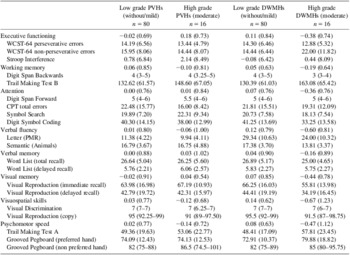
All participants completed an extensive neuropsychological battery. Cognitive measures were grouped into eight cognitive domains: executive functioning, working memory, attention, verbal fluency, verbal memory, visual memory, visuospatial skills, and psychomotor speed. Executive functioning (i.e., conceptualization, planning, and inhibition) was assessed with the 64-item computerized version of the Wisconsin Card Sorting Test (WCST-64) (Kongs, Thompson, Iverson, & Heaton, Reference Kongs, Thompson, Iverson and Heaton2000) and the interference score of the Color-Word Stroop Test (Golden, Reference Golden1978). Working memory was examined with Digit Span Backwards from the Wechsler Adult Intelligence Scale 3rd edition (WAIS-III) (Wechsler, Reference Wechsler1997a) and part B of the Trail Making Test (Tombaugh, Reference Tombaugh2004). Attentional abilities were assessed with a computerized version of the Continuous Performance Test (Conners, Reference Conners1995) and Digit Span Forward, Symbol Search, and Digit Symbol Coding subtests from the WAIS-III. Verbal fluency was measured with letter fluency (letters P, M and R) (Artiola, Hermosillo, Heaton, & Pardee, Reference Artiola, Hermosillo, Heaton and Pardee1999) and semantic category fluency (animals) (Strauss, Sherman, & Spreen, Reference Strauss, Sherman and Spreen2006) in 60s. Word Lists and Visual Reproduction from the Wechsler Memory Scale 3rd edition (WMS-III) (Wechsler, Reference Wechsler1997b) were administrated to measure verbal and visual memory, respectively. Visual Discrimination and the Copy from the Visual Reproduction subtest (WMS-III) were used to evaluate visuospatial skills. Psychomotor speed was assessed with part A of the Trail Making Test and Grooved Pegboard (Ruff & Parker, Reference Ruff and Parker1993). Participants’ raw scores were normalized to Z-scores using the mean and standard deviation of the sample. Composite Z-scores for each participant in each cognitive domain were calculated by averaging the Z-scores of all tests within that domain (Table 1).
Distribution of composite Z-scores for cognitive domains and distribution of raw test scores according to severity and regional distribution of WMLs

Note. WMLs = white matter lesions; PVHs = periventricular hyperintensities; DWMHs = deep white matter hyperintensities; WCST-64 = Wisconsin Card Sorting Test (64-item computerized version); CPT = Continuous Performance Test. Values are means (standard deviations) in Z-scores for each cognitive domain. Values are means (standard deviations) or medians (interquartile range) for each raw test score. Trail Making Test and Grooved Pegboard results are expressed in seconds.
Neuropsychological assessment also included the Mini-Mental State Examination (Folstein, Folstein, & McHugh, Reference Folstein, Folstein and McHugh1975) as a global cognitive function test and the Vocabulary subtest of the WAIS-III as a measure of premorbid intelligence.
MRI Scanning Protocol and Analysis
The MRI scanning protocol was performed with a Siemens Magnetom Trio 3T scanner (Siemens Diagnostics Healthcare, Erlangen, Germany) at the Image Diagnosis Center (Hospital Clinic, Barcelona, Spain). The MRI protocol included a set of three-dimensional magnetization-prepared rapid gradient echo (MPRAGE) T1-weighted images [repetition time (TR): 2300 ms; echo time (TE): 3 ms; flip angle: 15°; field of view: 245 mm; and voxel size: 1 × 1 × 1 mm, no gap], axial T2-weighted images (TR: 5520 ms; TE: 92 ms; and voxel size: 0.5 × 0.4 × 5 mm, gap: 1.5 mm) and axial fluid attenuated inversion recovery (FLAIR) images [TR: 9040 ms; TE: 85 ms; inversion time (TI): 2500 ms; and voxel size: 1.1 × 0.9 × 5 mm, gap: 1.5 mm].
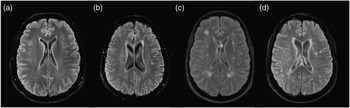
Location and severity of WMLs were estimated on T2 and FLAIR scans by a trained neuroradiologist (N.B.) using the Fazekas scale (Fazekas, Chawluk, Alavi, Hurtig, & Zimmerman, Reference Fazekas, Chawluk, Alavi, Hurtig and Zimmerman1987). On MRI, WMLs appear hyperintense on T2-weighted images. They also remain bright on FLAIR, a T2-weighted sequence that suppresses the signal from fluid-filled spaces. When only T2-weighted images are considered, confusion may occur with lacunes, small infarcts, and perivascular spaces (Fazekas et al., Reference Fazekas, Barkhof, Wahlund, Pantoni, Erkinjuntti, Scheltens and Schmidt2002). The Fazekas scale provides two different scores (PVH and DWMH), rated on a 0- to 3-point scale of increasing severity. The sum of the PVH and the DWMH scores provides a total score. Participants were classified as having no lesion, or mild, moderate, or severe lesions (0, 1, 2, or 3 points, respectively) in each location. Examples of different ratings are shown in Figure 1. The intrarater reliability was determined with 20 randomly selected scans that were scored twice. Reliability was good both for grading PVHs {weighted kappa with quadratic weights = 0.69 [95% confidence interval (CI): 0.41 to 0.99]} and for grading DWMHs [weighted kappa with quadratic weights = 0.7 (95% CI: 0.41 to 0.99)].
Fazekas scale ratings. (a) shows a participant with no periventricular hyperintensities (PVHs) or deep white matter hyperintensities (DWMHs). (b) shows a participant with small caps and thin lining (mild) PVHs and punctuate (mild) DWMHs. (c) shows a participant with thin lining (mild) PVHs and early confluent (moderate) DWMHs. (d) shows a participant with smooth halo (moderate) PVHs and early confluent (moderate) DWMHs. There were no participants with severe lesions.

Lacunar infarcts were defined as lesions with increased signal intensity on T2-weighted images and decreased signal intensity on T1-weighted and FLAIR images with a diameter of 5–15 mm, which were not located in areas with high prevalence of widened perivascular spaces (Fazekas et al., Reference Fazekas, Barkhof, Wahlund, Pantoni, Erkinjuntti, Scheltens and Schmidt2002; Vernooij et al., Reference Vernooij, Ikram, Tanghe, Vincent, Hofman, Krestin and van der Lugt2007). Their centers are isointense to cerebrospinal fluid (CSF), and thus they should not be mistaken for WMLs.
Gray matter volume (GM), white matter volume (WM), and total brain volume (TBV) were calculated with SIENAX software (http://www.fmrib.ox.ac.uk/fsl/siena/index.html) on high resolution T1-weighted images (Smith et al., Reference Smith, Zhang, Jenkinson, Chen, Matthews, Federico and De Stefano2002). Brain parenchymal volume (BP = GM + WM) was also calculated to use the ratio BP/TBV as a normalized measure of brain atrophy (Schmidt et al., Reference Schmidt, Ropele, Enzinger, Petrovic, Smith, Schmidt and Fazekas2005).
Statistical Analysis
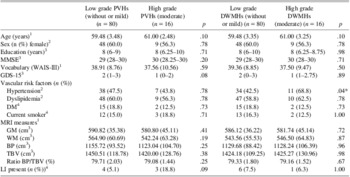
Data analyses were carried out using statistical package SPSS 17.0 for Windows (SPSS Inc., Chicago, IL). Descriptive statistics were calculated for demographic, clinical, neuropsychological, and MRI data. Outlier analyses were conducted for all continuous variables. There were no outliers. The assumption of normal distribution for continuous variables was tested by Kolmogorov-Smirnov test. The mean and standard deviation, or the median and the interquartile range, were used to describe participants’ characteristics for continuous variables (Table 2).
Demographic, clinical, and MRI data

Note. PVHs = periventricular hyperintensities; DWMHs = deep white matter hyperintensities; MMSE = Mini-Mental State Examination; GDS-15 = Geriatric Depression Scale, 15-item version; DM = diabetes mellitus; GM = gray matter volume; WM = white matter volume; BP = brain parenchymal volume = GM+WM; TBV = total brain volume; LI = lacunar infarcts. Values are means (standard deviations) in Student's t-test or medians (interquartile range) in Mann-Whitney test for continuous variables. Values are n (%) for categorical variables in chi-square test and Fisher's exact test. p shows statistical comparison between participants with high grade and low grade white matter lesions.
1Student's t-test.
2Chi-square test.
3Mann-Whitney test.
4Fisher's exact test.
*p < .05.
The distribution of the WMH scores was positively skewed as expected, with most participants having no lesions or mild lesions. Since mild lesions represent minimal cerebral abnormalities and pathological correlations indicate that they are of mixed origin, but moderate and severe lesions are usually ischemic and related to cognitive function, we dichotomized our sample into low grade WMLs (participants with no lesions or mild lesions) and high grade WMLs (participants with moderate or severe lesions). High grade PVHs were thus defined as PVH > 1 and high grade DWMHs as DWMH > 1.
To identify associations of demographic and clinical variables with WMH burden, continuous variables were evaluated with the Student's t test for independent samples or the Mann-Whitney test as appropriate. Categorical variables were evaluated with Pearson's χ 2 test or the Fisher's exact test as appropriate. Associations of demographic and clinical variables with cognitive function were also tested with Pearson or Spearman rank correlation coefficients to identify other potential confounding and mediating variables that might influence the association of WMLs with cognitive function (Table 3).
Association of demographic and clinical variables with cognitive domains

Note. EF = Executive Functioning; WM = Working Memory; VF = Verbal Fluency; Verbal M = Verbal Memory; Visual M = Visual Memory; VS = Visuospatial Skills; PS = Psychomotor Speed; Education = years of education; GDS-15 = Geriatric Depression Scale, 15-item version; HTA = arterial hypertension; DL = Dyslipidemia; DM = Diabetes Mellitus. Values are Pearson correlation coefficients (p value) in age. Values are Spearman rank correlation coefficients (p value) in years of education and GDS-15. Values are Student's t (p value) in sex and in the treatable cardiovascular risk factors.
§Confounding factor (p ⩽ .1).
Two types of analyses evaluated the specific contribution of PVHs and DWMHs to cognitive function. In the first set of analyses, cognitive test scores were analyzed as continuous variables. Differences in cognitive performance (Z-scores) were calculated between participants with high and low grade WMLs using multivariate linear regression, with separate analyses for PVHs and DWMHs. Linear regression models were first adjusted (Model 1) for age, sex, years of education, and treatable cardiovascular risk factors associated with WMH burden or cognitive function (p ⩽ .1). Models were also adjusted (Model 2) for other brain changes usually related to cognitive disturbances (brain atrophy and lacunar infarcts).
In the second set of analyses, cognitive test scores and composite Z-scores were dichotomized into normal versus impaired. Individual Z-scores <−1.5 on a cognitive test were considered to be impaired (Lezak, Howieson, & Loring, Reference Lezak, Howieson and Loring2004). A cognitive domain was considered impaired if at least one of the tests within it was impaired. Multivariate logistic regression was used to determine the odds ratios for impaired cognitive performance associated with high grade WMLs, with separate analyses for PVHs and DWMHs. Logistic regression models were adjusted for potential confounders as described above.
Results
Due to technical difficulties on MRI acquisition, four participants were excluded from the sample. There were no differences in demographic and clinical variables between the remaining 96 participants and those recruited from the PERART Study but excluded from the analyses. Demographic, clinical, and MRI characteristics of the remaining 96 participants (mean age = 59.7 years; 59% women; median education = 8 years) are summarized in Table 2. As expected, their intelligence, general cognitive function, and depressive symptoms were within the normal range.
Association of Demographic and Clinical Variables With WMH Burden
Arterial hypertension was the only clinical variable associated with WMH burden (Table 2). Arterial hypertension was more frequent in participants with high grade DWMHs (68.8%) versus low grade DWMHs (42.5%). There was no association between arterial hypertension and PVH burden. There were no associations between demographic variables and WMH burden, either PVH or DWMH. Age showed only a statistical trend for high grade PVHs and high grade DWMHs (p = .1).
Association of Demographic and Clinical Variables With Cognitive Function
To identify other potential confounders in the association between WMLs and cognitive function, association of demographic and clinical variables with cognitive domains was tested (Table 3). In summary, age was inversely related to psychomotor speed. Men had higher scores than women on attention, verbal fluency, and visual memory. Years of education was positively related to working memory, attention, verbal fluency, visual memory, and visuospatial skills. Participants with arterial hypertension had lower scores for verbal fluency, and participants with diabetes mellitus and current smokers had lower scores for psychomotor speed.
Prevalence and Severity of WMLs and Lacunar Infarcts
PVH ratings revealed 51 participants (53.1%) with no PVHs, 29 participants (30.2%) with mild PVHs (caps and pencil-thin lining), and 16 participants (16.7%) with moderate PVHs (smooth halo). DWMH ratings identified 19 participants (19.8%) without DWMHs, 61 participants (63.5%) with mild DWMHs (punctuate), and 16 participants (16.7%) with moderate DWMHs (early confluent). Seven participants (7.3%) had both moderate PVHs and moderate DWMHs. None of the participants had severe PVHs (irregular) or severe DWMHs (confluent). PVH scores were correlated with DWMH scores (r s = 0.46; p < .001) and total Fazekas score (r s = 0.88; p < .001). DWMH scores were also correlated with total Fazekas score (r s = 0.81; p < .001).
Thirteen lacunar brain infarcts were present across 7 participants (7.3%). Four of them had one lacunar infarct, two had two infarcts, and one person had three infarcts. Eight of the lacunar infarcts were located in the basal ganglia, and there was one lacunar infarct each in the pons, intern capsule, and corona radiata. The presence of lacunar infarcts was not associated with WMH burden, although the presence of high grade PVHs showed a statistical trend with the presence of lacunar infarcts (p = .09).
Cognitive Function Associated With High Grade PVHs and DWMHs
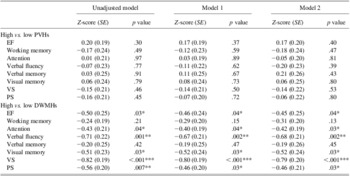
Table 4 shows Z-score differences in cognitive performance between participants with high versus low grade WMLs using linear regression models. Participants with high grade DWMHs had significantly lower scores in executive functioning [−0.50 standard deviations (SD)], attention (−0.43 SD), verbal fluency (−0.71 SD), visual memory (−0.51 SD), visuospatial skills (−0.82 SD), and psychomotor speed (−0.56 SD). Adjustments for age, sex, years of education, and cardiovascular risk factors related to cognitive performance (Model 1) generally reduced these associations, but they were still significant in each cognitive domain. These associations were essentially unaltered by additional adjustment for brain atrophy ratio and lacunar infarcts (Model 2). High grade PVHs were not related to lower scores in any cognitive domain.
Differences in cognitive performance (Z-scores) between participants with high grade WMLs versus participants with low grade WMLs using multivariate linear regression models

Note. WMLs = white matter lesions; SE = standard error; PVHs = periventricular hyperintensities; DWMHs = deep white matter hyperintensities; high grade = moderate lesions; low grade = without or mild lesions; EF = Executive Functioning; VS = Visuospatial Skills; PS = Psychomotor Speed. Model 1 = adjusted for age, sex, years of education, and treatable cardiovascular risk factors related to cognitive performance (p ⩽ .1); Model 2 = Model 1 plus adjustment for brain atrophy ratio (%) and presence of lacunar infarcts.
*p < .05.
**p < .01.
***p < .001.
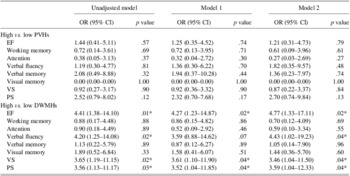
Table 5 shows odds ratios (OR) and 95% confidence intervals (CI) for risk of cognitive impairment associated with high versus low grade WMLs using logistic regression models. High grade DWMHs were associated with a three- to fourfold increased risk of cognitive impairment in executive functioning (OR = 4.41; 95% CI: 1.38–14.10), verbal fluency (OR = 4.20; 95% CI: 1.25–14.08), visuospatial skills (OR = 3.65; 95% CI: 1.19–11.15), and psychomotor speed (OR = 3.56; 95% CI: 1.13–11.17). The association with impairment in verbal fluency was not significant after adjusting for age, sex, years of education, and diagnosis of arterial hypertension (Model 1). All associations remained significant when subsequently adjusted for other brain changes (Model 2). High grade PVHs were not related to an increased risk of cognitive impairment.
Odds ratio (OR) and 95% confidence interval (CI) for risk of cognitive impairment in participants with high grade versus participants with low grade WMLs using logistic regression models

Note. WMLs = white matter lesions; PVHs = periventricular hyperintensities; DWMHs = deep white matter hyperintensities; high grade = moderate lesions; low grade = without or mild lesions; EF = Executive Functioning; VS = Visuospatial Skills; PS = Psychomotor Speed. Model 1 = adjusted for age, sex, years of education and treatable cardiovascular risk factors related to cognitive performance (p ⩽ .1); Model 2 = Model 1 plus adjustment for brain atrophy ratio (%) and presence of lacunar infarcts.
*p < .05.
Discussion
This study investigated the independent contributions of PVHs and DWMHs to cognitive function, as well as the prevalence and severity of WMLs and lacunar infarcts using a 3T MRI scanner, in a community-dwelling sample of middle-aged individuals. The principle finding was that high grade DWMHs were associated with lower scores in executive functioning, attention, verbal fluency, visual memory, visuospatial skills, and psychomotor speed. On the other hand, high grade PVHs were not associated with lower scores in any cognitive domain.
In an effort to increase the clinical relevance of our study, we also evaluated the independent association of PVHs and DWMHs with the risk of cognitive impairment (i.e., <−1.5 SD). Despite the relatively young age of the sample and the mild severity of the WMLs observed, high grade DWMHs were associated with a three- to fourfold increased risk of impaired performance in executive functioning, verbal fluency, visuospatial skills, and psychomotor speed. High grade PVHs were not associated with impaired cognitive performance in any cognitive domain either.
Disturbances in executive function and processing speed were related to WMLs as expected (De Groot et al., Reference De Groot, De Leeuw, Oudkerk, Van Gijn, Hofman, Jolles and Breteler2000; DeCarli et al., Reference DeCarli, Murphy, Tranh, Grady, Haxby, Gillette and Rapoport1995; Pantoni et al., Reference Pantoni, Poggesi and Inzitari2007; Schmidt et al., Reference Schmidt, Grazer, Enzinger, Ropele, Homayoon, Pluta-Fuerst and Fazekas2011; Vannorsdall et al., Reference Vannorsdall, Waldstein, Kraut, Pearlson and Schretlen2009). We also found a dysfunction in verbal fluency, which is a frontally-mediated function that can provide information relevant to executive control and processing speed (Hachinski et al., Reference Hachinski, Iadecola, Petersen, Breteler, Nyenhuis, Black and Leblanc2006; Strauss et al., Reference Strauss, Sherman and Spreen2006). In contrast with previous research (Stenset et al., Reference Stenset, Hofoss, Berstad, Negaard, Gjerstad and Fladby2008; Vannorsdall et al., Reference Vannorsdall, Waldstein, Kraut, Pearlson and Schretlen2009), high grade DWMHs were not associated with working memory dysfunction. This discrepancy may be explained by the high rate of missing data (almost 20%) for part B of the Trail Making Test, given the low educational level of the sample (median = 8 years). High grade DWMHs were also related to worse visual memory and visuospatial skills, which is consistent with previous investigations (Leaper et al., Reference Leaper, Murray, Lemmon, Staff, Deary, Crawford and Whalley2001; Schmidt et al., Reference Schmidt, Ropele, Enzinger, Petrovic, Smith, Schmidt and Fazekas2005; Stenset et al., Reference Stenset, Hofoss, Berstad, Negaard, Gjerstad and Fladby2008). Most of the associations between high grade DWMHs and poorer cognitive function in our sample were clinically relevant. This remarkable finding was present in the associations with executive functioning, visuospatial skills, and psychomotor speed.
Based on etiology and histopathological evidence, Kim, MacFall, and Payne (Reference Kim, MacFall and Payne2008) have suggested that WMLs should be divided into ischemic and non-ischemic. The new classification would include PVHs and DWMHs as well. Ischemic PVHs would be defined as being from 3 to 13 mm from the ventricles, affecting long associating tracts. PVHs within 3 mm of the ventricles are non-ischemic and their functional effect on cognition is unlikely (Pantoni, Reference Pantoni2002). Ischemic DWMHs would be defined as 13 mm or further from the ventricles (i.e., centrum semiovale), also affecting long associating tracts. Likewise, DWMHs within 4 mm from cortical GM would also be considered ischemic, causing disruption of short cortico-cortical connections consisting of arcuate U-fibers and affecting the integrity of frontal-subcortical circuits, probably leading to executive deficits (Fazekas et al., Reference Fazekas, Schmidt and Scheltens1998; Inzitari, Reference Inzitari2000).
In our sample, high grade DWMHs consisted of “early confluent” (moderate) DWMHs, which would be considered ischemic WMLs, whereas high grade PVHs consisted of “smooth halos” (moderate), which reflect primarily non-ischemic changes. We did not find severe PVHs, which are related to ischemic damage in long associating tracts. This fact may explain the lack of association between PVHs and cognition in our study and the incongruent results within the literature. The moderate correlation between PVH and DWMH scores described here (r s = 0.46; p < .001) suggests that each type of WMLs may have dissimilar pathogenic mechanisms in our sample. In contrast to the observed PVHs (caps, thin lining, bands, or halos), which appear to be more strongly related to age (Fernando et al., Reference Fernando, O'Brien, Perry, English, Forster, McMeekin and Ince2004), the observed DWMHs suggest an underlying vascular risk (Fazekas et al., Reference Fazekas, Schmidt and Scheltens1998; Fernando et al., Reference Fernando, Simpson, Matthews, Brayne, Lewis, Barber and Ince2006). Specifically, arterial hypertension was related to DWMH burden in our sample. On the other hand, age and the presence of lacunar infarcts only showed statistical trends with PVH and DWMH burden. The narrow and young age range and the mild severity of WMLs (especially PVHs) in our sample may account for this finding.
In this study, brain MRI was performed with a 3T scanner instead of 1.5T scanners used so far. Since higher magnetic fields can provide improved sensitivity and diagnostic capacity (Kim et al., Reference Kim, MacFall and Payne2008; Scarabino et al., Reference Scarabino, Nemore, Giannatempo, Bertolino, Di Salle and Salvolini2003), SVD-related pathology should be more easily detected. Nevertheless, the prevalence of participants with WMLs in our sample was lower than compared with other studies with participants of similar age (Wen & Sachdev, Reference Wen and Sachdev2004). The prevalence of moderate lesions was similar to previous reports (Mosley et al., Reference Mosley, Knopman, Catellier, Bryan, Hutchinson, Grothues and Szklo2005; Schmidt et al., Reference Schmidt, Schmidt, Fazekas, Schumacher, Niederkorn, Kapeller and Kostner1997) but none of our participants showed severe lesions. The prevalence of lacunar infarcts in our sample was slightly lower than seen elsewhere (Chen, Wen, Anstey, & Sachdev, Reference Chen, Wen, Anstey and Sachdev2009). Overall, these figures may be suggestive of a minor prevalence of SVD-related pathology in our sample. Lifestyle (i.e., dietary patterns) or genetic factors may be the basis of this lower prevalence (Alzamora et al., Reference Alzamora, Sorribes, Heras, Vila, Vicheto, Fores and Pera2008; Tunstall-Pedoe et al., Reference Tunstall-Pedoe, Kuulasmaa, Mähönen, Tolonen, Ruokokoski and Amouyel1999).
One potential weakness of the present study is the use of a visual rating scale (Fazekas et al., Reference Fazekas, Chawluk, Alavi, Hurtig and Zimmerman1987) to assess prevalence and severity of WMLs. Visual rating scales have some limitations, such as non-linearity of data, lack of sensitivity to small changes, and susceptibility to ceiling effects (Kim et al., Reference Kim, MacFall and Payne2008). Quantitative methods (i.e., volumetric analyses) have been regarded as more reliable and robust (Mosley et al., Reference Mosley, Knopman, Catellier, Bryan, Hutchinson, Grothues and Szklo2005). However, there is conflicting evidence regarding the idea that volumetric approaches for assessing WMLs may be more sensitive to clinical features than visual scores (Gouw et al., Reference Gouw, Van der Flier, van Straaten, Barkhof, Ferro, Baezner and Scheltens2006). In most community-dwelling studies, WMLs are measured using visual rating scales, which are widely used in clinical practice (De Groot et al., Reference De Groot, De Leeuw, Oudkerk, Van Gijn, Hofman, Jolles and Breteler2000; Longstreth et al., Reference Longstreth, Manolio, Arnold, Burke, Bryan, Jungreis and Fried1996; Pantoni et al., Reference Pantoni, Basile, Pracucci, Asplund, Bogousslavsky, Chabriat and Inzitari2005). Visual scales usually offer separate assessment of PVHs and DWMHs, which semi- and fully-automated quantitative methods often overlook.
Other possible limitations need to be considered. Cross-sectional studies with small size samples may report conflicting results regarding the association of WMLs with cognition, which is probably attributable to the low statistical power of samples (Desmond, Reference Desmond2002). Our sample size does not allow us to study the association of cognitive function with lobar locations of PVHs and DWMHs (frontal, parietal, temporal, or occipital), which may have some importance (Debette et al., Reference Debette, Bombois, Bruandet, Delbeuck, Lepoittevin, Delmaire and Pasquier2007). The cross-sectional design also precludes us from making causal inferences regarding these associations.
Overall, our results corroborate the hypothesis that PVHs and DWMHs differentially impact cognitive function in middle-aged individuals and support the ongoing distinction between both types of WMLs. High grade (moderate) DWMHs were related to extensive cognitive dysfunction in several domains whereas high grade (moderate) PVHs were not. Remarkably, most of these disturbances were clinically relevant in that they conferred a substantial increase in risk of cognitive impairment, making individuals with high grade DWMHs three to four times as likely to present with neuropsychological impairments. These results suggest that neuroradiologists should characterize separately PVHs and DWMHs in their reports, which should be available for neuropsychologists. The predominant role of DWMHs may be attributed to underlying ischemic processes, since only ischemic WMLs seem to exert histopathological changes that are located in white matter areas with potential functional relevance. This highlights the importance of primary prevention and treatment of modifiable risk factors, especially arterial hypertension, in middle-aged individuals. Further research is needed to more clearly elucidate whether WMLs types arise from dissociable forms of pathogenesis in middle-aged individuals.
Acknowledgments
This work was supported by the Spanish Ministry of Education and Science (J.J.S.R., grant number AP2006-00311), (M.M., grant number SEJ2006-15399/PSIC); the Generalitat of Catalonia (J.M., grant number 2009FI_B00285); and the Spanish Ministry of Health (J.F.A., grant number FIS 07/039). There are no conflicts of interest related to this study. The authors thank all the participants who voluntarily accepted to take part in this project. The authors are also grateful to Shelley Peery, PhD, for linguistic support and to the anonymous reviewers for enlightening comments on an earlier version of this manuscript and for the many improvements they kindly brought to our article throughout the reviewing process.