Canada's 23rd general election was held on January 23, 2006. Only 20 months earlier, on June 28, 2004, the governing Liberals—in power continuously since 1993—had been reduced to a minority in Parliament, winning 135 of 308 seats and 37% of the popular vote. Minority governments in Canada typically have quite short half-lives, and the Liberal government formed in 2004 was no exception. After narrowly avoiding defeat on its budget bill in May 2005, the government lost a vote of confidence in the House of Commons on November 28, and Canadians faced the prospect of a winter trek to the polls. And, since the holiday season was fast approaching, Election Day was deferred until late January, making the campaign an atypically long one by Canadian standards. It also proved to be a very exciting one.
Salient Issues and Campaign Dynamics
The issues in play in the 2006 campaign strongly resembled those in 2004. Most salient was the “Adscam” or “sponsorship” scandal. In the run-up to the 2004 election, the Auditor General's annual report revealed that former Prime Minister Jean Chrétien's government had allocated millions of dollars to pro-Liberal advertising agencies in Quebec, ostensibly to inform Quebeckers of the many good things Ottawa was doing on their behalf. In fact, much of the work was not done, and proper records were not maintained. The scandal prompted a judicial inquiry (the Gomery Commission) which reported on November 1, 2005, that although the current Liberal leader, Prime Minister Paul Martin, was not personally culpable, Chrétien and several other prominent Liberals bore responsibility for fostering a “culture of entitlement.” In addition, the report described a massive kickback scheme whereby large sums of money had been funneled into party coffers. The scandal had done substantial damage to the Liberals in 2004 and, reinvigorated by the Gomery findings, it threatened to do so again in 2006.
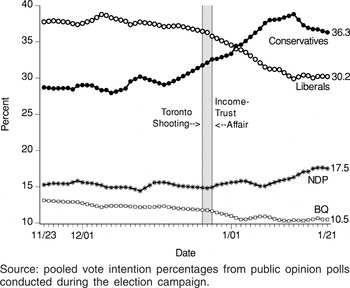
Initially, this did not seem to be the case. Although early November public opinion surveys showed a sharp drop in Liberal support immediately after the Gomery revelations, the party's poll numbers quickly rebounded. When the campaign began in late November, several pollsters reported that the Liberals were running well ahead of their principal rivals, the Conservative Party of Canada (CPC), with vote intention shares very similar to the parties' respective vote tallies in 2004. As Figure 1 shows, the Liberals maintained a sizable lead for nearly three weeks, prompting observers to conclude that the campaign was nothing more than déjà vu all over again.1
The data in Figure 1 were generated using a Bayesian state-space model for pooling time series data developed by Simon Jackman (2005). Details are available upon request.

Dynamics of Party Support in the 2006 Federal Election Campaign
The conclusion was decidedly premature. Canadians traditionally have prided themselves that their country—in sharp contrast to their giant neighbor to the south—is a land of “peace, order, and good government.” However, events in late December caused voters to reconsider. Violent crime has been on the increase in Canada in recent years, prompting widespread media attention and mounting public concern. The problem was dramatized on December 26 when a teenage girl became an innocent victim of gang violence when she was shot to death in mid-town Toronto. Sensational accounts of the horrific slaying prompted public outrage, and the Martin government was criticized for allowing “peace” and “order” to be jeopardized. More bad news for the prime minister and his colleagues quickly followed when two new financial scandals made national headlines, putting “good government” in question again. One of the stories concerned yet more misdeeds in the sponsorship scandal, whereas the second—the “income-trusts affair”—involved charges of insider-trading using information obtained from the office of Minister of Finance Ralph Gooddale. Gooddale, a senior Liberal cabinet minister, rejected calls for his resignation claiming that he had done nothing wrong, and that the public release of information about an RCMP investigation into the charges constituted a highly irregular attempt to influence the election.
Figure 1 suggests the finance minister had good reason to be concerned. As 2005 drew to a close, Liberal poll numbers slid downward, and CPC support—already increasing—surged. The events of late December seemingly acted like a booster rocket for the Conservatives. In early January, they pulled ahead of the Liberals and thereafter never relinquished the lead. Trends in party support in the large provinces of Ontario and Quebec were particularly important. In the former, the Conservatives and New Democratic Party (NDP) both benefited at the Liberals' expense, whereas in the latter, increasing numbers of so-called soft nationalists began to desert the hitherto dominant Bloc Québécois (BQ) in favor of the Conservatives.
Although scandals and violent crime dominated the news at a crucial juncture in the campaign, there were other prominent issues on the agenda. As is typical in Canadian elections, the competing parties tried to convince voters that they would deliver a bountiful supply of health care and other cherished public services. In 2006, hospital care waiting times and child care were focal points of concern. Attempting to demonstrate that he was very much in the mainstream, and not the “right-wing nut” the Liberals portrayed him as in 2004, Conservative leader Stephen Harper promised that a CPC government would boost health care funding, implement a guaranteed hospital waiting time scheme, and give families an annual $1,200 per child allowance “no strings attached.” Possible merits aside, Harper's child-care proposal had an immediate political payoff when Prime Minister Martin's communications director, Scott Reid, ill-advisedly quipped to the media that parents would simply blow it on “beer and popcorn.”
Another 2004 issue enjoying an encore was same-sex marriage. Endorsed as a “Charter Right” by both the Liberals and the NDP, and dismissed as irrelevant by the BQ, the Conservatives promised that same-sex marriage would be subject to a free vote in Parliament should they win the election. Gun control, U.S.-Canada relations, and the Goods and Services Tax (GST) also made return engagements. In the wake of heavy criticism of their gun registry program and the aforementioned wave of highly publicized shootings in major cities, the Liberals proposed eliminating all hand guns. The Conservatives responded that the Liberals (and NDP) were mistaking pistols for perpetrators, and that the latter, not the former, were the source of the problem.
And, replaying a perennial theme in Canadian politics, the parties sparred about relations with the United States. Portraying himself as the resolute defender of Canadian sovereignty, Prime Minister Martin charged that the U.S. had repeatedly violated NAFTA regulations about tariffs on the import of softwood lumber and was negligent on a host of environmental protection issues. In addition, Martin reiterated his 2004 charge that Harper was in league with President George W. Bush, and had plans to send Canadian troops to Iraq. Harper responded by saying that, in fact, it was Martin who had plans to put Canadians on the firing line in that war-torn country. As for the GST, the Conservatives announced that they would reduce the heartedly disliked national sales tax by 2%. The Liberals, touting low employment and a budget surplus, countered by arguing that an income tax reduction was the way forward.
Finally, national unity was once again on the front burner. After the very narrow defeat of the 1995 Quebec sovereignty referendum proposal, many observers argued that the separatist movement was in terminal decline. But, as the 2004 election result and numerous subsequent opinion polls demonstrated, this was wishful thinking (Clarke et al. 2005). Fueled by widespread perceptions that the federal Liberals had “disrespected” Quebec by their actions in the sponsorship scandal, Bloc Québécois' support skyrocketed. Early in the 2006 election campaign, a leaked internal Liberal party memo warned that the BQ was poised take all but 10 of the province's 75 seats. Moreover, polls showed that Jean Charest's pro-federalist provincial Liberal government also was massively unpopular, making a separatist victory in the next Quebec provincial election a distinct possibility. The latter would set the stage for another sovereignty referendum.
The strength of pro-sovereignty forces in Quebec early in the campaign was both a problem and an opportunity for the federal Liberals. It was an obvious problem for them because the growth of separatist sentiment has occurred on their watch. But, it was an opportunity as well. Historically, the Liberals have reaped political profits by portraying themselves to the ROC (rest of Canada) as the only party that can keep Quebec in Confederation. Equally, the Liberals have been able to convince many Quebeckers that they are the only party that can keep the separatists in check, while advancing Quebec's interests in the national political arena. In the 2006 election campaign, Martin and his party played this familiar, double-edged gambit one more time. The Conservatives countered by arguing that Quebeckers' support for federalism could be best secured by redressing the “fiscal imbalance” whereby Ottawa starved Quebec and other provinces of much-needed tax revenue. The idea proved popular.
An air of desperation and disorganization hung over the Liberal camp in the waning days of the campaign. Sensing their peril, the Liberals went negative. Replaying their 2004 strategy, they unleashed a barrage of somber TV advertisements that portrayed CPC leader Harper as an ideological zealot. Viewers were warned that Harper would dismantle the health care system and other highly valued public services, implement secret schemes for military occupation of major Canadian cities, and do the United States' bidding by placing Canadian soldiers in harm's way in Iraq and other danger zones. Also similar to 2004, the Liberals tried to convince supporters of the left-of-center NDP that they should behave tactically, voting Liberal to stop the right-wing bogey man. However, as it became evident that the Liberals' scare tactics were not working and that they were poised for defeat, NDP leader Jack Layton tried to turn the logic of tactical voting on its head. He appealed to Liberal supporters to “lend us your vote” to ensure a strong, progressive voice in Ottawa to oppose a Harper-led CPC government. For his part, Harper stuck to his carefully scripted game plan of emphasizing relatively popular policies such as cutting the GST and providing an unmonitored child care allowance, while restraining enthusiastic colleagues tempted to engage in ideological diatribes.
Electoral Choice
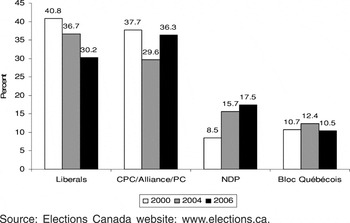
The Conservative plan was a winner. On Election Day, turnout was up slightly (64.7% v. 60.9% in 2004), with the CPC attracting 36% of the vote, almost a 7% increase over 2004 (see Figure 2). This was less than party strategists had hoped, but it was enough to give the CPC a small plurality (124) of seats, and the opportunity to form a minority government. In contrast, the Liberals' seat total dropped from 135 to 103 and their vote share fell from 36.7% to 30.2%. Upon learning the disappointing news, Liberal leader Paul Martin immediately resigned. The fortunes of the smaller parties also varied. The NDP was relatively successful, capturing 17.5% of the vote and 29 seats, 10 more than in 2004. However, the Bloc Québécois faltered. Although it captured 51 of Quebec's 75 seats (only three less than in 2004), its vote total in the province declined from 48.9% to 42.1%.

Vote Shares in the 2000, 2004, and 2006 Federal Elections
Data gathered in the 2006 Political Support in Canada (PSC) survey enable us to investigate forces that shaped these electoral choices.2
The 2006 Political Support in Canada (PSC) survey was a nationwide Internet survey (N = 6116) conducted by YouGov. Headquartered in Britain, YouGov has established a strong record for accurate forecasts of vote shares in elections in Britain and elsewhere. YouGov is one of two major survey firms that conducted research for the 2005 British Election Study. The questionnaire for the 2006 PSC survey is available at: www.utdallas.edu/∼hclarke.
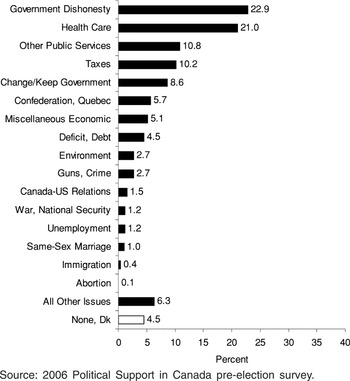
The PSC survey data reveal that, similar to 2004 and most other Canadian federal elections, valence issues topped the “most important issue” list in 2006. As shown in Figure 3, concerns about health care and other public services were mentioned by nearly one-third of the respondents, with government dishonesty (including the sponsorship scandal) being cited by nearly one-quarter more. All other issues were mentioned much less frequently. Especially noteworthy in this regard are same-sex marriage and relations with the United States. Although these position issues received intense media attention, less than 3% of the respondents mentioned one of them as most important. Two other hot button position issues, abortion and immigration, were cited by less than 1%.

Most Important Issues in the 2006 Canadian Federal Election
Economic issues also had relatively little resonance. Taxation was mentioned by slightly over 10% of the respondents, typically by people endorsing the Conservative plan to reduce the GST. Other economic issues, including clearly valenced ones such as unemployment, accounted for an additional 11%. Going into the campaign, the Liberals had hoped that voters would credit them for the country's healthy economy and, indeed, a plurality of people who mentioned an economic issue other than the GST as the most important issue selected the Liberals as the party closest to them. But the problem for the Liberals was that relatively few voters gave priority to the economy in 2006. The prosperity the Liberals hoped to profit from was seemingly taken for granted. This hurt because the party did not do well on most of the issues voters were emphasizing. Overall, only 22% preferred the Liberals on an issue of principal concern. The Conservatives did somewhat better (28%), with 17%, 8%, and 4% favoring the NDP, the BQ, or another minor party, respectively. An additional 22% said no party was closest or that there were no important issues.
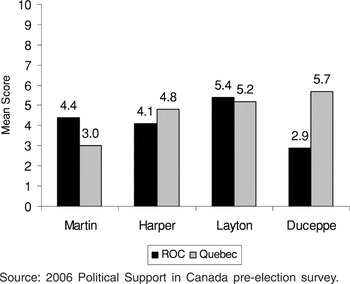
Like valence issues, party leader images have important effects on voting in Canada. Voters' assessments of the leaders' character and competence provide them with cost-effective cues to guide their electoral choices in a world of high stakes and abundant uncertainty (Clarke et al. 2004). The importance of leader effects suggests why a serious, protracted scandal such as the sponsorship affair could do major damage to Liberal prospects and, indeed, many voters had a decidedly negative view of Prime Minister Martin in the run-up to the 2006 election. In the PSC pre-election survey, his average score on a 0–10 “feeling thermometer” scale, with 0 being a negative feeling and 10 a positive feeling, was only 4.4 in English-speaking Canada, and a dismal 3.0 in Quebec (see Figure 4). Feelings about the prime minister were powerfully correlated (−.74) with reactions to the scandal. But, Martin was not the only leader to experience a chilly public reception. Most important, his principal rival, CPC leader Stephen Harper scored only 4.1 in the ROC and 4.8 in Quebec. The minor party leaders fared somewhat better, although few voters expressed much enthusiasm for them. NDP leader Jack Layton scored 5.2 in Quebec and 5.4 in the ROC, while BQ chieftain Gilles Duceppe achieved a 5.7 rating in Quebec, the only locale that mattered for him.

Feelings about the Party Leaders, Quebec and the Rest of Canada
Party identification is a third variable with major direct effects on voting behavior in Canada. Canadians' partisan ties are not fixed in stone. Analyses of panel surveys conducted since the 1970s indicate that a substantial number of people have flexible partisan attachments, and are prepared to move from one party to another in response to judgments about the performance of parties and party leaders (e.g., Clarke, Kornberg, and Wearing 2000). The widespread absence of strong, stable partisan attachments makes large-scale shifts in party support an ongoing possibility. In this regard, the vote intention dynamics in the 2006 campaign documented above are not unique. Over the past two decades, large movements in party support have occurred in several federal election campaigns (Clarke et al. 2005; Johnston et al. 1992).
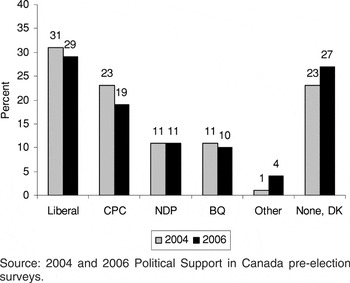
At the time of the 2006 election, only 29% of the PSC survey respondents identified themselves as Liberals (see Figure 5). This is the smallest cohort of Liberal partisans recorded in any national election survey conducted since 1965. However, it is considerably larger than the percentage of identifiers with any of the other parties, including the victorious Conservatives. Only 19%were CPC partisans—less than the percentage who identified with the CPC's predecessor, the Progressive Conservative (PC) Party at the time of the disastrous 1993 election that ended that party's status as a major player in federal politics. NDP and BQ partisan shares are also noteworthy. Although the New Democrats were encouraged by the 2006 election outcome, their achievement did not reflect any net growth in the cohort of NDP identifiers. On the contrary, the percentage (11%) of NDP partisans in 2006 was actually 1% less than that recorded in the first election study in 1965. The Bloc Québécois percentage in Figure 5 (10%) is a national figure, and in Quebec, 41% said they were BQ partisans. Although the latter figure is 5% smaller than in 2004, the BQ continued to have a much larger group of partisans than any of its rivals.

Distribution of Federal Party Identification in 2004 and 2006
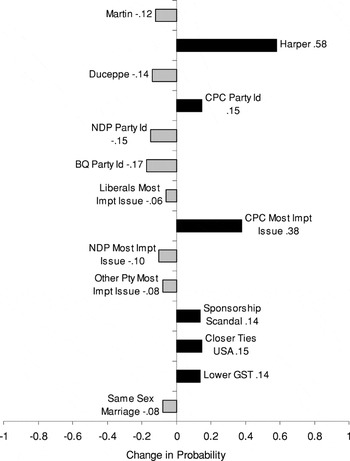
Multivariate analyses reveal that, similar to earlier Canadian federal elections, valence issues, leader images, and party identifications all exerted strong effects on voting in 2006. An illustration of these effects is provided in Figure 6, which reports results of an analysis that contrasts voting for the Conservatives with voting for any of the other parties.3
Information regarding variables used in the multivariate analysis and the results of the analysis are available at the web site cited in note 2.
Probabilities were calculated using the STATA CLARIFY program developed by Tomz, Wittenberg, and King (1999).

Effects of Significant Predictors on Probability of Voting Conservative
As discussed above, the 2006 list of most important issues was dominated by valence issues. The most frequently cited of these issues was the sponsorship scandal, but net of its large effect as a most important issue, a specific sponsorship scandal index has an additional effect, increasing the probability of a Conservative ballot by an additional 14 points. The effects of specific position issues are modest, albeit not trivial. Opinions regarding Canada's relationship with the United States, the advisability of lowering the GST, and the desirability of same-sex marriage change the probability of a CPC vote by 15, 14, and 8 points, respectively. The effects of party identification also are strongly in evidence. For example, shifting from being a BQ identifier to being a CPC identifier enhances the likelihood of a Conservative vote by 32 points (.15–−.17). Moving from the NDP to the CPC increases that likelihood by almost as much (30 points). Taken together, these numbers indicate that the forces operating on voting in 2006 were quite typical of those at work in Canadian elections.
Flawless Campaign, Fragile Victory
The 2006 Canadian federal election featured strong, consequential, campaign dynamics and the widely unexpected election of a party formed less than three years ago. To achieve its surprising victory, the new Conservative Party of Canada and its leader, Stephen Harper, benefited from two factors. First, they ran a flawless campaign. Recognizing the importance of valence issues, Harper and his colleagues emphasized a limited set of policies with broad appeal. Insofar as possible, divisive position issues such as abortion, immigration, and same-sex marriage were sidestepped, and party ideologues were tightly muzzled. As a result of their positive, centrist campaign, the Conservatives were able to minimize the effects of Liberal efforts to brand them as right-wing extremists. Second, the Conservatives were lucky. The Gomery Commission Report ensured that the sponsorship scandal would be a prominent issue again in 2006. Then, a major unanticipated campaign event—the income-trust affair—strongly reinforced the image that corruption in the Martin government was both widespread and serious. The Toronto shooting compounded the effect by helping to create a general sense that things were out of control. Prime Minister Martin and his party were in office, but they were not in control.
The Conservative victory is fragile. Most obviously, the CPC holds only a minority of parliamentary seats, and Canadian minority governments have notoriously poor track records for longevity. Also, the sponsorship scandal, a major factor in the 2004 and 2006 elections, will not be an issue next time around. The Liberals are out of office and Martin has resigned as party leader. Although the Liberals have not chosen his successor, they undoubtedly will select someone not implicated in the scandal. There is a good chance that the next leader will be from a younger generation of politicians with very limited or no experience in the Liberal governments of the past decade. With the heavy baggage of the sponsorship affair left behind, and a young, clean, potentially popular leader, the Liberals will be in a stronger position to contest the next election.
Finally, it bears emphasis that less than one voter in five is presently a CPC identifier. Absent the unusually fortuitous circumstances that favored the Conservatives in 2006, it is very difficult to imagine the party winning the next election with such a small partisan base. That is the bad news for Harper and CPC strategists. But, there is also good news—the size of that base is subject to change. The flexibility of Canadians' party identifications gives the new government a valuable opportunity to increase the size of the cohort of CPC identifiers. If the new Conservative government receives high marks for its performance in office, this will work to increase the number of CPC partisans. It will also bolster the image of Prime Minister Harper. With a larger group of identifiers and a more favorably received leader, the CPC will have a chance to retain, and perhaps to strengthen, its grip on power.