INTRODUCTION
People with Huntington’s disease (HD) experience reduced social quality of life, including social isolation, social withdrawal, and strained or disrupted family relationships (Maxted, Simpson, & Weatherhead, Reference Maxted, Simpson and Weatherhead2014; Tyler, Harper, Davies, & Newcome, Reference Tyler, Harper, Davies and Newcome1983; Vamos, Hambridge, Edwards, & Conaghan, Reference Vamos, Hambridge, Edwards and Conaghan2007). Social dysfunction is mediated, at least in part, by neuropsychiatric changes associated with HD (Aubeeluck & Buchanan, Reference Aubeeluck and Buchanan2006; Eddy & Rickards, Reference Eddy and Rickards2013; Ross, Pantelyat, Kogan, & Brandt, Reference Ross, Pantelyat, Kogan and Brandt2014). Neuropsychiatric symptoms in HD arise to some extent as a direct result of disease neuropathology, however, may also be influenced by other clinical manifestations. Interestingly, the relationships between social cognitive factors, such as the ability to recognize emotions from facial expressions, and neuropsychiatric symptoms are emerging in other neurodegenerative diseases. For instance, in Parkinson’s disease, emotion recognition impairments have been found in apathetic, but not non-apathetic patients (Martinez-Corral et al., Reference Martinez-Corral, Pagonabarraga, Llebaria, Pascual-Sedano, Garcia-Sanchez, Gironell and Kulisevsky2010). Other authors have reported a relationship between Parkinson’s disease patients’ performance on an emotion recognition task and symptoms of apathy, even after controlling for cognitive factors (Narme et al., Reference Narme, Mouras, Roussel, Duru, Krystkowiak and Godefroy2013; Robert et al., Reference Robert, Le Jeune, Dondaine, Drapier, Peron, Lozachmeur and Drapier2014). If the same relationships exist in HD, they may inform the development of new avenues of treatment for such symptoms.
HD is diagnosed after the onset of motor symptoms that are “unequivocal signs of HD” in people with either a family history of HD, or are HD-gene positive (Reilmann, Leavitt, & Ross, Reference Reilmann, Leavitt and Ross2014). Facial emotion recognition deficits onset even before patients are clinically diagnosed, in the “premanifest” disease phase (Johnson et al., Reference Johnson, Stout, Solomon, Langbehn, Aylward, Cruce and Paulsen2007; Tabrizi et al., Reference Tabrizi, Langbehn, Leavitt, Roos, Durr and Craufurd2009). These emotion recognition deficits affect the ability for people with premanifest and “manifest” (post-clinical diagnosis phase) HD to recognize negative emotions including anger, disgust, fear, and sadness (for a review see Henley et al., Reference Henley, Novak, Frost, King, Tabrizi and Warren2012), and may contribute to social dysfunction. While most research characterizing emotion recognition deficits in HD have used “static” tasks, removed of contextual and other emotional cues, more recent evidence demonstrates that people with manifest HD are also impaired for recognizing emotion from “dynamic” tasks in which multiple sources of emotional information are provided (Larsen, Vinther-Jensen, Gade, Nielsen, & Vogel, Reference Larsen, Vinther-Jensen, Gade, Nielsen and Vogel2016; Philpott, Andrews, Staios, Churchyard, & Fisher, Reference Philpott, Andrews, Staios, Churchyard and Fisher2016). Emotion recognition refers to a broad set of social cognitive skills that enable interpretation of emotional or affective information from visual, auditory, and even olfactory inputs, for example, scenes, facial expressions, body posture, and even odors, such as disgusting smells. Emotion recognition enables interpretation of emotional expressions that convey what others are thinking and feeling (Phillips, Drevets, Rauch, & Lane, Reference Phillips, Drevets, Rauch and Lane2003), facilitating successful social relationships in healthy individuals (Brackett, Rivers, & Salovey, Reference Brackett, Rivers and Salovey2011).
Along with declines in emotion recognition, socially debilitating neuropsychiatric symptoms also emerge in the premanifest stage (Paulsen, Ready, Hamilton, Mega, & Cummings, Reference Paulsen, Ready, Hamilton, Mega and Cummings2001; Rosenblatt, Reference Rosenblatt2007). Two neuropsychiatric symptoms, apathy and disinhibition, that are affected in HD can be assessed using the Frontal Systems Behavior Scale (FrSBe) (Duff et al., Reference Duff, Paulsen, Beglinger, Langbehn, Wang, Stout and Queller2010; Paulsen et al., Reference Paulsen, Long, Johnson, Aylward, Ross, Williams and Panegyres2014), and have been shown to correlate with markers of disease severity (Craufurd, Thompson, & Snowden, Reference Craufurd, Thompson and Snowden2001; Duff et al., Reference Duff, Paulsen, Beglinger, Langbehn, Stout and Investigators2007, Reference Duff, Paulsen, Beglinger, Langbehn, Wang, Stout and Queller2010). Although apathy and dishinhibition are not social cognitive symptoms, they each have features that affect social function. For instance, examples of items on the FrSBe Apathy subscale are, “I only speak when spoken to,” and “show little emotion, am unconcerned, and unresponsive,” and examples of items on the Disinhibition subscale are, “talk out of turn, interrupt others in conversation,” and “am sensitive to the needs of others.” The FrSBe also measures features of executive dysfunction; however, these are charactierized by cognitive, rather than social, symptoms.
Along with cognitive and motor symptoms, apathy and disinhibition may result from inefficiencies within frontostriatal circuits, which are affected by basal ganglia pathology early in the course of HD (O’Callaghan, Bertoux, & Hornberger, Reference O’Callaghan, Bertoux and Hornberger2014; Obeso, Rodriguez-Oroz, Stamelou, Bhatia, & Burn, Reference Obeso, Rodriguez-Oroz, Stamelou, Bhatia and Burn2014). The anterior cingulate, and orbital frontal circuits each contribute to apathy and disinhibition, respectively (Bonelli & Cummings, Reference Bonelli and Cummings2007; Tekin & Cummings, Reference Tekin and Cummings2002), as well being activated during facial affect processing (Etkin, Egner, & Kalisch, Reference Etkin, Egner and Kalisch2011).
Apathy, disinhibition, and emotion recognition impairments may each impact social function in HD. For example, apathy diminishes initiation of social interactions, and contributes to social withdrawal (Landes, Sperry, Strauss, & Geldmacher, Reference Landes, Sperry, Strauss and Geldmacher2001; Marin, Fogel, Hawkins, Duffy, & Krupp, Reference Marin, Fogel, Hawkins, Duffy and Krupp1995). Disinhibition may manifest in difficulty inhibiting socially inappropriate responses, causing aberrant social behavior (Rosenblatt & Leroi, Reference Rosenblatt and Leroi2000; Webster & Grossberg, Reference Webster and Grossberg1996). The recognition of facial expression is integrated with other social information, allowing the viewer to make assumptions about what an individual is thinking or feeling, and respond to their needs accordingly (Adolphs, Reference Adolphs2002, Reference Adolphs2003, Reference Adolphs2009); thus, the inability to “read” others’ emotional states may lead to HD patients being perceived as withdrawn, or socially inappropriate.
Whether emotion recognition skills even relate to symptoms of apathy and disinhibition has not been reported in HD, despite their similar neural underpinnings, and common social ramifications. Nevertheless, understanding the interplay of these socially debilitating disease features may guide the development of intervention strategies that could improve social quality of life in people with HD, and for those involved in their social contexts. For example, evidence indicates emotion recognition can be improved with training (Kempnich, Wong, Georgiou-Karistianis, & Stout, Reference Kempnich, Wong, Georgiou-Karistianis and Stout2017), which may lead to improvements in apathy or disinhibition by facilitating social engagement.
The goal of our study was to determine the relationship between emotion recognition and social-neuropsychiatric (apathy, disinhibition, but not executive dysfunction) symptoms in HD. Given that each of these features are associated with disease severity in HD (Duff et al., Reference Duff, Paulsen, Beglinger, Langbehn, Wang, Stout and Queller2010; Tabrizi et al., Reference Tabrizi, Scahill, Durr, Roos, Leavitt, Jones and Investigators2011), we aimed to establish whether any associations between emotion recognition and apathy, and disinhibition were explainable only by their common association to disease severity. To do this, we examined these associations independent of disease severity. HD participants completed Part 1 of The Awareness of Social Inference Test (TASIT), an emotion recognition task, and a family member rated the severity of apathy and disinhibition on the Frontal Systems Behavior Scale (FrSBe). Based on previous findings in Parkinson’s disease, we hypothesized that emotion recognition performance in HD would be associated with family-ratings of apathy and disinhibition, even after accounting for disease severity.
METHODS
Participants
Our study combined data from two independent research studies, and includes emotion recognition and neuropsychiatric data from 32 individuals with genetically confirmed premanifest or manifest HD, and the neuropsychiatric ratings made by a family member. Family members were either partners (65.6%), children (15.6%), parents (9.4%), or a close friend (3.1%). Participants were recruited from either an internal research database at Monash University, Clayton, Australia (47%), or from a specialist statewide HD clinic at the Calvary Bethlehem Health Care Hospital in Melbourne, Australia (53%).
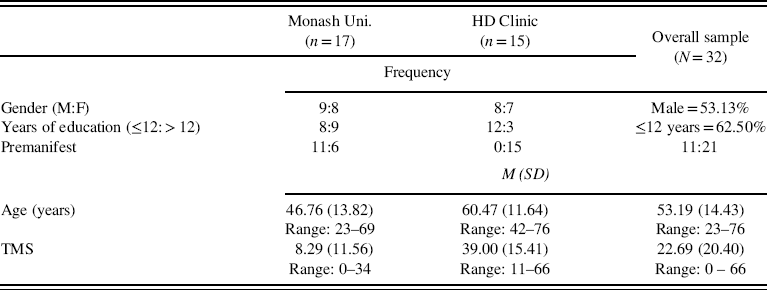
Both studies from which data were used excluded participants with prior brain injury, acute psychiatric conditions including severe depressive symptoms, or neurological conditions other than HD. All participants spoke English as their first language. Motor symptoms were rated using the Unified Huntington’s Disease Rating Scale Total Motor Score (TMS; Huntington Study Group, 1996) and obtained from participants’ most recent neurological assessment. TMS scores ranged from 0 to 66 of a possible 124, with higher scores indicating more severe motor symptoms. TMS scores ranged from 0–10 for premanifest participants, and 11–66 for manifest participants. Demographic and clinical information is outlined in Table 1. The study was approved by the Monash University Human Ethics Committee and the Calvary Health Care Bethlehem Human Research Ethics Committee. All participants gave informed, written consent.
Demographic characteristics of HD participants, separated by site and combined

TMS=Unified Huntington’s Disease Rating Scale – Total Motor Score.
Materials
The Awareness of Social Inference Test (TASIT)
TASIT is a dynamic emotion recognition task designed to measures aspects of social cognition including basic emotion recognition (McDonald, Flanagan, Martin, & Saunders, Reference McDonald, Flanagan, Martin and Saunders2004; McDonald, Flanagan, Rollins, & Kinch, Reference McDonald, Flanagan, Rollins and Kinch2003) through analysis of “real-world” social scenarios. Unlike standard static emotion recognition tasks, TASIT provides multiple sources of emotional information including from the face, voice, and other nonverbal domains. TASIT is reliable and ecologically valid and has been used to classify and describe social-cognitive impairments in HD (Larsen et al., Reference Larsen, Vinther-Jensen, Gade, Nielsen and Vogel2016; Philpott et al., Reference Philpott, Andrews, Staios, Churchyard and Fisher2016)
We administered the shortened Part 1 (Emotion Evaluation Test) of TASIT, in which participants view 14 short video vignettes of professional actors depicting various social scenarios or interactions and then select the emotion being conveyed by one of the actors in the scene, from a list of response options; “happy”, “surprise”, “neutral”, “sad”, “angry”, “anxious”, or “revolted.” Two vignettes per emotion type are presented. Scoring ranges from 0 to 14, with one point for each correct response. The shortened version of the TASIT has been validated (Westerhof-Evers, Visser-Keizer, McDonald, & Spikman, Reference Westerhof-Evers, Visser-Keizer, McDonald and Spikman2014) yielding comparable outcomes to the original longer form, with healthy people scoring on average 12.2 (SD=1.4) on the shortened Emotion Evaluation Test.
Frontal Systems Behavior Scale (FrSBe)
The FrSBe (Grace & Malloy, Reference Grace and Malloy2001) is a 46-item questionnaire that measures the severity of apathy, disinhibition, and executive dysfunction, which are each associated with frontal lobe dysfunction. On the Self-, and Family-Rated FrSBe forms, the participant and a close-other (e.g., spouse or family member), respectively, rate the frequency of certain behaviors on a Likert scale ranging from 1 (“almost never”) to 5 (“almost always”). We collected family ratings rather than self-ratings as previous studies have demonstrated that family ratings are more aligned with indices of disease severity, and may also be a more accurate index of neuropsychiatric symptoms than self-ratings due to decreased awareness of HD patients which may begin early in the disease process (Duff et al., Reference Duff, Paulsen, Beglinger, Langbehn, Wang, Stout and Queller2010; Hergert, Sanchez-Ramos, & Cimino, Reference Hergert, Sanchez-Ramos and Cimino2015). We converted FrSBe raw scores to T-scores for each of the three subscales: Apathy, Disinhibition, and Executive Dysfunction. T-scores stratify by age, gender, and education.
Previously reported data
The short-form TASIT data for 17 participants were derived from baseline assessments in an efficacy study of computerized emotion recognition remediation in premanifest and early-symptomatic HD (Kempnich et al., Reference Kempnich, Wong, Georgiou-Karistianis and Stout2017). The short-form TASIT, and family-rated FrSBe data from 15 participants with symptomatic HD have been previously reported elsewhere (Philpott et al., Reference Philpott, Andrews, Staios, Churchyard and Fisher2016).
Statistical Analyses
We first used a series of bivariate correlations to check for multicollinearity between independent and dependent variables. To address our key hypotheses, we then conducted a series of stepwise hierarchical linear multiple regression analyses using FrSBe Apathy and Disinhibition T-scores as dependent variables. TMS scores were entered in the first step to control for disease severity, and TASIT scores were entered in the second step. Although not central to the main aims of the study, as an exploratory analysis, we also conducted the same stepwise hierarchical linear multiple regression analysis using the third of the FrSBe subscales, Executive Dysfunction, as the dependent variable. No assumptions of multiple regression were violated.
RESULTS
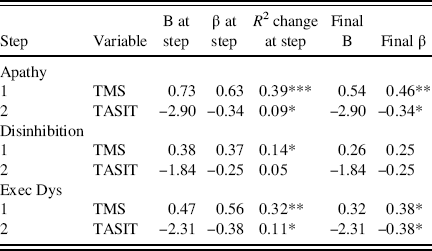
Consistent with our hypotheses, FrSBe Apathy was associated with patients’ TASIT emotion recognition performance, independent of disease severity as measured by motor scores. The association between FrSBe Disinhibition and TASIT performance, after accounting for motor symptoms, was not significant but showed a statistical trend. More specifically, at the first step of the linear multiple regression analyses, TMS scores were significantly associated with FrSBe Apathy (R=.62; adjusted R 2 =.39; F(1,30)=19.03; p < .001), and FrSBe Disinhibition T-scores (R=.37; adjusted R 2 =.11; F(1, 30)=4.75; p=.04). At the second step, after accounting for TMS, TASIT scores were significantly related to FrSBe Apathy (R=.69; adjusted R 2 =.44; F(2,29)=13.03; p < .001). For FrSBe Disinhibition T-scores, the relationship to TASIT scores after accounting for TMS approached significance (R=.42; adjusted R 2 =.12; F(2,29)=3.11; p=.06). TASIT scores uniquely explained 5% and 1% of the variance in FrSBe Apathy and Disinhibition T-scores, respectively.
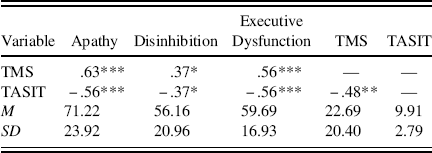
As expected, higher levels of motor dysfunction on the TMS were positively correlated with more severe neuropsychiatric ratings on the FrSBe, and poorer performance on the emotion recognition test from the TASIT. Higher ratings of neuropsychiatric symptoms on the FrSBe were also associated with poorer TASIT emotion recognition, shown in Table 2.
Descriptive statistics and intercorrelations among family-rated FrSBe T-scores and dependent variables

Note. FrSBe=Frontal Systems Behavior Scale; TMS=Unified Huntington Disease Rating Scale Total Motor Score; TASIT=The Awareness of Social Inference Test.
*** p < .001.
** p < .01.
* p < .05.
Interestingly, exploratory analyses revealed that family-ratings of Executive Dysfunction were also related to emotion recognition performance after accounting for motor symptoms. At the first step of the linear multiple regression analysis, TMS scores were significantly associated with Executive Dysfunction T-scores (R=.56; adjusted R 2 =.29; F(1,30)=13.55; p=.001). At the second step, after accounting for TMS, TASIT score was significantly related to Executive Dysfunction T-scores (R=.65; adjusted R 2 =.38; F(2,29)=10.38; p < .001). The variance accounted for by TMS and TASIT at each step of the model is indicated in Table 3.
Stepwise hierarchical linear multiple regression analyses of disease severity and emotion evaluation scores on family-rated FrSBe T-scores

Note. TMS=Unified Huntington Disease Rating Scale Total Motor Score; TASIT=The Awareness of Social Inference Test; Exec Dys=Executive Dysfunction.
*** p < .001.
** p < .01.
* p < .05.
DISCUSSION
As expected, our findings indicate that HD participants’ emotion recognition skills are related to social-neuropsychiatric symptoms, particularly apathy. Our results suggest that in people with HD, both difficulty recognizing facial expressions of emotion and apathy symptoms may contribute to the social withdrawal and reduced initiation of social interactions characteristic of HD. The data showed a similar pattern with disinhibition, but it was not statistically significant, which might be explained by the fact that there was less variability in disinhibition T-scores compared to apathy T-scores. Similarly, there were fewer participants scoring in the borderline or impaired range for Disinhibition, which may reflect our sample of which only approximately half were manifest. Given the results for Disinhibition were not significant, we have not interpreted these findings further.
Consistent with our hypothesis, the relationship between emotion recognition and key neuropsychiatric HD symptoms (that is, apathy) were independent of disease severity (motor signs). Our findings converge with neurobiological models of emotion recognition, and apathy, which suggests that these symptoms overlap in their neural circuitry, most likely via the anterior cingulate circuit. Our results are also consistent with emerging research in Parkinson’s disease which suggests that emotion recognition skills contribute to the social-neuropsychiatric symptoms of apathy (Martinez-Corral et al., Reference Martinez-Corral, Pagonabarraga, Llebaria, Pascual-Sedano, Garcia-Sanchez, Gironell and Kulisevsky2010; Narme et al., Reference Narme, Mouras, Roussel, Duru, Krystkowiak and Godefroy2013; Robert et al., Reference Robert, Le Jeune, Dondaine, Drapier, Peron, Lozachmeur and Drapier2014).
Neuropsychiatric symptoms are extremely burdensome to people with HD, impacting the quality-of-life of both patients and their families (Helder, Kaptein, van Kempen, van Houwelingen, & Roos, Reference Helder, Kaptein, van Kempen, van Houwelingen and Roos2001; Ho et al., Reference Ho, Robbins, Walters, Kaptoge, Sahakian and Barker2004). Currently, treatment of neuropsychiatric symptoms is limited to pharmacological methods, however, no “gold-standard” approach has been established (Estevez-Fraga, Olmos, Barral, & Moreno, Reference Estevez-Fraga, Olmos, Barral and Moreno2016; Killoran & Biglan, Reference Killoran and Biglan2014; Muller, Reference Muller2017; Shannon & Fraint, Reference Shannon and Fraint2015). Although emotion recognition explained a small, but significant, proportion of the variance in Apathy T-scores, the “real-world” significance of social cognitive skills for everyday social behavior in HD is not known, and requires further investigation.
Furthermore, the direction of the relationship between emotion recognition and social-neuropsychiatric symptoms is not elucidated by our findings, a factor which should be examined by future researchers. Our findings may suggest that emotion recognition is a potential therapeutic target in the treatment of apathy, which could have additional secondary benefits for patients’ social quality of life. Emotion recognition remediation research in HD is limited, however, evidence from one study shows promise in improving emotion recognition skills in premanifest and early-symptomatic disease stages (Kempnich et al., Reference Kempnich, Wong, Georgiou-Karistianis and Stout2017). Emotion recognition remediation might have benefits for social-behavioral symptoms in HD, such as enabling patients to respond to the needs of their family and friends more appropriately, or helping to facilitate social engagement, however, systematic evaluation of emotion recognition remediation for everyday social behavior is required.
Our study was limited by a small sample size, which restricted the number of predictors we could include in our multiple regression analyses. Thus, one or more variables not examined in this study might underlie the relationship between emotion recognition. We considered the possible influence of demographic variables but did not co-vary them in our statistical analyses, because age, gender, and level of education were accounted for in calculating FrSBe T-scores. Although age was significantly correlated to TASIT scores (r=0.35; p=.05), post hoc analyses in which age was included with TMS as independent variables in the first step of the multiple regression analyses and FrSBe subscale T-scores as the dependent variables resulted in age being excluded from the model in all instances. TASIT performance may also be associated with demographic factors, however, to our knowledge no demographically-stratified normative data are available for the TASIT, so we could not evaluate this possibility.
Besides emotion recognition, other aspects of cognitive performance (e.g., executive task performance) are known to relate to apathy and disease severity in HD (Baudic et al., Reference Baudic, Maison, Dolbeau, Boisse, Bartolomeo, Dalla Barba and Bachoud-Levi2006; Reedeker et al., Reference Reedeker, Bouwens, van Duijn, Giltay, Roos and van der Mast2011; van Duijn, Reedeker, Giltay, Roos, & van der Mast, Reference van Duijn, Reedeker, Giltay, Roos and van der Mast2010). Furthermore, executive function has been shown to moderate the relationship between emotion recognition and apathy in one study of various neurological disorders, including Parkinson’s disease (Narme, Roussel, Mouras, Krystkowiak, & Godefroy, Reference Narme, Roussel, Mouras, Krystowiak and Godefroy2017). Unfortunately, our study did not contain sufficient cognitive data to examine this possible relationship; however, our additional finding of a significant relationship between emotion recognition and ratings of executive dysfunction (FrSBe items from this subscale did not entail social content) suggests that cognitive factors might contribute to the relationship in some way. Future studies are needed to address whether aspects of cognition also mediate a portion of the relationship between emotion recognition, and apathy and disinhibition.
Although further research is required, our findings suggest that HD patients’ emotion recognition performance is associated with ratings of apathy and executive dysfunction, regardless of disease severity. These findings not only contribute to our understanding of the development of HD symptomatology, but, furthermore, highlight emotion recognition as a potential therapeutic target for improving HD patients’ social quality-of-life.
ACKNOWLEDGMENTS
We thank the participants and families who were involved in our studies. This research was partly funded by the Bethlehem Griffiths Research Foundation. The authors have no conflicts of interest to declare.