1. Introduction
Middle and Upper Ordovician olistostromes with calcareous olistoliths are rare in NW Europe and North America, being known from only a very small number of localities. One little-known olistostrome locality is in Anglesey in northwesternmost Wales, where the graptolite-bearing shales of the Garn Formation contain numerous fossil-bearing limestone olistoliths that are derived from a ‘ghost’ formation whose original depositional site remains unknown. Some broadly coeval olistoliths have also been recorded from successions in southern Scotland and at a few localities in eastern and southern North America. However, relatively little work has so far been carried out on significant geological aspects, such as age and depositional environments, of these ‘exotic’ olistoliths. An excellent example of the value of detailed olistolith work is that performed by Pohler, Barnes & James (Reference Pohler, Barnes, James and Austin1987) on the olistostromes of the Lower–Middle Ordovician Cow Head Group of western Newfoundland, which shows how a careful study of olistoliths may make it possible to reconstruct in some detail ‘ghost’ successions.
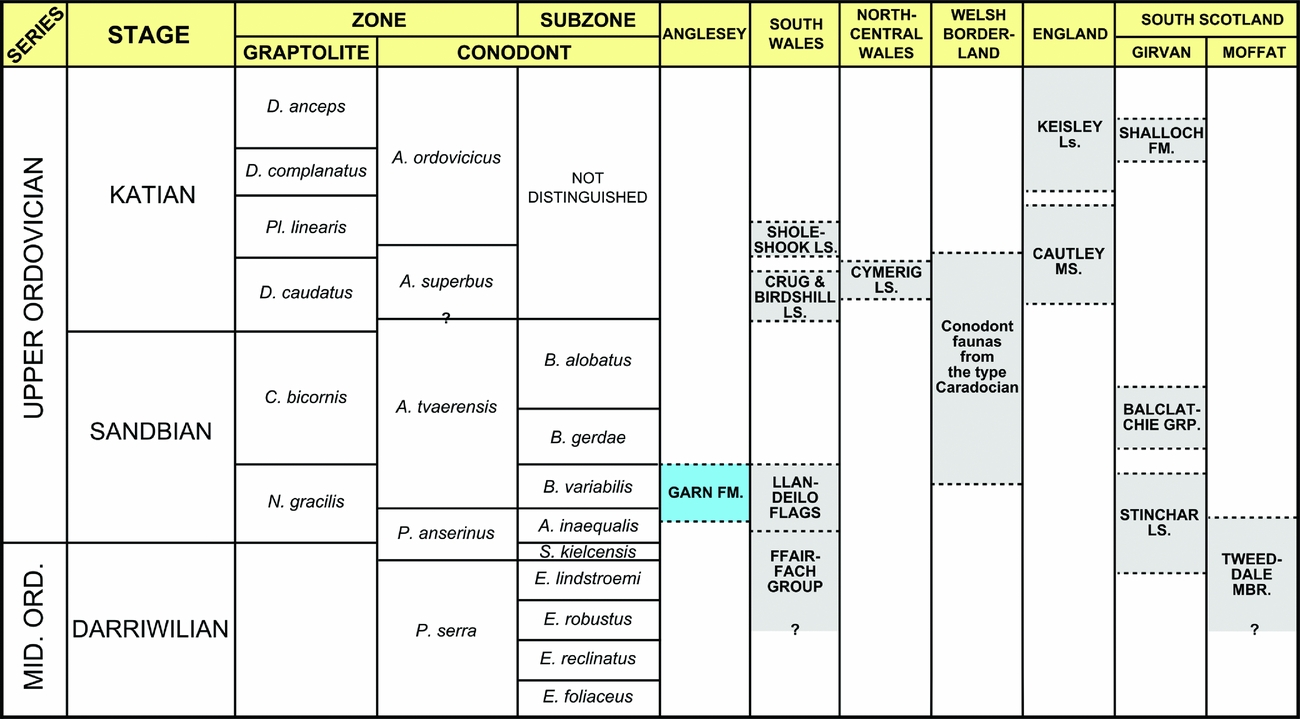
The present study was originally an attempt to obtain palaeobiogeographic and biostratigraphic conodont data from limestones of Sandbian and Katian age in northwestern Wales. The relative scarcity of carbonate rocks suitable for digestion in weak acids in the dominantly clastic Ordovician successions on the British Isles has resulted in the conodont faunas of this geologically classic region being known in far less detail than those of, for instance, Baltoscandia, North America and China. This is illustrated by the fact that very little has been published on British faunas from the Tremadocian, Floian, Dapingian and lower and middle Darriwilian (cf. Bergström & Orchard, Reference Bergström, Orchard, Higgins and Austin1985; Stouge et al., Reference Stouge, Harper, Sevastopulo, O'Mahony and Murray2016). Sandbian and Katian conodont faunas are much better known, having been described from several, but geographically rather scattered, localities as summarized in Figure 1 (see also Ferretti, Bergström & Barnes, Reference Ferretti, Bergström and Barnes2014; Ferretti, Bergström & Sevastopulo, Reference Ferretti, Bergström and Sevastopulo2014; Bergström & Ferretti, Reference Bergström and Ferretti2015). In addition to the principal occurrences shown in this figure, there are a few recorded reports of low-diversity conodont faunas, most of which are listed by Bergström & Orchard (Reference Bergström, Orchard, Higgins and Austin1985). In view of this comparatively incomplete conodont record, the discovery of new conodont faunas of relatively high diversity merits publication, especially if such a fauna is of biostratigraphic, biogeographic, palaeoecologic and/or taxonomic interest. The latter applies to the conodont fauna from ‘exotic’ limestone blocks in debris flows of the Garn Formation on Anglesey. Not only is this the first Ordovician conodont fauna described from Anglesey but also, as far as we are aware, this fauna is the first conodont fauna of any age described from that part of the UK. After its discovery by the senior author in 1970, some preliminary details about this fauna have been provided by Bergström (Reference Bergström1980, Reference Bergström1981) and Bergström & Orchard (Reference Bergström, Orchard, Higgins and Austin1985), but a detailed discussion of this fauna and its significance has not been published previously. Although the Garn conodont collection at hand is of only moderate size, it provides a significant amount of biostratigraphic, biogeographic, palaeoecologic and taxonomic information of more than local interest. The purpose of this paper is not only to describe this fauna and its unusual geologic setting, but also to discuss its biogeographic and palaeoecologic relations to some similar, more or less exotic, conodont faunas of broadly similar age from selected olistostrome localities in the UK, Newfoundland and the USA. Also, an attempt will be made to interpret aspects of the depositional environment of the ‘ghost’ formations that supplied the olistoliths of not only the Garn but also of the other study successions.
Biostratigraphic position of major conodont faunas described from the upper Darriwilian, Sandbian and Katian successions in the United Kingdom. In addition to those listed here, there are a few records of low-diversity conodont faunas from this stratigraphic interval (cf. Bergström & Orchard, Reference Bergström, Orchard, Higgins and Austin1985; Armstrong, Reference Armstrong1997), but no region in the British Isles has a reasonably complete Upper Ordovician conodont succession. This is no doubt due to the scarcity of carbonate rocks in the British Ordovician.

2. Geologic setting and collecting localities
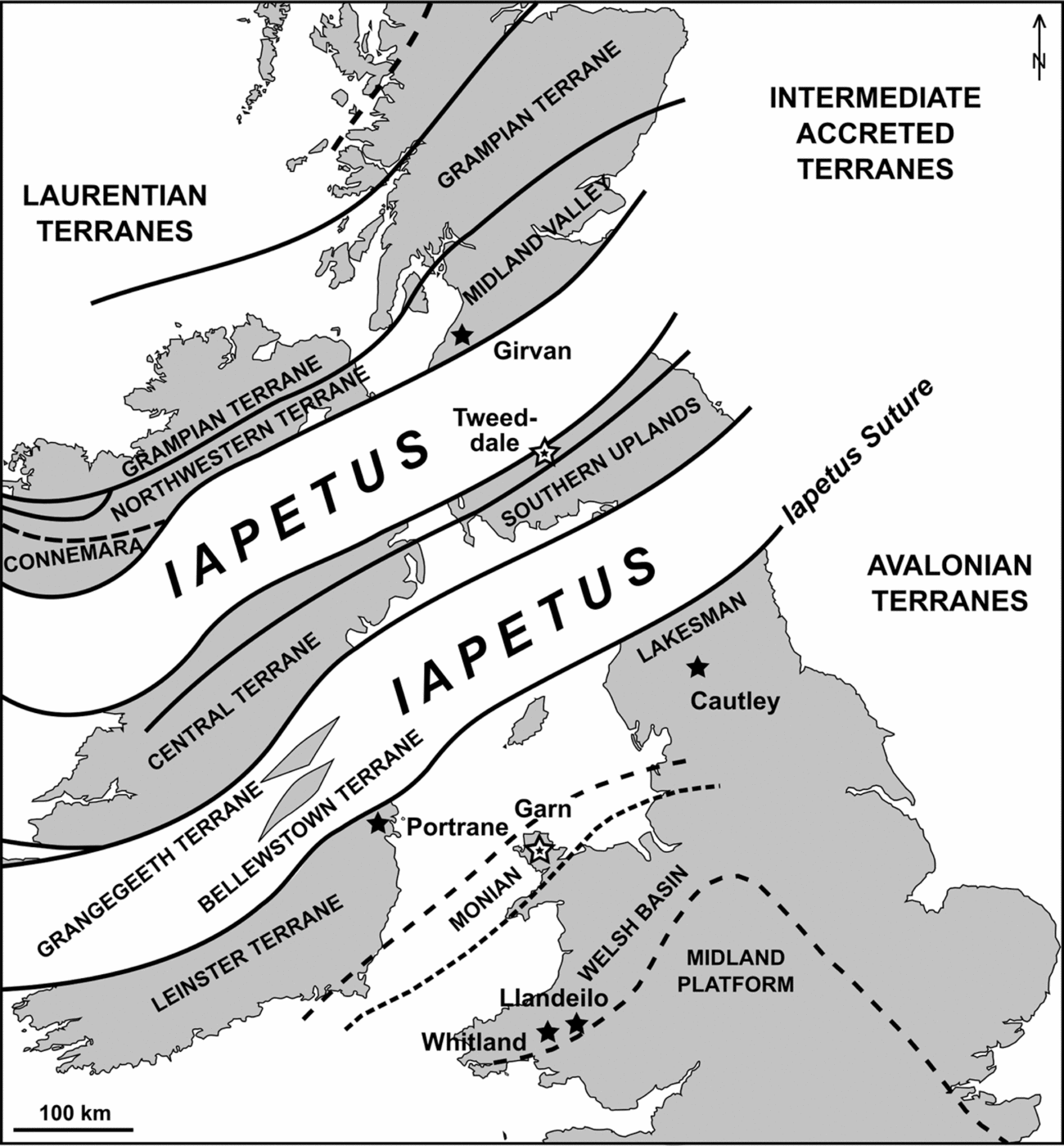
In terms of the major palaeotectonic terranes currently recognized in the Lower Palaeozoic of the British Isles, Anglesey occupies a position in the Monian Complex region, which is situated between the Leinster Terrane and the Welsh Basin (Fig. 2). It is important to note that Wales, including Anglesey, as well as the Welsh Borderland and other parts of England, are currently interpreted to represent the Avalonia region, which now is located southeast of the Iapetus Suture. The width of the Iapetus and the original distance between the terranes shown in Figure 2 remain speculative but may have been hundreds to thousands of km. As shown in Figure 2, the described conodont faunas in southern Scotland and northwestern Ireland (Connemara) are from localities northwest of the Iapetus Suture where the associated Middle to Upper Ordovician shelly faunas show Scoto-Appalachian affinities (e.g. Neuman, Reference Neuman1984). In a recent study, Harper et al. (Reference Harper, Rasmussen, Liljeroth, Blodgett, Candela, Jin, Percival, Rong, Villas, Zhan, Harper and Servais2013) referred these macrofossil faunas to their Anglo-Welsh-Baltic province.
Sketch map of Ordovician terranes in the British Isles (after Ferretti, Bergström & Sevastopulo, Reference Ferretti, Bergström and Sevastopulo2014) showing the location (open stars) of the collecting localities of the Garn and Tweeddale conodont faunas. Also shown (black stars) are the sites of some other major conodont localities in the United Kingdom and Ireland.

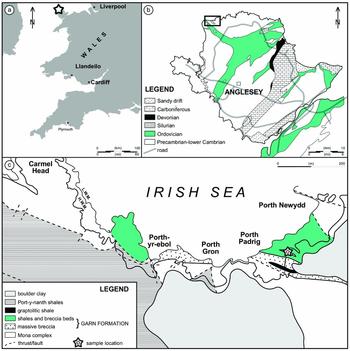
The conodont collections at hand are based on samples collected from coastal outcrops at Porth Padrig c. 1 km east-southeast of Carmel Head at the northwestern corner of Anglesey (Fig. 3). In the cliffs along the shore at this locality, there are excellent but partly structurally complex exposures of the dark shales of the Garn Formation (Greenly, Reference Greenly1919; Bates, Reference Bates1972).
Maps of the study area in Anglesey. (a) Location of the Carmel Head region (open star) in northwesternmost Anglesey. (b) Schematic geological map of Anglesey showing the outcrop area of Ordovician rocks. The outcrop area east of Carmel Head is marked by a rectangle. (c) Map of the coastal outcrops of the Garn Formation between Porth-yr-ebol and Porth Newydd (after Bates, Reference Bates1972). The conodont sample locality at Porth Padrig is shown by a star.

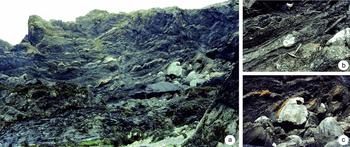
The Garn Formation olistostrome contains numerous beds and lenses of obviously transported material ranging greatly in age from Precambrian schists and quartzites of the Mona Complex to Ordovician grey fossiliferous limestones. Most limestone clasts are relatively small, but some boulders have a length of 2–3 m (Fig. 4). Whereas the non-limestone material appears to come from the local Mona Complex, the original source of the limestones remains unknown, no carbonate unit of this lithological type being known from Anglesey and nearby regions. According to Bates (Reference Bates1972), the debris flow material was probably transported from the north down a basinal slope, presumably from a shallow-water uplifted area in the Irish Sea that some authors speculatively have referred to as the Irish Platform. As noted by Bates (Reference Bates1972), the fact that some limestone boulders are several metres across suggests that it is unlikely that they were transported a very long distance down a platform margin slope. This transport is consistent with the fact that their lithology and shelly macrofossils suggest an environment of more shallow water than that in which the graptolite-bearing shales of the Garn Formation were deposited.
Photographs of olistostromes in the Garn Formation at Porth Padrig, Anglesey. Note the numerous olistolith beds with clasts of greatly variable size. Note hammer for scale in (b). Most of the olistoliths are from the Precambrian Mona Complex, but the light-coloured ones include clasts of Sandbian limestone that yielded the conodonts described herein.

3. Biostratigraphy
3.a. Previous work
Ever since the pioneer and classic work by Greenly (Reference Greenly1919), the graptolite species assemblage in the Garn Formation has been interpreted as representing the globally distributed Nemagraptus gracilis Zone. However, the list of species given by Greenly (Reference Greenly1919, pp. 478–9) from Porth Padrig includes both N. gracilis (Hall) and Climacograptus bicornis (Hall). The latter is the index of the C. bicornis Zone that overlies the N. gracilis Zone, and its appearance level is taken as the lower boundary of the C. bicornis Zone. Therefore, the presence of this species, if it is correctly identified, indicates that some part of the Garn Formation at Porth Padrig is referable to the C. bicornis Zone. Greenly (Reference Greenly1919) did not indicate the stratigraphic level of his collected specimens, and new collections are obviously needed to update Greenly's (Reference Greenly1919) identifications and clarify the graptolite biostratigraphy of the Garn Formation.
The trilobites and brachiopods collected from the limestone boulders in the debris flows at Porth Padrig (Greenly, Reference Greenly1919; Bates, Reference Bates1968) do not provide a very precise dating of the transported olistoliths. According to Bates (Reference Bates1968), the macrofossil fauna shows affinity to that of the Sandbian Derfel Limestone of the Arenig–Bala area of north-central Wales (Whittington & Williams, Reference Whittington and Williams1953), a unit that in the past has been regarded as coeval with the N. gracilis Zone (e.g. Williams et al. Reference Williams, Strachan, Bassett, Dean, Ingham, Wright and Whittington1972) although direct graptolite evidence for this age assignment has not been known. However, Fortey et al. (Reference Fortey, Harper, Ingham, Owen, Parkes, Rushton and Woodcock2000, fig. 11) correlated the Derfel Limestone with the Diplograptus foliaceus Zone, which is broadly equivalent with the C. bicornis Zone, based on the description of graptolites of that zone by Zalasiewicz (Reference Zalasiewicz1992) from the Llyn Conwy Formation, which underlies the Derfel Limestone. As noted above, the shales of the Garn Formation have yielded graptolites that, if correctly identified, represent the C. bicornis Zone, hence in agreement with the correlation proposed by Fortey et al. (Reference Fortey, Harper, Ingham, Owen, Parkes, Rushton and Woodcock2000).
3.b. The conodont fauna
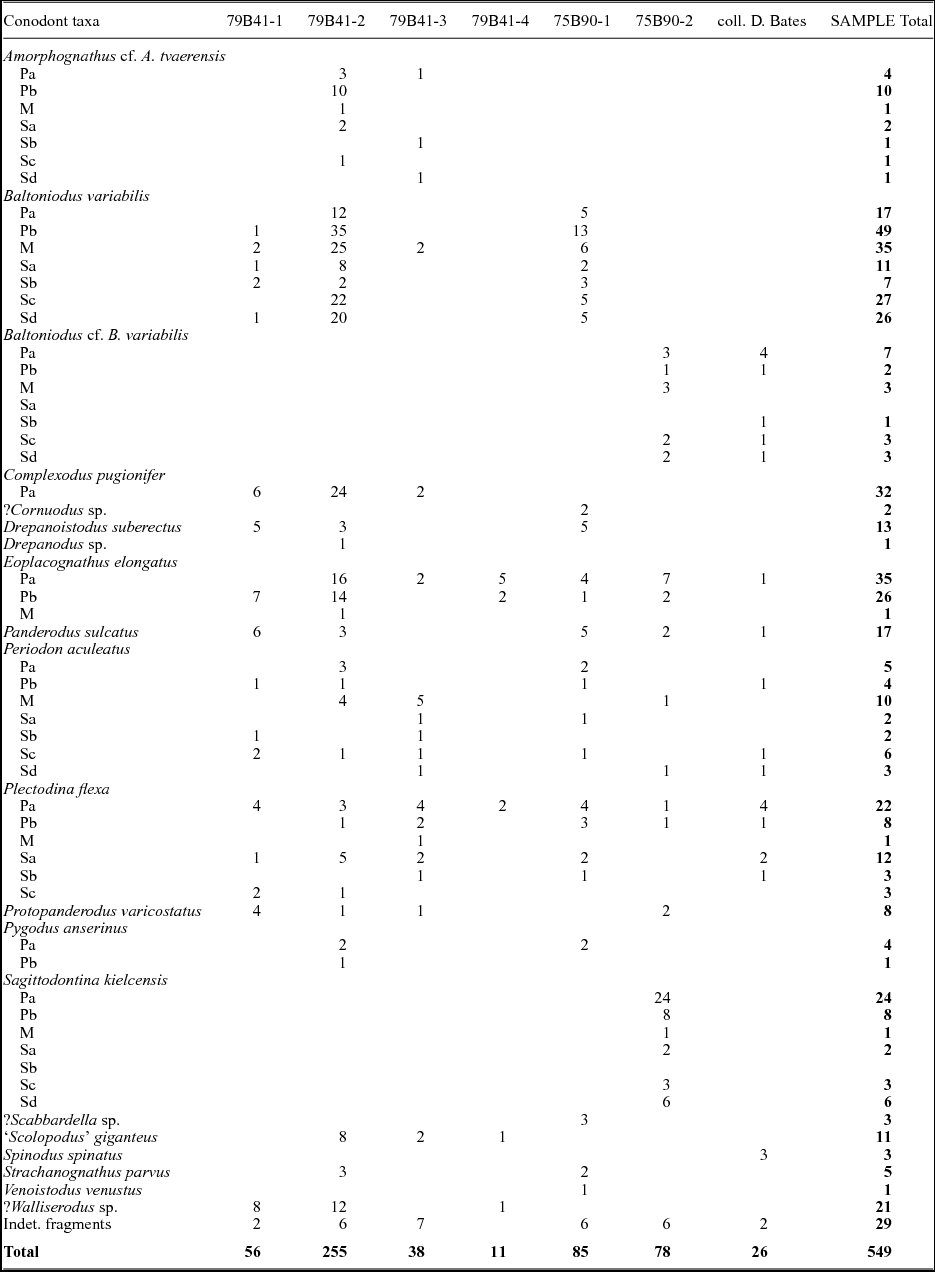
Seven samples collected from limestone olistoliths in the olistostrome at the Porth Padrig shelly fossil locality (Fig. 3c) yielded after digestion in weak acetic acid a total of 549 conodont elements, many of which are well preserved. This representative number of conodonts was somewhat surprising in view of the fact that the total amount of processed rock material was less than 10 kg and samples from British Ordovician limestones are rarely highly productive of conodonts. The conodont elements have been subjected to post-depositional heating in excess of 300°C as shown by their Colour Alteration Index (Epstein, Epstein & Harris, Reference Epstein, Epstein and Harris1977) of 5 (Bergström, Reference Bergström1980). Figured specimens are deposited in the ‘Inventario Paleontologia Università di Modena e Reggio Emilia’ (IPUM) at the Dipartimento di Scienze Chimiche e Geologiche, Modena, Italy, under repository numbers IPUM 28781 – IPUM 28845.
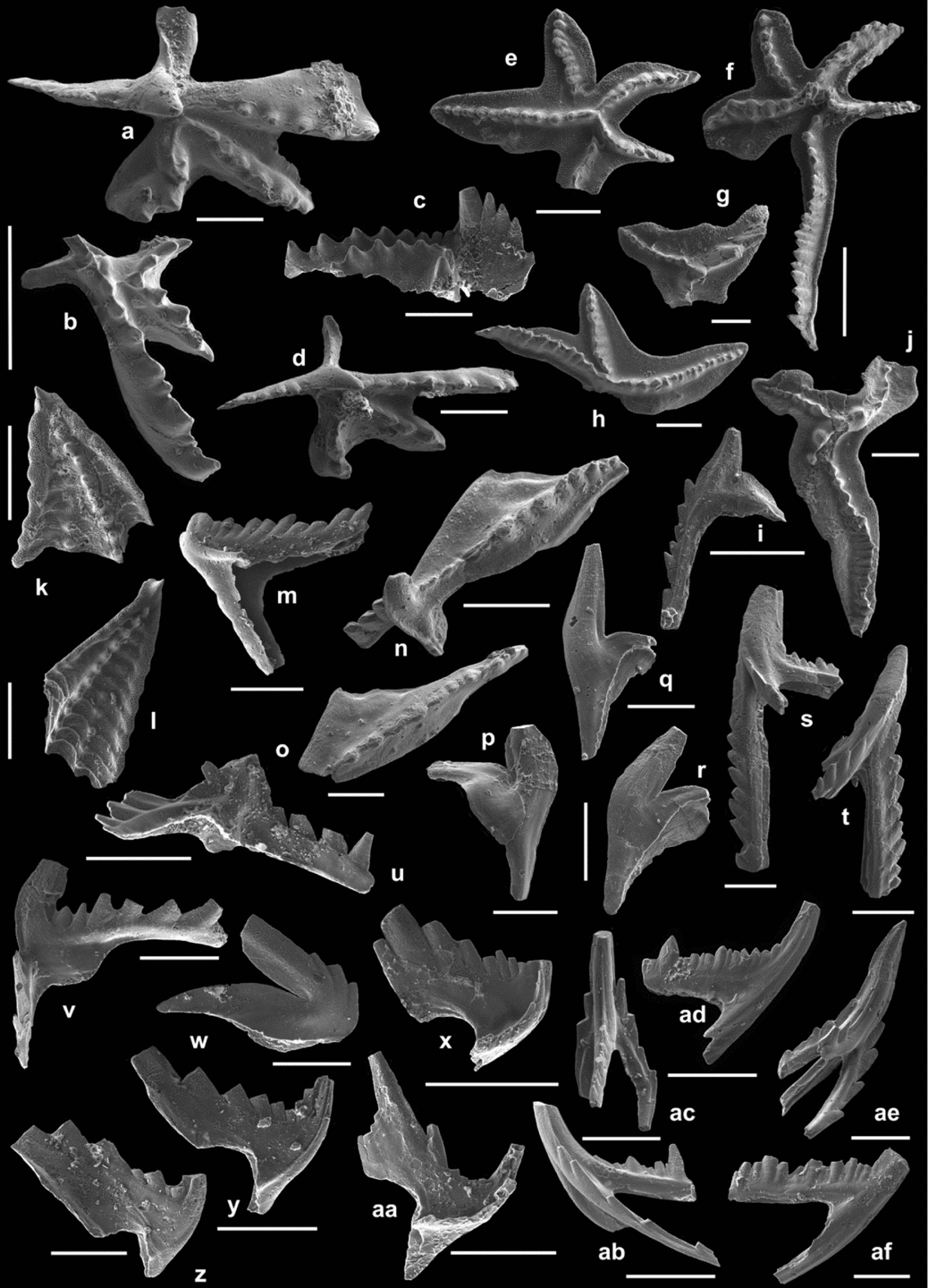
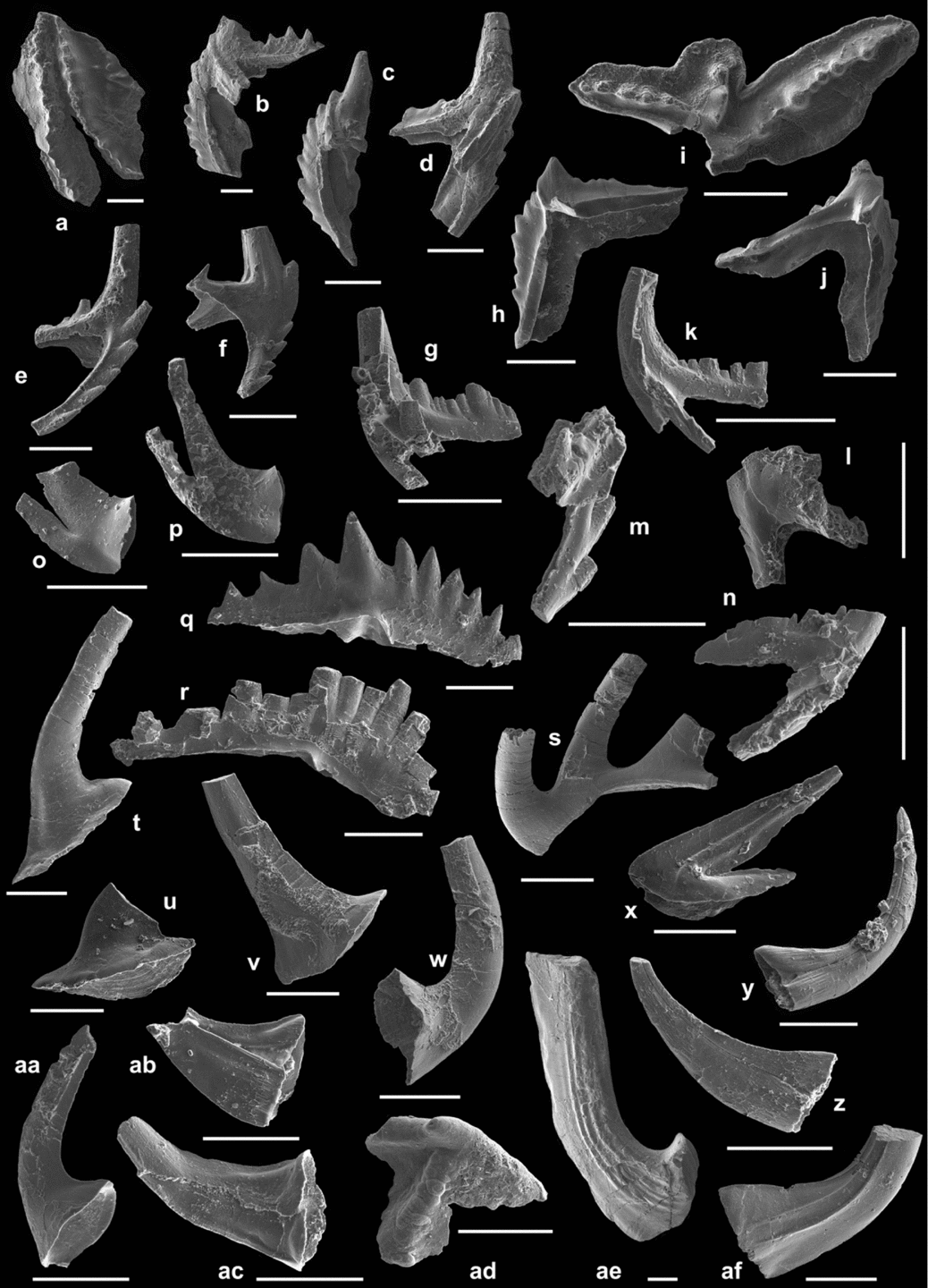
As shown in Table 1, the seven investigated samples produced 20 conodont taxa, among which 14 are confidently identified to species and two are compared with a species. The number of elements of each taxon in each sample is also listed in Table 1. Most taxa in the fauna are illustrated in Figures 5 and 6. Because the species in the Garn fauna have been adequately described in the Ordovician conodont literature and the specimens at hand do not exhibit unique morphological characteristics, we refrain from including species descriptions in the present report. This decision was also influenced by the fact that a brief diagnosis of several key Garn species is provided by Bergström & Orchard (Reference Bergström, Orchard, Higgins and Austin1985).
Frequency of elements of conodont taxa in our collections from the Garn Formation.

Late Ordovician conodonts from the Garn Formation, Anglesey, United Kingdom. All scale bars correspond to 200 μm. (a–d) Complexodus pugionifer (Drygant, 1974), all Pa elements: (a) IPUM 28781, upper view, sample 79B41-2; (b) IPUM 28782, upper-lateral view, sample 79B41-2; (c) IPUM 28783, lateral view, sample 79B41-2; (d) IPUM 28784, upper view, sample 79B41-2. (e–j) Eoplacognathus elongatus (Bergström, 1961): (e, f) IPUM 28785 and IPUM 28786, Pa dextral elements, upper views, both from sample 79B41-2; (g) IPUM 28787, Pb sinistral element, upper view, sample 79B41-1; (h) IPUM 28788, Pa sinistral element, upper view, sample 79B41-2; (i) IPUM 28789, M element, lateral view, sample 79B41-2; (j) IPUM 28790, Pb dextral element, upper view, sample 75B90-2. (k–m) Pygodus anserinus Lamont & Lindström, 1957: (k, l) IPUM 28791 and IPUM 28792, Pa elements, upper views, both from sample 79B41-2; (m) IPUM 28793, Pb element, lateral view, sample 79B41-2. (n–t, ab–af) Baltoniodus variabilis (Bergström, Reference Bergström1962): (n, o) IPUM 28794 and IPUM 28795, Pa elements, upper views, samples 79B41-2 and 75B90-1 respectively; (p) IPUM 28796, M element, outer-lateral view, sample 75B90-1; (q, r) IPUM 28797 and IPUM 28798, M elements, inner-lateral views, samples 79B41-2 and 79B41-1 respectively; (s, t) IPUM 28799 and IPUM 28800, Pb elements, lateral views, samples 79B41-2 and 75B90-1; (ab) IPUM 28801, Sa element, lateral view, sample 79B41-2; (ac) IPUM 28802, Sa element, posterior view, sample 79B41-2; (ad) IPUM 28803, Sb element, lateral view, sample 79B41-2; (ae) IPUM 28804, Sd element, postero-lateral view, sample 79B41-2; (af) IPUM 28805, Sc element, lateral view, sample 79B41-2. (u–aa) Periodon aculeatus Hadding, Reference Hadding1913: (u) IPUM 28806, Pa element, lateral view, sample 79B41-2; (v) IPUM 28807, Pb element, lateral view, sample coll. D. Bates; (w) IPUM 28808, M element, lateral view, sample 79B41-2; (x) IPUM 28809, Sa element, lateral view, sample 75B90-1; (y) IPUM 28810, Sb element, lateral view, sample 79B41-1; (z) IPUM 28811, Sc element, lateral view, sample 79B41-3; (aa) IPUM 28812, Sd element, lateral view, sample coll. D. Bates.

Late Ordovician conodonts from the Garn Formation. All scale bars correspond to 200 μm. (a–f) Sagittodontina kielcensis (Dzik, Reference Dzik1976): (a) IPUM 28813, Pa element, upper view, sample 75B90-2; (b–d) IPUM 28814, IPUM 28815 and IPUM 28816, Pb elements, upper views, all from sample 75B90-2; (e) IPUM 28817, Sc element, lateral view, sample 75B90-2; (f) IPUM 28818, M element, postero-lateral view, sample 75B90-2. (g–n) Amorphognathus cf. A. tvaerensis Bergström, Reference Bergström1962: (g) IPUM 28819, Sb element, lateral view, sample 79B41-3; (h, j) IPUM 28820 and IPUM 28822, Pb element, lateral views, both from sample 79B41-2; (i) IPUM 28821, Pa element, upper view, sample 79B41-2; (k) IPUM 28823, Sa element, lateral view, sample 79B41-2; (l) IPUM 28824, M element, antero-lateral view, sample 79B41-2; (m) IPUM 28825, Sd element, posterior view, sample 79B41-3; (n) IPUM 28826, Sc element, lateral view, sample 79B41-2. (o, p) Strachanognathus parvus Rhodes, Reference Rhodes1955: IPUM 28827 and IPUM 28828, lateral views, both from sample 79B41-2. (q, r) Plectodina flexa (Rhodes, Reference Rhodes1953): (q) IPUM 28829, Pa element, lateral view, sample 75B90-1; (r) IPUM 28830, Pb element, lateral view, sample 79B41-3. (s) Spinodus spinatus (Hadding, Reference Hadding1913), IPUM 28831, lateral view, sample coll. D. Bates. (t–v) Drepanoistodus suberectus (Branson & Mehl, Reference Branson and Mehl1933): (t) IPUM 28832, lateral view, sample 79B41-1; (u) IPUM 28833, lateral view, sample 75B90-1; (v) IPUM 28834, lateral view, sample 79B41-2. (w) Drepanodus sp., IPUM 28835, lateral view, sample 79B41-2. (x) Venoistodus venustus (Stauffer, Reference Stauffer1935), IPUM 28836, lateral view, sample 75B90-1. (y, z) Panderodus sulcatus (Fåhraeus, Reference Fåhraeus1966), IPUM 28837 and IPUM 28838, lateral views, both from sample 75B90-1. (aa) ?Cornuodus sp., IPUM 28839, lateral view, sample 75B90-1. (ab) ?Scabbardella sp., IPUM 28840, lateral view, sample 75B90-1. (ac) ?Walliserodus sp., IPUM 28841, lateral view, sample 79B41-1. (ad) Gen. et sp. indet., IPUM 28842, upper-lateral view, sample 79B41-3. (ae) ‘Scolopodus’ giganteus Sweet & Bergström, Reference Sweet and Bergström1962, IPUM 28843, lateral view, sample 79B41-2. (af) Protopanderodus varicostatus (Sweet & Bergström, Reference Sweet and Bergström1962), IPUM 28844, lateral view, sample 79B41-3.

The fact that there is no discernible difference in the general composition of the species associations in the different samples suggests that all the samples, and presumably the parent formation, represent a rather narrow stratigraphic interval. The most distinctive species include Amorphognathus cf. A. tvaerensis Bergström, Baltoniodus variabilis (Bergström), Complexodus pugionifer (Drygant), Eoplacognathus elongatus (Bergström), Periodon aculeatus Hadding, Plectodina flexa (Rhodes), Protopanderodus varicostatus (Sweet & Bergström), Pygodus anserinus Lamont & Lindström, Sagittodontina kielcensis Dzik, and Spinodus spinatus (Hadding).
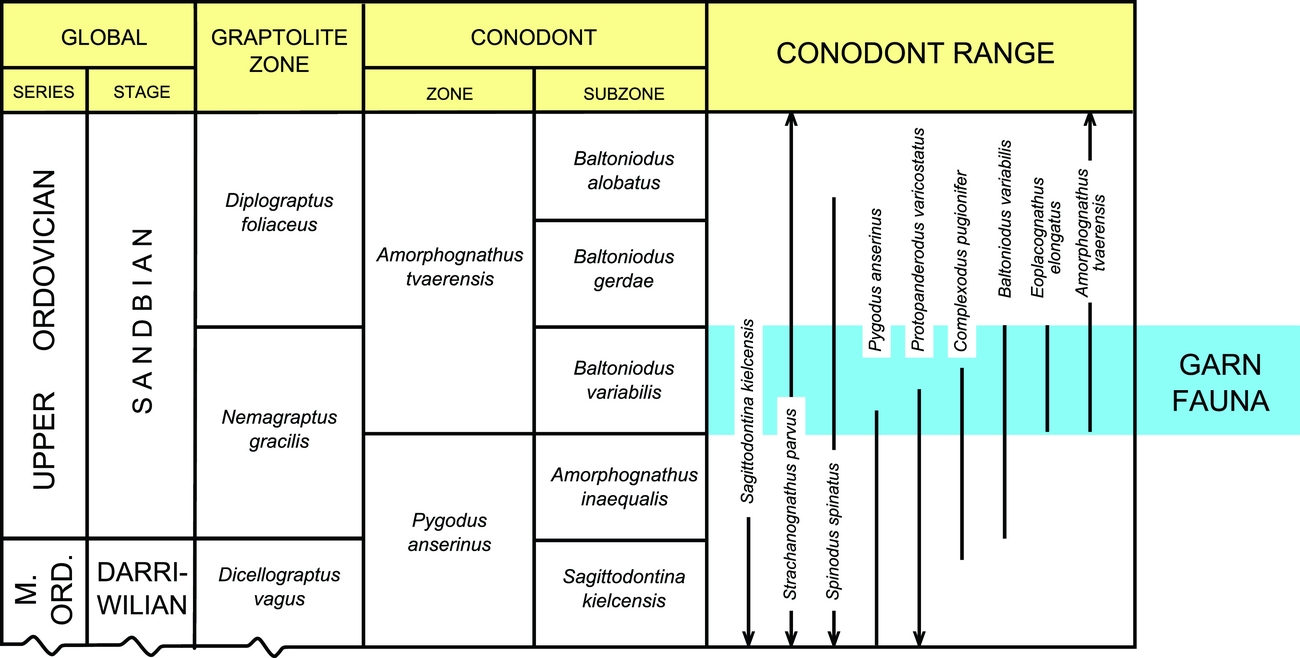
As shown in Figure 7, this species association closely resembles that of the early Sandbian Baltoniodus variabilis Subzone of the Amorphognathus tvaerensis Zone in Baltoscandia and other parts of northern Europe where this subzone is present in the Stage Slice Sa1 of Bergström et al. (Reference Bergström, Chen, Gutiérrez–Marco and Dronov2009). Strangely, precise classification of the Garn olistolith conodont fauna in terms of the standard British regional chronostratigraphic units is more difficult, but this fauna is probably of early Caradoc age. It may possibly represent the Costonian Stage as this unit was defined by Fortey et al. (Reference Fortey, Harper, Ingham, Owen, Parkes, Rushton and Woodcock2000). Probably based on the old graptolite identifications, these authors referred the Garn Formation to the Aurelucian Stage.
Known biostratigraphic ranges of identified conodont species from clasts in the Garn Formation. As shown here, the investigated conodont fauna is interpreted to represent the Baltoniodus variabilis Subzone of the Amorphognathus tvaerensis Zone that corresponds to the upper part of the Nemagraptus gracilis graptolite Zone. Because the limestone olistoliths are located in shales having graptolites of the Nemagraptus gracilis and Climacograptus bicornis zones, the limestone clasts are only slightly younger than the surrounding sediment.

As just noted, the Garn fauna shows great similarity to coeval Baltoscandic faunas (e.g. Bergström, Reference Bergström, Ebbestad, Wickström and Högström2007; Männik & Viira, Reference Männik and Viira2012), the only obvious difference being the presence of relatively common specimens of P. flexa, a species not recorded from this interval in Sweden but well represented in early Sandbian faunas from Wales and the Welsh Borderland (Rhodes, Reference Rhodes1953; Bergström, Reference Bergström1964, Reference Bergström, Sweet and Bergström1971; Savage & Bassett, Reference Savage and Bassett1985; Bergström, Rhodes & Lindström, Reference Bergström, Rhodes, Lindström and Austin1987). The provincial character of the conodont fauna is in agreement with the statement in Williams (Reference Williams and Wood1969) that the brachiopod fauna has Baltoscandic affinity. The limestone clast fauna differs from coeval conodont faunas from Wales and the Welsh Borderland in having representatives of the very characteristic genera Complexodus, Pygodus and Strachanognathus that have never been recorded from southern Wales or the Welsh Borderland but have a very wide geographic distribution elsewhere.
The assignment of the studied samples to the B. variabilis Subzone has other implications. That is, a variety of evidence indicates that this subzone corresponds to the upper half of the N. gracilis Zone (e.g. Bergström, Reference Bergström, Hughes and Rickards1986) and accordingly, there is only a slight difference between the age of the transported carbonate material and that of the surrounding shales. This shows that the transport of the limestone material into the mud deposition environment on the slope took place shortly after the formation of the limestone on the unknown nearby platform. This is consistent with the observation by Bates (Reference Bates1972) that at least some of the limestone boulders do not appear to have been fully solidified prior to their downslope transport.
3.c. Biogeographic affinity of the Garn conodont fauna
As a whole, the Garn conodont species association exhibits a much stronger similarity to coeval Baltoscandian (Bergström, Reference Bergström, Ebbestad, Wickström and Högström2007) and Polish (Dzik, Reference Dzik, Dzik, Olempska and Pisera1994) faunas than to the described faunas from South Wales (Rhodes, Reference Rhodes1953; Bergström, Reference Bergström1964, Reference Bergström, Sweet and Bergström1971; Bergström, Rhodes & Lindström, Reference Bergström, Rhodes, Lindström and Austin1987), such as those from the Golden Grove Group (formerly Llandeilo Flags; cf. Sutton, Bassett & Cherns, Reference Sutton, Bassett and Cherns1999) and the upper part of the Ffairfach Group. However, the Sandbian conodont species association of Amorphognathus, Baltoniodus, Complexodus, Eoplacognathus and Periodon and a variety of coniform taxa, such as Protopanderodus, has a virtually global distribution, especially along continental platform margins. Faunas of this type, which has been referred to the Atlantic Province, have been recorded from southern Scotland (Bergström, Reference Bergström, Sweet and Bergström1971, Reference Bergström1990; Armstrong, Reference Armstrong1997), the eastern Appalachian region in eastern Canada and USA (e.g. Bergström, Reference Bergström, Sweet and Bergström1971, Reference Bergström1973; Bergström, Riva & Kay, Reference Bergström, Riva and Kay1974; Fåhræus & Hunter, Reference Fåhraeus and Hunter1981, Reference Fåhraeus and Hunter1985), Tasmania, Australia (Burrett, Stait & Laurie, Reference Burrett, Stait and Laurie1983), and the Ordos region of China (Wang et al. Reference Wang, Bergström, Zhen, Chen and Zhang2013). Although strikingly different from coeval conodont faunas from equatorial regions, such as the North American Midcontinent, Siberia, and central Australia, the regional distribution of conodont faunas of the Garn type is complex and not readily defined in terms of a well-defined biogeographic region. Commonly, but not always, this type of conodont fauna occurs in carbonate interbeds in graptolite shales deposited in moderately deep water at mid- to high latitudes. It seems likely that the water temperature was a very important controlling factor in the distribution of this type of conodont fauna.
4. Regional comparisons
Sandbian conodonts have been recorded from a very large number of localities around the world (for a still useful review, see Bergström, Reference Bergström1990), and it is clearly outside the scope of the present contribution to present a global comparison of the Garn fauna. Therefore, we herein restrict ourselves to brief comparisons between the Garn fauna and a few Sandbian faunas known from ‘ghost’ formations in olistostromes in northern Europe and North America.
4.a. British Isles
Perhaps the currently best-known Ordovician olistostrome conodont faunas from the UK are those of the Tweeddale Member of the Shinnel Formation in the Southern Uplands of Scotland (Lindström, Reference Lindström1964; Bergström, Riva & Kay, Reference Bergström, Riva and Kay1974; Bergström & Orchard, Reference Bergström, Orchard, Higgins and Austin1985; Armstrong, Reference Armstrong1997). The Tweeddale conodonts occur in limestone clasts in the several tens of metres thick Tweeddale Member in the up to 2 km thick Shinnel Formation (Owen, Harper & Clarkson, Reference Owen, Harper and Clarkson1996). Because the latter is of middle to late Katian age (e.g. Fortey et al. Reference Fortey, Harper, Ingham, Owen, Parkes, Rushton and Woodcock2000), there is a significant age difference between the limestone clasts and the surrounding sediment. Individual clasts, which range in size from a grain to huge, locally quarried, boulders, consist of greyish, rather pure limestone. In the past the very large clasts received local stratigraphic names, such as the Wrae, Drumelzier, Winkston and Glencotho limestones, but these units are now considered to be of the same age and represent transported material from an otherwise unknown carbonate platform deposit of enigmatic location. Because many of the clasts contain a variety of shallow-marine shelly fossils (Owen, Harper & Clarkson, 1996), it appears that the original deposit that yielded the clasts was deposited in relatively shallow water.
The frequency of conodonts in these clasts varies (cf. Armstrong, Reference Armstrong1997, table 1) but the state of preservation is generally good. The fauna does not vary significantly between different clasts and it appears that only a rather limited stratigraphic interval is represented by the now known collections. Biostratigraphically useful species include, among others, Baltoniodus variabilis, Protopanderodus varicostatus, Pygodus anserinus and P. serra. Bergström (Reference Bergström1981, Reference Bergström1990), Bergström & Orchard (Reference Bergström, Orchard, Higgins and Austin1985) and Armstrong (Reference Armstrong1997) considered the fauna to represent the P. anserinus Zone, and hence to be of latest Darriwilian–earliest Sandbian age.
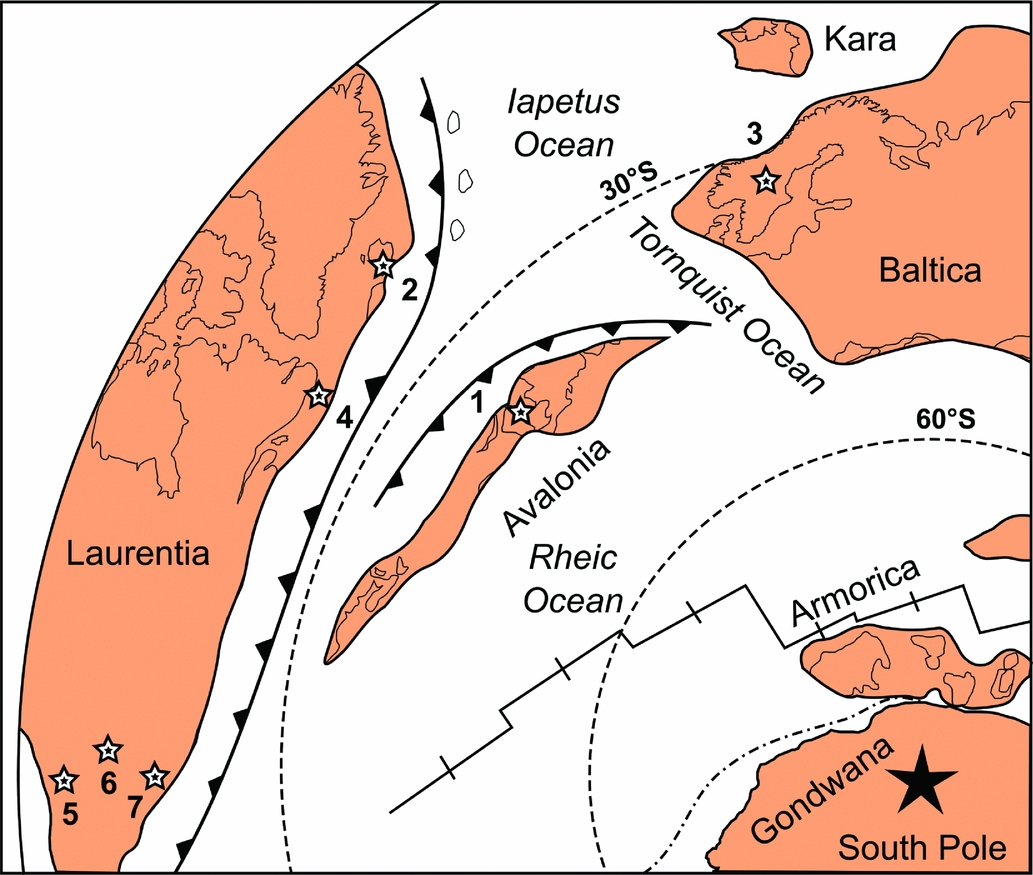
Although lacking representatives of Amorphognathus, Complexodus and Plectodina, the general aspect of the Tweeddale fauna is similar to that of the Garn Formation and it shares most of its species with coeval Baltoscandian faunas. This similarity may be somewhat surprising in view of the fact that according to recent palaeogeographic reconstructions (Fig. 8; also cf. Pollock, Hibbard & Van Staal, Reference Pollock, Hibbard and Van Staal2012), southern Scotland occupied a position in the central or western Iapetus in a region characterized by shelly faunas of the Scoto-Appalachian Province (e.g. Neuman, Reference Neuman1984). Although Neuman (Reference Neuman1984) did not discuss the affinities of the Tweeddale shelly faunas, he followed Cocks & Fortey (Reference Cocks and Fortey1982) in placing southern Scotland on the Laurentian side of Iapetus. Recent palaeomagnetic work has somewhat modified reconstructions of the Ordovician palaeogeography in the Iapetus region, but southern Scotland is still placed far from Baltoscandia, England and Wales (including Anglesey) during the Middle Ordovician (Fig. 8; also cf. Harper et al. Reference Harper, Rasmussen, Liljeroth, Blodgett, Candela, Jin, Percival, Rong, Villas, Zhan, Harper and Servais2013, fig. 11.8).
Middle–Upper Ordovician palaeogeographic sketch map (slightly modified from Cocks & Fortey, Reference Cocks, Fortey and Bassett2009) showing location of olistostromes discussed in the text. Note that the precise location of Avalonia is controversial in the absence of reliable palaeomagnetic data. Explanation of site numbers: (1) Garn, Anglesey, UK; (2) Tweeddale, southern Scotland, UK; (3) Siljan area, south-central Sweden; (4) Cobbs Arm, New World Island, Newfoundland, Canada; (5) Marathon region, West Texas, USA; (6) Pine Mountain, Ouachita Mountains, Arkansas, USA; (7) easternmost Tennessee, USA.

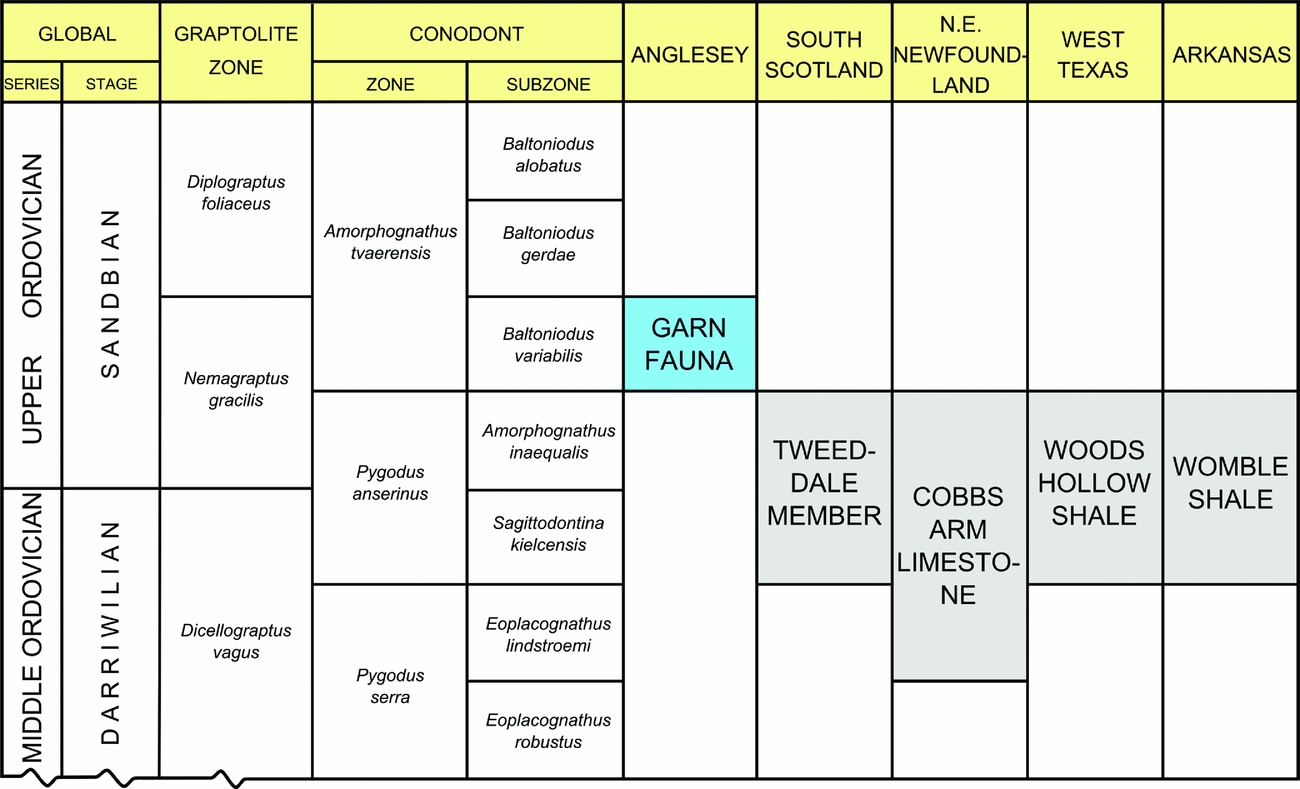
Diagram showing the biostratigraphic position of the five conodont-bearing olistostromes discussed in the text. Note that the Garn olistoliths are considered to be slightly younger biostratigraphically than the others.

4.b. Canada
Very few definite, or possible, olistostrome deposits with Sandbian or Katian conodonts have been described from North America. An important occurrence of a possible olistostrome is in the New World Island region of northeasternmost Newfoundland. A prominent Sandbian stratigraphic unit in this structurally complex area is the Cobbs Arm Limestone that at most localities occurs as giant blocks of rather pure limestone in a region dominated by clastic sediments. In some cases such blocks form a major part of small islands. Because of the complex structure and the nature of the outcrops, the precise nature of the contacts of these blocks is difficult to interpret but appears in most cases to be faults where the contacts are exposed. At least some of these giant limestone clasts were interpreted by McKerrow & Cocks (Reference McKerrow and Cocks1981) as olistoliths in an olistostrome in the Sandbian–Katian Hillgrade Group. Some authors have interpreted some of these limestone blocks as non-transported, but olistotromes with olistoliths of Cobbs Arm lithology are known from other places in northeastern Newfoundland. In the New World Island region, the interval of the Cobbs Arm Limestone is overlain, with fault contact, by argillites referred to as the Rodgers Cove Shale (Bergström, Riva & Kay, Reference Bergström, Riva and Kay1974), which has yielded graptolites of middle–late Katian age.
A taxonomically diverse conodont fauna has been isolated from samples collected from several outcrops of the Cobbs Arm Limestone (Bergström, Riva & Kay, Reference Bergström, Riva and Kay1974; Fåhraeus & Hunter, Reference Fåhraeus and Hunter1981, Reference Fåhraeus and Hunter1985). It includes c. 30 species, of which the most important are Ansella jemtlandica, A. nevadensis, Baltoniodus prevariabilis, B. variabilis, Cahabagnathus sweeti, Eoplacognathus cf. E. robustus, Goverdina avicula, Periodon aculeatus, Pygodus anserinus, P. serra, Spinodus spinatus, and an assortment of coniform taxa, comprising, among others, Protopanderodus varicostatus and Strachanognathus parvus. Bergström, Riva & Kay (Reference Bergström, Riva and Kay1974) interpreted this fauna as representing an interval ranging from the upper part of the P. serra Zone to the upper part of the P. anserinus Zone, an age assignment confirmed by Fåhraeus & Hunter (Reference Fåhraeus and Hunter1981, Reference Fåhraeus and Hunter1985) based on a larger number of samples.
Although the Cobbs Arm Limestone is slightly older than the Garn Ordovician olistoliths (Fig. 9), the general aspect of the conodont faunas from these units is quite similar, the only notable differences being the presence of Plectodina flexa in the Garn samples and the absence of Complexodus pugionifer in the Cobbs Arm fauna. The fauna of the former unit is less diverse than that of the Cobbs Arm Limestone, but we attribute this difference as probably due to the fact that the Garn Formation olistoliths have been subjected to far less intense collecting than the Cobbs Arm Limestone.
The similarity between the Cobbs Arm Limestone fauna and that of the Tweeddale limestones (Armstrong, Reference Armstrong1997), which is of approximately the same age (Fig. 9), is even greater. Although the latter fauna is less diverse than that of the Cobbs Arm Limestone, virtually all of its species are present. The depositional areas of the latter units were located in the tropical zone on the Laurentian side of the Iapetus, whereas that of the Garn limestones was situated at a much higher latitude in Avalonia based on modern palaeogeographic reconstructions.
4.c. United States
Although a great deal of Ordovician conodont work has been carried out in the Appalachians of the eastern United States, Sandbian olistostromes with diverse conodont faunas are currently not reported from that large region. Two notable occurrences of such deposits are in the southern part of the United States, namely in the Marathon area in the Big Bend region in West Texas and in the Ouachita Mountains in Arkansas and adjacent Oklahoma.
In the former area, numerous olistostromes, in some cases with giant boulders, occur throughout the Ordovician succession (King, Reference King1937). Many of these clasts are fossiliferous and the fossils show that the age of the transported boulders ranges from the Late Cambrian to various parts of the Ordovician. Of special interest for the present study is the Sandbian Woods Hollow Shale in which there are numerous debris flows between shales and occasional limestone beds. Graptolites show that the Woods Hollow Shale ranges from the Nemagraptus gracilis to the Climacograptus bicornis graptolite zones (e.g. Berry, Reference Berry1960). The conodont fauna described from this unit is taxonomically diverse (Bergström, Reference Bergström1978) and of special interest in view of the fact that the conodont biostratigraphy can be tied directly to the graptolite biostratigraphy. The best outcrop of the Woods Hollow Shale is the type section in the Woods Hollow Mountains, but unfortunately it is not available for study nowadays due to severe access restrictions. The sampling for conodonts half a century ago by Bergström (Reference Bergström1978) tried to avoid obvious debris flow beds and focused on what looked like non-debris limestone beds, but based on the associations of species present, it appears that the sampled beds contained some typical shallow-water specimens that are likely to have been transported. Species interpreted to represent taxa living in the local platform slope environment include Cahabagnathus sweeti, Periodon aculeatus, Protopanderodus varicostatus, Pygodus anserinus and Spinodus spinatus. All these taxa are widespread in faunas from continental margin localities around the world and occur in the Garn, Tweeddale and Cobbs Arm faunas. Specimens that probably were transported from a shallow-water platform environment comprise, among others, Belodina monitorensis, Leptochirognathus sp., Phragmodus flexuosus and Multioistodus sp. All these are common in the platform faunas of the North American Midcontinent, for instance in the succession in the Arbuckle Mountains in Oklahoma (Bauer, Reference Bauer1987, Reference Bauer2010). For further information about the Woods Hollow Shale conodont fauna, see Bergström (Reference Bergström1978).
Other notable occurrences of transported materials are known from the very thick, dominantly clastic, Ordovician succession in the Ouachita Mountains in Arkansas and Oklahoma, but at virtually all localities most of the allochthonous material consists of sandstone, arkose, granite and phyllite, whereas clasts of limestone are far less common. Very few of the calcareous clasts have been investigated for conodonts, the best known being a study of collections from a huge limestone boulder in the lower part of the Womble Shale near Pine Mountain, Arkansas (Repetski & Ethington, Reference Repetski, Ethington and Stone1977). This giant boulder is unique in the shaly Womble Shale succession, and has been quarried to supply material to a nearby dam. It is locally known as the Drowned Dogs Quarry.
Investigation of the succession in the quarried part of this large carbonate body suggests that the boulder has been flipped upside down, and its succession also appears to include clasts of weathered granite. Although the contact relations to the surrounding shale are not exposed, the conclusion by Repetski & Ethington (Reference Repetski, Ethington and Stone1977) seems reasonable that this boulder, which is many tens of metres across, probably was transported. Thirteen limestone samples from this olistolith processed for conodonts by Repetski & Ethington (Reference Repetski, Ethington and Stone1977) yielded representatives of more than 25 species. Among these, the best-known species from the North Atlantic Province include Costiconus ethingtoni, Periodon aculeatus, Protopanderodus liripipus, P. varicostatus, Pygodus anserinus and P. serra, hence a species association similar to those of the Garn Formation, the Tweeddale Member, the Cobbs Arm Limestone, and the Woods Hollow Shale. Based on key species in this conodont fauna it appears to represent the Pygodus anserinus Zone and be of similar age as the Garn Formation and the other olistostrome units discussed above (Fig. 9). Interestingly, the fact that the lower part of the Womble Shale elsewhere contains graptolites of the Nemagraptus gracilis Zone (Berry, Reference Berry1960) suggests that there is little age difference between the boulder and its surrounding shale, and that the boulder was transported shortly after the source limestone was deposited.
The Pine Mountain boulder fauna also includes taxa best known from the North American Midcontinent Province, such as species of Cardiodella, Coleodus, Erismodus, Leptochirognathus and Polycaulodus. Hence, as is the case with the Woods Hollow fauna, the conodont species association of this boulder seems mixed in terms of provinciality, and the fauna includes species best known from shallow and warm water and from deeper and possibly cooler water environments. This may be taken as a suggestion that the fauna includes quite a few elements that were transported into the depositional environment of the boulder rock prior to its final downslope movement.
5. Original depositional environments of the olistoliths
Relatively little is currently known about the marine carbonate successions from which the Garn, Tweeddale, Cobbs Arm and Pine Mountain boulder olistoliths were originally derived. The lithology of the limestone clasts and their still partly undescribed macrofossil faunas suggest a ‘normal’ marine depositional environment. Based on thin-sections, peels, and analysis of the type of trilobite depth community present in the formation, Fåhraeus & Hunter (Reference Fåhraeus and Hunter1981) concluded that the Cobbs Arm Limestone probably was deposited in moderately shallow water in a volcanic island environment. Neuman (Reference Neuman1984) supported the idea of a volcanic island environment and noted that the trilobites and brachiopods in this unit have Scoto-Appalachian Province affinities. In the case of the Tweeddale limestones, Armstrong (Reference Armstrong1997) reported that the trilobites represented the Illaenid–Cheirurid biofacies, which is characteristic of very shallow water. The detailed description by Peach & Horne (Reference Peach and Horne1899) of volcanic rocks associated with limestone clasts at many localities in the Tweeddale region may be taken as an indication that their depositional setting was similar to that of the Cobbs Arm Limestone. On the other hand, the Garn limestone clasts are not associated with coeval Ordovician volcanic rocks, and the same applies to the Woods Hollow and Pine Mountain slope successions, in which the limestone clasts appear to be derived from non-volcanic platform successions.
As has been increasingly clear in recent years, the distribution of many conodont taxa, as is the case with marine organisms in general, was to a large extent controlled by environmental parameters such as temperature and water depth. In view of this, it is of interest to examine if the conodont faunas from the olistoliths can provide information about the environmental conditions where these rocks were originally formed.
As noted above, the conodont faunas from our five olistostrome successions have much in common in terms of association of species. This particularly applies to the collections from the limestones of the Garn, Tweeddale and Cobbs Arm formations, which based on the carbonate lithology all appear to have been deposited in relatively shallow water. Most of the collections from the Woods Hollow Shale come from limestone interbeds in a shale/mudstone platform slope succession with some debris flows. The Pine Mountain giant boulder seems to have been subjected to downslope movement into the margin of a shale basin, but the location of the original deposition site of this limestone remains unknown. In a detailed study, Bergström & Carnes (Reference Bergström, Carnes and Barnes1976) analysed the horizontal and vertical distribution of conodont species in several non-olistostrome successions of late Darriwilian to early Sandbian age in eastern Tennessee. These represented a series of depth depositional environments ranging from intertidal to basinal. They found that there were striking differences between the associations of conodont species, and the relative abundance of taxa, in different environments. This made it possible to recognize several species associations that were typical of particular depositional environments. These were termed Recurrent Species Associations (RSAs). In principle, the term Recurrent Species Associations does not differ substantially from the more commonly used term biofacies, but in the present study we use the term RSA. For easy reference, these different RSAs are named for their characteristic conodont taxa. One of these RSAs, which is typical of marginal basin environments in the Sandbian of eastern Tennessee, contains many of the species present in the olistoliths dealt with herein, such as Baltoniodus variabilis, Cahabagnathus sweeti, Costiconus ethingtoni, Eoplacognathus elongatus, Periodon aculeatus, Protopanderodus varicostatus, Pygodus anserinus, P. serra and several additional coniform conodonts. This RSA, which is named the Periodon–Pygodus RSA, is the one present in the Tweeddale, Cobbs Arm, Woods Hollow and Pine Mountain limestones. The Periodon–Pygodus RSA is very widespread on the central Baltoscandian platform, where it is present in strata deposited in moderately deep water, in the Girvan area of Scotland (Bergström, Reference Bergström1990), at many localities along the margins of the North American continent, and on the Yangtze Platform in China. It seems to be characteristic of strata deposited in moderately deep and cold water, preferably at mid-latitudes. It has not been recorded in the North American Midcontinent and most of the Siberian Platform, where rocks deposited in shallow and warm waters dominate.
As noted by Bergström & Carnes (Reference Bergström, Carnes and Barnes1976), in faunas slightly younger than the P. anserinus Zone, Pygodus is replaced by Baltoniodus in this biofacies, which could be referred to as the Baltoniodus–Plectodina–Periodon RSA. We interpret the Garn fauna to represent this RSA. This RSA is typical of the middle Sandbian in Baltoscandia but is unknown in coeval faunas from the North American Midcontinent and Siberia and other regions in the tropical zone. On the other hand, it is present, although slightly modified, in such geographically remote and separated regions as the upper Miaopo Shale and associated strata in the Yangtze Platform region in China (e.g. Chen et al. Reference Chen, Bergström, Zhang, Goldman and Chen2011) and deep water carbonates of the Shoemaker Beds in southernmost Tasmania (Burrett, Stait & Laurie, Reference Burrett, Stait and Laurie1983).
In summary, the palaeoecologic data from the conodonts are in good agreement with other faunal data as well as with the clast lithology. These different types of evidence indicate that the limestone olistoliths discussed herein most likely came from successions deposited in relatively shallow to moderately deep, and probably also somewhat cold, water.
6. Conclusions
The following conclusions have emerged from our study of conodonts in the olistoliths in the Garn Formation and broadly coeval units in Scotland, Newfoundland, West Texas and Arkansas:
(1) Based on their conodonts, the olistoliths in the Garn Formation appear to represent a very limited biostratigraphic interval corresponding to the Baltoniodus variabilis Subzone of the Amorphognathus tvaerensis Zone. In our samples, there is no evidence of the presence of biostratigraphically older limestone olistoliths. Because this subzone correlates with the upper part of the Nemagraptus gracilis Zone in the graptolite zone succession, and the fact that the shales of the Garn Formation have yielded graptolites of the N. gracilis and/or the Climacograptus bicornis zones, there is little age difference between the olistoliths and their host sediment. This indicates that the transport of the limestone clasts took place shortly after the deposition of the rocks from which they are derived.
(2) The conodont fauna in the Garn olistoliths represents a type not previously known from Wales and England but present in southern Scotland, Baltoscandia, Newfoundland and some other regions around the world. It is characterized by species of Amorphognathus, Baltoniodus, Complexodus, Costiconus, Periodon, Protopanderodus and Sagittodontina. This type of fauna is widespread in western Baltoscandia (e.g. Bergström, Reference Bergström, Ebbestad, Wickström and Högström2007). In the Atlantic border regions, such faunas are previously known from the Tweeddale Member of the Shinnel Formation in southern Scotland, the Cobbs Arm Limestone in Newfoundland, and, slightly modified, in the Woods Hollow Shale of West Texas, the Womble Shale of Arkansas, and some formations in the eastern Appalachians of the United States.
(3) Based on indications from carbonate lithology, macrofossil biofacies and conodont palaeoecology, the ‘ghost’ formations that yielded the Sandbian–Katian olistoliths discussed herein were deposited in an environment of normal salinity and relatively shallow to moderately deep water. The Tweeddale and Cobbs Arm successions might have been laid down in a volcanic island environment, but many other occurrences of this conodont species association are not associated with coeval volcanic rocks.
(4) Globally, late Middle and early Late Ordovician olistostromes are rare components in the stratigraphic record, but, when present, their olistoliths may provide fascinating insights into the characteristics of otherwise unknown stratigraphic successions. As in the case with the Garn Formation olistoliths, their study may provide otherwise unavailable significant information about the geological history of a region.
Acknowledgements
The senior author is indebted to Dr Dennis E. B. Bates for valuable information and discussion, especially during an unplanned meeting in the field near the Garn study locality. The authors would also like to thank Prof. Mats E. Eriksson for reading the manuscript and suggesting useful improvements. Thanks are also due to Dr Massimo Tonelli (Centro Interdipartimentale Grandi Strumenti, CIGS, University of Modena and Reggio Emilia, Modena, Italy) for his assistance during the SEM-EDX investigations.
A.F. acknowledges grant support from Projects UNIMORE–FAR 2014 ROSAE and UNIMORE–FAR 2016 PAsTIME, Università degli Studi di Modena e Reggio Emilia. This paper is a contribution to the IGCP Project 653 ‘The onset of the Great Ordovician Biodiversity Event’.