Whereas late second language (L2) learners tend to demonstrate a great amount of improvement in relation to increased L2 experience, especially around the early phase of L2 acquisition processes (i.e., rate of learning), many researchers have extensively examined the extent to which L2 learners can continue to enhance their oral ability (i.e., ultimate attainment) in a way that could lead to near-nativelike proficiency. On the one hand, few bilinguals demonstrate perfect proficiency in all aspects of language like monolinguals do (Abrahamsson & Hyltenstam, Reference Abrahamsson and Hyltenstam2009; Flege, Yeni-Komshian, & Liu, Reference Flege, Yeni-Komshian and Liu1999). On the other hand, some learners are able to attain high-level L2 performance, and the incidence of successful L2 acquisition is influenced by several factors, such as the linguistic distance between first language (L1) and L2 structures (Best & Tyler, Reference Best, Tyler, Bohn and Munro2007; Flege, Reference Flege, Meyer and Schiller2003), aptitude (DeKeyser, Alfi-Shabtay, & Ravid, Reference DeKeyser, Alfi-Shabta and Ravid2010; Granena & Long, Reference Granena and Long2013), the quality and quantity of L2 input (Flege & Liu, Reference Flege and Liu2001; Jia & Aaronson, Reference Jia and Aaronson2003), cognitive aging (Birdsong, Reference Birdsong, Kroll and De Groot2005, Reference Birdsong2006; Hakuta, Bialystok, & Wiley Reference Hakuta, Bialystok and Wiley2003), motivation (Derwing & Munro, Reference Derwing and Munro2013; Dörnyei & Kubanyiova, Reference Dörnyei and Kubanyiova2014), level of education (Derwing & Munro, Reference Derwing and Munro2009; Spada & Tomita, Reference Spada and Tomita2010), and ethnic identity (Gatbonton, Trofimovich, & Segalowitz, Reference Gatbonton, Trofimovich and Segalowitz2011; Pavlenko & Blackledge, Reference Pavlenko and Blackledge2004).
Among these factors, previous L2 speech research has paid by far the most attention to examining learners’ age of acquisition (AOA), defined as the first intensive exposure to input and interaction in a L2-speaking environment.Footnote 1 There has been a great deal of empirical evidence that has shown that AOA is a relatively strong predictor of the end state of L2 acquisition (i.e., the earlier L2 learners arrive, the better the quality of their ultimate attainment tends to be), especially for early bilinguals who arrive in a L2 country before puberty (e.g., AOA < 16 years; e.g., Abrahamsson, Reference Abrahamsson2012; Abrahamsson & Hyltenstam, Reference Abrahamsson and Hyltenstam2008, Reference Abrahamsson and Hyltenstam2009; DeKeyser et al., Reference DeKeyser, Alfi-Shabta and Ravid2010; Flege, Munro, & MacKay, Reference Flege, Munro and MacKay1995; Flege et al., Reference Flege, Yeni-Komshian and Liu1999; Granena & Long, Reference Granena and Long2013; Hopp & Schmid, Reference Hopp and Schmid2013; Johnson & Newport, Reference Johnson and Newport1989; Munro & Mann, Reference Munro and Mann2005; Patkowski, Reference Patkowski1980, Reference Patkowski1990). However, it has remained highly controversial whether, to what degree, and how such age effects can be germane to late bilinguals whose immersion in the L2 country starts after puberty (e.g., AOA > 16 years; e.g., Birdsong, Reference Birdsong, Kroll and De Groot2005, vs. DeKeyser & Larson-Hall, Reference DeKeyser, Larson-Hall, Kroll and De Groot2005).
In what follows, I first provide an overview of two competing theoretical explanations for age effects on late bilingualism (i.e., the critical period hypothesis [CPH] vs. the cognitive aging hypothesis [CAH]). Subsequently, I review how recent studies have examined the interlanguage development of L2 oral ability from pronunciation, fluency, vocabulary, and grammar research perspectives. Last, I present the results of the current study, which examined in depth the role of AOA in predicting the global, segmental, prosodic, temporal, lexical, and grammatical qualities of L2 oral proficiency attainment by 88 experienced Japanese late arrival (> 16 years old) learners.
BACKGROUND
The Critical Period Hypothesis
Several researchers have claimed that age effects are found only for early bilinguals and not for late bilinguals, due to the fundamental and qualitative differences between the two L2 acquisition processes (e.g., Abrahamsson, Reference Abrahamsson2012; DeKeyser & Larson-Hall, Reference DeKeyser, Larson-Hall, Kroll and De Groot2005; Granena & Long, Reference Granena and Long2013; Johnson & Newport, Reference Johnson and Newport1989; Paradis, Reference Paradis2009; Patkowski, Reference Patkowski1990; Scovel, Reference Scovel2000). From birth, early learners progressively lose access to an assumed language-specific cognition system procedurally represented in the brain, a system used to pick up the L2 through mere exposure to natural input in an automatic and incidental manner. This results in strong age effects on the final quality of early bilingualism. Following the maturational accounts for L1 acquisition, Abrahamsson (Reference Abrahamsson2012) argued that the gradual loss of cerebral plasticity for language acquisition is correlated with the neurologically determined myelination processes of cortical neurons (Pulvermüller & Schumann, Reference Pulvermüller and Schumann1994). After passing such a critical and optimal period for implicit language acquisition, late L2 acquisition processes do not always benefit from simply being exposed to L2 input. Because the influence of aging effects apply only to implicit and automatic language learning, late learners’ ultimate attainment patterns are not associated with their AOA profiles (e.g., Abrahamsson, Reference Abrahamsson2012; Abrahamsson & Hyltenstam, Reference Abrahamsson and Hyltenstam2008, Reference Abrahamsson and Hyltenstam2009; DeKeyser, Reference DeKeyser2000; DeKeyser et al., Reference DeKeyser, Alfi-Shabta and Ravid2010; Granena & Long, Reference Granena and Long2013; Johnson & Newport, Reference Johnson and Newport1989; Patkowski, Reference Patkowski1980, Reference Patkowski1990).
During postcritical period L2 acquisition, late learners likely draw on explicit (rather than implicit) strategies via declarative memory to learn the L2 in a manner similar to the intentional and effortful learning of other general cognitive skills, such as mathematics and computer programming (Abrahamsson, Reference Abrahamsson2012; DeKeyser et al., Reference DeKeyser, Alfi-Shabta and Ravid2010). As is the case with developing domain-general cognition (e.g., Anderson, Reference Anderson1993), it has been shown that late learners’ L2 speech learning is characterized by the power law of learning—a quick improvement over the first few months of length of residence (LOR) in the L2 environment, followed by a leveling off, despite additional practice and environmental input (for a review, see DeKeyser & Larson-Hall, Reference DeKeyser, Larson-Hall, Kroll and De Groot2005). For example, experienced learners tend to be noted as having superior L2 speech ability when their performance is compared to beginning learners (LOR < 1 year; Flege, Bohn, & Jang, Reference Flege, Bohn and Jang1997; Flege & Fletcher, Reference Flege and Fletcher1992) but not when compared to intermediate learners (LOR > 1 year; Flege, Munro, & Fox, Reference Flege, Munro and Fox1994; Larson-Hall, Reference Larson-Hall2006).
In terms of their ultimate attainment, the upper limit and incidence of near-nativelike performance in late L2 acquisition is not linked with AOA but is instead subject to individual learner differences; for example, exceptional learners with high language learning aptitude display greater proficiency. DeKeyser (Reference DeKeyser2000) found that near-native performance on oral grammaticality judgment tests by late Hungarian learners of English significantly correlated with their high analytical aptitude (see also Abrahamsson & Hyltenstam, Reference Abrahamsson and Hyltenstam2008; DeKeyser et al., Reference DeKeyser, Alfi-Shabta and Ravid2010). In L2 pronunciation attainment, Granena and Long (Reference Granena and Long2013) examined how late Spanish-Chinese bilinguals’ speaking skills (i.e., reading aloud a paragraph) were related to various domains of their language learning aptitude measured via the LLAMA Language Aptitude Test (Meara, Reference Meara2005). The results demonstrated a strong link between their foreign accentedness scores and certain aspects of the aptitude test such as sound-symbol correspondence (i.e., connecting sounds with relevant symbols) and grammatical inferencing (i.e., discovering grammar rules in an unknown language).
The Cognitive Aging Hypothesis
Other researchers have claimed that the ultimate L2 attainment of both early and late bilinguals can be susceptible to age effects throughout the life span without any cutoff, suggesting that the language learning capacity used in successful L1 speech acquisition remains active even after puberty and can be applied to late L2 acquisition (Best & Tyler, Reference Best, Tyler, Bohn and Munro2007; Bialystok, Reference Bialystok1997; Birdsong, Reference Birdsong, Kroll and De Groot2005, Reference Birdsong2006; Flege, Reference Flege, Meyer and Schiller2003; Hakuta et al., Reference Hakuta, Bialystok and Wiley2003; Hopp & Schmid, Reference Hopp and Schmid2013).Footnote 2 According to this theoretical position, one underlying cause for more salient foreign accents in older rather than younger learners can be environmental, as opposed to maturational, in nature. That is, some late immigrants may be exposed to somewhat limited L2 input by choosing to exclusively use the L1 at home and at work within the same language background community, although early learners tend to receive a substantial amount of native speaker input from their caregivers and peers (Jia & Aaronson, Reference Jia and Aaronson2003). This theoretical position, therefore, suggests that late learners continue to learn new sounds as long as they can meet similar sociopsychological conditions that early learners likely benefit from (Bialystok, Reference Bialystok1997), such as high, frequent use of the L2 (Flege & Liu, Reference Flege and Liu2001) and high willingness to communicate in the L2 (Derwing & Munro, Reference Derwing and Munro2013).
Importantly, this position also assumes that the final quality of late L2 acquisition is closely related to AOA, as evidenced in L1 acquisition and early bilingualism. This is because AOA acts as a barometer for a subset of learner-intrinsic variables affecting L2 acquisition, such as the degree of L1 and L2 development. Late L2 acquisition builds on the common linguistic space wherein the L1 has been fully developed, resulting in inevitable foreign accent development (e.g., Best & Tyler, Reference Best, Tyler, Bohn and Munro2007; Flege et al., Reference Flege, Munro and MacKay1995). The mutual interaction between L1 and L2 categories, in turn, indicates not only that late learners who arrive in the L2 environment during earlier adulthood attain better L2 proficiency after a larger amount of L2 practice (Baker, Trofimovich, Flege, Mack, & Halter, Reference Baker, Trofimovich, Flege, Mack and Halter2008; Yeni-Komshian, Flege, & Liu, Reference Yeni-Komshian, Flege and Liu2000) but also that the intensive and constant use of the L2 alters their L1 performance (e.g., Bialystok & Miller, Reference Bialystok and Miller1999; Hopp & Schmid, Reference Hopp and Schmid2013). Another crucial variable is the age-related decline in many human cognitive functions, such as working memory, executive control, speech sound processing, or inhibition of task-irrelevant information (Hakuta et al., Reference Hakuta, Bialystok and Wiley2003). Birdsong (Reference Birdsong, Kroll and De Groot2005, Reference Birdsong2006) ascribed the notion of cognitive aging to the biologically (but not maturationally) defined aging processes in the brain system, such as decreases in brain volume and nigrostriatal dopamine (starting at age 20 years). According to Birdsong (Reference Birdsong2006), the dopamine system is believed to promote “defossilization, an undoing of automatized nontargetlike linguistic performance” (p. 32), while preventing L2 learners from drawing on their L1-related strategies during L2 processes.
Several studies lend some evidence to the significant role of AOA in late bilinguals’ attainment of various linguistic abilities. Birdsong and Molis (Reference Birdsong and Molis2001) showed that AOA (> 16 years) was predictive of the oral grammaticality judgment scores of Spanish learners of English (see also Bialystok & Miller, Reference Bialystok and Miller1999; Hakuta et al., Reference Hakuta, Bialystok and Wiley2003). In the context of 33 late Hungarian learners of English (AOA > 16 years), Hellman (Reference Hellman2011) showed that the ratio of their nativelike lexical attainment (vocabulary size and depth of word knowledge) was negatively correlated with AOA. Finally, Flege et al. (Reference Flege, Birdsong, Bialystok, Mack, Sung and Tsukada2006) examined 36 late Korean-English bilinguals’ sentence production (AOA > 20 years) and found a significant correlation between their accent ratings and AOA. According to the results, AOA accounted for 30.3% of variance in the late learners’ pronunciation performance (r = −.55).
In sum, the CPH and the CAH present sharply contrastive beliefs as to the predictive power of age for late L2 ultimate attainment. The CPH predicts “discontinuity in the AOA-proficiency” due to a fundamental and qualitative change in learning potential after the mid-teens (DeKeyser & Larson-Hall, Reference DeKeyser, Larson-Hall, Kroll and De Groot2005, p. 97). The CAH suggests “a linear monotonic decline of learning over the [AOA] spectrum, with age effects continuing past the point at which maturation has ceased” (Birdsong, Reference Birdsong, Kroll and De Groot2005, p. 115). Whereas previous findings have been mixed (e.g., Granena & Long, Reference Granena and Long2013, vs. Flege et al., Reference Flege, Birdsong, Bialystok, Mack, Sung and Tsukada2006), the disagreement between the positions is probably due to the complex nature of the assessment methodologies and the developmental patterns inherent in adult L2 speech production. In what follows, I review a wide range of measures that relevant studies have adopted to analyze L2 speech production and the way adult L2 learners can promote the development of pronunciation, fluency, vocabulary, and grammar as they increase their amount of L2 experience in naturalistic settings.
Assessing and Developing L2 Speech Production
One important factor in researching late learners’ oral proficiency concerns whether their performance is elicited at a controlled or spontaneous speech level. Many AOA researchers have exclusively drawn on controlled speech tasks, such as paragraph and sentence readings, whereby participants chorally repeat audio and written prompts (see Piske, MacKay, & Flege, Reference Piske, MacKay and Flege2001, for a review). Researchers may prefer these controlled tasks because they highlight certain features in L2 speech production that are of particular interest to them. Yet these tasks also allow adult L2 learners to focus specifically on carefully monitoring their correct linguistic forms, drawing on their explicit knowledge (Jiang, Reference Jiang2007). Given that L2 learners generally demonstrate better proficiency under formal rather than free production conditions (Major, Reference Major, Hansen Edwards and Zampini2008), such highly controlled L2 performance is claimed to merely mirror “language-like behavior” rather than “actual L2 proficiency” (Abrahamsson & Hyltenstam, Reference Abrahamsson and Hyltenstam2009, p. 254). In this regard, many SLA researchers have emphasized the importance of tapping the present state of L2 learners’ oral competence by adopting spontaneous speech tasks (e.g., picture narratives), which push L2 learners to pay equal attention to not only the phonological but also the temporal, lexical, grammatical, and discoursal domains of language to convey their communicative intentions in an effective and efficient manner (Spada & Tomita, Reference Spada and Tomita2010) under time pressure (Ellis, Reference Ellis2005).
Recently, L2 speech research has begun to analyze how late learners can improve their oral proficiency, especially at a spontaneous speech level, by adopting a range of linguistic measures in L2 pronunciation, fluency, vocabulary, and grammar research. Derwing and Munro (Reference Derwing and Munro2013) conducted longitudinal research to probe how late Slavic and Chinese immigrants in Canada could enhance the global qualities of their L2 speech production by comparing their performance at three different points of time (LOR = 0, 2, and 7 years). The results showed that their overall comprehensibility (ease of understanding) gradually improved from the onset to the endpoint of the data collection, especially among the Slavic learners, who generally reported positive attitudes toward interacting with native and nonnative speakers in the L2. Additionally, the global foreign accentedness (i.e., linguistic nativelikeness) of all participants remained unaltered over time (see also Derwing & Munro, Reference Derwing and Munro2009; Derwing, Rossiter, Munro, & Thomson, Reference Derwing, Rossiter, Munro and Thomson2004).
Using a cross-sectional research design and late Japanese learners of English with short, mid, and long LOR profiles (0–10 years), Saito (Reference Saito2015) not only replicated Derwing and Munro’s (Reference Derwing and Munro2013) research findings (i.e., experience effects for comprehensibility rather than accentedness) but also found indications of certain developmental patterns. Specifically, the learners improved specific elements of their L2 oral ability at different learning rates in relation to increased LOR. According to the results of simple and piecewise regression analyses, much learning appeared to take place at the initial and mid stages of L2 acquisition (LOR = 1–3 years) in terms of their proper lexicogrammar usage. Continuous development seemed to be observed over an extensive period of time (LOR = 5–6 years) in terms of the prosodic (word stress and intonation) and temporal (speech rate) domains of L2 speech production (see also Trofimovich & Baker, Reference Trofimovich and Baker2006). However, the amount of improvement in their sophisticated use of language (segmental accuracy, vocabulary richness, and grammatical complexity) was relatively limited.
Taken together, recent speech studies (Derwing & Munro, Reference Derwing and Munro2013; Saito, Reference Saito2015) suggest that L2 learners tend to selectively pay attention to improving the functional use of language (i.e., speech rate, adequate and varied prosody, and proper lexicogrammar usage) with a view of achieving successful communication in the L2 (i.e., comprehensibility) throughout the initial and mid states of late L2 acquisition. It is important to note that these previous studies were designed to examine how adult L2 learners develop certain aspects of their interlanguage system (especially those crucial for comprehensibility) in relation to an increasing amount of experience (LOR = 0–6 years). However, it remains to be answered whether and to what degree these learners can ultimately improve all domains of L2 speech production (influencing not only comprehensibility but also accentedness) and thereafter reach near-nativelike proficiency at the end state of late L2 acquisition. In particular, it still remains unclear how late learners’ potentially varied proficiency is related (or unrelated) to their varied ages of arrival in early, mid, and late adulthood.
Many reviews of the theoretical and methodological standards in age-related SLA research (e.g., Birdsong, Reference Birdsong, Kroll and De Groot2005; DeKeyser & Larson-Hall, Reference DeKeyser, Larson-Hall, Kroll and De Groot2005) emphasize that the AOA-proficiency function needs to be examined in the context of experienced L2 learners with plateaued and asymptotic proficiency. Such learners must have gone through an extensive amount of practice and immersion in the L2 on a daily basis and must manifest positive integrative and/or instrumental motivation toward using the target language (see also Derwing & Munro, Reference Derwing and Munro2013).
To further advance this line of L2 speech research (unlike the precursor study, which sought to highlight interlanguage development; LOR = 0–6 years), the current investigation is exclusively concerned with the end state of L2 speech production attainment (LOR = 6–42 years), focusing on a relatively large number of late bilinguals (88 experienced Japanese learners of English). The study aimed to examine the extent to which learners’ AOA (16–40 years) can be predictive of L2 oral proficiency in conjunction with different learning goals (comprehensibility and accentedness) and various linguistic domains (segmentals, suprasegmentals, fluency, vocabulary, and grammar).
METHOD
Talkers
Experienced Japanese Learners
The project was widely advertised on regional community websites and local newspapers in both Montreal and Vancouver, Canada, where the number of Japanese immigrants is relatively low (e.g., 0.06% of the population in Quebec and 1.00% in British Columbia; Statistics Canada, 2008). Originally, 108 Japanese learners of English were identified as late bilinguals who had already reached their plateau (i.e., little room for further L2 development) in line with two necessary conditions in the previous literature: (a) age of arrival in Canada beyond 16 years and (b) LOR of 6 years (for similar definitions of late bilinguals, see Birdsong & Molis, Reference Birdsong and Molis2001; Johnson & Newport, Reference Johnson and Newport1989).
To narrow down the sample to only those who used the L2 on a daily basis, with ample opportunities for practice, 88 participants (13 males and 75 females) were carefully selected on the basis of their language background questionnaires and interview data during the testing session according to the following criteria: (a) Their self-reported use of English was above 4 on a 6-point scale from 1 (very infrequent) to 6 (very frequent; M = 5.4), and (b) their primary language of communication either at home or work was English.Footnote 3 At the time of testing, the mean age of the 88 participants was 45.9 years (ranging from 30 to 70 years), their mean age of arrival in Canada was 26.1 years (ranging from 16 to 40 years), and their mean length of residence was 17.8 years (ranging from 6 to 42 years). They reported 6–9 years of English learning experience (typically through grammar translation methods) in secondary school settings in Japan prior to their arrival in Canada.Footnote 4 Although most of the participants had little knowledge of French, 12 participants (eight from Montreal, four from Vancouver) reported having limited exposure to French.
Japanese and English Baseline
To establish baseline speech data for the experienced Japanese learners, two groups of native speakers of Japanese and English were recruited. For the Japanese baseline, 10 native speakers of Japanese (two males and eight females) who had just arrived in Canada with little L2 experience (LOR < 1 month) were recruited at private language schools in downtown Montreal (M age = 17.9 years). For the English baseline, 10 native speakers of northeastern Canadian and American English (five males and five females) who were undergraduate students at an English-speaking university in Montreal were recruited (M age = 25.1 years). Preliminary analysis regarding the effects of age on their English /ɹ/ production was reported in Saito (Reference Saito2013). In the current study, the overall linguistic qualities of the same dataset were reanalyzed from not only segmental but also prosodic, temporal, lexical, and grammatical perspectives.
Speaking Task
For the sake of easy comparison, the same speaking task that was used in the precursor study (Saito, Reference Saito2015; i.e., timed picture description) was used in the present study to elicit the participants’ spontaneous production. Following L2 research standards, spontaneous production was defined as free speech that L2 learners produced to convey their intended message (Spada & Tomita, Reference Spada and Tomita2010) under communicative pressure without much room for conscious monitoring (Ellis, Reference Ellis2005). Picture narrative tasks, wherein participants describe one particular drawing (e.g., Munro & Mann, Reference Munro and Mann2005) or several pictures in a sequence (e.g., Derwing & Munro, Reference Derwing and Munro2013),Footnote 5 are some of the most commonly used tasks in L2 pronunciation research. However, these tasks have been identified as relatively demanding compared to other spontaneous speaking tasks, such as monologues and interactive interviews (Derwing et al., Reference Derwing, Rossiter, Munro and Thomson2004). In the present study, to elicit a certain length of spontaneous (rather than controlled) speech production without too many long filled and unfilled pauses, a picture narrative task was slightly modified in the following manner: (a) The participants described seven different pictures using three keywords depicted below each picture as hints, (b) the first four pictures were used as practice for participants to get used to the task procedure, (c) the last three pictures (Pictures A, B, and C) were used for the final analysis, and (d) participants were given 5 s of planning time before they started describing each picture under some communicative pressure.
Pictures A, B, and C, respectively, depicted a table left out in a driveway in heavy rain (keywords: rain, table, driveway), three men playing rock music with one singing a song and two others playing guitars (keywords: three guys, guitar, rock music), and a long stretch of road under a cloudy blue sky (keywords: blue sky, road, cloud). One critique of any spontaneous speech task of this kind is that learners can avoid difficult pronunciation features through careful word choice and can also avoid syntactic errors more salient to native speakers’ accentedness judgment (Munro & Mann, Reference Munro and Mann2005). Special attention was given, therefore, to selecting keywords that would elicit segmental, prosodic, and syllabic structures especially difficult for Japanese learners of English. For example, Japanese learners have been reported to neutralize the English /ɹ/-/l/ contrast (rain, rock, brew, crowd vs. lane, lock, blue, cloud) and to substitute borrowed words (i.e., Katakana) by inserting epenthesis vowels between consecutive consonants (/dəraɪvə/ for drive, /θəri/ for three, /səkaɪ/ for sky) and after word-final consonants (/teɪbələ/ for table, /myuzɪkə/ for music; for a review, see Saito, Reference Saito2014).
All speech recordings were carried out individually in quiet rooms in university labs, community centers, or participants’ homes in Montreal or Vancouver, using a digital Roland-05 audio recorder (44.1 kHz sampling rate with 16-bit quantization). All instructions were delivered in Japanese by the researcher (a native speaker of Japanese) to ensure that all speakers understood the procedure. The speakers first described four pictures randomly presented as distracters and then described the remaining three pictures randomly for the main analysis. In total, the participants generated 324 tokens (108 Japanese and baseline talkers × 3 pictures). Approximately 10 seconds of the beginning of each picture description (M = 8.5 s, ranging from 4.0 to 12.5 s) were extracted for each participant. Because three pictures were described, an average of 25.7 s (ranging from 14.4 to 34.0 s) of free speech samples was generated by each participant for subsequent global pronunciation, vocabulary, and grammar judgments. The length of the entire sample for each participant can be considered suitable compared to similar L2 speech research (e.g., Derwing & Munro, Reference Derwing and Munro2013 [30 s]; Hopp & Schmid, Reference Hopp and Schmid2013 [10–20 s]).
Global Analyses
Raters
To judge the global qualities (accentedness and comprehensibility) of the spontaneous speech samples, 10 native speakers of English (five males and five females) were recruited at an English-speaking university in Vancouver. As operationalized in previous L2 speech research (e.g., Derwing & Munro, Reference Derwing and Munro2009), the judgment of accentedness and comprehensibility by definition refers to naïve raters’ intuitive impressions about L2 speech production, without relying on any preexisting descriptors or background knowledge. Thus, efforts were made to carefully select raters based on a lack of familiarity and contact with Japanese learners of English.
All of the raters in the study were undergraduate students, with a mean age of 28.3 years. They majored in nonlinguistic disciplines (e.g., business or psychology) and reported little familiarity and contact with Japanese-accented English (M = 1.3 on a scale from 1 [not at all] to 6 [very much]). According to the definition laid out in Isaacs and Thomson (Reference Isaacs and Thomson2013), these raters can be considered inexperienced. All raters reported having normal hearing.
Accentedness and Comprehensibility Measures
First, the raters received a brief explanation on the definitions of accentedness (i.e., different patterns of speech sounds compared to their native language; Isaacs & Trofimovich, Reference Isaacs and Trofimovich2012) and comprehensibility (i.e., the degree of ease or difficulty in listeners’ understanding of L2 speech; Derwing & Munro, Reference Derwing and Munro2009). After familiarizing themselves with the picture prompts and keywords, they practiced the judgment procedure in a quiet room by evaluating five preliminary speech samples (not included in the main analysis) presented via the speech analysis software Praat (Boersma & Weenink, Reference Boersma and Weenink2012) based on a 9-point scale for accentedness (1 [little accent] to 9 [heavily accented]) and comprehensibility (1 [easy to understand] to 9 [hard to understand]). Afterward, they randomly heard and rated each of the 324 picture descriptions in a randomized order. Each picture description was played only once, on the assumption that accentedness and comprehensibility correspond to listeners’ initial intuitions and impressions about L2 speech. They were explicitly told that the dataset represented a range of ability levels, from nativelike speakers to beginners, and were asked to use the entire scale. Because the entire session took approximately three hours, they took a 10-min break halfway through to avoid listener fatigue.
Pronunciation, Fluency, Vocabulary, and Grammar Analyses
In the literature, L2 speaking proficiency has been not only conceptualized on the basis of global language ratings of accentedness and comprehensibility (e.g., Derwing & Munro, Reference Derwing and Munro2009) but also characterized as a composite phenomenon constituting various linguistic domains spanning pronunciation, fluency, vocabulary, and grammar (De Jong, Steinel, Florijn, Schoonen, & Hulstijn, 2012). Whereas these subdomains of L2 speech have traditionally been analyzed via a set of objective instruments at a fine-grained level (e.g., Isaacs & Trofimovich, Reference Isaacs and Trofimovich2012), recent L2 speech research has corroborated human raters’ intuitive judgments of various aspects of spontaneous speech production, such as segmentals (Piske et al., Reference Piske, MacKay and Flege2001); temporal fluency (Bosker, Pinget, Quené, Sanders, & De Jong, Reference Bosker, Pinget, Quené, Sanders and De Jong2013; Derwing et al., Reference Derwing, Rossiter, Munro and Thomson2004); and lexical accuracy, density, diversity, and sophistication (Crossley, Salsbury, & McNamara, Reference Crossley, Salsbury and McNamara2014).
Following this latter line of L2 assessment research (e.g., Bosker et al., Reference Bosker, Pinget, Quené, Sanders and De Jong2013; Crossley et al., Reference Crossley, Salsbury and McNamara2014; Piske et al., Reference Piske, MacKay and Flege2001), the current study adopted the human rater method, whereby experienced raters with linguistic and pedagogical backgrounds analyzed specific areas of language (i.e., pronunciation, fluency, vocabulary, and grammar) in conjunction with the eight categories developed and validated in Saito, Trofimovich, and Isaacs (Reference Saito, Trofimovich and Isaacsin press). These categories included the linguistic dimensions of pronunciation (segmentals, word stress, and intonation), fluency (speech rate), vocabulary (appropriateness and richness), and grammar (accuracy and complexity).Footnote 6
Raters
Unlike accentedness and comprehensibility, which allow for the use of inexperienced raters’ intuitive judgments, raters for the pronunciation, fluency, vocabulary, and grammar analyses were expected to have a great deal of relevant experience and knowledge to make reliable, accurate, and consistent judgments of the multiple linguistic aspects of L2 speech production (Saito et al., Reference Saito, Trofimovich and Isaacsin press). Following the definition of expert raters in Isaacs and Thomson (Reference Isaacs and Thomson2013), five native speakers of English (two males and three females), who were graduate students in applied linguistics at an English-speaking university in Montreal, were carefully selected. Their mean age was 29.4 years, and they reported (a) previous teaching experience in various English as a L2 (ESL) and English as a foreign language settings (M = 4.0 years of teaching); (b) previous training experience specific to pronunciation, fluency, vocabulary, and grammar analyses and teaching; and (c) varied familiarity with Japanese-accented English (M = 3.4, from 1 [not at all] to 6 [very much]).
Audio Measures
The three picture descriptions were combined and stored in a single WAV file for each talker to provide the raters with sufficient phonological information for their judgments. The raters listened to each sample (with an option to repeat until they felt satisfied) delivered offline using a custom software, Z-Lab (Yao, Saito, Trofimovich, & Isaacs, Reference Yao, Saito, Trofimovich and Isaacs2013), developed using the commercial software package MATLAB (Version 8.1). Then they used a free-moving slider on a computer screen to assess the four phonological and temporal categories of the tokens: (a) segmentals (substitution, omission, or insertion of individual consonants or vowels), (b) word stress (misplaced or missing primary stress), (c) intonation (appropriate and varied versus incorrect and monotonous use of pitch), and (d) speech rate (speed of utterance delivery).
If the slider was placed at the leftmost end of the continuum, labeled with a frowning face (indicating very negative), it was recorded as “0”; if it was placed at the rightmost end of the continuum, labeled with a smiling face (indicating very positive), it was recorded as “1,000.” The slider was initially placed in the middle of each scale. The raters were told that even a small movement of the slider may represent a fairly large difference in the rating score. Except for the frowning and smiling faces and accompanying brief verbal descriptions for the endpoints of each pronunciation and fluency category, the scale included no numerical labels or marked intervals of any kind (see the Appendix for examples of the onscreen labels).
Transcript Measures
The three picture descriptions were transcribed and stored in a single text file for each talker (M number of words = 42.5 per talker). The raters read the written files so that they could conduct the lexicogrammatical analysis without being distracted by pronunciation errors (Crossley et al., Reference Crossley, Salsbury and McNamara2014; Patkowski, Reference Patkowski1980). To this end, all speech tokens were first transcribed by a trained research assistant and then cleaned up via modifying pronunciation-specific errors, such as those related to given target words (e.g., “rock music” pronounced as “lock music,” “table” spoken as “devil”), mispronunciations whose meaning was obvious based on the contextual information of the pictures (“outside” pronounced as “ought side” was transcribed as “outside,” “lonely” pronounced as “lawn Lee” was transcribed as “lonely”), and orthographic markings of pausing (e.g., uh, um, oh, ehh; Lu, Reference Lu2012).
The final written transcripts were presented via the MATLAB software in a random order. The raters read three short paragraphs within each transcript, which were displayed on the screen in the same order as they were heard, and used similar free-moving sliders to assess four lexicogrammatical categories: (a) lexical appropriateness (accuracy of vocabulary), (b) lexical richness (varied and sophisticated use of vocabulary), (c) grammatical accuracy (errors in word order, grammar endings, and agreement), and (d) grammatical complexity (use of sophisticated, nonbasic grammar).
Training and Rating Sessions
The entire pronunciation, fluency, vocabulary, and grammar analysis sessions took place over 3 days, with Day 1 for the training phase (2 hr), Day 2 for the audio rating phase (2 hr), and Day 3 for the transcript rating phase (1 hr).
Day 1
The raters first received thorough instructions from a trained research assistant on the eight different elements of pronunciation, fluency, and lexicogrammar (see the Appendix for training scripts). They then proceeded to practice the judgment procedure in a quiet room by evaluating a total of 40 nonnative speakers’ picture narratives, first for audio-based measures (segmentals, word stress, intonation, and speech rate) and second for transcript-based measures (lexical appropriateness, lexical richness, grammatical accuracy, and grammatical complexity).
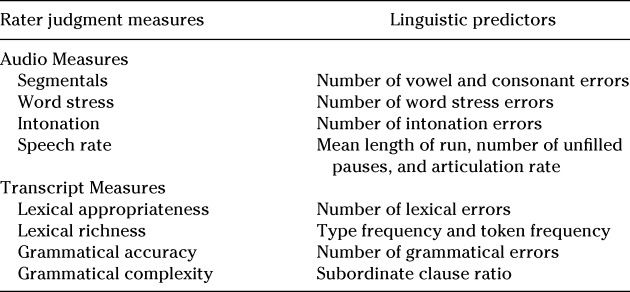
As reported in Saito et al. (Reference Saito, Trofimovich and Isaacsin press) and summarized in Table 1, these raters’ ratings were significantly correlated with key linguistic properties of the tokens, which, as a result, confirmed the accuracy and reliability of the participating human raters’ abilities to analyze the phonological, temporal, lexical, and grammatical qualities of L2 speech production.
Summary of the linguistic predictors for human raters’ phonological, temporal, lexical, and grammatical judgment of L2 speech in Saito et al. (Reference Saito, Trofimovich and Isaacsin press)

Day 2
After receiving recapped instructions on the four pronunciation and fluency categories and familiarizing themselves with the picture prompts and keywords for the current dataset, the raters first practiced rating five audio picture descriptions of Japanese learners (not included in the main analysis). For each practice sample, the raters explained their decisions and received feedback on the accuracy of their understanding of the categories. Subsequently, the raters proceeded to rate the main dataset of 108 audio samples, with a 10-min intermission halfway through.
Day 3
The raters first received recapped instruction on the four lexicogrammar categories and feedback on their practice ratings of the same three tokens (not included in the main dataset). Subsequently, they rated the 108 transcript samples.
Interrater Reliability
Cronbach’s alpha was calculated to check interrater agreement among the 10 inexperienced raters’ global scores of 324 samples (108 talkers × 3 picture descriptions) and the five experienced raters’ audio and transcript ratings of 108 speech samples (three picture descriptions combined per talker). In line with previous L2 comprehensibility research (e.g., Derwing & Munro, Reference Derwing and Munro2009), the results found relatively high alpha levels for accentedness (α = .97) and comprehensibility (α = .95). In terms of the pronunciation analyses, the raters’ judgments were overall consistent, demonstrating high reliability indexes (Cronbach’s alpha) for segmentals (α = .90), word stress (α = .87), intonation (α = .82), and speech rate (α = .88). The raters showed slightly less agreement for their analyses of lexical appropriateness (α = .75), lexical richness (α = .84), grammatical accuracy (α = .80), and grammatical complexity (α = .77). The reliability indices were acceptable overall, exceeding the benchmark value of .70–.80 in L2 research (Larson-Hall, Reference Larson-Hall2010). By averaging across all listeners’ ratings, one mean score was computed for each speaker according to global (accentedness and comprehensibility), phonological (segmentals, word stress, and intonation), temporal (speech rate), lexical (appropriateness and richness), and grammatical (accuracy and complexity) categories.
Interrelationships between Linguistic Scores
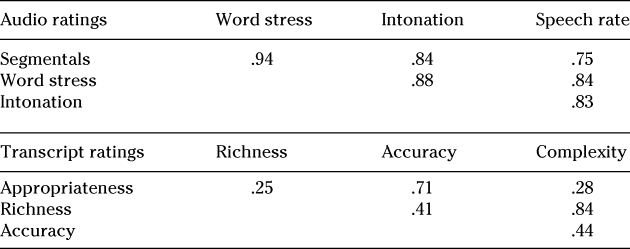
To investigate the degree of independence between audio and transcript ratings, a set of simple correlation analyses was performed (see Table 2). Differing strengths of correlation coefficients were also checked using the Fisher r-to-z transformation. For audio-based measures, the link between segmental scores and word stress scores (r = .94) was significantly stronger than that between segmental and intonation scores (r = .83) and than that between segmental and speech rate scores (r = .75) at a p < .001. This indicates that segmental scores were more closely related to word stress scores than to intonation or speech rate scores. Prosodic scores were similarly correlated to fluency scores (r = .84 for word stress; r = .83 for intonation); the strength of the two correlation coefficients (i.e., fluency/word stress vs. fluency/intonation) failed to reach statistical significance, p = .081. For transcript-based measures, relatively strong correlations were found between appropriateness and accuracy (r = .71) as well as richness and complexity (r = .84); the strength in the two correlation coefficients was statistically significant, p = .016. To summarize, as conceptualized and validated in the previous study (Saito et al., Reference Saito, Trofimovich and Isaacsin press), the eight rater-based linguistic categories were considered to tap into four domains of L2 speaking proficiency—pronunciation (segmentals and word stress), fluency (word stress, intonation, and speech rate), and the proper (appropriateness and accuracy) and sophisticated (richness and complexity) usage of lexicogrammar.
Intercorrelations between the audio and transcript ratings
RESULTS
The Linguistic Characteristics of L2 Oral Proficiency Attainment
The first aim of the statistical analysis was to investigate the global, phonological, temporal, and lexicogrammatical qualities of experienced Japanese learners’ oral proficiency attainment relative to the performance of two baseline groups of Japanese (LOR < 1 month) and English native speakers.
Global Analyses
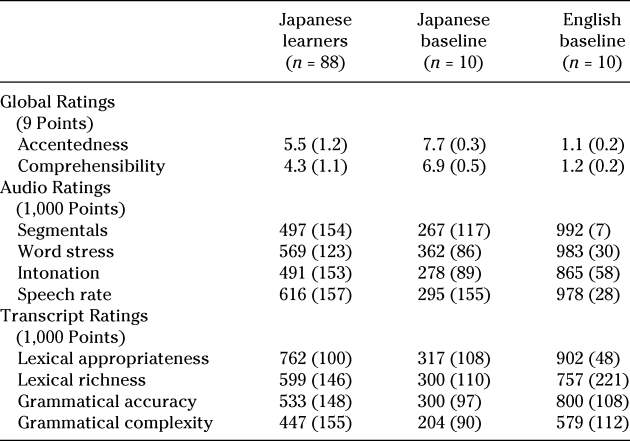
Participants’ accentedness and comprehensibility scores are summarized in Table 3. These scores were used as dependent variables and were submitted to a two-way ANOVA with group (experienced learners, Japanese baseline, and English baseline) as a between-subject factor and domain (accentedness and comprehensibility) as a within-subject factor. The results demonstrated a significant Group × Domain interaction effect, F(2, 105) = 18.86, p < .001. According to Bonferroni multiple comparisons, the experienced Japanese learners’ comprehensibility scores were rated higher than their accentedness scores. The experienced Japanese learners also significantly outperformed the Japanese baseline (p < .001) but performed more poorly compared to the English baseline (p < .001) in terms of both sets of scores.
Means and standard deviations (in parentheses) for the rated global, phonological, temporal, and lexicogrammatical qualities of Japanese learners and Japanese and English baseline picture descriptions
Note. In the 9-point scale, 1 = little accent, easy to understand, and 9 = heavily accented, hard to understand; in the 1,000-point scale, 1 = nontargetlike production, and 1,000 = targetlike production.
Pronunciation, Fluency, Vocabulary, and Grammar Analyses
Participants’ linguistic scores are also summarized in Table 3. A two-way ANOVA was conducted using participants’ audio (segmentals, word stress, intonation, and speech rate) and transcript (lexical appropriateness and richness and grammatical accuracy and complexity) rating scores as the dependent variables. The results yielded a significant interaction effect for group and domain for the audio measures, F(6, 315) = 4.79, p < .001, and the transcript measures, F(6, 315) = 5.21, p < .001. Bonferroni pairwise comparisons showed that, for all linguistic domains (pronunciation, fluency, vocabulary, and grammar), the experienced Japanese learners showed better performance than the Japanese baseline (p < .001) but still differed significantly from the English baseline (p < .001).
Age Effects on Attained L2 Oral Proficiency
The second aim of the statistical analysis was to examine whether and to what degree the 88 experienced Japanese learners’ AOA was predictive of their attained oral ability via a set of simple and partial correlation analyses.
Global Analyses
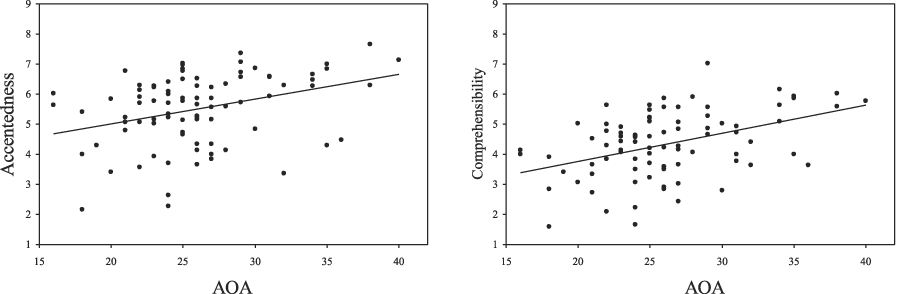
To check the normality of the dataset for subsequent correlation analyses, participants’ accentedness and comprehensibility scores were submitted to Grubb’s tests, which identified no outliers in both domains (p > .05). The simple correlation between the global rating score and AOA was significant for accentedness, r(87) = .346, p = .001, and comprehensibility, r(87) = .429, p < .001. A scatterplot for the AOA-proficiency relationship is presented in Figure 1.
Global accentedness and comprehensibility scores (1 = little accent, easy to understand, 9 = heavily accented, hard to understand) plotted as a function of AOA.
As many researchers have pointed out, AOA effects are likely confounded with learners’ LOR (i.e., the earlier they arrive in a L2 country, the longer they stay; e.g., Flege et al., Reference Flege, Munro and MacKay1995); the two variables were indeed significantly correlated in the current study, r(87) = −.315, p = .003. To this end, partial correlation analyses were conducted to examine the relationship between AOA and accentedness and comprehensibility when the other confounding variable (i.e., LOR) was controlled. With LOR factored out, the AOA-proficiency relationship still remained significant for accentedness, r(85) = .315, p = .003, and comprehensibility, r(85) = .412, p < .001.Footnote 7
Pronunciation, Fluency, Vocabulary, and Grammar Analyses
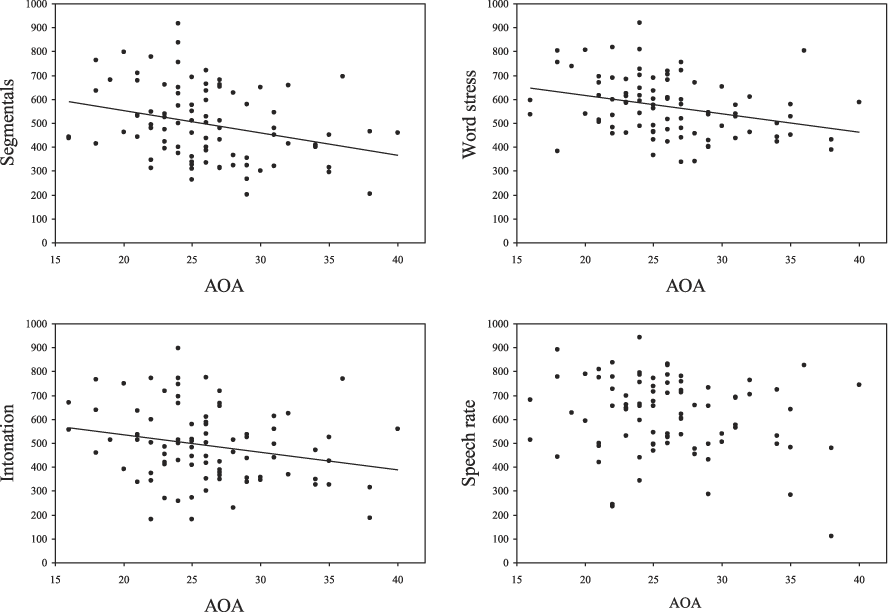
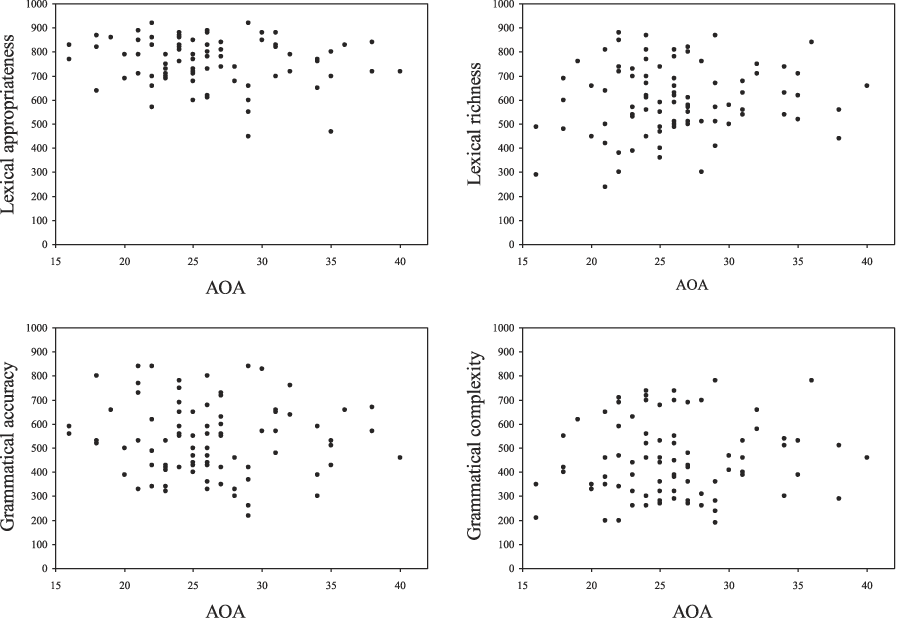
According to Grubb’s tests, one outlier was found in the context of lexical appropriateness (z = 3.88, p < .001); this participant’s score was eliminated for the relevant analyses. As for the pronunciation and fluency analyses, the results of a simple correlation between the four audio rating scores and AOA were significant for segmentals, r(87) = −.299, p = .005; word stress, r(87) = −.309, p = .003; and intonation, r(87) = −.235, p = .027. Yet they did not reach statistical significance for speech rate, r(87) = −.175, p = .102. As for the vocabulary and grammar analyses, AOA was not significantly correlated with any of the transcript rating scores, such as lexical appropriateness, r(86) = −.160, p = .137; lexical richness, r(87) = .122, p = .257; grammatical accuracy, r(87) = −.051, p = .635; and grammatical complexity, r(87) = .084, p = .436. Scatterplots for the relationship between AOA and linguistic proficiency are presented in Figures 2 and 3.
Pronunciation and fluency scores (0 = nontargetlike production, 1,000 = targetlike production) plotted as a function of AOA.
Vocabulary and grammar scores (0 = nontargetlike production, 1,000 = targetlike production) plotted as a function of AOA.
Partial correlation analyses were also performed to illustrate the impact of AOA on the learners’ pronunciation, fluency, and lexicogrammar performance by separating any other experience-related factors (i.e., LOR effects) from the age function. After the variable of the learners’ LOR profiles was removed, the AOA-proficiency link remained significant for segmentals, r(85) = −.240, p = .025, and word stress, r(85) = .260, p = .015, but became marginal for intonation, r(85) = −.210, p = .050, and nonsignificant for speech rate, r(85) = −.184, p = .087. As for lexicogrammar, the partial correlation analyses still failed to show any significant power of AOA for lexical appropriateness, r(84) = −.143, p = .188; lexical richness, r(85) = .182, p = .091; grammatical accuracy, r(85) = −.044, p = .684; and grammatical complexity, r(85) = .113, p = .299.
DISCUSSION
In the context of late Japanese-English bilinguals (AOA > 16 years), the current study aimed to examine whether and to what degree AOA can predict their postpubertal L2 oral proficiency attainment after years of input and interaction with native and nonnative speakers through extensive residence in the L2 environment (LOR > 6 years). Overall, the results provide three broad findings. First, the experienced Japanese learners’ L2 oral ability demonstrated significantly better global, phonological, temporal, lexical, and grammatical qualities compared to that of inexperienced Japanese learners (LOR < 1 month), although their performance was substantially different from that of native speakers of English. Second, AOA was significantly predictive of the late learners’ global L2 oral ability (accentedness and comprehensibility), arguably owing to relatively strong age effects on segmental and prosodic attainment. Third, AOA did not relate to the temporal and lexicogrammatical domains of attained L2 speech production.
By and large, these results do not provide the necessary support for the predictions of the strong version of the CPH, which explicitly hypothesizes the absence of age effects on any linguistic areas of late bilingualism (due to the close of a critical period). Rather, the data can be well explained in support of the predictions of the CAH, which assumes the existence of language-specific cognition across the life span. That is, both young and adult L2 learners alike successfully and continuously enhance their L2 oral ability, given ample opportunities and high motivation to use the L2 (Flege & Liu, Reference Flege and Liu2001), and the final-state quality of L2 learners’ near-nativelike performance is equally subject to age effects before and after puberty (Birdsong & Molis, Reference Birdsong and Molis2001). Regarding these age effects, the correlation coefficients on the AOA-proficiency relationship among the late learners in the study (r = .35 for accentedness, and r = .43 for comprehensibility) are somewhat comparable to those of early learners (AOA < 16 years) in the previous literature (e.g., r = .36–.56 for Granena & Long, Reference Granena and Long2013).
Noteworthy, however, is that the age factor differentially, not monolithically, predicted late L2 speech production attainment. The pronunciation, fluency, vocabulary, and grammar analyses demonstrated that the predictive power of AOA was strong, especially in the phonological (segmental and prosodic) domain of language and less so in the temporal and lexicogrammatical domains. Such complex results lead us to consider several possible accounts for the multifaceted nature of age effects on late L2 acquisition. One relevant discussion involves the recently proposed process-oriented model for L2 speech production development (e.g., Isaacs & Trofimovich, Reference Isaacs and Trofimovich2012). According to the model, native speakers draw on different realms of linguistic information (pronunciation, fluency, vocabulary, and grammar) when they perceive the L2 oral proficiency of beginner-, intermediate-, and advanced-level learners. For example, Derwing and Munro showed that, whereas good prosody (intonation) was invariably related to native speakers’ evaluation of all groups of learners, they likely prioritized temporal over segmental information to make proficiency judgments for inexperienced learners (Derwing & Munro, Reference Derwing and Munro1997) and vice versa for experienced learners (Munro & Derwing, Reference Munro and Derwing1995; see also Saito, Trofimovich, & Isaacs, Reference Saito, Trofimovich and Isaacs2015). Similarly, Isaacs and Trofimovich (Reference Isaacs and Trofimovich2012) found that prosodic qualities (word stress) equally predicted beginner, intermediate, and advanced levels of L2 comprehensibility. In contrast, temporal qualities (i.e., mean length of run) only distinguished between beginner- and intermediate-level learners.
The relative weights of the linguistic influences on native speakers’ assessment patterns shed some light on how L2 learners enhance their rate and attainment of L2 speech production as they increase their L2 experience at the initial, mid, and final phases of L2 acquisition. That is, the continuous development of optimal speech rate, proper lexicogrammar, and good prosody is characteristic of the initial to mid phases of L2 speech learning, and refined segmental and prosodic performance is representative of the mid to final phase of L2 speech learning (Saito, Reference Saito2015). Situated within this developmental framework, the results of the experienced Japanese learners (LOR > 6 years) suggest that AOA can be a good predictor of segmental and prosodic attainment arguably because it indicates to what degree these experienced learners can attain advanced levels of L2 oral proficiency via improving the phonological domain of language at the later stage of L2 speech learning. Conversely, given that the development of fluency and lexicogrammar is a crucial part of the initial to mid (but not final) stages of L2 speech learning, obtaining optimal speech rate and proper lexicogrammar usage can be achieved by virtue of being extensively exposed to L2 input, despite different timings of learners’ AOA (Saito, Reference Saito2015; Trofimovich & Baker, Reference Trofimovich and Baker2006).
Such differential effects of age on pronunciation, fluency, vocabulary, and grammar attainment reflect the continuum of easy, moderate, and difficult linguistic features that has been suggested by the extensive nativelikeness research in SLA. Whereas even late L2 learners likely attain some aspects of nativelike vocabulary performance (e.g., Hellman, Reference Hellman2011, for vocabulary size), the attainment of such high proficiency tends to occur very infrequently in grammar (Flege et al., Reference Flege, Yeni-Komshian and Liu1999) and entails an extensive amount of L2 experience in speech and articulation rate, rhythm, and the number of pauses (Munro & Derwing, 2014). Furthermore, the incidence of nativelikeness itself is found to be extremely rare compared to segmental (Abrahamsson, Reference Abrahamsson2012) and prosodic accuracy (Trofimovich & Baker, Reference Trofimovich and Baker2006) and vocabulary richness and grammatical complexity (Abrahamsson & Hyltenstam, Reference Abrahamsson and Hyltenstam2009). As shown in the current study, the Japanese learners reached what was likely their upper limits of proper lexicogrammar usage and optimal fluency as long as they had an adequate amount of L2 experience (i.e., at least 6 years of L2 immersion). Nevertheless, extensive LOR as well as early AOA profiles for Japanese learners may be required to further enhance the prosodic and segmental qualities of L2 speech production so as to attain advanced, sophisticated, and near-nativelike proficiency.
LIMITATIONS
Given the exploratory nature of the project, several methodological limitations need to be acknowledged with a view toward future replication studies. First and foremost, the findings, especially those regarding the role of AOA in lexicogrammar attainment, should be interpreted with caution due to an obvious methodological problem inherent in the study’s instruments. That is, only 30 s of the participants’ spontaneous speech production were used for the raters’ transcript-based judgments. Although the length of the speech samples (30 s) can be considered to have provided sufficient phonological information for judgment (e.g., Derwing & Munro, Reference Derwing and Munro1997; Hopp & Schmid, Reference Hopp and Schmid2013; Isaacs & Trofimovich, Reference Isaacs and Trofimovich2012), it may have failed to provide sufficient written data for even trained raters to analyze the detailed relationship between AOA and vocabulary and grammar performance.
For example, although our dataset constituted an average of approximately 50 words per talker, robust analyses of certain lexical measures (e.g., lexical richness) may require more than 100 words (Koizumi & In’nami, Reference Koizumi and In’nami2012). Previous research indeed has used longer speech samples for vocabulary and grammar analyses (3 min in Lu, Reference Lu2012; 5 min in Yuan & Ellis, Reference Yuan and Ellis2003). In addition, the four categories (lexical appropriateness and richness and grammatical accuracy and complexity) in the study may not be comprehensive enough to capture the numerous layers of participants’ vocabulary and grammar performance (e.g., see Saito, Webb, Trofimovich, & Isaacs, Reference Saito, Webb, Trofimovich and Isaacsin press, for different correlation coefficients between 12 lexical richness measures and L2 oral proficiency).
Another important issue concerns the type of speaking task used. It is crucial to reiterate that the tentative suggestions on AOA effects in the study were solely based on the timed picture description task; the nature of the task (i.e., describing each picture with three keywords and 5 s of preplanning time) may have failed in eliciting a sufficiently wide range of various lexical items. One could argue that the predictive power of the lexicogrammar factors did not reach statistical significance in any of the contexts, probably because all participants were allowed to simply use similar kinds of frequent and familiar lexical items. In fact, Crowther, Trofimovich, Isaacs, and Saito (Reference Crowther, Trofimovich, Isaacs and Saito2015) showed that native speaker raters tended to attend to pronunciation and lexicogrammar factors only when L2 speech was elicited via a relatively difficult speaking test (i.e., the TOEFL iBT integrated task). In contrast, they relied exclusively on the pronunciation factor when L2 speech was elicited based on a relatively easy task (i.e., the IELTS long-turn task; see also Derwing et al., Reference Derwing, Rossiter, Munro and Thomson2004, for similar task effects on L2 speaking proficiency). The generalizability of the results (especially those related to lexicogrammatical attainment) in the study needs to be tested within the context of various speaking tasks, especially more argumentative, formal, and complex ones whereby L2 learners are induced to demonstrate a more varied and sophisticated use of L2 vocabulary (see Hulstijn, Schoonen, De Jong, Steinel, & Florijn, Reference Hulstijn, Schoonen, De Jong, Steinel and Florijn2012).
Finally, future research is warranted to scrutinize the direct causes—such as crosslinguistic influence (Hopp & Schmid, Reference Hopp and Schmid2013) and/or the cognitive aging factor (Birdsong, Reference Birdsong, Kroll and De Groot2005, Reference Birdsong2006)—of the AOA-proficiency correlation in late bilingualism. One potential way to examine the underlying mechanism for the age effects on late L2 acquisition is to investigate whether learners’ AOA is related to not only the quality of the L2 but also L1 speech production. If we accept the view that extensive L2 use negatively affects L1 performance, it seems reasonable to assume that earlier AOA profiles can equally predict not only better L2 performance but also more L1 attrition. In terms of the influence of the cognitive aging factor on the age function in late L2 acquisition, participants’ levels of cognitive and neurobiological development can be first measured via instruments previously used and validated in the cognitive psychology literature (e.g., the Simon task; Bialystok, Craik, Klein, & Viswanathan, Reference Bialystok, Craik, Klein and Viswanathan2004). Subsequently, it would be intriguing to examine how the various aging conditions of early and late arrivals can be differentially related to their attained L2 proficiency. Such future research will highlight the intricate relationship between learners’ AOA, the magnitude of intrinsic L1-L2 interaction, the state of neurological and cognitive development, and various linguistic elements of L2 speech production.
CONCLUSION
The current study was designed to investigate the predictive power of AOA for the global, phonological, temporal, lexical, and grammatical qualities of postpubertal L2 speech production attainment by late experienced Japanese learners. According to the results of the global analyses, AOA was negatively correlated with accentedness and comprehensibility in L2 speech production, suggesting that the age factor remains pertinent to not only early but also late L2 acquisition throughout the age spectrum (Birdsong, Reference Birdsong, Kroll and De Groot2005, Reference Birdsong2006). It is important to reiterate here that one potential reason for the significant age function in the study can be attributed to the fact that participants who had many opportunities to process input and interaction in the L2 with native and nonnative speakers for many years (LOR > 6 years) were carefully chosen (Derwing & Munro, Reference Derwing and Munro2013), and their performance was measured at a spontaneous (rather than controlled) speech level (Hopp & Schmid, Reference Hopp and Schmid2013).
Additionally, the results of the pronunciation, fluency, vocabulary, and grammar analyses revealed that such postpubertal age effects were particularly strong in the case of segmental and prosodic attainment, which is a crucial linguistic characteristic of advanced-level L2 oral proficiency (Isaacs & Trofimovich, Reference Isaacs and Trofimovich2012; Saito et al., Reference Saito, Trofimovich and Isaacs2015). In contrast, AOA played a negligible role in temporal and lexicogrammar attainment, probably because most of the L2 learners had already passed the threshold needed for successful communication as a function of LOR instead of AOA profile (Saito, Reference Saito2015; Trofimovich & Baker, Reference Trofimovich and Baker2006).
Extending previous L2 speech studies of this kind (Derwing & Munro, Reference Derwing and Munro2013; Saito, Reference Saito2015), the current study leads to three tentative conclusions about the underlying mechanism for late L2 acquisition. First, regular and motivated L2 users are assumed to make steady improvement in the temporal and lexicogrammatical domains of language (optimal fluency, good prosody, appropriate vocabulary, and accurate grammar) over an extensive period of stay in the L2 environment (0 < LOR < 5 years) for the purpose of successful L2 social interaction (Derwing & Munro, Reference Derwing and Munro2013; Saito, Reference Saito2015). Second, in the long run, their AOA seems to be an important index for determining the extent to which they can attain advanced-level L2 oral proficiency, specifically via improving the phonological domain of language (correct consonant and vowel pronunciation and good prosody; Saito, Reference Saito2013; Trofimovich & Baker, Reference Trofimovich and Baker2006).
The first two conclusions motivate us to propose the last conclusion: that even adult L2 learners may draw on qualitatively and fundamentally similar language learning mechanisms used for early L2 acquisition and L1 acquisition with a lifelong gradual negative change in their L2 attainment with increasing age (Best & Tyler, Reference Best, Tyler, Bohn and Munro2007; Bialystok, Reference Bialystok1997; Birdsong, Reference Birdsong, Kroll and De Groot2005, Reference Birdsong2006; Flege, Reference Flege, Meyer and Schiller2003; Hakuta et al., Reference Hakuta, Bialystok and Wiley2003; Hopp & Schmid, Reference Hopp and Schmid2013). To obtain a better understanding of the plasticity for language learning in late L2 acquisition (i.e., similarities and dissimilarities in L1 and L2 acquisition), we call for more research that highlights age effects on both the L1 and L2 performance of early and late bilinguals. Such research should adopt more comprehensive measures of not only pronunciation and fluency but also lexicogrammar performance in the context of a range of speaking tasks requiring different lexicogrammatical thresholds (e.g., TOEFL iBT or IELTS). Because this study was based exclusively on Japanese learners of English, the generalizability of the results can be tested in conjunction with late bilinguals with different L1-L2 backgrounds.
APPENDIX
The following tables present the training materials and onscreen labels for the audio- and transcript-based measures used in this study.