


Introduction
The discourse around the masculinity crisis ranges from discussions about men’s declining educational attainment, job prospects, suicide and addiction rates, to their alignment with extreme political ideologies. Despite the fact that men have dominated the political sphere in the United States and around the world, empirical explorations into the role of masculinity in politics (and the purported masculinity crisis) have only recently been undertaken. Explorations in the field of political science have looked at how beliefs about masculinity, masculine identification, and threats to masculinity shape voters’ macro views of the entire country (Deckman & Cassese, Reference Deckman and Cassese2021), vote choice (Gidengil & Stolle, Reference Gidengil and Stolle2021), political ambition (Peterson, Palmer, & Bosanko, Reference Peterson, Palmer and Bosanko2024), and policy attitudes (Bittner & Goodyear-Grant, Reference Bittner and Goodyear-Grant2017; Willer, Rogalin, Conlon, & Wojnowicz, Reference Willer, Rogalin, Conlon and Wojnowicz2013). This work has generated important new insights into the role of gender identity and gender ideology, and masculinity more specifically, in politics.
But what does it mean to measure masculinity, and why does it matter for understanding political behavior, especially among men aligned with right-wing extremism or grievance politics? Masculinity is not only a set of beliefs or attitudes, but rather, an identity that can be core to one’s self-concept. In this perspective piece, we first review the measures of masculinity employed in political science and what we have learned from this growing literature. We then show, with original survey data, how broadened measures of masculine (and feminine) identity can shed important light on intra-gender variation in political attitudes and participation that we miss when we only use categorical measures of gender.
Though we do not directly measure the masculinity crisis in the present paper, we argue that to understand this possible “crisis” among men, gender backlash, and the role of masculinity in right-wing extremism and in shaping political attitudes, we have to consider not only how men think about gender relations and hierarchies, but also their own perceived and aspirational levels of masculinity (Stanaland, Gaither, & Gassman-Pines, Reference Stanaland, Gaither and Gassman-Pines2023). Rather than treating masculinity as a peripheral or background variable, we should think of it as a central identity that can motivate political engagement, shape political attitudes, and structure alignment with broader ideological movements. Discerning how men understand themselves in relation to masculinity could reveal insights into personal identity and how central it is to self-concept. This involves moving beyond beliefs about gender more broadly to examine the identity-based, psychological stakes of being a man in a rapidly changing political and cultural landscape. By studying masculinity as an identity that is subject to threat and changing levels of salience, we gain a clearer window into men’s political behavior, grievances, and alignment with extreme ideologies. We end this piece with suggestions for measuring masculine self-identification as not just a background or control variable. In particular, we recommend that scholars measure not only strength of identification with masculinity, but also aspirational levels of masculinity, and the differential between those measures. This “masculinity gap” or discrepancy between self-perceived and desired levels of masculinity may explain why some men gravitate toward extreme political ideologies, grievance politics, and anti-egalitarian sentiments.
Masculinity, measurement, and political behavior
The fields of psychology, sociology, and gender studies have long been generating insights into the role of masculinity in our broader culture and how it shapes attitudes and behaviors in individuals.Footnote 1 Though there is no singular, universally agreed-upon definition of masculinity, there are influential conceptualizations of masculinity developed over the years. These theoretical through-lines across definitions and concepts have shaped the way scholars theorize about masculinity and measure it. Generally, common notions of masculinity are viewed as mostly socially constructed, hierarchical in nature, and often experienced as contingent. Masculinity can be understood within a framework that recognizes that biological sex assigned at birth can, but does not always, directly overlap with gender identity. We start from the simple definition that “gender broadly refers to aspects of the self in relation to society typically associated with men (masculine) or women (feminine)” (Schneider & Bos, Reference Schneider, Bos, Huddy, Sears, Levy and Jerit2023).
From traits to structures: Early measures of masculinity
Early work on masculinity focused on gendered personality traits—the idea that people have both stereotypically “feminine” and “masculine” characteristics (Bem, Reference Bem1981; Spence, Helmreich, & Stapp, Reference Spence, Helmreich and Stapp1974). These scales were developed to assess how individuals conform to or internalize culturally defined traits associated with masculinity or femininity, often independent of their biological sex. For example, the commonly used Bem Sex Role Inventory (BSRI) consists of a battery of different traits that are consistent with masculine and feminine sex roles (Bem, Reference Bem1981). Importantly, these scales treat masculinity and femininity as distinct dimensions instead of a single continuum. According to Bem, individuals can be “sex typed,” or generally in line with conventions of sex roles, or they could deviate from traditional sex roles and be in alignment with traits culturally ascribed to the opposite sex. For example, a woman could identify as very high in stereotypically masculine traits. Furthermore, individuals could score high in both stereotypically masculine and feminine traits (e.g., an androgynous personality type), or very low, which the BSRI deems as “undifferentiated.” There have been challenges to this popular paradigm, specifically that the BSRI creates a top-down definition of what it means to be feminine or masculine, rather than allowing individuals to interpret these identities and their associated traits for themselves (Gidengil & Stolle, Reference Gidengil and Stolle2021; Schneider & Bos, Reference Schneider, Bos, Huddy, Sears, Levy and Jerit2023).
Other explorations of masculinity focus less on individual traits that signify masculinity in individuals and more on structural and cultural notions of ideal masculinity. For example, sociologists have developed the notion of hegemonic masculinity—a culturally exalted form of masculinity that legitimizes (some) men’s dominance at the top of society and women and other marginalized groups’ positions at the bottom (Connell & Messerschmidt, Reference Connell and Messerschmidt2005). Most men do not fully subscribe to or embody hegemonic masculinity, but they may still aspire to and benefit from its dominance. Measures building on the original theory of hegemonic masculinity generally focus on attitudes about gender relations and power dynamics as well as prescriptive and proscriptive social norms that govern men and masculinity (Thompson & Bennett, Reference Thompson and Bennett2015).Footnote 2 Rather than approaching masculinity as a set of particular traits or characteristics, like the BSRI or the Personal Attributes Questionnaire (Spence et al., Reference Spence, Helmreich and Stapp1974), this perspective defines masculinity as an ideology that encompasses particular social norms guiding and sanctioning men and their behaviors, attitudes, and beliefs. As Thompson and Bennett state (Thompson & Bennett, Reference Thompson and Bennett2015:p. 115), “From this perspective masculinity ideologies are properties of particular times, places, and groups, not individuals. They influence—although they do not wholly determine—how people think, feel, and behave in gender-salient matters.” For example, the Male Role Norms Scale (MRNS) includes dimensions that tap status, toughness, and anti-femininity norms (Thompson & Pleck, Reference Thompson and Pleck1986). These measures, rather than measuring traits or perceived levels of masculinity, capture attitudes, dogmas, and expectations of the socially constructed gender ideal for men.
In parallel, psychologists developed models of masculinity that emphasized its precarious and performative nature. According to Precarious Manhood Theory, masculinity is seen as a hard-won and easily lost social status. This is in contrast to femininity, which is culturally perceived as more innate, stable, and rooted in biology (Vandello & Bosson, Reference Vandello and Bosson2013). When masculinity is under threat, men often respond with extreme demonstrations of their gender identity. This phenomenon is articulated in the Masculine Overcompensation Thesis, which finds that masculinity threats increase support for dominance-oriented political attitudes, aggression, and risk-taking (Gothreau & Haas, Reference Gothreau and Haas2025; Vandello & Bosson, Reference Vandello and Bosson2013; Willer et al., Reference Willer, Rogalin, Conlon and Wojnowicz2013). Instead of measuring masculinity threat as a stable trait, most scholars have taken the approach of inducing a sense of masculinity threat in an experimental setting, and then measuring downstream effects on attitudes or behavior (Bosson et al., Reference Bosson, Vandello, Burnaford, Weaver and Arzu Wasti2009; Vandello & Bosson, Reference Vandello and Bosson2013; Vescio, Schermerhorn, Gallegos, & Laubach, Reference Vescio, Schermerhorn, Gallegos and Laubach2021; Willer et al., Reference Willer, Rogalin, Conlon and Wojnowicz2013). Alternatively, some have measured masculinity threat as a disposition (Bosson et al., Reference Bosson, Jurek, Vandello, Kosakowska-Berezecka, Olech and Besta2021), such as the Precarious Manhood Beliefs (PMB) scale, which includes the items “Other people often question whether a man is a real man” and “It is fairly easy for a man to lose his status as a man.”
Importantly, there are also explorations into masculinity that emphasize masculinity in relation to other identities like race, class, and sexuality (Mincey, Alfonso, Hackney, & Luque, Reference Mincey, Alfonso, Hackney and Luque2014). For example, studies of Black masculinity examine how Black men define manhood in ways that are distinct from the conceptions of white men (Chaney, Reference Chaney2009; Hunter & Davis, Reference Hunter and Davis1992). The takeaway from this work is that masculinity is not monolithic but often also racialized. Race-specific adaptations of scales, such as the Conformity to Masculine Norms Inventory (CMNI), attempt to capture these nuances (Hammond & Mattis, Reference Hammond and Mattis2005; Mahalik et al., Reference Mahalik, Locke, Ludlow, Diemer, Scott, Gottfried and Freitas2003).
Self-perceived masculinity as identity
Finally, and most relevant to this perspective piece, there are measures that focus on self-perceived masculinity. Instead of defining what masculinity is in terms of traits, stereotypes, cultural ideals, or precariousness, these questions allow individuals to simply report how masculine they feel or view themselves, or how central masculinity is to their self-concept. Often these measures are on a continuous scale, and the question posed is something like “How masculine do you consider yourself to be?” (Magliozzi, Saperstein, & Westbrook, Reference Magliozzi, Saperstein and Westbrook2016) or “Sometimes, one talks about individuals having both feminine and masculine characteristics. To what extent would you say that you have masculine and feminine characteristics, respectively?” (Coffe et al., Reference Coffe, Fraile, Alexander, Fortin-Rittberger and Banducci2023; Gidengil & Stolle, Reference Gidengil and Stolle2021; Wängnerud, Solevid, & Djerf-Pierre, Reference Wängnerud, Solevid and Djerf-Pierre2019). The goal of these items is to tap into people’s “gendered sense of self” (Magliozzi et al., Reference Magliozzi, Saperstein and Westbrook2016). In political science, these measures are often used in examining the relationship between self-perceived masculinity and political identity (Cassino & Besen-Cassino, Reference Cassino and Besen-Cassino2021), policy attitudes (Bittner & Goodyear-Grant, Reference Bittner and Goodyear-Grant2017), vote choice (Gidengil & Stolle, Reference Gidengil and Stolle2021; C. Gothreau, Laustsen, & Haas, Reference Gothreau, Laustsen and Haas2025), and populist radical right support (Coffe et al., Reference Coffe, Fraile, Alexander, Fortin-Rittberger and Banducci2023). Some of these continuous measures are unidimensional scales running on a single continuum from feminine to masculine, while others treat femininity and masculinity as separate dimensions.
Building on this framework, some scholars have added another layer of complexity by measuring not just self-perceived masculinity and femininity but also centrality—how important one’s gender identity is to their overall sense of self. For example, Cassino and Besen-Cassino (Reference Cassino and Besen-Cassino2020) look at sex, gender, and protective measures during the COVID-19 pandemic. Respondents were asked about their gender identity on a unidimensional scale running from “completely masculine” to “completely feminine” as well as how important being a man or being a woman was to their overall identity. They find that men’s gender identity was strongly related to their attitudes about wearing a mask, particularly when their masculine identity was core to their self-concept, suggesting the importance of combining gendered self-identification with the salience of that identification in shaping one’s overall self-concept.
Together, these measures reflect a growing interest in understanding masculinity (and femininity) not as a fixed set of traits or roles, but as a subjective identity that varies across individuals and contexts—and one that has measurable implications for political behavior. Table 1 provides an overview of measures of masculinity commonly used in the social sciences.
Overview of common measures of masculinity

Table 1. Long description
The table consists of four columns and five rows of data.
* Row 1: Trait-based approach. Key measures include B S R I and P A Q. It describes self-ascribed personality traits like assertiveness or nurturing, treating masculinity and femininity as separate dimensions. Citations: Bem 1981; Spence et al. 1974.
* Row 2: Structural or Ideological approach. Key measures include Hegemonic masculinity, M R N S, and C M N I. It describes masculinity as a social ideology regarding gender hierarchies and dominance. Citations: Connell and Messerschmidt 2005; Mahalik et al. 2003; Thompson and Pleck 1986.
* Row 3: Threat or Precariousness approach. Key measures include P M B and overcompensation paradigms. It describes the belief that masculinity is tenuous and must be proven through behavior like aggression. Citations: Bosson et al. 2009; Vandello and Bosson 2013; Willer et al. 2013.
* Row 4: Self-perceived masculinity (Identity) approach. Key measures include unidimensional and bidimensional self-placement scales. It describes subjective self-identification independent of traits or norms. Citations: Coffe et al. 2023; Gidengil and Stolle 2021; Magliozzi et al. 2016.
* Row 5: Centrality or Aspirational measures. Key measures include gender identity centrality scales and the masculinity gap. It describes how central masculinity is to self-concept and the discrepancy between perceived and desired masculinity. Citations: Cassino and Besen-Cassino 2020; Stanaland et al. 2023.
What we’ve learned: Masculinity beyond binary gender
The incorporation of measures of masculinity (and femininity) has broadened our understanding of many topics in political behavior, revealing important intra-gender variation that binary measures alone cannot capture. For example, masculinity is positively related to nascent political ambition, offering us a more nuanced picture of the gender gap in running for office (Peterson et al., Reference Peterson, Palmer and Bosanko2024). Similarly, McDermott (Reference McDermott2016) finds that masculinity—measured through a battery of gendered personality traits—predicts higher levels of political interest and engagement, even after accounting for binary gender. American men who identify as more masculine are also more likely to be Republicans (Pao & Roundy, Reference Pao, Roundy, McDermott and Cassino2025), further demonstrating the explanatory power of masculinity beyond biological sex or gender identity. Recent work by Gidengil and Stolle (Reference Gidengil and Stolle2021) shows that intra-gender differences among women and men exceed inter-gender differences between men and women in terms of support for Donald Trump. Though the binary partisan gender gap is large, the gap between hypermasculine men and weakly masculine men is larger. They state “Overall, the differences among men far exceed the differences between women and men, and those differences far exceed the differences among women” (Gidengil & Stolle, Reference Gidengil and Stolle2021:p.1820).
Furthermore, much scholarship has investigated the gender gap in support for populist radical right (PRR) parties, with women being less likely to support them (Coffé, Reference Coffé and Rydgren2018; Harteveld, Van Der Brug, Dahlberg, & Kokkonen, Reference Harteveld, Van Der Brug, Dahlberg and Kokkonen2015; Spierings & Zaslove, Reference Spierings and Zaslove2015). Building on this literature, Coffe et al. (Reference Coffe, Fraile, Alexander, Fortin-Rittberger and Banducci2023) demonstrate that people’s self-assessment of their own masculine features predicts support for PRRs. Sexist attitudes both mediate and moderate the effect of masculinity on PRR voting. Similarly, Coffé (Reference Coffé2019) finds that self-perceived masculine personality traits positively predict support for the Dutch radical right party, PVV. Related work by Van Hauwaert and van Kessel (Reference Van Hauwaert and Van Kessel2018) also identifies strong associations between authoritarian values—often coded as masculine—and PRR support across Europe.
Beyond vote choice, masculinity is associated with support for particular policies. DiMuccio and Knowles (Reference DiMuccio and Knowles2021, Reference DiMuccio and Knowles2023) provide evidence that masculinity threat increases men’s support for aggressive policies like the death penalty and the bombing of an enemy country. They also find a correlation between masculine anxieties and Trump’s vote share in 2016. Masculinity has also been linked to policy domains beyond aggression and security. Research on environmental attitudes shows that pro-environmental behaviors are often feminized, and that men who strongly identify with masculinity are less likely to support or engage in “green” acts (Brough et al., Reference Brough, Wilkie, Ma, Isaac and Gal2016). Attitudes generally around climate change can be predicted by sexism in the United States (Benegal & Holman, Reference Benegal and Holman2021), and much of the variation in attitudes about climate costs and benefits exists among men, across various countries and economic contexts (Bush & Clayton, Reference Bush and Clayton2023). Similarly, gun ownership and anti-gun control attitudes have been linked to masculine identity and expression (Carlson, Reference Carlson2015). Finally, Harrison and Michelson (Reference Harrison and Michelson2019) find that threatened masculinity among men predicts opposition to transgender rights. This aligns with the precarious manhood and masculinity overcompensation literature, which posits that masculinity is a tenuous social identity that requires maintenance and validation, often through displays of dominance or aggression.
Taken together, this growing body of research highlights that masculinity operates as a powerful ideological and behavioral orientation in its own right—one that cuts across binary gender lines and helps explain patterns of political ambition, engagement, partisanship, attitudes, and even political extremism that may otherwise be obscured.
Continuous measures and intra-gender variation
In an effort to move beyond binary sex and gender categories, as well as present an alternative to trait inventories that can potentially become outdated as gender roles change or be too costly to incorporate in a survey, we have asked participants across several datasets about the strength and salience of their personal gender identities. More specifically, respondents responded to the extent to which they identify as masculine or feminine, regardless of gender or sex assigned at birth. To explore the value of this approach, we draw on data from three original surveys, each of which includes continuous measures of masculinity and femininity alongside a range of political outcomes—including political participation, ideological orientation, and support for gender-related (and non-gender-related) policies. In each study, respondents were asked to rate the extent to which they personally identify with masculinity and femininity, typically on a 0 to 10 or 1 to 7 scale. Masculinity and femininity were always treated as two separate and distinct dimensions, allowing respondents to, for example, identify as high or low in both constructs. These self-reported identity measures allow for the analysis of intra-gender variation—capturing differences among men, or among women, that are often obscured in binary gender comparisonsFootnote 3 Across all three studies, masculinity and femininity vary within binary gender. Men, on average, report higher levels of masculinity and women, on average, report higher levels of femininity, yet there is overlap in the distribution of both constructs across binary gender groups. Supplementary Appendix B contains density plots of masculinity and femininity, subset by binary gender, across all three studies. To assess the impact of gender identity on our outcome measures, we estimate a series of regression models that incorporate continuous measures of masculinity and femininity both independently and in interaction with respondents’ binary gender identifications. More specifically, we begin with baseline models that estimate differences between men and women using conventional binary indicators. We then introduce masculinity and femininity to determine whether reported gendered self-perceptions account for additional variation in political attitudes and behaviors above and beyond binary gender. Lastly, we estimate interaction models between respondents’ gender identification and self-reported masculinity and femininity, again, to look at the intra-gender effects of masculinity and femininity. In this fully saturated model, we also include controls for demographic variables that traditionally predict political behavior. All figures are derived from the fully saturated models.
Control variables: Though we are chiefly interested in the relationship between binary gender, continuous gender identity, and the interaction between the two, we include a variety of control variables in our fully saturated empirical models to ensure that any correlations we find are robust to potential confounding variables that are also correlated with political attitudes and behavior. More specifically, we include age, race, educational attainment, and income. In Studies 1 and 2, we include controls for political party identification. In Study 3, because party identification was not asked, we control for political ideology.
Study 1: Masculinity and political participation
To explore the connection between binary gender, masculinity and femininity measures, and political participation, we leverage an original dataset of 1,017 participants who completed an online survey. Participants in this study were recruited in 2022 in the United States using the survey recruitment platform, Forthright (see Gothreau, Alvarez, & Friesen, Reference Gothreau, Alvarez and Friesen2023 for more details on the design). See Supplementary Table A1 for demographic characteristics of the sample. Upon consenting to participate in the study, participants first completed a set of demographic questions, including a traditional categorical gender measure and a continuous measure where respondents placed themselves on two dimensions—masculinity and femininity. Participants also completed an experimental task and answered questions about women in politics. Additionally, respondents completed a battery of questions about political participation. Extant research in political science finds that women are generally less politically engaged and participate less frequently in many political activities than men, with the notable exception of voting, where women tend to have higher turnout rates (Lawless & Fox, Reference Lawless and Fox2010; Pruysers & Blais, Reference Pruysers and Blais2014). However, we also know from McDermott (Reference McDermott2016) that masculinity, measured with a gendered personality trait battery, is positively associated with political interest and engagement regardless of categorical gender.
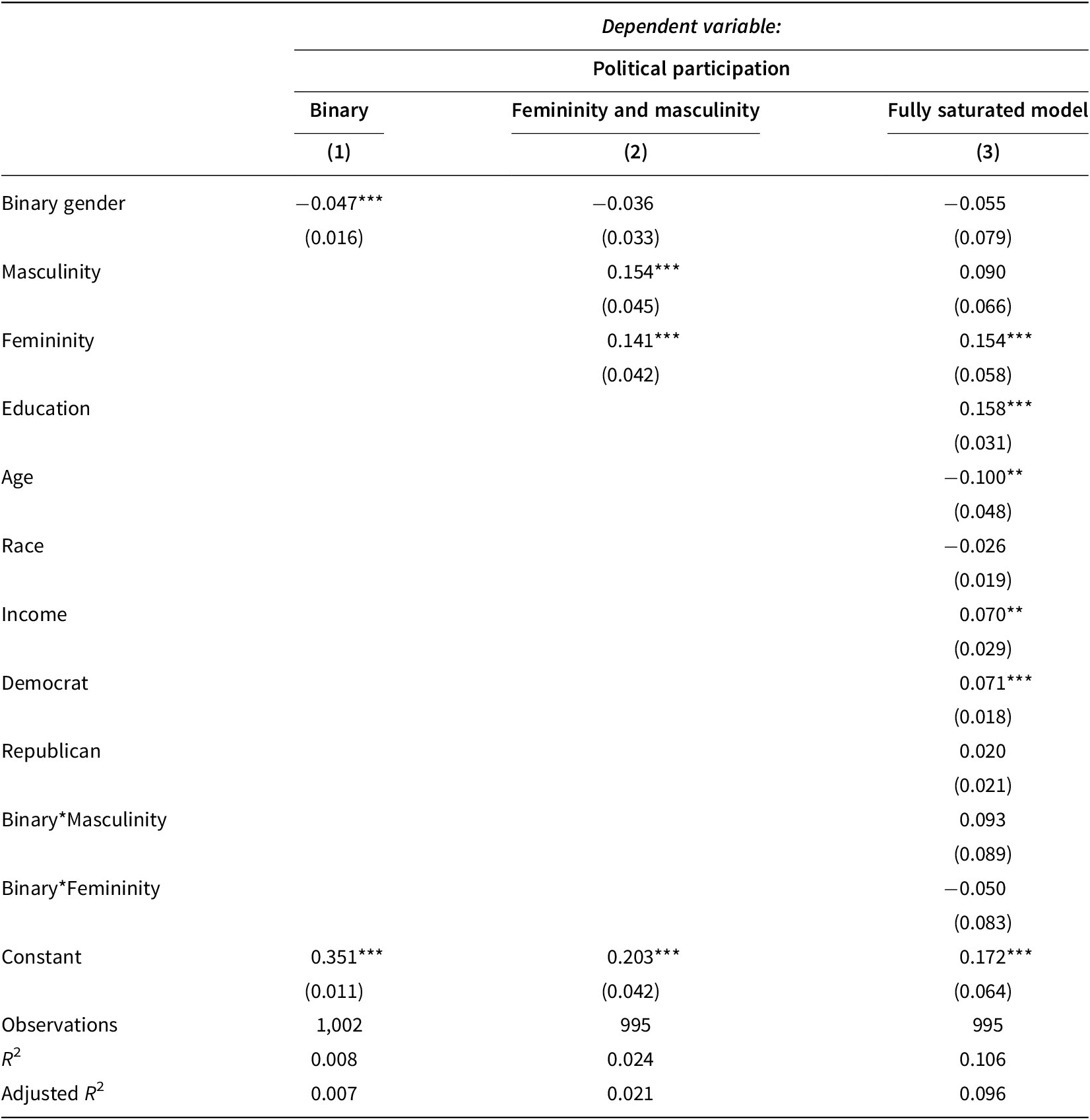
To see if self-perceived masculinity (and femininity) relate to political engagement, we ran OLS regression models and regressed a political participation composite scale on gender and self-reported femininity and masculinity, following the strategy outlined above.Footnote 4 Table 2 contains full regression results. Consistent with prior research (Burns, Schlozman, & Verba, Reference Burns, Schlozman and Verba2009; C. M. Gothreau, Reference Gothreau2021), women report participating in various political acts at a lower rate than men (p0.01) in Model 1. However, in Model 2, the effect of binary gender becomes statistically indistinguishable from zero, while both masculinity and femininity emerge as significant and positive predictors of participation (p0.01). Those who identify as more masculine and those who identify as more feminine report participating in political acts more frequently. This pattern suggests that gender differences in political participation are better explained by variation in individuals’ gendered self-perceptions.
OLS regression results study 1

Table 2. Long description
The table presents O L S regression results for the dependent variable Political participation across three models labeled 1, 2, and 3.
Model 1 (Binary):
- Binary gender: minus 0.047 (standard error 0.016) with p less than 0.01.
- Constant: 0.351 (0.011) with p less than 0.01.
- Observations: 1,002. R: 0.008. Adjusted R: 0.007.
Model 2 (Femininity and masculinity):
- Binary gender: minus 0.036 (0.033).
- Masculinity: 0.154 (0.045) with p less than 0.01.
- Femininity: 0.141 (0.042) with p less than 0.01.
- Constant: 0.203 (0.042) with p less than 0.01.
- Observations: 995. R: 0.024. Adjusted R: 0.021.
Model 3 (Fully saturated model):
- Binary gender: minus 0.055 (0.079).
- Masculinity: 0.090 (0.066).
- Femininity: 0.154 (0.058) with p less than 0.01.
- Education: 0.158 (0.031) with p less than 0.01.
- Age: minus 0.100 (0.048) with p less than 0.05.
- Race: minus 0.026 (0.019).
- Income: 0.070 (0.029) with p less than 0.05.
- Democrat: 0.071 (0.018) with p less than 0.01.
- Republican: 0.020 (0.021).
- Binary asterisk Masculinity: 0.093 (0.089).
- Binary asterisk Femininity: minus 0.050 (0.083).
- Constant: 0.172 (0.064) with p less than 0.01.
- Observations: 995. R: 0.106. Adjusted R: 0.096.
Note: Asterisk p less than 0.1; double asterisk p less than 0.05; triple asterisk p less than 0.01.
Note: *p < 0.1; **p < 0.05; ***p < 0.01
Figure 1 displays predicted political participation by both binary gender identification and across low (10th percentile), medium (50th percentile), and high (90th percentile) values of masculinity and femininity, separately for men and women based on estimates from the fully saturated model. Consistent with the regression results, we see that higher levels of masculine and feminine identification are associated with higher levels of participation for both men and women. Interestingly, predicted values suggest that femininity may be a somewhat stronger predictor of participation among men, whereas masculinity appears to be the slightly stronger predictor for women. Importantly, these differences are not statistically indistinguishable, which is reflected in the non-significant interaction terms. However, this pattern is consistent with the notion that identification with the “non-traditional” continuous gender identity (masculinity for women and femininity for men) is associated with higher levels of political participation. Rather than reinforcing inequality, these “non-traditional” ways of identifying may motivate higher levels of engagement. At minimum, these results suggest that gendered self-identification may help structure political participation and explain variation across participants more effectively than binary gender alone.
Predicted political participation by binary gender and continuous gender identity (Study 1).

Figure 1. Long description
The x-axis represents Predicted Political Participation on a scale from 0.20 to 0.40. The y-axis is divided into three vertical sections: Binary Gender, Men, and Women.
* The top section, Binary Gender, shows a single horizontal line connecting two points: Women at approximately 0.29 and Men at approximately 0.32.
* The middle section, Men, contains two rows. The Masculinity row shows three points: Low at 0.28, Medium at 0.32, and High at 0.37. The Femininity row shows Low at 0.25, Medium at 0.33, and High at 0.41.
* The bottom section, Women, contains two rows. The Masculinity row shows Low at 0.20, Medium at 0.29, and High at 0.38. The Femininity row shows Low at 0.24, Medium at 0.30, and High at 0.35.
A legend on the right indicates that light blue represents Low, medium blue represents Medium, and dark blue represents High levels of continuous gender identity, while light grey represents Men and dark grey represents Women in the binary category.
Study 2: Masculinity and policy attitudes
To further explore the relationship between binary gender, masculinity and femininity self-identification, and political participation and attitudes, we draw from another original dataset. In fall 2020, 1,043 participants completed an online survey in the United States, also through the survey recruitment platform, Forthright (see Friesen, Ksiazkiewicz, & Gothreau, Reference Friesen, Ksiazkiewicz and Gothreau2021 for more details on the design and sample). See Supplementary Table A2 for demographic characteristics of the sample. Again, upon consenting to participate in the study, participants completed demographic questions, including a traditional categorical gender measure and a continuous measure where respondents placed themselves on dimensions of masculinity and femininity. Participants also completed questions about food preferences (for another study), the Big Five Inventory, Wilson-Patterson issue attitudes, and a risk-taking battery. Additionally, respondents answered a series of questions about attitudes on salient political issues and political participation. Public opinion research has documented significant gender differences in public opinion and policy attitudes. For example, women are more likely than men to support gun control measures, access to abortion, and increases in spending on social welfare programs (Gothreau, Arceneaux, & Friesen, Reference Gothreau, Arceneaux and Friesen2022; Lizotte, Reference Lizotte2019, Reference Lizotte2020).
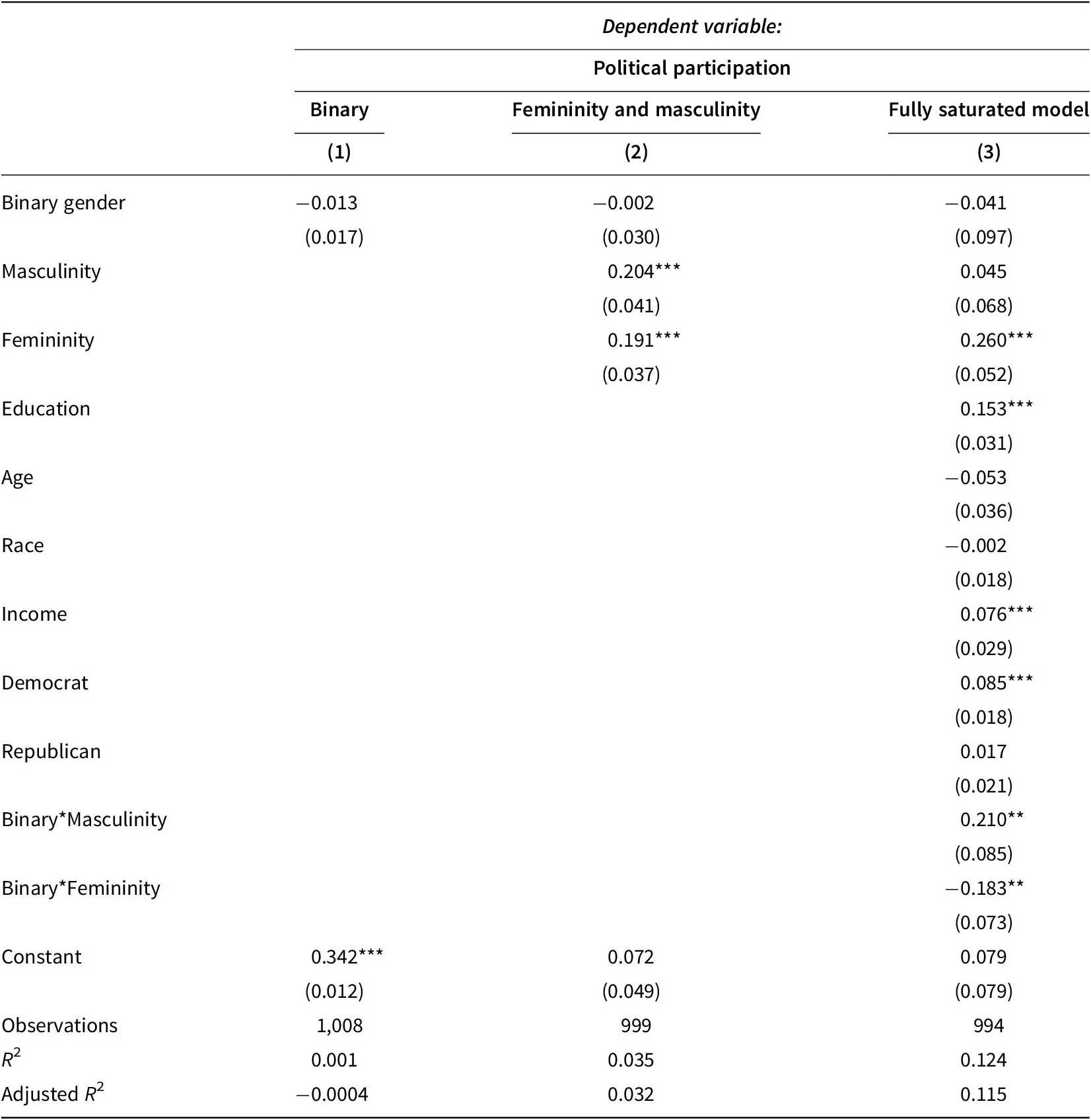
Using the same multi-step process described in Study 1, we ran OLS regression models, regressing a political participation composite scale on gender and self-reported femininity and masculinity to replicate our results in Study 1.Footnote 5 Table 3 details the full regression results. Interestingly, we find no statistically significant correlation between binary gender and political participation in Study 2 (p = 0.44). However, when we incorporate masculinity and femininity into the regression model, replicating the results in Study 1, masculinity and femininity emerge as significant and positive predictors of political participation (p < 0.01). Again, this pattern advances the notion that gender differences in political participation are more effectively explained by variation in gendered self-perceptions.
OLS regression results study 2

Table 3. Long description
The table presents O L S regression results for the dependent variable Political participation across three models. Column 1 is the Binary model, Column 2 is the Femininity and masculinity model, and Column 3 is the Fully saturated model.
* Binary gender: -0.013 (0.017) in model 1; -0.002 (0.030) in model 2; -0.041 (0.097) in model 3.
* Masculinity: 0.204 with p less than 0.01 (0.041) in model 2; 0.045 (0.068) in model 3.
* Femininity: 0.191 with p less than 0.01 (0.037) in model 2; 0.260 with p less than 0.01 (0.052) in model 3.
* Education: 0.153 with p less than 0.01 (0.031) in model 3.
* Age: -0.053 (0.036) in model 3.
* Race: -0.002 (0.018) in model 3.
* Income: 0.076 with p less than 0.01 (0.029) in model 3.
* Democrat: 0.085 with p less than 0.01 (0.018) in model 3.
* Republican: 0.017 (0.021) in model 3.
* Binary times Masculinity: 0.210 with p less than 0.05 (0.085) in model 3.
* Binary times Femininity: -0.183 with p less than 0.05 (0.073) in model 3.
* Constant: 0.342 with p less than 0.01 (0.012) in model 1; 0.072 (0.049) in model 2; 0.079 (0.079) in model 3.
Model statistics:
* Observations: 1,008 (Model 1); 999 (Model 2); 994 (Model 3).
* R-squared: 0.001 (Model 1); 0.035 (Model 2); 0.124 (Model 3).
* Adjusted R-squared: -0.0004 (Model 1); 0.032 (Model 2); 0.115 (Model 3).
Note: *p < 0.1; **p < 0.05; ***p < 0.01
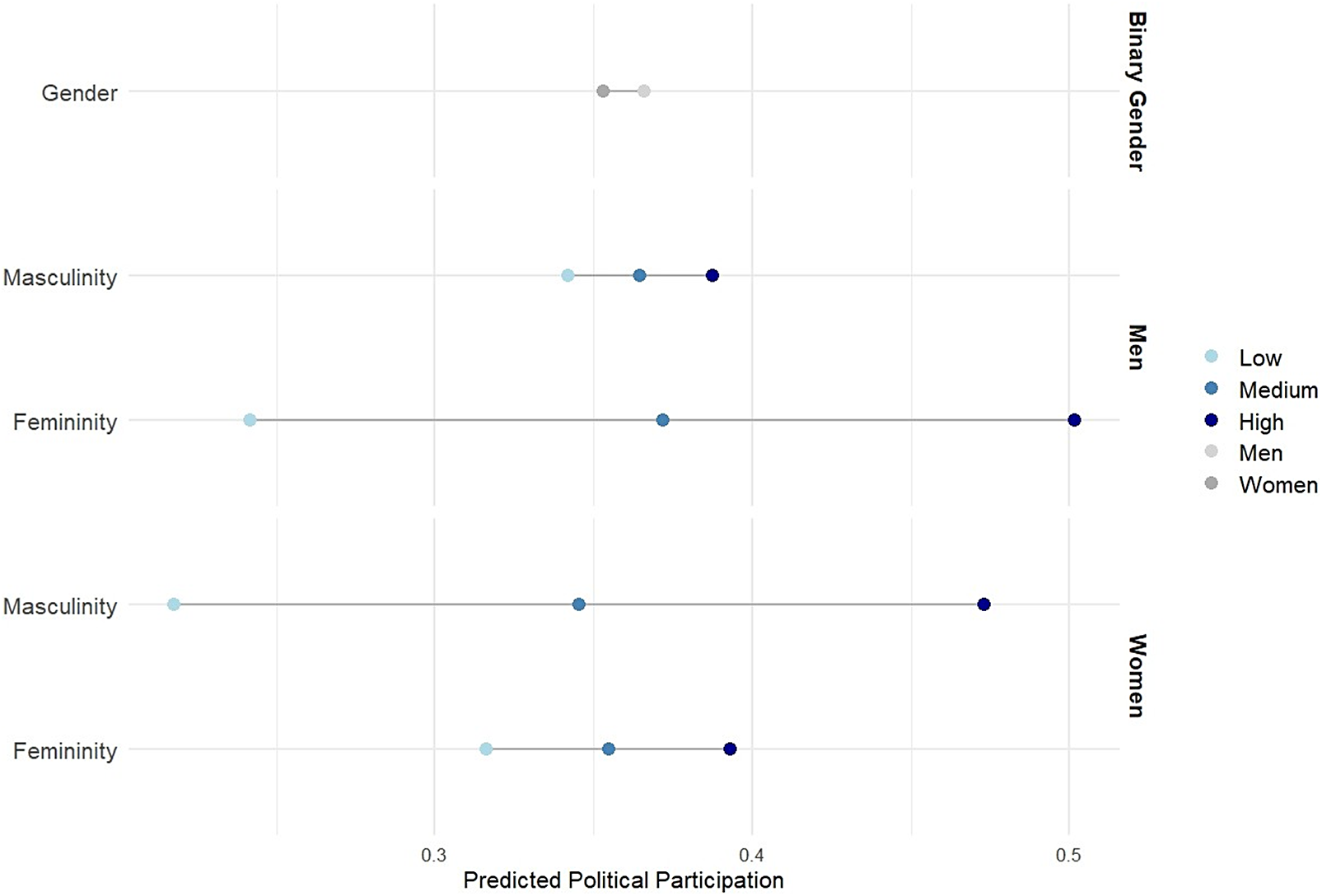
Figure 2 displays predicted political participation by both binary gender identification and across low, medium, and high values of masculinity and femininity. Consistent with the regression results in which we find statistically significant interactions, masculinity is more strongly associated with participation among women than among men, while femininity is more strongly associated with participation among men than among women. These findings give more credence to the prior suggestion that identifying with masculinity and femininity in gender atypical ways is associated with increased political engagement. Men who identify in the 90th percentile of femininity report higher levels of political participation than those in the 10th percentile of femininity. Conversely, women who identify in the 90th percentile of masculinity report higher levels of participation than women in the 10th percentile. By contrast, masculinity among men and femininity among women are comparatively weaker predictors of participation.
Predicted political participation by binary gender and continuous gender identity (Study 2).

Figure 2. Long description
The x-axis represents Predicted Political Participation ranging from 0.3 to 0.5. The y-axis contains categorical labels. A legend on the right identifies dots for Low (light blue), Medium (medium blue), High (dark blue), Men (light gray), and Women (dark gray).
* Top Panel (Binary Gender): A single horizontal line for Gender shows Women (dark gray dot) at approximately 0.35 and Men (light gray dot) at approximately 0.36.
* Middle Panel (Men): Two horizontal lines. The Masculinity line shows Low at 0.34, Medium at 0.36, and High at 0.39. The Femininity line shows a wider spread with Low at 0.24, Medium at 0.37, and High at 0.50.
* Bottom Panel (Women): Two horizontal lines. The Masculinity line shows Low at 0.22, Medium at 0.34, and High at 0.47. The Femininity line shows Low at 0.32, Medium at 0.35, and High at 0.39.
Prior research has also established correlations between gender identity, including masculinity measures, and policy attitudes (Brough et al., Reference Brough, Wilkie, Ma, Isaac and Gal2016; DiMuccio & Knowles, Reference DiMuccio and Knowles2021). We focus on force issues, more specifically support for gun rights and the death penalty. There is a documented gender gap as it relates to issues of force, with men, on average, being more supportive of punitive policies like the death penalty and less supportive of policies like increased gun control (Lizotte, Reference Lizotte2020). We speculate that considering intra-gender variations in masculine and feminine identification may reveal even more insight into how these gendered self-perceptions condition the effect of binary gender on political attitudes.
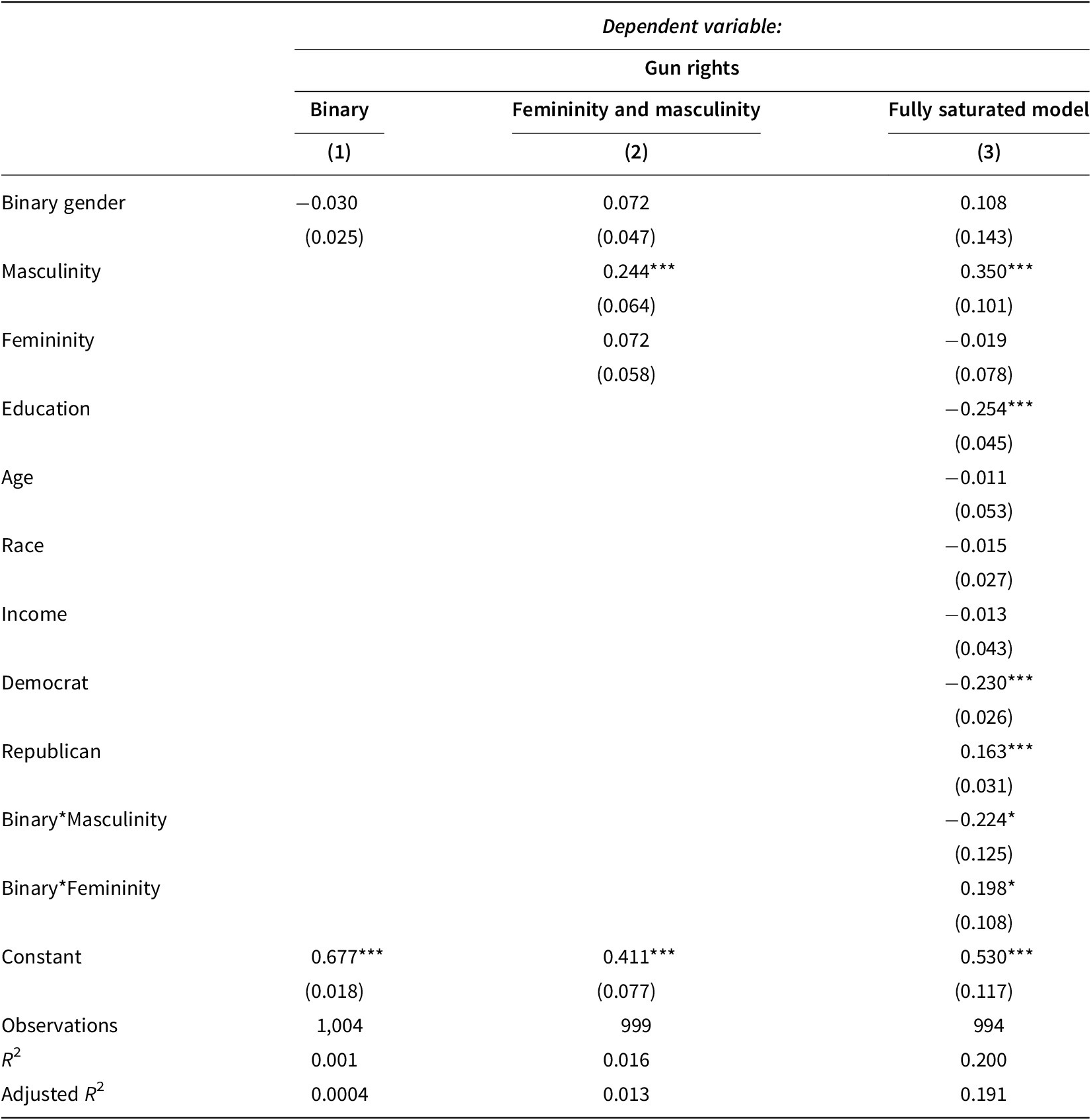
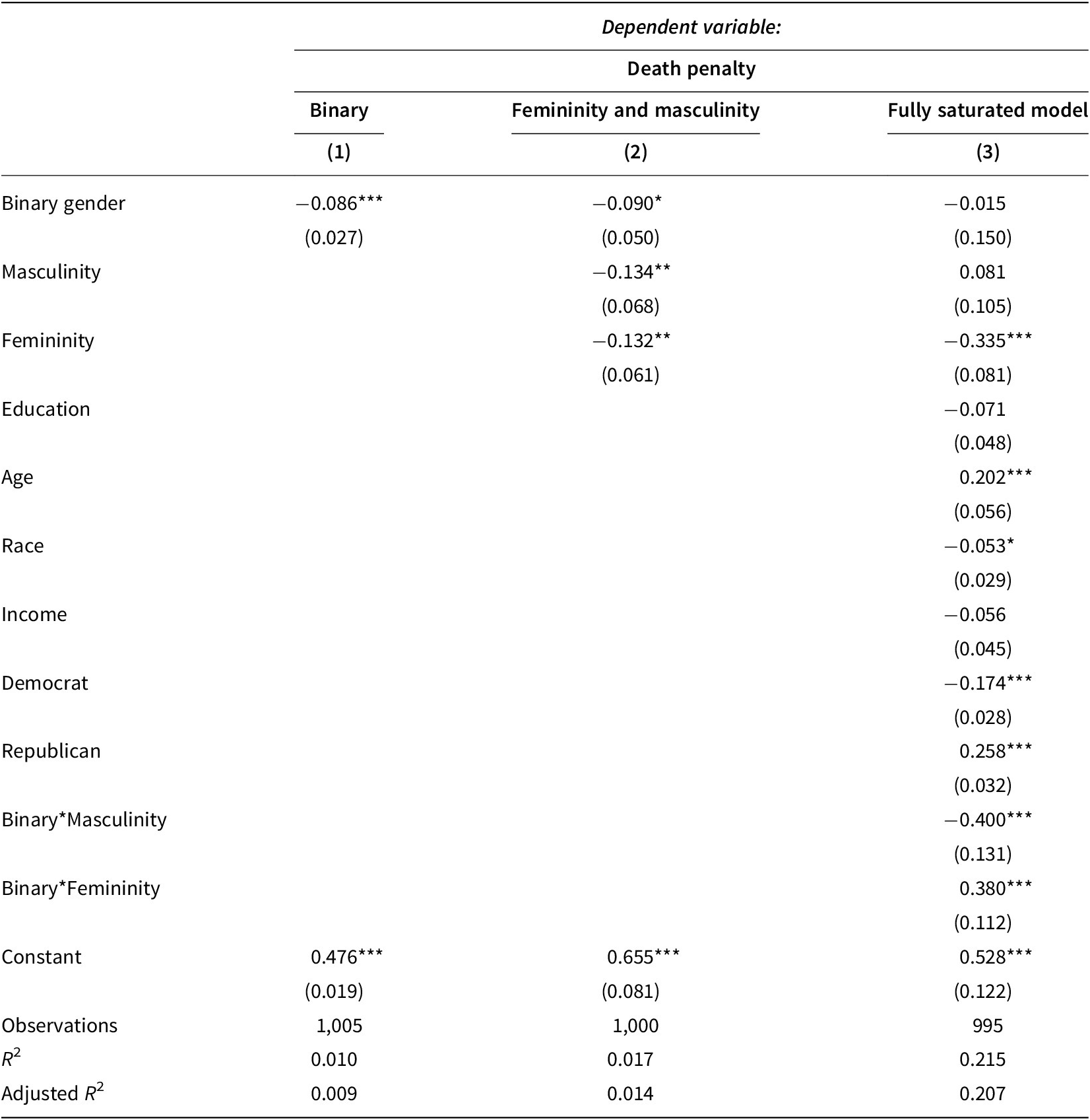
OLS regression results can be found in Tables 4 and 5. In our baseline models, we do not see a gender difference in support for gun rights, though we do see that women, compared to men, are significantly less supportive of the death penalty (p < 0.01). Adding the continuous gender identity measures to both “force issue” models adds explanatory power, though patterns are inconsistent. As it relates to gun rights, masculinity is a positive predictor (p < 0.01), and femininity is non-significant. Regarding death penalty support, both masculinity and femininity are negative predictors (p < 0.1 for masculinity and p < 0.05 for femininity). Looking at the fully saturated models with the interaction terms is more instructive. Masculinity predicts support for gun rights strongly among men and more weakly among women, which can also be seen in the left-hand panel of Figure 4. Conversely, femininity predicts support for gun rights among women but not among men (p < 0.1). The pattern of predicted effects suggests that gendered self-identification may structure attitudes toward gun rights differently across gender groups, aligning with traditional gender roles and other conservative attitudes. Turning to support for the death penalty, we see significant interaction terms in the fully saturated model (p < 0.01). Among men, higher levels of femininity are associated with lower support for the death penalty, while masculinity shows no significant relationship. Among women, however, masculinity is associated with lower support for the death penalty, whereas femininity has little effect. This can be observed in the right-hand panel of Figure 4. Consistent with patterns observed in earlier models, binary gender itself is no longer a significant predictor once continuous gender identity measures are included. Taken together, these results underscore that the political consequences of masculinity and femininity are contingent on both respondents’ binary gender and the policy domain in question. Masculinity does not uniformly increase support for “hard” or conservative policies.
OLS regression results

Table 4. Long description
The table presents regression coefficients and standard errors in parentheses for the dependent variable Gun rights.
* Model 1 (Binary): Binary gender coefficient is -0.030 (0.025). Constant is 0.677 (0.018) with p < 0.01. Observations: 1,004. R-squared: 0.001.
* Model 2 (Femininity and masculinity): Binary gender is 0.072 (0.047). Masculinity is 0.244 (0.064) with p < 0.01. Femininity is 0.072 (0.058). Constant is 0.411 (0.077) with p < 0.01. Observations: 999. R-squared: 0.016.
* Model 3 (Fully saturated model): Binary gender is 0.108 (0.143). Masculinity is 0.350 (0.101) with p < 0.01. Femininity is -0.019 (0.078). Significant controls include Education at -0.254 (0.045) with p < 0.01, Democrat at -0.230 (0.026) with p < 0.01, and Republican at 0.163 (0.031) with p < 0.01. Interaction terms Binary times Masculinity is -0.224 (0.125) with p < 0.1, and Binary times Femininity is 0.198 (0.108) with p < 0.1. Constant is 0.530 (0.117) with p < 0.01. Observations: 994. R-squared: 0.200.
Note: p-values are indicated by asterisks where one asterisk is p < 0.1, two is p < 0.05, and three is p < 0.01.
Note: *p < 0.1; **p < 0.05; ***p < 0.01
OLS regression results

Table 5. Long description
The table presents regression coefficients with standard errors in parentheses for three models.
* Model 1 (Binary): Binary gender coefficient is minus 0.086 (p < 0.01). Constant is 0.476 (p < 0.01). Observations: 1,005. R-squared: 0.010.
* Model 2 (Femininity and masculinity): Binary gender is minus 0.090 (p < 0.1). Masculinity is minus 0.134 (p < 0.05). Femininity is minus 0.132 (p < 0.05). Constant is 0.655 (p < 0.01). Observations: 1,000. R-squared: 0.017.
* Model 3 (Fully saturated model): Binary gender is minus 0.015. Masculinity is 0.081. Femininity is minus 0.335 (p < 0.01). Age is 0.202 (p < 0.01). Race is minus 0.053 (p < 0.1). Democrat is minus 0.174 (p < 0.01). Republican is 0.258 (p < 0.01). Interaction Binary times Masculinity is minus 0.400 (p < 0.01). Interaction Binary times Femininity is 0.380 (p < 0.01). Constant is 0.528 (p < 0.01). Observations: 995. R-squared: 0.215.
Note: *p < 0.1; **p < 0.05; ***p < 0.01.
Note: *p < 0.1; **p < 0.05; ***p < 0.01
The results from Study 2 replicate some of the pattern observed in Study 1. Across different participatory and attitudinal outcomes, the effect of binary gender diminishes once continuous measures of masculinity and femininity are incorporated into the empirical models. Though categorical gender is still important, particularly when interacted with continuous measures, our results suggest that intra-gender variation in gendered self-identification needs to be taken into consideration. At the same time, the effects of masculinity and femininity are not uniform across respondents. Our findings provide evidence that intra-gender variation in masculinity and femininity is an important and undervalued source of heterogeneity in political behavior and attitudes (Figure 3).
Predicted support for gun rights and the death penalty by binary gender and continuous gender identity (Study 2).

Figure 3. Long description
The image consists of two vertical panels.
Left Panel: Support for Gun Rights.
The X-axis ranges from 0.4 to 0.8.
1. Binary Gender: A line connects a light gray dot for Men at 0.6 and a dark gray dot for Women at 0.68.
2. Men: For Masculinity, dots range from Low at 0.42 to High at 0.77. For Femininity, dots are clustered near 0.6, with High Femininity showing slightly lower support.
3. Women: For Masculinity, dots range from Low at 0.62 to High at 0.74. For Femininity, dots range from Low at 0.6 to High at 0.78.
Right Panel: Support for the Death Penalty.
The X-axis ranges from 0.1 to 0.5.
1. Binary Gender: A line connects a dark gray dot for Women at 0.28 and a light gray dot for Men at 0.33.
2. Men: For Masculinity, dots range from Low at 0.29 to High at 0.37. For Femininity, dots show a wide spread from High at 0.16 to Low at 0.49.
3. Women: For Masculinity, dots range from High at 0.14 to Low at 0.45. For Femininity, dots are clustered between 0.26 and 0.31.
A legend at the bottom identifies light blue as Low, medium blue as Medium, dark blue as High, light gray as Men, and dark gray as Women.
Predicted SDO and RWA by binary gender and continuous gender identity (Study 3).

Figure 4. Long description
The image consists of two main columns of dot plots.
Left Column: The X-axis represents Predicted Social Dominance Orientation (S D O) ranging from 0.20 to 0.26.
- Top row: Binary Gender shows Women (dark grey dot) at approximately 0.21 and Men (light grey dot) at 0.22.
- Middle section (Men): Masculinity shows a positive trend with Low (light blue) at 0.24, Medium (medium blue) at 0.22, and High (dark blue) at 0.21. Femininity shows a negative trend with Low at 0.26, Medium at 0.225, and High at 0.19.
- Bottom section (Women): Masculinity shows Low at 0.215, Medium at 0.205, and High at 0.20. Femininity shows Low at 0.225, Medium at 0.21, and High at 0.195.
Right Column: The X-axis represents Predicted Right Wing Authoritarianism (R W A) ranging from 0.24 to 0.36.
- Top row: Binary Gender shows Men (light grey) at 0.28 and Women (dark grey) at 0.29.
- Middle section (Men): Masculinity shows a strong positive trend with Low at 0.22, Medium at 0.29, and High at 0.35. Femininity shows a negative trend with Low at 0.32, Medium at 0.28, and High at 0.24.
- Bottom section (Women): Masculinity shows a positive trend with Low at 0.36, Medium at 0.285, and High at 0.23. Femininity shows a positive trend with Low at 0.275, Medium at 0.295, and High at 0.31.
A legend at the bottom identifies the dots: light blue for Low, medium blue for Medium, dark blue for High, light grey for Men, and dark grey for Women.
Study 3: Masculinity and right-wing authoritarianism and social dominance orientation
Thus far, we have shown that gender identity measures predict various patterns of political participation and political attitudes on force issues. We now zoom out and turn to broader ideological orientations and predispositions that shape attitudes toward hierarchy, social order, and group dynamics. More specifically, we look at Right-Wing Authoritarianism (RWA) (Altemeyer, Reference Altemeyer1981) and Social Dominance Orientation (SDO) (Pratto, Sidanius, Stallworth, & Malle, Reference Pratto, Sidanius, Stallworth and Malle1994). In Study 3, we examine whether self-perceptions of masculinity and femininity are related to these more latent orientations.
We draw from another original dataset of 1,200 participants recruited through the survey recruitment platform Prolific in May 2022 (see Gothreau & Laustsen, Reference Gothreau and Laustsen2025 for more details on design and sample). See Supplementary Table A3 for demographic information on Study 3. Upon consenting to participate in the study, participants completed demographic questions, including a binary gender measure as well as a continuous measure of masculinity and femininity. They also completed a 12-item RWA battery and an eight-item SDO battery. After these items, participants completed a candidate conjoint experiment as part of another study. We generated mean summary scales for both measures that run from 0 to 1 (Cronbach’s α, RWA = .91; Cronbach’s α, SDO = .93).
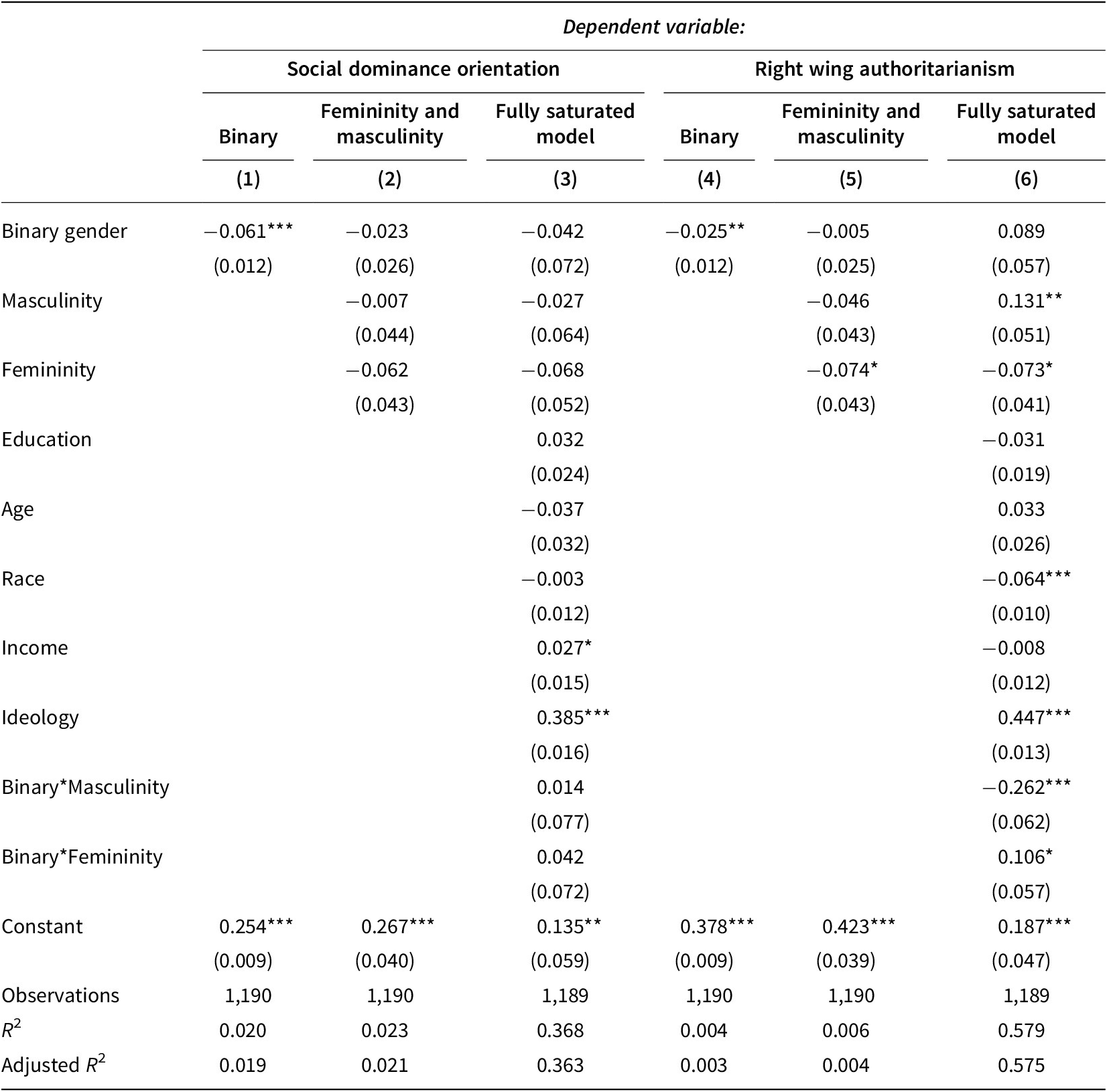
We once again ran a series of regression models to explore whether self-perceived masculinity and femininity relate to ideological orientations. Table 6 contains full regression results. In our baseline models, consistent with prior work (Schmitt & Wirth, Reference Schmitt and Wirth2009; Sibley, Wilson, & Duckitt, Reference Sibley, Wilson and Duckitt2007; Wilson & Liu, Reference Wilson and Liu2003), women, on average, report lower levels of SDO and RWA (p < 0.01). Adding the continuous measures, we see that both masculinity and femininity are not significant predictors of SDO. Femininity is a negative and significant (p < 0.1) predictor of RWA, while masculinity is non-significant. The non-significant interaction terms in the fully saturated model suggest that masculinity and femininity do not operate differently for men versus women in predicting SDO. However, we do see a significant interaction between binary gender and masculinity (p < 0.01) when it comes to RWA that indicates that increased masculinity aligns with more authoritarian attitudes among men, but works in the opposite direction among women. This shows masculinity is not a stable ideological predictor—it operates relationally with gender category expectations. Furthermore, there is a significant interaction between binary gender and femininity (p < 0.1) that indicates that for men, an increase in feminine identity is associated with a reduction in authoritarian attitudes, whereas for women, once both the continuous term and the interaction term are taken into consideration, there is little consistent effect. This interaction is only marginally significant; therefore, we interpret this result with caution.
OLS regression results

Table 6. Long description
A regression table with six columns labeled 1 through 6. Columns 1 to 3 use Social dominance orientation as the dependent variable, while columns 4 to 6 use Right wing authoritarianism. The models progress from Binary to Femininity and masculinity to a Fully saturated model for each variable.
Key findings include:
* Binary gender: Significant negative coefficients in model 1 (-0.061, p < 0.01) and model 4 (-0.025, p < 0.05).
* Masculinity: Significant positive coefficient in model 6 (0.131, p < 0.05).
* Femininity: Significant negative coefficients in model 5 (-0.074, p < 0.1) and model 6 (-0.073, p < 0.1).
* Ideology: Highly significant positive coefficients in model 3 (0.385, p < 0.01) and model 6 (0.447, p < 0.01).
* Interaction terms: Binary asterisk Masculinity is significant in model 6 (-0.262, p < 0.01), and Binary asterisk Femininity is significant in model 6 (0.106, p < 0.1).
* Model Statistics: Observations are approximately 1,190 per model. Adjusted R-squared values are highest for the fully saturated models, reaching 0.363 for Social dominance orientation and 0.575 for Right wing authoritarianism.
Note: p < 0.1; **p < 0.05; ***p < 0.01
These results suggest that masculinity is not just linked to issue attitudes but may contribute to broader ideological orientations that structure how individuals think about authority and conventionalism, extending the earlier findings from Studies 1 and 2. Whereas atypical gender identification was associated with higher participation, traditional or more “gender-congruent” gender identification appears more closely aligned with authoritarian worldviews. Whereas atypical gender identification was associated with higher levels of political participation in our earlier studies, here we find that more gender-congruent reports of identification—particularly higher masculinity and lower femininity among men—are associated with stronger authoritarian ideological orientations. Importantly, rather than uniformly increasing authoritarianism, masculinity operates differently depending on how it aligns with expectations tied to respondents’ binary gender category. Masculinity predicts high levels of right-wing authoritarianism among women but lower levels among women. Once again, these results are not causal, and therefore it is difficult to establish the ordering of gender identity and broader ideological orientations, but these findings suggest that there is a strong relationship between gendered self-concepts and ideology, particularly attitudes about authority, obedience, adherence to traditional norms and values, and order.
Summary of results
Taken together, the results across the three studies suggest that continuous gender identity measures capture meaningful variation in political behavior and attitudes above and beyond binary gender alone. However, these effects operate differently across different outcomes and domains. In Studies 1 and 2, we find that identifying in gender-atypical ways is associated with higher levels of political participation. Although our results are only correlational, this may suggest that individuals who have gendered self-concepts that depart from the traditional paradigm that men are masculine, and women are feminine, may be particularly politically engaged. This could conceivably be because they see gender identity as more salient or contested for them, or having a more liberal worldview could allow them to feel more comfortable identifying atypically. Conversely, the policy attitudes explored in Study 2 demonstrate more domain-specific patterns. Masculinity among men is associated with greater support for gun rights, while lower femininity among men predicts higher support for the death penalty; among women, masculinity, rather than femininity, is associated with lower support for the death penalty, and continuous gender identity plays a more limited role in structuring attitudes toward gun rights. Study 3 reveals that gendered self-identification is also related to broader ideological orientations and that more “traditionally” gender-typed identities are associated with higher levels of authoritarianism for men, whereas masculinity functions in the opposite direction for women. This suggests that the meaning of masculinity is contingent on how it aligns with expectations around individuals’ binary gender. Collectively, these findings, although not causal in nature, establish that continuous measures of masculinity and femininity can reveal patterns of intra-gender variation that are meaningful and politically relevant. Future research should unpack how well self-placement on masculine/feminine scales lines up with traditional gender role measures like the BSRI, whether these one-dimensional items can be used in lieu of longer batteries, or if we miss important nuance in what part of self-identification is driving political behaviors.
Call for research
We have provided evidence for the importance of gender identity, within binary gender or sex, for understanding political attitudes and behavior. Masculine and feminine gender measures operate in unique patterns across participation in politics, different kinds of policy issues, and broader orientations like SDO and RWA. The positive relationship between atypical gender identity, masculine women and feminine men, and higher levels of political participation is particularly intriguing. It is possible that more political people have knowledge about more inclusive and wide-ranging conceptions of gender, thus leading them to feel comfortable reporting a feminine or masculine identity “against type.” It is also possible that when people embrace different gender identities than their binary sex or gender, they feel their gender identity and expression may be under attack, threat, or just generally, inherently political. For the purposes of our current argument, we urge scholars to unpack more of what it means for men to feel comfortable scoring higher on femininity scales and how best to uncover true conceptions not subject to social desirability bias.
Regarding force-based policy attitudes, again, within-gender variation in masculinity is an important predictor, beyond the traditional binary gender gaps in these attitudes. How closely are masculinity conceptions tied to support for gun rights and the death penalty? Could messages about preservation of masculinity while advocating for gun control or against the death penalty, shift these attitudes among men for whom masculinity is important? Or do we risk a backlash where appeals to masculinity in support of gendered policies result in further benevolent sexism (Hunt & Friesen, Reference Hunt and Friesen2021)?
Finally, the variation between masculine/feminine identity within binary gender and SDO and RWA call for more research into which identities and preferences are strongest, most salient, and likely to develop first. In other words, how do people arrive at strongly or weakly masculine self-concepts? Do they adopt these orientations because of their subscription to social hierarchy and authoritarian views? Or, from an evolutionary psychology perspective, do their sex roles emerge first, and this strong sense of “being a man” leads to this other basket of ideas? Longitudinal studies and genetically informed samples could help uncover some of these relationships.
Age and generational cohorts are a key interaction for these questions-particularly with the recent conversations about larger gender gaps emerging or persisting for younger generations. Though when it comes to partisan voting in the U.S., the Gen Z gender gap in voting for Biden/Harris versus Trump decreased from the 2020 to 2024 election (see Cassese and Long (Reference Cassese, Long, Fox, Dittmar and Carrolln.d.) for a broader discussion about the nuances of the Gen Z gender gaps, both due to how age groups are divided and whether Gen Z women are the ones moving further left than older women).
For our current call for research, we see the future of this work further examining self-identification, particularly as it relates to societal gender norms. We find the work of Stanaland et al. (Reference Stanaland, Gaither and Gassman-Pines2023) particularly compelling, in their approach to understanding aspirational masculinity. They set up this framework in an “actual” self (how masculine am I?) compared to an “ought” self (how masculine should I be?) and an “ideal” self (how masculine do I want to be?). These levels vary among men. What matters less here is not one’s actual level of masculinity (as we test in our studies above) but the discrepancy between the ought or the ideal and one’s actual self. That is, a man with “medium” actual self-reported masculinity who believes that a “medium” level is ideal may display different characteristics and behaviors than a man who is “medium” in actual masculinity who thinks he needs to be (ought) and wishes to be (ideal) more masculine. In the face of threats to this masculinity, those with higher discrepancies may exhibit aggressive behaviors toward others or internalize feelings of shame or anxiety (Stanaland et al., Reference Stanaland, Gaither and Gassman-Pines2023). So again, it is not binary gender itself or gender identity that may drive sexism or outgroup attitudes, but instead, the compensation around men feeling their actual selves are far from obligatory or aspirational masculinity. We believe this framework can contribute to the body of work already explaining various gender gaps in policy positions or even the role of hostile and benevolent sexism (Gothreau et al., Reference Gothreau, Arceneaux and Friesen2022). For example, does sexism have the same predictive power across levels of masculinity discrepancy? What comes first? Does fragile masculinity lead to sexism, does sexism or misogyny precede masculine identity and perceptions, do they co-develop? What are the implications for political participation and issue preferences? If society embraced broader thinking around “ought” or “ideal” masculinity, would men in lower levels of “actual” masculinity be relieved from the discrepancy challenges? In fact, if masculinity were given a range of meanings within society, this could even shift self-evaluations of “actual” levels, if there were no longer a narrow archetype.
Understanding masculine identity expectancy-discrepancy-threat is a practical measurement tool that can easily be incorporated into survey research and experimental designs. Researchers can capture trait-based self-conceptions and preferences and examine these correlations with political participation, issue attitudes, and broad orientations like SDO and RWA. But actual, ought, and ideal masculine levels can also be incorporated into experimental designs, perhaps in the way policies are framed by the media or elite messaging around parties, candidates, and issues. Furthermore, just as the appearance of political candidates can influence their electoral success and perceived competence, how we understand the influence of gender expression might be explained by a perceiver’s personal masculinity expectancy-discrepancy-threat. In sum, we see the exploration of masculinity foundations as an important and fruitful direction for research into gender and politics.
Supplementary material
The supplementary material for this article can be found at http://doi.org/10.1017/pls.2026.10025.
Acknowledgments
We gratefully acknowledge funding support from [Blinded]. OpenAI’s ChatGPT (GPT-5.3) was used in a limited supporting role during the preparation of this work for spelling and grammar checks, minor stylistic editing, and assistance with code-related tasks. The tool was not used to generate original arguments or conclusions. Responsibility for all content, interpretations, and final revisions rests entirely with the author.
Financial support
We gratefully acknowledge funding support from the Centre for the Experimental-Philosophical Study of Discrimination at Aarhus University and from the Danish National Research Foundation (DNRF144).






 Open access

