In the opening essay of his massive work on insects, the French naturalist René-Antoine Ferchault de Réaumur (1683–1757) acknowledged his colleagues and collaborators, the people who had provided him with insects, observations and other sorts of assistance. He singled out for appreciation Count Pajot d'Onsenbray, a collector of natural-history specimens and scientific instruments and an honorary member of the Academy of Sciences who also happened to be director of the French postal system. In this position, he had the power to ‘facilitate the exchange necessary for extending and perfecting knowledge’ in the Republic of Letters. For natural history, the benevolence of the Postmaster General was no small thing, since Réaumur received by post not only letters, but packages of living insects and preserved specimens. Normally, the recipient would pay shipping costs, but d'Onsenbray's ‘love for the progress of the sciences’ caused the boxes to be delivered expeditiously and free of charge. Not that Réaumur could not have afforded the shipping costs, but he knew that his many correspondents might well have refrained from sending boxes of material if they thought he would have to pay for them. He described his arrangement with d'Onsenbray not only to thank him, and all those who had availed themselves of the postal service, but also to inform his readers – even those he did not know personally – that they too could send insects to Paris without fearing delays or unseemly expense:
Anyone interested in the progress of natural history, and who judges me capable of contributing to it, may make me presents which I will receive with an appreciation I will be happy to express publicly, if they will be so kind as to send me insects that seem to them unusual, and that they wish me to study. They have only to enclose them in little boxes with the necessary food for the journey, and to address them to Count d'Onsenbray, Postmaster General of the French Post; inside the first envelope, they should put a second with my address: they may be sure that the package will be faithfully and promptly delivered.Footnote 1
These quite explicit instructions show how the author intended his book to function as soon as it was printed. Readers could be confident that Réaumur would take their contributions seriously, if they chose to enter into this compact by sending him insects from their own localities, knowing that they might see themselves thanked in subsequent volumes. The decision to release the work one volume at a time (over eight years) thus had to do not only with the printing and engraving delays inevitable in a work of this scale, but also with how the author imagined the books being read and used. In practice, shipping insects and other specimens did not always go as smoothly as the encomium to d'Onsenbray implied. Many times the Postmaster was not prompt with the deliveries, or they went astray somewhere in the provinces, or they might be held by over-zealous customs officials. Other times, correspondents did not package their offerings carefully enough, and Réaumur opened the boxes only to find a jumble of dead or dismembered insects and broken bottles. Shipping live insects was a tricky business, but as Réaumur assured his readers, it was feasible.Footnote 2 His voluminous correspondence, from which he drew many observations for his published work, attests to the wide range of his informants and collaborators, and to the variety of items, living and dead, that arrived in Paris for his inspection. Sometimes these went into his renowned collection of naturalia; sometimes they went into his ‘insect zoo’, where he and his assistants watched their transformations and performed experiments on them.Footnote 3
Réaumur's appeal to his readers, like his efforts to enlist the curiosity and attention of his friends and associates all over the world, acknowledged the impracticality of pursuing the study of insects by oneself. The production of this kind of knowledge relied on material and intellectual input from different places and different kinds of people. Engaging readers, correspondents, travellers and all those interested in turning their attention to their surroundings could only benefit the rapidly expanding science of natural history. Although he did not aspire to the impossible goal of completeness for his ‘insectology’, Réaumur cast his net as widely as possible, always on the lookout for the ‘curious’ and ‘singular’, as well as the useful or noxious. To a first approximation, Réaumur's operation may sound like a Latourian centre of calculation, with material arriving from distant fields and forests to be analysed and codified into authoritative knowledge. Indeed, Réaumur occupied a powerful position in the capital, with a seat in the Academy of Sciences, where he dispensed patronage and collected contributions from his many official and unofficial correspondents. On closer inspection, however, the relations among observers in different locations do not fit the central-force model (action at a distance) as well as we might expect. Réaumur harboured no illusions about his ability to tell his correspondents what to do or to determine how the dynamic of exchange and circulation played out. Unlike the mechanisms of long-distance control cultivated by the Portuguese in the sixteenth century to manage their empire, the practices of natural history originated in many locations for many purposes.Footnote 4 The circulation of knowledge, objects (especially books and specimens), instruments and people was open-ended and relatively unorganized, and moved in all directions. And there were many local centres, besides the obvious node of scientific activity in the French capital. The shipping of insects – the materials necessary for observations and experiments – described by Réaumur in his book was only one of many modes of circulation and exchange essential to making and doing natural history.
Observing insects entailed many layers of practice, involving all sorts of apparatus, techniques, skills and locally specific resources. Naturalists, and their various assistants, collaborators and correspondents, dealt in specimens, but to an even greater degree in observations, which they made and exchanged continually. Watching systematically and devising experimental interventions led eventually to completed observations of varying degrees of generality. They could be simple statements such as ‘cicadas hatch in summer’ or ‘chrysalises breathe’; they could be complex accounts of the mating behaviour of particular species or the anatomical mechanisms for producing cocoons or trapping prey; they could be detailed narratives of experiments or series of observations; or they could be detailed descriptions of minute parts of insect anatomy. Naturalists synthesized myriad details of behaviour, anatomy and function into such observations that could then be exchanged, donated, questioned, replicated – in short, the observations became things that circulate. Of course, the circulation of this kind of knowledge depended on the exchange and transfer of many other things as well: instruments, containers, preparations, drawings, specimens (live and dead), books and letters, and sometimes the observers themselves. Natural history also circulated in the material form of books, where text and image might inspire people in scattered locations to become naturalists in their own fashion. They might start collections, or simply notice things in their surroundings for the first time, or even try experiments and sustained observations. This essay explores the circulatory dynamic of natural history through two cases taken from Réaumur's extensive correspondence. These examples show how new knowledge relied on the movement of objects and observations, and how locale played into the process of knowledge production.
My first case comes from the letters exchanged by Réaumur and the Provençal nobleman Joseph de Seytres, marquis de Caumont. Though not strictly equals in aristocratic rank, Réaumur and Caumont interacted as social equals; they knew each other personally, and cultivated a warm friendship over a period of many years, although they rarely met in person. Réaumur spent most of the year in Paris, attending biweekly meetings of the Academy of Sciences, building up his collections, and running various experimental programmes in town and at his country house at Charenton. He travelled during the two-month autumn vacation to his estate in Poitou, near La Rochelle. Caumont, although he had travelled to Paris in his youth, and maintained many connections there, lived his adult life as seigneur and paterfamilias on his various properties in and near Avignon, with occasional trips to Aix to attend to legal matters. In addition to overseeing his estates, Caumont prided himself on his collection of antiquities and his erudition about Roman inscriptions and monuments. On these matters especially, his learned correspondence linked him to savants across Europe. Like many provincial intellectuals, he cultivated an interest in local flora and fauna as well as in monuments and antiquities – both kinds of knowledge grew out of his immediate locality. Caumont was in fact studying the habits of local cicadas in Avignon before Réaumur embarked on his own investigations, and he volunteered to collect anything that might be of interest in Paris.Footnote 5 Their correspondence provided Réaumur with local knowledge from Provence, and inspired Caumont to devote considerable attention to the insects and birds on his lands.
The letters document a two-way traffic of insects, instruments, ideas, sentiments, observations and books. All these were the elements of new knowledge about the natural world, though an analogous pattern of circulation could easily be mapped for knowledge about antiquities. Caumont asked for advice about optical instruments; Réaumur sent him magnifying lenses, and advised against fancy microscopes. He also sent tips for how to gather, preserve and transport insects, and he sent books – his own and others. He hosted Caumont's sons when they came to Paris, and acted as a go-between when Caumont had business with the Academy of Sciences or the Academy of Inscriptions. In the other direction, Caumont sent specimens dead and alive, including insects of many kinds, worms, tree branches with nests of eggs, bird's nests and so on. Once a year, he shipped a generous supply of the olive oil produced on his estate, for the table of his friend in the capital.
Caumont had considerable local resources at his disposal, with property in town and in the countryside, and social and intellectual connections throughout Provence. The better to fulfil Réaumur's requests for insects, Caumont asked for help from a local acquaintance, one M Alphons, who did much of the legwork necessary to find specimens of cicadas and beetles. He in turn enlisted the help of peasants with their own even more local knowledge. Alphons was a retired military man, advanced in years, who passed his days doing good works in Cavaillon, a small town not far from Caumont's country estate. Caumont described him as ‘an instinctive natural philosopher’ – ‘phisicien par instinct’ – to indicate that he had the aptitude and inclinations Réaumur needed, without overly specialized learning.Footnote 6 Alphons was key to Caumont's participation in Réaumur's project, because he had the leisure and inclination for sustained observations. Living in a small town, he had easy access to the forests where insects like truffle flies and cicadas lived. Réaumur appreciated his efforts and gratefully acknowledged him by name in his book. ‘You have made a very nice discovery in him’, he wrote to Caumont, ‘and I look forward to great things from him’.Footnote 7
A detailed look at the investigation of the cicada's life cycle provides a nice vignette of the movement of objects and ideas between these different localities, Provence and Paris. Réaumur suspected that what he knew about cicadas from Aristotle and Pliny was inaccurate, or, at the very least, incomplete. But as these creatures were not native to either Paris or Poitou, he depended on specimens and observations sent from other regions. The cicadas in question deposit their eggs under the bark of dry tree branches; these hatch into larvae (or ‘worms’) that fall to the ground, transform into nymphs that bury themselves in the earth to feed on roots, and eventually emerge as cicadas. (This cycle was not at all clear at the beginning of the investigation, which extended over several seasons.)
Caumont turned to Alphons, who entered into the project willingly, asking peasants clearing dead trees to look for cicada nymphs in the ground. In due course, he reported back to his patron in Avignon, as the investigation developed. Since Caumont passed on Alphons's letters directly to Réaumur, we have an unusually detailed first-person account of the operation in the Provençal countryside:
A peasant who dug up six trees found some [nymphs] under the roots of a mulberry tree and brought me six of them in a basket which he filled with soil. I didn't dare take them out for fear they would die, and I could not put them in spirits of wine [esprit de vin] because I couldn't find any of it around here.Footnote 8
Alphons sent the basket with soil and insects to Avignon; Caumont put them in alcohol and sent them to Réaumur in Paris, along with Alphons's detailed letter, and sent back to his ‘phisicien campagnard’ the empty basket, a bottle of the right kind of esprit de vin to preserve his next harvest, and the empty specimen bottles.
Réaumur responded enthusiastically to the gift, and told Caumont exactly what he wanted Alphons to look for the next year. He appreciated the nymphs, but hoped for smaller worms as well, and in addition he wanted adult specimens of all three species of cicada, male and female. He thought it might be possible to send living insects ‘if your physicien puts whatever he finds into a little box with soil, and some little pieces of tree roots’. Realizing that Alphons was a resource not to be wasted – being interested, persistent and obliging – Réaumur gave detailed instructions for equipping him with the tools for collecting more extensively. He continued to use Caumont as the go-between in his dealings with Alphons; as far as I can tell, Réaumur and the provincial pensioner had no unmediated exchanges:
With a little care, there will be few species that he will not be able to show me. Here is the means: furnish him, sir, if you please, with what I call a ‘graveyard’, that is to say a large bottle filled with spirits of wine diluted by about a quarter with normal water. Have as much sugar thrown into the liquid as can be dissolved in it … Your naturalist, equipped with this graveyard, has only to toss into it 4 or 5 insects of all the species he finds, caterpillars, beetles, flies. It will accommodate anything but butterflies. And you can then send me in little bottles whatever you remove from the big graveyard.Footnote 9
Here we see quite graphically the layers of the process of obtaining specimens in Paris. Réaumur trusted the local informant (working with others, like the peasants engaged in the hard labour of uprooting trees) to find interesting insects, but not to identify them or even to send them on directly. Caumont would have had servants to actually mix up the preserving solution (as Réaumur recognized in the way he formulated his instructions), but he was actively involved as well, supplying the insect graveyard and removing the individual specimens from it for shipment. Caumont was thus doing more than giving orders or passing on instructions, although in this case he was not the one going out to look under tree bark for cicada eggs.
In the second year of the investigation, Alphons made some careful observations of how cicadas produce sounds, how they mate and how they lay their eggs. Unlike the workmen, he was not simply the means of obtaining the specimens, but was himself inspecting and manipulating the insects in order to draw conclusions about them:
Common opinion was that it is the female who sings and the prejudice about this is so strong that one cannot correct country people about it. Since I had some doubt about this, I wanted to clear it up for myself … You can well understand that by inspection of the animal and by the observations of its parts, we can determine this better than by stories or by what people know without having examined it.Footnote 10
Alphons, however inexpert, articulated the same empirical ideal espoused by Réaumur himself, and the same enlightened scepticism about folk superstition. Careful examination confirmed for Alphons that the male cicada indeed had the organs for chirping. He wrote up detailed observations to go with his specimens and sent them to Caumont, who had everything (including the narrative descriptions) packaged for shipment for Paris. Meanwhile, Alphons availed himself of Caumont's men: ‘I will instruct some of your workers to bring me some [nymphs] if they find any in digging up the ground’.Footnote 11 He passed along some shed skins he had found, and some adult cicadas that he had preserved by drying in the sun.
Always eager for more, Réaumur hoped to receive newly laid eggs in Paris the next year, so he could watch them hatch out:
I hope you will engage M Alphons to enable me to satisfy this desire next year, if he will be so kind as to try to surprise a cicada laying its eggs, and send me the eggs completely fresh. That way they will be able to arrive here before the worms have hatched.Footnote 12
By this time, Réaumur was making very specific requests, and even instructing his distant observer about how to gather the material he desperately wanted to observe for himself. To settle the question of what time of year the worms hatch, he asked Caumont to get Alphons to do an ‘experiment’, or even to do it himself. Alphons had written the previous year that the worms emerge in early summer from the twigs where the eggs had been laid; this contradicted another writer, reporting on cicadas in Italy. To settle the matter, ‘there are two methods which I beg you to try or to have [Alphons] try’. The idea was to find branches with eggs under the bark and wrap a few of the twigs in a sack or case of linen:
[The experimenter] will then tie this little sack by its ends against the branch. If the worms [vers] come out of the branch, they will fall into the sack. By visiting the sack from time to time, one will then know approximately when the worms were hatched. Another way to learn the same thing is to uncover from week to week, or more frequently, a nest of eggs, by removing the portion of wood covering them. It will be easy to see when the worms have come out of the eggs and into their nest.Footnote 13
Alphons obediently tried the experiment with the linen pouches, but could not find anything in them. Eventually, he unwrapped the branches and located the nests in the bark, where he saw eggs and some worms already hatched; he also found empty skins shed by the nymphs, before they entered the ground. Some of the men working with him even saw a few actual nymphs, ‘which was a stroke of luck because as soon as the nymphs emerge from the worms and leave the skin behind, they go underground’. Unfortunately, they neglected to collect any of them. ‘I am sending you in the little broken bottle some cicada eggs, some cicada worms and some skins of these worms from which the nymphs emerged. I would have liked to include the nymphs [but they were lost]’.Footnote 14 In the detailed memoir he sent along with this material, Alphons outlined the complex sequence of the cicada life cycle as he had observed it from the emergence of the adults in summer, through the egg-laying, the hatching of the worms the following June, their transformation into nymphs, and their retreat into the ground where they would take on the adult form. Alphons even instructed Caumont to examine the tiny worms with a microscope: ‘You can use a microscope to look at the ones I am sending you. You will discern the eggs of the worms and their skins’. With his microscope, Alphons could see the worms moving, though he was not sure they would still be alive when they arrived in Avignon. ‘It is therefore certain’, he concluded, ‘that they hatch in summer since we see some of them emerging from the eggs’.Footnote 15 We do not learn anything more about Alphons's microscope, which he does not treat as a novelty; nor is there any indication that he received it from Réaumur. It clearly distinguishes him further from the workers and brings him closer in the observational hierarchy to his aristocratic correspondent.
Caumont and Alphons operated as proxies for Réaumur, who could not travel to all locations himself: ‘Now I am definitely, thanks to your good offices, as far along with the history of cicadas as I would be if they were native to this region, and if it were easy for me to observe them here’.Footnote 16 At least in this case, his distant correspondent (with his dependents) made Réaumur's work possible. But we could say just as well that he, and his long-term investigation of insects, made their work possible. Without the promise of a receptive audience for his observations of cicadas, or the prompting to pursue them from one season to the next, Alphons would not have seen the motions that produced the cicada's song, or the worms hatching from the eggs. He would probably not have been out in the forest at all in those years, since he complained of various health problems that threatened to interfere with his fulfilling Caumont's requests. The various Provençal observers were certainly serving the interests of the elite naturalist in the capital, but (excepting the labourers, who were more focused on planting and harvesting than on the behaviour of cicadas) they were also reaping their own rewards in the form of locally grounded, and possibly significant, knowledge. When it came to the grasshoppers that periodically decimated local crops, the motivation for understanding their life cycles took on a new urgency. But even when there was no question of economic consequences, the observers on location were satisfying their own curiosity, as well as that of Réaumur.Footnote 17
Living cicadas could only be observed in the south, far from Paris; with luck, they could be collected and sent to the capital, but unlike many other species, even if the eggs or worms survived the journey, Réaumur could not contrive to see the transformation in captivity. ‘None of them hatched’, he reported, ‘even though I extended my care for them so far as to keep them in my vest pocket in a glass tube’.Footnote 18 Knowledge of the timing of their transformations, and their habitat and habits, depended on local workers and local observers – from the workmen and peasants, to Alphons the diligent amateur, to Caumont the proprietor of the land where the cicadas lived. From Avignon, the spoils of these efforts (whether insects or text) travelled by post or by coach to Paris, where Réaumur did his own experiments on the preserved specimens and attempted unsuccessfully to raise his own nymphs. In particular, he pursued the question of the cicada's song, dissecting the insect to discover the mechanism Alphons had investigated more superficially. In print, Réaumur transformed his own investigations on the materials sent from Avignon into instructions for curious readers who might want to discover similar things for themselves, much as he had instructed Alphons to peel back the bark to reveal the nests of eggs. He turned the necessity of working with preserved specimens into a virtue, when he described a dissection and his manipulation of the dead cicada's parts to produce a sound. Once he identified the muscles that would have moved these parts in the living insect he had found something
that it would not have been possible to discover however much attention one gave to a living cicada, even if it was cooperative enough to sing in the hand of the observer … While I was examining one of these muscles, and meanwhile pulled it gently with a pin and moved it a bit from its place to let it then fall back, it happened that I caused a cicada that had been dead for several months to sing.Footnote 19
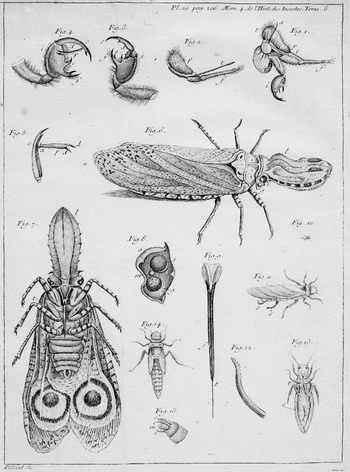
The example of the cicadas shows the collaborative nature of the production of observations, the raw material for written mémoires. When he wrote one of these long chapters or papers, Réaumur integrated what he had seen himself with what had been reported to him, and what he had read elsewhere (see Figure 1). Sometimes he included detailed reports from other observers; sometimes he used his observations to correct existing literature or folk knowledge (much as Alphons had done with the cicada's song). Letters, books, drawings, specimens – all these were grist for his mill. In the case of the Provençal cicadas, the insects themselves probably ended up in his vast collection, where they could be seen by visitors, and where they were drawn by his artist to illustrate his book (see Figure 2).
R.-A.F. de Réaumur, Mémoires pour servir à l'histoire des insectes, 6 vols., Paris: Imprimerie royale, 1734–42, vol. 5, Plate 19. (Courtesy of History and Special Collections Division, Louise M. Darling Biomedical Library, UCLA.)

R.-A.F. de Réaumur, Mémoires pour servir à l'histoire des insectes, vol. 5, Plate 20. (Courtesy of History and Special Collections Division, Louise M. Darling Biomedical Library, UCLA.)

For my second example of how material and observations circulated to produce knowledge, I turn to Gilles-Augustin Bazin (1681–1754), a Parisian lawyer and former inspector at the salt depot. He was a neighbour and friend of Réaumur, though there is no record of how their acquaintance began. Circumstantial evidence places him as a regular guest at Réaumur's country house in Charenton, and very likely a participant in observational excursions. When Bazin decided to leave the capital for personal reasons in 1732, Réaumur invited him to take refuge on the ancestral estate in Poitou. They travelled there together in September 1732 and Bazin stayed on for two years, maintaining an intensive programme of collection and observation of insects.Footnote 20 He proved to be an adept, even obsessive, observer and kept a steady stream of letters, specimens and drawings flowing from the countryside to Paris.
Though only Bazin's side of this correspondence survives, we can deduce a great deal from these letters about the dynamic of exchange between the two men. At times, he was following specific instructions from Réaumur:
I have three inchworms from the broom bush; I put them in dirt as soon as you told me I should … Our spittle bugs are going along nicely. I am sending you the fly [that hatched from their eggs]. I don't know if I have the larva of the cantharis, but I took about twenty little worms off the ash tree you told me about. It has only been 8 or 10 days since they hatched and they are already making their cocoons in my jar.Footnote 21
At other times, Bazin reported unanticipated discoveries, as when he came across a butterfly in the act of laying its eggs. Both Bazin and Réaumur kept many species of insect under observation over long periods of time, often purposefully replicating each other's efforts. They compared notes on how to keep the creatures alive, how to witness their transformations, how to control the rate of development in the chrysalis and so on. Insects, drawings and letters travelled to Paris by post; empty containers and other equipment travelled back with more letters, sometimes with specific requests or instructions. Once a year, when Réaumur made the long journey by carriage, he carried a selection of insects and cocoons, and brought others back with him two months later.Footnote 22
In almost all cases, the insects collected and sent back and forth were neither unique nor exotic. The eclectic nature of the enterprise is evident in this very typical inventory of a box sent to Paris by Bazin:
In the big box are 3 stalks of asparagus; stuck onto them you will find the eggs of the beetle that eats them. You will find also the worm hatched from these eggs, and the beetle that comes from this larva. In the little box on the right you will find the artichoke bugs, the eggs (on pieces of artichoke leaves) and the insect that comes from this egg before its metamorphosis into the bug. It has two long horns on its hind end which it arches over its back … You will also find two little shoots of ash leaves on which there are 4 cocoons of the insect in question that we suspect to be the cantharis but which look too small to produce it.Footnote 23
He arranged, as far as possible, to send all forms of each insect, housed in their own boxes; these may well have been destined for Réaumur's display collection in Paris. In the case of the cantharis, they did not yet know the adult form, and presumably both men planned to observe their respective specimens to see what happened to these cocoons. In addition to such materials for observation and display, Bazin also sent his own detailed observations, and sometimes drawings as well. Whenever possible he sent material evidence to support his interpretations or identifications.Footnote 24 Watching his growing caterpillars in captivity, he collected their shed skins, and sent some to Paris:
I hope that the [caterpillars] I have sent to you change their skins one more time, you will see it better for yourself because they are bigger than those that I still have [here]. I rushed to make this shipment because I thought that they had reached their full size, and that if they were to undergo another change it would be good that you should see it.Footnote 25
These few brief excerpts show Bazin and Réaumur engaged in seeing things together, even when they were not in the same place. It was a dynamic operation, always in flux, and often in transit, like the insects themselves.
In 1734, Bazin moved to Strasbourg to take up a position in the household of the bishop of Pharos, where he evidently had plenty of time to refine his observational techniques and continued to send descriptions and drawings and animals to Paris.Footnote 26 Now well beyond Réaumur's domain, and far from his direct supervision, Bazin pushed his own investigations beyond the limits of collecting and observing on Réaumur's instructions. From Strasbourg, he kept his friend supplied with new observations, especially of insect anatomy, and he asked in return for various things he could not acquire locally: magnifying lenses for himself and his friends, a microscope ‘suitable for contemplating the entrails of a caterpillar when it has been opened and spread out on a frame’, thermometers for measuring the temperatures of caterpillars. He even asked for help in obtaining a certain kind of chocolate, favoured by himself and the bishop for their breakfast, from a purveyor in Nantes. Réaumur complied with such requests for his services, and in return asked Bazin to be his intermediary in Strasbourg for books and letters coming from Germany. Because of his position, Bazin knew when clerics and other travellers were going between Strasbourg and Paris, and often asked them to carry books and fragile preparations back and forth.Footnote 27 As a mark of the value of the many observations and objects he sent to Paris, Bazin was named an official correspondent by the Academy of Sciences in 1737.
Once settled in Strasbourg, Bazin developed new techniques for dissecting insects, and sent back to Réaumur observations of such intricacies as caterpillar diaphragms, hearts and silk-spinning organs. In 1735, he wrote excitedly of his discovery, by dissection, of a caterpillar's tongue. ‘I spent the entire morning yesterday looking at the tongue of this animal, which is clearly visible … I will only be fully confident of the evidence of my eyes when yours will have confirmed my report’.Footnote 28 He sent a few of the living caterpillars, with instructions for how to do the operation, so that Réaumur would be able to replicate the observation before the creatures metamorphosed. Their history of working side by side in other locations gave the two men the foundation for this kind of joint observation, even when they were no longer in proximity to each other. Bazin's shipments allowed a kind of shared experience not otherwise possible at a distance, since direct inspection was necessary for corroborating and validating results. Bazin sometimes sent drawings, but he liked to send insects or eggs or cocoons whenever possible. Often he sent anatomical preparations as well: ‘I am so excited by my success, that I would be mortally disappointed if you did not witness it. I have done the impossible, as you wished, sir; I have detached the heart of a caterpillar from its surrounding tissues’.Footnote 29 To document his achievement, he sent a tablette (a preparation of the dissected caterpillar mounted on a frame), even though he was not sure it would survive the rigors of the trip. Réaumur responded by sending a recipe from the Paris anatomist Jacques Winslow for a mixture used to inject the fine vessels in dissected animal tissue, insisting that Bazin keep the formula secret.Footnote 30 Once he had perfected his injection technique, Bazin sent samples of his work, some preserved in alcohol, others dried.
It took me a long time to succeed in getting the injection to penetrate from the heart of our caterpillars all the way to the mouth; I was always hindered by air rushing in [to the vessels], until finally, by virtue of patience and little inventions, I succeeded. You will find, sir, on the biggest of the frames a heart injected as much as it can possibly be. You will see that I was mistaken previously, in telling you that the heart terminated in the oesophagus.Footnote 31
Whenever he found something that he thought would interest Réaumur, he tried to figure out a way to preserve it and transport it. Thus, when he observed the network of nerves beneath a caterpillar's skin, he removed it as best he could and mounted it, immersing the preparation in alcohol for the journey. He tried many ways of displaying injected and dried caterpillar hearts to show their structure. The preparations themselves became a challenge he enjoyed, and when he achieved something remarkable, he usually sent it off to Paris after showing it to his local acquaintances. In the case of a pair of butterflies, dissected in the act of mating to reveal the difficult-to-observe sex organs, he noted
its singularity and the difficulty of making another such tablette …Since I was not familiar with these butterflies, or the caterpillars they came from, I glued the wings of one of them onto the same mount. On the right are the wings seen from above and on the left the same viewed from underneath.Footnote 32
Bazin also promoted natural history among his friends and acquaintances in Alsace, and as he became known as a naturalist, he entered another current of circulating specimens and letters. He mentioned outings to other places and invited people in to see his preparations. He was part of a circle in Strasbourg (‘nos curieux d'icy’) who passed around books and instruments, and often tried their own experiments. Sometimes they went out to collect insects together. On a visit to a country priest in the vicinity, the party went looking for the elusive mole cricket:
This priest, who has a good mind, likes the new philosophy and does not disdain insectology. Being at his house, and reasoning on the subject, he gave us the pleasure of hunting for the mole cricket with oil, and confirmed for us what Godaert says about the gallery that this insect makes around its nest, from which he stands guard. He assured us he had seen this.Footnote 33
Such outings remind us that the habits of reading about, looking for, collecting, examining, drawing and dissecting insects were practised by a rather wide selection of people in the educated classes. Bazin was probably unusual in the depth of his commitment to his avocation, which he took up in earnest relatively late in life. Through his letters, though, we can catch glimpses of an informal and unstructured community of people, whether in Poitou or in Strasbourg, who shared his penchant for an observational natural history that took them out into nature as well as into their libraries.
In some cases, the circulation of specimens and observations and instruments relied on networks of personal connections, through friendships or ties of patronage. Many other epistolary and material exchanges followed from the circulation of books, which brought readers into the geographically dispersed community of naturalists and observers; even for Bazin and Caumont, who had personal ties to Réaumur, reading his books was a crucial part of their correspondence and their observing activities. In addition to reading and conversing, natural-history books stimulated readers to reproduce, correct or add to the observations they found in print. New observations might confirm what others had said, but just as often they led to corrections and revisions, and sometimes even produced novel discoveries. Referring to the existing literature, old and new, was an essential part of investigating the natural world, and books moved in all directions, like the specimens, drawings and letters I have been considering here.
My examples, selected from a much larger wealth of similar sources, have indicated how materials and observations circulated back and forth and around various loops, as people traded objects and knowledge and favours or services of all kinds. In a sense, Réaumur functioned as a clearing house, or a coordinator, for all sorts of natural-historical knowledge, but this was far from a systematic enterprise, and he was decidedly not the only node of collection and synthesis. Some things came in by happenstance, some things (like the cicadas) were requested from contacts in particular regions, others were sent by readers or other aspiring naturalists eager to cultivate ties to the capital. Réaumur's extensive correspondence network was in fact very loosely organized, and he hardly controlled the knowledge it produced. Sometimes he was able to correct the misapprehensions of his informants (this happened with Alphons sometimes), but in many other cases his own observations were corrected by his correspondents. In this essay, I have not been able to delineate the complex contours of the dispersed and variegated social world of natural history. Suffice it to say that however robust a local community might be, in some cases even nurturing an academy or other local circle of sociability, the participation of distant interlocutors proved essential to the ever-expanding field of natural-historical knowledge. This was true for Paris as well as for Strasbourg, Avignon or Poitou. The provincial players in this game were not simply sending in their specimens and observations for processing in the capital. They were doing the very kind of observation (often more so, as in the dissections of Bazin) that Réaumur would have done himself, or would do to confirm the observations of others once he had the necessary materials. Recognizing this, he preserved some of the local nature of observations when they appeared, written up as ‘histories’ in his publications, by naming his correspondents and collaborators, along with their locations, to situate the conclusions he was presenting to his readers. This recognition in print might inspire readers to emulate his informants, not only for his own collecting and observing project, but more generally to promote natural history in as many localities as possible. The circumstances and motivations of observers in these localities varied enormously; the examples discussed above give no more than a sampling of this variety.
Although his work on insects was printed initially in large quarto volumes, Réaumur intended his books to be used, for identifying insects and understanding their ways, but also for redoing observations and seeing things he had not yet seen or was not able to see.Footnote 34 As the books themselves circulated, and correspondence and insects continued to move in and out of Paris, knowledge about any given species might well remain in flux. In this sense, even once printed or engraved, narrative descriptions or images invited elaboration or correction by asking readers for corroboration and otherwise engaging their attention. Anyone who spent time examining the lives of insects knew that there would always be more to know, more species to find and to examine, new details to notice and more explanations to devise. The practice of natural history depended on the interaction of many sorts of people engaged to different degrees in the activity of observing and experimenting. Circulation – in all the senses we have explored here – made the production of this kind of knowledge possible, even as the elements of local specificity gave individual observations or specimens their validity.