Hospital-acquired infections are the most common avoidable complications in hospitalised patients. hospital-acquired infections are infections acquired in the hospital, which appear 48 hours or more after hospital admission or within 30 days after discharge following in-patient care. Reference Friedman, Kaye and Stout1 hospital-acquired infections are one of the top-10 leading causes of death in the United States of America. Reference Burke2 In addition, they lead to increased morbidity, Reference Friedman, Kaye and Stout1,Reference Bercault and Boulain3 mortality, Reference Kollef, Sharpless, Vlasnik, Pasque, Murphy and Fraser4–Reference Koch, Nilsen, Eriksen, Cox and Harthug8 protracted length of stay. Reference Kollef, Sharpless, Vlasnik, Pasque, Murphy and Fraser4,Reference Zimlichman, Henderson and Tamir6,Reference Barnett, Page and Campbell7,Reference Arefian, Hagel and Heublein9–Reference Rahmqvist, Samuelsson, Bastami and Rutberg11 and increased costs. Reference Plowman, Graves and Griffin12 The U.S. Centers for Disease Control and Prevention reports that nearly 1.7 million hospitalised patients annually acquire hospital-acquired infections, resulting in more than 98,000 deaths. 13 Hospital-acquired infections also put a tremendous financial strain on the healthcare system with an annual cost of up to $45 billion. Reference Hughes14–Reference Magill, Edwards and Bamberg15
The Centre for Disease Control and Prevention defines four primary hospital-acquired infections: central line-associated bloodstream infections, catheter-associated urinary tract infections, ventilator-associated pneumonia, and surgical site infections. 16 The Centre for Disease Control and Prevention’s National Healthcare Safety Network 2013 summary data for paediatric cardiac intensive care units accounted for a central line-associated bloodstream infection rate of 1.3 (43 centres), a catheter-associated urinary tract infection rate of 1.2 (36 centres), and a ventilator-associated pneumonia rate of 0.4 (14 centres). Reference Dudeck, Edwards and Allen-Bridson17 Furthermore, the Centre for Disease Control and Prevention identified the highest rates for central line-associated bloodstream infections to be those associated with paediatric heart patients. This finding is similar to other studies, largely attributed to the high risk associated with central vascular catheters. Reference Weinstein18
Numerous interventional studies have been conducted across paediatric sites. Most of these studies focus on staff education and changing the processes and/or equipment used for specific procedures in order to reduce infection rates. Miller et al led a multi-institutional study in 29 paediatric intensive care units (ICUs) across the United States of America. Reference Miller, Griswold and Harris19 The study concerned two central venous catheter-care practice bundles: an insertion and a maintenance bundle. The bundles resulted in average central line-associated bloodstream infection rates decreasing by 43% from January 2004 to September 2007 across the 29 Pediatric Intensive Care Units (PICUs) (5.4 versus 3.1 CLABSIs per 1000 central-line-days; p < 0.0001). Reference Miller, Griswold and Harris19 Bigham et al reported a decrease in ventilator-associated pneumonia rates from 5.6 (baseline) to 0.3 infections per 1000 ventilator days in a 25-bed PICU after implementing a ventilator-associated pneumonia bundle; p < 0.0001. Reference Bigham, Amato and Bondurrant20 Davis et al analysed the impact of a catheter-associated urinary tract infection prevention bundle that was initiated at a 500-bed tertiary care children’s hospital where roughly 40% of the beds are in the ICU. Reference Davis, Colebaugh and Eithun21 The catheter-associated urinary tract infection rate was reduced by 50% post-implementation from 5.41 to 2.49 per 1000 catheter days (95% confidence interval: −1.28 to −0.12; p = 0.02). Reference Davis, Colebaugh and Eithun21 These studies demonstrate the potential for effecting a marked improvement in the rate of hospital-acquired infections in this vulnerable population.
Infants and children undergoing congenital heart surgery offer unique challenges due to their differences in development, low birth weights, potentially weakened immune systems, exposure to foreign material, and other patient risk factors. During the period of 2014−2016, the Cardiac Service Line at Children’s Healthcare of Atlanta observed an increase in hospital-acquired infections when compared to both internal data and national benchmarks. This included a rise in the blood stream infection rate from 1.3 to 2.5; in the surgical site infection rate from 2.1 to 3.03; and an increase in the absolute number of catheter-associated urinary tract infections.
This study introduces a systems engineering approach to tackle multiple types of hospital-acquired infections across numerous procedures using a time–motion study framework to document hospital-acquired infection violations. Time–motion studies have been used in healthcare for many years to study current processes and find ways to improve them. Reference Pizziferri, Kittler and Volk22–Reference Zheng, Guo and Hanauer24 From the time–motion study, a novel framework to document hospital-acquired infection violations was created as well as computer-based training modules to educate visitors on hospital-acquired infection hygiene.
Methods
The study design is a mixed method approach and involves four major steps:
-
Perform time–motion studies of the CICU care process, record compliance and practice variance, analyse hospital data, and develop process maps of patient service workflows via objective process observations and structured interviews.
-
Establish a meaningful hospital-acquired infection schema by classifying observations into four categories: Observation Categories, Severity Levels, Procedure, and Personnel, along with accompanying subcategories.
-
Design a web-based system to manage and analyse the data: perform statistical analysis, conduct system analysis on practice variance, quantify compliance of stakeholders, and synthesise recommendations.
-
Design a prototypical computer-based training system to assist with hygiene compliance, particularly with visitors, and improve provider–parent communication.
A. Time–Motion study and process maps
Observing clinical processes and interactions among different stakeholders is critical to the understanding of causal factors of hospital-acquired infections. Observers were trained to document processes, personnel composition and skills, compliance, duration, and procedural steps within the CICU. To maintain a fresh perspective on the processes, new observers were introduced every 6 months while some existing ones were kept for continuity purposes. Observed processes include: dressing change, line insertion, line removal, intubation, extubation, diaper change, tubing change, mouth cleaning/suction, administering medication/fluids, zeroing lines, room cleaning, bathing, surgical operation, rounds, family-related visits, and general check-up. Since many of the unit’s patients undergo open-heart surgery, we also observed the surgical procedure for a number of cases in the operating room. Process maps were constructed based on observations, structured interviews, and clinical practice guidelines used by the care team.
B. Observation and data classification schema
Realising that observing and recording qualitative data presents high levels of variance among observers, we established a meaningful schema to classify each observation into four categories. Each category is further divided into subcategories to ensure maximum coverage of encountered observations. These categories were formed after we determined through literature reviews there was not a standard classification system for hospital-acquired infection observation data. We also designed the classifying criteria to better match the paediatric population and the actual observations that we were able to record.
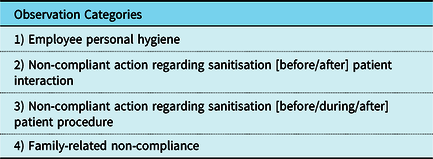
Specifically, observation was subdivided under one of these five classifications as shown in Table 1. Employee Personal Hygiene relates to violations without the presence of a patient. Non-Compliant Actions include improper sanitation practice with respect to interactions, procedures, and families.
Observation category classifications.

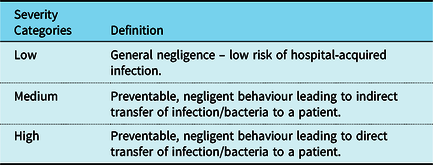
We also worked to create a severity classification tool. We realised that when a hospital forms an action plan to address the recommendations from our observations, it would be best if high-severity violations are tackled first with the limited resources (e.g., education/training) available. As shown in Table 2, the Severity Levels are defined on a scale from 1−3. Low severity corresponds to actions that lead to low risks of hospital-acquired infection (e.g., eating food in the unit), Medium (e.g., placing cell phone or a soft toy on a patient’s bed), and High (e.g., not sanitising after a diaper change and continuing to treat the patient) severities deal with Indirect and Direct, respectively, transfer of bacteria to a patient as a result of preventable negligent behaviours.
Severity level classifications.

In addition, the observation was classified by personnel and procedure observed. The personnel were classified by: Physician (includes advanced practice provider), Nurse, Technician (includes respiratory therapists), Family, and other (includes environment services staff). The definition of hospital-acquired infection rates this paper uses as non-compliant observations collected/total observations collected.
C. Web-based system for data management and analysis
We designed a web-based tool to store observational data in a unified manner. The backend is a MySQL database. The “observation” table is the core table that holds the majority of the data. Logical rules are applied to tables to minimise input error. In the frontend, we employed jQuery and PHP to build the webpage client and to accommodate our group of observers.
The system supports three types of users: Observers, Managers, and Physicians. Through the “upload” function, observers can upload observation notes. The system maintains an audit log that records logins, all input and modification activities, timestamps, and any modifier’s identity. This allows the users to keep track of changes. Finally, Physicians can see the data summary, and they can evaluate and order recommendations interactively via the online “dashboard”. Specifically, the recommendations can be organised using an impact–implementation table to determine a course of action to reduce the observed violations.
Users login through a secured web portal. Observations are organised according to the classification schema previously described. We built an analytic tool kit that visualises the collected data into graphs according to the created hospital-acquired infection schema. This allows the direct analysis of the collected data. Users can query by specifying the time period.
D. Design of computer-based training system
During the time–motion study, observations were noted where visitors committed hospital-acquired infection violations. hospital-acquired infection training modules were created to educate visitors on proper protocol to avoid spreading an infection to patients in the unit. Our computer-based training system was designed using HTML5 and JavaScript and hosted on a secured Linux server. It can be accessed via any digital device. The initial implementation is only in English; however, more languages will be added to accommodate visitors of all backgrounds. The system can be hosted on a secured server within the hospital’s secured Health Insurance Portability and Accountability Act (HIPAA) zone where data privacy and security are assured.
Results
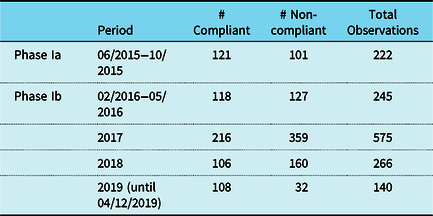
Over the course of 36 months, roughly 50 observers performed time–motion studies and collected a total of 1511 observations. Some of these observations were obtained by pairs of observers to ensure accuracy. Table 3 summarises the observational data collected during different time periods.
Observation data summary.

We applied a two-phase systems approach to uncover susceptible areas, processes, procedures, and behaviour during CICU stays, where infections are acquired, with the objective being to cultivate a proactive surveillance system of awareness of infection-prone situations. Specifically, a Phase I time–motion study was first carried out (June 2015−October 2016) to identify processes and areas for further in-depth investigation. Guided by the Phase I findings, we derive a meaningful schema to classify and standardise recording of each observation/incident. These common categories are vital to global data analysis and synthesis of recommendations for implementation. Next, we designed a web-based database and analytic environment for data management, summarisation, and visualisation. Usability tests were then carried out (November–December 2016) to refine the system. Phase II was subsequently undertaken (2017–April 2019), where observers used the web system and classification schema for data recording and analysis. Based on our findings, a computer-based training system was designed to facilitate hospital-acquired infection awareness and effective communication and training for parents and visitors.
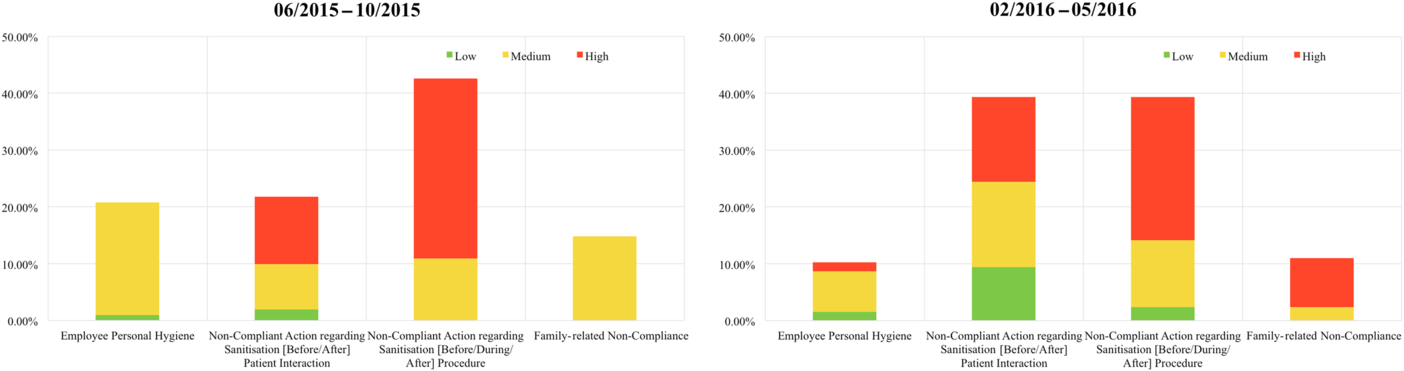
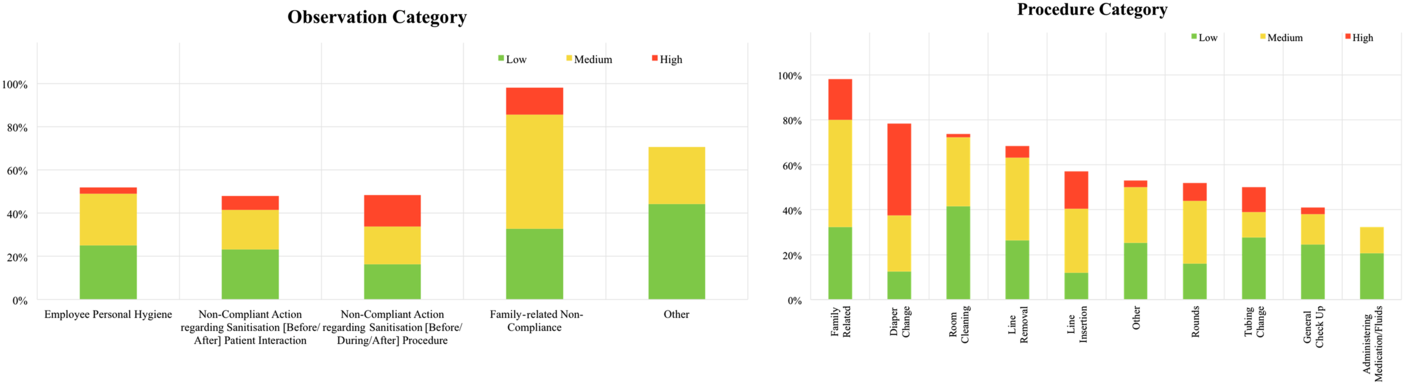
Figure 1 shows the Phase I non-compliance severity among the four observation categories (number of non-compliant by category over total number non-compliant). Staff not adhering to proper sterile practice during procedures contributed to a significant number of violations. The hospital mounted a campaign to improve employee personal hygiene after the Phase I feedback. As a result, substantial improvement was observed in employee personal hygiene in Phase II.
Total number of non-compliance observations collected divided by category.

In Phase II, in addition to classifying the observations by category we also classified the observation by procedure (Fig 2). The results show an important opportunity for family education to raise awareness of hand hygiene and sterilisation processes. Among the 105 observed data, 103 of non-compliance cases (with 19 cases of high violations) were observed. Most of these cases involve hand hygiene and proper sterile/sanitary precautions while interacting with the patients.
Non-compliance percentage of total observations collected by category (left) and non-compliance percentage of total observations collected by procedure (right).

Among procedures, excluding family related, diaper changes had the highest non-compliance incident rate of 78.5%. Most non-compliance incidents were performed without using proper sterile techniques. This includes dirty diapers and wipes left on the patient bed, no barrier placed between the patient and bed during a diaper change, and personnel not changing gloves after the diaper change and proceeding to care for the patient. The number of observations collected for dressing change, intubation, extubation, mouth cleaning/suction, zeroing lines, and surgical operation are fewer than 18 for each procedure and hence were not reported.
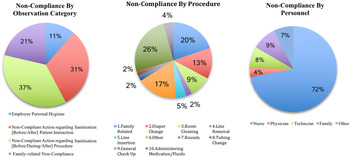
Among the 360 cases for “Sanitisation [Before/During/After] Procedure”, 174 non-compliance occurrences were observed. Most of these were due to hospital personnel entering a sterile field without sterile protection (e.g., facemasks, hair nets, etc.) and/or not observing proper hand hygiene. Nurses spend long hours and interact most with patients and accounted for 72% of the non-compliance violations, while family members/visitors accounted for 9% of all total violations (Fig 3).
Distributions of non-compliance types (from 2017 to 2019) among observation categories, procedures, and personnel.

Over the course of 36 months, roughly 50 observers performed time–motion studies and collected a total of 1511 observations (Table 3). Some of these observations were obtained by pairs of observers to ensure accuracy.
We applied a two-phase systems approach to uncover susceptible areas, processes, procedures, and behaviour during CICU stays, where infections are acquired, with the objective being to cultivate a proactive surveillance system of awareness of infection-prone situations. Specifically, a Phase I time–motion study was first carried out (June 2015−Oct 2016) to identify processes and areas for further in-depth investigation. Guided by the Phase I findings, we derive a meaningful schema to classify and standardise recording of each observation/incident. These common categories are vital to global data analysis and synthesis of recommendations for implementation. Next, we designed a web-based database and analytic environment for data management, summarisation, and visualisation. Usability tests were then carried out (November–December 2016) to refine the system. Phase II was subsequently undertaken (2017–April 2019), where observers used the web system and classification schema for data recording and analysis. Based on our findings, a computer-based training system was designed to facilitate hospital-acquired infection awareness and effective communication and training for parents and visitors.
Two observation time periods were conducted in Phase I. For both periods the non-compliant action regarding Sanitisation [Before/During/After] Procedure category had the greatest number of observations that were of high severity (Fig 1). This was due to staff not adhering to proper sterile practice during procedures contributed to a significant number of violations.
In Phase II, in addition to classifying the observations by category we also classified the observation by procedure (Fig 2). The results show an important opportunity for family education to raise awareness of hand hygiene and sterilisation processes. Among the 105 observed data, 103 of non-compliance cases (with 19 cases of high violations) were observed. Most of these cases involve hand hygiene and proper sterile/sanitary precautions while interacting with the patients.
Among procedures, excluding family related, diaper changes had the highest non-compliance incident rate of 78.5%. Most non-compliance incidents were performed without using proper sterile techniques. This includes dirty diapers and wipes left on the patient bed, no barrier placed between the patient and bed during a diaper change, and personnel not changing gloves after the diaper change and proceeding to care for the patient. The number of observations collected for dressing change, intubation, extubation, mouth cleaning/suction, zeroing lines, and surgical operation are fewer than 18 for each procedure and hence were not reported.
Among the 360 cases for “Sanitisation [Before/During/After] Procedure”, 174 non-compliance occurrences were observed. Most of these were due to hospital personnel entering a sterile field without sterile protection (e.g., facemasks, hair nets, etc.) and/or not observing proper hand hygiene. Nurses spend long hours and interact most with patients and accounted for 72% of the non-compliance violations, while family members/visitors accounted for 9% of all total violations (Fig 3).
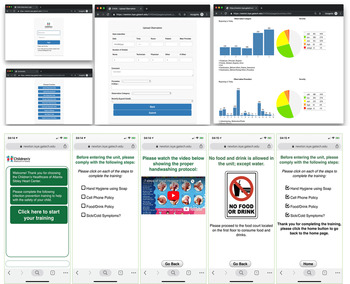
Since 2017, the data management web portal (Fig 4) has been used by 22 observers, comprised of 14 undergraduates, 7 graduates, and a high school student, inputting a total of 941 observations. The system is user-friendly and is extendable as we expand to observe other procedures and/or different types of patients or hospital settings.
Snapshots of the data management web portal and computer-based training system.

Family-related non-compliance offers a unique opportunity for introducing computer-based training for effective hygiene education and awareness. Family-related non-compliance observations included hand hygiene violations, bringing personal food/drinks next to the patient, and using a cell phone next to the patient or even putting the cell phone on the patient bed. Specifically, the hospital-acquired infection module designed by the team currently includes four training components for hygiene compliance that are beneficial to minimising hospital-acquired infection. This includes “Hand Hygiene using Soap”, “Cell Phone Policy”, “Food/Drink Policy”, and “Sick/Cold Symptoms” (Fig 4).
Discussion
hospital-acquired infections can compromise the outcomes of paediatric patients and consume additional resources. The challenges are multiple, including suboptimal adherence to current prevention recommendations; limitations in surveillance strategies; lack of efficient mechanisms for reporting adverse events; inconsistent metrics of measurement; and at times, lack of system-wide research. Furthermore, the paediatric population and the hospital units that house them are very distinct from adult units and require tailored prevention and control plans. The interdependencies and multi-faceted potential personnel and processes contribute to hospital-acquired infections, and make it difficult to pinpoint sources for early detection and intervention.
In this work, we conducted an extensive time–motion study to investigate risk factors and mitigation strategies for reducing hospital-acquired infection. Guided by our initial observations, we introduced a novel categorisation schema with action types, observation categories, severity classes, procedure classifications, and personnel categories that offer a systematic and efficient mechanism for reporting and classifying non-compliance and violations. Utilising these categories, a web-based database management system was designed that allows observers to input their data. This web analytic tool offers easy summarisation, data analysis, and visualisation of findings. The categorisation schema and the web data management tools facilitate standardisation of hospital-acquired infection data and research where observers, investigators, and stakeholders can report, collect and analyse data in a consistent manner utilising a common set of metrics for measurement. The approach and tools are generalisable to other areas for quality improvement.
Our analysis differs from previous studies which mostly focused on a single procedure or type of infections. Instead, we performed a mixed method system analysis through the continuum of care in paediatric CICUs utilising well-known engineering time–motion study techniques. To the best of our knowledge, this work represents the first comprehensive systems observation study for paediatric hospital-acquired infection analysis. Although the study is labour-and-time intensive and required a significant team of observers, the derived classifications schema, resulting web-based tools, and metrics of measurements establish a standard common framework that enables rapid data collection and analysis by other personnel. There is an opportunity to disseminate such standardisation for paediatric hospital-acquired infection investigation.
Hospital-acquired infection non-compliance by hospital visitors has been documented to increase infection rates of patients. Reference Tekerekoglu, Duman and Serindag25–Reference Forkpa, Rupp and Shulman29 Inspired by our own findings on family non-compliance and coupled with the ubiquity of personal digital devices, we designed a computer-based training system with hospital-acquired infection awareness training modules for use by parents and visitors.
Our findings offer a checklist of non-compliance situations and potential development of a proactive surveillance system of awareness of infection-prone situations. Findings from this study also offer opportunities for process change and quality improvement. Working with quality improvement experts and stakeholders, recommendations and actionable practice will be synthesised for implementation in clinical settings. Careful design of the implementation protocol is needed to measure and quantify the potential improvements in outcomes.
The collected observation data also offer a unique opportunity for modelling and optimisation of clinical workflow. Simulation, machine learning, and other state-of-the-art analytical tools will be used to analyse the interdependencies and uncover critical risk factors and mitigating strategies that will offer the best return on investment for outcome and quality. This is the subject of ongoing work.
Limitations
Due to the inherent difficulty noting observations for family members, the percentage of non-compliance observations noted for family members may be higher than the actual rate. While this presents a truly novel approach to combat hospital-acquired infections, the methods of this study still need to be tested to see if they result in reduced hospital-acquired infection. This will be addressed in ongoing work.
While observers were trained not to discuss with staff they were conducting an infection study, we cannot discount that just due to being observed, staff may have changed their behaviour, which may have resulted in a reduced non-compliance rate.
Acknowledgements
We thank Dr. Mahle for his leadership, clinical advice, CICU orientation, and arranging the hospital access for all members in this study; and Monica White for her assistance in hospital logistics and access, and HIPAA and EPIC training logistics. The Georgia Tech authors also want to thank the entire care team at CHOA CICU for their invaluable advice and collaboration and accommodations.
We thank Guanlin Chen for implementing the computer-based training system and testing its usage online and Eric Byun for designing the classification schema for observation, coordinating a team of students on data collection for the period January 2016–June 2016, and drafting an early report on design and findings.
The authors would like to thank Brenna Fromayan, Pritika Halder, Pratyush Kothiyal, Christina Rhines, Rodriguez Roberts, Lavannya Atri, Prashant Tailor, Raghav Srinath, Surina Puri, Shefali Jain, Qixuan Hou, Chenman Cheng, Farial Sufi, Meiyi Guo, Yuntian He, Wenyi Qiu, Alexandra Ojeda, Huiwen Ho, Le Lu, Moussa Hodjat-Shamami, Ashley A Ellingwood, Xu Huiyan, Priya R Patel, Abhinav Bhardwaj, Sam Mahle, Scott R Eckhaus, Ayush M Kayastha, Chris K Kwan, Autumn L Phillips, Ethan Cha Jung Min, Kevin Eun Ho Kwon, and many more Georgia Tech students for carrying out the time–motion study and observation in the clinic, and testing and usage of the web-based tools.
Financial support
This study was partially supported by grants from the National Science Foundation (NSF) and NSF Research Experiences for Undergraduates (REU) programme, grant numbers IIP-1361532, IP-1451529 (REU), IIP-1649462 (REU), and IIP-1744368 (REU). Findings and conclusions in this paper are those of the authors and do not reflect the views of the NSF.
Conflicts of interest
None.