


Impact Statement
Carbonylation is an important route to chemicals used in pharmaceuticals, agrochemicals, polymers, and other products, but many established processes require harsh reaction conditions, precious metal-based homogeneous catalysts, and the handling of toxic and flammable CO. This Perspective highlights how light can enable these transformations under far milder conditions. In particular, we identify opportunities to develop heterogenized photocatalytic systems using earth-abundant metals, porous frameworks, and semiconductor photocatalysts as platforms in which molecularly defined active sites, with the merit of high activity and selectivity, can be integrated with catalyst recovery and recycling. Although heterogeneous catalyst-based systems are still in their infancy, the well-established mechanistic understanding of photo-assisted homogeneous carbonylation systems can provide guidance for the development of next-generation light-driven carbonylation systems. Realizing the potential of these systems at scale will require advances beyond catalytic activity alone. Catalyst stability and metal leaching must be carefully evaluated, while the development of continuous-flow or circulation reactors will also be important for practical implementation. Addressing these challenges could transform photo-assisted carbonylation from a promising laboratory methodology into a practically viable approach for the synthesis of a variety of carbonyl-containing chemicals.
1. Introduction
Organic carbonyl compounds constitute one of the most important classes of molecules in the modern chemical industry, with widespread applications in agrochemicals, pharmaceuticals, functional materials (e.g., polymers), and daily consumer products [Reference Yang, Liu and Neumann1–Reference Li, Jiang, Wang and Cheng6]. Among the most atom-economical approaches for synthesizing such compounds are transition-metal-catalyzed carbonylation reactions using CO as a C1 feedstock. Modern carbonylation chemistry originates from the pioneering work of Walter Reppe, who developed a series of transition-metal-catalyzed reactions of acetylene under high-pressure conditions, collectively known as Reppe chemistry. In particular, Reppe carbonylation established the fundamental principles for the incorporation of CO into organic molecules, laying the foundation for numerous industrial carbonylation processes [Reference Reppe and Vetter7]. Later on, these related transformations achieved enormous industrial significance and represent some of the most successful homogeneous transition metal catalyzed processes in industrial chemistry [Reference Li, Hu and Wu8,Reference Kollár9], exemplified by methanol carbonylation processes (the Monsanto/Cativa process for acetic acid) [Reference Haynes, Maitlis and Morris10,Reference Jones11], hydroformylation (Oxo process for aldehyde) [Reference Billig and Bryant12,Reference Zhang, Kubis and Franke13,Reference Franke, Selent and Börner14], and alkoxycarbonylation processes (such as the Lucite Alpha technology for methyl methacrylate) [Reference Vondran, Furst, Eastham, Seidensticker and Cole-Hamilton15].
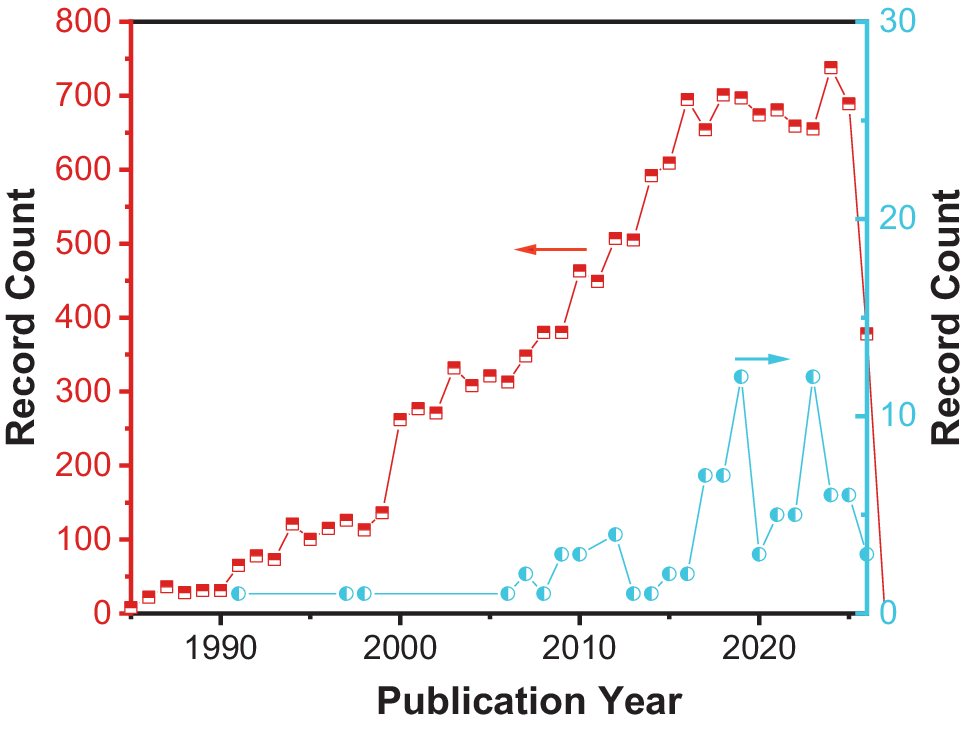
However, as retrieved from Web of Science using the keyword “carbonylation,” more than 600 publications have been reported annually over the past decade (accessed on July 6, 2026, Figure 1), despite the fact that many industrial carbonylation processes were already established in the last century. This sustained research activity highlights the unresolved challenges associated with carbonylation chemistry. The key limitations include (1) harsh reaction conditions, typically requiring elevated temperatures and high CO pressures [Reference Peng, Tian and Cao16,Reference Faculak, Veatch and Alexanian17,Reference Faculak, Rodriguez and Alexanian18], together with significant safety concerns associated with handling toxic CO under pressurized conditions [Reference Wang, Yang and Liu19,Reference Cao, Zheng, Xu and Xu20]. These challenges become even more pronounced when earth-abundant metals, such as Co [Reference Huang, Jackstell, Spannenberg and Beller21], Ni [Reference Yu, Gao, Hu and Huang22,Reference Chen, Chen and Lian23], and Fe [Reference Sun, Lu, Han and Beller24,Reference Liu, Li and Shi25,Reference Sun, Wang and Fang26], are employed as the catalysts; (2) the reliance on precious transition-metal catalysts, such as Pd [Reference Xu and Alper27,Reference Sumino, Fusano, Fukuyama and Ryu28,Reference Barnard29], Ir [Reference Haynes, Maitlis and Morris10,Reference Kubis, Baumann and Barsch30], Rh [Reference Wang, Wang, Neumann and Beller31,Reference Thomas and Süss-Fink32], and Ru [Reference Wu, Liu, Fleischer, Jackstell and Beller33,Reference Wu and Neumann34], often combined with expensive and air-sensitive phosphine ligands [Reference Rodriguez, Foster, Eastham and Cole-Hamilton35–Reference Sang, Hu and Razzaq38]; and (3) the intrinsic difficulties associated with the separation and recycling of homogeneous catalysts, which impact negatively on the sustainability in the context of carbon neutrality [Reference Shende, Saptal and Bhanage39]. Addressing these challenges, the development of sustainable carbonylation strategies that operate under mild reaction conditions using earth-abundant metals as catalysts has attracted considerable attention. One important approach relies on the use of a CO surrogate to circumvent the direct handling of toxic CO gas. In parallel, substantial efforts have been devoted to improving catalytic activity through the development of highly efficient catalytic systems and designing new ligands, thereby enabling carbonylation reactions to proceed under lower temperatures and reduced CO pressures.
Annual number of publications retrieved from the Web of Science using the keyword “carbonylation” (red curve) and the same search refined with the keyword “photo” (blue curve). Data accessed on July 6, 2026.

Figure 1. Long description
The X-axis represents Publication Year from 1985 to 2026. The left Y-axis, in red, represents Record Count for carbonylation from 0 to 800. The right Y-axis, in blue, represents Record Count for photo-carbonylation from 0 to 30.
* The red curve, marked with square points, shows a steady linear increase from near zero in 1985 to approximately 100 in 1995. It continues to rise, reaching a peak of over 700 publications around 2024 before a sharp drop in the final data point for 2026.
* The blue curve, marked with circular points, remains near zero until approximately 2006. It then shows a volatile upward trend with significant peaks and troughs, reaching its highest point of approximately 12 records around 2019 and 2023, followed by a decline toward 2026.
* Red and blue arrows point to their respective Y-axes to indicate which scale applies to each curve.
In recent years, photocatalysis has emerged as a powerful toolbox for the sustainable organic synthesis by either C–H activation and radical formation via hydrogen atom transfer (HAT) or proton-coupled electron transfer (PCET) processes [Reference Chai40,Reference Peng, Rockstroh and Rabeah41], or the generation of catalytically active species that drive the catalytic cycle in a thermal manner [Reference Peng, Tian and Cao16–Reference Faculak, Rodriguez and Alexanian18,Reference Maguire, Boese, Goldman and Goldman42]. The major advantage of photocatalysis compared with conventional thermal catalysis is its ability to promote catalytic transformations under significantly milder reaction conditions, since both the generation of reactive catalytic species and substrate activation can be induced directly by light irradiation. Among different transformations, carbonylation reactions have also been explored by photocatalysis and mainly focused on homogeneous catalytic systems (Figure 1) [Reference Vondran, Furst, Eastham, Seidensticker and Cole-Hamilton15–Reference Faculak, Veatch and Alexanian17,Reference Jiang, Wang and Li43,Reference Singh, Sharma and Sharma44]. Depending on the catalytic system, photocarbonylation reactions may proceed either through the direct utilization of gaseous CO under much reduced or even ambient pressure conditions or via the in situ generation of carbonyl species from suitable CO surrogates [Reference De La Cruz, Bauer and Cachuela45,Reference Raineri, Morlacci and Constantin46,Reference Le Saux, Mathis, Panizzolo and Morandi47]. By utilizing visible light as a renewable energy input, photocatalytic carbonylation provides new opportunities to reduce the energy demand and safety concerns associated with traditional carbonylation methodologies while enabling efficient C–C bond formation toward value-added oxygenated compounds.
In this Perspective, we will focus on recent progress in the photocatalytic carbonylative synthesis of carbonyl-containing compounds. It should be noted that, throughout this manuscript, the terms “photo-assisted,” “photocatalysis,” and “light-driven” are used with caution and may be adopted interchangeably depending on the specific reaction system. This distinction is important because light irradiation may promote the reaction through different pathways, including photochemical excitation or photo-induced radical generation, which can differ from the conventional concept of semiconductor-based photocatalysis involving bandgap excitation and charge-carrier separation processes. We will first highlight some investigations based on homogeneous catalytic systems, followed by selected examples of heterogenized photocatalytic platforms for carbonylation reactions. Furthermore, we provide an outlook on future research directions for the heterogenized photocatalytic carbonylation chemistry. We anticipate that, by enabling catalytic transformations under safer and milder reaction conditions, reducing the dependence on precious transition metals, and offering opportunities for catalyst recyclability through heterogeneous catalyst design, photocatalytic carbonylation is expected to provide promising solutions to several longstanding challenges associated with conventional thermally driven carbonylation processes.
2. Photocatalytic Carbonylation with Homogeneous Catalysts
Based on the recently reported systems, photo-assisted carbonylation processes can generally be classified into two categories. The first one involves radical-mediated pathways, in which carbon-centered radicals are generated through one of the following processes, including atom transfer carbonylation (ATC), single-electron transfer (SET), HAT, and PCET processes. These radicals are subsequently attacked by CO to form acyl radical intermediates, which then undergo further transformation to attain the target products. The second type relies on the photoinduced formation of coordinatively unsaturated metal carbonyl complexes via light-driven CO dissociation. The resulting active metal complexes subsequently catalyze the carbonylation reaction through conventional organometallic elementary steps, including substrate coordination, migratory CO insertion, and reductive elimination or nucleophilic attack processes.
2.1 Pre-functionalized Alkyl and Aryl Substrates
The carbonylation of functionalized alkyl and aryl substrates has witnessed significant advancements owing to the facile generation of carbon-centered radicals induced by light irradiation. Representative types of studied substrates include alkyl and aryl halides, aryldiazonium salts, oxime esters, and alkyl silicates. Although the classic ATC process requires no catalyst, it serves as a historical benchmark against which the milder conditions enabled by the catalysts discussed below can be compared and, thus, its mechanism is also illustrated in this section.
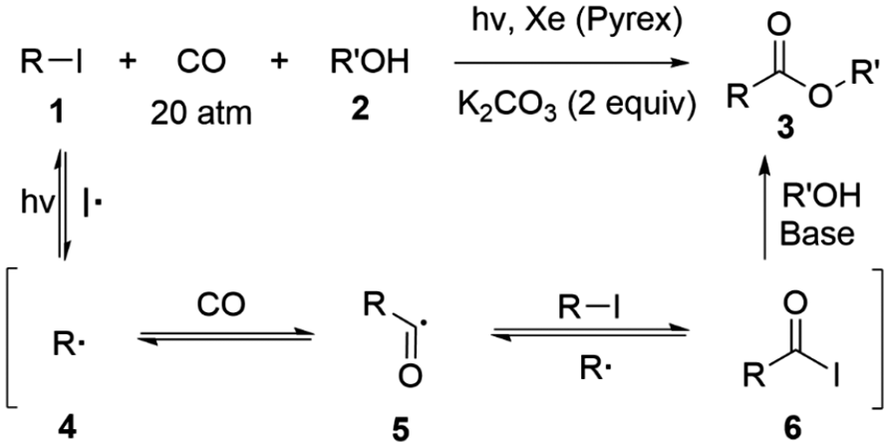
Among the abovementioned substrates, alkyl/aryl halides constitute the most extensively studied categories. Early studies relied on high-intensity mercury/xenon arc lamps emitting a large proportion of deep UV light, which could directly activate the substrate without the need for additional photosensitizers or transition metal catalysts, so-called ATC mechanism [Reference Fukuyama, Nishitani, Inouye, Morimoto and Ryu48]. In 1997, Ryu’s group reported the use of alkyl iodide 1 as the substrate, and alcohol 2 under CO atmosphere furnished ester product (Scheme 1) [Reference Nagahara, Ryu, Komatsu and Sonoda49]. In the proposed mechanism, alkyl iodide dissociated to an iodine radical and alkyl radical 4, and the latter underwent CO addition, followed by iodine radical quenching to form the acyl halide 6, and subsequently attacked by alcohol toward the target product 3. It has to be noted that an overstoichiometric amount of base is needed to promote the reaction. Additionally, pressurized CO is generally required to efficiently trap transient radicals and suppress undesired side reactions via this ATC process. Therefore, considering the use of deep-UV light and pressurized CO conditions, the ATC strategy is not sustainable from the perspectives of energy efficiency and operational safety.
Proposed mechanism of the catalyst-free radical carbonylation via the ATC process [Reference Nagahara, Ryu, Komatsu and Sonoda49].

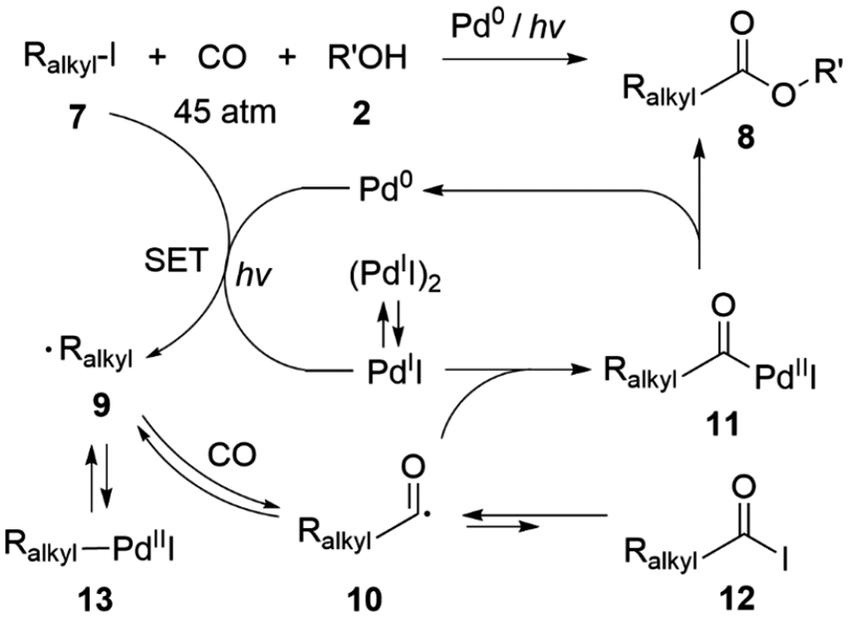
The employment of homogeneous transition-metal catalysts, particularly Pd [Reference Fukuyama, Nishitani, Inouye, Morimoto and Ryu48,Reference Fusano, Sumino and Nishitani50–Reference Torres, Liu and Arndtsen52], Co [Reference Veatch and Alexanian53,Reference Mu, Jia and Yin54], Cu [Reference Zhang, R.-H, Xu and Wu55,Reference Lu, Cheng, Chen, Chen and Xiao56,Reference Tung and Mankad57], Ni [Reference Hu, Singh and Arndtsen58,Reference Li, Hu, Ren, Arndtsen and Chu59,Reference Wang and Wu60], and Pt [Reference Kondo, Tsuji and Watanabe61] metal complexes, was also investigated for the photo-assisted carbonylation reaction and proved to be an efficient strategy in terms of substrate scope and reaction conditions. Taking Pd as an example (Scheme 2), it was proposed that homolytic scission of R–X takes place via a SET process [Reference Shen, Zhang and Zhang62], and acylpalladium key species 11 formed after CO addition to alkyl radicals 9 [Reference Sumino, Ui, Hamada, Fukuyama and Ryu63]. The acylpalladium species further react with alcohols or amines to deliver the final esters or amide products and regenerate the catalysts. Other metal-based catalytic cycles proceed in a slightly different regarding the formation of carbon centered radicals, but acyl-metal intermediates are generally the key species in the catalytic cycles.
Representative reaction mechanism for Pd-based photocatalytic carbonylation processes [Reference Fusano, Sumino and Nishitani50].

Scheme 2. Long description
A chemical flowchart illustrating a catalytic cycle. At the top, a linear reaction shows R sub alkyl dash I (labeled 7) plus C O plus R prime O H under 45 atm and P d super 0 forward slash h v yields an ester product (labeled 8). Below this, the catalytic cycle begins.
* Top-left: R sub alkyl dash I (7) enters the cycle. An arrow labeled S E T and h v points to the formation of an alkyl radical dot R sub alkyl (labeled 9).
* Bottom-left: The alkyl radical (9) is in equilibrium with R sub alkyl dash P d super I I I (labeled 13).
* Bottom-center: The alkyl radical (9) reacts with C O to form an acyl radical (labeled 10).
* Bottom-right: The acyl radical (10) is in equilibrium with an acyl iodide (labeled 12).
* Center: P d super I is in equilibrium with a dimer (P d super I I) sub 2. The acyl radical (10) reacts with P d super I to form an acyl-palladium species R sub alkyl dash C O dash P d super I I I (labeled 11).
* Top-right: The acyl-palladium species (11) releases the final ester product (8) and regenerates the P d super 0 catalyst to restart the cycle.
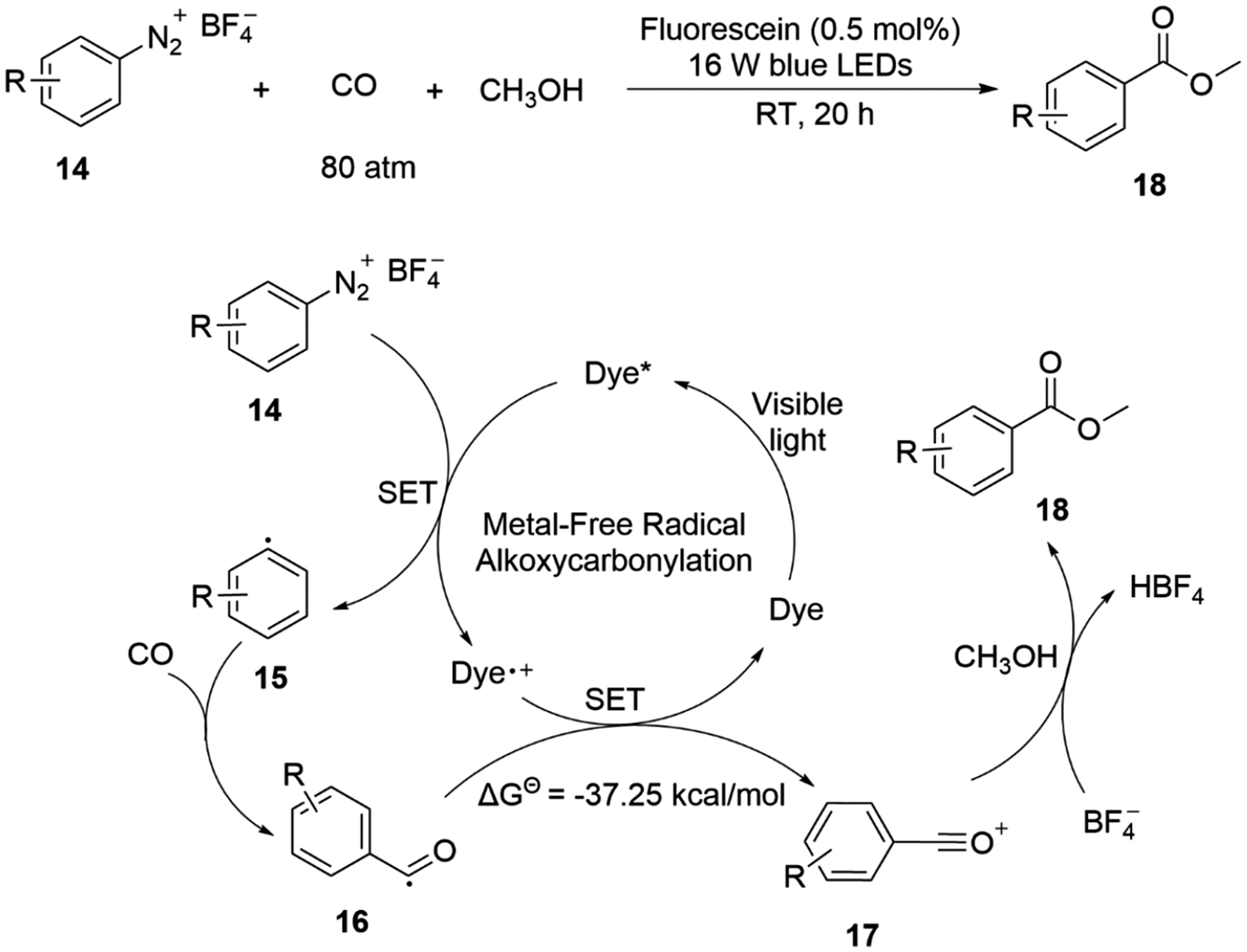
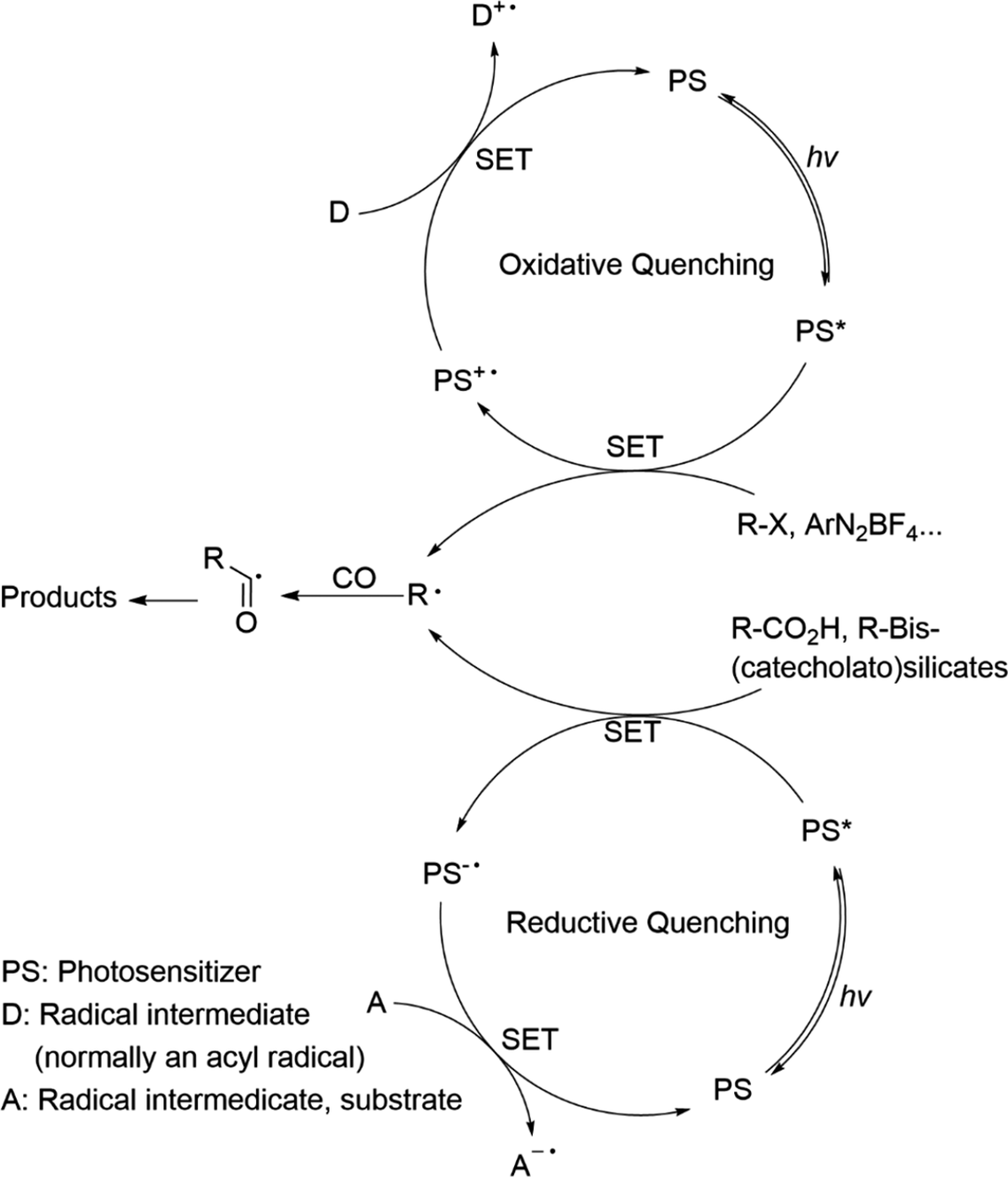
Aryldiazonium salts have emerged as highly efficient substrates owing to their low reduction potentials and the facile elimination of N2 under visible light-irradiation in the presence of photosensitizers (Scheme 3) [Reference Guo, Lu and Wang64,Reference Micic and Polyzos65]. Similarly, oxime esters [Reference Lu, Cheng, Chen, Chen and Xiao56], hemiketal hydroperoxides [Reference Tao, Liu and Zhang66,Reference Shan, Zhao and Wu67], and alkyl silicates [Reference Cartier, Levernier and Dhimane68,Reference Cartier, Levernier and Corcé69,Reference Wan, Huang and Shao70] provide alternative radical precursors to halogenated compounds for the generation of alkyl/aryl radicals. In many cases, these transformations proceed via visible-light photoredox catalysis using Ru–, Ir–, or organic dye-based photocatalysts. The key criterion is the redox potential of the excited-state photosensitizer relative to that of the substrate, which determines whether substrate activation proceeds via reductive quenching or oxidative quenching, as shown in Scheme 4.
The reaction cycle for photocatalytic alkoxycarbonylation reaction using aryldiazonium salts as the substrate reported by Xiao [Reference Guo, Lu and Wang64].

Scheme 3. Long description
The image consists of two main parts.
Top section: A linear reaction equation shows an aryldiazonium tetrafluoroborate substrate (14) reacting with C O (80 atm) and C H sub 3 O H. The reaction is catalyzed by Fluorescein (0.5 mol percent) under 16 W blue L E D s at room temperature (R T) for 20 hours to produce an ester product (18).
Bottom section: A catalytic cycle titled Metal-Free Radical Alkoxycarbonylation.
1. Photocatalytic Cycle: At the top right, Dye is excited by Visible light to Dye star. Dye star undergoes S E T (Single Electron Transfer) with substrate 14 to form Dye dot super plus and an aryl radical (15). Dye dot super plus then undergoes another S E T step to return to the ground state Dye, releasing energy (Delta G super minus equals minus 37.25 kcal/mol).
2. Substrate Transformation: Substrate 14 (Ar N sub 2 super plus B F sub 4 super minus) loses N sub 2 to become aryl radical 15. Radical 15 reacts with C O to form an acyl radical (16). Acyl radical 16 is oxidized during the second S E T step of the dye to form an acylium cation (17).
3. Product Formation: The acylium cation 17 reacts with C H sub 3 O H, releasing H B F sub 4 and B F sub 4 super minus to yield the final ester product 18 (Ar C O O C H sub 3).
The catalytic pathways for reductive quenching and oxidative quenching processes for the photocatalytic carbonylation reactions involving photosensitizers.

Scheme 4. Long description
The flowchart consists of two circular catalytic cycles stacked vertically, connected to a central horizontal reaction path.
Top Cycle: Oxidative Quenching
* At the top right, P S is excited by h v to become P S super asterisk.
* Moving clockwise, P S super asterisk undergoes S E T (Single Electron Transfer) with substrates R minus X or A r N sub 2 B F sub 4 to form P S super plus dot and a radical R dot.
* P S super plus dot then reacts with D to regenerate P S and produce D super plus dot via another S E T step.
Bottom Cycle: Reductive Quenching
* At the bottom right, P S is excited by h v to become P S super asterisk.
* Moving counter-clockwise, P S super asterisk undergoes S E T with substrates R minus C O sub 2 H or R minus Bis-catecholato silicates to form P S super minus dot and a radical R dot.
* P S super minus dot reacts with A to regenerate P S and produce A super minus dot via S E T.
Central Reaction Path:
* Both cycles produce a central radical R dot.
* R dot reacts with C O to form an acyl radical (R attached to a C double-bonded to O with a radical dot).
* The acyl radical then leads to the final Products.
Legend at the bottom left:
* P S: Photosensitizer
* D: Radical intermediate (normally an acyl radical)
* A: Radical intermediate, substrate
2.2 Unactivated Alkane and Alkene Substrates
The direct utilization of unactivated alkanes and alkenes is more practical and sustainable, as these feedstocks are abundant and readily available from the petroleum/coal industry. In contrast, functionalized alkenes and arenes often require sophisticated multistep synthetic procedures. Moreover, the halide-containing byproducts from pre-functionalized substrates raise additional environmental and waste-disposal concerns, reducing the overall atom economy. Compared to the functionalized substrates, the direct photo-assisted carbonylation of unactivated alkanes and alkenes remains less explored and much more challenging, because of the relative inertness of the C(sp2/sp3)–H bonds and therefore difficult to initiate the reaction via radical pathways [Reference Pan, An and Mai71]. There are also several reports employing stoichiometric amounts of radical initiators, such as alkoxylazinium salts and halogen-containing compounds, to activate C(sp3/sp2)–H bonds for carbonylation reactions [Reference Chen, Hou and Zheng72–Reference Lu, Bao, He, Xiao and Chen75]. However, these transformations generally rely on thermally initiated radical pathways rather than photocatalytic catalytic cycles and therefore fall outside the scope of this Perspective.
Polyoxometalates (POMs) can absorb visible light, and their excited states undergo a HAT process to abstract hydrogen atoms from alkanes, thereby enabling the activation of inert sp3 C–H bonds. Thus, they can serve as efficient photosensitizers for photocatalytic C–H bond activation [Reference Raymenants, Masson, Sanjosé-Orduna and Noël76]. In 1995, the group of Hill reported the photo-assisted carbonylation of cyclohexane to cyclohexanecarbaldehyde using a POM photocatalyst [Reference Jaynes and Hill77]. However, no substrate conversion data were provided, and only a relatively low turnover number (TON < 54) was reported. One possible reason for the limited catalytic performance is that the aldehyde product can undergo reverse decarbonylation under the reaction conditions, likely associating with the relatively weak formyl C–H bond energy in aldehydes. The later developed strategy involves a third component, such as olefins bearing electron-withdrawing groups, to form more stable ketone products via a Giese addition reaction [Reference Raymenants, Masson, Sanjosé-Orduna and Noël76,Reference Okada, Fukuyama and Yamada78]. In 2025, Gong’s team coupled alkane carbonylation with asymmetric Mannich or acyl radical addition to shift the equilibrium forward and thus overcome the above-mentioned limitation. This one-pot method makes chiral β- (25) and α-amino ketones (26) from simple alkanes, CO, and anilines, and scales up well via flow/batch setup. In the proposed mechanism, the imine 23, which is derived from the reaction of aniline with the aldehyde intermediate 22, acts as the key intermediate species that either reacts with the ketone substrate to form product 25 or couples with the acyl radical 5 to form product 26 (Scheme 5) [Reference Ding, He and Sayed79].
Proposed reaction mechanism of enantioselective synthesis of β- and α-amino ketones through reversible photocatalytic alkane carbonylation with tetra-n-butylammonium decatungstate as the photocatalyst [Reference Ding, He and Sayed79].

Scheme 5. Long description
A reaction mechanism diagram divided into two main sections.
Top section:
An overall reaction shows R H plus C O plus a ketone 20 plus Ar N H sub 2 yielding beta-amino ketone 25 or alpha-amino ketone 26.
Below this, a catalytic cycle involves decatungstate species A, A star, B, and C. Species A [W sub 10 O sub 32] super 4 minus is excited by light (h nu) to A star, which reacts with alkane 19 to form radical R dot 4 and species B [W sub 10 O sub 32] super 5 minus H super plus. Species B can disproportionate to species C [W sub 10 O sub 32] super 6 minus 2 H super plus and A.
Radical 4 reacts with C O to form acyl radical 5. Acyl radical 5 follows three paths.
Path a: Asymmetric radical addition to imine 23 via T S-2 to form 26.
Path b: P C E T (Proton-Coupled Electron Transfer) with species C to form radical 24, which undergoes asymmetric radical coupling via T S-3 to form 26.
Alternatively, acyl radical 5 is converted to aldehyde 22, then imine 23, which undergoes an asymmetric Mannich reaction with ketone 20 via T S-1 to form 25.
Bottom section:
Three dashed boxes show transition state models T S-1, T S-2, and T S-3. Each features a large chiral phosphoric acid ligand coordinated to a red Na super plus cation.
T S-1 shows the coordination of an imine and an enol.
T S-2 shows the coordination of an imine and an acyl radical.
T S-3 shows the coordination of a radical intermediate and an imine-derived radical.
Besides the radical-mediated pathways, light can also promote the generation of catalytically active metal species. In 1990, the group of Tanaka reported the use of RhCl(CO)(PR3)2 (27) as the catalyst for photo-assisted carbonylation of hydrocarbons [Reference Sakakura, Sodeyama, Sasaki, Wada and Tanaka80]. Under irradiation with near-UV light (>290 nm) in the presence of 1 atm of CO atmosphere, benzaldehyde 33 was obtained as the desired carbonylation products, together with several side products, including biphenyl, benzyl alcohol, benzoic acid, and benzophenone. The authors noted that the side products originated from the further reaction of benzaldehyde, a drawback similar to the POM systems mentioned above. Subsequent mechanistic investigations revealed that, rather than undergoing photoinduced CO dissociation, the intact electronically excited state of the Rh complex (28) directly undergoes C–H activation via oxidative addition at the Rh center [Reference Rosini, Boese and Goldman81]. The carbonylation rate was found to increase with increasing CO pressure, which was attributable to the reaction of CO with the unsaturated benzoyl intermediate, Rh(PMe3)2(COPh)HCl, formed after CO insertion into the Rh-phenyl bond ( Scheme 6 ). It should also be noted that when alkanes were employed as substrates (e.g., cyclooctane), catalytic dehydrogenation via β-hydride elimination from the Rh-alkyl intermediate acts as a significant competing pathway, leading to the formation of olefin side products. Furthermore, under short-wavelength irradiation, the Norrish Type II secondary photoreaction of the resulting aldehyde products also contributes to olefin formation.
Proposed mechanism of benzene carbonylation catalyzed by RhCl(CO)(PMe3)2 [Reference Rosini, Boese and Goldman81].

Scheme 6. Long description
A reaction flowchart consisting of an overall equation at the top and a circular catalytic cycle below.
Overall Equation: C sub 6 H sub 6 plus C O yields Ph C H O (labeled 33) over an arrow containing Cat. 27 and h v.
Catalytic Cycle:
1. Top Center: Catalyst 27 is Cl-Rh(C O)(P Me sub 3) sub 2. An arrow with h v points to the right.
2. Top Right: Complex 28 is an excited state Cl-Rh*(C O)(P Me sub 3) sub 2. An arrow points down with the addition of C sub 6 H sub 6.
3. Middle Right: Complex 29 is an octahedral Rh complex with ligands Cl, H, Ph, C O, and two P Me sub 3. It exists in equilibrium with Complex 30, which has a different spatial arrangement of the same ligands.
4. Bottom Center: Complex 31 is formed via h v from 29. It shows an acyl group (C O Ph) coordinated to Rh. An arrow points from 31 back toward the center, releasing Ph C H O (33) and C O to regenerate 27.
5. Bottom Left: Complex 31 also equilibrates with Complex 32 through the loss or gain of C O. Complex 32 is a five-coordinate Rh species with Cl, H, P Me sub 3, and an acyl group.
6. Top Left: Complex 32 releases Ph C H O (33) to return to the starting catalyst 27.
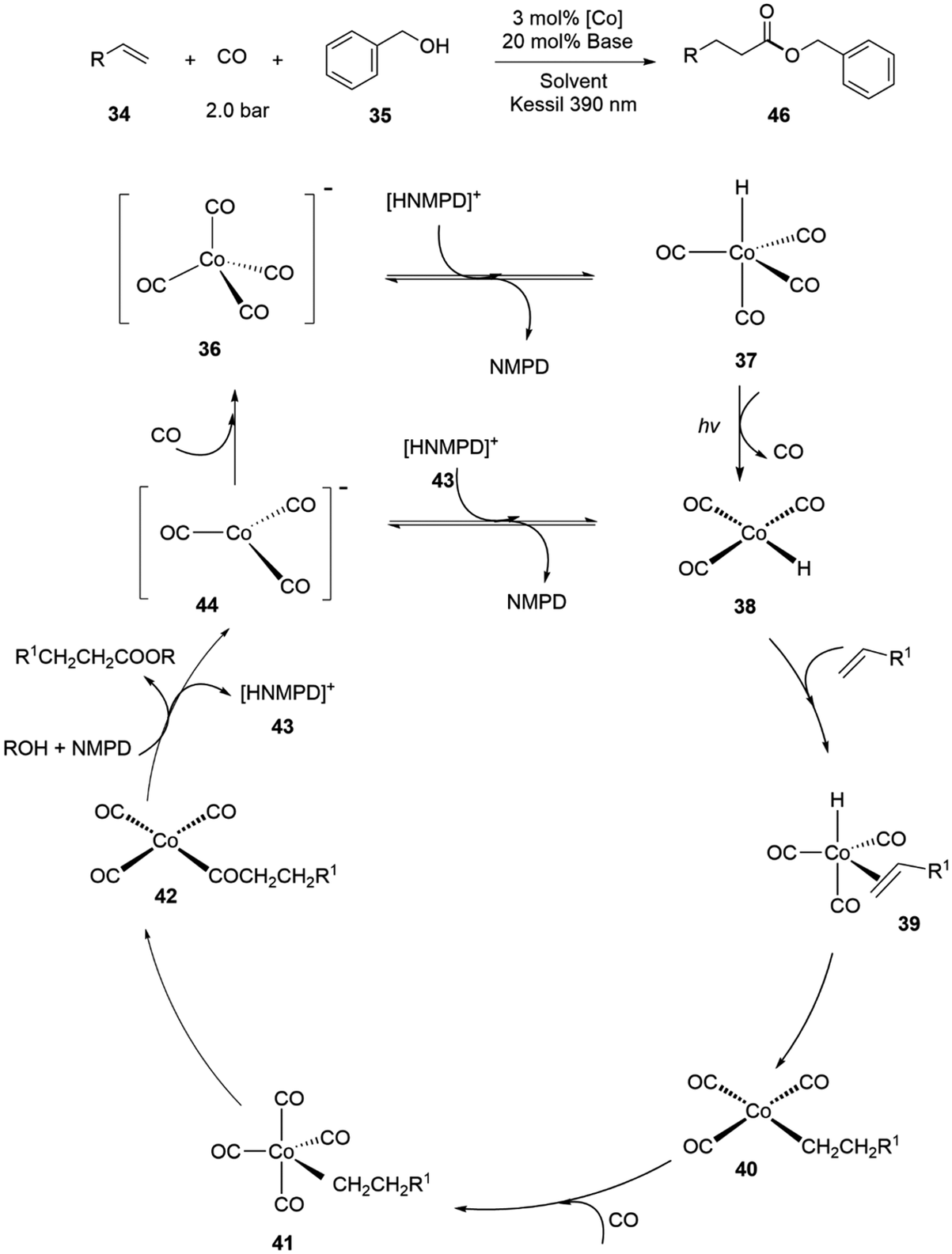
Cobalt has been demonstrated to be highly active in photo-assisted carbonylation upon blue light irradiation (390 nm). The group of Alexanian reported the use of Co2(CO)8 as a catalyst precursor for the aminocarbonylation of olefins, achieving high regioselectivity under mild conditions [Reference Faculak, Veatch and Alexanian17]. Mechanistic studies suggested that Co2(CO)8 undergoes disproportionation in the presence of a base to generate Co(CO)4-. This intermediate subsequently releases one CO ligand and undergoes protonation to form HCo(CO)3, which is proposed to be the key active catalytic species that can drive the reaction in a thermal manner [Reference Lerda, Altun, Faculak, Alexanian and Bistoni82]. Later, the same group demonstrated that, by optimizing the type of base, alkoxycarbonylation with high activity was achieved [Reference Faculak, Rodriguez and Alexanian18]. However, the regioselectivity for linear olefins remained relatively low. In the following year, Peng and Beller employed Co(II) salts as the catalyst precursor and through careful adjustment of the solvent, base, and sub-stoichiometric amount of diketone additive, achieved over 90% selectivity toward linear ester products with a broad substrate scope, ranging from terminal to internal olefins [Reference Peng, Tian and Cao16]. This work represented the first example of Co-catalyzed alkoxycarbonylation featuring controlled chain walking and excellent linear selectivity under mild conditions. DFT calculations revealed a reaction mechanism similar to that proposed by Alexanian and co-workers ( Scheme 7 ). The significant difference in regioselectivity was speculated to originate from the different reaction rates of interception of the acylcobalt intermediates derived from linear olefins. These kinetic differences determine whether complete isomerization of the acyl-cobalt intermediates can occur prior to product-forming steps, thereby governing the final regioselectivity.
Proposed catalytic cycle for the light-driven Co-catalyzed alkoxycarbonylation [Reference Peng, Tian and Cao16].

Scheme 7. Long description
The top section shows a general reaction equation where an alkene 34 reacts with C O at 2.0 bar and benzyl alcohol 35 in the presence of 3 mol percent C o catalyst, 20 mol percent base, solvent, and Kessil 390 nm light to yield ester 46.
The catalytic cycle below consists of nine numbered chemical structures arranged in a clockwise loop.
1. At the top left is complex 36, a C o C O sub 4 anion.
2. An equilibrium arrow involving H N M P D plus and N M P D leads to complex 37, a neutral H C o C O sub 4 species.
3. Light h nu and loss of C O leads to complex 38, a coordinatively unsaturated H C o C O sub 3.
4. Addition of an alkene R super 1 C H C H sub 2 leads to complex 39, where the alkene is pi-coordinated to the C o center.
5. Migration leads to complex 40, an alkyl-C o C O sub 3 species.
6. Addition of C O leads to complex 41, an alkyl-C o C O sub 4 species.
7. C O insertion leads to complex 42, an acyl-C o C O sub 4 species.
8. Reaction with R O H and N M P D releases the ester product R super 1 C H sub 2 C H sub 2 C O O R and generates H N M P D plus 43, leaving complex 44, a C o C O sub 3 anion.
9. Addition of C O to complex 44 completes the cycle by returning to the starting C o C O sub 4 anion 36.
Despite the significant advancements achieved in this field, the majority of the reported photocatalytic carbonylation reactions still rely heavily on pre-functionalized substrates. Moreover, undesired side reactions originating from the high reactivity of carbon-centered radical intermediates continue to motivate the development of more efficient catalysts and catalytic systems for photocatalytic carbonylation chemistry. Carbonylation reactions involving alkanes are appealing, but they remain highly challenging, largely due to the instability of the generated aldehyde products and the competing decarbonylation pathways, which significantly limit substrate conversion and product selectivity. Therefore, further efforts toward the development of robust catalytic systems capable of enabling efficient and selective carbonylation under mild conditions are still highly desirable.
3. Photocatalytic Carbonylation with Heterogeneous Catalysts
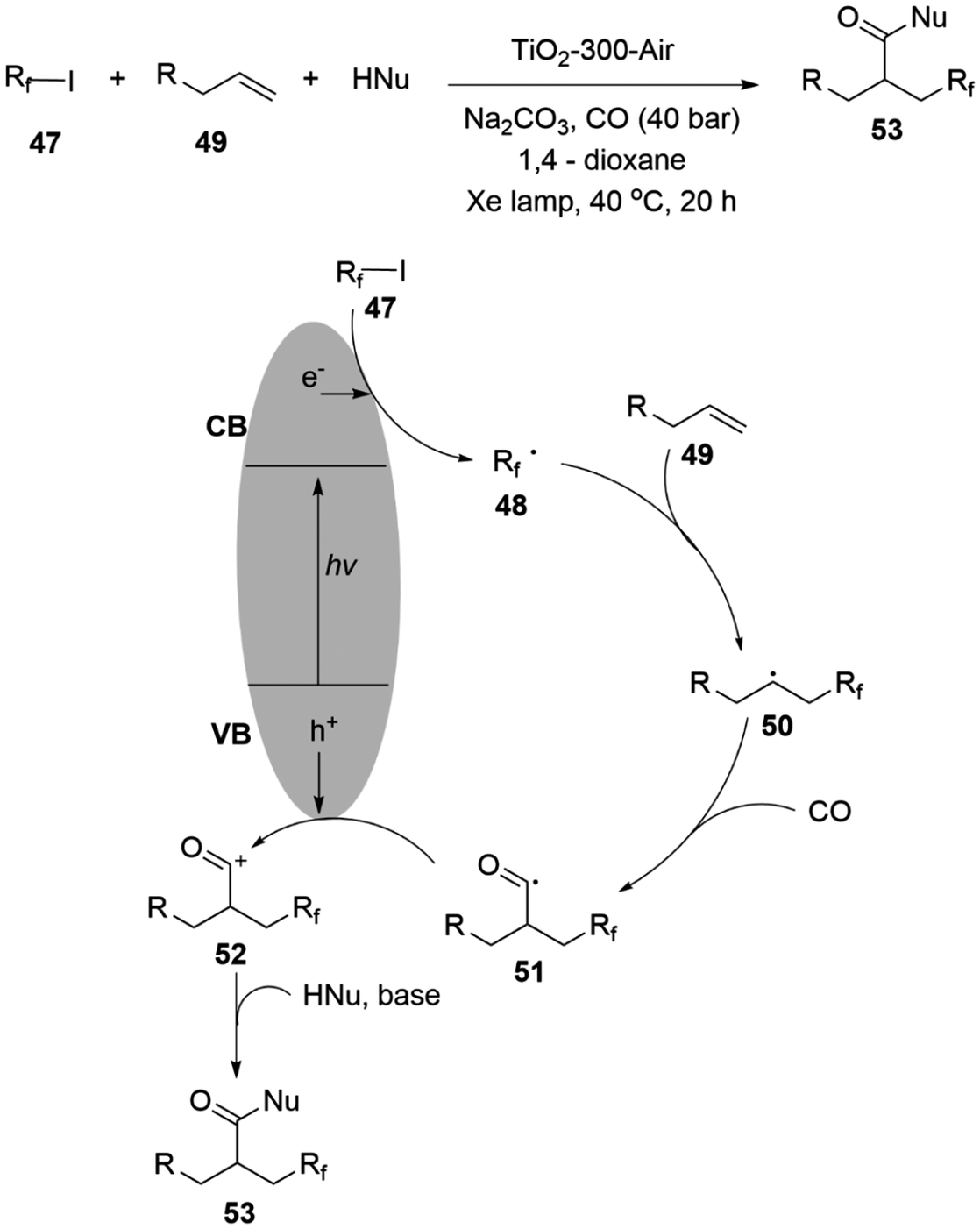
Heterogeneous photocatalytic carbonylation systems remain less explored compared with homogeneous systems. One representative example was reported by the group of Wu, where bare TiO2 was employed as the photocatalyst to initiate radical formation from perfluoroalkyl iodides ( Scheme 8 ) [Reference Yang, Yang, Wu and Chen83]. In the proposed mechanism, the excited electrons from the conduction band of TiO2 dissociate the C–I bond and generate a perfluoroalkyl radical, then underwent addition reaction with olefins to intermediate 50, followed by CO insertion and nucleophilic attack. Even though a broad substrate scope was demonstrated in this work, the transformation still relies on perfluoroalkyl iodides, a type of common activated radical precursor.
Proposed mechanism for photocatalytic carbonylation reaction with perfluorobutyl iodide as the substrate catalyzed by TiO2 [Reference Yang, Yang, Wu and Chen83].

Scheme 8. Long description
The top section shows a general reaction equation where R sub f dash I (47) plus an alkene (49) plus H N u yields product 53. The reaction conditions listed over the arrow are T i O sub 2 dash 300 dash Air, N a sub 2 C O sub 3, C O (40 bar), 1,4 dash dioxane, Xe lamp, 40 degrees Celsius, and 20 h.
The bottom section is a catalytic cycle centered on a vertical gray oval representing the T i O sub 2 catalyst. Inside the oval, light energy (h v) excites an electron (e super minus) to the conduction band (C B) and leaves a hole (h super plus) in the valence band (V B).
1. At the top right of the catalyst, R sub f dash I (47) accepts an electron from the C B to form the radical R sub f dot (48).
2. R sub f dot (48) reacts with alkene 49 to form radical intermediate 50.
3. Intermediate 50 reacts with C O to form acyl radical 51.
4. Acyl radical 51 is oxidized by the hole (h super plus) in the V B to form acyl cation 52.
5. Acyl cation 52 reacts with H N u and base to yield the final product 53.
There are some works reported the activation of methane and conversion to acetic acid [Reference Li, Liu and Mao84,Reference Dong, Marinova and Tayeb85] and acetone [Reference Zhang, Cai and Cui86] by a photocarbonylation process. The core idea is still the generation of a methyl radical (e.g., via a hydroxyl radical), and in most of the cases, side reactions cannot be avoided. In addition, no reports have demonstrated the substrate scope of the proposed catalysts and the developed methodology, showing still very large limitations to be used as a universal toolkit for different types of alkane transformations via photocatalytic carbonylation.
Beyond radical pathways initiated by activated radical precursors, heterogeneous platforms also enable non-radical carbonylation via two-electron organometallic cycles, and can additionally employ CO2 as the C1 feedstock in place of toxic pressurized CO. In this context, Zhang and co-workers developed a multicomponent MOF photocatalyst (Cu1Pd2)z@PCN-222(Co) (z = 1.3, 2.0, and 3.0 nm) for coupling CO2 photoreduction and Suzuki/Sonogashira reactions, achieving one-pot visible-light-driven carbonylation of aryl iodides with arylboronic acids under 1 atm CO2 at room temperature, with benzophenone derivatives obtained in over 90% yield and 97% selectivity [Reference Fu, Yao and Guo87]. Control experiments demonstrate that Co(II)-porphyrin single sites are responsible for the CO2 reduction to CO, while Cu1Pd2 nanoparticles are responsible for the carbonylation process. Notably, the integrated MOF far outperformed a physical mixture of the individual components (97.2% vs. 51.1% selectivity), highlighting the benefit of confining the in situ generated CO near the carbonylation active sites. However, the proposed carbonylation cycle, including oxidative addition of aryl iodide to Pd, CO insertion, transmetalation with the arylboronic acid, and reductive elimination (Scheme 9), consists of elementary steps that are thermodynamically feasible with Pd-based catalysts, and although the authors observed that a CO-atmosphere experiment in the dark afforded no product while irradiation gave 92.8% yield, the precise role of light in the Pd-catalyzed coupling itself was not mechanistically elaborated. This example therefore also underscores the need for rigorous dark and thermal control experiments to distinguish genuine photocatalytic contributions from possible thermal or localized-heating effects in such tandem heterogenized systems.
Proposed mechanism for the photocatalytic ketone production using CO2 as the carbonyl source with (Cu1Pd2)1.3@PCN-222(Co) as the catalyst. Figure adapted from ref. Reference Fu, Yao and Guo87 with Permission. Copyright 2021 American Chemical Society.

Scheme 9. Long description
The image is divided into three main sections.
1. Top Reaction Equation: A chemical equation shows iodobenzene (labeled 54) reacting with phenylboronic acid (labeled 55) over a catalyst with light (h nu), C O sub 2, and T E A. This yields benzophenone (labeled 56) and biphenyl (labeled 57).
2. Bottom-Left Energy Diagram: A vertical energy scale shows a H O M O level at the bottom with green spheres representing holes (h super plus) and a L U M O level at the top with pink spheres representing electrons (e super minus). The energy gap is 1.02 e V. A dashed blue line indicates a potential of minus 0.53 V versus N H E for C O sub 2 forward slash C O. A sun icon radiates light toward a hexagonal framework structure containing a small green and red cluster. An inset shows a porphyrin-like molecule where C O sub 2 is reduced to C O by two electrons.
3. Bottom-Right Catalytic Cycle: A clockwise circular flow describes the mechanism.
- Oxidative addition: Iodobenzene attaches to a green and red catalyst cluster.
- C O insertion: A C O molecule is incorporated into the complex.
- Transmetalation: Phenylboronic acid reacts with the complex in the presence of K sub 2 C O sub 3.
- Reductive elimination: The final benzophenone product is released, regenerating the catalyst cluster.
Photothermal carbonylation as a strategy has also been reported with halogenated alkyl as the substrate [Reference Lu, Chen and Lu88]. However, the actual contribution of light remains unclear, since localized heating generated under irradiation may dominate the catalytic activity. Therefore, careful control experiments under dark and thermal conditions are necessary to distinguish genuine photocatalytic effects from purely thermal processes.
Catalyst leaching should be taken with serious caution in heterogeneous catalyst-based systems. For catalysts containing Co, Cu, Pd, or related metals, dissolved homogeneous species via CO coordination may actually serve as the active catalytic species during the reaction. Consequently, filtration experiments, recycling studies, and ICP analyses are essential to distinguish truly heterogeneous catalysis from homogeneous catalysis.
4. Outlook and Perspective
Despite the limited number of publications, photo-assisted carbonylation using heterogeneous catalyst-based systems offers promising opportunities for future development, particularly because of the recyclability and facile recovery of heterogeneous catalysts. Based on the currently proposed reaction mechanisms for photo-assisted carbonylation, two major research directions can be anticipated.
The first direction involves radical-mediated carbonylation through rational catalyst design. It has been reported that chalcogenide semiconductors can activate C–H bonds through HAT processes under light irradiation [Reference Chai40,Reference Huang, Ci and Qiao89]. Therefore, semiconductor materials such as CdS, ZnS, and MoS2 may provide promising opportunities as photocatalysts or cocatalysts for photo-assisted carbonylation reactions. When coupled with transition-metal sites acting as radical trapping centers, the generated carbon-centered radicals may subsequently undergo CO insertion to form acyl-metal intermediates, followed by nucleophilic addition toward the target products. However, the photo-corrosion of chalcogenide-based catalysts should be carefully avoided. In addition, considering the activity of POMs for challenging sp3 C–H carbon activation, POMs immobilized on semiconductor materials or porous platforms may also provide opportunities for designing efficient heterogenized photocatalysts for carbonylation reactions.
Another attractive strategy involves the construction of well-studied homogeneous catalysts immobilized within solid frameworks, including porous organic polymers (POPs), covalent organic frameworks (COFs), metal–organic frameworks (MOFs) [Reference Daliran, Oveisi and Peng90,Reference Geng, He and Liu91,Reference Mohamed, EL-Mahdy, Kotp and Kuo92]. Those porous materials provide unique opportunities for microenvironment engineering [Reference Peng, Sanati, Morsali and García93], enabling the framework to function not only as support, but also as the ligand-like environment that can regulate the electronic and steric properties of the active centers, while preventing catalyst leaching. These heterogenized systems may combine the tunability and mechanistic understanding of homogeneous catalysts with the stability and recyclability of heterogeneous catalysts (Scheme 10). More importantly, immobilized molecular catalytic sites could enable the direct transfer of catalyst design principles from homogeneous carbonylation chemistry into heterogeneous photocatalytic systems.
Proposed future directions for photo-assisted carbonylation: merging the high activity and selectivity of homogeneous systems with the recyclability of heterogeneous catalysts through porous frameworks (MOFs, COFs, and POPs).

Scheme 10. Long description
The top of the diagram shows a chemical reaction: R minus X plus C O plus N u minus H, over an arrow labeled h v and Photocatalyst, yields a molecule with an R group and N u group bonded to a central carbonyl C double bond O.
On the left, two panels compare current systems. The top panel, Homogeneous, shows a molecular catalyst model with checkmarks for High Activity and High Selectivity, but an X for Poor Recyclability. The bottom panel, Heterogeneous, shows blue clusters on a gray lattice with a checkmark for Easy Separation.
Two curved arrows from these panels converge into a single green arrow labeled Merging Merits: Activity and Selectivity plus Recyclability. This arrow points to a circular diagram on the right titled Future Direction: Porous materials platform.
At the center of the circle is a green hexagonal lattice containing molecular catalysts. The outer ring of the circle is divided into three segments labeled with the initialisms M O F s, C O F s, and P O P s.
Operando spectroscopic techniques, including in situ DRIFTS, EPR, and X-ray absorption spectroscopy (XAS), are expected to play a critical role in identifying short-lived radical intermediates and tracking the evolution of metal-carbonyl species under working conditions. Such mechanistic insights will be essential for the rational design of next-generation heterogenized photocatalysts and for distinguishing truly heterogeneous pathways from possible homogeneous leaching.
Reactor design should also play an important role in efficient photo-assisted carbonylation reactions. In systems with semiconductor-based photocatalysts, the generated products, e.g., aldehydes and other oxygenated hydrocarbons, are liable to further oxidation with the generated holes under the irradiation conditions [Reference You, Han and Sun94,Reference Peng, Rabeah, Junge and Beller95,Reference Jiao, Zhang, Hao, Yu and Lv96], which is one of the major challenges in achieving high selectivity and practical scalability. Therefore, the appropriate reactor design (e.g., the development of flow reactors or circulation reactors) [Reference Peng, Rockstroh and Rabeah41,Reference Raymenants, Masson, Sanjosé-Orduna and Noël76,Reference Forni, Gandhi and Polyzos97] that allows timely isolation of the labile oxidation product from the reaction system will be crucial for future applications of heterogeneous photo-assisted carbonylation.
Open peer review
To view the open peer review materials for this article, please visit http://doi.org/10.1017/S2978169826000033.
Financial Support
We acknowledge financial support from Beihang University (501GJHZ2026127001).
Author Contributions
All authors contributed to the writing, revision, and final approval of this manuscript.
Competing Interests
The authors declare that they have no competing interests.
Data Availability Statement
Data availability is not applicable to this article as no new data were created or analysed in this study.




 Open access

