


Introduction
Ceramic style (including morphology and function) continues to dominate archaeological approaches to domestic pottery studies that aim to explore vessel function, foodways, social organisation, household economy, aesthetics and identity, among other topics (Sinopoli Reference Sinopoli1991; Price Reference Price2015). Irrespective of the theoretical lens of study—ecological (adaptive), functional or symbolic (Skibo Reference Skibo2013)—one of the biggest conundrums in archaeological ceramic studies is the relationship between stylistic attributes and technological choices (Lechtman & Merrill Reference Lechtman and Merrill1977). The unique insights that ceramic petrography—the study of mineralogical and microstructural composition—offers for understanding production processes, clay sourcing and local mineralogical provenance, and for the interpretation of potters’ choices of clay fabric groups, aplastic inclusions and other raw materials for fashioning various types of domestic pots, are widely recognised (e.g. Quinn Reference Quinn2013; Roux Reference Roux2019). Yet, this approach is only just beginning to gain traction in African archaeology (e.g. de Souza & Ownby Reference de Souza and Ownby2022; Bajeot et al. Reference Bajeot2024; Han et al. Reference Han2025). A few recent projects in West Africa have sought to integrate petrographic methods into ceramic analysis to distinguish local from non-local ceramic production, reconstruct raw material sourcing and processing, and investigate social relationships, networks of exchange and migrations, mostly in village and small-scale sociopolitical contexts (Orijemie et al. Reference Orijemie2021; Tsoupra et al. Reference Tsoupra2022; Gokee Reference Gokee2025). Building on these recent studies, this article presents the first major study of ceramic petrography in Yorùbá archaeology. It seeks to understand the relationships between mineralogical composition, tempering practices and clay-procurement strategies, on the one hand, and stylistically diverse assemblages, on the other, in state-level and specialised craft contexts (Ogundiran Reference Ogundiran2020). The study addresses questions regarding provenance, technology, ceramic paste and the intercommunication and circulation of knowledge among different stylistic groups. It offers the largest sample size for a petrographic study in Nigerian archaeology.
This study uses the mineralogical attributes of cooking and serving wares, as well as smoking pipes excavated from communal midden, residential and market sites in the Early Òṣogbo settlement, located in present-day south-west Nigeria (Figure 1), to investigate the relationship between ceramic stylistic groups (complexes) and clay fabrics/clay sourcing. The goal is to understand ceramic crafting technology across three ceramic stylistic groups and between earthenware and smoking pipes. Early Òṣogbo was an important internal frontier market town in the Upper Ọ̀ṣun area of the central Yorùbá region between c. AD 1590 and 1725. Previous studies have described it as an emergent frontier settlement, located at the crossroads of regional trading and political networks on the edges of three major political centres—Ọ̀yọ́, Iléṣà and Ilé-Ifẹ̀—and plugged into far-flung commercial networks, from the Atlantic Coast to the West African Sahel (Figure 2A; Ogundiran Reference Ogundiran2014). Not only that, unlike other contemporaneous settlements in the Upper Ọ̀ṣun area, which are dominated by a single ceramic complex during this period (Ogundiran Reference Ogundiran2001, Reference Ogundiran, Monroe and Ogundiran2012), Early Òṣogbo has yielded an unprecedented diversity of ceramic forms and decorative motifs representing three regional ceramic complexes—the Ọ̀ṣun, Ọ̀yọ́ and Ifẹ̀ complexes. A fourth, called ‘General Complex’, comprises forms and styles that cut across and go beyond these three ceramic complexes.
The Yorùbá region, showing the study area (Upper Ọ̀ṣun) (figure by authors).

Early Òṣogbo in the contexts of: A) the Ọ̀yọ́ Empire (AD 1570–1836); and B) the Ifẹ̀ Empire (AD 1100–1420) (figure by Akin Ogundiran).

Historical context
The Early Òṣogbo settlement was established at the end of the sixteenth century (Ogundiran Reference Ogundiran2014). Located in the transitional zone between the rainforest and woodland savanna (Figure 2A), the settlement thrived as a borderland and frontier market town between two hegemonic states—the Ọ̀yọ́ Empire and the Iléṣà Kingdom. Although Early Òṣogbo came under the political control of Iléṣà, it was open to the itineraries of traders, political emissaries and other travellers shuttling between the rainforest and the woodland savanna zones, and between the Ọ̀yọ́ Empire metropolis in the north and several rainforest principalities in the south, all the way to the Atlantic coast. Three radiocarbon dates obtained from the site—from a refuse/multipurpose deposit—give large standard deviations that weaken their value for finer-scale estimation of the site’s age. This is due to high fluctuations and artificial boosting of carbon in the atmosphere as a result of the combustion of fossil fuels and nuclear bomb effects over the past 300 years. However, the calibrated age of the dates is consistent with the chronological frameworks of oral traditions and artefacts of known age, such as smoking pipes and cowrie shells, that place the occupation of Early Òṣogbo in the late sixteenth through the early eighteenth century (Ogundiran Reference Ogundiran2014: 8).
A petrographic research agenda
Previous studies have established that three ceramic complexes and, by extension, three ceramic craft communities are represented in the Early Òṣogbo ceramic assemblage: Ọ̀yọ́, Ifẹ̀ and Ọ̀ṣun (Figures 3 & 4; Ogundiran Reference Ogundiran2014). The Ọ̀ṣun ceramic complex was assessed, based on morphology and style, to be an offshoot of the Ifẹ̀ complex (Ogundiran Reference Ogundiran2001). The presence of these three ceramic complexes in Early Òṣogbo reflects the settlement’s profile as a node of intense mobility, regional interactions and commercial networks (e.g. specialists and their crafts). Previous interpretations suggest that the ceramic forms of the Ọ̀yọ́ and Ifẹ̀ complexes were brought into Early Òṣogbo as trade items, and that the majority of Ọ̀ṣun pottery was made at or near the settlement. However, the question about provenance is something that petrographic study can answer more satisfactorily than stylistic study. If, indeed, this convergence of ceramic complexes originated from trade and different production sites, then we would expect their clay minerals to differ from one another, consistent with different geologies of production. However, if the vessel forms originated from potters residing at or near Early Òṣogbo, but working in different stylistic traditions and craft communities, we would expect the pottery across the three complexes to have the same or similar mineralogy and microstructure profiles. Those similarities might also originate from the exchange of ideas about clay sourcing and forming techniques.
Vessel forms, lids and tobacco pipes mentioned in the text. Images shown are not to scale and were not necessarily sampled for thin section (illustrations by Moses Ogunleye).

A sample of vessel forms from Early Òṣogbo used for thin section (illustrations by Rhys Riley & Akin Ogundiran).

Based on these hypotheses, this petrographic analysis seeks to answer the following questions:
-
1. How did the interstitial and frontier location of Early Òṣogbo affect the production, distribution and consumption of domestic pottery? Did a new ceramic-knowledge network develop because of the convergence of people and domestic pottery from different parts of the region in Early Òṣogbo?
-
2. What insights do the clay minerals of domestic ceramics provide about the regional population movements and commercial/political networks in Early Òṣogbo between 1590 and 1725?
-
3. What is the relationship between vessel forms and clay sourcing/forming techniques? Did vessel forms reflect specialisation in the use of certain clay types and forming techniques? Which vessel forms share the same mineral attributes and which do not, and what are the implications for mapping regional exchange networks in the central Yorùbá region during the sixteenth and early seventeenth centuries?
-
4. What are the relationships, in terms of clay minerals, between domestic ceramics and clay smoking pipes, and what do they tell us about any possible overlaps between these two different ceramic technologies?
Geological setting
Geologically, the study area (Òṣogbo) is underlain by the Precambrian Basement Complex terrains (gneiss and granites) that straddle south-western Nigeria (Ayodele Reference Ayodele2013). The dominant geological substrates and rock supergroups in the study area are variations of migmatite complexes, predominant granite gneiss, pegmatite and amphibolite, as well as lower-order mica and quartz schists formation along deeply weathered soil profiles (Rahaman & Ocan Reference Rahaman and Ocan1978). The parent schists derive from mica and sillimanite-rich quartzites, with several peaks of minor basic and ultrabasic rocks that characterise the groundmass along the southern parts of present-day Òṣogbo. Field surveys by the authors show weathering and decomposition of these rock substrates in the study area, especially in archaeological and road-cut contexts. Accordingly, numerous mineable clay deposits were observed, and these are largely composed of kaolinite and mica, derived from silicates formed in waterlogged regions. We conclude that two clay types are predominant in the region: non-plastic kaolin, derived from a pegmatite and granitic rock; and mica-rich clay derived from mica schist. Using Arc-GIS10 and Google Earth modelling to analyse the Nigerian geological map (Figure 5), we estimate that Early Òṣogbo and Upper Ọ̀ṣun in general lie on undifferentiated older granite and schist amphibolite, metavolcanics with pegmatite complex, porphyritic granite lithologies and numerous migmatites. This geologic provenance study enables us to identify the localised attributes of clay mineral constituents and morphology types.
Geology of Upper Ọ̀ṣun and the surrounding areas (estimations from sourcing of clays based on Arc-Catalog tools, proximity and buffer linear approximations modelled in Arc-GIS10) (figure by Bongumenzi Nxumalo using geologic data from the Nigeria Geological Survey (NGSA) geodata centre; https://ngsa.gov.ng/geodata-centre/).

Petrographic analysis: methods and procedures
Forty-three ceramic samples, comprising bowls, bowl lids and smoking pipes, excavated from stratified deposits in the Early Òṣogbo settlement (c. 1590–1725), were selected for thin-section analysis. Published petrographic studies in West African archaeology have tended to rely on small sample sizes (usually fewer than 25) and lack transparency regarding why and how the samples were selected (for an exception, see Gokee Reference Gokee2025). A large sample was selected to capture a wide range of technological variability within and between the three stylistic groups in Early Òṣogbo, thereby enabling confident distinction between dominant and rare fabric groups and strengthening interpretations of fabric selection, such as knowledge transmission and learning.
Bowls, lids and smoking pipes were selected because they can be easily transported long distances from their place of production and therefore are relevant to exploring questions about regional networks, the movement of people and goods and the exchange of ideas. Only rim sherds or nearly complete ceramic forms were selected because these can be reconstructed into their original shape, making it possible to relate clay minerals to vessel forms. Serving and cooking bowls and their lids, as well as smoking pipes, are also privileged in the sampling because they are often associated with identity-making practices at the group and individual levels. Therefore, based on these criteria for sample selection, clay minerals and forming techniques observed in thin sections can be related to the social uses of these artefacts. All selected ceramics have already been classified into typological-functional types using the pottery attributes developed by Ogundiran (Reference Ogundiran2001, Reference Ogundiran2014) for the Yorùbá region. Of the 43 samples, 20 belong to serving bowls, seven to cooking bowls, two to storage/special-purpose bowls, four are lids and 10 are smoking pipes (see Figure 3). Serving bowls are usually associated with social, symbolic and performative acts of foodways, and they have more morphological variations than other functional groups. For these reasons, they account for nearly half of the total petrographic samples.
The thin sections were produced at Quality Thin Section, a commercial laboratory in Tucson, Arizona (USA), and the petrographic analysis of the slides was carried out at the Material History Lab at Northwestern University, Illinois (USA). Using a Nikon Eclipse optical (plane and polarised) light microscope, the current study adopted the optical mineralogy assessment approach (see Quinn Reference Quinn2013) to examine ceramic and smoking-pipe fabric compositions, inclusions and voids with the goal of identifying clay mineral attributes and reconstructing forming processes. For petrographic interpretation, this study draws on published micro-morphological classification schemes (e.g. French Reference French2003; Macphail & Goldberg Reference Macphail and Goldberg2018), the sediment matrix composition observed during field surveys and published geological maps for Upper Ọ̀ṣun and the surrounding areas.
Clay fabric group types
Petrographic analysis identified three types of clay, each with different mineralogical and granulometric attributes.
Group 1 fabrics consist of fine- to coarse-grained clay (0.05–0.10mm) rich in mica (muscovite/biotite) and polycrystalline quartz, with smaller amounts of feldspar, mainly plagioclase (Figure 6). The fabrics are generally poorly sorted and highly porous, with abundant vughs (cavities) and large pore spaces. Quartz crystals form the dominant inclusions (around 35%), accompanied by muscovite mica and occasional biomicritic infill, while feldspar occurs in smaller quantities (around 15%). The mineral and textural properties of the fabric are characteristic of kaolinite clay from a mature profile derived from granitic geological substrates rich in quartz and mica. This fabric group is the second most common in the assemblage, accounting for 40 per cent of the serving bowls and 28.5 per cent of the cooking bowls, indicating that potters routinely used this clay source for multiple vessel types.
Group 1 fabric. Thin section of sample OSG005 under plane- (A) and cross-polarised (B) light showing elongated muscovite mica (orange arrows) and angular to rounded quartz grains (approximately 0.05mm) arranged in a poorly developed banded sorting. Numerous opaque inclusions are present, including iron nodules, charcoal and abraded plant remains (red dashed line). Also shown is a thin section of sample OSG054 under plane- (C) and cross-polarised (D) light, revealing a reddish-brown clay matrix that contains dusty clay coatings and yellowish-brown bioclastic infill (yellow dashed line), likely derived from carbonate-rich material. The fabric also exhibits opaque inclusions, iron nodules, charcoal and abraded plant remains (red dashed line). Magnification 20× (figure by Bongumenzi Nxumalo).

Group 2 fabrics are characterised by very fine-grained clay (approximately 0.05mm) dominated by mica minerals, particularly biotite and muscovite, with occasional larger quartz grains (up to 0.10mm) (Figure 7). The inclusions show no clear orientation, and the fabric is generally poorly sorted, with frequent pore spaces. Mineral grains sometimes appear weakly banded and interlocking, forming a compact, grain-supported structure. Biotite (approximately 30%) and feldspars—especially perthite and plagioclase with parallel twinning—are common, dispersed as angular to sub-rounded grains within the fine clay matrix. The fabric also contains consistent opaque oxides and nodules, likely produced during firing (Mercader et al. Reference Mercader2000).
Group 2 fabric. Thin section of sample OSG031 under plane- (A) and cross-polarised (B) light, showing feldspar grains, including perthite (orange dashed lines), dispersed within a very fine clay matrix; weakly formed fractures are visible in some grains. Also shown is a thin section of sample OSG044 under plane- (C) and cross-polarised (D) light, revealing feldspar crystals with albite and pericline twinning (yellow dashed line), forming a cross-hatched (‘tartan’) pattern (Chernet Reference Chernet2010). The groundmass contains potassium feldspars (microcline and plagioclase) and muscovite mica, along with numerous opaque inclusions, such as iron nodules and charred plant remains. Magnification 10× (figure by Bongumenzi Nxumalo).

The mineral composition suggests clays derived from metaluminous granitic and perthite-rich substrates, with contributions from metamorphic sources such as medium-grade schists. The abundance of mature earth minerals—including quartz, kaolinite, biotite and nesosilicates—indicates a mineralogically mature clay that required little or no added temper. Group 2 is the most common fabric in the assemblage, accounting for 42 per cent of domestic pottery and 40 per cent of smoking pipes, making it the dominant clay source used in Early Òṣogbo.
Group 3 fabrics range from fine- to coarse-grained (0.05–0.10mm) and are distinguished by a microlaminated clay matrix (Figure 8). The fabrics contain abundant mica (muscovite and biotite), fractured polycrystalline quartz and feldspars, mainly plagioclase and microcline.
Group 3 fabric. Thin sections of sample OSGX118 under plane- (A) and cross-polarised (B) light, showing a rock fragment composed of interlocking polycrystalline quartz grains (green dashed line) and plagioclase feldspar overgrowth (yellow arrows), typical of clays derived from metamorphic rocks. The dark reddish-brown mineral grains are likely due to firing, and the dark banded lines in the fabric are associated with hematite and quartz overgrowth. Also shown is a thin section of sample OSGX117 under plane- (C) and cross-polarised (D) light, revealing elongated quartz grains and banded biotite mica interlocking within the clay matrix. The fabric forms microlaminated layers of very fine clay with dispersed mica (biotite and muscovite) and opaque inclusions (red dashed lines). Magnification 10× (figure by Bongumenzi Nxumalo).

Two variants are present. Variant 8A shows mixed fine and coarse inclusions associated with pegmatite-rich granitic substrates, including microcline feldspar, pyroxene and amphibole, with accessory minerals such as calcium carbonate, chlorite and hornblende. This fabric is slightly porous, moderately to well sorted and forms a compact, grain-supported structure. Variant 8B contains mostly fine inclusions, with occasional coarser grains (up to 0.10mm), dominated by plagioclase feldspar consistent with metamorphic, granoblastic substrates. This variant, in contrast to 8A, is more porous, poorly sorted and comparatively loose.
Overall, Group 3 fabrics contain diverse mineral inclusions—feldspars, quartz and muscovite—which sometimes interlock to produce a banded appearance. Feldspar grains display moderate relief and common twinning. Although the fabric is texturally mature, with a well-sorted fine groundmass, it is mineralogically immature due to the high proportion of feldspar (around 55%) relative to muscovite (around 30%) and quartz (around 15%). The matrix also shows microlaminated stacking, iron-oxide halos and reddish-brown grain-boundary lines consistent with hematite formation during firing.
Notably, the bowls, smoking pipes and pottery lids made of Group 3 fabrics (OSG004, OSG016, OSG018, OSG021, OSG002 and OSG053) show abundant quartz grains (approximately 60%) often with faint cleavage and low relief. There are some polycrystalline quartz grains as well as lithics (around 5%) speckled on microlaminated, very fine groundmass with biotite, muscovite mica and opaque oxides that make up about 35 per cent of the fabric (Figure 9). The clay fabric is texturally and mineralogically mature, and is often iron-stained, with occasional opaque iron oxides, possibly due to firing techniques. The Group 3 clay fabric comes last in popularity, with 27 per cent of the bowls and lids and 50 per cent of the smoking pipes belonging to this group.
Other group 3 fabric. Thin section of sample OSG053 under plane- (A) and cross-polarised (B) light, showing a diamond-like fashioning pattern with tabular quartz grains embedded in muscovite mica (orange arrows) and numerous opaque oxides (red dashed lines) or birefringence (amorphous plant matter and charcoal: green dashed lines). Magnification 40× (figure by Bongumenzi Nxumalo).

Discussion
All the thin sections show that micaceous and kaolinite clays, derived from weathering metaluminous silicate minerals along river-valley or alluvial corridors, were preferred for making bowls and smoking pipes. The pastes largely contain naturally occurring earth minerals derived from exposed granites and porphyritic substrates, fayalite, pyroxene, amphibole and hornblende, biotite mica, quartz, feldspars and opaque iron oxides. Notably, outcrops of igneous and granite rocks are common in the study area, and the site itself is adjacent to the Ọ̀ṣun River. Across all the clay mineral groups and ceramic complexes, temper was rarely used for pottery forming. However, in rare cases—for example, samples OSG039 and OSG053 (lids, General)—there are indications that angular and elongated quartz grains, as well as muscovite mica were systematically added in the calcareous clay paste. That is, the rock fragments, feldspars and quartz grain minerals are inserted between the diamond-shaped clay fabric (see Figure 9). Also, there are indications that grog from old ceramics was used as temper in OSG051 (a serving bowl, Ọ̀yọ́) and OSG054 (a bowl lid, General).
The micaceous and kaolinite clays are optimal in pottery production because they do not require temper. Vessels made of these types of clays have low primary permeability and a high level of heat retention, advantageous for cooking and storage bowls. Pots made with micaceous-kaolinitic clays cook food faster, retain heat longer and keep food fresh and warm longer because they are not as porous as pots made from the highly plastic red ferruginous clay more commonly found in the region. The implication is that these bowls, often with their tight lids, kept the food warm for several hours before it was scheduled for consumption. Current evidence shows that the use of this type of greyish clay (decomposed granite rich in mica and kaolin) in the Yorùbá region (and West Africa in general) began only in the late sixteenth century at Ọ̀yọ́-Ile (Soper Reference Soper1982; Agbaje-Williams Reference Agbaje-Williams1983). Before then, the highly plastic red ferruginous clay was the near-exclusive source for making domestic pottery—jars, vats and bowls—in the region (Ogundiran Reference Ogundiran2001; also see Garlake Reference Garlake1977; Usman Reference Usman2003).
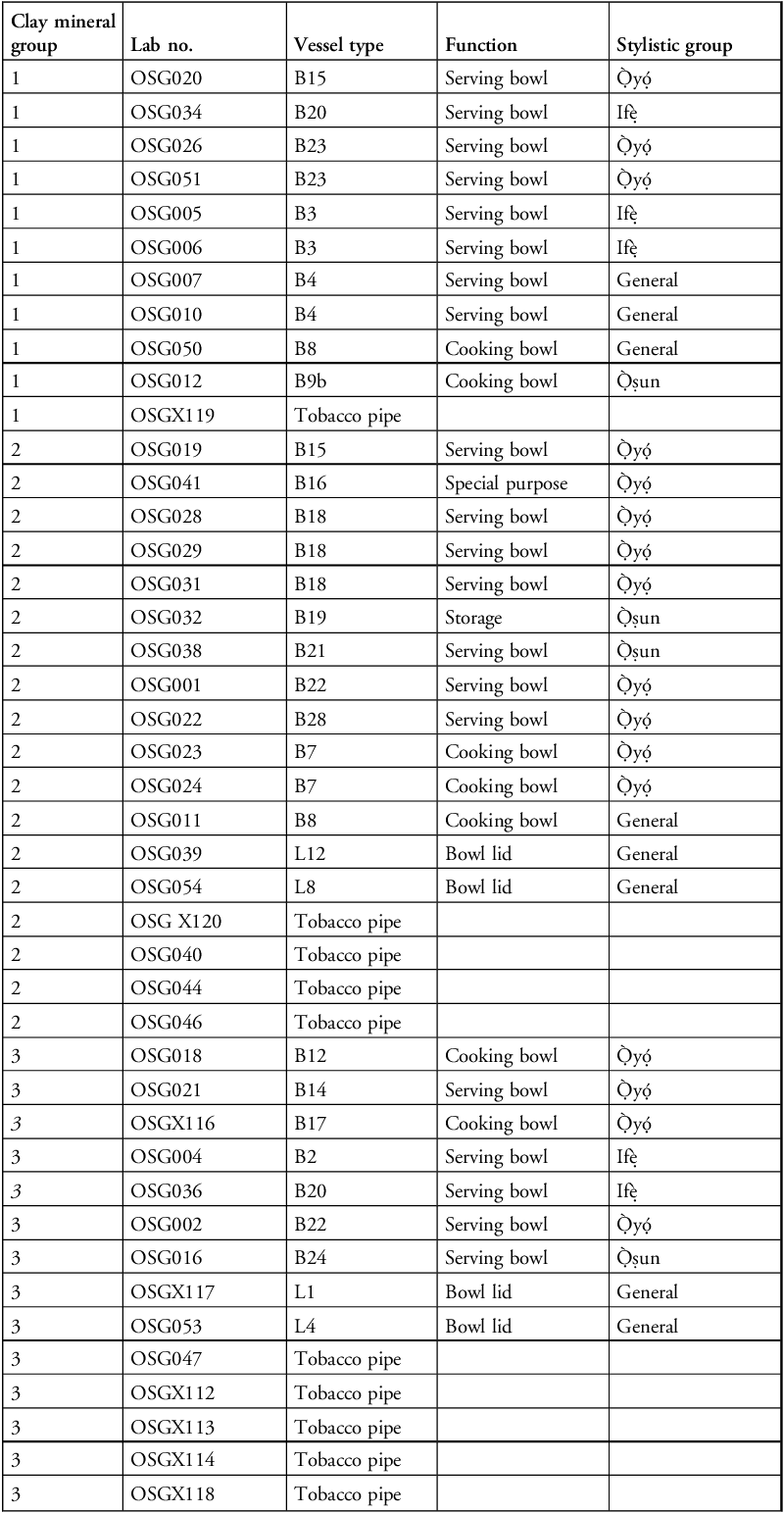
Ceramics from the Ọ̀yọ́ and Ọ̀ṣun complexes and smoking pipes are represented in all three clay fabric groups. More than half (56%) of the forms associated with the Ọ̀yọ́ ceramic complex belong to Group 2, with the other half almost evenly divided between Groups 1 and 3. There is a preference for Groups 2 and 3 clays for the manufacture of smoking pipes (90%). In contrast, the four samples from the Ọ̀ṣun complex are almost evenly split across the three fabric groups. The Ifẹ̀ complex is represented in Groups 1 and 3, and ceramic styles that cut across these three complexes (General complex) are represented in Groups 1 and 2 (Table 1). Although the sample sizes for Ifẹ̀, Ọ̀ṣun and General complexes are small, the overall picture indicates no cumulative relationship between ceramic complex and clay fabric. In other words, potters working in different traditions and ceramic styles used overlapping clay sources, and the clay fabrics indicate a preference for micaceous kaolinitic clays for making bowls and lids. Tobacco pipes also came from similar clay sources. All these complicate the use of style and form attributes for placing domestic pottery within regional or cultural traditions. The distribution of cooking and serving bowls is almost evenly split across the three mineralogical and clay fabrics. The special-purpose bowls are vessels for storing medicine and condiments or used as a spittoon, and both belong to Group 2. The lids are evenly split between Groups 2 and 3.
Relationships between vessel types, functional groups, stylistic groups (ceramic complexes) and clay mineral groups.

Table 1 Long description
The table categorizes ceramics and smoking pipes by clay mineral groups, vessel types, functions, and stylistic groups. It has 4 columns: Clay mineral group, Lab no., Vessel type, Function, and Stylistic group. The table contains 50 rows of data. Each row lists a specific ceramic or smoking pipe sample with its corresponding clay mineral group, lab number, vessel type, function, and stylistic group. The clay mineral groups are numbered 1, 2, and 3. The vessel types include various bowls, bowl lids, and tobacco pipes. The functions are categorized as serving bowls, cooking bowls, storage, and bowl lids. The stylistic groups include Óyó, Ife, General, and others. Notable trends include a preference for Groups 2 and 3 clays for manufacturing smoking pipes and an almost even distribution of cooking and serving bowls across the three mineralogical and clay fabrics.
Beyond this general overview, however, interesting patterns emerge when considering the relationships between vessel forms of a particular ceramic complex and clay fabric groups (see Table 1). First, serving bowls of Ọ̀yọ́ (B15, B23), Ifẹ̀ (B3, B20) and General (B4) complexes, and one Ọ̀ṣun cooking bowl form (B9b) are represented in Group 1. Second, some of the most diagnostic forms of the Ọ̀yọ́ ceramic complex—B16, B18, B22 and B7—are represented in Group 2 clay fabric. It is striking that all three B18 and two B7 samples belong to Group 2, suggesting that the production of these two vessel forms may have been restricted to particular geographies, clay sources and workshops. These contrast with B15, another Ọ̀yọ́ ceramic form that is present in both Group 1 and 2 clay fabrics. Third, two of the most diagnostic of the Ọ̀ṣun vessel forms—B19 (storage bowl) and B21 (serving bowl)—and three General complex forms—B8 (cooking bowl) and lids (L8 and L2)—also belong to Group 2. All of these suggest that potters working in different regional styles and forms (at least the Ọ̀yọ́ and Ọ̀ṣun ceramic complexes) obtained their clay sources from similar geologic zones. Fourth, four forms in the Ọ̀yọ́ ceramic complex (cooking bowls B12, B17 and serving bowls B14 and B22), two Ifẹ̀ serving bowls (B2 and B20), one Ọ̀ṣun serving bowl and two lids of the General complex (L1 and L4) belong to Group 3 clay fabric. Half of the smoking pipes (5) in the sample also belong to this clay fabric.
However, the fact that two or more regional ceramic styles (complexes) belong to the same clay fabric group does not mean that the clays were obtained from the same location. Rather, it suggests that clays of similar attributes, in this case micaceous kaolinite, were either obtained from different sources or potters working in different ceramic traditions migrated through marriage, economic incentives or political reasons to areas where these clays were available and used them for diverse ceramic forms. Hence, the petrographic analysis demonstrates that we must be cautious in making direct correlations between ceramic traditions and geographies of production, and recognise that ceramic production was mediated by technology, clay sources, socio-cultural exchanges and political networks.
The technological groups in this assemblage cut across stylistic spheres. The clay mineral Groups 1 and 3 are represented in the Ọ̀yọ́, Ifẹ̀ and Ọ̀ṣun stylistic groups, whereas Group 2 is represented in the Ọ̀yọ́ and Ọ̀ṣun ceramic complexes. Although there are no defined fabric group types that correspond to vessel functions (serving or cooking) or to ceramic traditions (complex), there are indications of choice. Broadly, households in Early Òṣogbo show a strong preference for bowls with clay fabrics characterised by stoneware-like properties, irrespective of the ceramic complex to which the forms belong. Clay fabrics dominated by pure kaolinite and micaceous attributes were preferred for making serving and cooking bowls because they have high-heat firing tolerance and produce durable vessels.
Also, the strong correlation between particular vessel types and mineral groups is suggestive of craft specialisation. For example, the two B3 vessel type samples (Ifẹ̀ Style) and two B23 samples (Ọ̀yọ́) belong to the Group 1 mineral clay type, while all three B18 and two B7 samples (Ọ̀yọ́) were fashioned with Group 2 clay mineral. All these indicate that workshops specialising in particular vessel types likely obtained their clay recipes from restricted sources, and that potters working in different styles accessed raw materials from similar sources. Additionally, the distribution of Ọ̀yọ́ and Ọ̀ṣun vessel forms across the three clay mineral groups indicates high mobility of potters and/or raw materials (clay). It appears Groups 2 and 3 fabrics were exclusively preferred for making smoking pipes, but this does not mean that the potters of domestic pottery were responsible for the pipes. In fact, the differences in the decoration grammar, surface finish and other stylistic attributes for domestic pottery and smoking pipes indicate that the two artefact types belong to different knowledge systems (Figure 3; see also Ogundiran Reference Ogundiran2014: 12). However, the potters and pipe-makers used clays with similar, and sometimes identical, properties in their respective crafts for the same reasons—textural and mineralogical maturity of clay and high temperature resistance to achieve durability.
Ceramic petrography provides insight into how potters interacted with their geological environment through the choice of clay sources and other recipes used in pottery production. They also interacted beyond their social groups, copying, borrowing and adapting clay fabrics. This study shows that potters working in different ceramic traditions across a large swath of the Yorùbá region (central and northern) between c. 1590 and 1725 preferred particular clays that originated from similar geologic substrates. Stretching between Upper Ọ̀ṣun and the Ọ̀yọ́ metropolis for more than 150km (see Figure 1), a diverse array of bowls originating from different traditions—Ọ̀yọ́, Ifẹ̀ and Ọ̀ṣun, among others—reveals a preference for micaceous kaolinitic clays. This was an innovation in Yorùbá pottery production that originated in the Ọ̀yọ́ metropolis in the late sixteenth century, from which it spread southward along the corridors of Ọ̀yọ́ territorial expansion, multi-directional migrations and commercial networks that linked many parts of the region during the seventeenth and eighteenth centuries (Ogundiran Reference Ogundiran, Monroe and Ogundiran2012).
The selective use of micaceous and kaolinite clays for making serving and cooking bowls eliminated the need for tempering materials. The economies of scale associated with this innovation were substantial. First, it reduced the time and effort required to prepare clay recipes and to form vessels. Second, it gave potters the opportunity to maximise time, labour and social networks in sourcing and storing only these optimal clay types. Third, the adoption of kaolinitic-micaceous clays increased specialisation in the ceramic production chain, from clay mining and transportation to manufacture and distribution. In fact, oral histories suggest that several potters increasingly purchased these kaolinitic-micaceous clays from suppliers rather than spending time mining clays (O’Hear Reference O’Hear1997: 26). Fourth, these high-quality clay recipes fostered standardisation of production and reduced the likelihood of potting failures, from forming to firing, This increased efficiency and consolidated technical knowledge, which in turn supported consistent output. Fifth, the exponential demand for these high-heat-resistant and durable cooking and serving bowls across the West African region, especially in the Bight of Benin and its mainland, stimulated large-scale production (Ogundiran & Saunders Reference Ogundiran and Saunders2011).
Conclusion
This study underscores the need to make ceramic petrography integral to the stylistic and functional analysis of pottery. The choices of style, technologies and functions that potters made at a particular time cannot be understood robustly without investigating how potters interact with their geological environment. This interaction, in the case of Early Òṣogbo, was mediated by political action, convergence of regional taste preferences, migrations, intensification of production and expansive commercial networks during the seventeenth and eighteenth centuries. All these factors facilitated the exchange of ideas (knowledge circulation) about the advantages of particular clay types (e.g. micaceous-kaolinite for serving and cooking bowls) and how to find and work such clays.
Returning to the questions and hypotheses that drive this study, the interstitial-frontier location of Early Òṣogbo seems to have made it a favourable place for the convergence of the three pottery traditions/groups. However, the petrographic data show that these three ceramic communities preferred micaceous-kaolinite clay deposited in low-energy valley environments for making cooking and serving bowls. This was a result of knowledge circulation and sharing due to the increased mobility of people and regional interactions in the Yorùbá region between the late sixteenth and early eighteenth centuries. In this regard, the petrographic data suggests that subgroup identities in the region during this period were more fluid and more compositional than anthropological literature and historiography had acknowledged (e.g. Matory Reference Matory1999; Peel Reference Peel2000). As consumers expressed a preference for bowls made from micaceous kaolinitic clays, potters across different ceramic traditions embraced this clay type for pottery production. Hence, we see shared technological traditions across stylistic boundaries. Three ceramic traditions not only converged in Early Òṣogbo, the knowledge and skills for ceramic production—especially clay sourcing and forming—also converged, leading to what we can call ceramic cosmopolitanism. Also, domestic pottery (bowls) and clay smoking pipes share the same clay type: at least 90 per cent of the smoking pipes and 70 per cent of the bowls (from the three ceramic traditions) belong to clay Groups 2 and 3, raising the possibility that smoking pipes were manufactured within the region, although direct evidence for pipe production is still missing.
The strength and elasticity of our interpretation rests not only on our sample size but also on the systematic sampling method. We find it more informative to use rim sherds that have already been assigned to specific vessel forms and functional and stylistic groups (e.g. cooking and serving bowls and smoking pipes) for thin-section petrographic analysis. This approach allows us to directly relate vessel forms and stylistic groups to technological groups. The comparison of clay fabrics in earthenware and smoking pipes also helps us to understand the intersections and overlaps in raw material selection among different craft communities of practice. We hope those seeking to undertake petrographic analysis in West Africa and beyond will find this sample selection protocol useful.
Acknowledgements
We thank the following colleagues for their assistance during the petrographic analysis and insightful feedback while preparing this manuscript: Foreman Bandama, Macham Mangut and Chiamaka Mangut. This article also benefited from conversations with Mark Hauser at Northwestern University.
Funding statement
We gratefully acknowledge that the fieldwork that generated the data in this article was funded by the National Endowment for the Humanities (HR-50114-04), the Wenner-Gren Foundation (2004), a Dumbarton Oaks’ Garden and Landscape Studies Grant (2011), and the Franklin Grant of the American Philosophical Society (2022) awarded to the second author (AO). A post-doctoral research award from the Nicholas D. Chabraja Center for Historical Studies afforded Bongumenzi Nxumalo the opportunity to be in residence at Northwestern University during the 2023/24 academic year, when the analysis for this study was completed. BN also received additional funds from the Cardiss Collins Professorship and the Program of African Studies at Northwestern University for conference travels.
Author contributions: CRediT categories
Bongumenzi Nxumalo: Conceptualization-Equal, Formal analysis-Lead, Investigation-Equal, Methodology-Lead, Project administration-Equal, Writing - original draft-Equal, Writing - review&editing-Equal. Akinwumi Ogundiran: Conceptualization-Equal, Data curation-Lead, Formal analysis-Supporting, Funding acquisition-Lead, Investigation-Equal, Methodology-Supporting, Supervision-Lead, Writing - original draft-Equal, Writing - review&editing-Equal.



 Open access

