Nearctic-Neotropical migrant songbirds spend most of their annual cycle in the Neotropics, yet we understand little about the non-breeding season ecology of most species especially those that settle in South America (Gómez et al. Reference GÓMEZ, BAYLY and ROSENBERG2014). With the advent of miniature light-archival technology (hereafter, geolocators), it has become apparent that the inability to determine the spatial and temporal movements of individuals in the tropics has concealed significant life-history events for many species. Recent studies have revealed that significant seasonal patterns of intratropical movement and settlement are not uncommon (Callo et al. Reference CALLO, MORTON and STUTCHBURY2013, Fraser et al. Reference FRASER, STUTCHBURY, SILVERIO, KRAMER, BARROW, NEWSTEAD, MICKLE, COUSENS, LEE, MORRISON, SHAHEEN, MAMMENGA, APPLEGATE and TAUTIN2012, Heckscher et al. Reference HECKSCHER, TAYLOR, FOX and AFANASYEV2011). Importantly, as birds move among and within tropical ecosystems, they likely fulfil important ecological roles unaccomplished by sedentary residents (Cotton Reference COTTON2007, Levey Reference LEVEY1994, Rodrigo de Castro et al. Reference RODRIGO DE CASTRO, CORTES, NAVARRO, GALETTI and MORELLATO2012).
Four distinct types of avian tropical movement have been widely recognized by ornithologists: altitudinal (Loiselle & Blake Reference LOISELLE and BLAKE1991), nomadic including itinerancy (i.e. facultative movement of birds in relation to shifting resources; Kristensen et al. Reference KRISTENSEN, TOTTRUP and THORUP2013), short-distance (e.g. shift in home range <100 km; Lefebvre & Poulin Reference LEFEBVRE and POULIN1996) and intratropical latitudinal or longitudinal migration (Morton Reference MORTON1977). Intratropical migration is the annual long-distance movement (≥100 km) of individuals that takes place between the Tropic of Cancer and the Tropic of Capricorn (Hayes Reference HAYES1995, Heckscher et al. Reference HECKSCHER, TAYLOR, FOX and AFANASYEV2011). Of the four, it is the least understood. Unlike nomadic movement, intratropical migration is temporally and spatially predictable and therefore presumably more obligatory than facultative. Significant non-breeding season migratory movements of Palaearctic–African passerine migrants in tropical regions have been recognized for some time (Lack Reference LACK1983, Moreau Reference MOREAU1972), yet until recently New World intratropical migration of passerines, as defined here, was recognized only in tropical residents and was largely without confirmation – observers noticed the disappearance of bird populations in one region followed by the appearance of individuals of the same species in another (Cotton Reference COTTON2007, Morton Reference MORTON1977). However, since 2011, at least three Nearctic-breeding species have shown some form of significant intratropical movement between Nearctic–Neotropical migrations (Swainson's thrush Catharus ustulatus, Cormier et al. Reference CORMIER, HUMPLE, GARDALI and SEAVY2013; purple martin Progne subis, Fraser et al. Reference FRASER, STUTCHBURY, SILVERIO, KRAMER, BARROW, NEWSTEAD, MICKLE, COUSENS, LEE, MORRISON, SHAHEEN, MAMMENGA, APPLEGATE and TAUTIN2012; veery C. fuscescens, Heckscher et al. Reference HECKSCHER, TAYLOR, FOX and AFANASYEV2011).
The veery is a Nearctic-breeding species that spends most of its annual cycle in South America. Using geolocators, Heckscher et al. (Reference HECKSCHER, TAYLOR, FOX and AFANASYEV2011) tracked five individuals from North to South America. Once in South America, veeries settled at non-breeding sites yet subsequently migrated to a second South American region prior to the initiation of northward migration, possibly prompted by the flood pulse of the southern Amazon basin (Heckscher et al. Reference HECKSCHER, TAYLOR, FOX and AFANASYEV2011). The veery's movement from first to second sites is inconsistent with stopover or staging behaviour yet meets the definition of intratropical migration (Heckscher et al. Reference HECKSCHER, TAYLOR, FOX and AFANASYEV2011). The behaviour is not isolated in our study population and occurs in individuals from across the species range as nine veeries recently tracked from British Columbia, Canada, show essentially the same pattern of spatial and temporal movement (Keith Hobson, pers. comm.). Thus, the species appears to be both a Nearctic–Neotropical migrant and an intratropical migrant. We report data on the movement of 25 individual veeries over multiple years to refine our knowledge of this complex system. Specifically, we tested two hypotheses: (1) The veery's intratropical movement is independent from Nearctic–Neotropical migration and (2) the movement remains spatially consistent with the cyclical flood pulse of the Amazon basin as previously hypothesized by Heckscher et al. (Reference HECKSCHER, TAYLOR, FOX and AFANASYEV2011). Finally, the Catharus lineage has been a model system for examining the evolution of migration (Outlaw et al. Reference OUTLAW, VOELKER, MILA and GIRMAN2003, Voelker et al. Reference VOELKER, BOWIE and KLICKA2013). Our study of intratropical migration contributes a unique perspective to the ongoing dialogue regarding the role of the tropics in the evolution of migration in the Catharus lineage.
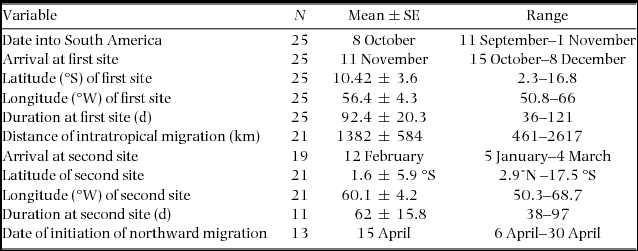
From 2010 to 2013, we retrieved geolocators (British Antarctic Survey models Mk10 and Mk12, and Lotek model Mk40C) from 25 individuals (2010–2013: N = 4, 11, 7, 3, respectively; male: N = 15; female: N = 10) at a Delaware, USA, breeding site (39°44′N, 75°45′W), that revealed their South American movement and approximate non-breeding season locations. We mapped the mean locations of each individual during stationary periods. Descriptive statistics with standard errors are reported in Table 1. Straight-line distances between stationary locations were measured in Google Earth (Google, Inc., Mountain View, CA, USA). Linear regressions were run using the R statistical program version 3.0.1 (R Development Core Team). Age and year effects could not be determined due to small sample size. For more details regarding data processing and mapping methods, see Heckscher et al. (Reference HECKSCHER, TAYLOR, FOX and AFANASYEV2011).
Descriptive statistics for veeries (Catharus fuscescens) in South America from date of first entry into the continent to departure. Data are from geolocators retrieved from veeries at a breeding site in Delaware, USA, from 2010 to 2013. Sample size differs due to differences in shading events and the failure of some units in March 2011.

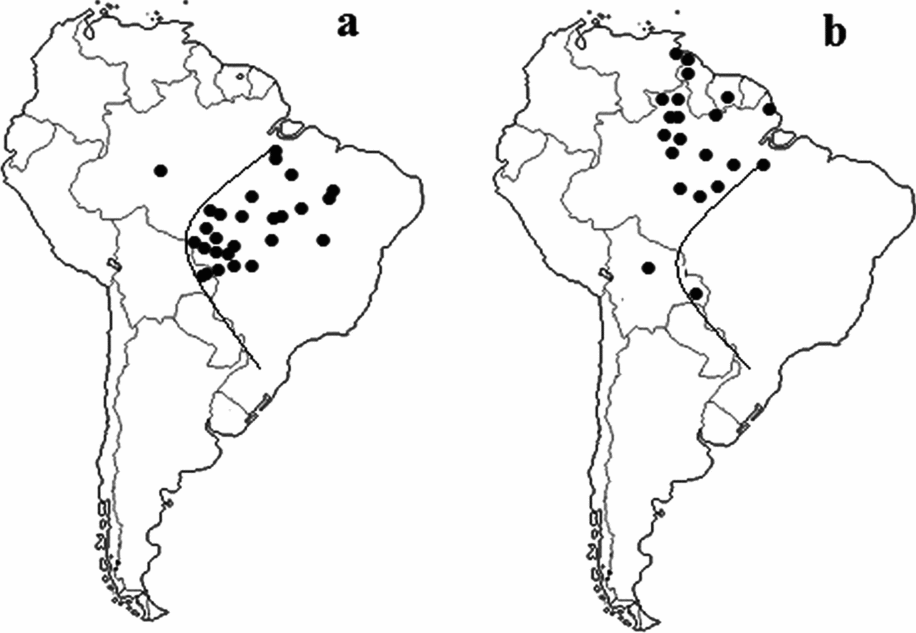
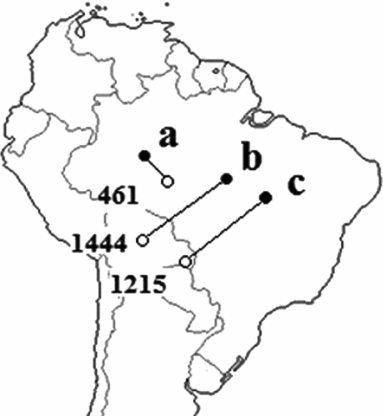
All of our study subjects initially settled south of the Amazon River. All but one bird settled on the western Brazilian Shield geological formation (Figure 1). Subsequently, most veeries moved north to second sites in lowland Amazonia and the Guiana Shield; however, three birds (12%) moved south of which two settled in Bolivia (Figure 2). A negative relationship between the date of arrival at first sites and the duration at those sites (N = 19; y = −0.8x + 34702; R 2 = 0.41, P = 0.003) indicates that the initiation of movement to second sites was not dependent on the duration at first sites. The farther south a bird initially settled, the longer its distance to second sites (N = 20; y = −0.003x − 6.5; R 2 = 0.25, P = 0.02), suggesting that the location of second sites were not influenced by the location of first sites. The date of initiation of northward migration (i.e. sustained movement north; Heckscher et al. Reference HECKSCHER, TAYLOR, FOX and AFANASYEV2011) was not dependent on the duration at second sites (N = 9; y = −0.8x + 33982; R 2 = 0.78, P = 0.001) nor was it influenced by the latitude of second sites (N = 12; y = 0.03x − 1372; R 2 = 0.001, P = 0.9). Taken cumulatively, these data show no interdependency of the intratropical movement and subsequent settlement with Nearctic–Neotropical migration. Discontinuity among the three migratory events is corroborated by the southward movement of three birds opposite from a northbound trajectory expected if intratropical migration marked the onset of migration back to North America as migratory stopover sites or staging areas are expected to be geographically positioned en route to breeding regions (Heckscher et al. Reference HECKSCHER, TAYLOR, FOX and AFANASYEV2011, Moore & Simons Reference MOORE, SIMONS, Hagan and Johnston1989, Moore et al. Reference MOORE, GAUTHREAUX, KERLINGER, SIMONS, Martin and Finch1995). Finally, the maximum duration spent at first and second sites (first site: 121 d, second site: 97 d; Table 1) both exceeded 50% of the South American non-breeding season (minimum range of 8 December–6 April; Table 1), far longer than expected for temporary stopover or staging areas. Given these data, we argue the veery's intratropical movement must continue to be viewed as a separate migratory event, as suggested by Heckscher et al. (Reference HECKSCHER, TAYLOR, FOX and AFANASYEV2011), independent from Nearctic–Neotropical migration with probable distinct ecological consequences.
Mean locations of 25 first South American non-breeding sites (a) and 21 second sites (b) of veeries (Catharus fuscescens) tracked via light-archival geolocator units from a Delaware, USA, breeding population from 2009 to 2013. The approximate western boundary of the Brazilian Shield is indicated as a thin curved line. The intratropical migration of veeries from the Brazilian Shield physiographic region is evident.
Southward movement of two male (a, c) and one female (b) veeries (Catharus fuscescens) from first non-breeding sites (solid circle) to second sites (open circle) in South America. The distance (km) of the intratropical movement is to the left of each corresponding second site. Dates of departure from first sites: 7 January 2010 (a), 28 February 2010 (b), February 2013 (precise day unknown) (c).
Outlaw et al. (Reference OUTLAW, VOELKER, MILA and GIRMAN2003) and Voelker et al. (Reference VOELKER, BOWIE and KLICKA2013) hypothesized that the genus Catharus originated in Central or North America, respectively, with recent expansion into South America. As time progresses, migration systems may become increasingly complex (Ruegg & Smith Reference RUEGG and SMITH2002). The veery's non-breeding season encompasses two separate regions, consists of a series of spatially and temporally distinct events, and incorporates an annual, predictable, independent, large-scale intratropical migration averaging >1300 km, farther than many documented migratory events in the northern hemisphere. Therefore, it seems probable to us that this system has relatively ancient South American ancestral roots rather than a system recently derived. Further, the ability to isolate the mid-season movement from other migratory events is significant in that it lends support to the possibility that intratropical migration preceded and perhaps facilitated Nearctic–Neotropical migration in this lineage (Levey–Stiles model of the origins of Nearctic–Neotropical migration; Levey & Stiles Reference LEVEY and STILES1992). Notably, that scenario was considered yet ultimately rejected by Outlaw et al. (2003) with the caveat that their decision was based largely on equivocal data.
Departure from the Brazilian Shield was initiated from west to east as evidenced by an inverse relationship between the longitude of first sites and the corresponding date of departure (N = 19; y = −0.12x + 5073; R 2 = 0.2, P = 0.05). Therefore, movement to second sites remained consistent with the Amazonian flood pulse (Heckscher et al. Reference HECKSCHER, TAYLOR, FOX and AFANASYEV2011), which increases in magnitude in a west to east pattern (Junk Reference JUNK1997). However, the proximate cue prompting movement may well be indirect considering that the Brazilian Shield is a topographically diverse region. Thus, if veeries are settling outside of lowland forest (i.e. terra firme) they nevertheless could be indirectly affected by its rising waters (e.g. via a corresponding shift in resource availability or interspecific competition). Precipitation or fruit availability unrelated to the Amazonian flood pulse could also prompt movement. However, latitudinal and longitudinal precipitation patterns are quite variable and unpredictable in this region (Liebmann & Marengo Reference LIEBMANN and MARENGO2001) and a marked seasonal change in precipitation (i.e. the cessation of the rainy season) occurs long after veeries have moved. Presently, there is not an obvious synchrony between veery departure date and seasonal fruit availability (Haugaasen & Peres Reference HAUGAASEN and PERES2007).
The settlement and subsequent migration of, plausibly, tens of thousands of veeries from the Brazilian Shield has heretofore gone unrecognized. The contribution to tropical forest structure and function may be significant. Herein, we have refined considerably our knowledge of this system. This migration is an intriguing tropical phenomenon with potentially important ecological and theoretical consequences that warrants further investigation.
ACKNOWLEDGEMENTS
We thank the Delaware Division of Parks and Recreation for their support. In particular, N. McFadden, C. Bennett and R. Line. A portion of our research was funded by the HBCU-SMILE Program, and internal funding from the College of Agriculture and Related Sciences, Delaware State University. Field assistants included: J. Barth, B. Bruce, V. Gómez, L. Gonce, H. Howard, I. Silva, S. Taylor and M. Wallrichs. J. Fox of Migrate Technology provided technical advice.