Introduction
A significant phonological property of a word which influences its production and recognition is phonological neighborhood density (PND; Vitevitch & Luce, Reference Vitevitch and Luce2016). PND refers to the number of words that can be formed from a given word by substituting, adding or deleting one phoneme (Vitevitch & Luce, Reference Vitevitch and Luce1999). Words with many similar sounding neighbors, such as mash (e.g., smash, ash, cash, mush, mat), have a dense neighborhood, whereas words with few or no neighbors, such as fudge (judge, fun), have a sparse neighborhood. In English, Spanish, and French, words with dense neighborhoods have on average 22 neighbors whereas words with sparse neighborhoods have about 6 neighbors (Yates, Friend & Ploetz, Reference Yates, Friend and Ploetz2008).
Cross-linguistic studies have shown that PND influences both word production and recognition in different ways, depending on the language (e.g., Harley & Brown, Reference Harley and Brown1998; Luce & Pisoni, Reference Luce and Pisoni1998; Vitevitch, Reference Vitevitch2002; Vitevitch & Luce, Reference Vitevitch and Luce1998, Reference Vitevitch and Luce1999; Vitevitch & Sommers, Reference Vitevitch and Sommers2003). For English-speaking adult participants in word production experiments, Vitevitch (Reference Vitevitch2002) demonstrated that words with dense neighborhoods were produced on average 25 ms faster than words with sparse neighborhoods. By contrast, in word recognition tasks, Luce and Pisoni (Reference Luce and Pisoni1998) showed that words with dense neighborhoods were recognized to about 102 ms slower than words with sparse neighborhoods. The same PND pattern in word production and recognition was found in experiments with French-speaking adults (Dufour & Frauenfelder, Reference Dufour and Frauenfelder2010; Zeigler & Muneaux, Reference Zeigler and Muneaux2007; Zeigler, Muneaux & Grainger, Reference Zeigler, Muneaux and Grainger2003). However, a strong reverse PND pattern was shown for Spanish-speaking adults: words with dense neighborhoods were produced slower than words with sparse neighborhoods, whereas a dense neighborhood facilitated word recognition (Sadat, Martin, Costa & Alario, Reference Sadat, Martin, Costa and Alario2014; Vitevitch & Rodríguez, Reference Vitevitch and Rodríguez2004; Vitevitch & Stamer, Reference Vitevitch and Stamer2006).
How can these cross-linguistic differences of the PND effects between English/French and Spanish be explained? Vitevitch and Stamer (Reference Vitevitch and Stamer2006) suggested that the reverse PND pattern found in Spanish word production and recognition may be caused by the difference in the amount of inflections between Spanish and English. In comparison to English, the Spanish language is more inflected, i.e., affixes, indicating gender and number in nouns, are used to a greater extent. For example, the Spanish nouns niño ‘a male child’ and niña ‘a female child’ are phonological neighbors but they are also morphologically similar. In languages with a rich inflectional system, such as Spanish, morphological inflections usually affect the end of the word, and during word production several words with phonological overlaps will be activated, resulting in a range of competing phonemes at the end of the word (e.g., niño vs. niña). Therefore, words with dense neighborhoods in Spanish will have more competing phonemes at the end of the word than words with sparse neighborhoods; this competition inhibits word production (Vitevitch & Stamer, Reference Vitevitch and Stamer2006). By contrast, in Spanish word recognition, additional morphological similarity facilitates lexical access (Vitevitch & Rodríguez, Reference Vitevitch and Rodríguez2004). Note, even for a less inflected language, such as English, it was shown that morphologically related words facilitated processing of each other in word recognition tasks (Rastle, Davis, Marslen-Wilson & Tyler, Reference Rastle, Davis, Marslen-Wilson and Tyler2000).
The PND effects that play a significant role in both word production and recognition in adults are largely unexplored for young children. Almost all studies to date have been conducted with older English-speaking children (ranging in age from 7;0 to 12;0). In a word production study, Newman and German (Reference Newman and German2002) observed that both typically developing children and children with word-finding difficulties performed naming and sentence completion tasks faster and more accurately for words with dense neighborhoods than for words with sparse neighborhoods (see also, German & Newman, Reference German and Newman2004). By contrast, in a word recognition study, Metsala (Reference Metsala1997) demonstrated that in a gating task 7-, 9- and 11-year-old English-speaking children recognized words with sparse neighborhoods about 67 ms faster and more accurately than words with dense neighborhoods. Therefore, in English speakers, the PND effects in word production and recognition were the same for adults and older children.
Existing studies of PND effects in young children concentrated mostly on the influence of PND on vocabulary development, word and pseudoword learning in noisy and no-noise conditions or on morphology acquisition in different languages rather than on the influence of a word's phonological neighbors on its production and recognition in terms of facilitation or inhibition (e.g., Dąbrowska & Szczerbiński, Reference Dąbrowska and Szczerbiński2006; Han, Storkel & Bontempo, Reference Han, Storkel and Bontempo2019; Hoover, Storkel & Hogan, Reference Hoover, Strokel and Hogan2010; van der Kleij, Rispens & Scheper, Reference van der Kleij, Rispens and Scheper2016; Granlund, Kolak, Vihman, Engelmann, Lieven, Pine, Theakston & Ambridge, Reference Granlund, Kolak, Vihman, Engelmann, Lieven, Pine, Theakston and Ambridge2019). For example, Savičiūtė, Ambridge and Pine (Reference Savičiūtė, Ambridge and Pine2018) studied how 4;0- to 5;5-year-old children acquired the Lithuanian inflectional noun morphology. With a picture naming task, they showed that children's correct production of familiar and novel nouns was correlated with the PND of the nouns. Dąbrowska and Szczerbiński (Reference Dąbrowska and Szczerbiński2006) touched upon the development of the Polish case-marking system and demonstrated that morphological productivity depended on phonological diversity. In a study of word learning in Dutch-speaking young children, van der Kleij et al., (Reference van der Kleij, Rispens and Scheper2016) showed that PND influenced vocabulary development from early childhood. Also, the significant PND influence on the verbal past tense morphology acquisition was observed in Finnish, Icelandic, and Norwegian young children (Kirjavainen, Nikolaev & Kidd, Reference Kirjavainen, Nikolaev and Kidd2012; Ragnarsdóttir, Simonsen & Plunkett, Reference Ragnarsdóttir, Simonsen and Plunkett1999). In a large-scale, elicited-production study of noun case marking in Polish, Finnish, and Estonian, Granlund et al., (Reference Granlund, Kolak, Vihman, Engelmann, Lieven, Pine, Theakston and Ambridge2019) found that children produced noun forms more accurately for words with larger PND class in all three languages.
Although the PND effects play a significant role in different aspects of language development from early childhood, we still do not clearly understand how PND influences the processes of word production and recognition in young children. There is only one study that investigated PND effects and their developmental trajectories in word recognition in young children (Mage ± SE = 5;6 ± 0;1), comparing them to older children (Mage ± SE = 7;6 ± 0;1) and adults (Garlock, Walley & Metsala, Reference Garlock, Walley and Metsala2001). The authors found that in a gating task, just as in the previous studies (Luce & Pisoni, Reference Luce and Pisoni1998; Newman & German, Reference Newman and German2002), adults and older children recognized words with sparse neighborhoods more quickly than words with dense neighborhoods, whereas young children did not show this effect. At the same time, in a word repetition task, young children demonstrated the PND effect found in adults; that is, words with sparse neighborhoods were repeated faster than words with dense neighborhoods. The authors concluded that PND effects can be affected by the task. Garlock et al., (Reference Garlock, Walley and Metsala2001) proposed that PND influenced word recognition in young children, but this effect was restricted in comparison to older children and adults. As for the influence of PND on word production in terms of facilitation or inhibition in children, it remains unknown.
To summarize, we already know that in English- and French-speaking adults as well as in English-speaking older children (Mage = 7;6), a dense phonological neighborhood facilitates production but inhibits recognition and, on the contrary, a sparse phonological neighborhood inhibits production but facilitates recognition. The opposite pattern was observed in Spanish-speaking adults. In English-speaking young children (Mage = 5;6), a restricted effect was found in a recognition task. What we do not yet know and aim to determine is how PND effects develop and influence word production and recognition, facilitating or inhibiting it, in 4-to-6-year-old children who speak a language morphologically more complex than English, such as Russian (e.g., Kornilov, Rakhlin & Grigorenko, Reference Kornilov, Rakhlin and Grigorenko2012; Wade, Reference Wade2011).
Russian noun morphology
Russian is a language with a rich inflectional system, i.e., a variety of affixes that express various morphological categories (Wade, Reference Wade2011). In comparison to Spanish in which gender and number are expressed within a noun, in Russian gender, number, and case are expressed within a noun. For example, the Russian lemma bochka ‘barrel’ (feminine) has 12 word forms, and three of them can be considered as phonological neighbors of bochka. As a results, one word form bochka has three phonological neighbors with the same stem (Table 1). Importantly, in this study, we defined phonological neighbors as words that are formed from a given word form by substituting, adding or deleting one phoneme (Vitevitch & Luce, Reference Vitevitch and Luce1999). It means that word forms bochka (Nominative Singular) and bochk'e (Dative Singular) were not considered as phonological neighbors because they differ in two phonemes: the phoneme [a] is substituted by [e] and the phoneme [k] is substituted by the palatalized phoneme [k’], according to (Padgett, Reference Padgett, Hume and Johnson2001). Similarly, kozaFootnote 1 ‘goat’ (Nominative Singular) and kozy ‘goats’ (Nominative Plural) were not considered as phonological neighbors either, because they differ in two vowels. The final vowel [a] is substituted by [y] and additionally, the first vowel [o] is stressed in kozy, but unstressed in koza. The unstressed vowel [o] in Russian undergoes qualitative reduction and sounds as [a]. We considered qualitative reduction, e.g., [o] → [a] in koza, as substitution.
The Russian case marking system for the word bochka ‘barrel’. Stressed vowels are underlined. Phonological neighbors of the nominative form bochka ‘barrel’ are written in bold.

In Russian, a word can have phonological neighbors that are not related to this word and phonological neighbors that are morphologically derived from the word. For example, bochka ‘barrel’ has a phonological neighbor tochka ‘point’ and dochka ‘daughter’ (the first phoneme substitution) and also has phonological neighbors which are its morphologically related word forms: e.g., bochka – bochku – bochkam – bochkah. We supposed that Russian words should have more phonological neighbors at the end of the word than at the beginning.
We also supposed that the property of Russian words to have more phonological neighbors at the end than at the beginning of the word was acquired with the acquisition of morphology. Russian studies on nominal case inflection acquisition showed that it is mostly acquired by the age of 4 (Babyonyshev, Reference Babyonyshev1993; Gagarina & Voeikova, Reference Gagarina, Voeikova, Stephany and Voeikova2009), which could mean that by the age of 4 Russian children should manifest similar effects to adults of PND on word production and recognition. However, see, e.g., preliminary experimental results for Russian (Ladinskaya, Chrabaszcz & Lopukhina, Reference Ladinskaya, Chrabaszcz and Lopukhina2019) and experimental evidence for the other languages with a rich inflectional morphology (Dąbrowska & Szczerbiński, Reference Dąbrowska and Szczerbiński2006; Granlund et al., Reference Granlund, Kolak, Vihman, Engelmann, Lieven, Pine, Theakston and Ambridge2019) which indicate that the acquisition of the case system may take longer.
The present study
The goal of the present study is to determine how PND influences word production and recognition in 4-to-6-year-old Russian children in comparison to Russian adults. We predict that PND effects in Russian will be similar to those in Spanish and opposite to those in English. Because Russian is a highly inflected language and each lemma has numerous word forms (some of them are phonological neighbors), we expect that during word production and recognition there will be more competition at the end than at the beginning of words, similarly to Spanish.
Therefore, we suppose that in Russian a dense neighborhood will inhibit production but facilitate recognition whereas a sparse neighborhood will facilitate production but inhibit recognition, which will be reflected in reaction time. For example, the picture with a barrel will be named slower than the picture with a ball because the word bochka ‘barrel’ has dense neighborhood with many morphologically related word forms that should inhibit production as compared to a word with sparse neighborhood myach ‘ball’, according to Vitevitch and Stamer's (Reference Vitevitch and Stamer2006) hypothesis. It is known that additional morphological similarity facilitates word recognition even for less inflected languages than Russian, for example for English (Rastle et al., Reference Rastle, Davis, Marslen-Wilson and Tyler2000). That is why we suppose that in a recognition task the word with a dense neighborhood bochka ‘barrel’ will be recognized faster than the word with a sparse neighborhood myach ‘ball’.
Our study is novel in three ways. First of all, it compares word production and recognition in the same groups of participants: the experimental group, consisting of 4-to-6-year-old Russian children, and the control group of Russian adults. Secondly, our study compares young children and adults using the exact same experimental design and materials. Finally, this is the first study that investigates the facilitatory and inhibitory effects of PND on word production and recognition in young children who speak a highly inflected language.
In the word production experiment, we use a classical picture naming task, whereas in a word recognition experiment we use the visual world eye-tracking paradigm with a classical ‘look and listen’ task (Huettig, Rommers & Meyer, Reference Huetting, Rommers and Meyer2011). We assume that both tasks are child-friendly and sensitive enough for catching PND effects. Picture naming was successfully used in word production experiments that studied PND effects both in children and adults (e.g., Newman & German, Reference Newman and German2002; Vitevitch, Reference Vitevitch2002), and we apply this paradigm in the present production experiment. Whereas, the visual world eye-tracking paradigm has never been used in PND research before. We chose this paradigm because eye-tracking is known to be one of the most sensitive online methodology for studying spoken word recognition in typically developing children (even babies and toddlers) and atypically developing children (e.g., Farris-Trimble & McMurray, Reference Farris-Trimble and McMurray2013; Chita-Tegmark, Arunachalam, Nelson & Tager-Flusberg, Reference Chita-Tegmark, Arunachalam, Nelson and Tager-Flusberg2015). Depending on age group, the instruction for participants in the visual world paradigm can be slightly different: for 12- or 18-month-old babies or toddlers each stimulus usually starts with ‘Please, look at the…’ or ‘Where is…?’ and participants are motivated to look at the relevant object in the screen. At the same time, 3-to-6-year-old children can already perform the ‘look and listen’ task: they look at a screen with several depicted objects and are asked to look at the relevant picture when they hear its name (e.g., Farris-Trimble & McMurray, Reference Farris-Trimble and McMurray2013; Fernald, Zangl, Portillo & Marchman, Reference Fernald, Zangl, Portillo, Marchman, Sekerina, Fernández and Clahsen2008; Grieco-Calub, Saffran & Litovsky, Reference Grieco-Calub, Saffran and Litovsky2009; Hurtado, Marchman & Fernald, Reference Hurtado, Marchman and Fernald2007; Sekerina & Brooks, Reference Sekerina and Brooks2007).
Experiment 1: Word production
Method
Participants
Twenty-five native Russian-speaking monolingual children (10 boys, 15 girls; age range 4;0–6;0 years, Mage = 4;9 years, SD = 0.8) and 20 Russian-speaking monolingual adults (13 males, 7 females; age range 19;0–36;0 years, Mage = 25;2 years, SD = 4.6) participated in the experiment. Exclusion criteria were previous history of hearing / vision problems and neurological or psychiatric disorders. All adult participants and parents of the children signed a written consent form in Russian, and some parents were unobtrusively present during the experiment. The data were collected in the INESNEK kindergarten or at the Center for Language and Brain of the Higher School of Economics (Moscow, Russia). The study was approved by the HSE Committee on Interuniversity Surveys and Ethical Assessment of Empirical Research and it was conducted in accordance with the Declaration of Helsinki.
Design and materials
The materials were 2 practice pictures and 30 experimental pictures, all child-friendly. Half of the pictures corresponded to words with dense neighborhoods and the other half to words with sparse neighborhoods.Footnote 2 All pictures were selected from the Verbs and Nouns Stimuli Database for Russian (Akinina, Grabovskaya, Vechkaeva, Ignatyev, Isaev & Khanova, Reference Akinina, Grabovskaya, Vechkaeva, Ignatyev, Isaev, Khanova, Aleksandrov and Anokhin2016) and were colored for this experiment (Figure 1). We selected nouns familiar to children according to norms for the Russian language available in the same database.
Experiment 1: Examples of stimulus pictures.

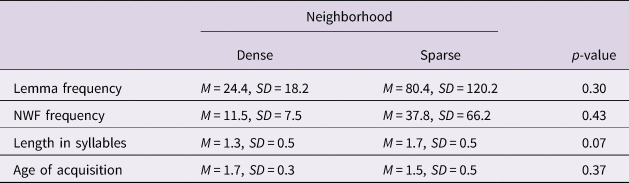
Initial neighborhood density counts for Russian words were determined according to the StimulStat Database (Alexeeva, Slioussar & Chernova, Reference Alexeeva, Slioussar, Chernova, Aleksandrov and Anokhin2016). Then, to be sure that phonological neighbours were familiar to children, we checked the age of acquisition of each neighbor based on Akinina et al., (Reference Akinina, Grabovskaya, Vechkaeva, Ignatyev, Isaev, Khanova, Aleksandrov and Anokhin2016). Phonological neighbors that were not familiar to 4-year-olds were excluded from the PND count. Additionally, we checked that this filtering did not influence the assignment of each noun to the dense or sparse neighborhood groups. Words with dense neighborhoods had significantly more neighbors (M = 7.8 words, SD = 1.7) than words with sparse neighborhoods (M = 2.8 words, SD = 1.6), t(27.9) = 8.1, p < 0.001. Words with dense and sparse neighborhoods did not differ in lemma frequency, frequency of the nominative word form (NWF), length, and age of acquisition (Table 2). The two groups of words had the same number of animate and inanimate nouns. All nouns were in their default gender, e.g., lisa ‘fox’, but not lis ‘male fox’. Additionally, words with dense and sparse neighborhoods had a comparable number of phonological neighbors with initial, medial or final phoneme difference.
The properties of the stimulus words for production experiment.

Note: lemma and NWF frequency is measured in ipm (instances per million words) and was obtained from the Russian National Corpus of texts (Lyashevskaya & Sharoff, Reference Lyashevskaya and Sharoff2009). Note, that these frequency counts may not reflect the frequency in the child's vocabulary or input. Word's age of acquisition was determined based on subjective age-of-acquisition norms for 696 Russian nouns (Akinina et al., Reference Akinina, Grabovskaya, Vechkaeva, Ignatyev, Isaev, Khanova, Aleksandrov and Anokhin2016). We ran t-tests to compare words with sparse and dense neighborhoods.
Following Vitevitch and Stamer (Reference Vitevitch and Stamer2006), we calculated the number of phonological neighbors for the first and the second part of each word in our stimuli set, e.g., for the word kosa ‘sickle’ ko- is the first part and -sa is the second part. Sample t-test showed that there was a difference between the number of neighbors for the first part of words and for the second part of words, t(56.7) = –4.75, p < 0.001. Stimuli for the production experiment had more phonological neighbors (that were formed from a given word by substituting, adding or deleting one phoneme) for the second part of the word (M = 3.8, SD = 2.0) than at the first part of the word (M = 1.4, SD = 1.7).
In this experiment, we recorded reaction time (RT) and accuracy of answers in picture naming.
Procedure
We used a classical naming task in which participants are asked to name the depicted object. Participants were tested individually in a quiet room in the kindergarten or at the Center for Language and Brain. Prior to conducting the experiment, each participant was familiarized with the equipment and the task requirement. The child was seated at a child-size table whereas the adult sat at a regular-size table, facing a tablet on which the stimuli were presented using the AutoRAT application (Ivanova, Dragoy, Akinina, Soloukhina, Iskra, Khudyakova & Akhutina, Reference Ivanova, Dragoy, Akinina, Soloukhina, Iskra, Khudyakova and Akhutina2016). Stimuli were presented once in random order by the experimenter. We measured the reaction time from the picture onset till response onset. The experiment lasted approximately 7 minutes including one break in the middle.
Analysis
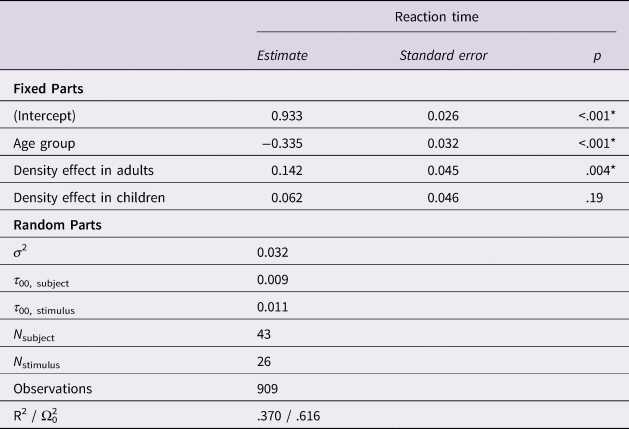
We analyzed the results with linear mixed models in R (R Core Team, 2015) and plotted them with ggplot2 (Wickham, Reference Wickham2016). The models were estimated with the lme4 package (Bates, Mäechler, Bolker & Walker, Reference Bates, Mächler, Bolker and Walker2015); the tables for the model outcomes (Tables 3 and 5) were created with the sjPlot package (Lüdecke, Reference Lüdecke2017).
The influence of PND on word production in Russian-speaking children and adults.

Both children and adults made three types of errors: 1) no response (e.g., picture ‘sickle’ for children), 2) incorrect responses (e.g., muha ‘fly’ instead of shmel’ ‘bumblebee’), and 3) diminutives. These errors, comprising 13% of the data for children and 6% for adults, were removed prior to analysis. Additionally, we removed all answers of two children who made a lot of response errors and whose accuracy was outside 2SD from the mean accuracy for children (8% of data). We also removed six trials that caused a large number of response errors for children (outside 2SD from the mean accuracy across trials; 20% of data; trials ‘bow’, ‘bumblebee’, ‘harp’, ‘sickle’, ‘genie’, ‘bone’).
Our first analysis aimed to estimate the main effect of the PND (dense vs. sparse), the main effect of age (children vs. adults), and their interaction. The main effects were coded using repeated contrasts: sparse PN was coded as 1, dense as –1; children were coded as 1, adults as –1. The model included random intercepts for participants and words. The dependent variable was reaction times converted in reciprocal seconds (1000/ms). The second analysis estimated whether the PND effect was significant separately in children and in adults. We fitted a linear mixed model that included three fixed effects: PND type nested within the group of children, PND type nested within the group of adults, and the main effect of the age group. This model also included random intercepts for participants and words and estimated reaction times in reciprocal seconds.Footnote 3
Results and discussion
The mean RTs and their SDs for each condition for both children and adults are provided in Figure 2.
Mean RTs as a function of PND type and age (ms).

The first analysis showed a significant main effect of PND: words with sparse neighborhoods were produced faster than words with dense neighborhoods (Est. = 0.10, SE = 0.04, t = 2.32, p = 0.03). There was also a significant main effect of age: children named pictures slower than adults (Est. = –0.33, SE = 0.03, t = –10.45, p < 0.001). We also found a significant interaction between the type of PND and the age of participants (Est. = –0.08, SE = 0.02, t = –3.17, p = 0.002). The model with nested contrasts demonstrated that, in children, there was no significant difference in RT between pictures that corresponded to words with dense versus sparse phonological neighborhoods. At the same time, there was a significant difference in RT between these conditions in adults (see Table 3 for statistical comparisons). We found that the PND effect in word production in Russian-speaking adults is the same as in Spanish-speaking adults: words with dense neighborhoods are produced 139 ms slower than words with sparse neighborhoods; this pattern is the opposite to word production in English. Additionally, we showed that in general adults produced words significantly faster than children. These results are in line with other studies on the development of reaction time during childhood (e.g., Kiselev, Espy & Sheffield, Reference Kiselev, Espy and Sheffield2009).
Experiment 2: Word recognition
Method
Participants
The same 25 children and 20 adults who participated in Experiment 1 took part in the second experiment.
Design and materials
The materials were 2 practice and 28 experimental sets of single words combined with corresponding visual displays. Each visual display consisted of three pictures: a target object (e.g., banan ‘banana’) and two distractors whose names did not overlap with the name of the target object (e.g., venik ‘broom’ and kulak ‘fist’) (see Figure 3). The location of the target object was randomized across trials. All pictures were selected from the Verbs and Nouns Stimuli Database for Russian (Akinina et al., Reference Akinina, Grabovskaya, Vechkaeva, Ignatyev, Isaev, Khanova, Aleksandrov and Anokhin2016) and colored. All words were nouns that were familiar to children (Akinina et al., Reference Akinina, Grabovskaya, Vechkaeva, Ignatyev, Isaev, Khanova, Aleksandrov and Anokhin2016). The words were recorded by a female native speaker of Russian. The minimal duration of the target noun was 300 ms and the maximal was 600 ms.
Experiment 2: Example of stimulus display.

Initial neighborhood density counts for Russian words were determined according to the StimulStat Database (Alexeeva et al., Reference Alexeeva, Slioussar, Chernova, Aleksandrov and Anokhin2016). After that we checked the age of acquisition of each neighbor based on (Akinina et al., Reference Akinina, Grabovskaya, Vechkaeva, Ignatyev, Isaev, Khanova, Aleksandrov and Anokhin2016) and excluded from the PND count phonological neighbors that were not familiar to 4-year-old children. We also checked that this filtering did not influence the assignment of each noun to the dense or sparse neighborhood groups. Words with a dense neighborhood had significantly more neighbors (M = 8.2 words, SD = 1.8) than words with a sparse neighborhood (M = 2.5 words, SD = 1.6), t(25.5) = 8.7, p < 0.001. Words with dense and sparse neighborhoods did not differ in lemma frequency, NWF frequency, length, and age of acquisition (Table 4). The two groups of words had the same number of animate and inanimate nouns. All nouns were in their default gender, e.g., lisa ‘fox’, but not lis ‘male fox’. Additionally, words with dense and sparse neighborhoods had a comparable number of phonological neighbors with initial, medial or final phoneme difference.
The properties of the stimulus words for recognition experiment.

Note: lemma and NWF frequency is measured in ipm (instances per million words) and was obtained from the Russian National Corpus of texts (Lyashevskaya & Sharoff, Reference Lyashevskaya and Sharoff2009). Note, that these frequency counts may not reflect the frequency in the child's vocabulary or input. Word's age of acquisition was determined based on subjective age-of-acquisition norms for 696 Russian nouns (Akinina et al., Reference Akinina, Grabovskaya, Vechkaeva, Ignatyev, Isaev, Khanova, Aleksandrov and Anokhin2016). We ran t-tests to compare words with sparse and dense neighborhoods.
We calculated the number of phonological neighbors for the first and the second part of each word in the stimuli set. Sample t-test showed that there was a difference between the number of neighbors for the first part of words and for the second part of words, t(57.9) = –3.17, p < 0.001. The stimuli in the recognition experiment had more phonological neighbors that were formed from a given word by substituting, adding or deleting one phoneme at the second part of the word (M = 3.4, SD = 2.0) than at the first part of the word (M = 1.7, SD = 2.0).
In this experiment, we used the classical visual world eye-tracking paradigm and recorded the first saccade to the target picture that started after the stimulus word onset.
Procedure
We used the SMI RED-m portable eye-tracker. Participants were tested individually in a quiet room in the kindergarten or at the Center for Language and Brain. Before the experiment, the experimenter explained the task, and participants had an opportunity to familiarize themselves with the eye-tracker.
The experiment started with a 6-point calibration procedure. Viewing was monocular and only the right eye was recorded. Children were seated at a child-size table and adults at a regular-size table facing a laptop with a 15.6-inch screen on which the stimuli were presented. The stimulus materials for each trial were programmed through the SMI Experiment Center. Each trial started with the presentation of three pictures for 2000 ms, and the participants were familiarizing themselves with the pictures during this time. Then the stimulus word was played, and the participant has to look at the named picture as fast as possible. The program advanced to the next trial after a fixation duration of 2000 ms in the AOI. The experiment lasted 15 minutes, including one break in the middle.
Analysis
We predicted that shortly after the onset of the spoken word, the participants would make a saccade to the target picture unless they had already been looking at it. Therefore, we selected all saccades starting 180 ms after the onset (this time is required to program a saccade; Altmann & Kamide, Reference Altmann, Kamide, Henderson and Ferreira2004) that started outside the target picture AOI, ended there, and were the first in a sequence of saccades. This approach has one limitation: if participants were already looking at the target picture when the word was played, then made a saccade somewhere else, and after that made a saccade back to the target picture, this last saccade was also included in the analysis. To overcome this limitation, we cut off all the first saccades to the target picture starting 2000 ms after the onset of the word, excluding 8% of data. Overall, we had 249 observations in the dense neighborhood condition and 240 observations in the sparse neighborhood condition for children, and 231 observations in the dense neighborhood condition and 240 observations in the sparse neighborhood condition for adults.
Our first linear mixed model included the main effect of the PND (dense vs. sparse), the main effect of age (children vs. adults), and their interaction. The main effects were coded using repeated contrasts: sparse PN was coded as 1, dense as –1; children were coded as 1, adults as –1. The model included random intercepts for participants and words. The dependent variable was log-transformed reaction times that were calculated as the first saccade to the target start time minus the time of the onset of a word. The second model estimated whether the PND effect was significant separately in children and in adults. It included three fixed effects: PND type nested within the group of children, PND type nested within the group of adults, and the main effect of the age group as well as random intercepts for participants and words.
Results and discussion
The mean RTs and their SDs for each condition, both for children and adults, are provided in Figure 4.
Mean RTs as a function of PND type and age (ms).

The analysis of the eye tracking data showed that there is a significant difference in RT between pictures corresponding to words with dense versus sparse phonological neighborhoods: words with dense neighborhoods were recognized on average 91 ms faster by children and 69 ms faster by adults than words with sparse neighborhoods (Est. = 0.11, SE = 0.04, t = 2.63, p = 0.01). We also found a significant main effect of age: children performed slower than adults (Est. = 0.16, SE = 0.05, t = 3.55, p = 0.0007). There was no interaction between the type of PND and the age of participants (Est. = –0.029, SE = 0.05, t = –0.63, p = 0.53). The model with nested contrasts demonstrated that both children and adults recognized pictures corresponding to words with sparse neighborhoods slower than pictures corresponding to words with dense neighborhoods (see Table 5 for statistical comparisons). Therefore, there is a reverse PND effect in word recognition in comparison to word production for Russian adults.
The influence of PND on word recognition in Russian-speaking children and adults.

General discussion
The aim of this study was to investigate the influence of PND on the speed of word production and recognition from a developmental perspective in the highly inflected Russian language. Overall, we conducted four experiments: a naming experiment and an experiment in the visual world paradigm in Russian 4-to-6-year-olds, and the same set of experiments in Russian adults. Crucially, the task demands and experimental materials were identical in both groups of participants, allowing for the direct comparison of reaction times in word production and recognition between the two age groups. Our results revealed no PND effect in word production and a strong PND effect in word recognition in 4-to-6-year-old Russian children and strong PND effects in both word production and recognition in Russian adults: words with dense neighborhoods (e.g., rak – raku, raka, raki, rai, rab, rad…) are recognized faster than words with sparse neighborhoods (e.g., poezd – poezda, poezdu) and are produced more slowly than words with sparse neighborhoods.
Our results for Russian-speaking adults are in line with the study of Spanish-speaking adults, showing the opposite effect to the studies of adult speakers of English and French. This effect can be explained by the difference in morphological structures between weakly inflected English and highly inflected Russian. Our findings support the mechanisms of word production and recognition proposed by Vitevitch and Stamer (Reference Vitevitch and Stamer2006): phonological neighbors in highly inflected languages are also morphologically similar, and in word production there are several words activated with phonological overlaps at the beginning of the words but competing phonemes at the end of the words. As a result, words with dense neighborhoods have more segments competing at the end of the word compared to words with sparse neighborhoods which inhibits word production (Vitevitch & Stamer, Reference Vitevitch and Stamer2006). At the same time, morphological similarity may facilitate word recognition in highly inflected languages such as Russian or Spanish; even in the less inflected English language, morphologically related words (e.g., departure – depart) facilitated processing of each other in word recognition tasks (Rastle et al., Reference Rastle, Davis, Marslen-Wilson and Tyler2000). Therefore, both our results for Russian and the results of Vitevitch and Stamer (Reference Vitevitch and Stamer2006) for Spanish challenge current models of speech production (e.g., Dell, Reference Dell1986; Levelt, Roelofs & Meyer, Reference Levelt, Roelofs and Meyer1999) and perception (e.g., Marslen-Wilson & Tyler, Reference Marslen-Wilson and Tyler1980; McClelland & Elman, Reference McClelland and Elman1986) that successfully explain the PND effects for English but do not explain the opposite effects found in Russian and Spanish.
We found no effect in 4-to-6-year-old Russian children in word production and a large PND effect in word recognition, which means that the PND recognition effect starts to develop in early childhood, and the PND production effect is formed later. Presumably, it is related to vocabulary growth and morphological development in highly inflected languages such as Russian. Morphology plays a significant role in Russian word production and recognition, and it has been reported that morphological awareness increases when children acquire reading skills (Anglin, Reference Anglin1993; Kornilov et al., Reference Kornilov, Rakhlin and Grigorenko2012). In other words, our findings for Russian young children are consistent with the existing theoretical point of view that changes in word production and recognition are associated with an increase in morphological awareness, reading ability and vocabulary growth (e.g., Metsala & Walley, Reference Metsala, Walley, Metsala and Ehri1998).
Garlock et al., (Reference Garlock, Walley and Metsala2001) suggested that the presence of PND effects can be affected by the experimental task. In our study, we used two classical methods which were successfully applied in experiments with young children: a picture naming task in the word production experiment and the visual world paradigm in the word recognition experiment. Picture naming is one of the most prominent paradigms for assessing expressive vocabulary in young children (Cycowicz, Friedman, Rothstein & Snodgrass, Reference Cycowicz, Friedman, Rothstein and Snodgrass1997) and the visual world paradigm is highly sensitive to the early stages of spoken-word recognition and has been successfully applied to experiments with young children as well (Sekerina & Brooks, Reference Sekerina and Brooks2007). We suggested that the latter experimental paradigm was sensitive enough to catch a PND effect in word recognition.
Although both experimental paradigms are widely used, sensitive, and child-friendly, they differ in complexity for young children. Picture naming requires the identification of a depicted object, lemma activation, phonological encoding and articulation (e.g., Caramazza, Reference Caramazza1997; Dell, Chang & Griffin, Reference Dell, Chang and Griffin1999). It is an active task, whereas visual-world eye-tracking paradigm does not require any active response: participants look at a screen with pictures, have time to become familiar with them, after that hear a stimulus word, and should look at the relevant picture. We suppose that for adults both tasks are relatively easy but for young children picture naming with active response is more challenging than passive looking at pictures. In our study, we did not find a statistically significant difference between dense and sparse conditions in word production but found it in word recognition. This was possibly related not only to morphological development during childhood or exceeded development of language comprehension in comparison to language production (e.g., Bornstein & Hendricks, Reference Bornstein and Hendricks2012) but also to the difference between our production and recognition tasks.
To summarize, we have found evidence of the developmental trajectories of the PND effects in Russian word production and recognition. The results of our study are consistent with those of Vitevitch and Stammer (Reference Vitevitch and Stamer2006) in Spanish-speaking adults and are opposite to the results that come from studies in English (Luce & Pisoni, Reference Luce and Pisoni1998), highlighting the importance of cross-linguistic investigations of PND effects. We showed that the rich inflectional system of a language influences PND effects in word production and recognition, facilitating or inhibiting lexical access. At the same time, we still need to know more about the developmental trajectories of PND effects in word production and recognition in younger and older Russian children as well as in other languages with different morphological structures. We suppose that these studies will provide a significant contribution to the existing psycholinguistic models of speech production and perception.
However, our study has some limitations which should be highlighted. First of all, our experimental group consists of children with the age range from 4;0 to 6;0 years, and we did not take into account the age effect within the group. For future studies, it seems reasonable either to consider age as a continuous variable or to narrow down the age difference in the group of children. Secondly, as in previous studies (e.g., Garlock et al., Reference Garlock, Walley and Metsala2001; Vitevitch & Stamer, Reference Vitevitch and Stamer2006), we designed the experiments with PND as a categorical variable with two levels. But it might be more informative to consider PND as a continuous variable. Thirdly, we obtained neighborhood density counts, age-of-acquisition estimates, and word frequency measures from the resources created for adults. Therefore, our measures were not necessarily reflective of the abovementioned word properties in the input or in the children's vocabulary. Further research with frequency measures from child-directed speech corpora is needed to confirm our conclusions. Finally, although we hypothesized on facilitation and inhibition effects in word production and recognition, we did not compare these effects to any baseline. Therefore, we are not completely sure whether PND effects are due to inhibitory processes, facilitatory processes or both. Previous experiments did not distinguish facilitation or inhibition because only two conditions were tested. For a proper comparison, it would be reasonable to have a neutral condition that the others can be compared to, e.g., a set of stimuli with average PND. All these limitations should be taken into account in future studies.
Acknowledgments
This work was funded within the framework of a subsidy by the Russian Academic Excellence Project ‘5–100'. We thank Prof. Irina Sekerina (City University of New York, USA) for helping with the manuscript preparation and for pushing us to make this paper the best it can be, Prof. Reinhold Kliegl (University of Potsdam, Germany) for advice with data analysis in the production experiment, and Konstantin Lopukhin (Scrapinghub, Moscow, Russia) for his assistance with data preparation in the eye tracking experiment. Special thanks go to all of the children and adults who enthusiastically participated in the experiments. We also thank the anonymous reviewers who made many helpful comments and suggestions.