1. Population Synthesis with Massive Stars
Starburst galaxies are hosts to intense episodes of star formation, making them home to rich populations of massive stars which contribute the majority of the UV flux to the integrated light of the galaxy (Leitherer Reference Leitherer2020). These populations of massive stars also generated substantial feedback through their hot, ionising spectra and strong stellar winds (Geen et al. Reference Geen, Agrawal and Crowther2023). Through population synthesis models we combine the observables and properties of all the massive stars in a given star-forming burst are able to quantify the total ionising output, wind luminosity, chemical yields as well as make predictions of composite spectra to calibrate observations of stellar populations throughout the Universe. Recent studies of highly star-forming regions from the Local Group, through nearby galaxies to high-redshift have shown current population synthesis models are unable to fully reproduce observed integrated properties (Cameron et al. Reference Cameron, Katz and Witten2024). In this work, we aim to resolve some of these discrepancies by updating the Starburst99 code to cover a wider range of low metallicity environments, account for stars with masses up to 500 M
 $_\odot$
and include the impact of rotation on stellar evolution.
2. pyStarburst99
To update Starburst99 (Leitherer et al. Reference Leitherer, Schaerer and Goldader1999; Leitherer et al. Reference Leitherer, Ekström and Meynet2014) we have incorporated the latest suite of Genec stellar evolution models covering a wide span of metallicities representative of a range of star-forming environments including the Galactic Centre (GalC), Milky Way (MW), LMC, SMC, I Zw 18 and zero-metallicity (Z0). These environments correspond to Z= 0.02, 0.014, 0.006, 0.002, 0.0004 and 0.0 respectively (Ekström et al. Reference Ekström, Georgy and Eggenberger2012; Georgy et al. Reference Georgy, Ekström and Eggenberger2013; Groh et al. Reference Groh, Ekström and Georgy2019; Eggenberger et al. Reference Eggenberger, Ekström and Georgy2021; Murphy et al. Reference Murphy, Groh and Ekström2021; Yusof et al. Reference Yusof, Hirschi and Eggenberger2022). A subset of the stellar evolution model grids have also been extended to higher masses to include very massive stars (VMS, up to 300 or 500 M
 $_\odot$
from 120
 $_\odot$
; Martinet et al. Reference Martinet, Meynet, Ekström, Georgy and Hirschi2023). To complement these models we have generated a new stellar library using a tailored grid of stellar atmosphere models using the Fastwind code (Santolaya-Rey et al. Reference Santolaya-Rey, Puls and Herrero1997; Puls et al. Reference Puls, Urbaneja and Venero2005). The pyStarburst99 software is a python version of the Starburst99 code including the extension of the new model grids and is available to install through GitHub (GitHub - pyStarburst99) or to run in browser using Colab (Colab - pyStarburst99).
3. New Stellar Feedback Predictions
The key stellar feedback parameters are expressed through the ionising flux, in this case
 $\textrm{H}^\textrm{0}$
(represented as
 $\textrm{Q}_\textrm{0}$
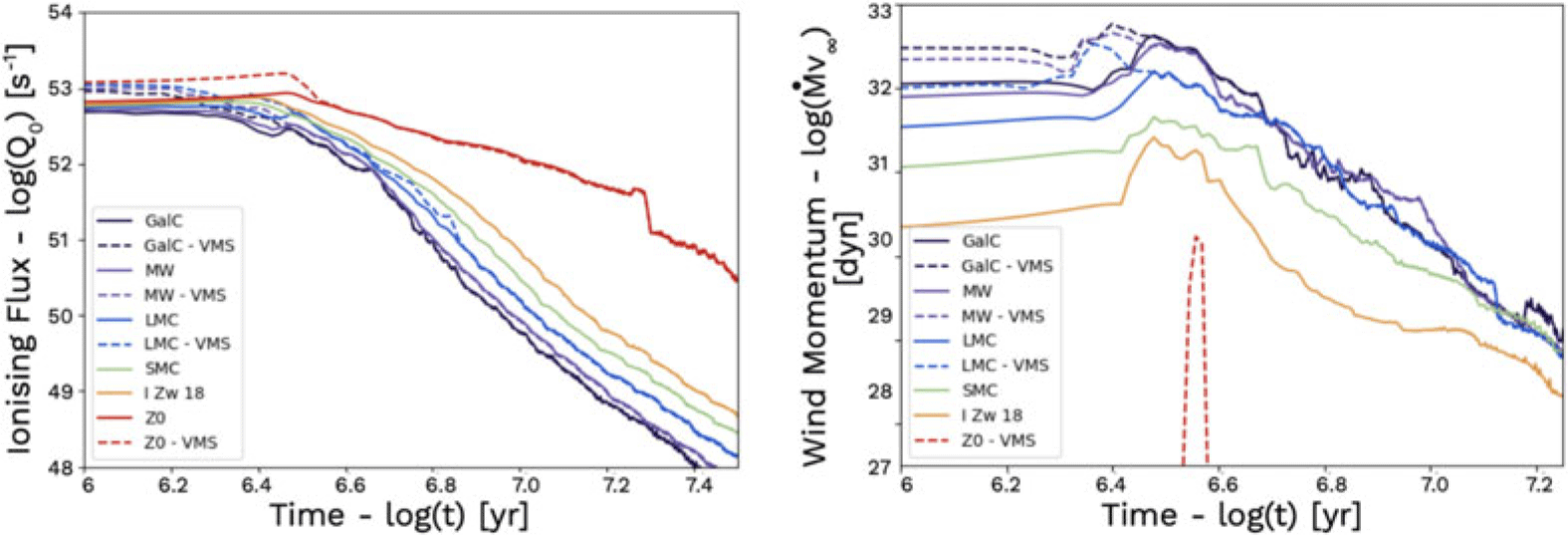
), and the wind output, here shown as wind momentum.Footnote † Metallicity has relatively little impact on the ionising flux initially as it remains nearly constant for the first 2Myr. Beyond this the
 $\textrm{H}^\textrm{0}$
drops steady as the most massive stars complete their evolution, shown in Fig. 1. Here we see the impact of lower metallicity increasing the
 $\textrm{H}^\textrm{0}$
flux at a given time. We note that this is an effect resulting from lower metallicity stars being hotter at a given luminosity in their evolution (see e.g. Mowlavi et al. Reference Mowlavi, Schaerer and Meynet1998), as the metallicity has almost no impact on the hydrogen ionising spectrum if other stellar parameters are constant. VMS boost the ionising flux by
 $\sim0.3$
dex during their lifetimes, which corresponds to the first 2 Myr of the population.
 $\textrm{H}^\textrm{0}$
ionising fluxes and wind momentum from pyStarburst99 at various metallicities from Z=0.02 to 0.0, implementing the non-rotating Genec stellar evolution models and new Fastwind synthetic spectral library. Solid lines show predictions with an upper mass limit of 120M
 $_\odot$
. Dashed lines extend the upper mass limit to 300M
 $_\odot$
.

The wind momentum steadily decreases with metallicity due to the lack of metal ions available to drive the stellar wind. However the extreme luminosity of VMS allows for a boost in wind momentum at all metallicities due to enhanced mass resulting from proximity to the Eddington limit (e.g. Bestenlehner et al. Reference Bestenlehner, Gräfener and Vink2014).
4. The Impact of Rotation
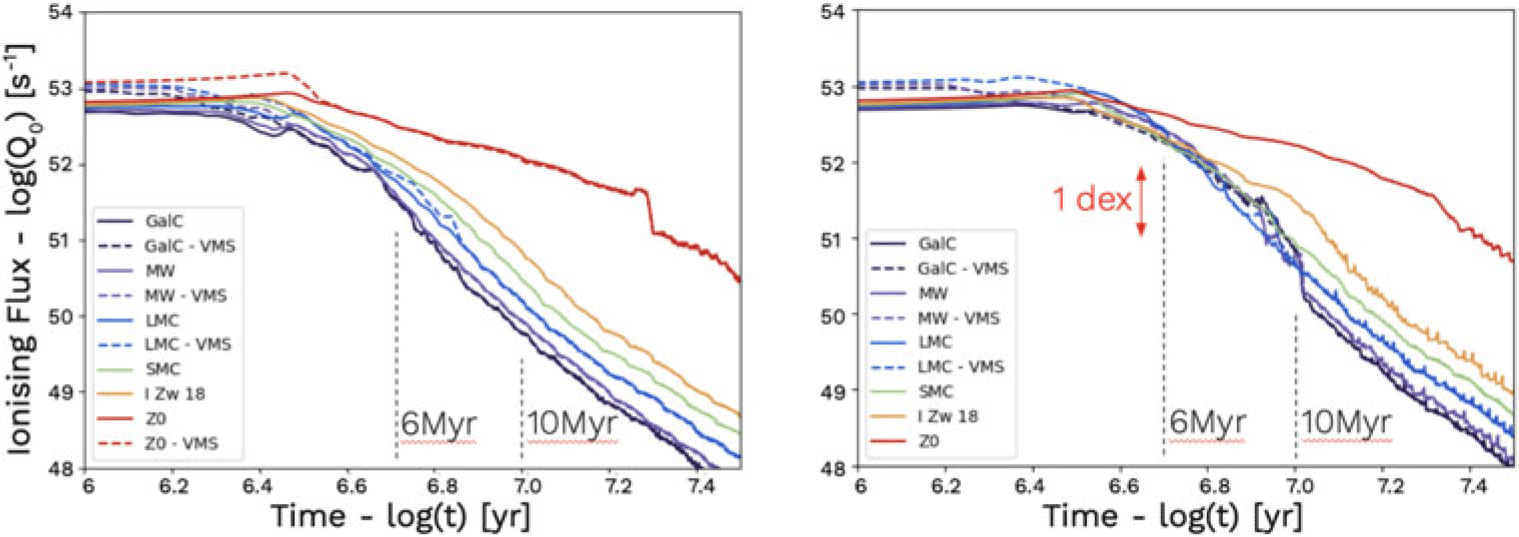
Rotation has the effect of increasing the stellar lifetimes by refueling the stellar core, therefore extending the H burning main sequence which results in increased ionising fluxes at a given time. For the example shown in Fig. 2 we assume all stars to be rotating at 40% critical, this creates an enhanced ionising flux most prominent in the range from 3 to 10 Myr with a maximum increase of 1 dex at 6 Myr. This highlights the need to include the effects of both rotation and binarity on stellar evolution, with binarity shown to have the most significant impact after 10 Myr (e.g. Eldridge et al. Reference Eldridge, Stanway and Xiao2017).
 $\textrm{H}^\textrm{0}$
ionising fluxes as in Fig. 1 but showing predictions using stellar evolution models without rotation in the left panel and including initial rotation at 40% critical in the right panel.

5. Stellar Yields
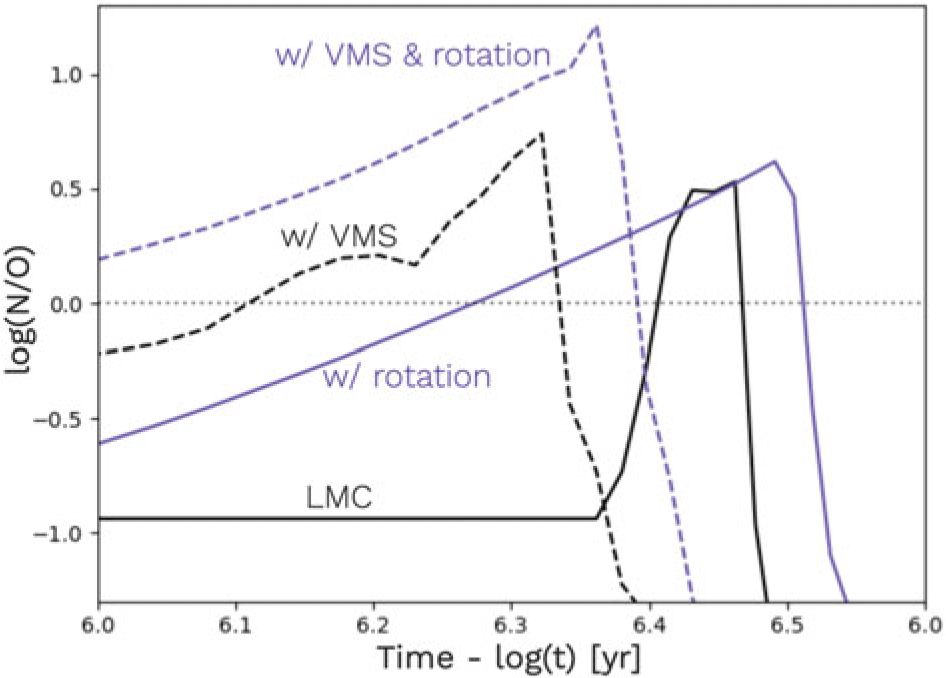
An estimate of the stellar yield of metals, shown in Fig. 3, can be obtained by combining the wind strength with the surface abundance of a given element. Given rotation causes surface enrichment and VMS have strong winds, we see an increase in the N/O abundance ratio in both cases with a larger combined boost if rotating VMS are included. These effects are even able to flip the N/O abundance ratio at early times which may be a helpful piece of the puzzle of nitrogen enrichment at observed at high redshift (Senchyna et al. Reference Senchyna, Plat and Stark2024; Ji et al. Reference Ji, Übler and Maiolino2024). In this example we assume all stars above 8M
 $_\odot$
explode as supernovae (SNe). The onset of SNe drastically increase the oxygen yield and thus significantly reduces the N/O abundance ratio. It is therefore possible to extend the time a high N/O abundance ratio is predicted if the most massive stars do not explode (see e.g. Schneider et al. Reference Schneider, Podsiadlowski and Müller2021).
Predictions of the nitrogen to oxygen abundance ratio (N/O) from stellar yields at LMC metallicity, showing the impact of including VMS and the effects of rotation.

6. Synthetic UV Spectra
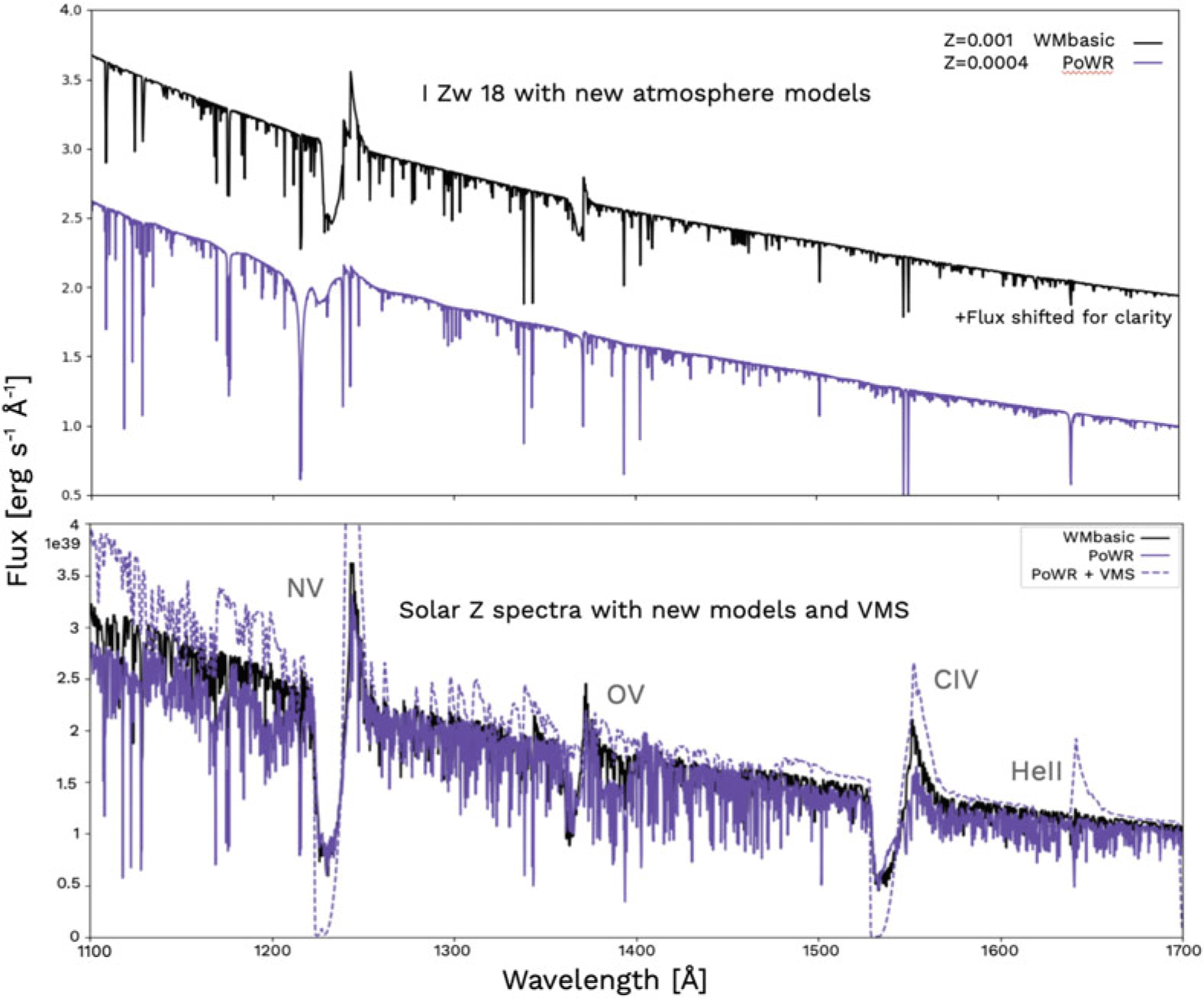
The predictions of integrated properties are all made with the fairly low resolution Fastwind spectral library. The extension of this spectral library to higher resolution and with varied stellar parameters, such as mass-loss rates and abundances, is currently underway and will be presented in the next release of pyStarburst99. In the meantime, there are publicly available grids of synthetic spectra for OB stars produced with other codes e.g. PoWR (Gräfener et al. Reference Gräfener, Koesterke and Hamann2002) and cmfgen (Hillier & Miller Reference Hillier and Miller1998). Here we implement the PoWR OB star grid (Hainich et al. Reference Hainich, Ramachandran and Shenar2019) to compare with grids currently used in Starburst99 produced with WMbasic (Pauldrach et al. Reference Pauldrach, Hoffmann and Lennon2001; Leitherer et al. Reference Leitherer, Ortiz Otálvaro and Bresolin2010). Figure 4 shows the difference in predictions for I Zw 18 from Starburst99 (isochrone at Z=0.004 and WMbasic library at Z=0.001) and pyStarburst99 (isochrone at Z=0.0004 and PoWR library at Z=0.0004). The main difference between these predictions comes from the reduced mass-loss rates used in the PoWR library compared to the WMbasic library, resulting in much weaker wind line signatures across the UV. The reduced line strengths are due to weaker winds from both lower metallicity and a downward revision of theoretical mass-loss rates to better match empirically derived mass-loss rates.
Predictions of composite UV spectra, showing a comparison between Starburst99 and pyStarburst99 at I Zw 18 metallicity in the upper panel, and the impact of VMS at solar metallicity in the lower panel.

The lower panel of Fig. 4 shows an example of the inclusion of VMS in the composite spectrum using a subset of the in-progress extension of the stellar libraries to VMS. While this is a preliminary prediction it gives an impression of the impact of VMS on the population, significantly increasing the strength of stellar wind lines and producing emission in
 $\textrm{He}^\textrm{+}$
, in good agreement with Martins et al. (Reference Martins, Palacios, Schaerer and Marques-Chaves2025).
7. Main Takeaways and Future Work
The first release of the pyStarburst99 code is an update and expansion of the Starburst99 population synthesis software ported from Fortran to python. The main focus of this release is to investigate the impact of metallicity, VMS and rotation on the composite properties of stellar populations related to feedback. We also present preliminary predictions of the new updates included in pyStarburst99 on yields and high-resolution synthetic UV spectra.
-
• Decreasing metallicity steadily increases ionising flux for populations older than 2Myr and significantly decreases the magntiude of wind feedback at all ages.
-
• Including VMS boosts both ionising and wind output in the first 2Myr
-
• The addition of rotation in stellar evolution models boosts the H i flux output mainly in the 3-10Myr window with a maximum increase of 1 dex predicted at 6Myr.
-
• Rotation and VMS can both increase the N/O abundance ratio in the pre-supernova phase.
-
• Metallicity and VMS significantly change the strength of stellar features in the composite UV spectrum.
A forthcoming release of the pyStarburst99 code will include updates to high resolution spectral synthesis, with new spectral libraries extending the metallicity and mass coverage, as well as expanding the wavelength range and implementing new empirical libraries (e.g. XShootU Roman-Duval et al. Reference Roman-Duval, Fischer and Fullerton2025; Vink et al. Reference Vink, Mehner and Crowther2023). New capabilities will also be implemented in future releases including predictions for mixed age stellar populations and tailored fitting routines. Additionally, new grids of photoionisation models based on pyStarburst99 will be presented in Aranguré et al. in prep.
Acknowledgments
Support for this work has been provided by NASA through grant No. AR-16623 from the Space Telescope Science Institute, which is operated by AURA, Inc., under NASA contract NAS5-26555.


 H0
 ⊙
 ⊙
 H0