Introduction
Digeneans typically have complex life cycles utilizing more than two hosts in their development, depending on the local availability of a variety of invertebrate and vertebrate hosts. Each host species harbours parasites in morphologically distinct developmental stages (Donald et al., Reference Donald, Kennedy, Poulin and Spencer2004) but, usually, only part of the life cycle is described, with only suggestions regarding the probable course of development (Pina et al., Reference Pina, Tajdari, Russell-Pinto and Rodrigues2009a). Furthermore, identification of the larval stages is crucial to elucidate the life cycles of different trematode species. However, due to the scarcity of reliable and specific morphological and anatomical distinguishing characteristics of the digenean larval stages, their taxonomic position often cannot be established (Jousson et al., Reference Jousson, Bartoli, Zaninettia and Pawlowskia1998; Bartoli & Gibson, Reference Bartoli and Gibson2007). In addition, some larvae (metacercariae) show varying degrees of development in the same intermediate host, depending on the date of infection, and this induces a morphological variability (Durieux, Reference Durieux2007). On the other hand, identification of digeneans is often based on the morphology of the adult stages alone because they provide more useful characters relative to larval stages (Jousson et al., Reference Jousson, Bartoli, Zaninettia and Pawlowskia1998, Reference Jousson, Bartoli and Pawlowski1999; Bartoli & Jousson Reference Bartoli, Jousson, Combes and Jourdane2003; Bartoli & Gibson, Reference Bartoli and Gibson2007). Accordingly, elucidating life cycles and establishing links between digenean larvae and adults are difficult and require laboratory experiments. However, these classical methods for elucidating life cycles (breeding hosts, experimental infections, etc.) take a long time and are sometimes unfeasible (Jousson et al., Reference Jousson, Bartoli, Zaninettia and Pawlowskia1998; Jousson & Bartoli, Reference Jousson and Bartoli1999; Criscione et al., Reference Criscione, Poulin and Blouin2005). Molecular data are used increasingly in conjunction with morphological characteristics, to overcome problems in understanding digenean life cycles by matching different life-cycle stages, thus avoiding difficulties associated with the identification of the larval stages and the completion of life cycles in laboratory conditions (Jousson et al., Reference Jousson, Bartoli, Zaninettia and Pawlowskia1998; Bartoli et al., Reference Bartoli, Jousson and Russell-Pinto2000; Jousson & Bartoli, Reference Jousson and Bartoli2000; Bartoli & Jousson Reference Bartoli, Jousson, Combes and Jourdane2003, Durieux, Reference Durieux2007; Pina et al., Reference Pina, Russell-Pinto and Rodrigues2007, Reference Pina, Tajdari, Russell-Pinto and Rodrigues2009a, Reference Pina, Barandela, João Santos, Russell-Pinto and Rodriguesb; Born-Torrijos et al., Reference Born-Torrijos, Kostadinova, Raga and Holzer2012). These methods are quick and accurate, and overcome the limitations of both morphological and experimental approaches.
The present study focuses on the digenean Proctoeces maculatus (Looss, 1901) (Fellodistomidae), a species with a complex synonymy (over 20 synonyms, see Bray, Reference Bray1983) that also exhibits two life-history strategies: (1) a three-host life cycle in the warmer waters of its range, with adults maturing in fish; and (2) a two-host life cycle in the colder waters of its range, with progenetic development within the mollusc intermediate hosts (Prévot, Reference Prévot1965; Bray & Gibson, Reference Bray and Gibson1980; Bray, Reference Bray1983). According to Prévot (Reference Prévot1965) and Lang & Dennis (Reference Lang and Dennis1976) this may represent a mechanism to enable the species to extend into cooler waters without a dependence on its usual tropical fish hosts. However, the second type of life cycle has also been recorded in the Black Sea and Morocco (Dolgikh, Reference Dolgikh1965a, Reference Dolgikhb, Reference Dolgikh1967, Reference Dolgikh1968, Reference Dolgikh1969, 1970; Dollfus, Reference Dollfus1965, Reference Dollfus1966). The life cycle of P. maculatus has been the object of several studies from which a number of different intermediate hosts have been reported (Freeman & Llewellyn, Reference Freeman and Llewellyn1958; Stunkard & Uzmann, Reference Stunkard and Uzmann1959; Prévot, Reference Prévot1965; Martinez, Reference Martinez1972, Reference Martinez1974; Lang & Dennis, Reference Lang and Dennis1976; Shimura & Egusa, Reference Shimura and Egusa1979; Wardle, Reference Wardle1980; Aitken-Ander & Levin, Reference Aitken-Ander and Levin1985; Machekvsky, 1985). To the best of our knowledge, there are 25 species belonging to different groups of invertebrates acting as intermediate hosts, and 61 teleost fish species and 19 species of invertebrates serving as definitive hosts, for this parasite. The aim of the present study was to establish links between the different developmental stages of P. maculatus in Bizerte Lagoon using morphological and molecular data.
Materials and methods
Collection and examination of samples
A total of 4228 Mytilus galloprovincialis was collected bi-monthly at the shellfish farm of Menzel Jemil (37°13′20.43″N; 9°55′48.59″E) in the north-east of Bizerte Lagoon between April 2011 and July 2012. In the laboratory, the bivalves were measured, weighed and examined under a binocular microscope in order to detect the presence of sporocysts containing cercariae of P. maculatus. The associated invertebrate fauna of the mussels was transported alive to the laboratory in aerated seawater taken from the lagoon. Thereafter, invertebrates were identified and dissected to search for metacercariae. A total of 884 invertebrates from the lagoon, comprising polychaetes (482 Sabella pavonina Savigny, 1822), bivalves (252 Chlamys varia (Linnaeus, 1758)) and gastropods (150 Hexaplexe trunculus (Linnaeus, 1758)), was examined.
Over the two-year period, 281 fish specimens belonging to two families (80 carangids (52 Trachurus trachurus (Linnaeus, 1758) and 28 Trachinotus ovatus (Linnaeus, 1758)) and 201 sparids (10 Boops boops (Linnaeus, 1758), 11 Diplodus annularis (Linnaeus, 1758), 93 Lithognathus mormyrus (Linnaeus, 1758) and 87 Sparus aurata Linnaeus, 1758) taken from the fish market of the lagoon were examined. Fish were kept on ice and immediately brought back to the laboratory where they were identified, measured, weighed and photographed. After dissection, the digestive tract was removed and examined for adult stages of P. maculatus. Digeneans were identified by comparison with the descriptions in Stunkard & Uzmann (Reference Stunkard and Uzmann1959), Prévot (Reference Prévot1965), Martinez (Reference Martinez1972) and Bray & Gibson (Reference Bray and Gibson1980). After identification, representative samples of sporocysts, metacercariae and adults were stored in ethanol (95%) at − 20°C either for a study in toto or for DNA isolation.
Morphological data
Morphological examination was conducted on live specimens and permanent mounts. Several larvae were collected live and their morphology and anatomy were studied on temporary mounts in seawater under the slight pressure of a coverslip. Several samples of sporocysts, cercariae, metacercariae and adults fixed in 95% ethanol were stained with iron-acetocarmine as described by Georgiev et al. (1986), dehydrated through an alcohol series, cleared in dimethylphthalate and mounted in Canada balsam. Drawings were made using a light microscope equipped with a drawing tube; in the illustrations of the metacercariae the excretory systems were added from sketches of living worms. Measurements were taken either from illustrations made at high magnification or from the digital images with the aid of QuickPHOTO CAMERA 2.3 image analysis software (PROMICRA, s.r.o., Praha, Czech Republic). All measurements are given in micrometres. Voucher specimens are deposited in the Helminthological Collection of the Institute of Parasitology (HCIP), Biology Centre of the Czech Academy of Sciences, České Budějovice, Czech Republic. Fish names follow FishBase (Froese & Pauly, Reference Froese and Pauly2015).
Molecular data
Total genomic DNA (gDNA) was isolated from a single, ethanol-fixed developmental stage in 200 μl of a 5% suspension of deionized water and Chelex® containing 0.1 mg/ml proteinase K, followed by incubation at 56°C for 3 h, boiling at 90°C for 8 min and centrifugation at 16,000 g for 10 min. Polymerase chain reaction (PCR) amplifications were carried out using illustra PuReTaq Ready-To-Go PCR beads (GE Healthcare, Little Chalfont, Bucks, UK) in a total volume of 25 μl (10 pmol of each primer) with 50 ng of genomic DNA. Partial fragments of the 28S rRNA gene (domains D1–D3; c.1200 nucleotides (nt)) were amplified using the forward primer ZX-1 (5′- ACCCGCTGAATTTAAGCATAT-3′) and the reverse primer 1500R (5′GCTATCCTGAGGGAACTTCG-3′) designed by Bray et al. (Reference Bray, Waeschenbach, Cribb, Weedall, Dyal and Littlewood2009) and Tkach et al. (Reference Tkach, Littlewood, Olson, Kinsella and Swiderski2003), respectively, under the following thermocycling conditions: denaturation at 95°C for 5 min, followed by 40 cycles of amplification (95°C for 30 s, 55°C for 30 s, 72°C for 2 min) and a final extension step at 72°C for 7 min. PCR amplicons were purified using a QIAquick PCR Purification kit (Qiagen Ltd, Manchester, UK) following the manufacturer's instructions, sequenced directly for both strands using the two PCR primers with ABI BigDye chemistry (ABI Perkin-Elmer, Warrington, UK), alcohol-precipitated and run on an ABI Prism 3130x1 automated sequencer. Contiguous sequences were assembled and edited with MEGA v6 (Tamura et al., Reference Tamura, Stecher, Peterson, Filipski and Kumar2013), and deposited in GenBank under accession numbers KU052934–KU052941 (adults: KU052934, KU052935, KU052936; juvenile: KU052937; sporocysts: KU052938, KU052939; metacercariae: KU052940, KU052941). Sequence identities were checked using the Basic Local Alignment Search Tool (BLAST). The newly generated 28S sequences were aligned with the only sequence for P. maculatus available in GenBank (AY222284, see Olson et al., Reference Olson, Cribb, Tkach, Bray and Littlewood2003) using Clustal W implemented in MEGA 6 (Tamura et al., Reference Tamura, Stecher, Peterson, Filipski and Kumar2013). We used three representatives of the family Fellodistomidae as outgroups (Steringophorus margolisi Bray, 1995 (AY222281), Fellodistomum fellis (Olsson, 1868) (AY222282) and Olssonium turneri Bray & Gibson, Reference Bray and Gibson1980 (AY222283), see Olson et al., Reference Olson, Cribb, Tkach, Bray and Littlewood2003). The analysis involved 12 nucleotide sequences. All ambiguous positions were removed for each sequence pair. Neighbour-joining (NJ) and maximum likelihood (ML) analyses were used to explore the relationships of the present isolates. Neighbour-joining analyses of Kimura-2-parameter distances were carried out using MEGA v6; nodal support was estimated using 1000 bootstrap re-samplings. Genetic distance matrices (p-distance model) were also calculated with MEGA v6. ML analysis was carried out with PhyML 3.0 (Guindon et al., Reference Guindon, Dufayard, Lefort, Anisimova, Hordijk and Gascuel2010) with a non-parametric bootstrap validation on 100 replicates. The best-fit nucleotide substitution model prior to ML analysis was estimated with jModelTest 2.1.4 (Guindon & Gascuel, Reference Guindon and Gascuel2003; Darriba et al., Reference Darriba, Taboada, Doallo and Posada2012) using Akaike Information Criterion (AIC). This was the general time reversible model with estimates of invariant sites (GTR+I).
Results
Molecular analysis
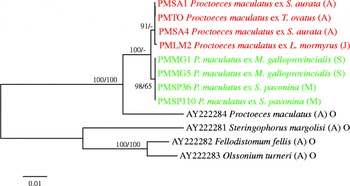
Partial 28S rDNA sequences were obtained for specimens identified based on morphology as P. maculatus from different hosts in the Bizerte Lagoon: two sporocysts isolated from M. galloprovincialis, three adults collected from S. aurata and T. ovatus, one juvenile collected from L. mormyrus and two metacercarial isolates from S. pavonina. The phylogenetic tree resulting from NJ/ML of the 28S rDNA dataset is shown in fig. 1. The 28S rDNA alignment was 1183 nt long. Comparative sequence analysis revealed that all isolates diverged by 0–0.42% (0–5 nt differences). Indeed, the sequences of sporocysts isolated from the mussel M. galloprovincialis and those of metacercariae collected from the annelid S. pavonina were 100% identical (0 nt differences). Similarly, the sequences of adult isolates collected from S. aurata and T. ovatus were identical (0 nt differences) but they differed from the sequence of the juvenile isolate collected from L. mormyrus by only 1 nt (0.08%) and from those of sporocyst isolates and the metacercarial isolates by only 4 nt (0.3%). This level of divergence between the developmental stages suggested the possibility of cryptic species. Clarification may be furnished by sequencing additional samples at more than one locus. However, all Mediterranean isolates differed substantially (47 nt differences; 3.9%) from the only sequence of P. maculatus available in GenBank. This sequence was obtained from Archosargus probatocephalus (Sheepshead) in the Gulf of Mexico and thus may, in fact, represent a different species of Proctoeces (Olson et al., Reference Olson, Cribb, Tkach, Bray and Littlewood2003).
Neighbour-joining (NJ) tree for life-cycle stages of Proctoeces maculatus based on the 28S rDNA gene with node support from maximum likelihood (NJ/ML). Sequence identification is as in GenBank, followed by letter: O, Olson et al. (Reference Olson, Cribb, Tkach, Bray and Littlewood2003). The scale-bar indicates the expected number of substitutions per site. The isolate code and the life-cycle stage are indicated. Abbreviations: S, sporocysts; M, metacercariae; J, juvenile; A, adult.

Proctoeces maculatus (Looss, 1901) Odhner, 1911
Taxonomic summary
First intermediate host. Mytilus galloprovincialis (Lamarck, 1819) (Mytiloida, Mytilidae).
Second intermediate host. Sabella pavonina (Savigny, 1822) (Sabellida, Sabellidae).
Definitive hosts. Lithognathus mormyrus (Linnaeus, 1758) (Perciformes, Sparidae), Sparus aurata Linnaeus, 1758 (Perciformes, Sparidae), Trachinotus ovatus (Linnaeus, 1758) (Perciformes, Carangidae).
Locality. Bizerte Lagoon (Tunisia).
Prevalence. Sporocysts: 0.18% (8/4228); metacercariae: 53.52% (258/482); adults: 3.44% (L. mormyrus), 9.67% (S. aurata), 3.57% (T. ovatus).
Abundance. Metacercariae: 1.69; adults: 0.04 (L. mormyrus), 0.15 (S. aurata), 0.03 (T. ovatus).
Mean intensity. Metacercariae: 3.15; adults: 1.33 (L. mormyrus), 1.55 (S. aurata), 1.00 (T. ovatus).
Voucher material: HCIP D-723.
Sporocysts
The description (fig. 2) is based on five live specimens, 17 whole-mounted specimens and two alcohol-fixed specimens. They were located in the digestive gland of the bivalves at the early infection stages and occupied mainly the mantle and the gonad at high intensities. Sporocysts are sac-shaped, with rounded extremities or sometimes slightly pointed at one extremity, thin-walled, whitish to yellow-orange in colour, depending upon the degree of maturation, motile with contraction movements. Four types of sporocysts were observed depending on the degree of maturation: (1) sporocysts containing germinal balls only (344–803 × 136–374 (n= 6)) (fig. 2A); (2) sporocysts containing daughter sporocysts (849 × 408 (n= 1)) (fig. 2B); (3) sporocysts containing daughter sporocysts and cercariae (770–799 × 258–320 (n= 2)) (fig. 2C); and (4) sporocysts filled with cercariae (678–1938 × 358–781 (n= 15)) (fig. 2D). Cercariae leave sporocysts through a terminal birth pore.
Four types of sporocysts of Proctoeces maculatus from Mytilus galloprovincialis from the Bizerte Lagoon, Tunisia. (A) Sporocysts containing germinal balls; (B) sporocysts containing daughter sporocysts; (C) sporocysts containing daughter sporocysts and cercariae; (D) sporocysts containing cercariae. Scale bars: (A–C) 200 μm; (D) 500 μm.

Cercariae
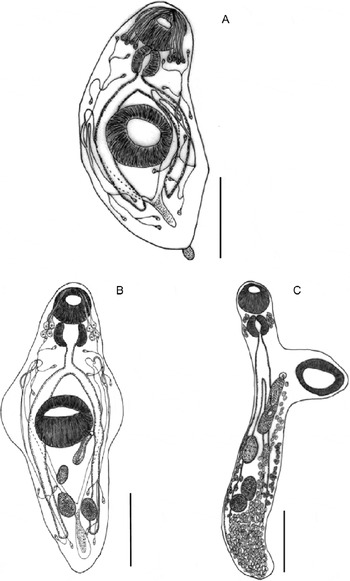
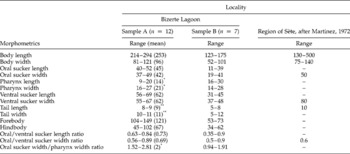
The description (fig. 3A, table 1) is based on seven flattened specimens in vivo. Microcercous cercaria. Body oval, tapered at both extremities, with maximum width at level of ventral sucker. Tegument smooth. Oral sucker subterminal, spherical, smaller than ventral sucker. Ventral sucker globular, situated at mid-body length. Eight gland-cells arranged in two groups of four located on each side of pharynx. Gland-cell ducts in four pairs, open at anterior edge of oral sucker. Prepharynx absent. Pharynx ovoid, muscular. Oesophagus very short. Intestinal bifurcation at level of mid-forebody. Caeca parallel to lateral body edges in hindbody, end blindly near posterior extremity. Excretory vesicle Y-shaped; stem bifurcates in two lateral arms with bulbous ends, reaching to intestinal bifurcation; excretory pore terminal. Flame-cell formula 2 [(2+2)+(2+2)] = 16. Tail minute.
Morphology of Proctoeces maculatus: (A) cercaria from Mytilus galloprovincialis; (B) metacercaria from Sabella pavonina; (C) adult from Sparus aurata from the Bizerte Lagoon, Tunisia. Scale bars: (A) 50 μm; (B–C) 300 μm.

Morphometrics of the cercariae of Proctoeces maculatus based upon permanent mounts (A) from digital images, and living specimens (B) from Mytilus galloprovincialis in the Bizerte Lagoon, compared with Martinez (Reference Martinez1972) from the region of Sète; measurements (in μm) are given as ranges followed by mean values in parentheses, n = number of specimens examined, except for *n = 7 and **n = 5.

Metacercariae
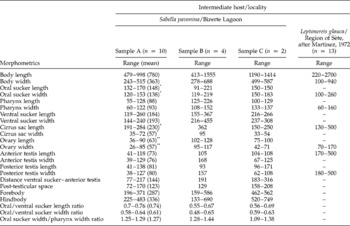
The description (fig. 3B, table 2) is based on 12 flattened whole-mounted specimens. Metacercariae unencysted, located in the coelom of the first segments of the polychaete S. pavonina, morphologically and anatomically very similar to cercariae. However, they are distinguished by the acquisition of the reproductive system and an increase in size. In the following, we describe only the reproductive organs. Two testes, longitudinally oval or round, entire, slightly separated, oblique, in posterior part of the body. Cirrus sac curved, intra-caecal, located in the acetabular region, its posterior limit slightly exceeds the posterior margin of the ventral sucker. Ovary ovoid to spherical, pre-testicular. Uterus not yet developed.
Morphometrics of the metacercariae of Proctoeces maculatus based upon permanent mounts (A) and wet mounts in water prior to sequencing (B) from digital images, and upon illustrations of permanent mounts (C), from Sabella pavonina in the Bizerte Lagoon, compared with Martinez (Reference Martinez1972) from the region of Sète; measurements (in μm) are given as ranges followed by mean values in parentheses; n = number of larvae examined, except for *n = 3 and **n = 6.

Adults
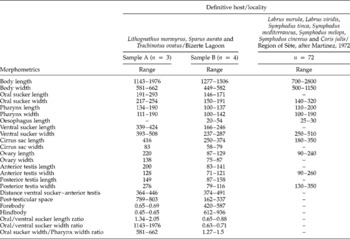
The description (fig. 3C, table 3) is based on four flattened specimens in toto. Adults were harvested either from the posterior intestine or rectum of definitive hosts. Body elongate, tapered at both ends, wider at level of ventral sucker. Tegument unarmed. Oral sucker globular, subterminal. Ventral sucker subspherical or transversely oval, in anterior second third of body, larger than oral sucker. Prepharynx absent. Pharynx globular, muscular. Oesophagus short. Intestinal bifurcation in mid-forebody. Caeca wide, reach post-testicular zone, terminate blindly close to posterior extremity. Two testes, rounded or sometimes ovoid, entire, contiguous or slightly separated (in one specimen), oblique, in posterior hindbody, overlapping partially right caeca. Cirrus sac elongate, slightly claviform, entirely in hindbody (in one specimen) or partly in acetabular zone, overlapping left caeca in a single specimen. Internal seminal vesicle tubular, coiled, in the proximal end of cirrus sac. Pars prostatica tubular, straight or slightly arcuate, occupies more than half of the cirrus sac, surrounded by numerous gland-cells. Ejaculatory duct short, opens in genital atrium. Genital atrium distinct. Genital pore, intra- or extra-caecal, dextral to ventral sucker. Ovary oval or slightly lobed, pre-testicular, in anterior hindbody. Seminal receptacle absent. Uterus fills much of hindbody, uterine loops occupy post-testicular zone, reach level of ovary and lead to genital atrium. Eggs numerous, operculate. Vitellarium follicular, in two lateral fields, follicles irregular, feebly developed, extending from anterior margin of ovary to posterior margin of anterior testis, sometimes reaching the posterior testis. Excretory pore terminal; vesicle not seen.
Morphometrics of the adults of Proctoeces maculatus based upon wet mounts in water prior to sequencing (A) from digital images, and upon illustrations of permanent mounts (B) from Lithognathus mormyrus, Sparus aurata and Trachinotus ovatus in the Bizerte Lagoon, compared with Martinez (Reference Martinez1972) from the region of Sète; measurements (in μm) are given as ranges; n = number of adults examined.

Discussion
Identification of members of the genus Proctoeces Odhner, 1911 is quite difficult due to the scarcity of reliable taxonomic distinguishing characteristics, the lack of consistent diagnostic characteristics and the great morphological and morphometrical variability found even within specimens of the same population parasitizing different hosts (Freeman & Llewellyn, Reference Freeman and Llewellyn1958; Freeman, Reference Freeman1963; Dollfus, Reference Dollfus1965; Lang & Dennis, Reference Lang and Dennis1976; Wardle, Reference Wardle1980; Bray, Reference Bray1983). For this reason, the taxonomic position of many species previously described has been questioned and many species have been synonymized with the type-species P. maculatus (see Bray & Gibson, Reference Bray and Gibson1980; Bray, Reference Bray1983), a species of worldwide distribution which displays diverse life-cycle patterns in a broad variety of hosts (Bray, Reference Bray1983). Until recently, the taxonomic status of Proctoeces spp. has been controversial. Valdivia et al. (Reference Valdivia, Cardenas, Gonzalez, Jofré, George-Nascimento, Guiñez and Oliva2010) suggested that there are at least three species of Proctoeces, thus overturning the postulates of Bray & Gibson (Reference Bray and Gibson1980) and Bray (Reference Bray1983); these latter authors stated that all described species in Proctoeces are synonymous with P. maculatus. To the best of our knowledge, only the life cycles of P. maculatus and P. lintoni Siddiqi & Cable, 1960 are known (Bray & Gibson, Reference Bray and Gibson1980; Bray, Reference Bray1983; Loot et al., Reference Loot, Aldana and Navarrete2005, Reference Loot, Blanchet, Aldana and Navarrete2008; Aldana et al., Reference Aldana, Gonzalez, Loot, Pulgar and Marquet2009). However, the three-host life cycle of P. lintoni proposed by Loot et al. (Reference Loot, Aldana and Navarrete2005, Reference Loot, Blanchet, Aldana and Navarrete2008) was later rejected by Oliva et al. (Reference Oliva, Valdivia, Cárdenas, George-Nascimento, Gonzalez, Guiñez and Cuell2010) on the basis of molecular and experimental evidence. These authors demonstrated that sporocysts and cercariae obtained from the mussel Perumitylus purpuratus (Lamarck, 1819) do not belong to P. lintoni, and thus P. purpuratus is not the first intermediate host for this parasite as suggested by Loot et al. (Reference Loot, Aldana and Navarrete2005, Reference Loot, Blanchet, Aldana and Navarrete2008). The present paper provides information regarding the life cycle of P. maculatus in Bizerte Lagoon.
The morphological examination of sporocysts and cercariae collected from the mussel M. galloprovincialis from the Bizerte Lagoon allowed us to attribute these larvae to P. maculatus. The sporocysts with cercariae were located in the digestive gland, the gonad and the mantle of the mussel at high intensities. Martinez (Reference Martinez1972) noted a passivity of cercariae in searching the second intermediate host. According to this author, this passivity is offset by the long period of free living of these larvae, increasing the chances of contamination.
The metacercariae recovered from S. pavonina showed all the morphological characters of P. maculatus: body broadly oval to elongate; pharynx large; oesophagus short or absent; intestinal bifurcation in mid-forebody; caeca of similar length, ending blindly; testes oval to rounded, entire, oblique to tandem in mid-hindbody. Cirrus sac claviform, variable in position; internal seminal vesicle narrow, tubular, coiled; pars prostatica long, wide, surrounded by numerous gland-cells. Ejaculatory duct short, muscular. Genital pore sinistrally submedian, bifurcal or postbifurcal. Ovary globular, pre-testicular. Excretory pore terminal. Excretory vesicle Y-shaped. The metacercariae were unencysted and moved freely in the coelom of the host. These larvae limit their distribution to the first segments of the polychaete; this precise location seems to increase the probability of transmission of metacercariae to the definitive host. Indeed, S. pavonina lives permanently in a tube and the only part that emerges out of the tube is the gill plume (breathing and trapping suspended particles in water) followed by the first segments; predatory fish that lurk around this annelid can consume this part when it is exposed before its retraction into the tube.
Unencysted metacercariae of P. maculatus were also reported by Prévot (Reference Prévot1965) in the polychaetes Hydroïdes norvegica Gunnerus, 1768 and Nereis cadatum Chiaje, 1841. Furthermore, Martinez (Reference Martinez1972) reported the presence of young unencysted metacercariae of this parasite at the level of the parapods of Leptonereis glauca (Claparède, 1870) at early infection stages, these larvae were found in the coelom after the development of their reproductive organs.
Morphologically, the adults described herein agree well with the description of P. maculatus by Martinez (Reference Martinez1972), based on material from seven species of Labridae (Labrus merula Linnaeus, 1758, Labrus viridis Linnaeus, 1758, Symphodus tinca (Linnaeus, 1758), Symphodus mediterraneus (Linnaeus, 1758), Symphodus melops (Linnaeus, 1758), Symphodus cinereus (Bonnaterre, 1788) and Coris julis (Linnaeus, 1758)) sampled in the pond of Thau and the sea near Sète. Apart from the fact that our specimens show smaller measurements, we found no significant morphological differences between specimens from Bizerte Lagoon and the descriptions of specimens from the region of Sète, France (Martinez, Reference Martinez1972). Indeed, almost all measurements were outside the upper range of adults described by Martinez (Reference Martinez1972) (with the exception of the length of the cirrus sac which is somewhat greater in the present material (table 3)). Proctoeces maculatus is characterized by a broad host range; these metrical differences observed in our specimens can be associated with the fact that in Bizerte Lagoon the parasite inhabits different definitive hosts. The labrid fishes harbouring a higher number of P. maculatus (between 1 and 4 specimens per fish (see Martinez, Reference Martinez1972)) and allowing a greater development of this digenean may possibly be its preferential hosts.
Comparative sequence analysis of partial fragments (D1–D3 domains) of the ribosomal 28S RNA gene demonstrated that the sequences of the three life-cycle stages of P. maculatus examined in the Bizerte Lagoon may represent two cryptic species. The sequences of sporocyst isolates from the mussel M. galloprovincialis and those of metacercariae collected from the annelid S. pavonina were identical but differed from those of adult isolates collected from S. aurata and T. ovatus by four nucleotides. All the Mediterranean isolates differed substantially from the sequence of P. maculatus available in GenBank (Olson et al., Reference Olson, Cribb, Tkach, Bray and Littlewood2003). This sequence was obtained from material collected from the sparid A. probatocephalus (Sheepshead) in the Gulf of Mexico, and thus may in fact represent a different species of Proctoeces. A similar explanation was suggested by Valdivia et al. (Reference Valdivia, Cardenas, Gonzalez, Jofré, George-Nascimento, Guiñez and Oliva2010) concerning specimens of P. lintoni Siddiqi & Cable, 1960 collected from the gonads of six gastropods of the genus Fissurella and the intestine of the gobiesocid fish Sicyases sanguineus from the Chilean coast. Indeed, the results of the phylogenetic analysis based on DNA sequences from the V4 region of the small subunit (SSU) rRNA gene obtained by these authors have shown convincingly that: (1) P. lintoni, considered by Bray (Reference Bray1983) as synonymous with P. maculatus on the basis of morphological criteria, constitutes a taxonomic group that is separate from P. maculatus analysed by Hall et al. (Reference Hall, Cribb and Barker1999) and Olson et al. (Reference Olson, Cribb, Tkach, Bray and Littlewood2003) in two different hosts (Choerodon cyanodus and A. probatocephalus) from two distinct geographical localities (Heron Island and the Gulf of Mexico); (2) these two sequences show genetic differences and therefore can be considered as different species. In summary, our data revealed the possibility of the existence of two cryptic species of P. maculatus. The life cycle of one of them involves the mussel M. galloprovincialis as the first intermediate host and the annelid S. pavonina as the second intermediate host. The adults of the second species were found in L. mormyrus, S. aurata and T. ovatus.
Acknowledgements
We are grateful to Dr Aneta Kostadinova for her comments on the original manuscript and for the correction of the English text, and Dr Simona Georgieva for her help with the molecular biology techniques.
Financial support
This study was supported by the Ministry of Higher Education and Scientific Research of Tunisia, the Czech Science Foundation (project P505/12/G112) and the Institute of Parasitology (RVO 60077344).
Conflict of interest
None.
Ethical standards
All applicable institutional, national and international guidelines for the care and use of animals were followed.