This study is concerned with the role of input in early word learning. Clearly, labeling is critical to word learning. The literature on labeling has focused on two different ways labels for present objects may be related to infant attention. The first is referred to as ‘follow-in,’ where mothers label (or comment about) the object that is in the child's current focus. The second is referred to as ‘lead-in,’ where mothers attempt to redirect their children's attention to an object that is not currently in their attentional focus. The way in which speakers use these types of labels has been shown to relate to children's lexical acquisition over the first two years (Tomasello & Todd, Reference Tomasello and Todd1983; Tomasello & Farrar, Reference Tomasello and Farrar1986; Baldwin, Reference Baldwin1991; Carpenter, Nagell & Tomasello, Reference Carpenter, Nagell and Tomasello1998).
Parents who use proportionately more follow-in labels have children with larger, more nominally based vocabularies than parents who use more of a lead-in labeling style (Tomasello & Todd, Reference Tomasello and Todd1983; Tomasello & Farrar, Reference Tomasello and Farrar1986; Tomasello, Mannle & Kruger, Reference Tomasello, Mannle and Kruger1986; Carpenter et al., Reference Carpenter, Nagell and Tomasello1998; Smith, Adamson & Bakeman, Reference Smith, Adamson and Bakeman1988). Tomasello & Todd (Reference Tomasello and Todd1983) observed mother–infant dyads in semi-structured sessions at home from 1 ; 0 to 1 ; 6 and found that the extent to which mothers followed their infants' attention correlated with children's language development. The authors concluded that following-in to infant attention does not require much of an active role from the infant in coordinating with the speaker's focus, while redirecting infant attention requires the infant to play a much more active role in determining and following the speaker's referential intent. Thus, follow-in labeling simplifies the word-learning task.
Tomasello & Farrar (Reference Tomasello and Farrar1986) investigated how follow-in and lead-in behaviors related to language development with both naturalistic and experimental data. In their first study, 24 infants were videotaped at home with their mothers in a semi-naturalistic observation at 1 ; 3 and 1 ; 9. Mothers' lead-in and follow-in behaviors were coded separately within and outside of joint attention episodes. Child language was measured by a structured interview with mothers at the two time-points. Results indicated that, within joint attention episodes, object labels that followed into infant attention correlated positively with subsequent lexical development; whereas object labels that attempted to redirect infant attention correlated negatively with child language. Later studies (e.g. Carpenter et al., Reference Carpenter, Nagell and Tomasello1998) have indicated that these follow-in and lead-in results should hold outside of joint attention sessions.
There was, however, an exception to Tomasello & Farrar's (Reference Tomasello and Farrar1986) redirective pattern. Their data show a single positive correlation between lead-in labels supported by gesture and vocabulary size. The authors noted the finding as ‘interesting,’ yet this pattern was not further explored. Tomasello & Farrar's (Reference Tomasello and Farrar1986) second study involved an experimental follow-up of the observational study, in which 10 infants at 1 ; 5 were taught words in either a follow-in or lead-in condition. Gesture use in object naming was not a variable in this study. Results showed that children demonstrated a better understanding of words presented in a follow-in condition. From the two studies, Tomasello & Farrar (Reference Tomasello and Farrar1986) concluded that use of lead-in utterances was negatively correlated with ease of lexical acquisition. While their conclusion concerning follow-in labels is clearly supported by their data as well as by other studies (e.g. Baldwin, Reference Baldwin1991; Carpenter et al., Reference Carpenter, Nagell and Tomasello1998; Dunham, Dunham & Curwin, Reference Dunham, Dunham and Curwin1993), the conclusion that it is important not to redirect attention seems to largely ignore the implications of a facilitative role of gesture.
If such a relation between gesture, lead-in success and child vocabulary is systematic, it would suggest that lead-in labeling is not necessarily detrimental. Recent research has supported the idea that redirection may not always pose an obstacle to word learning. Akhtar, Dunham & Dunham (Reference Akhtar, Dunham and Dunham1991) observed 12 mother–infant dyads at 1 ; 1 and examined the relation between lead-in and follow-in behaviors and child productive vocabulary at 1 ; 10. They found that directives that followed infants' actions and attentional foci correlated positively with lexical development. However, these directives which positively related to child language referred to the pragmatic nature of the utterance (e.g. asking the child to perform a specific action with a toy on which they are already focused), rather than redirecting the visual focus of children's attention. Similar to previous studies (e.g. Tomasello & Farrar, Reference Tomasello and Farrar1986), Akhtar et al. (Reference Akhtar, Dunham and Dunham1991) found negative relations between behaviors that attempted to redirect children's visual attention and child language.
In another recent study, Masur, Flynn & Eichorst (Reference Masur, Flynn and Eichorst2005) examined dyads in naturalistic interactions at 0 ; 10, 1 ; 1 and 1 ; 5, and found important differences between categories of parents' directive behaviors, such that, similar to Akhtar et al. (Reference Akhtar, Dunham and Dunham1991), while intrusive directiveness may be detrimental to early word learning, supportive directiveness was not. However, their supportive directive behaviors were still responsive to the children's current focus of attention. Thus, it is still unclear whether it is always detrimental to call attention to objects not currently in the child's attention, or whether it is only detrimental when children's attention is not successfully redirected.
Baldwin (Reference Baldwin1991) hypothesized that if infants were able to notice non-verbal cues during lead-in labels, and if they realize that cues are informative about the reference of the label being uttered, then infants themselves may be capable of using these cues to locate the intended referent. Baldwin (Reference Baldwin1991, Reference Baldwin1993) gave infants novel labels for objects in two conditions, either in a follow-in condition, or in a discrepant condition (lead-in) in which the experimenter looked at and labeled a different object from that to which the infant was attending. On comprehension trials, as in previous studies, children performed well in the follow-in condition. In the discrepant condition, children at 1 ; 6 were able to redirect their attention to the speaker's line of regard and use this information to learn the correct word–object mapping. Younger children did not demonstrate this ability. This suggests that infants, at least by 1 ; 6, may be able to respond to redirective labels when referential cues are presented.
The role of gesture in influencing infant attention has been previously recognized. Deák, Flom & Pick (Reference Deák, Flom and Pick2000) looked at infants' abilities to follow the target of a parent's referential cues at 1 ; 0 and 1 ; 6. In their first experiment, parents called children's attention to a display in one of three conditions: by looking alone, by gesturing and looking or by gesturing, looking and vocalizing. They found that parental gesturing increases children's ability to attend to the focal object at both ages. The effect of added vocalization was not significantly different from the looking and pointing and looking condition, but we note that parents' vocalizations did not necessarily include object names. Deák et al.'s (Reference Deák, Flom and Pick2000) findings reflect Tomasello & Farrar's data (Reference Tomasello and Farrar1986), in which, together, the use of gesture and infants' attention to the labeled referent positively correlated with vocabulary. In the current study, we extend these previous findings and systematically investigate two issues related to the use of gesture. First, we examine the extent to which parents offer gestural cues with their lead-in labels. Next, we determine whether lead-in labels paired with gesture are more likely to be successful in redirecting children's attention than lead-in labels not paired with gesture.
We propose the following hypotheses about the effects of labeling. First, as has been previously found in the literature, we predict that the use of follow-in labels should be more positively correlated with the infant's vocabulary level than lead-in labels. Follow-in labels are most relevant to the child's current focus of attention, and may therefore make the word-learning task easier for the child. Second, we predict that the overall use of lead-in labels should be predictive of low vocabulary, as these types of labels require an additional effort on the part of the child to search the environment for what the parent is referring to. However, this overall measure of ‘lead-in’ labeling includes labels that result in the infant attending to the correct referent, along with those that do not.
Our third prediction is that lead-in labels that successfully redirect the infant's attention to the intended referent may be more positively correlated with infant vocabulary development than lead-in labels that fail to redirect attention to the named object. To address these issues, we divide lead-in behaviors into those that succeed and those that do not succeed in redirecting infants' attention to the target object. Our fourth prediction is that, overall, the proportion of parents' labels for which infants attend to the referent should positively correlate with vocabulary development, whether these labels follow or successfully redirect children's attention. Our final prediction is that gesture may play an important role in attracting and maintaining children's attention to labeled referents, and that therefore parents' use of gesture with their lead-in labels will be associated with successful redirecting of children's attention.
METHOD
Participants
Eighteen infants (9 male, 9 female) and their mothers were recruited from the University of Chicago participant database to take part in this study beginning at age 1 ; 2 (mean age 1 ; 2·6, range 1 ; 2·0–1 ; 2·18). Twelve of these pairs were recruited as part of a larger longitudinal study of language development. The mothers were all married, English speaking, Caucasian and lived in the suburban Chicago area. To ensure that the mother's speech was the primary linguistic input, we sampled dyads in which mothers were the primary caretakers and in which the infants were firstborns with no siblings as of the first taping (see Huttenlocher, Haight, Bryk, Seltzer & Lyons, Reference Huttenlocher, Haight, Bryk, Seltzer and Lyons1991).
Procedure
Infants were videotaped in naturalistic free-play interactions in their homes with their mothers at three time points, when the infants were 1 ; 2, 1 ; 6 and 1 ; 10. The duration of each of the videotaped observations was 90 minutes. These home visits were coordinated with the mother to correspond with the child's most alert and rested period of the day. Observers informed the mothers that they were interested in observing the child's natural behavior in the home environment during early language development. No mention was made of the mothers' speech (as in Tomasello & Farrar, Reference Tomasello and Farrar1986). No attempt was made to direct or control the dyads' activities during the free-play sessions. The measures of maternal input and child observed productive language were assessed at all three visits.
Measures
All measures were calculated from transcribed videotaped observations during the 90-minute naturalistic free-play sessions. In assessing maternal input, only speech addressed to the infant was included. The mother–infant interactions were transcribed by the researcher who videotaped the interaction. All parent input measures were calculated separately when the infants were 1 ; 2, 1 ; 6 and 1 ; 10. Child vocabulary measures were calculated at 1 ; 2, and cumulative vocabulary measures were calculated at 1 ; 6 and 1 ; 10.
Object label criteria
Only those utterances that were directed to the child were coded for object labels. For the current study, our measure of object labeling was a token measure. A token, rather than type input measure was chosen, as it allowed us to track parents' social monitoring (e.g. follow-in behavior) and social cues (i.e. gesture) that accompanied each object label. A type measure would not be sensible for this purpose, as there is no guarantee that parents would use consistent social behaviors with all instances of a particular word type.
Words were counted as object labels if they were nouns that referred to a tangible object or were proper names (see Huttenlocher, Reference Huttenlocher and Solso1974). Object labels given during book reading or singing were not counted. In addition to our measure of object labels, we included a measure of overall word tokens to index maternal talkativeness. This measure includes all words given to the child at each time.
Finally, mothers' object label tokens were counted only if they referred to objects that were in the presence of the mother and infant at the time of the labeling utterance, since only references of these types allow for the infant to focus on the labeled object. Thus, words for absent referents were excluded from the current analyses. Rarely, object labels were given for which infant attention could not be determined; these labels were also excluded from our analyses.
Follow-in and lead-in labels
Mothers' object label tokens were coded as either ‘follow-in’ or ‘lead-in.’ Follow-in labels were defined as references to objects that were in the child's ongoing visual focus at the time of the label. Lead-in utterances were defined as references to objects that were not in the child's ongoing visual focus at the time of the label (as in Tomasello & Farrar, Reference Tomasello and Farrar1986). At each of the three time periods, mothers' speech was coded for the frequency and proportion of all labels that were either lead-in or follow-in.
Lead-in-successful labels and lead-in-unsuccessful labels
Lead-in labels were further coded as ‘lead-in-successful’ or ‘lead-in-unsuccessful’, based on children's subsequent attention or inattention to the labeled object. For example, a mother may call attention to a bird in the sky, saying ‘There's a bird!’ while the infant is looking at the grass. The label ‘bird’ would be coded as ‘lead-in successful’ if the infant looked up from the grass to attend to the bird. If, however, the child continued to look at the grass, the label ‘bird’ would be coded as ‘lead-in-unsuccessful.’ At each time period, mothers' speech was coded for the frequency and proportion of lead-in labels that were successful in redirecting infant attention.
Gesture
All lead-in labels were coded as to whether they were paired with a gesture. We coded gestures as non-verbal behaviors that highlighted the spatial location of the labeled object. The types of behaviors we included were: points or other waves to the object and head nods to the direction of the object. Similar to Tomasello & Farrar (Reference Tomasello and Farrar1986), who included in their gesture measure other non-verbal indications of attentional focus, we also included in this measure movements of the object to attract infant attention (e.g. shaking the object). These movements, along with pointing gestures, have been found to facilitate infant attention to objects (e.g. Pecheux, Findji & Ruel, Reference Pecheux, Findji and Ruel1992). Movement of the object as part of the object's typical use (e.g. stirring with a spoon), or movement of the object for the sake of transportation was not coded as a gesture. We measured the frequency and proportion of lead-in labels that included any of these gestures.
Total successful and unsuccessful labels
A final measure of ‘total successful labels’ indexed the frequency and proportion of all labels for which children attended to the target object. This was defined as the sum of ‘follow-in’ and ‘lead-in-successful’ labels. Note that the measure of ‘total unsuccessful labels’ would be equivalent to the measure of ‘lead-in-unsuccessful labels,’ as these were the only labels for which the child did not attend to the labeled object.
Infant productive vocabulary
Children's cumulative productive vocabulary was used as the outcome measure of language development, and was taken from the same videotaped samples as the mothers' predictor measures (as in Hoff & Naigles, Reference Hoff and Naigles2002). This measure was defined as the number of observed word types produced at 1 ; 2, and the additive number of observed word types produced at 1 ; 6 and 1 ; 10. Type measures were made following the criteria of Hoff & Naigles (Reference Hoff and Naigles2002), in that different forms of a word were treated as the same type (e.g. dog/dogs; eat/ate). We chose to use an observed vocabulary measure rather than one based on parental report, as the observed measure allowed us a high level of control over the way in which children's lexical items were credited to their vocabularies.
Three researchers independently coded the mother–infant interactions for the object label measures in this study. Reliability of the coding system was based on a random sample of 150 object labels. For each object label, we judged whether it followed into the child's attention, whether, if lead-in, it was successful or unsuccessful and whether gesture was used. Inter-coder reliability was assessed using the kappa coefficient for multiple raters. According to Fleiss (Reference Fleiss1981), scores greater than 0·75 indicate an excellent level of agreement across coders. Agreement was as follows: for follow-in labels, kappa=0·86; for lead-in unsuccessful labels, kappa=0·91; for lead-in successful labels, kappa=0·84; and for the use of gesture, kappa=0·87.
RESULTS
Pearson product-moment correlations were calculated between parent labeling measures (of both frequency and proportion) at 1 ; 2, 1 ; 6 and 1 ; 10 and child productive vocabulary at 1 ; 2, 1 ; 6 and 1 ; 10. We used one-tailed tests of significance. We first present descriptive statistics for our measures. We then present the relations between maternal input measures and child language measures.
Descriptives
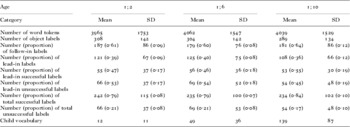
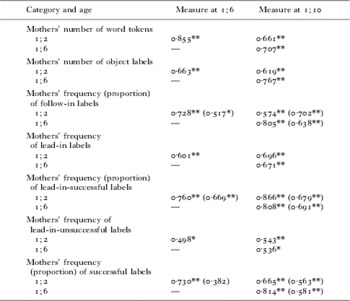
In Table 1, we list the descriptive statistics for the maternal predictor and child output variables. We present the means and standard deviations for the raw counts and proportions used in this study. In Table 2, we list correlations between maternal labeling measures over time. These results indicate a high level of consistency over time.
Descriptive statistics (Means and Standard Deviations)

Correlations between maternal input measures over time

Note that we did not find gender differences in children's vocabulary at any age (p>0·05, two tailed). We also looked at whether our input variables differed with respect to the child's gender, but found no significant relations (p>0·05, two tailed). Therefore, we do not discuss gender further in this paper.
Relations between maternal talk and child language
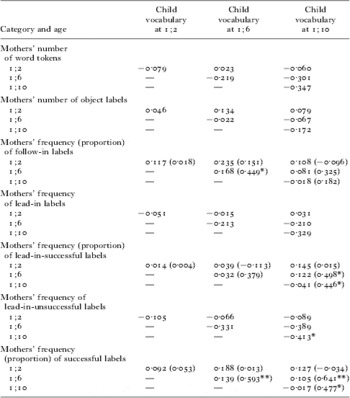
In Table 3, we present the relations between maternal input measures and child language. We begin with the relations between mothers' number of word tokens and object label tokens and child language. Neither measure related significantly to child language at any age. Second, we looked at the relation between mothers' follow-in/lead-in labels and child language. Only at 1 ; 6 was the relation between proportion of follow-in labels and child language significant. Third, we present the relations between parents' successful and unsuccessful lead-in labels and children's vocabulary. The proportion of mothers' lead-in labels that successfully redirected children's attention at 1 ; 6 and 1 ; 10 was positively and significantly correlated with child language at 1 ; 10. In addition, the number of lead-in unsuccessful labels at 1 ; 10 was negatively related to child language at the same time point. Fourth, we find that the proportion of overall successful labels at 1 ; 6 and 1 ; 10 was highly and significantly related to child vocabulary at these time-points. Recall that the proportion of lead-in unsuccessful labels is the complement of the proportion of successful labels, and thus the proportion of mothers' labels that failed to redirect children's attention is significantly negatively correlated with child vocabulary at these time-points.
Correlations between parent labeling measures and child vocabulary

* p<0·05; ** p 0·01, (one tailed).
note: Child vocabulary after 1 ; 2 is cumulative.
Gesture and lead-in labels
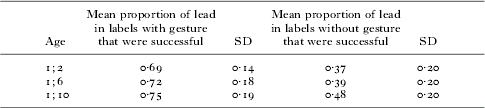
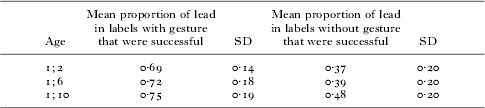
Finally, we divided lead-in labels into those that were and those that were not accompanied by gesture, and then calculated the percentage of lead-in labels that were successful for each of these two groups. When gestures were used to redirect children's attention, children were able to orient to the labeled object much more often than when no gestures were used (see Table 4). We conducted paired-sample t-tests comparing the mean percentages at each age of lead-in labels that were successful either with or without gestures. They showed a significant difference between the groups: t(17)=9·90, p<0·001 at 1 ; 2; t(17)=8·24, p<0·001 at 1 ; 6; t(17)=5·37, p<0·001 at 1 ; 10 (all two-tailed). Thus, lead-in labels that were accompanied by gestures were more likely to be successful than those that were not accompanied by gestures.
Means and Standard Deviations: Success of lead-in labels with and without gesture
DISCUSSION
The lead-in vs. follow-in distinction
The current investigation was influenced by earlier studies (Tomasello & Todd, Reference Tomasello and Todd1983; Tomasello & Farrar, Reference Tomasello and Farrar1986; Carpenter et al., Reference Carpenter, Nagell and Tomasello1998; Baldwin, Reference Baldwin1991, Reference Baldwin1993) that found positive correlations between follow-in labels and child vocabulary and negative relations between lead-in labels and child vocabulary. We noted that these earlier studies did not make the distinction between lead-in labels that successfully redirected children's attention and those that did not. Such a distinction would inform us as to whether it was lead-in labels themselves that were detrimental to children's vocabulary, or whether it was the outcome of these labels, namely children's inability to focus on the labeled referents. Our results support the latter, and we discuss the implications for these findings below.
Following earlier labeling studies (e.g. Tomasello & Todd, Reference Tomasello and Todd1983), we predicted that the overall use of lead-in labels should be predictive of low vocabulary, as these types of labels require an additional effort on the part of the child to search the environment for what the mother is referring to. Our results showed such a significant relation at 1 ; 6, and while this relation supports the previous labeling studies, at no other time point did we find such a relation. This is of note for our earliest age point, around which others have found significant relations (e.g. Carpenter et al., Reference Carpenter, Nagell and Tomasello1998). In fact, none of our maternal labeling measures at 1 ; 2 related to child vocabulary at any time period. While it is difficult to interpret a null result, we provide possible explanations. First, due to the naturalistic nature of our methods, it is more difficult to discern the true focus of a child's attention. Our coding of follow-in labels required that a child be looking only at the direction of an object while the mother provided the label. In many of these situations, there were other toys and objects that were also in the direction of the child's gaze. It is thus possible that we over-interpreted the follow-in category. Studies in more constrained settings would allow for more certainty in determining the child's focus of attention, especially for the youngest children, who seemed to display less active behaviors in relation to the labeled referents in their environments.
Additionally, we note that we found high consistency in mothers' use of input measures over time, including lead-in/follow-in measures. This is important to note, given that we see significant relations between these types of measures and child language at later time-points. Our data suggest that while parents are using these labeling behaviors at similar levels across time, only later are these input measures influential to child language. It is also possible, however, that the effects of these types of labels given at 1 ; 2 do not manifest themselves until later, an idea supported by the high correlation between maternal measures over time.
Successful redirection of children's attention
While the current investigation yielded only partial support for the relation between follow-in/lead-in labels and child language, we found an important difference between lead-in labels that successfully redirected attention and those that did not. We conclude, as predicted, that the relation between lead-in labels and children's vocabulary development is not necessarily a negative one, as had been previously theorized. Instead, it is the relative success of these lead-in labels in redirecting infants' attention to labeled referents that determines positive or negative relations to children's lexical development.
Given the findings of Tomasello & Farrar (Reference Tomasello and Farrar1986), it was important to determine whether additional non-verbal cues could aid in children's ability to successfully redirect their attention to labeled objects. Indeed, we found that when labeling objects that were not currently in children's visual attention, providing a gesture indicating the spatial location of the object aided successful redirection of children's attention to the labeled object. Thus, gesture seems to have a moderating effect on the success of lead-in labels. In sum, we conclude that mothers' tendencies to label objects for their children on which they are either already focused or on which they will subsequently focus is what matters with respect to children's vocabulary, a result supported by our measure of overall successful labels.
Parental labeling: The importance of style over frequency
At each time-point, our data looked at both proportion of parent labels that used a particular labeling style (e.g. lead-in) and the raw number of these types of labels. We note that we found, of all frequency measures, only a single significant relation with child language outcome. This exception was the frequency measure of lead-in unsuccessful labels at 1 ; 10. The proportion measure of this type of input was also significantly negatively related to child language. Thus, for no type of input was frequency a more significant predictor than proportion. In addition, not one of our speech frequency measures (i.e. number of object label tokens and overall speech tokens) related to child language. However, we find significant relations between maternal input and child language within each of our proportion measures. This suggests that the importance of parental input may not be in opportunities to learn, but in labeling style. Furthermore, as we found significant positive relations in the use of these styles over time, we infer that children's language learning experiences outside of our observations will reflect the labeling styles we observed. Our findings thus suggest that it is language quality, rather than quantity, that is of importance to child vocabulary development.
A mutually driven process
A final note concerns the directionality of our results. While our data suggest that the success of a lead-in label depends first on the mothers' accompanying their redirecting label with a gesture toward the intended object, this finding also supports the idea that the effectiveness of the label and gesture together may ultimately depend on the infants' ability to process those kinds of social cues. For example, we found an increase from 1 ; 2 to 1 ; 10 in the percentages of lead-in labels with gesture that were successful. Similarly, we found an increase in the proportions of lead-in labels without gesture that were successful. This suggests a developing ability on the part of the infant to successfully follow parents' lead-in gestures along with a decreasing reliance on these types of redundant measures (i.e. gestures). This idea is supported by previous studies which have suggested that such reliance on extralinguistic measures may start to decrease after 1 ; 6 (e.g. Carpenter et al., Reference Carpenter, Nagell and Tomasello1998; Hoff & Naigles, Reference Hoff and Naigles2002).
The current design limits our ability to make further conclusions about directionality. As our outcome measures relied on children's additive vocabularies, we did not control for initial vocabulary when predicting child outcomes, which would have allowed us to make stronger conclusions about directionality. We intentionally chose a cumulative vocabulary measure as a way of overcoming the limitations of using an observed vocabulary measure based on a relatively short time period. One such limitation of observed vocabulary was that some of our children produced less speech at 1 ; 10 than they did at 1 ; 6. Controlling for earlier vocabulary eliminates the benefit of using a cumulative vocabulary score and, further, underestimates earlier parental input effects. Thus, we are not able to conclude to what extent our findings are driven by the parents' input and to what extent the children's own abilities may be involved. The current findings strongly indicate a need to explore these issues further, with observational studies with larger sample sizes or studies employing experimental methodologies in order to better understand language development as a mutually driven process, involving caregiver input and children's abilities to effectively process the input.
Concluding remarks
The current study sought to extend results from previous labeling studies to examine the relations between object labels, infant attention and gesture. In sum, our main finding is simply that providing labels for objects upon which children focus their attention relates positively to children's lexical development. This is true whether or not labels are uttered in an attempt to name what was already in the child's focus, or whether labels are uttered that in turn lead the infant to attend to the correct referent. Furthermore, the addition of gesture increases the likelihood of successful redirection. Thus, based on our data, we argue that the distinction that has been previously been made between lead-in and follow-in labeling should be more finely tuned to include the additional bases of infant attention and the presence of gestural cues.