Being a victim of maltreatment increases the risk of homotypic and heterotypic intergenerational maltreatment, whereby one form of maltreatment can lead to the same or another form of maltreatment in the next generation (Madigan et al., Reference Madigan, Cyr, Eirich, Fearon, Ly, Rash, Poole and Alink2019). Studies that examine how parents with a history of maltreatment interact with their children reveal difficulties in parenting behaviors. A systematic review by Greene et al. (Reference Greene, Haisley, Wallace and Ford2020) indicates that parents with a history of maltreatment tend to use more negative parenting behaviors, like rejection and withdrawal, and show fewer positive behaviors toward their children, notably less supportive and nurturing responses to infants and toddlers. Savage et al. (Reference Savage, Tarabulsy, Pearson, Collin-Vézina and Gagné2019) demonstrate that a parental history of childhood maltreatment is related to insecure attachment in children and negative parenting such as rejection or hostility. However, not all maltreated parents will maintain the cycle of maltreatment. In their scoping review, Langevin et al. (Reference Langevin, Marshall and Kingsland2021) revealed that the prevalence of continuity varies between 7% and 88%.
While the relation between a history of maltreatment and parenting has been well-documented, the mechanisms explaining maltreatment (dis)continuity are still poorly understood. Parenting is a complex task that requires many different skills. At the core of positive parenting is the parental capacity to acknowledge children’s signals and respond to them in a prompt and appropriate manner, a concept Ainsworth et al. (Reference Ainsworth, Bell and Stayton1974) referred to as sensitivity. The concept of sensitivity is still widely used to define parent-child interaction (Mesman & Emmen, Reference Mesman and Emmen2013). It has been put in association with many outcomes, like children’s cognitive, social, and physical development (see Deans, Reference Deans2020 for a review). In an economic analysis of the cost associated with low-sensitive parenting, Bachmann et al., (Reference Bachmann, Beecham, O’Connor, Briskman and Scott2022) concluded that the long-term financial cost of low parental awareness of the needs, signals, and point of view of the children as measured during dyadic interactions was higher than the one associated with the parental report of child physical abuse. Parents in the highest quartile for sensitivity had social costs associated with health, social, and child protection services that were 13 times lower than parents in the lowest quartile, underlining the importance of better understanding the factors associated with its variations.
Emotion recognition and stress reactivity could be among these factors. Humans can convey complex messages about their needs and their feelings through facial emotional expressions. To be sensitive, parents have to learn to detect the evolving signals in their children’s facial emotional expressions. Once the emotional signal is identified, parents need to develop an appropriate response, which requires a good balance between being mobilized and not being overwhelmed. The stress reactivity to infant signals is important for parenting as blunted or overreactions could lead to disengagement or harsh parenting (Reijman et al., Reference Reijman, Bakermans-Kranenburg, Hiraoka, Crouch, Milner, Alink and van IJzendoorn2016). It occurs that both emotion recognition and stress reactivity have been documented as moderators in the relation between a history of childhood maltreatment and sensitive behaviors (Leite Ongilio et al., Reference Leite Ongilio, Gaspardo and Linhares2022).
Emotion recognition, sensitive behaviors, and trauma
Emotion recognition is important for the socialization of emotion, a process by which parents influence children’s development through their expression of emotions and their reactions to children’s emotions (Eisenberg, Reference Eisenberg2020; Hajal & Paley, Reference Hajal and Paley2020). The reaction to emotions depends on the accuracy of the recognition of the emotional signal. As such, different studies have examined the association between emotion recognition and sensitivity. In a study by Leerkes (Reference Leerkes2010) mothers’ abilities to detect infant distress was related to sensitivity. Mothers who were better at detecting infant distress were better at maintaining sensitive behaviors as infant distress increased than mothers with poorer abilities in distress detection. Similarly, Stern et al. (Reference Stern, Kelsey, Krol and Grossmann2023) demonstrated that the maternal ability to detect happiness in newborns predicts a more sensitive response to their 5-month-old infant. At the other end of the spectrum, a meta-analysis established that difficulties in emotion recognition are related to physical abuse (Wagner et al., Reference Wagner, Milner, McCarthy, Crouch, McCanne and Skowronski2015). Recently, a study by Camilo et al. (Reference Camilo, Vaz Garrido and Calheiros2021) demonstrated that physically abusive mothers had more difficulties recognizing negative emotions, whereas child neglect was associated with an overall decreased ability in emotion recognition.
Emotion recognition is not only related to sensitive parenting but is also influenced by the level of sensitivity the adult was exposed to as a child. For instance, adults with a history of childhood maltreatment differ from the general population in their accuracy in emotion recognition. When looking at adult faces, adults with a history of emotional maltreatment demonstrate a better accuracy in the recognition of fear and anger, but a lower accuracy for sadness (Cheng & Langevin, Reference Cheng and Langevin2022). Those results are also found in studies where adults are asked to identify facial expressions of emotions in children. In Turgeon et al. (Reference Turgeon, Bérubé, Blais, Lemieux and Fournier2020) study, parents with a history of physical abuse were less accurate in the recognition of fear and sadness, whereas emotional neglect was related to better recognition of anger. However, for parents with a history of severe maltreatment, the accuracy in emotion recognition was related to less sensitive behaviors when interacting with their children (Bérubé et al., Reference Bérubé, Blais, Fournier, Turgeon, Forget, Coutu and Dubeau2020). One possible explanation for those results could be that emotional signals in the face of children trigger a stress response that could be overwhelming for the parent. However, this hypothesis is tentative. As illustrated by Leite Ongilio et al. (Reference Leite Ongilio, Gaspardo and Linhares2022) systematic review, whereas different research has examined the role of emotion recognition or cortisol on the relation between maternal history of adversity and parenting, none seems to have examined how emotion recognition and stress interact together.
Stress, sensitive behaviors, and trauma
Parenting is stressful. Parents report children crying as irritating and when asked to hold an object in their hand, their grip strength increases when hearing crying infants (Bakermans-Kranenburg et al., Reference Bakermans-Kranenburg, Steele, Zeanah, Muhamedrahimov, Vorria, Dobrova-Krol, Steele, van IJzendoorn, Juffer and Gunnar2011). Many studies focus on the auditory perception of distress (infant cry). As the children grow up, crying gives way to greater variability of emotional expressions. By the age of two, children can express much the same range of emotions as adults, with the exception of emotions that require greater self-awareness, such as shame, guilt, or pride (Izard, Reference Izard1994). In addition, the control they gain over their emotions allows them to increase the delay between the onset of their emotion and its apex when voice is added to visual cues, such as during crying, laughter, or anger (Malatesta et al., Reference Malatesta, Culver, Tesman and Shepard1989). This delay provides an opportunity for the adult to adjust his or her behavior to that of the child and thus avoid emotional outbursts. However, to be efficient, the adult must feel engaged by the signal, without being overwhelmed.
One common way to measure stress is to measure salivary cortisol levels. The hypothalamic–pituitary–adrenal (HPA) axis provides the physiological infrastructure for cortisol secretion, a glucocorticoid. In addition to their many roles in promoting healthy functioning under basal conditions, glucocorticoids are secreted in response to threatening situations to facilitate coping and survival (Gunnar & Quevedo, Reference Gunnar and Quevedo2007; Stellern & Gunnar, Reference Stellern, Gunnar, Lemelin, Provost, Tarabulsy, Plamondon and Dufresne2012). Maternal cortisol reactivity has been associated with parenting behaviors (Swain & Ho, Reference Swain and Ho2017). One recent study looked at the cortisol level of mothers before and after a task where they saw their children being slightly distressed and had to comfort them. Mothers with higher cortisol reactivity showed more adjustments to their children. Their level of engagement varied in function of the level of negativity in their child, which was less true of mothers who reacted to the task with lower levels of cortisol (Wu, Reference Wu2021).
Research mentions the consequences of maltreatment on the development of the HPA axis (Gonzalez, Reference Gonzalez2013; Pearson et al., Reference Pearson, Collin-Vézina, Dans Milot, Collin Vezina and Godbout2018). In a systematic review, Leite Ongilio et al. (Reference Leite Ongilio, Gaspardo and Linhares2022) explored the impact of maternal exposition to trauma during childhood on the subsequent quality of the mother-child interaction. Cortisol levels appeared to be documented both as a moderator (Ludmer et al., Reference Ludmer, Gonzalez, Kennedy, Masellis, Meinz and Atkinson2018) and as a mediator (Juul et al., Reference Juul, Hendrix, Robinson, Stowe, Newport, Brennan and Johnson2016; Nyström-Hansen et al., Reference Nyström-Hansen, Andersen, Khoury, Davidsen, Gumley, Lyons-Ruth, MacBeth and Harder2019) in this relationship. Those mothers could experience a chronic activation of the autonomic nervous system possibly driven by the activation of the sympathetic nervous system which is responsible for the mobilization of energy during stressful events. For instance, in maltreated children, the HPA dysfunction has been related to overall higher diurnal cortisol levels, as well as blunted cortisol reactivity when facing a stressful situation (Marques-Feixa et al., Reference Marques-Feixa, Palma-Gudiel, Romero, Moya-Higueras, Rapado-Castro, Castro-Quintas, Zorrilla, José Muñoz, Ramírez, Mayoral, Mas, José Lobato, Blasco-Fontecilla and Fañanás2023). That chronic activation could explain the association found between childhood abuse and the higher concentration of hair cortisol in mothers during the first months of the life of their infant (Nyström-Hansen et al., Reference Nyström-Hansen, Andersen, Khoury, Davidsen, Gumley, Lyons-Ruth, MacBeth and Harder2019). It is also in line with studies that documented a blunted stress reactivity in adults with a history of childhood maltreatment. In a recent meta-analysis, Schär et al. (Reference Schär, Mürner-Lavanchy, Schmidt, Koenig and Kaess2022) examined 35 studies that calculated the change in stress levels mostly after the Trier Social Stress Test, a task created to elicit a stress reaction. Some studies examined reactions in situations that were not social-evaluative challenges (for example looking at emotionally charged images including scenes of child abuse; Suzuki et al., Reference Suzuki, Poon, Papadopoulos, Kumari and Cleare2014). Results from the meta-analysis indicated significantly lower levels of cortisol reactivity following the stressors for the childhood maltreatment group compared to the group without a history of childhood maltreatment.
It seems that both emotion recognition and reaction to emotions could be affected by the experience of trauma during childhood. In a study on the development of children in war context, Motsan et al., (Reference Motsan, Yirmiya and Feldman2022) found that in the context of trauma, the cortisol levels moderated the relation between behavioral strategies and emotion recognition abilities. The authors suggest that emotion recognition develops via two mechanisms that might be particularly affected by trauma. The first is practice, which, in line with the model of emotional socialization, requires contact with models displaying appropriate examples of emotional expressions and reactions. The second relies on cognitive functions, particularly memory consolidation, which an HPA axis dysfunction could impair. Therefore, the parental experience of trauma during childhood could have had an impact on both their abilities to recognize and to react to children’s emotions, which, following Ainsworth’s definition, would influence their sensitive behaviors toward their children. This theoretical model, suggesting that maltreatment leads to parenting difficulties, could explain how intergenerational cycles of risk are maintained, although further empirical confirmation is needed to support this model.
Objective
Our study examines how stress, measured by cortisol reactivity, and emotion recognition interact with a history of maltreatment to influence sensitive parenting behaviors. We examine how the cortisol level and the ability to recognize emotions in the faces of children interact in a moderated-moderation on the relationship between parental history of maltreatment and sensitive parenting behavior. We hypothesize that mothers with more severe exposure to abuse and neglect during their childhood and who have a better recognition of emotions in children might find children’s emotions stressful and react with less sensitive behaviors during an interaction with their children. However, based on the studies on maltreatment and blunted stress reactivity, the stress reaction might show up as an absence of an increase in cortisol levels (see Fig. 1).
Hypothesized conceptual moderated-moderation model.

Method
Participants
A sample of 58 mothers and their children participated in that study. The sample size was determined by a power analysis performed with G*Power considering six predictors (three variables and three interactions) and an effect size f 2 = 0.15 with a power of 1–β = 0.85. Children and their mothers were recruited from community organizations that provide services to vulnerable families, as well as from social media (Facebook), and posters in the community and on the university walls between 2017 and 2019. The sample was composed of 55% girls (n = 32). The average age of children was 45.76 months (SD = 12.51) ranging from 24 to 69 months. On average, the age of mothers was 32.84 (SD = 5.34) years. Most mothers were White (n = 48; 82.8%). The familial income of 65.5% of the sample was below the poverty level for a single person with a child (less than 33,000 CAN$). A quarter of the sample did not obtain a high school diploma (25.8%), another quarter (27.6%) obtained a professional diploma, and the others received a college or university diploma. Most mothers had two or more children (82.8%; n = 48). Regarding the history of maltreatment during childhood, two-thirds of the sample (69%; n = 40) reported at least one form of maltreatment, with half of the sample (51.7%; n = 30) reporting an intensity varying from moderate to severe.
Procedure
The procedures were approved by the University Ethical Committee prior to data collection (#2518). Conflicts of interest: None. Participants and their children were met during the morning at the community organization they attended or at the university. The protocol of the study was reviewed with the mothers, their questions were answered, and they signed the consent form. The child was then invited to accompany a research assistant in another room for the first part of the study. First, a salivary sample was collected to familiarize the participants with the procedure. The sociodemographic questionnaire was filled with mothers. Then, both were placed in their respective rooms, where mothers were invited to partake in a computerized emotion recognition task. Next, we explained to mothers and children the protocol for the next task which would be to interact together in a room filled with toys for a period of 15 minutes. Before the mother-child reunion, a cortisol sample was collected to establish a baseline level. After the interaction period, mothers returned to their room where a salivary sample was collected again, to obtain data on cortisol reactivity. Finally, the mother was asked to fill out questionnaires about her experience of childhood maltreatment. During this time, the child played with the research assistant in the interaction room. Mothers received $30 CAD for their participation and the child chose a gift in a surprise box (e.g.: books, balls, puzzles).
Instruments
Childhood experience of maltreatment
The French-translated and validated short version of the Childhood Trauma Questionnaire (CTQ) was used to assess early trauma in the parent (Paquette et al., Reference Paquette, Laporte, Bigras and Zoccolillo2004). The tool is composed of 28 questions. It provides a score on traumatic situations experienced during childhood, namely physical and emotional abuse, physical and emotional neglect, and sexual abuse. Mothers provided retrospective reports of maltreatment experiences during their childhood on a 5-point Likert scale, ranging from 1) Never true to 5) Very often true. The CTQ is validated in many languages and shows a high level of internal consistency, reliability, and validity of content and construct (Saini et al., Reference Saini, Hoffmann, Pantelis, Everall and Bousman2019). A severity score is given for each form of maltreatment. A score of 1 represents no maltreatment, 2 mild, 3 moderate, and 4 severe. We formed a global score to represent the level of maltreatment experienced by mothers (ranging from 5 to 20). The internal consistency for our sample is α = .86.
Stress
To obtain a biological measure of stress, the cortisol level of mothers was measured. As mentioned, a first measure was taken upon arrival to acclimate the participant to the procedure. This measure was not considered in the analysis. The baseline measure was taken prior to the interaction with the child. Another sample was collected 10 minutes after the 15-minute interaction with the child. An average of 35.90 minutes (SD = 7.99) elapsed between both measures. Baseline and post-interaction cortisol samples were collected between 10:00 a.m. and 11:30 a.m. to minimize the effect of endogenous cortisol variations. Participants were asked to chew a piece of cotton to soak it with saliva. The cotton ball was then inserted into the saliva cup which was closed and sealed. The samples were kept in a freezer (−20°C) until they were analyzed. The HS-cortisol High Sensitivity Salivary Cortisol Enzyme Immunoassay Kit, Salimetrics, LLC (State College, PA) was used. Delta was calculated for each participant by subtracting baseline cortisol from post-interaction cortisol, representing cortisol reactivity as done in previous studies (Wu, Reference Wu2021). A unit of 1 was added to each score in order to work with positive values.
Recognition of emotional expressions
To measure the mothers’ ability to recognize facial expressions, a task similar to the Facial Expression Megamix paradigm was used (Young et al., Reference Young, Rowland, Calder, Etcoff, Seth and Perrett1997). Two children (one male, one female), displaying facial expressions for the six basic emotions (anger, disgust, fear, sadness, surprise, and happiness) were selected from the Child Affective Facial Expression database (Lobue & Thrasher, Reference LoBue and Thrasher2015). Facial expressions were combined together in a pairwise manner using morphing software (Fantamorph 5.0). The two expressions were given the following complementary weights in the morphs: 20:80, 35:65, 50:50, 65:35, and 80:20%. A total of 150 stimuli were thus produced (15 expression combinations × 2 genders × 5 weights).
Mothers were asked to complete 450 trials during which the stimuli were presented in random order. To reduce fatigue, the task was divided into three blocks of 150 trials each. On each trial, one of the stimuli was displayed in the center of the screen. Mothers were asked to identify the dominant emotion expressed in the face picture. The stimulus remained on the screen until the participant responded. The emotion depicted with a weight of 50% or more in the stimulus was the correct answer. Categorizing the stimulus as depicting any of the other five emotions was an incorrect answer. No feedback was provided on the accuracy of the answer. Images were presented in grayscale over a neutral gray background, and the face width was subtended approximately 13 degrees of visual angle. This task has been validated and used previously (Daudelin-Peltier et al., Reference Daudelin-Peltier, Forget, Blais, Deschênes and Fiset2017).
Unbiased hit rates were used to create a performance score following Wagner (Reference Wagner1993). Unbiased hit rates are computed as follows. For each emotion, the participant proportion of hits (e.g., categorizing the expression as anger when anger is the dominant expression) is multiplied by the ratio between the number of hits and the number of times the participant categorized any of the stimuli as corresponding to this target emotion. Thus, this measure accounts for the occurrence of false alarms (when a participant erroneously categorizes the stimulus as depicting another emotion than the dominant one). Because unbiased hit rates are proportions, they were arcsine-transformed. The average of the unbiased hit rates across the six emotions represented the participant score. The Cronbach alpha for the score was .60 indicating coherence while representing a difference in performance from one emotion to another.
Sensitive behaviors
A mother-child interaction task was developed to measure sensitive parenting behaviors. More precisely, the mothers and their children were asked to interact for a period of 15 minutes. During the first 8 minutes, the mother and child were allowed a period of free play. Next, for the remaining of the period, the mother was instructed to ask the child to clean the room by sorting and putting away the toys, without offering her help other than verbal assistance. This task was used to induce discomfort in the relationship yet is typical of everyday activity and was used in other studies for that purpose (Franz et al., Reference Franz, Kumar, Brock, Calvi and DiLillo2022). The interactions between the mother and child were filmed by two cameras whose images were analyzed on the same screen to measure the quality of the interaction between the mother and child.
Mother-child interactions were coded following the analysis scheme developed by Feldman (Reference Feldman1998). The Coding Interactive Behavior (CIB) assesses the sensitive behaviors of a parent toward a child, the behaviors of the child during the interaction, and the dyadic synchrony between the two. Most studies using the CIB use composite scores relying on both theoretical ground and contextual factors, like the age of the child (Stuart et al., Reference Stuart, Egmose, Smith-Nielsen, Reijman, Wendelboe and Væver2023). One advantage of using the CIB is that it accounts for the dyadic nature of the interaction between a child and a parent. Therefore, the coder does not only concentrate on parental behaviors but looks at the responses to children’s signals. It makes it a more appropriate coding scheme for a variety of age ranges. Feldman developed different versions of the CIB, for toddlers, preschoolers, children, and for adolescents. We used the version for preschoolers which is designed for children from 3 to 6 years old. However, we ensured that the scales used for our study were also measured in the toddler version so that it could be used with 2 years old. For our study, we computed a scale composed of items from the parental sensitivity scale that measures the parental behaviors in reaction to the emotional behaviors of the child. Three scales were used. First, acknowledging refers to the parental response to the social signals of the child through verbal communication, gaze, facial expressions, and body movement. According to Feldman (Reference Feldman1998), this scale has the highest load on parental sensitivity. The second scale is resourcefulness, referring to the flexible and creative strategies used to handle the child’s lack of interest, distress, or fussiness. The third scale is the appropriate range of affect where parental emotional expressions are in accordance with the child’s state, emotions, or activities. Each scale is coded on a 5-point scale (1 = no observation of the behavior; 5 = clear or frequent manifestations of the behavior). We coded the second part of the interaction when the mother asks her child to clean the room, as it induces a challenge on the dyad while being typical of day-to-day interaction. It is representative of maternal sensitivity in a disciplinary context where the parent has to set clear indications to the child, a widely studied parenting context (see Li et al., Reference Li, Sturge-Apple and Davies2022). The alpha for the scale is .90.
Analyses
Descriptive and correlational analyses first tested whether there is a linear relationship between maltreatment, stress, emotion recognition, and sensitive behaviors. Demographic variables were added to examine their potential confounding effect. A multiple linear regression model was performed to examine which variables significantly predicted sensitive behaviors. The model comprises maltreatment, stress, and emotion recognition, as well as their interaction terms: maltreatment X stress; maltreatment X emotion recognition; stress X emotion recognition; and maltreatment X stress X emotion recognition.
SPSS 29.0.0 with the command PROCESS 3.1, model 3 was used to perform the analysis (Hayes, Reference Hayes2018). That macro provides a heteroskedasticity-consistent standard error (HCSE) estimator of ordinary least squares parameter estimates, which does not assume homoscedasticity (Hayes & Cai, Reference Hayes and Cai2007). HCSE estimator is recommended when testing the equality of independent slopes and we used the HC0 (Huber-White) as suggested by Rosopa et al. (Reference Rosopa, Brawley, Atkinson and Robertson2019). Mothers’ education was included in the models as a covariate, as it was correlated to each of the other variables. All independent variables were mean-centered prior to analysis which facilitated the interpretation of interactive effects. Both the p-level and 95% bootstrapped confidence intervals were used to infer a significant effect. Significant interactions were conditioned at low (-1 SD), moderate (mean), and high (+1 SD) levels to interpret the nature of the interactions (Aiken & West, Reference Aiken and West1991).
Results
Descriptives
The means, standard deviations, and range of the variables of interest and sociodemographic characteristics of the sample are presented in Table 1. Correlation analysis revealed that the severity of the history of maltreatment was negatively correlated to the ability to recognize emotions in children’s faces. The number of children was positively correlated to maltreatment and marginally correlated to education (p = .06). The educational level of mothers was positively related to sensitive behaviors and emotion recognition, and negatively correlated to the severity of maltreatment during childhood. Because they were both correlated and to avoid multicollinearity and maximize power, only education was therefore used as a covariate in all subsequent analyses.
Descriptive statistics and correlations for study variables (n = 58)

* p < .05.
** p < .01.
Moderated-moderation analyses
Multiple hierarchical regression models were conducted to determine whether emotion recognition, stress, and their interaction moderated the association between a history of maltreatment and sensitive behaviors. The score of sensitive behaviors during the task was regressed on childhood maltreatment, stress, emotion recognition, and the interactions between maltreatment and stress, maltreatment and emotion recognition, stress and emotion recognition, as well as maltreatment, stress, and emotion recognition.
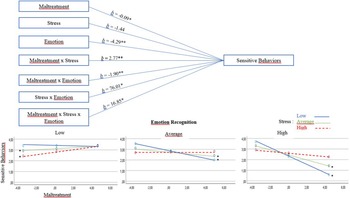
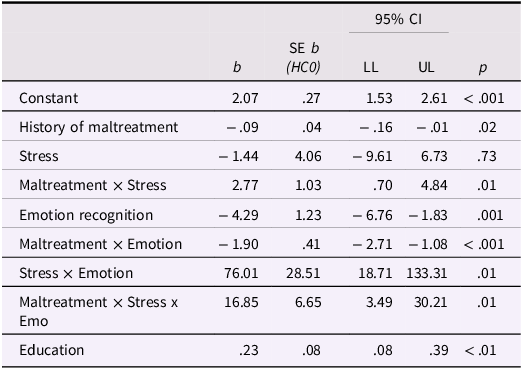
The model was significant F(8, 49) = 11.22, p < 0.01, with variables accounting for 35.50% of the variance in sensitive behaviors during the task. Maltreatment (b = −0.09, t(49) = −2.39, p = .02) and emotion recognition (b = −4.29, t(49) = −3.50, p = .001) were both independent significant predictors of sensitive behaviors and all two-way interactions achieved significance: Maltreatment X stress (b = −2.77, t(49) = 2.69, p = .01); Maltreatment X emotion recognition (b = −1.90, t(49) = −4.68, p < .001); Stress X emotion recognition (b = 76.01, t(49) = 2.67, p = .01). Since those coefficients represent simple effects, and not main effects, those conditional effects, and interactions are not interpreted (Hayes, Reference Hayes2022). The three-way interaction effect between stress, emotion recognition, and childhood maltreatment was significant (b = 16,85; t(49) = 2.53, p = .01). The 95% bias-corrected bootstrap (with 5,000 iterations) indicates that the confidence interval (CI) for the interaction is [3.49, 30.21], excluding zero (Table 2).
Multiple regression model for sensitive behaviors with a moderated-moderation by history of maltreatment, stress, and emotion recognition
The nature of the interactions was interpreted with simple slope test analysis where stress and emotion recognition were computed at low (−1 SD), moderate (mean), and high (+ 1 SD) levels. In many instances, as expected, the more severe the history of maltreatment, the lower the sensitivity toward their children. This negative association was significant for mothers with good or average emotion recognition abilities that did show a lower or an average increase in cortisol following the interaction: good emotion recognition and low cortisol: b = −0.39, t(49) = −3.82, p < .001; good emotion recognition and average cortisol: b = −0.23, t(49) = -3.73, p < .001; average emotion recognition and low cortisol: b = −0.19, t(49) = −3.14, p = .003; average emotion recognition and average cortisol: b = −0.09, t(49) = −2.39, p = .02. However, this relationship was no longer significant when mothers presented a high level of cortisol following the interaction with their child coupled with good or average emotion recognition skills (b = 0.02, t(49) = .37, p = .71 and b = −0.08, t(49) = −1.50, p = .14). Moreover, there was a positive association where higher maltreatment was related to more sensitive behaviors for mothers with lower abilities in emotion recognition and average or high stress levels (b = 0.06, t(49) = 2.23, p = .03 and b = 0.11, t(49) = 2.44, p = .02). As depicted in Figure 2, for mothers with good or average emotion recognition and a high level of cortisol following a challenging interaction with their child the severity of maltreatment during childhood was not related to sensitive behaviors. On the reverse, the severity of childhood maltreatment was related to less sensitive behaviors for mothers with average or good abilities in emotion recognition who did not experience an increase in stress following an interaction with their child.
Moderated-moderation results with unstandardized regression coefficients. Simple slopes indicate the linear relationship between maltreatment and sensitive behaviors for the three different levels of stress and emotion recognition. *p < .05; **p < .01.

Discussion
Being a parent of a young child comes with many day-to-day challenges. It requires continuous adjustments to evolving signals that have to be interpreted rapidly in order to offer an adequate response. The sequence from perception to interpretation to the selection of behavioral responses is at the core of sensitivity, as defined by Ainsworth et al., (Reference Ainsworth, Bell and Stayton1974). Parental sensitivity varies depending on many aspects related to personal and environmental contexts. Our findings indicate that parents who have been exposed to maltreatment differ in sensitivity toward their child depending on the level of cortisol the interaction elicits and their abilities to recognize the emotional facial expressions in children. For parents with average to good recognition skills who show low to average cortisol levels, the severity of maltreatment is related to less sensitive behaviors. Those mothers show more difficulties in acknowledging signals from their child, they are less flexible when handling the child’s lack of interest or distress, and their emotional expressions are less in accordance with the state of the child, as measured by the sensitivity scale (Feldman, Reference Feldman1998). On the other hand, higher cortisol levels either neutralized the association between maltreatment and sensitive behaviors or, in the case of low emotion recognition, were related to a positive relation where an increase in maltreatment was related to an increase in sensitive behaviors. Those results confirm the many studies that established a link between a history of maltreatment and difficulties in parenting (Alink et al., Reference Alink, Cyr and Madigan2019; Greene et al., Reference Greene, Haisley, Wallace and Ford2020; Savage et al., Reference Savage, Tarabulsy, Pearson, Collin-Vézina and Gagné2019; St-Laurent et al., Reference St-Laurent, Dubois-Comtois, Milot and Cantinotti2019). Our results contribute to existing knowledge by adding the effect of emotion recognition and stress to the comprehension of the mechanism behind that intergenerational cycle.
In our research, the severity of the history of maltreatment was particularly related to less sensitive behaviors when the interaction with their child was followed by smaller changes in cortisol levels. That lack of cortisol reactivity is often referred to as a blunted stress reactivity. As highlighted in a recent meta-analysis, blunted stress reactivity is more common in adults who have been exposed to a greater number of adverse childhood experiences (ACEs) and at a younger age (Brindle et al., Reference Brindle, Pearson and Ginty2022). Young and colleagues (2021) also found that an undifferentiated stress profile is related to exposure to stressors in early childhood, more so than to cumulative life stress. Studies on cortisol indicate that adults who have experienced childhood maltreatment react with a blunted reaction when facing the Trier Social Stress Test (TSST). In this stressful situation (i.e., making an oral presentation to a less-than-receptive audience), adults who have been abused as children demonstrate a decrease in their cortisol levels, whereas TSST leads to an increase in cortisol levels in other participants (Carpenter et al., Reference Carpenter, Shattuck, Tyrka, Geracioti and Price2011; Schalinski et al., Reference Schalinski, Elbert, Steudte-Schmiedgen and Kirschbaum2015). However, in other TSST studies, ACEs are associated with increased cortisol levels (Sullivan et al., Reference Sullivan, Bennett and Lewis2013). Research by Ouellet-Morin et al. (Reference Ouellet-Morin, Robitaille, Langevin, Cantave, Brendgen and Lupien2019) seems to shed light on these conflicting data. The authors revealed that cortisol response may vary with the severity of exposure to maltreatment, with possibly a curvilinear relation where extremes (none and severe maltreatment) could be related to greater cortisol reactivity, whereas moderate to severe trauma could trigger a blunted reaction. The paradigm used in our research is not as stressful as a TSST protocol. It consists of reacting to one’s own child in a typical interaction where the parent must ask the child to clean a room knowing that the interaction is filmed and will be analyzed. Such a task was used previously to elicit a stress reaction in parents (Franz et al., Reference Franz, Kumar, Brock, Calvi and DiLillo2022). It occurs that this situation is related to an increase in cortisol for many parents and that this increase is especially beneficial for parents with a history of childhood maltreatment.
Studies that examine stress reactivity and parenting are scarce. Recently, Leite Ongilio et al. (Reference Leite Ongilio, Gaspardo and Linhares2022) published a systematic review in which they identified three studies that measured cortisol levels in parents. Studies established a moderation or mediation role in the relationship between parental history of maltreatment and parenting. For instance, Wu (Reference Wu2021) found that more sensitive mothers had higher cortisol levels after seeing their children distressed and having to comfort them. A change in cortisol levels helped them to be more attuned to their child’s signals. Those results are in line with our results indicating that higher cortisol levels could act as a protective factor for mothers with a history of maltreatment by being associated with no correlation or even a positive correlation between maltreatment and sensitive parenting behaviors. Another study on diurnal stress levels also supports the importance of a fluctuating stress level for sensitive parenting. In their study, Gonzalez et al. (Reference Gonzalez, Jenkins, Steiner and Fleming2012) found that mothers with diurnal cortisol levels with little fluctuations, thus remaining high during the day, were less sensitive during filmed interactions with their children. The authors also found a relation between stable stress levels throughout the day and lower executive functioning that they argue could be necessary to adopt a flexible response to the demands of children. Finally, England-Mason et al. (Reference England-Mason, Kimber, Khoury, Atkinson, MacMillan and Gonzalez2017) demonstrated that postpartum mothers with a more severe history of maltreatment reacted with a blunted stress level to a challenging emotional Stroop task, particularly when they reported more difficulties in emotion regulation.
The association between blunted stress reactivity and parenting was also revealed in studies that measured stress reactivity with physiological measures other than cortisol, like heart rate and skin conductance (Reijman et al., Reference Reijman, Bakermans-Kranenburg, Hiraoka, Crouch, Milner, Alink and van IJzendoorn2016). In a study by Augustine and Leerkes (Reference Augustine and Leerkes2019), stress reactivity was related to a better adjustment to the child and the context. Mothers with greater stress reactivity reacted with more sensitive behaviors, particularly when their infant displayed greater distress whereas a lower physiological reactivity was associated with more disengagement from the parent-child relationship. As for cortisol, data with physiological measures indicate different pathways in stress reactivity. In a study examining the cardiovascular reactivity of adults with ACE, Keogh and colleagues (Reference Keogh, Howard, Gallagher and Ginty2023) found two clusters of participants. The cluster composed of adults with a blunted cardiovascular reactivity was exposed to more severe childhood maltreatment, reported more behavioral disengagement on a coping scale, and had higher levels of depression compared to the other cluster with more cardiovascular reactivity. Likewise, our results suggest that mothers with a history of maltreatment have different parenting profiles depending on their stress reactivity and their ability to recognize emotions. There is not a myriad of studies to help interpret the three-way interaction we found between a history of maltreatment, stress, and emotion recognition. Some research tends to support our results that stress levels and emotion recognition abilities interact together. For instance, Hartling et al. (Reference Hartling, Fan, Weigand, Trilla, Gärtner, Bajbouj, Dziobek and Grimm2019) classified participants based on their genetic profile of HPA axis reactivity. The genetic profile was a predictor of cortisol reactivity to a stress challenge, and it interacted with the severity of maltreatment during childhood to predict facial emotion recognition. As such, for participants with a more stress-responsive genetic profile, childhood maltreatment was more strongly associated with difficulties in emotion recognition.
Our research brings a new understanding of the variability of trajectories in the intergenerational transmission of maltreatment. It allows us to question what the best way could be to help parents with a history of maltreatment. Although the following propositions will have to be verified in future research, it seems that the difficulty of most parents is not only in recognizing children’s emotions but also in reacting to them. Leerkes and Augustine (Reference Leerkes and Augustine2019) offer a well-integrated model that illustrates how the personal history and characteristics of the parents can interfere with the chain of reactions between the perception of children’s behaviors (input) and the parental response (outcome). Other models, like the Tripartite Model of Emotion Socialization (Morris et al., Reference Morris, Silk, Steinberg, Myers and Robinson2007) also underline the importance of emotion regulation in the global process of emotion socialization. In a revision of the Eisenberg emotion socialization model, Hajal and Paley (Reference Hajal and Paley2020) illustrated the central position of parental emotion and emotion regulation and how it plays a role in both parenting and developmental outcomes for children. This interaction is stressed in the study by Cheng and Langevin (Reference Cheng and Langevin2022). Their results indicated that lower emotion regulation skills combined with greater childhood maltreatment predicted greater difficulties in the recognition of negative emotions. The authors’ proposed hypothesis for that interaction is in line with our results stipulating that emotion regulation abilities allow adults to deal with threatening stimuli by overriding the automatic hypervigilance response that it might have triggered.
Therefore, intervention should be very specific in mentoring parents based on their own profiles. Group sessions where parents are taught about different emotional situations and how they should react in different contexts might not be specific enough for parents with a history of maltreatment. Only an intervention where parents are seen in interaction documents their behavioral reaction to their children. One way to test how emotion recognition and stress reactivity could be acted upon would be to use the context of a video-feedback intervention. The positive effects of the attachment video-feedback intervention have been documented in different instances, as highlighted in a recent meta-analysis (van IJzendoorn et al., Reference van Ijzendoorn, Schuengel, Wang and Bakermans-Kranenburg2023). It has been shown to be effective in supporting parents at risk of maltreatment by increasing their emotional availability measured as an increase in sensitivity and structure, and a decrease in intrusiveness and hostility (Eguren et al., Reference Eguren, Cyr, Dubois-Comtois and Muela2023). However, the effectiveness of the intervention is moderated by childhood maltreatment with smaller improvements for parents with more severe trauma (van der Asdonk et al., Reference van der Asdonk, Cyr and Alink2021). It could be interesting to verify if the intervention changes the abilities of parents in emotion recognition and stress reactivity. It is possible that the intervention improves the ability of parents to better recognize the emotions of children, without supporting them to adapt with a better stress reactivity. This new awareness without the required mobilization could lead to even poorer interactions or more disengagement. In their study, van der Asdonk and colleagues suggest that the attachment video-feedback intervention could benefit from a combination with a trauma-informed approach. Our study indeed supports the need to evaluate the effectiveness of such a combination for parents with a severe history of maltreatment.
Strength and limitations
The current study makes an important contribution to understanding the mechanism at play in the (dis)continuity of maltreatment from one generation to another. Studies examine how a history of maltreatment interacts with stress reactivity or with emotion recognition, but none, to our knowledge, looked at the interplay between emotion recognition and stress. Moreover, there is little demonstration of the interaction between those two variables and sensitive behaviors. The knowledge brought by our study will need further replication. Our sample was small and although we ensured to have variability in the background of the participants, an important feature for moderation analysis (Memon et al., Reference Memon, Cheah, Ramayah, Ting, Chuah and Cham2019), it might not be representative of the general population. In that respect, our study is based on a convenience sample, composed mostly of white participants, and it includes only mothers. Regarding ethnicity, mothers were presented with two children of white ethnicity, a girl, and a boy. To increase the validity of the task, the stimuli would have to be of the same ethnicity as the participant, given the robust other-race effect reported in the literature (Elfenbein & Ambady, Reference Elfenbein and Ambady2002). In our sample, most participants were of white ethnicity and we performed analysis to ensure that we would not have to control for ethnicity. More research with protocols that acknowledge and respect the particularities of different cultures is needed to fully understand human parenting. Concerning genders, most knowledge on parenting is currently based on mothers, and the absence of fathers in research protocols is recurrently underlined (Davison et al., Reference Davison, Charles, Khandpur and Nelson2017). However, the effect of trauma on fathers has been demonstrated both on the biological and the behavioral components affecting parenting (Condon et al., Reference Condon, Dettmer, Baker, McFaul and Stover2022). New research is needed on the specific interaction between emotion recognition in fathers and parenting, as well as on how trauma influences the triadic interaction between mothers, fathers, and their children.
Another limitation is that childhood maltreatment was reported retrospectively. It might therefore be affected by the subjective interpretation of the experiences. A meta-analysis found that the agreement between retrospective and prospective measures is rather poor and that both types of measure might identify different populations (Baldwin et al., Reference Baldwin, Reuben, Newbury and Danese2019). However, difficulties in adaptative functioning, as in psychopathology, are strongly related to subjective reports of maltreatment and have a weak association with prospective reports that are not confirmed by subjective reports (Danese and Widom, Reference Danese and Widom2020). Since our study documents the adaptation of parents to their children, retrospective measures might be what matters the most.
The methodology we used to measure emotion recognition figures among the strength of our study. Mothers had to determine which was the predominant emotion in the face of children presenting a morph between two emotions. That methodology allows measuring what amount of emotional signal is required before the participant recognizes the emotion as dominant and is representative of real life where, most of the time, emotions are not presented as pure or at their apex.
Finally, it could be interesting to measure emotional recognition in one’s child. However, a task with one’s child would make it difficult to control the reliability of the pictures between children. It also raises a question inherent to the mechanism at play in the cycle of maltreatment. If an intergenerational cycle is at play, the reaction of mothers to emotions may have already interfered with the recognition and expression of emotion in their children. Those children could show particularities in both the recognition and the expression of emotion, despite being in an environment exempt from maltreatment. This important hypothesis needs to be addressed in future studies.
Conclusion
A history of maltreatment has been associated with more difficulties in parenting. Our study indicates that this intergenerational cycle is more specific to parents with good emotion recognition skills but lower stress reactivity when interacting with their children. Those results reiterate the profound interaction between individual characteristics and environmental factors when it comes to parenting. Interventions aimed at improving the parental response of adults with a history of childhood maltreatment should be based on each dyadic relationship. Future research should investigate if changes in emotion recognition and stress reactivity could be part of the implied mechanisms for the effectiveness of parenting interventions.
Acknowledgement
We would like to thank the parents and children who generously accepted to participate in our study. A special thanks to the research assistants that hide behind the data.
Funding statement
This work was supported by the Social Sciences and Humanities Research Council of Canada [grant number 430-2016-00521].