1. Introduction
The formation and evolution of continental crust in the Archaean Eon is a long-term theme of geoscience and is largely related to the genesis of the tonalite–trondhjemite–granodiorite (TTG) suite (e.g. Moyen, Reference Moyen2011; Zhai & Santosh, Reference Zhai and Santosh2011). As with many cratons worldwide, the North China Craton (NCC) has an early Precambrian basement composed of Archaean blocks and Palaeoproterozoic orogenic belts (Zhao et al. Reference Zhao, Sun, Wilde and Li2005; Zhai & Santosh, Reference Zhai and Santosh2011). In the NCC, the Archaean blocks are mainly composed of late Neoarchaean rocks, but early Neoarchaean magmatism was widely developed, and 4.08–4.0 Ga zircons with magmatic zoning have been discovered; thus, the NCC must have a Hadean geological history (Liu et al. Reference Liu, Nutman, Compston, Wu and Shen1992; Wan et al. Reference Wan, Liu, Dong, Xie, Kröner, Ma, Liu, Xie, Ren and Zhai2015, Reference Wan, Xie, Wang, Liu, Chu, Xiao, Li, Hao, Li, Dong and Liu2021). Commonly, in the late Neoarchaean of the NCC, supracrustal rocks were first deposited and then intruded by TTG at the same time or slightly later, followed closely by metamorphism, anatexis and formation of crustally derived granites (Zhai & Santosh, Reference Zhai and Santosh2011; Wan et al. Reference Wan, Liu, Dong, Xie, Kröner, Ma, Liu, Xie, Ren and Zhai2015, Reference Wan, Xie, Wang, Liu, Chu, Xiao, Li, Hao, Li, Dong and Liu2021). In areas lacking in a late Palaeoproterozoic tectonothermal overprint, rocks older than 2.53–2.52 Ga are commonly affected by strong metamorphism and deformation, whereas younger ones are partially or only weakly metamorphosed and deformed (Wan et al. Reference Wan, Liu, Dong, Xie, Kröner, Ma, Liu, Xie, Ren and Zhai2015; Li et al. Reference Li, Wan, Xie, Wilde and Liu2022). The phenomena became more complicated in the areas that experienced tectonothermal events in late Palaeoproterozoic time, with late Neoarchaean and late Palaeoproterozoic tectonothermal events varying in intensity in different areas from being very strong to very weak (Wan et al. Reference Wan, Xie, Dong and Liu2020).
Daqingshan is a typical area in the northwestern part of the NCC that underwent strong tectonothermal events in both late Neoarchaean and late Palaeoproterozoic times (Ma et al. Reference Ma, Wan, Santosh, Xu, Xie, Dong, Liu and Guo2012; Dong et al. Reference Dong, Wan, Xu and Liu2013; Wan et al. Reference Wan, Xu, Dong, Nutman, Ma, Xie, Liu, Liu, Wang and Chu2013; Cai et al. Reference Cai, Liu, Liu, Wang, Liu and Shi2014; Liu, P. H. et al. Reference Liu, Liu, Cai, Liu, Liu, Wang, Xiao and Shi2017). Here, late Neoarchaean supracrustal rocks are widely distributed, but there is currently a lack of precise ages on the late Neoarchaean plutonic rocks. For example, it has been considered that TTG magmatism occurred in early Palaeoproterozoic time (∼2.45 Ga), rather than in late Neoarchaean time (Liu, J. H. et al. Reference Liu, Dong, Xu, Santosh, Ma, Xie, Liu and Wan2013, Reference Liu, Liu, Cai, Liu, Liu, Wang, Xiao and Shi2017), being different from many other areas of the NCC where the majority of magmatism occurred in late Neoarchaean time rather than early Palaeoproterozoic time (Zhai & Santosh, Reference Zhai and Santosh2011; Wan et al. Reference Wan, Liu, Dong, Xie, Kröner, Ma, Liu, Xie, Ren and Zhai2015).
With this controversy in mind, we carried out zircon dating, Hf isotope analysis and whole-rock element and Nd isotopic studies on 12 samples of different plutonic rock types, including TTG gneiss, quartz monzonite gneiss, monzogranite gneiss, meta-gabbro and meta-diorite, to provide new constraints on the timing of Precambrian magmatism and metamorphism in the Daqingshan area and to evaluate the important issues relating to Neoarchaean crust formation and its evolution.
2. Geological background
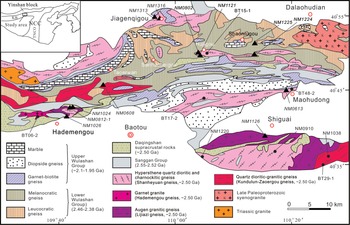
The Precambrian metamorphic basement in the Daqingshan area is composed of supracrustal and plutonic rocks of different types and ages (Jin et al. Reference Jin, Li and Liu1991, Reference Jin, Li and Liu1992; Xu et al. Reference Xu, Liu and Yang2002, Reference Xu, Liu, Hu and Yang2005, Reference Xu, Liu, Yang, Wu and Chen2007; Yang et al. Reference Yang, Xu and Liu2003, Reference Yang, Xu, Liu and Huang2006). The supracrustal rocks were divided into the late Neoarchaean Sanggan Group, the late Neoarchaean Daqingshan Supracrustal Rocks, the early Palaeoproterozoic Lower Wulashan Group and the late Palaeoproterozoic Upper Wulashan Group (Fig. 1). The Sanggan Group is metamorphosed at upper-amphibolite to granulite facies, with local amphibolite-facies retrogression. It was subdivided into mesocratic and leucocratic granulite units, with their protoliths interpreted as basic–intermediate and intermediate–acid volcano-sedimentary rocks, respectively. Recent secondary ion mass spectrometry (SIMS) zircon dating work has indicated that the formation age of the Sanggan Group is actually 2.55–2.50 Ga (Wan et al. Reference Wan, Liu, Dong, Xu, Wang, Wilde, Yang, Liu, Zhou, Reddy, Mazumder, Evans and Collins2009; Ma et al. Reference Ma, Wan, Santosh, Xu, Xie, Dong, Liu and Guo2012), much younger than previously thought (Palaeoarchaean) mainly based on its strong metamorphism and deformation (Yang et al. Reference Yang, Xu and Liu2003, Reference Yang, Xu, Liu and Huang2006). The protolith of the Lower Wulashan Group is similar to the Sanggan Group, and also underwent upper-amphibolite to granulite-facies metamorphism. In early studies, it was considered that the Lower Wulashan Group formed in Archaean time, but in fact, it formed in early Palaeoproterozoic time according to recent SIMS zircon dating (2455–2382 Ma; Dong et al. Reference Dong, Ma, Wilde, Liu, Li, Xu and Wan2022). The Upper Wulashan Group is mainly composed of meta-argillo-arenaceous rocks, calcsilicates, marbles and a small amount of metamorphosed basic rocks. It underwent upper-amphibolite to granulite-facies metamorphism. According to the rock assemblage, the Upper Wulashan Group can be further divided into three lithostratigraphic subunits: garnet-biotite gneiss, diopside gneiss and marble subunits (Xu et al. Reference Xu, Liu and Yang2002, Reference Xu, Liu, Yang, Wu and Chen2007; Yang et al. Reference Yang, Xu and Liu2003). Their formation age is late Palaeoproterozoic (2.15–1.95 Ga; Wan et al. Reference Wan, Liu, Dong, Xu, Wang, Wilde, Yang, Liu, Zhou, Reddy, Mazumder, Evans and Collins2009; Dong et al. Reference Dong, Wan, Xu and Liu2013). The Daqingshan Supracrustal Rocks are similar to the garnet-biotite gneiss subunit of the Upper Wulashan Group, but they contain no graphite, instead, banded iron formation (BIF) is abundant (Dong et al. Reference Dong, Wan, Wilde, Xu, Ma, Xie and Liu2014). Dong et al. (Reference Dong, Wan, Wilde, Xu, Ma, Xie and Liu2014) were the first to separate the Daqingshan Supracrustal Rocks from the garnet-biotite gneiss subunit of the Upper Wulashan Group, and they considered that the rocks formed in early Palaeoproterozoic time mainly based on SIMS zircon dating, which yielded detrital zircon ages of 2.55–2.50 Ga and metamorphic zircon ages of 2.45–2.40 Ga. However, 2.5 Ga meta-diorite intruding the Daqingshan Supracrustal Rocks indicates that they were more likely formed in late Neoarchaean time (Zhang et al. Reference Zhang, Dong, Liu, Bai, Ren and Wan2016).
Geological map of the Daqingshan area, northwestern North China Craton. Modified after Xu et al. (Reference Xu, Liu, Hu and Yang2005), with the inset from Zhao et al. (Reference Zhao, Sun, Wilde and Li2005). Triangles and circles show the locations of samples in this study and in previous studies, respectively.

Early Precambrian plutonic rocks are also widely distributed in the Daqingshan area, including hypersthene-quartz dioritic and charnockitic gneiss (Shanheyuan gneiss), quartz dioritic-granitic gneiss (Kundulun–Zaoergou gneiss), granitic augen gneiss (Lijiazi gneiss) and garnet granite gneiss (Hademengou gneiss) (Fig. 1; Xu et al. Reference Xu, Liu and Yang2002, Reference Xu, Liu, Hu and Yang2005, Reference Xu, Liu, Yang, Wu and Chen2007; Yang et al. Reference Yang, Xu and Liu2003, Reference Yang, Xu, Liu and Huang2006). Some felsic rocks in the Sanggan and Lower and Upper Wulashan groups are possibly TTG rocks overprinted by strong metamorphism, deformation and anataxis (e.g. Wan et al. Reference Wan, Liu, Dong, Xu, Wang, Wilde, Yang, Liu, Zhou, Reddy, Mazumder, Evans and Collins2009). The Shanheyuan gneiss is dominated by hypersthene-biotite-plagioclase granite gneiss, hypersthene-biotite granodiorite gneiss and hypersthene-biotite monzogranite gneiss, with some hornblende-hypersthene-quartz diorite gneiss and biotite-hornblende-hypersthene-plagioclase granitic gneiss. Granulite and BIF enclaves of different sizes are scattered throughout the Shanheyuan gneiss. The Kundulun–Zaoergou gneiss is mainly composed of quartz diorite–granodiorite gneiss. Gneissic structure is developed in weakly deformed rocks, but banded or striped structures occur where there has been anataxis and stronger deformation. The Lijiazi gneiss is characterized by its flesh-red appearance, originally containing abundant microcline phenocrysts and now having an augen texture. It also contains Shanheyuan gneiss enclaves. The Hademengou gneiss is only distributed in the Hademengou area, and is of a small scale. It is characterized by garnet and is spatially associated with the Daqingshan Supracrustal Rocks. Using the SIMS U–Pb dating method, Xu et al. (Reference Xu, Wan, Dong, Ma and Liu2015) obtained apparent ages of 2.49–2.48 Ga for ‘magmatic’ zircons from the Shanheyuan and Kundulun–Zaoergou gneisses to the south of Shiguai. It is considered that the slightly younger ages are due to overprinting by late Neoarchaean and late Palaeoproterozoic tectonothermal events, although the zircon domains still show magmatic zoning; thus, the TTG rocks more likely formed at the end of the Neoarchaean period. Using the laser ablation inductively coupled plasma mass spectrometry (LA-ICP-MS) U–Pb dating method, J. H. Liu et al. (Reference Liu, Liu, Ding, Chen, Liu, Shi, Cai and Wang2013, Reference Liu, Liu, Ding, Liu, Chen, Liu, Wang, Yang, Cai and Shi2017) obtained apparent ages of ∼2.45 Ga for magmatic zircons from TTG and crustally derived granite from the Shanheyuan and Kundulun–Zaoergou gneisses, and thus considered them to be early Palaeoproterozoic in age.
Two episodes of upper-amphibolite to granulite-facies metamorphism have been well documented in the area: in the late Neoarchaean – early Palaeoproterozoic (2.52–2.45 Ga) and in the late Palaeoproterozoic (1.95–1.80 Ga) (Wan et al. Reference Wan, Liu, Dong, Xu, Wang, Wilde, Yang, Liu, Zhou, Reddy, Mazumder, Evans and Collins2009; Ma et al. Reference Ma, Wan, Santosh, Xu, Xie, Dong, Liu and Guo2012; Dong et al. Reference Dong, Wan, Xu and Liu2013, Reference Dong, Wan, Wilde, Xu, Ma, Xie and Liu2014; Liu, P. H. et al. Reference Liu, Liu, Cai, Liu, Liu, Wang, Xiao and Shi2017; Shi et al. Reference Shi, Ding, Xu, Li, Li, Li, Zhao, Zhang, Jiang, Yang and Zhou2021). Some zircons with metamorphic structures even record ages of 2.30–2.10 Ga. It is still debatable whether or not the late Neoarchaean tectonothermal event lasted over such a long period from 2.50 Ga to 2.45 Ga and even later, or whether there were multiple events, or whether the ages of 2.30–2.10 Ga have no geological meaning because of strong late Palaeoproterozoic overprinting (Wan et al. Reference Wan, Xie, Dong and Liu2020).
3. Sampling and petrography
Twelve samples, including TTG gneisses, crustally derived granite gneisses, meta-mafic and intermediate rocks, were collected from the Daqingshan area for detailed investigation. Sample locations are shown in Figure 1. The mineral contents of the dated rock samples are listed in Table 1.
Summary of mineral contents for the late Neoarchaean – early Palaeoproterozoic meta-intrusive rocks in the Daqingshan area, northwestern North China Craton

3.a. TTG gneisses
3.a.1. Trondhjemitic gneiss (NM1224, 40° 49′ 54″ N, 110° 13′ 40″ E)
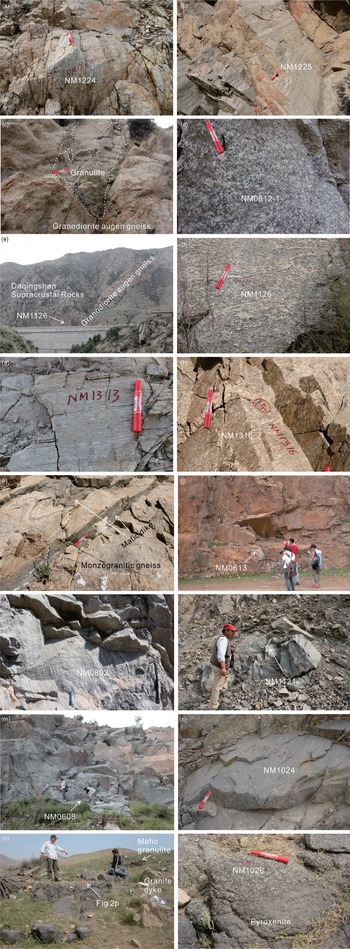
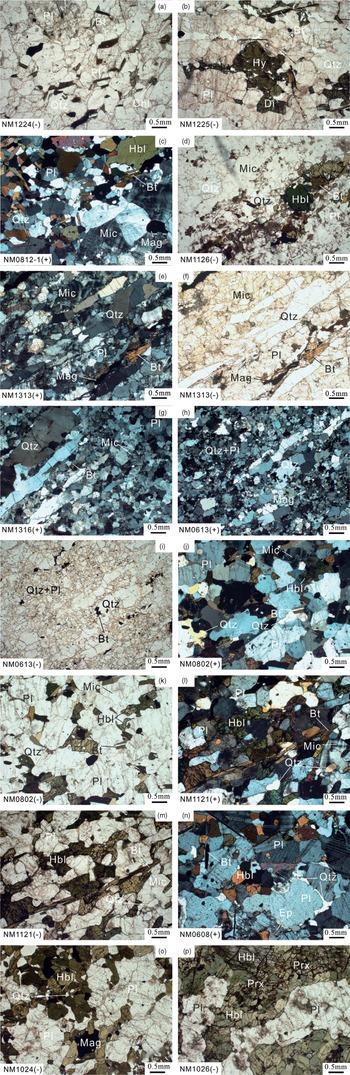
This sample was taken from ∼5 km southeast of Shaoniugou. The trondhjemitic gneiss extends in an E–W direction, parallel to its gneissosity (Fig. 2a). It is mainly composed of plagioclase and quartz, with minor biotite and microcline (Fig. 3a). Both plagioclase and quartz show recrystallized boundaries. Aligned biotite flakes, partly altered to chlorite, define a weak foliation.
Field photographs of the late Neoarchaean – early Palaeoproterozoic meta-plutonic rocks in the Daqingshan area, northwestern North China Craton. (a) Trondhjemitic gneiss (NM1224), ∼5 km northeast of Shaoniugou. (b) Trondhjemitic gneiss (NM1225), ∼2.5 km northeast of Shaoniugou. (c, d) Granodiorite augen gneiss (NM0812-1), containing granulite enclaves, ∼3 km northeast of Hademengou. (e) Granodiorite augen gneiss cutting the Daqingshan Supracrustal Rocks. (f) The site of sample NM1126, ∼2 km south of Shiguai. (g) Quartz monzonite gneiss (NM1313), showing strong deformation, ∼500 m west of Jiagenqigou. (h, i) Mylonitized augen monzogranite (NM1316), intruded by mafic dykes, ∼200 m west of Jiagenqigou. (j) Monzogranitic gneiss (NM0613), ∼2 km northwest of Maohudong. (k) Meta-diorite (NM0802), ∼1 km west of Hujigou. (l) Meta-diorite (NM1121), ∼3 km east of Hujigou. (m) Meta-gabbroic diorite (NM0608), ∼3 km southwest of Taoerwan. (n) Meta-gabbroic diorite (NM1024), ∼6 km northeast of Hademengou. (o, p) Meta-gabbro (NM1026), with granulite enclaves, ∼2 km northeast of Hademengou. The marker pen for scale is 14 cm in length.

Photomicrographs showing petrographic features of the late Neoarchaean – early Palaeoproterozoic meta-plutonic rocks in the Daqingshan area, northwestern North China Craton. (a) Trondhjemitic gneiss (NM1224). (b) Trondhjemitic gneiss (NM1225). (c) Granodiorite augen gneiss (NM0812-1). (d) Granodiorite augen gneiss (NM1126). (e, f) Quartz monzonite gneiss (NM1313). (g) Mylonitized augen monzogranite (NM1316). (h, i) Monzogranitic gneiss (NM0613). (j, k) Meta-diorite (NM0802). (l, m) Meta-diorite (NM1121). (n) Meta-gabbroic diorite (NM0608). (o) Meta-gabbroic diorite (NM1024). (p) Meta-gabbro (NM1026). (+) and (−) represent cross- and plane-polarized light, respectively. Mineral symbols: Bt – biotite; Pl – plagioclase; Qtz – quartz; Chl – chlorite; Hbl – hornblende; Mic – microcline; Di – diopside; Px – pyroxene; Mag – magnetite; Ep – epidote; Cpx – clinopyroxene.

3.a.2. Trondhjemitic gneiss (NM1225, 40° 51′ 15″ N, 110° 13′ 31″ E)
At ∼2.5 km north of sample NM1224, a small trondhjemitic body (<1 km2) was identified within the Lower Wulashan Group. The body is cut by mafic dykes and both have undergone granulite-facies metamorphism. The TTG rock locally shows a banded structure, but sample NM1225 was taken from a relatively homogeneous portion (Fig. 2b). It is mainly composed of plagioclase, quartz and mafic minerals, with minor microcline (Fig. 3b). The mafic minerals include hornblende, brown biotite and diopside. Although hypersthene is not observed in thin-section, it has been identified in the outcrop.
3.a.3. Granodiorite augen gneiss (NM0812-1, 40° 42′ 53″ N, 109° 42′ 15″ E)
There is a small augen gneiss body (1 × 5 km2) located to the east of the well-known Hademengou garnet granite north of Hademengou (Fig. 1). This granodiorite augen gneiss separates the Daqingshan Supracrustal Rocks in the north from charnockitic gneiss in the south, and locally contains mafic granulite enclaves (Fig. 2c). The augen gneiss commonly shows strong deformation, but sample NM0812-1 was taken from a relatively weakly deformed outcrop with the largest porphyroblasts up to 8 cm in length (Fig. 2d). It is mainly composed of plagioclase, microcline, quartz, hornblende and biotite (Fig. 3c). The matrix is fine to medium grained with a crystalloblastic structure, and the microcline porphyroblasts commonly contain quartz and plagioclase inclusions. Hornblende and biotite occur together and help to define the foliation.
3.a.4. Granodiorite augen gneiss (NM1126, 40° 38′ 57″ N, 110° 17′ 44″ E)
A large granodiorite augen gneiss body extends in an E–W direction to the south of Shiguai (Fig. 1). It encloses and cuts the Daqingshan Supracrustal Rocks (Fig. 2e). The granodiorite body shows large variations in the size and content of microcline porphyroblasts ranging from 2 cm to 10 cm and 30 % to 5 %, respectively. Commonly, the porphyroblasts decreases in size with their decrease in content. Sample NM1126 was taken from a domain representing the protolith in an outcrop where the granodiorite gneiss locally shows anatexis (Fig. 2f). It is mainly composed of microcline, plagioclase, quartz, biotite and hornblende (Fig. 3d). Oriented biotite and hornblende aggregates and quartz and microcline aggregates define a strong foliation.
3.b. Quartz monzonite and monzogranite gneisses
3.b.1. Quartz monzonite gneiss (NM1313, 40° 54′ 58.53″ N, 109° 55′ 44.02″ E)
At ∼1 km west of Jiagenqigou, where the Shanheyuan gneiss crops out (Fig. 1), locally exposed rocks show strong mylonitization with lineations extending in an E–W direction. Sample NM1313 was taken from a relatively fresh outcrop (Fig. 2g). It is mainly composed of feldspar and quartz, with minor biotite (Fig. 3e, f). The high K2O content (4.82 %) of the rock suggests that some untwinned feldspar may also be K-feldspar. Recrystallized quartz bands and oriented biotite flakes define a strong foliation.
3.b.2. Mylonitized augen monzogranite (NM1316, 40° 54′ 17.53″ N, 109° 57′ 10.45″ E)
This sample was taken from ∼200 m west of Jiagenqigou, where augen gneisses are well developed. They commonly show strong mylonitization (Fig. 2h), and the mylonite foliation and mafic dykes are folded (Fig. 2i). Sample NM1316 is mainly composed of microcline, plagioclase and quartz, with minor biotite. Microcline occurs as phenocrysts/augen (not shown here). Recrystallized quartz bands define a strong foliation (Fig. 3g). There are fine-grained mineral aggregates of plagioclase, microcline and quartz.
3.b.3. Monzogranitic gneiss (NM0613, 40° 45′ 04″ N, 110° 19′ 01″ E)
This sample was collected from ∼2 km northwest of Maohudong. The rock is homogeneous in mineral contents and is grey on fresh surfaces, but pinkish on weathered surfaces (Fig. 2j), being different from what is named on the geological map as hypersthene-quartz dioritic and charnockitic gneisses. Granulites occur as enclaves in the monzogranitic gneiss. Sample NM0613 is mainly composed of plagioclase, microcline and quartz (Fig. 3h, i), being similar in petrographic features to sample NM1313, but containing less microcline phenocrysts.
3.c. Meta-gabbros and diorites
3.c.1. Meta-diorite (NM0802, 40° 50′ 00″ N, 110° 03′ 47″ E)
This sample was taken from the Shanheyuan gneiss, ∼1 km southwest of Hujigou (Fig. 1). In a N–S section along the road, granitoid rocks commonly show a banded structure, partly because of anatexis. Sample NM0802 was taken from an outcrop with relatively homogeneous mineral contents (Fig. 2k). It is mainly composed of plagioclase and dark minerals, with some quartz and microcline (Fig. 3j, k). Plagioclase shows a crystalloblastic structure. Dark minerals include biotite and hornblende that occur as aggregates defining a weak foliation.
3.c.2. Meta-diorite (NM1121, 40° 49′ 47″ N, 110° 04′ 02″ E)
This sample was also collected from the Shanheyuan gneiss, ∼1 km south of sample NM0802 (Fig. 1). It is similar in field and petrographic features to sample NM0802, but shows strong deformation (Figs 2l, 3l, m).
3.c.3. Meta-gabbroic diorite (NM0608, 40° 46′ 12″ N, 109° 47′ 37″ E)
This sample was taken from the Kundulun–Zaoergou gneiss, ∼3 km southwest of Taoerwan (Fig. 1). The meta-gabbroic diorite occurs on a relatively large scale. The rock is homogeneous in mineral contents, and shows weak anatexis in outcrop, with some small red granitic dykes (Fig. 2m). It is mainly composed of plagioclase and hornblende, with lesser amounts of biotite and quartz (Fig. 3n). Some plagioclase shows polysynthetic twinning. Biotite commonly occurs together with hornblende. There are local, fine-grained felsic mineral aggregates between coarse-grained plagioclase grains, which are considered to be a result of anatexis.
3.c.4. Meta-gabbroic diorite (NM1024, 40° 43′ 01″ N, 109° 42′ 30″ E)
To the north of sample NM0812-1, ∼6 km northeast of Hademengou (Fig. 1), granodiorite augen gneiss was intruded by a gabbroic diorite dyke. The dyke is ∼40 m in width and extends in an E–W direction. The dyke is homogeneous with only a few leucosomes of probable anatectic origin (Fig. 2n). It is mainly composed of plagioclase and hornblende, with minor quartz (Fig. 3o). Plagioclase shows recrystallized boundaries with some altered to epidote. Some fine-grained quartz occurs in hornblende aggregates.
3.c.5. Meta-gabbro (NM1026, 40° 41′ 54″ N, 109° 40′ 58″ E)
This sample was taken from ∼2 km northeast of Hademengou (Fig. 1). It is a small meta-gabbro body in which there are mafic granulite and meta-pyroxenite enclaves showing a transitional relationship (Fig. 2o, p). The meta-gabbro is cut by granite dykes (Fig. 2o) and is mainly composed of pyroxene, hornblende and plagioclase (Fig. 3p). Some plagioclase is altered to epidote.
4. Analytical techniques
Zircon separation, cathodoluminescence (CL) imaging and zircon dating were carried out at the Beijing SHRIMP Centre, Chinese Academy of Geological Sciences (CAGS), Beijing. Age measurements were performed over a long period, but in all cases the analytical procedures and conditions were similar to those described by Williams (Reference Williams, McKibben, Shanks and Ridley1998). Mass resolution during the analytical sessions was ∼5000 (1 % height). The intensity of the primary O2− ion beam was 3–5 nA, and spot sizes were 25−30 μm, with each analytical site rastered for 2–3 minutes prior to analysis. Five scans through the mass stations were made for each age determination. Reference standard zircons used were M257 (U = 840 ppm, Nasdala et al. Reference Nasdala, Hofmeister, Norberg, Mattinson, Corfu, Dor, Kamo, Allen, Kennedy, Kronz, Reiners, Frei, Kosler, Wan, Goze, Hoer, Kröner and Valley2008) and TEMORA 1 (206Pb–238U age = 417 Ma, Black et al. Reference Black, Kamo, Allen, Aleinikoff, Davis, Korsch and Foudoulis2003). A common lead correction was applied using the measured 204Pb abundances and Cumming & Richards (Reference Cumming and Richards1975) common Pb composition for the likely age of the rocks. Data processing and assessment was carried out using the SQUID and Isoplot programs (Ludwig, Reference Ludwig2001, Reference Ludwig2003). Uncertainties in the isotopic ratios of individual analyses and on the concordia diagrams are given at 1σ, whereas uncertainties for weighted mean ages in the text are quoted at the 95 % confidence level.
In situ zircon Hf isotopic analyses for samples NM0608, NM0613, NM1024, NM1313 and NM1316 were conducted with a Nu Plasma II multi-collector (MC)-ICP-MS connected to a RESOLUTION M-50 193 nm laser system at the State Key Laboratory of Continental Dynamics, Northwest University, Xi’an. Details of the analytical procedure were described by Yuan et al. (Reference Yuan, Gao, Dai, Zong, Günther, Fontaine, Liu and Diwu2008). In all cases, in situ Lu–Hf analyses of zircons were conducted on the pits generated during U–Pb dating or a nearby area with the same internal structures as determined by CL. The spot size was 44 μm, while the laser repetition rate was 6 Hz and the energy density was 6 J cm−2. The obtained 176Hf/177Hf ratios of the GJ-1 and Mud Tank standards were 0.282008 ± 0.000028 (n = 20, 2σ) and 0.282500 ± 0.000021 (n = 20, 2σ; see online Supplementary Material Table S1 for details), respectively, which almost reproduced the recommended 176Hf/177Hf ratios (0.282015 ± 0.000019, 2σ; 0.282507 ± 0.000006, 2σ) (Woodhead & Hergt, Reference Woodhead and Hergt2005; Elhlou et al. Reference Elhlou, Belousova, Griffin, Pearson and O’Reilly2006). For the remaining samples, analyses were carried out using a Geolas-193 laser-ablation microprobe, attached to a Neptune MC-ICP-MS, at the Institute of Mineral Resources (IMR), CAGS, and the Tianjin Institute of Geology and Mineral Resources (TIGMR), China Geological Survey, Tianjin. The detailed analytical procedures were described by Hou et al. (Reference Hou, Li, Zou, Shi and Xie2007). Analyses were carried out using a spot size of 55 μm. Ablation times were ∼26 s for 200 cycles constituting each measurement, with an 8 Hz repetition rate, and a laser power of 100 mJ/pulse. The 176Hf/177Hf ratios of the GJ-1 standard during Hf isotopic analysis at IMR and TIGMR were 0.282011 ± 0.000018 (2σ, n = 50) and 0.282009 ± 0.000016 (2σ, n = 28; see online Supplementary Material Table S2 for details), respectively. They reproduced the recommended 176Hf/177Hf ratio (GJ-1: 0.282015 ± 0.000019 (2σ); Elhlou et al. Reference Elhlou, Belousova, Griffin, Pearson and O’Reilly2006). The decay constant for 176Lu of 1.867 × 10⁻¹¹ year−1 (Söderlund et al. Reference Söderlund, Patchett, Vervoort and Isachsen2004), and the present-day chondritic ratios of 176Hf/177Hf = 0.28325 and 176Lu/177Hf = 0.0336 (Bouvier et al. Reference Bouvier, Vervoort and Patchett2008) were adopted to calculate ϵHf(t) values. Single-stage Hf model ages (tDM1) were calculated by reference to depleted mantle with a present-day 176Hf/177Hf ratio of 0.28325 and 176Lu/177Hf ratio of 0.0384, and two-stage Hf model ages (tDM2) were calculated by assuming a mean 176Lu/177Hf value of 0.015 (Griffin et al. Reference Griffin, Wang, Jackson, Pearson, O’Reilly, Xu and Zhou2002) for the average continental crust.
This study presents elemental and Sm–Nd isotopic analyses on 15 and 11 samples, respectively. All samples were powdered to 200-mesh in an agate mill. Whole-rock element analyses were conducted at the National Research Centre of Geoanalysis, CAGS, Beijing. Major elements were determined by X-ray fluorescence spectrometry (XRF), with FeO and Fe2O3 contents determined by the wet chemical method. The analytical precision (1σ) for all major-element oxides is better than 2 %. Trace elements were separated using cation-exchange techniques and analysed by ICP-MS. Uncertainties are ∼10 % and ∼5 % for elements with abundances of ∼10 ppm and ∼10 ppm, respectively. The recommended and measured values of standards GBW07103, GBW07107, GBW07122 and GBW07123 are listed in online Supplementary Material Table S3, which are close to each other. Whole-rock Sm–Nd isotopic analyses were carried out in the Laboratory of Isotope Geology, CAGS, with the procedures similar to those described by Zhang & Ye (Reference Zhang and Ye1987). The 143Nd/144Nd ratio of the JMC-Nd standard during Sm–Nd isotopic analysis in the Laboratory of Isotope Geology, CAGS, was 0.511126 ± 5 (SD), which is close to the recommended 143Nd/144N ratio (JMC-Nd: 0.511134 ± 38 (SD); Zhang et & Hu, Reference Zhang and Hu2020). The Nd model ages reported here are based on the depleted mantle model of DePaolo (Reference DePaolo1988).
5. Zircon geochronology
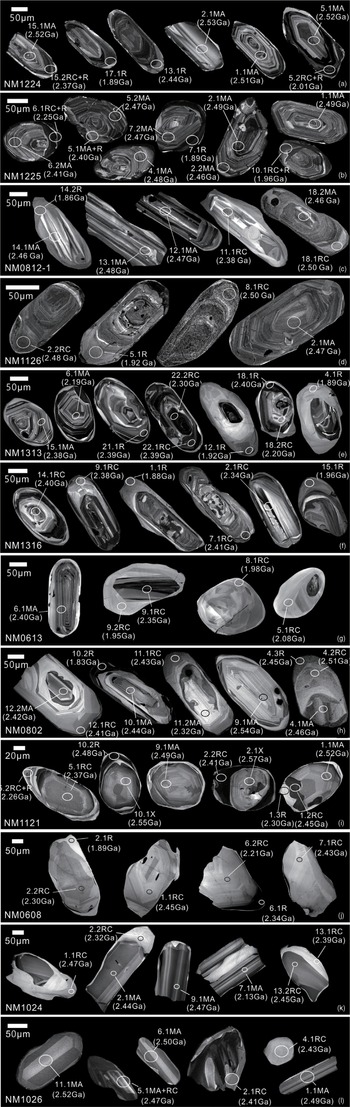
Using the CL imaging, Th/U ratios and ages, the analysed zircons were identified as magmatic (MA), recrystallized (RC), overgrowth (rim, R) or xenocrystic (X). Magmatic zircon commonly shows oscillatory zoning; recrystallized zircon refers to that in which the original texture has been modified under thermal and fluid conditions, such as the disappearance or blurring of magmatic zoning. Overgrowth zircon refers to zircon newly grown during metamorphism. Xenocrystic zircon is older than magmatic zircon but can keep magmatic zoning. In some or even many cases, it is difficult to determine the origin (recrystallization or overgrowth) of the metamorphic rims. U–Pb data are listed in online Supplementary Material Table S4.
5.a. TTG gneisses
5.a.1. Trondhjemitic gneiss (NM1224)
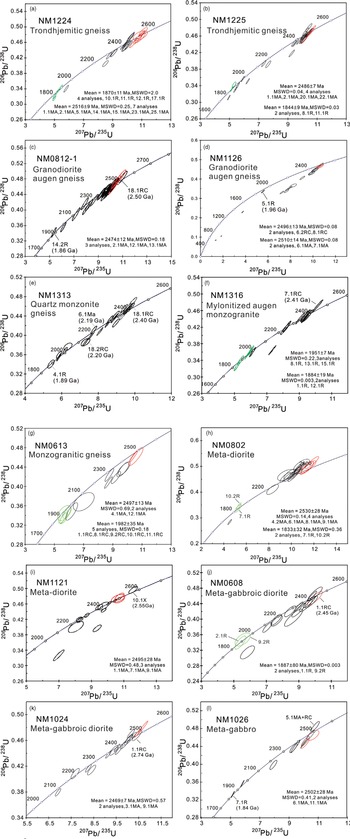
The zircons are subhedral and tabular in shape and some show core–rim structures in CL images (Fig. 4a). Magmatic cores mostly show oscillatory zoning, whereas recrystallized or overgrowth rims are homogeneous. Twenty-six analyses were performed on 24 zircon grains. Nine analyses on magmatic domains have U contents and Th/U ratios of 30–166 ppm and 0.25–1.17, respectively. Seven of them are concordant to slightly discordant (discordance ≤2 %), with a weighted mean 207Pb–206Pb age of 2516 ± 9 Ma (MSWD = 0.25; Fig. 5a). Four analyses (10.1R, 11.1R, 12.1R, 17.1R) on rims have U contents of 132–179 ppm, Th/U ratios of 0.3–0.7 and record a weighted mean 207Pb–206Pb age of 1870 ± 11 Ma (MSWD = 2.0). Other analyses on recrystallized and overgrowth domains have U contents of 100–855 ppm, Th/U ratios of 0.01–0.35 and 207Pb–206Pb ages ranging from 2460 to 2012 Ma. Five analyses (8.1R+RC, 13.1R, 19.1R, 20.1R, 21.1R) with low Th/U ratios of 0.01–0.07 have 207Pb–206Pb ages of 2442–2418 Ma.
Cathodoluminescence images of zircons from the late Neoarchaean – early Palaeoproterozoic meta-plutonic rocks in the Daqingshan area, northwestern North China Craton. (a) Trondhjemitic gneiss (NM1224). (b) Trondhjemitic gneiss (NM1225). (c) Granodiorite augen gneiss (NM0812-1). (d) Granodiorite augen gneiss (NM1126). (e) Quartz monzonite gneiss (NM1313). (f) Mylonitized augen monzogranite (NM1316). (g) Monzogranitic gneiss (NM0613). (h) Meta-diorite (NM0802). (i) Meta-diorite (NM1121). (j) Meta-gabbroic diorite (NM0608). (k) Meta-gabbroic diorite (NM1024). (l) Meta-gabbro (NM1026). MA – magmatic; RC – recrystallized; X – xenocrystic; R – overgrowth (rim).

Concordia diagrams showing SHRIMP U–Pb zircon analyses of the late Neoarchaean – early Palaeoproterozoic meta-plutonic rocks in the Daqingshan area, northwestern North China Craton. (a) Trondhjemitic gneiss (NM1224). (b) Trondhjemitic gneiss (NM1225). (c) Granodiorite augen gneiss (NM0812-1). (d) Granodiorite augen gneiss (NM1126). (e) Quartz monzonite gneiss (NM1313). (f) Mylonitized augen monzogranite (NM1316). (g) Monzogranitic gneiss (NM0613). (h) Meta-diorite (NM0802). (i) Meta-diorite (NM1121). (j) Meta-gabbroic diorite (NM0608). (k) Meta-gabbroic diorite (NM1024). (l) Meta-gabbro (NM1026). Red ellipses represent the magmatic and green ellipses the metamorphic zircon data used for age calculations.

5.a.2. Trondhjemitic gneiss (NM1225)
The zircons are stubby or oval in shape and have oscillatory zoning, with some having narrow rims in CL images (Fig. 4b). Twenty-seven analyses were performed on 22 zircons. Seventeen analyses on magmatic domains have U contents and Th/U ratios of 151–541 ppm and 0.47–1.30, respectively. Seventeen of them are on or close to concordia and have 207Pb–206Pb ages ranging from 2488 Ma to 2410 Ma (Fig. 5b). Among them, four analyses (1.1MA, 2.1MA, 20.1MA, 22.1MA) with the oldest ages yield a weighted mean 207Pb–206Pb age of 2486 ± 7 Ma (MSWD = 0.04). Three analyses (7.1R, 8.1R, 11.1R) on rims have U contents of 893–1028 ppm and Th/U ratios of 0.08–0.15; among them, analyses 8.1R and 11.1R have a weighted mean 207Pb–206Pb age of 1844 ± 9 Ma (MSWD = 0.03).
5.a.3. Granodiorite augen gneiss (NM0812-1)
The zircons are tabular in shape and have banded or oscillatory zoning, with evidence of internal recrystallization, and they also have narrow recrystallized or overgrowth rims (Fig. 4c). Thirty-one analyses were performed on 26 zircon grains. Eleven analyses on magmatic domains have U contents and Th/U ratios of 189–398 ppm and 0.41–1.53, respectively. All of them are on or close to concordia and have 207Pb–206Pb ages ranging almost continuously from 2478 Ma to 2395 Ma. Three analyses (2.1MA, 12.1MA, 13.1MA) with the oldest ages yield a weighted mean 207Pb–206Pb age of 2474 ± 12 Ma (MSWD = 0.18; Fig. 5c). Twenty analyses on recrystallized or overgrowth domains have U contents of 135–410 ppm, Th/U ratios of 0.05–0.79 and 207Pb–206Pb ages ranging from 2503 Ma to 1856 Ma. It is notable that on grain 18, the recrystallized rim (18.1RC) has an older 207Pb–206Pb age (2503 ± 15 Ma, discordance = −1 %) than the magmatic core (18.2MA. 2455 ± 9 Ma, discordance = 3 %). The youngest rim (14.2R) has a Th/U ratio of 0.08 and a 207Pb–206Pb age of 1856 ± 13 Ma (discordance = −2 %; Figs 4c, 5c).
5.a.4. Granodiorite augen gneiss (NM1126)
The zircons are subhedral and tabular in shape and some show core–rim structures in CL images (Fig. 4d). Magmatic cores have oscillatory zoning, whereas the recrystallized or overgrowth rims are more homogeneous. Commonly, there are light seams around the cores, indicating fluid-present recrystallization (Fig. 4d). Eighteen analyses were performed on 14 zircon grains. Nine analyses on magmatic domains have U contents and Th/U ratios of 77–337 ppm and 0.61–1.08, respectively. The zircons have undergone radiogenic lead loss to different degrees, but all analyses define a discordia (Fig. 5d). Two analyses (6.1MA, 7.1MA) closest to concordia yield a weighted mean 207Pb–206Pb age of 2510 ± 14 Ma (MSWD = 0.08). Five analyses on recrystallized or overgrowth rims have U contents of 207–640 ppm and Th/U ratios of 0.31–0.47; they also show radiogenic lead loss with a similar distribution to magmatic zircons. Two analyses (6.2RC, 8.1RC) closest to concordia have a weighted mean 207Pb–206Pb age of 2496 ± 13 Ma (MSWD = 0.08). Four analyses on rim domains have U contents of 184–690 ppm and Th/U ratios of 0.03–0.11. They roughly constitute another discordia, with analysis 5.1R that is closest to concordia having a 207Pb–206Pb age of 1956 ± 10 Ma.
5.b. Quartz monzonite and monzogranitic gneisses
5.b.1. Quartz monzonite gneiss (NM1313)
The zircons are stubby or oval in shape and have oscillatory zoning, with evidence of internal recrystallization and recrystallized or overgrowth rims (Fig. 4e). Twenty-five analyses were performed on 23 zircon grains, and 20 of them are distributed on or close to concordia (discordance ≤3 %; Fig. 5e). Eight analyses on magmatic domains have U contents and Th/U ratios of 184–347 ppm and 0.41–0.76, respectively, and show large 207Pb–206Pb age variations from 2396 Ma to 2188 Ma (Fig. 5e). Four analyses on recrystallized domains have higher U contents and lower Th/U ratios than the magmatic domains, but show similar 207Pb–206Pb age variations. Thirteen analyses on recrystallized or overgrowth rims have U contents of 64–891 ppm and show higher Th/U ratios of 0.02–2.26 and 207Pb–206Pb age variations of 2402–1887 Ma. Analysis 4.1R on a rim has the highest Th/U ratio of 2.26 and the youngest 207Pb–206Pb age of 1887 Ma. Similar to zircons from sample NM0812-1, some rims have older 207Pb–206Pb ages than cores (grains 18 and 22 in Fig. 5e).
5.b.2. Mylonitized augen monzogranite (NM1316)
The zircons are subhedral and tabular in shape and show recrystallization to different degrees, with little magmatic zoning remaining. They also have recrystallized or overgrowth rims; core–rim structures are common (Fig. 4f). Fifteen analyses were performed on 15 zircon grains, and are concentrated in four populations on the concordia diagram (Fig. 5f), with a similar distribution to zircons from sample NM1313. Nine analyses on recrystallized domains have U contents and Th/U ratios of 229–1310 ppm and 0.24–1.10, respectively, and have 207Pb–206Pb ages of 2414–2008 Ma (Fig. 5f). Six analyses on recrystallized or overgrowth rims have U contents of 249–2124 ppm and Th/U ratios of 0.10–0.56. Analysis 3.1R has a Th/U ratio of 0.10 and a 207Pb–206Pb age of 2304 Ma (discordance = 13 %). The remaining analyses are concentrated in two locations on concordia, with weighted mean 207Pb–206Pb ages of 1951 ± 7 Ma (MSWD = 0.22) and 1884 ± 19 Ma (MSWD = 0.003).
5.b.3. Monzogranitic gneiss (NM0613)
The zircons are oval, stubby or tabular in shape and show oscillatory and banded zoning, with evidence of strong recrystallization that commonly forms core–rim structures (Fig. 4g). Fourteen analyses were performed on 13 zircon grains. Six analyses on magmatic domains have U contents of 53–459 ppm and Th/U ratios of 0.52–1.64. They show radiogenic lead loss to different degrees but are roughly distributed along a discordia (Fig. 5g). Two analyses closest to concordia yield a weighted mean 207Pb–206Pb age of 2497 ± 13 Ma (MSWD = 0.69). Eight analyses on recrystallized domains have U contents of 27–271 ppm and Th/U ratios 0.13–0.97. Five of them are concentrated on concordia and yield a weighted mean 207Pb–206Pb age of 1982 ± 35 Ma (MSWD = 0.18).
5.c. Meta-gabbros and diorites
5.c.1. Meta-diorite (NM0802)
The zircons are stubby to tabular in shape and show oscillatory zoning with some displaying recrystallization and overgrowth rims in CL images, defining core–rim structures (Fig. 4h). Twenty-one analyses were carried out on 12 zircon grains. Ten analyses on magmatic domains have U contents and Th/U ratios of 24–98 ppm and 0.62–3.94, respectively, and are concentrated along concordia, with 207Pb–206Pb ages of 2538–2323 Ma; four of them with the oldest ages define a weighted mean 207Pb–206Pb age of 2530 ± 28 Ma (MSWD = 0.14) (Fig. 5h). Six analyses on recrystallization domains have U contents of 36–96 ppm, Th/U ratios 0.79–1.49 and 207Pb–206Pb ages of 2510–2315 Ma. Four analyses on recrystallized or overgrowth rims have U contents of 47–387 ppm and Th/U ratios 0.05–1.44. Analysis 4.3R has the oldest 207Pb–206Pb age of 2450 ± 25 Ma, whereas analyses 7.1R and 10.2R yield a weighted mean 207Pb–206Pb age of 1833 ± 32 Ma (MSWD = 0.36).
5.c.2. Meta-diorite (NM1121)
The zircons are oval to stubby in shape and show core–rim structures in CL images (Fig. 4i). Magmatic cores are homogeneous or have oscillatory zoning, with evidence of recrystallization, together with thin recrystallized or overgrowth rims. Fifteen analyses were performed on ten zircon grains. Three analyses on magmatic domains have U contents and Th/U ratios of 68–119 ppm and 0.79–0.85, respectively, and yield a weighted mean 207Pb–206Pb age of 2495 ± 28 Ma (MSWD = 0.48) (Fig. 5i). Six analyses on recrystallized domains have U contents of 141–1102 ppm, Th/U ratios of 0.16–1.13 and 207Pb–206Pb ages of 2453–2275 Ma. Three analyses on recrystallized or overgrowth rims have U contents of 60–725 ppm and Th/U ratios 0.07–0.47, with the oldest 207Pb–206Pb age being 2475 ± 8 Ma (10.2R). Analysis 10.1X lies on concordia and has a 207Pb–206Pb age of 2551 ± 17 Ma, which is older than the magmatic zircon, and is probably xenocrystic in origin.
5.c.3. Meta-gabbroic diorite (NM0608)
The zircons are anhedral, stubby to weakly elongated in shape and almost all show recrystallization, with some having recrystallized or overgrowth rims in CL images (Fig. 4j). Sixteen analyses were carried out on 12 zircon grains. Ten analyses on recrystallized domains have U contents and Th/U ratios of 31–61 ppm and 0.64–1.38, respectively, and show large 207Pb–206Pb age variations from 2452 Ma to 2167 Ma along concordia (Fig. 5j). Six analyses on recrystallized or overgrowth rims have U contents and Th/U ratios of 18–249 ppm and 0.57–0.68, respectively. As with the recrystallized zircons, they also show large, but younger, 207Pb–206Pb age variations from 2411 Ma to 1886 Ma. Analyses 2.1R and 9.2R record the youngest ages and yield a weighted mean 207Pb–206Pb age of 1887 ± 80 Ma (MSWD = 0.003), with a large error.
5.c.4. Meta-gabbroic diorite (NM1024)
The zircons are elongate to irregular in shape, and are either homogeneous or show banded zoning with some evidence of recrystallization in CL images (Fig. 4k). Sixteen analyses were performed on 14 zircon grains, and they are distributed on or close to concordia (Fig. 5k). Eight analyses on magmatic domains have U contents of 111–526 ppm, Th/U ratios of 0.38–1.00 and large 207Pb–206Pb age variations from 2471 Ma to 2127 Ma. Two analyses (3.1MA, 9.1MA) with the oldest 207Pb–206Pb ages yield a weighted mean 207Pb–206Pb age of 2469 ± 7 Ma (MSWD = 0.57). Eight analyses on recrystallization domains have U contents of 64–217 ppm and Th/U ratios of 0.23–0.45. They have similar 207Pb–206Pb age variations to the magmatic zircon, ranging from 2474 Ma to 2181 Ma.
5.c.5. Meta-gabbro (NM1026)
The zircons show similar features to those from sample NM1024, although banded zoning is less pronounced (Fig. 4l). Eleven analyses were performed on 11 zircons. Five analyses on magmatic domains have U contents and Th/U ratios of 177–1766 ppm and 0.58–0.87, respectively. They are distributed on a discordia line, and two of them (6.1Ma, 11.1MA) with the oldest 207Pb–206Pb ages yield a weighted mean 207Pb–206Pb age of 2502 ± 28 Ma (MSWD = 0.41; Fig. 5l). Six analyses on recrystallized or overgrowth rims have U contents and Th/U ratios of 112–2161 ppm and 0.09–0.60, respectively. They show large 207Pb–206Pb age variations from 2408 Ma to 1841 Ma, but with the latter (7.1R) being concordant.
6. Zircon Lu–Hf isotopes
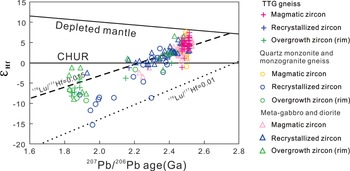
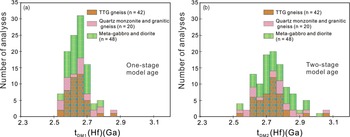
In situ Lu–Hf isotopic analysis was carried out on zircons from all dated samples, including those dated by Xu et al. (Reference Xu, Wan, Dong, Ma and Liu2015) (online Supplementary Material Table S5). Magmatic zircons from four TTG samples are similar to each other in Hf isotopic compositions. They show large variations in ϵHf(t) values from −1.1 to +6.2 (Fig. 6), corresponding to tDM1(Hf) and tDM2(Hf) model ages of 2.7–2.5 Ga and 2.8–2.6 Ga, respectively (Fig. 7). Magmatic zircons from the quartz monzonite and monzogranite gneisses (four samples) have ϵHf(t) values of −0.95 to +7.5, tDM1(Hf) of 2.9–2.5 Ga and tDM2(Hf) of 3.1–2.5 Ga, being similar in Hf isotopic composition to those of magmatic zircons from the TTG gneisses. Magmatic zircons from seven gabbroic and dioritic rocks have similar Hf isotopic compositions to those from granitoid rocks, with ϵHf(t) and tDM1(Hf) values being −3.4 to +7.3 and 2.8–2.5 Ga, respectively. Recrystallized and overgrowth zircon domains are similar in Hf isotopic composition to the magmatic domains, except for some from monzogranitic gneiss sample NM0613, which have more negative ϵHf(t) values (Fig. 6).
ϵHf(t) versus zircon age diagram for the late Neoarchaean – early Palaeoproterozoic meta-plutonic rocks in the Daqingshan area, northwestern North China Craton. The weighted mean 207Pb–206Pb age of 2500 Ma was used for samples with no magmatic zircon ages. Dotted and dashed lines represent felsic crust with 176Lu/177Hf being 0.01 and 0.015, respectively. CHUR – chondritic uniform reservoir.

Hf-in-zircon model age histograms for the late Neoarchaean – early Palaeoproterozoic meta-plutonic rocks in the Daqingshan area, northwestern North China Craton. (a) One-stage model age; (b) two-stage model age.

7. Whole-rock elemental and isotopic compositions
7.a. Whole-rock geochemistry
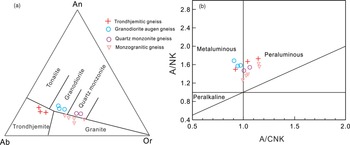
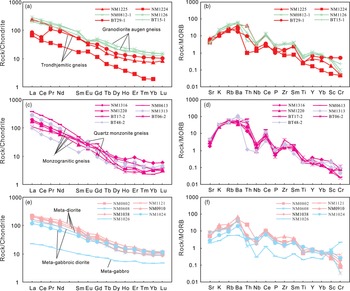
Whole-rock oxide and element compositions for all samples dated in this study, together with those for three samples dated by Xu et al. (Reference Xu, Wan, Dong, Ma and Liu2015), are listed in online Supplementary Material Table S6. Four TTG gneiss samples have SiO2 of 61.48–69.77 %, TFeO of 2.56–6.01 %, MgO of 1.08–1.87 % and K2O of 1.59–3.55 %. They plot in the trondhjemite and granodiorite fields (Fig. 8a) and show large variations in total rare earth elements (ΣREEs) (67–334 ppm), (La/Yb)n (11.8–32.1) and Eu/Eu* (0.6–1.3) (Fig. 9a, c). Compared with the TTG gneiss, the quartz monzonite and monzogranite gneiss samples (Fig. 8a) are higher in SiO2 (68.29–73.77 %) and K2O (3.77–4.82 %) and lower in TFeO (1.84–3.21 %) and MgO (0.20–1.39 %), have similar ΣREE contents (191–356 ppm) and Eu/Eu* (0.72–1.3), but have larger (La/Yb)n ratios (31.3–151.0; Fig. 9a, c). Most granitoids are peraluminous with some TTG being metaluminous (Fig. 8b). They are enriched in large ion lithophile elements (LILEs) and depleted in Nb and P (Fig. 9c, d).
(a) Modal An–Ab–Or and (b) A/CNK–A/NK diagrams of the late Neoarchaean – early Palaeoproterozoic meta-plutonic rocks in the Daqingshan area, northwestern North China Craton.

REE and trace-element distribution patterns for the late Neoarchaean – early Palaeoproterozoic meta-plutonic rocks in the Daqingshan area, northwestern North China Craton. (a, b) TTG; (c, d) monzogranite and quartz monzonite; (e, f) meta-gabbro and diorite. The samples with prefix BT are from Liu et al. (Reference Liu, Liu, Ding, Liu, Chen, Liu, Wang, Yang, Cai and Shi2017). Chondrite and primitive mantle normalization values are from Sun & McDonough (Reference Sun, McDonough, Saunders and Norry1989) and Pearce (Reference Pearce, Hawkesworth and Norry1983), respectively.

The meta-gabbroic diorites and diorites (NM0608, NM0802, NM0910, NM1038, NM1024, NM1121) show inverse correlations of SiO2 (53.98–59.62 %) with other oxides, including MgO (2.17–4.49 %), TFeO (5.99–10.68 %), CaO (4.65–7.82 %), Na2O (3.62–4.66 %) and K2O (0.87–3.48 %). They have similar REE patterns, with ΣREE, (La/Yb)n and Eu*/Eu being 153–296 ppm, 9.5–18.4 and 0.72–1.1, respectively (Fig. 9e). Meta-gabbro sample NM1026 has MgO = 12.93 %, TFeO = 7.45 %, Na2O = 2.08 % and K2O = 0.41 %. Compared with other meta-gabbroic diorites and diorites, it has a lower ΣREE content of 34 ppm and a lower (La/Yb)n ratio of 4.5. All the meta-gabbroic and dioritic rocks are enriched in LILEs and depleted in Nb (Fig. 9f).
7.b. Whole-rock Nd isotopes
A total of 11 samples, including three samples dated by Xu et al. (Reference Xu, Wan, Dong, Ma and Liu2015), were analysed for their Sm–Nd isotopic composition (online Supplementary Material Table S7). The TTG gneisses (NM0812-1, NM1126, NM1224, NM1225) are similar in their Nd isotopic compositions (Fig. 10). The ϵNd(t), tDM1(Nd) and tDM2(Nd) values are +1.2 to +2.4, ∼2.7 Ga and 2.8–2.7 Ga, respectively. The monzogranite gneiss (NM1220) is similar in Nd isotope composition to the TTG gneisses. The meta-gabbroic and dioritic rocks (NM0802, NM0910, NM1024, NM1026, NM1038, NM1121) are different in Nd isotopic compositions from the granitoid rocks, with the ϵNd(t), tDM1(Nd) and tDM2(Nd) values being +1.5 to +4.3, 2.7–2.5 Ga and 2.8–2.6 Ga, respectively.
Whole-rock ϵNd(t) versus age diagram for the late Neoarchaean – early Palaeoproterozoic meta-plutonic rocks in the Daqingshan area, northwestern North China Craton.

8. Discussion
8.a. Late Neoarchaean – earliest Palaeoproterozoic magmatism
Among the 12 samples dated in this study, nine of them from a range of different rock types have the oldest population of magmatic zircons recording ages of 2530–2474 Ma (Table 2). Considering all samples, U–Pb zircon data recording both magmatic and metamorphic ages are distributed almost continuously along concordia from 2.53 Ga to 1.82 Ga. The oldest concordant magmatic zircons in the TTG samples range from 2516 ± 9 Ma to 2474 ± 12 Ma. Importantly, in some samples, zircon domains, interpreted as experiencing recrystallization, yield older ages than the magmatic cores. For example, in granodiorite augen gneiss sample NM0812-1, the recrystallized rim of grain 18 (18.1RC) has a 207Pb–206Pb age of 2503 ± 15 Ma, older than the 2455 ± 9 Ma age of the magmatic core (18.2MA) (online Supplementary Material Table S4). Magmatic zircons from the quartz monzonite gneiss (NM1313) have the youngest magmatic ages of all the samples, ranging from 2391 Ma to 2188 Ma, but with one recrystallized rim (18.1R) recording an older age of 2402 ± 10 Ma (online Supplementary Material Table S4). For the monzogranite (NM0613), the two oldest analyses closest to concordia yield a weighted mean 207Pb–206Pb age of 2497 ± 13 Ma, whereas the recrystallized domains record considerably younger ages ranging from 2314 ± 16 Ma to 1978 ± 30 Ma; note that no magmatic zircon domains remain in the mylonitized monzogranite sample NM1316. For the two diorite samples (NM0802, NM1121), the ages of the domains with magmatic structures range from 2538 ± 25 Ma to 2368 ± 37 Ma. Clearly, there are issues here with both a wide age range and such relatively young ages, suggesting that some oscillatory zoned domains have undergone radiogenic lead loss, while still retaining their ‘magmatic’ structure. This is also the case for the meta-gabbroic diorite (NM1024), where the oldest magmatic domain has an apparent age of 2471 ± 5 Ma, yet the oldest recrystallized domain has a similar 207Pb–206Pb age of 2474 ± 12 Ma. The meta-gabbroic diorite NM0608 does not retain any magmatic domains, but the oldest recrystallized core records an apparent age of 2452 ± 27 Ma. The meta-gabbro (NM1026) records a maximum 207Pb–206Pb age of 2520 ± 32 Ma from a magmatic domain, but with some recrystallized cores being less than 50 Ma younger. In addition, many samples record late Palaeoproterozoic (1.95–1.82 Ga) ages, with their zircon data distributed along concordia, suggesting that they underwent strong overprinting by late Palaeoproterozoic events (e.g. meta-gabbroic diorite NM1024 and meta-diorite sample NM1121; see online Supplementary Material Table S4).
Summary of zircon ages for the late Neoarchaean – early Palaeoproterozoic meta-intrusive rocks in the Daqingshan area, northwestern North China Craton

Dong et al. (Reference Dong, Wan, Wilde, Xu, Ma, Xie and Liu2014) considered that the Daqingshan Supracrustal Rocks formed in earliest Palaeoproterozoic time based on the phenomenon that detrital magmatic zircons had apparent ages of 2.55–2.50 Ga and metamorphic zircon domains had apparent ages of 2.45–2.40 Ga. However, Zhang et al. (Reference Zhang, Dong, Liu, Bai, Ren and Wan2016) established that they were deposited in late Neoarchaean time owing to the supracrustal rocks being intruded by 2.5 Ga diorite. Indeed, in other areas of the NCC with evidence of both strong late Neoarchaean and late Palaeoproterozoic tectonothermal events, such as in eastern Shandong and northwestern Hebei, it is common for the late widespread high-grade metamorphism to result in apparent younging of U–Pb ages in magmatic zircons due to recrystallization and ancient lead loss. Thus, such younger ages may not represent the time of zircon crystallization (even for those that still show good oscillatory zoning; Ma et al. Reference Ma, Wan, Santosh, Xu, Xie, Dong, Liu and Guo2012; Wan et al. Reference Wan, Xie, Dong and Liu2020). This phenomenon has also been observed in mafic granulites in the Athabasca area, North America (Flowers et al. Reference Flowers, Bowring, Mahan, Williams and Williams2008).
Therefore, it is considered that most, if not all, rocks dated in this study were formed during late Neoarchaean to earliest Palaeoproterozoic times (>2.48 Ga). Considering that the metamorphic zircon domains have complex structures and the samples analysed by LA-ICP-MS utilized a much greater volume of material than the SIMS U–Pb method, with the potential to traverse several different domains (Kröner et al. Reference Kröner, Wan, Liu and Liu2014), it is speculated that the ∼2.45 Ga granitoid rocks dated by J. H. Liu et al. (Reference Liu, Liu, Ding, Chen, Liu, Shi, Cai and Wang2013, Reference Liu, Liu, Ding, Liu, Chen, Liu, Wang, Yang, Cai and Shi2017) may also be late Neoarchaean plutonic rocks. Therefore, major magmatism in the Daqingshan area mainly occurred in late Neoarchaean – earliest Palaeoproterozoic times.
In the Daqingshan area, a series of tectonothermal events in late Palaeoproterozoic time caused high-grade metamorphism and deformation of the late Neoarchaean K-rich granites. This is different from the Yinshan block in the north (inset in Fig. 1) where the late Palaeoproterozoic tectonothermal events were relatively weak, with most of the late Neoarchaean meta-plutonic rocks having magmatic zircon ages >2500 Ma (e.g. Jian et al. Reference Jian, Kröner, Windley, Zhang, Zhang and Zhang2012; Ma et al. Reference Ma, Fan and Guo2013; Liu, J. H. et al. Reference Liu, Liu, Cai, Liu, Liu, Wang, Xiao and Shi2017; Dong et al. Reference Dong, Ma, Xie, Zhang and Wan2021). In these late Neoarchaean gneisses, there are local middle to late Palaeoproterozoic plutonic rocks (Liu, J. H. et al. Reference Liu, Dong, Xu, Santosh, Ma, Xie, Liu and Wan2013; Liu, S. J. et al. Reference Liu, Dong, Xu, Santosh, Ma, Xie, Liu and Wan2013; Wan et al. Reference Wan, Xu, Dong, Nutman, Ma, Xie, Liu, Liu, Wang and Chu2013; Liu et al. Reference Liu, Liu, Liu, Liu, Wang, Xiao, Cai and Shi2014). However, in the Daqingshan area, most of the >1.85 Ga geological units are in tectonic contact, owing to the strong late Palaeoproterozoic tectonothermal events. The only exceptions are the latest Palaeoproterozoic red granites (mainly dykes), which intruded all earlier geological units.
The late Palaeoproterozoic tectonothermal events have long been widely recognized in the Daqingshan area (e.g. Ma et al. Reference Ma, Wan, Santosh, Xu, Xie, Dong, Liu and Guo2012; Dong et al. Reference Dong, Wan, Xu and Liu2013; Liu, P. H. et al. Reference Liu, Liu, Cai, Liu, Liu, Wang, Xiao and Shi2017) and, indeed, throughout the entire Khondalite Belt (e.g. Jiao et al. Reference Jiao, Fitzsimons, Zi, Evans, Mcdonald and Guo2020), resulting in final cratonization of the NCC (Zhai & Santosh, Reference Zhai and Santosh2011) during amalgamation of the Columbia (Nuna) supercontinent (Rogers & Santosh, Reference Rogers and Santosh2002; Zhao et al. Reference Zhao, Cawood, Wilde and Sun2002).
8.b. Petrogenesis of the plutonic rocks
Three types of rocks, including TTG, monzogranite and gabbro-diorite, have ‘magmatic’ zircon ages of ∼2.5 Ga. The apparent ages cannot be used to determine their formation order owing to strong late Palaeoproterozoic tectonothermal overprinting, which resulted in ancient lead loss of magmatic zircon. However, field observation suggests that the gabbro-diorite commonly formed slightly later than the TTG rocks, and the monzogranite was younger than the TTG rocks.
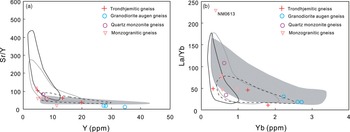
The various plutonic rock types in this study are similar in composition to those described by J. H. Liu et al. (Reference Liu, Liu, Ding, Liu, Chen, Liu, Wang, Yang, Cai and Shi2017) (Figs 8, 9, 11, 12). The TTG rocks commonly have low Sr/Y and La/Yb ratios (Fig. 11a, b), indicating that they formed by partial melting of basaltic rocks under low- to medium-pressure conditions where garnet is absent, but plagioclase is residual (Rapp & Watson, Reference Rapp and Watson1995; Moyen, Reference Moyen2011). Quartz monzonitic and monzogranitic gneisses are richer in K2O and show higher La/Yb ratios compared with the TTG rocks. It is notable that quartz monzonite sample NM1313 has a SiO2 content of 68.29 wt %, being higher than the TTG rocks; thus, sample NM1313 is likely to be granite rather than quartz monzonite. However, considering the anatexis and strong deformation, the high SiO2 content may be due to local migration of material. The monzogranites may be derived from recycling of continental material or magma mixing, and their composition mainly reflects that of their source region. The meta-gabbroic and dioritic rocks are high in ΣREEs and show REE fractionation, suggesting that they were derived from enriched mantle, and that assimilation–fractional crystallization (AFC) processes may play an important role in their formation. The mafic to intermediate magmatism not only added material to the continental crust but also provided heat for formation of crustally derived granites in an extensional environment.
(a) Sr/Y–Y and (b) La/Yb–Yb diagrams (after Moyen, Reference Moyen2011) for the late Neoarchaean – early Palaeoproterozoic meta-plutonic granitoids in the Daqingshan area, northwestern North China Craton. The marked fields are as follows: grey shaded area – potassic granitoids; within thick black line – high-pressure TTG; within grey line – medium-pressure TTG; within dashed line – low-pressure TTG.

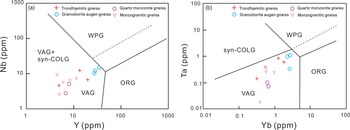
(a) Nb–Y and (b) Ta–Yb diagrams (after Pearce et al. Reference Pearce, Harris and Tindle1984) for the late Neoarchaean – early Palaeoproterozoic meta-plutonic granitoids in the Daqingshan area, northwestern North China Craton. syn-COLG – syn-collision granites; VAG – volcanic arc granites; WPG – within plate granites; ORG – ocean ridge granites. The dashed line represents the upper compositional boundary for ORG from anomalous ridge segments.

The TTG gneisses have whole-rock ϵNd(t) of +1.2 to +2.4 (Fig. 10) and tDM1(Nd) of 2.7 Ga, whereas analyses on magmatic zircons from the TTG gneisses have ϵHf(t) values of −1.1 to +6.2 and tDM1(Hf) of 2.7–2.5 Ga (Figs 6, 7a). These indicate that the TTG rocks were derived from mafic material input from the mantle at ∼2.5 Ga or slightly earlier. Considering the absence of zircon >2.6 Ga, the Sanggan Group may have formed in an oceanic environment, whereas the TTG rocks formed as a result of partial melting of the basaltic rocks (oceanic crust?) of the Sanggan Group under relatively low-pressure conditions. The quartz monzonite and monzogranite gneisses are similar in Nd–Hf isotope composition to the TTG gneisses. This suggests that they were influenced by, or partially derived from, Neoarchaean continental basement. The gabbroic and dioritic rocks are similar in Nd–Hf isotopic composition to the granitoid gneisses, but with derivation from enriched mantle accompanied by AFC processes, as revealed by their element compositions. Overall, the Nd–Hf isotope compositions of the rocks are similar to those of the late Neoarchaean rocks all over the NCC, consistent with the view that the late Mesoarchean – early Neoarchaean was an important period when much of the NCC (and global) juvenile continental crust formed (Condie, Reference Condie2000; Condie et al. Reference Condie, Belousova, Griffin and Sircombe2009; Geng et al. Reference Geng, Du and Ren2012; Wan et al. Reference Wan, Liu, Dong, Xie, Kröner, Ma, Liu, Xie, Ren and Zhai2015).
8.c. Tectonic environment in the late Neoarchaean
There are different opinions on whether mantle plume activity (or underplating) and/or arc magmatism, or both, played key roles in the Neoarchaean period (Chadwick et al. Reference Chadwick, Vasudev, Hegde and Nutman2007; Condie & Kröner. Reference Condie and Kröner2013; Mohan et al. Reference Mohan, Piercey, Kamber and Sarma2013), and the same applies to the NCC (Zhao et al. Reference Zhao, Wilde, Cawood and Sun2001; Kusky & Li. Reference Kusky and Li2003; Kröner et al. Reference Kröner, Wilde, Li and Wang2005; Wilde et al. Reference Wilde, Cawood, Wang and Nemchin2005; Geng et al. Reference Geng, Liu and Yang2006; Yang et al. Reference Yang, Wu, Wilde and Zhao2008; Liu et al. Reference Liu, Santosh, Wang, Bai and Yang2011; Nutman et al. Reference Nutman, Wan, Du, Friend, Dong, Xie, Wang, Sun and Liu2011). In the Daqingshan area, the late Neoarchaean Sanggan Group is mainly composed of mesocratic and leucocratic granulite units, whose protoliths were considered to be mainly basaltic and andesitic rocks, respectively (Yang et al. Reference Yang, Xu and Liu2003, Reference Yang, Xu, Liu and Huang2006). From the perspective of regional structure, Yang et al. (Reference Yang, Xu and Liu2003, Reference Yang, Xu, Liu and Huang2006) indicated that the original Upper Wulashan Group (including the Daqingshan Supracrustal Rocks) formed later than the Sanggan Group. It is notable that in the Daqingshan area, no rock >2.6 Ga has been identified, and zircon >2.6 Ga is absent or rare in any type of rocks. This is different from many other areas of the NCC. The late Neoarchaean granitoid rocks from the Daqingshan area plot in the volcanic arc granites (VAG) + syn-collision granites (syn–COLG) field in the Nb–Y diagram (Fig. 12a) and in the VAG field in the Ta–Yb diagram (Fig. 12b). All rocks, including the meta-gabbroic and dioritic rocks, show LILE enrichment and Nb depletion in their trace-element distribution patterns (Fig. 9b, d, f). Depletion of Th in some samples may be due to the influence of the strong Palaeoproterozoic tectonothermal events. Therefore, this study supports the conclusion of J. H. Liu et al. (Reference Liu, Liu, Ding, Liu, Chen, Liu, Wang, Yang, Cai and Shi2017) that the late Neoarchaean plutonic rocks in the Daqingshan area formed as a result of arc magmatism. We further suggest that it may be an intra-oceanic arc environment, rather than an Andean-type arc environment in terms of the rock association of the Sanggan Group (mainly meta-basaltic and andesitic rocks) and the absence of >2.6 Ga rocks and zircons.
9. Conclusions
-
(1) Late Neoarchaean magmatism was well developed in the Daqingshan area, probably extending into earliest Palaeoproterozoic time. The rock types include TTG, quartz monzonite, monzogranite and gabbroic and dioritic rocks.
-
(2) The TTG gneisses have low Sr/Y and La/Yb ratios, and have whole-rock ϵNd(t) and magmatic zircon ϵHf(t) values of +1.2 to +2.4 and −1.1 to +6.2, respectively. The quartz monzonite and monzogranite gneisses are similar in Nd–Hf isotope composition to the TTG gneisses. The gabbroic and dioritic rocks are high in ΣREEs and show REE fractionation, but have similar Nd–Hf isotopic compositions to the granitoids.
-
(3) As in many other areas of the NCC and worldwide, the late Mesoarchean – early Neoarchaean was an important period when huge volumes of continental crust formed. The Daqingshan area may have been an intra-oceanic arc environment, rather than an Andean-type arc environment during the late Neoarchaean period.
-
(4) Most of the Neoarchaean rocks in the Daqingshan area underwent strong tectonothermal events in late Palaeoproterozoic time. These events were widespread in the NCC, resulting in the final cratonization of the NCC.
Supplementary material
To view supplementary material for this article, please visit https://doi.org/10.1017/S0016756822001212
Acknowledgements
We express our gratitude to Weilin Gan for making the zircon mounts; Xiaochao Che and Jianhui Liu are thanked for maintenance of the SHRIMP II, and Liqin Zhou and Zhichao Zhang for help with CL imaging. We are grateful to editor Tim Johnson and two anonymous reviewers for their valuable comments and suggestions. The study was supported financially by the National Natural Science Foundation of China [41472167, 41872200].