Introduction: geographical framework of the case-study
The Greek social housing model is a rather exceptional case in Europe. Although it is part of the southern European model, there are also important differences amongst the countries of this region. This survey aims to examine the Greek experience through the case of Athens, where the specific model of social housing estate construction was developed. Two examples of housing estates built in Athens during the period 1922–2012 are included.
The study focuses on Athens primarily for two reasons. The first is that Athens is a distinctive case within the southern European model. This uniqueness has to do with Greece being the only country characterized by a complete absence of social housing for rental, since the dominant model of housing provision is homeownership, and because social housing in Greece developed in the context of urgent housing needs and not as a permanent, organized policy.Footnote 1 The second is that the cities of southern Europe have for too long been relegated to the periphery of the historiography of modern urban Europe in contrast with the mainstream urban history of northern and western Europe.Footnote 2 Thus, through the study of the Athenian case, a southern European city can take its place as a model for social housing worth further investigation and analysis that can provide valuable insights.
The concept of this survey is not to examine the case of Athens in a comparative framework amongst European countries, but to take the Athens case as the starting point. This will allow the analysis of the Athenian case in greater depth. Moreover, the case of Athens allows us to focus on the analysis of two of the most important housing estates that were built in Athens: Dourgouti, a neighbourhood of Neos Kosmos, located in the southern part of the municipality of Athens, and Tavros, located just outside the south-west border of the municipality.
In Greece, there was no official definition of social housing. The concept of social housing has historically been shaped in Greece according to the needs and purposes it would serve as well as the beneficiaries (to whom these houses were provided). So, there was housing for the refugees, the popular class and the working class, respectively.Footnote 3 The general term ‘social housing’, includes all the previous types and therefore it is used in this survey. The type of social housing in Greece has always been residualFootnote 4 and was aimed at the urgent and circumstantial needs of specific population groups (refugees, internal migrants, salaried workers and residents who lived in old estates in inadequate housing conditions, and who were not property owners). Also, it was directly associated with slum clearance programmes and their replacement by social housing estates designated for homeownership. This was also the rule in the rest of the southern European countries.Footnote 5 These countries constituted a single group (with differences, however, between them) whose states’ role in the provision of social housing was characterized as residual, which targets the poorest income strata and historically has been associated with slum clearance programmes.
Also, the apartments in the Greek case were given to beneficiaries for homeownership, not for rent. In fact, Greece remains the only European country whose housing model is characterized by the complete absence of the social rental sector.Footnote 6 So, the most common form of public housing provision in Greece, and specifically in the metropolitan area of Athens, was the construction of social housing estates. These estates were designed by public agencies primarily from the inter-war periodFootnote 7 to 2004.
The aim here is to document a case-study of social housing in twentieth-century Athens that exhibits both shared and singular characteristics with social housing in other parts of Europe. The main shared characteristic is the type of social housing that was predominantly provided in the form of housing estates.Footnote 8 However, Athens showcases unique characteristics concerning firstly, the different actors (chiefly public actors versus more mixed programmes in western cities); secondly, the housing tenure (only homeownership versus rental); thirdly, the beneficiaries (specific population groupsFootnote 9 versus wider social strata); and fourthly, the role of migration (the massive influx of refugees and internal migrants into the cities, which was the motivation for the state mechanism for the construction of social housing during the pre- and post-war periods in contrast with the absence of state policy for the housing of the foreign immigrants).
The main research objective of this survey is to investigate what current challenges housing estates are facing. Also, through the study of the Athenian case, in the context of being an ineffective model of housing provision, I will be addressing the following issues: the characteristics shown by the Athenian case that make the Greek housing model unique; the characteristics that led to this type of social housing development and its decline; the challenges that this type of policy faces today; and the role of the city of Athens – both as an actor and as a locus – in the planning and distribution of social housing.
This survey is a follow-up to the discussion initiated in a book chapter and, predominantly, in my doctoral dissertation.Footnote 10 The main argument in these works is that the housing estates in Athens do not constitute a stock of social housing since they were immediately transferred to beneficiaries for homeownership and the public agencies that promoted them had no responsibility after this transfer. The absence of public intervention, and the fact that the residents have been unable to maintain the private and collective spaces, have led to the degradation of the estates. The main challenge of the public policies today is the need for a long-term social housing policy that will affect those who cannot access housing on their own or for those facing the risk of housing deprivation (primarily the homeless and the most deprived population groups, which were not included in the programmes of the previous periods).
Here, we argue that today, due to the absence of a comprehensive social housing policy in the context of a residual welfare model, the housing stock that was built from the inter-war period to 2004 as social housing could become again, through public intervention, a significant tool for accommodating those in direct need of housing.
Methodology
This survey, primarily based on secondary data (bibliographic references), addresses the housing estates issue in a specific area of Athens over a long period (1922 to 2012) and associates the specific model that was followed from the inter-war period to 2004 with the challenges that need to be addressed today regarding the future of the buildings that were produced as social housing estates. This Greek case-study may have a broader interest because it deals with a rather exceptional type of social housing provision, which is an extreme form of the southern European model that comprises no social housing for rent at all. Also, an important attribute of this survey is the detailed mapping and discussion of the location of housing estates within the metropolis and the analysis of some statistical data that were collected from the online application Panorama of Greek Census Data 1991–2011. Footnote 11
For the purpose of the case-study analysis, the empirical material of the survey was expanded to include primary sources for two of the social housing estates in Athens: Dourgouti and Tavros. These sources include data that were collected through interviews with residents. The interview material was collected for my doctoral dissertation. The main research method I used was qualitative, through semi-structured in-depth interviews with residents of the social housing estates of Dourgouti and Tavros. Overall, 43 semi-structured interviews were conducted (24 in Dourgouti, 19 in Tavros). The interviewees narrated their ancestors’ trajectory before their settlement in Dourgouti and Tavros, and they primarily referred to their ancestors’ lives in the two neighbourhoods. Also, they narrated their own lives and their relationships with the other residents in Dourgouti and Tavros since their first settlement. Through these narratives, the history of the two neighbourhoods, as well as the problems that the residents face today, were recorded to highlight ‘the aspects from the past but also from the current urban life, which had remained unseen in public biographies of cities’.Footnote 12
Historiography of the social housing policy in the metropolitan area of Athens
The historical review of social housing development in Athens concerns the following three periods: 1922–39, 1950–74 and 1975–2012. These periods are closely related to various events, such as huge population exchanges, wars, migration flows, etc., which changed Athens’ demographic and social profiles and usually induced important housing needs. These needs were urgent or less urgent, as will be demonstrated in the analysis that follows. Also, during those periods, the development, evolution and decline of the social housing policy took place.
The inter-war period (1922–39)
The social housing sector was developed for the first time after the Asia Minor Catastrophe and the need for housing large numbers of refugees from Asia Minor, Eastern Thrace and Pontus due to the defeat of the Greeks in the Asia Minor Campaign in 1922 and the subsequent signing of the Lausanne Treaty in 1923.Footnote 13 The housing of a large number of refugees was difficult for the state to accomplish due to three factors: firstly, lack of previous experience in the field of housing rehabilitation; secondly, the absence of a public policy for the housing of vulnerable social groups; and thirdly, limited available financial resources. The two Balkan Wars and World War I, which had preceded the Asia Minor Catastrophe, restricted to a great extent the country's financial resources.Footnote 14
During the 1920s, the Refugee Care Fund (TPP, in Greek, or Fund) and the Refugee Settlement Commission (EAP, in Greek, or Commission) were the two institutions that acted in the field of refugee housing rehabilitation.Footnote 15 The TPP was established by the Greek government, while the EAP was autonomous from the state but was supervised by an international organization, the League of Nations. More specifically, the TPP (the institution that began the construction of new settlements in the region of Athens and Piraeus) was the first institution to that point that had dealt with the housing of vulnerable social groups, in particular, refugees. Hence, the Fund laid the foundation for the creation of a social housing sector after housing thousands of refugees. Also, the ΕAP continued the refugee housing work until 1930.Footnote 16
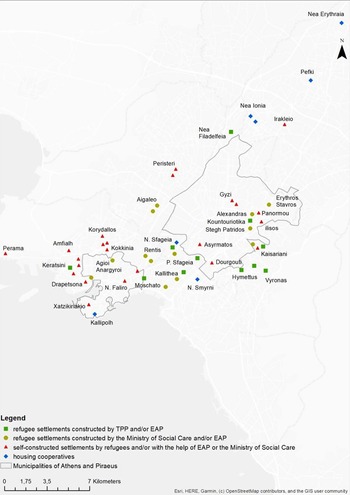
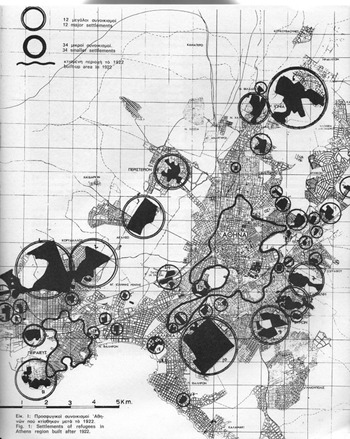
Despite the action of the public agencies, some refugees who remained homeless settled on vacant land and formed makeshift accommodations.Footnote 17 Particularly in the city of Athens, the refugees self-constructed their housing near the existing settlements that were built by the state (e.g. in Vyronas, Kaisariani, Nea Filadelfeia, Palaia Sfageia) – or wherever they found vacant landFootnote 18 (e.g. in Asyrmatos, Dourgouti, Gyzi, Ilisos) (see Figure 1). In these previously unoccupied areas, refugees built shacks. Hence, many settlements were created from scratch.Footnote 19 In total, for the refugee housing rehabilitation project during the inter-war period, 12 principal and 34 secondary settlements were built outside the existing urban tissues of Athens and Piraeus.Footnote 20 Eventually, this led to the development of several suburban areas uninhabited before 1922 (see Figure 2). For instance, Dourgouti was created in the early 1920s with self-construction in shacks built by the refugees in an area outside the official city plan. This area was allocated to the refugees by the stateFootnote 21 (the anecdotal version being that a state officer from Piraeus port – one of the main gateways to Athens – showed them this area and told them it was vacant and that they could settle there). Also, in Tavros, refugees settled either in shacks constructed by the refugees themselves or in prefabricated wooden shacks constructed by the state.
The refugee settlements in the metropolitan area of Athens (1922–40).
Data source: E. Papadopoulou and Y. Sarigiannis, Summary Report about Refugee Areas in the Basin of Athens (Athens, 2006).

The settlements that were built from 1922 to the late 1930s in the region of Athens and Piraeus.
Source: Papaioannou and Vasilikioti, Housing, 15.

The activity of the central government through the Ministry of Welfare began in parallel with the actions of the two institutions. Further work of the Ministry was the concession of a land plot with or without a loan for the construction of a residence, as well as the establishment of construction co-operatives (e.g. in Nea Smyrni, Nea Kalipolh) (see Figure 1).Footnote 22 However, the beneficiary refugee was responsible for the construction of the residence.Footnote 23 During the 1930s, the Ministry constructed housing estates in slum areas, after the demolition of the shacks, or near them.Footnote 24 So, there were no specific criteria except the location of the slum areas, and these areas were already owned by the state.
More specifically, four of the estates were located in Athens, one in Piraeus and the rest in the wider Piraeus region. They were built in two periods, 1933–36 and 1936–39, and were given to beneficiaries exclusively for owner-occupation and not for rent.Footnote 25 The housing estates were influenced by the modern architecture of the time (Bauhaus School) and the views of Le Corbusier.Footnote 26 The beneficiaries of the apartments were the Asia Minor refugees who were the residents of the shacks. Examples include apartment blocks at Alexandras Avenue, Stegh Patridos, Erythros Stavros, Dourgouti (within Athens municipality area, see Figure 1) and elsewhere. For instance, in Dourgouti in the 1930s, the Ministry of Welfare built the first eight apartment buildings for the housing of the refugees after clearing part of the area covered by shacks. Dourgouti was characterized as the ‘largest centre with apartment buildings for refugees’.Footnote 27
The allocation of the apartments was implemented through a lottery, taking into consideration the number of the members of each family, and it was stipulated that the beneficiaries’ families could have no other real estate property of any sort.Footnote 28 These apartment blocks constituted social housing estates since they were constructed by the state for those who could not access housing on their own (i.e. refugees who lived in shacks). Beneficiaries were required to pay a low price to the Ministry – much lower than the market price – to attain ownership of the apartment.Footnote 29 The Ministry made it easier for them to pay the price by allowing them to repay 70 per cent of the price that was spent on the purchase of the land and for the construction of the residence within 15 years. But the issue of paying back the cost of the apartments acquired by the refugees from the Ministry was linked to the issue of the exchangeable propertiesFootnote 30 (i.e. the properties they lost in Asia Minor). The majority of the refugees refused to pay the price of their apartment because the apartment was the only compensation for the property they had lost. Also, although the beneficiaries were the homeowners, they were prohibited from selling their apartments for seven years after the repayment of the entire price.Footnote 31
The impact of the state's action for the housing of refugees on the overall issue of social housing is undoubted. The social housing sector was developed for the first time in Greece due to the need to house such a large number of refugees, and this laid the foundation for the creation of a wider social housing policy. Nevertheless, while the task of housing thousands of refugees was in progress, this was not the case for the poor social strata of the native population. Social housing was strictly understood as refugee housing.Footnote 32
During the same period, other European countries conducted mass housing programmes implemented by their governments.Footnote 33 After the end of World War I, housing programmes sponsored by the state replaced the charity and the initiative of the industrialists because ‘the destruction caused by the First World War led governments (in particular local authorities) to adopt a more interventionist attitude’.Footnote 34
Post-war period (1950–74)
Later, in the 1940s, the construction of the estates was stopped due to World War II (1939–45) and the Greek Civil War (1946–49).Footnote 35 Housing needs after these wars were also intense for three reasons. Firstly, the housing stock decreased due to the war catastrophes. Secondly, in the 1950s, there were refugees for whom the problem of housing remained unresolved. Thirdly, in the post-war period, the population of the Athens metropolitan area nearly tripled. This was due to the influx of new residents, internal immigrants from rural areas to Athens for various reasons: persecution during the Civil War due to political convictions, job searching due to the high unemployment rate in rural areas, etc. Thus, internal immigrants settled in Dourgouti, Tavros or other refugee settlements in Athens, and they either occupied abandoned shacks or constructed temporary dwellings. In particular, the Dourgouti slum area, due to its labyrinth-like structure, was also used as a settlement for political dissidents. Also, in the Tavros area, there were municipal slaughterhouses and several craft businesses where the newly arrived people (internal migrants from various parts of Greece) could be employed. Therefore, the issue of housing the internal immigrants was added to the already pending issue of housing the refugees.
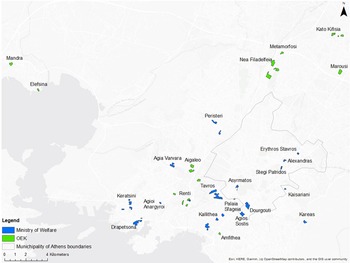
During the post-war period, most social housing projects were undertaken by the Ministry of Welfare through slum clearance programmes and the construction of social housing estates. These estates were built to accommodate the Asia Minor refugees, as well as the natives who lived in shacks.Footnote 36 Examples include apartment block construction after the demolition of the shacks in different areas in the municipality of Athens (Dourgouti, Asyrmatos or in the wider areas of Kaisariani, Tavros, Drapetsona and Aigaleo) (see Figure 3). Also, in Peristeri and Agios Sostis (a neighbourhood in the south of the Athens municipality), housing estates were constructed in areas that the Ministry of Welfare had acquired by expropriation (see Figure 3).
The area that today occupies the housing estates that were constructed by the Ministry of Welfare and OEK during the period 1930–74.
Data source: Papaioannou and Vasilikioti, Housing; Papadopoulou and Sarigiannis, Summary Report; Google Earth and local visits by the author.

During the dictatorship (1967–74), high-rise buildings were a main construction characteristic. Examples are the 12-storey apartment building in Dourgouti, the 11-storey buildings in Tavros as well as the 10-storey apartment buildings in Peristeri (a municipality in the north-western part of the Athens agglomeration) and Drapetsona (a suburb in the south-western part of the Piraeus agglomeration) (see Figure 3). These stand in contrast with the lower (predominantly 4-storey) estates built in the 1950s and early 1960s.
The beneficiaries of the apartments in social housing estates were low-income households who were settled in inadequate houses and were not homeowners or landowners in some other area. The allocation of the apartments was implemented, as in the previous period, by lottery. The beneficiaries could not choose according to selected features (such as which floor the apartment was on, the dwelling size, etc.). Thus, the apartments they received were not guaranteed to satisfy their needs.Footnote 37
Also, the beneficiaries bought the apartment from the Ministry for a subsidized price. Therefore, due to the issue of the exchangeable properties (as I have already mentioned), the majority of the Asian Minor refugees and their descendants refused to pay the debt for the apartment they were assigned because, according to them, the Greek state had already been paid from the exchangeable properties.Footnote 38 According to the interviewees, some of the refugees who were beneficiaries of the Ministry of Welfare were organized in settlers’ associations, and they claimed and were granted forgiveness of their debt to the state. Regardless of whether they made payment or not, the apartments, according to the interviewees, were given to the beneficiaries. However, this issue only concerned the refugees; the internal migrants were obliged to pay their debt for the apartments.
During the demolition of the shacks and the building of the new estates, beneficiaries were given a rent subsidy. In many cases, households were relocated from the neighbourhood in which they used to live to a different one.Footnote 39 These relocations, even though they resulted in better housing conditions, brought significant changes. These changes had to do with the aspects of everyday life that concerned residents.
In that period, along with the Ministry of Welfare, the Workers’ Housing Organization (OEK in Greek) became active. The OEK was established in 1954 as an independent agency by the Ministry of Employment and Social Security. Until 1975, its revenue came primarily from employee contributions.Footnote 40 This organization provided housing for private-sector employees who were not homeowners.Footnote 41 The OEK was the first organization whose housing policy was intended to be more comprehensive, as opposed to the state policy, which, until that point, gave priority to the housing rehabilitation of refugees, slum residents and other residents affected by various natural or anthropogenic disasters. However, the most vulnerable social groups – such as the homeless and the unemployed – were excluded from the OEK social housing policy.Footnote 42
The beneficiaries were either given loans (for self-housing or buying a new house) or apartments in newly constructed housing estates. The OEK provided apartments to beneficiaries exclusively for owner-occupation and not for rent, just like the other public agencies that had provided social housing since 1922. The beneficiaries had to pay a low price to the OEK to purchase the apartment. The apartments were allocated by lottery amongst potential beneficiaries. In comparison with the Ministry's similar process, the OEK lottery was based on social and localization criteria. For example, two of the main criteria were the distance from the neighbourhoods (without housing estates) and the proximity to potential employment areas.Footnote 43
The buildings constructed by the OEK were two-storey detached houses and three-, four-, eight- and ten-storey apartment buildings. In the design of the OEK housing estates, there was a provision for the formation of open spaces and green areas. The apartment buildings were arranged in rows with an appropriate distance between the buildings (to ensure adequate lighting and ventilation for the apartments).Footnote 44
The location of the OEK estates in the metropolitan area of Athens and Piraeus during the post-war period was positioned at a distance from the existing urban tissue.Footnote 45 After all, the isolation of these areas, and their location near industries, crafts or abandoned factories (e.g. estates in Renti, Tavros, Nea Filadelfeia, etc.), were also the main criteria of the settlement location of refugees (see Figure 3). More specifically, the first OEK project was the construction of the Nea Filadelfeia estate (the first amongst five in the area) in 1955, which consisted of 77 apartment buildings, while the last that was constructed in the post-war period was an estate in Elefsina (West Attica) (see Figure 3) in 1971, consisting of 23 apartment buildings.Footnote 46
In conclusion, the Ministry of Welfare predominantly dealt with emergencies that caused urgent housing needs, while the OEK programmes were geared towards specific population groups with no direct needs, but without taking into account the homeless.Footnote 47 However, the Ministry of Welfare and the OEK were the two agencies that provided social housing to specific groups, with the Ministry of Welfare being the main public agency that provided housing for those in the vulnerable social strataFootnote 48 and, more specifically, for those in urgent need. Also, the number of dwellings that were constructed by the Ministry of Welfare and the OEK was small in comparison with other European countries. Nevertheless, for the Greek case, the work of the Ministry of Welfare and the OEK was important. The two agencies constructed 31 housing estates during the post-war period with approximately 11,930 dwellings,Footnote 49 while, for example, in the suburbs of Stockholm (Sweden is a country with a strong tradition in social housing construction) at 10–20 km distance from the city centre, 34 housing estates with 83,796 dwellings were built from 1951 to 1970.Footnote 50
Those differences between Athens and the other cities of northern and western European countries have to do with the fact that, after World War II, great emphasis was put on the construction of social housing estates as an appropriate solution to the problem of housing inadequacy due to war catastrophes and the reduction of construction activity.Footnote 51 However, new needs for more housing arose due to internal migration and the increase in the number of births (baby boom) after World War II.Footnote 52 ‘Thus, in most countries, social housing – housing provided or directly supported by government – became the dominant form of new housing production.’Footnote 53 This was the dominant choice for the larger part of Europe.Footnote 54 In contrast, the role of the state in housing in Greece and the other southern European countries was indirect and had to do with the promotion of policies in order to facilitate access to homeownership. In this way, the family-centred welfare system and the clientelistic political system partly replaced the welfare state.Footnote 55
From 1975 to 2012
In 1975, there was a significant change. The social housing provision to those who were deprived of housing or those who were housed inadequately became the obligation of the state by law (Article 21, Paragraph 4 of the Constitution).Footnote 56
In Athens, the influx of immigrants from 1975 to 1989 was not as heavy as in the previous periods. This number increased significantly after 1990 when the country experienced a large new wave of immigrants (external immigrants and expatriate Greeks) who came after the collapse of the socialist regimes in 1989–90.Footnote 57 For the external migrants, there was no housing policy. Due to the lack of a social housing policy, the immigrants − who did not have access to family support networks − were obliged to seek housing in the private rental sector or settle in the informal accommodations in inadequate housing conditions.Footnote 58
With regard to social housing policy worldwide, after 1975, the tendency was to replace the social housing estate system with a new model. The new one provided financial assistance for the construction or the individual purchase of a house produced by private companies. This change, as well as the decrease of the Ministry of Welfare programmes, also affected how policy was pursued in Greece.Footnote 59
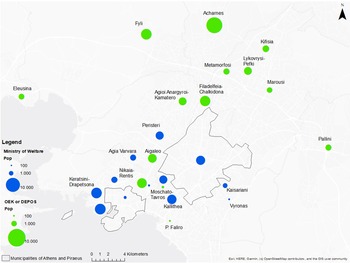
The OEK was the main public agency that provided social housing from 1975 to 2011 (see Figure 4). Except for the construction of housing estates, the OEK lent money to individuals for them to acquire housing and subsidized rent to beneficiaries who met specific criteria.Footnote 60 The OEK's activity in Athens, compared with that in the medium-sized Greek cities, was less important. Only 10 per cent of the agency's total activity from 1955 to 2012 was located in the metropolitan area of Athens.Footnote 61 The OEK housing estates were primarily located in the north-western part of the suburban ring of Athens, in the north suburbs and East Attica.
The area occupied today by the housing estates constructed by the OEK and the DEPOS between 1975 and 2004.
Data source: Stavridis et al., Transformations; Gouvousi, Organized Housing; Google Earth and local visits by the author.

The Olympiako Chorio (Olympic Village) was the last housing estate constructed by the OEK in Athens (see Figure 4). Also, it was not a characteristic example of a social housing estate due to the variation of the beneficiaries for whom it was intended. This estate was constructed to temporarily house athletes during the Olympic and Paralympic Games held in Athens in 2004. After that, the dwellings were used for the housing rehabilitation of the OEK's beneficiaries.Footnote 62
The involvement of the last institution, the Public Enterprise of Town Planning and Housing (DEPOS in Greek), in social housing provision began during the same period. The DEPOS was founded in 1976 by the Ministry for the Environment, Physical Planning and Public Works and was abolished in 2010. Its purpose was to provide affordable housing for the low- and middle-income social strata. The main activity of the DEPOS (supervised by the Ministry for the Environment, Physical Planning and Public Works) was the reconstruction of small-scale areas with old housing stock. These projects had to do with the renovation of the old housing estates that were constructed by the Ministry of Welfare during the inter-war period at Nea Filadelfeia, Kaisariani and Tavros (see Figure 4).Footnote 63 For instance, Tavros was the largest among them. The DEPOS project concerned the reconstruction of eight apartment blocks that were built in the mid-1930s by the Ministry of Welfare. The project began for two basic reasons: firstly, this neighbourhood was the most degraded in the area and had severe social problems (i.e. cases of domestic violence); and secondly, the income of the homeowners was low and they were financially unable to maintain and upgrade their apartments and the whole estate collectively. The residents consented to the project implementation, which was required for the beginning of the project.Footnote 64 The intervention of the state in all three cases was necessary because these areas with the old post-war housing estates had deteriorated due to ageing, the abandonment of the old housing stock and the inability of the residents to maintain and upgrade their apartments and, collectively, the entire estate.Footnote 65
In contrast to the other agencies, DEPOS’ action started at the request of the residents. The residents were involved in the process from the beginning of the redevelopment projects. These projects were implemented in co-operation with the municipalities, utilizing democratic and participatory planning processes. In addition, until the project was completed, beneficiaries were given a rent subsidy.Footnote 66
DEPOS’ action was the exception to the social housing policy that followed in the late 1970s, where the goal was no longer the provision of housing through the construction of apartment buildings. The intense reactions from private interests resulted in the reduction of DEPOS’ action from significant to insignificant activity until 2010 when it was abolished.Footnote 67 Also, since 2012, when the function of the OEK was terminated, no public agencies for accommodating housing of low-income households have existed. The housing needs of vulnerable groups are therefore resolved through emergency/temporary solutions rather than by established housing policies.Footnote 68
In parallel with the decline of this exceptional and marginal social housing policy in Greece, the welfare state declined globally from the mid-1970s, indirectly affecting the established social housing policy.Footnote 69 The sectors in which the welfare state was operating (health, education, pensions, etc.) suffered curtailments. The housing sector has suffered the most from the welfare state decline. After all, in the previous period, housing conditions had already improved, and there was also a significant stock of social housing estates.Footnote 70 Since the mid-1970s, therefore, the role of the welfare state has changed, and, hence, the respective social housing policies of the state were replaced by a more privatized form through the sale of these dwellings (mostly in the UK and Ireland, and less dramatically in France, the Netherlands and Sweden).Footnote 71 Thus, the model of social housing provision changed from the mass construction of estates to subsidies (rent assistance and allowances) for the acquisition of housing through the private market.Footnote 72 The creation of incentives for the promotion of private rental in combination with housing inadequacy for the very poor has increased the demand for social housing in less popular areas from the more vulnerable population groups (homeless and immigrants).Footnote 73
General conclusions
In conclusion, as I have previously argued, the Greek housing model through the Athenian example is a unique case. Those characteristics that make the Greek case distinctive are the specific model of social housing and the context in which the model was developed. More specifically, the dominant housing tenure was homeownership and not rental, as was the case in the rest of the European countries. Greece is the only European countryFootnote 74 where there was no development of the social rental sector.Footnote 75 Also, the context in which this model was developed was the urgent need for the housing rehabilitation of specific population groups. Those characteristics led to the development and decline of social housing, and also to the various challenges that social housing faces today.
The social housing development in Athens began in 1922 in the context of an urgent need to house large numbers of refugees. However, not before the end of the 1920s, and only during the last decade of the inter-war period, was there construction of social housing estates by the Ministry of Welfare. After World War II and throughout the post-war period, the development of social housing continued because the issue of housing remained unresolved for many refugees and because the influx of internal immigrants in Athens induced new housing needs. Also, in addition to the state, the OEK, another public organization, assumed the provision of social housing for wider population groups, including not only refugees or internal immigrants, but also those not in immediate need such as the homeless.
During the study period in Athens, the construction of housing estates as the main model of social housing policy provision was significant. More specifically, the three agencies − the Ministry of Welfare, OEK and DEPOS − from the inter-war period until 2004 constructed 19,299 dwellings in the metropolitan area of Athens for the housing rehabilitation of three groups: firstly, refugees and internal migrants who lived in shacks; secondly, private-sector employees; and thirdly, residents who lived in old social housing estates. Today, the share of people living in housing estates in the metropolitan area of Athens is very low, approximately 1.6 per cent, according to the 2011 census data.Footnote 76 This proportion is low compared to 7.4 per cent of the total population of Brussels who, according to 2011 census data, live in social housing estates built during the period 1946–90, 15.2 per cent of the population of Stockholm who, according to 2014 data, live in the 49 social housing estates and 19 per cent of the total population of Helsinki who live in the 48 estates, also according to 2014 data.Footnote 77
These estates are mostly concentrated in small areas with reduced populations. The number of residents in the Ministry of Welfare estates and in the OEK or DEPOS estates per municipality are represented with proportional symbols (see Figure 5). Only four of these estates have over 3,000 residents, which are in the peri-urban fringe (Olympiako Chorio and Acharnes) and the western suburbs of the working class (Nea Filadelfeia and Tavros), as census data indicates.Footnote 78
The number of residents in the housing estates of the metropolitan area of Athens per municipality and public agency (census date 2011).
Data source: ELSTAT–EKKE, Panorama.

Also, according to the census data, the socio-demographic features of the population of the housing estates in the metropolitan area of Athens broadly followed the trends in the surrounding areas (the whole metropolitan area) from 1991 to 2011 (see Figure 6). Some dissimilarities persisted between census tracts with housing estates and those around them, without housing estates. For instance, the share of manual workers and housing deprivation remained higher in housing estates, but the distance from the surrounding areas decreased. On the other hand, the share of university graduates remained lower while the share of migrants and the unemployment rate remained higher on census tracks with estates. However, the difference from the surrounding areas increased for the three indicators from 2001 to 2011.Footnote 79
A comparative evolution of the socio-demographic characteristics of census tracts with housing estates and the Athens metropolitan area (census data 1991–2011).
Source: Kandylis, Maloutas and Myofa, ‘Exceptional social housing’.

The experience, so far, has led to the need for a new housing policy for the wider population that will be active in a broader context and not only in cases of emergency. After all, the solutions given during the previous periods in the context of weak welfare state development did not meet all the housing needs. Since the mid-1970s, emergency incidents, such as the influx of external migrants, recent refugee inflows and anthropogenic and/or natural disasters have induced the need for immediate housing for small or large numbers of people. These incidents, together with the increase in the number of homeless, those who live in inadequate housing conditions as well as those at risk of losing their homes, make the need for a structured and long-term social housing policy more urgent than ever.
Except for the impact of the state's action regarding the overall issue of social housing, the role of the city of Athens as the locus in the planning and distribution of social housing was important. The new settlements were built in vacant lands at a distance from the existing city, resulting in the population growth of the suburban areas. The development of these vacant lands in the peri-urban areas on the outskirts of the existing cities of Athens and Piraeus resulted in filling the gap between the two large municipalities and the formation of a single urban complex.Footnote 80 Some of these settlements were demolished and social housing estates were constructed in their place by the Ministry of Welfare, while others were totally demolished, and no estates were built in their place (e.g. Ilisos area, etc.).Footnote 81
During the post-war period, estates were constructed in areas that the Ministry of Welfare acquired by expropriation, primarily near other areas with estates or in slum areas after the final demolition of the shacks. The localization of the Ministry estates was mostly near central areas of Athens as well as by main roads, in contrast with the cities of other European countries where the housing estates were located in the suburbs. Also, as in the inter-war period, when the settlements were built at a distance from the residential areas, the same happened in the post-war period. In contrast with the Ministry of Welfare, the construction of the OEK estates took place in the periphery of the city.Footnote 82 From 1975 to 2012, the OEK constructed estates in the north-western part of the metropolitan area of Athens (Acharnes and Fyli) – which was and continues to be predominantly inhabited by the working class – and in the northern suburbs (Marousi and Pefki) as well as in East Attica in Pallini (see Figure 4) – which are primarily inhabited by the upper and upper middle classes.Footnote 83 Thus, there was no specific policy for the localization of the OEK estates related to the social characteristics of the residents of the specific area. Also, there was no need for the selection of an area for DEPOS’ projects since these projects had to do with the reconstruction of old housing estates.
The existing housing estates face some significant challenges. Specifically, the fact that the apartments were given for homeownership initially led to quite a homogeneous profile of the housing estates. Nevertheless, homogeneity started to change in the early 1990s with the inflow of low-income households from neighbouring countries attracted by housing estates because of their low rents. In addition, the fact that the apartments in these blocks were given to beneficiaries exclusively for owner-occupation and not for rent meant that this model of social housing, provided by the state, gradually lost its social character. The neighbourhoods in which these housing estates were located (in terms of their social characteristics and the housing market) would cease to be different from their wider areas once they followed the dominant housing tenure system, homeownership, as it eventually happened.
Furthermore, as no social housing for rent was produced, the state immediately abandoned any responsibility for this housing stock. Instead, the owners were individually responsible for the maintenance and upgrading of their apartments and collectively for the entire estate, regardless of their financial situation. However, the financial inability of some of the owners led to the gradual degradation of the social housing estates. The abandonment of the apartments (especially in the estates that were constructed during the 1930s by the Ministry of Welfare) intensified this trend towards degradation. As a result, there is now a constant need for the redevelopment of the housing estates, although the public agencies that produced them have been abolished, and long before their abolishment, they were not responsible for their fate.
Even though these areas with housing estates have lost their social character and have gradually been integrated into their surrounding areas, they could still be reused through public intervention. The redevelopment of the apartment buildings could lead to the resettlement of the residents (primarily those who have abandoned their apartments due to their degradation) in these areas. After all, both redevelopment and resettlement are a constant demand of homeowners. Therefore, the reorganization of a public agency that could undertake the renovation of housing estates is of great importance. Also, vacant apartments or those in limited use may be used as a form of social housing, with the consent of their owners, especially for those who are not able to find adequate housing by their own means. Moreover, these apartments in housing estates could create a pilot project for communities of social cohabitation, even if the small number of available apartments would mean that it would be on a limited scale.