Introduction
The San Francisco Valley, Brazil, is known for the export of many irrigation-grown fruits such as mango (Mangifera indica L.), grape (Vitis vinifera L.), banana (Musa spp.) and guava (Psidium guajava L.). Guava exhibits high, year-round fruit production, offering an economic advantage to farmers in comparison with cultivation of fruit crops with season-specific fruit production. However, guava production has declined in recent years due to the infectious parasite Meloidogyne enterolobii (1988) Rammah & Hirschmann, and it is estimated that approximately 50% of guava production in the San Francisco Valley is lost to this phytonematode, causing significant economic loss to producers (Lot & Ferraz, Reference Lot and Ferraz2007). Meloidogyne enterolobii is classified as a sedentary endoparasite and most of its life cycle takes place within plant roots. Infection by this nematode, therefore, inhibits plants from absorbing the water and nutrients necessary for normal development and growth. The main symptoms of M. enterolobii infection include root necrosis and gall formation, shoot yellowing, leaf-edge scorching, defoliation and death in more extreme cases (Carneiro et al., Reference Carneiro, Moreira, Almeida and Gomes2001) Arbuscular mycorrhizal fungi (AMF) are common inhabitants of the plant rhizosphere. In agriculture, these fungi are known to form symbiotic mutualistic associations with vegetables, favouring plant growth through improved absorption of nutrients by the fungi, which, in turn, receive carbohydrates and lipids from the plant. Studies have demonstrated that AMF can have positive effects on guava seedling development and growth (Schiavo & Martins, Reference Schiavo and Martins2002), even in the presence of M. enterolobii in seedlings 43 days after inoculation with this nematode (Campos et al., Reference Campos, Silva, Yano-Melo, Melo, Pedrosa and Maia2013). However, it is not known whether AMF are able to mitigate the negative effects of the parasite over a longer period of time, spanning several nematode life cycles (up to 60 days). We monitored M. enterolobii infection over time in guava seedlings inoculated with different species of AMF to test the hypothesis that AMF confer benefits to guava plants over long periods of time, but that such benefits depend on the types of AMF used.
Materials and methods
Soil was collected from the Caatinga area in the San Francisco Valley and sterilized twice in an autoclave at 121°C for 30 min each time. It was then oven-dried at 100°C. The chemical characterization of the soil was: phosphorus: 4.92 mg dm−3; potassium: 0.25 cmolc dm−3; calcium: 1.1 cmolc dm−3; aluminium: 0.0 cmolc dm−3; sodium: 0.05 cmolc dm−3; magnesium: 1.24 cmolc dm−3, pH: 5.60; organic matter: 8.9 g kg−1; and electrical conductivity: 0.22 dS m−1. The AMF isolates used were: Gigaspora albida (1982) N.C. Schenck & G.S. Sm. (Federal University of Pernambuco: UFPE 01), Claroideoglomus etunicatum (2010) (W.N. Becker & Gerd.) C. Walker & A. Schüßler (UFPE 06) and Acaulospora longula (1984) Spain & N.C. Schenk (UFPE 21). All AMF species were cultured on Panicum miliaceum L. as a host.
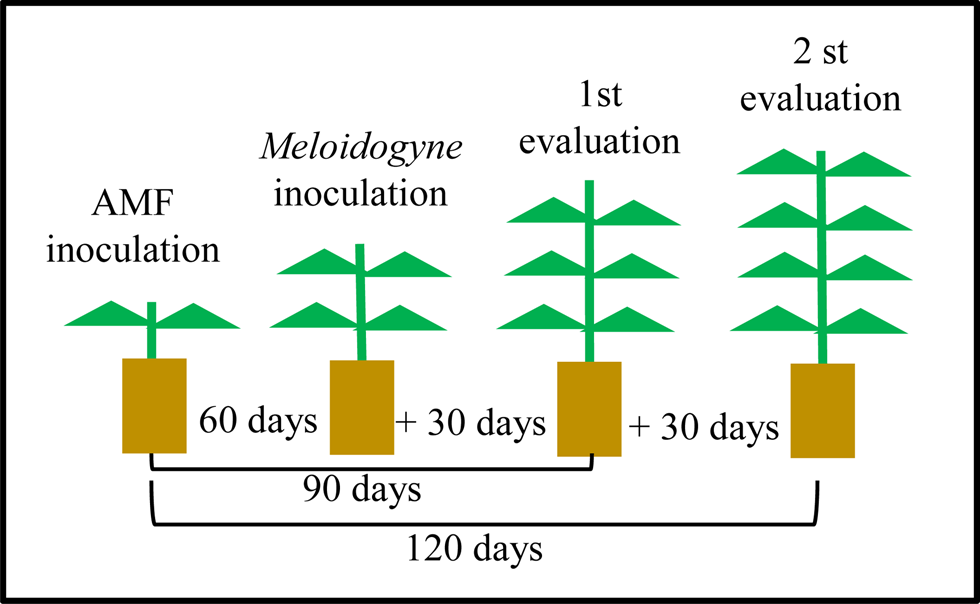
Seeds of the Paluma guava variety were removed from ripe fruits, washed, dried for 48 h, disinfected with sodium hypochlorite (0.05%) for 2 min and sown in a 1:1 mixture of sterile soil and vermiculite. The seeds were left to germinate and grow to the two definitive leaves stage, at which point they were inoculated with the AMF. Each seedling was transferred to a black polyethylene bag holding 1 kg of soil mixture, and inoculum soil containing 200 spores, hyphae and colonized roots of one of each of the three AMF species was applied to the root region of each plant. For each AMF species, a total of eight seedlings was inoculated. All seedlings were grown for a total of 120 days under ambient conditions of light, temperature (minimum 18°C and maximum 30°C) and relative humidity (minimum 34.14% and maximum 84.23%). Meloidogyne enterolobii was cultured for 150 days using guava seedlings as a host, after which the nematodes for use in the experiment were extracted following the method of Hussey & Barker (Reference Hussey and Barker1973). The experimental guava seedlings were inoculated with M. enterolobii 60 days after inoculation with the AMF. An aqueous suspension containing a mixture of 2000 M. enterolobii eggs and juveniles was applied to each guava seedling. To evaluate the nematode and AMF effects, the guava seedlings were sampled twice, at 30 and 60 days after inoculation with M. enterolobii, (fig. 1). Four replicates of each treatment were harvested to evaluate leaf number, stem diameter, shoot and root fresh weight and shoot dry weight. The harvested root material was randomly divided into three portions that were used to determine (1) extent of mycorrhizal colonization; (2) Meloidogyne number in the roots (MIR) counting all stages, without distinction; and (3) number of Meloidogyne eggs.
Timeline of the experiment indicating when the guava seedlings were inoculated with arbuscular mycorrhizal fungi (AMF) and Meloidogyne enterolobii, and when plants were harvested for evaluation.

To determine shoot dry weight, the harvested shoots were oven-dried at 45°C to a constant weight. For evaluation of mycorrhizal colonization, the roots in Portion 1 of the root material were washed, clarified with 10% Potassium hydroxide and stained with 0.05% trypan blue in lactoglycerol (modified procedure: Phillips & Hayman, Reference Phillips and Hayman1970). The percentage mycorrhizal colonization was estimated according to Giovannetti & Mosse (Reference Giovannetti and Mosse1980). Roots from Portion 2 of the root material were washed, clarified and stained according to Byrd & Barker (Reference Byrd and Barker1983), and the MIR was determined using a stereomicroscope. Portion 3 of the root material was used to determine the number of nematode eggs that were extracted from 1-cm root fragments using 1% sodium hypochlorite for 4 min (Hussey & Barker, Reference Hussey and Barker1973) and counted using a microscope.
A randomized factorial experimental design was used, with four AMF conditions (no inoculation control and inoculation with A. longula or C. etunicatum or G. albida) × two nematode conditions (no inoculation control and inoculation with M. enterolobii) × two evaluation times (30 and 60 days post-nematode inoculation) × four replicates, resulting in a total of 64 experimental units.
The data were subjected to analysis of variance and Tukey's post-hoc tests with an alpha of 0.05. Percentage and number values were converted to arcsin x/100 and in log x+1, respectively. Statistica 6.0 was used for all analyses (Statsoft, Reference Sharma and Sharma1997).
Results and discussion
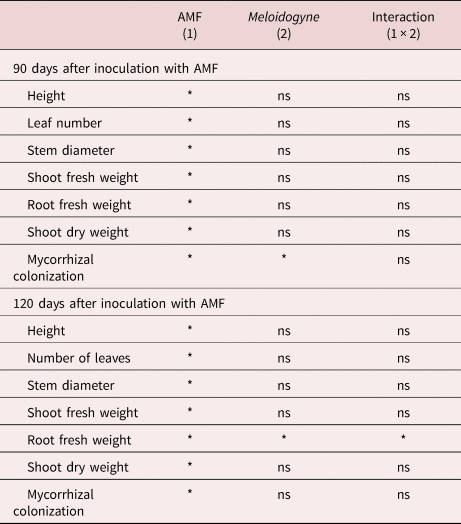
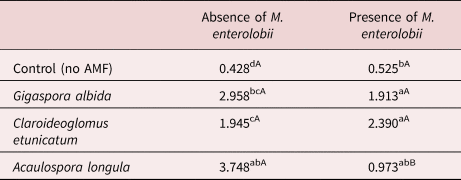
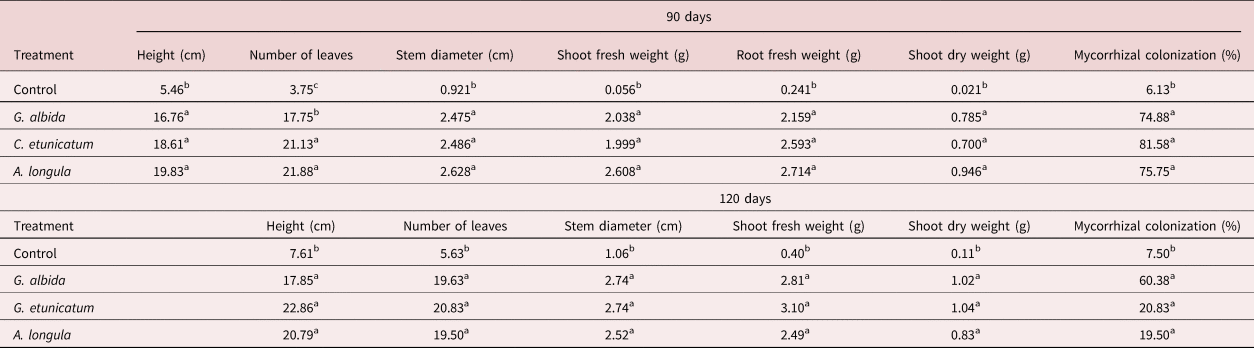
There was a significant interaction between treatments (AMF and M. enterolobii) for root fresh weight at 120 days (tables 1 and 2). However, there was no significant interaction between treatments for any of the other seedling growth parameters: height, leaf number, stem diameter, shoot fresh weight and shoot dry weight at 90 and 120 days, and root fresh weight at 90 days, showing differences related only to treatment with AMF, at both 90 and 120 days post-AMF inoculation (tables 1 and 3). Mycorrhizal colonization 30 days after nematode inoculation differed significantly between the nematode and AMF treatments, but without interaction (tables 1 and 3).
Significance of the variables evaluated in relation to the factors: (1) inoculation with arbuscular mycorrhizal fungi (AMF); (2) inoculation with Meloidogyne enterolobii; and (1 × 2) interaction between these two factors.

Ns, not statistically significant; *significant (Tukey's post-hoc test, alpha of 0.05).
Fresh root weight (g) of guava seedlings inoculated with three species of arbuscular mycorrhizal fungi (AMF) in the presence or absence of Meloidogyne enterolobii, 120 days after inoculation with AMF.
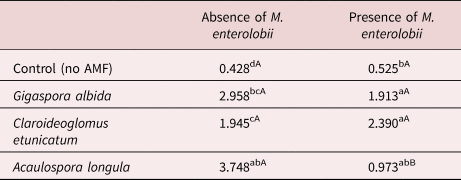
Averages followed by the same letter (uppercase across rows and lowercase down columns) are not statistically significant (Tukey's post-hoc test, alpha of 0.05).
Guava seedling growth parameters and mycorrhizal colonization at 90 and 120 days after inoculation with arbuscular mycorrhizal fungi (AMF), regardless of inoculation with Meloidogyne enterolobii.

Averages followed by the same letter (down the columns) are not statistically significant (Tukey's post-hoc test, alpha of 0.05). The AMF were: Gigaspora albida, Claroideoglomus etunicatum and Acaulospora longula.
Without Meloidogyne infection, the root fresh weight at 120 days post-AMF inoculation was significantly higher in A. longula-treated seedlings than in seedlings treated with C. etunicatum or the no-AMF control. In comparison, nematode-infected plants inoculated with C. etunicatum or with G. albida had higher root fresh weights (table 2) than A. longula-treated seedlings or the no-AMF control. Root fresh weight was significantly higher in seedlings inoculated with A. longula without nematode infection (table 2), suggesting that the presence of nematodes had a negative effect on the root system of guava seedlings inoculated with A. longula.
After 90 days post-AMF inoculation (30 days post-nematode inoculation), the height, leaf number, stem diameter, shoot and root fresh weights and shoot dry weight were higher in plants inoculated with the AMF (table 3). At 120 days post-AMF inoculation (60 days post-Meloidogyne inoculation), the height, leaf number, stem diameter and shoot fresh and dry weights remained higher in plants inoculated with AMF (table 3), regardless of Meloidogyne infection. Generally, it has been shown that plants infected with Meloidogyne undergo more growth when their roots are associated with AMF (Sharma & Sharma, Reference Sharma and Sharma2017a; Campos, Reference Campos2020). The trends in our study corroborate those found by Campos et al. (Reference Campos, Silva, Yano-Melo, Melo, Pedrosa and Maia2013) who investigated the effects of the same AMF species on guava plants. However, the plants used by Campos et al. (Reference Campos, Silva, Yano-Melo, Melo, Pedrosa and Maia2013) were rooted cuttings and only the A. longula treatment yielded significant results, whereas, in the present study, the guava plants were grown from seed, and all the AMF species tested were found to promote growth (table 3).
Mycorrhizal colonization was higher in roots inoculated with AMF (table 3). However, seedlings without nematodes showed a significantly higher percentage of mycorrhizal colonization (64%) than seedlings infected with nematodes (56%). Ferreira et al. (Reference Ferreira, Santana, Macedo, Silva, Carneiro and Rocha2018) observed that high mycorrhizal colonization is associated with low nematode abundance. A reduction in mycorrhizal colonization in the presence of Meloidogyne is well documented in the literature (Borowicz, Reference Borowicz2001; Campos, Reference Campos2020) and can be attributed to competition for space and nutrients in the root environment. Meloidogyne is known to create feeding sites within roots and, in the process, to transform root cells to form galls. Gall regions in roots infected with Meloidogyne are often not colonized by AMF (Dehne, Reference Dehne1982; Ingham, Reference Ingham1988).
In the present study, seedlings were inoculated with Meloidogyne 60 days after inoculation with AMF to allow for mycorrhizal colonization; nevertheless, our results suggest that, over time, Meloidogyne may have reduced the space available in the roots for AMF colonization (table 3). However, the reduction in extent of mycorrhizal colonization over time did not appear to prevent the AMF from stimulating guava seedling growth, as indicated by the high growth values of plants treated with AMF, despite the presence of nematodes (table 3). This finding, therefore, suggests that AMF could be used as biocontrol agents of M. enterolobii.
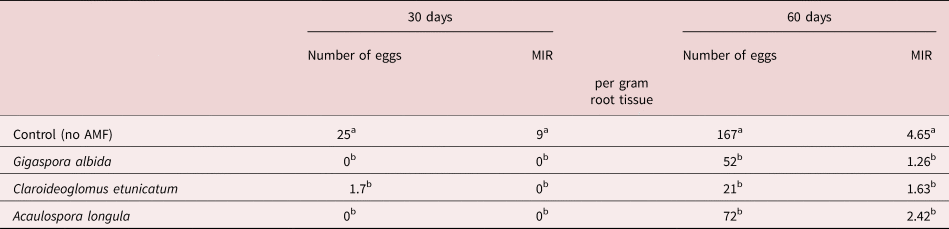
At both evaluation times, the number of Meloidogyne eggs and individuals in the roots (MIR, corresponding to juveniles: J2, J3, J4 and adults), per gram of root, was significantly lower for the AMF treatments than for the control (table 4). At 30 days after nematode inoculation, nematodes were not observed in the roots. Eggs were found only in roots of seedlings treated with C. etunicatum and only in low abundance (<2 eggs per gram of root). At 60 days after Meloidogyne inoculation, the amount of MIR and the egg count was higher. These results suggest that the AMF were able to colonize and protect the guava seedlings more effectively because they were given time to become established before the plants were infected with nematodes. This finding indicates that the cultivation of guava seedlings inoculated with the species of AMF tested in this study could be a solution to combat Meloidogyne infection.
Meloidogyne enterolobii characteristics observed in guava seedling roots in association with arbuscular mycorrhizal fungi (AMF) at 30 and 60 days after inoculation with this nematode.

Means followed by the same letter (down the columns) are not statistically significant (Tukey's post-hoc test, alpha of 0.05). Values are per 1 g of root tissue. MIR indicates Meloidogyne in the roots (J2, J3, J4 and adults).
The presence of AMF normally slows the reproduction of Meloidogyne, thus reducing the number of Meloidogyne eggs in the roots (Campos et al., Reference Campos, Silva, Yano-Melo, Melo and Maia2017). Vos et al. (2012) observed a lower rate of Meloidogyne infection in all stages of nematode development in tomato seedlings inoculated with AMF. Sharma & Sharma (Reference Sharma and Sharma2015) observed fewer female Meloidogyne in tomato roots (Lycopersicon esculentum cv. PT-3) inoculated with AMF and infected with Meloidogyne incognita. A higher production of defence enzymes in the mycorrhized plants was observed in these studies, reinforcing the importance of AMF as a nematode biocontrol agent. Further evidence is provided in a study by Khan et al. (Reference Khan, Javed, Javed, Sahi, Mukhtar, Khan and Ashraf2017) that followed the developmental stages (from J2 to adult females) of M. incognita in eggplant roots (Solanum melongena L.) for five weeks. A reduction in all M. incognita stages was observed in plants inoculated with AMF.
Some authors suggest that the quality and quantity of root exudates from mycorrhized plants make the roots less attractive to nematodes, thus reducing their capacity to penetrate the root tissues (Sharma & Sharma, Reference Sharma and Sharma2015). For example, root exudates have been shown to have negative effects on motility of the J2 stage (Vos et al., 2012). Reduced J2 motility may have occurred in the present study, possibly accounting for the lower number of nematodes in the roots of guava seedlings inoculated with AMF. It is likely that most of the nematodes did not manage to penetrate the roots and, of those that did, only a few developed into adult females, leading to low egg production. Consequently, the population of Meloidogyne may have remained small enough to be of little harm to the plants.
Other factors may be involved in the reduction of Meloidogyne in roots colonized by AMF. Suresh et al. (Reference Siddiqui and Mahmood1985) observed a reduction in the number of giant cells produced by M. incognita in tomato plants colonized by Glomus fasciculatum. Siddiqui & Mahmood (Reference Sharma and Sharma1998) observed a reduction in the length and width of the body, neck and median bulb of Meloidogyne javanica in tomato roots colonized by Glomus mosseae. Fewer giant cells in infected plants would mean fewer feeding sites for Meloidogyne, and a consequent reduction in nematode development, growth and population size.
Other effects associated with AMF include the production of nematicidal compounds, increases in root lignification, changes in cell wall composition and activation of plant defence mechanisms (Azcón-Aguilar & Barea, Reference Azcón-Aguilar and Barea1996) and defence enzymes such as peroxidase (Sharma & Sharma, Reference Sharma and Sharma2017b). Vos et al. (Reference Suresh, Bagyaraj and Reddy2013) observed a higher expression of genes associated with plant defences, such as those involved in protein synthesis and transduction, in tomato plants pre-colonized by G. mosseae and infected with M. incognita.
In this study, guava seedling growth was enhanced by inoculation with AMF, even when the seedlings were infected with M. enterolobii. In addition, the presence of the AMF decreased the amount of M. enterolobii within the roots of the guava plants. While this and other studies clearly show a reduction in the amount of Meloidogyne in plants colonized by AMF, the mechanisms involved have yet to be elucidated. Management of Meloidogyne in guava farming is challenging; therefore, the use of AMF in the cultivation of guava seedlings is recommended to render them more tolerant of nematode infection in the field for longer periods of time.
Acknowledgements
Our thanks to Dr José Mauro da Cunha e Castro from the Brazilian Agricultural Research Corporation (Embrapa Semiárido) for the identification and supply of individuals from Meloidogyne enterolobii; to the Foundation for Support to Science and Technology of the State of Pernambuco (FACEPE) for granting the master's scholarship to the first author; to the Institutional Program for Excellence in the quality of the stricto sensu support to the researcher APQ 2017 (University of Pernambuco) number 229; and to the Coordination for the Improvement of Higher Education Personnel (CAPES) for supporting the Postgraduate Program in Environmental Science and Technology (PPGCTAS), University of Pernambuco, Brazil. We would also like to thank Editage (www.editage.com) for the English language editing.
Financial support
Foundation for Support to Science and Technology of the State of Pernambuco (FACEPE) and Institutional Program for Excellence in the quality of the stricto sensu support to the researcher APQ 2017 (University of Pernambuco) number 229.
Conflicts of interest
None.
Ethical standards
None.