Introduction
In coming decades, energy generation from nuclear reactors will invariably increase, which means that the demand for uranium-based fuels will become a matter of priority energy security.[Reference Abney, Mayes, Saito and Dai1] Until now, the demand has been totally satisfied with terrestrial deposits (mines),[2] however, according to the current extraction dynamics, and without spending more than 30% of known reserves in the category of <USD 130/kg U, it is only possible to guarantee the supply until 2035, and total existing deposits would only last for 80–120 years.[3] On the other hand, if we start to develop research focused on the extraction from uranium non-conventional sources (sources or reserves where uranium is in low concentration or recoverable as a secondary by-product, for example, phosphate rocks, black shale deposits, carbonatite, non-ferrous ores, lignite, and seawater), in a relatively short time it would be possible to access the 4.5 billion tons estimated to be in equilibrium distributed along the oceans and seas of the planet,[Reference Abney, Mayes, Saito and Dai1] and ensure supply of fuels for thousands of years.
Among disadvantages for non-conventional sources are high extraction costs, associated with low concentrations, and chemical forms that require extra purification processes.[Reference Linfeng4] With 3.3 ppb uranium average, tons of water are required to obtain only 100 g of the metal (approximately 30 tons), besides, diversity of existing species complicates extraction and diminish selectivity.
Therefore, efforts should focus on cheapening extraction processes, developing more and better solid phase extraction materials and highlighting the environmental benefits represented by the extraction of uranium from phosphate rocks and bodies of water.[Reference Romero Guzmán, Solache Ríos, Iturbe García and Ordoñez Regil5]
Several functionalized extraction resins are in the market (cationic, anionic, hydrophobic, complexing, porous, polymeric, etc.), that goes from modified chitosan, through quinolines or styrene resins, to the latest polymers based on amidoxime,[Reference Dolatyari, Yaftian and Rostamnia6] to name a few, each one with useful characteristics under specific conditions and analytes. Although some have high efficiency and ease of synthesis, they still show flaws in selectivity; prolonged extraction times; use and generation of dangerous substances; technical complexity and, therefore, poor-viability.[Reference Liu, Cao, Hua, Wang, Liu, Pang and Wang7]
Some natural biopolymers can retain metals (chitosan, chitin, starch, cellulose, etc.), but in harsh chemical environments or weathering phenomena, they undergo structural modifications and losing adsorption capacity. But with the inclusion of functional groups by gamma radiation-induced grafting,[Reference Bucio, Cedillo, Burillo and Ogawa8] by crosslinking polymerizations,[Reference Rimdusit, Somsaeng, Kewsuwan, Jubsilp and Tiptipakorn9] or by chemical modifications, it is possible to develop more resistant materials without sacrificing adsorption capacities.
In this investigation, materials inspired by the chemical structure of fulvic acids were developed. Fulvic acids are macromolecular natural organic compounds, soluble in water, heterogeneous and with a high density of carboxylic groups.[Reference Wei, Liao, Liu, Zhang, Kang, Yang and Jin10, Reference Rashid and King11] Fulvic substances function as a vehicle to concentrate and transport metals in the environment, to be available for several metabolic processes and chemical equilibria.[Reference Shanbhag and Choppin12] Looking for a chemical compound analogous to the minimum functional unit present in natural fulvic acids, which present polycarboxylic aromatic rings,[Reference Zhu and Ryan13] we chose pyromellitic acid (PMA) (benzene 1,2,4,5-tetracarboxylic acid) due to its solubility, stability to gamma radiation[Reference Barkleit, Tsushima, Savchuk, Philipp, Heim, Acker, Taut and Fahmy14] and low cost.
PMA is not polymerizable per se, however, the 4 carboxylic groups attached to the ring give us the possibility to carry out esterification reactions in two of the four available groups (to incorporate polymerizable allylic groups into the molecule), leaving two free carboxylic groups to act as ligands or binding sites of uranyl ions  ${\rm (UO}_2^{{\rm 2 +}} )$ in solid phase extraction resins.[Reference Cousson, Stout, Nectoux, Pages and Gasperin15]
With modified Paine III method,[Reference Paine16] esterification were performed by alcoholysis under mild conditions adding stoichiometric equivalents of allyl alcohol. Allyl alcohol is a promising candidate as a second hydrophilic monomer since it has good chemical resistance and provide improved mechanical properties to the final polymer.[Reference Quintero, Ponce, Cremona, Triques, d'Almeida and Braga17] To increase selectivity and decrease costs, they were polymerized under ionic imprinting technique and using gamma radiation as the polymerization initiator of 2,5-bis((allyloxy)carbonyl)terephthalic acid and 4,6-bis((allyloxy)carbonyl)isophthalic acid. Polymerization yields and extraction capacity were determined, and the extraction parameters were optimized (temperature, extraction time, and pH).
Polymerization induced by gamma-radiation was made because chemical initiators are avoided, reaction takes place at room temperature and uniformly.[Reference Lopez, Plata, Burillo and Medina18] In addition, when synthesizing materials by ionic imprinting techniques, monomers are linked to  $\rm{UO}_2^{2 +}$ ions and polymerized; then template is removed from the polymer to obtain materials with specific cavities in terms of charge, size, and complexation geometry for
 $\rm{UO}_2^{2 +} $.[Reference Cormack and Elorza19]
Materials and methods
Reagents and instrumental
Uranyl nitrate hexahydrate (UO2(NO3)2 · 6H2O) solutions were prepared from a stock solution of 1000 ppm as required. PMA (CAS 89-05-4) (Sigma-Aldrich) was used at 96% reactive grade without any treatment. Allyl alcohol  $(CH_2 = \hbox{CHC}{H_2} \hbox{OH)}$ (CAS 107-18-6) was distilled under reduced pressure prior to use. The irradiations were performed using a Gammabeam 651PT 60Co equipment at a dose rate of 10.52 kGy/h. The rest of the reagents and solvents were used without further purification, directly from the container. In all the solutions, bidistilled water previously boiled was used to eliminate the excess of carbonates that could generate interferences with uranyl ions.
Fourier transform infrared (FTIR) spectrometry analysis was performed with a Perkin Elmer Spectrum 100 device coupled to Universal ATR sampling. Uranium measurement was made by spectrophotometric determination of the  $\rm{UO}_2^{2 +} $–dibenzoylmethane complex that presents absorbance proportional to the concentration at 400 nm.[Reference Yoe, Fitz and Black20] Potentiometric titrations were made with a combined electrode coupled to a HANNA HI4212pH meter.
Monomer synthesis (DAPY)
One of the characteristics that monomers must comply for gamma radiation-induced polymerizations is the presence of unsaturation in their structure. Due to the polycarboxylic structure of PMA, allylic groups were incorporated by esterification reactions under mild conditions using the modified Paine III method.[Reference Paine21]
The first step was the dehydration of PMA to pyromellitic dianhydride (PMDA), since the esterification reaction from anhydrides is presented as a viable alternative when esterification cannot be carried out on carboxylic acids and alcohols (alcoholysis) with good yields or specificity. Anhydrides are more reactive than carboxylic acids due to the tension of the ring in its structure, that is, it is not necessary to activate the functional group (process required in the acid-catalyzed alcoholysis) for an eventual nucleophilic attack that would carry out the oxygen of the alcohol on one of the carbonyl groups of the anhydride [Fig. 1(a)].[Reference Furniss, Hannaford, Smith and Tatchell22] Dehydration was made by heating dry PMA in glacial acetic acid (98.87%) to boiling and adding acetic anhydride to complete the water removal. The solid was cooled and washed with ethyl acetate/hexane mixtures. The PMDA was dried and reserved for esterification reactions.
(a) PMDA esterification mechanism with allyl alcohol and (b) PMDA esterification reaction with 2 equivalents of allyl alcohol. Rate of reaction for the opening of the anhydride ring does not allow obtaining ortho isomer (4,5-bis((allyloxy)carbonyl)phthalic acid); instead, only meta (4,6-bis((allyloxy)carbonyl)isophthalic acid) and para (2,5-bis((allyloxy)carbonyl)terephthalic acid) isomers were obtained in 40–60 to 60–40% yields.

Synthesis of diesters of terephthalic acid and isophthalic acid were obtained by controlling the amount of allyl alcohol. With the addition of only 2 equivalents of allylic alcohol (per equivalent of PMDA) almost exclusively the di-esterified product is obtained. First esterification is fast but the reaction between another alcohol molecule and the second anhydride cycle is about 20 times slower, so longer reaction times are required.[Reference Kreuz, Angelo and Barth23]
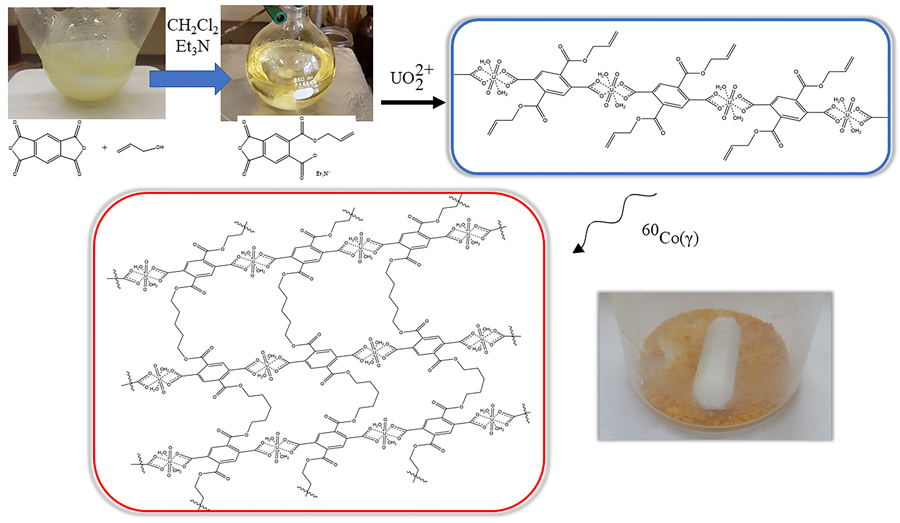
In a flask, 0.1 mol of PMDA (26.61 g) and 0.2 mol of allylic alcohol (13.6 mL) were dissolved in 112 mL of CH2Cl2. The mixture was stirred for 10 min and, dropwise, 27.8 mL of Et3N were added in a period of 4 min. The solution began to boil and was kept in agitation for 2 h more. Et3N functions as a catalyzer by forming ammonium salt (Et3N+) of the esterified anhydride. Then, the solution was filtered, to remove solid impurities, and washed with a mixture of H2O/HCl (80/20). The organic phase was neutralized with Na2CO3 and dried with 1 g of Na2SO4 to eliminate color. Sixty milliliters of concentrated HOAc are added and evaporated under reduced pressure to obtain the compound. White solid was solubilized in 4-methyl-2-pentanone and recrystallized for further polymerization.
Prepolymer complex  $\rm{(UO}_2^{2 +} [\rm{(DAPY)}_2\lpar {\rm{H}_2\rm{O}} \rpar _2]^{2-})$

The first step for ionic-imprinted polymer (IIP) synthesis is to form coordination compounds in which bonds are established between the uranyl ions and the carboxyl groups of the functional monomer (DAPY). Equimolar amounts of dry UO2(NO3)2 · 6H2O and DAPY were dissolved in 10 mL of deionized water. It was stirred for 2 h by adjusting the pH to 5 with diluted HNO3, to guarantee the ionization of the carboxylic groups of the monomer, but without reaching enough concentration of OH− to form hydroxylated uranyl complexes. After agitation, solutions were evaporated to 1/3 of their original volume and cooled to room temperature to promote product crystallization. Solids were filtered and dried for subsequent irradiation.
Radiation-induced polymerization
Approximately 0.300 g (±0.010) of pre-polymer complex were dissolved in 4 mL of acetone (reactive grade) and stirred for 30 min. Solutions were poured into glass ampoules (Pyrex) and degassed using liquid nitrogen (freezing/melting cycles) connected to a vacuum line. Ampoules were sealed under reduced pressure and irradiated at absorbed doses of 30, 60, 90, 120, and 150 kGy with an irradiator of 60Co. At the end of the irradiation process, solutions were filtered (in the case of polymer formation) or evaporated (if the polymer is suspended). Polymers were washed with water and dried at 60 °C in an oven overnight and weighed to determine yield.
Analogously, solutions with DAPY in acetone were prepared, but without the addition of the analyte template UO2(NO3)2 · 6H2O, to compare the effects of ionic imprinting.
Template removal
Uranyl ion removal with different desorption solutions was tested (HCl, NaOH, NaCl, and HNO3) for periods of 2 h (0.1 M). However, FTIR spectra for the resins after desorption showed that polymer structure is seriously affected by strong acids; and for salts and basic solutions, the analyte is not extracted in a high percentage; so, desorption was carried out with Na2CO3. Carbonate ions form stable carbonated species with uranyl, without degrading the structure under mild conditions. Imprinted resins were undergone to one cycle of agitation in Na2CO3 (2 M) and two cycles in 1 M concentration for 2 h to ensure the complete uranium removal. After, resins were filtered and dried in an oven at 60 °C overnight. Uranium elimination was monitored by FTIR and UV-VIS spectroscopy.
Extraction assays
For maximum extraction capacity (Q; mg/g), 100 mg of each resin was weighed and agitated in 100 mL of UO2(NO3)2 · 6H2O solution [200 ppm of U(VI)]. The pH was adjusted with NaOH (0.1 M) to 5–5.5; and stirred (200 rpm) for 60 min at room temperature (≈23 °C). After the extraction time, the solids were filtered and uranium concentration in the leachate was determined. The amount retained in the material was obtained by difference. Extractions were performed by triplicate to improve certainty.
A complete study of the behavior of materials under different conditions of pH, temperature, adsorption time, and yield, is essential. In this way, we can know its possible applications and limitations in specific environments. Adsorption studies were carried out for resins with/without ionic imprinting and by triplicate.
The effect of pH (2–9) on the extraction capacity of the resins was evaluated (Q; mg/g). It was not evaluated at pH values above 9 because hydroxylated complexes of uranyl compete for extraction, in addition, such basic values are not common in natural bodies of water. The pH of the solutions was modulated by adding HNO3 (0.001 M) or NaOH (0.00320 M) until reaching the required value. To evaluate the minimum time in which maximum adsorption can be achieved, 0.1 g of each polymer was suspended in solutions prepared with 13 mg of U(VI) (27 mg of UO2(NO3)2 · 6H2O) in 100 mL of water for periods of 5–90 min, under constant stirring. Temperature effect on the extraction capacity of the resins obtained in the range of 15–85 °C for periods of 60 min in solutions with 200 ppm of U(VI) was also evaluated.
Results and discussion
Monomer synthesis
Kinetics of the reaction on the first anhydride ring is so high that the ortho compound (4,5-bis((allyloxy)carbonyl)phthalic acid) does not occur, instead, the esterification of the second ring of the anhydride happens, to result in the meta and para compounds. Previous investigations have reported that reaction yields vary in the range of 60–40 to 40–60% between the meta and para isomers.[Reference Ohtsuka, Matsumoto and Kimura24] There is not yet an explanation for such behavior, but for the purposes of the present investigation, it was not sought to develop materials from only one of the isomers, but from the mixture of both [Fig. 1(b)].
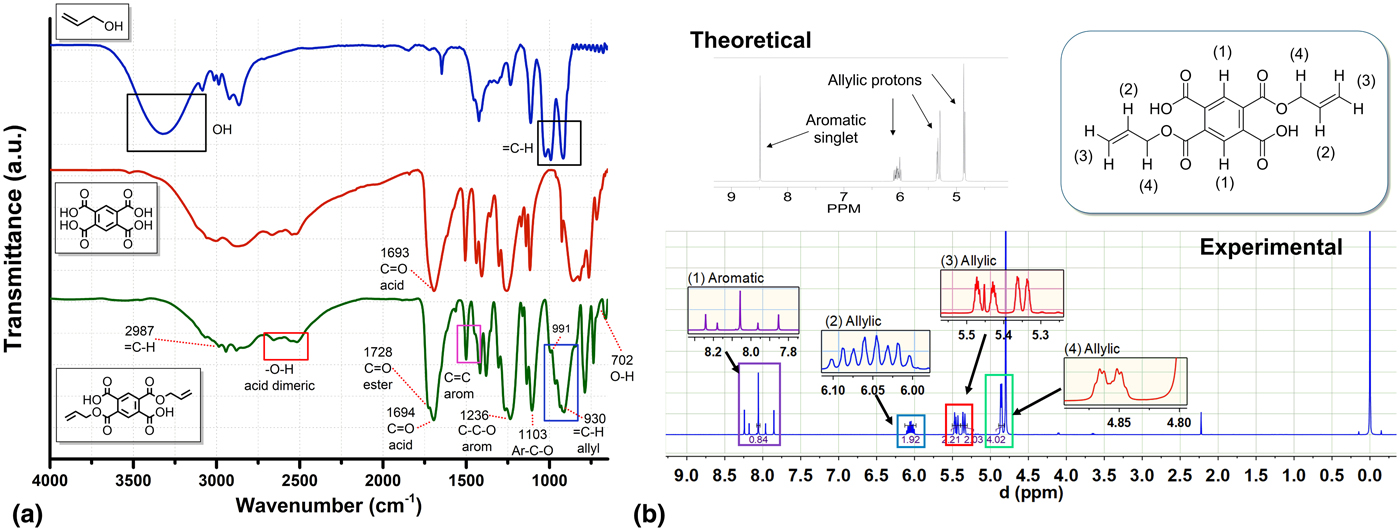
Infrared spectroscopy analysis for the diallylic compound shows a double signal for the  $\rm{C}\dbond \rm{O}$ bond [Fig. 2(a)]. At 1694/cm the characteristic signal for carbonyl groups of carboxylic acids is present, but in the spectrum, a shoulder is observed at 1725/cm, which corresponds to ester carbonyls. At 911 and 993/cm, the signals corresponding to the bending movement of the hydrogens in the bond
 $\dbond \rm{C}-\rm{H}$ of allylic groups and in 2987/cm of the stretching are observed. Absorptions for the aromatic ring (
 $\rm{C}\dbond \rm{C}\,1500/\rm{cm}$) and overtones between 700 and 800/cm are preserved, and the conjugation of carboxyl groups by hydrogen bonds between 2500 and 3000/cm decreases.
(a) FTIR spectrum for allylic alcohol, PMA, and DAPY (top to bottom) and (b) H-NMR spectrum for DAPY synthesized by the Paine III method.

NMR spectra [Fig. 2(b)] showed signals for four different types of protons. Signals in chemical shifts of 6.05 (blue), 5.4 (red), and 4.86 (green) correspond to the allylic protons. Theoretical spectrum for DAPY presents a singlet due to the symmetry of the molecule (para isomer), but in the experimental spectrum singlets with different displacements were observed. The coupling constants (J) do not correspond to a multiplet, so we are talking about different types of protons. Aromatic proton multiplet is complex due to the presence of two isomers (meta and para).
Bottom line, what matters is the presence of free carboxyl groups capable of coordinating uranyl ions, as well as allyl groups able to polymerize by the interaction of gamma radiation, so monomer mixture does not represent a problem for the purposes of the investigation. In subsequent investigations, the impact on the extraction capacity of materials with a single type of isomer will be evaluated.
Polymerization yield
The presence of uranyl ions in the polymerization undoubtedly modified the yields (Fig. S1). In all cases, the imprinted resins showed lower yields (w/w) than their non-imprinted counterparts, reaching a maximum of 120 kGy (11.7%). Lower yields are probably to the fact that non-imprinted resins polymerize without any spatial restriction, i.e., monomers freely move in the medium and only double bond interaction is required to continue the chain growth; while in imprinted polymers, monomers are coordinated to uranyl ions which limits their movement, and therefore, their likelihood of radical interaction from other chains. For chain-growth reactions happen, monomers must approach in the proper position and with enough energy to overcome the activation energy. Resins were not detected at doses lower than 20 kGy, and the maximum yield for imprinted resins was obtained at doses of 80 kGy (60.2 ± 1.4%) to decrease at higher doses consistently.
Infrared spectra for irradiated polymers (Fig. S2) no longer show the characteristic bands for the allylic bonds ( $\dbond\rm{C}-\rm{H}$) of DAPY in the 900–1000/cm region, where the stretching signals appear. At 0 kGy, allylic bands overlap with the –OH characteristic broad band; but at 150 kGy a sharp band appears may be due to the U–O stretching of the coordinated uranyl ions, hence, the allylic groups were polymerized to form alkyl chains by crosslinking polymer chains.
Extraction capacity (Q)
The amount of uranium retained was calculated through mass balance with the equation:
 $$Q_{\rm e} = \displaystyle{{\lpar {C_0-C_{\rm e}} \rpar V} \over m}$$
where C 0 and C e correspond to the initial and equilibrium concentration of U(VI) (mg/L); m is the polymer mass (g), and V stands for the volume solution (L).
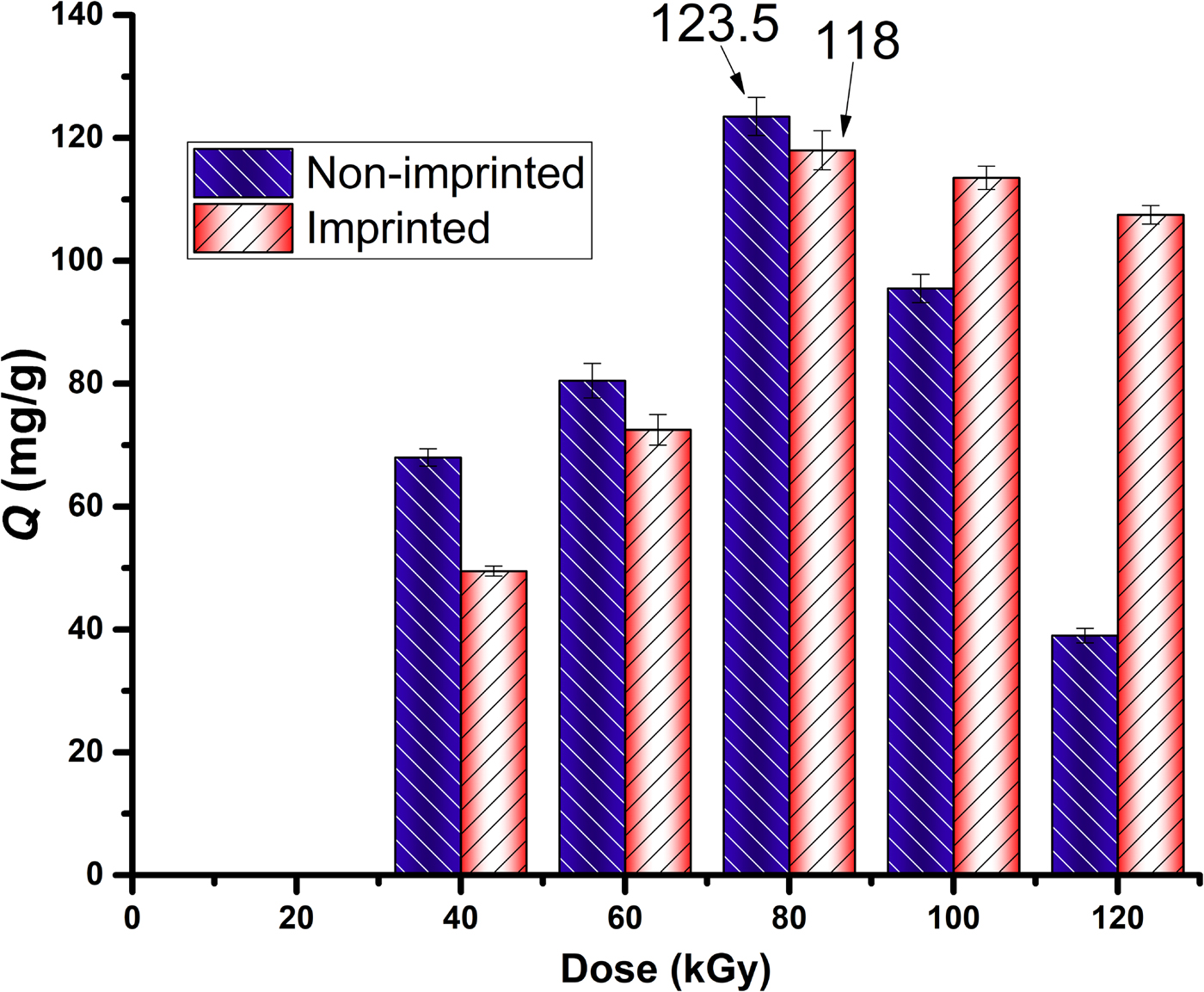
The extraction capacity did not behave consistently for all absorbed doses. Non-imprinted resins polymerized below 80 kGy showed greater capacity than their imprinted counterpart, but at higher doses the trend is reversed (Fig. 3). Maximum extraction of all the synthesized polymers was 123.5 ± 3.1 (mg/g) obtained with non-imprinted resins irradiated at 80 kGy, followed very closely by imprinted resins with 118 ± 3.2 (mg/g). The reversal of the trend in extraction capacity at higher doses may be due to the higher crosslinking of the non-imprinted resins, which hinders ion migration or ion diffusion to the binding sites inside the material. In imprinted resins, the effect is not so important, since cavities are controlled by the size of the coordinated uranyl ions, however, the extraction decreases by crosslinking at higher doses, but not as dramatically as the non-imprinted resins.
Uranium extraction capacity (Q) for IIPs and NIPs from 0 to 150 kGy of absorbed dose.

Parameter optimization
Since the conditions of maximum extraction capacity were determined, the parameters of pH, temperature, and extraction time were optimized for polymers irradiated at 80 kGy.
Temperature
The temperature evaluated was from 15 to 85 °C, since under normal conditions is the range presented by natural bodies of water. At lower temperatures, ion diffusion rate is lower, and it is likely that under the experimental conditions the system is not yet in adsorption equilibrium. The adsorption process is endothermic, then adsorption capacity increases with temperature, nevertheless, as kinetic energy of the system increases, the adsorption decreases. Dynamic equilibrium is established, but generally, the extraction capacity decreases. Fig. 4(a) depicts maxima extraction between 25 and 55 °C with variations that can be attributed to normal randomness (verified by analysis of variance analysis, α = 0.05). At temperatures above 55 °C extraction decreased to less than 80 mg/g. The gap between IIP and non-imprinted polymers (NIPs) maintains along the experimental curve, in all cases, non-imprinted resins showed better extraction capacities, except for the test conducted at 75 °C, where the extraction of the two systems was equal. It is again apparent that the structural specificity of the binding sites hinders the access of the analyte compared to the more accessible binding sites of the non-imprinted resins.
Effect of several parameters on the extraction capacity for IIP and NIP based on DAPY isomers polymerized al 80 kGy of absorbed dose: (a) temperature, (b) pH, and (c) extraction time.

pH
Adsorption of resins containing carboxylic groups in their structure is highly dependent on the pH of the medium, since, according to the pK a of the acidic species, these will be found protonated or not. It should be remembered that for the maximum generation of coordination bonds between the carboxyl groups (–COOH) and uranyl ions UO22+, deprotonated carboxyl groups (–COO−) are required.
In solutions with a high H+ concentration, the adsorption capacity decreases due to the competition between the hydronium ions (H3O+) and the uranyl cations (UO22+) for the binding sites. The equilibria that are established according to the pK as are the following:
 $${\rm UO}_2^{{\rm 2 +}} + {\rm 2}{\rm H}_2{\rm O} \rightleftharpoons {\rm U}{\rm O}_2\lpar {{\rm OH}} \rpar ^ + + {\rm H}_3{\rm O}^ + \quad {\rm p}K = {\rm 5}{\rm. 8}$$
 $${\rm 2UO}_2^{{\rm 2 +}} + {\rm 4}{\rm H}_2{\rm O}\rightleftharpoons {\rm U}{\rm O}_2\lpar {{\rm OH}} \rpar _2^{{\rm 2 +}} + 2{\rm H}_3{\rm O}^ + \quad {\rm p}K = {\rm 5}{\rm. 62}$$
 $${\rm 3UO}_2^{{\rm 2 +}} + {\rm 10}{\rm H}_2{\rm O}\rightleftharpoons {\rm U}{\rm O}_3\lpar {{\rm OH}} \rpar _5^{{\rm 2 +}} + {\rm 5}{\rm H}_3{\rm O}^ + \quad {\rm p}K = {\rm 15}{\rm. 63}$$
Changing the acidity of the medium we realize that the two resins behave in a similar way [Fig. 4(b)]. At pH values lower than 4.5, extraction capacity is below 80 mg/g, with 21% more extraction for non-printed resins (NIP) with respect to imprinted resins (IIP). As we increase the pH, the difference between the extraction capacities decreases (between 3 and 4.5%), reaching maxima of 120–123.6 mg/g for the NIP and of 116.2–118 mg/g for the IIP in the pH range of 5–6.5.
Upon exceeding the neutrality of the solution, OH− ions begin to be available, and hydroxylated uranyl species are formed. That is why extraction capacities for pH > 7 fall to 80 mg/g and lower. When the system is purely basic (pH 11–12) polymers response is very similar, although the polymers still manage to extract uranium (around 50 mg/g), its performance falls to the lowest level of all the pH range tested. As far as ionic imprinting is concerned, the uncertainty of both values overlaps, and it is not possible to conclude that there are significant differences under basic conditions.
Extraction time
Finally, the time required for the material, under constant agitation, to reach the maximum analyte adsorption was determined [Fig. 4(c)]. The rapid initial adsorption is due to a low resistance to mass transfer, a higher density of binding sites and to the fact that the reaction only depends on the diffusion rate of the adsorbate in the medium. Maximum adsorption was observed after periods of 70 min for the NIP (polymer saturation), while imprinted resins took 10 min longer to reach saturation. IIPs take a longer time to reach the equilibrium concentration, because of the bottlenecks formed when using the ionic imprinting technique. The cavities are specific for size, charge, and complexation geometry to retain uranium, hence ion adsorption takes longer time, unlike the NIP where binding sites are more accessible, although it does not necessarily mean that the selectivity is greater.
According to the results, it would not be required a longer contact time to obtain maximum extraction for the conditions used. No doubt later adsorption studies will characterize the materials in depth.
Uranium extraction materials
In the market, there are a wide variety of materials available to uranium extraction from bodies of water. Dimensioning the results obtained in an appropriate context always gives validity and importance to the investigations. Resins based on modified styrene reaches extractions of 3.6 mg/g, it may seem little, but the resin is one of the most popular and cheap substances on the market, although without much selectivity. Natural materials based on chitosan showed excellent extraction capacities ranging from 72.46 to 239.9 mg/g, and some IIPs in the range of 30.1–98.5 mg/g.[Reference Pakade25] The resins obtained in the current investigation are in the average of those, but as a first effort in the field of fulvic acids and aromatic polycarboxylic resins polymerized by gamma radiation, we think it is a considerable and interesting advance. Selectivity studies for synthesized resins are currently underway, which will be presented in future work.
Conclusions
The highest polymerization yield was obtained at absorbed doses of 80 kGy with a maximum extraction capacity of Q = 123.5 mg/g for NIP and 118 mg/g for IIP. FTIR studies showed no appreciable degradation up to a dose of 150 kGy for imprinted resins, while non-imprinted resins degrade more easily. Maximum weight yields were 60.4% for the IIP and 64.8% for NIP. The resins maintained maximum levels of extraction in solutions with a pH of 5–6.5 and temperatures of 25–55 °C. The minimum time to achieve maximum extraction of uranyl in aqueous solution was 80 min under constant agitation of 200 rpm for ionic imprinted resins and 70 min for NIP.
Probably the NIPs presented greater extraction capacity per gram of material, but if selectivity or useful cycles is low, diminish its benefits. In next studies, the selectivity of the synthesized resins will be evaluated to determine its viability. Polymers behaved in a consistent manner under temperatures normally found in natural bodies of water. It is recalled that one of the motivations of the research is to develop materials for the extraction of uranium from natural bodies of water, such as for example, seawater. Should be noted that there were no tests with natural samples of freshwater or seawater, but in future investigations, the materials will be tested in much more complex conditions. This is the first approximation and under controlled laboratory conditions.
Supplementary material
The supplementary material for this article can be found at https://doi.org/10.1557/mrc.2018.230.
Acknowledgments
The authors thank Conacyt (CVU: 490913 A. Ramos Ballesteros, No. Scholarship holder: 274234). This work was supported by Dirección General de Asuntos del Personal Académico, Universidad Nacional Autónoma de México under Grant IN201617 (Mexico). The authors thank B. Leal from ICN-UNAM and G. Cedillo from IIM-UNAM, all for their technical assistance.