Introduction
Tinnitus can be defined as the perception of sound without an external physical source.Reference Møller, Møller, Langguth, De Ridder and Kleinjung1 The prevalence of tinnitus increases with age,Reference Sindhusake, Golding, Newall, Rubin, Jakobsen and Mitchell2, Reference Shargorodsky, Curhan and Farwell3 with a maximum prevalence of 14.3 per cent in individuals aged between 60 and 69 years.Reference Shargorodsky, Curhan and Farwell3 Most persons suffering from chronic tinnitus do not seek help to manage their problem.Reference Henry, Dennis and Schechter4 Nevertheless, tinnitus has a significant impact on the quality of life of up to 5 per cent of the adult population.Reference Coles5, Reference Nondahl, Cruickshanks, Wiley, Klein, Klein and Tweed6 Sleep disturbance and difficulties in performing daily activities are often reported.Reference Martines, Bentivegna, Martines, Sciacca and Martinciglio7–Reference Henry and Meikle9
Tinnitus assessment generally consists of a medical and audiological evaluation aimed at objectivising the subjective complaint and searching for common tinnitus causes.Reference Snow10, Reference Kleinjung, Møller, Langguth, De Ridder and Kleinjung11 Questions are asked to establish characteristics, such as tinnitus type, location and onset, and psychoacoustic measurements of tinnitus pitch, loudness and maskability are performed.Reference Henry and Meikle9, Reference Henry, Zaugg and Schechter12 Several studies, however, have reported minimal or even absent relationships between the tinnitus characteristics and its perceived severity.Reference Martines, Bentivegna, Martines, Sciacca and Martinciglio7, Reference Figueiredo, Rates, Azevedo, Oliveira and Navarro13–Reference Hiller and Goebel17
Some authors have reported that factors other than the audiological characteristics of tinnitus are important for explaining differences in perceived tinnitus severity among patients.Reference Ooms, Vanheule, Meganck, Vinck, Watelet and Dhooge18–Reference Hiller and Goebel20 Some studies have reported an association between tinnitus severity and the degree of hearing loss.Reference Hiller and Goebel20–Reference Mazurek, Olze, Haupt and Szczepek23 It has also been suggested that sociodemographic factors such as sex and advanced age can influence tinnitus severity.Reference Milerová, Anders, Dvořák, Sand, Königer and Langguth19, Reference Hiller and Goebel20, Reference Schlee, Kleinjung, Hiller, Goebel, Kolassa and Langguth24 A higher degree of distress was also reported in tinnitus patients with associated hyperacusis.Reference Fioretti, Fusetti and Eibenstein8, Reference Hiller and Goebel20, Reference Schecklmann, Landgrebe, Langguth and Group25 Although hyperacusis is often associated with tinnitus,Reference Goldstein and Shulman26 there has been little research into the impact of coexisting tinnitus and hyperacusis on tinnitus severity.
In summary, existing studies show inconsistency regarding which variables relate to the perceived impact of tinnitus. This may be due to the use of different methods to assess tinnitus and different outcome instruments to measure the impact of tinnitus. Furthermore, many studies did not include regression analysis, which is a very useful way of exploring relationships between variables.Reference Hoekstra, Wesdorp and van Zanten27
The present study, therefore, measured the (psychoacoustic) characteristics of tinnitus and tinnitus-related variables using current audiological assessment methods and questionnaires in a group of patients with chronic tinnitus.Reference Henry and Meikle9, Reference Snow10 It also explored by regression analysis whether these characteristics and variables independently affect tinnitus-related handicap.
Materials and methods
Participants
This study was conducted at the Department of Otolaryngology, Ghent University Hospital, Belgium. All participants were patients older than 18 years who presented with subjective non-pulsatile tinnitus that had existed for at least 3 months. The study was approved by the local Ethical Committee, and all participants gave informed consent.
Procedures
A medical history was obtained from all patients and all underwent otological examination. Hearing status was subsequently evaluated by tympanometry and pure tone audiometry and psychophysical measurements of tinnitus pitch and loudness, tinnitus maskability and loudness discomfort levels were performed. All measurements were conducted in a double-walled, sound-attenuated booth. Furthermore, all patients completed three self-reported questionnaires. The Tinnitus Sample Case History Questionnaire, the Hyperacusis Questionnaire and the Tinnitus Handicap Inventory were administered to verify tinnitus-related variables, hyperacusis and tinnitus-related handicap, respectively.Reference Langguth, Goodey, Azevedo, Bjorne, Cacace and Crocetti28–Reference Newman, Jacobson and Spitzer30
All procedures contributing to this work complied with the ethical standards of the relevant national and institutional guidelines on human experimentation and with the Helsinki Declaration of 1975, as revised in 2008.
Audiological evaluation
Tympanometry
All patients were subjected to 226-Hz tympanometry with an 85-dB sound pressure level probe tone (Tympstar; Grason-Stadler, Eden Prairie, Minnesota, USA). Type A tympanograms were obtained for all ears, indicating normal middle-ear status.
Audiometry
Pure tone audiometry was performed using the modified Hughson–Westlake method. Air conduction thresholds were determined at octave frequencies from 0.25 to 8 kHz and at the half-octave frequencies 3 and 6 kHz, and bone conduction thresholds were determined at octave frequencies from 0.25 to 4 kHz (Personal computer based audiometer, Equinox 2.0 with TDH39 headphones, Interacoustics, Assen, Denmark). The pure tone average (PTA1,2,4 kHz) was calculated for air conduction as the average of air conduction thresholds at 1, 2 and 4 kHz.
Psychoacoustic measurements of tinnitus
Tinnitus was evaluated using the same equipment as used for pure tone audiometry. TDH39 headphones (Interacoustics) were used for all measurements. In addition, an HDA 200 phone (Sennheiser, Wedemark, Germany) was used to assess high-frequency (i.e. greater than 8 kHz) tinnitus. Tinnitus analysis consisted of (1) tinnitus pitch matching, (2) tinnitus loudness matching and (3) determining tinnitus maskability and residual inhibition.
Before pitch matching, participants were asked to indicate whether their tinnitus was tonal or noise-like. Depending on these characteristics, tinnitus pitch matching was performed using pure tone, narrow band noise or white noise. The stimulus was presented in one ear at an intensity of 10 dB SL.Reference Henry, Zaugg and Schechter12, Reference Vernon and Meikle31 The pitch-matching procedure consisted of a two-alternative forced choice procedure and a test for octave confusion.Reference Henry, Zaugg and Schechter12, Reference Vernon and Meikle31 Tinnitus was matched to half-octave frequencies between 0.125 and 20 kHz.
Tinnitus loudness was measured by presenting the pure tone, narrow band or white noise identified by pitch matching to the ipsilateral ear. First, the hearing threshold at this frequency was determined according to the modified Hughson–Westlake method. Second, the stimulus intensity was increased by 1-dB steps until the patient reported that the stimulus was as loud as the tinnitus. The loudness match was expressed in dB SL.
Tinnitus maskability was examined using both white noise and narrow band noise. Narrow band noise was presented binaurally for patients with bilateral tinnitus and monaurally for those with unilateral tinnitus at octave frequencies from 0.25 and 8 kHz, including 3 and 6 kHz.Reference Feldmann32 The noise level was raised by 1 dB increments until the patient reported that the tinnitus had become inaudible. The corresponding sound level was defined as the minimum masking level in dB SL. The average minimum masking level for narrow band noise over all tested frequencies was calculated. The minimum masking level for white noise was determined by presenting white noise binaurally for patients with bilateral tinnitus and monaurally for those with unilateral tinnitus.Reference Henry, Zaugg and Schechter12 To determine residual inhibition, white noise was presented to both ears for one minute at an intensity 10 dB above the minimum masking level for white noise.Reference Vernon and Meikle31 Afterwards, the patient had to report whether the tinnitus had changed. Four classes of residual inhibition were considered: (1) positive, tinnitus disappeared completely; (2) partially positive, tinnitus reduced in loudness; (3) rebound, tinnitus increased in loudness; and (4) negative, tinnitus was unchanged.
Loudness discomfort levels
Loudness discomfort levels were measured using the method of Jastreboff and Hazell.Reference Jastreboff and Hazell33 At each half-octave frequency between 0.25 and 8 kHz and at the tinnitus pitch match, the stimulus was presented at 65 dB HL and then increased in 5 dB steps. Each ear was tested separately. Patients had to indicate the level at which the stimulus became uncomfortably loud. The average loudness discomfort level was calculated as the average of the loudness discomfort level thresholds at each frequency tested.
Self-reported questionnaires
All patients completed a Dutch validated version of the Tinnitus Sample Case History Questionnaire.Reference Langguth, Goodey, Azevedo, Bjorne, Cacace and Crocetti28 This consists of 35 questions on patient background, tinnitus history, modifying influences and related conditions. An item list for this questionnaire was developed to achieve data comparability between studies.Reference Langguth, Goodey, Azevedo, Bjorne, Cacace and Crocetti28 The full item list consists of 14 essential (level A) and 21 highly desirable (level B) items; however, this study evaluated the essential items only. One level A item considered the presence of pulsatile tinnitus, which was used as an exclusion criterion in this study. It was therefore omitted from the analysis and replaced by an item concerning the subjective description of tinnitus pitch. A validated Dutch version of the Hyperacusis Questionnaire was used to quantify and characterise hyperacusis.Reference Khalfa, Dubal, Veuillet, Perez-Diaz, Jouvent and Collet29, Reference Meeus, Spaepen, De Ridder and Van de Heyning34 This questionnaire consists of 14 items with 4 answer possibilities (no; yes, a little; yes, quite a lot; yes, a lot) to yield a score ranging from 0 to 42. A validated Dutch version of the Tinnitus Handicap Inventory was used to evaluate the tinnitus-related handicap.Reference Newman, Jacobson and Spitzer30 The Tinnitus Handicap Inventory is a 25-item questionnaire with 3 answer possibilities (no; yes; sometimes) that yields scores ranging from 0 to 100. It is one of the most commonly used questionnaires to measure the degree of disability caused by tinnitus and to select patients who need intervention.Reference Newman, Jacobson and Spitzer30 It has high reliability and construct validity.Reference Newman, Jacobson and Spitzer30, Reference Newman, Sandridge and Jacobson35
Data analysis
Statistical analysis was performed using IBM SPSS Statistics software version 21.0 (Armonk, New York, USA). Descriptive parameters were established for the variables examined during the audiological evaluation and the questionnaire outcomes. Univariate analyses were performed to evaluate the effect of each variable on the Tinnitus Handicap Inventory. For categorical variables, an independent samples t-test or analysis of variance with post-hoc Scheffé testing was conducted. To examine possible correlations between continuous variables, Pearson correlation coefficients (for normally distributed data) or Spearman correlation coefficients were calculated. Correlation coefficients less than 0.30 were considered weak, those between 0.30 and 0.50 were considered moderate and those greater than 0.50 were considered strong.Reference Cohen, Cohen, West and Aiken36 Variables showing a significant association with the Tinnitus Handicap Inventory score were subjected to stepwise multiple regression analysis with the Tinnitus Handicap Inventory score as the dependent variable. Correlation between predictor variables was evaluated by collinearity diagnostics and expressed by the variance inflation factor: values less than five implied no correlations among predictor variables.Reference Menard37
Results
The total study sample comprised 81 adults (53 men and 28 women) aged from 18 to 73 years (mean 47.6 years, standard deviation (SD) 14.4 years). The mean PTA1,2,4 kHz was 22.8 dB HL (SD 18.9 dB HL, range 3–82 dB HL). Tinnitus was unilateral in 45.6 per cent of patients (16.0 per cent in the right ear, 29.6 per cent in the left ear) and bilateral in 54.4 per cent. The average tinnitus duration was 4.1 years (SD 6.2 years, range 1–33 years). The median tinnitus pitch was 4.0 kHz (SD 2.6 kHz, range 0.125–11.2 kHz) and the mean value for tinnitus loudness was 6.1 dB SL (SD 4.5 dB SL, 1–21 dB SL). Tinnitus Handicap Inventory scores were normally distributed, with a mean of 44.2 (SD 24.9, range 4–100).
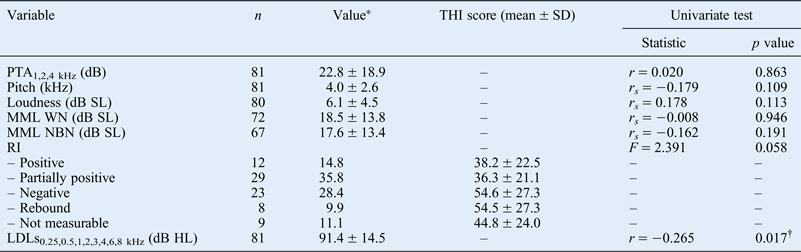
Table I provides an overview of the variables examined in the audiological evaluation. Psychoacoustic measurements of tinnitus were performed for all except one patient, in whom it was not possible to measure tinnitus loudness because hearing loss was too pronounced. Additionally, it was not possible to determine a complete masking curve in 14 patients because tinnitus symptoms disappeared when narrow band noise was presented (3 patients) or because tinnitus could not be masked with narrow band noise (11 patients). Likewise, the residual inhibition could not be determined in nine patients because it was not possible to determine the minimum masking level for white noise (1 patient) or to mask the tinnitus with white noise (8 patients). Table I further shows the univariate relationship between the variables examined during the audiological evaluation and the Tinnitus Handicap Inventory score. The average loudness discomfort level was the only variable to show a significant, albeit weak, correlation (r = 0.265) with the Tinnitus Handicap Inventory score.
Univariate analysis of the THI and variables determined during the audiological evaluation
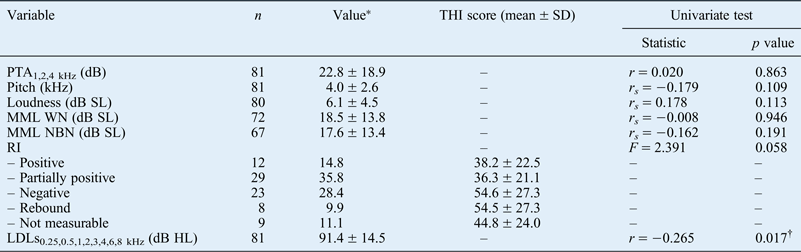
*Data are presented as a percentage or as the mean ± standard deviation. †Significant association, p < 0.05. THI = Tinnitus Handicap Inventory; PTA = pure tone average; MML WN = minimum masking level for white noise; MML NBN = minimum masking level for narrow band noise; RI = residual inhibition; LDL = loudness discomfort level
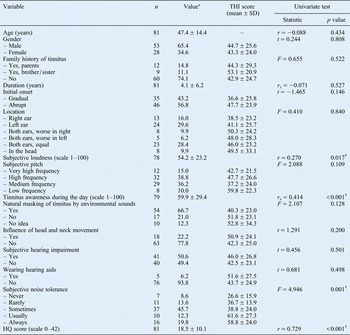
Table II provides an overview of the Tinnitus Sample Case History Questionnaire (level A items) and the Hyperacusis Questionnaire, together with the univariate relationship of their variables with the Tinnitus Handicap Inventory score. For the Tinnitus Sample Case History Questionnaire, items regarding the subjective experience of tinnitus loudness and tinnitus awareness during the day were not completed by two and three patients, respectively. Four variables significantly correlated with the Tinnitus Handicap Inventory score. A weak correlation was found for the subjective experience of tinnitus loudness (r s = 0.270), and moderate and strong correlations were found for tinnitus awareness during the day (r s = 0.414) and the Hyperacusis Questionnaire score (r = 0.729), respectively. Furthermore, a difference in the Tinnitus Handicap Inventory score was found for noise intolerance. Post-hoc Scheffé tests showed higher Tinnitus Handicap Inventory scores for patients who always or usually experienced noise intolerance compared with patients who sometimes, rarely or never experienced noise intolerance.
Univariate analysis of the THI and variables of the TSCHQ (14 items) and HQ

*Percentage or mean ± SD. †Significant association, p < 0.05. THI = Tinnitus Handicap Inventory; TSCHQ = Tinnitus Sample Case History Questionnaire; HQ = Hyperacusis Questionnaire
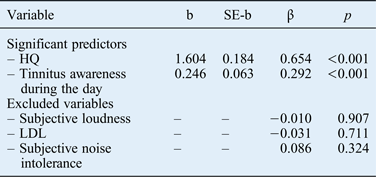
The five variables (one determined through audiological assessment and four determined using questionnaires) that were significantly related to the Tinnitus Handicap Inventory score were entered into a stepwise multiple regression model (Table III). The model was statistically significant (F(1, 76) = 58.029, p < 0.001), and accounted for 60 per cent of the variance of the Tinnitus handicap score (R² = 0.611, R 2adjusted = 0.600). Tinnitus awareness during the day (β = 0.29, p < 0.001), and especially the Hyperacusis Questionnaire score (β = 0.65, p < 0.001) significantly predicted the Tinnitus Handicap Inventory score; significance was retained after correction for multiple comparisons (α = 0.05/22).
Stepwise multiple regression analysis of variables with a significant univariate relationship with the THI score
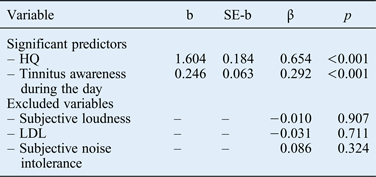
Note that the dependent variable was the THI. R2 = 0.611, adjusted R2 = 0.600. THI = Tinnitus Handicap Inventory; SE-b = standard error of coefficient b; HQ = Hyperacusis Questionnaire; LDL = loudness discomfort level
Discussion
Tinnitus patients often mention an impact of tinnitus on their quality of life, with the degree of impact varying from person to person.Reference Møller, Møller, Langguth, De Ridder and Kleinjung1 Several studies have addressed the importance of evaluating the psychoacoustic characteristics of tinnitus along with perceived tinnitus severity. However, most of these studies did not find a relationship between tinnitus characteristics and perceived tinnitus severity.Reference Martines, Bentivegna, Martines, Sciacca and Martinciglio7, Reference Figueiredo, Rates, Azevedo, Oliveira and Navarro13–Reference Hiller and Goebel17 Other factors such as hearing loss, hyperacusis and sociodemographic factors including age have also been proposed to influence tinnitus severity.Reference Milerová, Anders, Dvořák, Sand, Königer and Langguth19, Reference Hiller and Goebel20, Reference Schlee, Kleinjung, Hiller, Goebel, Kolassa and Langguth24, Reference Schecklmann, Landgrebe, Langguth and Group25 The present study determined tinnitus characteristics and evaluated the presence of hearing loss and hyperacusis using current audiological assessment methods and questionnaires.Reference Henry and Meikle9, Reference Snow10 Univariate and multivariate analyses were performed to verify which variables were independently related to tinnitus-related handicap as measured with the Tinnitus Handicap Inventory.
The percentage of tinnitus awareness during the day and the Hyperacusis Questionnaire score appeared to have independent, significant effects on the Tinnitus Handicap Inventory score. The Hyperacusis Questionnaire score was the strongest contributory factor to the Tinnitus Handicap Inventory score in the multiple regression analysis, thus emphasising the high relevancy of hyperacusis to tinnitus-related handicap. These findings are in accordance with previous reports that the presence of hyperacusis in tinnitus patients increases the impact of tinnitus on quality of life.Reference Fioretti, Fusetti and Eibenstein8, Reference Schecklmann, Landgrebe, Langguth and Group25, Reference Falkenberg and Wie38 They are also consistent with both tinnitus and hyperacusis inducing emotional and cognitive reactions.Reference Henry, Dennis and Schechter4, Reference Khalfa, Dubal, Veuillet, Perez-Diaz, Jouvent and Collet29 The Tinnitus Handicap Inventory and the Hyperacusis Questionnaire quantify attentional and emotional reactions to symptoms associated with tinnitus and hyperacusis, respectively.Reference Khalfa, Dubal, Veuillet, Perez-Diaz, Jouvent and Collet29, Reference Newman, Jacobson and Spitzer30 This probably explains the strong association between the Tinnitus Handicap Inventory and Hyperacusis Questionnaire scores. In addition to quantifying hyperacusis using the Hyperacusis Questionnaire, the present study evaluated abnormal sound tolerance by measuring loudness discomfort levels. Although the average loudness discomfort level was significantly related to the Tinnitus Handicap Inventory score in a univariate analysis, it had no unique predictive value for the Tinnitus Handicap Inventory score in the multiple regression analysis. No consistent relationship between loudness discomfort levels and Tinnitus Handicap Inventory score has been reported.Reference Karatas and Deniz14 As such, results suggest that the loudness discomfort level can be used to identify abnormal sound tolerance but has no additional value over the Hyperacusis Questionnaire score for verifying tinnitus-related handicap.
Tinnitus awareness during the day also had a significant effect on the Tinnitus Handicap Inventory score. Wallhäußer-Franke et al. found that permanent tinnitus awareness influences the subjective loudness of tinnitus and tinnitus severity.Reference Wallhäußer-Franke, Brade, Balkenhol, D'Amelio, Seegmüller and Delb39 The present study showed a weak univariate correlation between the Tinnitus Handicap Inventory score and the subjective experience of tinnitus loudness. However, no correlation was found when loudness was measured audiometrically. According to previous reports, this suggests that the psychoacoustic measurement of tinnitus loudness is not related to tinnitus-related handicap, but that the perceived handicap might influence the subjective experience of tinnitus loudness.Reference Hoekstra, Wesdorp and van Zanten27, Reference Kuk, Tyler, Russell and Jordan40
Similarly, the present study found that neither (subjective) tinnitus pitch and maskability nor the level of residual inhibition contribute to the Tinnitus Handicap Inventory score. Several previous studies also reported that tinnitus pitch, maskability and residual inhibition have no predictive value for tinnitus severity.Reference Karatas and Deniz14, Reference Hiller and Goebel17, Reference Unterrainer, Greimel, Leibetseder and Koller41
Furthermore, the present study did not identify a relationship between the Tinnitus Handicap Inventory score and sociodemographic variables (age and sex) or tinnitus location, initial onset or duration. Additionally, no relationship was found between the Tinnitus Handicap Inventory score and family history of tinnitus, head and neck movements, hearing loss or hearing aid wearing. Previous research also could not demonstrate a clear relationship between those variables and tinnitus severity.Reference Karatas and Deniz14, Reference Hiller and Goebel17, Reference Hiller and Goebel20, Reference Axelsson and Ringdahl22, Reference Hoekstra, Wesdorp and van Zanten27, Reference Wallhäußer-Franke, Brade, Balkenhol, D'Amelio, Seegmüller and Delb39, Reference Unterrainer, Greimel, Leibetseder and Koller41, Reference Andersson, Lyttkens and Larsen42 However, some authors have stated that age and hearing loss have additional influences on tinnitus severity.Reference Hiller and Goebel17, Reference Hiller and Goebel20, Reference Schlee, Kleinjung, Hiller, Goebel, Kolassa and Langguth24, Reference Sindhusake, Golding, Wigney, Newall, Jakobsen and Mitchell43 The Tinnitus Handicap Inventory contains no items on auditory perceptual difficulty.Reference Milerová, Anders, Dvořák, Sand, Königer and Langguth19, Reference Newman, Jacobson and Spitzer30 Sensory and perceptual functions decrease with age.Reference Keppler, Dhooge, Corthals, Maes, D'haenens and Bockstael44, Reference Patterson, Nimmo-Smith, Weber and Milroy45 Therefore, the Tinnitus Handicap Inventory might not detect subtle subjective changes associated with ageing and hearing loss. On the other hand, questionnaires containing several items on hearing loss might overestimate the score because of confounding factors.Reference Milerová, Anders, Dvořák, Sand, Königer and Langguth19
• Tinnitus can have a significant impact on quality of life
• There is no consensus on which variables contribute to tinnitus-related handicap
• Hyperacusis and tinnitus awareness are related to tinnitus-related handicap
• These variables can be useful for evaluating and counselling tinnitus patients
It should be pointed out that the present study used only the Tinnitus Handicap Inventory to measure tinnitus-related handicap. It is possible that other results would have been found with other questionnaires, such as the Tinnitus Questionnaire or the Tinnitus Handicap Questionnaire.Reference Kuk, Tyler, Russell and Jordan40, Reference Goebel and Hiller46 The lack of a ‘gold standard’ for measuring tinnitus-related handicap is well known. Moreover, previous research showed that the Tinnitus Handicap Inventory and the Tinnitus Questionnaire measure tinnitus-related handicap in a broadly similar way.Reference Milerová, Anders, Dvořák, Sand, Königer and Langguth19, Reference Hoekstra, Wesdorp and van Zanten27 Nevertheless, small differences between questionnaires do exist and these should be taken into account when these tools are used to subjectively identify perceived tinnitus-related handicap.Reference Milerová, Anders, Dvořák, Sand, Königer and Langguth19
Conclusion
Tinnitus awareness during the day, and hyperacusis especially, appear to be related to the Tinnitus Handicap Inventory score. Questionnaires on tinnitus and, especially, on hyperacusis were most suited to providing insight into the impact of tinnitus. Therefore, we recommended including a hyperacusis questionnaire when evaluating tinnitus patients. Furthermore, assessing tinnitus awareness and hyperacusis makes it possible to identify patients at risk of increased tinnitus-related handicap who need more extensive counselling. In addition, this study confirms that the relationship between the audiological characteristics of tinnitus and the perceived tinnitus-related handicap is not straightforward. Nevertheless, a medical and audiological evaluation of tinnitus is still necessary to explore the underlying medical otological conditions. Finally, this study was cross-sectional and evaluated the characteristics of tinnitus and tinnitus-related handicap during a single consultation. Therefore, further research is needed to examine the long-term effects of factors associated with the impact of tinnitus on quality of life and to determine how these may change over time or might be influenced by counselling or therapy.