Introduction
The concept of using algae in poultry diets is not novel and has been the subject of much research over the past two decades. Early limitations to the use of macro algae as a substitute protein source for soybean or canola meal in animal diets included high price, variable nutrient specifications and lack of a commercial supply. Commercially grown microscopic algae are usually cultivated in photobioreactors including tanks, vertical columns, horizontal tubes and flat panels, whereas macroscopic algae must be cultured in large open ponds or harvested directly from the wild. An aspect of macro algae that has received little attention is its secondary metabolites and their potential to mediate gut health. Secondary metabolites are easily extracted and new developments in production methods have resulted in potential for commercial scale volumes. Examination of macroscopic algae and their metabolites as feed additives for poultry warrants further consideration. The purpose of this review is to examine macroscopic algae as an ingredient to provide both nutrients and beneficial secondary metabolites for the poultry industry.
Biological classification of algae
Algae are easily distinguished by size and colour. Research on microscopic algae and poultry is described by Światkiewicz et al. (Reference ŚWIATKIEWICZ, ARCZEWSKA-WLOSEK and JOZEFIAK2015). Macroscopic algae are multi cellular photosynthetic organisms easily visible to the naked eye (Chapman, Reference CHAPMAN2013), in contrast to microscopic algae that are unicellular photosynthetic organisms requiring a microscope to view the cells. The macroscopic algae are separated into the general classes: green (Chlorophyceae), red (Rhodophyceae) and brown (Phaeophyceae) as briefly described below. Classification of algae is made difficult by the number of species that exist with continued debate resulting in re-classification over time (McCourt et al., Reference MCCOURT, DELWICHE and KAROL2004).
Green macroscopic algae
The Chlorophyceae class of algae is commonly known as green algae, and include both microscopic and macroscopic forms. They are the most diverse algae with more than 13,000 different species, and it is estimated that around half of the species are macroscopic green algae (Guiry, Reference GUIRY2012). Most of the macroscopic forms are referred to as green seaweeds. Chlorophyceae are given their characteristic colour by the presence of chlorophyll pigment that is used during the photosynthetic process. McCourt et al. (Reference MCCOURT, DELWICHE and KAROL2004) explained that there has long been debate over the origin of land plants. However, in the second half of the 20th century, the Chlorophyceae were split into two divisions, the charophytes and the chlorophytes. It is now believed the origin of the land plants lies in the charophyte division. The Chlorophyta are grouped into the classes: Chlorophyceae, Trebouxiophyceae, Ulvophyceae and Prasinophyceae. These algal classes all contain swimming cells with two or four anterior flagella and four microbial rootlets (Lewis and McCourt, Reference LEWIS and MCCOURT2004). The majority of published studies using chlorophyte algae in poultry nutrition have used members of the class Ulvophyceae.
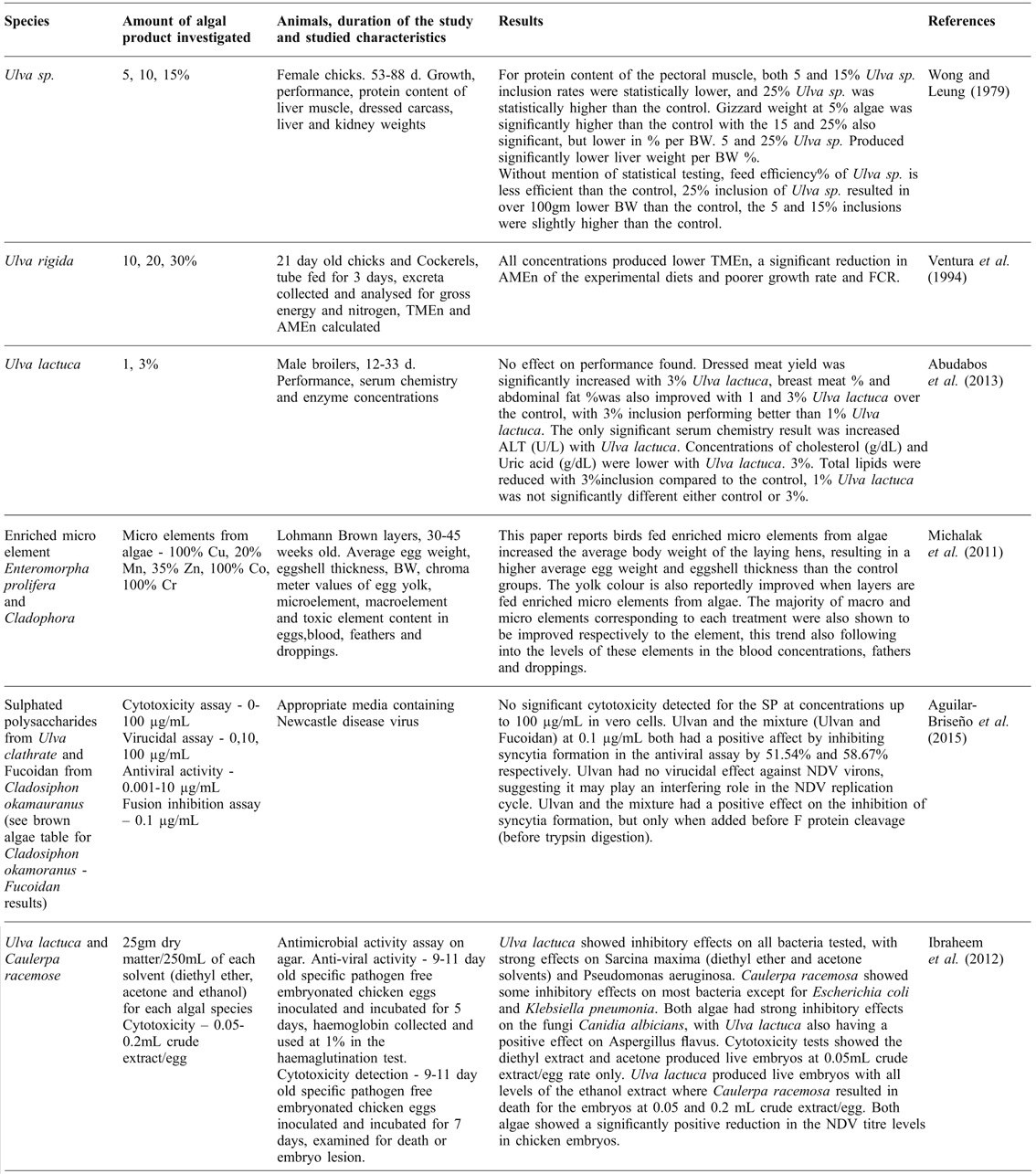
The class Ulvophyceae includes Ulva, Caulepra and Cladosphon in its many genera. Characteristics of this class are the possession of four polysaccharide families, two major water soluble ulvans and insoluble celluloses as well as two minor ones, a peculiar alkali-soluble linear xyloglucan and glucuronan (Lahaye and Robic, Reference LAHAYE and ROBIC2007). Members of this class contain major sulphated hetero-polysaccharide groups that contain galactose, xylose, arabinose, mannose, glucuronic acid or glucose (Ngo and Kim, Reference NGO and KIM2013). The genus Ulva is used in human food products as ‘sea lettuce’ where it is used as a vegetable in soups and salads, and is the most prevalent of the algae researched in poultry ( Table 1 ). Most studies use a specific particular species of Ulva; however, (Wong and Leung, Reference WONG and LEUNG1979) collected, washed, dried and ground without identifying the specific species. While the authors have concluded that the use of seaweed at a low dietary inclusion (5%) may be an option for partial protein meal replacement in poultry diets, it was recognised that variation in algal species at the time of collection requires further investigation. Ventura et al. (Reference VENTURA, CASTAÑON and MCNAB1994) showed that the inclusion of 10, 20 and 30% Ulva rigida in poultry diets reduced dietary AMEn, resulting in poorer bird performance. This led the authors to suggest it would not be a suitable dietary ingredient for poultry unless more work with enzymes could overcome the reduction in AMEn. Abudabos et al. (Reference ABUDABOS, OKAB, ALJUMAAH, SAMARA, ABDOUN and AL-HAIDARY2013) found no effect on performance using Ulva lactuca in broilers; however this was at a significantly lower inclusion rate, 3% vs. 30% for Wong and Leung (Reference WONG and LEUNG1979), Abudabos et al. (Reference ABUDABOS, OKAB, ALJUMAAH, SAMARA, ABDOUN and AL-HAIDARY2013) reported significantly higher dressed breast meat yield and reduced relative abdominal fat pad in chickens. The authors hypothesised that inclusion of Ulva in poultry diets may have an upper limit of between 3 and 10% without any detriment in broiler diets, in terms of effects on performance. Michalak et al. (Reference MICHALAK, CHOJNACKA, DOBRZAŃSKI, GÓRECKI, ZIELIŃSKA, KORCZYŃSKI and OPALIŃSKI2011) used enriched microelements to replace and investigate individual microelement ions in layer feed. Each treatment replaced a portion of the microelement at the following levels 100% Cu, 20% Mn, 35% Zn, 100% Co, 100% Cr from the Ulva species, Enteromorpha prolifera and Cladophora that had been enriched. This resulted in heavier birds, heavier eggs and improved nutrient value in the egg corresponding to the micronutrient tested and improved yolk colour suggesting benefits for layer production can be gained. Both Aguilar-Briseño et al. (Reference AGUILAR-BRISEÑO, CRUZ-SUAREZ, SASSI, RICQUE-MARIE, ZAPATA-BENAVIDES, MENDOZA-GAMBOA, RODRÍGUEZ-PADILLA and TREJO-AVILA2015) and Ibraheem et al. (Reference IBRAHEEM, ABDEL-RAOUF, ABDEL-HAMEED and EL-YAMANY2012) reported that Ulva (Ulva clathrata, Ulva lactuca) and Caulerpa racemosa exhibited an antiviral effect on Newcastle disease virus (NDV). In addition, the use of Ulva had significant inhibitory effects on bacteria and fungi in both studies, highlighting an opportunity for use of this alga in poultry for anti-viral and gut health applications.
Results of selected poultry related studies of the effects of green macroscopic algae in poultry diets.

Brown macroscopic algae
The brown appearance of brown macro algae is derived from the pigment fucoxanthin. There are in excess of 1,500 species reported, all marine, multicellular and the majority are macroscopic (Jones, Reference JONES1964). These belong to the class Phaephyceae, phylum Heterokontophyta and are characterised by having chloroplasts surrounded by four membranes in combination with their brown pigmentation.
The brown algae contain three unique polysaccharides – a glucan called laminaran, specific alginates and fucans. Ahmadi et al. (Reference AHMADI, SOHEIL ZOROFCHIAN, ABUBAKAR and ZANDI2015) suggested that the high content of these polysaccharides (more than 50% of the dry matter) may be important for development of marine-based polysaccharide drugs. Laminaran is the storage carbohydrate for (and is unique to) brown algae, as other seaweed genera use starch to store carbon. This gives brown algae a carbohydrate metabolism which, combined with D-mannitol production, is uniquely different from other living things that use starch for energy (Michel et al., Reference MICHEL, TONON, SCORNET, COCK and KLOAREG2010).
Brown algae are the subject of reported health benefits through suppression of virus proliferation (Wang et al., Reference WANG, WANG and GUAN2012) making them of interest to animal health researchers. The results of O'Doherty et al. (Reference O'DOHERTY, DILLON, FIGAT, CALLAN and SWEENEY2010) showed, in pigs, a reduction in the number of Escherichia coli and an increase in Lactobacilli spp. with dietary inclusion of the brown algae Laminaria spp. The authors reported that this was due to reduced adherence and translocation of bacteria across the epithelial wall, supporting the notion that this unique polysaccharide might offer support for improved health in animals. Alginates are linear anionic polysaccharides (made up of only two uronic acids) found in the principle cell wall of brown macroscopic algae. Ahmadi et al. (Reference AHMADI, SOHEIL ZOROFCHIAN, ABUBAKAR and ZANDI2015) reasoned that these polysaccharides are particularly attractive due to their antiviral activities having positive effects on infections such as HIV-1, both in vitro and in vivo. These findings were supported by those of Wang et al. (Reference WANG, WANG and GUAN2012) who attributed them to the inhibition of viral reverse transcriptase, the interference with viral absorption and the enhancement of immune function.
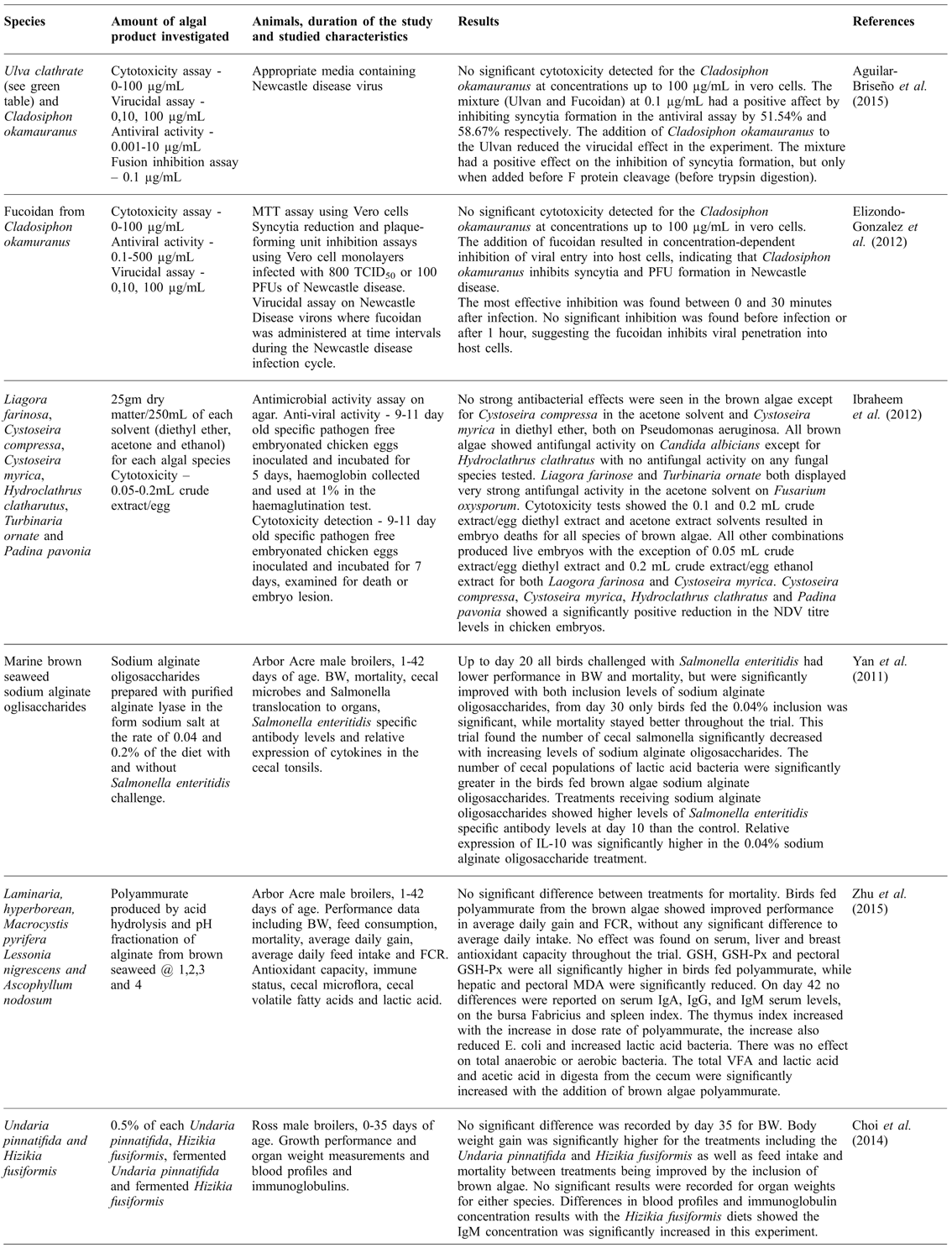
The fucans contain three groups; glycuronoglactofucans, fucodians and xylofucglycurnans and occur in the intercellular tissues or mucilaginous matrix of brown algae (Ahmadi et al., Reference AHMADI, SOHEIL ZOROFCHIAN, ABUBAKAR and ZANDI2015). In a review by Wang et al. (Reference WANG, WANG and GUAN2012), these are listed as having antiviral activities on HIV, dengue virus and influenza A virus. Ngo and Kim (Reference NGO and KIM2013) suggest that the fucans of different species of brown algae have varying antiviral effects due to differences in composition of sugars and sulphates. While the majority of antiviral and antibacterial work has been done in relation to human health, there have been reports suggesting similar results in poultry ( Table 2 ). Antiviral activity was shown to increase when Newcastle disease vero cell monolayers were treated with fucoidans tested in a virucidal assay at 0.1 µg/ml (Aguilar-Briseño et al., Reference AGUILAR-BRISEÑO, CRUZ-SUAREZ, SASSI, RICQUE-MARIE, ZAPATA-BENAVIDES, MENDOZA-GAMBOA, RODRÍGUEZ-PADILLA and TREJO-AVILA2015). Similarly, Elizondo-Gonzalez et al. (Reference ELIZONDO-GONZALEZ, CRUZ-SUAREZ, RICQUE-MARIE, MENDOZA-GAMBOA, RODRIGUEZ-PADILLA and TREJO-AVILA2012) provided further understanding of the mode of action of fucoidan concluding that, while it inhibits Newcastle disease virus in vitro without toxicity, the mode of action is in the early stages of viral infection and has direct inactivation effect on virons. Fungal studies using Fusarium oxysporum and brown macro algae reported strong anti-fungal activity when 25 g dry matter/250ml of both Liagora farinose and Turbinaria ornate were prepared in an acetone solvent on the agar plate by a diffusion assay method (Ibraheem et al. (Reference IBRAHEEM, ABDEL-RAOUF, ABDEL-HAMEED and EL-YAMANY2012). Antibacterial properties were not observed, although, Yan et al. (Reference YAN, GUO, YUAN, LIU and ZHANG2011) reported improvements in body weight and mortality of broilers infected with Salmonella enteritidis when birds were fed marine brown seaweed sodium alginate oligosaccharides prepared with purified alginate lyase in the form of the sodium salt at the rate of 0.04 and 0.2% of the diet. The positive results from this work included a decrease in caecal Salmonella spp. and significant increases in Salmonella spp. specific antibodies 10 days after treatment of both rates of sodium alginate inclusion. Supporting these antibacterial results, Zhu et al. (Reference ZHU, LI, WANG, WU, XIA, BI, GUAN and ZHANG2015) reported a reduction in E. coli in caecal microflora samples, which was associated with increased lactic acid bacteria when brown algae polyammurate was fed to broilers. Choi et al. (Reference CHOI, LEE and OH2014) showed positive effects on immune status with lower mortality and higher body weight in broilers fed 0.5% of each of Undaria pinnatifida, Hizikia fusiformis, fermented Undaria pinnatifida and fermented Hizikia fusiformis. Increased IgM concentration was observed in broilers fed 0.5% of Hizikia fusiformis. Further investigation examining the combination of these unique polysaccharides on health and performance of poultry are warranted. Patel (Reference PATEL2012) suggested that brown algal growth conditions and extraction methods are important to consider to ensure maximum effectiveness of the extracted compounds.
Results of selected poultry related studies of the effects of brown macroscopic algae in poultry diets.
Red macroscopic algae
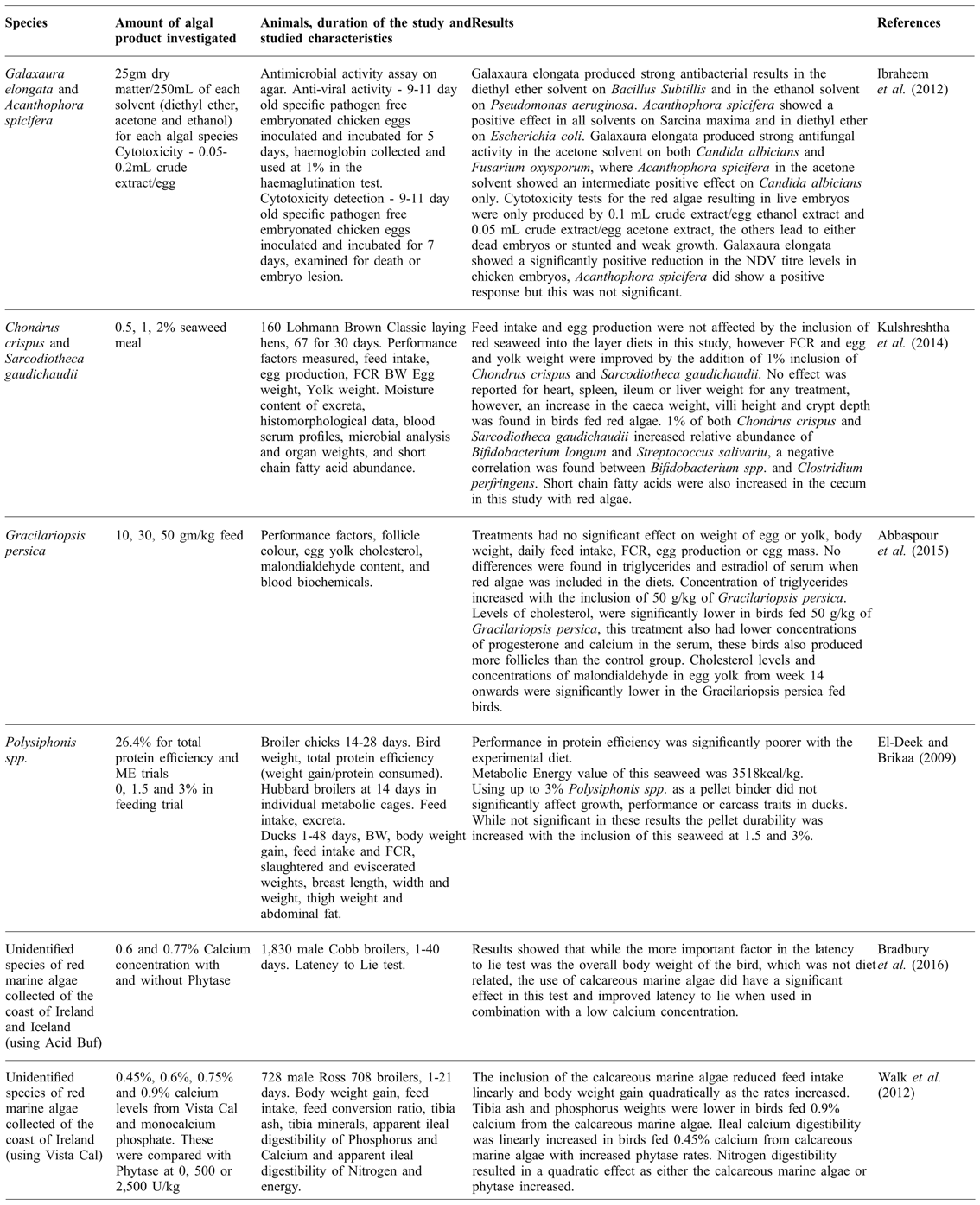
Red macroscopic algae are a large group with more than 5,000 species identified. The majority of red macro algae are multicellular marine algae found predominantly from the low tide mark to 100 m in depth (Makkar et al. (Reference MAKKAR, TRAN, HEUZÉ, GIGER-REVERDIN, LESSIRE, LEBAS and ANKERS2016). Red macro algae contain eukaryotic cells without flagella and centrioles. They have chloroplasts lacking an external endoplasmic reticulum, contain unstacked thylakoids, and use phycobiliproteins as accessory pigments, making the algae red. When dead, these coralline algae form calcareous deposits called maerl that are harvested as a calcium carbonate source (Makkar et al., Reference MAKKAR, TRAN, HEUZÉ, GIGER-REVERDIN, LESSIRE, LEBAS and ANKERS2016). Red algae contain specific bioactive compounds; agars, carrageenans, xylans, sulphated galactans and porphyrins that may have beneficial health effects on animals. Ngo and Kim (Reference NGO and KIM2013) and Wijesekara et al. (Reference WIJESEKARA, PANGESTUTI and KIM2011) suggested that the antioxidant activity of the carrageenans may help as an anti-inflammatory, and the sulphated galactans have shown promising results by inhibiting the HIV virus in vitro. These bioactive compounds have been found to exert antiviral (Newcastle disease virus), antifungal (Candida albicians and Fusarium oxysporum) and antibacterial (for example, Bacillus subtilis, Pseudomonas aeruginosa, Sarcina maxima, Escherichia coli) activities, that are relevant for poultry. The aforementioned E. coli and fungi such as Candida albicians were all significantly reduced with the use of red algal species Galaxaura elongata or Acanthophora spicifera. Kulshreshtha et al. (Reference KULSHRESHTHA, RATHGEBER, STRATTON, THOMAS, EVANS, CRITCHLEY, HAFTING and PRITHIVIRAJ2014) demonstrated similar antibacterial properties in laying hens, using Chondrus crispus and Sarcodiotheca gaudichaudii to reduce Bifidobacterium spp. and Clostridium perfringens, while supporting the growth of gram positive bacteria Bifidobacterium longum and Streptococcus salivariu. Supplementing laying hens resulted in improved yolk weight and FCR ( Table 3 ). Abbaspour et al. (Reference ABBASPOUR, DAVOOD and MOHAMMADI-SANGCHESHMEH2015) found positive egg production and egg quality results with dietary inclusion of red algae in terms of increased follicle production, reduced cholesterol and increased triglycerides. These findings are thought to be the result of hypertriglyceridemia and hypocholesterolemia during biochemical transformation in laying quail.
Results of selected poultry related studies of the effects of red macroscopic algae in poultry diets.

Published literature in broilers regarding use of red macroscopic algae is limited and reports contain varying results. El-Deek and Brikaa (Reference EL-DEEK and BRIKAA2009)) reported poorer broiler performance using 26.4% Polysiphonis spp. in investigations to evaluate protein digestibility, however, Bradbury et al. (Reference BRADBURY, WILKINSON, CRONIN, THOMSON, WALK and COWIESON2016) and Walk et al. (Reference WALK, ADDO-CHIDIE, BEDFORD and ADEOLA2012) suggested that there may be some benefits in using red seaweed as a calcium source. Bradbury et al. (Reference BRADBURY, WILKINSON, CRONIN, THOMSON, WALK and COWIESON2016) found reduced lameness in broilers in an experiment using the Weeks et al. (Reference WEEKS, KNOWLES, GORDON, KERR, PEYTON and TILBROOK2002) ‘latency to lie’ method to grade the severity of leg weakness following use of a commercially available product derived from calcified red marine algae, while Walk et al. (Reference WALK, ADDO-CHIDIE, BEDFORD and ADEOLA2012) combined the seaweed product with phytase to reduce the dietary calcium need while maintaining broiler performance and bone ash. El-Deek and Brikaa (Reference EL-DEEK and BRIKAA2009) investigated the use of Polysiphonis spp. in duck feed as a pellet binder and found that, while there was an increase in the durability of the pellets at inclusion rates of 1.5% and 3%, these results were not significant; and the product had no effect on duck performance, growth, yield or carcass traits.
Although there is limited published work in this area, the unique sulphated polysaccharides in red macroscopic algae, used in the live-harvested form or dead coralline form in poultry diets, show promise in areas of improved animal health by bacterial and fungal control as well as the calcium carbonate possibly improving skeletal health in broilers.
Conclusions
From the available literature using macroscopic algae in poultry diets, as well as work performed in other animal species, it can be concluded that there is potential for further use of macroscopic algae to improve areas of gut health, disease and viral control in poultry. Macro algae also show promise in the performance and egg quality aspects of layers, while also improving some nutritive aspects of the eggs. The benefits shown in this review support further research into the use of algae in view of the increasing pressure for an antibiotic free poultry industry by offering alternatives in the form of natural prebiotics.