Introduction
The genus Megalaria Hafellner was erected for the single species M. grossa (Pers. ex Nyl.) Hafellner (Hafellner Reference Hafellner1984), but has subsequently been enlarged by the addition of numerous other, morphologically similar species (Schreiner & Hafellner Reference Schreiner and Hafellner1992; Nimis Reference Nimis1993; Ekman & Tønsberg Reference Ekman and Tønsberg1996; Fryday Reference Fryday2004a, b; Galloway Reference Galloway2004; Fryday Reference Fryday2007; Kalb Reference Kalb2007; Lendemer Reference Lendemer2007; Kantvilas Reference Kantvilas2008). Ekman & Tønsberg (Reference Ekman and Tønsberg1996) reviewed the genus and concluded that, although there were differences in ascus structure, and other minor differences, between M. grossa and the other species assigned to the genus, there was little to be gained from a monotypic Megalaria, and all the species should be retained in Megalaria pending a full morphological/molecular revision. Ekman (Reference Ekman2001) provided evidence based on molecular data that M. grossa and M. laureri (Hepp ex Th. Fr.) Hafellner form a monophyletic group, although with moderate bootstrap support (72%) and rather long branch length. In recent publications (Fryday Reference Fryday2004a, Reference Fryday2007; Lendemer Reference Lendemer2007; Lendemer & Knudsen Reference Lendemer and Knudsen2008) we have supported Ekman & Tønsberg (Reference Ekman and Tønsberg1996) in arguing for a broad circumscription of Megalaria. Our support for this approach has been due, in large part, to the absence of a published phylogeny inferred from a dataset with broad taxon sampling within Megalaria s. lat.
Recently, the status quo of a large, broadly-circumscribed Megalaria was ended by the description of the genus Catillochroma Kalb (Kalb Reference Kalb2007) to accommodate Lecanora endochroma Fée and putative related species. Catillochroma endochroma is an unusual tropical lichen that had not previously been associated with Megalaria, but Kalb correctly included the new genus in the Megalariaceae, which is now included in the Ramalinaceae (Ekman Reference Ekman2001; Ekman et al. Reference Ekman, Andersen and Wedin2008). Kalb (Reference Kalb2007) distinguished Catillochroma from Megalaria on the basis of a bi-layered exciple and a thalline chemistry that included zeorin (see full discussion in Lendemer & Knudsen Reference Lendemer and Knudsen2008).The result of the description of Catillochroma was essentially a restriction in the circumscription of Megalaria s. lat., and, as such, several species having either of the two purported synapomorphies of Catillochroma were transferred there from Megalaria (Kalb Reference Kalb2007).
During the course of preparing a revision of the isidiate and sorediate species of Megalaria s. lat. in the West Indies and adjacent mainland North America (J. C. Lendemer & A. M. Fryday, unpublished) and of the species of Megalaria s. lat. in southern South America (A. M. Fryday, unpublished) we examined material of many species that had not been reviewed since Hafellner erected Megalaria in Reference Hafellner1984. When we started these studies we were content to place all of these species in Megalaria but after Catillochroma was described, we attempted to assign a given species to either that genus or to Megalaria. Our studies quickly revealed the existence of species whose combined character states contradicted the circumscription of Catillochroma proposed by Kalb (Reference Kalb2007): species with intermediate morphology and, in one case, a species that could not be assigned to a genus because of its aberrant chemistry (xanthones). We thus concluded that the present circumscriptions of the genera were untenable and that a more parsimonious solution was needed.
Materials and Methods
This study is based chiefly upon the ample collections of Megalaria s. lat. held in MSC and NY. The MSC specimens were gathered by Dr H. A. Imshaug and his co-workers during several expeditions to various austral regions in the 1960s and 1970s. The NY material represents the accumulated collections of more than a century of collecting expeditions to the West Indies and south-eastern North America. Relevant type material, and other critical specimens, were also borrowed from BM, CANL, FH, and H-Nyl. Observations of apothecial anatomy were undertaken using light microscopy on hand-cut sections, mounted in water, 10% KOH (K) or Lugol's iodine (IKI). Heavily pigmented apothecial sections were bleached with C and counterstained with Toluidine Blue, whereas sections with large oil inclusions were pre-treated with 100% ethanol before being transferred to water.
Chemical analyses using thin-layer chromatography follow standard methods (Orange et al. Reference Orange, James and White2001), mainly using solvents A and C, and comparison with a range of reliable reference specimens. Nomenclature of ascus types follows Hafellner (Reference Hafellner1984).
Selected reference specimens examined. Megalaria beechingii: USA: Georgia: Rabun Co., Lake Burton Wildlife management Area, vicinity of Popcorn Overlook, ∼ 7·5 miles east of Clayton, on large boulders, 2006, Lendemer 7700 (NY—holotype; MSC—isotype).
Megalaria brodoana: Canada: British Columbia: Queen Charlotte Islands, Moresby Island, Tasu, in Picea-Thuja forest on Gowing Island, on Alnus rubra above beach, 1967, Brodo et al. 12844 (CANL); Moresby Island, Jedway, along road to foot of Harriet Harbour and near stream inlet, Picea-Tsuga-Abies stand on shore, on Tsuga at edge of forest, 1967, Brodo et al. 12552 (CANL), Brodo et al. 12569 (CANL).
Megalaria columbiana: Canada: British Columbia: Didney, on alder trunks, 1912, Macoun 59 (CANL—isolectotype).
Megalaria granulosa: Dominica: Parishes of St. Andrew, St. Joseph, and St. David: Central Forest Reserve, Blue mahoe nursery (planted in 1956), c. 1500 ft., 1963, Imshaug 25234 & F. Imshaug (MSC); ibid., Central Forest Reserve, 1500 ft., 1963, Imshaug 33563 & F. Imshaug (MSC).
Megalaria grossa: Portugal: Estremadura: Between Moorish Castle and Parque da Pena, Serra de Sintra, on Platanus trees along roadside, 1964, Imshaug 36260 (MSC).
Megalaria laureri: USA: Maine: Hancock Co., Lead Mountain, on Acer, 2007, Harris 53787 (NY). Michigan: Houghton Co., along shore of Lake Superior, along stream on upland with sugar maples, Thuja, and birch, on sugar maple, 1958, Wetmore 1368 (MSC). North Carolina: Haywood Co., Great Smoky Mountains National Park, E-slopes above Caldwell Fork, on Acer, 2009, Tripp 580 & Lendemer (NY).
Megalaria ochraceonigra: USA: Hawaii: Puna, Nanawale Forest Reserve, on Pandanus, 4 ii 1977, Degener & Degener (NY [ex Kalb-12817], sterile).
Megalaria trachonoides: New Caledonia: North Prov.: Nordspitze der Insel, Boat Pass, on Rhizophora, 31 viii 1994, Kalb & Kalb (NY).
Discussion of the characters defining Catillochroma
Exciple anatomy
Kalb (Reference Kalb2007) considered the primary character separating Catillochroma from Megalaria to be differences in the anatomy of the exciple. He described the exciple of Catillochroma as bi-layered, with a distinct prosoplectenchymatous outer layer and an inner layer composed of textura intricata with large intercellular spaces, contrasting it to that of Megalaria which he considered to be uniform and entirely prosoplectenchymatous. After examining material of C. endochroma and M. grossa we agree that the exciple of the type species of Catillochroma is distinctive and superficially markedly different to that of M. grossa. We disagree, however, with Kalb's interpretation of the exciple of M. grossa as being uniformly prosoplectenchymatous, and also with his conclusion that this difference is consistent across the species he assigned to each genus.
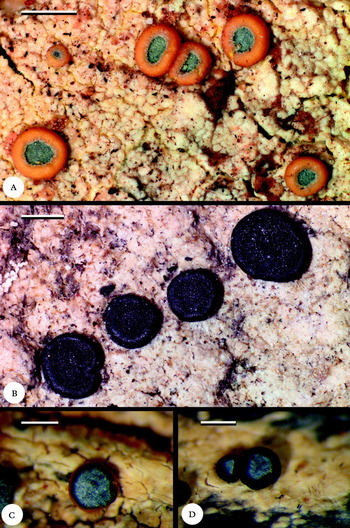
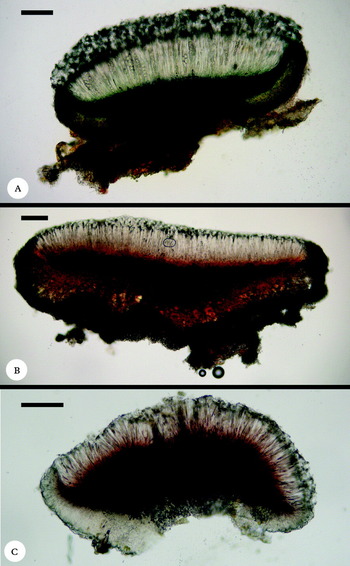
Pigmentation of the exciple of many species of Megalaria (including M. grossa) often makes the anatomy difficult to discern, and elucidation of the excipular structure is further hindered by the presence of minute crystals and/or large oil inclusions in many species. Lack of pigmentation in the outer exciple of C. endochroma and some other species is also responsible for the appearance of the apothecia (a dark disc surrounded by a yellow or orange margin; Fig. 1A), which, although superficially distinct from typical members of Megalaria (Fig. 1B), is of taxonomic consequence only at the species level. Even at this level, variation in the appearance of the apothecia within a single thallus can be large (Fig. 1 C & D). We also noted that the exciple of M. grossa is further distinguished by the presence of an inner dark-pigmented band adjacent to the proper exciple that is best interpreted as an extension of the hypothecium (Fig. 2A), although even this is also often discernable in other species of the genus (e.g., M. granulosa, Fig. 2B; M. beechingii, Fig. 2C).
Megalaria species, apothecia. A, M. endochroma (Imshaug 16277); B, M. grossa (Imshaug 36260); C & D, M. melanotropa (Imshaug 47198). Scales: A–D = 0·5 mm.

Megalaria species, apothecial sections. A, M. grossa (Imshaug 36260); B, M. granulosa (Imshaug 25234); C, M. beechingii (Lendemer 7700, isotype). Scales: A–C = 100 µm.

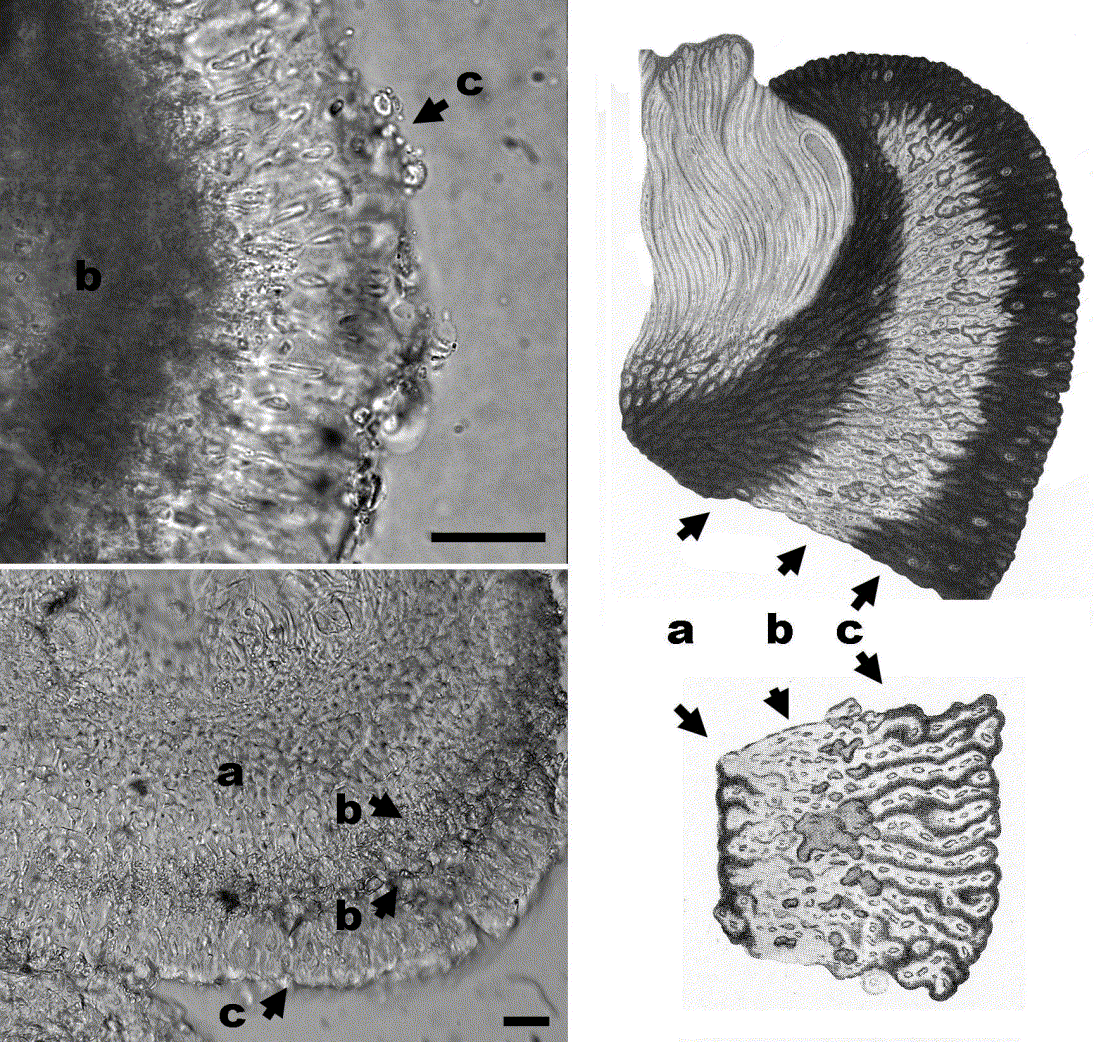
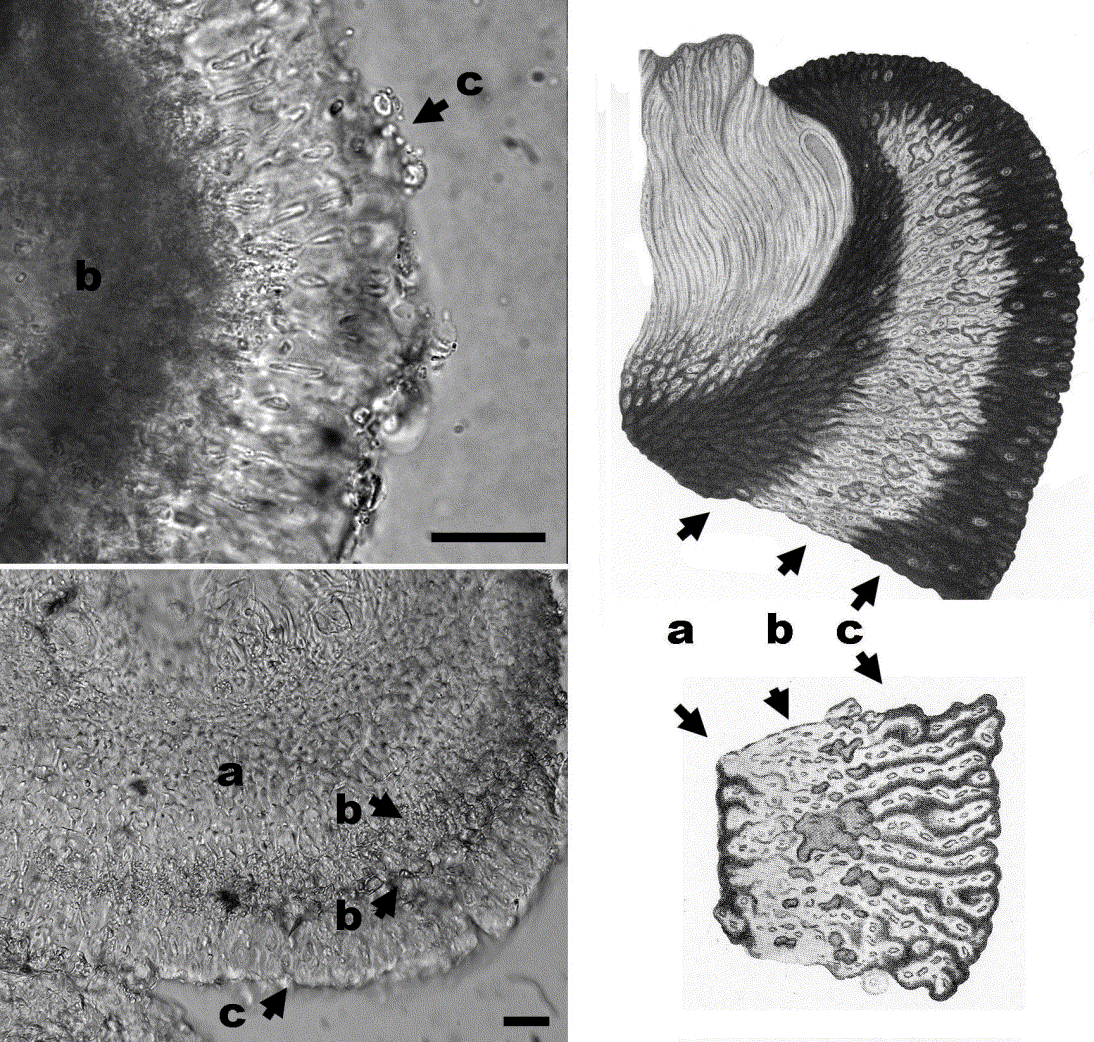
Kalb's diagnosis of Catillochroma states “similis generis Megalaria, sed excipulo dimidiato, parte exteriore prosoplectenchymatica, parte interiore textura laxe intricata”. After bleaching with C, the exciple of M. grossa was revealed to be bi-layered, consisting of an outer prosplectenchymatic layer and an inner layer of dense textura intricata, as has already been described and illustrated in detail by Galløe (Reference Galløe1929; Fig. 3 herein). Recognizing that the exciples of C. endochroma and M. grossa are both bi-layered eliminates the primary character separating the two genera and leaves the spacing of the hyphae in the layer of textura intricata (loose in Catillochroma, dense in Megalaria) as the only remaining distinguishing morphological character.
Megalaria grossa, exciple anatomy; a= hypothecium, b= inner layer of textura intricata, c= outer layer of prosoplectenchyma. Right, illustrations reproduced from Galløe (Reference Galløe1929). Left, light micrographs (note the dense inspersion of the inner exciple “b” in the upper image; Buck 47119, scales = 20 µm).
During our studies of West Indian and austral Megalaria s. lat. we discovered examples of taxa whose exciple anatomy was intermediate between the morphological extremes of the type species of Catillochroma and Megalaria. In these taxa (e.g., M. beechingii Lendemer) the development of the layer of textura intricata and the spacing of the hyphae were variable amongst apothecia from the same thallus. The discovery of taxa whose morphology could not be easily accommodated in either exciple type defined by Kalb (Reference Kalb2007) clearly indicates that the differences in the textura intricata found in the type species of Catillochroma and Megalaria represent extremes of a continuum of morphological variation.
The fact that exciple type and development of textura intricata cannot alone be used to distinguish these two genera is perhaps best illustrated by M. granulosa Kalb and C. pulverea (Borrer) Kalb. The degree of development of textura intricata in both taxa is intermediate between Catillochroma and Megalaria and yet they were placed in separate genera. Kalb gave no explanation as to why he placed these species in different genera but, given the similarity of their exciple structure, we can only surmise that it was based on thalline chemistry, which Kalb (Reference Kalb2007) used as a secondary, supporting character for his new genus, and which is discussed in detail below.
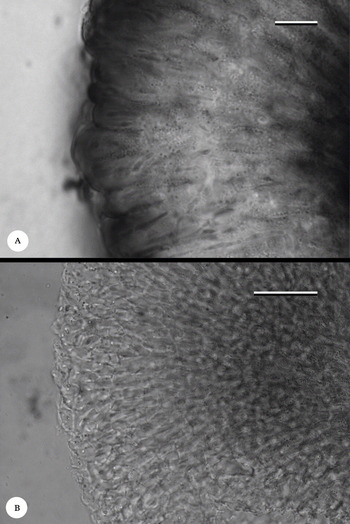
The excipular anatomy of the species assigned to Megalaria is, in fact, far more diverse than acknowledged by Kalb (Reference Kalb2007). As described previously (Fryday Reference Fryday2004b), the exciple of many species from the southern hemisphere (e.g., M. obludens (Nyl.) Fryday & Lendemer [syn. M. imshaugii Fryday], M. melanotropa), have an exciple consisting of thin, radiating hyphae with a thick gelatinous coat up to 15 µm thick, and this exciple type is also present in several tropical and northern temperate species (e.g., M. beechingii; Fig 4A). A distinctly different exciple structure is shown by several collections in MSC from the Juan Fernandez Islands that were identified by Henry Imshaug as Catillaria leucochlora (Mont.) Zahlbr. These specimens are clearly related to Megalaria but have an exciple consisting of fine, radiating, richly branched and anastomosing hyphae (Fig. 4B) reminiscent of that found in, for example, Cliostomum Fr. This species should almost certainly be removed to a separate genus but we do not do so because we have not seen type material, which is currently unavailable, only the specimens determined as this species by Imshaug. We do, however, think it appropriate to combine the epithet into Megalaria (see below), so that it is at least in the correct family.
Megalaria s. lat., exciple structure. A, M. beechingii (Lendemer 7700); B, M. leucochlora (Imshaug 37559 B). Scales: A=10 µm, B = 50 µm.

Thalline chemistry
The second character used by Kalb (Reference Kalb2007) to distinguish Catillochroma from Megalaria was thalline chemistry. Recognizing that C. endochroma produces zeorin in addition to atranorin, and that zeorin was also present in several other species with comparable excipular anatomy [e.g., C. anaglyptica (Kremp.) Kalb, C. leptocheilia (Tuck.) Kalb], Kalb clearly concluded that the presence of zeorin was a chemical character that correlated with exciple type and could be used to determine the generic placement of a species. The result was that all species of Megalaria s. lat. with zeorin were transferred to Catillochroma while all species lacking zeorin were retained in Megalaria. This is illustrated by his decision to transfer Megalaria albocincta (Degel.) Tønsberg to Catillochroma with the note that from the description of Ekman & Tønsberg (Reference Ekman and Tønsberg1996) “it became obvious that it belongs in Catillochroma”. In fact Ekman & Tønsberg (Reference Ekman and Tønsberg1996) made no mention of the exciple structure of this species and stated only that the thallus contains zeorin.
Unfortunately using the presence/absence of zeorin as a secondary character to circumscribe Catillochroma and Megalaria resulted in an artificial taxonomy where species with comparable exciple types were placed in separate genera (see above). The fallacy of this approach is further illustrated by comparing the exciples of M. granulosa (Fig. 2B), which has a thallus lacking zeorin, and M. beechingii (Fig. 2C), which has a thallus containing zeorin. The exciple of M. granulosa is composed of lax textura intricata suggesting a placement in Catillochroma but Kalb (Reference Kalb2007) retained it in Megalaria because the thallus lacked zeorin. Conversely, the exciple of M. beechingii is composed of compact tissue, suggesting it belongs in Megalaria, whereas the presence of zeorin in the thallus suggests it should be transferred to Catillochroma. Using presence/absence of a single substance as a genus level character also does not take into account the potential existence of species with entirely different chemistries; for example, xanthones. While no such species of Megalaria was known at the time Catillochroma was described, we discovered such a species, Catillaria pannosa Zahlbr., while preparing a revision of West Indian Megalaria. It is worth noting that in the related genus Tasmidella Kantvilas, Hafellner & Elix (Kantvilas et al. Reference Kantvilas, Hafellner and Elix1999), T. variabilis var. inactiva Kantvilas et al. was separated from the typical variety solely by the presence of xanthones in place of atranorin.
Other significant characters
Ascus structure
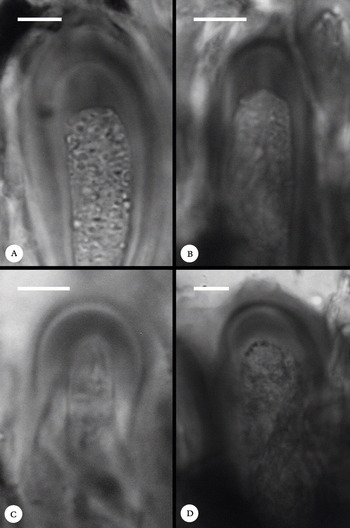
The ascus structure within Megalaria ranges from Lecanora-type in the type species (M. grossa; Fig. 5A) to Bacidia/Biatora type in the other species (Fig. 5B). Kalb (Reference Kalb2007) did not include a discussion of ascus structure in his protologue of Catillochroma but our investigations show that there is significant variation in this character within the species he transferred to the genus. The asci of the type species, C. endochroma, and its close relatives lack a masse-axiale (Fig. 5C) whereas other species have the Bacidia/Biatora type ascus typical of the rest of Megalaria (except M. grossa). This supports recognizing the endochroma-group as distinct from Megalaria, an approach with which we have no argument, but it also clearly shows that the other species should not be included with it and are best retained in Megalaria. Since Kalb and Hafellner (Kalb Reference Kalb1990) separated Lopezaria from Megalaria by the ascus lacking a masse-axiale, there is clearly some similarity between the endochroma-group and Lopezaria. However, we prefer, at this stage, to retain all the species in Megalaria rather than transferring the endochroma-group to Lopezaria for reasons explained in more detail below.
Megalaria s. lat, immature asci. A, M. grossa (Imshaug 36260); B, M. laueri (Wetmore 1368); C, M. endochroma (Imshaug 16277); D, M. versicolor (Imshaug 14077). Scales: A–D = 10 µm.

Conidia
Pycnidia are generally rare in Megalaria and related genera. Ekman & Tønsberg (Reference Ekman and Tønsberg1996) stated that they were known from only two species; conidia having been reported as ellipsoid to oblong, 3–4 × 1·5–3 µm in M. grossa by Coppins (Reference Coppins, Purvis, Coppins, Hawksworth, James and Moore1992), whereas Ekman & Tønsberg themselves reported them from M. columbiana as ampulliform, c. 2·5 × 1·5 µm. In addition, Sipman (Reference Sipman1983) described the conidia of Lopezaria versicolor (Flot.) Kalb & HafellnerFootnote 1 as ampulliform, c. 3·5 × 1 µm, and Kantvilas et al. (Reference Kantvilas, Hafellner and Elix1999) described the conidia of the new genus Tasmidella as bacilliform to filiform 12–14 × 1 µm. In the present study, conidia were observed in only two species; M. melanotropa, in which they were rare and resembled those of M. grossa (ellipsoid/oblong, 4–6 × 1·5–2·5 µm), and M. leucochlora, in which they were frequent and ± globose (2–3 µm).
This diversity of conidial types, which do not appear to correspond with any of the other characters discussed here, emphasizes the complexity of defining genera within Megalaria s. lat. and is further supporting evidence for retaining all the species in a widely circumscribed Megalaria pending a full systematic study. However, the frequency and unique shape of the conidia in M. leucochlora re-affirms the peripheral position of that species in the genus suggested by its exciple anatomy (see above).
Lopezaria Kalb & Hafellner
The genus Lopezaria was introduced by Kalb & Hafellner (Kalb Reference Kalb1990) for Lopezaria versicolor, a tropical species that was previously included in Megalospora Meyen by Zahlbruckner (Engler & Prantl Reference Engler and Prantl1907) and transferred to Catinaria Vain. by Sipman (Reference Sipman1983). The placement of this species in Catinaria by Sipman indicates that he considered it to be congeneric with M. grossa, which was also accommodated in Catinaria at that time (Sipman Reference Sipman1983).
Investigation of L. versicolor showed that it was clearly related to Megalaria, a position supported by molecular evidence that placed it in the Ramalinaceae (Miądlikowska et al. 2006). In addition, as noted by Sipman (Reference Sipman1983), it had a two-layered exciple with a medulla of loose textura intricata; that is, an exciple similar to that of C. endochroma. Sipman (Reference Sipman1983) also noted that the thallus contained “zeorin and atranorin, usually in small amounts”, which would be consistent with Catillochroma. However, we studied 12 collections of L. versicolor from MSC with TLC and found only atranorin. Kalb & Hafellner (1990) distinguished Lopezaria from Megalaria by it having an ascus with an amyloid tholus lacking a masse-axiale (Fig. 5D) but, as discussed above, investigation of the ascus of C. endochroma showed that this species had an identical ascus structure (Fig. 5C). Therefore Lopezaria differs from Catillochroma in only two characters; the absence of zeorin in the thallus, which has been shown above not to be a consistent character at the genus level, and the larger ascospores (40–50 × 15–25 µm), which are not significantly larger than those of M. grossa (20–30 × 10–15 µm) or M. macrospora (28–36 × 14–17 µm), and are the same length as those of M. allantoidea (Fryday Reference Fryday2007). Some of the ascospores of L. versicolor also have the “small indentation from the spore lumina into the spore septum” as illustrated by Hafellner (Reference Hafellner1984) and mentioned by Ekman & Tonsberg (Reference Ekman and Tønsberg1996) as characteristic of some species of Megalaria s. lat. Consequently, we consider that, if the endochroma group is recognized as distinct from Megalaria, it should be included in Lopezaria.
The only other species referred to Lopezaria, L. isidiza (Makhija & Nagarkar) Aptroot & Sipman, is, according to Sipman (Reference Sipman1983), similar to L. versicolor, but differs in being isidiate, having an excipular medulla composed of compact tissue and lacking any lichen substances in its thallus. The type specimen of L. isidiza was not available for this study, but Sipman's description is confirmed by an isidiate collection from Jamaica that has similar ascospores to those of L. versicolor and an excipular medulla of compact tissue. Consequently, although the type species of Catillochroma (C. endochroma) is apparently more closely related to the type species of Lopezaria (L. versicolor) than to the type species of Megalaria (M. grossa), we prefer not to transfer the endochroma-group to Lopezaria, because this would leave L. isidiza, which is clearly closely related to L. versicolor, in an isolated position.
Conclusions
Considering the above, and lacking molecular evidence to the contrary, it seems clear that the present distinction between Megalaria and Catillochroma cannot be maintained. The current circumscription of these genera has resulted in a highly artificial taxonomy where morphologically similar species have been placed in separate genera on the basis of perceived differences in exciple type that, in fact, form a continuum, and minor differences in thalline chemistry that do not correlate with the supposedly different exciple types. We believe that, as discussed by Ekman & Tønsberg (Reference Ekman and Tønsberg1996) and shown by Ekman (Reference Ekman2001), Megalaria s. lat. is a monophyletic group, and thus is an acceptable taxonomic unit at the genus level. However, as we have shown, the species currently included in Catillochroma do not form a monophyletic group and that by removing these species from Megalaria that genus is also rendered paraphyletic.
One solution to this problem, as outlined by Lendemer & Knudsen (Reference Lendemer and Knudsen2008), would be to restrict Catillochroma to its type species and its close relatives, retaining the rest of the species in a broadly circumscribed Megalaria. However, while accepting that the C. endochroma group may be monophyletic, we consider that they are best retained within Megalaria because the synapomorphies characterizing the genus, at least as defined by Kalb, are part of a continuum within Megalaria and that removing them from Megalaria is, at best, premature because this would most likely render Megalaria paraphyletic. We also believe that this group is most closely related to Lopezaria, but prefer not to include it in this genus because of uncertain generic limits within Megalaria s. lat. that can only be resolved by a full molecular/morphological/chemical investigation.
Another solution could be to restrict Megalaria to its type species, and transfer the remainder of the species to Catillochroma. However, this solution has already been strongly rejected by Ekman & Tønsberg (Reference Ekman and Tønsberg1996), with whom we agree, and this position is reinforced by the arguments presented above, which show that the exciples of the type species of both genera are bi-layered and that they differ from one another only in the degree of the development of a layer of textura intricata. It would also result in the creation of numerous, probably superfluous taxonomic novelties because we are convinced that some of the species that would be transferred to Catillochroma are more closely related to the type species of Megalaria than to the type species of Catillochroma.
Given this, it seems that the only solution that would result in a morphologically discrete generic circumscription would be the continued recognition of a broadly defined Megalaria that includes the species currently placed in Catillochroma and Lopezaria. Therefore we propose the transfer of all species of Catillochroma and Lopezaria to Megalaria, including the type species C. endochroma and L. versicolor, and thus place these two genera into synonymy with the latter.
Transfer of Catillochroma species to Megalaria
Megalaria albocincta (Degel.) Tønsberg
In Ekman & Tønsberg, Bryologist 99(1): 39 (1996).—Catillaria albocincta Degel., Kungl. Vet. Vitterh. Samh. Handl. F. 6, Ser. B, 1(7): 11 (1941).—Catillochroma albocincta (Degel.) Kalb Biblioth. Lichenol. 95: 299 (2007); type: Azores, Terceira, toppen av St. Barbara, 24 iv 1937, H. Persson (UPS—holotype).
Chemistry. Atranorin, zeorin, +/−fumarprotocetraric acid.
Megalaria anaglyptica (Kremp.) Fryday & Lendemer comb. nov
MycoBank No.: MB 518124
Lecidea anaglyptica Kremp., Vidensk. Meddl. Dansk Naturhist. Foren. København, 1–4: 21 (1874 [1873]).—Catillochroma anaglyptica (Kremp.) Kalb & Hafellner, Biblioth. Lichenol. 95: 300 (2007); type: Brazil, Minas Gerais, Serra da Piedade, E. Warming 101 (M—holotype).
Chemistry. Atranorin, zeorin, fumarprotocetraric acid.
Megalaria endochroma (Fée) Fryday & Lendemer comb. nov
MycoBank No.: MB 518125
Lecanora enodochroma Fée, Essai sur les cryptogams des écorces exotiques officinales, 114 (1825 [1824]).—Catillochroma endochroma (Fée) Kalb, Biblioth. Lichenol. 95: 300 (2007); type: America meridionali, ad Cinchonas (G— holotype).
Chemistry. Atranorin, zeorin, pigments.
Selected specimens examined. Dominican Republic: ridge above Los Amaceyes, 3000–3200 ft. Cordillera Septentriona, l958, Imshaug 23307 (MSC).—Grenada: St. George Parish: Cocoa plantation, Annandale Falls, 500 ft., on coconut trunk, 1953, Imshaug 16277 (MSC).
Megalaria intermiscens (Nyl.) Fryday & Lendemer comb. nov
MycoBank No.: MB 518126
Lecidea intermiscens Nyl., Bull. Soc. Linn. Normandie, ser. 2, 2: 84 (1868).—Catillochroma intermiscens (Nyl.) Kalb, Biblioth. Lichenol. 95: 301 (2007); type: Brazil, Rio de Janeiro, Serra dos Orgãos, Helmreich (W—holotype).
Chemistry. Atranorin, zeorin.
Megalaria leptocheila (Tuck.) Fryday & Lendemer comb. nov
MycoBank No.: MB 518127
Lecidea leptocheila Tuck. in Nyl., Ann. Sci. Nat., ser. 4, 19: 351 (1863).—Catillochroma leptocheila (Tuck.) Kalb, Biblioth. Lichenol. 95: 302 (2007); type: Cuba, C. Wright s. n. = Lich. Cub. 227 (FH—holotype).
Chemistry. Not tested (thallus too thin).
Megalaria melanotropa (Nyl.) D. J. Galloway
N. Z. J. Bot. 42(1): 115 (2004).—Catillochroma melanotropa (Nyl.) Kalb, Biblioth. Lichenol. 95: 303 (2007).—Lecidea melanotropa Nyl., Bot. J. Linn. Soc., 9: 255 (1866); type: New Zealand, Otago, Dunedin, x 1861, W. L. Lindsay (H-Nyl—holotype).
Chemistry. Atranorin, zeorin.
Selected specimens examined. New Zealand: Campbell Island: coastal rocks with adjacent Dracophyllum and Hebe, northeast of Beeman Station, on Dracophyllum scoparium, 1979, Imshaug 47198 (MSC); ibid, tall Dracophyllum scrub in very moist site along stream south of Tucker Cove Station, on Dracophyllum scoparium, 1969, Harris 4882 (MSC).
Megalaria pulverea (Borrer) Hafellner & E. Schreiner
Biblioth. Lichenol. 45: 146 (1992).—Catillochroma pulverea (Borrer) Kalb, Biblioth. Lichenol. 95: 303 (2007).—Lecidea pulverea Borrer in Hooker & Sowerby, Suppl. Eng. Bot. 2: tab. 2726 (1834); type: [Great Britain], England, [Hampshire], New Forest, on oak-bark, 1807, C. Lyell (BM —holotype).
Chemistry. Atranorin, zeorin, +/− fumarprotocetraric acid.
Specimen examined. Great Britain: England: V.C. 3, South Devon, Dartmoor, Okehampton, Throwleigh Blackaton Brook, on bole of Quercus in sheltered, rather moist woodland, 14 xii 1975, James (CANL).
Transfer of Lopezaria species to Megalaria
Megalaria isidiza (Makhija & Nagarkar) Fryday & Lendemer comb. nov
MycoBank No.: MB 518134
Megalospora isidiza Makhija & Nagarkar, Current Science 50: 823 (1981).—Catinaria isidiza (Makhija & Nagarkar) Sipman, Biblioth. Lichen. 18: 171 (1983).—Lopezaria isidiza (Makhija & Nagarkar) Aptroot & Sipman, in Aptroot, Saipunkaew, Sipman, Sparrius & Wolseley, Fungal Diversity 24: 110 (2007); type: India, Maharashtra, Mahabaleshwar, in moist evergreen forest, 28 xi 1974, A. V. Prabhu & M. B. Nagarkar (AMH).
Chemistry. Nil by TLC.
Specimen examined. Jamaica: Parish of St. Thomas: Corn Puss Gap Forest Hut, montane rain forest. 3500 ft., 1952, Imshaug 13463 (MSC).
Megalaria versicolor (Flot.) Kalb & Hafellner Fryday & Lendemer comb. nov
MycoBank No.: MB 518133
Heterothecium versicolor Flot., Bot. Zeitung (Berlin) 8: 555. (1850).—Megalospora versicolor (Flot.) Zahlbr., in Engler & Prantl, Nat. Pflanzenfam., Teil. I (Leipzig) 1*: 134 (1907).—Catinaria versicolor (Flot.) Sipman, Biblioth. Lichenol. 18: 172 (1983).—Lopezaria versicolor (Flot.) Kalb & Hafellner, in Kalb, Lichenes Neotropici, Fascicle XI (nos 451–475) (Neumarkt): 2, no. 464 (1990); type: in America meridionali, ad Cinchonam, hb. Fée (G).
Chemistry. Atranorin.
Selected specimens examined. Jamaica: St. Andrew parish: Silver Hill Gap, 3450 ft., 1953, Imshaug 14077 (MSC); ibid., Flora River, 2700 ft., 1953, Imshaug 14405 (MSC); ibid., Bellevue to Mt. Rosanna, 3800 ft, 1953, Imshaug 14508 (MSC).
Other New Combinations in Megalaria
Megalaria leucochlora (Mont.) Fryday & Lendemer comb. nov
MycoBank No.: MB 518128
Parmelia varia var. leucochlora Mont., Annls Sci. Nat., Bot., sér. 2 4: 91 (1835).—Parmelia leucochlora (Mont.) Mont., Annls Sci. Nat., Bot., sér. 3 18: 310 (1852); type: Chile, Juan Fernández, Más a Tierra, auf Rinde, 1830, Cl. Bertero 1616 (PC—holotype).
Chemistry. Atranorin.
Selected specimen examined. Chile: Juan Fernandez Islands: Mas A Tierra; El Yunque, Portezuelo de Villagra, on narrow ridge at saddle, 570 m., scrub and brushwood, 1965, H. A. Imshaug 37559 B (MSC).
Megalaria melanopotamica (I. M. Lamb) Fryday & Lendemer comb. nov
MycoBank No.: MB 518129
Catillaria melanopotamica I. M. Lamb, Farlowia 4: 445 (1955); type: Argentina, Patagonia, Rio Negro, insula Victoria in lacu Nahuel Huapi, ad corticum Nothofagi, 1950, I. M. Lamb 5815 (CANL—holotype; !FH, SI—isotypes).
Chemistry. Nil by TLC.
Megalaria obludens (Nyl.) Fryday & Lendemer comb. nov
MycoBank No.: MB 518130
Lecidea obludens Nyl. Lich. Fueg et Patag.: 12 (1888); type: Chile, Isla Basket, 1882, Spegazzini (!H–Nyl—holotype).
Megalaria imshaugii Fryday syn. nov., Biblioth. Lichenol. 88: 136 (2004); type: New Zealand, Campbell Island, Beeman Hill, 1979, Imshaug 47051 (!MSC—holotype).
Chemistry. No substances by TLC.
Megalaria pannosa (Zahlbr.) Fryday & Lendemer comb. nov
MycoBank No.: MB 518131
Catillaria pannosa Zahlbr., Mycologia, 22: 77 (1930); type: Porto Rico, Mayaguez, open roadside, on mango bark, B. Fink 1097 (!W—holotype; !NY—isotype).
Chemistry. Xanthones.
Additional specimens examined. Porto Rico: Mayagüez District: Maricao State Forest, 1989, Harris 24021 (NY), Harris 24034 (NY).—USA: Florida: Highlands Co., Archbold Biological Station, on Persea, 1998, Harris 41811 (NY); Manatee Co., Upper Myakka River Watershed, on Nyssa, 1998, Harris 42012 (NY).
Megalaria phaeolomiza (I. M. Lamb) Fryday & Lendemer comb. nov
MycoBank No.: MB 518132
Catillaria phaeolomiza I. M. Lamb, Farlowia 4: 447 (1955); type: Argentina, Patagonia, Nahuel Huapi, loco accuraticus non indicato, corticola, 1943, L. E. Cannelle 120 (LIL—holotype; !FH—isotype).
Chemistry. Atranorin or nil (type).
Excluded Species
Megalaria semipallida (C. Knight) D. J. Galloway
N. Z. J. Bot. 42: 115 (2004.)—Lecidea semipallida C. Knight, Trans. N. Z. Inst. 12: 376 (1880); type: New Zealand, sine loco (probably Wellington), C. Knight (WELT—lectotype; !H–Nyl—isolectotype).
This name was included in the synonymy of Micarea denigrata by Czarnota (Reference Czarnota2007), which is clearly correct.
Megalaria subcarnea (Müll. Arg.) D. J. Galloway
N. Z. J. Bot. 42: 116 (2004).—Patellaria subcarnea Müll. Arg., Hedwigia 32: 128 (1893); type: New Zealand, Stewart Island, T. Kirk (!BM—holotype).
The collection is small so was not investigated in detail but it is certainly not a species of Catillochroma, Megalaria or Cliostomum. From the form of the thallus, the fusiform shaped ascospores and other anatomical details, it is most probably a species of Coenogonium, and from the orange-red colour of the apothecia it may be an earlier name for Coenogonium rubrofusca (Vězda & Malcolm) Malcolm.
Megalaria variegata (Müll. Arg.) D. J. Galloway
N. Z. J. Bot. 42: 116 (2004).—Patellaria variegata Müll. Arg., Bot. J. Linn. Soc. 32: 205 (1896); type: New Zealand, sine loco, W. Colenso (!BM—lectotype).
This name is a synonym of Cliostomum griffithii (Sm.) Coppins.
We acknowledge the assistance of the US National Science Foundation (NSF) for Awards No. DBI–9808735 and DBI–0237401 (Alan Prather, PI) to Michigan State University that facilitated access to Dr Imshaug's extensive collections. We also thank the curators of BM, CANL, FH, and H-Nyl for the loan of specimens in their care, and Dr Richard Harris (NY) for suggesting that Lopezaria may be related to Megalaria.