Introduction
The effect of agricultural produce on food safety, health and the environment has gained the increasing attention of consumers around the world, particularly in the developed countries. Developed countries’ interests are primarily focused on certified organic production. However, as a developing country, Thailand has adopted various levels of ‘clean and safe’ agricultural production. Its market demand continues to increaseReference Vanit-Anunchai, Schmidt, Batt and Jayamangkala 1 – Reference Johnson, Weinberger and Wu 3 , but the lack of ‘clean and safe’ produce of good quality and in sufficient variety constrains the development of a ‘clean and safe’ vegetable industryReference Posri, Shankar and Chadbunchachai 2 , Reference Kramol, Thong-ngam, Gypmantasiri, Davies, Batt and Jayamangkala 4 , Reference Lorlowhakarn, Boonyanopakun, Ellis, Panyakul, Vildozo and Kasterine 5 .
We analyze the productivity of smallholder farms operating in different ‘clean and safe’ vegetable farming systems in northern Thailand because productivity gains can help overcome this constraint on development of the industry. ‘Clean and safe’ farmers are categorized into three groups based on their use of synthetic chemicals: organic, pesticide-free and safe use of chemicals and synthetic fertilizers. Organic farming uses biological and ecological processes adapted to local conditions, rather than the use of chemicals or synthetic fertilizers 6 . Pesticide-free and safe-use practices, on the other hand, are possible stages before converting conventional farms to organic farms, but there is no single path from conventional to organic and farmers may go organic and opt out again. These different classifications of farmers also imply a different classification of farming systems, which are OV, PFV, SUV and CV for organic vegetable, pesticide-free vegetable, safe-use vegetable and conventional vegetable farming systems, respectively. Technical efficiencies (TEs) of farms in the three ‘clean and safe’ farming systems plus the conventional farming system were predicted using stochastic frontier analysis. To make productivity comparisons across farming systems, a metafrontier approach was employed that enables the estimation of metatechnology ratios (MTRs), which show the extent of technology gaps between farming systems.
Our objectives were to evaluate farm performance and to identify factors affecting productivity in different vegetable farming systems. This paper is organized as follows. First, we give a brief overview of ‘clean and safe’ vegetable farming systems in northern Thailand. Issues of productivity differences between ‘clean and safe’ farming systems are then discussed, after which we describe the analytical framework incorporating stochastic frontier analysis and metafrontier analysis. Results and their implications are presented and discussed in the next two sections and we end with some conclusions.
‘Clean and Safe’ Farming Systems in Thailand
‘Clean and safe’ agricultural systems in Thailand have been promoted by government agencies and non-government organizations (NGOs) for sustainable economic development and to increase awareness of health and environmental hazards. Although rice is the most important crop in Thailand based on consumption, production and income, vegetable crops are also significant as an alternative source of household income and are considered essential foods, particularly in northern Thailand. When food safety issues are considered, vegetables are subject to a high risk from chemical contamination because of production practices and consumption behaviorReference Posri, Shankar and Chadbunchachai 2 , Reference Vanit-Anunchai 7 .
The development of organic farming, which was the only recognized ‘clean and safe’ agriculture in the 1980s, was driven mainly by NGOs to counter the adverse effects of Green Revolution production technologies. ‘Clean and safe’ systems first appeared in home gardens and were expanded to commercial farmsReference Panyakul 8 . They have captured wider public interest since 2001 after the Thai government implemented a series of policies related to ‘clean and safe’ food and farming, which included the Act that declared ‘Food Safety Year Campaign in 2004’. Organic agriculture was promoted as a national agenda item covering issues such as food safety, soil and natural resources conservation and farmer awareness of consumers’ health. In 2008, the National Organic Agriculture Development Board was established in collaboration with government agencies, private organizations, NGOs and resource persons from farmer groups and academia. It aims to improve the quality of life of farmers and consumers, promote food security, reduce poverty and enhance capacity in organic production and marketing. Four strategies were formulated to achieve the goals: focusing on consolidating the knowledge base, capturing local knowledge, marketing improvement and networking 9 .
Northern Thailand, particularly Chiang Mai Province, is considered as the most promising and important vegetable-producing region in Thailand, with its diverse ecosystems and favorable growing conditions for tropical and sub-tropical crop speciesReference Gypmantasiri, Puangmanee, Thong-ngam, Chowsilpa and Limnirankul 10 . ‘Clean and safe’ farming systems in northern Thailand were initially practiced by smallholder farmers in their home gardens. After ‘clean and safe’ agricultural products became important among traders and government organizations, the systems were also adopted commercially near big cities.
Agricultural conversion to ‘clean and safe’ production systems, including organic farming practices, is widely encouraged in northern Thailand by the organic or sustainable agriculture initiatives of NGOs. Also, government policies aimed at making Thailand an integral part of the ‘world kitchen’ and to provide safe food worldwide have been developed for implementation by both public and private organizationsReference Kramol, Thong-ngam, Villano and Kristiansen 11 . Two common types of marketing systems, following different approaches, are operating for farmers using ‘clean and safe’ farming systems. The first type is based on self-sufficiency, emphasizing household food security, food safety and income stabilityReference Panyakul 8 . This marketing system is often organized through groups and networks, encouraged mainly by NGOs, and by government organizations and universities. Natural ecosystems with a polyculture of local vegetables, herbs, medicinal plants and fruit crops have been established in home gardens. Outputs are sold mostly in alternative markets such as farmers’ markets, fairs and special retail outlets that sell ‘green’ and ‘healthy’ products. Only a few smallholder farmers distribute their organic produce to supermarkets and hypermarkets. The second type is focused more on the market-driven organic production system and is mostly adopted by private exporters and organizations such as the Royal Project FoundationReference Kramol, Thong-ngam, Gypmantasiri, Davies, Batt and Jayamangkala 4 . The produce is mainly distributed locally to supermarkets and hypermarkets, and exported to overseas markets.
‘Clean and safe’ agriculture in northern Thailand is in various stages of conversion from a heavy dependence on chemicals to no use of chemicals. Following McCoy and ParlevlietReference McCoy and Parlevliet 12 , the ‘clean and safe’ vegetable farming practices in Thailand range from production practices that allow the use of chemical inputs through safe-chemical use and pesticide-free production to no chemical use with environmentally friendly practices (organic farming). Organic farming is ideal among ‘clean and safe’ farming systemsReference McCoy and Parlevliet 12 in that it allows the use of organic substitutes such as organic fertilizers and herbal pesticides rather than synthetic chemicals. Safe-use and pesticide-free farming are therefore intermediate practices between the organic and conventional farmingReference McCoy and Parlevliet 12 . A pesticide-free farming system is considered as a step taken before organic practice since its systems tend to have similar concepts to organic farming systems. However, the pesticide-free method allows the use of synthetic fertilizers to improve farmers’ ability to enhance vegetable yields. The safe-use farming system permits the use of synthetic or artificial chemical fertilizers, insecticides, fungicides and herbicides provided the practices strictly follow the system's guidelines. Produce from this system is normally tested for safe levels of chemical residues. This farming practice follows the ‘good agricultural practice’ guidelines developed by the Departments of Agriculture and Agricultural ExtensionReference Salakpetch, Hu and Bejosano-Gloria 13 . Conventional farms use mainstream production practices that conform to the standard, dominant farming approachReference Kristiansen, Taji, Reganold, Kristiansen, Taji and Reganold 14 .
The four systems are also different in terms of the degree of crop diversification on their farms. Organic farms are likely to have more vegetable species than the other production systems, whereas conventional farms have the least variety of vegetable species. Pesticide-free farmers tend to cultivate numerous cash vegetables based on market demand, whereas safe-use farms are placed between pesticide-free farms and conventional farms in terms of farm diversification and number of vegetable species.
‘Clean and safe’ and conventional vegetable farming systems adopt different marketing practices. PFV are commonly sold in the same markets as organic produce, whereas SUV are mainly sold through conventional markets and partly distributed through farmer markets, institutional markets and fairs. CV are generally distributed through traders to wholesale markets.
Productivity Differences in ‘Clean and Safe’ Vegetable Farming
There is sparse literature on the productivity and efficiency of ‘clean and safe’ farming systems, especially in Thailand. Thai studies on ‘clean and safe’ farming productivity are concentrated on rice crops, comparing the profitability and performance of organic and conventional rice farmingReference Setboonsarng, Leung and Cai 15 , Reference Songsrirote and Singhapreecha 16 as reported by KramolReference Kramol 17 .
Studies on efficiency and productivity in organic farming in other countries have focused on livestock, dairy and mixed crop farms, particularly in Europe. Previous studies compared organic and conventional farms by estimating separate production frontiers using data envelopment analysis (DEA) and stochastic frontier analysis. Oude Lansink et al.Reference Oude Lansink, Pietola and Backman 18 compared the efficiency and productivity of conventional and organic crop and livestock farms in Finland using DEA. They concluded that organic farms are more efficient relative to their own technology but use significantly less productive technology than conventional farms. Kumbhakar et al. Reference Kumbhakar, Tsionas and Sipiläinen 19 found that organic dairy farms in Finland were 5% less efficient than conventional farms. In Italy, MadauReference Madau 20 concluded that organic cereal farms used their variable resources less efficiently than conventional cereal farms although the mean TE estimates were close at 0.831 and 0.902, respectively. The study also showed that efficiency played a crucial role in affecting productivity in the organic process. Sipiläinen and Oude LansinkReference Sipiläinen and Oude Lansink 21 controlled for possible selection bias and regional heterogeneity to estimate the TE in organic and conventional dairy farming in Finland, and its development over time. They found that the TE scores of organic farms with respect to their own frontier were less than those for conventional farms. However, after 6–7 years from the switch to organic production, TEs started to increase again, highlighting the significance of the learning process during a transition phase.
Method of Analysis
There are two concerns in our attempt to measure production efficiency in different farming systems. First, self-selectivity biasReference Heckman 22 needs to be considered in order to avoid bias from the self-selection by farmers to belong to one of the four farming systems. Secondly, estimation of the traditional stochastic frontier model to compare TEs among the four farming systems is not appropriate. To overcome the latter problem, the metafrontier approach is adopted.
Three processes were followed. First, we estimated a farmers’ decision model using multinomial logit analysis, including a selection variable from the decision model in the estimated stochastic frontier model, and tested for the existence of self-selectivity bias. Secondly, we estimated individual vegetable farm frontiers and tested for differences in production technologies. Finally, we estimated MTRs and TEs by using a metafrontier framework.
HeckmanReference Heckman 22 was first to warn that sample selection bias may arise in practice because the decision-making units belong to a particular group being investigated through a process of self-selection. The estimation of behavioral relationships is considered to arise from the problem of omitted variables. Following HeckmanReference Heckman 22 , joint estimation of the decision and production models includes the determinants of selecting among four farming systems and the determinants of productivity in vegetable production. A selection variable, the inverse Mill's ratio (IMR), was included in the production frontier model to test for self-selectivity bias. The result of a likelihood ratio test conclusively does not reject the null hypothesis that the coefficient of the IMR variable is zero. A t-test on the IMR variable shows the same result. Therefore, it was concluded that self-selectivity bias does not exist in this study.
After testing for self-selectivity bias, we then employed the other two estimation procedures. First, stochastic frontier analysis was used to analyze TE in different farming systems. Secondly, a metafrontier approach was applied to discern technology gaps between the farming systems.
Stochastic frontier analysis
The stochastic frontier model is able to measure a composed error structure in production function estimationReference Aigner, Lovell and Schmidt 23 . A two-sided symmetric error captures the random effects that are beyond the control of the producer. A one-sided error component captures technical inefficiency. The stochastic production frontier model is represented as:
 $$Y_i = f\,(X_i, {\rm \beta} )e^{V_i - U_i}, \quad \; i = {\rm 1},\,{\rm 2}, \ldots, \,N$$
where Y i is the scalar output of the ith farm; X i is a vector of N inputs used by producer i; f(X i , β) is the production frontier; and β is a vector of technology parameters that need to be estimated. V i is intended to capture the effect of statistical noise and U i expresses the technical inefficiency in production.
Metafrontier analysis
The metafrontier framework was first introduced by HayamiReference Hayami 24 and Hayami and RuttanReference Hayami and Ruttan 25 , Reference Hayami and Ruttan 26 , and was developed extensively by Battese and RaoReference Battese and Rao 27 , Battese et al.Reference Battese, Rao and O'Donnell 28 and O'Donnell et al.Reference O'Donnell, Rao and Battese 29 . It provides a basis to compare TE and productivity among farmers using different production technologies and operating in different farming environments. Following Villano et al.Reference Villano, Mehrabi Boshrabadi and Fleming 30 , the use of metafrontier concept in the context of ‘clean and safe’ farming systems is appropriate given the differences associated with the inherent nature of use of inputs in each farming system and the different environments where vegetables are grown. To date, no studies have used this approach to compare conventional farms with farms using different ‘clean and safe’ production technologies.
Farmers in different circumstances (such as logistics and systems) face different production opportunities and make choices from different technology sets with varying sets of feasible input and output combinations. Technology sets differ in terms of human capital, economic infrastructure, resource endowments and socio-economic environment. As a result, frontiers should be estimated separately for each technology set in order to measure the TE of the different groups of farms. However, the comparison of efficiency levels measured relative to different frontiers is commonly unattainable because one frontier may not be comparable to another. The metafrontier framework allows the comparison of technical inefficiencies across a number of firms in an industry (in this study, vegetable farms with different production systems) that use different technologies. Measurement of the technology gap is undertaken in order to make this comparison. The boundary of an unrestricted technology set is defined as a common metafrontier, while the boundaries of restricted technology sets are defined as group frontiers.
As the metafrontier envelops the group frontiers, efficiencies measured relative to the metafrontier can be divided into two components. The first component is associated with the common measure of TE that measures the distance from an input–output relative to the group frontier. The other component measures the distance between the group frontiers and the metafrontier, which corresponds to the restrictive characteristics of the production technologies residing in the four vegetable farming systems in our study.
Equation (1) can be re-expressed as a stochastic frontier of each group-k frontier model asReference Battese and Rao 27 :
 $$Y_i^k = f\,(X_i, {\rm \beta} ^k )e^{V_i^k - U_i^k} $$
 $$Y_i^k = f(X_i, {\rm \beta} ^k )e^{V_i^k - U_i^k} \equiv e^{X_i {\rm \beta} ^k + V_i^k - U_i^k} $$
where X
i
is the input quantity of the ith firm; β
k
is an unknown parameter vector associated with the kth group; V
i
k
represents statistical noise and is assumed to be independently and identically distributed as
 $N(0,\sigma _{V^k} ^2 )$
random variables; and U
i
k
represents the technical inefficiency that is defined by the truncation (at zero) of the
 $N{\rm (}\mu _i^k, \sigma _{U^k} ^2 {\rm )}$
distributions. The expected values of U
i
k
, given by μ
i
k
, are defined by a model containing a set of explanatory variables and an unknown vector of coefficients to be estimated. The μ
i
k
can have different distributional assumptions, for example, following StevensonReference Stevenson
31
, Kumbhakar et al.Reference Kumbhakar, Ghosh and McGuckin
32
and Battese and CoelliReference Battese and Coelli
33
.
The TE of the ith firm with respect to the group-k frontier can be obtained using:
 $${\rm TE}_i ^k = \displaystyle{{Y_i^k} \over {e^{X_i {\rm \beta} ^k + V_i^k}}} = e^{ - U_i^k} $$
A stochastic metafrontier production function model in all firms can be expressed as:
 $$Y_i^* = f\,(X_i, {\rm \beta} ^* ) \equiv e^{X_i {\rm \beta} ^*} $$
where
 $Y_i^* $
is the metafrontier output and β* is the vector of metafrontier parameters satisfying the constraints:
 $$X_i {\rm \beta} ^* \geqslant X_i {\rm \beta} ^k \quad \; {\rm for}\,{\rm all}\quad k = {\rm 1},{\rm 2}, \ldots, K$$
The constraints given by Equation (5) imply that the metafrontier function cannot fall below any of the group frontiers.
An estimated metafrontier function that envelops the estimated group frontiers was obtained by applying the optimization problemReference O'Donnell, Rao and Battese 29 .
Equation (2) can be alternatively expressed in terms of the metafrontier function in Equation (4) as:
 $$Y_i = e^{ - U_{_i} ^k}. \displaystyle{{e^{X_i {\rm \beta} ^k}} \over {e^{X_i {\rm \beta} ^*}}}. e^{X_i {\rm \beta} ^* + V_{_i} ^k} $$
where
 $e^{ - U_{_i} ^k} $
is defined by Equation (3), the TE of the ith firm with respect to the group k frontier. The second term represents the MTR.
 $${\rm MTR}_i ^k = \displaystyle{{e^{X_i {\rm \beta} ^k}} \over {e^{X_i {\rm \beta} ^*}}} \quad \; {\rm where}\quad 0 \leqslant {\rm MTR} \leqslant 1$$
The MTR measures the ratio of the output in the frontier production function for the kth group relative to the potential output defined by the metafrontier function. As the value of MTR approaches 1, the gap between the group frontier and the metafrontier decreases.
The TE of the ith firm relative to the metafrontier is denoted by TEm i and is defined in a similar way to Equation (3). It is the ratio of the observed output relative to the metafrontier output—the last term on the right-hand side of Equation (6). TE is then defined as:
 $${\rm TE}{m}_i = \displaystyle{{Y_i} \over {e^{X_i {\rm \beta} ^* + V_{_i} ^k}}} $$
The TE relative to the metafrontier is the ratio of the observed output to the frontier output. Then,
 $${\rm TE}{m}_i = {\mathop {{\rm TE}_i ^k} \limits^ \wedge} \times {\mathop {{\rm MTR}_i ^k} \limits^ \wedge} $$
where
 $\mathop {{\rm TE}_i ^k} \limits^ \wedge $
and
 $\mathop {{\rm MTR}_i ^k}\limits^\wedge $
are predictors discussed in connection to Equation (3).
 ${\rm TE}m_i^{} $
provides a means to compare total factor productivity (TFP) indices between farms and mean TFPs across farming systemsReference Mariano, Villano and Fleming
34
following the same procedure used by Coelli et al.Reference Coelli, Rao and Battese
35
to measure the temporal change in TFP. It is the measure of productivity that we also use in this study.
Empirical model
The three ‘clean and safe’ vegetable farming systems are considered to be different from each other and from the conventional farming system in terms of their sets of technology. Different technologies might have different production performances and efficiencies. Stochastic frontier analysis was used to estimate TE in each farming system and metafrontier analysis was used to estimate the MTRs. The group frontiers and metafrontier are illustrated in Fig. 1.
Technical efficiency (TE) and metatechnology ratios (MTRs). Source: Battese et al. (2004 p. 93) and O'Donnell et al. (2008 p. 31).

A stochastic frontier model with underlying translog functional form was specified as:
 $$\eqalign{\ln Y_{i} ^k &=& {\rm \beta} _{0} ^k + \sum\limits_{\,j = 1}^5 {{\rm \beta} _{j} ^k \ln X_{{ij}} ^k + {\textstyle{1 \over 2}}\sum\limits_{\,j = 1}^5 {\sum\limits_{s = 1}^5 {{\rm \beta} _{{\,js}} ^k \ln X_{{ij}} ^k \ln X_{{is}} ^k}}}\hskip-10pt\cr & &+ D_{i} ^k + V_{i} ^k - U_{i} ^k} $$
where j represents the jth input (j = 1, 2,…, 5) of the ith firm (1, 2,…, N k ); β ij k =β ji k for all j and k; k 1=organic vegetable (OV) farming system, k 2=pesticide-free vegetable (PFV) farming system, k 3=safe-use vegetable (SUV) farming system and k 4=conventional vegetable (CV) farming system; Y i represents the value of vegetable output (baht, 1 Thai baht=US$ 0.03); X 1 is the total area planted to vegetables (rai, 1 rai=0.16 ha); X 2 is the value of seed used (baht); X 3 is labor used (man-days); X 4 is the value of artificial fertilizers used (baht); X 5 is the value of synthetic crop protection inputs used (baht); D 1 and D 2 are dummy variables for zero values of X 4 and X5, respectively; D 3 is a dummy variable for farms that used only synthetic fertilizer and pesticide; and D 4(k) is a location dummy variable of farm areas with altitude at least 750 m.
Most studies of agricultural productivity in developing countries support the theory developed by SchultzReference Schultz 36 who argued that smaller farms were more productive because land was used more intensively or labor allocated more efficiently. However, the literature still contains varying findings about the relationship between farm size and efficiency. For example, HajiReference Haji 37 reported an inverse relationship between farm size and inefficiency in mixed-vegetable farms in Ethiopia, and Rios and ShivelyReference Rios and Shively 38 showed that lower TE was associated with smaller coffee farms in Vietnam. In this study, an important consideration is to examine the effect of farm size on expected output and its effect on efficiency.
There are several approaches to address the effects of area in an analysis, including (i) expressing all output and input variables per unit of area (hectare or rai) as in LiuReference Liu 39 , (ii) following PiesseReference Piesse 40 , classifying farms into different sizes, so that separate models can be estimated and (iii) including area as an independent variable in the regression model. The advantage of expressing variables on per unit of area basis is the ability to obtain normalized measures of elasticities. However, a limitation of this approach is the assumption of constant returns to scale and not being able to test for its presence. The method proposed by Piesse would have been ideal as we are able to test productivity and efficiency differences within and between farm size categories, but would require data observations in each farm size and farming system category.
To choose between (i) and (iii), we estimated both models and compared the results. Since the variables are expressed in different formats, a quasi-R 2 was computed following StudenmundReference Studenmund 41 to have a comparable coefficient of multiple determination. A quasi-R 2 value of 0.53 was obtained for (i). It was lower than the adjusted-R 2 for (iii), which was 0.72. In view of the limitations in the number of our observations and results of our initial model calibrations, we have included area (X 1) as an explanatory variable in the production function (model iii) specified in Equation (10). This approach also allows us to examine (i) the marginal effects of area on output, while holding other inputs constant, (ii) marginal effects of other inputs while holding the area constant, (iii) interaction of inputs, and (iv) obtain and test for returns to scale. Summary of results for model (i) is presented in Appendix 1.
Following BatteseReference Battese 42 , the dummy variables D 1, D 2 and D 3 are included to account for the differences in marginal productivities of farmers using these inputs. Failure to do so would distort the partial output elasticities with respect to inputs and the variances of the errors because the technological structures differ for the two cases of zero and positive input use. All except the dummy variables were mean-corrected to zero and hence the first-order estimates of the coefficients in the model are interpreted as elasticities.
Following the technical inefficiency model specification of Battese and CoelliReference Battese and Coelli 33 , μ is defined for the kth group as:
 $${\rm \mu} ^k = {\rm \delta} _0 + \sum\limits_{\,j = 1}^6 {{\rm \delta} _j Z_{\,ji}} + \sum\limits_{s = 1}^6 {{\rm \delta} _s D_{si}} $$
where δ js (j=0, 1,…, 6 and s=0, 1,…, 6) are unknown parameters; Z 1 is vegetable farming experience (years); Z 2 is land holding (rai); Z 3 is highest education level attained by any member working on the farm (years); Z 4 is the average age of members working on the farm; Z 5 is total household off-farm income (baht); Z 6 is the proportion of family labor working on farm; D 7 is a location dummy (1 if high land (>750 m), 0 otherwise); D 8 is a dummy variable for information sources (1 if farmers get agricultural information from mass communication, 0 otherwise); D9 is a dummy variable for public role and political position (1 if the farmer has any public role or political position, 0 otherwise); D 10 is a dummy variable for crop type (1 if a mixed-vegetable farm that includes local vegetables, 0 otherwise); D 11 is a dummy variable for assistance provider (1 if an assistance provider is a government organization, 0 otherwise); D 12 is a dummy variable for assistance provider (1 if assistance provider is an NGO, 0 otherwise); D 13 is a dummy variable for assistance provider (1 if assistance provider is a private organization, 0 otherwise) and D 14 is a dummy for crop diversification, categorized as the number of kinds of vegetables grown on farms (1 if the farmer grows more than three kinds of vegetables, 0 otherwise).
Data and Variables
Data used in this study were collected from various sources, including secondary data from different government institutions, NGOs and private organizations. Information used to plan the survey was obtained from key informants including heads of villages, farmers and extension workers. Detailed information on demographics, farm characteristics, production data and other socio-economic variables were obtained using farm-level interviews with a structured questionnaire.
Farm-level data were collected from a cross-section sample of vegetable farms in northern Thailand, focusing on Chiang Mai province in the crop year 2007/2008. An on-farm survey using questionnaires was applied to farmer respondents on 104 OV, 88 PFV, 88 SUV and 97 CV farms. Districts in Chiang Mai province with ‘clean and safe’ vegetable farms practicing with assistance provided by relevant government institutions, NGOs and private organizations were initially selected. Next, villages known to have vegetable farms were selected randomly from within districts. Finally, individual farmers who practiced the various vegetable farming methods were selected randomly in the villages.
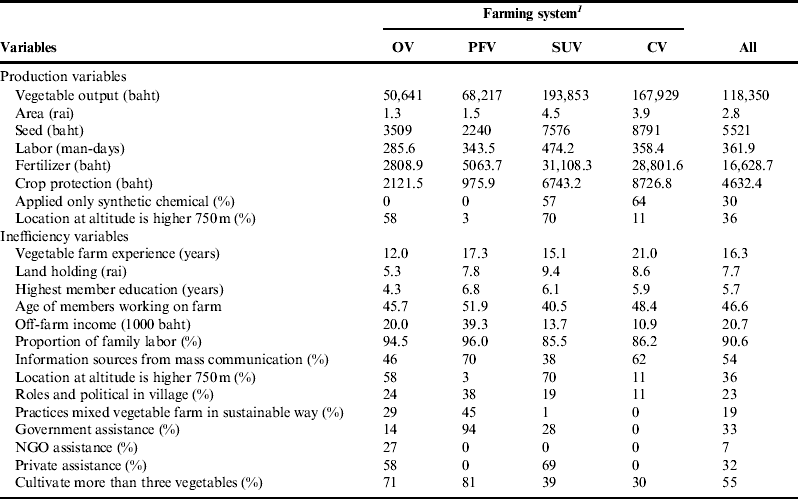
Descriptive statistics of the variables included in the stochastic frontier production functions are summarized in Table 1. The average vegetable farm income was 118,350 baht, which was approximately 42,267 baht per rai. There were differences in total income per vegetable farm across farming systems where the less restricted SUV and CV farms had about three times higher income than OV and PFV farms (see Table 1). Differences were small when scaled by area. The average vegetable farm area was about 2.8 rai, which is about 0.45 ha. SUV and CV farms had larger areas than OV and PFV farms. Seed use was about 5521 baht per farm, with PFV farms having the lowest seed cost. The OV and PFV farms were labor-intensive but had lower fertilizer use and crop protection cost than the SUV and CV farms. Location of vegetable farm is expected to influence vegetable production since there are environmental differences such as temperature, soil condition and water sources. Only 36% of mostly OV and SUV farms were located 750 m and above. Finally, 57% of SUV farms and 64% of CV farms used only synthetic fertilizer and pesticides.
Mean production and inefficiency variables by farming system.

1 OV, PFV, SUV and CV refer to organic, pesticide-free, safe-use and conventional vegetable farming systems, respectively.
The average age of members working on the farms was about 47 years old. Farmers had vegetable farming experience for 16 years on average. The PFV and CV farmers had higher age and more experience than others. The highest educational attainment was commonly in primary school, which is six schooling years. The PFV farmers were the most educated group, whereas the OV farmers were the least educated. The OV and PFV farms had smaller land holdings than the SUV and CV farms, and had a high proportion of household members working on the farm. The SUV and CV farms had less off-farm income. The PFV households tended to receive a higher proportion of mass communication information, had public roles and political positions in the village, and had the highest proportions of farmers growing more than three kinds of vegetables and including local vegetables in their cropping patterns. Only 39% of SUV farms and 30% of CV farms grew more than three kinds of vegetables.
Results
The maximum-likelihood estimates of the parameters in the group frontiers and inefficiency models were obtained simultaneously. Estimations were undertaken using the FRONTIER 4.1 programReference Coelli 43 .
A pooled stochastic frontier was estimated to test for differences in frontiers between farming systems. We rejected the null hypothesis of the generalized likelihood ratio test statistic that group frontiers are the same. The generalized likelihood ratio test statistic that group frontiers are the same is LR=223.5, with a P value of 0.000. Therefore, the estimation of a metafrontier is justified.
Stochastic production frontier estimates
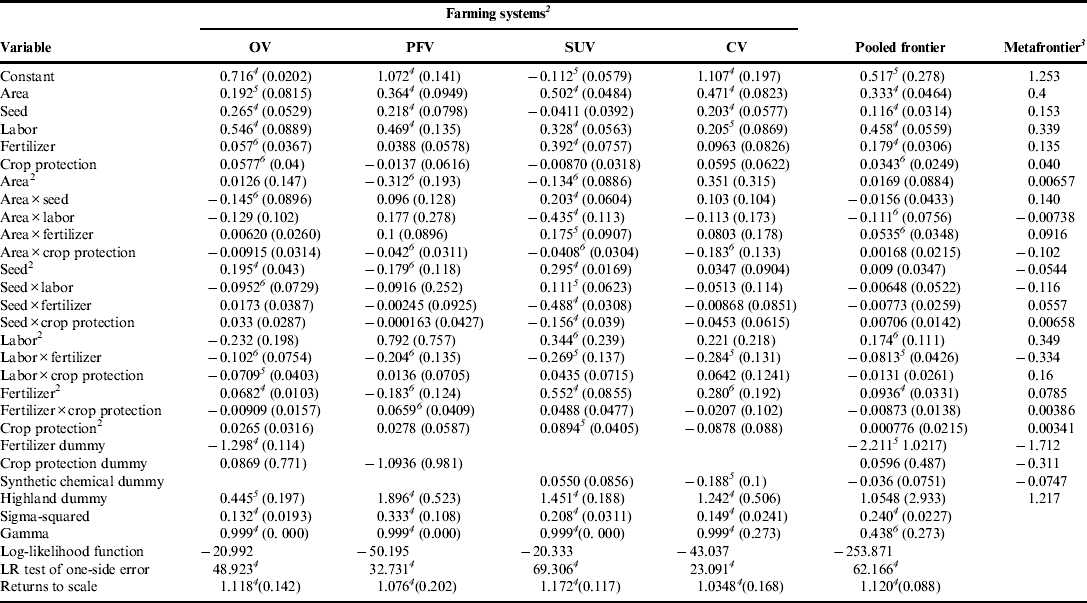
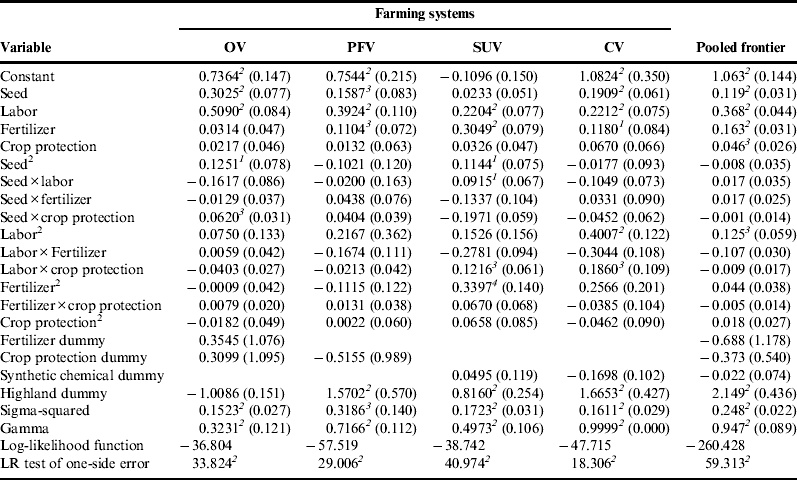
Estimates of the stochastic frontier models using vegetable output (measured in baht) as dependent variable are summarized in Table 2. The first-order estimates denote the partial output elasticities for each input at the mean level because the values of explanatory variables in the translog stochastic frontier model were normalized by their geometric mean. For all group frontiers, the technical inefficiency variables significantly add to the explanatory power of the model, as evidenced by the significant values of the likelihood ratio test for one-sided errors.
Estimates of parameters of the translog stochastic production frontier models for the vegetable farming systems 1 .

1 The dependent variable is vegetable output (baht).
2 OV, PFV, SUV and CV refer to organic, pesticide-free, safe-use and conventional vegetable farming systems, respectively.
3 The metafrontier estimates are obtained using linear programming by satisfying the conditions and constraint presented in Equations (4) and (5).
4 , 5 and 6 denote significant using a one-tailed test at 1, 5 and 10% levels, respectively.
Figures in parentheses are standard errors.
Using the result for the pooled frontier, all the estimated first-order coefficients have values from zero to one, which suggests that the monotonicity condition is satisfied; that is, marginal products are positive and diminishing at the mean of inputs. The relevance of each input to the output produced varies across different farming systems. Area and labor have highly significant effects on vegetable output. Seed is highly significant for all groups except SUV farms. Fertilizer has a highly significant and positive impact on SUV production while it is significant and positive at the 10% level for OV farms.
On average, there is no significant difference in the mean output of farmers who practiced alternative crop protection practices. However, for those who choose to use alternative crop protection the marginal effect on output is significant only for OV farms at the 10% significance level. The coefficient of the dummy variable for farms using only synthetic chemicals is negative and significant at the 5% level for CV farms. The coefficient on the dummy variable for highland farms is positive for all groups and significant at the 1% level, except for OV farms where it is significant at the 5% level. Our results also indicate that the interactions between area and labor are negative except for the PFV farms. This implies that labor productivity decreases as area cultivated increases in different farming systems. Mechanization, or even cheap off-farm labor, can enhance the ability to increase the land area under production. However, where there is a reliance on family labor, especially in labor-intensive vegetable systems that are difficult to mechanize, greater efficiency may be achieved on smaller land holdings, as observed by Giller et al.Reference Giller, Rowe, de Ridder and van Keulen 44 .
The results also show slight differences between the metafrontier and the pooled frontier with respect to the magnitude of parameters. All input variables have positive effects on vegetable production. The most important factors that strongly influence vegetable production are area and labor (partial elasticities of output ranging from 0.333 to 0.458). Seed and crop protection have lower effects on vegetable production with elasticities ranging from 0.1 to 0.2. Crop protection has slight effects on production in both the pooled frontier and metafrontier models (elasticities in the range of 0.034 to 0.04).
The estimated returns-to-scale parameters are obtained by aggregating the output elasticities of all conventional inputs at their mean values. Our results indicate that all models have a returns-to-scale parameter significantly greater than one, which implies that all farming systems exhibit increasing returns to scale.
TE and MTR estimates
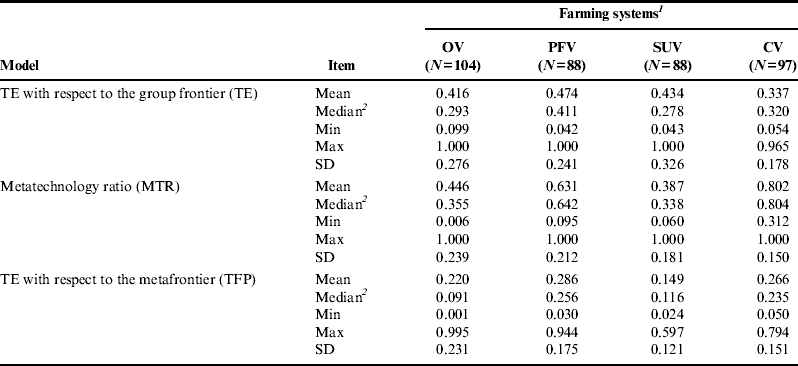
The mean TE estimates within the farming systems are presented in Table 3. The mean TE for PFV farms is higher than the mean TEs for SUV and OV farms, and it is lowest for CV farms.
Estimates of TE, TFP and MTR for different vegetable farming systems.

1 OV, PFV, SUV and CV refer to organic, pesticide-free, safe-use and conventional vegetable farming systems, respectively.
2 Denotes significant for median test at 1% level using Kruskal–Wallis test.
MTRs also need to be taken into account to compare TFP across farming systems with different technologies. The parameter estimates of the metafrontier presented in Table 3 show that the estimated mean MTRs for OV, PFV, SUV and CV farms were 0.446, 0.631, 0.387 and 0.802, respectively, illustrating the technology gaps between vegetable farming systems. The MTRs of conventional farms were highest, as expected given that CV farms had the fewest technology constraints. Mean TFPs (the product of TE and MTR) in Table 3 ranged from 0.149 to 0.286. Pesticide-free farms had the highest mean TFP followed by CV, OV and SV farms. The mean TFP of OV farms, with all its production constraints, was not markedly below that for CV farms. However, the median TFP was particularly low for OV farms as a result of the highly positive skewness of the TEs and MTRs.
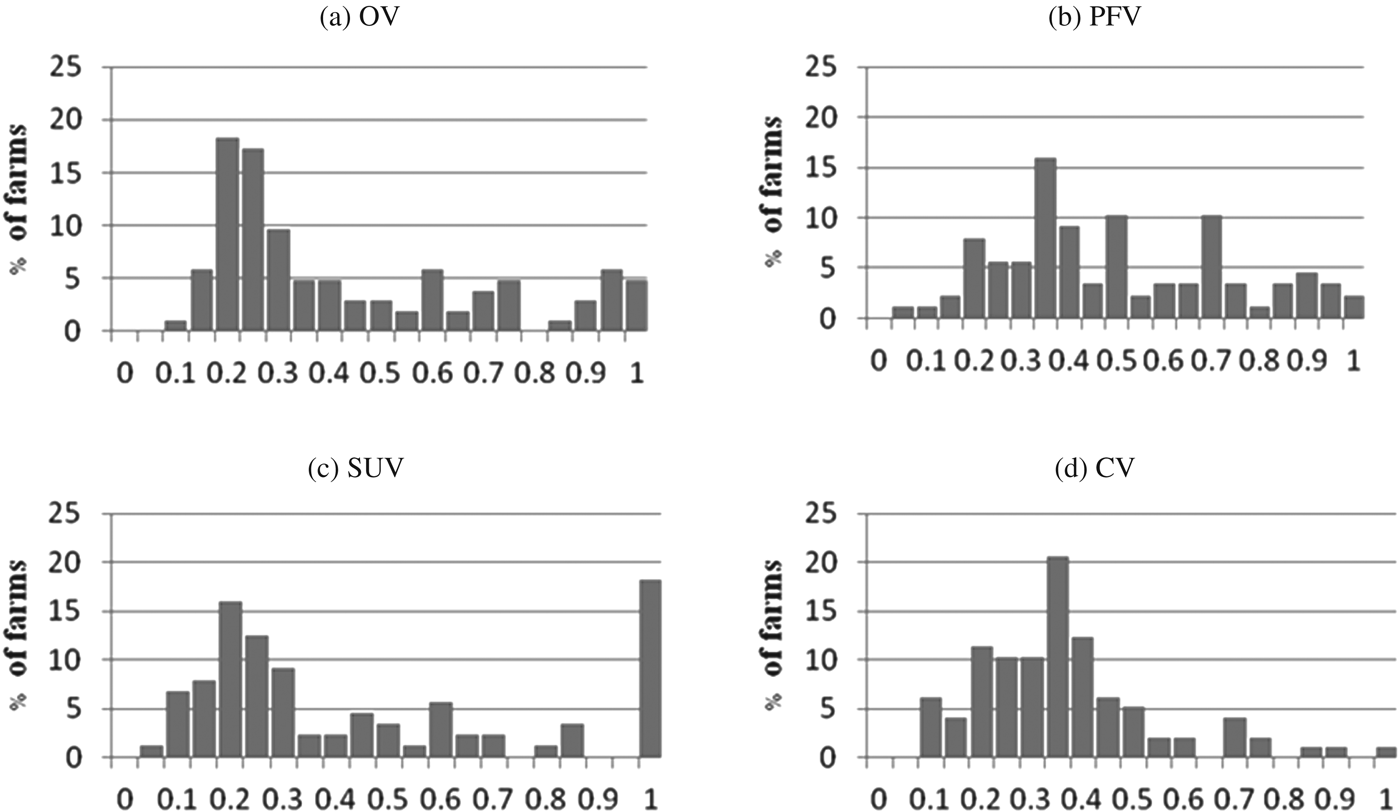
The estimated density functions of the TE, MTR and TFP estimates are presented in Figs. 2–4. The distributions of these indicators are significantly different from each other, as confirmed by statistical tests conducted on the median values. All farming systems had a wide distribution; OV and PFV farming systems had much more diverse TEs than other farming systems, suggesting that many farmers struggled to overcome the constraints imposed by their chosen technology. However, maximum MTRs for at least one farm in every farming system indicate that farms in all systems are potentially able to overcome technology constraints in order to improve their farm performance.
Density of farm-level technical efficiencies (TEs) with respect to group frontier.

Density of metatechnology ratios (MTRs).

Density of farm-level technical efficiencies (TEs) with respect to the metafrontier.

Factors influencing technical inefficiency
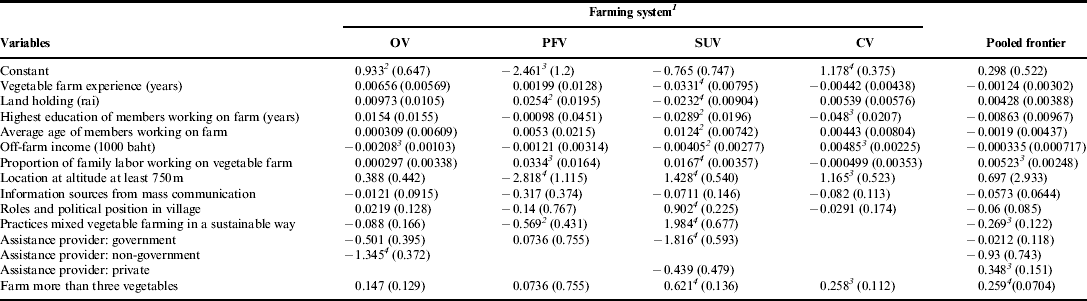
The estimated coefficients for the factors influencing TE are reported in Table 4. The results show that the farming systems were influenced by different factors, and the coefficients of efficiency variables had different signs among farming systems. The negative and positive signs associated with each explanatory variable denote the effects on the level of inefficiency, such that a negative sign implies a decrease in technical inefficiency and thus an improvement in TE. In this section, we report the impact of each variable on TE and further discussion is provided in the next section.
Estimates of parameters of the factors affecting inefficiency of smallholders in the vegetable farming systems.

1 OV, PFV, SUV and CV refer to organic, pesticide-free, safe-use and conventional vegetable farming systems, respectively. The signs associated with each explanatory variable denote the effect on technical inefficiency. Thus, the negative sign indicates a reduction in technical inefficiency, which implies an improvement in technical efficiency (TE).
2, 3 and 4 denote significance using a one-tailed test at 10, 5 and 1% levels, respectively.
Figures in parentheses are standard errors.
Vegetable experience has a positive significant effect on TE for SUV farms, while lower TE, albeit not significant, is associated with less farming experience for OV and PFV. Land holding was found to have had a significant and negative effect on efficiency for PFV farms but a positive effect on TE for SUV farms. Our result is consistent with the evidence from the literature (discussed above). The TE of farms depends on market costs of production, where the large farms may have advantages competing with small farms.
The TEs of SUV and CV farms improved with more education. The mean age of members working on the farm and having roles and positions in the village showed significant and negative effects on TE for SUV farms only. Off-farm income had a significant and positive effect on efficiency for OV and SUV, but a negative effect for CV farms. OV and SUV farms are relatively small and hence there are more opportunities for family members to do off-farm work, which would then imply additional income that can be invested in vegetable farms. On the contrary, more off-farm activity entails less labor devoted to vegetable farming. Having a higher proportion of family labor working on the vegetable farm was found to lead to lower efficiency on PFV and SUV farms.
The assistance provided to farmers by government, non-government and private organizations influences the TE of farmers under different farming conditions. Assistance by government organizations had a positive and significant effect on TE for SUV farms only. Having the support of NGOs had a positive effect on TE for OV farms. Government support is provided to OV, PFV and SUV farms. The differential impact of assistance providers is a reflection of the timing of their implementation. OV farms first received support from NGOs in 1970s, while government organizations have promoted SUV since 1988 and OV since 2004.
Vegetable farms in highland areas and cultivating local vegetables showed higher efficiency for PFV farms but lower efficiency for SUV and CV farms. Lastly, SUV and CV farms growing more than three vegetables had significantly lower TE than farms in the OV and PFV farming systems.
Discussion
It is difficult to plot a single path to raising productivity in vegetable farming systems in northern Thailand. First, the estimates of the two components of farm performance based on TFP (TE within farming systems and MTRs) differ across farming systems. Second, there is no indication across farming systems provided by the estimates of factors influencing TE to suggest common ways to improve TE.
Improving TE
The most striking features of these estimates are that TE was generally low and that it varied widely. A high proportion of farms were not able to use their inputs effectively to achieve the highest output possible, based on their own technology sets. As a result, substantial scope exists to improve productivity by raising the TE of vegetable production regardless of the farming system. Indeed, TE scores recorded here are lower than in other studiesReference Kumbhakar, Tsionas and Sipiläinen 19 , Reference Madau 20 . This may be due to the more complex cropping patterns used in vegetable production (e.g., greater crop diversity and more intensive rotations) than in livestock and cereal productionReference Henderson, Bishop and Sindel 45 .
With respect to the specific production frontiers, the TE with which vegetable farms were operating varied within their respective technological group. ‘Clean and safe’ farms achieved a higher TE score than CV farms, indicating their more efficient use of inputs in producing a certain level of output. It also suggests that the high levels of use of seed, fertilizer and pesticide inputs did not achieve high farm output on most CV farms. The government could consider providing greater assistance to CV farmers to help them improve their TE to levels achieved by farms with ‘clean and safe’ practices.
Farmers’ abilities to operate vegetable farms efficiently can be improved by paying attention to the effects of certain efficiency variables, with different factors influencing TE in the four farming methods. Of particular importance is the finding that assistance provided by NGOs has large and positive impacts on TE levels on OV farmsReference Lee 46 . Following a predominantly self-sufficiency marketing strategy, which was initially implemented by NGOs, OV farmers were encouraged to operate their farms using internal inputs rather than purchasing them from input markets. Farming assistance was commonly transferred through farmer groups and networks. On the other hand, the commercial farming strategy was applied on OV farms with advice and assistance received from private organizations and where conversion to organic practices was at an early stage. Farmers depended substantially on external inputs such as commercial pesticides and fertilizers that are permitted to be used in certified organic production. To meet designated standards, OV farmers need relevant support on production, postharvest and marketing practices, particularly during the period of conversion to OV farmingReference Kramol, Thong-ngam, Gypmantasiri, Davies, Batt and Jayamangkala 4 , Reference Lorlowhakarn, Boonyanopakun, Ellis, Panyakul, Vildozo and Kasterine 5 , Reference Kramol, Thong-ngam, Villano and Kristiansen 11 . For these reasons, factors affecting the provision of farmer assistance need to be identified to improve OV farm efficiency. Off-farm income is also associated with higher TE on OV farms.
Technical inefficiencies of PFV farms were lower than those of OV farms, especially for those farmers located at an altitude of at least 750 m. The idea of sustainable farming on PFV farms is relevant to that of traditional OV farming, because the only obvious disparity between OV and PFV farms is that PFV farmers are allowed the use of synthetic fertilizers. Smaller PFV farms were more technically efficient than larger farms.
It was expected that growing fewer vegetables would have improved the TE on farms in terms of simplifying farm management and marketing activities. This was found to be so on PFV and CV farms but SUV farms that practiced mixed-vegetable farming were found to be more technically efficient than those that do not.
PFV and SUV farms using a high proportion of family labor were less technically efficient. This result probably reflects underutilized labor resources with few alternative income-earning opportunities available for some household members.
SUV and CV farms showed some similar results on the factors affecting their TE. Higher farmer education and greater experience were found to improve efficiency for farms in both groups (although the coefficient on the experience variable is only significant at a low level for SUV farms). Efficiency could also be increased in both farming systems by greater specialization in vegetable production. Planting fewer vegetable species reduces time and cost in production and marketing. In addition, farms located at an altitude below 750 m had higher TE because the farms are closer to the central city markets where NGO support and farmer networking is more likely to occur. Low TE on CV farms can also be explained by low or lack of production and marketing support. On SUV farms, results show that support from government organizations can improve TE. This finding suggests that training farmers in production skills and marketing arrangement enhances their abilities to increase their efficiency in vegetable production.
Closing the technology gap
TFP was extremely low because of the wide technology gaps between ‘clean and safe’ farming systems and the CV farming system. The technology gaps indicate the differences in the production frontier for a particular group in an industry and the metafrontier for the industry. This gap includes the constraints placed on the potential output by the environment, and the interaction between the production technology and the environmentReference Mehrabi Boshrabadi, Villano and Fleming 47 . We use MTR (Equation 7) as an indicator of these gaps. The mean MTR of farms in the CV farming system was quite high, at 0.802, reflecting their higher production capacity despite their generally lower efficiency in transforming inputs into outputs for a given production technology. Production technology constraints were highest on OV and SUV farms, for which mean MTRs were 0.446 and 0.387, respectively. Technology constraints were lower on PFV farms, where the mean MTR was 0.642. The fact that SUV farms have the lowest mean technology gap ratios on average is interesting since synthetic chemical use is expected to improve output capacity compared with organic farming. But restrictive regulations can be a major technology barrier because SUV farms, like OV farms, are required to conform to strict standards in their practices. Nevertheless, OV farms were expected to have the lowest mean MTR because they are inspected both on farming practices and for the issuance of produce qualifications.
Despite the low mean MTRs on ‘clean and safe’ farms, all four farming systems were found to have at least one farm that lay on the metafrontier. This result means that at least some farmers practicing different methods are able to eliminate technological constraints to achieve the highest possible output regardless of the technology used. Because all ‘clean and safe’ farming systems have the potential to achieve high levels of productivity, it becomes a matter of knowledge transfer processes to improve innovation and adoption. Their farming practices are subject to more regulations and certification, as well as to higher demands of agronomic skills, which can have a particularly large negative effect on productivity in the conversion period. Although there are a number of assistance providers, agencies and projects supporting farmers, improving the relevance and effectiveness of their technology transfer strategies is required. Direct and practical support from NGOs through participatory and community-based training methodsReference Lorlowhakarn, Boonyanopakun, Ellis, Panyakul, Vildozo and Kasterine 5 should be considered to enhance the process of technology transfer. NGO support needs to be complemented by collaborative assistance and support from relevant organizations in both the public and private sectors.
The effectiveness and availability of production technologies to deal with agronomic constraints, especially crop protection and nutrient management, is fundamental. The technology improvement should be relevant to particular farms’ circumstances, conditions and logistical systems. The technologies applied on the farm following the directions given by different assistance providers have their own strengths and weaknesses that should be considered. Variations in land quality in the study region may impact on adoption rates, with the relative gains from adoption possibly being greater for low quality landReference Moreno and Sunding 48 .
‘Clean and safe’ producers need not only production support but also value chain development to manage the marketing of farmers’ produce. Marketing infrastructure such as processing facilities and labeling schemes and a suitable array of value chains are important factors influencing technology adoption.
Conclusions
This paper provides a comparative analysis of production performance in three ‘clean and safe’ vegetable farming systems and a CV farming system. The TEs and technology gaps of organic, pesticide-free, safe-use and conventional farms are analyzed using stochastic frontier analysis and metafrontier analysis, respectively. The TEs with respect to individual frontiers show that all group frontiers have low mean TEs. For conventional farms, TEs with respect to their frontier are lower than those for other groups. In contrast, the estimates of technology gap ratios for conventional farms are significantly higher than those for ‘clean and safe’ farms.
However, the group frontiers of all farming systems are found to touch the metafrontier, meaning that all farming systems have the potential to overcome their technology constraints to achieve the highest available productivity level. On this basis, appropriate support services should enable ‘clean and safe’ vegetable farms to reach productivity levels at least equivalent to those achieved by conventional farms. Unfortunately, the efforts of government agencies, NGOs and private organizations to convert agriculture in northern Thailand to ‘clean and safe’ production systems, including organic farming practices, has had a profound influence on only a small proportion of farmers following this route. A wide range of TEs and MTRs of farms in all farming systems remains, suggesting that organizations need to rethink their initiatives to improve farm performance through the provision of assistance services. These vast differences in production performance among farmers indicate that the extent and forms of assistance are likely to vary among members in each group. Organizations and projects providing assistance for ‘clean and safe’ farming methods that influence vegetable production in northern Thailand still have a lot of work to do if farmers engaging in these practices are to achieve their full potential.
Various factors, including forms of support provided by different organizations, were found to improve TE, but their impacts were not consistent across farming systems. The inefficiencies of all individual farming systems are influenced by different factors such as effective assistance providers, farm location, farmer education and number of vegetable species grown. Specifically, improvements are needed for agronomic technology, supply chains, farmer capacity in production and marketing, and effectiveness of technology transfer processes.
Acknowledgements
We would like to acknowledge the three anonymous referees and editorial team for their comments and suggestions. The usual disclaimer applies.
Estimates of parameters of the translog stochastic production frontier models for the different vegetable farming systems 1 .