





1. Introduction
Following the Global Financial Crisis, there has been a broad consensus among scholars and policymakers that regulation is essential for financial stability (Tooze, Reference Tooze2018; Tarullo, Reference Tarullo2019). From this perspective, free banking systems, as archetypes of financial deregulation, are often perceived as inherently unstable (Gorton and Zhang, Reference Gorton and Zhang2023).Footnote 1 However, the experience of Antioquia, a region in Colombia, challenges this notion. Between the 1870s and 1880s, despite significant political and social turmoil, Antioquia’s free banking system was notably stable. It saw sustained credit expansion, widespread use of private banknotes, no panic episodes, and no banks going out of business.
This paper aims to offer a preliminary exploration of the financial stability of Antioquia during this period, a topic that has been broadly ignored in the economic history of Colombia.Footnote 2 The focus will be on the endogenous factors contributing to this stability, particularly how the risk of every single individual bank depended on the risk of their peers. To do so, we develop a method that estimates systemic risk in pre-modern environments. These environments are typically unsuitable for most modern methods due to the limited development of financial markets and the lack of detailed information on the operations of financial institutions. The generality of the method we propose here, which focuses on the ownership structure of financial institutions, allows it to be implemented in various contexts and represents a methodological contribution. The free banking episode in Antioquia, which exhibits profound data limitations, works as a tool to show the potential shortcomings and data requirements of the methodology.
While this approach does not address all potential factors behind Antioquia’s financial stability, it is a crucial first step in integrating the regional banking history of Colombia into contemporary discussions on financial stability. In doing so, it also provides a deeper understanding of the complexities of banking activity during this period, an area that remains underexplored in the Colombian discussion.
The structure of this paper is as follows: first, we review the literature, connecting the explorations of financial instability in economic history with the modern literature on systemic risk. We then present our methodology to estimate systemic risk, which we call the property-network approach. Next, we examine the Antioquia banking system during the free banking era, focusing on the structure of the property network and its implications for systemic risk. We do so through a stress-test simulation, which allows us to infer potential counterfactuals of financial instability. Finally, the paper concludes, offering insights into future research directions on the history of financial stability in Latin America and the potential implementations of our methodology to estimate systemic risk in other historical contexts.
2. Financial instability theory and measurement
2.1. Financial instability in economic history
Financial stability is often studied by examining its absence—through the analysis of crises. Thus, the significant social costs of financial crises have been a major area of interest for economic historians for decades, and the Global Financial Crisis has renewed this interest. Comprehensive reviews on the history of major financial crises, such as those by Ferguson (Reference Ferguson2008), Reinhart and Rogoff (Reference Reinhart and Rogoff2009), Marichal (Reference Marichal2010), Calomiris and Haber (Reference Calomiris and Haber2014), and the reissued work of Kindleberger (Reference Kindleberger2011), garnered significant attention, even among non-specialist audiences.
In addition to these general overviews, numerous studies on specific episodes of instability have emerged over the last two decades. In Latin America, the focus has often been on sovereign crises (e.g., Boonman, Reference Boonman2017; Alvarez, Reference Alvarez2018; Flores, Reference Flores2024). Notable exceptions include Flores’ work (Reference Flores2007 and Reference Flores2011) on the Panic of 1890 in Argentina (the Baring crisis), which examines the role of competition structure and information asymmetries in the Buenos Aires and London stock markets, and Briones’ (Reference Briones2016) exploration of the 1878 banking crisis in Chile during the free banking period.
Similarly, Triner and Wandschneider (Reference Triner and Wandschneider2005) take a more macro approach to explore the role of international markets in Brazil’s financial crisis of 1890–1891 (the bankruptcy of the Encilhamento), emphasizing the idea of contagion from international capital flows. In general, the importance of international capital flows has been a central theme in much of the literature, particularly concerning crises originating in sovereign debt. Studies focusing on the evolution of debt conditions in the London market include notable works by Mauro et al. (Reference Mauro, Sussman and Yafeh2002); Flandreau and Flores (Reference Flandreau and Flores2009); Della Paolera and Taylor (Reference Della Paolera and Taylor2013); Kaminsky and Vega-García (Reference Kaminsky and Vega-García2014); and Summerhill (Reference Summerhill2015).
Our paper is situated within this context. However, we do not examine a crisis. Instead, we focus on an episode that, despite institutional weakness, lack of regulation, and extensive contextual turmoil, experienced widespread stability. As such, we concentrate on the internal determinants of this stability, in particular, the features of the system that limited stress propagation. This perspective provides a different view of the evolution of banking in Latin America, suggesting that non-external forces played a significant role in shaping its future. This approach is valuable as it aligns the study with contemporary discussions on financial stability and systemic risk, fostering a dialogue between Latin American financial history and modern finance.Footnote 3 Additionally, the local focus and systematic use of social network analysis in this paper conceptually differentiates it from the historiographical tradition outlined above. Overall, we think that we contribute to a more nuanced understanding of 19th-century Latin American financial history.
2.2. Financial instability in Colombia’s 19th century
Monetary and financial history has been a central theme in the new economic history of Colombia, with most studies focusing on the 20th century, particularly the period following the establishment of Banco de la República (e.g., Sánchez Torres, Reference Sánchez Torres1994; Salazar, Reference Salazar1996; Kalmanovitz, Reference Kalmanovitz2003; Sánchez et al., Reference Sánchez, Armenta and Fernández2005; Urrutia-Montoya and Namen, Reference Urrutia-Montoya and Namen2012). Notable exceptions include the work of Adolfo Meisel, Eduardo Posada, and María Mercedes Botero, who explored earlier periods. Botero’s research centers on Antioquia (Botero, Reference Botero1984, Reference Botero1988, Reference Botero and Sánchez1994), while Meisel and Posada focus on the Atlantic Coast (Meisel and Posada, Reference Meisel and Posada1988, Reference Meisel, Posada and Sánchez1994; Meisel, Reference Meisel1990).
These studies reveal that the emergence of banking in Colombia was fragmented and slower compared to other Latin American countries, such as Mexico, Peru, and Argentina (Marichal, Reference Marichal2022). Colombian banking also had limited connections to foreign banks’ international presence (Marichal, Reference Marichal2024). This lag is largely attributed to the limited success of export sectors before the coffee boom of the early 20th century (Ocampo, Reference Ocampo2013) and minimal exposure to the late 19th-century migration waves (Feldmann et al., Reference Feldmann, Bada, Durand and Schütze2023).
Interest in 19th-century Colombian money and banking grew in the 2010s, enabling a deeper understanding of the local origins of banking (Álvarez and Acuña, Reference Álvarez and Acuña2013; Álvarez and Timoté, Reference Álvarez and Timoté2011; Correa, Reference Correa2009; Sastoque, Reference Sastoque2018). This research primarily examines currency availability, tensions between national regulations and local banks, and the integration of international trade and credit with regional banking systems.
To date, no study has systematically analyzed endogenous banking crises in 19th-century Colombia. However, the existing literature identifies periods of significant financial stress triggered by exogenous shocks. Two major crises stand out. The first occurred in the late 1880s during the Núñez administration’s monopolization of currency issuance, which forced most free-banking-era issuing banks out of business (Rodríguez Salazar and Arévalo, Reference Rodríguez Salazar and Arévalo2013). The second was the Thousand Days’ War, during which massive government-led monetary expansion to finance the war caused the only hyperinflation in Colombia’s history and the collapse of numerous banks (Arévalo, Reference Arévalo and Arévalo2016; Mejía and Parra-Montoya, Reference Mejía and Parra-Montoya2022).
This paper contributes to this literature by examining Colombian financial stability from an internal perspective, focusing on the structure of the financial system and the incentives of its participants. In doing so, it bridges the historical literature on Colombian finance with modern studies on banking sector resilience (e.g., León and Miguélez, Reference León and Miguélez2021).
2.3. Systemic risk estimation
The Global Financial Crisis underscored systemic risk as a pivotal concept in financial stability, emphasizing how distress spreads through interconnected institutions. This perspective frames instability as an endogenous process tied to system interdependencies, complementing exogenous shock explanations (Allen and Gale, Reference Allen and Gale2000; Gai et al., Reference Gai, Haldane and Kapadia2011). Traditionally, scholars model financial systems as networks, often focusing on credit linkages (Boss et al., Reference Boss, Elsinger, Thurner and Summer2004; Babus, Reference Babus2007; Von Peter, Reference Von Peter2007; Bech and Atalay, Reference Bech and Atalay2008; Battiston et al., Reference Battiston, Delli Gatti, Gallegati, Greenwald and Stiglitz2012; Elliott et al., Reference Elliott, Golub and Jackson2014; Acemoglu et al., Reference Acemoglu, Ozdaglar and Tahbaz-Salehi2015; Acharya et al., Reference Acharya, Pedersen, Philippon and Richardson2017) to reveal how individual risks cascade system-wide.
In the Colombian context, the leading figure adopting this approach is Caros Leon (León and Berndsen, Reference León and Berndsen2014; Berndsen et al., Reference Berndsen, León and Renneboog2018; León et al., Reference León, Machado and Sarmiento2018; León and Miguélez, Reference León and Miguélez2021). His work has stressed the limitations of traditional homogeneous models of risk contagion and describes how the modern Colombian financial system needs a careful analysis of the key actors within the liquidity network, including those that play roles as market infrastructures.
The financial contagion approach has also been applied to historical contexts. Most of them, however, have well-developed financial systems, such as the US during the Great Depression (e.g., Mitchener and Richardson, Reference Mitchener and Richardson2019; Das et al., Reference Das, Mitchener and Vossmeyer2022). Unfortunately, despite significant advancements in the history of financial instability, applying the credit-network approach to non-contemporary financial systems, particularly those with limited depth, presents significant challenges. The primary difficulty is that this approach requires extensive information about firms’ operations and the performance of their assets in organized public markets.
As I show below, such a type of information has not been preserved in the case of Antioquia during the free banking period. The data limitations of this case motivate us to develop the property-network approach. We argue that this approach, which has lower data requirements and better reflects the logics of environments where shareholders hold strong influence in the operation of firms, might be better adapted to study historical episodes. We consider this one of the contributions of our paper.
3. Property-network approach
To circumvent the aforementioned data challenges of the credit-network approach, we propose an alternative method to estimate systemic risk in pre-modern financial systems. This method follows the logic of most systemic risk estimation techniques: determining the risks of individual financial institutions and observing how these affect the risk of other institutions in the system. However, instead of focusing on the system as a credit network, this method examines it as an ownership network—i.e., the connections between institutions that arise from shared property. Thus, we call this a property-network approach.
3.1. Modeling strategy
The objective of the model developed in this section is not to estimate a fully structural representation of systemic risk, nor to recover historically calibrated parameters in the modern sense. Rather, the model should be read as a structured accounting framework that translates ownership relations into potential channels of risk transmission under stress.
This approach is motivated by the severe data limitations characteristic of 19th-century banking systems, where detailed balance-sheet dynamics, market prices, and time-series information are unavailable. In this context, formalization serves primarily to discipline assumptions and ensure internal consistency, rather than to recover precise quantitative estimates.
Accordingly, the contribution of the model lies not in the precise numerical level of systemic risk it produces, but in the rankings and comparative statics it generates across banks under a wide range of plausible assumptions.
3.2. Individual risk
Extensive literature identifies leverage as an appropriate indicator of a firm’s risk of bankruptcy (see Verwijmeren and Derwall, Reference VERWIJMEREN and DERWALL2010; Bruno et al., Reference Bruno, Cartapanis and Nasica2014). The intuition behind this is that greater leverage indicates higher borrowing relative to owners’ funds; in our context, this means that the bank’s debt is supported by fewer internal resources, which can hinder current operations and exacerbate situations of illiquidity or insolvency.
Thus, one can approximate the individual risk of each bank through the degree of leverage—i.e., the debt–equity ratio. Since a bank’s individual risk also depends on other operational variables such as its capitalization, loan activities, liquidity, and profitability, these factors can be incorporated into the variable  ${\theta _i}$ as a leverage-grade amplifier. Thus, the individual risk of bank i is defined as:
 \begin{equation}I{R_i} = \left( {1 + {\theta _i}} \right)\left[ {\frac{{Debt}}{{Equity}}} \right]\end{equation}
 ${\theta _i}$ captures the relative amplification of leverage-related risk beyond the baseline balance-sheet ratio. Empirically,
 ${\theta _i}$ should be understood as a reduced-form weight summarizing institutional features—such as liquidity practices, governance arrangements, and reserve discipline—that cannot be separately observed. In settings characterized by a lack of firm-level time-series data, such as the free banking system of Antioquia examined below, one should not expect to estimate
 ${\theta _i}$ but normalized to one, implying a conservative benchmark in which leverage maps linearly into individual risk.
3.3. Network risk
To determine how risk spreads across institutions, the first step is to describe the financial system as a network, with links between banks based on the relationships of their owners. Analyzing these relationships is essential to understanding pre-modern financial systems, in which owners had significant control over firms.
The first element necessary to describe the network topology is the gross co-participation coefficient ( $P{b_{ij}}$). This is the ratio between the number of owners linked between two banks and the sum of the number of owners of both banks. Thus, the gross co-participation coefficient between bank i (with n owners) and bank j (with m owners), with u owners linked to both, is defined as follows:
 \begin{equation}P{b_{ij}} = \frac{u}{{n + m}} \times 100\end{equation}
For example, if bank i and j each have 50 shareholders and 25 of them are in both banks, then  $P{b_{ij}} = 25$. This coefficient indicates the relative importance of the relationship between the two banks. A higher number of shared owners implies a closer link between the financial conditions of the banks and a greater transfer of resources, information, and risk between them. This indicator reflects mass behavior without considering the intensity of ties.
Notice that the coparticipation index refers to distinct banks, for which the maximum value is 50 by construction when ownership sets are identical. By contrast, the diagonal elements of the coparticipation matrix represent self-overlap—that is, the fraction of owners a bank shares with itself—which is equal to one by definition and reported as 100 in the figures of our case study. The diagonal therefore reflects an identity condition rather than a normalized overlap measure and should not be interpreted as comparable to off-diagonal values.
To incorporate the importance of tie strength, the gross co-participation coefficient is weighted with the equity participation of the actors of bank i in bank j ( ${\alpha _{ij}}$), resulting in the net co-participation coefficient (
 $P{n_{ij}}$):
 \begin{equation}P{n_{ij}} = {\alpha _{ij}}P{b_{ij}}\end{equation}
Once the structure of the network has been specified, one can define the link risk,  $L{R_{ij}}$, as the contribution of the risk of bank i to the risk of bank j. Link risk is a higher-order function of the relative size of the bank, the individual risk, and the net co-participation coefficients. Formally:
 \begin{equation}L{R_{ij}} = H\left( {f,g,z} \right)\left( {{\beta _i},I{R_i},P{n_{ij}},P{n_{ji}}} \right) = z\left( {{\beta _i}} \right)g\left( {I{R_i}} \right)f\left( {P{n_{ij}},P{n_{ji}}} \right)\end{equation}
where  ${\beta _i} = \frac{{{k_i}}}{K}$, with
 ${k_i}$ representing the capital of bank i and K the sum of the capitals of all the banks of the system, and
 $z\left( {{\beta _i}} \right)$,
 $g\left( {I{R_i}} \right)$, and
 $f\left( {P{n_{ij}},P{n_{ji}}} \right)$ are general functions.
For simplicity, we will assume that  $z\left( {{\beta _i}} \right) = {\beta _i}^\xi $,
 $g\left( {I{R_i}} \right) = \left( {1 + \pi I{R_i}} \right)$, and
 $f\left( {P{n_{ij}},P{n_{ji}}} \right) = \frac{{\gamma P{n_{ij}}}}{{\left( {1 + \gamma P{n_{ij}}} \right)}}\left( {1 + k \sum ^ P{n_{ji}}} \right)$ with
 $\xi ,\;\pi ,\;\gamma ,\;k$parameters that weight the importance of
 ${\beta _i}$,
 $I{R_i}$,
 $P{n_{ij}}$, and
 $P{n_{ji}}$, respectively.Footnote 4 Overall:
 \begin{equation*}L{R_{ij}} = H\left( {f,g,z} \right)\left( {{\beta _i},I{R_i},P{n_{ij}},P{n_{ji}}} \right) = \frac{{{\beta _i}^\xi \left( {1 + \pi I{R_i}} \right)\left( {\gamma P{n_{ij}}} \right)\left( {1 + k\sum P{n_{ji}}} \right)}}{{\left( {1 + \gamma P{n_{ij}}} \right)}}\end{equation*}
Thus, link risk is a concept that describes the balance of two forces in tension. On the one hand, there are the decisions on the risk behavior of individual banks. Investors in bank j would be in a more fragile situation if the position of bank i is larger and riskier. On the other hand, the same connections that expose bank j to the risk of i can also serve as buffers: investors in other banks with ties to bank i might step in to support it in times of stress, thereby enhancing its stability. However, these same links can also serve as channels for contagion, transmitting stress from bank i to others. All this is scaled by the size of bank i.
3.4. Systemic risk
Finally, the last step is to specify how the contagion process generalizes throughout the system. For this purpose, J is defined as a system that includes all the banks of the initial network except bank i. Using the link risk indicator, we can establish the contribution of an institution to the risk of system J, which is the total exogenous systemic risk indicator ( $SR{X_{iJ}}$). It is defined as follows:
 \begin{equation}SR{X_{iJ}} = \beta _i^\xi \left( {1 + aI{R_i}} \right)\sum \frac{{\gamma P{n_{ij}}}}{{1 + \gamma P{n_{ij}}}}\left( {1 + k\sum P{n_{ji}}} \right)\end{equation}
Although this provides a rapid measure of systemic risk, it does not account for the dependency of bank i’s risk on systemic risk, which is a significant oversight. To address this, we must endogenize, considering that the risk of a bank includes the risk transferred to it by system J, as follows:
 \begin{equation}SR{N_{iJ}} = \beta _i^\xi \left( {1 + a\left( {I{R_i} + SR{N_{Ji}}} \right)} \right)\sum \frac{{\gamma P{n_{ij}}}}{{1 + \gamma P{n_{ij}}}}\left( {1 + k\sum P{n_{ji}}} \right)\end{equation}
where:
 \begin{equation}SR{N_{Ji}} = {(1 - {\beta _i})^\xi }\left( {1 + a\left( {\sum I{R_j} + SR{N_{Ji}}} \right)} \right)\sum \frac{{\gamma P{n_{ji}}}}{{1 + \gamma P{n_{ji}}}}\left( {1 + k\sum P{n_{ij}}} \right)\end{equation}
Equation (7) represents the counterparty of Equation (6), in which the systemic risk of the rest of the system depends on its size (1 − βi), its individual risk (∑IRj), the risk transferred to it by bank i (SRNiJ), and its connection with bank i (∑Pnji).
By solving the system of equations formed by Equations (6) and (7), we get:
 \begin{equation}SR{N_{iJ}} = \frac{{\begin{matrix} \beta _i^\xi \left( {\sum {\frac{{\gamma P{n_{ij}}}}{{1 + \gamma P{n_{ij}}}} \cdot \left( {1 + k\sum {P{n_{ji}}} } \right)} } \right)\Big( 1 + aI{R_i} + a{{\left( {1 - {\beta _i}} \right)}^\xi }\\ \times\left.\sum {\frac{{\gamma P{n_{ji}}}}{{1 + \gamma P{n_{ji}}}}\left( {1 + k\sum {P{n_{ij}}} } \right)\left( {1 + a\sum {I{R_j}} } \right)} \right)\end{matrix}}}{{1 - \beta _i^\xi {a^2}\left( {1 - {\beta _i}} \right){}^\xi \left( {\sum {\frac{{\gamma P{n_{ij}}}}{{1 + \gamma P{n_{ij}}}} \cdot \left( {1 + k \cdot \sum {P{n_{ji}}} } \right)} } \right)\left( {\sum {\frac{{\gamma P{n_{ji}}}}{{1 + \gamma P{n_{ji}}}}} \cdot \left( {1 + k\sum {P{n_{ij}}} } \right)} \right)}}\end{equation}
 \begin{equation}SR{N_{Ji}} = \frac{{\begin{matrix} {{\left( {1 - {\beta _i}} \right)}^\xi }\left( {\sum {\frac{{\gamma P{n_{ji}}}}{{1 + \gamma P{n_{ji}}}} \cdot \left( {1 + k\sum {P{n_{ij}}} } \right)} } \right)\Big( 1 + a\sum IRj + a\beta _i^\xi \\ \left.\left( {\sum {\frac{{\gamma P{n_{ij}}}}{{1 + \gamma P{n_{ij}}}}\left( {1 + k\sum {P{n_{ji}}} } \right)} } \right)\left( {1 + aI{R_i}} \right) \right) \end{matrix}}}{{1 - \beta _i^\xi {a^2}{{\left( {1 - {\beta _i}} \right)}^\xi }\left( {\sum {\frac{{\gamma P{n_{ij}}}}{{1 + \gamma P{n_{ij}}}} \cdot \left( {1 + k\sum {P{n_{ji}}} } \right)} } \right)\left( {\left( {\sum {\frac{{\gamma P{n_{ji}}}}{{1 + \gamma P{n_{ji}}}}\left( {1 + k\sum {Pnij} } \right)} } \right)} \right)}}\end{equation}
When expressed in percentage terms, these measures can be interpreted as:
 \begin{equation}s{r_{iJ}} = \frac{{SR{N_{iJ}}}}{{\sum SR{N_{iJ}}}} \times 100\% \end{equation}
 \begin{equation}s{r_{Ji}} = \frac{{SR{N_{Ji}}}}{{\mathop \sum \nolimits^ SR{N_{Ji}}}} \times 100\% \end{equation}
where  $s{r_{iJ}}$ represents the share of systemic risk contributed by bank i, and
 $s{r_{Ji}}$ the share of systemic risk of the system to which bank i is exposed.
Taken together, Equations (4)–(9) and their proportional outputs define a closed-form mapping from observable ownership structure and balance-sheet size into measures of contribution to and exposure to systemic risk. Their purpose is not to generate point estimates with structural interpretation, but to ensure internal consistency when comparing counterfactual stress scenarios.
3.5. Property networks vs credit networks
The property-network approach highlights how investors’ shared interest in the system can contribute to financial stability. This stands in contrast to the credit-network approach, where connections between institutions are primarily based on shared liabilities. In that framework, connections function as channels through which financial risk flows. In the property-network framework, connections can instead function as buffers during periods of stress, enabling coordinated support or bailouts among linked institutions.
Thus, focusing on property networks draws attention to the role of shareholders as active decision-makers. This perspective is particularly appropriate in historical contexts where shareholders were not fully dispersed—such as during the pre-corporate and early corporate periods (Berle and Means, Reference Berle and Means1932; Chandler, Reference Chandler1977). It also makes sense in banking environments where institutions lacked a complex client base and relied primarily on the general public, rather than other financial actors, for funding. As we show in the next section, the case of Antioquia during the free banking era exemplifies these characteristics.
However, in settings with deep financial markets—where securities are widely traded across banks—and in modern corporate environments with hundreds of thousands of small shareholders and formal governance structures that separate ownership from management, the credit-network approach becomes more appropriate.
4. Free banking in Antioquia
4.1. Context: Antioquia before the industrialization
Antioquia is a region in western Colombia. While its formal borders have changed over the years, for this paper, we will consider the current department of Antioquia. This region covers approximately 63,000 square kilometers, primarily consisting of mountainous terrain. In 1870, about 14% of Colombia’s population lived in Antioquia (Mejía, Reference Mejía2015). The challenging geography of the region resulted in exceptionally high transport costs and a prolonged disconnection with the rest of the country (see Figure 1).
Map of Antioquia.

1 Long description
Map of Antioquia, a region in western Colombia, highlighting its mountainous terrain and various cities such as Medellín, Santa Rosa de Osos and Rionegro. The map includes a scale bar indicating 60 kilometers and a compass rose for orientation. An inset map shows the location of Antioquia within Colombia and South America, with neighboring regions like Chocó and Risaralda. The map details rivers and elevation changes, emphasizing the region′s complex geography.
These geographical challenges resulted in a fragmented economy, with a dynamic urban industrial sector only emerging in the early 20th century (Mejía, Reference Mejía2024). In contrast, Antioquia’s rural economy was dominated by a relatively productive gold mining sector (Poveda Ramos, Reference Poveda Ramos1984; Uribe and Álvarez, Reference Uribe and Álvarez1985; Botero, Reference Botero2007). This sector provided a steady supply of metallic currency and frequent capital surpluses, which helped fuel the development of the regional banking system. In turn, banking expansion offered the infrastructure that enabled the integration of mining into broader international trading circuits, connecting miners with import merchants (Botero, Reference Botero2007).
Despite these developments, Antioquia’s per capita income barely exceeded the national average, with most households living just above subsistence. For reference, by the 1860s, the region’s per capita income was only about 35% of that in the US (Mejía, Reference Mejía2015).
The 1870s and 1880s marked a period of significant banking growth in Antioquia, which revitalized various sectors of the urban economy. During this period, the region’s economy grew at an annual rate of 2%—double the national average. Private banks likely played a central role in this growth. Beyond expanding the money supply through note issuance, which facilitated transactions, banks also acted as key lenders. They channeled capital from sectors with large surpluses, such as mining, to sectors with greater capital needs, like urban trade. The flow of credit was not unidirectional, however. Botero (Reference Botero1984) documents loans as large as 150,000 pesos extended to miners to finance major investments. Interest rates on such large-scale loans, typically backed by real estate collateral, were relatively low by modern standards in the developing world—ranging from 7% to 12% annually. Overall, the liquidity provided by these banks was a crucial driver of the region’s economic dynamism during this period.
4.2. Origins of banking
Despite Antioquia’s geographical isolation, it was still quite influenced by the broader institutional framework of Colombia. Monetary policy and financial regulation, in particular, deeply influenced the emergence and consolidation of Antioquia’s banking system.
Initially, during the Colonial period, the Catholic Church controlled most large-scale credit in Colombia through customary practices (see Restrepo, Reference Restrepo2013, for evidence from Antioquia). However, throughout the 19th century, as trade expanded, commercial houses increasingly provided credit services, leading to a systematic decline in the Church’s role. Several legislative and entrepreneurial efforts to establish banks occurred during this century, but it was not until the approval of Law 35 in 1865 that these efforts became successful.
Law 35 allowed regional governments to legislate for the creation of banks that could accept deposits, perform transfers, trade with exchange letters, and, importantly, issue currency. Thus, the emergence of banking in Colombia was closely linked to the liberal and federal reforms of the late 19th century. These reforms resulted in a highly fragmented free-banking ecosystem in which regional banks thrived (Álvarez and Acuña, Reference Álvarez and Acuña2013).Footnote 5
Within this context, the first banks in Antioquia emerged, quickly integrating with the region’s trade and mining economy. Many of these banks were established specifically to support mining projects and facilitate bullion transactions for international trade (Botero, Reference Botero1984). By the mid-1880s, Antioquia had developed a fairly sophisticated system consisting of eight banks that were highly interconnected in terms of ownership and operations (see Figure 2). The system was quite stable. None of the banks founded during this period closed for insolvency reasons, and all of them issued their own banknotes, which circulated without discount across all urban areas of the region (Mejía and Parra-Montoya, Reference Mejía and Parra-Montoya2022).
Banking cycles. Antioquia. 1870–1930.

The system also proves quite effective in promoting economic activity in the real sector. Gold and silver stocks backed the paper money they issued. The fact that there was a fractional reserve system, meaning banks did not maintain 100% of the banknotes issued as metal reserves (see Appendix A), implied that the issuance of banknotes increased the money supply, functioning as a monetary multiplier. Additionally, Álvarez and Acuña (Reference Álvarez and Acuña2013) demonstrated that, unlike in Cundinamarca, banknotes in Antioquia partially replaced metallic currency in circulation. This substitution was likely due to the export nature of precious metals in the region and the higher opportunity cost of using metallic currency domestically. In short, the issuance of private banknotes helped address currency shortages, facilitating business and contributing to the region’s economic growth (Mejía, Reference Mejía2015).
Free banking in Colombia came to an end when the new centralist government in Bogotá decided to prohibit private currency issuance nationwide and strengthen the role of a proto-central bank, Banco Nacional. More specifically, in 1887, Law 5 marked the end of private banknote issuance in Colombia. The Act stated:
Article 52. - The power of the banks, referred to in the preceding articles, to issue bearer notes shall be suspended as long as the Banco Nacional enjoys this power as an exclusive privilege, which is confirmed by this law.
Article 53. - Banks that have banknotes in circulation are obliged to exchange them for legal currency. They are forbidden to increase their current circulation, and to put back into circulation those who change or receive in payment of their obligations. (Law 15 of 1887, p. 11)
This law provides a valuable opportunity to evaluate the free banking period, as it brought a large-scale public effort to systematically collect information on banks’ operations. In Antioquia, this information was agglomerated by Camilo Botero Guerra (Botero, Reference Botero1888), and it allows us to estimate the individual risk of each bank as proposed in Section 3.
4.3. The banking sector
Although 1872, the year the first bank was founded in Antioquia, is often marked as the start of free banking in the region, only three banks operated as issuing banks until 1879. It was not until the early 1880s that a proper banking network emerged. This network became fundamental to the trade circuits that linked the export of gold from Antioquia with the import of European products, upon which the local economy was deeply dependent. While these trade circuits existed before the emergence of banking in Antioquia, the creation of banks established an orderly mechanism where numerous transactions were channeled through various banks to Banco de Antioquia. Partly owned by the state of Antioquia, Banco de Antioquia was responsible for carrying out international transactions (Botero, Reference Botero and Sánchez1994).
By 1888, the banking network comprised five banks and three banking housesFootnote 6 (see Appendix A for details on each institution). Although they were not the only firms dealing with bills of exchange and providing loans, they were the only ones known to issue private currency. As shown in Table 1, the equity structure of these banks was quite heterogeneous. Some, like Banco de Medellín and Banco de Oriente, appeared to be organizations that resemble the notion of corporations with a large number of shareholders and relatively low average contributions per shareholder. Others, such as Banco del Progreso, were traditional partnerships with large equity contributed by a few shareholders. Banco de Antioquia represented an intermediate case, with a relatively high average shareholder contribution but a somewhat broad shareholder base.
Equity structure of banks. Antioquia. 1872–1888

Source: Calculations based on Botero (Reference Botero1984).
Beyond the details of the equity structure, banks were large-scale projects. For instance, the average contribution of shareholders in Banco del Progreso represented the equivalent of about 350 average Antioqueños’ annual income. As a reference point, Mejía (Reference Mejía2015) estimates the annual per capita income in Antioquia around the 1890s to be approximately 41 pesos. Together, the capital of these banks, totaling 2,515,120 pesos, equaled just over 12.5% of Antioquia’s 1890 GDP.
4.4. The banking network
The banking sector was primarily consolidated by the local business elite. Analyzing the family network of the Antioquia elite of the period (see Appendix B) reveals that bankers were particularly well-connected individuals in society. This is systematically shown in Table 2, which presents averages of three main measures of network centrality.Footnote 7 They suggest that bankers were more central within the Antioquia elite than non-bankers. Mejía (Reference Mejía and Caicedo2023) shows that until the Great Depression, social connections were essential in the banking business, mostly as a means to collect large amounts of capital.
Difference of means for all measures of shareholder centrality with respect to other members of the Antioquia elite

Source: Calculations based on Mejía (Reference Mejía2012).
Focusing on the property connections between shareholders of banks, we can see the financial sector as a business network. This network was dominated by a handful of large actors. Table 3 shows the participation of what we will call “the big bankers,” which are the relevant investors and commercial houses (which are families of investors) in the banking sector:
This table shows that 18 individuals or firms owned about 37% of the banking sector in Antioquia by 1888. If this percentage is added to the participation of the banks within the system itself, the total would be around 42%.
Table 3 also highlights how Botero Arango e Hijos, despite not being prominently mentioned in the literature and being a rather small bank on its own, was arguably the most important actor in the network. In nearly all cases, Botero Arango e Hijos was the largest shareholder of each bank at the time. In contrast, Vicente B. Villa e Hijos and Restrepo & Cía., often noted for their other business activities and political ties, were less significant in the banking sector. More important were the commercial houses Eduardo and Julián Vásquez Jaramillo, M.A. Santamaría and Lalinde, Uribe Díaz, and Montoya e Hijos. Additionally, some individuals, representing groups of shareholders, played key roles, such as Néstor Castro and Francisco A. Álvarez.
Share of large bankers in the banking system. (%). Antioquia. 1888

Table 3 Long description
Percent shares for major bankers across five Antioquia banks in 1888 are listed by banker, with a final column giving each banker’s share in the overall system. Totals indicate concentration by bank: Banco del Progreso totals 80%, Banco de Antioquia 70.54%, Banco Popular 61%, Banco de Medellin 26.84%, and Banco de Oriente 10.27%; the system total is 37.05%. Banco del Progreso is dominated by Nestor Castro at 24%, plus Botero Arango e Hijos and Bartolome Chaves and Hermanas at 20% each, and Julian Vasquez Calle at 16%. Banco Popular’s largest entries are Botero Arango e Hijos at 20% and Eduardo y Julian Vasquez J. at 10%, with several others at 8% or 4%. Banco de Antioquia has multiple large shares, led by Francisco A. Alvarez at 11.51%, Eduardo y Julian Vasquez J. at 11.15%, and Uribe Diaz at 11.09%. In the system column, the largest single share is Botero Arango e Hijos at 6.76%, followed by Eduardo y Julian Vasquez J. at 3.82% and Uribe Diaz at 3.78%. Some bankers appear only in one bank while others span several banks, so cross-bank comparisons should note that the totals reflect summed shares within each bank rather than a single unified market.
Source: Calculations based on Botero (Reference Botero1984) and Mejía (2012).
a On behalf of others.
Thus, this handful of investors had large positions and a strong interest in several of the banks. To illustrate this, in Figure 3, we group the big bankers by banks. The size of the nodes is proportional to the banks’ equity, and the thickness of the tie reflects the number of connections in common.
Banking network. Antioquia. 1888.

To understand the interconnection between institutions in detail, Figure 4 presents the gross co-participation coefficients (Pbij). These coefficients, based on 100, indicate the number of investors linked between institutions. Among commercial houses, these indicators are zero since, due to their family nature, none of them had ownership in any others.
Gross coparticipation coefficients (Pb). Antioquia. 1888.

Figure 4 represents a symmetric matrix that does not provide information on the directionality of ties. Directionality is introduced in the net co-participation coefficients (Pni) through the shareholding percentages (αij) shown in Figure 5. For example, the shareholders of Banco de Antioquia owned 19.04% of Banco de Medellín, while the shareholders of Banco de Medellín owned 61.19% of Banco de Antioquia.
Percentage of shareholding (α). 1888.

Thus, the net co-participation coefficients (Pnij) indicate the intensity and direction of the connection that existed between bank i and bank j. This is presented in Figure 6. Some banks, such as Vicente B. Villa, Restrepo y Cía., and Banco de Oriente, were quite independent from the rest of the network. In contrast, Banco del Progreso and Botero Arango e Hijos were highly interconnected. Note that some banks have very close relations in one direction but not in another, due to the directionality incorporated by the shareholdings participation. This is the case with Banco de Medellín and Botero Arango e Hijos. This asymmetry has a particular meaning and is important to consider. For general interpretations on the degree of integration of a bank with the rest of the system, we will use ∑Pnji∑Pnij as the main indicator. The estimated values for this indicator are presented in Table 4. Botero Arango e Hijos was the most deeply interconnected bank, followed by Banco Popular. Conversely, Restrepo y Cía. and Vicente B Villa were the least integrated into the network.
Net co-participation coefficients (Pn). Antioquia. 1888.

Information on operations. Antioquia. 1888

Table 4 Long description
Bank-level figures compare closure year, share capital valued at 1888 prices, each bank’s share of total capital, banknotes in circulation valued at 1888 prices, and several additional ratio and share measures. Banco de Medellin has the largest capital at 1,846,800 and the biggest capital share at 63.2%, closing in 1902. Banco de Antioquia is second in capital at 569,080 with a 19.5% capital share, closing in 1892. Banco Popular has relatively small capital at 88,757 (3.0%) but the highest banknotes-to-capital ratio at 3.86, with banknotes of 342,559, suggesting heavier note issuance relative to its capital base. Banco del Progreso shows 127,000 capital and 83,058 banknotes with a ratio of 0.65, while Banco de Oriente has 160,553 capital and 128,437 banknotes with a ratio of 0.79 and closes much later in 1944. Vicente B Villa is smallest among those with complete figures, with 25,400 capital and 1,000 banknotes and a very low ratio of 0.03. Restrepo y Cia lists banknotes of 100,000 but has missing values for capital and related measures, limiting comparisons for that row. One additional share metric is highest for Botero Arango e Hijos at 43.1%, while another is highest for Banco de Medellin at 53.5%, but the meaning of these share columns is not defined in the table.
Source: Calculations based on Botero (Reference Botero1984).
4.5. Risk
4.5.1. Individual risk
The objectives of the banking institutions of the time were broadly stated in their founding charters as “speculation in all businesses concerning issue, draft and discount banks, and in all those that it deems desirable and not prohibited by law” (Campuzano, Reference Campuzano2006, p. 213). However, their operations tended to be narrower, generally limited to dealing with money orders, securities discounts, credit, and primarily, the issuance of banknotes. Some banks operated as deposit banks, but this was neither widespread nor significant within the system. By 1888, private banks were prohibited from issuing new banknotes. Existing notes kept circulating for several years, but banks had the obligation of converting them for gold or bills from Banco Nacional at the request of the holder. Consequently, the main liabilities of the banks in Antioquia in 1888 were banknotes in circulation.
This context allows us to construct individual risk indicators using simple leverage ratios, based on equity and banknotes in circulation. Except for Banco del Progreso, which allocated 30% of its capital to reserves in its first operational period (Botero and Sáenz, Reference Botero and Sáenz1923), there is little evidence of recapitalization during this period for the other banks. Thus, my estimations use the founding equity adjusted for inflation, using the price index by Pardo (Reference Pardo1979) for this purpose.
Overall, banks maintained relatively low leverage, averaging just under 1.1 with a standard deviation of 1.18. Cash reserves were also substantial, covering roughly 50% of issued banknotes (see Appendix B). By modern standards, this indicates that the banking system operated with a strong capital base—an element that, as shown in the next section, appears to have been an important factor in its stability.Footnote 8
There are only two firms whose leverage differs significantly from the average, Banco Popular had more than two standard deviations higher, while Vicente B. Villa e Hijos about one lower. On the one hand, Banco Popular was created with a social entrepreneurship spirit. Its founding charter defined an obligation to offer loans at low interest rates and with small collateral support (Campuzano, Reference Campuzano2006). Its high leverage is reasonable considering this. On the other hand, Vicente B. Villa e Hijos reported, for 1888, a very low circulation of its notes, barely 4.9% of the issuance. Vicente B. Villa e Hijos issued their notes just before the 1887 legislation changes that require private banks to stop printing, making them recollect their series in an anticipated way.
To evaluate systemic risk, we must specify a set of parameters that govern how individual bank characteristics and network position translate into system-wide sensitivity. In the present context, these parameters cannot be empirically estimated, as there is no firm-level time-series evidence, no established calibration benchmarks, and no prior quantitative literature for 19th-century banking systems of this type. Accordingly, the parameters introduced here should be interpreted as weighting devices that encode qualitative historical asymmetries rather than as structurally identified coefficients.
Drawing on the historical context, we assign a relatively low weight to outward connections and a higher weight to inward connections by setting  $k = 0.0001$ and
 $\xi = 0.5$. This choice reflects the idea that ownership exposure primarily shaped a bank’s vulnerability to distress, whereas its role as a transmitter of risk through ownership ties was comparatively limited. Similarly, we set
 $\gamma = 8$ and
 $a = 0.1$, which implies that relative bank size plays a larger role than individual balance-sheet risk in determining systemic relevance. This assumption captures the historically plausible asymmetry whereby large, highly visible banks exerted a disproportionate influence on confidence and coordination, independently of their specific leverage ratios.
These parameter values should therefore be read as ordinal assumptions—that is, they encode directional and relative importance rather than precise magnitudes. On this interpretation, the relevant object of analysis is not the level of systemic risk itself, but the ranking of institutions and the comparative response of the system under stress. Consistent with this reading, Appendix D shows that the main results are robust to substantial perturbations of the parameter values, indicating that the conclusions do not hinge on fine calibration choices.
Analyzing systemic risk estimations reveals distinct patterns in the contributions of banks to systemic risk and their exposure to systemic risk within the network. Banco de Medellín leads with the highest contribution to systemic risk at 53.5%, followed by Banco de Antioquia (16.7%) and Banco Popular (12.2%), reflecting their significant roles due to a combination of relative size, individual risk, and connectivity. Conversely, Botero Arango e Hijos is the most exposed to systemic risk at 43.1%, driven by its extremely high incoming connectivity, while Banco del Progreso (17.5%) and Banco Popular (14%) follow, indicating moderate exposure due to their network positions. Smaller banks like Vicente B Villa (7%) and Banco de Oriente (1.8%) are less vulnerable, aligning with their lower connectivity and risk profiles. Notably, the rankings highlight a tension between size and connectivity: larger banks contribute more to systemic risk, while highly connected banks, regardless of size, face greater exposure, underscoring the dual role of network ties as both risk amplifiers and potential buffers.
4.5.2. Systemic risk: a stress-test approach
An ideal research design to explore the determinants of stability would involve tracking the evolution of systemic risk indicators over time, identifying critical events, and, along with the usual historical-economic arguments, understanding the origins of those events. However, as mentioned above, during the free-banking period, there were no bankruptcies or cessations of payments within the banking system, nor any significant financial runs or panics.Footnote 9
Perhaps the only notable case of financial stress in Antioquia during this period was the looting of the Banco de Antioquia’s coffers by Tomás Rengifo, a liberal politician who invaded the region in 1876. Concerns for the Bank’s solvency were resolved without major setbacks thanks to the merchant community of Medellín, which decided to accept all its banknotes as long-term debt securities (Botero, Reference Botero1984). Merchants’ motivation to accept private banknotes during such a panic likely stemmed from protecting their interests as bank owners, highlighting the importance of interconnectedness in system stability. By this time, Banco de Antioquia was the heart of the system. Although Restrepo y Cía. was the only commercial house issuing currency, Botero Arango e Hijos and Vicente B. Villa e Hijos were already involved in banking activities, and their owners were significant shareholders of Banco de Antioquia. Unfortunately, there is no individual risk data to estimate systemic risk during this period.
Given the data limitations, an alternative method for estimating system stability would be to establish the relationship between the closure dates (due to insolvency) of different banks and systemic risk indicators. However, since all the analyzed banks closed their doors in periods other than those of free banking, often due to their inability to adapt to new conditions (Banco de la República, 1990), the calculated systemic risk does not provide any explanatory power.
Thus, while the property-network approach requires relatively little information, the absence of longitudinal data and the scarcity of stress events limit its direct application. To address this, we apply a stress-test simulation to explore how hypothetical crises might have propagated across the network and whether those dynamics align with our systemic risk estimates.
Since the Global Financial Crisis and the Federal Reserve’s Supervisory Capital Assessment Program, stress-test simulations of worst-case losses have become the dominant tool for policymakers to assess financial stability (Hirtle and Lehnert, Reference Hirtle and Lehnert2015). In our case, exposing the Antioquian network to a synthetic liquidity shock allows us to test whether ownership ties acted as stabilizers or amplifiers of systemic risk. If the system behaves as theorized, the results provide process-oriented evidence that the property-network framework captures essential features of Antioquia’s financial stability during this period.
To implement this logic, let the banking system be represented by a directed weighted graph  $G = \left( {V,E} \right)$, where
 $V$ is the set of nodes (banks), and
 $E \subset V \times V$ is the set of directed edges. An edge
 $\left( {i \to j} \right) \in E$ with associated weight
 ${w_{ij}} \gt 0$ indicates that bank
 $i$ and bank
 $j$ share common shareholders following the network described in Figure 3. Each bank
 $i \in V$ is characterized by two scalar quantities: capital
 ${K_i} \in {\mathbb{R}_ + }$ and outstanding banknotes
 ${B_i} \in {\mathbb{R}_ + }$.
A shock is initiated on bank  $i$ as a proportion
 $\gamma \in {\mathbb{Q}_ + }$ of its issued backnotes, generating a liquidity demand
 ${L_i} = \gamma {B_i}$. That is, noteholders demand redemption of a proportion
 $\gamma $ of bank i’s circulating banknotes in gold.
If  ${L_i} \leq \;{K_i}$, the bank’s capital is sufficient to absorb the shock, and no contagion occurs. Otherwise, the unfunded portion
 $\widetilde {{L_i}} = {L_i} - {K_i}$ is distributed across the set of eligible funding targets in the period
 $t$, which are the remaining banks where the owners of bank i have property as shareholders:
 \begin{equation*}\tau _i^{\left( t \right)} = \left\{ {j \in V:\left( {i \to j} \right) \in E\, and\, j \notin {\mathcal{F}^{\left( { \leq t} \right)}}} \right\}\end{equation*}
where  ${\mathcal{F}^{( \leq t}})$ is the set of all banks that have failed in rounds up to and including
 $t$. For each
 $j \in \tau _i^{\left( t \right)}$ the proportional allocation of the liquidity request is given by
 $f_{ij}^{\left( t \right)} = {\alpha _{ij}}{L_i}$, with
 ${a_{ij}} = \frac{{{w_{ij}}}}{{{\sum\limits _{j' \in \tau _i^{\left( t \right)}}}{w_{ij'}}}}$.
Each bank  $j \in \tau _i^{\left( t \right)}$ receives cumulative funding requests from one or more distressed banks
 $i$, and is considered unable to respond if:
 \begin{equation*}\sum \limits_{i,\,\, j \in \tau _i^{\left( t \right)}} f_{ij}^{\left( t \right)} \gt {K_j}\end{equation*}
In such cases,  $j$ is added to the set of newly failed institutions for the next round, denoted
 ${\mathcal{F}^{\left( {t + 1} \right)}}$. The set of distressed banks is updated recursively in discrete rounds
 $t = 0,1,2, \ldots ,$ starting from the initially shocked institution. At each round, the banks in
 ${\mathcal{F}^{\left( t \right)}}$ generate funding demands that may further propagate stress through the network. The simulation halts at round
 $T$ when no additional failures occur, i.e.,
 ${\mathcal{F}^{\left( {T + 1} \right)}} = \emptyset $.
The union  ${\mathcal{F}^*} = \cup _{(t = 0)}^T{\mathcal{F}^{(t)}}$ represents the total set of banks that were unable to meet funding needs either directly or indirectly due to the breakdown of liquidity provision via common ownership ties.
Intuitively, the stress test models a process in which shocked banks, unable to cover their liquidity demands, seek support from their investors in other banks. If these investors cannot provide sufficient funds, the shortfall propagates to their institutions. This continues until the shock is absorbed or the system collapses.
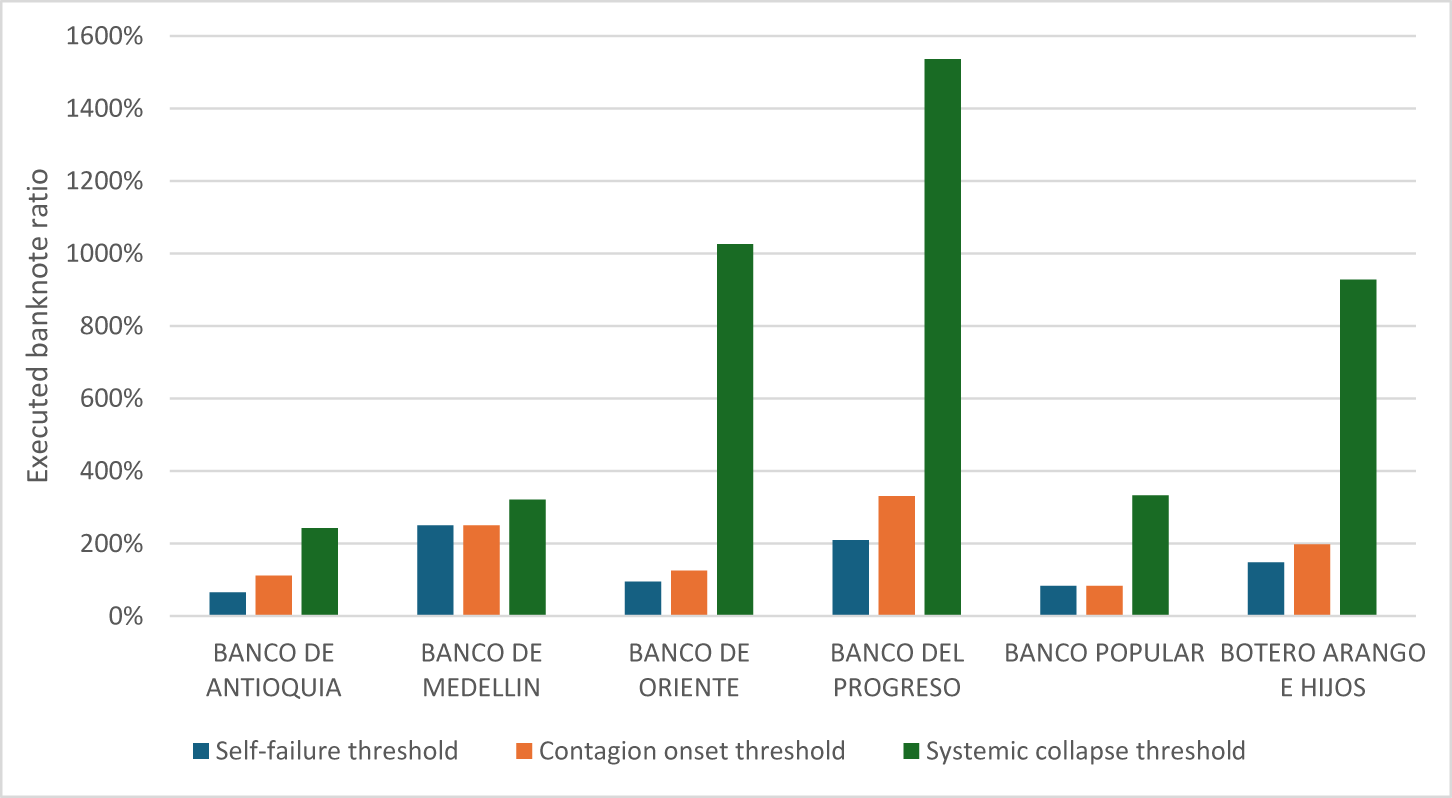
The simulation identifies conditions under which shocks to specific banks trigger contagion. Figure 7 illustrates three thresholds: when a bank cannot cover its own debt, when the shock spreads to neighboring banks, and when it causes a system-wide collapse.
Stress test. Antioquia. 1888.

For example, Banco de Medellín required a large shock (over 200% of its circulating banknotes) to default, due to its substantial cash reserves. However, its size and high network centrality meant that such a shock would have immediately caused a neighboring bank to fail, and a slightly larger shock would have collapsed the entire system. In contrast, Banco de Oriente, with a high leverage ratio, could have failed with a smaller shock (less than 100% of its banknotes). However, its lower connectivity meant that a shock over twice as large as that affecting Banco de Medellín would have been needed to collapse the system.
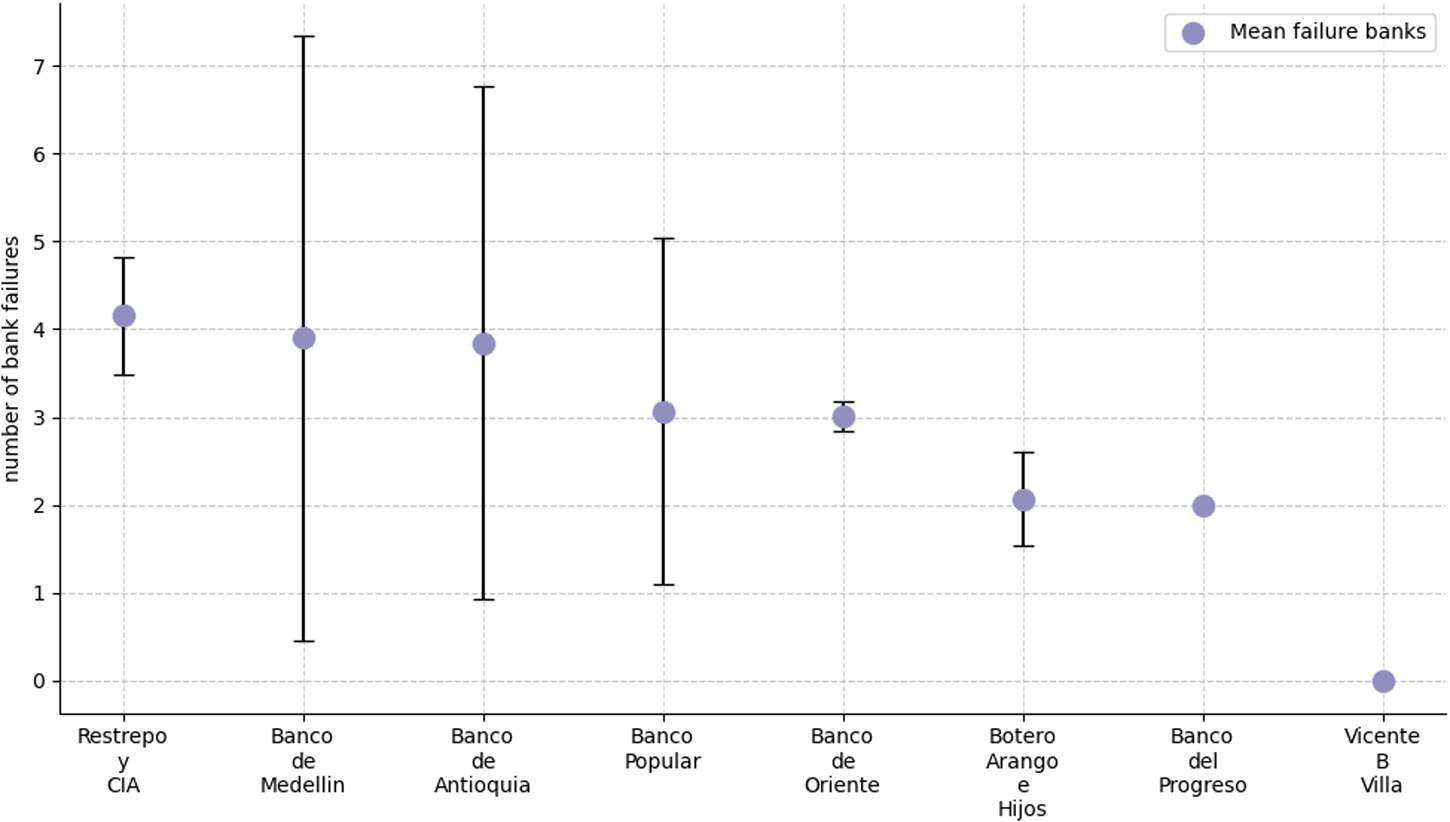
Because financial shocks are random events, a natural way to analyze them is through stochastic simulation. We therefore modeled 100,000 shocks drawn from a normal distribution, with the mean placed midway between the self-failure and systemic collapse thresholds, and the standard deviation set so that shocks span this range. In other words, the shocks were large enough to topple the originating bank but not necessarily sufficient to destroy the entire system.
Given a shock originating at bank i, how many other banks fail as a result? Figure 8 answers this question. On average, a shock starting at Banco de Medellín leads to the collapse of four banks, while a shock at Banco del Progreso causes two bank failures. This serves as a proxy for systemic risk  $s{r_{iJ}}$, capturing how destructive a shock to a particular bank is for the system as a whole.
Expected number of bank failures triggered by a random shock from bank i.

We also examine how quickly a given bank fails when shocks strike the network at random. Using normally distributed shocks large enough to topple an average bank, but not necessarily the entire system, Figure 9 shows that Botero Arango e Hijos would collapse almost immediately, while Banco de Oriente would survive several rounds of cascading failures.
Average round at which each bank fails.

The wide dispersion observed for Banco de Medellín and Banco de Antioquia seems to reflect their dual role as both large institutions and central nodes in the ownership network. Under stress, this combination produces heterogeneous outcomes depending on whether shocks originate internally or propagate through connected institutions.
The patterns observed in Figures 8 and 9 are consistent with the systemic risk estimates in Table 4, lending support to our estimation strategy for this case study. Moreover, it validates the theoretical intuition of the property-network approach, showing the complex dynamic in which interconnected investors could both stabilize and endanger banks, depending on individual bank decisions. Importantly, this test shows that very large shocks—several times greater than the value of circulating banknotes—were generally needed to destabilize the system. This outcome aligns with qualitative accounts of the relative stability of free banking in Antioquia.
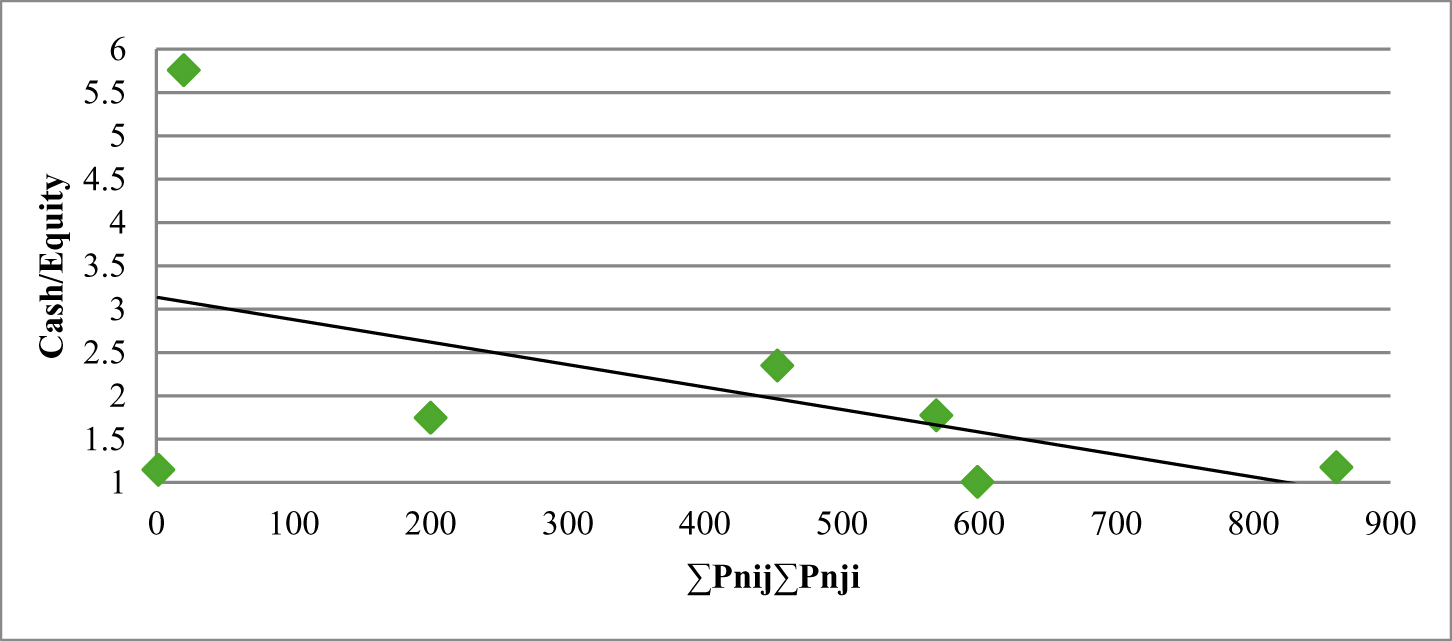
Highly interconnected banks, such as Botero Arango e Hijos, were also more exposed to systemic risk and responded by adopting conservative risk-management practices. This pattern appears throughout the data: institutions with greater connectivity tended to carry lower individual risk. Figure 10 illustrates a negative correlation between institutional interconnectedness and the cash-to-equity ratio—a measure of liquid resources relative to capital available to meet short-term obligations, including the redemption of banknotes (see Appendix B). The system’s high level of interconnectivity—and, crucially, the recognition of the risks it entailed—played a central role in preserving regional financial stability.
Relationship between the interconnection of institutions and the ratio of cash–equity.

5. Final remarks
This article reflects on financial stability during the free banking era in Antioquia, focusing on the interdependence of actors within the system. This perspective sheds light on the internal complexity of regional capital markets in Colombia in the late 19th century, a period for which banking history remains obscure, dominated by legal perspectives and general reflections. A key aspect of this vision is identifying the banks’ functioning as a network configured by the Antioquian elite. Analyzing ownership ties within this elite allowed for a reevaluation of the importance of different actors. For instance, we find that the banking house Botero Arango e Hijos was central within the financial sector, and that some individual investors representing medium and small shareholders were more relevant than those extensively studied within the region’s business historiography.
The paper shows that despite weak government regulation during this period, banks held relatively low-risk positions compared to modern standards. Interestingly, the institutions that were least connected within the system tended to engage in riskier behavior.
Overall, the paper provides evidence suggesting that interconnectedness is crucial for interpreting the stability of the financial system at the time. The findings of this paper resonate with DeLong’s (Reference DeLong1991) analysis of J. P. Morgan’s role in Gilded Age finance, which highlights how interconnected governance structures can stabilize financial systems despite weak formal regulation. While DeLong emphasizes reputation, this study reveals a parallel dynamic through the incentives that property connections provide. Bankers with interests in several banks have incentives to procure these institutions to avoid high-risk positions, as the collapse in one of them might spread to their other institutions.
Although the evidence we present here is not definitive, it is suggestive enough to highlight the need for further research on the importance of banks’ interdependence. Thus, as a first approximation to a subject that deserves much more detailed study, it outlines the main lines for progress on this issue:
First, more information is needed on the daily operations of banks, which requires extensive archival work. Despite the recent expansion of the work on archival collection and digitalization, most efforts have focused on individual-level information, with almost no relevant extraction of new information regarding banks in Colombia over the last decade. This endeavor is challenging due to the variety of sources spread across different archives, but it is essential given the regional nature of Colombia’s fragmented capital markets.
Second, a better understanding of periods of financial stress is necessary. While Colombian history is rich with analyses of social and political turmoil, these studies have rarely extended to the impact on banks’ operations. Research should explore how bank clients behaved during turbulent periods, what asset allocation decisions they made to protect against uncertainty, and how banks responded to these incentives. This line of research can be complemented by examining discussions in newspapers, opinions of business leaders, and narratives from the period, requiring an intersection between political and economic history.
Third, understanding how banks reacted to trade shocks is essential, particularly during the 19th century when much of the formal economy was connected to export activities. This would help align traditional agendas on foreign trade and commodity cycles with more recent work on business history and the domestic economy.
Fourth, Colombia’s experience with multiple relatively independent banking systems within similar institutional frameworks can provide general insights into the functioning of free banking and its stability determinants. However, this requires a comparative lens to interpret the heterogeneity of these systems and their reactions to various conditions. Thus, the experience of Antioquia should be interpreted from the experience of other regions as well.
Finally, the limitations of the Antioquian case during the free banking period illustrate the requirements of the property-network approach. Despite its lower data requirements compared to modern methods, it still needs frequent information on the liabilities of financial institutions. This approach has more potential in cases covering longer periods with more stress events, offering valuable insights into system stability. Implementing this approach in other, better-suited cases would help illustrate its potential and advance its refinement.
Acknowledgements
We thank Diego Felipe López for his comments and the members of the Economic and Political History Lab, in particular Mariana Lopera and Daniel Lazo, for their outstanding research assistance.
Appendices
Appendix A. Banks founded in Antioquia. Free banking era
1. Banks:
Banco de Antioquia: Its creation was authorized by Law 194 on October 6, 1871. The State of Antioquia established it with certain powers and privileges. Among these privileges was the support of the Government of the State of Antioquia for the bank’s issuance of notes. This meant that if a banknote was not redeemed upon presentation at the bank’s offices, the state government would cover it in gold. These notes were also accepted as current currency by all State Revenue Offices.
Banco Mercantil: The Banco Mercantil de Medellín was a short-lived but significant financial institution within the context of Colombia’s regional banking in the 19th century. Established on January 5, 1875, according to a public deed, it operated as a regular collective company with an initial capital of $40,000, of which one-quarter was in metallic currency, a common practice to back the issuance of banknotes at the time. The institution was authorized to issue banknotes in denominations of 1, 5, 10, 20, and 50 pesos, payable to the bearer in metallic currency or in notes of the Banco de Antioquia, reflecting the monetary flexibility of the era. The bank closed briefly after opening for unknown reasons. As no information survives for this bank, it was not included in our analysis.
Banco de Medellín: Founded as a joint-stock company, it began operations in 1881. Unlike Banco de Antioquia, it did not enjoy special privileges with the state. Its members came from various sectors in the Aburrá Valley, especially from Medellín. Although there was a cap of 200 shares per person, some groups, such as the house Botero Arango e Hijos, managed to control a much higher percentage of the firm.
Banco del Progreso: Founded in 1883, it specialized in granting loans to the miners of Marmato. With the highest average contribution per shareholder in the system, its partners were big traders and miners. Notable partners included Bartolomé Chaves, a mine owner and wealthy merchant from southern Antioquia; Julián Vásquez Calle, an iconic merchant and shareholder of Banco Popular de Medellín; and the house Botero Arango e Hijos.
Banco de Oriente: The average contribution per shareholder in Banco de Oriente was quite low ($557). Additionally, most shareholders were from outside Medellín (79.3%). Thus, the ownership and power of this bank were concentrated among merchants from the Antioquia periphery. Thirteen shareholders (12 from Rionegro) controlled 60.45% of the bank’s shares. Banco de Oriente aimed to be a provincial bank, seeking to monopolize urban markets outside of Medellín. Its operations did not include handling gold ingots or conducting foreign transactions. Its discount and credit services were restricted to the local level, usually serving well-known merchants in the east of Antioquia. It was the only bank founded during the 19th century that resisted monetary reforms and speculative processes of the turn of the century, operating until the 1940s (Botero, Reference Botero1988).
Banco Popular de Medellín: Founded in September 1882 with a subscribed capital of $60,000, it aimed to provide credit to small entrepreneurs, particularly farmers and miners, offering loans from $1. Additionally, the bank’s statutes required that 5% of the profits be allocated to a “pious association.”
2. Banking houses:
Restrepo & Cía.: Founded in 1854 as a regular partnership to engage in the trade of all kinds of goods, agriculture, and mining. From 1875, its statutes were modified, and it began to act as a bank, though records of its loans and mortgages can be found earlier. During the free banking period, it was led by Luciano Restrepo, a recognized liberal politician.
Botero Arango e Hijos: Founded in 1867 as a regular partnership by José María Botero and his children, it primarily focused on foreign trade. In 1879, it started issuing its own banknotes.
Vicente B. Villa e Hijos: Formed as a limited partnership in 1884, it was directed by Vicente B. Villa, an influential businessman, and co-owner of the firm with his sons and Gabriel Echeverri, another renowned merchant of Medellín.
Appendix B. Banking system’s reserves. 1888

Source: Calculations based on Botero (Reference Botero1984) and Botero (Reference Botero1988).
Appendix C. Family network of the Antioquia elite

Appendix D. Systemic risk estimates 1888

Source: Calculations based on Botero (Reference Botero1984).
Notes: This table reports systemic risk estimates under three scenarios: a 25% decrease (−25%) and a 25% increase (+25%) in all parameters relative to the baseline values.




 Open access

