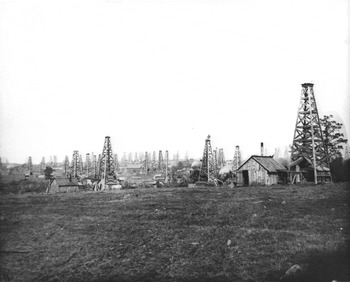
On 31 October 1866, four men were traveling by buggy a few miles south of Pleasantville, Pennsylvania, which at the time was little more than a crossroads on the edge of the oil fields. One of the men, Abraham James, was no stranger to the region, although this was the first time he had set foot physically in Venango County. According to biographer and fellow spiritualist James Martin Peebles, James had “frequently visit[ed] these Pennsylvania oil regions as a spirit, accompanied by his spirit-guides.”Footnote 1 On this particular visit, James, along with C. P. Easton, George Porter, and George McBride, was looking at a piece of property owned by Porter. Suddenly, James was forcefully possessed by his spirit-guides and conveyed out of the buggy and over a fence on the east side of the road. He did not know if he was “in the body or out,” and was moved around a field and thrown violently upon the ground. James then stuck a penny into the ground and fell into a “psychometrical condition,” during which “Indian spirits controlled his body mechanically, while wisdom spirits induced the trance condition.”Footnote 2 Speaking through James, spirits communicated that the men were standing on an immense oil deposit. Harmonial no. 1 was sunk on the William Porter farm, exactly on the spot James had indicated. Drilling began on 31 August 1867 and the event was written about in newspapers across western Pennsylvania and New York and featured in spiritualist publications. Oil was struck in February 1868 at a depth of approximately 835 feet and Harmonial no. 1 began to produce over 100 barrels a day (three other Harmonial wells later would be drilled in the area). The Pleasantville excitement had begun, and Abraham James and his spirit-guides stood at the convergence of two nineteenth-century American phenomena: spiritualism and oil (Fig. 1).
Harmonial Well, John A. Mather, Courtesy of The Drake Well Museum, Pennsylvania Historical and Museum Commission.

American spiritualism and the oil industry developed around the same time and in relatively close geographic proximity. By the mid-nineteenth century, spiritualism had anywhere from half a million to a rather generous estimate of eleven million adherents, and had garnered immense popular attention as the public learned of the spirit rappings of Kate and Margaret Fox at their home in Hydesville, New York in 1848.Footnote 3 Reflecting on the popularity of American spiritualism, theologian Theodore Parker remarked that “in 1856, it seemed more likely that spiritualism would become the religion of America than in 156 that Christianity would become the religion of the Roman Empire, or in 756 that Mohamedanism would be that of the Arabian population.”Footnote 4 In addition to lectures, spiritualist conventions, and circles held in private homes, there were numerous books, pamphlets, and periodicals devoted to spiritualist philosophy, and spiritualism circulated throughout many of the popular reform movements of the nineteenth century. The oil boom also generated popular enthusiasm and curiosity. With the success of Col. Edwin Drake and the Pennsylvania Rock Oil Company (later Seneca Oil) in 1859, people began to flock to the western Pennsylvania oil fields hoping to find wealth and opportunity. An era of pond freshets, exploding wagons full of nitroglycerin, and wild financial speculation had begun.Footnote 5
As this essay will suggest, American spiritualism and the early oil industry had more in common than just temporal and geographic proximity. These two nineteenth-century phenomena were both invested in a belief in the unseen, whether in the form of deceased loved ones or of underground oil reserves. Spiritualists such as James turned to the oil industry because of its lucrative financial opportunities and because of its potential to demonstrate the “practical” applications of spiritualism and Harmonial philosophy (as advanced by Andrew Jackson Davis, the “seer of Poughkeepsie,” whose work James read and admired).Footnote 6 Spiritualism offered an alternative to evangelical Christian and classical republican conceptions of industry, and a vibrant communication network ready to relay sensational accounts of the oil region to the general public.Footnote 7 Reading accounts of James's work as an “oil wizard” reveals the industrial aspirations of spiritualism and the psychometric aspects of the oil industry, both of which have been largely erased from twentieth-century historiography.Footnote 8 This essay focusses on biographical accounts of James and accounts of his work in Chicago, Illinois (1863–64) and Pleasantville, Pennsylvania (1866–68) to show how spiritualism shaped and was shaped by nineteenth-century oil culture. Throughout the nineteenth century, spiritualist publications, newspapers, technical manuals, and popular accounts of the oil industry produced James as a new kind of male medium, capable of meeting the exigencies of the oil fields. He proved infinitely reproducible as an agent of “practical spiritualism” and was discussed alongside the other drillers, operators, laborers, teamsters, and investors at work in the oil region. As petroleum geology began to establish itself as a discipline in the early twentieth century, accounts of the early oil industry began to reframe James, along with other practitioners of divination, as an amusing, if somewhat embarrassing, anomaly in an attempt to distinguish the modern “scientific” oil industry from its chaotic and superstitious beginnings. While later historians have offered a more sympathetic reading of divination's role in the oil fields, James and his Harmonial wells have largely disappeared from the historical record. Yet, despite scientific innovation and revisionist history, the oil industry still bears traces of its psychometric past and must contend with the ways in which its future is dependent on successfully channeling the unseen.
ABRAHAM JAMES: THE MEDIUM AND THE MESSAGE
Like the oil that he was credited with locating and the spirits with whom he apparently communed, James provided a kind of rhetorical availability and functioned as a site onto which discourses, desires, and anxieties of various kinds could be mapped. Just as Edwin Drake's personal history was slightly altered to meet the exigencies of the oil fields – he was given the honorary title of “Colonel” by James M. Townsend, then president of the Pennsylvania Rock Oil Company, to establish his credibility in western Pennsylvania – details of James's life were adapted to produce him as someone who could traverse the spiritual and the industrial. Various and sometimes contradictory pictures of James emerge from nineteenth- and twentieth-century accounts of his life and work. Descriptions of his physical appearance, age, background, and personality, and the identity of his spirit-guides, frequently differed; not even his name was consistent.Footnote 9 Certainly, James himself may have been partially responsible for these changes; he seems to have answered to both “Abraham” and “Abram,” and may have given different accounts of his life and work in the various places that he visited. Merely viewing James as a confidence man, however, obscures the ways in which, in the early 1860s, James and the oil he sought to locate were commodities in search of value, a value that then had to be produced and marketed to the public.Footnote 10 This section will focus on the ways in which biographical accounts of James, while they may have differed on some of the details of his life, represented him as a liminal figure who moved between the spiritual and the physical realms. Pamphlets written by Chicago spiritualist George Shufeldt in the 1860s and Peebles's The Practical of Spiritualism: A Biographical Sketch of Abraham James (1868) constructed James as a new kind of male medium, a practical spiritualist who brought both “Indian” wisdom and geological knowledge to his exploration of subterranean frontiers.
Who was Abraham James? A survey of the various accounts of his life suggests that he was born in Pennsylvania and may have worked for the railroad and traveled to California and the Pacific Northwest as a young man. He was involved with the Spirits' Well in Chicago in 1863–64 and arrived in the oil region of Pennsylvania around 1866. The rest of his biography is harder to pin down. An obituary, published in the New York Times on 29 November 1884, claims that James was “reported dead” in Oregon (the precise date is unknown) at the age of 77, which suggests that he was born sometime around 1807.Footnote 11 However, this account is not substantiated by any of the other narratives of James's life and work. Peebles's account of James's life indicated a birth date of 16 June 1827, a date supported by the 1900 census, which shows an Abraham James born on that date who resided in Fredonia, New York at the time of the census. That Abraham James was married to a Martha Ann James, had several children, and practiced vitapathy in Fredonia, New York, while also working in the oil business.Footnote 12 The Abraham James listed in the 1900 Census also had a twin brother, William James, a fact that dovetails with the account of James's family given in Peebles's biography.Footnote 13 The “facts” of James's life, including verifiable birth and death dates, familial connections, and places of residence have proved somewhat elusive, which has allowed historians and biographers to project certain traits onto him, while still maintaining an air of mystery that proved rhetorically useful for promoting his spiritual powers.
James was positioned as an explicitly Christian spiritualist, in the style of his biographer, J. M. Peebles, himself a well-known nineteenth-century spiritualist and author, and Andrew Jackson Davis. Several accounts of James published in the 1860s note that he was of Quaker origins, often as testament to his veracity and the validity of his communion with the spirit world. Presenting James as a Quaker linked him with the broader philosophical and religious history of spiritualism.Footnote 14 Moreover, associating James with a particular religious tradition served as a means of emphasizing spiritualism's connections with, rather than opposition to, Christianity and American religious history. Peebles, who published the only full-length biography of James in 1868 as part of an attempt to prove “that religion and science are a unit,” went further in proclaiming James's connections with mysticism and establishing a genealogy for his spiritual powers. He wrote of James's birth: “Under the sign of Gemini, Jupiter the reigning planet, and Venus exercising a controlling influence, Abraham James, a twin brother, was born on the 16th day of June 1827.” James's mother, according to Peebles, was also gifted with the “second sight.”Footnote 15 Peebles repeatedly doubled James, giving him all the familiar markings of a mystic, while still maintaining his connection to Christian tradition and material reality; he was a twin born under the sign of the twins to a mother with two kinds of vision and lived a kind of “dual existence,” simultaneously inhabiting spiritual and earthly realms. Later discussions of James expanded on connections between the medium and Christian prophecy. In The Early and Later History of Petroleum (1873), written by J. T. Henry, the medium's experience is likened to that of Paul on the road to Damascus. Harry Botsford's The Valley of Oil explicitly linked James with the Old Testament prophets, and many accounts of his well placement note his religious background so as to distinguish him from predatory “sharpers” and duplicitous oil firms such as those satirized by a popular song of the 1860s (“There's Ketchum & Cheatum, and Lure'um and Bleed'um, and Swindle'um all in a row …”Footnote 16). Within the context of nineteenth-century industrialism, which was framed as immoral and irreligious by ministers and social reformers, James's particular brand of spiritualism offered a model of moral industry that combined practicality, individuality, and empiricism, with the ability to transcend one's personal concerns and focus on the greater good. Such a model resonated not only with mainstream Protestant discourse, but also with republican notions of the ideal male citizen.
Yet James's masculinity was itself informed by spiritualist discourse and stood in contrast with that embodied by the rough and uncouth oilmen described in many nineteenth-century accounts of the industry. Shufeldt, Peebles, and other writers deemphasized or feminized James's physical presence, using what was to spiritualists a familiar discourse associated with male mediums.Footnote 17 In a pamphlet entitled Petroleum Near Chicago (1864), Shufeldt described James as “mild and soft in his manners, [and] gentle in his disposition.”Footnote 18 Despite his weak constitution, James had been forced by material circumstances, Shufeldt recalled, to work for the railroad and perform other forms of physical labor to which he was unsuited. In a later pamphlet, Shufeldt reiterated his assertion that James's physical appearance did not attract attention, characterizing him as “unostentatious.”Footnote 19 Peebles further highlighted James's physical weakness and asserted that James had spent his early years in California for health reasons. His work as a conductor on the railroad had been very taxing for someone so fragile. According to Peebles, James had a “spare slender figure” and a countenance that phrenologists would interpret as marked by candor and integrity. He was gentle and retiring, and his gait was “easy and unstudied.” James's physical body was unremarkable even to the point of weakness, which further emphasized his sensitivity and spiritual, rather than physical, capacities. And, according to Peebles, James inherited his spiritual powers from his mother, who continued to encourage his mediumship after her death. These powers were presented as a maternal legacy that James, because of his gentle and receptive nature, was able to wield. As Molly McGarry and other historians of spiritualism have noted, young women played a crucial role in spiritualist practice, but “women and – sometimes less often – effeminate, ‘gentle’ men were called to spiritualist service.”Footnote 20 Yet narratives about James balanced traits that were coded “feminine” – mildness, gentleness, and a slender physical form – with James's business sense, work experience, and the scientific knowledge of his spirit-guides, offering readers a vision of nineteenth-century manhood that traversed the spiritual and the scientific/industrial. Moreover, his work with the oil industry functioned to create a new vision of the male medium as uniquely suited to the spiritual and material exigencies of nineteenth-century capitalism.
Discussions of James's education and work experience reinforced this sense of a man who moved easily between the spiritual/cerebral and the industrial/physical, in accordance with Harmonial philosophy. Shufeldt in particular highlighted his lack of formal education, initially framing James as a man “of good natural abilities, [and] fair ordinary education.” His second account of James, published in History of the Chicago Artesian Well (1865), went a bit further, calling James “simple-minded, in the sense that he knows nothing of frauds, trickery, or imposture – perfectly truthful and upright in his character, unostentatious, and seeking no publicity or notoriety.” In short, according to Shufeldt, James was “a natural, honest man.”Footnote 21 Peebles presented a slightly different view of James's education, claiming that his family could not afford a great deal of schooling, but noted that James did attend Unionville Seminary and taught school briefly in the South. Several accounts suggest that James worked as a conductor for the railroad and used his powers as a medium to prevent accidents. According to Peebles, it was James's “mediumship” that gave him the reputation of being a safe conductor.Footnote 22 It was while visiting his twin brother, who was “tunneling for gold” in California, that James was introduced to Andrew Jackson Davis's The Principles of Nature, Her Divine Revelations, and a Voice to Mankind (1847). Through James's engagement with Davis's Harmonial philosophy, “he clearly grasped the theory that this visible world was but the phenomenal exhibition of that superior spirit-realm which comprehends the energizing forces, the primal forms and the eternal laws of the world.”Footnote 23 Peebles wrote that James, like Davis and other spiritualists and Transcendentalists who were influenced by Emanuel Swedenborg, embraced a vision of the spirit realm that “existed in a relationship Swedenborg called ‘correspondence’ with the material realm” and that “the two realms operated according to parallel laws and spiritual realities had physical expression.”Footnote 24 Like his work on the railroad, James's search for oil was framed in the language of correspondence and Davis's Harmonial philosophy rather than the language of the individual pursuit of wealth. With the exception of his observations of his brother's work in the California gold rush, Peebles reported, James was untrained in geology.Footnote 25 His placement of wells was not attributed to his own knowledge but to that of his spirit-circle, made up of American Indians and geologists who were said to be eager to demonstrate through James that human beings do not lose their interests and experience after death. As Peebles wrote, James's experiences proved that “changing worlds does not change identity” and “activity and progress” continue after human beings pass into the next realm.Footnote 26 Although Shufeldt emphasized James's intellectual blankness (even calling him “simple-minded”), Peebles framed James as educated by experience and as part of a larger effort in which the specific geological knowledge needed to produce wells was supplied not by James, but by his attending spirits. In the hands of Peebles, this group effort reinforced nineteenth-century discourses of individualism by demonstrating that people maintain their “self” even after they die and both the spiritual and physical realms are characterized by “progress.”
The equation of progress with the communication of Native wisdom from Indian spirits to a white medium echoed colonialist rhetorics of Manifest Destiny, in which American Indian nations were imagined to give way before the advance of white settlers, and framed the subterranean oil reserves as a kind of “frontier” to be explored by the practical spiritualist. The account of James's work published in the New York Times obituary explicitly framed James as an explorer:
Presently the earth opened and an immense cavern yawned before them. Into this James was led by the spirit. They journeyed down into the earth for a long distance, and finally the spirit brought James to the margin of a lake of petroleum of unknown depth and extent. Speechless with amazement, James gazed on that apparently boundless store of wealth for a few minutes, when the spirit led him back to the surface. The mouth of the cavern closed, and the spirit vanished.Footnote 27
In this scene, which is reminiscent of images of western expansion, James functioned as what Mary Louise Pratt called the “seeing man,” an agent of colonialism who visually surveys and possesses rhetorically available territory.Footnote 28 In terms that resonated with nineteenth-century ideologies of Manifest Destiny, the oil fields were constructed as a new kind of frontier, where once again Native people were imagined to pave the way for white “progress.” Yet it was the practical spiritualist, not the woodsman or the Cavalry officer, who was positioned at the forefront of this exploration.
Spiritualist and nonspiritualist publications rehearsed James's biography in order to establish his credibility as a medium and challenge the notion that religion was diametrically opposed to science and industry. Particularly in Peebles's biography, James embodied Swedenborgian notions of correspondence between the spiritual and material realms; reading the Harmonial philosophy of Davis allowed him to better understand his dual nature and apply it to his work on the railroad and in the oil fields. He appeared in the historical record as the product of his familial and religious background, his own experience, and the knowledge of his spirit-circle. James was packaged and sold to nineteenth-century readers in spiritualist publications, secular newspapers and journals, and book-length accounts of the early oil industry. As the concrete details of his life remained sparse and he himself produced few surviving writings, James functioned as a medium through which notions of practical spiritualism and ideological constructions of the oil industry could be communicated to the public.Footnote 29
CHICAGO: THE OILDERADO THAT WASN'T
Chicago is not often included in histories of the early American oil industry, but it was the site of Abraham James's first attempt to place an oil well using psychometrics and the first time that what we might call the spiritualist network engaged the topic of petroleum. While the presence of oil had been noted for some time by workers in the limestone quarries, which provided building materials for many of Chicago's noted landmarks of the period, there was no “oil industry” as such near the city in the early 1860s.Footnote 30 Drake's success in Titusville set off a chain of events that led to the famous oil boom in western Pennsylvania and attempts to duplicate, or even surpass, his efforts, in locations further west such as Chicago. During this period, Chicago had a well-established spiritualist community who sought to both communicate the practical side of spiritualism and cement the city's place as a modern cultural and economic center. Their efforts led to the drilling of the aptly named Spirits’ Well, which was located on a forty-acre tract of land on what was then the outskirts of Chicago, at the corner of Chicago and Western Avenues, about three and a quarter miles from the Court House.Footnote 31 Rival accounts of James's involvement with the Spirits’ Well published in the 1860s reveal not only the medium honing his craft, but also the internal divisions among practical spiritualists, which included disagreements about the proper relationship between spiritualism and public enterprises like the oil industry. As the following section will suggest, Chicago was a test of sorts, not only of the emergent oil technology, but also of the ways in which practical spiritualism could intervene in the pursuit of petroleum.
In the 1860s, Chicago was the site of significant spiritualist activity. Spiritualists had formed a society there in the 1850s and held meetings at “Harmony Hall,” located on Clark Street. Andrew Jackson Davis came to the city in 1856 to give lectures, and historian Alfred Theodore Andreas has noted that there were at least fifteen mediums in the city at this time.Footnote 32 The first national spiritualist convention was held in Chicago in 1864 and another convention was held the following year.Footnote 33 The city was also a center of spiritualist publishing; two spiritualist journals, News from the Spirit World (1868–70) and the Religio-philosophical Journal (1865–1905), were produced in Chicago.Footnote 34 The Spiritual Magazine described Chicago in an 1866 article about James and the Spirits’ Well as “the newest and most go-ahead city of the world.”Footnote 35 Reflecting on the relationship between Chicago and spiritual philosophy, Dr. William Cleveland argued, “Chicago is new, Spiritualism is new, they commenced life about the same time, and the line of progress continues about equal.”Footnote 36 Less religiously orthodox than some Eastern cities, Chicago was positioned by Cleveland and others as the center of American religious thought, a city that could eclipse New York in terms of cultural influence. Shufeldt argued that Chicago, with its central location and diverse population, could function as a stage for a spiritual performance that could be communicated to the entire world.Footnote 37 James came to the city in the early 1860s, and was part of a larger group of mediums and spiritualists who formed the Chicago Rock Oil Company. This company intended to demonstrate the power and veracity of spiritualism by the placement of oil wells and to promote the advancement of Chicago on the national stage. Accounts of the Spirits' Well suggest that rather than being opposed to capitalism and industrial development, James's spiritual communications were framed as an effect of capitalism: to speak to the interests of nineteenth-century Americans, the spirits were forced to communicate through languages of industry and commerce. Members of the Chicago Rock Oil Company hoped that oil itself could function as a kind of medium and persuade nonbelievers that spiritualism could make practical contributions to modern life.
James was not the first medium involved with the Spirits' Well, but he would come to be celebrated as the one who placed it. In the summer of 1863, Mr. Thomas J. Whitehead and Mr. A. E. Swift, two spiritualists, visited Chicago on business and met in a spiritualist circle with Mrs. Caroline Jordan, a relative of Mr. Whitehead. Through the mediumship of Mrs. Jordan, the group received a communication from the spiritual realm that a further communication of an important nature would soon be given. According to Shufeldt, Mrs. Jordan declared “that Petroleum, or Rock Oil, existed in large quantities near Chicago, and the particular tract or piece of land was pointed out on which it would be found.” Said communication was said to have come from “E. P. Hines,” a noted geologist from Maine and the friend of Mr. Swift. James then joined the group and produced several spoken revelations as well as a geological map, completed in a trance-like state.Footnote 38 But questions remained about where exactly to place the well. According to Shufeldt, in “the most prolific oil regions of Pennsylvania, not more than one well in ten strikes the oil,” and the odds in Illinois remained even slimmer.Footnote 39 Surface indications were notoriously unreliable, and direct communication from the spirits represented an alternative to the often misleading sensory evidence that could be gleaned from ordinary human observation. Shufeldt described how James determined the location of the well. He was traveling with Swift, Whitehead, and A. F. Croskey, across the tract of land that the spirits had indicated in October 1863. They were just about to return home, when James became entranced by spirits and indicated that the party was standing on an immense oil reserve.Footnote 40 This performance prefigured the one that he would enact in Pleasantville in several ways. James took three investors out in the month of October to tour the site of the proposed well. Entering into a trancelike state, he was physically moved by the spirits, predicted the presence of oil, and argued for drilling to commence.
The Chicago spiritualists were divided, however, by ideological differences and the material challenges of separating the oil and water produced by their wells. James became a locus of these internal divisions. In her account of the operation, which was written as a rebuttal to Shufeldt's histories of the well, Adeline Buffum, editor of News from the Spirit World, noted the many parties who were involved in the operation. The drilling
was protected by various bands of spirits: mechanical, scientific, geological, financial, and political; also, ancient bands of Hebrews and Chaldeans, and philosophers, prophets, poets and heralds from the most remote sphere, with Roger Bacon, of the thirteenth century, as sentinel, to drive away all the myriads, and myriads of spiritual and material substances that lurked about, not necessary to the enterprise of boring for oil, and the whole was surrounded by a wisdom sphere.Footnote 41
Spirits helped to place the well and were also invoked to ward off the usual dangers that accompanied drilling. Despite the efforts of Bacon and the other spirits, the Rock Oil Company struck water instead of oil and the mediums (and spirits) began to disagree with one another as to how to proceed. Twenty-four spirits were consulted; twelve voted to keep drilling for oil, while the other twelve voted to pursue the water. Conveniently, the sprits could not be held to any one position on the issue. According to Buffum, Jordan and another female medium, Mrs. Genung, challenged James's placement of the well. Genung channeled the spirit of Tecumseh, who apparently trumped James's unnamed spiritual advisers. Although he had been framed in other accounts as gentle and almost effeminate, in Buffum's account James invoked his masculinity when answering Jordan's challenge, telling the women that drilling for oil was “no boy's play” and that they should listen to his advice.Footnote 42 Shufeldt's accounts, which largely wrote women out of the history of the Spirits' Well, reinforced the idea that while women were central to the overall project of spiritualism, the placement of oil wells was the work of male mediums such as James.
When the Spirits' Well failed to produce enough oil to be profitable, the Chicago Rock Oil Company quickly transformed itself into the Chicago Artesian Well Company and James soon left for the oil regions of Pennsylvania. Buffum was critical of the Well Company, and her critique registered the imbrication of spiritualism and capitalism. She recounted the spirits' promise of a profitable oil well “for they were obliged to make demonstrations through the power of gold, owing to the present condition of society, since all mankind seemed to be guided through that channel.”Footnote 43 Returning to an earlier republican discourse that equated industry with corruption, she concluded that the enterprise failed because those involved with the oil well were too “selfish” and “carnal minded” for the operation to be successful.Footnote 44 Her conclusion was that spiritualism needed to be cleansed of “imposters” (James is implicated here but not named) and “great public enterprises like the Chicago Rock Oil Co., alias Artesian Well Co.”Footnote 45 Peebles, however, claimed that Davis's theory of “correspondence” between the spiritual and the physical accounted for the discovery of water. Since human beings are largely made of water, he argued, “sympathy” exists between human bodies and water, which explains why James's early mediumistic efforts resulted in the location of water rather than oil.Footnote 46 The spirits meant oil to be a “second lesson” for James, one that he would learn in western Pennsylvania.Footnote 47 The Chicago Artesian Well Company incorporated in 1867 and Buffum's warnings, which were informed by republican associations between industry and greed, were largely overwritten by the Harmonial rhetoric of Shufeldt and Peebles.
Spiritualism had already proven useful to the development of “public enterprises” such as the early oil industry by providing an established print network and rhetorics of correspondence between the physical and the spiritual that undercut equations of industry with corruption and binaries of success and failure. Despite a lack of oil, the Spirits' Well became a tourist site, largely due to the marketing abilities of the more “carnal minded” Chicago spiritualists; James's geological drawings were displayed and Shufeldt's History of the Artesian Well was available for purchase by interested visitors. At least three histories of the well were published during the 1860s, the first of which was distributed at the 1864 spiritualist convention, and the well was also featured in periodicals as diverse as Scientific American, the New York Evangelist, Friends Intelligencer, and the Round Table.Footnote 48 The intersection of spiritualism and the oil industry also created new opportunities for male mediums, who positioned themselves as the forefront of practical spiritualism. James touted his placement of the “celebrated Artesian well” while on the lecture circuit and likely used his connection to the well to establish his reputation as a medium in Pennsylvania.Footnote 49
PLEASANTVILLE: PSYCHOMETRICS AND PETROLEUM
After he left Chicago, James took his brand of practical spiritualism to the oil fields of western Pennsylvania, reportedly arriving on 31 October 1866 and bringing with him the celebrity that he earned in Chicago and the resources of the spiritualist communication network. While he would emerge as the most famous medium to visit the oil fields, James was part of a broader culture of divination that already had a toehold in the region. Various forms of divination, including those practiced by oil dousers, who used y-shaped rods to lead them to drilling spots, and oil smellers, who relied on their olfactory abilities, were employed in the oil region in the 1860s.Footnote 50 The following section will situate James within the broader context of oil diviners and chart the ways in which accounts of James's life and work dovetail with larger literary and historiographical trends related to the oil industry. Early accounts of divination and James's psychometrics framed the use of spiritualism as proof of the pragmatic approach of the early oil operators, who used all available means at their disposal to avoid the costs associated with an unproductive well. Yet, as oil geology became a more established and “professional” discipline in the early twentieth century, Abraham James was recast as an object of derision and a curious relic of a bygone era.Footnote 51 The focus shifted from James himself to his spirits, who become increasingly sensationalized as stereotypical Indian figures meant to further emphasize the “premodern” features of James and his work. Ultimately, James and the Harmonial wells that he placed seemed to disappear from studies of the history of the Pennsylvania oil fields and the development of the oil industry.
James came to the oil fields at a volatile period between the failure of Charles Vernon Culver's banks in 1866 and the Pleasantville excitement that was produced by Harmonial no. 1.Footnote 52 Financial panic swept the region in 1867 as a result of the bank failures. During this period the estimated cost of sinking a well was $3,300 and half of all wells were unproductive. For the fifty percent that did produce, the average lifespan was six months.Footnote 53 As Peebles suggested, “there were little system and no science exhibited in putting down these wells. Hundreds of wells were sunk to the proper depth and no oil obtained.”Footnote 54 Concerns about the unpredictability of the enterprise intensified when prices fell in 1867 and productivity was comparatively low.Footnote 55 Summing up the feelings of many who came to the region in search of oil, one writer for the New York Tribune reflected, “The business is all lottery, say the operators.”Footnote 56 People throughout the region were in search of a means of rendering the process of locating wells intelligible and predictable. According to Roger M. and Diana Davids Olien, in the oil fields “the laws of man were both bent and broken” and the “new petroleum industry was unscientific, unpredictable.”Footnote 57 Tracing the development of the oil industry from a speculative venture to a scientific enterprise, Edgar Wesley Owen concluded,
In the nineteenth century, they followed hunches and set up their rigs by seepages or located places to drill according to “creekology” and topographic “breaks” and “belt lines,” or followed a douser (“doodlebug”). Later the wildcatters adapted geology almost as readily as did the major companies.Footnote 58
When James arrived in the oil fields of Pennsylvania, he worked alongside a host of what Brian Frehner has called “vernacular prospectors,” men who generally did not have formal training in geology and engaged in the business of locating oil long before petroleum geography became an established discipline.Footnote 59 These vernacular prospectors relied on sensory data, surface indications, and tools such as the dowsing rod or the doodlebug (a term which could refer to the gadget or its user). According to Black,
The divining rod became the most acceptable method of well location [in the 1860s]. Using a forked twig from a witch hazel shrub or a peach tree, a diviner would tightly hold the wood as he passed around the property. A swift downward dip of the wood, often imperceptible to the naked eye, would show where one should locate a well.Footnote 60
Other oil-finding devices were more elaborate, including one doodlebug device that “consisted of bells, whistles, and dials attached to a large black box that a man operated while seated and covered with a shroud while four men carried him and the device around prospective oil fields.”Footnote 61 Although he did not mention James specifically, Black noted that during the 1860s, the industry went “metaphysical” and “spiritualists and oil smellers also made a fine living in the oil fields.”Footnote 62 James and his spirit-guides were part of a larger cast of characters who populated the early oil fields and derived their authority not from geological expertise, but from spiritual, sensory, or extrasensory sources. Yet the success of the Harmonial wells, which were credited with starting the Pleasantville excitement, combined with James's connections to a broader spiritualist network, served to distinguish him from numerous other “vernacular prospectors” who lived and worked in the oil regions of Pennsylvania, and garnered him widespread fame (Fig. 2).
General view of the William Porter Farm, John A. Mather, Courtesy of the Drake Well Museum, Pennsylvania Historical and Museum Commission.

Throughout the nineteenth century, James, his Harmonial wells, and his psychometric approach were regularly featured in accounts of the oil region published in handbooks and technical manuals, newspapers and periodicals (produced by spiritualists and nonspiritualists alike), and in book-length accounts of the “discovery” of oil written for popular audiences. Spiritualists used their literary connections to keep James in the public eye, celebrating James's work in Pleasantville in periodicals such as Buchanan's Journal of Man and books such as Emma Hardinge's encyclopedic Modern American Spiritualism (1870).Footnote 63 James himself gave lectures on the topic. Accounts written by nonspiritualists offer psychometrics as one of a number of available approaches to what seemed like an arbitrary endeavor. In an 1865 account of his travels in the oil region, William Wright conceded that “the diviners have a power in Petrolia, among a people as keenly inquisitive and practical as are to be found,” because their services cost very little as compared to the overall expense of sinking a well and any sort of advice was better than drilling blind.Footnote 64 Writers such as J. T. Trowbridge, whose “A Carpet-Bagger in Pennsylvania” was published in Atlantic Monthly in 1869, claimed that James's success spoke for itself in the oil regions:
I hardly know what effect this practical argument of the spiritualists will have on the minds of unbelievers. I talk with some of these, who smile at it, saying that, although James's enterprise succeeded, many similar attempts to find oil or treasure through spirit agencies have failed, and that consequently nothing is proved. Still I perceive that they talk of James with respect. “There is one good thing, success.” Everybody appreciates that.Footnote 65
James's success, which included several wells that produced over a hundred barrels per day, overrode skepticism about his approach.Footnote 66 An 1879 History of Venango County echoes similar sentiments: “There are many operators in whose minds are yet fresh the implicit confidence placed in ‘Oil Wizards,’ and their power to successfully locate wells.”Footnote 67 Nearly all of the accounts published in the nineteenth century also note that whether or not other operators believed in James and his spirits, many placed wells very close to Harmonial no. 1, hoping to capitalize on James's success.Footnote 68
Accounts varied as to the extent of James's financial success and what he did after the collapse of the Pleasantville oil boom in 1869. Some framed James as one of the great success stories of the region, while others assert that he made nothing from the endeavor or lost his fortune through a series of bad investments. Cone and Johns suggested that by the time of the Pleasantville collapse, James was one of the wealthiest oilmen in the area, and an article in the Spiritual Magazine described James's philanthropic support of spiritualist halls, libraries for children's lyceums, and individual lecturers and mediums.Footnote 69 According to The Derrick's Hand-Book, after the Pleasantville oil field was exhausted, James purchased land near President, Pennsylvania (roughly halfway between Oil City and Tionesta on the Allegheny River) and attempted to replicate his success with Harmonial no. 1. Yet another account claimed that James tried to sink a well in the middle of the Clarion River and lost $6,000 in the process. The New York Times obituary claimed that James left the oil region worth an estimated $500,000.Footnote 70 The pages of nineteenth-century stories of the region are filled with examples of drillers, operators, and investors who, like James, made and lost money in the oil fields. That James and his spirits may not have been infallible initially did not detract from the fame of the Harmonial wells and the Pleasantville boom. It was only later that stories of his failed attempt to place a well in the middle of the Clarion River came to eclipse his achievements.Footnote 71
By the early decades of the twentieth century, James and his Harmonial wells had, like the doodlebugs, become an amusing footnote, a reminder of an earlier time before the oil industry became serious and scientific. Such accounts provided more detail about his spirits, often framing them as American Indian leaders, than they did about James. In a 1915 account of a commemoration of Drake's strike, an anonymous author from the New York Times devotes several paragraphs to a discussion of James and his Harmonial well, framing it as one of a series of curious events that transpired in the chaotic period before Standard Oil intervened, regulating prices and stabilizing the market (it is noteworthy that Standard Oil functioned as the hero here, in the wake of the 1911 breakup and mass public disapproval). James in this article is guided by a figure called “Mountain Bear,” who was ostensibly a Seneca leader. Journalist Herbert Asbury, who wrote a series of “informal histories” of subjects ranging from gambling to the San Francisco and New York underworlds, discussed James and his “friendly spirit of a Seneca Indian chief” at some length in The Golden Flood: An Informal History of America's First Oil Field. Herbert added a few flourishes to the then-familiar story of James and his placement of the Harmonial well; he wrote that when James was possessed by his spirit-guide, “a stream of Indian talk pour[ed] from his lips” and he “went skipping across one of Porter's fields like a jack rabbit, bounding high into the air at every jump.”Footnote 72 According to Herbert, “As long as James remained in the Pleasantville field his control was infallible, but when he attempted to operate in other parts of the region the Indian chief appeared to have lost his bearings.”Footnote 73 Nevertheless, Asbury does concede that James became wealthy in the oil regions, despite the fallibility of his spirits.
Shortly after the publication of Asbury's history, popular histories transformed the identity of James's spirit from a Seneca chief to Lalah, a beautiful Indian maiden, a romanticized figure who served to further distance James from the practical, scientific oil industry of the present day. Henry Botsford included an entire chapter on James (whom he called Abram James) in his 1946 book The Valley of Oil, although the chapter was titled “Lalah, the Spirit Guide.” The story of Lalah, which would be repeated by later writers, appears first in Botsford's work, a sensationalized vision of the early oil industry that is contrasted sharply with the contemporary moment:
It is a far cry from these modern pioneers, who have planned and applied scientific methods to the secondary recovery of oil from fields that have had the appearance a few decades ago of being depleted, to the days of Abram James. Lalah, the spirit guide, has been replaced, as has the old rule-of-thumb, by engineering, hydraulics, and the slide rule. Today's oil men prefer to deal with tangibles. If another Abram James should appear on the scene, even if the spirit guide were to be streamlined and jet-propelled, it is most unlikely that the oil industry would accept the proffered guidance.
Today's oil men are practical folk; if they have anything to do with spirits they want them straight from the bottle.Footnote 74
Here Botsford conflated James and “Lalah” with the nineteenth-century oil industry as a whole so as to contrast the “modern” and “scientific” methods (engineering, hydraulics, and the highly advanced slide rule) of his own era with the premodern methods used by James (spiritual communication with Romanticized preindustrial Indian figures). These representations of Indian spirits are less about advancing a kind of frontier logic, as in the earlier accounts, and more about distinguishing James from the “practical folk” of the 1940s.
James's increasing marginalization reflected broader trends in narratives produced by and about the oil industry, in which psychometrics of various forms were replaced by geology. According to Frehner, a 1940 advertisement by the Union Oil Company of California that appeared in Fortune Magazine celebrated the triumph of science over the doodlebug and his black box.Footnote 75 Like the doodlebug, James and his psychometric methods were distinguished from both practical and scientific methods of oil location, recast as folklore, and, in some cases, dismissed entirely as a fraud. Paul Giddens, preeminent historian of the early oil industry, acknowledged the success of the Harmonial, but also claimed that “no one put any faith in the highly supernatural narrative of James.”Footnote 76 James appeared in Hildegarde Dolson's The Great Oilderado as a “rabid-eyed spiritualist” named James Abram in a chapter entitled “Spies and Robbers,” an example of the corrupt outsiders who were drawn to the oil fields (Coal Oil Johnny here is framed as “one of the few natives who forgot himself”).Footnote 77 Mody Boatright's Folklore of the Oil Industry featured James along with several other “oil locators whose methods were professedly occult” in a work that also includes Paul Bunyan and tall tales of the oil region.Footnote 78 Claiming that “in many respects the oil witch bears the same relation to petroleum geology and geophysics that the alchemist bears to chemistry,” Boatright recounted the story of James and his Indian guide (who in this account locate oil on the Potter rather than Porter farm) as part of a larger argument for the “importance of folk-belief in the history of the oil industry.”Footnote 79 While arguing for the importance of James and his fellow “occult” practitioners, Boatright's study nonetheless served to amplify the distinction between James's psychometrics and the practical, scientific efforts of other oil operators.
Although the practice of divination has received more attention in late twentieth- and twenty-first-century accounts of the early oil industry, James and his role in the Pleasantville excitement have virtually disappeared from the historical record.Footnote 80 Owen's magisterial Trek of the Oil Finders, published as part of the Semicentennial of the founding of the American Association of Petroleum Geologists, chronicled the “methods, men, and the industrial mechanism involved in the oil-finding effort” and included brief discussions of doodlebugs, dowsing, and divining, but does not mention James at all in the more than 1,500 pages that it devotes to the topic of oil finding.Footnote 81 Challenging narratives produced by companies such as Union Oil, Frehner's Finding Oil (2011) argued that a “number of different constituencies contributed to the body of knowledge that large corporations used for finding oil,” constituencies who included doodlebugs and clairvoyants.Footnote 82 While he does not mention James or his Harmonial Well, Frehner's work invites a reconsideration of figures such as James, who listed his occupation as “oil operator” on US Census records and was viewed by contemporaries as an embodiment of both the practical and the spiritual dimensions of oil location.
While nineteenth-century accounts recognized the ways in which spiritualists such as James, Shufeldt, and others were an integral part of the industrial landscape, the contributions of James and the other “occasional,” “incidental,” and “practical” oilmen were marginalized in historical accounts written by and about the oil industry during the first decades of the twentieth century, a period Owen connects with the establishment of “the professional practice of petroleum geology.”Footnote 83 Industry, it seemed, no longer needed to connect itself with Americans' spiritual lives or offer a governing morality for its actions, and the “practical” oilman was supplanted by the “professional” geologist. Recovering Abraham James and reintroducing him and “practical” spiritualism to accounts of the early oil industry continue the work of challenging teleological narratives by and about the oil industry in which the “scientific” and professional triumphed over the varied practices of amateurs and charlatans. James and his Harmonial wells remind us of the practical applications of spiritualism and the psychometric aspects of the oil industry and force us to rethink widely held distinctions between the spiritual and scientific.
CONCLUSION
It was by no means a foregone conclusion in the 1860s that the United States would become the oil culture that it is today. In the years following Drake's “discovery” of oil, investors and operators were not entirely certain of its value. They largely acted on blind faith and sheer force of will, hoping to develop a reliable system for placing wells and to demonstrate the utility of crude oil. Practical spiritualism, which took mediums and spirits out of the parlor and into the oil fields, was deeply involved in marketing the oil industry to the American people. It provided not only established networks (publishers, lecture circuits and lyceums, and so forth), but also a rhetoric of correspondence between the physical and spiritual worlds that allowed the excitement and pursuant dangers of drilling and speculation to be recast in terms of “discovery” and divine revelation, languages of frontier exploration that resonated with the nineteenth-century American national psyche.Footnote 84 Abraham James, constructed as a liminal figure who traversed the physical and the metaphysical, was deployed in nineteenth-century print discourse to legitimate both practical spiritualism and the oil industry. While later historians recast him as an anomaly in order to celebrate the modernity and technological know-how of their own historical moment, James reveals dualities and tensions that continue to characterize the oil industry writ large and US oil culture. Commenting on the catastrophic events in the Gulf, a New York Times article published on 25 December 2010 notes, “For all of the Horizon's engineering wizardry, it was tangling with powerful and highly unpredictable geological forces.”Footnote 85 After more than 140 years, the oil industry still pits its wizards against the forces of nature and geology, staking its success on the combined efforts of science and psychometrics.