





1. Introduction
Human communication is inherently multimodal. Spoken language is routinely accompanied by visible bodily actions, particularly hand movements, that are tightly coordinated with speech and meaning. Early theoretical work argued that gesture is not merely an add-on to language but an integral component of the language system itself. McNeill (Reference McNeill1992) proposed that gesture and speech constitute a single, integrated system of expression that jointly reflects underlying thought. According to this view, both modalities arise from a common representational unit – the Growth Point – in which imagistic and linguistic components are integrated from the outset. Gesture is therefore not an auxiliary communicative channel but an intrinsic component of thinking through which ideas are externalized during communication. This view was further elaborated by Kendon (Reference Kendon2004), who argued that gestures are constitutive components of utterances and should be understood as integral elements of communicative action.
If gesture is an integral component of thinking, an important question is whether its temporal deployment is preferentially related to the organization of discourse itself. Existing theoretical and empirical accounts converge on the prediction that gesture is selectively recruited at moments of increased communicative significance. Within the Functional Sentence Perspective tradition, communicative dynamism refers to the degree to which discourse elements advance the communicative agenda by contributing new or structurally important information (Firbas, Reference Firbas1971, Reference Firbas1992). Extending this framework to multimodal communication, McNeill and colleagues argued that discourse elements representing greater departures from the immediately preceding context – and therefore carrying higher communicative dynamism – are more likely to elicit gesture (Levy & McNeill, Reference Levy and McNeill1992; McNeill et al., Reference McNeill, Levy, Duncan, Tannen, Hamilton and Schiffrin2015).
Related evidence comes from research on information status and discourse coherence. Studies of information status have shown that gesture is more likely to accompany new than given information, suggesting that gesture production is sensitive to how information is introduced and updated across discourse (Debreslioska & Gullberg, Reference Debreslioska and Gullberg2022). Recurring gesture forms, or catchments, may additionally maintain thematic coherence across stretches of discourse by linking related ideas across successive discourse segments (McNeill et al., Reference McNeill, Levy, Duncan, Tannen, Hamilton and Schiffrin2015; McNeill & Duncan, Reference McNeill, Duncan and McNeill2000).
Why should gesture be preferentially recruited during moments of discourse organization? One influential answer is that gesture is tightly coupled to the evolving cognitive processes through which discourse itself is constructed. A substantial body of work supports this view by demonstrating that gesture often reveals cognitive information that is not fully expressed in speech. Gesture–speech mismatches reliably signal transitional knowledge states during learning (Alibali & Goldin-Meadow, Reference Alibali and Goldin-Meadow1993; Church & Goldin-Meadow, Reference Church and Goldin-Meadow1986), while spontaneous gestures frequently reveal implicit knowledge and emerging mental representations unavailable in speakers’ verbal reports (Goldin-Meadow, Reference Goldin-Meadow2003). More broadly, gesture and speech form an integrated communicative system in which complementary aspects of thought are distributed across modalities rather than redundantly encoded (Goldin-Meadow, Reference Goldin-Meadow1999). If gesture continuously reflects the evolving organization of thought, it follows that moments requiring substantial cognitive reorganization – such as discourse transitions – should be accompanied by systematic changes in manual behavior rather than random fluctuations in movement.
This close coupling between gesture, cognition, and discourse organization makes instructional discourse a particularly informative context in which to examine these predictions. During classroom teaching, speakers must continuously introduce new concepts, reorganize existing knowledge, and coordinate complex conceptual relationships for learners. Consistent with this role, instructional gestures facilitate learning by grounding abstract explanations in perceptual space, particularly when speakers must communicate spatial or relational information (Valenzeno et al., Reference Valenzeno, Alibali and Klatzky2003). Complementing this experimental evidence, naturalistic classroom studies further demonstrate that teachers systematically deploy gesture to organize conceptual content during ongoing instruction. In mathematics classrooms, for example, gesture helps establish common ground by resolving abstraction, representational shifts, and potential misalignment between teacher and learner (Alibali & Nathan, Reference Alibali and Nathan2012). Together, these findings suggest that gesture is not randomly distributed throughout instructional discourse but is preferentially recruited when speakers introduce, reorganize, or stabilize conceptual structure.
This broader pattern is not unique to manual behavior. Similar boundary-related organization has also been reported in other bodily channels, including posture shifts and gaze, which systematically cluster around discourse segment boundaries (Cassell et al., Reference Cassell, Nakano, Bickmore, Sidner and Rich2001). Collectively, these findings suggest that discourse organization is reflected across multiple coordinated behavioral modalities rather than speech alone. However, although previous work has demonstrated where gesture tends to occur and why it is recruited during communication, the fine-grained temporal dynamics through which discourse organization is reflected in continuous movement remain poorly understood. If gesture reflects continuously evolving cognition, analytical approaches should preserve its frame-level temporal dynamics rather than rely exclusively on manually predefined gesture categories or behavioral phases.
Despite these theoretical developments, gesture research has continued to rely predominantly on manually annotating hand movements into discrete categories such as deictic, iconic, or metaphoric gestures (McNeill, Reference McNeill1992). Although this approach has yielded important insights into gesture meaning, communicative function, and cognition, its reliance on predefined behavioral categories makes it less well suited to characterizing the continuous temporal organization of movement during discourse. This limitation is particularly relevant given theoretical accounts arguing that gesture preserves holistic and continuously evolving aspects of thought that are not readily captured through discrete segmentation (McNeill, Reference McNeill1992). Consequently, an important question remains unresolved: whether the temporal organization of discourse can be recovered from continuous movement dynamics without requiring prior semantic classification of gesture form.
Recent dynamical accounts have begun to address this question by conceptualizing gesture as a self-organizing dynamical system whose communicative significance emerges through the ongoing coordination of cognitive, linguistic, and motor processes (De Jonge-Hoekstra et al., Reference De Jonge-Hoekstra, Van der Steen, Van Geert and Cox2016). Rather than treating gestures as isolated communicative events, this perspective proposes that communicative organization itself emerges through continuously evolving movement dynamics, predicting that discourse organization should be reflected in the temporal organization of movement rather than only in discrete gesture events. If so, analytical approaches must be capable of characterizing these dynamics directly rather than beginning with predefined behavioral categories or segmented events. Recent advances in computational movement analysis now make this prediction empirically testable. Kinematic studies have shown that manual movement consistently changes as communicative systems become more structured (Pouw et al., Reference Pouw, Dingemanse, Motamedi and Özyürek2021), while computer vision and markerless motion tracking enable continuous quantification of hand kinematics during targeted interactive tasks (Trujillo et al., Reference Trujillo, Simanova, Bekkering and Özyürek2018). However, most existing computational work has focused on gesture detection, gesture classification, or constrained laboratory paradigms rather than examining how discourse organization emerges in continuous movement dynamics. Consequently, a scalable computational framework for linking continuous hand kinematics to discourse structure remains lacking.
The present study addresses this gap by developing a fully automated computational pipeline for extracting and analyzing continuous hand-movement signals in naturalistic classroom instruction. Using markerless pose estimation (Lugaresi et al., Reference Lugaresi, Tang, Nash, McClanahan, Uboweja, Hays, Zhang, Chang, Yong, Lee, Chang, Hua, Georg and Grundmann2019), the pipeline extracts frame-level kinematic measures of hand movement from instructional videos and aligns movement patterns derived from these trajectories with independently annotated discourse boundaries. Rather than beginning with manually assigned semantic categories or predefined gesture phases, it represents manual activity as a continuous temporal signal and identifies brief movement bursts using a uniform kinematic criterion. Applying this framework across multiple lessons, instructional domains, and complementary null models allowed us to evaluate both the stability and the generality of gesture–discourse alignment.
If gesture provides a window into how discourse is organized in real time, then its temporal deployment should reliably relate to moments at which speakers reorganize ongoing discourse. Unlike viewing discourse boundaries as isolated markers separating adjacent discourse segments, the present study asks whether they are reflected in the continuous temporal organization of manual behavior. To evaluate this possibility, we tested three related predictions.
First, we predicted that brief bursts of unusually strong hand movement would occur at a higher rate within short temporal windows surrounding high-confidence discourse boundaries than during the remaining analyzed time. We further examined whether these movement bursts occurred more frequently before or after the boundary – that is, whether gesture activity tended to precede or follow discourse transitions. Second, if gesture–discourse alignment reflects a stable property of communicative organization rather than lesson-specific variation, the temporal organization of gesture around discourse boundaries should be reproducible within individual teachers across repeated lessons, giving rise to reliable teacher-specific temporal signatures. Finally, we examined whether these temporal organization patterns generalized across instructional domains by comparing mathematics and literature instruction, asking whether gesture–discourse alignment reflects domain-specific communicative strategies or a broader property of discourse organization. Taken together, these predictions evaluate whether discourse organization is systematically reflected in the continuous temporal dynamics of manual movement, and whether gesture forms part of the multimodal processes through which discourse is organized in naturalistic communication.
2. Methods
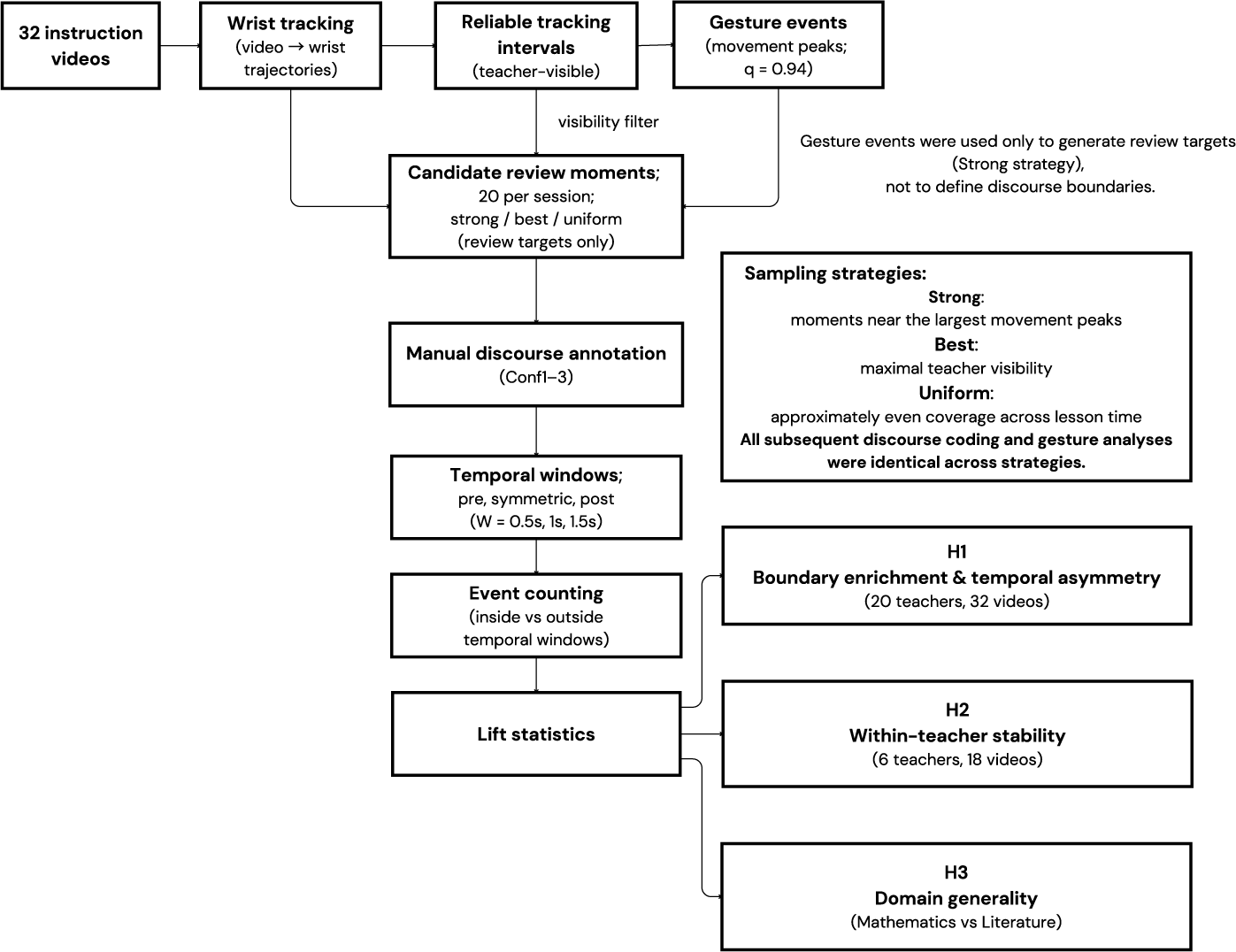
To test these hypotheses, we examined the temporal relationship between continuous kinematic measures of teachers’ hand movements and discourse structure in naturalistic classroom instruction. Gesture events were identified automatically from video using kinematic criteria, whereas discourse-structural boundaries were annotated independently based on instructional content. The two streams were then temporally aligned using predefined analysis windows. We tested whether gesture events occurred more frequently near discourse boundaries than elsewhere in the analyzed time and whether they occurred more often before or after the boundary. These comparisons were evaluated against permutation-based null models. The overall computational pipeline is illustrated in Figure 1.
Overview of the computational pipeline.

Figure 1 Long description
Thirty-two classroom videos are processed to extract continuous wrist trajectories and identify gesture events. Candidate review moments are generated automatically to guide manual discourse review but do not themselves constitute discourse boundaries. Reviewed moments are assigned discourse-boundary confidence ratings from Conf1 to Conf3. Gesture events are then aligned relative to annotated discourse boundaries within temporal windows. The resulting measures are used to evaluate H1, boundary-centered gesture enrichment and pre/post asymmetry; H2, within-teacher stability across lessons; and H3, similarity across mathematics and literature instruction.
Continuous wrist trajectories were extracted from 32 instructional videos to identify gesture events and automatically generate candidate review moments. Candidate review moments served only as targets for manual discourse annotation and did not themselves constitute discourse boundaries. Following manual annotation (Conf1–3), gesture events were aligned relative to discourse boundaries within temporal windows, and gesture-concentration measures were computed to evaluate H1 (whether movement events occurred more frequently near discourse boundaries and whether they occurred more often before or after the boundary), H2 (within-teacher stability), and H3 (domain generality). Supplementary analyses assessed the consistency of manual confidence ratings for candidate review moments selected by more than one sampling strategy.
2.1. Corpus and data description
The corpus consisted of naturalistic classroom instruction videos spanning two instructional domains: mathematics and literature. Mathematics and literature were selected because they differ substantially in their representational and pedagogical demands while both involve extended teacher-led discourse. Mathematics instruction frequently relies on spatial, symbolic, and diagrammatic representations, whereas literature instruction is more strongly oriented toward narrative interpretation and textual analysis (Alibali & Nathan, Reference Alibali and Nathan2012; O’Halloran, Reference O’Halloran2005). Examining these contrasting instructional domains allowed us to evaluate whether gesture–discourse alignment reflects domain-specific communicative strategies or a more domain-general property of discourse organization.
In total, 20 teachers were represented in the dataset. Each instructional video featured extended teacher-led discourse, providing a sustained temporal sequence suitable for examining gesture–discourse alignment. The dataset was organized hierarchically to support both overall and domain-level analyses while accounting for repeated lessons contributed by the same instructor. At the video level, 32 instructional videos were analyzed, including 16 mathematics lessons and 16 literature lessons. Each video was processed as a separate temporal sequence for the estimation of gesture–discourse alignment. For teacher-level analyses, however, video-level estimates were first averaged within each teacher, such that each of the 20 teachers contributed one independent estimate. Teachers who contributed three videos were therefore represented by the mean of their three lesson-level estimates, whereas teachers who contributed one video were represented by that single lesson-level estimate. An overview of the instructional corpus and analytic subsets is provided in Table 1.
Instructional corpus and analytic subsets

Table 1. Long description
The table lists two analysis sets for mathematics and literature. Full corpus: mathematics, 10 teachers and 16 videos; literature, 10 teachers and 16 videos. Within-teacher subset: mathematics, 3 teachers and 9 videos; literature, 3 teachers and 9 videos.
Note: Numbers indicate the count of teachers and instructional videos included in each analysis set.
Analyses examining the within-teacher stability of gesture–discourse alignment were restricted to the six teachers for whom three complete instructional videos were available: three mathematics teachers and three literature teachers. These teachers contributed a total of 18 lessons, comprising nine mathematics lessons and nine literature lessons. In these analyses, the three lesson-level temporal profiles for each teacher were retained separately and compared within teacher to assess the consistency of gesture–discourse alignment across instructional episodes. The subset included all instructors in the corpus who contributed at least three complete videos and was therefore determined entirely by data availability. No additional selection procedures or exclusion criteria were applied.
All temporal alignment measures (e.g., lift statistics and permutation-based p values) were first computed independently for each instructional video, with each lesson treated as an independent temporal sequence. To avoid pseudo-replication arising from temporally dense observations, group-level analyses were conducted using teacher-level aggregation, such that each teacher contributed a single summary profile averaged across that teacher’s lessons.
Importantly, the six-teacher subset was used exclusively for analyses of within-teacher stability. All corpus-level analyses reported in the study were conducted on the full dataset. Consequently, findings from the within-teacher analyses should be interpreted as evidence that teacher-specific temporal signatures can emerge and remain stable across repeated lessons, rather than as estimates of population-level variability.
2.2. Discourse-structural annotation
Discourse structure was annotated using an event-centered framework inspired by Event Segmentation Theory (Zacks & Tversky, Reference Zacks and Tversky2001; Zacks et al., Reference Zacks, Speer, Swallow, Braver and Reynolds2007). EST proposes that comprehenders continuously organize unfolding experience into meaningful units and periodically update their mental representations when substantial changes occur. Although originally developed to explain the segmentation of everyday events, EST provides a useful heuristic for identifying moments at which speakers reorganize ongoing discourse. The theory is invoked here as a conceptual framework rather than as a direct object of empirical evaluation.
In the present study, a structural point was defined as a discourse boundary marking a meaningful transition in the organization of instructional discourse. Such boundaries included conceptual shifts, topic resets, reframing episodes, or discourse closure. More generally, a structural point was coded whenever the speaker departed from the immediately preceding discourse context and initiated a new discourse segment. In contrast, local elaborations, repetitions, examples, or continuations within an existing discourse segment were not treated as structural points. This operationalization is consistent with previous work showing that communicative behavior, including gesture, often changes systematically around discourse boundaries (Levy & McNeill, Reference Levy and McNeill1992; McNeill et al., Reference McNeill, Levy, Duncan, Tannen, Hamilton and Schiffrin2015).
Because reviewing entire classroom lessons frame by frame was impractical, an automated sampling procedure was first used to identify approximately 20 candidate moments per lesson for human inspection, thereby reducing the amount of video requiring manual review. Candidate moments were selected from teacher-visible intervals, as defined in Section 2.7, using the sampling strategies described in Section 2.4. These strategies were designed to provide broad temporal coverage across each lesson while remaining independent of discourse coding. These timestamps served only as review targets that guided the annotator to portions of the lesson for closer examination and did not themselves constitute discourse boundaries. Whether a candidate moment was ultimately classified as a discourse boundary depended on manual evaluation of the surrounding discourse context rather than the sampling procedure itself.
Each candidate moment was subsequently reviewed manually by the first author using the discourse-structural criteria described above. During review, the surrounding instructional context was examined to determine whether the candidate segment contained a meaningful discourse transition (e.g., a topic shift, conceptual reframing, or discourse closure) and, if so, to localize that transition in time. Thus, the automated procedure determined only which stretches of continuous discourse were inspected, whereas both the classification and temporal localization of discourse boundaries were based on the organization of the surrounding discourse rather than on movement magnitude or peak timing. This dynamics-first, segment-based procedure did not involve first identifying an exhaustive set of semantic boundaries and then selecting those that coincided with strong hand movement. Instead, it examined the temporal organization of hand movement within sampled discourse segments relative to content-based structural annotations.
Each reviewed candidate was assigned a confidence rating ranging from 1 (weak or ambiguous transition) to 3 (clear and substantial discourse reorganization), reflecting the annotator’s confidence that a genuine discourse boundary had occurred. High-confidence boundaries (Conf3) were treated as the primary inferential targets in subsequent analyses, consistent with evidence that stronger discourse boundaries are marked by more pronounced prosodic cues (Swerts, Reference Swerts1997).
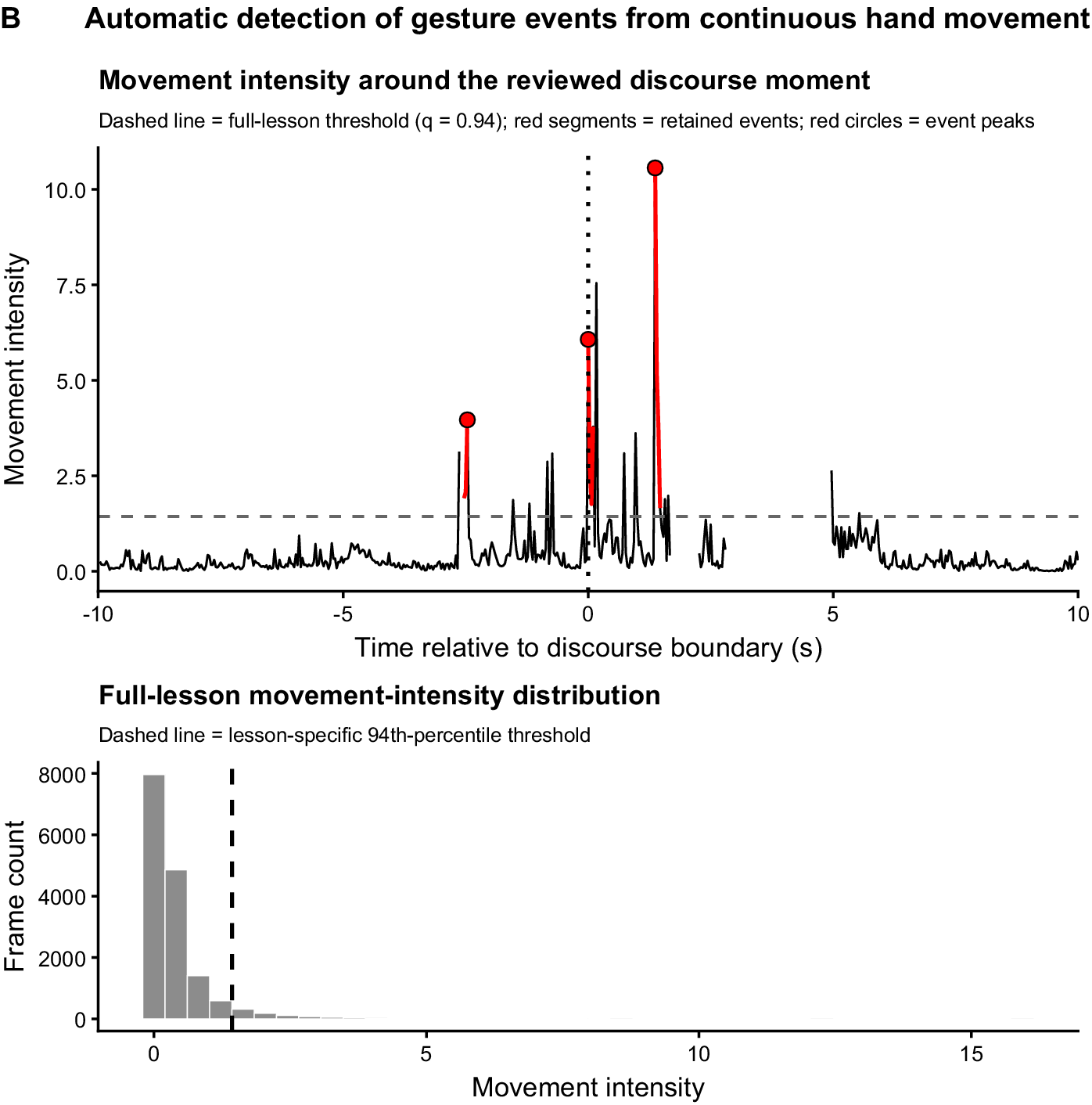
Figure 2 provides a representative example of the annotation procedure. Panel A illustrates a high-confidence discourse boundary (Conf3) identified during manual review. In this example, the instructor concluded one conceptual explanation and initiated a new line of reasoning, thereby marking a transition between discourse segments. Panel B shows the continuous movement-intensity signal surrounding the same boundary, illustrating how manually annotated discourse boundaries were temporally aligned with automatically extracted gesture events in subsequent analyses.
Example of discourse-boundary annotation and gesture-event detection.
Panel A. Example of a high-confidence discourse boundary (Conf3) identified during manual discourse annotation.
At t = 58.8 s in lesson M02, the instructor transitioned from explaining matrix invertibility (“A transpose A is invertible”) to introducing a new conceptual topic (“Well, if A has a null space…”). This marked a conceptual shift from explaining one mathematical property to introducing a different topic (null spaces). Such transitions, in which the ongoing discourse moved to a new conceptual focus, were annotated as discourse boundaries. The annotation was therefore based on the organization of the discourse instead of on pauses, sentence boundaries, or gesture timing. The corresponding hand-movement signal surrounding this discourse boundary is shown in Panel B, where gesture events are identified automatically as local peaks in the continuous movement signal.
Source: Gilbert Strang, Linear Algebra (18.06), Massachusetts Institute of Technology: MIT OpenCourseWare, https://ocw.mit.edu/courses/18-06-linear-algebra-spring-2010/ (accessed September 29, 2026). License: CC BY-NC-SA 4.0.

Panel B. Continuous hand-movement intensity surrounding the discourse boundary shown in Panel A.
Wrist trajectories were converted into a continuous hand-movement intensity signal. Gesture events were defined as runs of at least three consecutive frames exceeding the lesson-specific threshold (horizontal dashed line; q = 0.94), and the point of maximum movement intensity within each retained run is indicated by a red circle. The vertical dashed line marks the manually annotated discourse boundary. The lower panel shows the distribution of movement intensity for the same lesson and the corresponding lesson-specific detection threshold. Together, these panels illustrate how automatically detected bursts of hand movement were aligned with manually annotated discourse boundaries in the subsequent analyses.

Annotation confidence distributions and agreement across candidate-selection strategies are reported in the Supplementary Materials (Tables S2.1–S2.2).
2.3. Automated pose estimation and kinematic signal construction
Hand movement was extracted using a fully automated markerless pipeline. Teachers were first localized in each video frame using a YOLO-based object-detection model, a computer-vision algorithm that automatically identifies and tracks people in video recordings (Jocher et al., Reference Jocher, Qiu and Chaurasia2026). Wrist trajectories were then estimated with MediaPipe Pose (Supplementary Figure S1), which provides high-resolution tracking of upper-limb kinematics in naturalistic settings (Lugaresi et al., Reference Lugaresi, Tang, Nash, McClanahan, Uboweja, Hays, Zhang, Chang, Yong, Lee, Chang, Hua, Georg and Grundmann2019).
Gesture was operationalized as a continuous motor signal rather than a categorical label. Instantaneous wrist velocity was computed as the frame-to-frame displacement multiplied by frame rate. Movement intensity was defined as the maximum velocity across the left and right wrists at each frame, yielding a dominant-hand–agnostic measure of manual activity. In addition to wrist kinematics, frame-level detection confidence and shoulder visibility scores were retained to determine teacher-visible time intervals for teacher-constrained analyses (see Section 2.7).
Although velocity-based measures do not distinguish gesture forms, they are well suited to capturing the temporal deployment of manual activity, which is the focus of the present study. Previous work has shown that continuous movement trajectories contain meaningful information about the temporal organization of communication (Pouw & Dixon, Reference Pouw and Dixon2019). In addition, manual movement and speech can be biomechanically coupled, suggesting that variation in movement kinematics may capture aspects of structured multimodal coordination rather than merely isolated motor activity (Pouw et al., Reference Pouw, Harrison and Dixon2020).
The present analyses focused on when and how strongly the hands moved; they did not quantify rhythmic patterning, handshape, or the semantic content of gesture. Velocity-based measures therefore provide a complementary way to characterize temporal organization and embodied cognitive–motor involvement in communication (Hostetter & Alibali, Reference Hostetter and Alibali2008; Pouw et al., Reference Pouw, de Nooijer, van Gog, Zwaan and Paas2014) without first assigning gestures to semantic categories.
2.4. Gesture event detection
Gesture events were identified as moments of unusually strong hand movement within each lesson. To account for differences in movement style and overall activity, each lesson’s movement record was analyzed relative to its own baseline. Frames in which hand velocity exceeded the 94th percentile of the lesson-specific movement distribution (q = 0.94) were classified as high-movement frames. Consecutive high-movement frames were combined into a single event, and only runs lasting at least three frames were retained. The moment of maximum movement intensity within each retained event was used as the reference time for all alignment analyses. Thus, continuous hand movement provided the underlying measurement signal, whereas automatically detected event peaks provided temporally localized reference points for the subsequent boundary-alignment analyses.
Because discourse boundaries were identified through manual review (Section 2.2), candidate review moments (“watch points”) were first selected automatically to guide annotation. The primary strategy used in the main analyses (“strong”) preferentially selected moments associated with the most salient movement peaks while satisfying teacher-visibility constraints. To evaluate robustness, two additional sampling strategies were also implemented: a “best” strategy prioritizing maximal teacher visibility and a “uniform” strategy providing approximately time-stratified coverage across the lesson. These strategies differed only in how candidate review moments were selected; manual discourse annotation, gesture-event detection, temporal alignment, and all subsequent statistical analyses were identical across strategies.
The same discourse-annotation criteria were applied across all three sampling strategies. For candidate review moments selected by more than one strategy, the resulting confidence ratings were compared to assess whether manual boundary judgments were consistent across selection procedures. Agreement statistics are reported in Supplementary Table S2.2.
2.5. Comparing gesture concentration inside and outside discourse-boundary windows
To quantify the relationship between hand movement and discourse structure, we asked whether, within the sampled stretches of continuous discourse, kinematically defined movement events were temporally concentrated around independently identified structural updates rather than distributed diffusely across the surrounding instructional sequence.
For each lesson, gesture events were first restricted to the relevant allowed time interval (global: the full lesson; teacher-constrained: teacher-visible intervals), and windows were intersected with the same allowed time before counting aligned events. Let
$ {T}_{in} $
 denote the total duration of the window union within the allowed time, and
$ {T}_{out}={T}_{allowed}-{T}_{in} $
 . Let
$ {N}_{in} $
 be the number of gesture-event peaks falling within the allowed window union. The number of events outside the windows is given by:
$ {N}_{out}={N}_{allowed}-{N}_{in} $
 .
Here, enrichment refers to a higher density of gesture events near discourse boundaries than outside the boundary windows; the primary quantitative measure was gesture-rate lift.
We report two related but mathematically distinct lift formulations. A rate-based lift compares event rates:

A probability-based lift compares the observed proportion of events captured by the windows to the proportion of time covered by the windows:

A lift value of 1 indicates equal event density inside and outside the boundary windows. Values greater than 1 indicate that gesture events occur at a higher density near discourse boundaries than during the remaining analyzed time, whereas values below 1 indicate the opposite. Window half-sizes were varied from 0.5 to 1.5 s to assess whether enrichment estimates were robust across different temporal scales.
2.6. Comparing gesture concentration before and after discourse boundaries
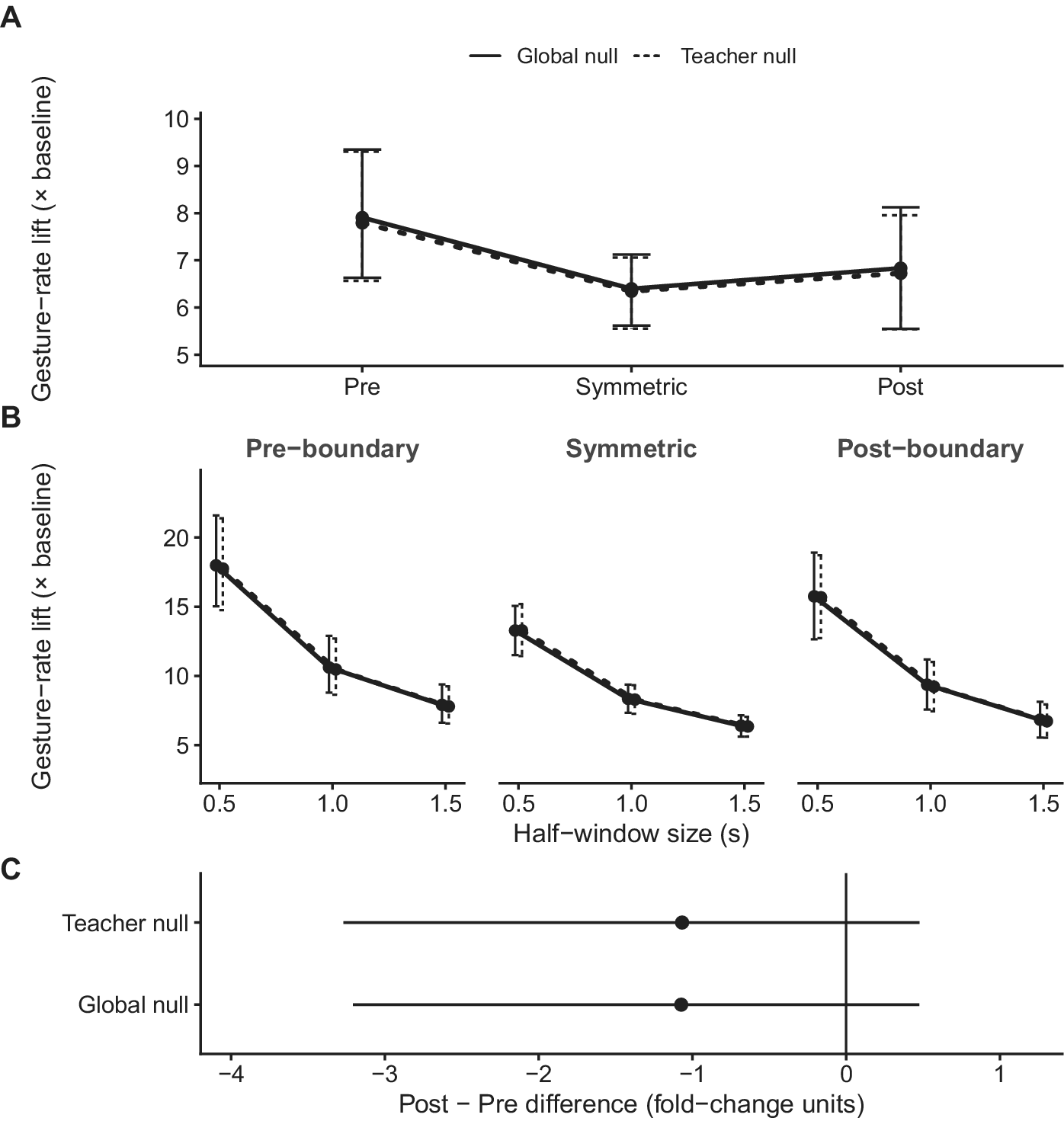
Beyond overall enrichment, we also examined whether gesture events preferentially occurred before or after discourse boundaries. Temporal asymmetry was quantified as the post–pre difference in gesture enrichment (Figure 3C):


Temporal Alignment of Gesture Events with Discourse Boundaries.
(A) Gesture-rate lift (values >1 indicate a greater-than-baseline concentration of gesture events) for pre-boundary, symmetric, and post-boundary windows (half-window size W = 1.5 s), shown under global and teacher-constrained null models. (B) Gesture-rate lift across different temporal window sizes (W = 0.5, 1.0, and 1.5 s) for pre-boundary, symmetric, and post-boundary analyses. (C) Difference in gesture-rate lift between post- and pre-boundary windows (post minus pre) under each null model.

Positive values indicate that gesture events occurred more frequently after discourse boundaries than before them. Negative values indicate the opposite, whereas values near zero indicate that gestures were distributed similarly before and after discourse boundaries.
2.7. Statistical analysis
All alignment measures were first computed separately for each instructional video. Primary group-level summaries used teacher-equal aggregation: lesson-level estimates were first averaged within teacher, and the resulting teacher means were then averaged across teachers, so that instructors contributing multiple lessons did not receive disproportionate weight. For H1, we additionally computed lesson-weighted summaries as a robustness check, with each instructional video contributing equally to the group estimate. Group-level 95% confidence intervals were obtained using percentile bootstrap resampling of the corresponding analysis units: teachers for teacher-equal summaries and lessons for lesson-weighted summaries.
Lesson-level departures from chance alignment were evaluated using permutation-based null models. Rather than assuming a particular parametric distribution, these models estimated how much gesture–boundary alignment would be expected by chance while preserving the observed number of gesture events within each analyzed lesson. For each lesson and condition, gesture events were restricted to the relevant allowed time interval: the full lesson for the global null model and teacher-visible intervals for the teacher-constrained null model.
In the teacher-constrained analyses, teacher-visible intervals were derived from the automated pose-estimation output. Time points were considered observable only when detection confidence met the minimum threshold and both shoulder landmarks were sufficiently visible; contiguous observable runs shorter than the minimum duration were excluded (detection confidence ≥0.35; shoulder visibility ≥0.45 for both shoulders; minimum interval length = 0.20 s). These constraints ensured that both observed and permuted event times were drawn only from intervals in which gesture events could, in principle, be detected.
Each null distribution was based on 2,000 permutations. In each permutation, the observed event count was preserved, but event times were randomly reassigned within the relevant allowed interval. Gesture-rate lift was then recomputed using the same temporal windows as in the observed data. Repeating this procedure generated a null distribution representing the level of gesture–boundary alignment expected by chance. One-sided p-values were calculated as the proportion of permuted lift values greater than or equal to the observed lift, using a plus-one correction.
Alignment analyses were stratified by boundary-confidence level (Conf1–3). High-confidence boundaries (Conf3) were designated as the primary inferential targets because they represented the clearest cases of discourse reorganization in the annotation scheme. This emphasis is also consistent with evidence that stronger discourse boundaries receive more pronounced prosodic marking (Swerts, Reference Swerts1997). Lower-confidence candidates (Conf1–2) were excluded from the primary inferential analyses but retained for supplementary quality-control and robustness analyses.
2.8. Software implementation
Automated pose estimation and wrist tracking were performed in Python 3.10.19 using NumPy 2.2.6 (Harris et al., Reference Harris, Millman, van der Walt, Gommers, Virtanen, Cournapeau, Wieser, Taylor, Berg, Smith, Kern, Picus, Hoyer, van Kerkwijk, Brett, Haldane, Fernández del Río, Wiebe, Peterson and Oliphant2020), OpenCV 4.12.0 (Bradski, Reference Bradski2000), PyTorch 2.9.1 (Paszke et al., Reference Paszke, Gross, Massa, Lerer, Bradbury, Chanan, Killeen, Lin, Gimelshein, Antiga, Desmaison, Köpf, Yang, DeVito, Raison, Tejani, Chilamkurthy, Steiner, Fang and Chintala2019), MediaPipe 0.10.14 (Lugaresi et al., Reference Lugaresi, Tang, Nash, McClanahan, Uboweja, Hays, Zhang, Chang, Yong, Lee, Chang, Hua, Georg and Grundmann2019), and Ultralytics 8.3.246 (Jocher et al., Reference Jocher, Qiu and Chaurasia2026), called from R 4.5.2 (R Core Team, 2025) via reticulate 1.44.1 (Ushey et al., Reference Ushey, Allaire and Tang2025). All subsequent data processing, including kinematic signal construction, gesture-event detection, temporal alignment, statistical analyses, permutation testing and figure generation, was implemented within a unified R workflow using readr 2.1.6 (Wickham et al., Reference Wickham, Hester and Bryan2025), dplyr 1.1.4 (Wickham et al., Reference Wickham, François, Henry, Müller and Vaughan2023), stringr 1.6.0 (Wickham, Reference Wickham2025), tidyr 1.3.2 (Wickham et al., Reference Wickham, Vaughan and Girlich2025), purrr 1.2.0 (Wickham & Henry, Reference Wickham and Henry2025), tibble 3.3.0 (Müller & Wickham, Reference Müller and Wickham2025), ggplot2 4.0.1 (Wickham, Reference Wickham2016), patchwork 1.3.2 (Pedersen, Reference Pedersen2025) and openxlsx 4.2.8.1 (Schauberger & Walker, Reference Schauberger and Walker2025). Data and analysis code required to reproduce the reported analyses are available in the associated Open Science Framework repository (Liu, Reference Liu2026).
Analysis datasets were assembled into a single long-format table recording, for each lesson and analytic condition (window definition, window size, boundary-confidence subset, and null model), the corresponding time-based counts, rates, lift values, and permutation p-values. Summary tables and figures were generated directly from this unified output.
3. Results
3.1. Gesture events cluster around discourse boundaries
Gesture events occurred substantially more often near high-confidence discourse boundaries than expected by chance and showed a systematic temporal distribution around those boundaries. These effects were observed across teachers and lessons (20 teachers, 32 lessons) and were robust to null-model specification and analytic parameterization.
3.1.1. Gesture events occur more frequently near discourse boundaries than expected by chance
Using the primary half-window size (W = 1.5 s) and teacher-equal weighting (averaging across sessions within teacher before computing the grand mean), mean lift values exceeded 1 under both the global and teacher-constrained permutation null models across all window definitions (Figure 3A), indicating greater-than-chance gesture concentration near discourse boundaries. Gesture concentration was strongest in the pre-boundary window.
Points indicate teacher-equal means, with lessons averaged within teacher before computing the group mean. Solid lines indicate the global null model and dashed lines the teacher-constrained null model. Error bars in Panels A–B and horizontal intervals in Panel C show 95% percentile bootstrap confidence intervals across teachers (5,000 resamples).
Gesture events occurred substantially more often near discourse boundaries than expected under both permutation-based null models. Under the primary analysis window (±1.5 s), gesture concentration was highest in the pre-boundary window (global: M = 7.91, SD = 3.21, 95% CI [6.63, 9.35]; teacher-constrained: M = 7.79, SD = 3.15, 95% CI [6.56, 9.30]), lower in the symmetric window (global: M = 6.40, SD = 1.77, 95% CI [5.62, 7.12]; teacher-constrained: M = 6.34, SD = 1.70, 95% CI [5.55, 7.06]), and remained elevated in the post-boundary window, although less strongly than before the boundary (global: M = 6.83, SD = 3.01, 95% CI [5.55, 8.13]; teacher-constrained: M = 6.73, SD = 2.86, 95% CI [5.54, 7.95]). All corresponding teacher-level bootstrap confidence intervals remained well above the equal-density null value of 1. At the lesson level, permutation-derived p-values were below .05 for all 32 lessons in the pre-boundary and symmetric windows under both null models, and for 30 of the 32 lessons in the post-boundary window under both null models. The close correspondence between the two null models indicates that the observed pattern was robust to whether event times were redistributed across the full lesson or only within teacher-visible intervals (Supplementary Figure S3.1).
Comparable results were obtained under session-weighted aggregation, indicating that the observed group-level pattern was not driven by the unequal number of lessons contributed by individual teachers.
3.1.2. Comparing gesture concentration before and after discourse boundaries
To determine whether gesture events tended to occur before or after discourse boundaries, we directly compared gesture concentration in post- and pre-boundary windows (Figure 3C). The mean post–pre difference was negative under both null models at the teacher-equal level (global: M = −1.07, SD = 4.39, 95% CI [−3.21, 0.48]; teacher-constrained: M = −1.07, SD = 4.39, 95% CI [−3.27, 0.48]), indicating an aggregate tendency toward greater pre-boundary than post-boundary enrichment. A comparable aggregate tendency was also observed under session-weighted aggregation. However, confidence intervals included zero, and the direction of the post–pre difference varied across individual teachers and lessons.
3.1.3. Gesture concentration declines with increasing temporal window size
To determine whether gesture events were tightly concentrated around discourse boundaries or spread across broader stretches of discourse, we repeated the analyses using progressively larger temporal windows (±0.5 s, ±1.0 s, and ± 1.5 s; Figure 3B). If gesture events were distributed broadly across the surrounding discourse, increasing the window size would have little effect on the observed concentration around discourse boundaries. Instead, the concentration of gesture events declined steadily as the analysis window became larger, indicating that gesture events were most tightly clustered in the immediate vicinity of discourse boundaries.
Under the global null model, gesture events were most strongly concentrated within the narrowest analysis windows (W = 0.5 s). As the window size increased to 1.0 s and 1.5 s, gesture-rate lift progressively decreased in the pre-boundary window (17.99 → 10.61 → 7.91), symmetric window (13.28 → 8.34 → 6.40) and post-boundary window (15.75 → 9.36 → 6.83). An equivalent decline was observed under the teacher-constrained null model (pre: 17.76 → 10.47 → 7.79; symmetric: 13.29 → 8.29 → 6.34; post: 15.68 → 9.22 → 6.73), indicating that the pattern was robust to the choice of null model. In other words, gesture–boundary coupling was strongest within a narrow temporal interval around discourse boundaries and became progressively weaker as the analysis window expanded to include broader stretches of surrounding discourse.
The same pattern was observed across individual teachers: all teachers showed a stronger concentration of gesture events within the narrowest temporal window (±0.5 s) than within the broadest window (±1.5 s). This indicates that the effect was not driven by a small subset of teachers but was consistently observed across instructors. Together, these findings indicate that gesture events were concentrated within a narrow temporal interval surrounding discourse boundaries instead of being broadly distributed across longer stretches of discourse.
3.1.3.1. Synthesis
Together, these findings show that bursts of elevated hand movement occurred preferentially around manually identified high-confidence discourse boundaries and became progressively less concentrated as the analysis window widened away from the boundary. The aggregate analyses also suggested greater pre-boundary than post-boundary enrichment; however, confidence intervals included zero, and the direction of this asymmetry varied across teachers and lessons. Boundary-centered enrichment and its attenuation across wider windows were broadly consistent across teachers, lessons, null models, and analysis strategies, whereas the data did not support a uniform pre- or post-boundary direction. Overall, these findings indicate a stable, temporally localized relationship between hand movement and discourse organization.
3.2. Teacher-specific temporal patterns
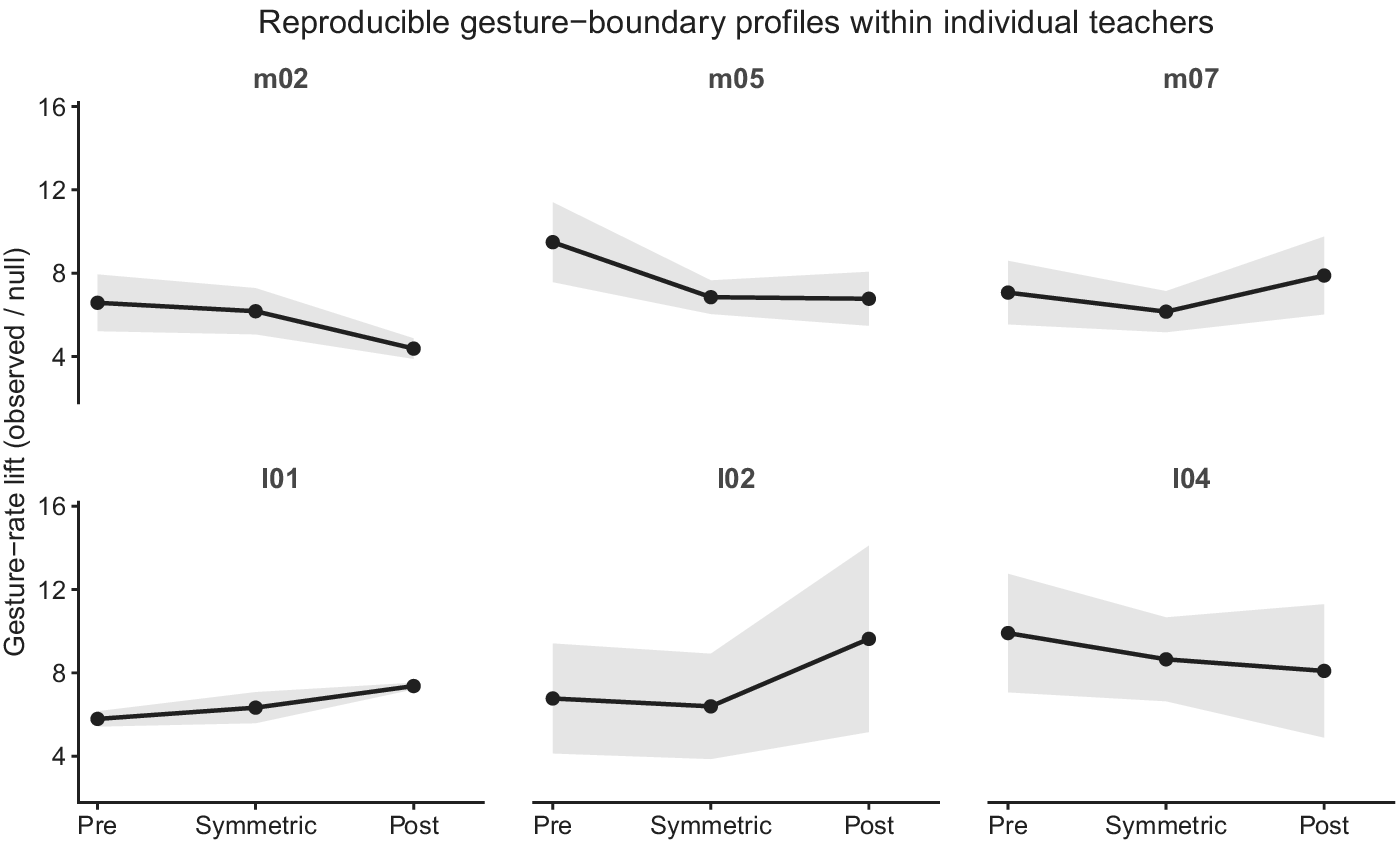
We next asked whether the temporal relationship between gesture events and discourse boundaries was reproducible within individual teachers across different lessons, rather than reflecting lesson-specific variation or emerging only after averaging across teachers. As shown in Figure 4, teachers differed in the overall magnitude and detailed shape of their temporal enrichment profiles. Nevertheless, each teacher exhibited a characteristic temporal profile that was reproducible across repeated lessons, giving rise to stable teacher-specific temporal signatures. This indicates that the overall findings cannot be explained solely by averaging across teachers but instead reflect consistent patterns within individual teachers.
Teacher-level temporal enrichment profiles.
Gesture activity around discourse boundaries for each teacher, shown separately for the pre-boundary, symmetric, and post-boundary windows.

Points represent the mean gesture-rate lift across each teacher’s lessons, and shaded regions denote ±1 SE across lessons. Profiles are shown under the global null model.
Teachers differed in both the overall magnitude and temporal shape of gesture enrichment. Some teachers showed stronger pre-boundary enrichment, whereas others showed greater post-boundary enrichment. Nevertheless, each teacher exhibited a distinct temporal enrichment profile across lessons, indicating that the aggregate findings were not solely an artifact of averaging across teachers. Quantitative analyses of within-teacher reproducibility are presented in Section 3.2.1.
3.2.1. Within-teacher consistency across lessons
The temporal relationship between gesture events and discourse boundaries was generally reproducible within individual teachers across repeated lessons. Although both the magnitude and temporal shape of gesture enrichment varied across teachers, each teacher tended to exhibit a characteristic temporal profile that recurred across recordings.
This reproducibility was confirmed quantitatively using cosine similarity between lesson-specific three-window profiles. Under the global null model, the mean pairwise cosine similarity across the 18 within-teacher lesson pairs was 0.954 (SD = 0.060), with values ranging from 0.764 to 0.998. Because each teacher contributed three lessons, each teacher contributed three pairwise comparisons. These three pairwise similarities were then averaged within each teacher, yielding six teacher-level mean similarities, which ranged from 0.867 to 0.985. The teacher-constrained null model produced nearly identical estimates, indicating that within-teacher reproducibility was robust to the choice of null model.
Together, these findings indicate that gesture–discourse alignment was reproducible within individual teachers across independent lessons while preserving meaningful variation in the specific temporal organization expressed by different teachers.
3.2.2. Between-teacher variation in temporal enrichment profiles
Teachers differed in both the magnitude and temporal organization of gesture enrichment around discourse boundaries (Figure 4). Some showed stronger pre-boundary enrichment, whereas others showed greater post-boundary enrichment. Because these differences were reproducible across repeated lessons within teachers (Section 3.2.1), they appear to reflect stable teacher-specific variation rather than random lesson-to-lesson fluctuation.
3.3. Similar gesture–boundary patterns across instructional domains
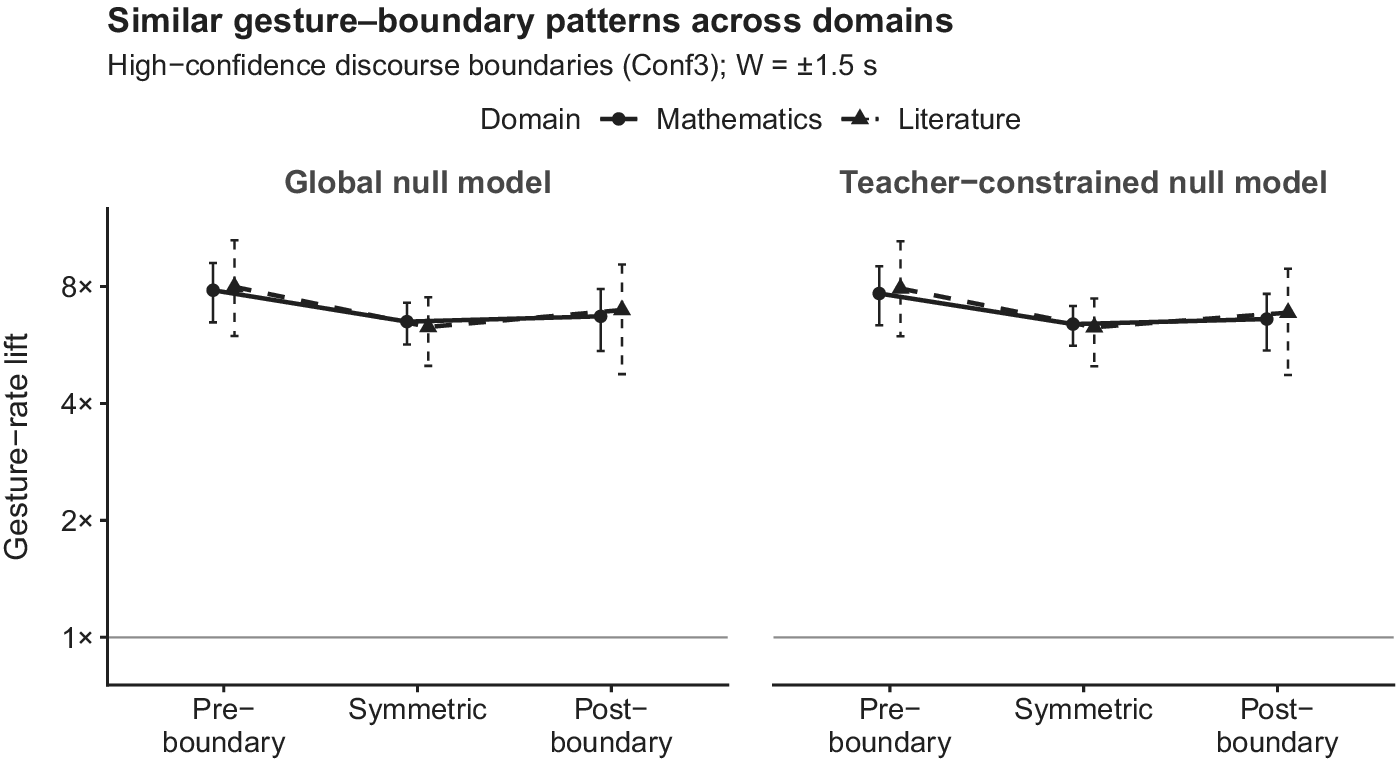
We next asked whether the temporal relationship between gesture events and discourse boundaries differed between mathematics and literature lessons. Gesture activity was quantified around high-confidence discourse boundaries (Conf3) using the same pre-boundary, symmetric, and post-boundary windows described above. The corresponding domain-level gesture–boundary alignment patterns are shown in Figure 5.
Gesture activity around discourse boundaries in mathematics and literature. Circles with solid lines indicate Mathematics and triangles with dashed lines indicate Literature. Error bars show 95% percentile bootstrap confidence intervals across teachers (3,000 resamples), with repeated lessons averaged within teachers before group-level estimation.

At the primary half-window size (W = 1.5 s), both domains showed similar temporal profiles. Under the global null model, gesture-rate lift in literature was 7.99 (SD = 4.02, 95% CI [5.97, 10.53]) pre-boundary, 6.30 (SD = 2.17, 95% CI [5.00, 7.51]) in the symmetric window, and 6.96 (SD = 3.84, 95% CI [4.76, 9.11]) post-boundary. Corresponding values in mathematics were 7.83 (SD = 2.36, 95% CI [6.47, 9.20]), 6.50 (SD = 1.36, 95% CI [5.67, 7.27]), and 6.71 (SD = 2.08, 95% CI [5.46, 7.89]). The teacher-constrained null model produced nearly identical estimates.
Across both domains, lift was lowest in the symmetric window and higher in the adjacent pre- and post-boundary windows. This pattern persisted across window sizes (Supplementary Figure S4.1), with lift decreasing as windows widened. Together, these findings indicate similar gesture–discourse alignment in mathematics and literature instruction.
4. Discussion
4.1. Summary of main findings
The present study provides convergent evidence that the timing of gesture is systematically related to discourse organization in naturalistic classroom instruction rather than being distributed uniformly throughout a lesson. By operationalizing gesture as a continuous kinematic signal rather than a set of discrete categories, we were able to identify fine-grained temporal relationships between hand movement and the unfolding structure of instructional discourse.
Three primary findings emerged. First, bursts of hand movement occurred more frequently around high-confidence discourse boundaries than during the remainder of the lesson, indicating that gesture events were concentrated at moments of discourse reorganization rather than distributed evenly across instructional time. Second, gesture–discourse alignment exhibited reproducible teacher-specific temporal profiles across repeated lessons, indicating that each teacher expressed a stable temporal signature rather than lesson-specific variation. Third, similar temporal alignment patterns were observed in both mathematics and literature instruction, indicating that gesture–discourse coupling generalized across instructional domains despite modest differences in overall magnitude.
Together, these findings indicate that the temporal organization of gesture provides an observable behavioral marker of how speakers organize discourse in real time.
4.2. Selective recruitment of gesture during discourse organization
Our findings extend longstanding accounts proposing that gesture is selectively recruited during moments of increased communicative significance rather than being distributed uniformly throughout discourse. Within the Functional Sentence Perspective framework, communicative dynamism refers to the extent to which discourse elements advance the communicative progression of a message (Firbas, Reference Firbas1971). Building on this framework, McNeill and colleagues argued that gesture is especially likely to accompany discourse segments representing substantial departures from the immediately preceding context. While previous evidence has primarily relied on categorical gesture coding, the present findings provide continuous temporal evidence for this proposal. The localized enrichment of hand movement around discourse boundaries suggests that manual activity is preferentially recruited during moments of increased communicative dynamism.
This interpretation is also consistent with studies of information structure showing that gesture preferentially accompanies new rather than given information (Debreslioska & Gullberg, Reference Debreslioska and Gullberg2022). Because the discourse boundaries examined here were defined as topic shifts, conceptual transitions, reframing episodes or closures, they typically marked moments at which instructional discourse advanced or reorganized. The observed concentration of movement around these boundaries therefore aligns with broader evidence that gesture preferentially accompanies structurally important discourse.
One possible explanation for this convergence is that discourse boundaries place increased demands on information packaging and communicative coordination. Rather than representing arbitrary temporal markers, discourse transitions often coincide with moments at which speakers restructure conceptual content while introducing communicatively important information. Such periods may therefore require increased coordination among cognitive, linguistic, and motor processes, making gesture more likely to accompany discourse organization. Consistent with the present findings and with accounts based on communicative dynamism and information structure, this perspective suggests that discourse boundaries are not simply locations at which gesture becomes more frequent, but temporally extended periods during which increased communicative demands recruit coordinated manual activity. Our findings also complement the framework of gestural catchments (McNeill et al., Reference McNeill, Levy, Duncan, Tannen, Hamilton and Schiffrin2015; McNeill & Duncan, Reference McNeill, Duncan and McNeill2000). Whereas catchments describe the recurrence of gesture features that maintain coherence within discourse segments, the present results identify when manual activity becomes concentrated – specifically, at transitions between those segments. Together, these perspectives suggest that gesture contributes both to maintaining discourse continuity and to marking discourse reorganization.
Finally, the present findings extend earlier observations that discourse boundaries are reflected across multiple bodily modalities. Cassell et al. (Reference Cassell, Nakano, Bickmore, Sidner and Rich2001) showed that posture shifts cluster around discourse segment boundaries; the present study demonstrates a parallel phenomenon in continuous hand kinematics using an automated computational approach. Together, these findings suggest that discourse organization is externalized through coordinated multimodal behavior rather than speech alone.
4.3. Temporal organization of gesture around discourse boundaries
Our findings indicate that gesture timing is systematically organized around discourse transitions rather than being randomly distributed throughout instructional discourse. Rather than occurring at isolated moments, gesture activity was concentrated within a narrow temporal interval surrounding discourse boundaries. This pattern suggests that discourse boundaries are better understood as temporally extended episodes of communicative organization than as instantaneous markers separating adjacent discourse segments.
This interpretation is broadly consistent with Event Segmentation Theory (Zacks et al., Reference Zacks, Speer, Swallow, Braver and Reynolds2007). Although originally developed to explain event perception, EST proposes that boundaries correspond to periods during which ongoing mental representations are reorganized in response to changes in unfolding events. Under this view, boundaries are not instantaneous points but localized intervals during which existing representations are updated, and new organizational structures become established. If discourse boundaries share this temporal organization, behavioral correlates of discourse processing should likewise be expected to unfold over a limited temporal interval rather than occurring exclusively at a single moment.
One possible interpretation of this temporal organization is provided by the articulatory phonology framework of π-gesture (Byrd & Saltzman, Reference Byrd and Saltzman2003). Rather than treating boundaries as passive separators between adjacent units, the π-gesture framework conceptualizes them as temporal control signals that transiently reorganize ongoing motor coordination.
Although originally developed to explain boundary-related lengthening in speech articulation, the dynamical logic of the π-gesture framework raises the possibility that boundary-related temporal modulation may extend to other continuous motor behaviors, including manual movement. From this perspective, the present findings are consistent with the possibility that communicative transitions transiently reorganize ongoing motor activity rather than merely marking the completion of one discourse segment and the beginning of another.
Empirical observations across communicative modalities are consistent with this interpretation. Esteve-Gibert and Prieto (Reference Esteve-Gibert and Prieto2013) demonstrated that prosodic structure shapes the temporal realization of manual gesture movements, while Krivokapić et al. (Reference Krivokapić, Tiede and Tyrone2017) showed that prosodic boundaries systematically modulate the kinematic organization of both articulatory and manual gestures.
4.4. Gesture timing as a possible behavioral correlate of discourse-model updating
Against this converging view of discourse boundaries as temporally extended periods of representational updating and transient motor reorganization, the temporal localization of gesture around discourse boundaries may provide a plausible behavioral correlate of discourse-model updating. Within Event Segmentation Theory (Zacks et al., Reference Zacks, Speer, Swallow, Braver and Reynolds2007; Zacks & Tversky, Reference Zacks and Tversky2001), boundaries are associated with moments at which an ongoing event model is revised in response to changes in the unfolding situation. Although the present study did not directly measure speakers’ internal discourse models, the concentration of hand movement around independently annotated discourse transitions is consistent with the possibility that manual behavior changes as speakers reorganize ongoing discourse.
Gesture enrichment occurred in both pre- and post-boundary windows, suggesting that manual activity was organized around the transition process rather than being confined exclusively to either anticipation or response. The aggregate analyses showed a modest tendency toward greater pre-boundary than post-boundary enrichment, but this directional effect was weak: confidence intervals included zero, and the direction of the difference varied across teachers and lessons. The asymmetry was therefore small relative to the overall boundary-centered enrichment. Rather than supporting a strictly predictive or reactive account, the results indicate that gesture recruitment extends across a temporally distributed transition interval.
The window-sweep analysis further clarified the temporal precision of this relationship. Gesture-rate lift declined systematically as progressively wider windows were examined, indicating that movement events were most densely concentrated in the immediate vicinity of discourse boundaries rather than broadly distributed across the surrounding discourse. As wider windows incorporated increasing amounts of time outside the transition interval, the localized enrichment was progressively diluted. This pattern was preserved across instructional domains and under both permutation null models, suggesting that the temporal localization was not an artifact of a particular window definition or baseline specification.
Taken together, these findings suggest that discourse-model updating may be accompanied by a temporally localized reorganization of manual activity. This interpretation should remain cautious because discourse-model updating was inferred from content-based boundary annotation rather than measured directly. Nevertheless, the reproducible concentration of gesture events around such boundaries identifies gesture timing as a plausible behavioral correlate of moments at which speakers reorganize ongoing discourse.
4.5. Teacher-level stability and domain convergence
An important feature of the present findings is that gesture–discourse alignment was not driven by a small number of idiosyncratic lessons. Instead, temporal profiles were highly consistent within individual teachers across independent lessons, indicating that boundary-related gesture organization reflects a stable property of communicative behavior rather than lesson-specific fluctuation. Although teachers differed in the overall magnitude of enrichment, the characteristic boundary-centered temporal profile was largely preserved across repeated observations, suggesting that gesture timing represents a reliable aspect of discourse organization. The teacher-level gallery further illustrates that, despite substantial differences in temporal shape across teachers, individual teachers tended to reproduce similar overall profiles across repeated lessons.
A similarly consistent pattern emerged across instructional domains. Mathematics and literature instruction exhibited remarkably similar temporal profiles despite substantial differences in subject matter and representational demands. This convergence suggests that gesture–structure coupling reflects a domain-general property of discourse organization rather than a strategy specific to particular forms of instructional content.
Together, the within-teacher stability and cross-domain convergence support the interpretation that temporal gesture–discourse alignment reflects a broadly shared organizational principle of naturalistic communication.
4.6. From temporal localization to movement dynamics
Beyond their theoretical implications, the present findings also carry broader methodological implications for gesture research. Previous computational approaches have often focused on detecting gestures or dividing them into predefined phases such as preparation, stroke, hold and retraction (Neff et al., Reference Neff, Kipp, Albrecht and Seidel2008). These approaches have substantially advanced the study of gesture form and function by providing interpretable units for analysis. The present framework differs not by abandoning event-based analysis, but by changing how movement events are identified. Rather than beginning with manually segmented semantic categories or predefined phases, it tracks wrist movement frame by frame and identifies brief movement bursts directly from the continuous signal. The continuous signal therefore provides the underlying measure, while automatically detected movement peaks provide time points for testing alignment with discourse structure.
Establishing these temporal reference points creates a basis for investigating how movement itself changes across discourse transitions. This extension is consistent with dynamical accounts that conceptualize gesture as an evolving coordination among cognitive, linguistic, and motor processes rather than as a sequence of isolated behavioral units (De Jonge-Hoekstra et al., Reference De Jonge-Hoekstra, Van der Steen, Van Geert and Cox2016). Future analyses could characterize changes in movement timing, velocity, acceleration, trajectory geometry, interlimb coordination, and transitions between successive movement states as speakers approach, traverse, and depart from discourse boundaries.
Continuous kinematic analysis should be understood as complementing rather than replacing traditional form-based gesture analysis. Semantic, handshape, and phase analyses remain indispensable for determining what a gesture conveys and how it is structured, whereas the present framework focuses on how communicative movement is organized over time. These perspectives address different but complementary questions: one concerns what gestures express, while the other concerns how movement unfolds dynamically. Future work could therefore combine continuous trajectories with phase- and form-based annotation to test whether particular hand configurations, gesture phases, or holds correspond to specific portions of the boundary-centered movement profile (Kendon, Reference Kendon2004; McNeill, Reference McNeill1992).
Such combined analyses could also test whether discourse transitions involve transient stabilization of a hand configuration, gesture holds, or systematic preparation–release sequences. The present analyses cannot distinguish among these possibilities because handshape, gesture phases and holds were not systematically coded. These possibilities should therefore be treated as hypotheses for future investigation rather than as explanations of the current window-based results.
More broadly, treating continuous movement as an analytical object provides a scalable means of revealing organizational properties that are difficult to recover from categorical descriptions alone. Temporal localization is not the endpoint of analysis, but a starting point for examining how communicative movement reorganizes over time. As computational methods continue to improve the resolution and scalability of behavioral measurement, extending analysis from where movement events occur to how movement changes may help clarify the dynamical principles through which cognition, language, and action remain coordinated during natural communication.
Supplementary material
The supplementary material for this article can be found at http://doi.org/10.1017/langcog.2026.10124.
Data availability statement
The data and analysis code supporting this study are available on the Open Science Framework at https://osf.io/45u8x/.
Competing interests
The author declares none.




 Open access

