I. INTRODUCTION
As a result of increasing consumption of fossil fuel, new substitutive energy sources are being explored. Solar energy is a renewable, clear, and new energy source. Organic photovoltaic devices offering a promising technology to harvest solar energy are candidates for renewable low-cost source of low carbon electricity. Recently, polymer solar cells based on electron-donating conjugated polymers and electron-accepting carbon materials have attracted general attention because of their potential advantageous properties, such as low cost, light weight, large area fabrication, and mechanical flexibility.Reference Wu, Huang, Cheng, Chou and Tang1–Reference Jo, Jung, Lee and Jo8 Today, the power conversion efficiency of organic bulk heterojunction solar cells has been increased to more than 8%,Reference Wu, Huang, Cheng, Chou and Tang1 but it is also lower than that of silicon solar cells.
Carbon materials include three-dimensional (3D) diamonds, two-dimensional graphenes, one-dimensional carbon nanotubes, and quasi-zero-dimensional fullerenes. Although the carbon film materials from carbon nanotubes, fullerenes, or graphenes have recently achieved breakthrough in the performance of solar cells,Reference Mackenzie, Kirchartz, Dibb and Nelson6–Reference Lessmann, Hong, Scholz, Maennig, Riede and Leo11 carbon microspheres (CMSs) as constituent unit of solar cells have got few reports. CMSs have stable chemical properties, good electroconductivity, and low preparation cost.Reference Yang, Liu, Guo, Li, Liu and Xu12, Reference Yang, Song, Han, Guo, Liu and Xu13 Carbon film made from CMSs, which may be excellent electron acceptors, is expected to have excellent photovoltaic characteristics.
As an important and well-explored representative conjugated polymer, poly(3-hexylthiophene) (P3HT) has been widely applied in organic transistors, solar cells, and other optical and electrochemical devices.Reference Wang, Wei, Liu and Gu2, Reference Motaung, Malgas, Arendse, Mavundla, Oliphant and Knoesen3
In the present work, cyclic voltammetry (CV) measurements were performed on oxidized CMSs, and P3HT:CMSs composite films were prepared with P3HT as the electron donor and oxidized CMSs as the electron acceptor in chloroform solution. The composite films were prepared by spin coating, and the effects of revolving speed and suspension concentration during spin coating were investigated. The composite films were annealed for further analysis of optical performance. This lays an experimental and theoretical foundation for fabricating polymer solar cells with CMSs at low cost.
II. EXPERIMENTAL
A. Preparation of oxidized CMSs
CMSs were synthesized by chemical vapor deposition in Ar atmosphere using C2H2 as carbon source.Reference Yang, Han, Liu and Xu14 One gram of CMSs was oxidized by sonication in the solution mixed by 30 mL of concentrated HNO3 and 90 mL of concentrated H2SO4at 70 °C for 1 h. After the reaction, the mixture was cooled to room temperature, filtered, washed with distilled water several times to close to neutral, and then dried at 40 °C in air for 24 h to give the sample oxidized CMSs.
B. Synthesis of P3HT:CMSs composite films
An appropriate amount of oxidized CMSs was dispersed in chloroform by stirring for 12 h. A predetermined quantity of P3HT was dissolved in chloroform by stirring for 12 h. Then, above-mentioned two kinds of solution were mixed in an appropriate proportion and magnetically stirred for 8 h.
Glass substrate was cleaned repeatedly in windshield washer fluid, acetone, and distilled water. A thin layer of poly(3,4-ethylenedioxythiophene):poly(styrenesulfonate) (PEDOT:PSS) solution was spin coated onto the cleaned glass substrates at a spin rate of 3000 rpm for 40 s. Then, the P3HT:CMSs blend was spin coated onto PEDOT:PSS layer for a spin-coating time of 40 s at different spinning rates. Finally, P3HT:CMSs composite films were annealed at 120 °C for 10 min.
C. Characterizations of oxidized CMSs and P3HT:CMSs composite films
CV, which is one of the simplest and most practical methods to provide as much information as needed to reveal the electronic structures of materials,Reference Cai, Wang, Zhang, Wang, Yang, Chao, Moon, Wu, Xiong and Cao15 was performed on an electrochemical workstation. The workstation was equipped with a three-electrode cell with a platinum sheet work electrode, a platinum wire counter electrode, and an Ag/AgNO3reference electrode. The measurements were done in anhydrous N,N-dimethylformamide (DMF) with tetrabutylammonium perchlorate (TBAP, 0.1 M) as the supporting electrolyte at a scan rate of 50 mV/s. Oxidized CMSs (1 g/L) were dispersed in DMF solution of TBAP (0.1 M) mentioned above.
The composite films were examined by atomic force microscopy (AFM), Fourier transformation infrared spectrometry (FTIR), x-ray diffraction (XRD), ultraviolet–visible (UV–vis) spectrophotometry, and photoluminescence (PL).
III. RESULTS AND DISCUSSION
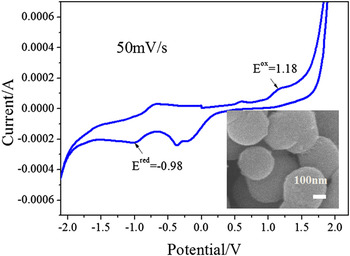
The values of E HOMO and E LUMO were obtained by CV measurements to confirm the matching energy levels of electron acceptor (CMSs, as shown in inset of Fig. 1) and electron donor (P3HT). Oxidation potential (E 0ox) and reduction potential (E 0red) were 1.18 and −0.98 V, respectively (Fig. 1). Therefore, E HOMO was −5.92 eV and E LUMO was −3.76 eV in terms of Eqs. (1) and (2) below the vacuum energy levelReference Yang, Song, Han, Guo, Liu and Xu13:
 $$E_{{\rm{HOMO}}} = - (E_0^{{\rm{\,ox}}} + 4.74){\rm{eV,}}$$
 $$E_{{\rm{LUMO}}} = - (E_{\,0}^{{\rm{\,red}}} + 4.74){\rm{eV}}{\rm{.}}$$
CV curves of oxidized CMSs in 0.1 M TBAP, at a scan rate of 50 mV/s.

E g was calculated to be 2.16 eV by E g = E LUMO − E HOMO.
To guarantee the effective charge separation of excitons at the donor/acceptor interface, ΔE 1 [E LUMO (D − A)] and ΔE 3 [E HOMO (D − A)] should be greater than exciton binding energies (0.3 eV).Reference Li16 In terms of P3HT, E HOMO was −5.2 eV and E LUMO was −3.3 eV.Reference Liu, Li, Sun, Tai, Lau and Yan17 Therefore, ΔE 1 was 0.46 eV and ΔE 3was 0.70 eV for active layer based on electron-donating P3HT and electron-accepting CMSs. Therefore, it might be feasible that CMSs act as acceptor.
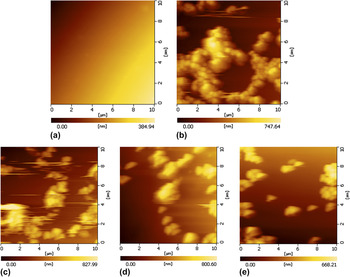
The P3HT film was fabricated with concentration of 10 mg/mL P3HT in chloroform. The P3HT:CMSs composite films were fabricated by blending suspensions of CMSs and P3HT in chloroform with concentration of 10 mg/mL for each and then spin-coating at different spinning rates. The films were observed by AFM, as shown in Fig. 2. The P3HT film was clean and smooth, as shown in Fig. 2(a). When spinning rate was 1500 rpm, the obtained P3HT:CMSs composite films had interstices owing to stacking composites [Fig. 2(b)]. With the increase of spinning rate, as-obtained composite films became sparser under various rotational speeds from 2000 to 3000 rpm at suspension concentration of 10 mg/mL. It can be speculated that the thickness of the composite film gradually became thinner with the increase of spinning rate, CMSs separating from composite films. P3HT:CMSs composite films at different spinning rates were further studied.
AFM images of P3HT film with concentration of 10 mg/mL and 2500 rpm (a), and P3HT:CMSs composite films prepared under different spinning rates: (b) 1500 rpm, (c) 2000 rpm, (d) 2500 rpm, and (e) 3000 rpm. (The suspension concentrations of CMSs and P3HT were 10 mg/mL before blending, separately.)

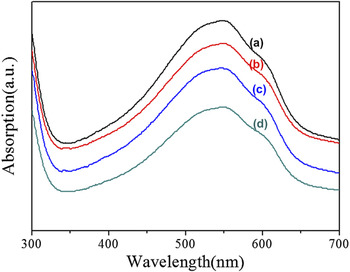
The UV–vis spectra of P3HT:CMSs composite films prepared under suspension concentration of 10 mg/mL at different spinning rate are shown in Fig. 3. The absorbance of film gradually decreased along with the increase of spinning rate. According to the Lambert–Beer law, at constant concentration, film thickness should be linear with the absorbency. Therefore, thickness of the composite film gradually became thinner with the increase of spinning rate.
UV–vis spectra of P3HT:CMSs composite films prepared under suspension concentration of 10 mg/mL at spinning rate of (a) 1500 rpm, (b) 2000 rpm, (c) 2500 rpm, and (d) 3000 rpm.

As in conjunction with Fig. 2, P3HT:CMSs composites were scattered heterogeneously during the formation of the composite films at too low spinning rate, and many CMSs were removed away from composite films at too high spinning rate. Therefore, a proper spinning rate is necessary to improve the morphology of composite films. The spin speeds of 2000 and 2500 rpm were selected in following study in which the influence of suspension concentration on the formation of composite films was investigated.
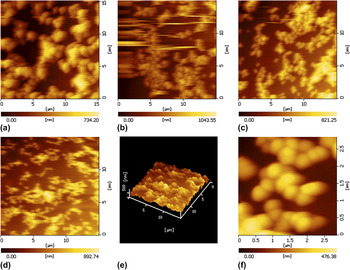
Figures 4(a) and 4(b) display AFM images of P3HT:CMSs films with suspension concentration of 20 mg/mL before blending at spinning rate of 2000 or 2500 rpm. When concentration was 20 mg/mL at spinning speed of 2000 rpm [Fig. 4(a)], films were not dense and uniform with rather aggregated CMSs. At the spinning speed of 2500 rpm [Fig. 4(b)], although the agglomeration of CMSs was improved, composite film was still defective and not dense. Therefore, the composite films were spin coated with suspension concentration of 30 mg/mL [Figs. 4(c)–4(f)]. When spinning speed was 2500 rpm, CMSs had good dispersion and less surface defects. From these results, suspension concentration of 30 mg/mL and spinning rate of 2500 rpm were appropriate for fabricating P3HT:CMSs composite films.
AFM images of P3HT:CMSs composite films prepared under different spinning rate and suspension concentration before blending. (a) 20 mg/mL, 2000 rpm; (b) 20 mg/mL, 2500 rpm; (c) 30 mg/mL, 2000 rpm; (d) 30 mg/mL, 2500 rpm; (e) 3D image of (d); and (f) high magnification of (d).

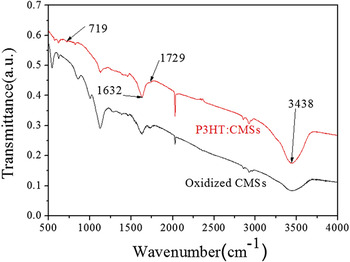
Figure 5 shows FTIR spectra of oxidized CMSs and P3HT:CMSs blend. For oxidized CMSs, the band at 3438 cm−1 was attributed to the presence of hydroxyl groups (–OH), the band at 1729 cm−1 was assigned to the C = O stretching vibrations, and 1632 cm−1 to C = C stretching vibrations. The absorption band of P3HT:CMSs blend at 1729 cm−1 was weakened obviously, probably as a result of the formation of C = O···H+···S2- hydrogen bond. The hydrogen bond would make electron cloud of C = O and lone pair electrons of S transfer, leading to decreased electron cloud density in C = O.Reference Yue, Wu, Xiao, Ye, Xie, Lan, Li, Huang and Lin18 The band of S in thiophene ring emerged at 719 nm. Although absorption band and strength changed a little, P3HT:CMSs blend still retained CMSs band; no new compounds were generated.
FTIR spectra of oxidized CMSs, P3HT:CMSs blend (30 mg/mL before blending at spinning rate of 2500 rpm).

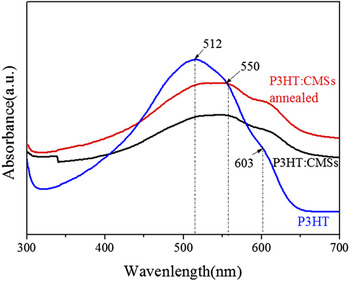
The absorbance of P3HT and P3HT:CMSs composite films before and after annealing is shown in Fig. 6. Three obvious shoulder peaks of pure P3HT were observed at 512, 550, and 603 nm, which were caused by the π-π stacking of thiophene rings,Reference Thomas, Worfolk, Rider, Taschuk, Buriak and Brett19, Reference Yu20 indicating good order of P3HT. In comparison with pure P3HT, the active layer P3HT:CMSs heterojunction film caused a redshift for the absorption spectra. Addition of CMSs improved the absorption of the composites in the infrared and visible regions, resulting in the increased overlap with the solar spectrum. The absorption of the composite films after annealing increased significantly in the visible range, especially between 450 and 650 nm, and moved weakly to the long wave direction, which suggests that annealing induced some ordering in the P3HT polymer chains for lower band gap between π and π*, and the induction of the optical π-π* transition.Reference Shrotriya, Ouyang, Tseng, Li and Yang21 Annealing enhanced absorption of composite film and caused a redshift, which is better increased absorption of solar spectrum and thus increased performance of polymer solar cells.
UV–vis spectra of P3HT, P3HT:CMSs, and P3HT:CMSs annealed at 120 °C for 10 min films (30 mg/mL before blending at spinning rate of 2500 rpm).

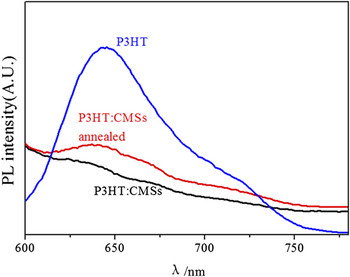
PL spectra refer to the radioactive recombination of excitons generated by light. To estimate the exciton quenching for different samples, PL spectra of P3HT film and P3HT:CMSs films before and after annealing were recorded at an excitation wave length of 450 nm. Figure 7 shows that the excitons were quenched in active layer when introducing CMSs into composite film, as compared with P3HT film. The lower intensity of PL spectra in photovoltaic devices means the more effective separation of electron–hole pairs. Consequently, electrons and holes in P3HT:CMSs blend films transferred in their interpenetrating phase. Fluorescent peaks of annealed P3HT:CMSs increased, as a result of improved intimated order degree of P3HT, resulting in luminescence from exciton recombination.
PL spectra of P3HT, P3HT:CMSs, and P3HT:CMSs annealed at 120 °C for 10 min films (30 mg/mL before blending at spinning rate of 2500 rpm).

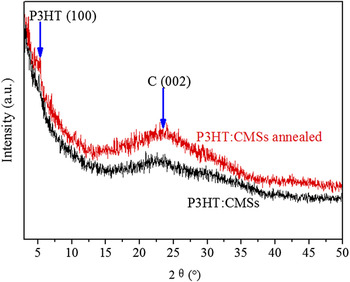
Figure 8 illustrates the effect of annealing on the structure of the P3HT:CMSs composite films. Intense peaks at 23.6 °, assigned to (002) reflection of carbon layer in CMSs, were observed. In addition, the peak at 5.20 ° was associated with the (100) reflection of the P3HT.
XRD patterns of the P3HT:CMSs thin films before and after annealing at 120 °C for 10 min.

Specifically, this peak corresponds to a-axis orientation, with the main polymer chains parallel to the substrate and the side chains perpendicular to the substrate.Reference Karagiannidis, Kassavetis, Pitsalidis and Logothetidis22 After annealing, the intensity of this peak increased, indicating an improvement of the degree of crystallinity. Annealing improved the crystallization degree of film, which favored the carrier mobility of semiconductor materials, and finally enhanced photoelectric conversion efficiency of solar cells.
IV. CONCLUSION
In summary, E HOMO and E LUMOdetermined by CV of oxidized CMSs were −5.92 and −3.76 eV, below the vacuum energy level, respectively, indicating that CMSs as acceptor were feasible. The microstructure-dependent photovoltaic properties of the bulk heterojunction solar cells based on P3HT:CMSs blends were investigated by varying spinning rate and suspension concentration of the P3HT and CMSs. P3HT:CMSs composite films coated from 30 mg/mL CMSs and 30 mg/mL P3HT under 2500 rpm had good dispersion and less surface defects. After annealing, the arrangement of P3HT polymer chains became more regular, absorption of the P3HT:CMSs composite films was enhanced, and a redshift occurred; the improved crystallization degree of film led to improved charge mobility. This lays an experimental and theoretical foundation for fabricating polymer solar cells with CMSs. A further study is ongoing in the photovoltaic properties of the solar cells based on P3HT:CMSs blends.
ACKNOWLEDGMENTS
Acknowledgments are made to the Program for Changjiang Scholar and Innovative Research Team in University (Grant No. IRT0972), National Natural Science Foundation of China (Grant Nos. 51152001, 21176169, and 20971094), International Science & Technology Cooperation Program of China (Grant No. 2012DFR50460), Ph.D. Programs Foundation of Ministry of Education of China (Grant No. 20101402110007). Research Project Supported by Shanxi Scholarship Council of China (Grant No. 2012-038).