1. Introduction.
Physicists and philosophers have been trying to interpret quantum mechanics for decades, understanding this task as a problem of giving a clear meaning to the mathematical formalism of the theory. Still today we have no consensus on what the meaning of quantum theory is; none of the proposed answers has won overall acceptance. Perhaps the most remarkable manifestation of the failure to interpret quantum mechanics is the attitude taught to most young physicists in lecture rooms and research laboratories in the last half century, “Shut up and calculate!” (Mermin Reference Mermin2004).
One of the reasons why there is no unique interpretation of quantum theory is that a meaning given to the mathematical formalism of quantum mechanics cannot be considered universally satisfactory if it is merely heaped over and above the formalism, instead of coming all the way along with the formalism as it rises in a derivation of the theory. This is precisely what is grasped by the notion of reconstruction. In this article I briefly review examples of reconstruction and then discuss the problem of conceptual foundation of information-theoretic reconstructions that has so far remained to a large extent unsolved.
Reconstruction is understood here as the following schema (this notion is different from Carnap's [Reference Carnap1928] rational reconstruction): Theorems and major results of physical theory are formally derived from simpler mathematical assumptions. These assumptions or axioms, in turn, appear as a representation in the formal language, of a set of physical principles. Reconstruction therefore consists of three stages: first give a set of physical principles, then formulate their mathematical representation, and finally rigorously derive the formalism of the theory.
Contrary to interpretation, the three-stage structure of reconstruction permits the latter to acquire supplementary persuasive power, due to the use of mathematical derivation. Established as valid results, theorems and equations of the theory become unquestionable and free of suspicion. ‘Why is it so?’—‘Because we derived it.’ The question of meaning, previously asked with regard to the formalism, is removed and now bears, if at all, only on the selection of the principles. No room for mystery remains in what concerns the meaning of the theory's mathematical apparatus. This implies that in the reconstruction program, giving one or another solution of the measurement problem loses the central role it has occupied for the success of an interpretation of quantum mechanics. One now makes sense of all of the formalism solely on the basis of the first principles, and whatever mathematical element is contained in the formalism that is used in a particular reconstruction, it now acquires a precise meaning in virtue of the first principles.
Explanatory power of the reconstruction is a power of explanation of where the structure of the theory comes from, not necessarily a power of explanation by the theory, of the real world. Traditionally, interpretations have been paying attention to the latter task and giving less importance to the former. Reconstruction shifts one's focus: its added value for better understanding quantum theory originates in the new insights into the structure of the theory.
Anyone who wishes to attempt a reconstruction of physical theory must formulate the foundational principles which he or she believes plausible and translate them into mathematical axioms. These first principles must be simple physical statements, that is, assertions, such that their meaning is immediately, easily accessible to a scientist's understanding. Determining precisely the philosophical status of the first principles is a problem that lies beyond the scope of this article; its further discussion can be found in Grinbaum Reference Grinbaum2007.
2. Examples of Reconstruction.
In the last decade reconstruction, in the sense given above, has become a major trend in the foundations of quantum mechanics. This phenomenon is new: a majority of historic axiomatic derivations of quantum theory were not reconstructions, for they were based on highly abstract mathematical assumptions instead of simple physical principles. Exemplary work by Mackey (Reference Mackey1957, Reference Mackey1963) is a classic of such mathematically founded derivations. Mackey's axioms were consequently reformulated in the language of quantum logic, thereby rephrasing the assumptions that underlie the Hilbert space structure. This has been the case, most prominently, in Jauch (Reference Jauch1968) and Piron (Reference Piron1964, Reference Piron1972), and also in an important state-of-the-art book by Beltrametti and Cassineli (Reference Beltrametti and Cassinelli1981). Quantum logical assumptions proposed in this work are simple enough to be accessible to direct comprehension, in contrast to Mackey's axioms, but they tend to be linguistic rather than physical. This means that one typically argues that it makes no sense to speak about certain concepts unless some suitable ‘trivial’ properties of these concepts have been postulated, for example, the notion of proposition is meaningful only if, as in Demopoulos Reference Demopoulos2004, negation or partial order, or, as in Beltrametti and Cassinelli Reference Beltrametti and Cassinelli1981, implication, are defined. Although linguistic a priori arguments can be powerful, they are to be distinguished from the reconstruction program: in the latter, first principles from which the theory is derived have a physical meaning, that is, they tell us something directly and intuitively comprehensible about the world. Such principles must be independent of a particular formalism that one further employs to derive quantum theory, and therefore must not rely on quantum logic as just one among many such formalisms.
It is startling how Mackey's and similar axiomatic sets for quantum mechanics differ from systems of first principles proposed by several contemporary authors. One nowadays casually feels the urge to give a nontechnical, physical motivation for the choice of axioms. One interesting example is Hardy's (Reference Hardy2001) instrumentalist derivation of quantum theory. Hardy's “five reasonable axioms” set up a link between two initially introduced natural numbers, K and N. K is the number of degrees of freedom of the system and is defined as the minimum number of probability measurements needed to determine the state. Dimension N is defined as the maximum number of states that can be reliably distinguished from one another in a single measurement. The axioms are:
H1 Probabilities. In the limit as n becomes infinite, relative frequencies (measured by taking the proportion of times a particular outcome is observed) tend to the same value for any case where a given measurement is performed on an ensemble of n systems prepared by some given preparation.
H2 Simplicity. K is determined by a function of N where
 $N=1,\, 2,\ldots $
and where, for each given N, K takes the minimum value consistent with the axioms.
H3 Subspaces. A system whose state is constrained to belong to an M dimensional subspace behaves like a system of dimension M.
H4 Composite systems. A composite system consisting of subsystems A and B satisfies
 $N=N_{A}N_{B}$
and
 $K=K_{A}K_{B}.$
H5 Continuity. There exists a continuous reversible transformation on a system between any two pure states of that system.
This list of axioms is considerably shorter and simpler than Mackey's, and although four of H1–H5 still use mathematical language in their formulation, the meaning of Hardy's axioms is more accessible. Indeed, it is already suggested by the names given to the axioms by Hardy. One can then rephrase H1–H4 into physical principles, thereby turning this system of axioms into a complete example of reconstruction (cf. Grinbaum Reference Grinbaum2007).
3. Information-Theoretic Reconstructions.
3.1. Two Approaches.
Clifton, Bub, and Halvorson (Reference Clifton, Bub and Halvorson2003) (CBH) propose a set of quantum informational constraints from which one derives the basic elements of quantum theory. Inspired by the theorems of quantum computing, they formulate three fundamental principles as
CBH1, no superluminal information transfer via measurement,
CBH2, no broadcasting,
CBH3, no bit commitment,
and then employ the
 $C^{*}$
-algebraic formalism to derive the structure of the formalism of quantum theory. This article will not discuss the details of the CBH derivation (the reader is referred to Grinbaum Reference Grinbaum2007); instead, a different example is taken, based on the axioms initially proposed by Rovelli (Reference Rovelli1996):
R1: There exists a maximum amount of relevant information that can be extracted from a system.
R2: It is always possible to obtain new information about the system.
From these axioms one develops an information-theoretic reconstruction of the formalism of quantum theory using quantum logical techniques. To give the main lines of the derivation (see Grinbaum Reference Grinbaum2003, Reference Grinbaum2005 for details), observe first that R1 and R2 seem to contradict each other. Indeed, R1 says that the quantity of information is finite, while from R2 it follows that this quantity must be infinite, because it is always possible to obtain some new information. The reason why there is no contradiction is in the use of the term ‘relevant’ in R1, that does not appear in R2. Relevance of new information must be judged with respect to the information already possessed by the observer, and defined formally. Bringing about new information can, not only increase the amount of information currently available to the observer, but also reduce it, due to the fact that some previously relevant information may become irrelevant. Thus, what is relevant depends on a particular sequence of questions asked by the observer, and for different observers the quantitative change in the amount of information brought in by the seemingly identical new fact, may also differ. Facts and information are defined only relative to an observer. If one now postulates that information is obtained through answers to yes-no questions that can be asked about the system, then assuming that the set of such yes-no questions forms a complete atomic orthocomplemented lattice, one derives that this lattice is orthomodular. If a further assumption is made about the lattice of questions being isomorphic to the lattice of all closed subspaces of a Banach space constructed over a numeric field (i.e., real or complex numbers or quaternions), one then obtains that this Banach space is indeed a Hilbert space. Its quantum rather than classical character follows from axiom R2.
3.2. A Philosophy for Information-Theoretic Reconstructions.
Information-theoretic approaches to quantum theory, although they formulate their axioms in different ways, have in common a philosophical background used for justifying the choice of the language of information in formulating the first principles of their respective reconstruction programs.
It was not until the work of Bohr and his followers that physicists fully realized that the new physical theories—quantum theory and relativity—necessitate a cut between the observer and what is observed. Bohr argued that “there must be, so to speak, a partition between the subject which communicates and the object which is the content of the communication” (Petersen Reference Petersen1963); this partition is called the von Neumann cut due to its extensive use in von Neumann's (Reference von Neumann1932) measurement theory or, sometimes, the Dirac cut. The necessity of the cut is motivated by the fact that conclusions of quantum theory, as well as those of special relativity, do not depend on the constitution of the means of observations that these theories use: whatever the internal structure of a clock or of a measuring apparatus, special relativity and quantum mechanics do not change their content even slightly as a function of this structure. This suggests, as Fock consistently emphasized (Reference Fock1971a, Reference Fock1976), that measurement apparata, both in special relativity and in quantum theory, are metatheoretic entities. They are characterized (1) by the fact that they are ultimate elements of the observation chain, and there is no second measurement apparatus that would be used to observe the first measurement apparatus; and (2) by the abstract and idealized description of the apparatus itself, which assumes that measuring degrees of freedom completely exhausts all processes that physics needs to account for, with respect to the evolution of the measurement apparatus. In a markedly Bohrian spirit, Fock maintains that “the construction and functioning of a measuring device is to be described in a way essentially different from that necessary for the description of the properties and behavior of the atomic objects (for the investigation of which the appropriate measuring device has been designed). This difference is so fundamental that, from the epistemological point of view, atomic objects and measuring devices are to be considered as belonging to different categories” (Reference Fock1971b, 294). This last statement can be used to situate the neo-Bohrian epistemology characteristic of the information-theoretic reconstructions of quantum theory.
Historically quantum physics has been predominantly conceived as a theory of nonclassical waves and particles, while special relativity was thought of as a theory of moving rods and clocks. Fock argues that such views have been well-motivated only at the early stages of the development of these theories, when few experimental results were available and the dominant philosophy was still couched in the physics that preceded the creation of the new theories. Therefore, for long time many physicists have lacked understanding of the epistemological lesson coming from the necessity of the cut between the observer and the observed. Einstein, for instance, believed all his life that the postulate of the existence of a particle or a quantum is a basic axiom of the physics. In a letter to Born as late as 1948 he writes: “We all of us have some idea of what the basic axioms in physics will turn out to be. The quantum or the particle will surely be one amongst them; the field, in Faraday's or Maxwell's sense, could possibly be, but it is not certain” (Born Reference Born1971, 164). This is to say that Einstein believed that a proper physical theory must be based on the ontology of certain physical systems, such as particles or fields, and will build upon the known facts about these elementary systems in order to provide an account of all physical phenomena. In another illuminating piece of his late writing, Einstein at the same time acknowledges the necessity of the epistemological cut, but fails to recognize its implications for the way new physical theories must be thought of:
One is struck [by the fact] that the theory [of special relativity] … introduces two kinds of physical things, i.e., (1) measuring rods and clocks, (2) all other things, e.g., the electromagnetic field, the material point, etc. This, in a certain sense, is inconsistent; strictly speaking measuring rods and clocks would have to be represented as solutions of the basic equations (objects consisting of moving atomic configurations), not, as it were, as theoretically self-sufficient entities. However, the procedure justifies itself because it was clear from the very beginning that the postulates of the theory are not strong enough to deduce from them sufficiently complete equations … in order to base upon such a foundation a theory of measuring rods and clocks. (Reference Einstein and Schlipp1969, 59, 61)
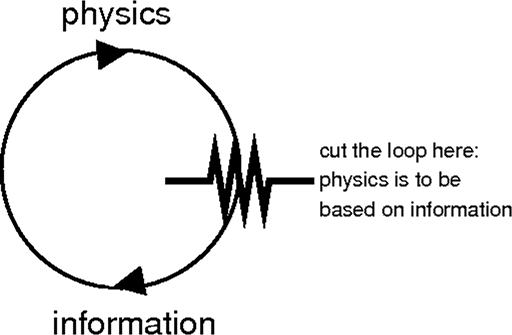
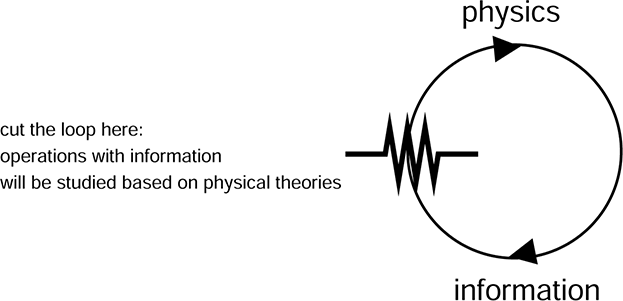
Epistemologically, it is unreasonable to expect, as Einstein did, that the theory of measuring rods and clocks could be based on a set of yet stronger postulates that would, at the same time, provide also an account of all physical phenomena measured by means of these rods and clocks. To see why Einstein found himself at an impasse, albeit an unnecessary one, consider the following schematic representation of physical theories. Assume that phenomena are best described by theories that are interconnected in the form of loop. Any particular theory is represented by cutting the loop at some point and thus separating the target object of the theory from the theory's presuppositions. Due to the necessity of the cut, it is impossible to give a theoretical description of the loop as a whole. Now, when the position of the cut is fixed, some elements of the loop are treated as objects of the theory, while other elements fall into the domain of metatheory. At another loop cut, those elements exchange roles: the ones that had been explanans become explanandum, and those that had previously been explanandum become explanans. Different theories do not form a pyramid which is reduced to yet more and more fundamental theories with “stronger postulates”; on the contrary, for the purposes of each theory, a part of the loop must be taken as a given, and the relation between theories is the one of mutual illumination rather than that of reduction. Metatheory of a given theory, that is, the part of the loop kept fixed in the task of reconstructing the theory in question, is no more and no less than the theory that explains the functioning of measuring devices of the theory that is being reconstructed. For the purposes of the reconstruction of a given theory, the loop view demonstrates how measuring devices of the theory can be assumed to be metatheoretic and abstract in Fock's sense while driving the reconstruction; but in a different loop cut, the same measuring devices become themselves objects of another theory that would explain their functioning.
Consider the loop between physical theory and information. Physics and information mutually constrain each other, and every theory will give an account of but a part of the loop, leaving the other part for metatheoretic assumptions. In the cut shown in Figure 1 information lies in the metatheory of the physical theory, and physics is therefore based on information. In a different loop cut (Figure 2), informational agents are physical beings, and one can describe their storage of, and operation with, information, by means of effective theories that are reduced, or reducible in principle, to physical theory.
Loop cut: Physics is informational.

Loop cut: Information is physical.

Without recognizing the importance of the cut, one cannot fully appreciate the unbridgeable (within a given theory) separation between the observer and the observed. The loop view allows one to make sense of assertions that mark no small change in the conception of physics, for example, of Bub's idea that information must be recognized as “a new sort of physical entity, not reducible to the motion of particles and fields” (Reference Bub2004). In the loop epistemology, however, information is an entity, but not a physical entity or object of physical theory like particles or fields are. Were information a basic physical entity, the information-theoretic viewpoint would then do nothing to approach the problem of giving quantum physics a foundation, for it would need to provide a inevitably circular argument taking, at the same time, information to be a fundamental irreducible concept, and explaining how information can be stored, or operated with, physically. The only way to avoid circularity is through removing information into metatheory. When one does so consistently, the conventional physical concepts such as particles and fields are reduced to information, not put along with it on equal grounds; but information itself, in another loop cut, can also be treated as a derivative notion, in another theory that would itself take particles and fields as givens.
In the loop cut of Figure 2 the question of reconstruction of physical theory is meaningless, because physical theory is taken for granted. Indeed, once a particular loop cut is assumed, it is a logical error to ask questions that make sense only in a different loop cut. For instance, the critique of information-theoretic reconstructions motivated among some physicists mainly by Landauer's dictum “information is physical” (Reference Landauer1987) can be avoided by adopting the loop view. Einstein's plea for “stronger postulates” is then a mere epistemological illusion. Fervent defenders of such view would be led to a logical impasse, considering it to be possible to have a physical theory that would include within itself a description of the physical structure of its own measurement devices.
3.3. Comparison with Special Relativity.
A particularly well-known example of reconstruction is the special theory of relativity. However, in the light of what was said in the previous section, one must adopt a certain critical distance with respect to Einstein's personal feelings for his work, and to interpret it given our current condition of knowledge rather than historically.
Since Einstein's 1905 work, special relativity is a well-understood physical theory, but it is equally well-known that its formal content, that is, the Lorentz transformations, were written by Lorentz and Poincaré and not by Einstein, indeed several years before 1905. Lorentz transformations were fiercely debated and many interpretations of what they mean were offered, among them quite a plausible one involving interactions between bodies and the ether. However, after Einstein, things suddenly became clear and the debate stopped. This was because Einstein gave a few simple physical principles from which he derived the Lorentz transformations, therefore closing the attempts to append philosophy and give a meaning a posteriori to an already working formalism. Einstein's idea was to assume that there is no absolute, but only a relative, notion of simultaneity and that the velocity of light is constant. Once a derivation starting from these principles has been carried through, the physical meaning of the Lorentz transformations stood clear, and special relativity has not raised any controversy (except historical) ever since. Modern reconstructions of special relativity, based on Einstein's work, indicate unequivocally how one obtains the Lorentz transformations from such sets of principles as constancy of the speed of light, or homogeneity of space-time and isotropy of space (cf. Fock Reference Fock1955).
Einstein had doubts about the fundamental character of his own theory. To describe these doubts, he proposed to make a distinction between principle and constructive theories, arguing that, in his view, only constructive theories can supply a satisfactory physical explanation. Principle theories, according to Einstein, “employ the analytic, not the synthetic, method. The elements which form their basis and starting point are not hypothetically constructed but empirically discovered ones, general characteristics of natural processes, principles that give rise to mathematically formulated criteria which the separate processes or the theoretical representations of them have to satisfy” (Reference Einstein1954). Einstein's preference for constructive theories is due to his feeling of repulsion for the epistemological cut between the observer and the observed which precludes one given theory from explaining the totality of phenomena. Reconstruction, on the contrary, particularly reconstructions based on information-theoretic principles, fully adopt the necessity of the cut. Their explanatory power is the power of explanation, of where the structure of the theory comes from, not the power of explanation of the world.
4. Intentionally Incomplete Reconstructions.
All reconstructions discussed above share the goal of deriving, in the end, the full-blown structure of quantum theory. But it is perhaps not accidental that none of them could fully succeed. Recently, a new type of information-theoretic reconstruction has appeared, intentionally not aimed at deriving the whole quantum theoretic structure (Aaronson Reference Aaronson and Khrennikov2004, Reference Aaronson2005; Barrett Reference Barrett2005; Hardy Reference Hardy1999; Popescu and Rohrlich Reference Popescu and Rohrlich1994; Smolin Reference Smolin2005; Spekkens Reference Spekkens2004). Christened pejoratively by their own authors, these “toy models,” “fantasy quantum mechanics,” or “quantum mechanics lite” employ a methodology of reconstruction that has been previously overlooked by scientists: it is now claimed as helpful to reconstruct, not the full version, but only a certain part of quantum theory. One builds, therefore, a new theory which is, from the very beginning, not intended to be the quantum theory; but this new theory allows one nevertheless to better understand the structure of the ‘true’ quantum theory. To the same old ultimate aim of better understanding quantum mechanics toy models provide a variety of new promising insights.
The idea of modifying standard quantum theory is not new. Nonlinear extensions of the Schrödinger equation have been explored by various authors (Bialynicki-Birula and Mycielski Reference Bialynicki-Birula and Mycielski1976; Gisin Reference Gisin1990; Weinberg Reference Weinberg1989), and comprehensive reviews of these attempts can be found in Natterman Reference Nattermann, Shkil, Nikitin and Boyko1997 and Svetlichny Reference Svetlichny2004. Nonlinear models are also sometimes analyzed in the context of quantum theories more general than quantum mechanics, for example, in quantum gravity. Intentionally incomplete reconstructions, however, differ substantively from these attempts to modify quantum theory. While the latter take standard linear quantum mechanics to be incomplete and purport to replace it by a nonlinear, more complete theory, toy models see themselves as incomplete. They do not question the validity of quantum mechanics and do not compete with it in explaining empirical phenomena. Methodologically, as this is routinely emphasized in the opening paragraphs of articles introducing toy models, for example, by Barrett (Reference Barrett2005), toy models focus on important physical principles, which are upheld while other possibilities are modified. Thus the consequences of such and such principle are investigated, independently of other principles. Hence, intentionally incomplete reconstructions are not aimless, but allow one to achieve a better understanding of the structure of quantum theory. Incompleteness, then, becomes a feature rather than a flaw of toy models.
Most of the existing examples of toy models are based on information-theoretic principles. To compare the toy model with standard quantum theory, one then asks whether the former reproduces quantum computational phenomena available in the latter. Among others, such questions may include:
• Does the toy model allow superluminal signalling?
• Does the toy model allow bit commitment?
• Does the toy model allow teleportation, dense coding, or remote steering?
• Does the toy model allow exponential speed-up relative to classical computation or solving NP-complete problems in polynomial time?
Other toy models are inspired by information-theoretic principles, but they are compared with standard quantum theory in the aspects that do not necessarily relate to computation:
• Does the toy model allow nonlocality and to what extent?
• Is the toy model contextual?
• Does the toy model possess a continuum of states, measurements and transformations between states?
Answers given to all of these questions can be ‘yes’ or ‘no’ depending on the model. Investigating the difference between the first principles of a particular toy model and those of standard quantum mechanics, one learns with precision which fundamental principle is responsible for which element of the quantum theoretic structure. Spekkens's (Reference Spekkens2004) toy model, for example, accommodates such quantum phenomena as noncommutativity, interference, the multiplicity of convex decompositions of a mixed state, no cloning, teleportation, and others. One learns that the continuous state space, the existence of a Bell theorem, or contextuality, all of which are absent from this toy model, go unconnected with the appearance of the phenomena that are reproduced. Analogously, the toy model known as nonlocal, or PR, boxes (Barrett Reference Barrett2005; Popescu and Rohrlich Reference Popescu and Rohrlich1994) allows nonlocal correlations that are strictly stronger than those allowed by quantum mechanics, while it only slightly modifies the quantum mechanical state space. One then sees that nonlocality is not an exclusively quantum feature and, further, that the amount of nonlocality in quantum theory is smaller than in some other theories. One can then conjecture, for instance, that the ‘true’ quantum theory has as much nonlocality as it does, and not more or less, due to the continuum of states and to reversible transformations between pure states, both of these being left out of the PR boxes toy model.
These examples show how one obtains the deeper insight into the structure of quantum theory and therefore achieves what was initially promised by the program of intentionally incomplete reconstruction. Toy models, although incomplete, form a very fertile class of reconstructions. Their recent advent in the area of the foundations of quantum theory manifests the fact that the shift from interpretation of quantum theory to its reconstruction gave birth, in this area, to many new, previously nonexistent, ideas.
5. Conclusion.
Reconstruction is the exclusive way to make things clear about quantum mechanics. As such, this idea is not novel but has been in the air for some time, and a concise statement can for example be found in Rovelli Reference Rovelli1996: “Quantum mechanics will cease to look puzzling only when we will be able to derive the formalism of the theory from a set of simple physical assertions (`postulates,' `principles') about the world. Therefore, we should not try to append a reasonable interpretation to the quantum mechanical formalism, but rather to derive the formalism from a set of experimentally motivated postulates” (1639). What is novel, however, is that an increasing number of researchers work nowadays on reconstructing quantum theory, and the time is ripe to promote this general framework to the status of a widely accepted paradigmatic shift in the domain of the foundations of physics.
Reconstruction brings in clarity to where interpretation was struggling to make sense of a physical theory. What belongs to physical theory is no more than what is needed for its derivation. All other questions belong to metatheory and are related to the justification task for the choice of first principles, conducted externally. Reconstruction is successfully competing with more traditional interpretations, due to its appealing conceptual transparency and to the clarity that it brings into the structure of the theory. However, completely reconstructing quantum theory remains only a partially solved problem, and intentionally incomplete reconstructions show that this apparent failure may not be accidental. Although to a varying degree, mathematical abstraction is a necessity for each of the currently existing reconstructions. Also, it would be too ambitious to expect that all of modern quantum theory, including field theory and quantum gravity, could be derived from a few axioms. Still, if one wishes to understand the meaning of even most advanced parts of quantum theory, and to reach a consensus in this understanding, it is then inevitable that simple physical principles be formulated and put in the very foundation of the reconstruction of quantum theory.