INTRODUCTION
Social cognitive deficits, a common feature of Huntington’s disease (HD), have been reported even in the premanifest stage of the disease (Eddy & Rickards, Reference Eddy and Rickards2015a), worsening as the disease progresses (Bora, Velakoulis, & Walterfang, Reference Bora, Velakoulis and Walterfang2016). Deficits in social cognition in HD include difficulties with basic emotion recognition (Baez et al., Reference Baez, Herrera, Gershanik, Garcia, Bocanegra, Kargieman and Ibanez2015; Henley et al., Reference Henley, Novak, Frost, King, Tabrizi and Warren2012) and impaired empathy and understanding of social norms (Eddy et al., Reference Eddy, Parkinson and Rickards2016). Social cognitive deficits negatively impact social functioning and therefore contribute to greater social conflict, isolation, loneliness, and reduced quality of life (Cacioppo et al., Reference Cacioppo, Capitanio and Cacioppo2014; Phillips et al., Reference Phillips, Scott, Henry, Mowat and Bell2010).
There are four core domains of social cognition: theory of mind (ToM), social perception, affective empathy, and social behaviour (Henry, Von Hippel, Molenberghs, Lee, & Sachdev, Reference Henry, Von Hippel, Molenberghs, Lee and Sachdev2016). ToM refers to the ability to understand the mental states of others and to appreciate that these may differ from one’s own (Henry et al., Reference Henry, Von Hippel, Molenberghs, Lee and Sachdev2016). ToM includes both cognitive and affective components. Whereas cognitive ToM involves understanding others’ thoughts, beliefs, and intentions, affective ToM involves understanding others’ feelings (Dvash & Shamay-Tsoory, Reference Dvash and Shamay-Tsoory2014). Social perception refers to the ability to use basic cues such as facial expressions, body language, and vocalisations to interpret the emotional states of others. Affective empathy pertains to one’s emotional response to the perceived situation of another, such as feeling sadness when a friend is experiencing unfortunate circumstances (Henry et al., Reference Henry, Von Hippel, Molenberghs, Lee and Sachdev2016). Finally, social behaviour refers to the way a person behaves during social interactions, with poor social behaviour often manifesting as a lack of social tact, poor manners, and a reduced use of communicative gestures (Henry et al., Reference Henry, Von Hippel, Molenberghs, Lee and Sachdev2016).
A number of studies have investigated specific domains of social cognition in people with HD but have reported inconsistent findings. Most studies have assessed social perception, reporting impairments in the ability to recognise negative emotions in individuals with premanifest HD and continuing throughout the manifest stage. (Henley et al., Reference Henley, Novak, Frost, King, Tabrizi and Warren2012; Johnson et al., Reference Johnson, Stout, Solomon, Langbehn, Aylward and Cruce2007; Sprengelmeyer, Schroeder, Young, & Epplen, Reference Sprengelmeyer, Schroeder, Young and Epplen2006; Tabrizi et al., Reference Tabrizi, Langbehn, Leavitt, Roos, Durr, Craufurd and Scahill2009). Early investigations noted a disproportionate deficit in recognition of disgust from facial expressions (Gray et al., Reference Gray, Young, Barker, Curtis and Gibson1997; Halligan, Reference Halligan1998; Hayes et al., Reference Hayes, Stevenson and Coltheart2007; Sprengelmeyer et al., Reference Sprengelmeyer, Schroeder, Young and Epplen2006; Sprengelmeyer et al., Reference Sprengelmeyer, Young, Calder, Karnat, Lange, Hömberg and Rowland1996). However, more recent investigations have noted that all negative emotions are equally impacted in people with HD across the varying stages of the disease (Calder et al., Reference Calder, Keane, Young, Lawrence, Mason and Barker2010; Johnson et al., Reference Johnson, Stout, Solomon, Langbehn, Aylward and Cruce2007; Labuschagne et al., Reference Labuschagne, Jones, Callaghan, Whitehead, Dumas, Say and Stout2013; Tabrizi et al., Reference Tabrizi, Langbehn, Leavitt, Roos, Durr, Craufurd and Scahill2009). ToM impairments in premanifest HD cohorts have also been reported in some (Eddy & Rickards, Reference Eddy and Rickards2015b; Eddy, Mahalingappa, & Rickards, Reference Eddy, Mahalingappa and Rickards2012; Eddy, Mahalingappa, & Rickards, Reference Eddy, Mahalingappa and Rickards2014; Larsen, Vinther-Jensen, Gade, Nielsen, & Vogel, Reference Larsen, Vinther-Jensen, Gade, Nielsen and Vogel2016; Mason et al., Reference Mason, Zhang, Begeti, Guzman, Lezar, Rowe and Hampshire2015), but not all studies (Saft et al., Reference Saft, Lissek, Hoffmann, Nicolas, Tegenthoff, Juckel and Brüne2013), with deficits evident for facial and written tasks. Equivocal evidence has been noted for empathy, with some studies reporting deficits (Baez et al., Reference Baez, Herrera, Gershanik, Garcia, Bocanegra, Kargieman and Ibanez2015; Maurage et al., Reference Maurage, Lahaye, Grynberg, Jeanjean, Guettat, Verellen-Dumoulin and Constant2016) and others noting no differences between individuals with manifest HD and healthy controls (Adjeroud et al., Reference Adjeroud, Besnard, El Massioui, Verny, Prudean, Scherer and Allain2015; Trinkler, de Langavant, & Bachoud-Levi, Reference Trinkler, de Langavant and Bachoud-Lévi2013). The aforenoted discrepancies in findings may be due to differences in the studied populations, including the disease stage of participants, as well as the utilisation of different measures, with most studies employing different study measures. While not thoroughly investigated in HD, anecdotal reports suggest that problems in social behaviour also arise early in the disease course and negatively impact the size and diversity of social networks, which is of clinical relevance, particularly considering the protective role of social connectedness on brain health, cognition, and mood state in healthy and other clinical populations (Lewis et al., Reference Lewis, Rezaie, Brown, Roberts and Dunbar2011; Powell et al., Reference Powell, Lewis, Roberts, Garcia-Finana and Dunbar2012).
While informative, a number of gaps still exist with respect to the characterisation of social cognition in HD. Existing studies have tended to focus on a single domain, as opposed to all domains of social cognition, providing an incomplete picture of the social cognitive phenotype of people with premanifest HD. In addition, prior studies have assessed social cognition solely at a group level, as opposed to an individual level, which may not provide an accurate representation of the prevalence and severity of social cognition impairments in this cohort (Costa et al., Reference Costa, Dogan, Schulz and Reetz2019; Demeyere, Riddoch, Slavkova, Bickerton, & Humphreys, Reference Demeyere, Riddoch, Slavkova, Bickerton and Humphreys2015). Further, existing studies have not assessed the heterogeneity in performance across social cognitive domains (intra-individual dispersion), an approach that has been used for other neurocognitive domains in groups such as Alzheimer’s disease (Bangen et al., Reference Bangen, Weigand, Thomas, Delano-Wood, Clark, Eppig and Bondi2019; Lövdén et al., Reference Lövdén, Schmiedek, Kennedy, Rodrigue, Lindenberger and Raz2013; Reckess et al., Reference Reckess, Varvaris, Gordon and Schretlen2014; Schretlen et al., Reference Schretlen, Munro, Anthony and Pearlson2003). Intra-individual dispersion is of growing importance as we move as a clinical and scientific community towards personalised therapeutic strategies for managing and treating deficiencies in social cognition, such as social skills training. Finally, few studies have examined whether changes to other clinical outcomes, including neurocognition and mood, negatively impact social cognition in individuals with premanifest HD (Adjeroud et al., Reference Adjeroud, Besnard, El Massioui, Verny, Prudean, Scherer and Allain2015; Allain et al., Reference Allain, Havet-Thomassin, Verny, Gohier, Lancelot, Besnard and Le Gall2011; Baez et al., Reference Baez, Herrera, Gershanik, Garcia, Bocanegra, Kargieman and Ibanez2015; Brüne, Blank, Witthaus, & Saft, Reference Brüne, Blank, Witthaus and Saft2011; Eddy et al., Reference Eddy, Mahalingappa and Rickards2012, Reference Eddy, Mahalingappa and Rickards2014; Eddy & Rickards, Reference Eddy and Rickards2015a, Reference Eddy and Rickards2015b; Kempnich et al., Reference Kempnich, Andrews, Fisher, Wong, Georgiou-Karistianis and Stout2017; Lagravinese et al., Reference Lagravinese, Avanzino, De Ferrari, Marchese, Serrati, Mandich and Pelosin2017; Larsen et al., Reference Larsen, Vinther-Jensen, Gade, Nielsen and Vogel2016). Additionally, there has been no investigation on the effect of changes in sleep and social cognition in individuals with HD, despite well-established links in individuals with autism spectrum disorders (ASDs) (Malow et al., Reference Malow, Marzec, McGrew, Wang, Henderson and Stone2006; Schreck, Mulick, & Smith, Reference Schreck, Mulick and Smith2004; Taylor, Schreck, & Mulick, Reference Taylor, Schreck and Mulick2012). These gaps in the literature require investigation, particularly as the research community moves closer to therapeutic strategies to combat social cognitive difficulties.
Here, we assessed social cognition in individuals with premanifest HD using a comprehensive battery of social cognitive measures in line with recommendations by Henry et al. (Reference Henry, Von Hippel, Molenberghs, Lee and Sachdev2016), with the primary aim of identifying interindividual differences as well as intra-individual deficits over the battery of tests to develop a social cognitive profile for people with HD. In addition, we assessed whether social cognitive performance was associated with neurocognitive, mood, and sleep outcomes. We hypothesised that (1) the premanifest HD cohort would have poorer outcomes on all social cognitive domains compared to the healthy control cohort, (2) the majority of the premanifest HD group would display poorer performance than healthy controls when compared to the cut-off scores for all social cognitive domains, (3) people with premanifest HD would exhibit greater social cognitive dispersion compared to healthy controls, and (4) performance on social cognitive domains would be associated with mood, sleep, and neurocognitive outcomes in the premanifest HD group.
METHODS
Participants
Thirty-five people with premanifest HD (male = 11; female = 24) and 29 age- and sex-matched healthy controls (male = 8; female = 21) were recruited. Thirty-two participants were Caucasian and the remaining three participants were of Asian descent. HD participants were recruited through existing study databases, while age- and sex- matched healthy controls were recruited via public advertisement (i.e., social media, radio, and newspaper). Inclusion criteria for the premanifest HD group comprised the following: a HD gene-positive test result (cytosine-adenine-guanine, CAG, repeat length >39) and clinically verified premanifest HD, as indicated by a diagnostic confidence level score of ≤ 2 on the Unified Huntington’s Disease Rating Scale (UHDRS) and a Total Functional Capacity score of 13 (Ross et al., Reference Ross, Reilmann, Cardoso, McCusker, Testa, Stout and Tabrizi2019). Exclusion criteria for all participants included concomitant neurological, immunological, metabolic, or sleep conditions. Data on disease burden score, years of education, and alexithymia status [as indicated by the Toronto Alexithymia Scale (TAS-20) (Bagby et al., Reference Bagby, Parker and Taylor1994)] were also collected. Ethical approval was granted by Edith Cowan University (13145), North Metropolitan Area Mental Health Service (NMAMHS) (2009_16), and Monash University (CF15/117-2015000058) Human Research Ethics Committees. Written informed consent was provided by all participants.
Study Procedures
Participants completed social cognitive, neurocognitive, mood, and sleep assessments. All neurocognitive and social cognitive measures were completed within one testing session, with neurocognitive measures being collected first, followed by social cognitive measures. Neurocognitive measures consisted of the following (in order): the Trail Making Test (TMT), Hopkins Verbal Learning Test (HVLT), Symbol Digit Modalities Test, and the One Touch Stockings (OTS) of Cambridge Test. Social cognitive measures consisted of the following (in order): Reading the Mind in The Eyes Test (RMET), Cambridge Mindreading Face-Voice Battery (CAM Faces Task), Mini-Social Cognition and Emotional Assessment (mini-SEA), Montreal Affective Voices (MAV) task, Musical Emotional Bursts (MEB) task, Social Network Index, and Interpersonal Reactivity Index (IRI). Mood and sleep data were collected within a week of neurocognitive and social cognitive measures. Mood measures included the Hospital Anxiety and Depression Scale (HADS) and the Beck’s Depression Inventory (BDI). Sleep measures included the Pittsburgh Sleep Quality Index (PSQI) and the Epworth Sleepiness Scale (ESS).
Social Cognitive Profile Measures
A social cognitive profile was generated for each participant based on measures of ToM, social perception, empathy, and social network. Scores for each of the measures were compared to the median of the healthy control group, as well as the cut-off value that was generated for each measure. Participants were classified as being either at or above the healthy control median, below the healthy control median, or below the cut-off value for each measure.
Theory of Mind (ToM)
ToM was examined using the RMET (Baron-Cohen et al., Reference Baron-Cohen, Wheelwright, Hill, Raste and Plumb2001; Henry et al., Reference Henry, Von Hippel, Molenberghs, Lee and Sachdev2016), the Cambridge Mindreading Face-Voice Battery (CAM Faces Task) (Golan, Baron-Cohen, & Hill, Reference Golan, Baron-Cohen and Hill2006), and the faux pas component of the mini-SEA battery (Bertoux et al., Reference Bertoux, Delavest, De Souza, Funkiewiez, Lépine, Fossati and Sarazin2012).
Reading the Mind in the Eyes Test (RMET)
The RMET is one of the most commonly used assessments of affective ToM available to date (Baron-Cohen et al., Reference Baron-Cohen, Jolliffe, Mortimore and Robertson1997) and has demonstrated validity in HD (Eddy et al., Reference Eddy, Mahalingappa and Rickards2014; Mason et al., Reference Mason, Zhang, Begeti, Guzman, Lezar, Rowe and Hampshire2015) and acceptable test–retest reliability (Hallerbäck et al., Reference Hallerbäck, Lugnegård, Hjärthag and Gillberg2009; Khorashad et al., Reference Khorashad, Baron-Cohen, Roshan, Kazemian, Khazai, Aghili and Afkhamizadeh2015; Prevost et al., Reference Prevost, Carrier, Chowne, Zelkowitz, Joseph and Gold2014; Vellante et al., Reference Vellante, Baron-Cohen, Melis, Marrone, Petretto, Masala and Preti2013; Yildirim et al., Reference Yildirim, Kasar, Guduk, Ozalmete, Ates and Kucukparlak2011). This task consists of 36 black and white photographs of pairs of people’s eyes, which are presented alongside four words that describe different emotional and mental states (e.g., jealous, panicked, arrogant, and hateful). Participants were required to select which word they believed was best suited to the photograph of the pair of eyes. Responses were scored as correct or incorrect, and all correct responses were compiled to create a total score out of 36. There was no time limit to complete the task.
Cambridge Mindreading Face-Voice Battery (CAM Faces Task)
The CAM Faces Task assesses affective ToM by measuring the comprehension of specific complex emotions (Golan et al., Reference Golan, Baron-Cohen and Hill2006). This task has been demonstrated to be a valid and reliable measure of social perception in children with ASD (Golan et al., Reference Golan, Sinai-Gavrilov and Baron-Cohen2015). It consists of 40 emotional stimuli in the form of short videos (3–5 s each) comprising 2 each of 20 different complex emotional and mental states (5 positive, 12 negative, and 3 neutral). Participants were asked to select one of four adjectives (e.g., assertive, calculating, stern, and insincere) that best indicated the emotion being portrayed in the video. There was no time limit to compete the task and the total score reflected the number of correct responses, out of 40.
Mini SEA – Faux Pas Test
The Faux Pas test assesses cognitive ToM and consists of 10 brief written accounts of a character communicating with another, accompanied by a set of 3 photos. In five of these encounters, an inappropriate remark, or faux pas, occurs and in the other five encounters, no faux pas occurs. Participants were asked a question assessing recognition of the faux pas and then were asked to explain why they chose this answer. This was followed by a question concerning comprehension of the faux pas scenario and finally a question regarding their views on the character’s beliefs. There was no time limit and the test was scored out of 40. This test has been demonstrated to be reliable and valid in individuals with dementia (Bertoux et al., Reference Bertoux, Delavest, De Souza, Funkiewiez, Lépine, Fossati and Sarazin2012).
Social Perception
Social perception was assessed using the facial emotional recognition component of the mini-SEA, the MAV task, and the MEB task.
Mini SEA – Facial Emotional Recognition
The mini-SEA Facial Emotion Recognition task includes 35 pictures from the Ekman faces set (Ekman & Friesen, Reference Ekman and Friesen2003). Participants were presented with a series of faces expressing the six basic emotions (i.e., anger, disgust, fear, sadness, surprise, or happiness) and a neutral expression. These six emotion response options along with a neutral response option were provided below each picture and participants selected which emotion the actor was expressing. Five pictures for each of the seven emotions were presented. There was no time limit and total scores reflected the number of correct responses, out of 35. The Facial Emotion Recognition task has been clinically validated across various clinical conditions including dementia (Bertoux et al., Reference Bertoux, Delavest, De Souza, Funkiewiez, Lépine, Fossati and Sarazin2012; Funkiewiez et al., Reference Funkiewiez, Bertoux, de Souza, Lévy and Dubois2012).
Montreal Affective Voices Task (MAV)
The MAV task (Belin et al., Reference Belin, Fillion-Bilodeau and Gosselin2008) was designed to be an auditory counterpart to the Ekman faces set (Ekman & Friesen, Reference Ekman and Friesen2003). Twenty-seven nonverbal vocal stimuli were used to represent expressions of disgust, fear, anger, sadness, pain, happiness, surprise, pleasure, and a neutral expression. For each nonverbal vocalisation, participants were required to select one of the aforementioned emotions. There was no time limit and scores were the total of correct responses, out of 27. The MAV has been shown to be valid and reliable in individuals with Parkinson’s disease (Saffarian et al., Reference Saffarian, Shavaki, Shahidi and Jafari2019).
Musical Emotional Bursts (MEB)
The MEB task (Paquette et al., Reference Paquette, Peretz and Belin2013) was designed to be the musical equivalent of the MAV task. It consists of 80 short musical bouts played on either a violin or clarinet, reflecting one of three emotions (fear, sadness, and happiness) or a neutral display. Each of the four emotions are expressed 10 times for each musical instrument. Here, we used 20 stimuli (5 for each emotion) from the clarinet battery. There was no time limit and the number of correct responses out of 20 was recorded. The MEB has been shown to be valid indicator of emotion perception in non-clinical populations (Paquette et al., Reference Paquette, Peretz and Belin2013).
Empathy
The IRI (Davis, Reference Davis1983) was used to evaluate empathy and contains 28 items that participants respond to on a 5-point Likert scale. The IRI has four subscales that measure different aspects of empathy, including perspective taking, fantasising, empathic concern, and personal distress. For this study, the perspective taking and empathic concern subscales were used to measure cognitive and affective empathy, respectively, in line with previous studies (Banissy et al., Reference Banissy, Kanai, Walsh and Rees2012; Henry et al., Reference Henry, Von Hippel, Molenberghs, Lee and Sachdev2016). The IRI has been used as a measure of empathy across a number of neurological conditions, including ASD (Bos & Stokes, Reference Bos and Stokes2019) and HD (Eddy & Rickards, Reference Eddy and Rickards2015b; Eddy et al., Reference Eddy, Mahalingappa and Rickards2014; Trinkler et al., Reference Trinkler, de Langavant and Bachoud-Lévi2013) and shown to be a valid measure.
Social Behaviour
While social behaviour was not directly measured, studies suggest that social network size and diversity, or social connectedness, provide good indicators of social behaviour (Kanai et al., Reference Kanai, Bahrami, Duchaine, Janik, Banissy and Rees2012; Lamblin, Murawski, Whittle, & Fornito, Reference Lamblin, Murawski, Whittle and Fornito2017); therefore, the Social Network Index was used as a proxy variable for social behaviour.
Social Network Index
The Social Network Index (Cohen et al., Reference Cohen, Doyle, Skoner, Rabin and Gwaltney1997) was used to measure participation in 12 types of social relationships (e.g., spouse, children, work mates, and fellow volunteers). The questionnaire encompasses three measures: number of high contact roles (network diversity), number of people in each social network, and number of embedded networks. For example, to determine an individual’s network diversity, a point was received for each social role in which they have regular contact (i.e., at least once every 2 weeks) with at least one person. The Social Network Index has been shown to be reliable in healthy and other clinical populations (Platt et al., Reference Platt, Keyes and Koenen2014; Zawisza et al., Reference Zawisza, Galas, Tobiasz-Adamczyk, Chatterji, Haro, Miret and Leonardi2014).
MOOD MEASURES
Hospital Anxiety and Depression Scale
Symptoms of anxiety and depression were measured using the HADS, which has been shown to be valid and reliable in HD (De Souza, Jones, & Rickards, Reference De Souza, Jones and Rickards2010). The HADS consists of 14 questions – 7 relating to anxiety and 7 relating to depression symptomatology. The participant indicated on a scale of 0 to 3 how much they agreed with each statement. Total scores range from 0 to 21 for each of the anxiety and depression subscales, with subscale scores above 10 being indicative of anxiety or depression symptomatology.
Beck Depression Inventory
Depressive symptomology was measured using the BDI, which has been shown to be valid and reliable in HD (De Souza et al., Reference De Souza, Jones and Rickards2010). The BDI is a 21-item self-reporting scale, of which participants were required to indicate on a scale of 0–3 the severity of their symptoms. Total scores range from 0 to 63, with higher scores indicative of greater depressive symptomology.
SLEEP MEASURES
Pittsburgh Sleep Quality Index
Subjective sleep quality was evaluated using the PSQI (Buysse et al., Reference Buysse, Reynolds, Monk, Berman and Kupfer1998). The PSQI consists of seven components related to sleep quality, latency, duration, efficiency and disturbance, use of sleep medications, and daytime dysfunction. Scores of each component were summated to produce a global score, with scores above 5 indicative of poor sleep quality. The PSQI is a valid and reliable measure for insomnia (Backhaus et al., Reference Backhaus, Junghanns, Broocks, Riemann and Hohagen2002) and frequently used as a measure for sleep quality in HD studies (Aziz et al., Reference Aziz, Anguelova, Marinus, Lammers and Roos2010; Bartlett et al., Reference Bartlett, Dominguez, Lazar, Kordsachia, Rankin, Lo and Cruickshank2020; Lazar et al., Reference Lazar, Panin, Goodman, Lazic, Lazar, Mason and Barker2015).
Epworth Sleepiness Scale
The ESS is a valid and reliable self-administered eight-item questionnaire used to measure daytime sleepiness (Johns, Reference Johns1992). Participants are asked to rate on a scale of 0–3 the chances that they would fall asleep in eight situations in recent times (0 = never, 3 = high chance of dozing). The ESS score is the sum of the eight-item scores, ranging from 0 to 24.
NEUROCOGNITIVE MEASURES
Trail Making Test Part A and B
Attention and cognitive flexibility were measured using the TMT Part A and B, respectively. Part A of the TMT required the participant to connect 25 numbered circles from 1 to 25 in numerical order. Part B of the TMT required the participant to connect circles numbered 1 to 13 and letters A to L in ascending order, alternating from number to letter. If the participant made an error and did not self-correct, the examiner pointed out the error immediately and the additional time needed to correct the error was included in the total time (seconds) taken to complete the test. This assessment has previously been used by large, longitudinal studies in HD including PREDICT-HD (Cruickshank et al., Reference Cruickshank, Reyes, Peñailillo, Thompson and Ziman2014; Paulsen et al., Reference Paulsen, Langbehn, Stout, Aylward, Ross, Nance and Beglinger2008; Stout et al., Reference Stout, Queller, Baker, Cowlishaw, Sampaio, Fitzer-Attas and Borowsky2014; Thompson et al., Reference Thompson, Cruickshank, Penailillo, Lee, Newton, Barker and Ziman2012).
Hopkins Verbal Learning Test
Verbal learning and memory were measured using the revised Hopkins Verbal Learning Test (HVLT-R) (Brandt, Reference Brandt1991). This test consists of a 12-item word list, composed of four words from three semantic categories. The participant was asked to memorise the word list as it was called out by the examiner and then recall as many words as possible immediately following the test. This procedure was performed three times. A 20-min delay was observed, following which the participant was asked to recite as many words as they could remember from the original list of 12 words (delayed recall). Following the delayed recall component of the task, a list of 24 words, a mix of the 12 words from the initial list as well as 12 new words, was read out and the participant was asked to determine if the word appeared on the list (yes/no format). The number of correctly recognised words was recorded. This assessment has been previously used in larger longitudinal studies including PREDICT-HD (Solomon et al., Reference Solomon, Stout, Johnson, Langbehn, Aylward, Brandt and Paulsen2007; Stout et al., Reference Stout, Queller, Baker, Cowlishaw, Sampaio, Fitzer-Attas and Borowsky2014; Thompson et al., Reference Thompson, Cruickshank, Penailillo, Lee, Newton, Barker and Ziman2012).
Symbol Digit Modality Test (SDMT)
Processing speed and attention were measured using the Symbol Digit Modality Test (SDMT) (Smith, Reference Smith1982). This test required the participant to pair specific numbers with given geometric figures for 90 s using a reference key. A score was given as the correct amount of responses after the given time. The SDMT has previously been used as a valid and reliable measure in HD (Stout et al., Reference Stout, Queller, Baker, Cowlishaw, Sampaio, Fitzer-Attas and Borowsky2014; Tabrizi et al., Reference Tabrizi, Scahill, Owen, Durr, Leavitt, Roos and Johnson2013; Thompson et al., Reference Thompson, Cruickshank, Penailillo, Lee, Newton, Barker and Ziman2012).
One Touch Stockings (OTS) of Cambridge
Planning and problem solving were assessed using the OTS of Cambridge task (Owen et al., Reference Owen, Downes, Sahakian, Polkey and Robbins1990). Two sets of three stockings were presented, each set containing three coloured balls. In each set, the first of the three stockings can hold three balls, the second two balls, and the third a single ball. By moving one ball at a time, the participant attempted to replicate the arrangement of balls shown in the top set of stockings. Participants received 20 stimuli for the OTS examination. The outcomes were number of moves, movement times (seconds), and planning time (seconds) (Bartlett et al., Reference Bartlett, Dominguez, Lazar, Kordsachia, Rankin, Lo and Cruickshank2020; Stout et al., Reference Stout, Queller, Baker, Cowlishaw, Sampaio, Fitzer-Attas and Borowsky2014).
Statistical Analysis
Group-level differences were first examined to determine if social cognitive outcomes differed between the premanifest HD and healthy control groups. This was then followed by individual-level analyses to determine the degree to which performance on each of the four social cognitive domains was affected for each individual participant. As noted earlier, the goal of these individual-level analyses was to develop a profiling method capable of differentiating those with and without impairments in social cognition, and where impairments were identified, the magnitude and specificity of these impairments across the social cognitive domains.
First, group-level analyses for social cognition variables were conducted. Normality assumptions were assessed using Shapiro–Wilk tests. While not the case for all data, data for the majority of outcomes did not fit the normal distribution; therefore, non-parametric Mann–Whitney U tests were applied.
Second, cut-off scores for each variable used to generate the social cognitive profile were obtained using previously published methods (Jones, Reference Jones2019; Zijlstra et al., Reference Zijlstra, Van Der Ark and Sijtsma2007). Briefly, the 25th percentile (P25) and interquartile range (IQR) for each variable for the healthy control group were determined. The below equation was then used to generate a cut-off score for each variable:
 $${\rm{Cut \hbox- off}}\,{\rm{score}} = {{\rm{P}}_{25}} - 1.5 \times {\rm{IQR}}$$
The scores on each variable for every participant were compared to the respective cut-off score, as well as the median for the healthy control cohort, and percentages were calculated based on the proportion of the premanifest HD cohort that fell below these values.
Third, intra-individual variability was calculated across social cognition domains based on previously published methods (Kälin et al., Reference Kälin, Pflüger, Gietl, Riese, Jäncke, Nitsch and Hock2014; Malek-Ahmadi et al., Reference Malek-Ahmadi, Lu, Chan, Perez, Chen and Mufson2017). The raw total score for each social cognition measure was converted to a Z score based on the mean and standard deviation. The Z scores for the individual tests were averaged across each respective domain to generate a composite score for each of the domains of ToM, social perception, empathy, and social behaviour. An intra-subject standard deviation (ISD) value was calculated based on the standard deviation of the Z scores for each social cognitive domain for each participant. A composite score for social cognitive dispersion was also calculated by averaging the ISDs across the four domains. ISDs for each social cognitive domain and the composite score were then compared between groups using Mann–Whitney U tests.
Finally, Spearman’s correlation analyses were undertaken to investigate potential associations between and within social cognitive domains as well as with disease burden, neurocognitive, mood alexithymia, and sleep outcomes.
All statistical analyses were conducted using SPSS version 25.0 (IBM Corp., Armonk, NY). Holm–Bonferroni corrections were applied to adjust for multiple comparisons. Results were considered significant at p ≤ 0.05, adjusted. Both uncorrected and corrected p-values are presented.
RESULTS
Participant Demographic and Clinical Characteristics
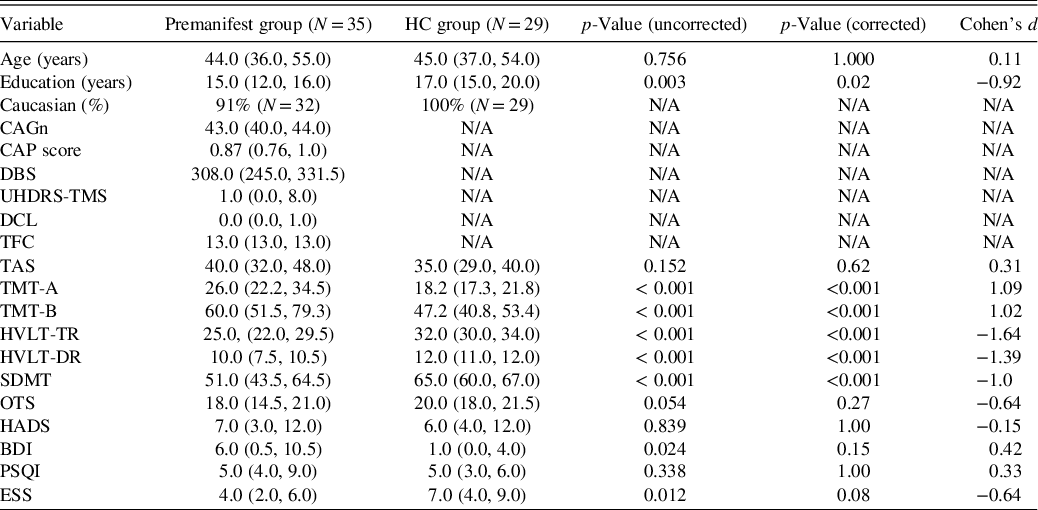
People with premanifest HD were comparable to healthy controls across all demographic characteristics (Table 1).
Comparison of baseline characteristics between the premanifest HD group and healthy control (HC) group

CAGn, cytosine-adenine-guanine repeat number; CAP, CAG-age product; DBS, disease burden score; UHDRS-TMS, Unified Huntington’s Disease Rating Scale-Total Motor Score; DCL, diagnostic confidence level; TFC, Total Functional Capacity; TAS, Toronto Alexithymia Scale; TMT-A, Trail Making Test-Part A; TMT-B, Trail Making Test-Part B; HVLT-TR, Hopkins Verbal Learning Test – Total Recall; HVLT-DR, Hopkins Verbal Learning Test – Delayed Recall; SDMT, Symbol Digit Modality Test; OTS, One Touch Stockings of Cambridge; HADS, Hospital Anxiety and Depression Scale; BDI, Beck Depression Inventory; PSQI, Pittsburgh Sleep Quality Index; ESS, Epworth Sleepiness Scale.
Data are presented as median (interquartile range). A t test was used for comparison of education between groups due to data being normally distributed. Mann–Whitney U tests were used for all other analyses. Holm–Bonferroni corrections were applied to adjust for multiple comparisons.
Group-Level Comparisons for Social Cognition Outcomes
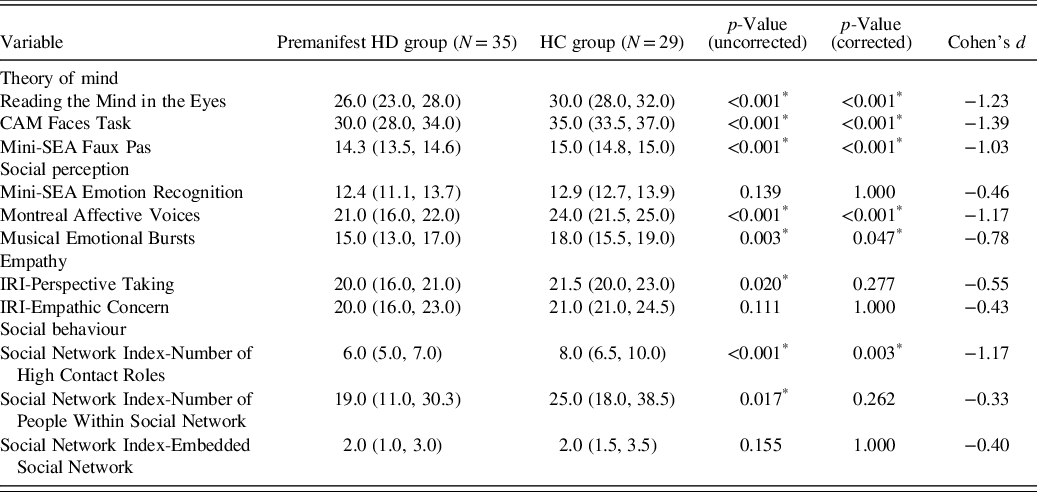
Group-level analyses revealed significantly poorer performance on the RMET, the faux pas component of the mini-SEA, the CAM Faces Task, MAV, and MEB in the premanifest HD group compared to healthy controls (Table 2). The premanifest HD group had a significantly reduced number of high contact roles, as measured by the Social Network Index, when compared to healthy controls.
Group-level differences in social cognitive outcomes between people with premanifest HD and healthy controls (HC)

Mini-SEA, Mini-Social Cognition and Emotional Assessment; IRI, Interpersonal Reactivity Index.
Data are presented as median (interquartile range). Mann–Whitney U tests were used for analyses, with Holm–Bonferroni corrections applied for multiple comparisons.
* p < 0.05 significant after correction for multiple comparisons.
Both uncorrected and corrected p-values are presented.
Social Cognitive Profile of People with Premanifest HD
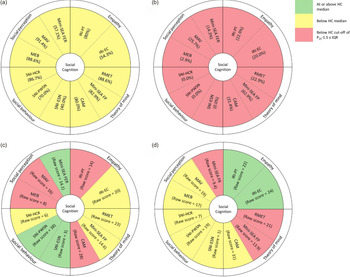
An analysis of the social cognitive profile revealed that more than 80% of people within the premanifest HD group demonstrated poorer performance on all three ToM tasks when compared to the median scores for healthy controls (RMET = 88.6%; mini-SEA Faux Pas = 82.9%; CAM Faces Task = 80.0%; Figure 1a). In comparison to the cut-off value for each assessment, 22.9% of people with premanifest HD performed poorer on the RMET task, 31.4% on the CAM Faces Task, and 62.9% on the mini-SEA Faux Pas test (Figure 1b).
Examples of how the social cognition profiling method could be used in a clinical setting. Figure 1 shows the percentage of the premanifest HD cohort that (a) fell below the median and (b) fell below the cut-off of P25 – 1.5 x IQR of the healthy control cohort. (c and d) Representative social cognition profiles of two participants with premanifest HD using the proposed profiling method. The profiling method has been adapted from Demeyere et al., Reference Demeyere, Riddoch, Slavkova, Bickerton and Humphreys2015. Mini-SEA FER, mini-SEA Facial Emotion Recognition task; MAV, Montreal Affective Voices task; MEB, Musical Emotional Bursts task; IRI-PT, Interpersonal Reactivity Index-Perspective Taking; IRI-EC, Interpersonal Reactivity Index-Empathic Concern; SNI-HCR, Social Network Index-Number of High Contact Roles; SNI-PWSN, Social Network Index-Number of People Within Social Network; SNI-ESN, Social Network Index-Embedded Social Network; RMET, Reading the Mind in the Eyes Test; Mini-SEA FP, Mini-SEA Faux Pas task; CAM, Cambridge Faces Task.

The premanifest HD group generally performed poorer on social perception tests compared to the median scores for healthy controls (mini-SEA Facial Recognition = 57.1%; MAV = 91.4%; MEB = 88.6%). When compared to the cut-off value for each assessment, 14.3% of people with premanifest HD performed poorer on the mini-SEA Facial Emotion Recognition task, 25.7% on the MAV, and 2.9% on the MEB test (Figure 1b).
When compared to the healthy control median, 80.0% of people within the premanifest HD group performed poorer on the perspective taking subscale and 54.3% on the empathic concern subscale of the IRI. At least 20.0% of people in the premanifest HD group scored below the cut-off value for empathy (perspective taking = 22.9%; empathic concern = 20.0%).
Up to 86.7% of people in the premanifest HD group scored lower than the healthy control median on the Social Network Index (number of high contact roles = 86.7%; number of people in the social network = 70.0%; embedded social networks = 40.0%). None of the people in the premanifest HD group scored lower than the cut-off for any of the Social Network Index components (Figure 1b).
Social Cognitive Dispersion
Social cognitive dispersion indices (ISDs) within each social cognitive domain did not differ between the premanifest HD and healthy control groups (ToM, p = 0.233 uncorrected, p = 1.000 corrected; social perception, p = 0.272 uncorrected, p = 1.000 corrected; empathy, p = 0.437 uncorrected, p = 1.000 corrected; social behaviour, p = 0.718 uncorrected, p = 1.000 corrected). Furthermore, no difference was observed in the social cognitive dispersion ISDs between the premanifest HD and healthy control groups (p = 0.134 uncorrected, p = 1.000 corrected), indicating that the variation in performance between social cognitive domains does not significantly differ between people with premanifest HD and healthy controls. It is worth noting that two people in the HD group did not provide data for social connectedness and therefore ISD was calculated based on the available domains.
Associations between Social Cognitive Measures
Associations between social cognitive measures are provided in Supplementary Table 1. Significant positive associations were observed between the following measures: RMET with the CAM, mini-SEA Faux Pas, MAV, and MEB; CAM with the mini-SEA Faux Pas, MAV, and number of high contact roles; mini-SEA Faux Pas with the number of high contact roles; and MAV with the MEB.
Associations between Social Cognitive Domains and Mood, Neurocognitive Function, and Sleep
Associations between social cognitive domains and neurocognitive, mood, and sleep outcomes are presented in Supplementary Table 2. No associations were observed between social cognitive domains and disease burden, neurocognitive, mood, alexithymia, and sleep outcomes after adjusting for multiple comparisons. A significant positive association was found between ToM and social perception domains.
DISCUSSION
The present study provides the first critically needed investigation of social cognition, not only at the group level, but also at the individual level in people with premanifest HD. In line with our expectations, group-level analyses revealed significant impairments in social cognition in individuals with premanifest HD when compared to healthy controls. However, analyses conducted at an individual level revealed that most, but not all individuals with premanifest HD, exhibited worse performance on social cognitive measures. No associations were observed between measures of disease burden, neurocognition, mood, alexithymia and sleep, and social cognition in individuals with premanifest HD. Associations were, however, evident between specific measures of ToM, social perception, and social behaviour.
Consistent with most previous investigations (Baez et al., Reference Baez, Herrera, Gershanik, Garcia, Bocanegra, Kargieman and Ibanez2015; Bora et al., Reference Bora, Velakoulis and Walterfang2016; Eddy & Rickards, Reference Eddy and Rickards2015b; Henley et al., Reference Henley, Novak, Frost, King, Tabrizi and Warren2012; Larsen et al., Reference Larsen, Vinther-Jensen, Gade, Nielsen and Vogel2016), group-level analyses revealed significant deficits in ToM and social perception in the premanifest HD group in comparison to the healthy control group. We also observed a significant difference in social connectedness, with the premanifest HD group reporting fewer social contacts than the healthy control group. To our knowledge, this is the first study to report differences in social network size between people with premanifest HD and healthy controls. Our findings also revealed no differences in empathy between people with premanifest HD and healthy controls, which aligns with some, but not all prior studies. It is noteworthy that these conflicting findings may be due to the self-report nature of instruments used to date, which may be due to impairments in insight and cognition such as memory deficits which are notable features of HD (Wibawa et al., Reference Wibawa, Zombor, Dragovic, Hayhow, Lee, Panegyres and Starkstein2020). While the aforementioned findings indicate that group-level differences exist between people with premanifest HD and healthy controls, at least for this cohort, these findings do not describe the presence or severity of individual deficits in social cognition, which is of relevance from a clinical perspective, particularly with respect to personalised medicine.
Two methods were used to evaluate inter- and intra-individual differences in social cognitive performance between individuals with premanifest HD and healthy controls. The first method aimed to evaluate the percentage of premanifest HD participants above and below median values and values less than P25 – 1.5 × IQR for the development of a social cognition profiling method. The second method aimed to evaluate individual differences in performance across social cognitive domains (dispersion) between individuals with premanifest HD and healthy controls. Consistent with previous investigations and our findings here at a group level, the first method revealed that a large proportion of people with premanifest HD fell below healthy control median values across the social cognition domains of ToM (>80%), social perception (>57%), empathy (>54%), and social behaviour (>40%). A smaller, yet notable percentage of the premanifest HD group also displayed severe impairments in select social cognition domains, as indicated by values less than P25 – 1.5 × IQR. The most impaired domains appeared to be empathy and ToM, with greater than 20% and 22% of premanifest HD individuals demonstrating more pronounced impairments, respectively. This finding is of interest, particularly as no significant deficits were observed for empathy at a group level between individuals with premanifest HD and healthy controls, reinforcing the importance of assessing patients at an individual level, especially as the scientific community moves closer to personalised therapies for individuals living with HD. With the exception of the MAV task, only a small percentage of people with premanifest HD displayed severe impairments in social perception and none appeared to have severely reduced social connectedness.
In contrast to our expectations, we did not find significant evidence of social cognitive dispersion between people with premanifest HD and healthy controls. These data suggest that individuals with premanifest HD exhibit global impairments in social cognition, as opposed to impairments in select social cognitive domains. This could reflect the fact that social cognitive domains often overlap and are not entirely distinct from each other, as is the case with neurocognitive domains (Bora et al., Reference Bora, Velakoulis and Walterfang2016; Demeyere et al., Reference Demeyere, Riddoch, Slavkova, Bickerton and Humphreys2015). However, further studies are required to determine if this same consistency of impairment is reflected in a larger cohort of people with premanifest HD, as well as if intra-individual dispersion between social cognition domains changes as the disease progresses. The clinical application of these findings may help to develop specific treatment strategies such as social skills training, a method currently used in ASD, in which individuals are taught specific skills to improve overall social performance and quality of life and decrease problematic behaviours (Mitchell et al., Reference Mitchell, Regehr, Reaume and Feldman2010; Tse et al., Reference Tse, Strulovitch, Tagalakis, Meng and Fombonne2007). However, due to the degenerative nature of the disease, a HD-specific programme should consider the decline of social cognitive performance and future research into the implementation of such a programme is essential.
No significant associations were observed between measures of disease burden and neurocognition and social cognitive domains. These results were unexpected, particularly given previous meta-regression analyses (Bora et al., Reference Bora, Velakoulis and Walterfang2016), which have shown that more severe impairments in social cognition are associated with greater disease burden (Johnson et al., Reference Johnson, Stout, Solomon, Langbehn, Aylward and Cruce2007) and neurocognitive deficits, particularly executive deficits (Allain et al., Reference Allain, Havet-Thomassin, Verny, Gohier, Lancelot, Besnard and Le Gall2011; Brüne et al., Reference Brüne, Blank, Witthaus and Saft2011). No associations were observed between performance on social cognitive tasks and mood and sleep outcomes. This was somewhat unexpected, with previous work by Eddy et al. (Reference Eddy, Mahalingappa and Rickards2014) noting greater ToM impairments in manifest HD individuals with more severe anxiety symptoms. The link between mood disturbances and social cognitive impairments is also well established in individuals with other neurological and psychiatric disorders (Cotter et al., Reference Cotter, Bartholomeusz, Papas, Allott, Nelson, Yung and Thompson2017; Lee et al., Reference Lee, Harkness, Sabbagh and Jacobson2005; Nejati et al., Reference Nejati, Zabihzadeh, Maleki and Tehranchi2012). It is noteworthy that our cohort did not appear to have mood symptomology, as indicated by low values on anxiety and depression measures, which likely explains the aforenoted findings. Potential associations between sleep quality and social cognitive performance were also explored. We expected sleep quality to be associated with performance on social cognitive outcomes, which has been previously described in individuals with ASD (Malow et al., Reference Malow, Marzec, McGrew, Wang, Henderson and Stone2006; Schreck et al., Reference Schreck, Mulick and Smith2004; Taylor et al., Reference Taylor, Schreck and Mulick2012). In contrast to the aforenoted findings, we did not find associations between sleep quality and social cognitive performance, which suggests that sleep does not influence social cognitive performance in individuals with HD. Taken together, these findings suggest that social cognitive performance is not influenced by disease burden, neurocognitive, mood, or sleep disturbances. However, these associations need to be explored longitudinally to draw any firm conclusions.
This study has several limitations. First, the cut-off scores used for each social cognition measure were generated using data from healthy control participants. These cut-off scores require validation in a larger cohort of participants. Second, the limited sample size of individuals with premanifest HD (N = 35) could impact tests for associations between social cognition measures and neurocognitive, mood, and sleep variables. Therefore, future studies should evaluate these findings with larger cohorts. Third, social connectedness was used as a proxy for social behaviour. While social connectedness is closely associated with social behaviour (Lamblin et al., Reference Lamblin, Murawski, Whittle and Fornito2017), future studies should measure social behaviour directly using validated measures, such as informant ratings of social behaviour (Barsuglia et al., Reference Barsuglia, Kaiser, Wilkins, Joshi, Barrows, Paholpak and Mendez2014; Henry et al., Reference Henry, Von Hippel, Molenberghs, Lee and Sachdev2016). Furthermore, while we assumed that the participants of the study were familiar with socially appropriate behaviour as guided by Western culture, information regarding the participants’ country of origin and how long they have lived in Australia was not collected. It is important to note that socially appropriate behaviour may be viewed differently depending on the ethnic or cultural background of the participant depending on cultural values and practices (Rule et al., Reference Rule, Freeman and Ambady2013) and should be taken into consideration in future studies. Fourth, this study used a cross-sectional design. As such, it is not possible to determine whether observed deficits persist or worsen over time and are therefore a true measure of disease progression. Fifth, the study population included people with premanifest HD, and further research is needed to establish whether a similar profile of impairment and level of dispersion is seen in manifest HD. Finally, this study included a number of social cognitive measures without established validity and reliability in individuals with HD. While undoubtedly a limitation, it should be noted that these measures have demonstrated validity and reliability in healthy adults and other clinical populations.
Despite these limitations, the findings from this study provide novel and important evidence that people with premanifest HD exhibit deficits across ToM, social perception, and social behaviour that are not influenced by disease burden or neurocognitive, mood, or sleep outcomes. This study also provides a rationale for the assessment of social cognition at the individual level using evaluated profiling methods. Importantly, following validation, this profiling method has the potential to facilitate the development and implementation of targeted therapies to reduce the impact of social cognition deficits in many clinical groups.
ACKNOWLEDGEMENTS
The authors sincerely thank the participants and their families and Huntington’s WA (Inc) for their involvement in this study.
AUTHOR CONTRIBUTIONS
Kate Turner and Danielle Bartlett contributed equally to this manuscript.
FINANCIAL SUPPORT
This work was supported by Lotterywest (grant number 107/20090827).
CONFLICTS OF INTEREST
The authors have nothing to disclose.
ETHICAL STANDARDS
Ethical approval was granted by Edith Cowan University (13145), North Metropolitan Area Mental Health Service (NMAMHS) (2009_16), and Monash University (CF15/117-2015000058) Human Research Ethics Committees. Written informed consent was provided by all participants.
SUPPLEMENTARY MATERIAL
To view supplementary material for this article, please visit https://doi.org/10.1017/S1355617721000357