On April 15 and 17, 2009, the first cases of novel influenza A virus infection in the United States were confirmed in 2 children from California.1 Public Health–Seattle & King County (PHSKC) identified 3 probable cases of 2009 H1N1 flu in King County residents on April 29, 2009. None had traveled to an area with confirmed cases of novel influenza, indicating that the individuals were infected locally in the community. In the following weeks of sustained media attention and high public concern, health care providers reported large numbers of patients presenting for care in emergency departments and primary care clinics. Many patients had uncomplicated illness that did not require testing or treatment. Following surveillance guidelines from the Centers for Disease Control and Prevention (CDC), initial PHSKC surveillance efforts focused on those who traveled to areas affected by 2009 H1N1, then broadened to all with influenza-like illness (ILI) after the presence of the virus in the community was established. Beginning May 23, 2009, criteria for H1N1 flu testing shifted to focus on patients who were hospitalized or at increased risk of influenza complications. Emergency department (ED) visits for ILI returned to baseline in mid-June 2009, after approximately 6 weeks of sustained high-level influenza activity.
This article describes the epidemiology of the spring 2009 H1N1 flu outbreak in King County, home to a culturally diverse population of 1.9 million people in a mixture of metropolitan and rural environments with 19 acute care hospitals. PHSKC is the tenth largest metropolitan health department in the United States. The goals of the analysis were to describe trends in ED visits and hospitalizations for ILI collected by the county’s syndromic surveillance system; describe the demographics of confirmed cases; calculate rates of hospitalization and critical care or death; analyze factors predisposing individuals to more severe illness for seasonal influenza, and whether there were factors associated with hospitalization and critical care or death; and analyze the time between illness onset and antiviral treatment, and determine whether there were differences between patients who required critical care or died and patients not requiring critical care.
METHODS
The 2 primary sources of data for this report are syndromic surveillance for ILI and case reports of 2009 H1N1 flu in King County. The syndromic surveillance system captures data from 18 of 19 EDs in King County, and includes the date and time of ED visit; age, sex, and home ZIPcode of the patient; chief complaint, diagnosis, and disposition; and a patient and visit key. Data do not include identifying information such as name, date of birth, and address. All ED visits that occurred during the previous day are transmitted electronically to PHSKC daily. The chief complaints and diagnoses are grouped into syndromic categories based on the presence or absence of key words and ICD codes. A syndromic category for ILI was defined as International Statistical Classification of Diseases and Related Health Problems code 487 or mention of “flu” in the chief complaint or diagnosis, or a chief complaint or diagnosis of fever plus cough, or a chief complaint or diagnosis of fever plus sore throat. We used the Early Aberration Reporting SystemReference Hutwagner, Thompson and Seeman2 developed by CDC, which uses control chart–based algorithms commonly referred to as C1, C2, and C3 to examine whether observed trends in syndromic data were significantly different than baseline levels.
Syndromic surveillance system data were compared with other components of the PHSKC influenza surveillance system: influenza test results from the sentinel provider network, weekly aggregate numbers of rapid antigen test results submitted to laboratories in King County, and case reports of laboratory confirmed 2009 H1N1.
Sentinel providers are volunteer physicians who obtain specimens of respiratory secretions from a subset of patients who present with ILI and submit them for viral culture at the Public Health Laboratory of PHSKC. The Public Health Laboratory, a National Respiratory and Enteric Viral Surveillance System Collaborating Laboratory, determines the type and subtype of influenza (A or B) and submits a sample of influenza viruses to the CDC for further antigenic characterization. The Public Health Laboratory also tests for other common respiratory viruses including parainfluenza virus, respiratory syncytial virus, and enterovirus. Aggregate numbers of influenza rapid antigen test results are submitted by several local microbiology laboratories each week. These include results from both inpatients and outpatients.
Case reports include patients who sought health care for their illness, were tested for 2009 H1N1 flu by their health care providers, and found to be positive for the virus by polymerase chain reaction testing. Cases reported before August 1, 2009, are included in this analysis. Almost all of the cases were confirmed through testing by the Washington Department of Health Public Health Laboratory; the rest were confirmed through the University of Washington Virology Laboratory or by a commercial laboratory. PHSKC investigators completed a standardized case investigation form using both case interviews and medical chart review. Interpreters were used for patients with limited English proficiency. For the purposes of analysis, a person was considered to be a foreign language speaker if a non-English language was either the primary or secondary language spoken at home.
Case reports underestimate the true burden of 2009 H1N1 flu because not all people who were infected sought health care and not all people who sought health care were tested for influenza. Confirmatory testing for 2009 H1N1 was sought depending on the surveillance guidelines at the time that the patient presented, and these guidelines changed at different stages of the outbreak.
Population estimates for 2009 from the Washington Office of Financial Management were used to calculate the rates of hospitalization as well as the rates of critical care or death.3
Bivariate and multivariate logistic regression analyses were performed with Stata. T tests were used to look at differences in mean days from illness onset to the start of antiviral treatment between different groups.
RESULTS
Syndromic Surveillance for ED ILI Visits
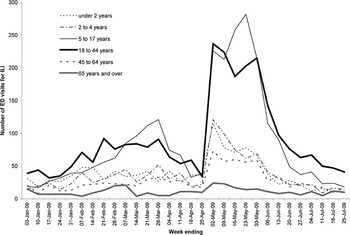
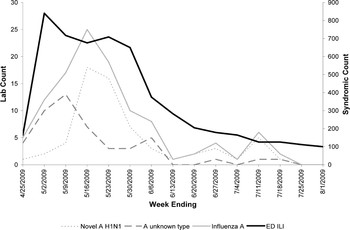
Starting in the last week of April, PHSKC’s syndromic surveillance system detected a surge of visits among patients with ILI that exceeded the numbers seen during a typical seasonal influenza outbreak and lasted more than 1 month (Fig. 1). ED ILI visits peaked the week ending May 2, 2009, 1 week before the peak in reports from health care providers of confirmed H1N1 cases, 2 weeks before the peak number of influenza A positives and novel influenza A H1N1 reported by sentinel providers (Fig. 2), and 3 weeks before the peak number of influenza-positive rapid antigen reports. Stratified by age group, the volume of ED ILI visits among children ages 5 to 17 years peaked the week ending May 23, 3 weeks after the peak volume observed for all of the other age groups (Fig. 1). The highest volume of ED ILI visits was observed among patients in the 5- to 17-years-old and 18- to 44-years-old age groups. At its peak, weekly ED visits for ILI were 5 times higher compared with preoutbreak levels and 2.5 times higher than during the peak of seasonal influenza in March 2009. Daily counts of ED visits for ILI decreased to preoutbreak levels for all age groups by June 18, 2009.
Emergency department visits for influenza-like illness by age group.

Emergency department syndromic data compared to sentinel provider laboratory data.

ED disposition (eg, admitted, discharged, expired, transferred) captured by our syndromic surveillance system was available for all but 14% of patients for the period January 1, 2009–August 31, 2009. The average weekly count of ILI admissions increased gradually between January 1, 2009, and mid-April 2009. Analysis of syndromic surveillance data identified a significant increase in the weekly count of ED ILI admissions during 3 weeks in May 2009, with a return to baseline levels by the end of July 2009. At its peak, the weekly count of ILI admissions (n = 23) was roughly double compared with the 7-week moving average; the observed magnitude was comparable to levels observed during the 2007 influenza season, during which there was a high level of influenza activity in the county. For the period April 25, 2009–August 1, 2009, the Pearson correlation coefficient comparing the weekly count of ED ILI admissions with the weekly number of hospitalized novel influenza A H1N1 patients reported to our health department was r = .66.
Demographics of Confirmed Cases
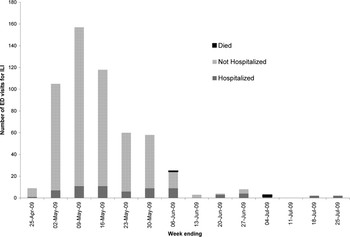
Between April 25, 2009, and August 1, 2009, PHSKC received 565 reports of confirmed novel influenza A H1N1, including 70 hospitalizations and 3 deaths (Fig. 3).
Confirmed cases of 2009 H1N1 by symptom onset date.

Of all of the cases, 47% were female. Nearly half of all of the cases (49%) were school-age children 5 to 17 years old. Overall, 22% were children ages 4 years and younger; 21% of cases were among adults ages 18 to 44 years; 6% of cases were among adults ages 50 to 64 years; and 1% of cases were among those 65 years and older.
Race and ethnicity information was available for 405 cases (72%). Nonwhite racial groups were disproportionately represented. Of the cases for which racial data were available, 36% of cases were white, 21% black, 31% Asian or Pacific Islander, 1% Native American, and 10% other race. Of all of the cases, 22% were Hispanic. For comparison, 76% of King County residents are white, 6.1% are black, 14% Asian or Pacific Islander, 1% Native American, and 3% multiracial; 6.8% of King County residents are Hispanic.4
Language data were available for 393 cases (70%). Of these, 157 (40%) spoke a language other than English as the primary or secondary language at home. Overall, 23 different languages were represented. Among the foreign language speakers, Spanish was the most common language (48%), followed by Somali (13%) and Vietnamese (9%). Other languages were spoken by less than 5% of foreign language speakers. Of the 77 black cases, 26 (34%) spoke a foreign language at home, with Somali being the most common (25%). Of the 102 Asian cases, 32 spoke a foreign language, most commonly Vietnamese (13%).
Rates of Hospitalization and Critical Care
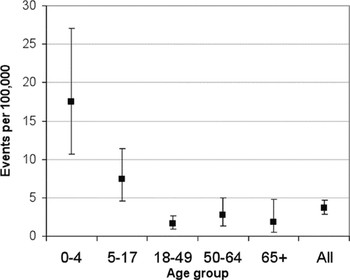
Among confirmed cases of 2009 H1N1 between April 25, 2009, and August 1, 2009, children younger than 4 years old had the highest rate of hospitalization at 17.5 admissions per 100,000 people (95% confidence interval [CI] 10.7–27.1; Fig. 4). This was significantly higher than each of the other age groups except for children 5 to 17 years, who had 7.4 admissions per 100,000 (95% CI 4.6–11.4). Adults 18 to 49 years old had the lowest rate at 1.6 admissions per 100,000 (95% CI 0.5–4.8).
2009 H1N1 hospitalization rates by age group with 95% confidence intervals.

The rates of critical care or death were not significantly different across age groups, although the small number of cases in each age group resulted in wide confidence intervals. Children 5 to 17 years of age had the highest rate at 1.8 events per 100,000 (95% CI 0.6–4.1), followed by adults 50 to 64 years of age at 1.4 events per 100,000 (95% CI 0.4–3.2), children 0 to 4 years of age at 0.9 events per 100,000 (95% CI 0–4.9), adults 18 to 49 years of age at 0.5 events per 100,000 (95% CI 0.2–1.3), and adults 65 and older at 0.5 events per 100,000 (95% CI 0–2.6).
Factors Associated With Hospitalization and Critical Care or Death
Among the 70 hospitalized patients were 3 deaths, resulting in a case fatality rate for hospitalized patients of 4.3%. All 3 deaths occurred among patients admitted to an intensive care unit:
• An Asian male in the 65 years and older age group with chronic lung disease
• A Hispanic female in the 5- to 17-year-old age group with severe immune compromise due to chemotherapy
• A Hispanic female in the 18- to 49-year-old age group with diabetes and morbid obesity (body mass index 43.6 kg/m2)
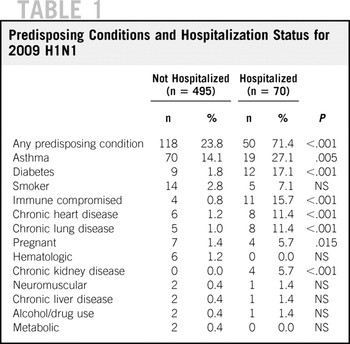
Hospitalized patients were more likely to be adults (odds ratio [OR] 1.9; 95% CI 1.1–3.2), and were more likely than nonhospitalized cases to have a predisposing condition (71% vs 24%; OR 8.0; 95% CI 4.6–14.0). Of all of the confirmed cases, 30% had at least 1 predisposing condition associated with an increased risk of complications from seasonal influenza. Among hospitalized patients, 79% of adults had at least 1 predisposing condition, compared with 44% of children. Table 1 summarizes these conditions along with chi-square P values from bivariate analysis.
Predisposing Conditions and Hospitalization Status for 2009 H1N1

In a multivariate analysis including age, demographic factors, and predisposing conditions, hospitalization was associated with black race (OR 4.2; 95% CI 1.8–9.8), Hispanic ethnicity (OR 3.3; 95% CI 1.5–7.4), and Asian race (OR 2.9; 95% CI 1.3–6.6). The predisposing factors associated with hospital admission were immune compromise (OR 15.0; 95% CI 3.9–58.3), chronic lung disease (OR 12.2; 95% CI 3.4–44.4), chronic heart disease (OR 9.4; 95% CI 2.1–41.6), pregnancy (OR 5.7; 95% CI 1.5–21.6), diabetes (OR 4.1; 95% CI 1.3–13.5), and asthma (OR 2.8; 95% CI 1.4–5.6).
Using multivariate analysis, critical care or death was associated with chronic lung disease (OR 25.3; 95% CI 5.9–108.4), immune compromise (OR 15.8; 95% CI 3.6–68.2), and diabetes (OR 13.1; 95% CI 3.3–51.7).
Obesity data were not systematically collected and therefore not included in this analysis; however, of the 17 patients requiring critical care, at least 7 (41%) were obese on the basis of either health care provider documentation in chart notes or a body mass index >30. For comparison, 19.5% of adults in King County are estimated to be obese.5 Two of the obese critical care patients did not have a diagnosed predisposing condition for complications of influenza, 1 had a single predisposing condition, 1 had 2 predisposing conditions, and 3 had 3 predisposing conditions. Diabetes was the most common risk factor, affecting 4 of the 7 obese critical care patients.
Time to Treatment
Information on whether a patient received antiviral treatment was available for 528 (93%) of confirmed cases. Of those, 297 (56%) reported receiving antiviral treatment, for which antiviral treatment start dates were available for 282 (95%). The mean number of days between symptom onset and antiviral treatment was 2.5 days. Of people receiving antiviral treatment, 34% started their medication more than 2 calendar days after the onset of illness. Those people with a predisposing condition were more likely to receive antiviral treatment than those without a predisposing condition (OR 1.8; 95% CI 1.2–2.6), but were no more likely to have treatment initiated within 2 calendar days.
Individuals who spoke a foreign language were just as likely to receive antiviral treatment as those who did not, but they had a greater mean time between onset date and treatment date (3.1 days for foreign language speakers versus 2.3 days for nonforeign language speakers, P = .02).
Hospitalized patients were more likely to receive antiviral treatment, but had a longer mean time between symptom onset and treatment compared with nonhospitalized patients. Of the 70 hospitalized patients, 54 (77%) received antiviral therapy. Of these, 50 (93%) had treatment started on or after the date of admission. Hospitalized patients had a mean time between onset and treatment of 4.0 days compared with 2.2 days for nonhospitalized patients (P < .001). Among the 17 hospitalized patients who died or required critical care, 14 received antiviral treatment and had a mean of 6.2 days between onset and treatment, compared with a mean of 3.2 days for hospitalized patients not requiring critical care (P < .01). None of the patients requiring critical care had an antiviral treatment date before the admission date.
Looking at both hospitalized and nonhospitalized cases, Hispanic ethnicity was associated with longer mean time between onset date and treatment date (3.1 for Hispanics vs 2.3 days for others, P = .02). When time to treatment and foreign language were included in the multivariate models, Hispanic ethnicity ceased to be a statistically significant risk factor for hospitalization but became a statistically significant predictor of critical care or death.
DISCUSSION
During the spring 2009 influenza A H1N1 outbreak in King County, ED visits for ILI peaked quickly in the first week of the outbreak and remained above the preoutbreak baseline for approximately 6 weeks, with school-age children accounting for the greater number of ED visits, followed by adults 18 to 44 years old. Weekly counts of ED admissions for ILI also increased early in the outbreak. We found ED visits to be a useful piece of information for helping us describe the outbreak in real time; in general, ED ILI trends seemed to correlate well with other surveillance indicators. Due to missing data and the potential for misclassification, however, further exploration of the validity of using syndromic surveillance to describe seasonal and pandemic influenza, including validation of the use of ED disposition as a marker of illness severity, would be helpful.
Unlike seasonal influenza, which causes the highest rates of serious illness and death among people aged 65 years and older,6 rates of hospitalization and critical care for 2009 H1N1 in King County were not elevated in people older than 65 compared with other age groups. Data from reported cases showed that children 0 to 4 years of age had the highest rates of hospitalization for 2009 H1N1 per 100,000 people. School-age children 5 to 17 years old had the next highest rate of hospitalization and had the highest rate of critical care. Rates of critical care did not differ significantly across age groups in our study.
Patients with chronic lung and heart diseases, asthma, diabetes, immune compromise, and pregnancy were at significantly increased risk for hospitalization for 2009 H1N1. Despite the recommendation that antiviral treatment for influenza be initiated within 48 hours of symptom onset,Reference Harper, Bradley and Englund7 one third of patients for whom antiviral treatment data were available were found to have initiated treatment more than 2 calendar days after the start of their illness. Among hospitalized patients, those who required critical care received antiviral treatment later than those who did not require critical care. The association between delayed treatment and more severe disease deserves additional study.
Certain racial and ethnic minorities were at greater risk of hospitalization as well as critical care. This finding has been previously described for both seasonal influenza and 2009 H1N1. Population-based surveillance for hospitalization due to influenza, parainfluenza, and respiratory syncytial virus in children during the 2000–2001 flu season found higher rates of admission in blacks and Hispanics.Reference Iwane, Edwards and Szilagyi8 A report describing the spring influenza A H1N1 outbreak in Chicago also described higher rates of hospitalization among blacks, Asians, and Hispanics.9 Jain et al reported that of the 272 patients hospitalized in the United States for 2009 H1N1 from April 2009 to mid-June 2009, 30% were Hispanic and 27% were non-Hispanic white.Reference Jain, Kamimoto and Bramley10
The reasons for apparent racial and ethnic disparities in 2009 H1N1 hospitalization in King County are not known and cannot be determined from available data. Blacks and Spanish-speaking Hispanic patients have been shown to have lower rates of influenza vaccination than non-Hispanic whites,Reference Fiscella, Franks and Doescher11 but seasonal influenza vaccination coverage would not be expected to influence outcomes for a novel influenza strain. Potential explanations include delays in seeking care, barriers to receiving care, and/or delayed treatment leading to greater severity of illness at presentation. Lower socioeconomic status, education, cultural attitudes affecting health care–seeking behavior, and a greater prevalence of predisposing conditions such as asthma,12 diabetes,13 and obesity14 could contribute as well. Racial and ethnic variations in receipt of antiviral treatment for influenza have been previously described in a retrospective analysis from a primary care setting, but in that report blacks were more likely to be prescribed antiviral treatment than whites or Hispanics.Reference Linder, Chan and Bates15 The observation that people who spoke a foreign language as either their primary or secondary language had delayed treatment compared with exclusively English-speaking people also warrants further exploration. More information is necessary to better understand the effects of race and ethnicity on outcomes of 2009 H1N1 infection. Racial and ethnic factors as well as age-related findings may be related to the early pattern of disease transmission after introduction of the virus and should be reassessed during periods of communitywide spread. Routine collection of information relevant to health disparities including socioeconomic factors such as insurance coverage, homelessness, primary language, and other social and demographic variables is needed to more fully understand disease risk factors including racial and ethnic data, but this will require additional resources.
There are several limitations to this analysis that affect the interpretation of these results. There may be other important demographic and clinical factors affecting outcomes that we were not able to detect due to the small sample size. Case investigation data were obtained from a combination of chart review and patient interviews done in the course of an outbreak investigation and was not standardized to the degree possible in a prospective study. For example, it was not possible to verify the presence or absence of predisposing conditions in a standardized way through supplemental medical record reviews or interviews. Case interviews were done days to weeks after diagnosis, making the information obtained during investigations subject to potential recall error and bias. Other limitations relate to the previously mentioned confounding factors that could contribute to the finding that racial and ethnic minorities were disproportionately affected: No data were collected on severity of illness, socioeconomic status, education, or health insurance coverage; systematic collection of obesity data would also have been helpful.
Despite these limitations, these findings from the spring 2009 outbreak, combined with the expectation that 2009 H1N1 will be the predominant strain during the 2009–2010 influenza season, have important implications. Assuming that the epidemiology of the 2009 H1N1 virus does not change significantly between flu seasons, health care providers and facilities should prepare for a high volume of emergency department and clinic visits for flu-like illness early in the outbreak, particularly among children 5 to 17 years and adults 18 to 44 years old. Hospitals serving children should prepare for a high rate of admissions, particularly among children 0 to 4 years old. Although rates of hospitalization are greatest for children, clinicians should be aware that all age groups are at risk for critical care and death, particularly among those with certain predisposing conditions. Also, because transmission of the H1N1 virus is expected to be more widespread this fall and winter, hospitals should be prepared for increased critical care hospitalizations among both children and adults.
Health care providers and health care facilities should be aware of the possible factors that could increase risk among racial and ethnic minorities: delayed access to care, higher frequency of unrecognized risk factors, and different patterns of virus transmission, as well as innate increased susceptibility. Systems should be put in place to ensure that antiviral treatment is initiated promptly (ideally within 48 hours of symptom onset) when it is indicated in people with severe illness and people at high risk for complications from influenza. Potential barriers to care for racial and ethnic minorities (eg, language) also should be proactively addressed to ensure that all people have access to prompt evaluation and antiviral treatment when indicated.
Authors' Disclosures
The authors report no conflicts of interest.
Acknowledgments
The authors thank the following epidemiologists and nurses for their invaluable work in case investigation and data management (in alphabetical order): Betsy Hubbard, RN; Jenny Lloyd, MS; Shelly McKeirnan, RN, MPH; Krista Rietberg, MPH; and Laurie Stewart, MS; Kurt Wuellner and Julia Byrd are thanked for their managerial roles during the outbreak. The authors also thank Susan Buskin, PhD, MPH, for epidemiology consultation and Karen Segar, MA, for assisting with the preliminary data analysis. Finally, the authors express their gratitude to the following people for their role in collecting data on 2009 H1N1 cases in King County (in alphabetical order): Neil Abernethy, Edith Allen, Elizabeth Barash, Amy Bauer, Russell Campbell, Jesse Chipps, Avra Cohen Veilleux, Marisa A. D’Angeli, Bill DeYoung, James Drew, Sid Forman, Lauren Greenfield, Kate Halamay, Matt Hanson, Susanne Hanson, Janis Harsila, Kyle Hoesterey, Kathryn Koelemay, Amanda Markovitz, Susan Matt, Carey Melmed, Moni Muraki, Monica Pecha, Michelle Pederson, Sandy Randels, Carla Rodriguez, Shonita Savage, Meg Savlov, Lauri Serafin, Craig Sivak, Robert L. Smith, Hal Garcia Smith, Beth Sohlberg, Lin Song, Courtney Speigner, Yoli Stetson, Michael Strojen, Whitney Taylor, Nhan Thai, and Diana Vinh.