Scholars have long recognized the central role of timing in the calculus of political decision making. Party leaders in parliamentary systems act strategically when timing national elections (Lupia and Strøm Reference Lupia and Kaare1995). Legislators strategically time their position taking on prominent issues (Box-Steffensmeier, Arnold, and Zorn Reference Box-Steffensmeier, Laura and Christopher1997; Caldeira and Zorn Reference Caldeira and James2004). Presidents use the timing of speeches and trips to improve their chance of reelection (Brace and Hinckley Reference Brace and Barbara1993). Political conditions similarly can influence when US Supreme Court justices (Hagle Reference Hagle1993) and US Courts of Appeals judges (Spriggs and Wahlbeck Reference Spriggs and Paul1995) choose to retire from the bench.
In this article, I extend the logic of strategic timing to the context of constitutional review. While scholars have largely focused on strategic timing by elected officials concerned with reelection, most constitutional courts similarly have the means to strategically time their decisions. Such capacity is potentially significant for the quality of modern liberal democratic governance, as courts with the authority to engage in constitutional review are increasingly seen as critical for ensuring that elected officials act within the bounds of constitutional norms. Even though courts can often choose the timing of their decisions, the motivation for doing so strategically is not immediately clear. Since constitutional court judges are not elected, they do not face the electoral pressures that can motivate the timing of elected officials’ decisions.Footnote 1 Moreover, the legitimacy of the courts on which judges serve is derived in part from the presence and preservation of the appearance that the judiciary does not openly engage in politics (Gibson, Caldeira, and Baird Reference Gibson, Gregory and Vanessa1998; Staton Reference Staton2010). With these points in mind, any explanation for why a court might strategically time its decisions must first identify the court’s goal.
In this article, I argue that the threat of potential noncompliance by government officials creates an incentive for courts to strategically time their decisions. Building on the literature on the separation of powers and the comparative judicial politics literature, I develop an argument for both why a court might strategically time its decisions and how it might go about doing so. Specifically, I show that when a court enjoys a high level of diffuse public support, it has an incentive to strategically time certain decisions based on the proximity of the next election. Using data on constitutional review cases at the Federal German Constitutional Court, I show that the court was more likely to invalidate statutes in the period immediately preceding the next national election. The analysis provides evidence that even powerful courts have the means and motive to strategically time their decisions.
Noncompliance and the Strategic Timing of Judicial Decisions
Although constitutional courts have become prominent features of modern liberal democratic politics, the potency of review is fundamentally limited. Courts are inherently weak institutions. With the power of neither the sword nor the purse, courts cannot directly enforce their own decisions. Unlike executives with their “swords” or legislatures with their “purses,” courts have few formal powers to ensure that court orders are carried out. Constitutional review provisions typically grant courts the authority to issue rulings on the constitutionality of government actions and legislation, but they rarely provide judges with the institutional tools needed to implement and enforce those decisions. As a consequence, compliance with the rulings of constitutional courts relies on the willingness of elected officials to faithfully implement a court’s decision.
This institutional arrangement leaves courts in a potentially precarious situation. Judiciaries are tasked with constraining governing majorities, and yet at the same time they are reliant on those very same elected officials for the implementation of their decisions. Obtaining such cooperation from elected officials is fairly straightforward when a court’s decision conforms with or otherwise serves the government’s interests (e.g., Rogers Reference Rogers2001; Ginsburg Reference Ginsburg2003; Whittington Reference Whittington2005). When the government’s preferred outcome differs from that of the court, however, ensuring compliance can become problematic. Faced with a decision striking down their preferred policy, elected officials have an incentive to not comply with the court’s ruling by ignoring or defying the court.
Overcoming this noncompliance threat poses a fundamental challenge of judicial decision making. One solution to this problem is public support for the legitimacy of a court, also referred to as diffuse public support (e.g., Caldeira and Gibson Reference Caldeira and Christopher1995; Gibson et al. Reference Gibson, Gregory and Vanessa1998).Footnote 2 When citizens value judicial independence and have a strong commitment to the appropriateness of constitutional review, courts can exercise review with the expectation that attempts at noncompliance will result in a loss of support for the government.Footnote 3 Critically, this threat of punishment for noncompliance is based on the public’s support for the court’s authority to exercise review, not the specific content of that review. Consequently, courts with high levels of legitimacy can expect the public to back them should government officials attempt to evade a court’s decision, even when judicial review results in the invalidation of a popular policy or brings the court into conflict with an otherwise popular government.Footnote 4
The challenge in translating legitimacy into sufficient pressure to compel compliance, however, is the public’s lack of awareness of judicial decisions and subsequent government responses. Examining the German Federal Constitutional Court, Vanberg (Reference Vanberg2001, Reference Vanberg2005) argues that the impact of public support on the efficacy of constitutional review is conditioned by the likelihood that the public will become aware of government noncompliance. When the public is aware of a case and the court enjoys a high level of support, the court is free to rule against the government with the knowledge that voters will hold their elected officials accountable for noncompliance. If, however, the public is unaware of a case and the government’s noncompliance, then voters cannot punish officials, even if they staunchly support the court’s legitimacy. Critically, while courts cannot assume their rulings will always attract the necessary public attention to assure compliance, they can potentially influence the likelihood of public awareness through their own actions (Staton Reference Staton2006, Reference Staton2010).
Strategic timing of decisions is one possible action available to courts that enjoy a high level of diffuse support and seek to affect the level of awareness of decisions. If it is the case that courts time their decisions with noncompliance in mind, then they likely seek to issue their decisions when citizens are most likely to become aware of the ruling. In modern liberal democracies, elections can serve as this basis. Election campaigns typically increase press and public attention to all political matters, including constitutional review. Consequently, rulings issued in that period may be more likely to garner greater attention than those issued far from the spotlight of election campaigns.
The unique context created by the months preceding an election can make the media coverage and subsequent public attention to judicial decisions particularly effective at pressuring a government into compliance. As Vanberg (Reference Vanberg2005) notes, opinion leaders such as news editors and editorial writers have a critical role in generating public awareness of judicial decisions and legislative responses. This influence on public opinion and awareness takes on an added importance as an election nears and the cost of potentially losing public support due to noncompliance increases.Footnote 5 Even delaying action or paying lip service to compliance can be costly if such action or inaction is criticized by the media as voters prepare to cast their ballots in an approaching election.Footnote 6 This immediate pressure may compel governments to publicly commit to compliance.
Moreover, the proximity of a decision to an election may affect the likelihood of future public attention by situating the court’s decision and government’s reaction in the context of the campaign and subsequent election. Cases associated with an election may remain salient longer and be more easily recalled by citizens in the event of future noncompliance. Put another way, being connected with an election may elevate the public’s familiarity with a decision in such a way that its salience is longer lasting and more readily replicated by future media coverage. This higher level of latent interest in turn can create an incentive for the future media coverage of noncompliance critical to holding officials accountable. Between the increased immediate electoral pressure for compliance and the longer-term implications for case salience, the timing of decisions should directly affect a government’s incentive to comply with court decisions. A strategic court concerned with garnering sufficient public awareness of its decisions to compel government officials to comply with its decisions should, then, take advantage of the electoral cycle by ruling against the government in the period immediately preceding an election. This expectation leads to the first hypothesis:
H1: A court is more likely to rule against the government in the period immediately preceding an election.
One of the key implications of this argument is that a court will use its discretion to increase public awareness only when faced with a credible threat of noncompliance. When the government does not value the policy under review, whether because the policy is of little importance or because the government prefers the law struck down, noncompliance is not at issue, and the court need not strategically time its decision. Accordingly, a court that values compliance with its rulings should be more likely to strike down statutes as unconstitutional in the period leading up to an election only when the defendant government’s investment in the policy signals the potential for noncompliance. That is, a court need not be strategic in this manner when noncompliance is not a threat, and as a result one would not expect in those cases to find evidence of the strategic relationship proposed in the first hypothesis. This brings us to our second hypothesis:
H2: The relationship defined in hypothesis 1 is limited to cases involving a threat of noncompliance.
A challenge facing a court attempting to strategically time its decisions is uncertainty over the length of the electoral cycle. Constitutional courts often operate in political systems whose electoral cycles are not always fixed. Successful motions of no confidence in national parliaments, for example, can result in the holding of early elections. Similarly, in some parliamentary democracies the prime minister can choose to call an election before the end of the current term (see Goplerud and Schleiter Reference Goplerud and Petra2016; Schleiter and Tavits Reference Schleiter and Margit2016). As a result of these powers, predicting when the next election will take place is not straightforward for a court attempting to strategically time its decisions. Such a court cannot be assured that an attempt to time a decision to coincide with the next election will in fact do so, as the court may miss its opportunity as a result of an unexpected early election. Thus, courts may be less successful at strategically timing their decisions when a government terminates its term in office with an early election. If this is the case, then one might expect the relationship between a court’s likelihood of striking down legislation as unconstitutional and issuing the decision in the period immediately preceding an election to be limited only to cases decided in electoral terms that are not ended in an early election. Conversely, the court cannot effectively time its decisions, and as a result we should not observe the relationship between timing and case disposition when there is an early election. This brings us to our third hypothesis:
H3: The relationship defined in hypothesis 1 is limited to cases decided during a standard election period.
A court may additionally be constrained by the intensity and magnitude of media coverage of an election. Recall that the mechanism proposed here is that a court can take advantage of increased media scrutiny of political events in the months leading up to an election. Just as an indifferent or inattentive media undermines a court’s attempts to raise awareness of decisions, so can a media whose singular focus on an election extends far in advance of election day. When election coverage is so extensive and intense that it overwhelms potential coverage of judicial decisions, courts may find the period immediately preceding an election to be problematic for garnering public attention. If the media’s attention is intently focused elsewhere during the run-up to an election, a court might expect coverage of its decisions not to increase or even to decrease in the months preceding election day. As a consequence, this potential for a “crowding out” effect of media coverage may condition the relationship between the timing of decisions and case disposition.
This crowding-out effect may particularly be the case when intense media scrutiny extends well before election day. For example, this could be due to the dominance of a single or few issues or events. In such instances, media focus on the dominant topic of the election has the ability to consistently crowd out coverage of judicial decisions, making the media-rich environment that might otherwise engender public awareness deleterious for a court’s ability to effectively communicate with the public. Moreover, the significance of a dominant issue or event can result in an intensified media environment that begins long before election day and continues until voters finally cast their ballots. With the media focus elsewhere for the months leading up to an election, there may be particularly limited space for media attention to judicial decisions. As a result, a court may not be able to count on media attention for its decisions. Consequently, we might expect the relationship between timing and case disposition not to be present in electoral cycles with a lengthened, high-salience preelection period. The expectation of this scope condition of the theory is summarized in the fourth hypothesis.
H4: The relationship defined in hypothesis 1 is not present when media coverage of elections is heightened for an extended period of time before election day.
The German Constitutional Court
Before turning to the empirical tests of these hypotheses, I consider their applicability in the case of the German Federal Constitutional Court (FCC). Composed of 16 justices across two equally sized senates, the FCC serves as the exclusive arbiter of constitutional questions and disputes. This prominent role in the German political system has led to the court’s placement as one the most powerful and influential constitutional courts in the world (Kommers Reference Kommers1994b). In particular, the court’s consistently high level of diffuse public support has aided in the development and maintenance of its considerable legal and political authority (Vanberg Reference Vanberg2001, Reference Vanberg2005; Kommers and Miller Reference Kommers and Russell2012).Footnote 7 This secure position within the German political system potentially mitigates the need for strategic behavior, making the FCC ideal for considering the hypotheses since we might then expect the German court to be a difficult environment to find the predicted relationships.
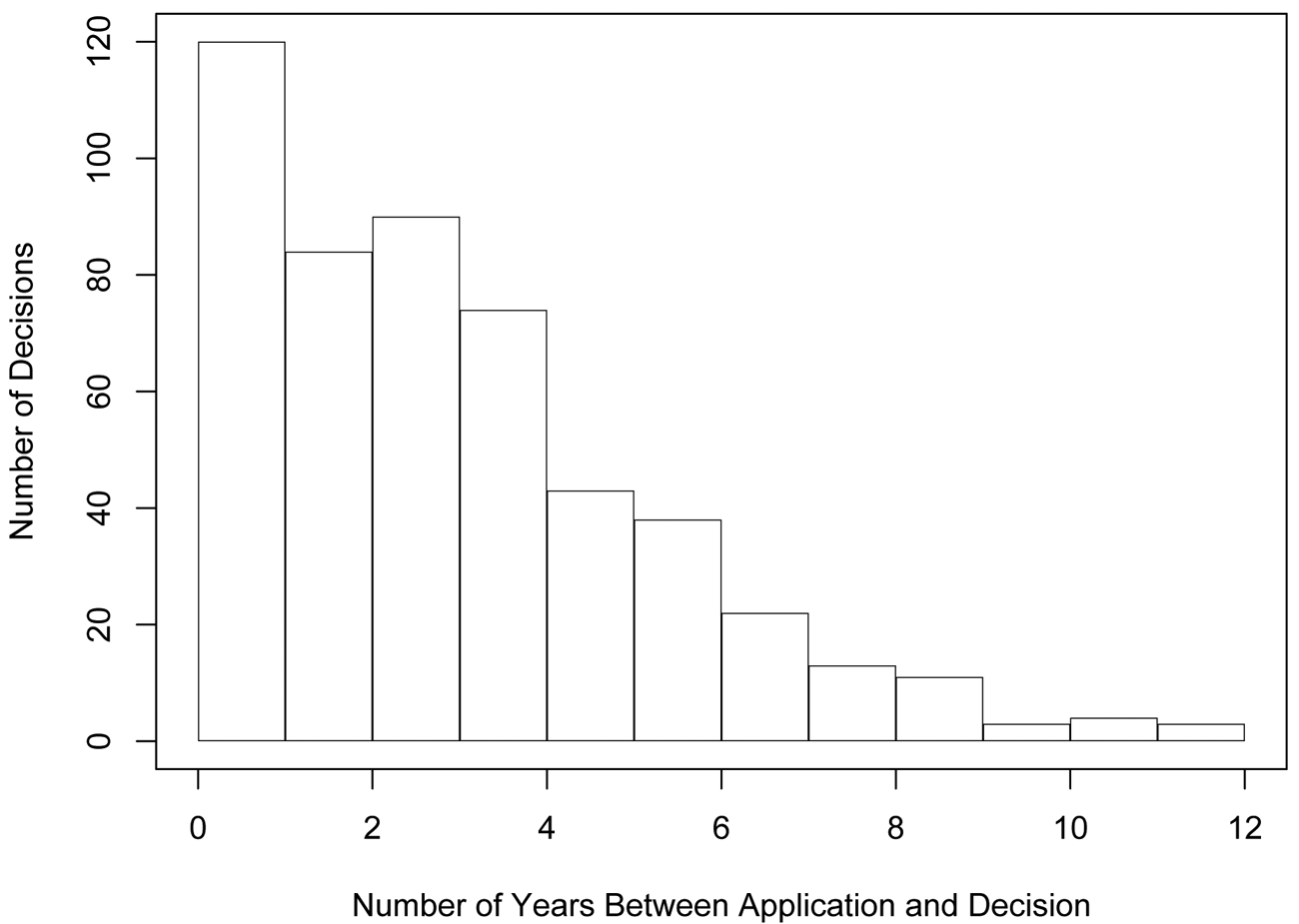
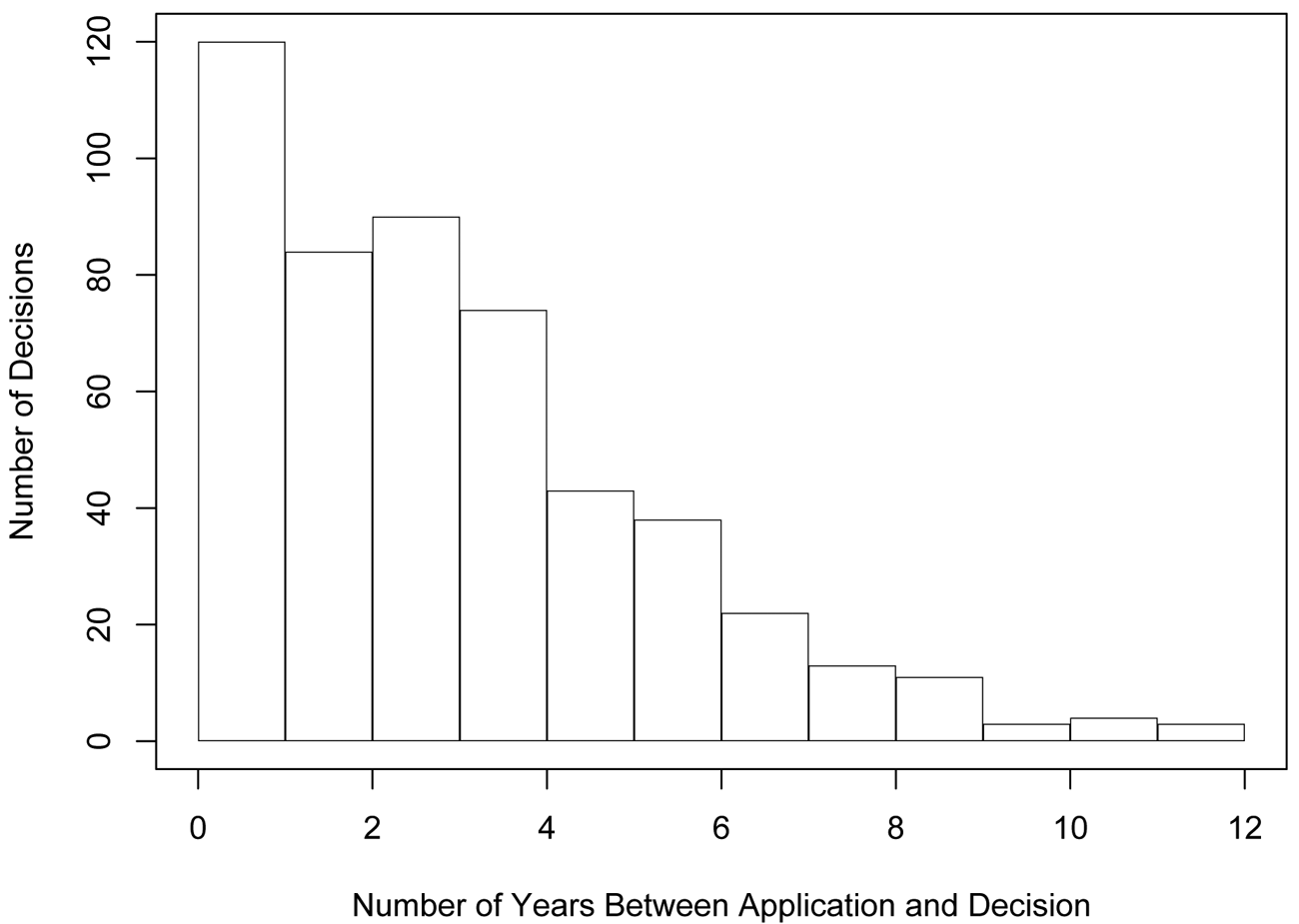
Notably, the German court has considerable discretion over the timing of its decisions. There is no specified timeline by which the court must make its decisions. That is, while the US Supreme Court, for example, typically issues its decisions on cases within a year of receiving the case, the FCC may take years to dispose of a case. Figure 1 highlights this discretion by showing the variation in the number of years the German court took to decide concrete review and constitutional complaint cases involving federal laws from 1983 to 2013. While the plurality of cases are decided within a year of being filed, the median amount of time between application and decision is 3 years. The variation shown in the figure is particularly striking, with the court having taken as long as 12 years to provide a ruling in some cases and regularly taking 5 years in others.
Time between application and decision of cases at the FCC. The column to the left of each number on the x-axis indicates the number of cases decided after that number of years had passed since a case’s application to the court. So, for example, the left-most column counts the number of cases decided less than 1 year after their application.
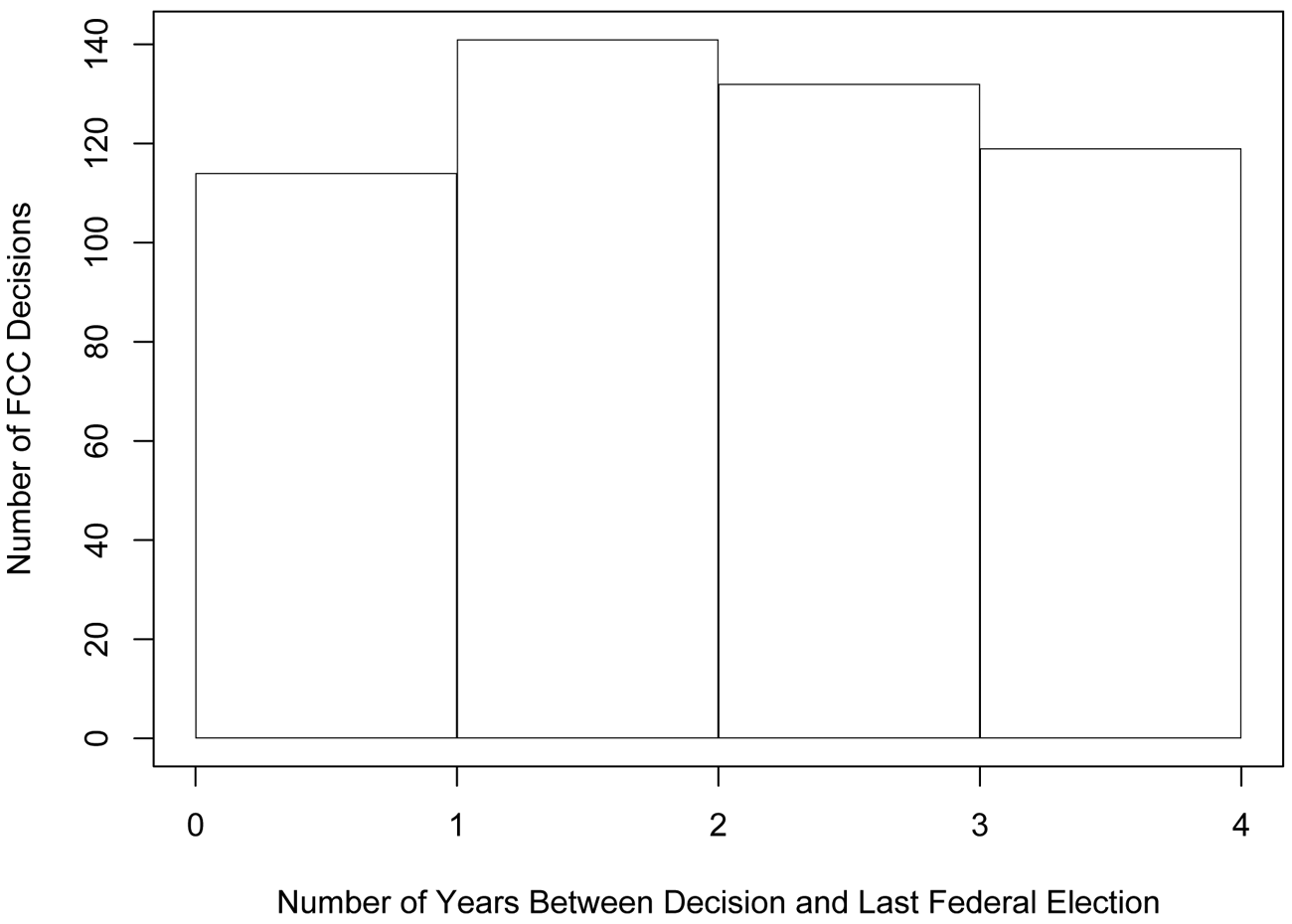
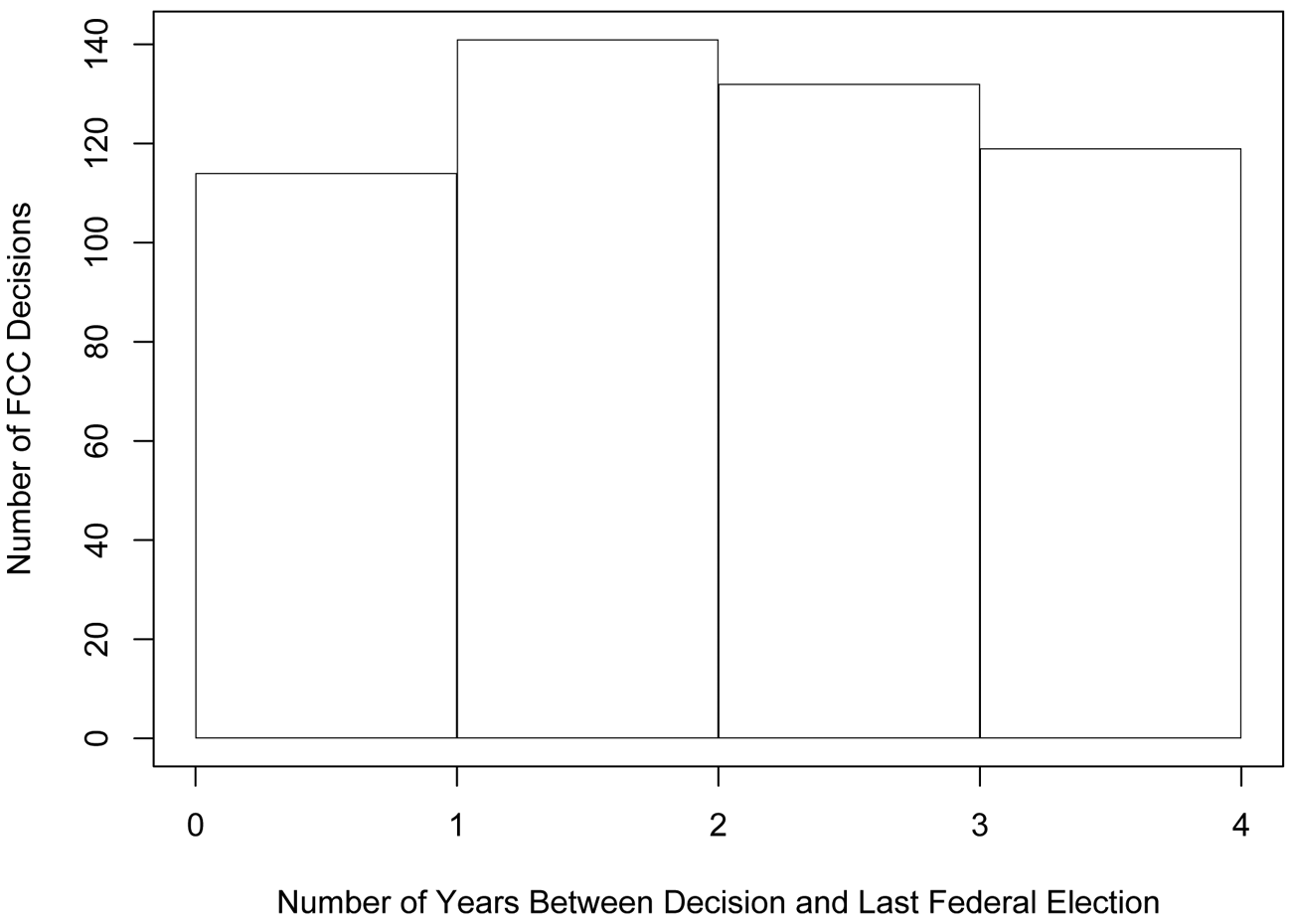
There is also variation in the timing of FCC decisions with respect to the German electoral cycle. Figure 2 shows the frequency of FCC decisions by the number of years between the decision and the most recent national election. Two specific observations from the figure warrant particular attention. First, the court issued decisions throughout the electoral cycle. Interestingly, the frequency of decisions decreases as the number of years since the last election increases. Second, the court issued the most decisions after the first and second years following an election. The number of decisions then tapers as the electoral cycle moves forward, with the fewest decisions issued after 4 years have passed since the last election. This observation makes sense, as the German constitution requires that a national election be held at least roughly every 4 years. More generally, taken together, these figures illustrate the FCC’s use of discretion over the timing of decisions and highlight potential trends in the court’s use of this discretion, which I argue are in part due to strategic considerations regarding noncompliance.
Timing of FCC decisions in the electoral cycle. The column to the left of each number on the x-axis indicates the number of cases decided after that number of years had passed since the last national election. So, for example, the left-most column counts the number of cases decided less than a full year after a national election.
German Elections and the Media
The German constitution lays out guidelines for the timing of federal elections, including Bundestag elections. The first section of Article 39 stipulates that “the Bundestag shall be elected for four years. Its term shall end when a new Bundestag convenes. New elections shall be held no sooner than forty-six months and no later than forty-eight months after the electoral term begins.” A result of this requirement is a largely stable and consistent electoral calendar.Footnote 8
Nonetheless, the possibility of an early election is present. Since 1983, early elections have been held on three occasions: 1983, 1990, and 2005. Since the theory contends that courts cannot time their decisions as effectively when the electoral cycle is unexpectedly shortened by an early election, it is necessary that the decision to hold an early election is exogenous to the behavior of the FCC. Otherwise, the court may have been able to strategically time its decisions more effectively since it would be informed of the likelihood of an early election. Critically, in each of these three early elections, the decision to hold an early election was not the direct result of FCC actions. In the case of the 1990 election, few politicians, much less the FCC, had seen reunification coming as swiftly as it did (Winkler Reference Winkler2007). In both the 1983 and 2005 early elections, it was the desire of the chancellor that new elections be called in response to shifts in the German political environment.Footnote 9 Consequently, the court in each instance was left with little time to attempt to strategically time its decisions without appearing to behave politically.
Once the Bundestag is dissolved, then the constitution requires a new election to be held within 60 days. The length of Bundestag election campaigns, however, is regulated neither by the constitution nor by federal law. Rather, state and local laws govern certain aspects of campaigning. For example, the use of billboards is often limited to a few weeks immediately preceding the election. Similarly, advertising on radio and television is limited by state laws to a 4-week period before the election. Otherwise, the timing of formal campaigns is left to convention, with the norm being that parties begin campaigning in earnest 5 or 6 weeks before the election (Birnbaum Reference Birnbaum2013; Khazan Reference Khazan2013).
While formal campaigning may not begin until a few months before election day, media interest in Bundestag elections typically begins much sooner and crescendos as the election nears. Since the timing of the next election is constrained by the constitution (barring an early election), media outlets can begin reporting on the dynamics of an upcoming election well in advance of the parties’ campaigning. And as the election nears, the intensity of media coverage grows. Peak coverage comes in the months immediately preceding the election known as the “hot phase” of the campaign, during which voters are inundated with campaign-related coverage (Schoenbach Reference Schoenbach1987; Schoenbach, Ridder, and Lauf Reference Schoenbach, Ridder and Edmund2001; Bachl and Brettschneider Reference Bachl and Frank2011).
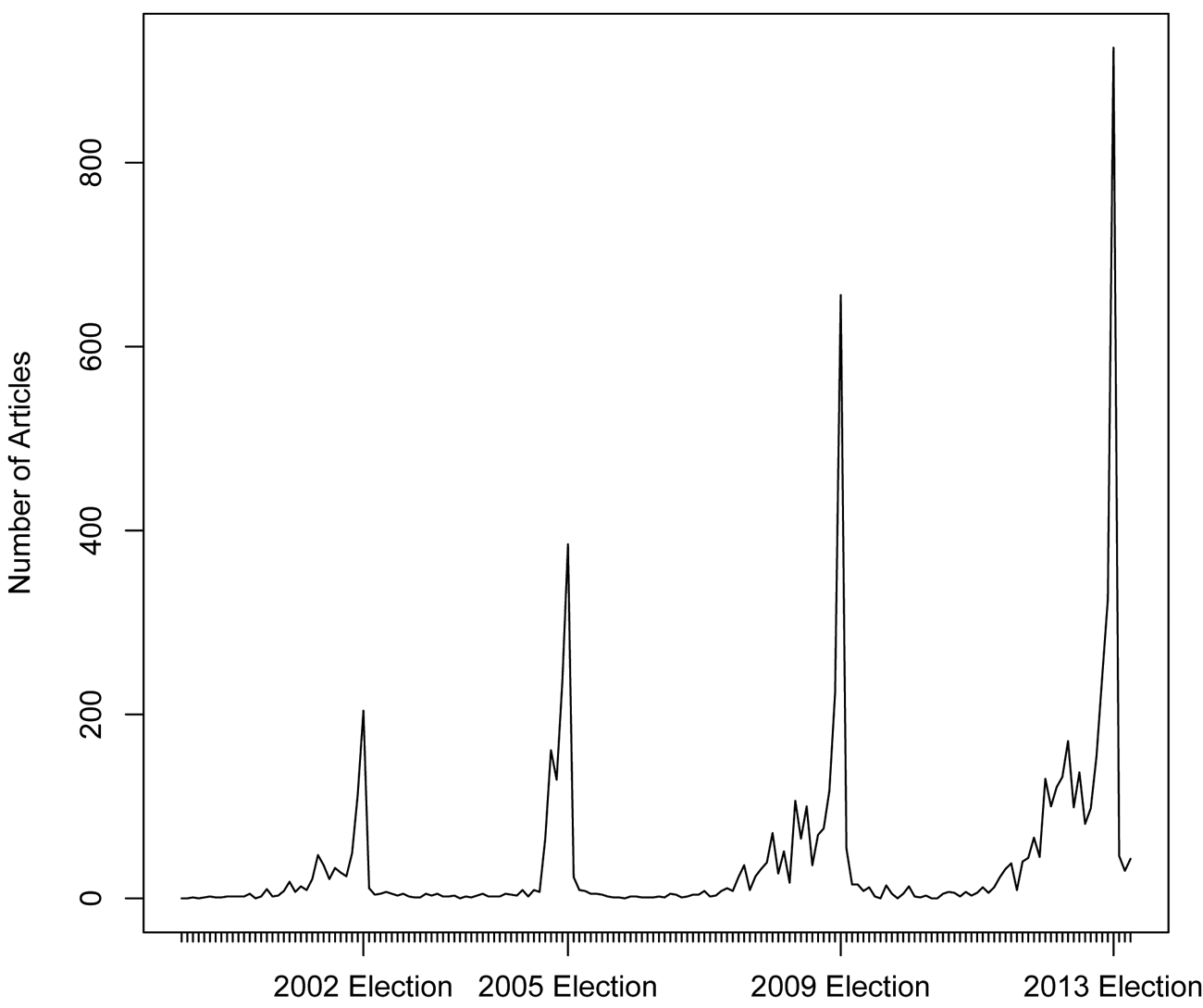
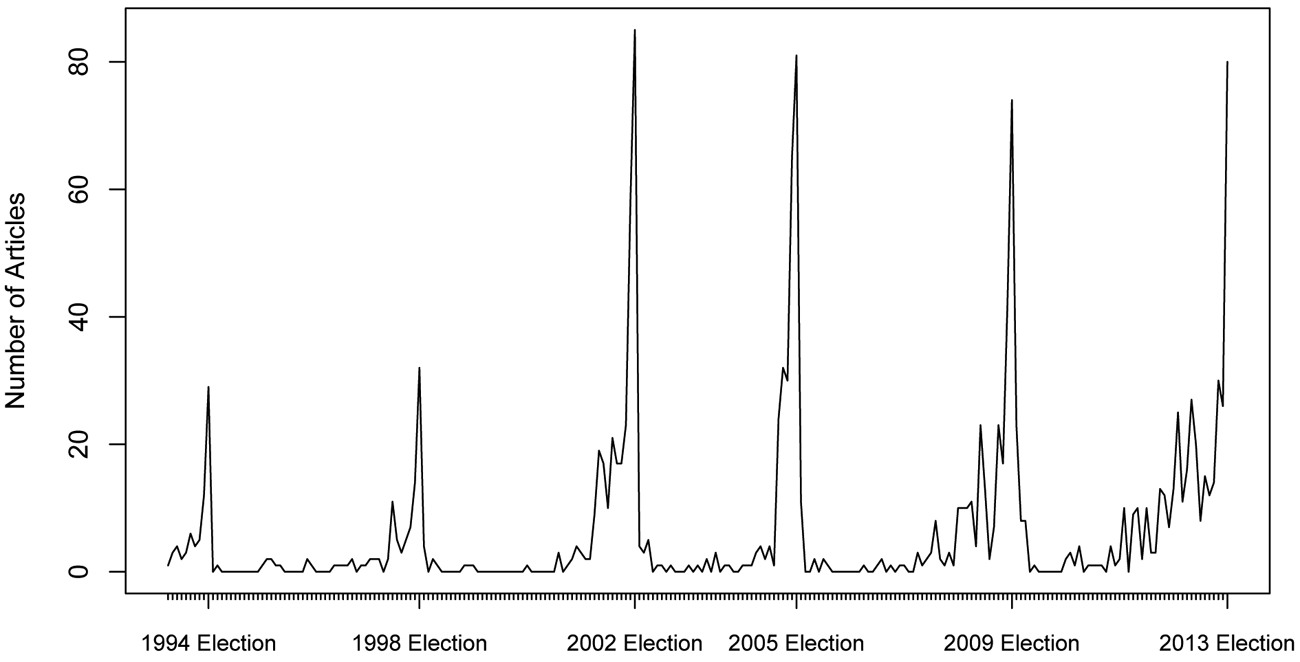
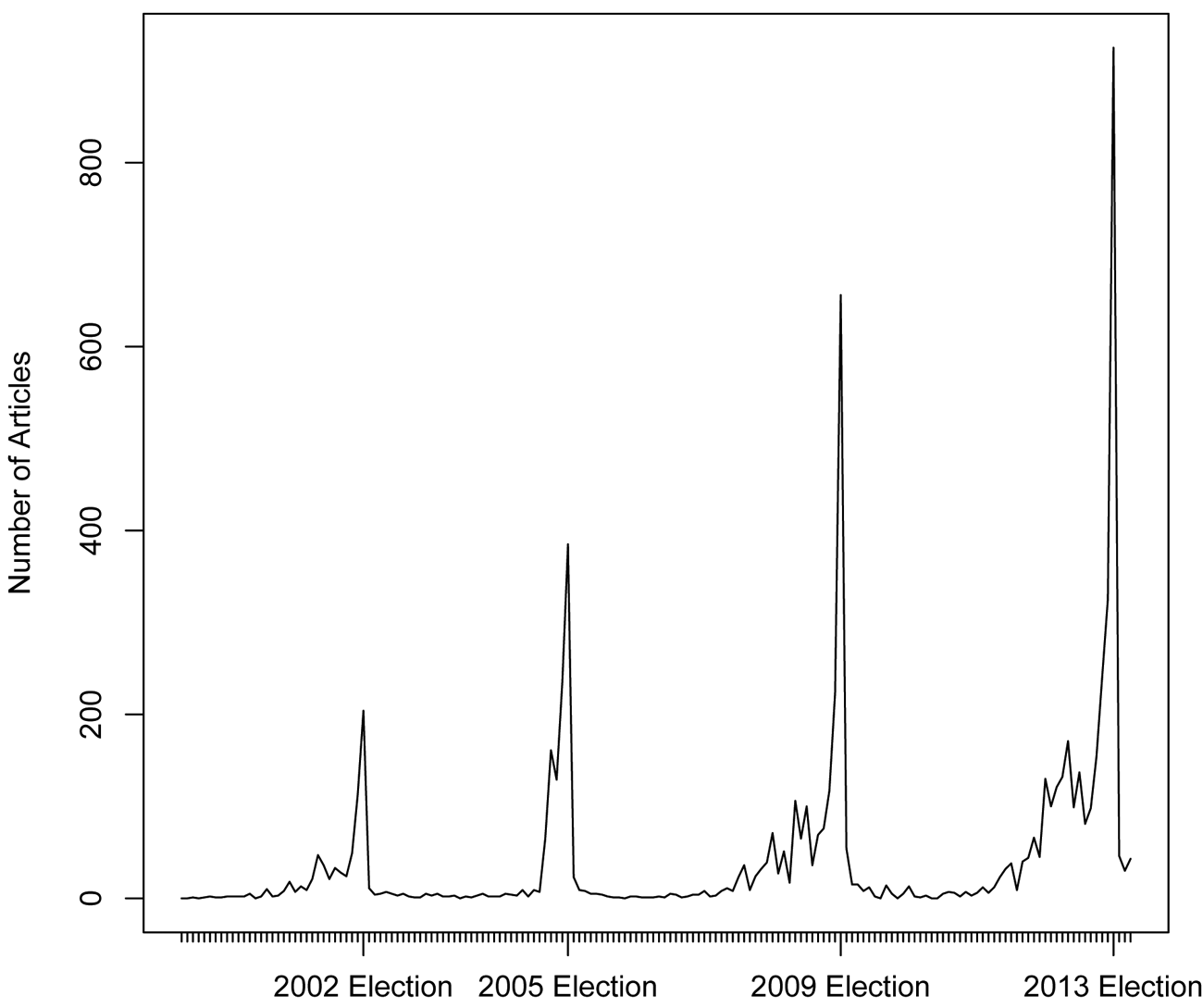
To see how media coverage grows in the months preceding an election, I use the Lexis- Nexis Foreign Language News Search function to construct two data sets on newspaper coverage of Bundestag elections. In the first data set, I counted the total number of newspaper articles with titles including the word Bundestagswahl (Bundestag Election) in each month from 2000 and 2013, a period covering four elections (2002, 2005, 2009, and 2013).Footnote 10 To account for potential variation in data availability across outlets and years, the second data set counts the number of headlines including the word Bundestagswahl in two of Germany’s major daily newspapers, Die Süddeutsche Zeitung and Die Tageszeitung. In addition to being two of the most widely circulated and influential newspapers, their digitized archives provide data dating back to 1994. Similar to the first data set, each observation is the combined number of headlines for each month from 1994 to 2013.Footnote 11
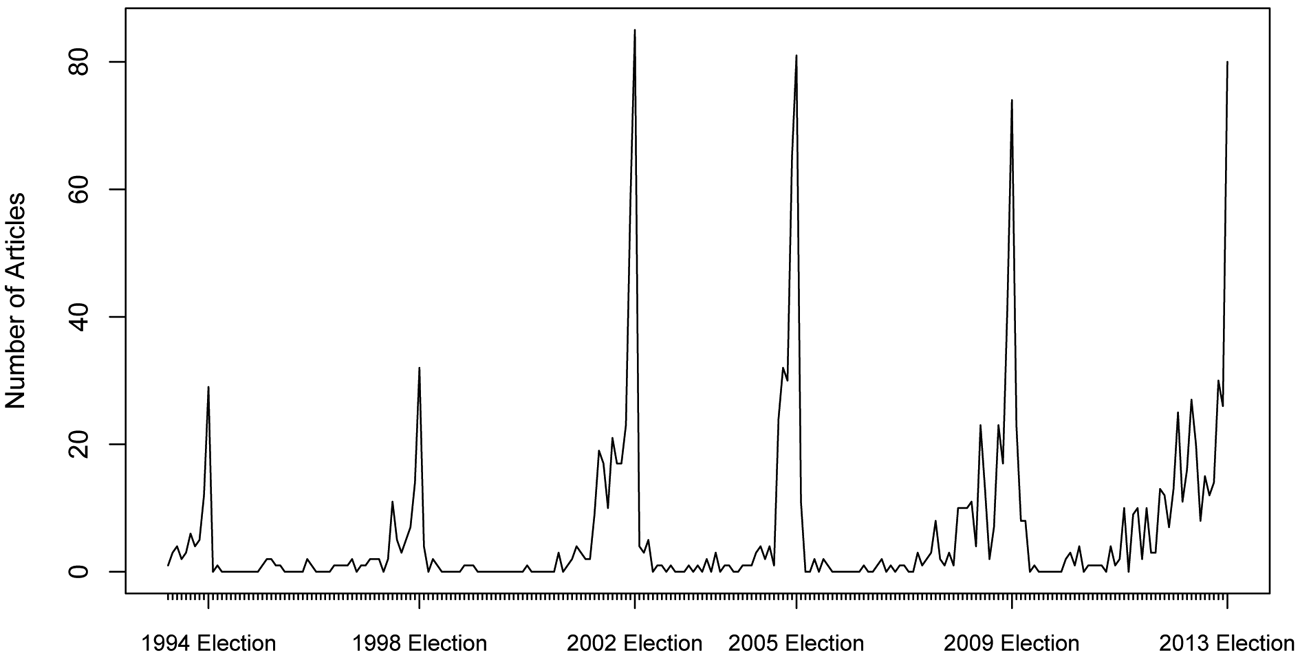
The results of the first data set are presented in figure 3, while those of the second data set on coverage from Die Süddeutsche Zeitung and Die Tageszeitung are shown in figure 4. A few observations are apparent from the figures. First, media coverage of elections has increased, particularly after the 1998 election.Footnote 12 This finding is generally consistent with analyses of trends in media coverage of German elections (e.g., Semetko and Schoenbach Reference Semetko and Klaus2003). A second, more theoretically critical, observation is that the speed with which media coverage of electoral politics accelerates varies across elections. Compared to earlier elections, the 2009 and 2013 elections witnessed an early start to the media’s focus on the upcoming election day. In the case of the 2009 election, the financial crisis that had started the year before dominated the attention of the government and media through to election day (Krewel, Schmitt-Beck, and Wolsing 2011). Early and sustained media coverage was particularly noticeable in the 2013 election. One reason for this was the campaign effectively starting nearly a year before election day with the Social Democrat’s nomination of Peer Steinbrück for chancellor in October 2012. The domination of the campaign by the euro crisis further contributed to the expansive coverage (Fass Reference Fass2015). In contrast, earlier elections, including even the salient 2002 and 2005 elections, experienced a more typical “hot phase” of coverage (Schoenbach Reference Schoenbach1987; Semetko and Schoenbach Reference Semetko and Klaus2003; Krewel et al. Reference Krewel, Schmitt-Beck and Ansgar2011).Footnote 13
Newspaper coverage of Bundestag elections, 2000–2013. Monthly tick marks shown along the x-axis.
Die Süddeutsche Zeitung and Die Tageszeitung coverage of Bundestag elections, 1994–2013. Monthly tick marks shown along the x-axis.
While this analysis establishes the variable relationship between elections and media coverage, it does not speak to the central claim of the theory that judicial decisions issued in the months immediately preceding an election should receive greater media coverage. I conduct two sets of analyses to determine whether there is empirical support for this claim. In the first, I again use the Lexis-Nexis Foreign Language News Search function to search for the total number of newspaper articles and press releases (e.g., Agence France, Reuters, etc.) covering each FCC decision involving a federal law from 2000 to 2013. In order to maintain consistent search terms, I use each case’s official case number (e.g., 1 BvR 1804/03).Footnote 14 This count variable, Decision Coverage, serves as the outcome variable in the analysis.
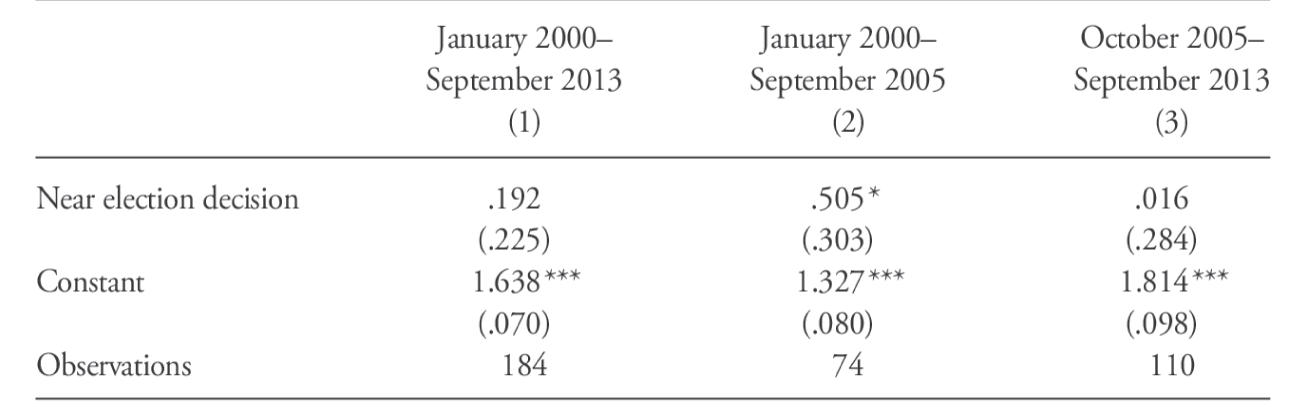
The explanatory variable of interest, Near Election Decision, is whether a decision was issued in the 6-month period immediately preceding a federal election. I chose the 6-month period for two key reasons. First, it effectively captures the upper bound of the time frame of the media environment most likely to support the court’s efforts to raise awareness of its decisions. As seen in figures 3 and 4, coverage has historically ramped up in the several months preceding an election, with the exception of the extended hot phases of 2009 and 2013. Increasing the variable to, for example, 9 months or a year moves the measure beyond the theoretical grounding outlined here. Second, extending the time frame to 6 months accounts for judges’ concern for appearing overtly political or influencing election results by issuing decisions too close to election day. Judges are keenly aware of the importance of appearing apolitical for the court’s legitimacy and maintained public support (Vanberg Reference Vanberg2005, 125). Consequently, they generally refrain from issuing rulings in the few weeks or days before election so as not to be seen as attempting to affect the outcome. By using a 6-month time frame, the measure accounts both for the strategic potential of the election cycle and for the desire to avoid the appearance of judicial interference in electoral politics. The results of this analysis, which uses a negative binomial regression, are presented in table 1.
Total Newspaper Headlines on FCC Decisions, 2000–2013
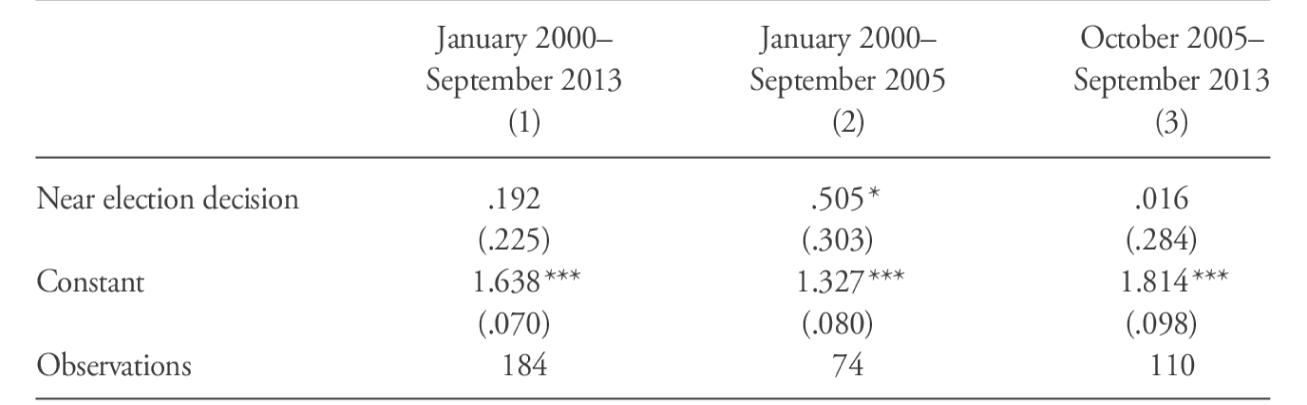
Note.— Negative binomial coefficients. Outcome is total number of articles covering an FCC decision.
* p < .1.
** p < .05.
*** p < .01.
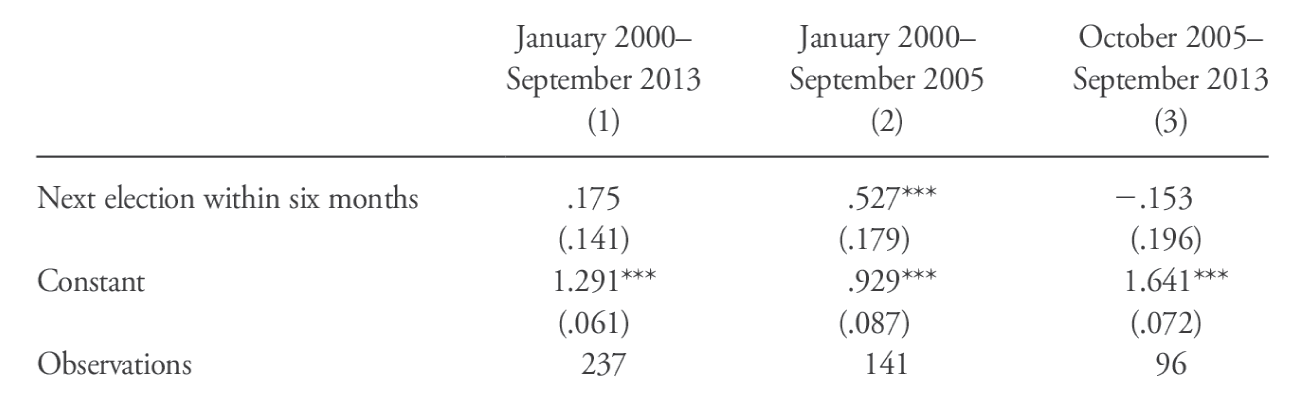
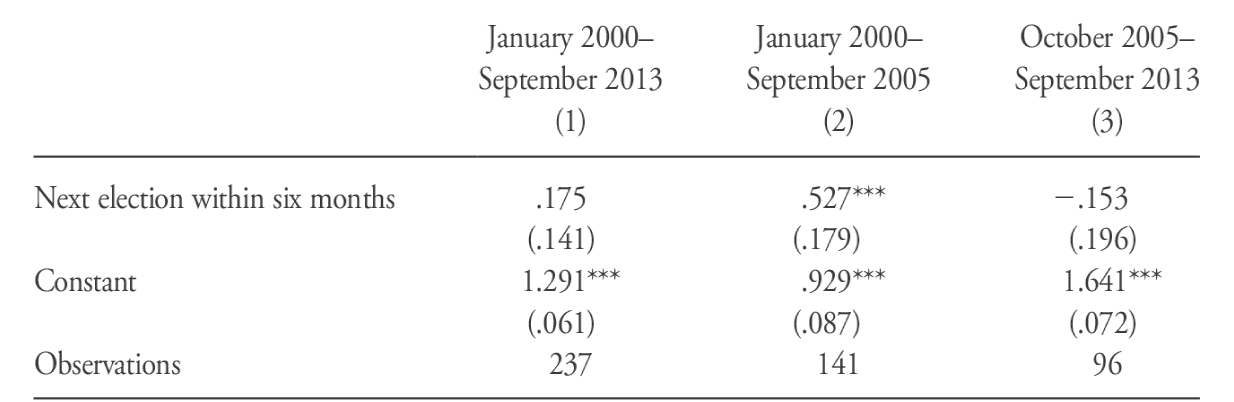
While using official case numbers ensures a level of consistency across cases, it is possible that news outlets of the Court regularly omit this technical piece of information in their coverage of decisions. To provide an alternative analysis of coverage that avoids this potential pitfall, I use the Lexis-Nexis Foreign Language News Search function to collect data on the monthly number of headlines including the word Bundesverfassungsgericht (Federal Constitutional Court) in Die Süddeutsche Zeitung and Die Tageszeitung between January 1994 and September 2013.Footnote 15 While using monthly headline counts results in losing information on the individual case level, it does provide insights into the degree to which the FCC made the news over the course of each election cycle. In total, headline counts are available for 237 months with a mean of nearly 4 and a median of 3. This count variable, FCC Newspaper Coverage, serves as the outcome variable for the second analysis. For the explanatory variable, the variable Next Election within Six Months indicates whether or not a given month was within 6 months of the next federal election. Table 2 provides the results of the negative binomial regression estimating the relationship between these two variables.
Die Süddeutsche Zeitung and Die Tageszeitung Headlines on the FCC, 1994–2013
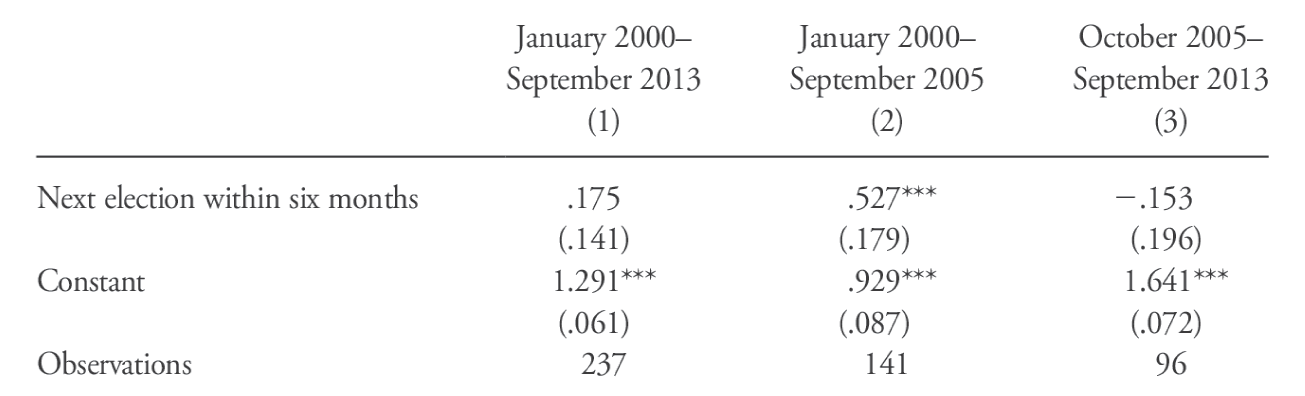
Note.— Negative binomial coefficients. Outcome variable is the combined number of headlines in a given month.
* p < .1.
** p < .05.
*** p < .01.
The results of these analyses are presented in column 1 of tables 1 and 2. In both instances, the results do not conform with the expectation that media coverage, either of specific decisions or the FCC more generally, increases in the months before an election. The preceding discussion of media coverage of German elections suggests one potential explanation for this result. With the 2009 and 2013 elections experiencing an unusually long and active hot phase of media coverage, coverage of the court’s decisions may have been crowded out or otherwise limited. By subsetting each data set according to whether a decision or month occurred after October 2005, which was the first month of the 2009 electoral cycle, I can account for this potential “crowding out” of election coverage when estimating the relationship between timing and coverage.
The results of these subset analyses are presented in columns 2 and 3 of tables 1 and 2. As expected, the predicted level of media coverage of the FCC and its decisions is greater for cases decided within 6 months of the next federal election for the pre-2009 electoral cycles. After the September 2005 election, however, this relationship fails to reach statistical significance, and in the case of coverage by Die Süddeutsche Zeitung and Die Tageszeitung actually turns negative. Taken together, these results indicate that the FCC does in fact tend to receive more coverage in the months leading up to an election but only when the media environment provides space for meaningful attention to the court’s decisions.
Empirical Analysis
To test my hypotheses, I consider all constitutional complaint and concrete review rulings involving the federal government from 1983 to 2013. I restrict the analysis to cases of national law because of data limitations regarding cases addressing questions of state law. The mechanism proposed here argues that impending elections increase media coverage. This trait of elections, however, is generally less prominent in state elections than national elections. Moreover, attention to elections likely varies across states; elections in some states, such as the highly populated Nordrhein-Westfalen and Niedersachsen, are likely to garner significantly more attention than others, such as the less populated Saarland or Mecklenburg-Vorpommern states. To appropriately model this requires estimating state-level relationships between timing and case disposition, a task that requires more observations per state than the data provide.Footnote 16 By limiting the analysis to disputes over the constitutionality of national laws, I can avoid these issues and ensure I employ the appropriate empirical model.
Since the theory focuses on the impact of timing on case disposition, the outcome variable of interest is whether the FCC struck down or upheld the challenged statute.Footnote 17 This variable, Strike, is coded 1 if the FCC strikes down a law as unconstitutional and 0 if the court upholds the law. I take an expansive view of what it means for the court to strike down a law by assigning cases a value of 1 when the court at least partially invalidates the law. I also code a case as 1 when the court declares a law incompatible with the Grundgesetz (the German constitution), which requires the legislature to revise the law but in the meantime allows for its continued implementation for a limited period of time.
The key explanatory variable for the analysis is whether or not the FCC issued its decision on a case in the period immediately preceding a national election. As in the analysis of media coverage of FCC decisions, the dichotomous variable Near Election Decision codes cases as being close to the next election if the court issued the decision within 6 months of election day.Footnote 18 As was the case in the media coverage analysis, the 6-month cutoff accounts for the FCC’s desire to avoid appearing overtly political and the nature of media attention. While a 6-month time frame best captures the proposed theoretical mechanism, alternative time frames such as 9 months or 1 year are plausible. Importantly, the results are robust to these alternatives.Footnote 19
For the second hypothesis, which states that the relationship between the timing of FCC decisions and case disposition is conditional on the potential for noncompliance, I use the variable No Government Brief. Recall that this variable is coded 1 if the government does not file a brief defending the constitutionality of the challenged statute and 0 if it does file such a brief. Since the analysis is limited to cases involving national laws, this variable is based solely on whether the federal government filed such a brief. To measure the key concept of the third hypothesis, which predicts that the relationship between timing of decisions and case disposition is conditioned by the timing of national elections, I consider whether or not a case was decided during a term of the Bundestag ended by an early election. That is, if the FCC decided a case during the electoral cycles ended by the early elections of 1983, 1990, or 2005, then the variable Early Election takes a value of 1. If the FCC issued its decision during any other electoral cycle, then this variable takes a value of 0.
I employ the following empirical strategy for hypotheses 2, 3, and 4. Consider the fourth hypothesis, which predicts the relationship between case disposition and timing to be conditioned by the nature of media coverage. The results from the previous analysis on media coverage suggest that this condition corresponds to the 2009 and 2013 electoral cycles. That is, in applying the theory to the case of Germany, we should expect a relationship between case disposition and timing of decisions in decisions issued before the 2009 electoral cycle, while such a relationship should not hold for decisions issued in the 2009 and 2013 electoral cycle.Footnote 20 Accordingly, I subset the data based on whether a decision was issued before or after the beginning of the 2009 electoral cycle.
As hypotheses 2 and 3 predict a relationship between case disposition and timing that is conditioned by the risk of noncompliance and nature of the electoral term, respectively, I estimate a logistic model with a triple interaction term for cases decided before the 2009 electoral cycle (Kam and Franzese Reference Kam and Robert2007). The constituent terms of this interaction are the three variables Near Election Decision, No Government Brief, and Early Election. Since these three variables are all dichotomous, the coefficients for each of the constituent terms correspond to the relationship between the outcome variable and the individual explanatory variables when they take a value of 1 and the other two components of the interaction equal 0. Recall that the key explanatory variable is the timing of the FCC’s decision, the variable Near Election Decision, which I expect to have a positive correlation with case disposition when the government files a brief (No Government Brief = 0) and the decision is not issued in an electoral cycle ended by an early election (Early Election = 0). Therefore, the coefficient of interest here is Near Election Decision, as it will indicate the relationship between case disposition and timing when the two conditioning variables equal 0. For cases decided after the beginning of the 2009 electoral cycle, I estimate a logistic regression without these interactions because of the lack of cases decided within 6 months of either election without a brief from the government defending the statute and because neither the 2009 nor 2013 election was an early election.Footnote 21
I include a series of control variables in the analysis to deal with potential omitted variable bias and account for factors previous research identifies as influencing judicial decision making in general and at the FCC in particular. First, I control for the legal merits of the case using the variables Lower Court Unconstitutionality Brief and Amicus Brief Balance. The former is coded 1 if any other court in the German judiciary filed a brief in favor of striking down the challenged law, while the latter is the difference between the number of briefs defending the law and the number of briefs favoring an unconstitutionality ruling. Including these variables accounts for potential bias resulting from a correlation between legal merits and both case disposition and the timing of the court’s decisions. If it is the case that the FCC is not strategic about the timing of its decisions, then strategic litigants could be influencing the timing of decisions and a case’s outcome. Strategic litigants might have an incentive to time their applications to the court to maximize the likelihood of the FCC issuing its decision near an election. In such a story, politically motivated litigants might try to time cases with particularly strong legal arguments to come out near the election to embarrass or otherwise electorally harm the government. A critical implication of this account is that litigants, not the court, are acting strategically, which suggests that failing to account for this possibility could lead to an incorrect interpretation of the empirical analysis.
Second, I control for procedural aspects and the issue area of each case that might influence both case disposition and timing. The variable Second Senate is included to ensure that characteristics unique to one of the senates is not driving the results. The court is made up of two largely independent senates, with each senate assigned jurisdiction over specific issue areas. It is possible that some issue areas are more likely to compel the court into strategically timing its decisions, which would lead one senate to tailor its decisions more frequently than the other. A senate’s jurisdiction may further correspond to either the complexity of cases or the government’s likelihood of filing a brief defending the constitutionality of the challenged statute. If either of these accounts is accurate, then failing to include this control could result in biased coefficients. The variable Second Senate addresses these concerns, with cases adjudicated by the second senate assigned a value of 1 and those adjudicated by the first senate coded as 0.
The variable Hearing addresses the possibility that the focus of the court is on the strategic use of one of the most prominent judicial procedures, public oral hearings. Failing to account for this aspect of the process could mean that an empirical relationship between timing and case disposition is an artifact of the court’s use of this procedure rather than a strategic use of timing. I include the variable Case Complexity, as litigants may strategically select cases that will be readily understood by voters during an election campaign and time their applications to increase the likelihood of the FCC issuing its decision in the lead-up to an election. To measure complexity, I use Vanberg’s (Reference Vanberg2005) dichotomous coding scheme to construct the variable Case Complexity. Cases involving taxation, budgets, economic regulation, social insurance, civil servant compensation, and party finance are coded as “complex” with a value of 0, while those involving institutional disputes, family law, judicial process, individual rights, asylum rights, and military conscription are coded as “simple” with a value of 1.
Results
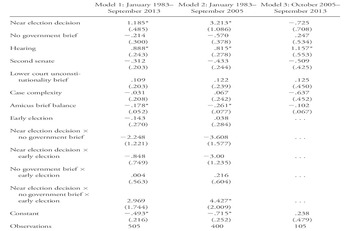
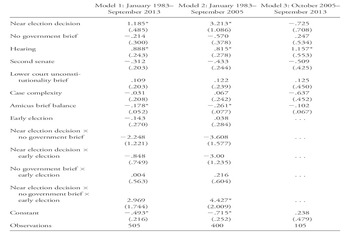
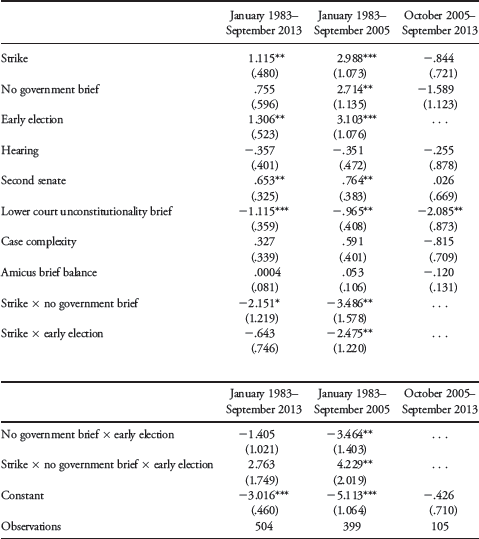
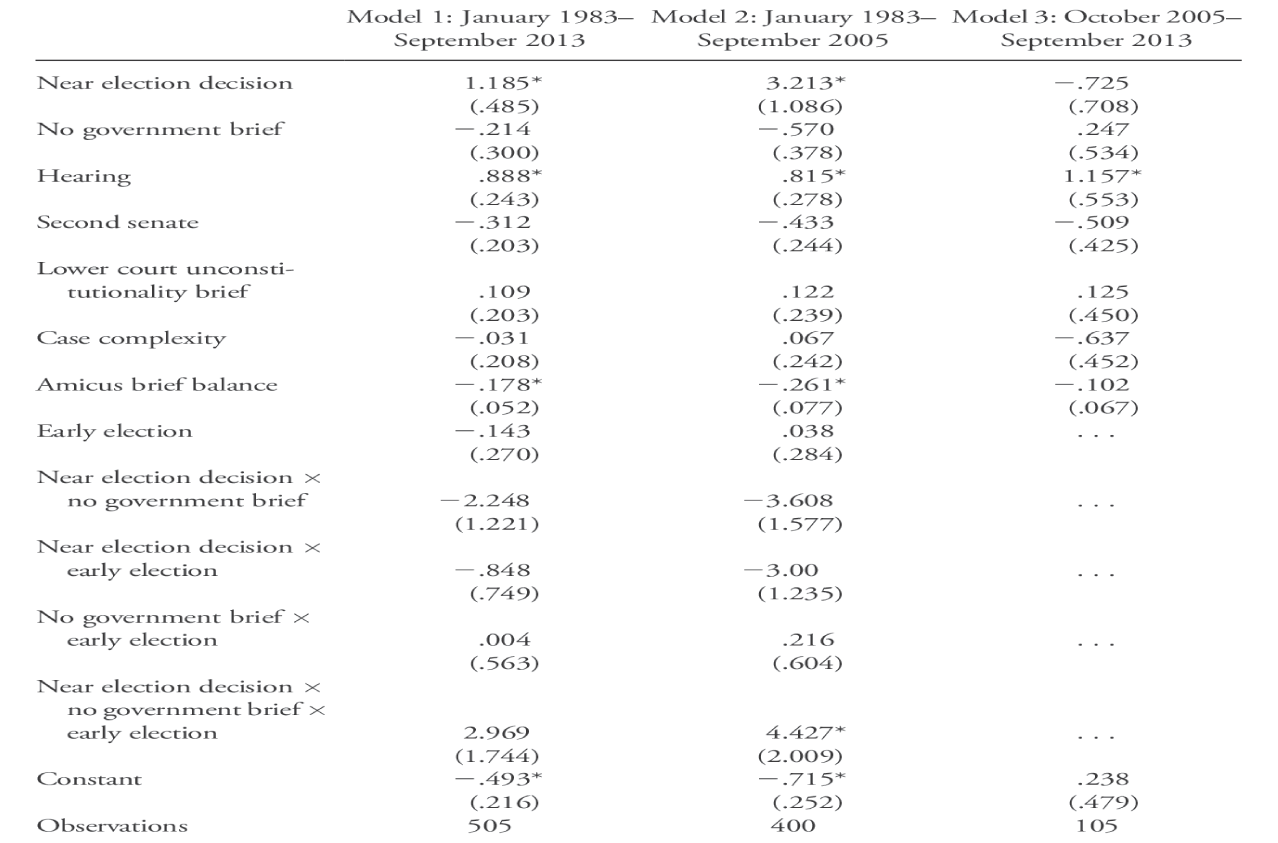
Table 3 presents the results of the three logistic regressions. Model 1 analyzes the full data set of decisions from 1983 to 2013, while model 2 is estimated using the subset of data from 1983 to October 2005, and model 3 does so for decisions from October 2005 to 2013. The results are consistent with the expectations of each hypothesis. Consider hypothesis 1, which makes the central claim that the court is more likely to invalidate a statute in the months preceding an election. As expected, in model 1 the coefficient for Near Election Decision is both positive and statistically significant, indicating that the FCC is more likely to strike down a statute as unconstitutional in decisions issued within the 6-month period immediately preceding a national election. As models 2 and 3 show, however, this relationship is conditioned by the electoral periods considered. As predicted by hypothesis 4, this relationship holds for decisions issued between the 1983 and 2005 elections but fails to do so in the unique media environments of the 2009 and 2013 electoral cycles.Footnote 22
Case Disposition and the Timing of FCC Decisions
Note.— Standard errors in parentheses.
* p < .05.
Focusing on model 2, the results also provide support for the expectations of hypotheses 2 and 3. Recall that hypothesis 2 predicts the positive relationship between the timing of decisions and case disposition to be limited to cases involving a potential threat of noncompliance, as measured by the presence of a government amicus brief defending a statute’s constitutionality. The results of the coefficient for Near Election Decision and the interaction term between Near Election Decision and No Government Brief point to just such a dynamic, as the court is only more likely to invalidate a statute in the 6 months preceding an election in cases including such a brief from the government. Similarly, the results conform with the expectation of hypothesis 3 that the positive relationship between timing and case disposition is limited to cases decided during standard-length electoral terms. Specifically, the finding of a greater likelihood of striking down a statute in the 6 months preceding an election is only supported for cases decided during electoral terms not shortened by early elections.
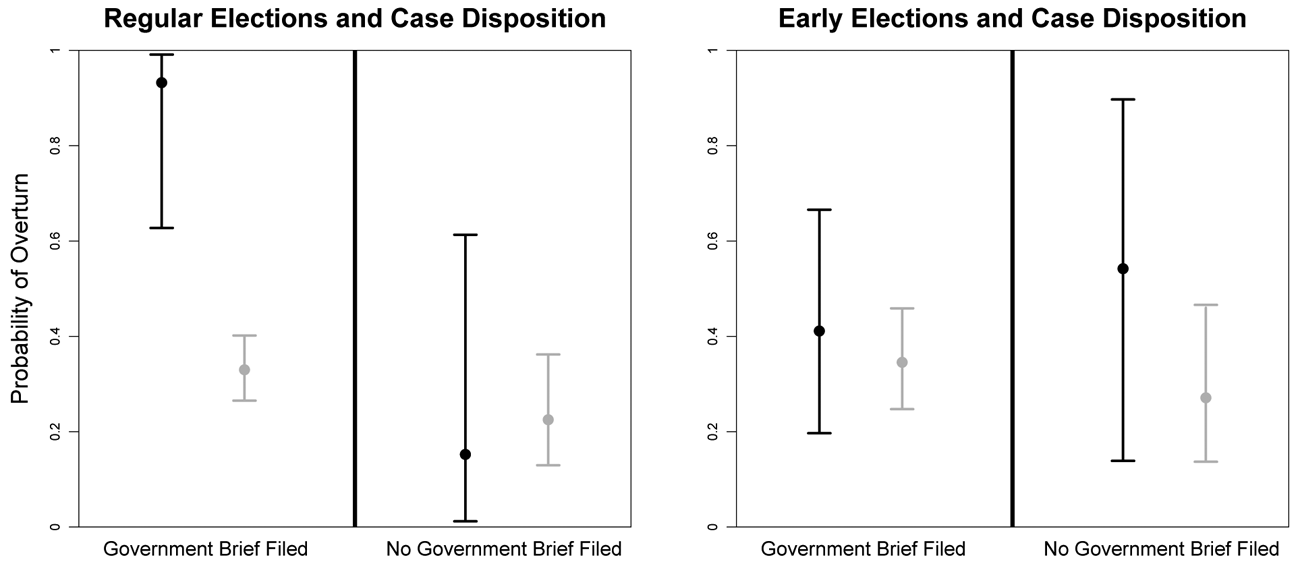
Since the coefficients of the logistic regression do not lend themselves to straightforward interpretation, I turn to the predicted probabilities presented in figure 5 for a substantive interpretation of the empirical results of model 2. The left panel of the figure provides the predicted probability of the FCC striking down legislation as unconstitutional when the court issues its decision in regular electoral cycles. In these instances, the figure then distinguishes between cases involving potential noncompliance and the timing of the FCC’s decision. The results are striking: when the government files a brief defending the constitutionality of the challenged statute, the probability of the FCC striking down legislation increases by 60% when the court decides a case in the 6 months immediately preceding the next election.Footnote 23
Analysis of timing of FCC decisions, 1983–2005. Based on model 2. Black points, predicted probability of the FCC striking down legislation as unconstitutional when the case is decided in the 6 months before the next national election. Gray points, probability of such a ruling for cases decided more than 6 months before the next national election. Lines indicate 95% confidence intervals.
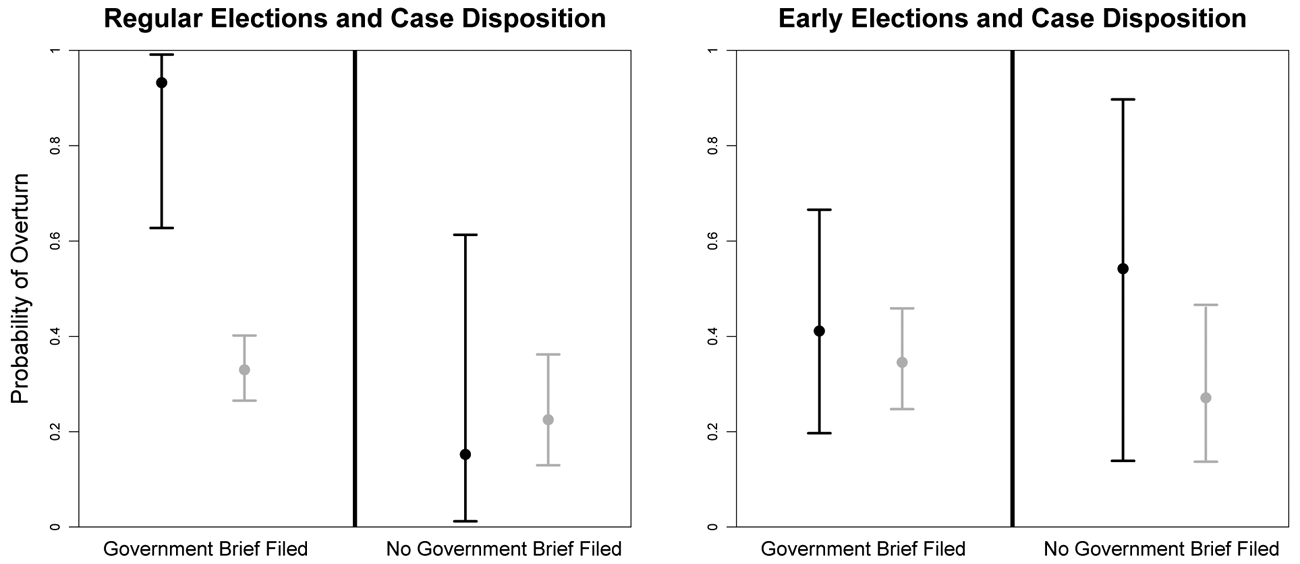
The results in the right panel of the figure, which provides predicted probabilities of case disposition for cases decided during electoral cycles ended with an early election, are noteworthy as well. In these cases, the relationship between the timing of the FCC’s decision and case disposition fails to reach statistical significance. Moreover, this is the case irrespective of the government’s decision to file a brief defending the constitutionality of the challenged statute. In short, the link between the FCC’s strategic timing of decisions and the political conditions of constitutional review cases is considerably hampered by the use of early elections.
Conclusion
Timing can be everything in politics. In this article, I argue that timing can play a pivotal role in judicial politics despite the lack of a direct electoral connection between judges and citizens. Building on the judicial politics literature on noncompliance, I showed how courts can strategically time their decisions to coincide with a period of heightened public interest in politics, specifically the months leading up to a national election. An empirical analysis of decisions by the German Constitutional Court yielded evidence that preelection periods provide an environment in which courts can effectively exercise constitutional review. Importantly, however, this relationship is conditioned by factors such as the possibility of noncompliance, the use of early elections, and the existing media environment.
A few notable implications follow from these results. First, these results help to paint a fuller picture of the strategic interactions that occur between courts and elected officials. Typical treatments of executive-judicial relations focus on the separation-of-powers dynamic between institutions. In doing so, however, the literature rarely explicitly accounts for exogenous factors affecting that dynamic. The results of this project suggest that the relationship between courts and governments can be influenced by events largely outside the direct control of either institution, such as elections. Future research might look to more thoroughly incorporate the political environment in which courts and governments find themselves into our theoretical accounts.
Second, the article identifies an underdiscussed institutional tool available to courts for addressing the challenge of noncompliance. Given the importance of effective constitutional review for liberal democratic governance, understanding how courts can ensure the implementation of their decisions has implications for our broader understanding of democratic politics. Scholars have previously noted the ability of courts to use institutional features such as press releases (Staton Reference Staton2006, Reference Staton2010). This article adds strategic timing, and in particular the timing of decisions with respect to the electoral cycle, to the list of tools potentially available to courts. In doing so, we gain further insight into how the least dangerous branch can constrain the other branches of government. Moving forward, scholars may do well to consider how these various institutional tools interact with one another to form judiciaries’ strategies for confronting governments.
Third, the theoretical and empirical analyses highlight the limitations of such institutional tools. While strategically timing decisions may help courts alleviate the risk of noncompliance in some instances, it is not a panacea. Rather, the article demonstrates how the effectiveness of the tools available to courts is dependent on conditions often beyond courts’ control. As shown by the analysis of early elections and media coverage in the context of strategic timing, the capacity of courts to successfully alter their environment is often limited by the political and social context in which they operate. Crucially, this observation is likely not limited to the timing of decisions, as other opportunities for strategic action may too be constrained by exogenous factors.
Finally, the results have clear import for our understanding of the German Constitutional Court. As one of the most prominent judiciaries in the world, the German court garners significant scholarly attention (e.g., Vanberg Reference Vanberg2005; Hönnige Reference Hönnige2009; Kommers and Miller Reference Kommers and Russell2012). This study expands our knowledge of the court by incorporating a major aspect of German politics, parliamentary elections, into a theoretical and empirical examination of the court’s behavior. Moreover, it provides a new lens through which to view past FCC decisions.Footnote 24 Together with previous studies (e.g., Vanberg Reference Vanberg2005), these results provide yet further evidence of how noncompliance influences decision making at the FCC.
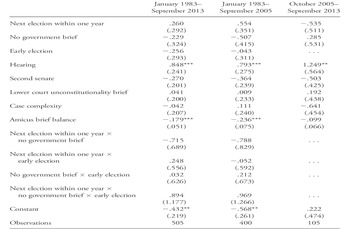
Appendix
Case Disposition and the FCC Decisions within 1 Year of Next Election
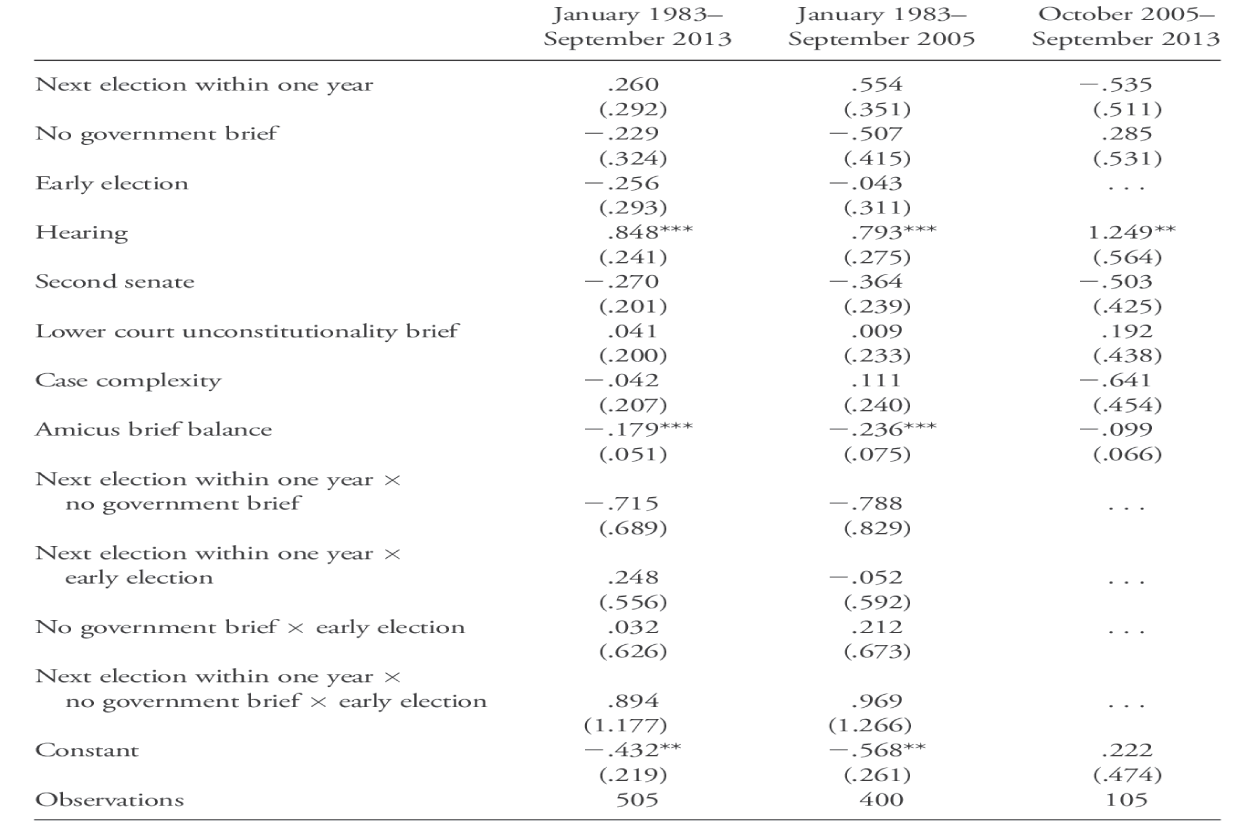
Note.— Standard errors in parentheses.
* p < .1.
** p < .05.
*** p < .01.
Case Disposition and FCC Decisions within 9 Months of the Next Election
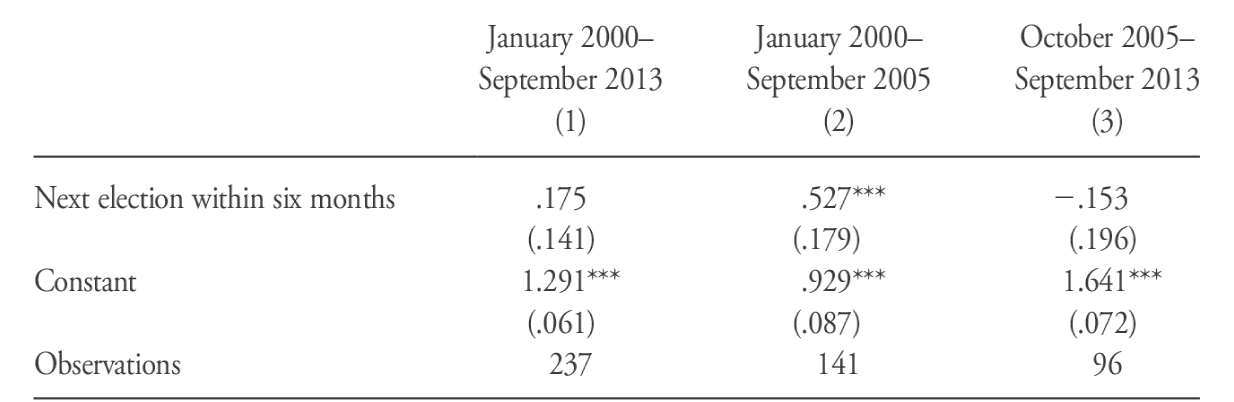
Note.— Standard errors in parentheses.
* p < .1.
** p < .05.
*** p < .01.
Analysis of Full Data Set Using Four-Way Interaction Term (
 )
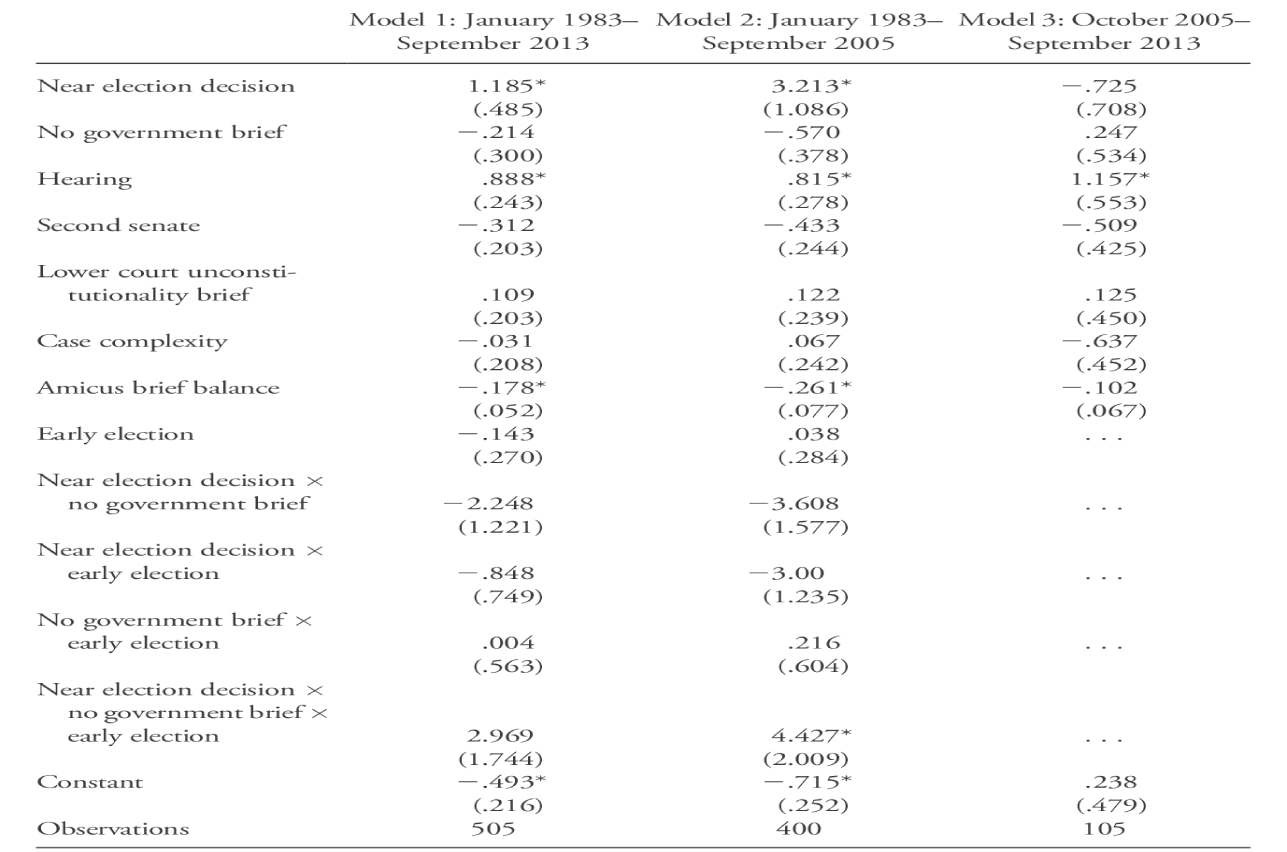
Note.— Standard errors in parentheses.
* p < .1.
** p < .05.
*** p < .01.
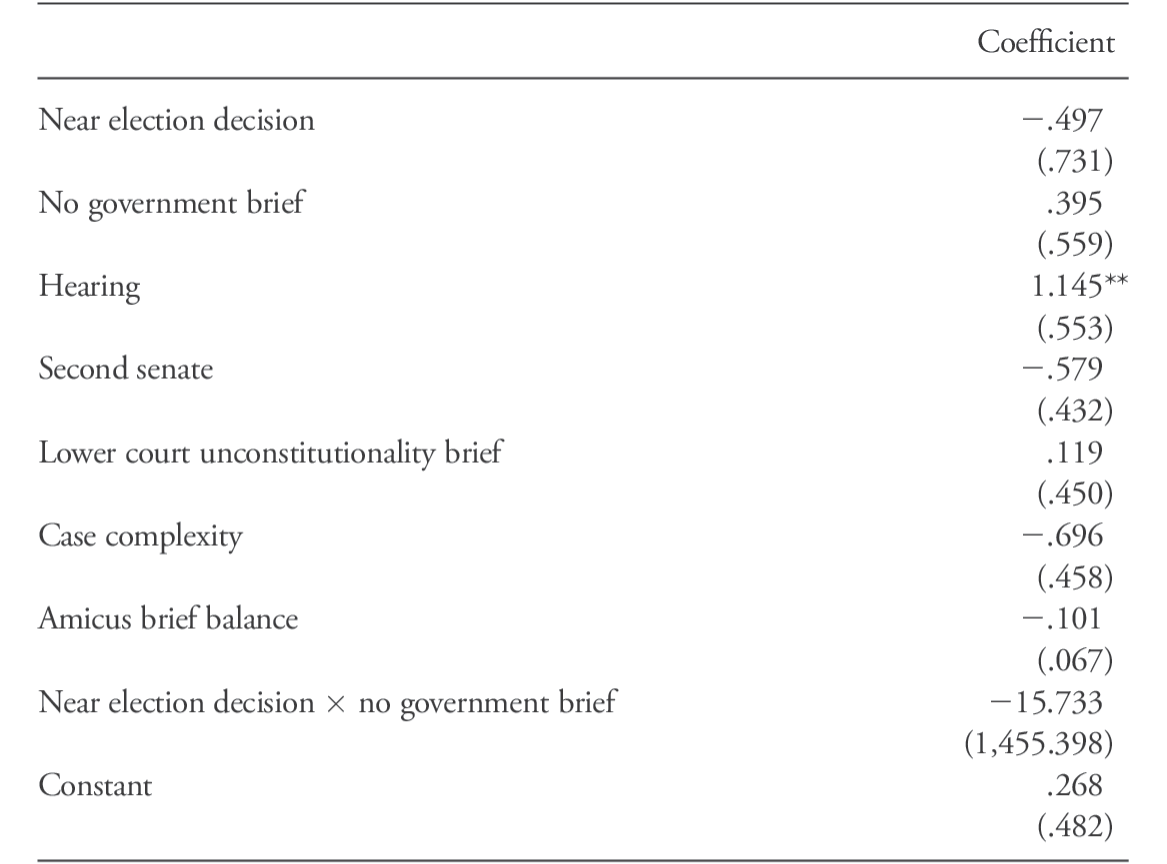
Interaction Analysis of Post-2005 Election Data Set (
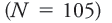 )
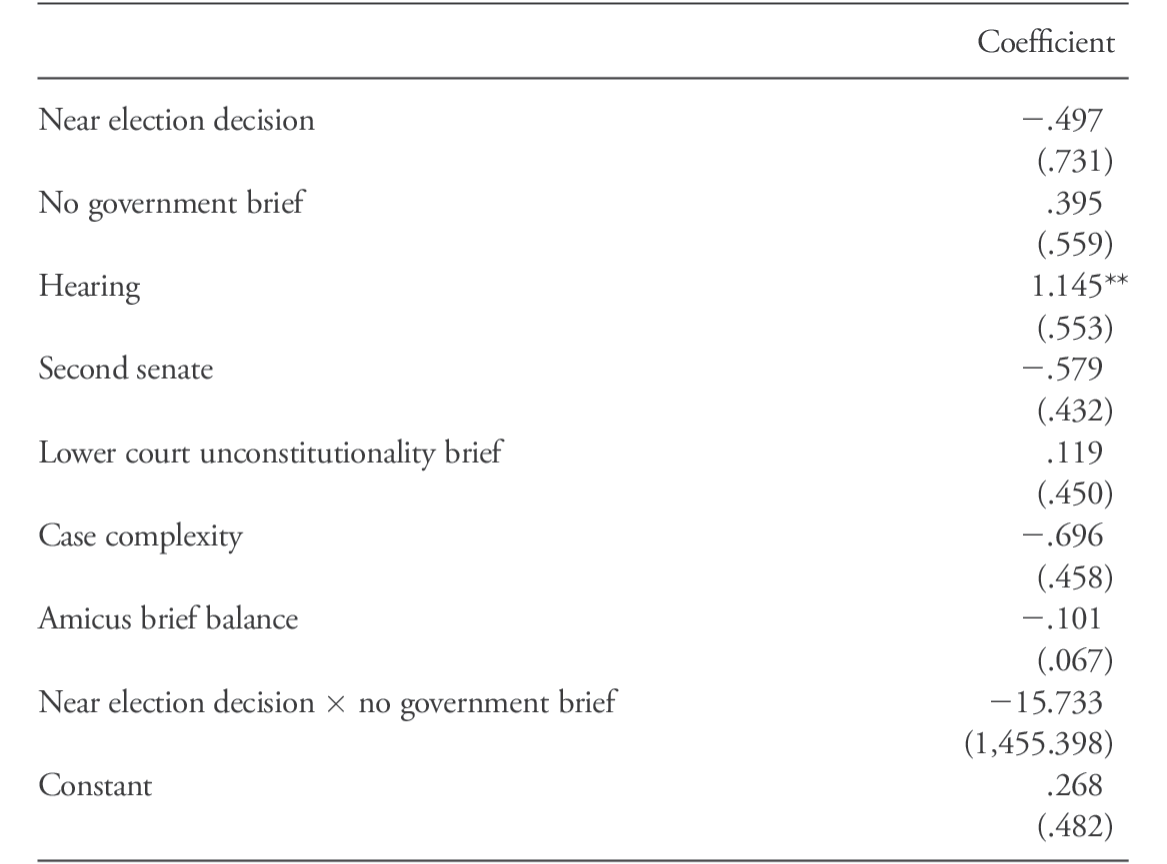
Note.— Standard errors in parentheses.
* p < .1.
* p < .05.
*** p < .01.
Robustness Analysis Using Near Election Decision as Outcome Variable
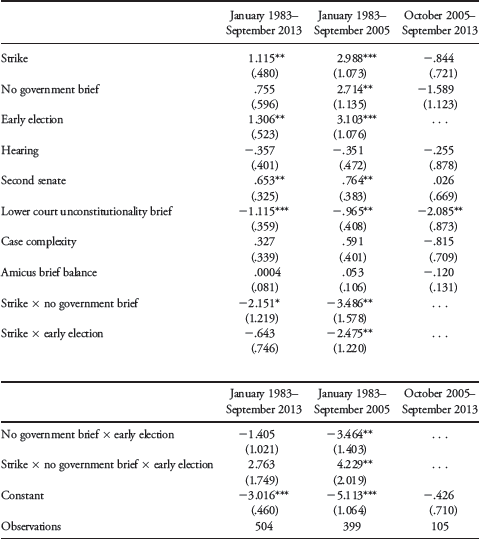
Note.— Standard errors in parentheses.
* p < .1.
** p < .05.
*** p < .01.