Musicological literature devoted to the life and works of Gregor Joseph Werner (1693–1766) has remained very limited.Footnote 1 Researchers have usually been motivated to discover more about him for two reasons: the fact that from 1728 he was Kapellmeister at the court of the Esterházy princes in Eisenstadt, and that while there he met and worked with the great Joseph Haydn. It is no exaggeration to claim that Werner is usually mentioned only because of this association: he has found his way into music history on account of his connection with Haydn. However, this approach leaves too much room for a superficial assessment of Werner's achievements as a composer. Haydn valued his music and commented on it favourably. His private music collection included Werner's Good Friday oratorios and arrangements of the Lamentations of Jeremiah. In a striking testament to the respect he had for Werner's music, Haydn also arranged six of Werner's fugues for string quartet, writing his own musical introductions, and published them with Artaria in Vienna in 1804 as VI Fugen in Quartetten auf zwey Violin, Viola und Violonzell von G. J. Werner Weyland Kapelmeister S. D. des Fürsten N. Esterházy etc. / Aus besonderer Achtung gegen diesen berühmten Meister nun herausgegeben von dessen Nachfolger J. Haydn, a volume dedicated to Prince Nicholas Esterházy II.Footnote 2
In stylistic terms Werner's output belongs to the high Baroque. Although his instrumental pieces include some tentative attempts at a more galant style (such as the Musikalischer Instrumental-Kalender or the quodlibets Wienerischer Tandelmarkt and Bauren-Richters-Wahl), and his vocal music shows some influence of the Neapolitan school, Werner never fully embraced those trends, at the height of their novelty in the mid-eighteenth century. As a result of his background in the tradition of strict counterpoint, his output mostly comprised sacred music. Notably, over his thirty-year period as Kapellmeister at Eisenstadt, Werner had managed to raise the technical skills of the ducal Kapelle and the local music culture more generally to a level where Haydn was able comfortably to flex his composing muscles the moment he was hired by the Esterházy family. In short, Werner was not at all the insignificant prelude to a great successor that some have made him out to be.
At present it seems almost impossible fully to reconstruct Werner's biography, since there remain many more questions than answers. Hence any piece of archival information, however tiny, that would reveal at least a fraction of additional knowledge about the life of this composer, his career and his works will be eagerly welcomed by researchers. The purpose of this essay is precisely that: to present to the reader previously little-known documents which partially fill the gap in our knowledge of this composer's life during the years 1716–1726. Perhaps this documentation will also provide a guiding light for future searches and archival explorations relating to Werner.
It is assumed in the literature that during the years 1715–1716 Werner was working as an organist in Melk. This assumption is based on the somewhat weak premise of a note found on the cover of the organ part in a copy of Missa ex F by Werner dating from 1741. This source, containing the note ‘Werner Organoed[us] Mellicens[is]’, is held in the musical archive of the Benedictine abbey in Seitenstetten.Footnote 3 However, Werner's surname never appears on the list of organists of the monastery in Melk, a point emphasized by Oskar Pausch. It was on the basis of ‘Werner Organoed Mellicens’ that Pausch suggested the possibility of the composer having filled that post temporarily for five months (from 29 November 1715 to 1 May 1716), after the death of the organist Mathias Hochedlinger from Ybbs.Footnote 4 Although it is likely, the claim that Werner studied with Johann Joseph Fux should also be regarded purely as hypothesis, since such an episode in his life has not been confirmed by any archival documentation.Footnote 5 It is for this reason that Adolf Trittinger suggested that if Werner had been educated in Melk, it would have been possible at that time for him to have had contact with Fux.Footnote 6 On the other hand, according to documents widely known and quoted in the literature, on 27 January 1727 Werner married Anna Christina Busch in Vienna; on 10 May 1728 he was appointed Kapellmeister at Eisenstadt, finally moving there on 15 June of the same year.Footnote 7 It is only from that moment that the career and works of Gregor Joseph Werner seem to be relatively thoroughly known and researched.
JACOB HEINRICH VON FLEMMING AND HIS CAPELLE
While researching the musical patronage of Jacob Heinrich von Flemming (1667–1728), Field Marshal of Saxony and one of the most influential politicians surrounding August II (King of Poland and Elector of Saxony), I came across documents which may allow one to view the years 1716–1726 in Werner's biography from an unexpected perspective. From 1694 until his death Flemming was one of the main architects of Saxon policy, and author of the plan, which came to successful fruition in 1697, of settling the Saxon Elector Frederick August I on the Polish throne (as August II, known as ‘the Strong’). A consummate diplomat, Marshal Flemming acted as the envoy of his employer at the imperial court in Vienna on many occasions. One of the most important diplomatic missions entrusted to him was to finalize negotiations regarding the political treaty with Emperor Charles VI during the years 1718–1719. The aims of the treaty being negotiated included the alliance of Austria, Saxony and Poland against Russia and Sweden and securing the rule of August II in Saxony and Poland after the end of the Great Northern War. The agreement, when concluded, was to be guaranteed by the marriage of Prince Frederick August, son of August II, to the emperor's niece, Maria Josepha, daughter of Joseph I, who died in 1711. As part of this mission Flemming also brought about the final agreement on the conditions of the marriage contract.Footnote 8 It is this event that provides important background for the discussion of the previously unknown aspects of the biography of Gregor Joseph Werner presented here.
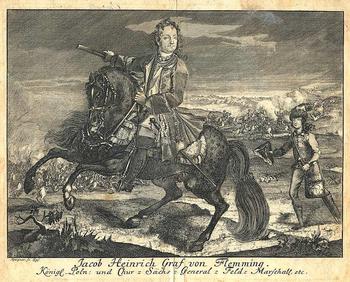
Jacob Heinrich von Flemming (see Figure 1) was a member of the intellectual elite of the Royal-Polish and Electoral-Saxon court in Dresden. He had received a brilliant education that gave him a deep understanding of philosophy and theology, and he spoke a number of foreign languages fluently – including Polish (owing to his two marriages, each to an aristocratic Polish woman). The Marshal collected paintings by the greatest European masters. He also owned an extensive library and a collection of music that he systematically expanded through regular purchases. For a long time musicological literature knew Flemming only in his supposed capacity as the host in the autumn of 1717 of the legendary harpsichord duel between two great musicians of his time, Johann Sebastian Bach and Louis Marchand.Footnote 9 Flemming's involvement in musical matters has interested me for some time, and has been partially described in some of my earlier publications.Footnote 10 For current purposes we may limit ourselves to information about the ensemble that Flemming maintained for a period at his residences in Saxony and Poland, examining Werner's presence among the musicians in Flemming's service. This is made possible by discoveries I have made in the archives of Warsaw, which had previously not been investigated from this perspective (Central Archives of Historical Records; hereafter PL-Wagad), as well as those in Dresden (Sächsisches Hauptstaatsarchiv Dresden; hereafter D-Dla), Vilnius (Lithuanian State Historical Archives; hereafter LAH) and Minsk (National Historical Archives of Belarus; hereafter MAH).Footnote 11
Johann Gottfried Krügner, portrait of Field Marshal Jacob Heinrich Count von Flemming on a horse, copperplate (Leipzig, c1710). The National Library of Poland, sign. G. 144/Sz. 6

These sources relating to musicians maintained by the Marshal are almost exclusively financial documents from his private archive. They include lists of monthly payments, settlements and expenditures, as well as receipts for remunerations. In these, musicians are usually identified as a separate group, and are sometimes referred to as Capelle or Cammer Musicanten. However, only rarely do we find, alongside their names, information about the instruments on which they played as specialists in the ensemble. On the other hand, if the Marshal's clerks or administrators tried to describe the instrument which a given musician played, they often used imprecise terminology or made errors. Other types of financial documentation deal with the transport of musicians, their lodgings during the Marshal's travels, and purchase of and repairs to instruments. These also include notes about gifts that Flemming bestowed on artist-musicians, either those who appeared as guests in his residences or members of his own ensemble. On this basis I was able to reconstruct, in large part, the personnel of Jacob Flemming's musical ensemble during the years 1714–1728, a study which was the subject of an earlier, separate publication.Footnote 12
WERNER DER BASSISTE
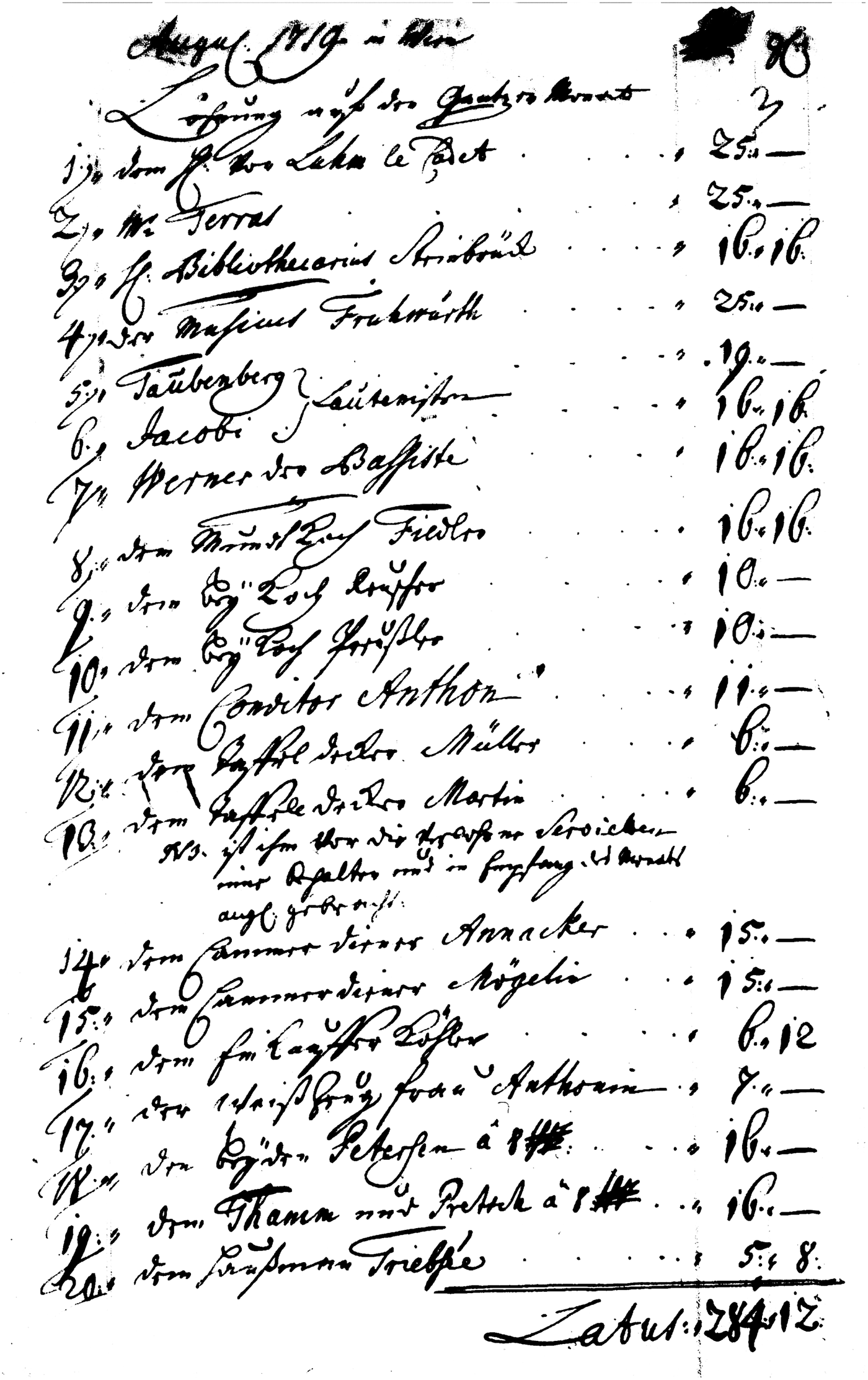
In 1722 Flemming's Capelle numbered eight musicians, each with an annual salary of three hundred thalers. Only the Italian violinist Francesco Cattaneo (truly an ornament to the ensemble, later Konzertmeister of the Dresden Hof-Kapelle) was then receiving a higher salary of four hundred thalers a year.Footnote 13 However, the number of members of Flemming's Cammer-Musique kept changing, as is largely confirmed by lists of remuneration from different years and other financial documents. On this basis it was possible to identify the surnames of most of Flemming's musicians and, in a number of cases, their first names too. On some occasions their area of specialization could also be identified. In particular, the Flemming papers sometimes add the title Bassist next to the surnames of some musicians, including that of Werner. This description did not apply to singers, since there is no trace of such musicians being maintained by the Marshal; rather, it applied only to those who played bass instruments such as the violone or double bass. For example, the additional term Bassist appears in Flemming's financial documents from April 1714 next to the surnames of two musicians, Braun and Conradt.Footnote 14 The name of Braun can be associated with the Johann Ludwig Braun who was described in Dresden's so-called Kirchenwochenzettel (now located in the Stadtarchiv Dresden) as Hoch Gräffl. Musicus, and who died in August 1727,Footnote 15 but it has not been possible to discover any additional information about the second name. Of particular significance, however, is the description der Bassiste which also appears in lists of Flemming's expenses from the period of his stay in Vienna in August 1719 next to the surname Werner (see Figure 2a and 2b).Footnote 16 Moreover, this is the first occasion that this name has appeared in the Marshal's archives.Footnote 17
Fragment of Flemming's accounts relating to expenditure on clerks and servants in Vienna in August 1719: list of monthly payments, including item No. 7, ‘Werner der Bassiste’, 16,16 (thalers). Lithuanian State Historical Archives, shelfmark F. 459/1, No. 1625, fol. 3

Fragment of Flemming's accounts, item No. 7, “Werner der Bassiste”, detail

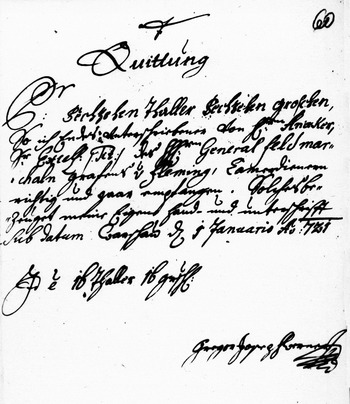
Receipt for payment for the month of January 1721 signed by Gregor Joseph Werner in Warsaw. Lithuanian State Historical Archives, shelfmark F. 1280/1, No. 1109, fol. 60

From that point on the name of Werner der Bassiste or Musicus makes a regular appearance on lists of monthly expenditure on servants and services to Jacob Heinrich Flemming and his household until and including the year 1725. Sometimes Werner is recorded among the laquais. Fortunately, it has been possible to find receipts for the payments on which the Bassiste in question signed his name in full: Gregorius (or Gregor) Joseph Werner.Footnote 18 On this basis we may conclude that this Werner der Bassiste is the same person as the later Kapellmeister at the court of the Esterházy princes in Eisenstadt. Those documents from the years 1719–1725 confirming Werner's presence among the musicians of Marshal Flemming allow us to fill a gap in the biography of a composer about whom little was previously known.
This documentation allows us to assume that Flemming engaged Werner as a member of his musical ensemble when in Vienna at some time during the summer of 1719, perhaps even a few months earlier. As noted already, Flemming had been at the Habsburg capital since autumn 1718 (with a short break in the spring of 1719) negotiating the alliance between August II and Charles VI as well as the marriage between the electoral heir to the throne, the Polish Crown Prince Frederick August (later King August III), and the Emperor's niece, Maria Josepha. We do not know how Werner came to meet Flemming, nor on whose recommendation he was engaged. We even do not know what he did in Vienna at all. Was he employed there as a bassist in one or more of the church orchestras? If Werner did work largely as a freelance bassist, it might account for his professional invisibility at this time. The extant archives show that having joined Flemming's ensemble, Werner then moved to Dresden and accompanied his patron on numerous travels between the capital of Saxony and Warsaw. This is confirmed by receipts for remuneration from both Dresden and Warsaw signed by him. At present we have no knowledge of other details of Werner's activities in the Marshal's service. He returned to Vienna in the autumn of 1726 at the latest, since on 27 January 1727 he married Anna Christina Busch at St Stephen's Cathedral in Vienna.
Almost nothing is known about Werner's activities as a composer during his time in Warsaw and Dresden. However, one interesting trace of such activity survives: in his Inventarium rerum Musicarum Variorum Authorum, from the years 1726–1739, Jan Dismas Zelenka, in the group of compositions for the first Sunday of Lent, Quadragesimalia, records a four-part arrangement of the canticle Benedictus Dominus Deus Israel (stromenti ad lib.) by a composer named Werner.Footnote 19 Although, as has been pointed out by Wolfgang Horn, the Inventarium only mentions the surname ‘Werner’, there is little question that this concerns a composition by Gregor Joseph Werner, today regarded as lost. This is perhaps the only composition present in the liturgical repertory of the Catholic chapel at the Dresden court that is attributed to Werner.Footnote 20 At present we may only speculate as to the circumstances in which Zelenka came to know this work and copy it. It is highly probable that Werner and Zelenka had already come into contact with each other in Vienna, during the years 1716–1719, and this acquaintance may have continued during Werner's employment as Count Flemming's Cammer-Musicus. There is a striking parallel between their careers, since both started out in Dresden as bassists; this goes to show that the rise from bassist to Kapellmeister, which Werner completed within a single decade, may not have been particularly remarkable. In any case, this entry by Zelenka in his Inventarium provides an interesting clue to the question of Werner's potential contacts with composers associated with the Dresden Hof-Kapelle.
WERNER AND CARL
When considering Werner's presence among Count Flemming's Cammer Musicanten, one naturally becomes interested in the presence of another musician in the Marshal's archival documents, known only as Carl. There is much to indicate that, like Werner, this Carl later became associated with the house of Esterházy. It has proven difficult to identify him, not only because the writing of his surname in the documents is not always legible, but also because the documentation does not give first names or specializations. Carl's surname is usually recorded among the musici, but sometimes he also appears as a laquais. It is thus possible that this surname may refer to one person or to two different people. The said Carl appears in Flemming's accounts during the years 1723–1728 and, as we can surmise on the basis of the documents in question, he did not leave the Count's ensemble until it was dissolved following the Marshal's death.Footnote 21 Thus for at least three years (1723–1725), and possibly more, Carl might have had almost daily contact with Werner, since they both played in the same ensemble. There would be nothing exceptional about this were it not for the fact that after their service with Flemming came to an end they appear to have continued to maintain contact in some way. Perhaps they even collaborated closely, continuing their careers in the service of the Esterházys either in Eisenstadt or in Pressburg (Bratislava). Evidence for this comes from the fact that from 1727 a Leopold Carl (1698–1744) is recorded among the members of the musical ensemble of the Primate of Hungary, Emmerich (Imre) Esterházy, in Pressburg. Emmerich inherited this post from Christian August von Sachsen-Zeitz, who died in 1725 (and who is known to historians of the period of the Polish-Saxon union because of his involvement in the conversion of August II to Catholicism in 1697). Details of the personnel and activities of this, by all accounts, excellent ensemble have been described by Ladislav Kačic.Footnote 22 Following Kačic, we know that Carl was employed with the ensemble of Esterházy from 1727 until his death in 1744. He arrived in Pressburg on 6 June 1727 and was engaged to play in the primate's ensemble there on 11 July. According to Kačic, Carl was one of the best violinists in the ensemble, and for many years there was even its concertmaster.Footnote 23
It seems almost certain that the Carl from Flemming's ensemble and Leopold Carl from the ensemble of Emmerich Esterházy are one and the same person. However, there is an overlap in the years of Carl's employment in the two ensembles. This raises a doubt that is difficult to overcome at the present stage of research. Yet it is not impossible that from mid-1727, if only because of Flemming's recurrent illnesses and subsequent death in April of 1728 in Vienna,Footnote 24 Carl remained only nominally in the service of the Saxon Marshal. It is not known how the musician might have come into contact with Emmerich Esterházy, but it is very likely that it was Gregor Joseph Werner who acted as an intermediary in this matter, and that his previous employment in Flemming's ensemble played a significant part in recommending Carl for the new post.
We cannot exclude the possibility that contact between Werner and Carl continued long after both had left Flemming's ensemble. Perhaps this association bore fruit in the form of their joint composition, Vesperae de Apostolis a 4 Voci 2 Violini con Organo e Violone, which is now held in the Esterházy collection at the National Library in Budapest. In the Budapest catalogue of the Esterházy musicalia this work is signed with two surnames – ‘del Werner e Carlo (A. o. 1757)’ (shelfmark H-Bn, Ms.mus III.98) – and a copy, attributed to Carl alone, is also held at the Domarchiv in Eisenstadt (shelfmark A-Ed G22). If in fact this vespers setting was the result of cooperation between two musicians who had previously worked in the ensemble of Marshal Flemming, one should not be at all surprised at Carl's presence in the Esterházy household from 1727.Footnote 25
The surnames Werner and Carl appear alongside each other in Flemming's accounts from Warsaw and Dresden for a number of years, which for Werner date from the time of the Marshal's residence in Vienna during 1718–1719. Hence it must be assumed that Werner (certainly) and Carl (probably) joined Jacob Heinrich Flemming's ensemble from the Viennese musical community, and both eventually returned there – drawn, perhaps, by attractive offers of employment and professional advancement within the circle of artistic influence of the Esterházy family. Speaking specifically of Werner, we can only speculate at this point about the extent to which his time in Dresden influenced his later style as a composer. As pointed out above, none of his works from that period are known, and his responsibilities as a member of Flemming's ensemble only involved secular instrumental music. On the other hand, Werner's time in Saxony did coincide with a remarkable flourishing of music at the Dresden Hofkirche. As a matter of pure conjecture, if Werner did study with Fux in Vienna, as some have posited, why wouldn't he have taken the opportunity to hone his composing skills further in Dresden with a maestro like Zelenka, so that he could return to Austria with greater expertise in church music?
I hope that in future it will be possible to develop further these lines of research so as either fully to confirm or to correct the hypotheses presented here. In any case, the story of Werner's employment, first in Flemming's ensemble and then in Eisenstadt, provides an excellent illustration of the network of artistic connections between such artistic centres as Vienna, Dresden, Warsaw and Pressburg (Bratislava) during the first half of the eighteenth century. In addition, this story not only makes us aware of the possible routes of migration of musicians through what were then the most important political centres of central and central-eastern Europe, but it also demonstrates how deeply the events taking place within grand politics and the ambitions of their authors, as well as their social and family interdependencies, affected the possible artistic career paths of masters of music both great and small.
APPENDIX
Documents recording Werner's surname in the archives from Vilnius, Minsk and WarsawFootnote 1
1. Vilnius, Lithuanian State Historical Archives
LAH: shelfmark F. 1280/1, 1109, fol. 5
List of payments from Flemming's funds for the month of March 1719 to clerks and servants, including Werner (described as Castellan – 20 thalers)
LAH: shelfmark F. 459/1, 1625, fol. 3
List of payments from Flemming's funds for the month of August 1719 in Vienna to clerks and servants; item 7: Werner der Bassiste (16.16 thalers)
LAH: shelfmark F. 1280/1, 1109, fol. 57
List of payments from Flemming's funds for the month of January 1721 to clerks and servants, including Werner (16.16 thalers)
LAH: shelfmark F. 1280/1, 1109, fol. 60
Werner's receipt for 16.16 thalers in payment for January 1721 in Warsaw (signed Gregor Joseph Werner)
LAH: shelfmark F. 459/1, 1848, fol. 15
List of payments from Flemming's funds for the month of December 1722 to clerks and servants, including Musicus Werner (16.31 thalers)
LAH: shelfmark F. 459/1, 1848, fol. 24
Werner's receipt for 16.16 thalers in payment for December 1722 in Warsaw (signed Gregorius Joseph Werner)
LAH: shelfmark F. 1280/1, 1109, fol. 108
List of payments from Flemming's funds for the month of December 1723 to clerks and servants, including Musicus Werner (16.16 thalers)
2. Minsk, National Historical Archives of Belarus
MAH, shelfmark F. 694 op. 6, No. 270, fol. 17
List of payments from Flemming's funds for the month of September 1719 to clerks and servants, including Musicus Werner (25 thalers)
MAH, shelfmark F. 694 op. 6, No. 247, fol. 316Footnote 2
List of payments from Flemming's funds for the month of July 1722 to clerks and servants, including Musicus Werner (16.16 thalers)
MAH, shelfmark F. 694 op. 6, No. 270, fol. 46Footnote 3
List of payments from Flemming's funds for the month of April 1724 to clerks and servants, including Musicus Werner (16.16 thalers)
3. Warsaw, Central Archives of Historical Records: Archiwum Radziwiłłów, dział X ‘Dokumenty domów obcych – Papiery Flemmingów z lat 1697–1730’
PL-Wagad: shelfmark AR X No. 360, fol. 14
List of payments from Flemming's funds for the month of November 1722 to clerks and servants, including Werner (16.31 thalers)
PL-Wagad: shelfmark AR X No. 360, fol. 23
Werner's receipt for 16.31 thalers in payment for November 1722 in Warsaw (signed Gregorius Joseph Werner)