


Autobiographical memories include lifetime periods, general events, and event-specific knowledge that shape the foundation of one's life story, personal identity, and the experience of enduring personhood over time. According to the self-memory system (SMS; Conway & Pleydell-Pearce, Reference Conway and Pleydell-Pearce2000), individuals have a strong need for congruency between the self and memories. Hence, executive dynamic processes (‘working self’) facilitate, alter, misremember, and inhibit the accessibility of autobiographical memories that are inconsistent with current self, including beliefs, personality traits, attitudes, goals, and attachment patterns. Similarly, the self may be reconstructed and changed consistent with autobiographical knowledge (Conway & Pleydell-Pearce, Reference Conway and Pleydell-Pearce2000).
Singer and Salovey (Reference Singer and Salovey1993) focused on ‘self-defining’ memories (SDM) to describe autobiographical memories of highly significant events. These memories are intensely emotional, vivid and repeatedly retrieved, and often reflect dominant themes, unresolved conflicts and enduring concerns in a person's life (Blagov & Singer, Reference Blagov and Singer2004). These specific event memories are incorporated into individuals’ integrative life story and identity (McAdams & McLean, Reference McAdams and McLean2013), and provide a sense of purpose, continuity, and meaning across situations (Blagov & Singer, Reference Blagov and Singer2004), as well as a better understanding of both the self and the world (Singer & Moffit, Reference Singer and Moffitt1991).
Studies have examined the contribution of various dimensions of self-defining memories to individuals’ adaptation and the development of the self (McAdams & McLean, Reference McAdams and McLean2013). These studies have identified several central themes, including life-threatening events, communion, interpersonal relationships, achievements and agency, guilt- and shame-inducing events, and exploration/recreation (Blagov & Singer, Reference Blagov and Singer2004). When studying the valence of the memory (McLean & Breen, Reference McLean and Breen2009), researchers have reported a positive link between recalling a positive SDM and an individual's sense of identity (McAdams & McLean, Reference McAdams and McLean2013). Researchers have also found a positive association between sophisticated meaning making and achieving a sense of identity in emerging adulthood (McLean & Pratt, Reference McLean and Pratt2006). Finally, studies have also examined the extent to which individuals remember the events in a clear and logical way (Sutin & Gillath, Reference Sutin and Gillath2009).
Temperament and Memories
Temperament is defined as individual differences in emotional, motor, and attentional reactivity, which are biologically based and linked to individuals’ genetic inheritance (Evans & Rothbart, Reference Evans and Rothbart2007). Negative emotionality refers to negative sensory sensitivity and unpleasant affect such as fear, sadness, disappointment, frustration, and sensory discomfort, and relates to neuroticism. Orienting sensitivity is defined as an automatic attention to both external sensory cues and internal events, including sensory signs, moods and emotions, and relates to intellect and/or openness to experiences (Evans & Rothbart, Reference Evans and Rothbart2007). Temperament influences individuals’ dispositions in attentional focusing and appraisal (Evans & Rothbart, Reference Evans and Rothbart2007).
Previous studies did not examine the associations between temperament and memories but found that people's personality organisation shapes the quality of their memories. For instance, openness to experiences was associated with complexity and depth in meaning making and with self-growth, and extraversion was correlated with self-growth, whereas neuroticism was associated with negative affect and lower associations between self and events (McLean & Fournier, Reference McLean and Fournier2008). It is thus likely that participants’ temperament might be associated with the nature of SDMs.
Resiliency and Memories
Resiliency refers to an individual's competence in the context of significant challenges to adaptation or development (Masten & Obradvić, Reference Masten and Obradović2006), as displayed in the person's emotional reactivity, sense of mastery, and relatedness (Prince-Embury, Reference Prince-Embury2007). Emotional reactivity refers to a person's vulnerability, arousability, or threshold of tolerance prior to the occurrence of adverse events or circumstances and is often reflected in rigid or chaotic emotional regulation. A sense of mastery refers to a sense of efficacy, competence, and agency that enables individuals to use, respond, and enjoy relationships with a sense of optimism and adaptability. Relatedness includes the experiences of trust, comfort with others, perceived access to support, and tolerance of differences (Prince-Embury, Reference Prince-Embury2007). Research has repeatedly demonstrated that more resilient youth are less likely to develop psychological and behavioural problems when they experience adversities than those who are less resilient (Masten & Obradvić, Reference Masten and Obradović2006). Research has indicated that resiliency may be closely associated with the capacity to narrate past taxing events with positive emotions, as well as finding a positive meaning in negative life events (Philippe, Lecours, & Beaulieu-Pelletier, Reference Philippe, Lecours and Beaulieu-Pelletier2009).
Attachment and Memories
An individual's mental health and capacity to form close relationships are intimately linked to past relationships with attachment figures that provided emotional support and protection (Bretherton & Munholland, Reference Bretherton, Munholland, Cassidy and Shaver2008). Children who experienced consistently responsive, available, helpful, and warm caregiving are likely to develop a sense of security. They perceive others as trusted and supportive when needed, and develop trust in others, comfort with closeness, and adaptive ways of dealing with stress. In contrast, insecure attachment is expressed in discomfort with closeness and an inclination for self-reliance (avoidant attachment), or in an intense wish for closeness and concern about partner availability (ambivalent attachment; Mikulincer & Shaver, Reference Mikulincer, Shaver, Kruglanski and Higgins2007).
Relationships with attachment figures contribute to the development of generalised models of the self and others that subsequently serve as a guide for behaviour in novel circumstances throughout the life of the individual (Mikulincer & Shaver, Reference Mikulincer, Shaver, Kruglanski and Higgins2007). In adulthood, a typology of four categories was suggested (Bartholomew & Horowitz, Reference Bartholomew and Horowitz1991). A person with a secure attachment style is described as having a positive self-image and a sense of being worthy of love, combined with positive expectations that others will be generally accepting and responsive in times of need. Individuals with a preoccupied anxious-ambivalent style are characterised by a negative self-image and a sense of un-lovability, combined with a positive evaluation of others. A person with a dismissing attachment style is described as valuing a strong and independent self (positive self) while dismissing the need for intimacy with others (negative others). A person described as fearful is characterised as being fearful of intimacy and as socially avoidant, distrustful, and afraid of being hurt by others, resulting in a negative appraisal of both the self and significant others. Finally, a fifth category was suggested, describing a profoundly distrustful style where significant others are perceived as entirely untrustworthy (Holmes & Lyons-Ruth, Reference Holmes and Lyons-Ruth2006).
Attachment theory thus could shed light on the way relational memories are shaped and recalled (Haggerty, Siefert, & Weinberger, Reference Haggerty, Siefert and Weinberger2010). Studies have indicated that attachment avoidance is associated with impairments and difficulty recalling negative, emotional-related memories (Haggerty et al., Reference Haggerty, Siefert and Weinberger2010; Mikulincer & Orbach, Reference Mikulincer and Orbach1995), probably because avoidant individuals deactivate and minimise distressful feelings as a way of diminishing emotional intimacy with others. In contrast, attachment anxiety is more strongly associated with the negative emotional content of memories (Feeney & Cassidy, Reference Feeney and Cassidy2003), possibly because these individuals have easily accessible memories of negative experiences (Gillath, Bunge, Shaver, Wendelken, & Mikulincer, Reference Gillath, Bunge, Shaver, Wendelken and Mikulincer2005). These findings are consistent with adults’ narrative style as revealed in the Adult Attachment Interview (AAI; Main & Hesse Reference Main, Hesse, Greenberg and Cicchetti1990). For instance, Conway, Singer, and Tagini (Reference Conway, Singer and Tagini2004) showed in several case studies that self-defining memories of people with an autonomous AAI style were rich, specific, and integrative, reflecting these individuals’ ability to merge affect and cognition in an optimal manner. The narrative style of a preoccupied person was confused, excessively detailed, and contradictory, and contained themes of failures and subsequent humiliation by caregivers. Finally, the dismissing style was reflected in an inability to generate self-defining memories. The memories evoked were emotionless, over-general, and conveyed a vague and diffuse sense of self and others.
Neurological and physiological regulatory functions might also influence the cognitive-affective processes and autobiographical memory. Researchers have suggested that enduring child-caregiver interactions are encoded in the neural circuitry of the brain and shape attentional and implicit and explicit memory processes. Secure attachment facilitates an individual's capacity to generate self-knowledge and awareness, to produce episodic and autobiographical memories, and to imagine oneself in the future while remembering oneself in the past (Schore, Reference Schore2001; Siegel, Reference Siegel1999, Reference Siegel2001). Secure individuals might be able to acquire a more richly developed capacity for neural integration in response to various experiences probably because of the enduring openness of their brain (Siegel, Reference Siegel2001). In contrast, non-optimal attachment experiences may predispose individuals to psychological vulnerability by altering the brain's neuroendocrine response to stress (Liu et al., Reference Liu, Diorio, Tannenbaum, Caldji, Francis, Freedman and Meaney1997; Rosenblum et al., Reference Rosenblum, Coplan, Friedman, Bassoff, Gorman and Andrews1994). Fear responses to stress affect the hippocampus, which leads to deficits in explicit recall (Cahill & McGaugh, Reference Cahill and McGaugh1998; Roozendaal, McEwen, & Chattarji, Reference Roozendaal, McEwen and Chattarji2009). The blockage in the flow of energy and information between hemispheres might be a central feature of disorganized attachment (Siegel, Reference Siegel1999, Reference Siegel2001).
Distressing experiences (e.g., separation) might influence neurobiology regulatory processes, revealed in decline of general activity level or behavioural hyper-reactivity (Ahnert, Gunnar, Lamb, & Barthel, Reference Ahnert, Gunnar, Lamb and Barthel2004; Gunnar, Reference Gunnar1998; Hofer, Reference Hofer2006). The researchers suggest that these regulatory processes, which are biological in their nature, serve as early-learning processes and shape the child's developing capacities to remember, anticipate events, and respond to social symbolic cues (Hofer, Reference Hofer2006).
In sum, developmental theories and empirical findings suggest that individuals’ temperament, resiliency, and attachment orientations may shape people's self-defining memories. Specifically, individuals’ emotional reactivity, resiliency, and secure attachment would be associated with recalling more interpersonal and achievement/leisure-time memories, positive affect, and meaning making, while negative affect and insecure attachment orientations would be associated with recalling more life-threatening memories, negative affect, and absence of meaning making.
Moreover, previous studies indicated gender differences in emotional expressivity (Scharf, Reference Scharf2001) that might affect the narratives of the two genders (Fivush, Brotman, Buckner, & Goodman, Reference Fivush, Brotman, Buckner and Goodman2000). Specifically, both girls’ and adult females’ narratives are more intimacy-oriented and contain relational themes such as relationship references and social events (Fivush et al., Reference Fivush, Brotman, Buckner and Goodman2000; McAdams et al., Reference McAdams, Anyidoho, Brown, Huang, Kaplan and Machado2004; McAdams et al., Reference McAdams, Bauer, Sakaeda, Anyidoho, Machado, Magrino-Failla and Pals2006). Therefore, in the current study we examine these associations in a sample of female adolescents and young adults to deepen our understanding.
Method
Participants and Procedure
Eighty-three (N = 83) female adolescents and young adults participated in this study. This sample size allows the power of .14 with alpha of .05 (Cohen, Reference Cohen1988). In addition, to meet statistical power considerations and based on gender differences in the studied variables, we decided to focus on females only, rather than split the sample into two smaller groups of males and females.
The mean age of the participants was 21.13 years (range 13–30; SD = 5.32). Of the participants, 65% were single and the remainder were married (35%) or divorced (12%). Sixty percent came from two-parent families and 40% were from divorced or single-parent families; 72% of the participants were born in Israel, and the remainder were immigrants (most from the former Soviet Union). Of the participants, 36% had a college education, 42% were undergraduate students, and the remaining 22% were high/middle-school students. No correlations were found between background variables and any of the study variables; hence, we examined our hypotheses for the whole sample.
Participants completed the questionnaires and were also asked to write two self-defining memories. The instructions for the self-defining memory task were adapted from Singer and Moffitt (Reference Singer and Moffitt1991): ‘You are asked to think about an event in your past that you feel is still important and helps you define who you are. The memory is at least one year old and is very clear and familiar to you. This is a memory that helps you understand who you are as an individual and might be a memory you would tell someone if you wanted that person to understand you in a basic way.’ Participants were asked to write a description of the memory, their age at the time of the event, and the meaning of the event. Since only 38 participants reported two memories, we only coded participants’ first memory.
Measures
Attachment styles (Relationships Questionnaire [RQ]; Bartholomew & Horowitz Reference Bartholomew and Horowitz1991)
The original measure was a two-dimensional construct referring to perception of self and perception of others in the four attachment styles (secure, preoccupied, dismissing, fearful). The RQ consists of five short paragraphs describing five attachment patterns described in the introduction. Respondents were asked to read each description and rate the extent to which it corresponded to their general relationship style on a 7-point scale ranging from 1 (disagree strongly) to 7 (agree strongly). The original measure has been used in many studies (e.g., Bartholomew & Horowitz, Reference Bartholomew and Horowitz1991; Griffin & Bartholomew, Reference Griffin and Bartholomew1994), and the profound-distrust style was shown to be related to hostile, intrusive, and negative behaviours toward the infant (Holmes & Lyons-Ruth, Reference Holmes and Lyons-Ruth2006).
Resiliency
The Resiliency Scales for Children and Adolescents (RSCA; Prince-Embury, Reference Prince-Embury2007) comprise 64 items rated on a 5-point Likert scale (0 = never, 4 = almost always) assessing personal resiliency within three developmental domains. Sense of mastery includes the subscales of optimism, self-efficacy, and adaptability (20 items). Sense of relatedness, includes the subscales of trust, perceived social support, comfort, and tolerance (24 items). Emotional reactivity includes the subscales of sensitivity, recovery, and impairment (20 items). The psychometric characteristics of the scales are excellent (Prince-Embury & Courville, Reference Prince-Embury and Courville2008), with internal reliabilities ranging from .86 to .95, and test–retest reliabilities ≥.70 (Prince-Embury, Reference Prince-Embury2007). In the current study, the alphas were .90, .93, and .93 for mastery, relatedness, and emotional reactivity respectively. Although this measure has generally been used with younger participants, a pretest with Israeli participants and study with 726 undergraduate Chinese students (Cui, Teng, Li, & Oei, Reference Cui, Teng, Li and Oei2010) demonstrated its sound psychometric properties, validity, and reliability among relatively older youngsters as well.
Temperament
Twenty-five items from the Adult Temperament Questionnaire (ATQ; Evans & Rothbart, Reference Evans and Rothbart2007) rated on a 7-point Likert-scale (1 = not at all applicable; 7 = completely applicable) were used to assess temperamental sensitivity (Evans & Rothbart, Reference Evans and Rothbart2007). Negative affect refers to fear, sadness, frustration, and sensory discomfort (18 items, ‘Are you annoyed when people try to get you to do too much at once?’). Orienting sensitivity refers to automatic attention to both external sensory events and internal thoughts and images (7 items, ‘Do you seem to be aware of subtleties in your environment?’). In the current study the reliabilities were .86 for negative affect and .71 for orienting sensitivity.
Narrative coding
All the written responses were coded by the authors. Reliability was examined on 20% of the cases with an independent coder who was blind to the hypotheses of the study. Kappas for interrater reliability are reported for each code below.
Type of memory
Self-defining events were coded into one of four categories of life events based on criteria delineated in Thorne and McLean (Reference Thorne and McLean2002). Interpersonal events refer to a specific interpersonal encounter, usually with a parent or peer, and the themes often involved new or renewed intimacy, separation, or tension (n = 42, 51%). Life-threatening narratives depicted illness and narratives of mortality events, such as severe accidents, physical or sexual assaults, or deaths of loved ones (n = 26, 31%). Achievement events included effortful attempts to master vocational, physical, social, or spiritual goals (n = 8, 10%). Leisure-time events were focused on recreational activities such as hobbies, celebrations, travel, or sports; the emphasis was on recreation, play, or exploration (n = 7, 8%). Due to the small number of leisure and achievement events, we combined these events into one category (kappa = .83).
Meaning making
Narratives were coded on the basis of the presence or absence of any kind of meaning, including lesson learning, a reference to having learned a specific lesson from the memory with implications for subsequent behaviour in similar situations, or gaining an insight or a meaning from the event that applied to larger areas of the person's life. These categories were suggested by Thorne and McLean (Reference Thorne and McLean2002) to assess sophistication of meaning (kappa = .87).
Affect
Memories were coded according to their salient affect (McLean & Breen Reference McLean and Breen2009), which was defined as positive, negative, or mixed (kappa = .83).
Results
To examine the differences in attachment orientations, resilience, and temperament according to the qualities of the memories, we conducted four MANOVA analyses with the attachment, resilience, and temperament scales as the dependent variables, and the different dimensions of the memory (type of memory, salient affect, meaning making) as the independent variables. These analyses were followed by a series of ANOVA tests and post-hoc Duncan tests.
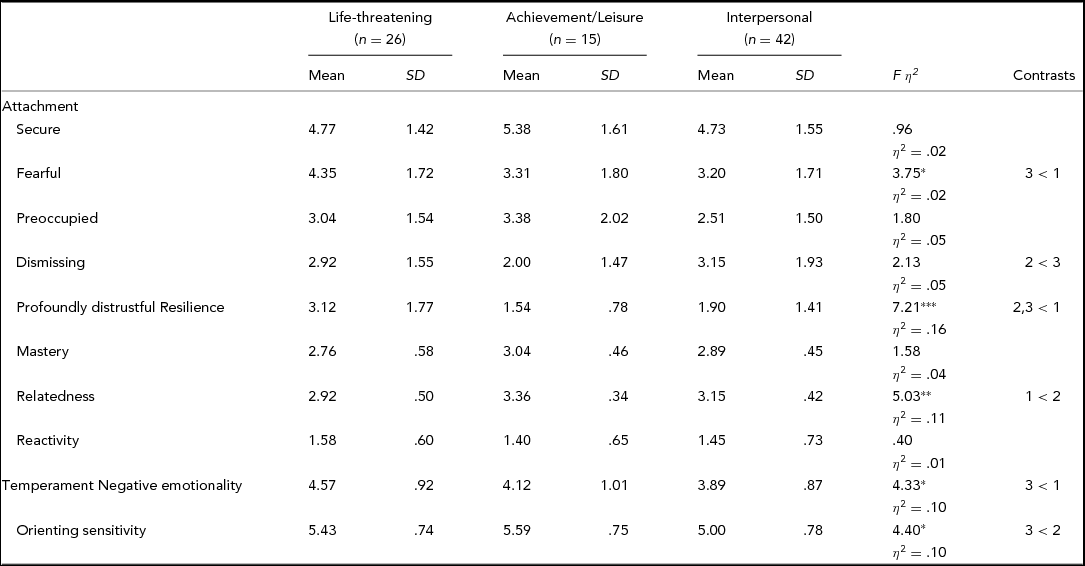
The MANOVA analyses for the type of memory (life threatening, achievement/leisure, or interpersonal) revealed significant main effects for attachment, F(5, 74) = 5.88, p < .001, η2 = .28, resilience, F(3, 78) = 3.38, p < .05, η2 = .12, and temperament, F(2, 78) = 5.66, p < .01, η2 = .13. As shown in Table 1, participants with interpersonal memories showed lower levels of fearful attachment orientation than individuals with life-threatening memories. Participants with life-threatening memories also showed higher profound-distrust attachment orientation than individuals with interpersonal and achievement/leisure memories. Participants with achievement/leisure memories showed higher scores of relatedness than those with life-threatening memories. Finally, participants with interpersonal memories showed higher negative sensitivity than individuals with life-threatening memories, and lower levels of orienting sensitivity than individuals with achievement/leisure memories.
Differences in Individuals’ Characteristics According to the Type of Memory

Note: *p < .05. **p < .01. ***p < .001. #p < .10.
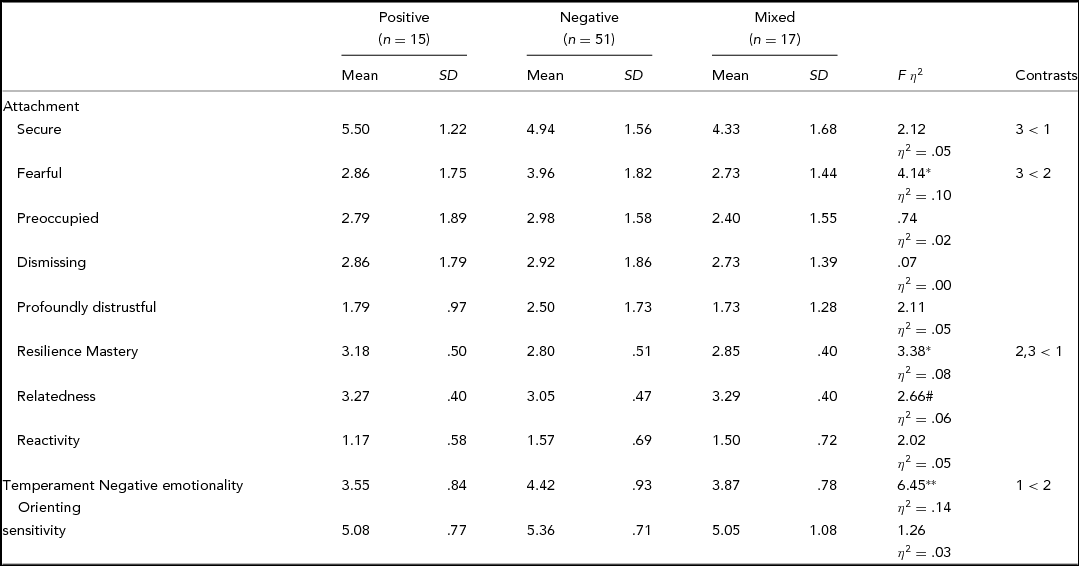
As regards salient affect, the MANOVA analyses revealed significant main effects for attachment, F(5, 77) = 2.95, p < .05, η2 = .17, resilience, F(3, 77) = 2.69, p < .05, η2 = .10, and temperament, F(2, 77) = 6.51, p .01, η2 = .15. As shown in Table 2, participants with mixed emotions (positive and negative) in their memories showed lower levels of fearful attachment orientation than individuals with memories characterised by negative emotions. Participants whose memories were characterised by positive emotions showed higher levels of mastery than the groups with negative and mixed emotions, and lower levels of negative emotionality than participants whose memories were characterised by negative emotions.
Differences in Individuals’ Characteristics according to the Memory's Salient Affect

Note: *p < .05. **p < .01. ***p < .001. #p < .10.
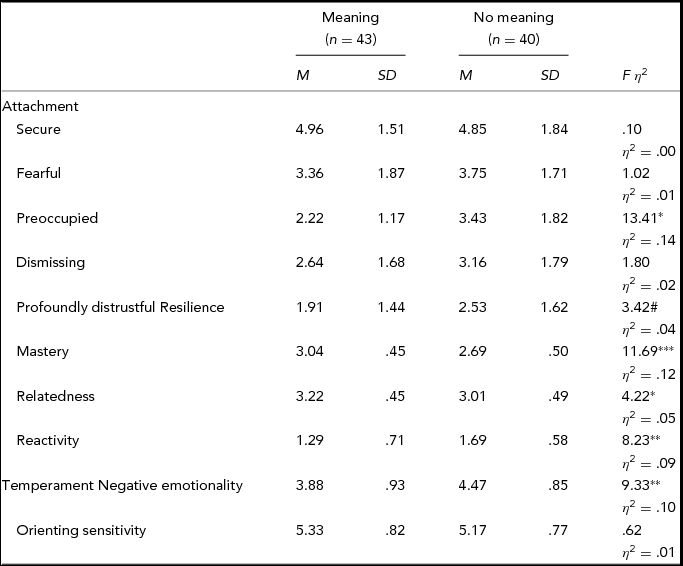
Finally, the MANOVA analyses regarding meaning making (absence of meaning vs. presence of meaning) revealed significant main effects for resilience, F(3, 81) = 4.80, p < .01, η2 = .15, and temperament, F(2, 82) = 6.34, p < .01, η2 = 13, but the MANOVA for attachment orientation was not significant. As shown in Table 3, participants who generated meaning from memories showed higher levels of mastery and relatedness and lower levels of reactivity than participants who did not find meaning in their memories.
Differences in Individuals’ Characteristics according to Memory's Meaning

Note: *p < .05. **p < .01. ***p < .001. #p < .10.
Discussion
This study examined differences in attachment orientations, resilience, and temperament with regard to various dimensions of self-defining memories in a sample of female youth. In most cases, participants’ biological tendencies (temperament) and their resilience were associated with appraising the valence of the memory, and producing a meaning.
Specifically, having internal resources such as a sense of competence in terms of coping with life's challenges, having close relations with others, and having a positive and curious approach toward external and internal stimuli appear to have contributed to the accessibility and retrieval of accomplishment and exploration memories, experiencing past events in a positive manner, and generating a meaningful narrative. In contrast, negative sensitivity may have prompted the participants to elicit threatening events from memory and recall past events in a negative manner. Thus, participants’ negative emotionality may induce negative memories and hamper their ability to resolve past painful events and reorganise them in a meaningful and reflective way. These findings underscore individual differences and inherited psychological dispositions in recalling positive memories of specific events in their lives (Williams & Dritschel, Reference Williams and Dritschel1988).
Attachment orientation was mainly associated with the content and emotional tone of the memories. Participants’ internal working models may have served as a lens for appraising, organising, interpreting, understanding, resolving, and learning from past experiences. For instance, the self-system of securely attached individuals, which incorporates the protecting, soothing, and approving functions originally enacted by security-enhancing attachment figures (Mikulincer & Shaver, Reference Mikulincer, Shaver, Kruglanski and Higgins2007), may automatically call to mind participants’ positive internal working models and thus produce mainly positive memories (Siegel, Reference Siegel1999, Reference Siegel2001). Conversely, fearful attachment is associated with profound disturbances in self-system processes, including an impaired sense of agency, a sense of inner badness, and uncertainty regarding others’ availability. These individuals are more biased toward retrieving life-threatening memories and interpreting them negatively (Holmes & Lyons-Ruth, Reference Holmes and Lyons-Ruth2006; Siegel, Reference Siegel1999, Reference Siegel2001). Extreme experiences may transform people's attachment orientation, but the current study was not designed to examine this possibility. Finally, a preoccupied attachment orientation, which is connected with individuals’ tendency to heighten and hyperactivate their expression of distress (Cassidy & Berlin, Reference Cassidy and Berlin1994), hinders their ability to generate a meaning from their past events (Diamond & Aspinwall, Reference Diamond and Aspinwall2003; Siegel, Reference Siegel1999, Reference Siegel2001).
The findings here may reflect the accessibility and impairments of people's retrieval of their autobiographical memories, which thus align with self-representations, attitudes, and personality to avoid discrepancies in the self-system and support identity-coherence (Siegel, Reference Siegel1999, Reference Siegel2001). This is consistent with the idea that SMS acts as a ‘working self’ by using executive processes that operate to activate or suppress the relationships between events and self-concepts (Conway & Pleydell-Pearce, Reference Conway and Pleydell-Pearce2000).
This study may also point to the factors that might promote post-traumatic growth among female youth. Naturally, traumatic events are engraved in our memories (Siegel, Reference Siegel2001), though there are people who are more immune to difficult experiences, whereas others may be vulnerable to less difficult experiences (Maccallum & Bryant, Reference Maccallum and Bryant2008). Learning more about the factors that promote resiliency and an optimistic outlook on life may shed further light on the way memories are shaped and remembered as an activation of one's self-memory system.
Interestingly, the findings did not reveal the associations between participants’ attachment orientations, meaning making, or narrative style. This may result from the measurement of attachment orientation used in this study. Specifically, Bartholomew and Horowitz's (Reference Bartholomew and Horowitz1991) distinction between a fearful and a dismissing style of avoidance raises questions as to whether these two subgroups of avoidant individuals would differ in the way they regulate social information and process autobiographical memories (Mikulincer & Orbach, Reference Mikulincer and Orbach1995). Similarly, the use the fifth dimension in Holmes and Lyons-Ruth's (Reference Holmes and Lyons-Ruth2006) classification has not been studied extensively and may be more appropriate for studies of at-risk samples. These suggestions are supported by the intercorrelations between the attachment dimensions in this study in that the correlation between the fearful dimension and the preoccupied dimension was .51 (p < .001) and the correlation between the dismissing and the profoundly-distrustful dimension was .62 (p < .001). Thus, future research should attempt to replicate the current findings using other attachment measures or assess attachment using the AAI (Main & Hesse, Reference Main, Hesse, Greenberg and Cicchetti1990).
The findings may also have implications with regard to the contribution of individuals’ resiliency, temperament, and attachment orientations to their narratives of recollections. This information may help clinicians when working with their clients on their life and self-schemas. From a diagnostic point of view, analysing individuals’ self-defining memories by according their content, emotional valence, and meaning may aid in screening and identifying at-risk individuals. Note, however, that these conclusions are based on preliminary correlative findings and thus should be viewed with caution. Finally, studies have demonstrated the associations between insecure attachment and both internalising (e.g., anxiety, depression) and externalising problems (e.g., aggression, oppositional behaviour) in youth (e.g., Rönnlund & Karlsson, Reference Rönnlund and Karlsson2006; Roelofs, Meesters, ter Huurne, Bamelis, & Muris, Reference Roelofs, Meesters, ter Huurne, Bamelis and Muris2006). Thus, it would be useful to gather information regarding participants’ attachment patterns to be able to identify future problematic adjustment.
Limitations and Future Directions
Several limitations of the present study should be acknowledged. First, this study was exploratory; hence, precluding an examination of cause-effect relationships between attachment, temperament, resiliency, and memories. Future studies should further address these relations, preferably by using a longitudinal or an experimental study designed to explore competing or alternative hypotheses. Second, the study relied on questionnaires that may have been biased toward a positive presentation, though we substantiated them with a more projective task; namely, recalling a significant memory. Third, participants’ attachment orientations were assessed using single items, and we also used the resiliency measure among older youths. Therefore, generalising from these measures requires future corroboration. Finally, our study was conducted among a non-clinical sample of women in Israel. Future studies could explore whether these findings extend to other samples such as males, at-risk and clinical populations, or participants in other cultures and contexts.